30/05/2020
- Chinese groups calling for more ‘fighting spirit’ are getting the upper hand on those who favour calm and cooperation, government adviser says
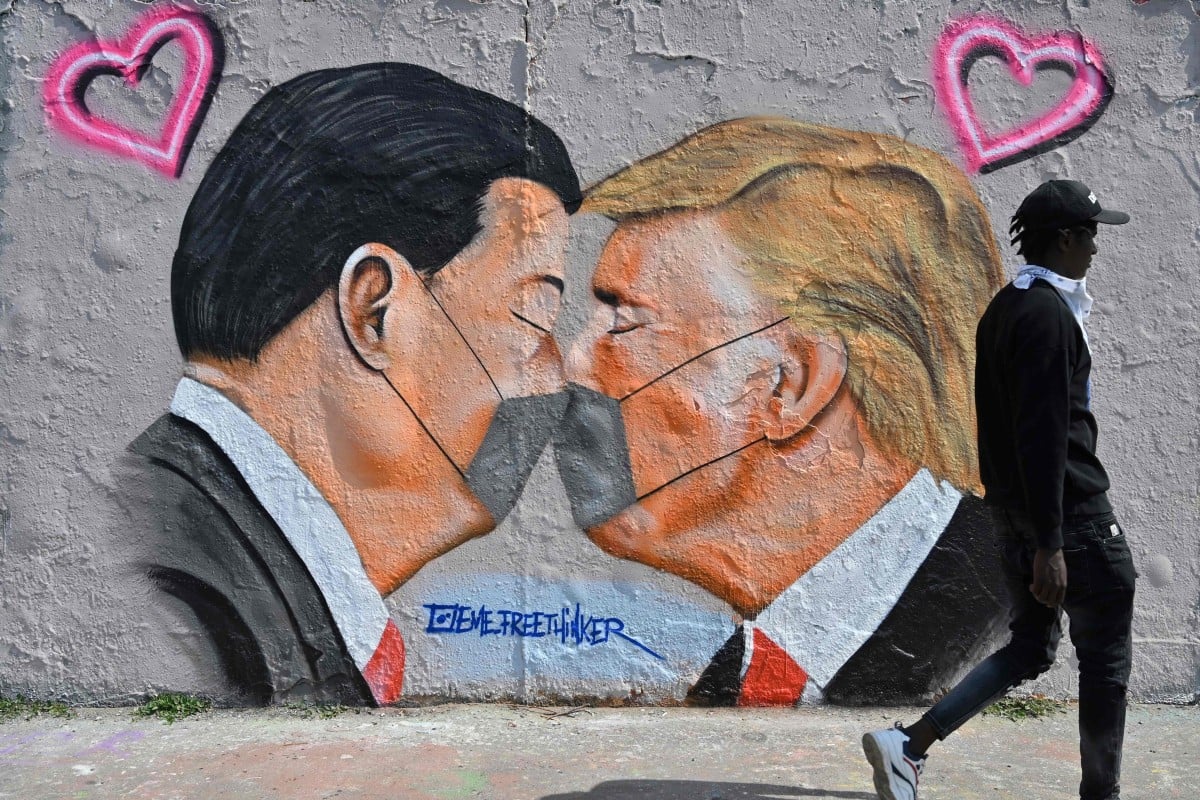
- From Hong Kong to Covid-19, trade to the South China Sea, Beijing and Washington are clashing on a growing number of fronts and in an increasingly aggressive way
Efforts to promote dialogue and cooperation between the US and China are failing, observers say. Photo: AFP
Moderates who favour dialogue and cooperation as a way to resolve China’s disputes with the
United States are losing ground to hardline groups bent on taking the fight to Washington, according to political insiders and observers.
“There are two camps in China,” said a former state official who now serves as a government adviser and asked not to be named.
“One is stressing the combat spirit, the other is trying to relieve tensions. And the former has the upper hand.”
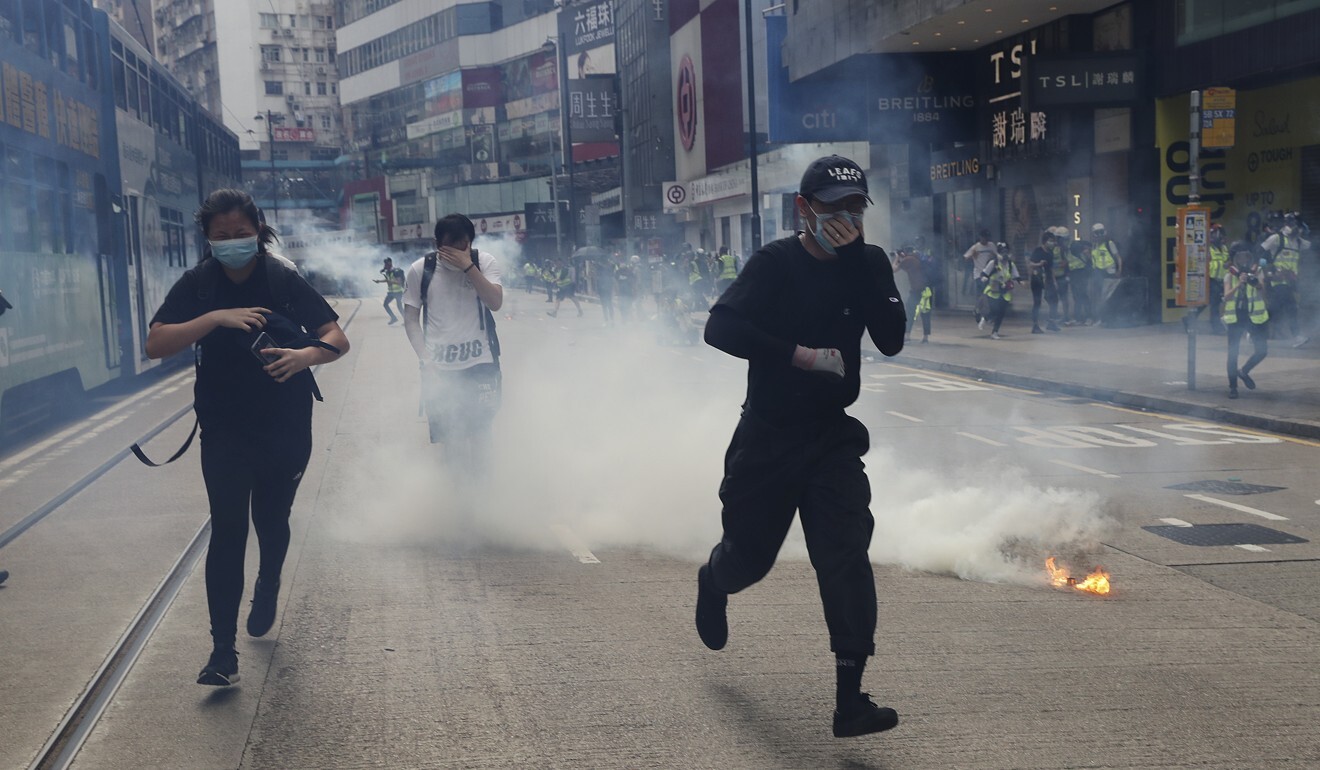
Relations between China and the US are under intense pressure. After Beijing moved to introduce a national security law for Hong Kong, US President Donald Trump said on Friday that Washington would begin eliminating the special policy exemptions it grants the city, as it no longer considers it autonomous from mainland China.
Beijing’s decision to enact a national security law for Hong Kong was met with anger from the US and other Western countries. Photo: Sam Tsang
The two nations have also clashed over trade, Xinjiang, Taiwan and the South China Sea, with the US passing several acts denouncing Beijing and sanctioning Chinese officials.
China has also experienced turbulence in its relations with other countries, including Australia and members of the European Union, mostly related to the Covid-19 pandemic
and Beijing’s efforts to position itself as a leader in the fight against the disease with its policy of “mask diplomacy”.
After Canberra appealed for an independent investigation to be carried out to determine the origins of the coronavirus, Beijing responded by imposing tariffs on imports of Australian barley, showing it is prepared to do more than just trade insults and accusations with its adversaries.
Pang Zhongying, a professor of international relations at Ocean University of China in Qingdao, said there was a worrying trend in China’s relations with other nations.
“We need political and diplomatic means to resolve the challenges we are facing, but … diplomatic methods have become undiplomatic,” he said.
“There are some who believe that problems can be solved through tough gestures, but this will never work. Without diplomacy, problems become confrontations.”
said during his annual press conference on the sidelines of the National People’s Congress last weekend that China and the United States must work together to prevent a new Cold War.
His words were echoed by
Chinese Premier Li Keqiang, who said during a press conference after the closure of the legislative session on Thursday that the many challenges facing the China-US relations could only be resolved through cooperation.
However, the government adviser said there was often quite a chasm between what China’s leaders said and what happened in reality.
“Even though we say we do not want a Cold War, what is happening at the working level seems to be different.” he said. “The implementation of policies is not properly coordinated and often chaotic.”
Tensions between China and the US have been in a poor state since the start of a trade war almost two years ago. After multiple rounds of negotiations, the sides in January signed a phase one deal, but the positivity that created was short-lived.
In February, Beijing expelled three reporters from The Wall Street Journal over an article it deemed racist, while Washington has ramped up its military activity in the South China Sea and Taiwan Strait, and threatened to revoke the visas of Chinese students studying science and technology in the US over concerns they might be engaged in espionage.
Beijing has also used its state media and army of “
Wolf Warrior” diplomats to promote its narrative, though many Chinese scholars and foreign policy advisers have said the latter’s nationalistic fervour has done more harm than good and appealed to Beijing to adopt a more conciliatory tone.
However, Hu Xijin, editor-in-chief of Chinese tabloid Global Times, said China had no option but to stare down the US, which regarded the world’s most populous nation as its main rival.
“Being contained by the US is too high a price for China to pay,” he said. “I think the best thing people can do is forget the old days of China-US ties”.
Jin Canrong, a professor of international relations at Renmin University in Beijing, wrote in a recent newspaper article that Beijing’s actions – notably enacting a national security law for Hong Kong – showed it was uncompromising and ready to stand its ground against the US.
Wu Xinbo, dean of international studies at Fudan University in Shanghai, agreed, saying relations between the two countries were likely to worsen in the run-up to the US presidential election in November and that Beijing should be prepared for a fight.
But Adam Ni, director of China Policy Centre, a think tank in Canberra, said the issue was not that the moderate camp had been sidelined, but rather Beijing’s perception of the US had changed.
“Beijing has woken up to the idea that America’s tough policy on China will continue and it is expecting an escalation of the tensions,” he said.
“The centre of gravity in terms of Beijing’s perception of the US has shifted, in the same way the US perception of China has shifted towards a more negative image”.
Beijing was simply responding in kind to the hardline, assertive manner of the US, he said.
Source: SCMP
Posted in aggressive way, annual, appealed, Australia, Australian, autonomous, ‘fighting spirit, “Wolf Warrior”, barley, Beijing, calm and cooperation, Canberra, chaotic, chasm, China-US relations, China-US ties, Chinese foreign minister Wang Yi, Chinese groups, Chinese premier Li Keqiang, Chinese scholars, Chinese students, Chinese tabloid, clashing, Cold War, conciliatory, confrontations, contained, cooperation, coordinated, coronavirus, COVID-19, Covid-19 pandemic, diplomacy, diplomats, editor-in-chief, Espionage, European Union, favour, foreign policy advisers, Fudan University, Global Times, growing, hardliners, Hong Kong, implementation, increasingly, independent investigation, lose out, main rival, Mainland China, moderate camp, moderates, more harm than good, narrative, National People’s Congress, national security law, November, number of fronts, observers, origins, policies, political insiders, presidential election, press conference, problems, promote, Qingdao, Renmin University, resolved, revoke, science and technology, Shanghai, sidelines, South China Sea, special policy exemptions, studying, Taiwan, Taiwan Strait, tariffs, The Wall Street Journal, think tank, threatened, tone, Trade, two camps, Uncategorized, uncompromising, undiplomatic, United States, upper hand, US President Donald Trump, US-China tensions, Visas, Washington, Western countries, world’s most populous nation, worsen, Xinjiang |
Leave a Comment »
15/05/2020
WASHINGTON (Reuters) – U.S. President Donald Trump signaled a further deterioration of his relationship with China over the coronavirus outbreak, saying he has no interest in speaking to President Xi Jinping right now and going so far as to suggest he could even cut ties with the world’s second largest economy.
In an interview with Fox Business Network broadcast on Thursday, Trump said he was very disappointed with China’s failure to contain the disease and that the pandemic had cast a pall over his January trade deal with Beijing, which he has previously hailed as a major achievement.
“They should have never let this happen,” Trump said. “So I make a great trade deal and now I say this doesn’t feel the same to me. The ink was barely dry and the plague came over. And it doesn’t feel the same to me.”
Trump’s pique extended to Xi, with whom the U.S. president has said repeatedly he has a good relationship.
“But I just – right now I don’t want to speak to him,” Trump said in the interview, which was taped on Wednesday.
Trump was asked about a Republican senator’s suggestion that U.S. visas be denied to Chinese students applying to study in fields related to national security, such as quantum computing and artificial intelligence.
“There are many things we could do. We could do things. We could cut off the whole relationship,” he replied.
“Now, if you did, what would happen? You’d save $500 billion,” Trump said, referring to estimated U.S. annual imports from China, which he often refers to as lost money.
Chinese foreign ministry spokesman Zhao Lijian told reporters in Beijing on Friday that maintaining a steady bilateral relationship served the interests of both peoples and would be beneficial for world peace and stability.
“Both China and the U.S. should now be cooperating more on fighting the virus together, to cure patients and resume economic production, but this requires the U.S. to want to work with us on this,” Zhao said.
Trump’s remarks drew ridicule from Hu Xijin, editor in chief of China’s influential Global Times tabloid, who referred to the president’s much-criticized comments last month about how COVID-19, the disease caused by the coronavirus, might be treated.
“This president once suggested COVID-19 patients inject disinfectants,” Hu said on Twitter. “Remember this and you won’t be surprised when he said he could cut off the whole relationship with China.”
CONCERNED, REVIEWING OPTIONS
U.S. Treasury Secretary Steven Mnuchin told Fox Business Network China needed to provide a lot more information about the coronavirus and Trump was reviewing his options.
“The president is concerned. He’s reviewing all his options. Obviously, we’re very concerned about the impact of this virus on the economy, on American jobs, the health of the American public and the president is going to do everything to protect the economy and protect American workers,” Mnuchin said.
“It’s a difficult and complex matter and the president has made very clear, he wants more information. They didn’t let us in, they didn’t let us understand what was going on.”
Trump and his Republican backers have accused Beijing of failing to alert the world to the severity and scope of the coronavirus outbreak and of withholding data about the earliest cases. The pandemic has sparked a sharp global recession and threatened Trump’s November re-election chances.
The United States has been hardest hit by the pandemic, according to official data.
China insists it has been transparent, and, amid increasingly bitter exchanges, both sides have questioned the future of the trade deal.
Opponents of Trump have said that while China has much to answer for over the outbreak, he appears to be seeking to deflect attention from criticism over his response to the crisis.
Scott Kennedy of Washington’s Center for Strategic and International Studies think tank called Trump’s remarks “dangerous bravado.”
“Avoiding communication is not an effective strategy for solving a crisis that requires global cooperation. And cutting off the economic relationship would badly damage the American economy,” he said.
Michael Pillsbury, a China analyst who has worked as an outside adviser to Trump, told Reuters he believed the president was concerned that China not only wanted to re-negotiate the Phase 1 deal, but also had not been meeting goals in purchasing from United States.
He said that according to figures cited by the China Daily, China’s purchases of U.S. products in the first four months of this year were 3% less than during the same period last year.
“It’s not good news for reducing the trade deficit or helping our economy recover from the coronavirus crisis,” he said.
China took some additional steps towards the Phase 1 goals on Thursday, buying U.S. soybean oil for the first time in nearly two years and issued customs notices allowing imports of U.S. barley and blueberries.
An executive from Chinese state agriculture trading house COFCO said China was set to speed up purchases of U.S. farm goods to implement the Phase 1 deal.
While U.S. intelligence agencies have said the coronavirus does not appear manmade or genetically modified, Trump said in his interview that China should have stopped it at its source.
“Whether it came from the lab or came from the bats, it all came from China, and they should have stopped it,” he said.
“It got out of control.”
Source: Reuters
Posted in 'cyber actors', accused, achievement, American Jobs, American public, American workers, annual imports, Artificial intelligence, “dangerous bravado.”, Beijing, bilateral relationship, Center for Strategic and International Studies, China, China-linked, China’s, chinese foreign ministry spokesman, Chinese students, condemns, cooperating, coronavirus, coronavirus outbreak, coronavirus patients, COVID, COVID-19, denied, deterioration, disappointed, Disease, Disinfectants, economy, failure, Fox Business Network, Global Times, hailed, Interest, interests, lost money, Major, National security, Opponents, pandemic, pique, plague, President Xi Jinping, previously, quantum computing, relationship, reporters, Republican, Republican backers, research, signaled, speaking, stability, steady, steal, suggestion, surprised, to contain, trade deal, Twitter, U.S. intelligence agencies, U.S. president, U.S. President Donald Trump, U.S. Treasury Secretary Steven Mnuchin, U.S. visas, Uncategorized, United States, world peace, world’s second-largest economy |
Leave a Comment »
23/04/2020
- Travel restrictions and continued uncertainty about when campuses will reopen has reduced enrolments from America’s biggest group of international students
- Demand was already softening due to worsening US-China relations before Covid-19 pandemic struck
The coronavirus is making many Chinese youngsters think twice about pursuing a higher education in the US. Photo: Xinhua
The
Covid-19 pandemic has upended the appetite for prestigious US degrees among Chinese students, jeopardising US$15 billion in revenue for American colleges.
The disease – which has spread to more than 185 countries, infected more than 2.6 million people and claimed more than 180,000 lives worldwide – has caused unprecedented disruption. Borders are closed and travel has been significantly limited to contain the spread.
For American schools, it has meant reduced Chinese demand for higher education in the 2020-21 academic year, according to a Congressional report into the cascading economic impacts of the pandemic published on Tuesday by the US China Economic and Security Review Commission.
The report identified a host of issues, from delays or cancellations of US entrance exams in China, through to indefinite travel restrictions and continued uncertainty about when US college campuses will reopen. The consequences could be severe, with nearly a third of all tuition payments to US public universities coming from international students.
Amid outbreak, universities contend with dependence on Chinese students
China has remained the largest source of international students for the US in the past decade, with 369,548 Chinese students enrolled in US higher education programmes in 2018, more than three times the count from nine years earlier, according to the Institute of International Education. The group together contributed US$15 billion in tuition payments.
University administrators told the authors of the report that cancelled recruitment events in China and an inability to work with local recruitment agencies could further depress Chinese student enrolment in US university programmes.
The blow will be severe as international students typically pay full tuition, with only 17 per cent receiving grants or scholarships from their institution, according to a report published by World Education News & Reviews in December.
Wuhan, Los Angeles officials talk about getting back to work after lockdown
The sudden decrease in enrolments added to a softening trend in Chinese student numbers in recent years as US-China relations have become more hostile. Tensions between China and the US over tariffs and trade disputes put more strain on academic exchanges between the two countries.
Before the coronavirus disrupted international travel and school terms,
US schools had already seen a decline in enrolments from Chinese students. Last June, Beijing warned its students about the risks of studying in the US and China’s education ministry said some were encountering problems with the duration of their visas limited and an increase in visa refusals.
“This has affected Chinese students going to study in the United States or smoothly completing their studies,” it said.
“The education ministry reminds students and academics of the need to strengthen risk assessment before studying abroad, enhance prevention awareness and make corresponding preparations.”
Chinese students battle rising tide of prejudice in US
Chinese students and scholars have attracted scrutiny from the Trump administration, with claims some could be helping Beijing to obtain trade and technological secrets. US lawmakers are also concerned about China’s growing ambition through effort to influence through its own narratives globally.
, for example, which are based on college campuses and funded by Beijing to promote Chinese language and culture, have been investigated over espionage allegations. Two dozen US schools closed the cultural centres on their campuses in the past two years. The most recent closure, in January, was also the oldest Confucius Institute in the country – at the University of Maryland – which had been operating since 1985.
Tuesday’s report said that as well as the decline in Chinese enrolments, tourism from China would also suffer. Together, higher education and tourism make up the US’ top services exports to China, which will lead to a narrowing in its services trade surplus with China, it said.
Source: SCMP
Posted in Beijing, billion, Chinese students, Confucius Institute, coronavirus, Covid-19 pandemic, faces, hit, Los Angeles, prestigious, stay away, Tuesday, Uncategorized, US China Economic and Security Review Commission, US education, World Education News & Reviews, Wuhan |
Leave a Comment »
19/04/2020
URUMQI, April 18 (Xinhua) — A medical team of eight experts who aided Pakistan’s fight against COVID-19 returned Friday night to Urumqi, capital of northwest China’s Xinjiang Uygur Autonomous Region.
The team, consisting of experts in various fields including respiratory, critical care and traditional Chinese medicine (TCM), arrived in Pakistan on March 28 and visited cities of Islamabad, Lahore and Karachi.
The Chinese experts communicated with the Pakistani federal government, national and local health authorities, hospitals and medical schools, as well as the Red Crescent.
The team members shared their experience through several video conferences and offered practical, specific suggestions to their Pakistani peers concerning the diagnosis, clinical treatment and epidemiologic study of COVID-19, and the application of TCM, hospital infection control and the construction of temporary hospitals.
The team also assisted with improving Pakistan’s guidelines on diagnosis and treatment of COVID-19 to help build an efficient epidemic prevention and control system in Pakistan and enhance its screening and testing capabilities.
Meanwhile, the experts carried out epidemic prevention guidance and popular science education for the Chinese embassy in Pakistan, Chinese enterprises, overseas Chinese and Chinese students in the country.
Source: Xinhua
Posted in 28, after, against, aid mission, aided, application, arrived, assisted, Ürümqi, capabilities, capital, carried out, China's, Chinese, Chinese embassy, Chinese enterprises, Chinese experts, Chinese students, cities, clinical treatment, communicated, concerning, Construction, Country, COVID-19, critical care, diagnosis, education, efficient, eight, enhance, epidemic, epidemiologic study, experts, federal government, fields, fight, Friday, guidelines, health authorities, hospital infection control, hospitals, improving, including, Islamabad, Karachi, Lahore, local, March, Meanwhile, medical schools, Medical team, National, night, northwest, Overseas Chinese, Pakistan, Pakistan’s, Pakistani, peers, popular, practical, prevention and control system, prevention guidance, Red Crescent, respiratory, returned, returns, Science, SCREENING, specific, suggestions, TCM, temporary, testing, traditional Chinese medicine (TCM), treatment, Uncategorized, video conferences, visited, Xinjiang Uygur Autonomous Region |
Leave a Comment »
06/04/2020
- Embassy says those flown back must pay for themselves, and praises the US health system, in a departure from the war of words with Washington
- More than a million Chinese students remain overseas, but China is on alert against the threat of imported infections
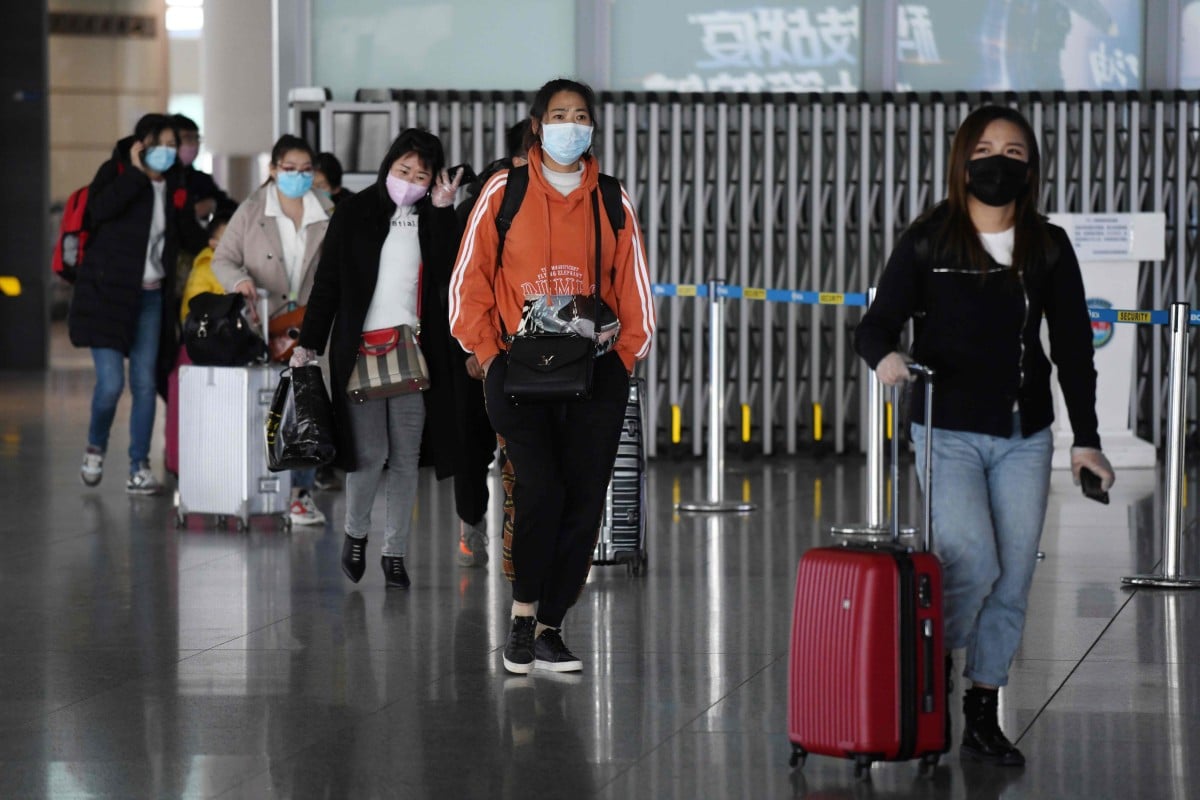
China has drastically cut flights to try to prevent people who arrive from abroad importing the coronavirus. Photo: AFP
Chinese students could be flown home from
coronavirus hotspots such as the United States but will have to pay their own expenses, amid efforts by Beijing to persuade some to remain overseas rather than risk bringing the infection with them.
A statement posted on the website of China’s Washington embassy on Monday said that the Chinese government was aware that many school and university students had encountered difficulties in travelling back to China and was taking steps to arrange charter flights for those who needed to return urgently.
With the initial coronavirus outbreak appearing to have been largely contained in mainland China, some Chinese students have travelled home despite soaring air ticket prices and the requirement that those who have been overseas enter quarantine.
Students brought back on charter flights would still need to pay for the ticket and the costs of the mandatory 14-day quarantine upon arrival in China.
Trump says US approaching a ‘horrendous’ time as coronavirus death toll rises
More than 1.6 million Chinese are studying overseas, including about 410,000 in the US. At least 1.42 million Chinese students remained overseas, vice foreign minister Ma Zhaoxu said on Thursday.
Having initially boasted of its success in stopping the virus, Beijing has become notably cautious in recent weeks about welcoming overseas students back home, especially with imported cases continuing to rise.
China’s foreign ministry and its overseas missions have urged students considering travelling home to exercise caution. The embassy in the US issued a notice on Friday speaking highly of the American medical system and its response to the pandemic, in a marked departure from Beijing’s narrative, which has included pinning the blame for the pandemic on the United States.
Friday’s embassy notice also dismissed rumours that Chinese students had been targeted because of the coronavirus during the closures of universities, and pledged help if students had trouble communicating with universities about campus accommodation.
China advises foreign diplomats to stay away from Beijing until May 15
3 Apr 2020
Ma said that most overseas students had heeded his government’s advice and chosen not to go back to China, but an online survey late last month that was cited by Caixin magazine on Saturday showed nearly 60 per cent of Chinese students in the US wanted to return home.
Most of the 4,000 students polled said they were unable to make the trip because of concerns about contracting the coronavirus during the journey and air fares that had more than doubled recently. Both China and the US have drastically cut back long-haul international flights.
After weeks stranded in Peru, 65 Hongkongers return home
Students under 18 years of age who want to return to China are required by the embassy to register online.
The initial evacuation plan announced on Monday proposed to prioritise school-age children whose parents were not in the US with them. The proposed arrangement appeared to include students from Hong Kong, Macau and Taiwan.
Source: SCMP
Posted in air ticket, American medical system, Beijing, Beijing’s, Caixin magazine, campus accommodation, charter flights, China’s Foreign Ministry, chinese government, Chinese students, coronavirus, coronavirus outbreak, declined, difficulties, embassy, encountered, foreign diplomats, Home, Hong Kong, Hongkongers, hotspots, infections, long-haul international flights, Macau, Mainland China, marked departure, narrative, offers, overseas, overseas missions, own expenses, pandemic, Peru, pinning the blame, prices, quarantine, requirement, school, students, Taiwan, to fly, travelling, Trump, Uncategorized, United States, university, urgently, US, US health system, Washington |
Leave a Comment »
22/03/2020
BEIJING (Reuters) – China on Sunday reported 46 new cases of coronavirus, the fourth straight day with an increase, with all but one of those imported from overseas, and further stepped up measures to intercept cases from abroad as the outbreak worsens globally.
While China says it has drastically reduced the number of domestically transmitted cases – the one reported on Sunday was the first in four days – it is seeing a steady rise in imported cases, mostly from Chinese people returning from overseas.
In a sign of how seriously China is taking the threat of imported cases, all international flights due to arrive in Beijing starting Monday will first land at another airport, where passengers will undergo virus screening, government agencies said on Sunday, in an expansion of existing measures.
International flights that were scheduled to arrive in the capital will land instead at one of 12 airports. Passengers who clear screening will then be permitted to reboard the plane, which will then fly to Beijing, the regulator said.
Separately, Shanghai and Guangzhou both announced that all arriving international passengers will undergo an RNA test to screen for coronavirus, expanding a program that previously only applied to those coming from heavily-hit countries.
Among the new cases from abroad reported on Sunday, a record 14 were in the financial hub of Shanghai and 13 were in Beijing, a decline from 21 the previous day.
The new locally transmitted case was in the southern metropolis of Guangzhou and was also the first known case where the infection of a local person was linked to the arrival of someone from overseas, according to Guangdong province.
Hu Xijin, the editor-in-chief of the Global Times newspaper, called for all cities in China to implement 14-day quarantines for people arriving from abroad.
He also called for quarantine policies to apply to people from Hong Kong and Macau as well, he said on his Weibo account on Sunday.
“I am worried that there are similar cases to the Guangzhou one existing in other parts of the country. There were reports previously that people coming back from abroad returned to their homes in Shanghai without any obstacles,” Hu said.
“It matters to the overall situation of China’s next prevention and control efforts if we can plug the leaks.”
The Global Times is a tabloid published by the Ruling Communist Party’s People’s Daily.
The latest figures from China’s National Health Commission bring total reported coronavirus cases in the country to 81,054, with 3,261 deaths, including six on Saturday. On Saturday, China reported 41 new coronavirus cases for the previous day, all of them imported.
Of all 97 imported cases as of end-Saturday, 92 of them are Chinese nationals and 51 are Chinese students returning from studying abroad, said Gao Xiaojun, spokesman for the Beijing Municipal Health Commission during a press conference on Sunday.
The Beijing health commission announced separately on its website it had two more imported cases on Sunday, bringing the city’s total number of imported cases to 99 as of Sunday noon.
BACK TO A KIND OF NORMAL
China is trying to revive an economy that is widely expected to contract deeply in the current quarter, with life slowly returning to normal in cities such as Beijing and Shanghai, albeit with everyone wearing masks in public.
Still, numerous shops and restaurants remain shut – many have gone out of business – and factories and other workplaces are still not operating at full capacity.
On Sunday, a central bank official called for stepped-up global policy coordination to manage the economic impact of the pandemic. He said China’s recent policy measures were gaining traction, and it has capacity for further action.
Chen Yulu, a deputy governor at the People’s Bank of China (PBOC), also said he expects significant improvement in the Chinese economy in the second quarter.
And while the virus will continue putting upward pressure on near-term consumer prices, there is no basis for long-term inflation or deflation, he told a news briefing.
Globally, roughly 275,000 people have been infected with the virus, and more than 11,000 have died, according to a Reuters tally, with the number of deaths in Italy recently surpassing those in China.
“Now I think the epidemic has been controlled. But this definitely doesn’t mean that it’s over,” said a 25-year-old woman surnamed He who works in the internet sector and was visiting the vast Summer Palace complex in Beijing on Saturday.
“I’m willing to come out today but of course I am still afraid,” she told Reuters.
The central province of Hubei, where the outbreak first emerged late last year in its capital Wuhan, reported its fourth straight day of no new cases.
China has used draconian measures to contain the spread of the virus, including locking down Hubei province.
Source: Reuters
Posted in 14-day quarantines, abroad, Beijing, Beijing Municipal Health Commission, central bank official, China, China’s National Health Commission, Chinese economy, Chinese nationals, Chinese students, coronavirus cases, curb, deaths, draconian measures, Emirates airline, epidemic, factories, Global Times, Guangzhou, Hong Kong, hubei province, imported, Italy, locking down, Macau, newspaper, People’s Bank of China (PBOC), People’s Daily, restaurants, Reuters tally, rise, Ruling Communist Party’s, scrambles, Seattle, Shanghai, shops, shut, studying, Summer Palace, Uncategorized, Virus, Weibo, workplaces |
Leave a Comment »
21/03/2020
BEIJING, March 21 (Xinhua) — Chinese State Councilor and Foreign Minister Wang Yi said on Friday that the Chinese side is willing to join hands with the British side as the country is in a tough fight against the novel coronavirus epidemic.
Wang made the remarks during his telephone conversation with British Foreign Secretary Dominic Raab.
He said that the epidemic is breaking out in many parts of the world, and the number of confirmed cases in European countries such as Britain is increasing, for which China expresses sincere sympathies with the British side and believes that the British people can come together and ultimately overcome the epidemic.
“When the Chinese people are facing the severe challenges of the epidemic, the British side has extended a helping hand, which we will remember in our hearts,” said Wang, adding that at this difficult time when Britain is fighting the epidemic, China is also ready to join hands with Britain.
China still faces an arduous epidemic prevention and control task, but it will manage to provide a batch of medical supplies to the British side and help facilitate the purchasing through commercial means, he said.
He also said that the top priority for China’s epidemic prevention and control is to avoid a rebound, adding that China is willing to carry out joint prevention and control with Britain, and hopes Britain can strengthen border control, maintain the essential cross-border flow between the two countries, and prevent cross-infection to the greatest extent.
Wang said that the Chinese side has been sharing epidemic-related information and carrying out anti-epidemic cooperation with the international community in an open, transparent and responsible manner since the beginning of its fight against the outbreak, adding that the country is currently providing various forms of support to nearly 100 countries in need.
What is alarming is that some people are trying to politicize the epidemic, label the virus and stigmatize China, Wang noted, adding that such detrimental acts will undermine the solidarity and cooperation of the international community and hinder the joint efforts of all parties to combat the epidemic.
Wang said he believes that all countries, including Britain, will uphold an objective and fair attitude and resist this narrow-minded approach.
Noting that many overseas Chinese, including Chinese students, work, study and live in Britain, Wang called them bridges of friendship between the two countries.
It is hoped that the British side will attach great importance to and protect their health and safety, and provide timely and necessary medical care, he added.
Raab spoke highly of China’s notable achievements in fighting the epidemic, and thanked China for its sympathies with Britain, and for providing medical supplies and facilitating procurement.
Noting that the British side attaches great importance to China’s experience in the COVID-19 fight, Raab said his country stands ready to strengthen coordination with China and other countries in epidemic prevention and control, vaccine research and development, and in assisting countries with fragile medical systems, so as to promote international cooperation and strive for an early victory over the epidemic.
The British government will spare no effort to ensure the health and safety of overseas Chinese in his country, he added.
Voicing opposition to politicizing the epidemic, Raab stressed that the British side totally agrees with China’s position that the origin of the virus is a scientific issue that requires scientific and professional opinions.
He also urged that all sides work together to overcome the hardship amid the epidemic.
Source: Xinhua
Posted in border control, Britain, China, Chinese State Councilor and Foreign Minister Wang Yi, Chinese students, COVID-19, cross-border flow, epidemic, European countries, fight, help, medical supplies, novel coronavirus epidemic, Overseas Chinese, Uncategorized |
Leave a Comment »






 CHINDIA ALERT: You'll be living in their world, very soon