10/09/2019
- More than 40 per cent of those surveyed in an online poll say they feel they have no other choice, while just a quarter think the extra tutoring is necessary
- It reflects widespread anxiety over getting places at the top schools, according to researcher
Sixty per cent of mainland Chinese children aged from three to 15 are receiving extra tutoring outside the classroom, according to a report. Photo: Handout
More than 40 per cent of Chinese parents feel they have no choice but to send their children to after-school classes because of the intense competition in the education system, according to an online poll.
But just a quarter of the respondents said they thought the extra tutoring was actually necessary for their children.
Nearly 200,000 parents had responded to the survey, conducted by social network Weibo, by Tuesday.
It comes after a report last week said 60 per cent of children aged between three and 15 in mainland China were receiving extra tutoring outside the classroom.
That report, released by the China National Children’s Centre and the Social Sciences Academic Press, also said parents of children in the age range were spending an average of 9,200 yuan (US$1,290) per year on after-school classes to cope with growing academic pressure.
It was based on a survey of nearly 15,000 children in 10 mainland cities and rural areas.
For the children, that meant they were spending an average of less than two hours playing outside on weekends, according to the report. They were also found to be devoting an average of 88 minutes a day to homework on school days.
Chinese parents send their children to a wide range of after-school classes. Photo: Xinhua
Wu Hong, a researcher from the Dandelion Education Think Tank in Chongqing, said the findings reflected the widespread anxiety of parents over their children getting places at the top schools.
“Many parents don’t have their own ideas about how their kids should be educated and they just follow others blindly. For example, a friend of mine said she plans to send her two five-year-olds to an international school in Thailand just because several of her friends did that,” Wu said.
“It’s not that kids should not attend any after-school classes, but we are apparently giving them too much when they’re so young, and this is only limiting their imagination.”
Last go at exam success for China’s ‘gaokao grandpa’
Studying a wider range of subjects in more depth than the public school syllabus requires and getting a head start by going over topics before they are covered in school have become common tactics used by parents trying to help their children compete in a challenging educational environment in China.
In the more affluent cities, some parents are spending a lot more than the average on their children’s extracurricular activities. Shanghai mother Emma Jin said she wanted to give her daughter, who is in Year Two, a good chance in the education system.
“Extra English classes cost 20,000 yuan for a year. She also takes dance classes, taekwondo and so on,” Jin said. “I don’t expect much from her, but I don’t want her to be the worst in the class either.”
Some parents said the pressure came from the schools.
“My child is studying at a public school. The teacher told us to have our child learn pinyin [the mainland’s system of romanisation of Mandarin script] in advance at after-school classes during the admission interview. Should I have just disregarded his advice?” one parent commented on Weibo.
‘Heavy burden’ of homework leaving Chinese children sleep-deprived, study finds
The heavy pressure on children from extra classes has meanwhile prompted the Ministry of Education to issue several directives to schools asking them to pay more attention to pupils’ well-being – including by encouraging them to get at least one hour of outdoor exercise and 10 hours’ sleep a day. Last year, it also banned cram schools from holding competitions or offering classes to children that were too advanced for their age.
Source: SCMP
Posted in academic pressure, after-school classes, China National Children’s Centre, chinese parents, Chongqing, Dandelion Education Think Tank, extra tutoring, forces, gaokao grandpa, homework, imagination, intense competition, international school, Mainland China, Mandarin, Ministry of Education, send children, Social Sciences Academic Press, Thailand, top schools, Uncategorized, weekends |
Leave a Comment »
31/08/2019
- Shanghai AI conference has attracted executives from nearly 300 companies including US firms Intel, IBM, Microsoft and Qualcomm
- Ma is mainly an AI optimist, whereas Musk has sounded several warnings on the topic
Elon Musk and Jack Ma face off over AI at the 2019 Shanghai WAIC. Photo: SCMP
Billionaire techpreneurs Jack Ma and Elon Musk faced off over AI in a much-anticipated morning session at the Shanghai World Artificial Intelligence Conference on Thursday, and although sparks didn’t actually fly it was clear to the packed audience that they each have a different vision of the future.
“AI will open a new chapter so that humans will know themselves better,” said Jack Ma, Alibaba Group Holding founder. “Most of the projections about AI are wrong … people who are street-smart about AI are not scared by it.”
The conference has attracted executives from nearly 300 companies including US firms Intel, IBM, Microsoft and Qualcomm as well as scientists and scholars from across the world. Both men had to condense their visions of the future into a compact 45-minute session, which also included answering a series of pre-prepared questions from Chinese netizens.
“Due to AI, people will have more time to enjoy themselves as a human being … forget long days, we could end up with 12-hour work weeks,” said Ma. “I don’t worry too much about the impact of AI on jobs … in the future we will not need a lot of jobs.”
Musk, who has founded a string of tech ventures including SpaceX, Boring Company and Neuralink aside from his role as co-founder and CEO of Tesla, said he had heard that “AI sounds like love in Chinese” but in a more cautious tone described AI as “much more than just a smart human”.
“Humans may become too slow. A millisecond is an eternity to a computer today,” said Musk, who has championed everything from electric cars to Mars colonies. “Computers are already smarter than human beings in many aspects,” he said, adding that while humans write AI software today, in the end the machine will do this itself.
Alibaba co-founder and chairman Jack Ma speaks at the 2019 World Economic Forum (WEF) annual meeting in Davos. Photo: Xinhua
The comments from the two executives, who are both engaged in industries [e-commerce and autonomous driving] where AI is essential – were largely in line with what they have said before on the topic. Ma is mainly an optimist, seeing AI as an inevitable agent of change in a digital world, whereas Musk has sounded several warnings.
In 2017, Musk – along with 100 robotics and AI leaders – urged the United Nations to take action against the dangers of autonomous weapons, known as “killer robots”. He has also described AI as humanity’s “biggest existential threat”, comparing it to “summoning the demon”.
AI cannot replace me yet, says Esquire magazine editor
Earlier in the week, Ma said that amid an escalating trade and technology war between the US and China, both countries needed to make a concerted effort to work together on technology for the world to benefit from the digital era.
“In the smart era, it is almost impossible for anyone to strike out on their own,” Ma said in a speech at the Smart China Expo in Chongqing on Monday. “Only if China and the US work together on technology, can we enter the digital era together.”
Tesla CEO Elon Musk, 2019. Photo: AP
Chinese Vice-Premier Liu He, Beijing’s top trade negotiator said on Monday at a conference that an escalation of the trade war was not in anyone’s interests. US tariffs on some US$300 billion worth of Chinese imports – mostly consumer goods – are expected to increase from 10 to 15 per cent later this year, in retaliation to China’s decision last week to impose tariffs of between 5 to 10 per cent on US$75 billion worth of American products including soybeans, pork and crude oil.
Automobiles is one of the most high-profile sectors to be affected by the trade war, and US President Donald Trump has highlighted the tariff gap between the US and China on imported cars in earlier comments.
Minority Report-style crime prevention is fast becoming reality
Founded in 2003, Tesla is currently building its first overseas factory in Shanghai, which is nearing completion and expected to start production by the year end with an initial annual output of 250,000 vehicles.
China is Tesla’s second largest market after the US. The California-based electric car-maker reported an over 40 per cent year-on-year surge in sales generated in the country to nearly US$1.5 billion in the first six months of the year.
Musk is expected to visit the US$5 billion production facility in Lingang, part of Shanghai’s free-trade zone, amid his China trip and launch a China unit for his infrastructure start-up Boring, as announced earlier on Twitter.
Source: SCMP
Posted in Alibaba, Automobiles, Chinese netizens, Chinese Vice-Premier Liu He, Chongqing, Elon Musk, Esquire magazine, IBM, Intel, Jack Ma, machine control, Microsoft, Qualcomm Inc, Shanghai, Shanghai AI conference, Shanghai World Artificial Intelligence Conference, Smart China Expo, Tesla, Twitter, Uncategorized, US President Donald Trump |
Leave a Comment »
27/08/2019
Chinese Vice Premier Liu He, also a member of the Political Bureau of the Communist Party of China Central Committee, reads a congratulatory letter to the 2019 Smart China Expo sent by Chinese President Xi Jinping at the expo’s opening ceremony in southwest China’s Chongqing Municipality, Aug. 26, 2019. (Xinhua/Wang Quanchao)
CHONGQING, Aug. 26 (Xinhua) — Chinese Vice Premier Liu He on Monday called for seizing the new opportunities in technological development and promoting the healthy development of the intelligent industry.
Liu, also a member of the Political Bureau of the Communist Party of China Central Committee, made the remarks at the 2019 Smart China Expo that opened Monday in southwest China’s Chongqing Municipality.
At the opening ceremony, he read a congratulatory letter from President Xi Jinping.
The letter fully demonstrated that the president attaches great importance to the development of intelligent industry, and pointed the direction for the sector’s healthy development, Liu said.
Noting that China’s economy is switching from high-speed growth to high-quality development, Liu said the country’s dynamic microfundations and sufficient macro-policy tools can ensure the sound fundamentals of its economic development.
China’s intelligent industry is developing rapidly and emerging as a new economic growth point, Liu said.
To promote the sector’s development, efforts must be centered on promoting the well-being of humanity, maintain a balance between efficiency and job creation, respect and protect individual privacy, and uphold the ethical and moral bottom line, he said.
In underscoring China’s willingness to advance international cooperation in the intelligent sector, Liu said China welcomes enterprises from all over the world, including the United States, to invest and operate in China.
The country will continue to create an appealing investment environment and strengthen protection of property rights and intellectual property rights, he said.
China is willing to resolve problems calmly through consultation and resolutely opposes the escalation of the trade war, Liu said, adding that any escalation will run against the interests of the people of China, the United States and the whole world.
Source: Xinhua
Posted in 2019 Smart China Expo, Chinese Vice Premier, Chinese Vice Premier Liu He, Chongqing, congratulatory letter, dynamic microfundations, Economic development, economic growth point, efficiency, enterprises, ethical bottom line, fundamentals, high-quality development, high-speed growth, humanity, individual privacy, intelligent industry, international cooperation, job creation, macro-policy tools, member of the Political Bureau of the Communist Party of China Central Committee, moral bottom line, new opportunities, President Xi Jinping, technological development, Uncategorized, United States |
Leave a Comment »
05/07/2019
- Mountain park worker Wan Tiandi started making the near-1,000ft bungee jump every day as the most efficient way of delivering a hot meal to her colleagues
- She says it would take more than half an hour to drive down the mountain, but this way means she can get the food there within minutes
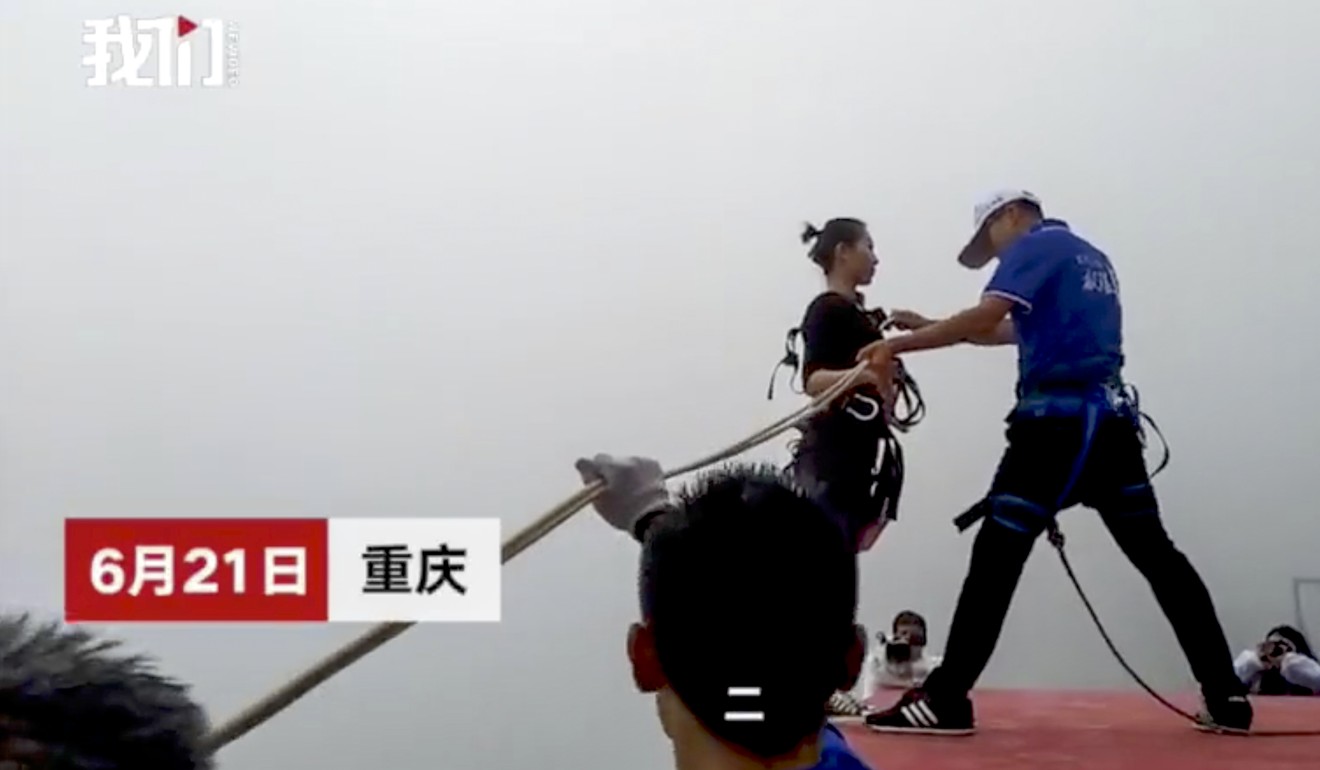
Wan Tiandi makes the 300-metre leap every lunchtime. Photo: Weibo
A woman working at a mountainous beauty spot in southwest China has started delivering hot meals to her colleagues by bungee jumping 300 metres (985ft) every lunchtime.
Wan Tiandi works at Dream Ordovician Park in Chongqing, where her duties include delivering lunches to more than 200 employees who are not allowed to leave their posts during their lunch hour, The Beijing News reported.
Because of the park’s geography it would take over half an hour to drive down the mountain to their work station.
To save time, she has now started bungee-jumping down the cliff to deliver the lunchboxes to her colleagues.
“Our park is huge. It will take me more than half an hour’s drive to send lunches to them, while this bungee jump takes only two minutes,” Wan was quoted as saying.
Wan Tiandi prepares to make the jump. Photo: Weibo
She said that in the past when her colleagues received the lunches, they were already cold.
She said she and her colleagues had discussed the problem and developed their unorthodox food delivery method.
“My colleagues need us to send them food but transport on the mountain is not easy. Some of them work at places where there are no roads except narrow mountainous paths,” Wan said.
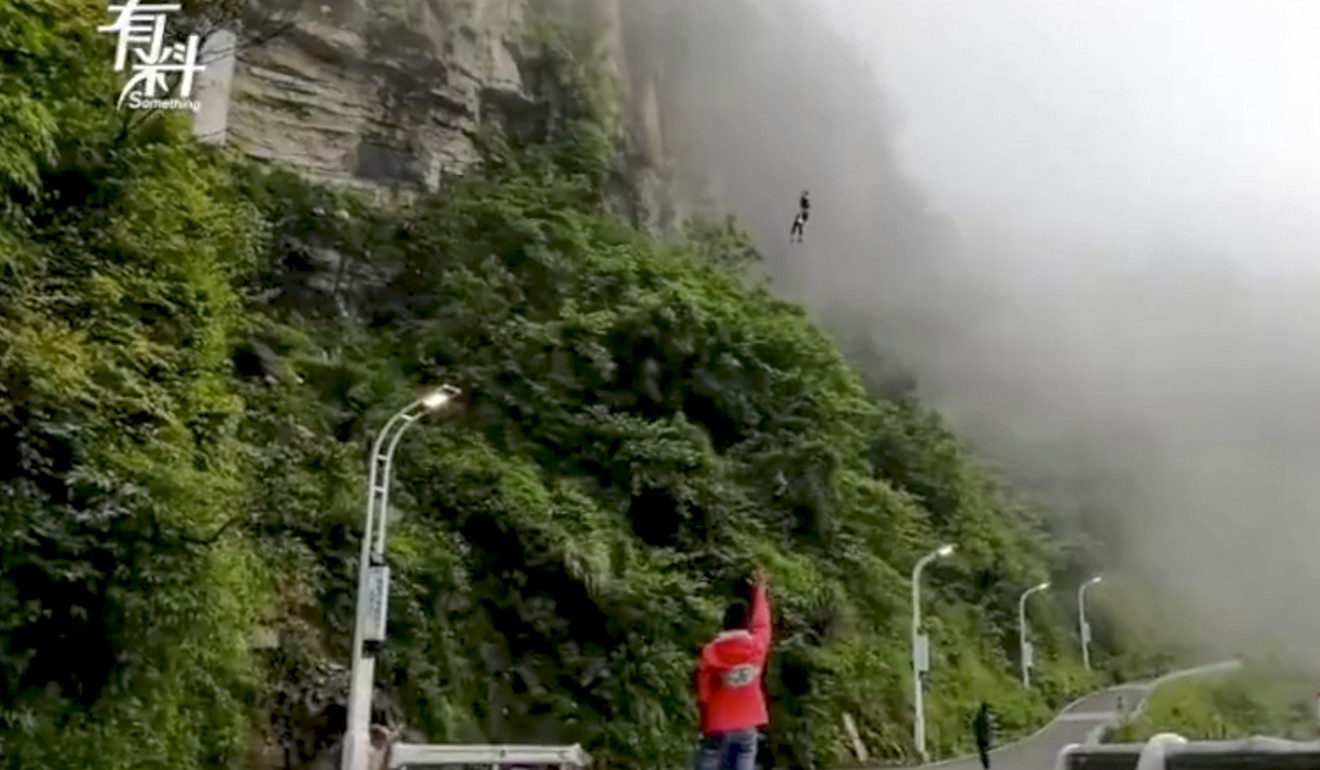
Wan Tiandi bungee jumps off the cliff every lunchtime. Photo: Weibo
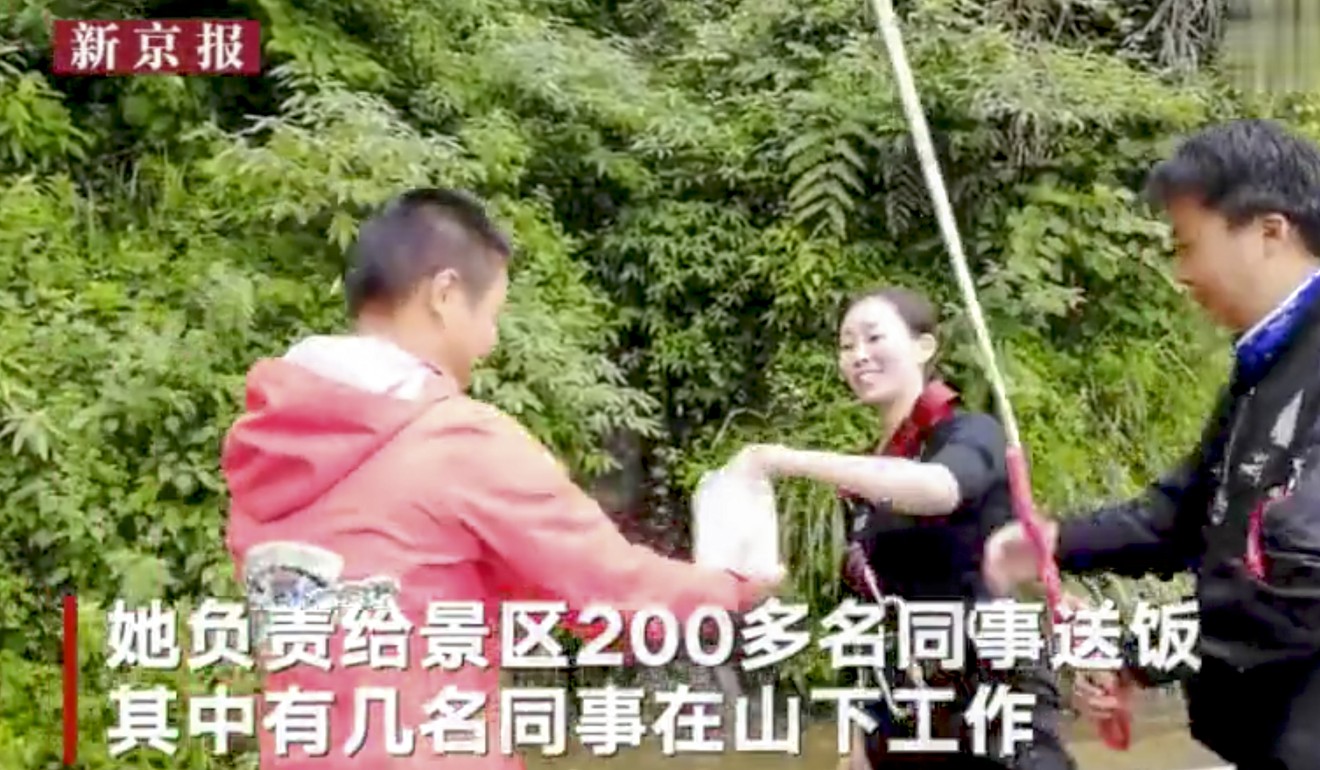
After she jumps from the cliff, Wan’s colleagues collect their lunchboxes that she carries in bags strapped to her waist.
Wan added that she enjoyed the thrill of bungee jumping and the sports enthusiast then jogged back to her office at the top of the mountain.
Her colleagues praised her for working hard to deliver hot food. “It is not easy. Her delivery is fast, steady and always on time,” one of her colleagues was quoted as saying.
Wan hands over the hot meals at the bottom of the cliff. Photo: Weibo
Source: SCMP
Posted in bottom of the cliff, bungee jumping, Chinese woman, Chongqing, colleagues, deliver lunch, delivering a hot meal, Dream Ordovician Park, drive down the mountain, drops in, height of 300 metres, jogged back, lunchboxes, most efficient way, Mountain park worker, sports enthusiast, The Beijing News, Uncategorized, work colleagues |
Leave a Comment »
04/06/2019
- Brahma Chellaney writes that excessive damming and drastic overuse of water resources are causing the world’s major waterways to run dry
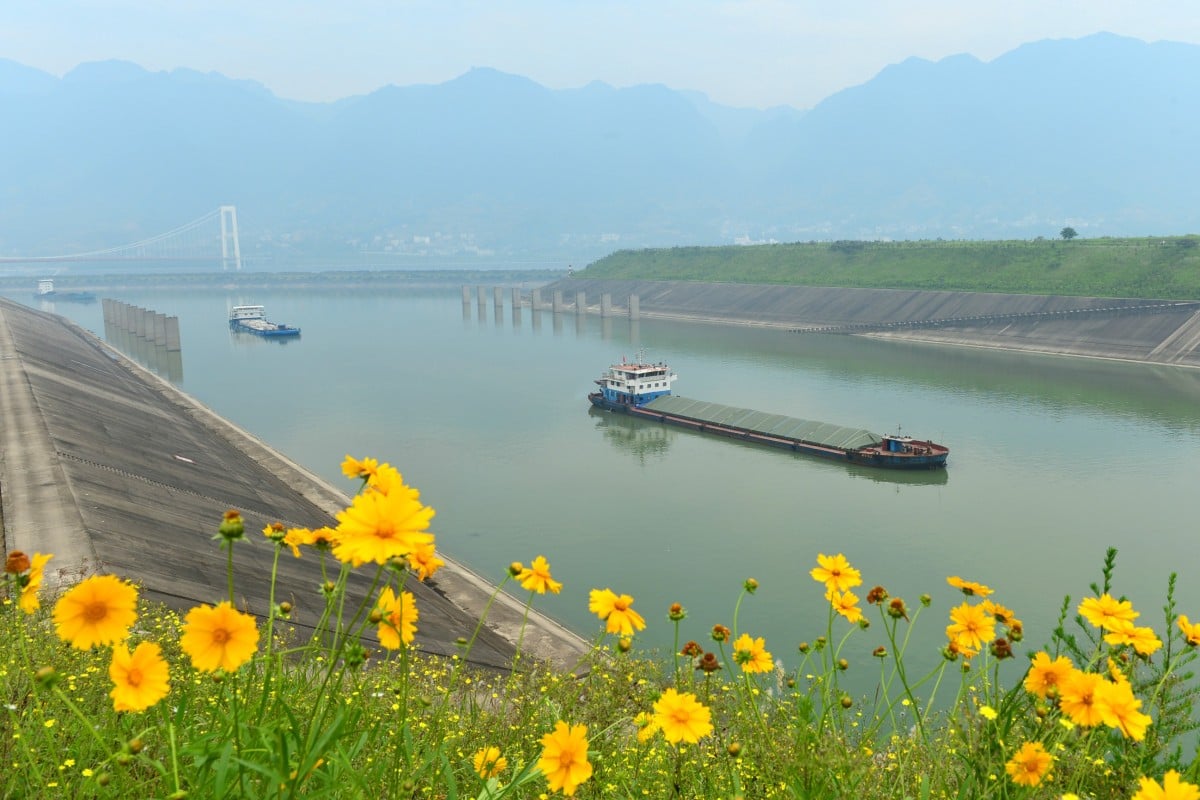
Vessels head for the lock of the Three Gorges Dam in Yichang, in central China’s Hubei province. Sediment build-up in the dam’s reservoir stems from silt flow disruption in the Yangtze River, Brahma Chellaney writes. Photo: Xinhua
Thanks to excessive damming and drastic overuse of water resources, an increasing number of major rivers across the world are drying up before reaching the sea.
Nowhere is this more evident than in China, where the old saying, “Follow the river and it will eventually lead you to a sea,” is no longer wholly true.
While a number of smaller rivers in China have simply disappeared, the Yellow River – the cradle of the Chinese civilisation – now tends to run dry before reaching the sea.
This has prompted Chinese scientists to embark on a controversial rainmaking project to help increase the Yellow’s flow. By sucking moisture from the air, however, the project could potentially affect monsoon rains elsewhere.
For large sections of the world’s population, major river systems serve as lifelines. The rivers not only supply the most essential of all natural resources – water – but also sustain biodiversity, which in turn supports human beings.
Yet an increasing number of rivers, not just in China, are drying up before reaching the sea.
A major new United Nations study published early this month offers grim conclusions: human actions are irremediably altering rivers and other ecosystems and driving increasing numbers of plant and animal species to extinction.
“Nature across the globe has now been significantly altered,” according to the study’s summary of findings.
The Yangtze and Jialing rivers come together in the southwestern city of Chongqing. Photo: Simon Song
Water sustains life and livelihoods and enables economic development.
If the world is to avert a thirsty future and contain the risks of greater intrastate and interstate water conflict, it must protect freshwater ecosystems, which harbour the greatest concentration of species.
The Mekong is mighty no more: book charts river’s demise
Yet, according to another study published in Nature this month humans have modified the flows of most long rivers, other than those found in the remote regions of the
Amazon and Congo basins and the Arctic.
Consequently, only a little more than one-third of the world’s 246 long rivers are still free-flowing, meaning they remain free from dams, levees and other man-made water-diversion structures that leave them increasingly fragmented.
Humans have modified the flows of most long rivers, including the Yangtze, home to some of China’s most spectacular natural scenery. Photo: WWF
Such fragmentation is affecting river hydrology, flow of nutrient-rich sediment from the mountains where rivers originate, riparian vegetation, migration of fish and quality of water.
Take the Colorado River, one of the world’s most diverted and dammed rivers. Broken up by more than 100 dams and thousands of kilometres of diversion canals, the Colorado has not reached the sea since 1998.
Sinking sands along the Mekong River leave Vietnamese homeless
The river, which originates in the Rocky Mountains and is the lifeblood for the southwestern United States, used to empty into the Sea of Cortez in Mexico.
But now, owing to the upstream diversion of 9.3 billion cubic metres (328.4 billion cubic feet) of water annually, the Colorado’s flow into its delta has been reduced to a trickle.
Altering the flow characteristics of rivers poses a serious problem for sustainable development, because they affect the ecosystem services on which both humans and wildlife depend. Photo: AP
Other major rivers that run dry before reaching the sea include the Amu Darya and the Syr Darya, the two lifelines of Central Asia; the Euphrates and the Tigris in the Middle East; and the Rio Grande, which marks the border between Texas and Mexico before heading to the Gulf of Mexico.
The overused Murray in Australia and Indus in Pakistan are at risk of meeting the same fate.
Are China’s Mekong dams washing away Cambodian livelihoods?
More fundamentally, altered flow characteristics of rivers are among the most serious problems for sustainable development, because they seriously affect the ecosystem services on which both humans and wildlife depend.
Free-flowing rivers, while supporting a wealth of biodiversity, allow billions of fish – the main source of protein for the poor – to trek through their waters and breed copiously.
Urgent action is needed to save the world’s rivers, including improving agricultural practices, which account for the bulk of freshwater withdrawals
Free-flowing rivers also deliver nutrient-rich silt crucial to agriculture, fisheries and marine life.
Such high-quality sediment helps to naturally re-fertilise overworked soils in the plains, sustain freshwater species and, after rivers empty into seas or oceans, underpin the aquatic food chain supporting marine life.
China’s hyperactive dam building illustrates the high costs of river fragmentation. No country in history has built more dams than China. In fact, China today boasts more large dams than the rest of the world combined.
China’s chain of dams and reservoirs on each of its long rivers impedes the downstream flow of sediment, thereby denying essential nutrients to agricultural land and aquatic species.
A case in point is China’s Three Gorges Dam – the world’s largest – which has a problematic build-up of sediment in its own massive reservoir because it has disrupted silt flows in the Yangtze River.
Likewise, China’s cascade of eight giant dams on the Mekong, just before the river enters Southeast Asia, is affecting the quality and quantity of flows in the delta, in Vietnam.
Yangtze dams may spell end to sturgeon in a decade
Undeterred, China is building or planning another 20 dams on the Mekong.
How the drying up of rivers affects seas and oceans is apparent from the Aral Sea, which has shrunk 74 per cent in area and 90 per cent in volume, with its salinity growing nine-fold.
People beat the heat by cooling off in the Yangtze River in Wuhan, in central China’s Hubei province. Photo: Nora Tam
This change is the result of the Aral Sea’s principal water sources, the Amu Darya and Syr Darya, being so overexploited for irrigation that they are drying up before reaching what was once the world’s fourth-largest inland lake.
Compounding the challenges is the increasing pollution of rivers. Aquatic ecosystems have lost half of their biodiversity since the mid-1970s alone.
Chinese court jails nine for dumping toxic waste in Yangtze
Urgent action is needed to save the world’s rivers. This includes action on several fronts, including improving practices in agriculture, which accounts for the bulk of the world’s freshwater withdrawals.
Without embracing integrated water resource management and other sustainable practices, the world risks a parched future.
Source: SCMP
Posted in Amazon, Amu Darya, Aral Sea, Arctic, Australia, Brahma Chellaney, Cambodian, China alert, Chinese civilisation, Chongqing, Colorado River, Congo, drastic overuse, drying up, ecosystems, especially, Euphrates, excessive damming, extinction, Gulf of Mexico, hubei province, hyperactive dam building, Indus River, Jialing, major waterways, Mekong, Mexico, Middle East, Murray, nature, No time to waste, Pakistan, Rio Grande, Rocky Mountains, run dry, saving, Sea of Cortez, Syr Darya, Texas, Three Gorges Dam, Tigris, Uncategorized, United Nations, United States, Water resources, world’s rivers, Yangtze River, Yellow River, Yichang |
Leave a Comment »
04/06/2019
- Unveiled in Shandong, prototype will be a first step towards ground-breaking high-speed travel that will rival passenger jets, project engineer says
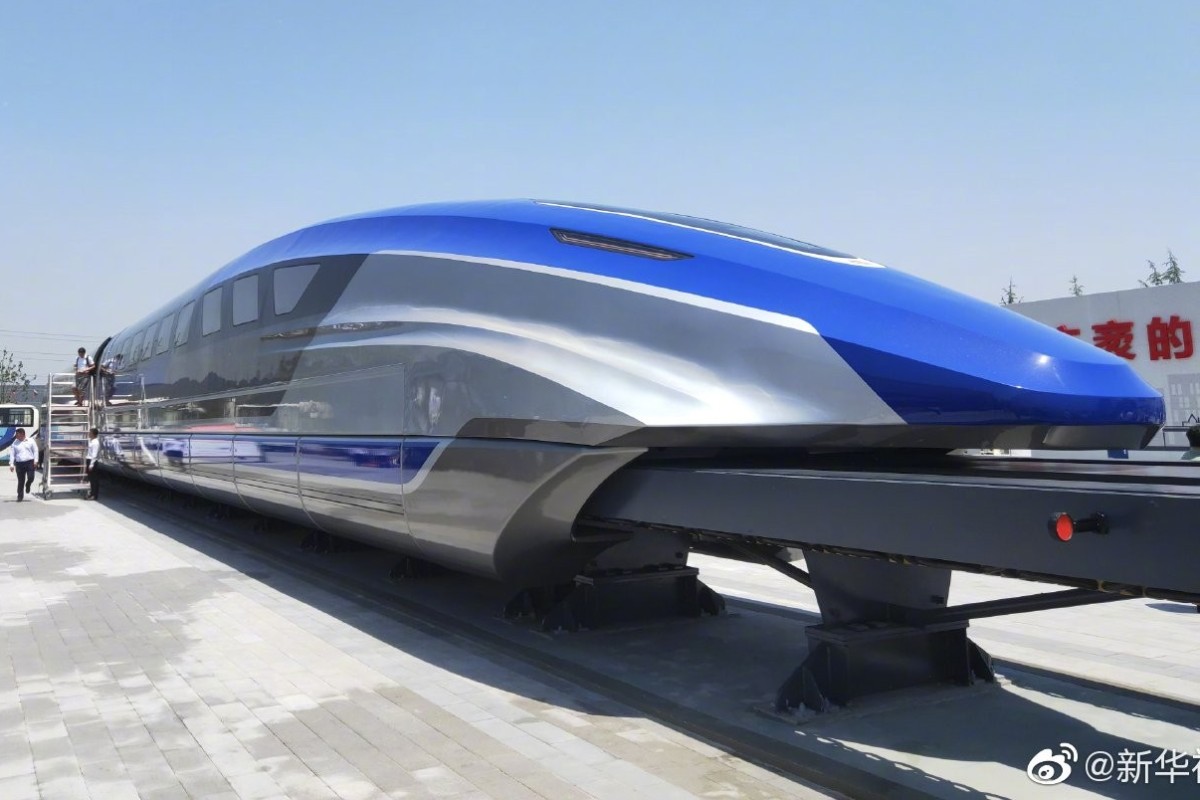
One possible future for rapid transport in China is unveiled in the form of a magnetic levitation train at Qingdao in Shandong province. Photo: Weibo
An experimental magnetic levitation train capable of travelling at 600km/h went on show at Qingdao in eastern Shandong province on Thursday, state media said.
Powerful electromagnets hold the Qingdao prototype at a thumb’s width from the rail, giving a quiet, smooth ride at speeds close to those involved in air travel, developers said.
While China operates the world’s fastest conventional train service, which can reach a speed of 350km/h, the Shanghai Maglev has been in commercial operation since the end of 2002 and can reach a top speed of 430km/h. It operates on one 30-kilometre (19-mile) line between two stations.
Ding Sansan, deputy chief engineer with developer the CRRC Sifang Corporation, said China achieved breakthroughs in maglev technology during the “three-year-battle” to build the new train that involved cooperation between more than 30 enterprises, universities and government research institutes.
The construction of a train body with ultra-lightweight, high-strength materials was a challenge, Ding said. Complex physical problems created by high speeds also needed to be solved in new ways if the Qingdao prototype was to reach peak performance.
China was a leader in technologies that included suspension, guidance, control and high-powered traction, Ding told Qingdao Daily.
“The test vehicle has been powered up and is in good order,” Ding was quoted by the newspaper as saying.
Chinese maglev train capable of travelling at 600km/h on track for 2020 test run as design completed
The prototype promised to eliminate the advantages jet passenger planes had over ground vehicles over a distance of 1,500km, he said.
Taking Beijing-to-Shanghai by plane as an example, Ding suggested: “It takes about four-and-a-half hours by plane including preparation time for the journey; about five-and-a-half hours by high-speed rail, and [would] only [take] about three-and-a-half hours by maglev.”
While earlier reports suggested the prototype was expected to begin full-scale testing by 2020, it was unclear what Thursday’s unveiling meant for this timetable.
China’s latest prototype high-speed maglev train factors the comfort of paying customers into its test operations. Photo: Weibo
More maglevs would join the development project in the coming months, the team leader was quoted as saying, while mass production of the technology was likely by 2021.
In contrast to the optimism of the team at Qingdao, Chen Peihong, professor of economics at Beijing Jiaotong University and a transport analyst, was more circumspect about the future of maglev trains.
“The market has to be bigger. Technology alone cannot make [the concept] a success,” she said.
Plane or train: as high-speed rail link connects Hong Kong to 44 mainland Chinese cities, what are cheapest and fastest ways to get where you are going?
Public transport relied heavily on economies of scale, Chen said. Chinese cities including Jinan, Hangzhou and Chongqing were considering maglev lines, but even the longest – from Jinan to Taian – would not exceed 50 kilometres.
Chen said that electromagnetic fields from maglevs were greater than those from the lines that powered high-speed trains, while environmental worries might keep maglevs out of densely-populated areas.
There was a debate in China in the early 2000s about the benefits of a developing a maglev compared to high-speed rail, researchers on that project said. Rail was preferred by the government because it was an established technology and one that was cheaper to realise.
By the end of last year, China’s high-speed rail network extended to most of the country at a distance in excess of 29,000 kilometres, according to government figures, twice as long as the rest of the world’s high-speed rail lines combined. Spain’s high-speed AVE network was the second-longest at 3,100km.
Elsewhere, researchers in Chengdu, Sichuan province, said a vehicle inside a vacuum tube powered by a superconductor coil from a maglev train – a hyperlink – was in development. They expected the vehicle to reach speeds in excess of 1,000km/h as air was pumped from the tube and resistance to the speeding object gradually eliminated.
Source: SCMP
Posted in air travellers, AVE network, Beijing Jiaotong University, Beijing-to-Shanghai, Chengdu, Chongqing, CRRC Sifang Corporation, down to earth, Hangzhou, High-speed rail, Hong Kong, Jinan, Jinan to Taian, maglev train, professor of economics, Qingdao, Qingdao Daily, shandong province, Shanghai Maglev, sichuan province, Spain, Uncategorized |
Leave a Comment »
29/04/2019
-
- Fusion reactor built by Chinese scientists in eastern Anhui province has notched up a series of research firsts
- There are plans to build a separate facility that could start generating commercially viable fusion power by 2050, official says
The Experimental Advanced Superconducting Tokamak (EAST) device – or “artificial sun” – in Hefei, Anhui province. Photo: AFP/Chinese Academy of Sciences
A groundbreaking fusion reactor built by Chinese scientists is underscoring Beijing’s determination to be at the core of clean energy technology, as it eyes a fully functioning plant by 2050.
Sometimes called an “artificial sun” for the sheer heat and power it produces, the doughnut-shaped Experimental Advanced Superconducting Tokamak (EAST) that juts out on a spit of land into a lake in eastern Anhui province, has notched up a succession of research firsts.
In 2017 it became the world’s first such facility to sustain certain conditions necessary for nuclear fusion for
, and last November hit a
of 100 million degrees Celsius (212 million Fahrenheit) – six times as hot as the sun’s core.
Such mind-boggling temperatures are crucial to achieving fusion reactions, which promise an inexhaustible energy source.
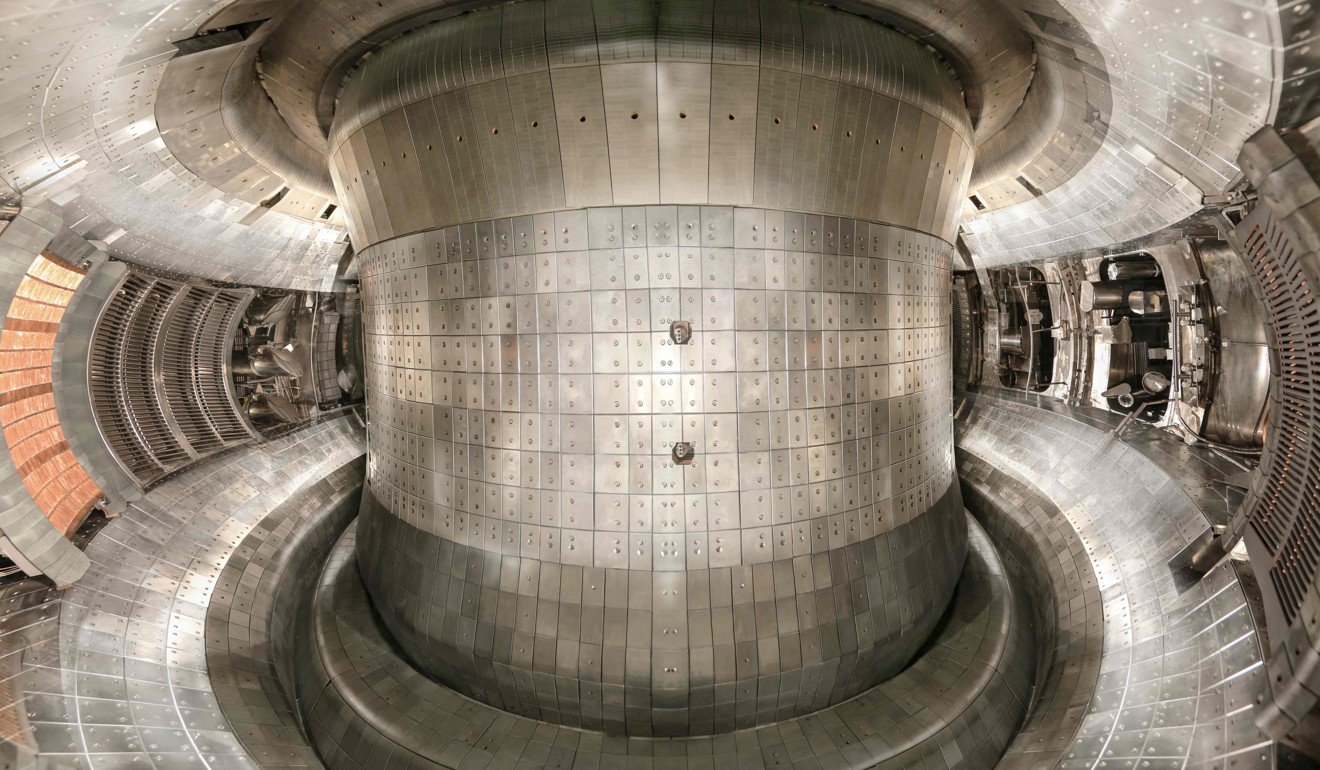
EAST’s main reactor stands within a concrete structure, with pipes and cables spread outward like spokes connecting to a jumble of censors and other equipment encircling the core. A red Chinese flag stands on top of the reactor.
A vacuum vessel inside the fusion reactor, which has achieved a temperature of 100 million degrees Celsius – six times as hot as the sun’s core. Photo: AFP/Chinese Academy of Sciences
“We are hoping to expand international cooperation through this device [EAST] and make Chinese contributions to mankind’s future use of nuclear fusion,” said Song Yuntao, a top official involved in the project, on a recent tour of the facility.
China is also aiming to build a separate fusion reactor that could begin generating commercially viable fusion power by mid-century, he added.
Some 6 billion yuan (US$891.5 million) has been promised for the ambitious project.
EAST is part of the International Thermonuclear Experimental Reactor (ITER) project, which seeks to prove the feasibility of fusion power.
Funded and run by the European Union, India, Japan, China, Russia, South Korea and the United States, the multibillion-dollar project’s centrepiece will be a giant cylindrical fusion device, called a tokamak.
Now under construction in Provence in southern France, it will incorporate parts developed at the EAST and other sites, and draw on their research findings.
China is “hoping to expand international cooperation” through EAST. Photo: Reuters
Fusion is considered the Holy Grail of energy and is what powers our sun.
It merges atomic nuclei to create massive amounts of energy – the opposite of the fission process used in atomic weapons and nuclear power plants, which splits them into fragments.
Unlike fission, fusion emits no greenhouse gases and carries less risk of accidents or the theft of atomic material.
But achieving fusion is both extremely difficult and prohibitively expensive – the total cost of ITER is estimated at €20 billion (US$22.3 billion).
Wu Songtao, a top Chinese engineer with ITER, conceded that China’s technical capabilities on fusion still lag behind more developed countries, and that US and
Japanese tokamaks have achieved more valuable overall results.
But the Anhui test reactor underlines China’s fast-improving scientific advancement and its commitment to achieve yet more.
China’s capabilities “have developed rapidly in the past 20 years, especially after catching the ITER express train”, Wu said.
In an interview with state-run Xinhua news agency in 2017, ITER’s director general Bernard Bigot lauded China’s government as “highly motivated” on fusion.
“Fusion is not something that one country can accomplish alone,” Song said.
“As with ITER, people all over the world need to work together on this.”
Posted in 32 jailed, 39 million pieces, Anhui province, atomic material, “artificial sun”, Bernard Bigot, China alert, Chongqing, computer hackers, criminal gang, doughnut-shaped, European Union, Experimental Advanced Superconducting Tokamak (EAST) device, Facial recognition system, giant cylindrical fusion device, greenhouse gases, Guizhou Province, Hefei, Holy Grail of energy, ID card and mobile phone numbers, India alert, International Thermonuclear Experimental Reactor (ITER), ITER’s director general, Japan, Ministry of Public Security, names, addresses and dates of birth, nuclear fusion, painting and decorating company, People’s Daily, private data, Russia, Shanghai, Shanghai Real Estate Trading Centre, South Korea, stealing, tokamak, top Chinese engineer, Uncategorized, United States, vacuum vessel, Wang, Wu Songtao, zhejiang province, Zhongxian public security bureau |
Leave a Comment »
19/04/2019
Chinese President Xi Jinping, also general secretary of the Communist Party of China Central Committee and chairman of the Central Military Commission, talks with villagers, primary-level officials, cadres in charge of poverty alleviation work and village doctors in Huaxi Village of Shizhu Tujia Autonomous County, southwest China’s Chongqing, April 15, 2019. From April 15 to 17, Xi made an inspection tour to Chongqing. He also presided over and delivered a speech at a symposium to address the problems concerning the basic living needs of rural poor populations and their access to compulsory education, basic medical services, and safe housing. (Xinhua/Ju Peng)
CHONGQING, April 18 (Xinhua) — Eliminating absolute poverty in China has been an aspiration of the Communist Party of China (CPC) throughout its 98-year history and a goal for the 70-year-old People’s Republic of China and the 40 years of reform and opening-up.
It is a major concern for Xi Jinping, general secretary of the CPC Central Committee. During an inspection tour to southwest China’s Chongqing Municipality from Monday to Wednesday, he pledged to address this issue like “a hammer driving a nail.”
Since the 18th CPC National Congress held in late 2012, China has made incredible progress in fighting poverty. The number of rural residents living below the current poverty line has been reduced from 98.99 million in 2012 to 16.6 million in 2018.
“The battle against poverty has entered a decisive and critical stage. We must press ahead with our full strength and strongest resolve and never stop until securing a complete victory,” he said.
CONFIDENCE
When Xi walked into the home of Ma Peiqing, a resident of Huaxi Village, located deep in the mountains of Chongqing, it was around 6 p.m. Monday.
After flying from Beijing in the morning to Chongqing, he spent another three hours, first by train and then by road, to reach Huaxi Village, home to 85 households and 302 villagers who were registered as living below the current poverty line. Today, only eight households and 19 villagers remain on the list.
Huaxi Village is a typical case of China’s impoverished regions. The basic needs for food and clothing have been met, but more efforts are needed for compulsory education, basic medical care and safe housing.
“I was diagnosed with nasopharynx cancer in 2017,” said Zhang Jianfeng, an impoverished villager. “About 80,000 yuan (11,900 U.S. dollars) of my medical expenses were reimbursed by medical insurance. It was indeed a timely help.”
“After visiting the village, I feel reassured,” said Xi. “We may have about 6 million impoverished people and 60 impoverished counties left at the beginning of 2020. If we make sure this year’s work is well-implemented and push ahead next year, we will eliminate poverty.”
“We are confident about accomplishing the mission,” he added.
NO LAXITY
“Less than two years are left before fulfilling the objective of poverty alleviation. This year is particularly crucial,” Xi said at a symposium held Tuesday afternoon in Chongqing. “The most important thing at this stage is to prevent laxity and backsliding.”
Xi stressed that people need to be aware of the difficulties and problems and clearly define priorities.
What needs to be solved and can be solved must be tackled urgently, he said, adding that as for the long-term problems, plans should be made and solutions developed step by step.
Of the country’s 832 poverty-stricken counties, 153 have been removed from the state list while another 284 are under assessment.
“To get rid of poverty, we must consider both quantity and quality. We must strictly enforce the standards and procedures for evaluating whether people are poor or not, so as to ensure that genuinely poor people really get rid of poverty.”
SOLIDARITY
Tan Xuefeng, Party chief of the Zhongyi Township, shared with Xi his seven-year experience in the forefront of the fight against poverty.
“Last year, my colleagues and I only took three full weekends off, spending the rest on household surveys and implementing the policies,” said Tan.
Throughout the years, more than three million officials from governments above the county level, state-owned enterprises and public institutions have stayed in impoverished villages to offer assistance.
Reaffirming the Party’s commitment to poverty reduction, Xi said that no one should be left behind as the country marches toward building a moderately prosperous society in all respects, and the assistance must be offered to everyone in need because “that makes a Communist party.”
Source: Xinhua
Posted in Beijing, China alert, Chinese President Xi Jinping, Chongqing, Communist Party of China (CPC), general secretary of the CPC Central Committee, Huaxi Village, Ma Peiqing, party chief, People's Republic of China, poverty alleviation, Tan Xuefeng, Uncategorized, Zhongyi Township |
Leave a Comment »
16/04/2019
Chinese President Xi Jinping, also general secretary of the Communist Party of China Central Committee and chairman of the Central Military Commission, talks with villagers to learn about the progress of poverty alleviation and in solving prominent problems including meeting the basic need of food and clothing and guaranteeing compulsory education, basic medical care and safe housing, in Huaxi Village of Shizhu Tujia Autonomous County, southwest China’s Chongqing, April 15, 2019. Xi went on an inspection tour in southwest China’s Chongqing Municipality Monday. (Xinhua/Xie Huanchi)
CHONGQING, April 15 (Xinhua) — Xi Jinping, general secretary of the Communist Party of China Central Committee, went on an inspection tour in southwest China’s Chongqing Municipality Monday.
Source: Xinhua
Posted in China alert, Chinese President Xi Jinping, Chongqing, Chongqing Municipality, general secretary of the Communist Party of China Central Committee, inspection tour, Uncategorized |
Leave a Comment »
05/04/2019
BEIJING, April 5 (Xinhua) — “The air and environment in the cemetery have been notably improved, with less people burning joss paper,” said Wang Fang, a tomb sweeper from Yinchuan, Ningxia Hui Autonomous Region.
This year’s Tomb Sweeping Day, which falls on Friday, witnesses more changes, as China has made various efforts to reform funeral traditions in recent years, and ecological burial and environmentally friendly tomb sweeping practices are increasingly popular.
GREENER BURIAL
In a tea garden in Hangzhou in east China’s Zhejiang Province, there stands a hidden cemetery where burial plots are built under tea trees in a bid to enlarge its green area as well as conserve land.
“It would be good to return to nature here after I pass away,” said a local resident surnamed Wu.
China has seen progress in ecological burials in recent years, especially in developed cities. The first model ecological cemetery of Beijing has been built in Babaoshan Revolutionary Cemetery, with a green coverage rate of nearly 90 percent.
Currently, ecological burials in first-tier cities, including Beijing, Shanghai and Guangzhou, takes up more than 20 percent of the total. It is expected that by 2020, the share of ecological burial across the country reach over 50 percent.
In addition, tomb sweeping practices have become greener. Most tomb sweepers would rather present flowers at tombstones than burn joss paper to pay tribute to their deceased families and friends.
On Tomb Sweeping Day, some cemeteries hold cultural activities, such as calligraphy and painting exhibitions as well as poetry recitals as an alternative to tomb sweeping.
LAND CONSERVATIVE
Besides the “tea garden burial,” other ecological burial methods in China include tree, flower, wall and sea burials.
Replacing traditional tombstones with trees and flower beds, putting urns on shelves in walls or just dropping ashes into the sea requires less or even no land.
“At first people said it was for those in financial difficulties to save money, but as time changes, the popularity of ecological burials have increased,” said Zhao Quansheng, manager of a Yinchuan-based cemetery.
“A customer told us that his father voluntarily asked for an ecological burial to conserve land,” Zhao said.
Non-profit cemeteries are also thriving in places of separate burial traditions. In Yishui County, east China’s Shandong Province, 110 non-profit cemeteries have been built, leading to conservation of large areas of land that otherwise would be utilized for burial sites.
Xue Feng, Party secretary of Yishui, said it used to take about 20 to 27 hectares of land to accommodate all the private tombs in the county, but now it only needs 10 percent of that.
LESS MONEY
China has beefed up funeral infrastructure and public services, with the number of funeral parlours and cemeteries reaching 1,760 and 1,420, respectively.
Since 2009, the Ministry of Civil Affairs has pushed forward fee reduction in basic public funeral services as well as other preferential policies, benefiting low-income groups. For example, commercial cemeteries in Chongqing, Gansu and Ningxia were required to set aside part of their burial sites as non-profits for those with financial difficulties.
“Now the whole funeral is free, including the urn and burial site, which is a great help for households with low incomes like us,” said Yuan Li, a rural resident from Yishui, where funeral services have been free of charge since 2017.
Xue said the fee-reduction policy could save the public nearly 200 million yuan (about 30 million U.S. dollars) annually.
The Ministry of Civil Affairs issued a pilot plan for funeral reform in 2017, and released guidelines with another 14 authorities on further reform in 2018.
“The funeral reforms help encourage fine and up-to-date practices and trends, and make contributions to land and ecological conservation,” said Ma Guanghai, sociology professor of Shandong University. “It is an important aspect of social progress.”
Source: Xinhua
Posted in Babaoshan Revolutionary Cemetery, Beijing, China alert, Chongqing, Funeral reform, Gansu, Guangzhou, Hangzhou, Ma Guanghai, Ministry of Civil Affairs, Ningshia, Ningxia Hui Autonomous Region, Party secretary of Yishui, Shanghai, sociology professor of Shandong University, tea garden burial, tomb sweeper, Uncategorized, Xue Feng, Yinchuan, Yinchuan-based cemetery, zhejiang province |
Leave a Comment »












 CHINDIA ALERT: You'll be living in their world, very soon