Chindia Alert: You’ll be Living in their World Very Soon
aims to alert you to the threats and opportunities that China and India present. China and India require serious attention; case of ‘hidden dragon and crouching tiger’.
Without this attention, governments, businesses and, indeed, individuals may find themselves at a great disadvantage sooner rather than later.
The POSTs (front webpages) are mainly 'cuttings' from reliable sources, updated continuously.
The PAGEs (see Tabs, above) attempt to make the information more meaningful by putting some structure to the information we have researched and assembled since 2006.
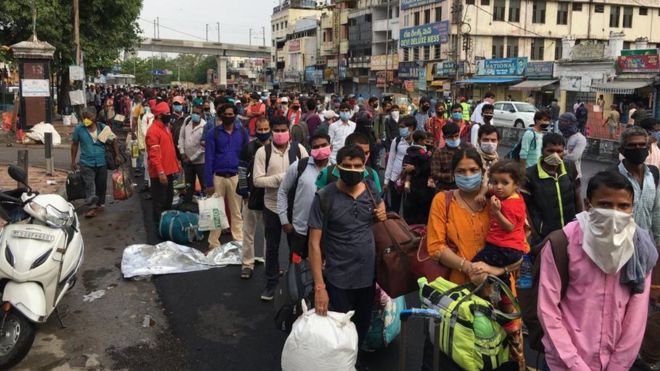
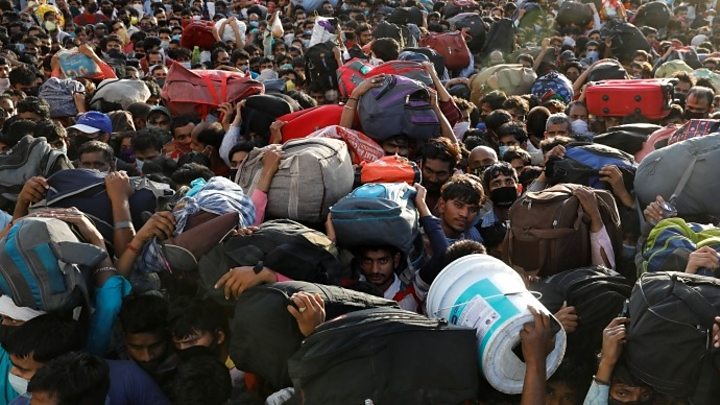
Image caption Passengers gathered outside Secundarabad station in Andhra Pradesh state
India has partially restored train services amid reports of chaos and overcrowding at some stations.
At least 145,000 people will travel in trains on Monday as the country starts to reopen after a prolonged lockdown.
Two hundred trains will now start operations – up from the existing 30 that are currently running.
But maintaining social distancing and cleanliness is proving to be a difficult task as huge crowds gathered outside some stations.
India’s mammoth railway network usually carries 25 million passengers every day.
The ministry of home affairs has issued specific guidelines for the smooth operation of train services. They say that all passengers will have to be screened, social distancing must be followed at the station and in trains and only passengers who have confirmed tickets will be allowed to travel.
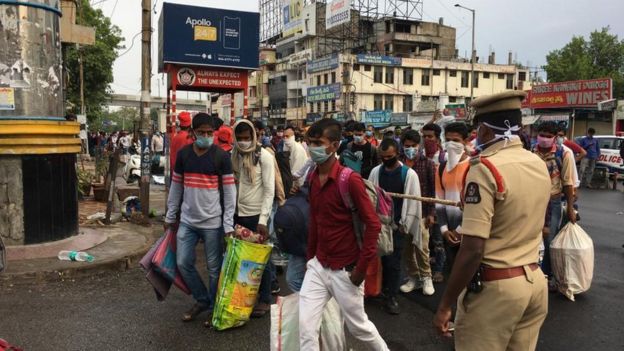
Image caption Police struggled to enforce social distancing due to large crowds
But some stations reported chaotic scenes as officials struggled to enforce these guidelines. BBC Telugu reported that people were standing much too close to each other at Secunderabad railway station in the southern state of Telangana.
“Railway staff and police didn’t allow passengers to go inside the station until at least one hour before the scheduled departure, citing physical distancing measures. This led to some chaos outside the railway station as a large number of passengers had gathered and there was no physical distance maintained. Police later arrived and organised the queues,” BBC Telugu’s Sharath Behara says.
Reporting from Delhi, BBC Hindi’s Salman Ravi said strict social distancing was being followed when passengers boarded trains, and all of them wore masks.
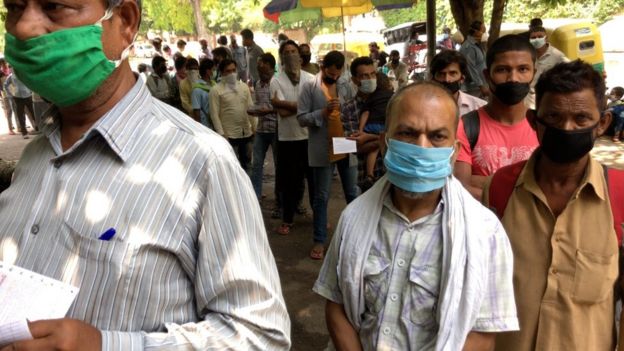
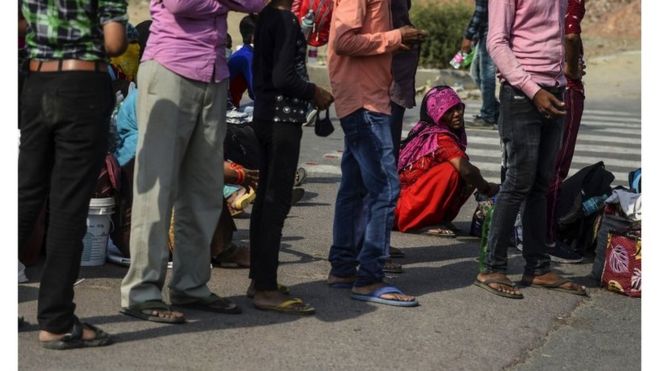
Image caption Passengers waiting outside the train station in Delhi
“But the same was not observed at ticket booking counters. Many people who did not have tickets also turned up at the station and that caused crowding,” he added.
Train services came to a grinding halt when Prime Minister Narendra Modi announced the lockdown on 24 March to stop the spread of coronavirus.
This left millions of daily-wage workers stranded as they desperately tried to go back to their villages from cities. Many of them decided to walk long distances – in some cases more than 1,000 kilometres.
As pressure and criticism mounted, the government started running special trains to ferry migrants. Some 30 trains restarted on 12 May, since then there has been a consistent demand to reopen more routes.
Getting the train network going again is part of the government’s wider strategy to slowly reopen the economy. Millions have lost jobs and factories are struggling to reopen as demand is likely to be sluggish in the coming weeks.
Image copyright GETTY IMAGESImage caption India has more than 150,000 reported infections
On the face of it, things may not look bad.
Since the first case of coronavirus at the end of January, India has reported more than 150,000 Covid-19 infections. More than 4,000 people have died of the infection.
To put this in some context, as of 22 May, India’s testing positivity rate was around 4%, the death rate from the infection around 3% and the doubling rate of infection – or the amount of time it takes for the number of coronavirus cases to double – was 13 days. The recovery rate of infected patients was around 40%.
All this is markedly lower than in the countries badly hit by the pandemic.
Like elsewhere in the world, there are hotspots and clusters of infection.
More than 80% of the active cases are in five states – Maharashtra, Tamil Nadu, Delhi, Gujarat and Madhya Pradesh – and more than 60% of the cases in five cities, including Mumbai, Delhi and Ahmedabad, according to official data.
More than half of people who have died of the disease have been aged 60 and older and many have underlying conditions, hewing to the international data about elderly people being more vulnerable to the disease.
The more than two-month-long grinding lockdown, official data suggests, has prevented the loss of between 37,000 and 78,000 lives. A paper published in Harvard Data Science Review appears to support that – it shows an eight-week lockdown can prevent about two million cases and, at a 3% fatality rate, prevent some 60,000 deaths.
“Infection has remained limited to certain areas. This also gives us confidence to open up other areas. It is so far an urban disease,” says VK Paul, who heads the medical emergency management plan on Covid-19.
This is where such claims enter uncertain territory.
Image copyright GETTY IMAGESImage caption India has conducted some 180,000 tests so far
Infections are rising sharply, up from 536 cases on 25 March when the first phase of the world’s harshest lockdown was imposed. The growth of infections is outpacing growth in testing – tests have doubled since April but cases have leapt fourfold.
Epidemiologists say the increase in reported infections is possibly because of increased testing. India has been testing up to 100,000 samples a day in the past week. Testing criteria has been expanded to include asymptomatic contacts of positive patients.
Yet, India’s testing remains one of the lowest in the world per head of population – 2,198 tests per million people.
The bungled lockdown at the end of March triggered an exodus of millions of informal workers who lost their jobs in the cities and began returning home in droves, first on foot and then by train. Some four million workers have travelled by rail from cities to their villages in more than half a dozen states in the past three weeks.
There is mounting evidence that this has already led to the spread of infection from the cities to the villages. And with the messy easing of the lockdown earlier this month, there are growing fears of infections spreading further in the cities.
Rising infections and a still-low fatality rate possibly points to milder infection in a younger population and a large number of asymptomatic cases. The focus, says Amitabh Kant, CEO of the government think-tank NITI Aayog, should be “bringing down fatalities and improving the recovery rate”.
But if the infection rate continues to grow, “things are going to get pretty grim in a few weeks time,” a leading virologist told me.
Image copyright GETTY IMAGESImage caption Millions of workers have fled the cities and returned to their villages after the lockdown
Doctors in the capital, Delhi, and the western city of Mumbai tell me they are already seeing a steady surge in Covid-19 admissions and worry about a looming shortage of hospital beds, including in critical care.
When the infection peaks in July, as is expected, a spike in infections could easily lead to many avoidable deaths as hospitals run out of beds for, or delay treatment to, infected patients who need timely oxygen support and clinical care to recover.
“That is the real worry. A critical-care bed needs an oxygen line, a ventilator, doctors, nursing staff. Everything will be under pressure,” Dr Ravi Dosi, who is heading a Covid-19 ward at a hospital in Indore, told me. His 50-bed ICU is already full of patients battling the infection.
With the lockdown easing, doctors are feeling jittery. “It’s a tactical nightmare because some people have begun going to work but there is a lot of fear”, says Dr Dosi.
“One co-worker sneezed in the office and 10-15 of his colleagues panicked and came to the hospital and demanded they get tested. These are the pressures that are building up.”
One reason for the confusion is the lack of – or the opacity of – adequate data on the pandemic to help frame a strategic and granular response.
Most experts say a one-size-fits-all strategy to contain the pandemic and impose and lift lockdowns will not work in India where different states will see infection peaks at different times. The reported infection rate – the number of infections for every 100 tests – in Maharashtra state, for example, is three times the national average.
“The infection is not spreading uniformly. India will see staggered waves,” a leading virologist, who insisted on anonymity, told me.
The lack of data means questions abound.
What about some 3,000 cases, which are not being assigned to any state because these people were found infected in places where they don’t live? (To put this into context, nine states in India have more than 3,000 cases.) How many of these cases have died or recovered?
Also, it is not clear whether the current data – sparse, and sporadic – is sufficient to map the future trajectory of the disease.
There is, for example, no robust estimate of carriers of the virus who have no symptoms – last month a senior government scientist said at least “80 out of every 100 Covid-19 patients may be asymptomatic or could be showing mild symptoms”.
Image copyright GETTY IMAGESImage caption More than 4,000 people have died of Covid-19 in India
If that is indeed true, then India’s fatality rate is bound to be lower. Atanu Biswas, a professor of statistics, says the predicted trajectory could change “with the huge inclusion of asymptomatic cases”. But, in the absence of data, India cannot be sure.
Also, epidemiologists say, measures like the doubling time of the infections and the reproduction number or R0 have their limitations. R0, or simply the R value, is a way of rating a disease’s ability to spread. The new coronavirus, Sars-CoV-2, has a reproduction number of about three, but estimates vary.
“These measures are good when we are in the middle of a pandemic, less robust with fewer cases. You do need forecasting models for at least a month’s projection to anticipate healthcare needs. We should always evaluate an aggregate of evidence, not just one measure, but a cascade of measures,” Bhramar Mukherjee, a professor of biostatistics and epidemiology at the University of Michigan, told me.
Others say even calculating the number of recorded infections every day is “not always a good indicator of how an infection is spreading”.
A better option would be to look at the number of new tests and new cases every day that would provide a “degree of standardisation”, K Srinath Reddy, president of the Public Health Foundation of India, told me.
Likewise, he believes, a measure of how many Covid-19 deaths have occurred compared with the size of a country’s population – the numbers of deaths per million people – is a better indicator of the fatality rate. Reason: the denominator – the country’s population – remains stable.
In the absence of robust and expansive data, India appears to be struggling to predict the future trajectory of the infection.
It is not clear yet how many deaths are not being reported, although there is no evidence of large scale “hidden deaths”.
Image copyright GETTY IMAGESImage caption A Covid-19 isolation ward in India
Epidemiologists say they would like to see clearer data on deaths due to pneumonia and influenza-like illnesses at this time over the past few years to quantify excess deaths and help with accurate reporting of Covid-19 deaths.
They would also like to see what racial disparities in infections and deaths there are to help improve containment in specific community areas. (In Louisiana, for example, African Americans accounted for 70% of Covid-19 deaths, while comprising 33% of the population.)
What is clear, say epidemiologists, is that India is as yet unable to get a grip on the extent of the spread of infection because of the still limited testing.
“We need reliable forecasting models with projection for the next few weeks for the country and the states,” says Dr Mukherjee.
Epidemiologists say India needs more testing and contact-tracing for both asymptomatic and symptomatic infections, as well as isolation and quarantine.
There’s also the need to test based on the “contact network” to stop super-spreader events – frontline workers, delivery workers, essential workers, practically anybody who interacts with a large group of people.
“We have to learn how to manage and minimise risk in our daily lives as the virus is going to be with us,” says Dr Mukherjee.
Without knowing the true number of infected cases India is, in the words of an epidemiologist, “flying blindfolded”.
That can seriously jeopardise India’s fight against the virus and hobble its response in reviving the broken economy.
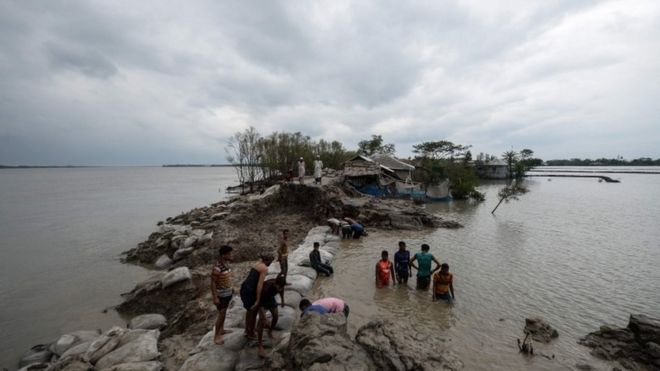
Image copyright AFPImage caption Embankments have been washed away in Bangladesh
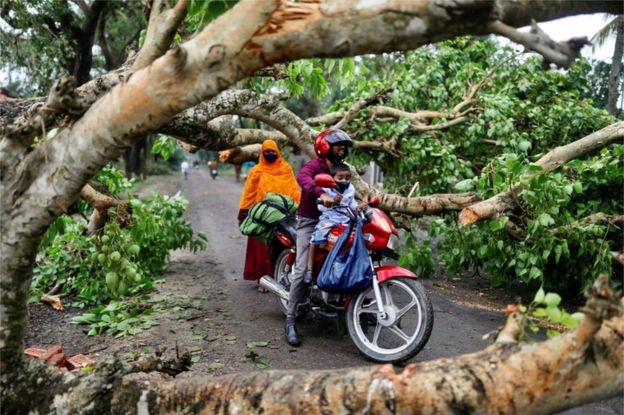
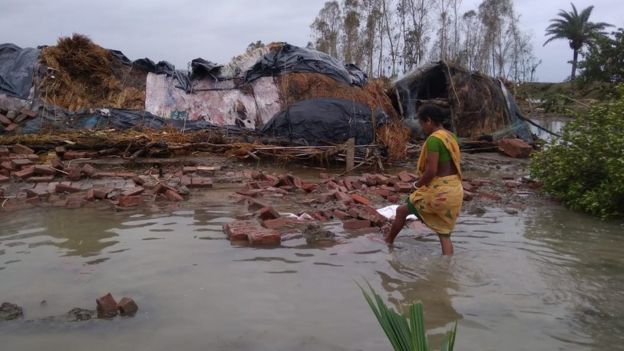
Millions of people across Bangladesh and eastern India are taking stock of the devastation left by Cyclone Amphan.
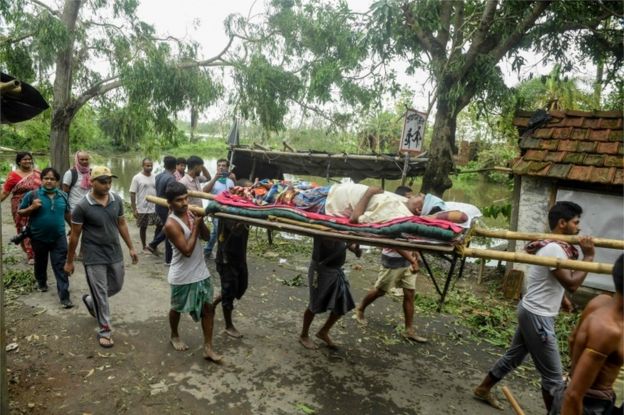
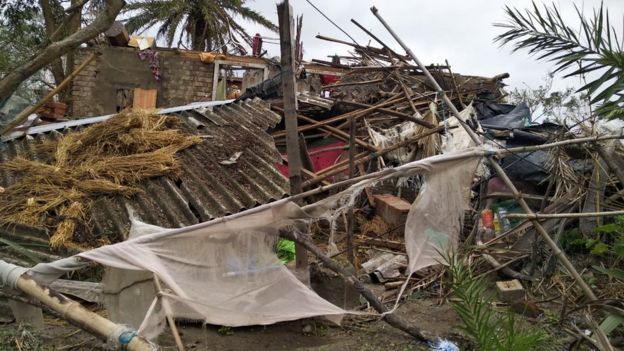
A massive clean-up operation has begun after the storm left 84 dead and flattened homes, uprooted trees and left cities without power.
India’s Prime Minister Narendra Modi has arrived in West Bengal state to conduct an aerial survey.
Authorities in both countries had evacuated millions of people before the storm struck.
Covid-19 and social-distancing measures made mass evacuations more difficult, with shelters unable to be used to full capacity.
Officials also said people were afraid and reluctant to move to shelters for fear of contracting the virus.
The cyclone arrived with winds gusting up to 185km/h (115mph) and waves as high as 15ft.
Image copyright REUTERSImage caption Roads have been blocked by falling trees in BangladeshImage copyright AFPImage caption Many people have been injured in wall collapses in Bengal
It is the first super cyclone to form in the Bay of Bengal since 1999. Though its winds had weakened by the time it struck, it was still classified as a very severe cyclone.
Three districts in India’s West Bengal – South and North 24 Parganas and East Midnapore – were very badly hit.
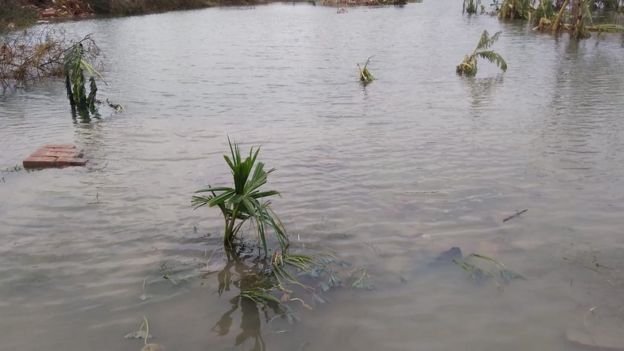
In Bangladesh, there are reports of tens of thousands of homes damaged or destroyed and many villages submerged by storm surges in low-lying coastal areas like Khulna and Satkhira.
The affected areas include the Sunderbans, mangroves spread over an area of more than 10,000 square kilometres that spans both India and Bangladesh – the swampy islands are home to more than four million of the world’s poorest people.
Image copyright MUKTIImage caption Many homes, built of brick and mud, have been washed away
Those in the Sunderbans say it is too early to estimate casualties in the area, which is now cut-off from the mainland by the storm.
“There are houses which have collapsed and people could be trapped in them but we don’t know yet,” Debabrat Halder, who runs an NGO in one of the villages, told the BBC.
He recalls cyclone Bulbul in November 2019, which was followed by a huge incidence of fever, diarrhoea and flu, and is afraid that that the same may happen again.
And worse, he adds, is that the flooding from contaminated sea water, has likely destroyed the soil.
“Nothing will grow in this soil,” he says, adding that it will likely take years to convert it into fertile land again.
Image copyright MUKTIImage caption The Sunderbans delta is frequently hit by severe stormsImage copyright MUKTIImage caption Crops have all been destroyed by the flooding
Kolkata, the capital of West Bengal, and one of India’s biggest cities has been devastated. Its roads are flooded and the city was without power for more than 14 hours.
The state’s chief minister, Mamata Banerjee, said the devastation in Kolkata was “a bigger disaster than Covid-19”.
But assessment of the damage is being hampered by blocked roads and flooding in all these areas.
Image copyright INDIA MET DEPARTMENTImage caption The storm has worsened over the last 12 hours
Indian officials are on alert after Cyclone Amphan – due to make landfall on the east coast – looks likely to intensify into a “very severe” storm.
The storm is expected to make landfall on Wednesday afternoon and hit West Bengal and Odisha states. Twenty relief teams have been dispatched there.
Prime Minister Narendra Modi is due to chair a high-level meeting to further discuss preparations for the storm.
The cyclone comes amid huge levels of migration from the cities to villages.
Tens of thousands of people are fleeing cities in the wake of a lockdown to curb the spread of coronavirus. Both Odisha and West Bengal are seeing a large number of people return.
There are fears about the impact of the storm on them – many are on foot.
India’s meteorological department has issued a “yellow alert” for the region, advising fishermen not to “venture into the south Bay of Bengal during the next 24 hours, and north Bay of Bengal from 18-20 May”.
A ‘”yellow alert” or “cyclone alert” is issued “of the expected commencement of adverse weather over the coastal areas”.
In a bulletin, the weather department said the storm is likely to move across the north-west Bay of Bengal, and cross West Bengal and Bangladesh coasts from noon local time on 20 May as a “very severe cyclonic storm”.
It also warned of rough seas, with storm surges that could inundate coastal areas.
The head of India’s National Disaster Relief Force (NDRF), SN Pradhan, said they were watching the situation closely and were in touch with state governments.
Last June a powerful cyclone that was expected to make landfall on India’s western coast changed its course, and moved further into the Arabian sea.
Hundreds of thousands of people had already been evacuated as the region braced for Cyclone Vayu, which was classified as “very severe”.
And in May last year India evacuated more than a million people to safety to avoid Cyclone Fani, in which 16 people were killed in Odisha.
In the Bay of Bengal, the cyclone season typically runs from April to December.
The plight of these workers, many of whom have been walking for days without adequate food and water, has caused widespread anger in the country.
Train and bus services were shut during the lockdown and even though some have been restarted for migrants, many say they cannot afford the fare and are unsure if they will be accommodated on them due to social distancing norms.
Several have died in making the journey, including 16 migrants who were run over by a train while they were sleeping on the railway tracks.
Media caption Coronavirus: Heartbreaking scenes as India lockdown sparks mass migration
Ms Sitharaman also announced that workers would be able to use ration cards – usually only valid at village level – anywhere in the country regardless of where it was issued.
The ration cards usually entitle holders to subsidised food.
She added that the move towards portable cards would benefit nearly 670 million people and will be completed by March next year.
The government will also provide affordable housing for migrant labour by converting existing vacant government funded housing complexes, among other things.
The announcements on Thursday – the second tranche of a series of economic stimulus measures – were aimed at migrant workers, street hawkers, small traders and small farmers.
The full details of the economic package, which is equivalent to 10% of India’s gross domestic product, will be known in some days as the government is announcing a different tranche every day.
Ms Sitharaman’s announcements also included details of “special credit” to be provided to five million street hawkers who have been forced to cease working over the last month and a half.
To help farmers, the government also announced an emergency $4bn “working capital funding” which would benefit some 30 million small farmers to meet crop requirements in May and June
In March, India said it would provide around 1.7 trillion rupees in direct cash transfers and food security measures, mainly for the poor.
However, Mr Modi’s administration had been accused in some quarters of not having done enough.
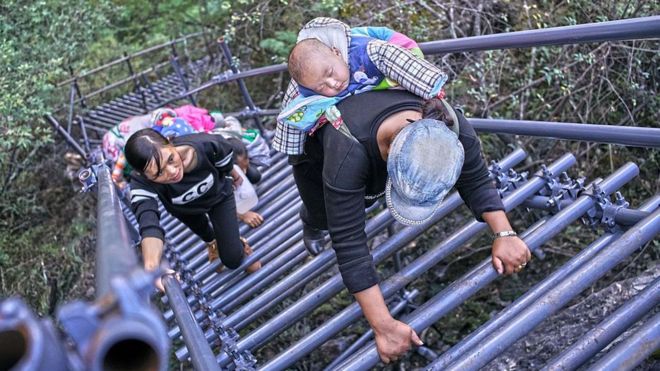
Image copyright GETTY IMAGESImage caption The village made headlines after photos showed people scaling ladders to get home
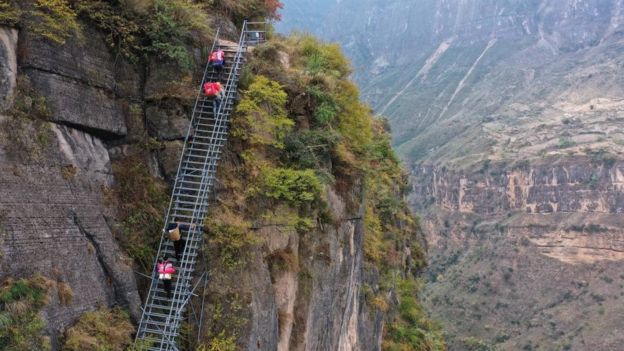
They used to call an 800m-high cliff home, but dozens of villagers in China’s Sichuan province have now been relocated to an urban housing estate.
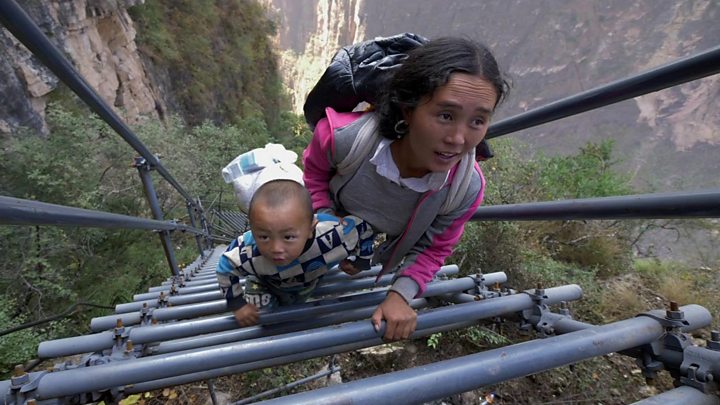
Atulie’er village became famous after photos emerged showing adults and children precariously scaling the cliff using just rattan ladders.
Around 84 households have now been moved into newly built flats as part of a local poverty alleviation campaign.
It’s part of a bigger national campaign to end poverty by the end of 2020.
‘So happy I got a house’
Atulie-er village made headlines in 2016 when it was revealed that its villagers had to scale precarious ladders to get home, carrying babies and anything the village needed.
The households have now been moved to the county town of Zhaojue, around 70km away.
They will be rehoused in furnished apartment blocks, which come in models of 50, 75 and 100 sq m – depending on the number of people in each household.
It’ll be a big change for many of these villagers, who are from the Yi minority and have lived in Atulie-er for generations.
According to Mark Wang, a human geography professor at the University of Melbourne, such housing schemes are often heavily subsidised by the government, typically up to 70%. However, in some instances families have been unable to afford the apartments despite the subsidies.
“For some really poor villages, the 30% may still be difficult for them to pay, so they end up having to borrow money – [ironically] causing them even more debt,” he told BBC News.
“For the poorest, it’s a big financial burden and so in some instances, they might have to stay.”
According to Chinese state media outlet China Daily, each person will have to pay 2,500 yuan ($352; £288) for this particular move – so for a family of four, the cost would come up to 10,000 yuan.
Image copyright GETTY IMAGESImage caption This is the journey the villagers had to make to get home
This is quite a low price, says Mr Wang, as he had heard of people having to pay up to 40,000 yuan for other relocation projects.
Mr Wang says in most poverty resettlement campaigns, villagers are given a choice whether or not to move, and are not usually moved into cities from the countryside.
“In most instances it’s a move to a county town or a suburb. So it’s not like they’re moving to a big city. Not everyone wants an urban life and most of those who do would have already left these villages and moved to the big cities,” he says.
“Usually the government [puts a limit] on the resettlement distance. This is in most people’s favour because it means they can keep their farm land, so that’s very attractive.”
The Atulie’er villagers will share this new apartment complex with impoverished residents across Sichuan province.
Image copyright CGTN/YOUTUBEImage caption The villagers will be living in these apartment buildings
Around 30 households will remain in the Atulie’er village- which is set to turn into a tourism spot.
According to Chinese state media outlet China Daily, these households will effectively be in charge of local tourism, running inns and showing tourists around.
The county government has ambitious plans – planning to install a cable car to transport tourists to the village and to develop some surrounding areas. An earlier report said there were plans to turn the village into a vacation resort, with state media saying the state would pump 630 million yuan into investment.
Though these developments are likely to bring more jobs to the area, it’s not clear what safeguards are in place to make sure that the site’s ecological areas are protected and not at risk of being overdeveloped.
Media caption Do people in China’s rural communities think poverty reduction can work?
Chinese President Xi Jinping has declared that China will eradicate poverty in China by 2020.
There’s no one standard definition of poverty across all of China, as it differs from province to province.
One widely quoted national standard is 2,300 yuan ($331; £253) net income a year. Under that standard, there were around 30 million people living in poverty across the whole of China in 2017.
But the 2020 deadline is approaching fast – and Mr Wang says the plan could be derailed by the virus outbreak.
“Even without Covid-19 it would be hard to meet this deadline and now realistically, it has made it even more difficult.”
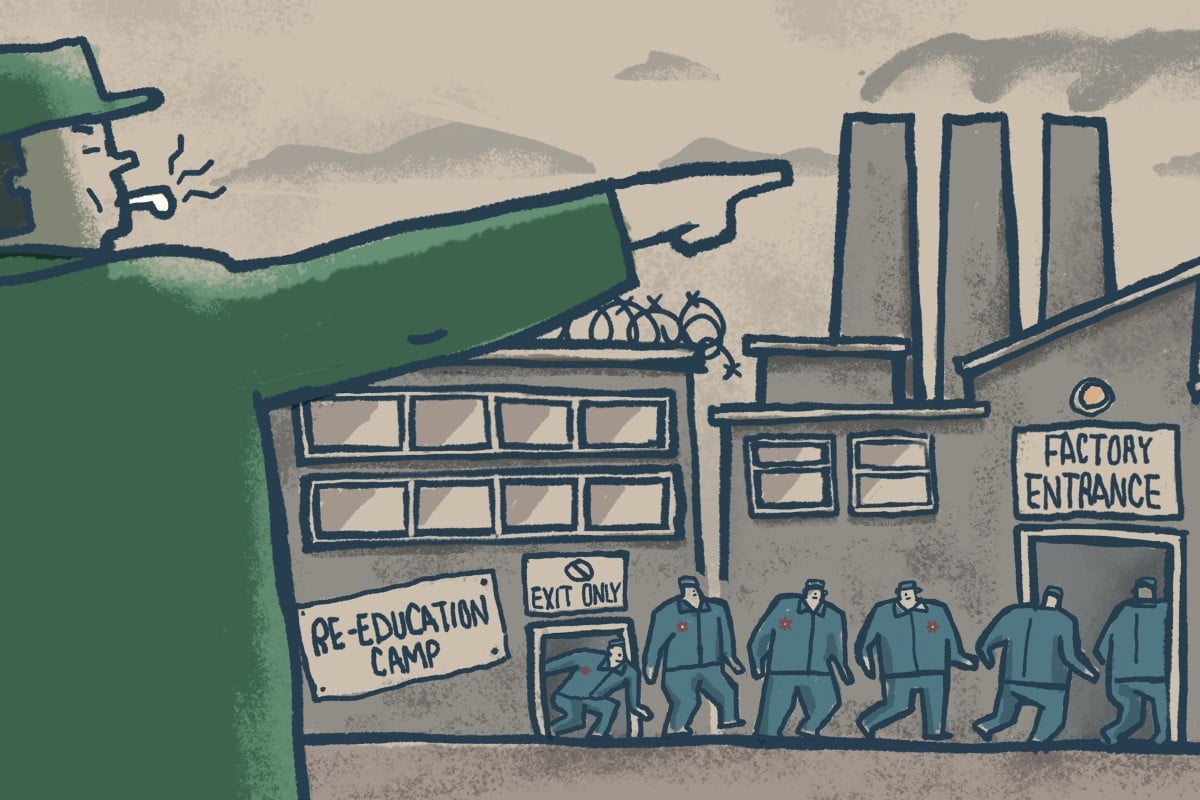
Inmates who have undergone compulsory re-education programme to be moved to other parts of China under job placement scheme delayed by Covid-19 outbreak
Critics have said the camps are a move to eradicate cultural and religious identity but Beijing has defended them as way of boosting job opportunities and combating Islamic radicalisation
Illustration by Perry Tse
The Chinese government has resumed a job placement scheme for tens of thousands of Uygur Muslims who have completed compulsory programmes at the “re-education” camps in the far-western region of Xinjiang, sources said.
The plan, which includes a quota for the numbers provinces must take, was finalised last year but disrupted by the outbreak of Covid-19.
The delay threatens to undermine the Chinese government’s efforts to justify its use of internment camps in Xinjiang.
Critics have said these camps were part of the measures designed to eradicate the ethnic and cultural identity of Uygurs and other Muslim minorities and that participants had no choice but to undertake the re-education programme.
Beijing has repeatedly dismissed these criticisms and said the camps are to give Uygurs the training they need to find better jobs and stay away from the influence of radical fundamentalism.
First Xinjiang, now Tibet passes rules to promote ‘ethnic unity’
17 Feb 2020
Now with the disease under control, the Chinese government has resumed the job placement deal for other provinces to absorb Xinjiang labourers, sources said.
Despite the devastating impact of the disease on its economy and job markets, the Chinese authorities are determined to go ahead with the plan, which they believe would
“Excellent graduates were to be taken on as labourers by various inland governments, in particular, 19 provinces and municipalities,” said the source. It is unclear what constitutes “excellent graduates”.
Some sources earlier said that the programme may be scaled back in light of the new economic reality and uncertainties.
But a Beijing-based source said the overall targets would remain unchanged.
“The unemployment problem in Xinjiang must be resolved at all costs, despite the outbreak,” the source said.
The South China Morning Post has learned that at least 19 provinces and cities have been given quotas to hire Muslim minorities, mostly Uygurs, who have “graduated” from re-education camps.
As early as February, when the daily number of infections started to come down outside Hubei province, China already begun to send Uygur workers to their new jobs.
A photo taken in February showed thousands of young Uygurs, all wearing face masks and with huge red silk flowers pinned to their chests, being dispatched to work in factories outside their hometowns.
By the end of February, Xinjiang alone has created jobs for more than 60,000 Uygur graduates from the camps. A few thousand were also sent to work in other provinces.
Many have been employed in factories making toys and clothes.
Xinjiang’s new rules against domestic violence expand China’s ‘extremism’ front to the home
7 Apr 2020
Sources told the Post that the southern city of Shenzhen – China’s hi-tech manufacturing centre – was given a target last year to eventually resettle 50,000 Uygurs. The city is allowed to do this in several batches, with 15,000 to 20,000 planned for the first stage.
In Fujian province, a government source also said they had been told to hire “tens of thousands of Xinjiang workers”.
“I heard the first batch of several thousands would arrive soon. We have already received official directives asking us to handle their settlement with care,” said the source.
He said the preparation work includes providing halal food to the workers as well as putting in place stronger security measures to “minimise the risks of mass incidents”. It is not known whether they will be given access to prayer rooms.
There are no official statistics of how many Uygurs will be resettled to other provinces and the matter is rarely reported by the mainland media.
But in March, Anhui Daily, the province’s official newspaper, reported that it had received 1,560 “organised labourers from Xinjiang”.
The Uygur workers on average could earn between 1,200 yuan (US$170) to 4,000 yuan (US$565) a month, with accommodation and meals provided by the local authorities, according to Chinese media reports.
However, they are not allowed to leave their dormitories without permission.
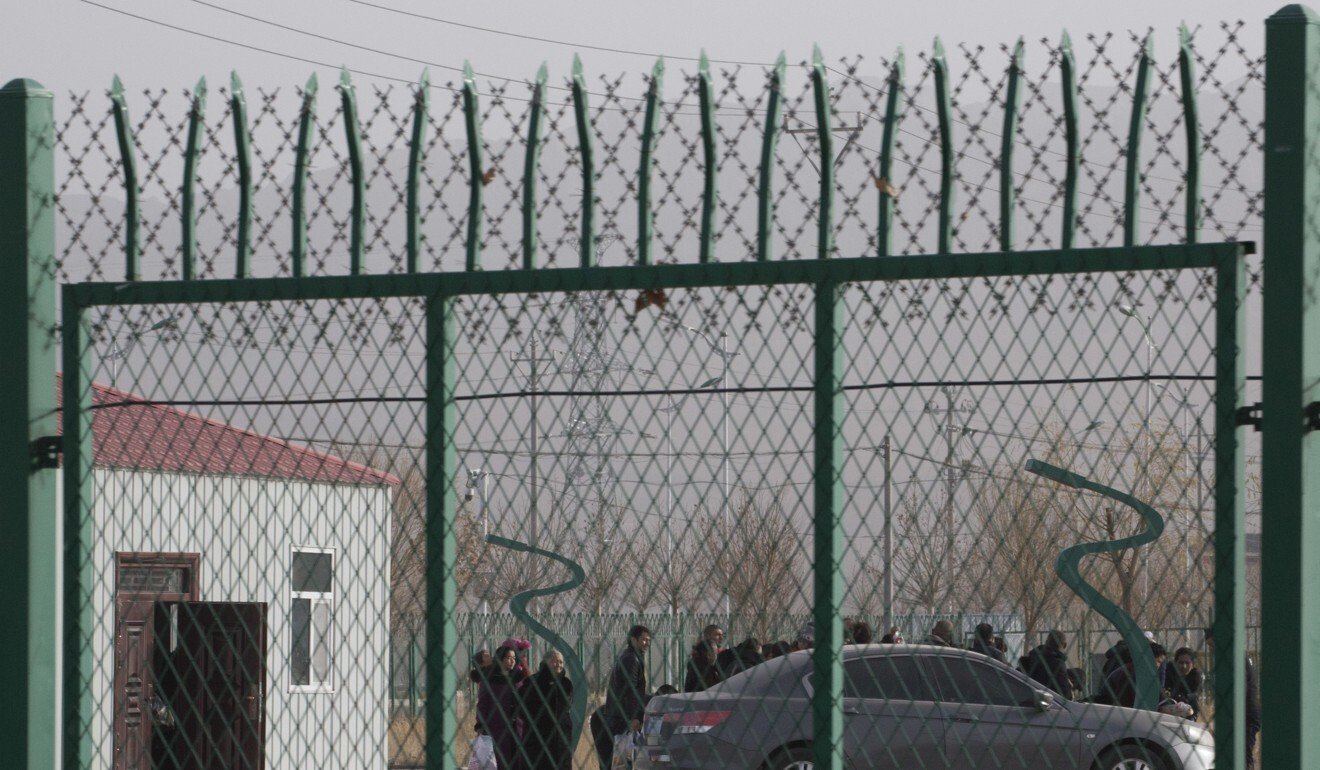
The UN has estimated that up to a million Muslims were being held in the camps. Photo: AP
Xinjiang’s per capita disposable income in 2018 was 1,791 yuan a month, according to state news agency Xinhua. But the salary level outside the region’s biggest cities such as Urumqi may be much lower.
The official unemployment rate for the region is between 3 and 4 per cent, but the statistics do not include those living in remote rural areas.
Mindful of the potential risks of the resettlement, Beijing has taken painstaking efforts to carefully manage everything – from recruitment to setting contract terms to managing the workers’ day-to-day lives.
Local officials will go to each Uygur workers’ home to personally take them to prearranged flights and trains. On arrival, they will be immediately picked up and sent to their assigned factories.
US bill would bar goods from Xinjiang, classifying them the product of forced labour by Uygurs
12 Mar 2020
Such arrangements are not unique to Uygurs and local governments have made similar arrangements for ethnic Han workers in other parts of China.
After screening them for Covid-19, local governments have arranged for workers to be sent to their workplaces in batches. They are checked again on arrival, before being sent to work.
China is accelerating such placement deals on a massive scale to offset the impact of the economic slowdown after the outbreak.
Sources told the South China Morning Post that the job placement deal was first finalised by governments in Xinjiang and other provinces last year.
The aim is to guarantee jobs for Uygur Muslim who have “completed vocational training” at the re-education camps and meet poverty alleviation deals in the region, one of the poorest parts of China.
The training they receive in the camps includes vocational training for various job types such as factory work, mechanical maintenance and hotel room servicing. They also have to study Mandarin, Chinese law, core party values and patriotic education.
Xinjiang’s massive internment camps have drawn widespread international condemnation.
The United Nations has estimated that up to 1 million Uygur and other Muslim minority citizens are being arbitrarily detained in the camps, which Beijing insists are necessary to combat terrorism and Islamic radicalisation.
Late last year, Xinjiang’s officials announced that all the inmates of these so-called vocational training centres had “graduated” and taken up employment.
Before this labour placement scheme was introduced, it was extremely difficult for Uygurs to find jobs or live and work in inland regions.
Muslim ethnic minorities, Uygurs in particular, have been subjected to blatant discrimination in China and the situation worsened after the 2009 clashes.
Earlier this month, the Australian Strategic Policy Institute released a report saying more than 80,000 Uygurs had been moved from Xinjiang to work in factories in nine Chinese regions and provinces.
It identified a total of 27 factories that supplied 83 brands, including household names such as Google, Apple, Microsoft, Mitsubishi, Siemens, Sony, Huawei, Samsung, Nike, Abercrombie and Fitch, Uniqlo, Adidas and Lacoste.
‘Psychological torture’: Uygurs abroad face mental health crisis over plight of relatives who remain in Xinjiang
11 Mar 2020
The security think tank concluded that the Chinese government had transferred Uygur workers “under conditions that strongly suggest forced labour” between 2017 and 2019, sometimes drawing labourers directly from re-education camps.
The report also said the work programme represents a “new phase in China’s social re-engineering campaign targeting minority citizens”.
Workers were typically sent to live in segregated dormitories, underwent organised Mandarin lessons and ideological training outside working hours and were subject to constant surveillance, the researcher found.
They were also forbidden from taking part in religious observances, according to the report that is based on open-source documents, satellite pictures, academic research and on-the-ground reporting.
Chinese foreign ministry spokesman Zhao Lijian criticised the report saying it had “no factual basis”.
Carrier targets return of daily services to major Asian cities and more frequent long-haul services
Airline to monitor global situation and adjustments may be made ‘as necessary’
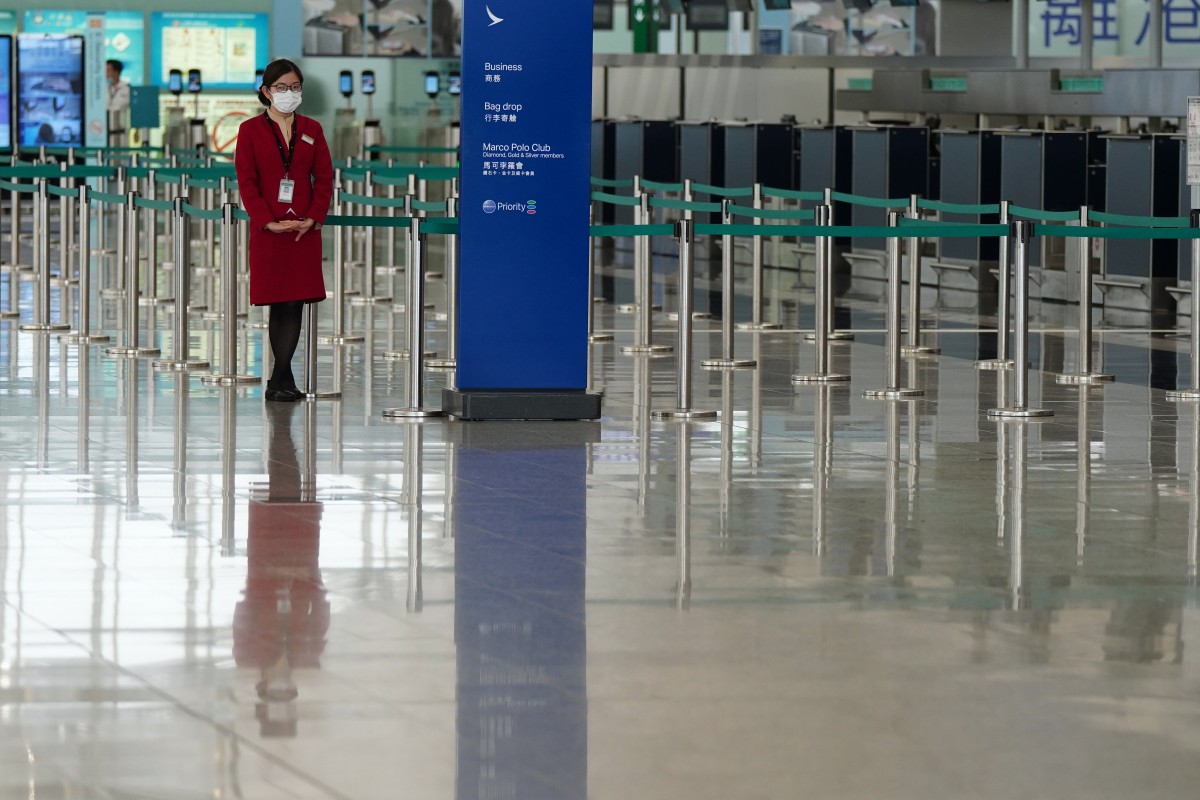
A Cathay Pacific employee stands near the check-in desks at a virtually deserted Hong Kong International Airport. Photo: Sam Tsang
Cathay Pacific Airways has signalled its intent to start reversing its near-total grounding of aircraft because of the coronavirus pandemic, and plans to start increasing its number of passenger flights in the last week of June.
The airline said it hoped to add more long-haul destinations, make flights more frequent, and reinstate some major Asian cities to its daily schedule for the first time in several months, “subject to government travel restrictions”.
Cathay scaled its operations back to a skeleton schedule of 3 per cent of services in early April, and that was extended until June 20. The newly announced increases would take that up to 5 per cent.
Tracking the massive impact of the Covid-19 pandemic on the world’s airline industry in early 2020 Singapore Airlines, another of Asia’s major carriers, said last week it would maintain a 96 per cent reduction in flights until the end of June.
Cathay, which has 236 aircraft, currently operates long-haul flights to London Heathrow, Los Angeles, Vancouver and Sydney twice a week, but will increase that to five times a week.
On top of that, Amsterdam, Frankfurt, San Francisco and Melbourne are among the long-haul destinations set to return three times a week.
With regional routes currently operating three times a week, including Tokyo Narita, Taipei, Beijing and Singapore, Asian routes will increase to a daily service. Osaka and Seoul would also return to the network, too.
“We will continue to monitor the developing situation and further adjustments may be made as necessary,” the airline said.
Coronavirus: ban on non-residents leaves Hong Kong airport virtually deserted
Earlier this month, Cathay’s budget unit HK Express extended its total grounding until June 18, having been on hiatus since March 23.
Meanwhile, Boeing has added to warnings of a very slow recovery in air travel, with Dave Calhoun, its CEO, saying demand may not return to 2019 levels for two to three years.
Cathay Pacific’s daily passenger volume has collapsed from regular previous peaks of 100,000 to less than 1,000 in April. Over the past two months, the company has been running more than 250 extra pairs of cargo-only passenger flights to maintain air freight capacity, much of which is accounted for by passenger services.
In a bid to cut costs, most of the Cathay Pacific Group’s 34,200 staff have taken three weeks of unpaid leave. Also, 433 cabin crew in the US and Canada were told they would be laid off, while about 200 pilots in the UK, Australia have been furloughed.
The International Air Transport Association, which revised down pandemic-related revenue losses for the global sector to US$314 billion (HK$2.4 trillion) two weeks ago, said last week the Hong Kong aviation market would take a US$7.5 billion hit this year, a 27 per cent increase on the previous estimate. That equates to a 59 per cent decline in air travel demand, or a loss of almost 31 million passengers, in 2020.
BOCOM International, a financial services company, forecast in a report on Monday that the city’s aviation sector would lose HK$65.2 billion in revenue in 2020, yet Cathay Pacific could emerge as a winner if it survived largely unscathed, given the weakness of rivals at home and in the region plus its dominant position in Hong Kong.
“Hong Kong aviation is at the most critical juncture in its history. Though calamitous, Covid-19 is set to reshape Hong Kong’s aviation industry for the years, possibly decades, to come,” said transportation analyst Luya You.
“Covid-19’s sweeping blows now offer a blank slate for remaining players to regain lost leadership or gain new markets. If [Cathay Pacific] can survive intact from Covid, the carrier could enjoy winner-takes-all growth trajectory in the years following [2020].”
QINGDAO, April 27 (Xinhua) — New cargo train services have been launched between east China’s Shandong Province and countries of Shanghai Cooperation Organization (SCO).
A train carrying 45 containers departed Monday from the intermodal transportation center of the demonstration zone for China-SCO local economic and trade cooperation in the city of Qingdao, according to the demonstration zone.
The train, loaded with excavators and land levelers worth a total of 20 million yuan (2.8 million U.S. dollars), is expected to arrive at Almaty, Kazakhstan, in eight days.
With the intermodal transportation center in Qingdao as the cargo distribution center, the monthly train services will deliver cargo to more than 30 cities of SCO countries, including Tashkent, Minsk and Ulan Bator.
SHANGHAI (Reuters) – China’s smog-prone northern province of Hebei met its air quality targets by a big margin over the winter after concerted efforts to tackle emissions, a local official said on Sunday, without mentioning coronavirus-related factory shutdowns.
Average PM2.5 concentrations over the October-March period dropped 15% from a year earlier to 61 micrograms per cubic metre, while sulphur dioxide also fell by a third, said He Litao, vice-head of the provincial environmental bureau.
Most experts have attributed the significant decline in air pollution throughout China in the first quarter to the coronavirus outbreak and tough containment measures, which saw cities and entire provinces locked down and sharply reduced traffic and industrial activity throughout the country.
With millions staying at home, concentrations of lung-damaging PM2.5 particles fell by nearly 15% in more than 300 Chinese cities in the first three months of 2020.
Shanghai saw emissions fall by nearly 20% in the first quarter, while in Wuhan, where the pandemic originated, monthly averages dropped more than a third compared to last year.
However, He of the Hebei environmental bureau attributed the local decline in pollution to the “conscientious implementation” of government decisions even in the face of unfavourable weather conditions.
According to a winter action plan published last year, 10 cities in Hebei were expected to cut lung-damaging small particles known as PM2.5 by 1%-6% compared to the previous year.
Despite the decline, average PM2.5 was still much higher than China’s official standard of 35 micrograms, and the recommended World Health Organization level of 10 micrograms.












 CHINDIA ALERT: You'll be living in their world, very soon