Chindia Alert: You’ll be Living in their World Very Soon
aims to alert you to the threats and opportunities that China and India present. China and India require serious attention; case of ‘hidden dragon and crouching tiger’.
Without this attention, governments, businesses and, indeed, individuals may find themselves at a great disadvantage sooner rather than later.
The POSTs (front webpages) are mainly 'cuttings' from reliable sources, updated continuously.
The PAGEs (see Tabs, above) attempt to make the information more meaningful by putting some structure to the information we have researched and assembled since 2006.
TAIPEI (Reuters) – Taiwan cannot accept becoming part of China under its “one country, two systems” offer of autonomy , President Tsai Ing-wen said on Wednesday, strongly rejecting China’s sovereignty claims and likely setting the stage for an ever worsening of ties.
China responded that “reunification” was inevitable and that it would never tolerate Taiwan’s independence.
In a speech after being sworn in for her second and final term in office, Tsai said relations between Taiwan and China had reached an historical turning point.
“Both sides have a duty to find a way to coexist over the long term and prevent the intensification of antagonism and differences,” she said.
Tsai and her Democratic Progressive Party won January’s presidential and parliamentary elections by a landslide, vowing to stand up to China, which claims Taiwan as its own and says it would be brought under Beijing’s control by force if needed.
“Here, I want to reiterate the words ‘peace, parity, democracy, and dialogue’. We will not accept the Beijing authorities’ use of ‘one country, two systems’ to downgrade Taiwan and undermine the cross-strait status quo. We stand fast by this principle,” Tsai said.
China uses the “one country, two systems” policy, which is supposed to guarantee a high degree of autonomy, to run the former British colony of Hong Kong, which returned to Chinese rule in 1997. It has offered it to Taiwan, though all major Taiwanese parties have rejected it.
China’s Taiwan Affairs Office, responding to Tsai, said Beijing would stick to “one country, two systems” – a central tenet of Chinese President Xi Jinping’s Taiwan policy – and “not leave any space for Taiwan independence separatist activities”.
“Reunification is a historical inevitability of the great rejuvenation of the Chinese nation,” it said. “We have the firm will, full confidence, and sufficient ability to defend national sovereignty and territorial integrity.”
China views Tsai as a separatist bent on formal independence for Taiwan. Tsai says Taiwan is an independent state called the Republic of China, its official name, and does not want to be part of the People’s Republic of China governed by Beijing.
TAIWAN OPEN TO DIALOGUE
China has stepped up its military drills near Taiwan since Tsai’s re-election, flying fighter jets into the island’s air space and sailing warships around Taiwan.
Tsai said Taiwan has made the greatest effort to maintain peace and stability in the narrow Taiwan Strait that separates the democratic island from its autocratic neighbour China.
“We will continue these efforts, and we are willing to engage in dialogue with China and make more concrete contributions to regional security,” she added, speaking in the garden of the old Japanese governor’s house in Taipei, in front of a socially-distanced audience of officials and diplomats.
Taiwan has become a rising source of friction between China and the United States, with the Trump administration strongly backing Taiwan even in the absence of formal diplomatic ties.
U.S. Secretary of State Mike Pompeo sent his congratulations to Tsai on Tuesday, praising her “courage and vision in leading Taiwan’s vibrant democracy”, in a rare high-level message from Washington direct to Taiwan’s government.
China’s Foreign Ministry condemned Pompeo’s remarks, and said the government would take “necessary countermeasures”, though did not elaborate.
China cut off a formal talks mechanism with Taiwan in 2016 after Tsai first won election.
Yao Chia-wen, a senior adviser to Tsai, told Reuters the chance of talks with China were small given ongoing tensions.
“We are ready to engage with them any time, but China is unlikely to make concessions to Taiwan,” he said. “In the next four years there’s little chance for the cross-strait relationship to improve.”
TAIPEI (Reuters) – Taiwan waded into the hotly contested politics of the Pacific on Wednesday, donating face masks and thermal cameras to its four diplomatic allies there to combat the coronavirus in a region where China is challenging traditional power of the United States.
The small developing nations lie in the highly strategic waters of the Pacific, dominated since World War Two by the United States and its friends, who have been concerned over China’s moves to expand its footprint there.
Democratic Taiwan has faced intense pressure from China, which claims the island as its territory with no right to state-to-state ties, and is bent on wooing away its few allies.
Taiwan has only 15 formal allies left worldwide after losing two Pacific nations, the Solomon Islands and Kiribati, to China in September.
Beijing has ramped up its diplomatic push into the Pacific, pledging virus aid and medical advice.
In its own aid programme, Taiwan has donated 16 million masks to countries around the world.
“We are a very small country, so it’s easier for us to work with Taiwan than mainland China,” Neijon Edwards, the Marshall Islands ambassador to Taiwan, told Reuters at the donation ceremony in Taipei.
China has been too overbearing, she added.
“It’s pressing too much, and it’s been trying to come to the Marshall Islands, several times, but up to this time we haven’t even opened the door yet.”
While the masks presented at the ceremony are going to Taiwan’s Pacific allies, all its 15 global allies are sharing the thermal cameras.
“Today’s ceremony once again shows that Taiwan is taking concrete actions not only to safeguard the health of Taiwanese people but also to contribute to global efforts to contain COVID-19,” said Foreign Minister Joseph Wu.
Though Pacific Island states offer little economically to either China and Taiwan, their support is valued in global forums such as the United Nations and as China seeks to isolate Taiwan.
China has offered to help developing countries including those of the Pacific, and many see Chinese lending as the best bet to develop their economies.
But critics say Chinese loans can lead countries into a “debt trap”, charges China has angrily rejected.
The debt issue was a serious problem and would only lead to the spread of Chinese influence regionwide, said Jarden Kephas, the ambassador of Nauru.
“They will end up dominating or having a lot of say in those countries because of the amount of debt,” he told Reuters, wondering how the money could ever be repaid. “We are not rich countries.”
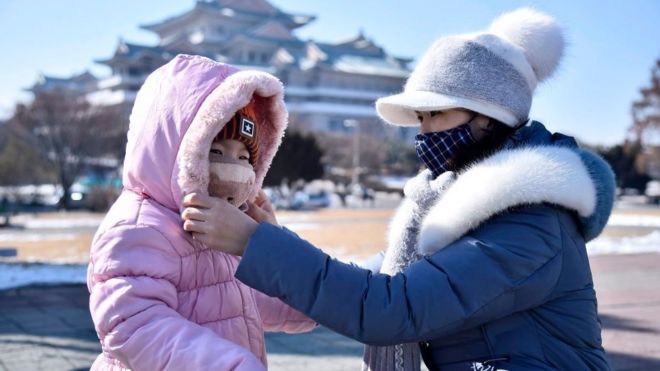
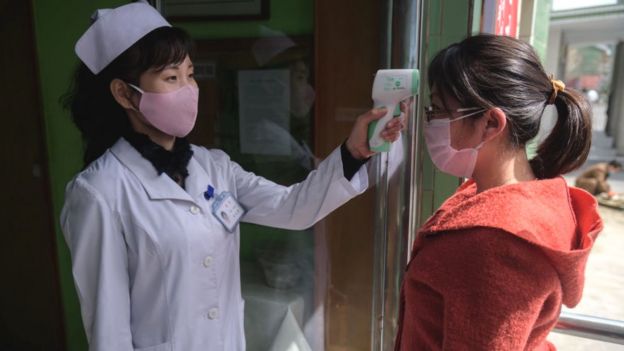
Image copyright GETTY IMAGESImage caption North Korea says not a single person has the virus
North Korea’s claim that “not a single person” in the country has been infected with the coronavirus is facing growing scepticism.
It has credited strict containment measures and the shutting down of its borders for this success.
But the top US military commander in South Korea has said this is “untrue”, calling it an “impossible claim”.
A North Korean expert told the BBC it was likely there were cases but unlikely a mass outbreak had happened.
There are currently more than one million coronavirus cases across the world and 53,069 deaths, according to a Johns Hopkins University tally.
Pak Myong-su, a director at North Korea’s Central Emergency Anti-epidemic headquarters, told news agency AFP on Friday: “Not one single person has been infected with the novel coronavirus in our country so far.”
“We have carried out pre-emptive and scientific measures such as inspections and quarantine for all personnel entering our country and thoroughly disinfecting all goods, as well as closing borders and blocking sea and air lanes.”
Could this be true?
US General Robert Abrams, head of the US military forces in South Korea, has said it is untrue that North Korea has no virus cases.
“I can tell you that is an impossible claim based on all of the intel that we have seen,” he said in a joint interview with news sites CNN and VOA.
However, he said he could not say exactly how many cases there were, not confirm where the information came from.
Oliver Hotham, managing editor of specialist news site NK News, agreed that North Korea has probably had cases.
“It’s very unlikely that it has seen no cases because it borders China and South Korea. [Especially with China], given the amount of cross border trade and the economic relationship I really don’t see how its possible they could have prevented it,” he said.
However, he adds that it is “unlikely” there is a full scale outbreak.
“They really did take precautions early. I think it’s possible they’ve prevented a full on outbreak.”
How has North Korea reacted to the crisis?
North Korea has indeed moved much more quickly against the virus than many other countries in the region.
In late January, it sealed off its borders and later quarantined hundreds of foreigners in the capital Pyongyang. During that time, the number of cases in China were growing exponentially.
An NK News report also suggests that up to 10,000 citizens had been placed under isolation in the country – around 500 still remain in quarantine.
Are those in North Korea even aware of the virus?
Most people in North Korea are “really aware” of what’s going on, says Mr Hotham.
“There’s been so much media coverage. Almost every day you have a whole page about the efforts the country is taking domestically and also the international situation,” he told the BBC.
Fyodor Tertitskiy, a senior researcher at Kookmin University, also adds the country is currently running an “ongoing propaganda campaign teaching people how to prevent the spread of the virus”.
The answer is, according to experts – better than you would think – depending on where in North Korea you are.
Mr Tertitsky says the North’s healthcare system is “much, much better than other countries with a similar GDP per capita”.
“What they did was to train a large number of doctors who, although less qualified and infinitely paid less than their colleagues in the West, can still provide basic healthcare to the population,” he told the BBC.
Mr Hotham agrees, but says that the number of doctors in North Korea enables the country to deal with basic illnesses, but perhaps not so much more serious illnesses which also need more healthcare equipment.
Sanctions have also restricted North Korea’s ability to obtain advanced medical equipment.
Mr Hotham adds that the care you receive largely depends on where you are. The capital, Pyongyang, for example, has various medical facilities, but those in rural areas might not be so lucky.
“Some provinces are desperately underfunded, where you’ll have hospitals with no running water or stable power.”
Image copyright GETTY IMAGESImage caption Some international experts say North Korea’s health system is appalling
Why might North Korea be trying to cover up cases?
For North Korea to admit they have cases now could be a sign of “defeat”.
“The state has put a lot of stock into its response and there has been so much propaganda about how well they’re doing,” said Mr Hotham.
“I think for them to admit now that there were cases is essentially to admit defeat. I think it would also cause panic and people would freak out. If you have large movements of people trying to get away, that could create instability and even more infections.”
Mr Tertitskiy also puts this down to North Korea trying to preserve its self-image.
“The country is very paranoid about giving away any information that may make it look bad. Their basic rule is to say nothing unless there is a good reason to do otherwise.”
British supermarket is investigating after newspaper report that six-year-old girl found message in card saying it was packed by Shanghai prisoners
Britain’s biggest retailer Tesco said it was “shocked by these allegations”. Photo: AFP
British supermarket giant Tesco suspended a Chinese supplier of Christmas cards on Sunday after a press report said a customer found a message written inside a card saying it had been packed by foreign prisoners who were victims of forced labour.
“We abhor the use of prison labour and would never allow it in our supply chain,” a Tesco spokesman said on Sunday.
“We were shocked by these allegations and immediately suspended the factory where these cards are produced and launched an investigation.”
donates £300,000 (US$390,000) a year from the sale of the cards to the charities British Heart Foundation, Cancer Research UK and Diabetes UK.
The Sunday Times said the message inside the card read: “We are foreign prisoners in Shanghai Qingpu Prison China. Forced to work against our will. Please help us and notify human rights organisation.
“Use the link to contact Mr Peter Humphrey.”
Peter Humphrey is a British former journalist and corporate fraud investigator.
Humphrey and his American wife Yu Yingzeng were both sentenced in China in 2014
for illegally obtaining private records of Chinese citizens and selling the information to clients including drug maker GlaxoSmithKline. The couple were deported from China in June 2015 after their jail terms were reduced.
The message inside the card was found by a six-year-old girl, Florence Widdicombe, in London, The Sunday Times said. Her father contacted Humphrey via the LinkedIn social network.
Writing in The Sunday Times, Humphrey said he did not know the identities or the nationalities of the prisoners who put the note into the card, but he “had no doubt they are Qingpu prisoners who knew me before my release in June 2015 from the suburban prison where I spent 23 months”.
Tesco, Britain’s biggest retailer, said it had a comprehensive auditing process in place.
“This supplier was independently audited as recently as last month and no evidence was found to suggest they had broken our rule banning the use of prison labour,” the spokesman said.
“If a supplier breaches these rules, we will immediately and permanently delist them.”
Sky News said the cards were produced at the Zheijiang Yunguang Printing factory, which is about 100km (60 miles) from Shanghai Qingpu prison.
The company, which prints cards and books for food and pharmaceutical companies, says on its website it supplies Tesco.
Two phone calls and one emailed request for comment to the company went unanswered after usual business hours on Sunday.
Humphrey and his wife said in their trial they had not thought they were doing anything illegal in their activities in China.
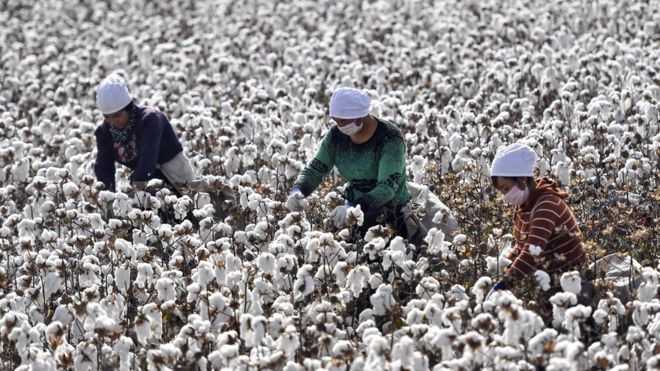
Global retailers are facing scrutiny over cotton supplies sourced from Xinjiang, a Chinese region plagued by allegations of human rights abuses.
China is one of the world’s top cotton producers and most of its crop is grown in Xinjiang.
Rights groups say Xinjiang’s Uighur minority are being persecuted and recruited for forced labour.
Many brands are thought to indirectly source cotton products from the Xinjiang region in China’s far west.
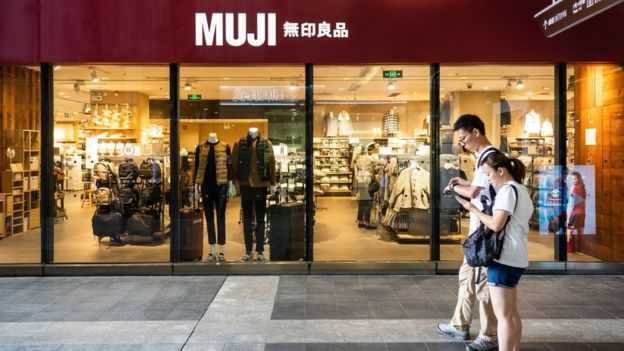
Japanese retailers Muji and Uniqlo attracted attention recently after a report highlighted the brands used the Xinjiang-origin of their cotton as a selling point in advertisements.
“You can’t be sure that you don’t have coerced labour in your supply chain if you do cotton business in China,” said Nathan Ruser, researcher at the Australian Strategic Policy Institute.
“Xinjiang labour and what is almost certainly coerced labour is very deeply entrenched into the supply chain that exists in Xinjiang.”
What is happening in Xinjiang?
UN experts and human rights groups say China is holding more than a million Uighurs and other ethnic minorities in vast detention camps.
Rights groups also say people in camps are made to learn Mandarin Chinese, swear loyalty to President Xi Jinping, and criticise or renounce their faith.
China says those people are attending “vocational training centres” which are giving them jobs and helping them integrate into Chinese society, in the name of preventing terrorism.
What is produced in Xinjiang?
The Xinjiang region is a key hub of Chinese cotton production.
Last year, 84% of Chinese cotton came from Xinjiang, the report said.
That has raised concerns over whether forced labour has been used in the production of cotton from the region.
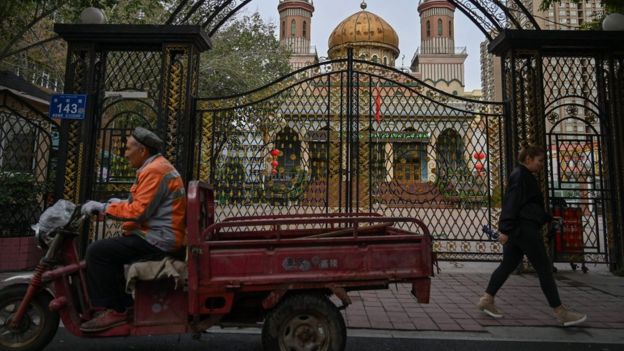
Image copyright GETTY IMAGESImage caption The Uighurs are mostly Muslims, and number about 11 million in China’s Xinjiang region
Nury Turkel, chairman of the Uighur Human Rights Project in Washington, said the Uighurs were being “detained and tormented” and “swept into a vast system of forced labor” in Xinjiang.
In testimony to US congress, he said it was becoming “increasingly hard to ignore the fact” that the goods manufactured in the region have “a high likelihood” of being produced with forced labour.
Which brands use Xinjiang cotton?
Amy Lehr, director of CSIS Human Rights Initiative, said in many cases Western companies aren’t buying directly from factories in Xinjiang.
“Rather, the products may go through several stages of transformation after leaving Xinjiang before they are sent to large Western brands,” she said.
Some, like Muji, are very open about sourcing material from Xinjiang.
“Uniqlo does not have any production partners located in the Xinjiang region. Moreover, Uniqlo production partners must commit to our strict company code of conduct.
“To the best of our knowledge, this means our cotton comes only from ethical sources,” the spokesperson told the BBC.
Many of the companies looked into the allegations, including those without clear links to the Huafu mill.
In a statement to the BBC, Adidas said: “While we do not have a contractual relationship with Huafu Fashion Co., or any direct leverage with this business entity or its subsidiary, we are currently investigating these claims.”
“We advised our material suppliers to place no orders with Huafu until we have completed those investigations,” the Adidas spokesperson said.
Esprit, which also does not source cotton directly from Xinjiang, said it had made several inquiries earlier this year.
“We concluded that a very small amount of cotton from a Huafu factory in Xinjiang was used in a limited number of Esprit garments,” the firm said in a statement.
The company has instructed all suppliers to not source Huafu yarn from Aksu, the statement said.
H&M said it does not have “a direct or indirect business relationship” with any garment manufacturer in the Xinjiang region.
“We have an indirect business relationship with Huafu’s spinning unit in Shanyu, which is not located in the Xinjiang region, and according to our data, the vast majority of the yarn used for our garment manufacturing comes from this spinning unit,” a spokesperson for H&M said.
“Since we have an indirect business relationship with the yarn supplier Huafu, we also asked for access to their spinning facilities in Aksu. Our investigations showed no evidence of forced labor.”
China suggests good progress made in Regional Comprehensive Economic Partnership talks after marathon 10-day negotiations in Zhengzhou
Indian Commerce Minister Piyush Goyal has opted to skip the upcoming high-level meetings, adding fuel to rumours that the country could be removed
The Association of Southeast Asian Nations (Asean) has overtaken the US to become China’s second-largest trading partner in the first half of 2019. Photo: AP
China has claimed “positive progress” towards finalising the world’s largest free-trade agreement by the end of 2019 after hosting 10 days of talks, but insiders have suggested there was “never a chance” of concluding the deal in Zhengzhou.
The 27th round of the Regional Comprehensive Economic Partnership (RCEP) negotiations closed on Wednesday in the central Chinese city.
working level conference brought over 700 negotiators from all 16 member countries to Henan province, with China keen to push through a deal which has proven extremely difficult to close.
If finalised, the agreement, which involves the 10 Asean nations, as well as China, Japan, South Korea, Australia, New Zealand, and India, would cover around one-third of the global gross domestic product, about 40 per cent of world trade and almost half the world’s population.
“This round of talks has made positive progress in various fields,” said assistant minister of commerce Li Chenggang, adding that all parties had reaffirmed the goal of concluding the deal this year. “China will work together with the RCEP countries to proactively push forward the negotiation, strive to resolve the remaining issues as soon as possible, and to end the negotiations as soon as possible.”
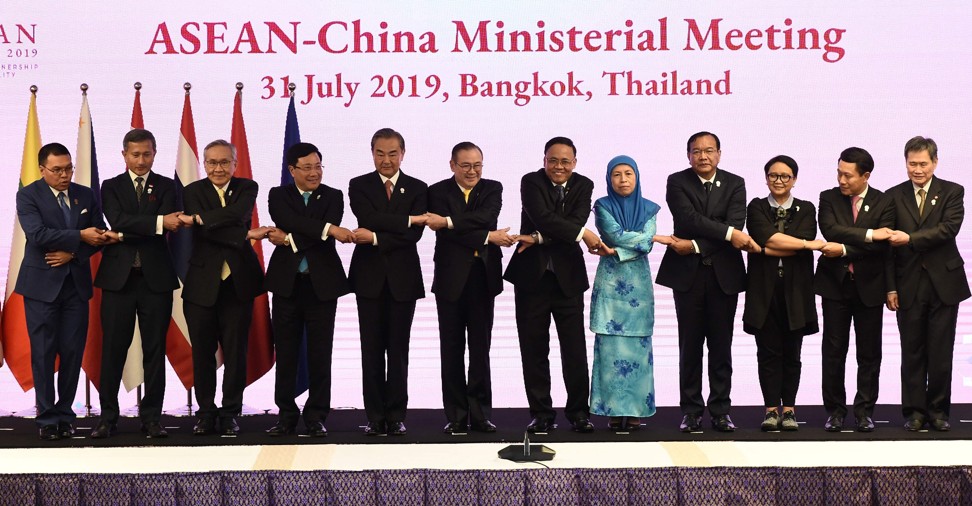
China’s Foreign Minister Wang Yi (fifth left) poses with foreign ministers from the Association of Southeast Asian Nations (Asean) countries during the ASEAN-China Ministerial Meeting in Bangkok. Photo: AFP
China is keen to complete a deal which would offer it a buffer against the United States in Asia, and which would allow it to champion its free trade position, while the US pursues protectionist trade policy.
The RCEP talks took place as Chinese and American trade negotiators resumed face-to-face discussions in Shanghai, which also ended on Wednesday, although there was little sign of similar progress.
As the rivalry between Beijing and Washington has intensified and bilateral trade waned, the Association of Southeast Asian Nations (Asean) overtook the US to become China’s second-largest trading partner in the first half of 2019. From January to June, the trade volume between China and the 10-member bloc reached US$291.85 billion, up by 4.2 per cent from a year ago, according to government data.
The Asean bloc is made up of Indonesia, Thailand, Malaysia, Singapore, Philippines, Vietnam, Myanmar, Cambodia, Brunei and Laos.
China will work together with the RCEP countries to proactively push forward the negotiation, strive to resolve the remaining issues as soon as possible, and to end the negotiations as soon as possible. Li Chenggang
RCEP talks will now move to a higher level ministerial meeting in Beijing on Friday and Saturday, but trade experts have warned that if material progress is not made, it is likely that the RCEP talks will continue into 2020, prolonging a saga which has already dragged on longer than many expected. It is the first time China has hosted the ministerial level talks.
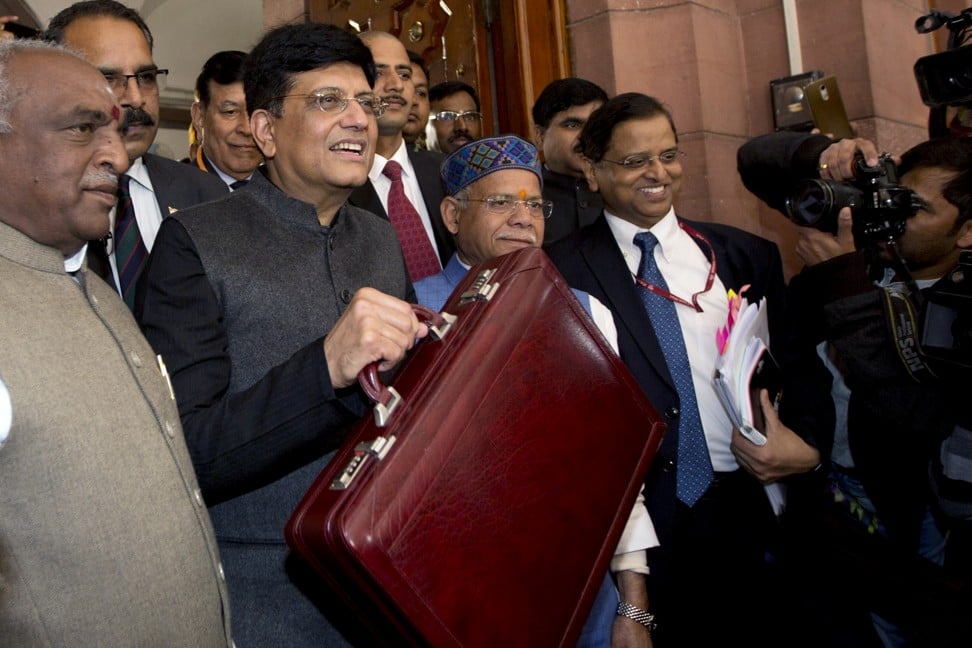
But complicating matters is the fact that India’s Commerce Minister, Piyush Goyal, will not attend the ministerial level talks, with an Indian government official saying that he has to participate in an extended parliamentary session.
India is widely viewed as the biggest roadblock to concluding RCEP, the first negotiations for which were held in May 2013 in Brunei. Delhi has allegedly opposed opening its domestic markets to tariff-free goods and services, particularly from China, and has also had issues with the rules of origin chapter of RCEP.
China is understood to be “egging on” other members to move forward without India, but this could be politically explosive, particularly for smaller Asean nations, a source familiar with talks said.
Deborah Elms, executive director of the Asian Trade Centre, a Singapore-based lobby group, said that after the last round of negotiations in Melbourne between June 22 to July 3 – which she attended – there was “frustration” at India’s reluctance to move forward.
She suggested that in India’s absence, ministers in China could decide to move forward through a “pathfinder” agreement, which would remove India, but also potentially Australia and New Zealand.
India’s Commerce Minister, Piyush Goyal, will not attend the ministerial level talks this week in Beijing. Photo: Bloomberg
This “Asean-plus three” deal would be designed to encourage India to come on board, Elms said, but would surely not go down well in Australia and New Zealand, which have been two of the agreement’s biggest supporters.
New Zealand has had objections to the investor protections sections of RCEP, and both countries have historically been pushing for a more comprehensive deal than many members are comfortable with, since both already have free trade agreements with many of the other member nations.
However, their exclusion would be due to “an unfortunate geographical problem, which is if you’re going to kick out India, there has always been an Asean-plus three concept to start with”. Therefore it is easier to exclude Australia and New Zealand, rather than India alone, which would politically difficult.
A source close to the negotiating teams described the prospect of being cut out of the deal at this late stage as a “frustrating rumour”, adding that “as far as I know [it] has no real basis other than a scare tactic against India”.
There was “never a chance of concluding [the deal during] this round, but good progress is being made is what I understand. The key issues remain India and China”, said the source, who wished to remain anonymous.
Replacing bilateral cooperation with regional collaborations is a means of resolving the disputesTong Jiadong
However, Tong Jiadong, a professor of international trade at the Nankai University of Tianjin, said Washington’s refusal to recognise India as a developing country at the World Trade Organisation could nudge the world’s second most populous nation closer to signing RCEP.
“That might push India to the RCEP, accelerating the pace of RCEP,” Tong said, adding that ongoing trade tensions between Japan and South Korea could also be soothed by RCEP’s passage.
“Replacing bilateral cooperation with regional collaborations is a means of resolving the disputes between the two countries,” Tong said.
Although the plan was first proposed by the Southeast Asian countries, China has been playing an increasingly active role, first as a response to the now defunct US-backed Trans-Pacific Partnership (TPP), and more recently as a means of containing the impact of the trade war.
China’s vice-commerce Minister, Wang Shouwen, told delegates last week that RCEP was “the most important free trade deal in East Asia”. He called on all participants to “take full advantage of the good momentum and accelerating progress at the moment” to conclude a deal by the end of the year.
NEW DELHI/SRINAGAR, India (Reuters) – Islamic State (IS) claimed for the first time that it has established a “province” in India, after a clash between militants and security forces in the contested Kashmir region killed a militant with alleged ties to the group.
IS’s Amaq News Agency late on Friday announced the new province, that it called “Wilayah of Hind”, in a statement that also claimed IS inflicted casualties on Indian army soldiers in the town of Amshipora in the Shopian district of Kashmir.
The IS statement corresponds with an Indian police statement on Friday that a militant called Ishfaq Ahmad Sofi was killed in an encounter in Shopian.
IS’s statement establishing the new province appears to be designed to bolster its standing after the group was driven from its self-styled “caliphate” in Iraq and Syria in April, where at one point it controlled thousands of miles of territory.
IS has stepped up hit-and-run raids and suicide attacks, including taking responsibility for the Easter Sunday bombing in Sri Lanka that killed at least 253 people.
“The establishment of a ‘province’ in a region where it has nothing resembling actual governance is absurd, but it should not be written off,” said Rita Katz, director of the SITE Intel Group that tracks Islamic extremists.
“The world may roll its eyes at these developments, but to jihadists in these vulnerable regions, these are significant gestures to help lay the groundwork in rebuilding the map of the IS ‘caliphate’.”
Sofi had been involved in several militant groups in Kashmir for more than a decade before pledging allegiance to Islamic State, according to a military official on Saturday and an interview given by Sofi to a Srinagar-based magazine sympathetic to IS.
He was suspected of several grenade attacks on security forces in the region, police and military sources said.
“It was a clean operation and no collateral damage took place during the exchange of fire,” a police spokesman said in the statement on Friday’s encounter.
The military official said it was possible that Sofi had been the only militant left in Kashmir associated with IS.
Separatists have for decades fought an armed conflict against Indian rule in Muslim-majority Kashmir. The majority of these groups want independence for Kashmir or to join India’s arch-rival Pakistan. They have not, like Islamic State, sought to establish an empire across the Muslim world.
Nuclear powers India and Pakistan have fought two wars over Kashmir, and came to the brink of a third earlier this year after a suicide attack by a Pakistan-based militant group killed at least 40 paramilitary police in the Indian-controlled portion of the region.
A spokesman for India’s home ministry, which is responsible for security in Kashmir, did not respond to a request for comment.






 CHINDIA ALERT: You'll be living in their world, very soon