Chindia Alert: You’ll be Living in their World Very Soon
aims to alert you to the threats and opportunities that China and India present. China and India require serious attention; case of ‘hidden dragon and crouching tiger’.
Without this attention, governments, businesses and, indeed, individuals may find themselves at a great disadvantage sooner rather than later.
The POSTs (front webpages) are mainly 'cuttings' from reliable sources, updated continuously.
The PAGEs (see Tabs, above) attempt to make the information more meaningful by putting some structure to the information we have researched and assembled since 2006.
Photos showing Indian soldiers purportedly brought down by PLA soldiers at a fist and stick fight circulated among Chinese military websites
WeChat and YouTube become new fighting arenas for soldiers but their governments are playing down Himalayan clashes
A photo showing PLA troops after purportedly bringing down several Indian soldiers at a close-quarters fight at Pangong Lake border area with India, was circulated among Chinese military websites on Sunday. Photo: Handout
People’s Liberation Army soldiers and their Indian counterparts have moved
over border disputes in the Himalayas to social media platforms as both their governments try to play down the fights.
A post with photos showing several Indian soldiers purportedly brought down by PLA soldiers in a fist and stick fight at the Pangong Lake border area with India was circulated among Chinese military websites on Sunday.
On the Chinese social media site WeChat, a Chinese soldier posted photos showing a number of Indian soldiers lying on the ground with a group of PLA soldiers standing nearby with sticks in their hands. The photos were accompanied by a Chinese caption saying the Chinese side “had just one injury but dozens of Indian soldiers were wounded”.
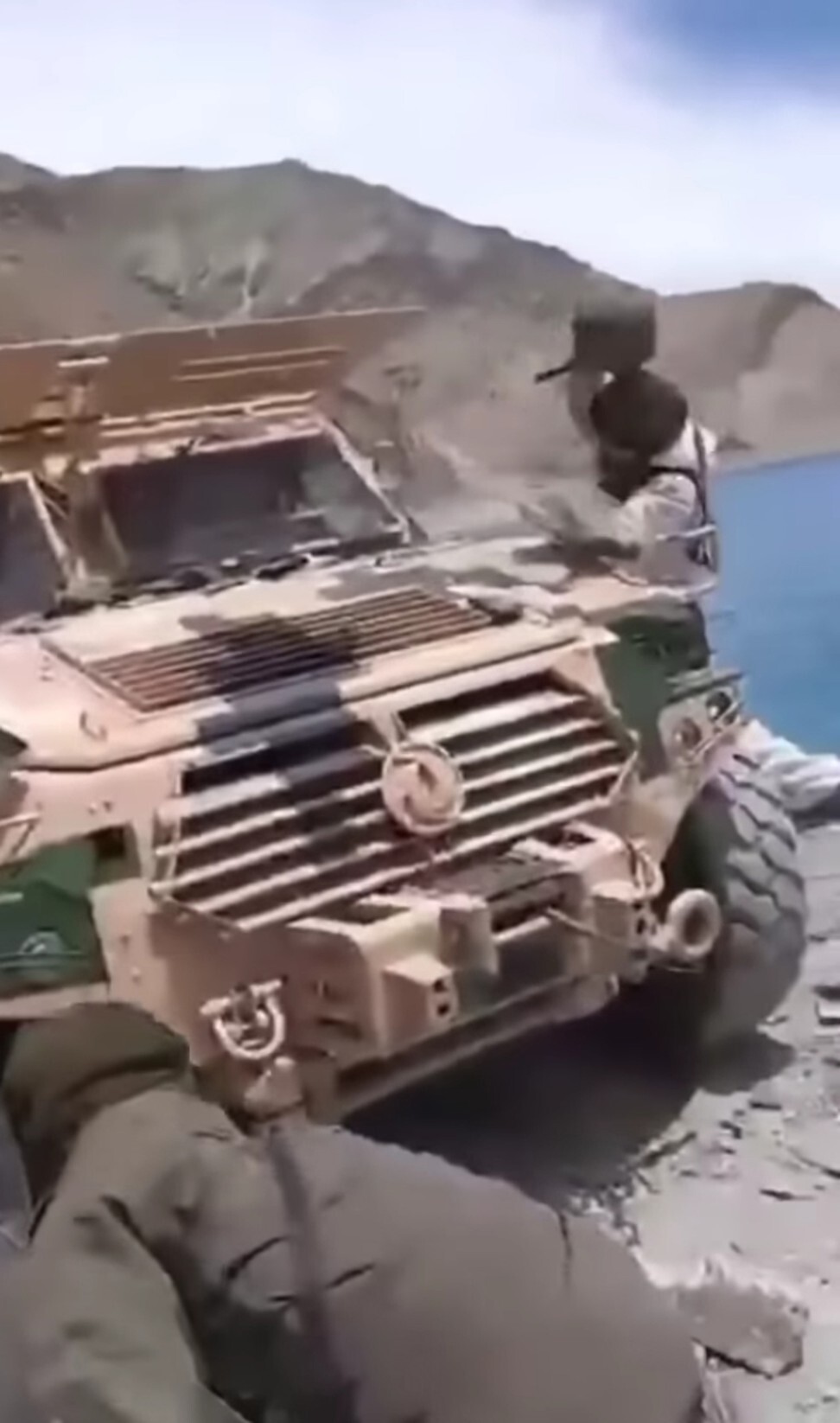
A screen grab of YouTube video in which Indian troops claimed to have captured a Chinese officer, who appeared hurt after a brawl at Pangong Lake in the Himalayas. Photo: Handout
The report was published one day after the Indian side posted a video on YouTube showing that Indian troops had captured a Chinese officer, who appeared badly roughed up during the brawl at Pangong Lake, about 4,350 metres (14,300 feet) above sea level in the Himalayas.
The YouTube video posted by someone on the Indian side did not state the time or date of the incident. Photo: Handout
The crudely made video, which did not include the date of the incident, also showed a damaged PLA military vehicle amid cheering Indian troops.
Two independent sources close to the PLA said “the wounded Chinese officer was an interpreter who was taken in by the Indian troops but was later released with minor injuries after the Chinese side called for reinforcements”.
The sources said soldiers from both sides had turned to social media to give a positive spin to their “acts of bravery” while their commanders wanted to play down the disputes. One source pointed out that the pictures of injured Indian soldiers were posted by a Chinese soldier on his personal social media account and not on official channels.
“Beijing didn’t want its people to think that Chinese soldiers lost in the fight but at the same time it is mindful of not escalating the matter,” said the source, who requested anonymity because of sensitivity of the situation.
India denies that Trump spoke to Modi about border tensions with China
29 May 2020
Beijing-based military expert Zhou Chenming said the Chinese border troops had been told to be “restrained”.
“In border disputes, China always wants to keep the status quo, especially now when both sides should do all they can to avoid fighting,” Zhou said. “China is busy dealing with the Covid-19 pandemic and other issues like Taiwan and Hong Kong, and India also faces a serious Covid-19 situation.”
Rajeev Ranjan Chaturvedy, an international relations expert based in New Delhi, agreed with Zhou’s analysis, saying both China and India understood the seriousness and sensitivity of their border disputes.
“Civilian and military officials of both countries are already in discussion under existing mechanisms,” he said. “The stakes are too high for both countries and the probability of a war [between India and China] is low, in my view.
“Though, the situation is very serious and India is closely monitoring Chinese activities.”
Military and diplomacy analysts believe border skirmishes between China and India will not escalate to war because of a range of factors, including the coronavirus pandemic. Photo: AP
Overseas media reported that both Chinese and Indian militaries had increased deployment to the border, with the PLA moving 5,000 personnel to the area.
Speaking last Wednesday, Chinese foreign ministry spokesman Zhao Lijian did not deny the troop deployment reports but said the overall situation in the China-India border area remained “stable and under control, and the two countries were capable of resolving border issues through dialogue and negotiations”.
Border conflicts between China and India have escalated since 2017, with Indian troops and the PLA staging the most serious confrontation in Doklam near a tri-junction border area – known as Donglang or Donglang Caochang, in Chinese – a territory which is claimed by both China and Bhutan, an ally of India.
KOLKATA (Reuters) – Indian and Chinese troops on border patrol duties had a brief skirmish in Sikkim, a northeastern Indian state bordering China, the Indian Defence Ministry said on Sunday, blaming both sides for the incident.
“Aggressive behaviour by the two sides resulted in minor injuries to troops. The two sides disengaged after dialogue and interaction at the local level,” the ministry said in a statement.
The Indian daily Hindustan Times, citing a military source, said four Indian soldiers and seven Chinese troops were injured when some of the soldiers exchanged blows during the confrontation, which it said took place on Saturday and involved some 150 soldiers.
The Defence Ministry said the incident took place in the Nakula area but did not give details of how it started, or what caused the injuries.
China’s Ministry of Defense could not be immediately reached for comment on Sunday.
India and China have often accused each other of intrusions into each other’s territories, but clashes are rare.
There is still deep mistrust between the two countries over their festering border dispute, which triggered a brief war in 1962.
Hundreds of troops from both sides were deployed in 2017 on the Doklam plateau, near the borders of India, Bhutan, and China after India objected to Chinese construction of a road in the Himalayan area, in the most serious standoff in years.
NEW DELHI (Reuters) – Violent clashes erupted in Delhi between police and hundreds of university students on Friday over the enactment of a new citizenship law that critics say undermines India’s secular foundations.
The unrest has already led Japanese Prime Minister Shinzo Abe to cancel a planned visit to India from Sunday.
The new law offers a way to Indian citizenship for six minority religious groups from neighbouring Bangladesh, Pakistan and Afghanistan including Hindus and Christians, but not Muslims.
RELATED COVERAGE
Explainer: What does India’s new citizenship law mean?
Clashes erupt in New Delhi between students, police over citizenship law
See more stories
Police fired tear gas and used baton charges to disperse scores of students demonstrating at Jamia Millia Islamia university in the heart of Delhi over the law.
Protesters attacked cars in the capital, and several people were injured and taken to hospital.
Zakir Riyaz, a PhD student in social work, said the new law made a mockery of India’s religious openness.
“It goes against the whole idea of a secular India,” he said, speaking by phone from the Holy Family Hospital in New Delhi where 15 of his fellow students were admitted after being injured in a police baton charge.
Police barricades were knocked down and streets were strewn with shoes and broken bricks. An official at the university dispensary said that more than 100 students had been brought in with injuries but all had been discharged.
Parvez Hashmi, a local politician who went to the protest site to speak to police, said about 50 students had been detained.
Students said it was meant to be a peaceful protest, with them trying to go from Jamia University to Parliament Street to show their opposition to the legislation. But police pushed them back, leading to clashes.
Critics of Prime Minister Narendra Modi’s government say it is promoting a Hindu-first agenda for India and that the citizenship law excluding Muslims showed a deep-seated bias against India’s 170 million Muslims.
Imran Chowdhury, a researcher, said “either give citizenship to refugees of all religions or none at all. The constitution is being tampered with in the name of religion.”
Modi’s ruling Bharatiya Janata Party denies any religious bias but says it is opposed to the appeasement of one community. It says the new law is meant to help minority groups facing persecution in the three nearby Muslim countries.
ABE CANCELS
The United Nations human rights office voiced concern that the new law is “fundamentally discriminatory in nature”, and called for it to be reviewed.
Two people were killed in India’s Assam state on Thursday when police opened fire on mobs torching buildings and attacking railway stations in protest at the new citizenship rules signed into law on Thursday.
Japan’s Prime Minister Shinzo Abe cancelled a trip to Assam for a summit with his Indian counterpart Narendra Modi that had been due to begin on Sunday.
Japan has stepped up infrastructure development work in Assam in recent years, which the two sides were expected to highlight during the summit. Abe had also planned to visit a memorial in the nearby state of Manipur where Japanese soldiers were killed in World War Two.
“With reference to the proposed visit of Japanese PM Abe Shinzo to India, both sides have decided to defer the visit to a mutually convenient date in the near future,” Indian foreign ministry spokesman Raveesh Kumar said in a tweet.
Japan’s Chief Cabinet Secretary Yoshihide Suga said both countries would decide on the appropriate timing for the visit although nothing has been decided yet.
A movement against immigrants from Bangladesh has raged in Assam for decades. Protesters there say granting Indian nationality to more people will further strain the state’s resources and lead to the marginalisation of indigenous communities.
HONG KONG (Reuters) – China’s People’s Liberation Army (PLA) soldiers in shorts and t-shirts made a surprising appearance in some Hong Kong streets on Saturday, briefly helping residents clean up debris after anti-government protests blocked roads, witnesses said.
The presence of PLA troops on the streets, even to help clean up roads near their base, could stoke further controversy over the Chinese-ruled territory’s autonomous status.
Hong Kong has been rocked by more than five months of demonstrations by protesters angry at perceived Communist Party meddling in the former British colony, which was guaranteed its freedoms when it returned to Chinese rule in 1997.
Beijing denies interfering and has blamed the unrest on foreign influences.
Clashes between protesters and police have become increasingly violent. China has warned that any attempt at independence for Hong Kong will be crushed, but troops have remained inside their base.
RELATED COVERAGE
China’s PLA soldiers seen helping clean up streets after Hong Kong protests – RTHK
Saturday’s clean up followed some of the worst violence seen this year, after a police operation against protesters at the Chinese University of Hong Kong on Tuesday.
The authorities have since largely stayed away from at least five university campuses that had been barricaded by thousands of students and activists who stockpiled petrol bombs, catapults, bows and arrows and other weapons.
Many protesters appeared to have left the campuses by late Saturday, though some remained behind to man makeshift barricades. Hong Kong’s Cross-Harbour Tunnel was still blocked by protesters occupying Polytechnic University.
Earlier, hundreds of pro-China demonstrators gathered by the city’s legislature and police headquarters, waving Chinese and Hong Kong flags. Some held up posters reading “Police we stand with you”, while others chanted “Support the police”.
Pro-China protests have so far attracted much smaller numbers than those angry at Beijing.
RARE TROOP PRESENCE
By late afternoon, the PLA soldiers had left the streets outside Baptist University, beside their barracks in leafy Kowloon Tong.
Chinese troops have appeared on local streets only once since the 1997 handover, to help with cleanup operations after a typhoon in late 2018. It was not immediately clear how many were involved on Saturday.
Calls to the PLA Hong Kong garrison office and a media liaison officer went unanswered.
Demosistō, a pro-democracy organisation, said Saturday’s cleanup operation could set a “grave precedent” if the city’s government invites the military to deal with internal problems.
In August, Beijing moved thousands of troops across the border into Hong Kong in what state news agency Xinhua described as a routine “rotation”.
Foreign envoys and security analysts estimate up to 12,000 troops are now based across Hong Kong — more than double the usual garrison number.
Standing beside a black flag with the slogan “Liberate Hong Kong, Revolution of our Times,” James Wong, 23, was among a handful of protesters still manning a bridge at Baptist University.
“We didn’t want to confront the people and the PLA troops directly,” he told Reuters. “We are not directly against the PLA, but rather the government. But the PLA should not leave their base because this is Hong Kong territory.”
Wong said even after the campus fortifications have been dismantled “Hong Kong will keep resisting until the government responds to our demands”.
Hundreds of residents moved in to help clear barricaded roads near several universities.
Clashes on Saturday saw at least one petrol bomb thrown before anti-government protesters at the campuses retreated. No soldiers appeared to have been involved in the confrontations.
“We just want our lives to continue,” said one resident who was helping clear streets near HKU. “There are many elderly who need to go the hospital and children who need to go to school. I am very sad to see what is happening in my community.”
PRO-POLICE DEMONSTRATION
Saturday’s rally to denounce the anti-government violence drew a mix of young and elderly.
“From the bottom of our hearts, we believe it is the correct thing to support the police in fighting the rioters for Hong Kong citizens,” said a 49-year-old housewife surnamed Kong.
“A lot of people keep silent, afraid of the rioters. It’s time for all the people who are silent to step up and say that’s enough.”
A 70-year-old street cleaner died on Thursday after being hit on the head by one of several bricks police said had been thrown by “masked rioters”. On Monday, police blamed a “rioter” for dousing a man in petrol and setting him on fire. The victim is in critical condition.
On the same day, police shot a protester in the abdomen. He was in a stable condition.
Many pro-police protesters laid white flowers outside the government office to pay their respects to the cleaner. Others applauded and cheered the police, some bowing and giving thumbs up as they walked past riot police on duty.
Authorities said on Saturday that a highway blocked by anti-government protesters on Friday had reopened after being cleared of debris and petrol bombs.
Train services suspended earlier in the week were gradually resuming, metro operator MTR Corp (0066.HK) said.
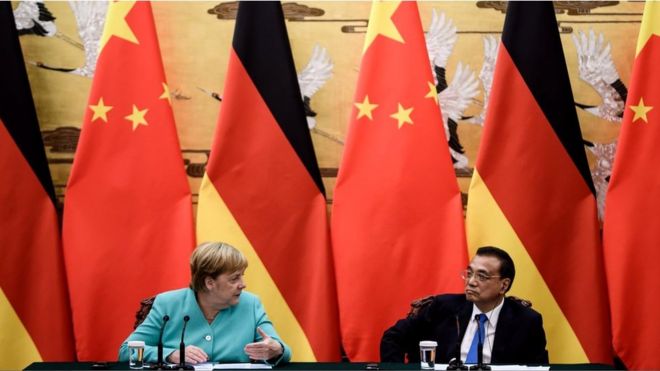
Image copyright EPAImage caption Ms Merkel calls for dialogue while Mr Li says China can handle its own matters
China’s Premier Li Keqiang has said Beijing supports the Hong Kong government “to end the violence and chaos”.
He is the most senior Chinese official to comment on the unrest which has rocked Hong Kong for months.
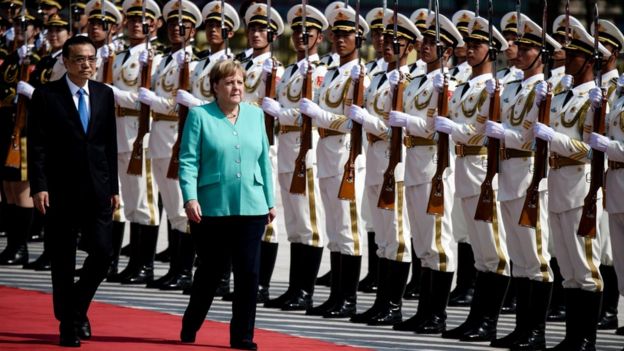
His comments came during a joint press conference with German Chancellor Angela Merkel in Beijing.
Hong Kong has seen months of often-violent protests calling for democracy and less influence from China.
The protests were sparked by changes to a law that would allow extradition to mainland China, but have since widened to include calls for an independent inquiry into police brutality and demands for greater democracy.
Image copyright EPAImage caption Hong Kong activists hope for Western support
Instead, protests continued on Friday evening, when clashes erupted between police and the demonstrators outside a subway station on the Kowloon peninsula.
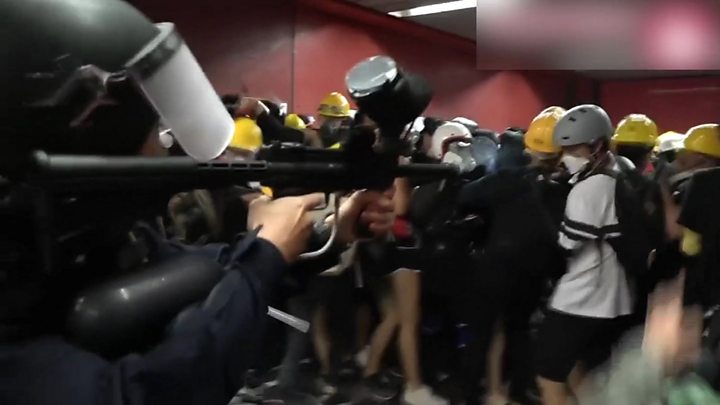
Riot police fired both tear gas and rubber bullets at protesters before clearing the nearby streets as the crowd of protesters was forced to retreat.
What did the Chinese premier say?
In August, China had likened to protests to terrorism, warning activists not to “underestimate the firm resolve” of the Beijing government.
Li Keqiang, China’s second highest-ranking leader, told reporters on Friday: “The Chinese government unswervingly safeguards ‘one country, two systems’ and ‘Hong Kong people govern Hong Kong people’.”
He said China backed Hong Kong “to end the violence and chaos in accordance with the law, to return to order, which is to safeguard Hong Kong’s long-term prosperity and stability”.
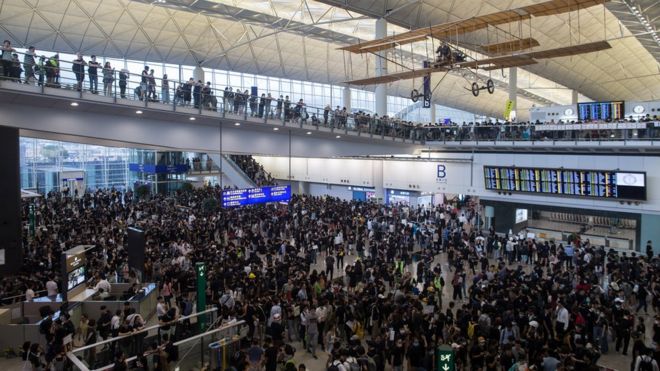
Image copyright EPAImage caption Officials say about 5,000 gathered for the fourth day of protests at the airport
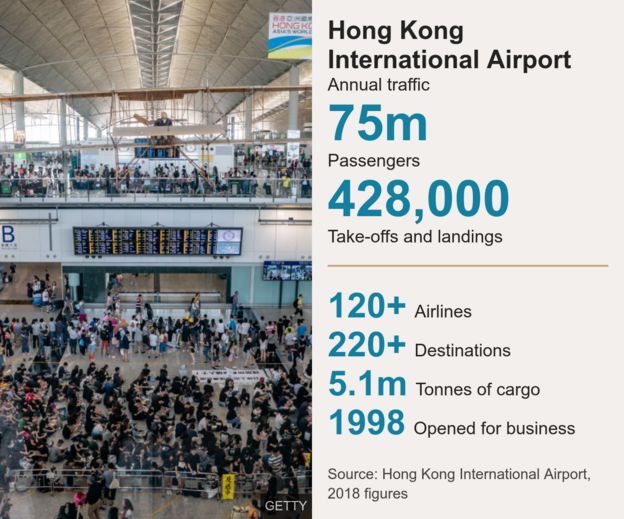
Hong Kong International Airport cancelled all departures on Monday, as thousands of anti-government protesters occupied and caused disruption.
Passengers have been told not to travel to the airport, which is one of the world’s busiest transport hubs.
In a statement, officials blamed “seriously disrupted” operations.
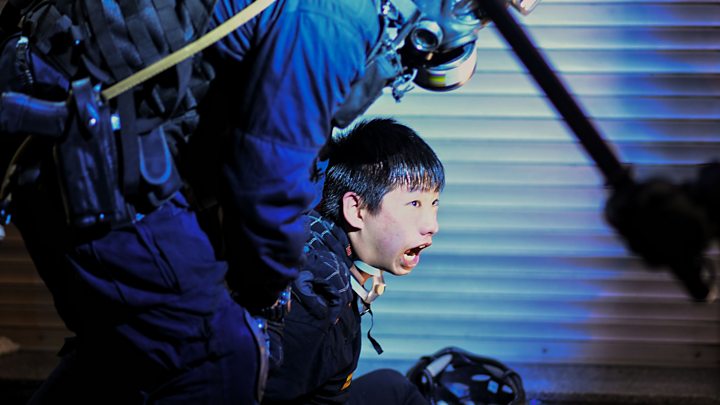
Many of those protesting are critical of the actions of police, who on Sunday were filmed firing tear gas and rubber bullets at close range.
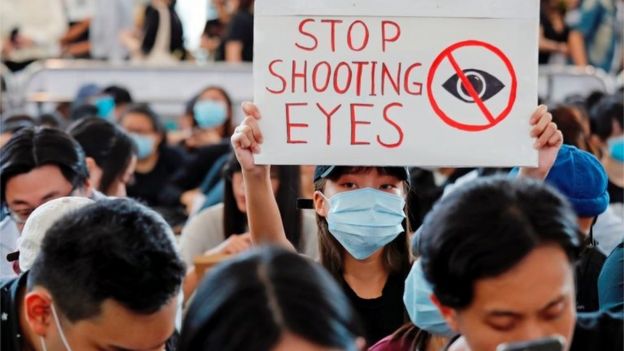
Some protesters wore bandages over their eyes in response to images of a woman bleeding heavily from her eye on Sunday, having reportedly been shot by a police projectile.
In a statement on Monday afternoon, Hong Kong’s Airport Authority said they were cancelling all flights that were not yet checked in.
More than 160 flights scheduled to leave after 18:00 local time (10:00 GMT) will now not depart.
Arrivals already heading into Hong Kong will still be allowed to land, but other scheduled flights have been cancelled.
Officials are now working to reopen the airport by 06:00 on Tuesday, a statement said.
Some passengers expressed annoyance at the disruption. “It’s very frustrating and scary for some people,” one man from Pakistan told the BBC. “We’ll just have to wait for our next flight.”
Helena Morgan, from the UK, said she was set to return to the UK to get her exam results on Thursday. “I’m hoping we get back for them and we’re not on a flight,” she said.
But others were more understanding of the protests. “I was expecting something, given all the news,” one arrival, Gurinda Singh, told Reuters news agency.
As rumours spread that police plan to move in on protesters on Monday evening, thousands opted to leave on foot. There are large backlogs for transport back into the centre, local reports say.
The BBC’s Stephen McDonell, who is at the scene, says the airport has effectively shut down while authorities work out how to deal with the crisis.
Hong Kong’s mass demonstrations and unrest show no sign of abating, more than two months after they were sparked by a controversial extradition bill.
Beijing officials have strongly condemned Sunday’s violence and linked violent protesters to “terrorism”.
Image copyright REUTERSImage caption Many of those who gathered carried signs condemning police conduct
What happened on Sunday?
On Sunday afternoon, a peaceful rally in the city’s Victoria Park led to clashes when protesters moved out of the area and marched along a major road despite a police ban.
There were confrontations in several central districts and police used rubber bullets in an attempt to disperse the demonstrators.
In the bustling central Wan Chai district, petrol bombs and bricks were thrown at police, who responded by charging at protesters.
A number of people, including a police officer, were injured in the clashes.
Videos on social media also showed officers storming enclosed railway stations and firing tear gas.
Footage inside another station showed officers firing what appeared to be rubber bullets at close range and several police officers beating people with batons.
Media caption Violence erupts in HK train stations
Local media outlets reported that suspected undercover police officers had dressed-up as protesters to make surprise arrests.
While protests in the city have turned increasingly violent, there were no reports of arrests during the three previous days of the airport sit-in.
What has the reaction been?
On Monday the Chinese authorities, who have not yet physically intervened to quell the unrest, used their strongest language yet to condemn violent protesters.
“Hong Kong’s radical demonstrators have repeatedly used extremely dangerous tools to attack police officers, which already constitutes a serious violent crime, and also shows the first signs of terrorism emerging,” Yang Guang, a spokesman for the Hong Kong and Macau Affairs Office (HKMAO), said at a press briefing.
“This wantonly tramples on Hong Kong’s rule of law and social order.”
Demonstrations started in June in opposition to a proposed extradition bill, which would have allowed suspected criminals to be sent to mainland China for trial.
Critics said it would undermine Hong Kong’s legal freedoms, and could be used to silence political dissidents.
Although the government has now suspended the bill, demonstrators want it to be fully withdrawn.
Their demands have broadened to include calls for an independent inquiry into alleged police brutality, and an amnesty for all arrested protesters.
Hong Kong is part of China but its citizens have more autonomy than those on the mainland.
It has a free press and judicial independence under the so-called “one country, two systems” approach – freedoms which activists fear are being increasingly eroded.
MUMBAI/NEW DELHI (Reuters) – Police broke up clashes between rival groups of voters in West Bengal on Monday as some of India’s richest families and Bollywood stars also cast their ballots in Mumbai during the fourth phase of a massive, staggered general election.
In West Bengal, a populous eastern state crucial for Prime Minister Narendra Modi’s re-election bid, supporters of his Hindu nationalist Bharatiya Janata Party (BJP) clashed with others from the regional Trinamool Congress, police said.
TV footage showed armed security forces chasing away people wielding sticks, although it was initially difficult to determine the scale of the clashes.
There were no immediate reports of any poll-related injuries in West Bengal, where at least one person was killed and three injured during the third phase of voting last week.
The BJP is in a direct, and sometimes bloody, fight in West Bengal with Trinamool, whose chief Mamata Banerjee is one of Modi’s biggest critics and a potential prime ministerial candidate.
More than 127 million people are eligible to vote in this round of the seven-phase election held across 71 seats in nine states. Modi’s coalition won more than 75 percent of the seats in the previous election in 2014.
Many of the constituencies are in Uttar Pradesh in the north and western India’s Maharashtra, where the financial capital Mumbai is located. Uttar Pradesh elects the most lawmakers, with Maharashtra next. Both states are ruled by the BJP and its allies.
However, political analysts say the BJP may struggle to repeat its strong showing this time due mainly to a jobs shortage and weak farm prices, issues upon which the main opposition Congress party has seized.
‘SOME PROGRESS’
First-time voter Ankita Bhavke, a college student in Mumbai, said she voted for economic development.
“I want the country to be at par with the best in the world,” she said. “There’s been some progress in the last five years.”
India’s financial markets were closed on Monday for the election.
Mumbai is home to the massive Hindi film industry, as well as Asia’s wealthiest man, Mukesh Ambani, and India’s richest banker, Uday Kotak.
Ambani, who heads Reliance Industries, and Kotak, managing director of Kotak Mahindra Bank, created a stir this month by publicly endorsing an opposition Congress party candidate from their upscale South Mumbai constituency.
Mumbai, which has six seats, is India’s wealthiest city but ageing and insufficient infrastructure is a major concern. Six people were killed last month when part of a pedestrian bridge collapsed, recalling memories of a 2017 rush-hour stampede that killed at least 22 people on a narrow pedestrian bridge.
The election, the world’s biggest democratic exercise with about 900 million voters, started on April 11 with Modi in the lead amid heightened tension with long-time enemy Pakistan.
The last phase of voting is on May 19, with results released four days later.
There are a total of 545 seats in the Lok Sabha.
Modi sent warplanes into Pakistan in late February in response to a suicide attack by an Islamist militant group based there that killed 40 Indian police in the disputed Kashmir region.
Modi has sought votes on his tough response towards militancy and in recent days has evoked the deadly Easter Sunday bombings in nearby Sri Lanka.
Maidul Islam, a professor of political science at Kolkata’s Centre for Studies in Social Sciences, said long queues outside polling stations would indicate whether Modi’s national security pitch was working.
“Whenever there is a BJP kind of a wave, you see a higher voter turnout,” he said.




 CHINDIA ALERT: You'll be living in their world, very soon
Indian, Chinese border troops in brief skirmish on northeast Indian border, India says
KOLKATA (Reuters) – Indian and Chinese troops on border patrol duties had a brief skirmish in Sikkim, a northeastern Indian state bordering China, the Indian Defence Ministry said on Sunday, blaming both sides for the incident.
“Aggressive behaviour by the two sides resulted in minor injuries to troops. The two sides disengaged after dialogue and interaction at the local level,” the ministry said in a statement.
The Indian daily Hindustan Times, citing a military source, said four Indian soldiers and seven Chinese troops were injured when some of the soldiers exchanged blows during the confrontation, which it said took place on Saturday and involved some 150 soldiers.
The Defence Ministry said the incident took place in the Nakula area but did not give details of how it started, or what caused the injuries.
China’s Ministry of Defense could not be immediately reached for comment on Sunday.
India and China have often accused each other of intrusions into each other’s territories, but clashes are rare.
There is still deep mistrust between the two countries over their festering border dispute, which triggered a brief war in 1962.
Hundreds of troops from both sides were deployed in 2017 on the Doklam plateau, near the borders of India, Bhutan, and China after India objected to Chinese construction of a road in the Himalayan area, in the most serious standoff in years.
Source: Reuters
Posted in 1962, 2017, accused, aggressive, behaviour, Bhutan, blaming, border, bordering, both, brief, China, China’s, Chinese, citing, clashes, comment, confrontations, Construction, countries, daily, deep, defence ministry, deployed, details, dialogue, disengaged, dispute, duties, festering, four, Himalayan, Hindustan Times, hundreds, immediately, incident, India, Indian, Indian soldiers, injured, injuries, interaction, intrusions, involved, Kolkata, level, local, Military, ministry, Ministry of Defense, minor, mistrust, Nakula, Northeast, Northeastern, patrol, rare, reached, resulted, roads, Saturday, serious, seven, sides, Sikkim, skirmish, source, standoff, state, statement, Sunday, territories, triggered, troops, two, Uncategorized, war, years | Leave a Comment »