Chindia Alert: You’ll be Living in their World Very Soon
aims to alert you to the threats and opportunities that China and India present. China and India require serious attention; case of ‘hidden dragon and crouching tiger’.
Without this attention, governments, businesses and, indeed, individuals may find themselves at a great disadvantage sooner rather than later.
The POSTs (front webpages) are mainly 'cuttings' from reliable sources, updated continuously.
The PAGEs (see Tabs, above) attempt to make the information more meaningful by putting some structure to the information we have researched and assembled since 2006.
The article comes in the wake of the most violent riots to take place in capital, Delhi, in decades.
Mr Singh also referred to slowing growth and the possibility of a coronavirus outbreak.
More than 50 Indians have died in recent religious riots sparked by clashes over a controversial citizenship law in Delhi.
“The India that we know and cherish is slipping away fast. Wilfully stoked communal tensions, gross economic mismanagement and an external health shock are threatening to derail India’s progress and standing,” Mr Singh wrote.
He said he worried deeply that “this potent combination of risks may not only rupture the soul of India but also diminish our global standing as an economic and democratic power in the world”.
Mr Singh, who belongs to the main opposition Congress party, was the prime minister from 2004 to 2014.
Mr Singh said it was “well accepted” that a lack of new investment from the private sector only highlighted a “floundering” economy.
“Social harmony, the bedrock of economic development, is now under peril. No amount of tweaking of tax rates, showering of corporate incentives or goading will propel Indian or foreign businesses to invest, when the risk of eruption of sudden violence in one’s neighbourhood looms large.”
The former prime minister said a lack of investment meant fewer jobs and lower incomes, leading to diminished demand in the economy.
“A lack of demand will only further suppress private investments. This is the vicious cycle that our economy is stuck in.”
Media caption GDP: Why India’s growth rate is shrinking rapidly
Mr Singh also addressed the threat of coronavirus in India, saying the country needs a “full-scale operation” to deal with the health crisis. He warned that an outbreak would have a significant impact on Indian business.
“India’s economic growth was already tepid and this external health shock is bound to make things much worse.”
Mr Singh concluded his article with some advice to the ruling Hindu nationalist Bharatiya Janata Party (BJP) government, saying they must “reassure” the country.
He said the government should embark on a “three-point plan”: containing the coronavirus threat, withdrawing or amending the citizenship law and a fiscal stimulus to boost demand and revive the economy.
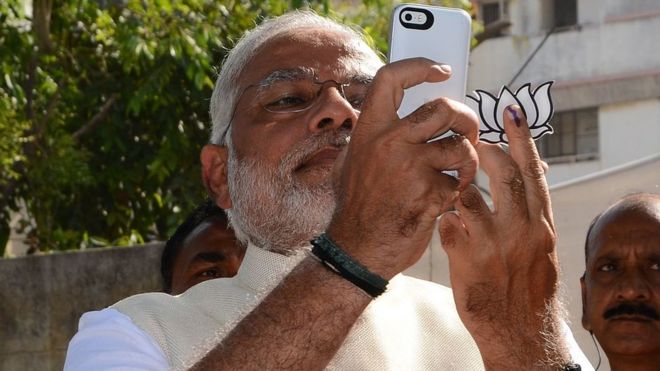
Image copyright STRDELImage caption Prime Minister Modi is the third most followed leader on Twitter after Donald Trump
The world’s second most popular leader – when it comes to social media, at least – sent shockwaves through the internet on Monday, after announcing he was considering leaving the platforms.
After all, Indian Prime Minister Narendra Modi is the only politician to even come close to challenging US President Donald Trump’s online dominance.
And so it was somewhat unsurprising that the hashtag #ModiQuitsSocialMedia began trending in India, with users quick to share a heady cocktail of conspiracy theories, memes and desperate pleas.
However, Mr Modi, who has 54 million followers on Twitter, 35.2 million followers on picture sharing platform Instagram and 44 million followers on Facebook, soon revealed the true reason behind his abandonment of social media.
On Tuesday, he said that he would “give away my social media accounts to women whose life & work inspire us”.
But the “big reveal” came only after his first tweet generated an absolute social media storm.
Some theories suggested he was quitting social media platforms as they were being controlled by his opponents. Others speculated that he would launch an indigenous social platform, to match Twitter and Facebook, something similar to social media platforms like WeChat and Weibo in China.
“Expect SM companies stock to crash,” wrote one confident user.
Apart from the theories, there were desperate pleas from his fans. One wrote: “Please Sir, You can’t leave social media now for the sake of your fans!” Another added: “Modi Ji if you leave social media , they will use it against you and nation interest.”
“For me he is not only PM of India but also emotion. You’re king of social media. Don’t go sir.”
Some users suggested that his account had been hacked.
Soon, #Iwillalsoleavetwitter started trending.
Arun Yadav, the head of Haryana state IT and social media for BJP, tweeted asking the PM to not quit the platform as it was one way Indians could communicate with him.
But there were also jokes.
“Spare a thought for Twitter, Facebook & their stocks. PM Modi is all set to demonetise social media,” wrote one user, referring to the overnight decision to ban high value currency notes in November.
One user suggested that the prime minister was quitting all other platforms in order to make his TikTok debut.
“Modi ji is a typical Indian boyfriend after breakup,” quipped one Twitter user.
“Modiji should be awarded Nobel Peace Prize for bringing peace in the digital world,” said another.
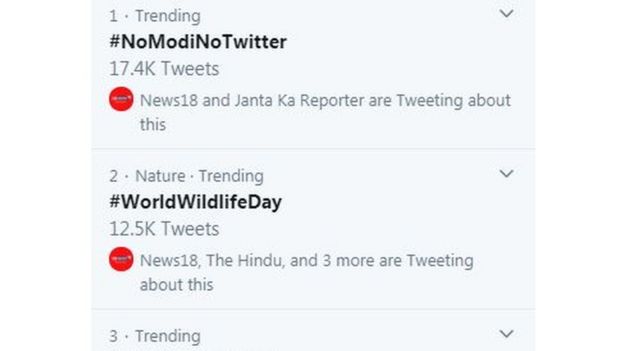
Image caption #NoModiNoTwitter was a India trend on Twitter after PM Modi’s tweet yesterday
There were political reactions too.
In a cheeky response, Rahul Gandhi, former president of the main opposition Congress party, tweeted: “Give up hatred, not social media accounts.”
Congress leader and MP Shashi Tharoor followed suit, writing: “The PM’s abrupt announcement has led many to worry whether it’s a prelude to banning these services throughout the country too.”
Mr Modi’s eventual tweet which clarified matters was seen by some as an anti-climax.
But for the millions who were pleading with him to reconsider, this is surely a big relief.
NEW DELHI/MUMBAI (Reuters) – India’s ruling Bharatiya Janata Party (BJP) is set to sweep two state polls next week, the first since Prime Minister Narendra Modi’s landslide win in a parliamentary election in May, a leading pollster said.
The BJP is set to comfortably win elections in the western state of Maharashtra and the northern state of Haryana, leaving the main opposition Congress party trailing, according to a survey by polling agency CVoter released on Friday.
CVoter estimates that a BJP-led alliance in Maharashtra will pick up 194 of the 288 seats on offer. In Haryana, the party is predicted to win 83 of the state’s 90 seats, leaving just three for Congress.
Voting in the elections will be held on Monday with the results expected to be announced on Thursday.
Several Congress party officials conceded they had all but given up hope of posing a serious challenge to Modi and the BJP.
In particular, the resignation of Congress chief Rahul Gandhi in July, after weeks of drama following the loss to the BJP in the general election, has sown internal confusion, triggering infighting and exits, two party officials in New Delhi said.
“It’s going to be a rout, and it will deflate morale even further,” one of the officials said, referring to the state elections. “It’s like a slow-moving disaster.”
They requested anonymity because they are not authorised to speak to the media.
Pranav Jha, the secretary in charge of Congress’s communication department, said the party was undergoing a period of “cleansing and churning” and remained committed to taking on the BJP.
“The people of India…can see through the diversionary drama of the ruling party, and realise that jobs, economy and issues of farmers can only be put on track by the Congress party,” Jha told Reuters.
Modi, analysts say, has moved decisively, including withdrawing special rights for Muslim-majority Jammu and Kashmir state, and consolidating the BJP’s hold over India’s Hindu-majority electorate.
INFIGHTING, INDIFFERENCE
In Maharashtra, one of India’s most industrialised states which includes Mumbai, two Congress officials said the top leadership’s relative indifference and infighting had hurt their already weak campaign.
Congress’s state wing had asked for Gandhi, his mother and current party chief Sonia Gandhi, and his charismatic sister Priyanka Gandhi Vadra to join the campaign, one of the two officials said.
But only Rahul Gandhi came and spoke at a handful of rallies.
“Senior leaders from BJP have covered every district. They have been visiting Maharashtra for the last two months to build momentum,” said one Congress official, who is contesting the upcoming poll.
“There wasn’t any concrete effort from Congress leaders in New Delhi to give energy to our cadre,” he said.
The list of recent resignations from the party include Ashok Tanwar, Congress’s former chief in Haryana who quit earlier this month and is now campaigning against his old party.
“The state of affairs in the Congress party is so dire that the decision makers can’t win an election themselves, while the soldiers on ground who stay in touch with the masses are neglected,” Tanwar wrote in his resignation letter.
The situation has even riled Congress allies. Two leaders from the Nationalist Congress Party, which is in alliance with the Congress in Maharashtra, said their partner was slack.
“It looks like Congress is not very serious about the state elections,” one of the leaders said. “Congress is not in the picture. Congress leaders are not attacking the ruling party the way we expected.”
In New Delhi, Congress officials said there was a sense of inertia at the party headquarters, without any understanding of who will become president after Sonia Gandhi, who is only holding charge temporarily.
“Without a clear leadership, nothing is going to change,” one of the officials said, “If it continues like this, the party will fade away.”
SRINAGAR/NEW DELHI (Reuters) – Authorities in Indian Kashmir have arrested nearly 4,000 people since the scrapping of its special status last month, government data shows, the most clear evidence yet of the scale of one of the disputed region’s biggest crackdowns.
Muslim-majority Kashmir, claimed by both India and Pakistan, has been in turmoil since India stripped its portion of the region of its autonomy and statehood on Aug. 5, leading to clashes between security forces and residents and inflaming tension with Pakistan.
India said the removal of the status that its part of Kashmir has held since independence from Britain in 1947 would help integrate it into the Indian economy, to the benefit of all.
In an attempt to stifle the protests that the reform sparked in Kashmir, India cut internet and mobile services and imposed curfew-like restrictions in many areas.
It has also arrested more than 3,800 people, according to a government report dated Sept. 6 and seen by Reuters, though about 2,600 have since been released.
A spokeswoman for India’s interior ministry did not respond to a request for comment. Neither did Jammu and Kashmir police.
It was not clear on what basis most of the people were being held but an Indian official said some were held under the Public Safety Act, a law in Jammu and Kashmir state that allows for detention for up to two years without charge.
The data for the first time shows the extent of the detentions, as well as indicating who was picked up and where.
More than 200 politicians, including two former chief ministers of the state were arrested, along with more than 100 leaders and activists from an umbrella organisation of pro-separatist political groups.
The bulk of those arrested – more than 3,000 – were listed as “stone pelters and other miscreants”. On Sunday, 85 detainees were shifted to a prison in Agra in northern India, a police source said.
Rights group Amnesty International said the crackdown was “distinct and unprecedented” in the recent history of the region and the detentions had contributed to “widespread fear and alienation”.
“The communication blackout, security clampdown and detention of the political leaders in the region has made it worse,” said Aakar Patel, head of Amnesty International India.
‘RIGHT TO LIFE’
India says the detentions are necessary to maintain order and prevent violence, and points to the relatively limited number of casualties compared with previous bouts of unrest.
The government says only one person is confirmed to have died compared with dozens in 2016, when the killing of a militant leader sparked widespread violence.
“The right to life is the most important human right,” India’s national security adviser Ajit Doval told reporters recently.
The report contains data from the 13 police districts that make up the Kashmir Valley, the most populous part of the Himalayan region where the main city of Srinagar is located.
The largest number of arrests have been in Srinagar, the data shows, at nearly 1,000. Earlier unrest often centred in rural areas.
Of the detained political leaders, more than 80 were from the People’s Democratic Party, formerly in coalition in Jammu and Kashmir state with the ruling Bharatiya Janata Party.
About 70 are from the National Conference, which has for years dominated politics in Indian Kashmir, and more than a dozen from India’s main opposition Congress party.
Police also arrested more than 150 people accused of association with militant groups fighting Indian rule.
An Indian official said it was likely that more than 1,200 people were still held, including all the high-profile politicians and separatists mentioned in the report, while dozens more are being arrested every day.
In the 24 hours before the report was compiled, more than two dozen people were arrested, mainly on suspicion of throwing stones at troops, the data showed.
The data did not include those under informal house arrest, nor people detained in a round-up of separatists that began in February after a bomb attack by a Pakistan-based militant group on Indian troops.
Days before India’s move to strip Kashmir of special status, one prominent separatist leader told Reuters that more than 250 people with links to the movement were already in detention.
The Chief Economic Adviser, K Subramanian, disagreed with the idea of industry-specific incentives and argued for structural reforms in land and labour markets. Members of Prime Minister Narendra Modi’s economic advisory council sound inchoate, resorting to social media and opinion editorials to counter one another.
In essence, the quibble among the members of the economic team of Mr Modi and his government is not about whether India is facing an economic slowdown or not, but about how grave the current economic crisis is.
To put all this in context, it was less than just two years ago, in November 2017, that the global ratings agency Moody’s upgraded India’s sovereign ratings – an independent assessment of the creditworthiness of a country – for the first time in 14 years.
Image copyrightGETTY IMAGESImage captionSales of cars and SUVs have slumped to a seven-year low
Justifying the upgrade, Moody’s had then argued that the economy was undergoing dramatic “structural” reforms under Mr Modi.
In the two years since, Moody’s has downgraded its 2019 GDP growth forecast for India thrice – from 7.5% to 7.4% to 6.8% to 6.2%.
The immediate questions that arise now are: is India’s economic condition really that grim and, if yes, how did it deteriorate so rapidly?
To make matters worse, Finance Minister Nirmala Sitharaman presented her first budget recently with some ominous tax proposals that threatened foreign capital flows and dented investor confidence. It sparked criticism and Ms Sitharaman was forced to roll back many of her proposals.
Image copyright GETTY IMAGESImage caption In 2016, India withdrew 85% of all currency notes from the economy
So, it is indeed true that India is facing a sharp economic downturn and severe loss of business confidence.
The alarm over the economic condition is not merely a reflection of a slowdown in GDP growth but also the poor quality of growth.
Private sector investment, the mainstay of sustainable growth in any economy, is at a 15-year low.
In other words, there is almost no investment in new projects by the private sector. The situation is so bad that many Indian industrialists have complained loudly about the state of the economy, the distrust of the government towards businesses and harassment by tax authorities.
But India’s economic slowdown is neither sudden nor a surprise.
Behind the fawning headlines in the press over the past five years about the robustness of India’s growth was a vulnerable economy, straddled with massive bad loans in the financial sector, disguised further by a macroeconomic bonanza from low global oil prices.
India’s largest import is oil and the fortuitous decline in oil prices between 2014 and 2016 added a full percentage point to headline GDP growth, masking the real problems. Confusing luck with skill, the government was callous about fixing the choked financial system.
Media caption What is really happening with India’s economy?
This move destroyed supply chains and impacted agriculture, construction and manufacturing that together account for three-quarters of all employment in the country.
Before the economy could recover from the currency ban shock, the government enacted a transition to a new indirect taxation system of the Goods and Services Tax (GST) in 2017. The GST rollout wasn’t smooth and many small businesses initially struggled to understand it.
Such massive external shocks to the economy, coupled with a reversal in low oil prices, dealt the final blow to the economy. Millions of Indians started to lose their jobs and rural wages remained stagnant. This, in turn, impacted consumption, slowing down the economy sharply.
Not easy
The wobbly state of the economy has also thrown government finances in disarray: tax revenues are much below expectations.
On Monday, the government got a much-needed breather when India’s central bank announced a $24bn (£19bn) one-time payout for the cash-starved government. (This amount is more than the dividend paid by the central bank to the government in all five years of the Congress rule between 2009 and 2014.)
The solutions to the economic crisis are not easy.
Indian industry, fed and fattened with government protection through decades, is once again clamouring for tax cuts and financial incentives.
But it is not clear that such benefits will revive private sector investment and domestic consumption immediately.
For all the hype about the Make in India programme, hailed as the harbinger of the country’s emergence as a manufacturing power, India’s dependence on China for goods has only doubled in the past five years.
India today imports from China the equivalent of 6,000 rupees ($83; £68) worth of goods for every Indian, which has doubled from 3,000 rupees in 2014.
So, India is neither making goods for itself nor for the world.
Image copyright AFPImage caption India’s agrarian crisis is a major stumbling block
Ornamental tax and other fiscal incentives to specific industries are not suddenly going to make Indian manufacturers competitive and stop India’s addiction for affordable Chinese goods. If any, the trade spat between China and the United States only saw countries such as Vietnam and Bangladesh benefit and not India.
More currency or trade tariffs are not the solutions either. The central bank has lowered interest rates and there is some push to lowering the cost of capital for industry. But again, Indian industry will invest more only when demand for goods and services increases. And demand will increase only when wages increase, or there is money in the hands of people.
So, the only immediate solution for India seems to be to boost consumption through a stimulus given directly to people, in the classical Keynesian mould.
Of course, such a stimulus should be combined with reforms to boost business morale and confidence.
In sum, India’s economic picture is not pretty.
It is important for India’s political leadership to see this not-so-pretty picture and not hide behind rose tinted glasses. Prime Minister Modi has a unique electoral mandate to embark on bold moves to truly transform the economy and pull India out of the woods.
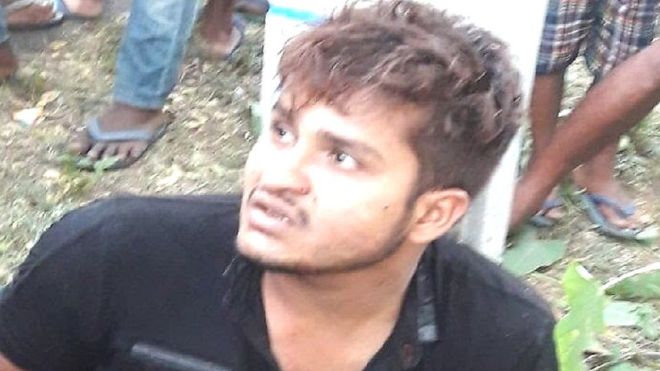
Image copyright BBC HINDIImage caption A video showing Tabrez Ansari pleading for his life was widely circulated on social media
In many parts of India, Hindus often invoke the popular god Ram’s name as a greeting. But in recent years, Hindu lynch mobs have turned Ram’s name into a murder cry, writes the BBC’s Geeta Pandey in Delhi.
Last month, a video that went viral on social media showed a terrified Muslim man tied to a pole being assaulted by a lynch mob made up of Hindu men in the eastern state of Jharkhand.
In the video, 24-year old Tabrez Ansari is seen pleading for his life, blood and tears streaming down his face.
His attackers force him to repeatedly chant “Jai Shri Ram”, which translates from Hindi to “hail Lord Ram” or “victory to Lord Ram”.
Mr Ansari does as told, and when the mob is finished with him, he is handed over to the police.
The police lock him up and his family is not allowed to see him. He dies four days later from injuries sustained during the attack.
Mr Ansari is not the only one to have been singled out in this manner. June was a particularly bloody month for Indian Muslims, who were targeted in several such attacks.
In Barpeta district in the north-eastern state of Assam, a group of young Muslim men were assaulted and then made to chant slogans like “Jai Shri Ram”, “Bharat Mata ki Jai” (long live Mother India) and “Pakistan murdabad” (death to Pakistan).
In the commercial capital Mumbai, a 25-year-old Muslim taxi driver was abused, beaten up and told to chant “Jai Shri Ram” by a group of men. Faizal Usman Khan said he was attacked when his taxi broke down and he was trying to fix it. His attackers fled after a passenger called the police.
And in the eastern city of Kolkata, Hafeez Mohd Sahrukh Haldar, a 26-year-old Muslim teacher at a madrassa (religious seminary), was heckled while travelling on a train by a group of men chanting “Jai Shri Ram”.
He told reporters that they made fun of his clothes and beard, and then insisted that he also chant the slogans. When he refused, they pushed him out of the moving train. Mr Haldar was injured, but lived to tell the tale.
The slogan-shouting and heckling is no longer restricted to the mob and the streets. Worryingly, it has also entered parliament.
When the newly-elected lower house convened for the first time on 17 June, Muslim and opposition MPs were heckled by members of Prime Minister Narendra Modi’s Bharatiya Janata Party (BJP) when they stood up to take the oath.
The attacks on the minorities have been condemned by opposition politicians. Rahul Gandhi, before he resigned as leader of the main opposition Congress party, described the mob lynching of Tabrez Ansari as a “blot on humanity”.
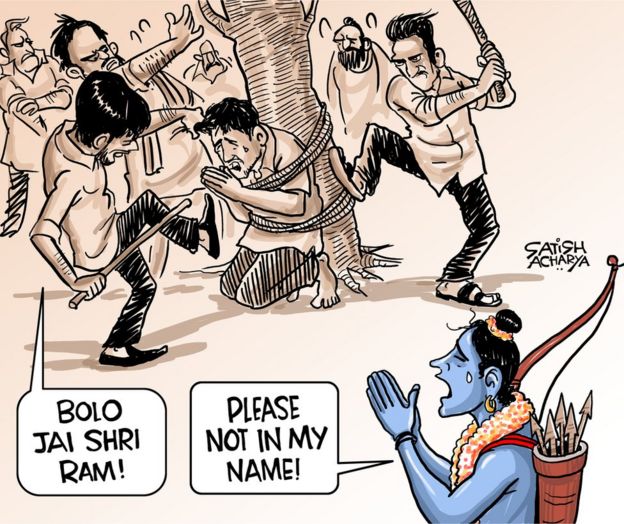
Many critics, including cartoonist Satish Acharya, have also expressed alarm over the rising number of such incidents.
Image copyright COURTESY: SATISH ACHARYAImage caption Cartoonist Satish Acharya says using Ram’s name to unleash violence risks widening India’s religious divide
In villages across north India, devout Hindus have traditionally used “Ram Ram”, “Jai Siya Ram” (goddess Siya or Sita is Ram’s consort) or “Jai Ram Ji Ki” as a greeting.
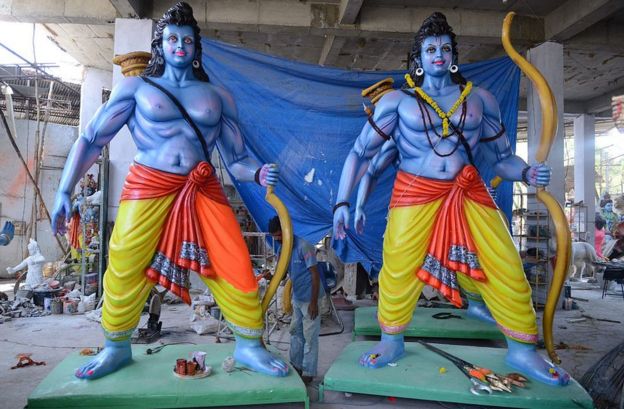
And many feel a sense of unease that these attacks and killings are being carried out in the name of a god revered by millions for his sense of justice and benevolence.
But “Jai Shri Ram” has now been turned into a cry of attack, meant to intimidate and threaten those who worship differently.
The party’s then president LK Advani launched a march supporting the construction of the temple and in December 1992 mobs chanting “Jai Shri Ram” marched upon the northern town and tore down the 16th Century Babri mosque.
The BJP believes the mosque was built after the destruction of a temple to Ram that once stood there.
The campaign galvanised Hindu voters in favour of the BJP and helped turn Ram from personal to political. Since then, the party has consistently invoked the deity during elections and the 2019 polls were no exception.
Critics say those who heckle minorities, inside parliament and outside it, see the BJP’s sweeping victory in the April/May elections as sanctioning their behaviour. The party won more than 300 seats in the 543-member lower house, propelling Mr Modi to a second term.
Mr Modi’s first term in power was marked by violence against minorities. There were numerous incidents of Muslims being attacked by so-called “cow vigilantes” over rumours that they had eaten beef, or that they were trying to smuggle cows – an animal many Hindus consider holy – for slaughter.
The prime minister did not condone such attacks, but was criticised for not condemning them either.
Image copyright GETTY IMAGESImage caption Millions of Hindus revere the god Ram for his sense of justice and benevolence
But right after the BJP’s stunning victory in May, Mr Modi expanded his earlier slogan of “sabka saath, sabka vikas” (development for all) to include “sabka vishwas” (to win the trust of everyone), giving rise to hopes that this term would be different.
A few days after Tabrez Ansari’s death, he told parliament that he was “pained” by the incident and that “the guilty must be severely punished”.
But many Indians doubt that any serious action will be taken against those who carry out such attacks.
Several dozen people have been killed and hundreds injured since 2014 in mob attacks, but there have been convictions in only a handful of cases.
In others, the accused remain free, often due to a lack of evidence, and some have been seen being feted by Mr Modi’s party’s colleagues.
BJP leaders often downplay such incidents, calling them “minor” and accusing the press of “maligning the image of the government”.
One BJP MP recently told a news website that the popularity of the slogan “Jai Shri Ram” was a sort of protest by Hindus “against a certain bias and tilt of the polity towards minorities”.
“They are also asserting that we are Hindus and we count as Hindus,” he said.
But critics say that there are other – better – ways of doing that.
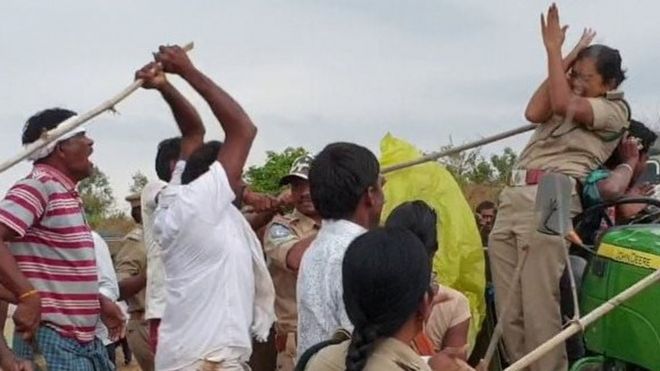
Sixteen men have been arrested after a female forest official was brutally beaten with sticks by a mob as police officers watched in the southern Indian state of Telangana.
The mob, led by a member of the state’s ruling party, was protesting against a tree plantation drive on Sunday.
A video of the incident has gone viral, and the party’s president has condemned the attack on Twitter.
The forest officer is being treated in hospital for severe injuries.
A video of the incident shows the mob attacking the officer with bamboo sticks, as she stands on a tractor and tries to placate them.
She is repeatedly hit with the sticks until forest officials and local police step in to disperse the mob and contain the attack.
The footage has gone viral in India and led to outrage across the country.
This prompted a high-ranking official of the Telangana Rashtra Samithi (TRS) party, Kalvakuntla Taraka Rama Rao, to condemn the incident on Twitter.
I strongly condemn the atrocious behaviour of Koneru Krishna who attacked a forest officer who was doing her job. He has been arrested & a case booked already; no one is above law of the land
The leader of the mob has been identified as Koneru Krishna Rao, a local official who is the brother of a TRS lawmaker. The party confirmed that he has also been arrested.
In his defence, Mr Rao told local media that he was trying to “ensure justice for tribal farmers as forest officials were destroying their crops”.
“The forest department is terrorising tribal farmers and confiscating their land forcefully”, he alleged, adding that the attack was “accidental”.
Media caption ‘This ambitious water project killed my husband’
Two police officers, who were at the scene at the time of the attack, have been suspended for failing to protect the officer, BBC Telugu confirmed.
The incident occurred in the town of Kagaznagar, where the state’s forest department has been authorised to carry out a plantation drive as part of the Kaleshwaram project – a large irrigation scheme, which was inaugurated last week.
Opposition parties in the state, the Bharatiya Janata Party (BJP) and the Congress party, have strongly condemned the attack.
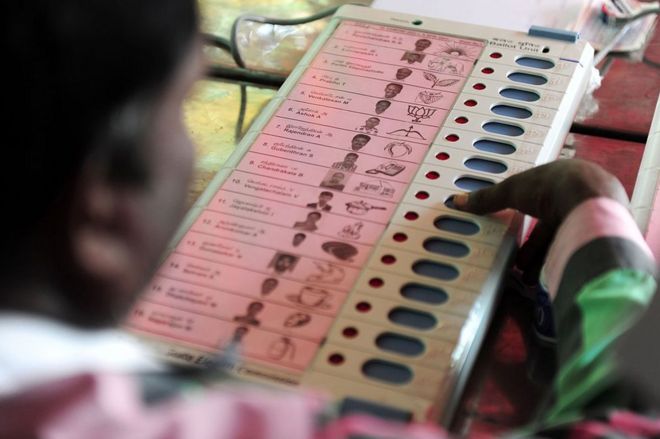
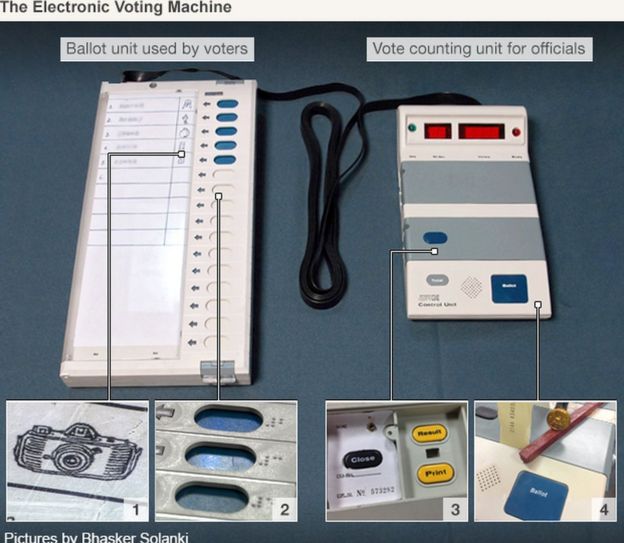
Image copyright AFPImage caption More than 1.5 million e-voting machines will be used in the summer elections
India’s election is nearly over: voting began on 11 April, and the final ballot was cast on 19 May with results out on 23 May. Every day, the BBC will be bringing you all the latest updates on the twists and turns of the world’s largest democracy.
What happened?
India’s Election Commission has denied allegations that voting machines had been tampered with in parts of India.
India’s opposition parties are meeting the election watchdog on Tuesday to demand more transparency in counting of votes on 23 May (Thursday).
Opposition leaders said the EC had to ensure that there was no possibility of anybody manipulating the Electronic Voting Machines (EVMs) which were used to record votes in the general election that concluded on Sunday.
In Uttar Pradesh’s Ghazipur constituency, a candidate belonging to the opposition Bahujan Samaj Party held a protest outside a room where the machines have been stored ahead of the counting. The candidate alleged that attempts were being made to take out the machines from the storage room.
Local officials have said the allegations are baseless.
The apprehensions regarding EVMs are baseless. EVMs are in strong room with 24×7 CISF security. And candidates have been allowed to post their agents to monitor the strong room.
In Chandauli constituency, supporters of Samajwadi Party have circulated a mobile phone clip, alleging that some machines were being brought to the counting station on Monday, a day after the election.
Local officials have said the machines shown in the video are reserve machines which had been brought from another part of the constituency because of logistical reasons.
The Election Commission has insisted that “proper security and protocol” was maintained in storing the electronic voting machines.
Why does this matter?
The move comes after a slew of exit polls predicted that the governing Bharatiya Janata Party (BJP) would get a comfortable majority in parliament to form a government.
Sitaram Yechury from the Left Front said the EC was “yet to come out with a mechanism” to deal with a mismatch between an EVM result and the corresponding paper trail.
During voting, EVMs are connected to a Voter-Verifiable Paper Audit Trail (VVPAT) machine, which dispenses a slip of paper with the symbol of the party the voter selected.
The Supreme Court has ordered the EC to tally the results from five EVMs with VVPAT receipts in at least five polling stations in every assembly seat. A parliamentary constituency comprises several assembly seats.
But opposition parties say that the tally should done for the entire constituency in case of a mismatch.
“On VVPATs and the EVM tally, the EC is yet to come out with a procedure in case there is a mismatch. Even if there is one mismatch in the EVMs or VVPAT samples picked for counting, to maintain the integrity of the electoral process, all VVPATs in that Assembly segment must be counted. This is important to maintain integrity of the electoral process,” Mr Yechury said.
If this were to happen however, it would considerably slow down the counting process and declaration of results.
PM Modi tweets tribute to former PM Rajiv Gandhi
What happened?
Prime Minister Narendra Modi has tweeted on the occasion of the death anniversary of former PM Rajiv Gandhi.
Mr Modi has repeatedly attacked Mr Gandhi on the campaign trail and his slurs have prompted widespread criticism.
He called Mr Gandhi the “number one corrupt man in the country” at a rally earlier this month in the northern state of Uttar Pradesh. A few days later, he went after Mr Gandhi again – accusing him of using a naval aircraft carrier to take him and his family to an island for a “family holiday”.
Mr Gandhi was assassinated by a suicide bomber in 1991 during a campaign rally.
Why does this matter?
Mr Modi’s tweet marking Mr Gandhi’s death anniversary is customary – but it has garnered attention because he attacked the former prime minister repeatedly while campaigning and didn’t back down when challenged.
Many were taken aback by Mr Modi’s criticism of Mr Gandhi. It elicited condemnation not just from the main opposition Congress party, but other regional opposition leaders, political commentators and even former political opponents of Mr Gandhi.
Analysts said the comments were a sign of “desperation” and showed that Mr Modi “knew” his party was not going to perform as well as expected in the election.
Now that campaigning is over and the election is nearly at an end, Mr Modi seems to be abandoning acerbic rhetoric for something more conciliatory.
On Monday, opposition rejects exit poll results
Image copyrightGETTY IMAGES
What happened?
Opposition leaders have dismissed the exit polls, which suggest that the governing Bharatiya Janata Party (BJP) is on course to win the general election.
I don’t trust Exit Poll gossip. The game plan is to manipulate or replace thousands of EVMs through this gossip. I appeal to all Opposition parties to be united, strong and bold. We will fight this battle together
A slew of exit polls released on Sunday predict big wins for the BJP-led National Democratic Alliance (NDA). The highest poll prediction for the NDA is 365 seats, and the lowest is 242.
An average of all exit polls gives the NDA 295 seats. Any party or coalition needs at least 272 seats to secure a majority in parliament and form a government.
The BJP welcomed the prediction and many of its leaders congratulated party workers’ efforts on social media.
Why does this matter?
Exit polls have to be taken with caution because they have been wrong in the past – a fact that opposition leaders were quick to point out.
I believe the exit polls are all wrong. In Australia last weekend, 56 different exit polls proved wrong. In India many people don’t tell pollsters the truth fearing they might be from the Government. Will wait till 23rd for the real results.
Time and again exit polls have failed to catch the People’s pulse. Exit polls have proved to be incorrect and far from ground reality in many instances. While undoubtedly TDP govt will be formed in AP, we are confident that non-BJP parties will form a non-BJP govt at the center.
The BJP is locked in a fierce electoral battle with the Congress and a clutch of regional parties in various states. But the trends suggest that the opposition’s strategy may have failed.
The most surprising prediction has come from the bellwether state of Uttar Pradesh (UP), which sends 80 MPs to parliament – more than any other.
So the state always holds the key to who forms the government – in 2014, the BJP won 71 seats.
Analysts had predicted that powerful regional parties would comfortably defeat the BJP this time around. But most of the exit polls suggest the party will perform much better than expected in UP – winning anything between 38 to 68 seats.
Only two polls – Nielsen-ABP and NewsX-Neta – have predicted that the BJP would lose at least 40 seats in UP to regional parties. Nielsen-ABP says the NDA will win 22 seats in the state, while NewsX-Neta gives the coalition only 33 seats.
These are the the only two polls which predict that the BJP-led alliance could fall short of an outright majority.
On Wednesday, Priyanka Gandhi is taking on Prime Minister Narendra Modi on his home turf – by holding a road show in his constituency Varanasi. Ever since she formally joined politics in February, she has been on a whirlwind tour, campaigning mostly in Uttar Pradesh where Varanasi is located. But will her efforts make any difference to the fortunes of the Congress party in the general elections?
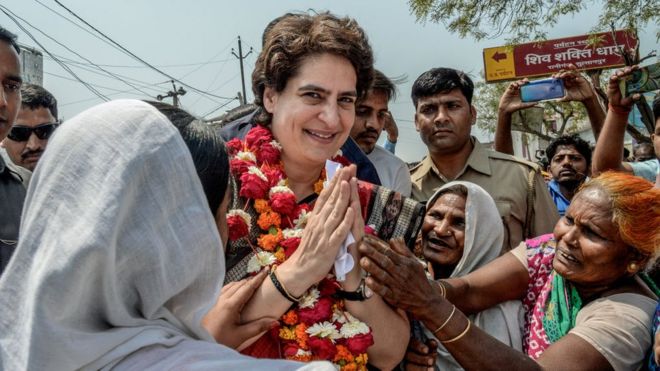
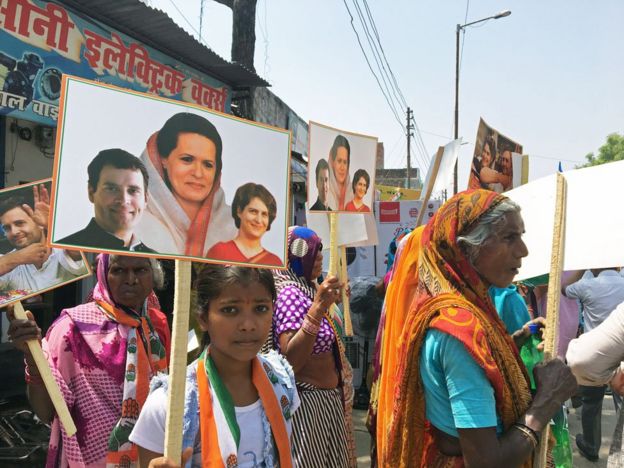
When Ms Gandhi, the charismatic sister of Congress party president Rahul Gandhi, walked up onto the stage at a rally in the town of Pratapgarh last week, she was greeted by shouts of “Priyanka Gandhi zindabad! [Long Live Priyanka Gandhi!]”. A massive garland of red roses was held up by local Congress leaders to frame her and a golden crown was placed on her head.
Ms Gandhi launched a direct attack on Mr Modi, accusing him of not fulfilling the promises he had made before the 2014 elections.
His government, she said, had failed to create jobs, his decision to scrap high denomination banknotes had broken the backs of poor people and small businesses, and she chided the prime minister for denying farmers their rights.
When the Congress is voted to power, she said, the job scheme for the poor would be extended, wages paid on time and high school education made free.
Image caption Ms Gandhi connects easily with people, especially women
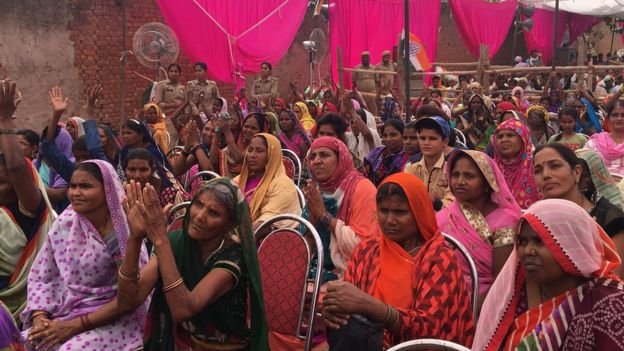
The rally was held in a small ground in the town centre and it was a small crowd, but the audience was responsive, clapping and cheering as she spoke in flawless Hindi. She ended her speech by appealing to them to vote for the Congress candidate, to vote in the change.
Mithilesh Kumar Yadav, a 21-year-old student in the audience, told me that as a young man, that’s what he wanted.
“Priyanka Gandhi wants to bring change here. As a young man I want change. Mr Modi’s policies have affected people adversely,” he said, adding that “the prime minister doesn’t talk about issues that are important. He’s trying to divert attention from his unkept promises.”
Congress spokesman Akhilesh Pratap Singh told me that Ms Gandhi had been brought in to strengthen her brother’s hands, help energise the party rank and file and counter Mr Modi’s Bharatiya Janata Party (BJP).
Since taking the plunge into active politics, Ms Gandhi has hit the ground running. In the past three months, I too have travelled extensively in this bellwether state that elects 80 MPs, talking to Congress party supporters to understand why they clamour for the Gandhis, especially her.
At her rallies and road shows, I have met people who are enthused by her presence, her decision for a more active political role, but I didn’t meet a single person who said they were going to vote for the Congress because of her.
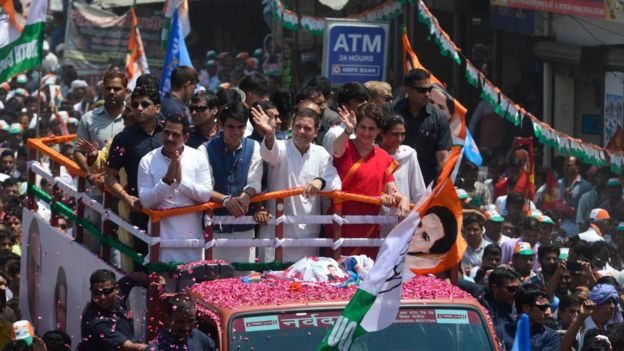
Ms Gandhi has spent hours campaigning in cars, trucks and even a boat, participated in dozens of road shows and addressed scores of rallies, grinning and waving at supporters, often reaching out to shake hands.
In February, when she made her first public appearance as a full-time politician in the state capital, Lucknow, along with her brother, thousands of supporters thronged the streets to greet them. Party workers and supporters were charged up and many told me that the Congress was now on course to win the elections and form the next government.
Similar scenes were repeated later in Amethi, Mr Gandhi’s constituency, and in towns and cities across northern India.
Image copyright GETTY IMAGESImage caption The Gandhi siblings received a tumultuous welcome during their road show in Amethi
A natural politician, Ms Gandhi is extremely articulate in Hindi and English and connects easily with people, especially women. With her short hair and crisp cotton saris, she bears a striking resemblance to her grandmother, India’s tough and only female prime minister Indira Gandhi.
And even though she’s not running for parliament, there is obsessive media interest in everything she does – during her visit to a village of snake charmers in her mother’s constituency Rae Bareli, she’s photographed holding up snakes, and in central India, a sari-clad Priyanka Gandhi is seen scaling a fence to mingle with the crowd at a rally while her security men race to catch up with her.
Her visits to temples and shrines to woo the religious are streamed live on TV channels, her road shows get prime time, and her comments about PM Modi often make headlines. And increasingly, it’s her who’s taking on Mr Modi, countering his criticism of her family and his charge that the siblings are there not because of merit but their name.
Ms Gandhi is not exactly a newcomer to politics. For almost two decades now, she has managed campaigns for her brother and mother Sonia Gandhi, but been reluctant to take on a wider role.
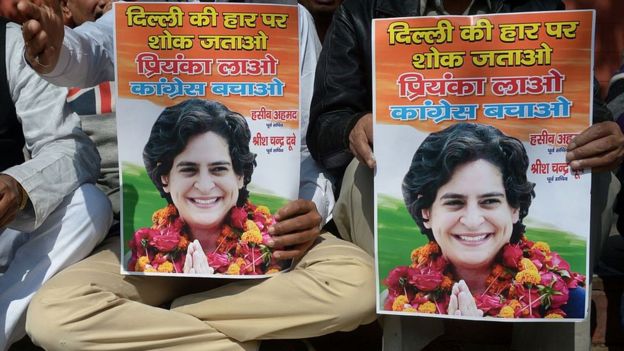
The 47-year-old mother-of-two has always been regarded as the more charismatic of the Gandhi siblings. And in recent years, as the Congress has suffered major electoral setbacks, the chorus for her to take on a larger role has been getting louder. In 2015, some party workers demonstrated outside the Congress headquarters in Delhi, holding placards that read, “Priyanka lao, Congress bachao [Bring Priyanka, Save Congress]”.
So when it was announced in January that she had been appointed as general secretary for the eastern part of Uttar Pradesh, supporters celebrated by setting off fireworks and dancing outside the party office. She was described as the “Brahmastra” – a mythical celestial weapon of last resort deployed by Hindu deities to annihilate the enemy.
In a recent interview with a Hindi-language newspaper, Ms Gandhi explained the reasons why she finally said yes.
“Democracy, constitution and our institutions are under attack and it would have been cowardly not to take the plunge now. In 2017, Rahul asked me to take on Uttar Pradesh but I didn’t. It was a mistake but people learn from their experiences, so this time when he asked, I agreed.”
The Gandhi siblings are the fourth generation of the Nehru-Gandhi dynasty, often described as India’s political royalty. Their great-grandfather, Jawaharlal Nehru, was the first prime minister of independent India, their grandmother and father also served as prime ministers, while their mother, Italian-born Sonia, was the Congress chief until poor health forced her to hand over the reins to her son.
Image copyright GETTY IMAGESImage caption In 2015, some party workers demonstrated outside Congress HQ in Delhi, holding placards that read “Bring Priyanka, Save Congress”
Mr Modi often mocks the siblings, saying they lead the Congress because of entitlement and not achievement.
Congress supporters, however, don’t seem unduly worried about the dynasty link – they talk about the fact that their grandmother and father were assassinated and the “sacrifices” the family has made for the country.
Spokesman Akhilesh Pratap Singh says Rahul – and now Priyanka – have re-energised the party. “BJP leaders, including PM Modi, are rattled, otherwise why would they call her names or say she won’t make any impact on the elections?”
Mr Singh says the most important thing is that “our workers are enthused and the public confidence in the party has grown”.
But will all this adulation really convert into votes and seats for the party?
“Definitely,” Mr Singh says. “When the votes are counted, you’ll see our voting percentage has gone up.”
Image caption Congress says Ms Gandhi has been brought in to help energise the party rank and file in Uttar Pradesh
Political analyst Neerja Chowdhury says Ms Gandhi has lots of charisma but she is a great example of its limits.
She “left it a bit too late” and should have come out a year ago and worked to galvanise the people, she says.
“The party organisation is decimated in the state and has to be built from scratch. She doesn’t have a magic wand.”
Ms Chowdhury says expecting Ms Gandhi to turn around the party in such a short time is asking her to do the impossible and it’s unfair on her because it will open her to being dismissed as a failure.
But in the absence of a strong party machinery or leadership in Uttar Pradesh, Ms Gandhi’s efforts can take Congress only so far and no further.
Ms Chowdhury says she would need to build the party base in the state brick-by-brick – that would require much more than charisma, and plenty of hard work.
But one thing, she says, she’s sure about is that “Ms Gandhi is here to stay”.
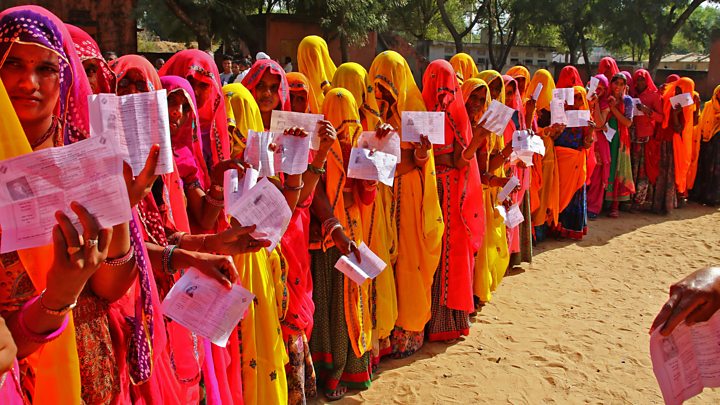
NEW DELHI (Reuters) – Voters in north India lined up early on Sunday to cast their ballots in the second-to-last round of a seven-phase general election, with Prime Minister Narendra Modi facing a diverse group of opposition parties seeking to deny him a second term.
More than 100 million people across seven states are eligible to vote in the sixth phase of the 39-day-long poll, which Modi began on April 11 as front-runner after an escalation of tension with neighbouring Pakistan.
But opposition parties have recently taken heart at what they see as signs Modi’s Hindu nationalist Bharatiya Janata Party (BJP) may be losing ground and have begun negotiations over a post-election alliance even before polling ends on May 19. Votes will be counted on May 23.
The president of the main opposition Congress party, Rahul Gandhi, said the main issues in the election were unemployment, distress in the countryside, the demonetisation of bank notes and a new sales tax.
“It was a good fight,” Gandhi said after he cast his vote.
“Narendra Modi used hatred, we used love. And I think love is going to win.”
A lack of new jobs – despite annual economic growth of about 7% – and the plight of farmers struggling with falling crop prices have been major worries for voters.
A new good and services tax (GST), as well as Modi’s shock ban on all high-value currency notes in 2016, hurt small and medium businesses.
Some voters in the capital, New Delhi, said they were backing Modi because they were won over by his tough stand on security.
Indian warplanes attacked what the government said was a terrorist training camp in Pakistan in February, soon after a suicide car bomb attack in the disputed Kashmir region killed 40 police officers.
BIG CHANCE FOR SMALL PARTIES?
The aggressive response stirred nationalist passions that pollsters said could favour Modi in the election.
“I have voted for Modi’s sound foreign policy and national security,” said a 36-year-old first-time voter who declined to be identified.
“The demonetisation has affected jobs growth but over time, the positive effects of GST and demonetisation would take care of jobs,” he said.
But concern about unemployment and crop prices have put the BJP on the back foot, and the opposition has in recent days felt more upbeat about its chances.
Political analysts say state-based and caste-driven parties could be decisive in determining the make-up of the next government.
“Regional parties will play a bigger role compared to the previous 5 years or even 15 years,” said K.C. Suri, a political science professor at the University of Hyderabad. “They will regain their importance in national politics.”
Recent weeks have also been marked by personal attacks between leaders, including comments from Modi about the family of Congress President Rahul Gandhi, the scion of the Nehru-Gandhi political dynasty.
At a recent rally Modi called Gandhi’s late father, former Prime Minister Rajiv Gandhi, “corrupt no. 1”. The BJP says Modi was reacting to Rahul Gandhi calling him a thief.
“The political vitriolic has become intense, and negatively intense,” said Ashok Acharya, a political science professor at the University of Delhi.
“It seems as if this particular election is all about a few political personalities. It is not about issues, any kind of an agenda.”


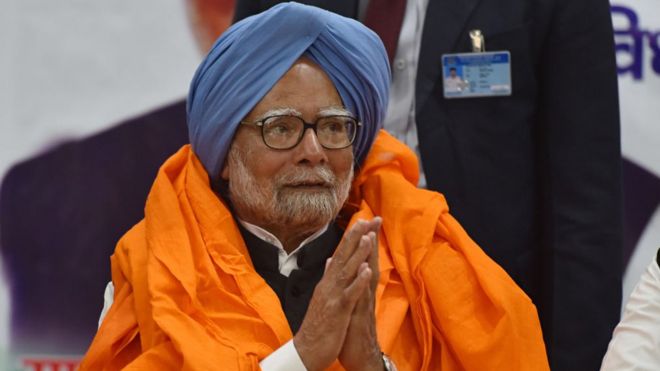 Image copyright GETTY IMAGES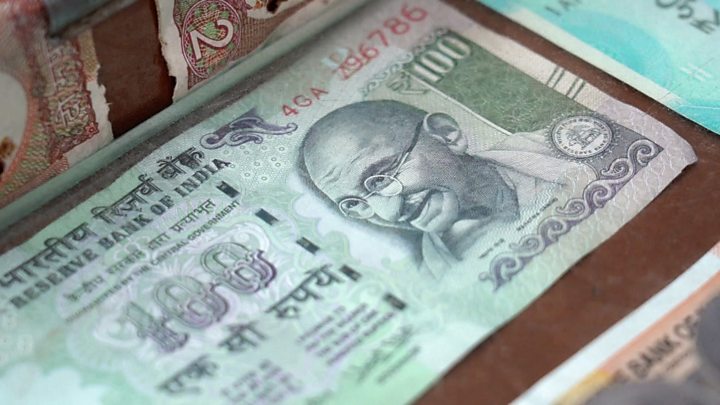







 CHINDIA ALERT: You'll be living in their world, very soon