Chindia Alert: You’ll be Living in their World Very Soon
aims to alert you to the threats and opportunities that China and India present. China and India require serious attention; case of ‘hidden dragon and crouching tiger’.
Without this attention, governments, businesses and, indeed, individuals may find themselves at a great disadvantage sooner rather than later.
The POSTs (front webpages) are mainly 'cuttings' from reliable sources, updated continuously.
The PAGEs (see Tabs, above) attempt to make the information more meaningful by putting some structure to the information we have researched and assembled since 2006.
Image copyright GETTY IMAGESImage caption Around 300,000 in Hong Kong hold a British National (Overseas) passport
The UK has said it is considering more rights for holders of a special passport issued to some people in Hong Kong.
The territory, which used to be a British colony, was handed back to China in 1997. Anyone born before then is eligible to apply for a British National (Overseas) passport, known as a BNO.
If China implements a controversial proposed security law, people holding the BNO, could get a “path to citizenship”, the UK said.
What is the BNO and who has one?
The BNO passport is essentially a travel document that does not carry citizenship rights with it – although you are entitled to some consular assistance outside of Hong Kong and China with it.
It was issued to people in Hong Kong by the UK before Hong Kong was handed over to China.
Around 300,000 people currently hold a BNO passport, allowing them to visit the UK visa-free for six months. An estimated 2.9 million people are eligible for a BNO passport, said the British Consulate General in Hong Kong.
Though it gives the passport holder the right to remain in the UK for up to six months, it doesn’t automatically allow them to reside or work there. They also aren’t allowed to access public funds, including things like government benefits.
BNO holders cannot pass this status on to their children.
What is the UK proposing – and why?
China on Thursday formally approved a plan to impose controversial national security legislation in Hong Kong. It could go into effect as early as the end of June.
Hong Kong was handed back to China, on a number of conditions. These include the region’s high level of autonomy and maintaining certain rights like freedom of speech that do not exist in mainland China.
But this new plan, if put into law, would make it a crime to undermine Beijing’s authority in Hong Kong, and many are concerned it could end Hong Kong’s unique status.
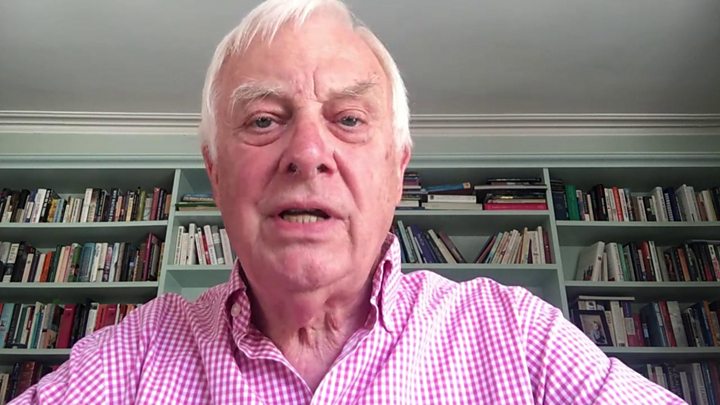
The move triggered a wave of criticism around the world, with many – including Chris Patten, the last governor of Hong Kong – urging the UK to stand up for the territory.
Image caption Under current rules, BNO holders are allowed to stay for six months
Later on Thursday, UK Foreign Secretary Dominic Raab said the country would move to scrap the six-month stay limit for BNO holders if China goes on to officially implement the law.
Mr Raab said that BNO passport holders would be allowed to “apply to work and study for extendable periods of 12 months and that will itself provide a pathway to future citizenship”.
What difference could it make?
As a way to help people in Hong Kong who would rather not stay there if the new security laws are implemented, it might prove more symbolic.
For starters only a small percentage of people in Hong Kong currently have a BNO.
But also, the people who the security laws are aimed at – the young anti-mainland protesters who have been getting into violent confrontations with police for months – are not likely to be eligible for the BNO because of their age.
Additionally, though the BNO gives the passport holder the right to visit the UK for up to a year potentially, it’s not clear what other benefits the extension might bring, or if the UK would make it any easier administratively for those already in the country to apply for work or study.
On social media, some Hong Kongers dismissed it as a gesture that amounted to little more than a 12-month tourist visa.
Effectively, it means that those who come to stay in the UK for a year, and who have the funds to be able to extend this enough, could eventually be eligible to apply for citizenship.
It cuts out some of the administrative hoops BNO holders would have had to jump through before this move if they wanted this path.
How has China reacted?
China has firmly opposed the move by the UK, saying it is a violation of the handover agreement that stipulates BNO passport holders do not enjoy UK residency.
China has repeatedly warned Britain to stay out of its affairs in Hong Kong.
The Chinese ambassador to the UK Liu Xiaoming had previously accused some British politicians of viewing Hong Kong “as part of the British empire”.
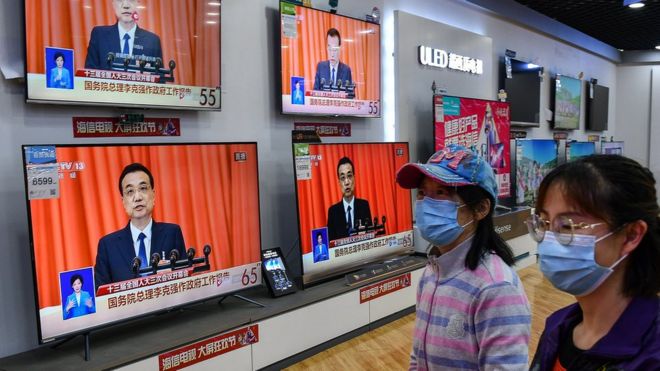
Image copyright AFP / GETTYImage caption Shoppers walking past a broadcast of Chinese Premier Li Keqiang delivering his speech at the opening of the NPC on Thursday
China’s ruling Communist Party has set in motion a controversial national security law for Hong Kong, a move seen as a major blow to the city’s freedoms.
The law to ban “treason, secession, sedition and subversion” could bypass Hong Kong’s lawmakers.
Critics say China is breaking its promise to allow Hong Kong freedoms not seen elsewhere in China.
It is likely to fuel public anger and may even trigger fresh protests and demands for democratic reform.
The plan was submitted at the annual National People’s Congress (NPC), which largely rubber-stamps decisions already taken by the Communist leadership, but is still the most important political event of the year.
Hong Kong, a semi-autonomous region and an economic powerhouse, was always meant to have introduced such laws after the handover from British control to Chinese rule in 1997.
After last year’s wave of sustained and violent protest, Beijing is now attempting to push them through, arguing “law-based and forceful measures” must be taken to “prevent, stop and punish” such protests in the future.
On Friday, Hong Kong’s government said it would co-operate with Beijing to enact the law, adding it would not affect the city’s freedoms.
That article says Hong Kong “must improve” national security, before adding: “When needed, relevant national security organs of the Central People’s Government will set up agencies in Hong Kong to fulfil relevant duties to safeguard national security in accordance with the law.”
China could essentially place this law into Annex III of the Basic Law, which covers national laws that must be implemented in Hong Kong – either by legislation, or decree.
Addressing the congress, Premier Li Keqiang spoke of the economic impact of the coronavirus and on Hong Kong and Macau said: “We’ll establish sound legal systems and enforcement mechanisms for safeguarding national security in the two Special Administrative Regions.”
What do opponents say the dangers are?
Hong Kong is what is known as a “special administrative region” of China.
It has observed a “one country, two systems” policy since Britain returned sovereignty in 1997, which has allowed it certain freedoms the rest of China does not have.
Pro-democracy activists fear that China pushing through the law could mean “the end of Hong Kong” – that is, the effective end of its autonomy and these freedoms.
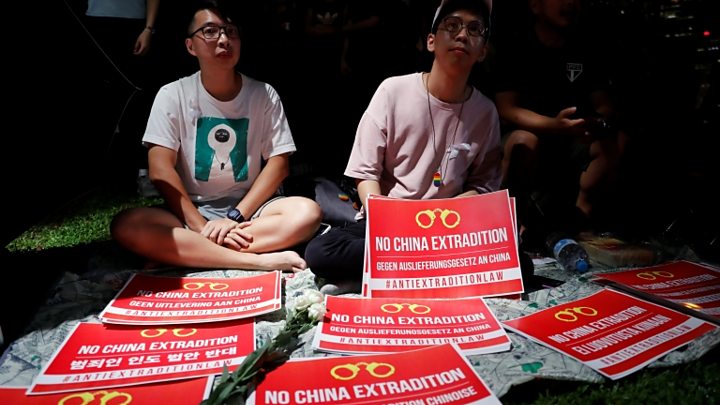
Last year’s mass protests in Hong Kong were sparked by a bill that would have allowed extraditions to mainland China.
Media caption Former Hong Kong governor Chris Patten: “UK should tell China this is outrageous”
The bill was paused, then withdrawn – but the protests continued until the virus outbreak at the end of the year.
The US has also weighed in, with President Trump saying the US would react strongly if it went through – without giving details.
It is currently considering whether to extend Hong Kong’s preferential trading and investment privileges.
Why is China doing this?
Mr Wang said the security risks had become “increasingly notable” – a reference to last year’s protests.
“Considering Hong Kong’s situation at present, efforts must be made at the state-level to establish and improve the legal system and enforcement mechanisms,” he is quoted as saying in state media.
Media caption The BBC’s Helier Cheung on Hong Kong’s 2019 protests
Beijing may also fear September’s elections to Hong Kong’s legislature.
If last year’s success for pro-democracy parties in district elections is repeated, government bills could potentially be blocked.
What is Hong Kong’s legal situation?
Hong Kong was under British control for more than 150 years up to 1997.
The British and Chinese governments signed a treaty – the Sino-British Joint Declaration – that agreed Hong Kong would have “a high degree of autonomy, except in foreign and defence affairs”, for 50 years.
This was enshrined in the Basic Law, which runs out in 2047.
Faced with a backlash from the West over its handling of the early stages of the pandemic, Beijing has been quietly gaining ground in Asia
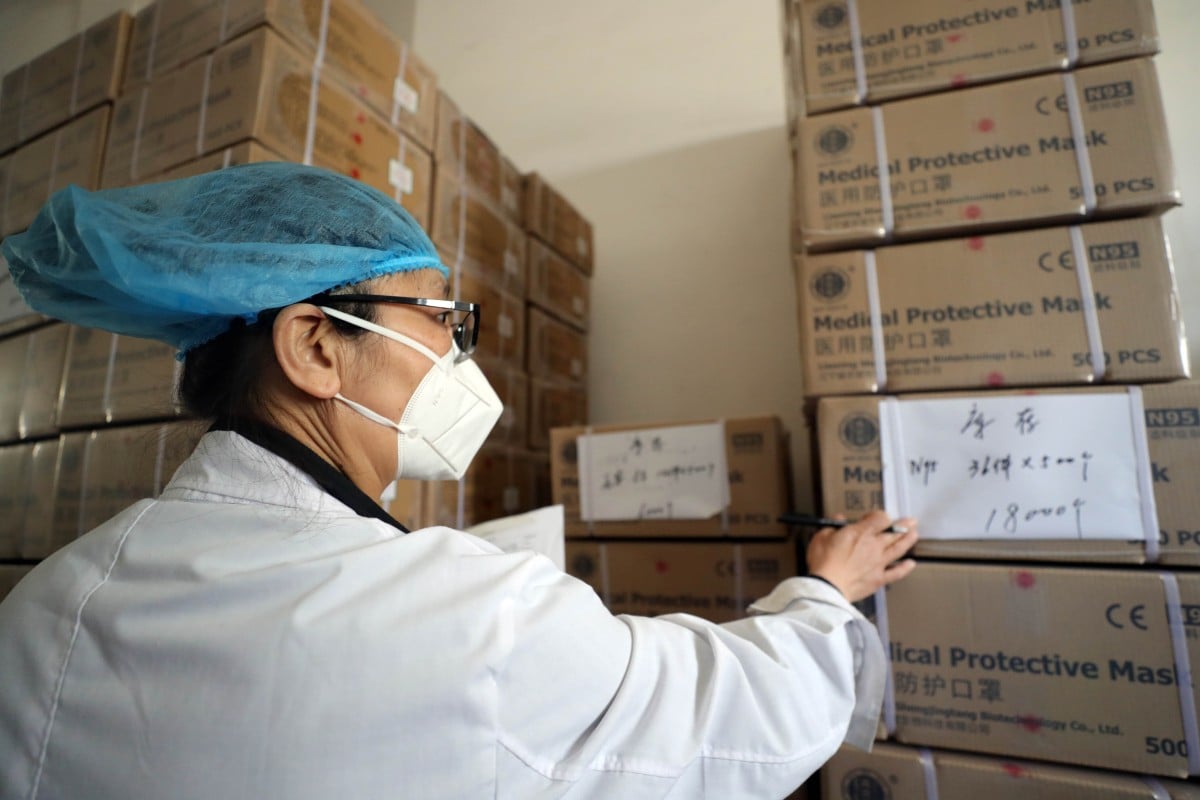
Teams of experts and donations of medical supplies have been largely welcomed by China’s neighbours
Despite facing some criticism from the West, China’s Asian neighbours have welcomed its medical expertise and vital supplies. Photo: Xinhua
While China’s campaign to mend its international image in the wake of its handling of the coronavirus health crisis has been met with scepticism and even a backlash from the US and its Western allies, Beijing has been quietly gaining ground in Asia.
Teams of experts have been sent to Cambodia, the Philippines, Myanmar, Pakistan and soon to Malaysia, to share their knowledge from the pandemic’s ground zero in central China.
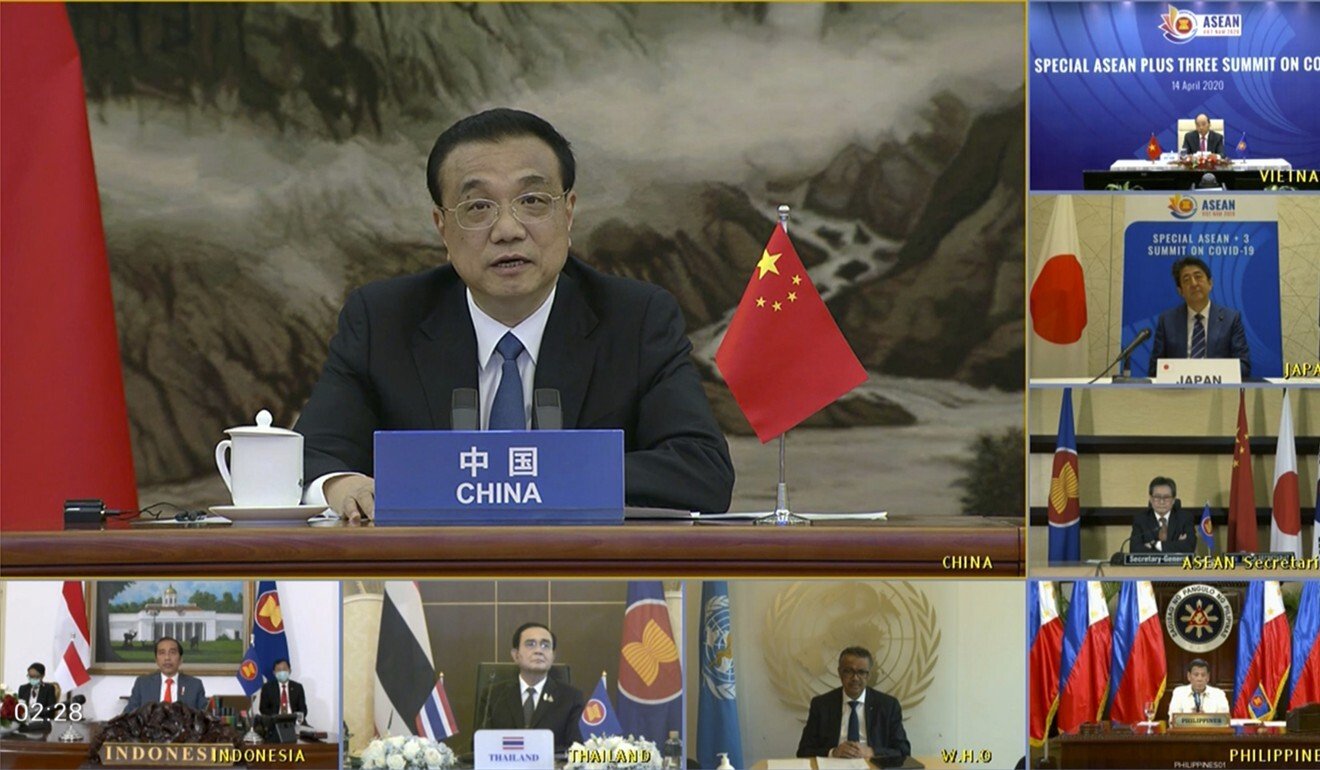
China has also held a series of online “special meetings” with its Asian neighbours, most recently on Tuesday when Premier Li Keqiang discussed his country’s experiences in combating the disease and rebooting a stalled economy with the leaders of the Association of Southeast Asian Nations (Asean), Japan and South Korea.
Chinese Prime Minister Li Keqiang speaks to Asean Plus Three leaders during a virtual summit on Tuesday. Photo: AP
Many Western politicians have publicly questioned Beijing’s role and its subsequent handling of the crisis but Asian leaders – including Philippine President Rodrigo Duterte and Japanese Prime Minister Shinzo Abe – have been reluctant to blame the Chinese government, while also facing criticism at home for not closing their borders with China soon enough to prevent the spread of the virus.
An official from one Asian country said attention had shifted from the early stages of the outbreak – when disgruntled voices among the public were at their loudest – as people watched the virus continue its deadly spread through their homes and across the world.
“Now everybody just wants to get past the quarantine,” he said. “China has been very helpful to us. It’s also closer to us so it’s easier to get shipments from them. The [medical] supplies keep coming, which is what we need right now.”
The official said also that while the teams of experts sent by Beijing were mainly there to observe and offer advice, the gesture was still appreciated.
Another Asian official said the tardy response by Western governments in handling the outbreak had given China an advantage, despite its initial lack of transparency over the outbreak.
“The West is not doing a better job on this,” he said, adding that his government had taken cues from Beijing on the use of propaganda in shaping public opinion and boosting patriotic sentiment in a time of crisis.
“Because it happened in China first, it has given us time to observe what works in China and adopt [these measures] for our country,” the official said.
Experts in the region said that Beijing’s intensifying campaign of “mask diplomacy” to reverse the damage to its reputation had met with less resistance in Asia.
Why China’s ‘mask diplomacy’ is raising concern in the West
29 Mar 2020
“Over the past two months or so, China, after getting the Covid-19 outbreak under control, has been using a very concerted effort to reshape the narrative, to pre-empt the narrative that China is liable for this global pandemic, that China has to compensate other countries,” said Richard Heydarian, a Manila-based academic and former policy adviser to the Philippine government.
“It doesn’t help that the US is in lockdown with its domestic crisis and that we have someone like President Trump who is more interested in playing the blame game rather than acting like a global leader,” he said.
Shahriman Lockman, a senior analyst with the foreign policy and security studies programme at Malaysia’s Institute of Strategic and International Studies, said that as the US had withdrawn into its own affairs as it struggled to contain the pandemic, China had found Southeast Asia a fertile ground for cultivating an image of itself as a provider.
China’s first-quarter GDP shrinks for the first time since 1976 as coronavirus cripples economy
Beijing’s highly publicised delegations tasking medical equipment and supplies had burnished that reputation, he said, adding that the Chinese government had also “quite successfully shaped general Southeast Asian perceptions of its handling of the pandemic, despite growing evidence that it could have acted more swiftly at the early stages of the outbreak in Wuhan”.
“Its capacity and will to build hospitals from scratch and put hundreds of millions of people on lockdown are being compared to the more indecisive and chaotic responses seen in the West, especially in Britain and the United States,” he said.
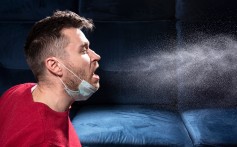
Coronavirus droplets may travel further than personal distancing guidelines
16 Apr 2020
Lockman said Southeast Asian countries had also been careful to avoid getting caught in the middle of the deteriorating relationship between Beijing and Washington as the two powers pointed fingers at each other over the origins of the new coronavirus.
“The squabble between China and the United States about the pandemic is precisely what Asean governments would go to great lengths to avoid because it is seen as an expression of Sino-US rivalry,” he said.
“Furthermore, the immense Chinese market is seen as providing an irreplaceable route towards Southeast Asia’s post-pandemic economic recovery.”
Aaron Connelly, a research fellow in Southeast Asian political change and foreign policy with the International Institute for Strategic Studies in Singapore, said Asian countries’ dependence on China had made them slow to blame China for the pandemic.
“Anecdotally, it seems to me that most Southeast Asian political and business elites have given Beijing a pass on the initial cover-up of Covid-19, and high marks for the domestic lockdown that followed,” he said.
“This may be motivated reasoning, because these elites are so dependent on Chinese trade and investment, and see little benefit in criticising China.”
China and Vietnam ‘likely to clash again’ as they build maritime militias
12 Apr 2020
The cooperation with its neighbours as they grapple with the coronavirus had not slowed China’s military and research activities in the disputed areas of the South China Sea – a point of contention that would continue to cloud relations in the region, experts said.
Earlier this month an encounter in the South China Sea with a Chinese coastguard vessel led to the sinking of a fishing boat from Vietnam, which this year assumed chairmanship of Asean.
And in a move that could spark fresh regional concerns, shipping data on Thursday showed a controversial Chinese government survey ship, the Haiyang Dizhi 8, had moved closer to Malaysia’s exclusive economic zone.
The survey ship was embroiled in a months-long stand-off last year with Vietnamese vessels within Hanoi’s exclusive economic zone and was spotted again on Tuesday 158km (98 miles) off the Vietnamese coast.
MUNICH (Reuters) – One January lunchtime in a car parts company, a worker turned to a colleague and asked to borrow the salt.
As well as the saltshaker, in that instant, they shared the new coronavirus, scientists have since concluded.
That their exchange was documented at all is the result of intense scrutiny, part of a rare success story in the global fight against the virus.
The co-workers were early links in what was to be the first documented chain of multiple human-to-human transmissions outside Asia of COVID-19, the disease caused by the coronavirus.
They are based in Stockdorf, a German town of 4,000 near Munich in Bavaria, and they work at car parts supplier Webasto Group. The company was thrust under a global microscope after it disclosed that one of its employees, a Chinese woman, caught the virus and brought it to Webasto headquarters. There, it was passed to colleagues – including, scientists would learn, a person lunching in the canteen with whom the Chinese patient had no contact.
The Jan. 22 canteen scene was one of dozens of mundane incidents that scientists have logged in a medical manhunt to trace, test and isolate infected workers so that the regional government of Bavaria could stop the virus from spreading.
That hunt has helped Germany win crucial time to build its COVID-19 defences.
The time Germany bought may have saved lives, scientists say. Its first outbreak of locally transmitted COVID-19 began earlier than Italy’s, but Germany has had many fewer deaths. Italy’s first detected local transmission was on Feb. 21. By then Germany had kicked off a health ministry information campaign and a government strategy to tackle the virus which would hinge on widespread testing. In Germany so far, more than 2,100 people have died of COVID-19. In Italy, with a smaller population, the total exceeds 17,600.
“We learned that we must meticulously trace chains of infection in order to interrupt them,” Clemens Wendtner, the doctor who treated the Munich patients, told Reuters.
Wendtner teamed up with some of Germany’s top scientists to tackle what became known as the ‘Munich cluster,’ and they advised the Bavarian government on how to respond. Bavaria led the way with the lockdowns, which went nationwide on March 22.
Scientists including England’s Chief Medical Officer Chris Whitty have credited Germany’s early, widespread testing with slowing the spread of the virus. “‘We all know Germany got ahead in terms of its ability to do testing for the virus and there’s a lot to learn from that,’” he said on TV earlier this week.
Christian Drosten, the top virologist at Berlin’s Charite hospital, said Germany was helped by having a clear early cluster. “Because we had this Munich cohort right at the start … it became clear that with a big push we could inhibit this spreading further,” he said in a daily podcast for NDR radio on the coronavirus.
Drosten, who declined to be interviewed for this story, was one of more than 40 scientists involved in scrutiny of the cluster. Their work was documented in preliminary form in a working paper at the end of last month, intended for The Lancet. The paper, not yet peer-reviewed, was shared on the NDR site.
ELECTRONIC DIARIES
It was on Monday, Jan. 27, that Holger Engelmann, Webasto’s CEO, told the authorities that one of his employees had tested positive for the new coronavirus. The woman, who was based in Shanghai, had facilitated several days of workshops and attended meetings at Webasto’s HQ.
The woman’s parents, from Wuhan, had visited her before she travelled on Jan. 19 to Stockdorf, the paper said. While in Germany, she felt unusual chest and back aches and was tired for her whole stay. But she put the symptoms down to jet lag.
She became feverish on the return flight to China, tested positive after landing and was hospitalised. Her parents also later tested positive. She told her managers of the result and they emailed the CEO.
In Germany, Engelmann said he immediately set up a crisis team that alerted the medical authorities and started trying to trace staff members who had been in contact with their Chinese colleague.
The CEO himself was among them. “Just four or five days before I received the news, I had shaken hands with her,” he said.
Now known as Germany’s “Case #0,” the Shanghai patient is a “long-standing, proven employee from project management” who Engelmann knows personally, he told Reuters. The company has not revealed her identity or that of others involved, saying anonymity has encouraged staff to co-operate in Germany’s effort to contain the virus.
The task of finding who had contact with her was made easier by Webasto workers’ electronic calendars – for the most part, all the doctors needed was to look at staff appointments.
“It was a stroke of luck,” said Wendtner, the doctor who treated the Munich patients. “We got all the information we needed from the staff to reconstruct the chains of infection.”
For example, case #1 – the first person in Germany to be infected by the Chinese woman – sat next to her in a meeting in a small room on Jan. 20, the scientists wrote.
Where calendar data was incomplete, the scientists said, they were often able to use whole genome sequencing, which analyses differences in the genetic code of the virus from different patients, to map its spread.
By following all these links, they discovered that case #4 had been in contact several times with the Shanghai patient. Then case #4 sat back-to-back with a colleague in the canteen.
When that colleague turned to borrow the salt, the scientists deduced, the virus passed between them. The colleague became case #5.
Webasto said on Jan. 28 it was temporarily closing its Stockdorf site. Between Jan. 27 and Feb. 11, a total of 16 COVID-19 cases were identified in the Munich cluster. All but one were to develop symptoms.
All those who tested positive were sent to hospital so they could be observed and doctors could learn from the disease.
Bavaria closed down public life in mid-March. Germany has since closed schools, shops, restaurants, playgrounds and sports facilities, and many companies have shut to aid the cause.
HAMMER AND DANCE
This is not to say Germany has defeated COVID-19.
Its coronavirus death rate of 1.9%, based on data collated by Reuters, is the lowest among the countries most affected and compares with 12.6% in Italy. But experts say more deaths in Germany are inevitable.
“The death rate will rise,” said Lothar Wieler, president of Germany’s Robert Koch Institute for infectious diseases.
The difference between Germany and Italy is partly statistical: Germany’s rate seems so much lower because it has tested widely. Germany has carried out more than 1.3 million tests, according to the Robert Koch Institute. It is now carrying out up to 500,000 tests a week, Drosten said. Italy has conducted more than 807,000 tests since Feb. 21, according to its Civil Protection Agency. With a few local exceptions, Italy only tests people taken to hospital with clear and severe symptoms.
Germany’s government is using the weeks gained by the Munich experience to double the number of intensive care beds from about 28,000. The country already has Europe’s highest number of critical care beds per head of the population, according to a 2012 study.
Even that may not be enough, however. An Interior Ministry paper sent to other government departments on March 22 included a worst-case scenario with more than 1 million deaths.
Another scenario saw 12,000 deaths – with more testing after partial relaxation of restrictions. That scenario was dubbed “hammer and dance,” a term coined by blogger Tomas Pueyo. It refers to the ‘hammer’ of quick aggressive measures for some weeks, including heavy social distancing, followed by the ‘dance’ of calibrating such measures depending on the transmission rate.
The German government paper argued that in the ‘hammer and dance’ scenario, the use of big data and location tracking is inevitable. Such monitoring is already proving controversial in Germany, where memories of the East German Stasi secret police and its informants are still fresh in the minds of many.
A subsequent draft action plan compiled by the government proposes the rapid tracing of infection chains, mandatory mask-wearing in public and limits on gatherings to help enable a phased return to normal life after Germany’s lockdown. The government is backing the development of a smartphone app to help trace infections.
Germany has said it will re-evaluate the lockdown after the Easter holiday; for the car parts maker at the heart of its first outbreak, the immediate crisis is over. Webasto’s office has reopened.
All 16 people who caught COVID-19 there have recovered.
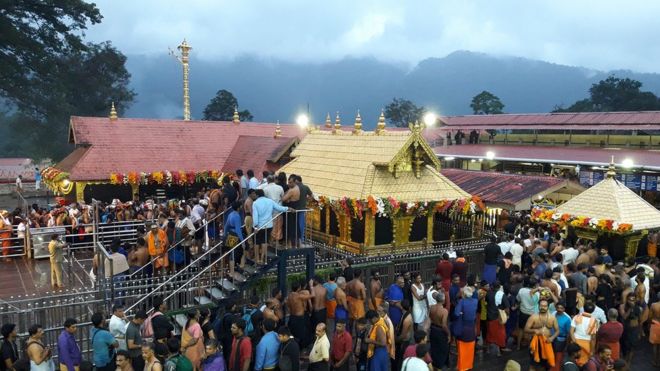
Image copyright KAVIYOOR SANTHOSHImage caption Sabarimala is one of the most prominent Hindu temples in the country
India’s Supreme Court has agreed to review its landmark judgement allowing women of menstruating age to enter a controversial Hindu shrine.
A five-judge bench last year ruled that keeping women out of the Sabarimala shrine in the southern state of Kerala was discriminatory.
The verdict led to massive protests in the state.
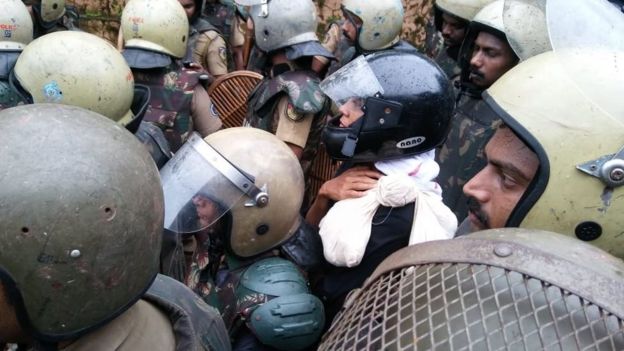
Women who tried to enter the shrine were either sent back or, in some cases, even assaulted.
The move is likely to anger women who fought hard to win the right to enter the temple.
Hinduism regards menstruating women as unclean and bars them from participating in religious rituals.
Many temples bar women during their periods and many devout women voluntarily stay away, but Sabarimala had a blanket ban on all women between the ages of 10 and 50.
What did the court say?
On Thursday the five-judge bench, responding to dozens of review petitions challenging the court’s landmark judgement last year, said that the matter would now be heard by a larger bench.
In doing so, however, it did not stay its earlier order. This means women can still legally enter the temple.
But it’s not going to be easy for them.
Image caption Some women tried to enter the temple last year
A temple official welcomed the ruling and appealed to women to stay away.
Women trying to enter the temple after the verdict last year were attacked by mobs blocking the way.
Many checked vehicles heading towards the temple to see if any women of a “menstruating age” – deemed to be those aged between 10 and 50 years – were trying to enter.
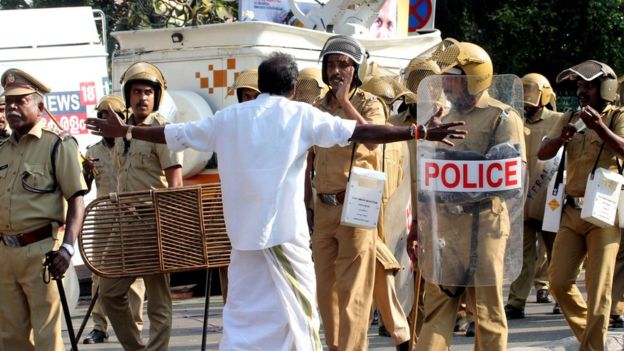
Following Thursday’s verdict, police in Kerala have appealed for calm, saying that action will be taken “against those who take the law into their own hands”. They added that social media accounts would be under surveillance and those stoking religious tensions online would be arrested.
‘One step forward, two steps back’
Geeta Pandey, BBC News, Delhi
Today’s verdict will come as a massive disappointment to women’s rights campaigners. It’s a case of one step forward, two steps back.
In 2018, while lifting the ban on women’s entry into the shrine, the Supreme Court had said that everyone had the right to practice religion and that the ban was a form of “untouchability”.
It was seen as a hugely progressive ruling and had given hope to women that they were equal before the law and could now claim equality before the gods too. What happened in court today has taken that sense away.
The Supreme Court has not put its earlier order on hold, but with the ambiguity over women’s entry continuing, it’s very likely they could be kept out in the name of keeping peace.
With the case now to be reopened by a larger seven-judge bench, the fight will have to be fought all over again.
Why is the temple so controversial?
Part of the violent opposition to the Supreme Court order to reverse the temple’s historical ban on women was because protesters felt the ruling goes against the wishes of the deity, Lord Ayappa, himself.
While most Hindu temples allow women to enter as long as they are not menstruating, the Sabarimala temple is unusual in that it was one of the few that did not allow women in a broad age group to enter at all.
Hindu devotees say that the ban on women entering Sabarimala is not about menstruation alone – it is also in keeping with the wish of the deity who is believed to have laid down clear rules about the pilgrimage to seek his blessings.
Image copyright GETTY IMAGESImage caption The entry of women into the Sabarimala temple sparked angry scenes
Every year, millions of male devotees trek up a steep hill, often barefoot, to visit the shrine. They also undertake a rigorous 41-day fast, abstaining from smoking, alcohol, meat, sex and contact with menstruating women before they begin the journey.
Women’s rights campaigners who appealed to the Supreme Court to lift the ban said that this custom violated equality guaranteed under India’s constitution. They added that it was prejudiced against women and their right to worship.
Supporters of the ban argued that the practice had been in effect for centuries, and there was no need to change it now.
So, were any women able to enter last year?
In January, two women defied protesters and entered the shrine.
Kanakadurga, 39, and Bindu Ammini, 40, made history when they entered the Sabarimala shrine – but they had to do so under heavy police protection and were also met with massive protests after.
Right-wing groups, supported by India’s ruling Hindu nationalist Bharatiya Janata Party (BJP), demanded a state-wide shutdown after, and businesses and transportation became paralysed.
Across the state hundreds were arrested, and at least one person was killed in clashes.
In an interview with the BBC, the women said they felt it necessary to uphold women’s rights and they weren’t afraid of mobs “enraged” by their actions.
Media caption One of the women who defied protesters to enter the Sabarimala temple says she has ‘no fear’
“I am not afraid. But every time women make any progress, society has always made a lot of noise,” Ms Kanakadurga told the BBC in January.
But their decision to enter the temple also came at heavy personal cost.
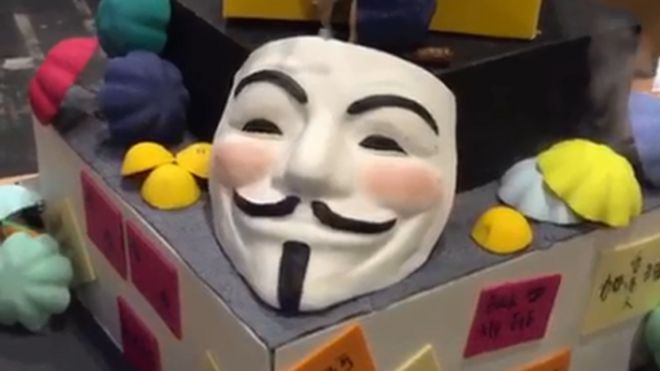
Image copyright 3RD SPACEImage caption The Guy Fawkes mask has been worn by many protesters during anti government rallies
A Hong Kong protest-themed cake has been disqualified from a cake decorating competition in the UK, in a move that has been referred to as “political censorship”.
It featured protest symbols including umbrellas and a Guy Fawkes mask.
The company behind the cake told the BBC it believed it was pulled after complaints from Chinese competitors.
But the Birmingham competition organisers said it was because one element of the cake was oversized.
Anti-government protests have been taking place in Hong Kong for five months.
They first erupted in June, triggered by a controversial bill that would have allowed extradition to mainland China.
The bill has been withdrawn but the protests have continued, having evolved into a broader revolt against the way Hong Kong is administered by Beijing.
‘Obvious it was an excuse’
The cake was one of many displayed this year at the Cake International competition, held in the city of Birmingham from 1- 3 November.
It draws competitors from all over the world.
The entry by a baker from the 3rd Space cafe in Hong Kong included fake tear gas and a figure made to look like a typical protester clad in black and wearing a hard hat.
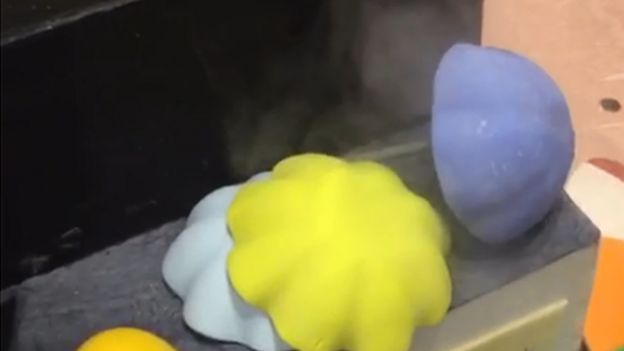
Image copyright 3RD SPACEImage caption A man in a yellow hard hat, carrying an umbrella, was one element of the cakeImage copyright 3RD SPACEImage caption The cake also had umbrellas which had fake “tear gas” coming out of them
It was inspired by the “streets [of] Hong Kong”, the spokesperson for the cafe told the BBC.
“The design was simply an expression of what is happening at the moment in Hong Kong,” the spokesperson added.
A music box placed inside the cake also played “Glory to Hong Kong”- a tune which has been adopted as the unofficial anthem of the protests – on loop.
But according to 3rd Space, Cake International decided to take action after it received numerous “complaints from Chinese candidates”, who said the cake featured “offensive content… promoting [the] independence of Hong Kong”.
Cake International first decided to turn the music off, before later sending the baker an email telling them that the cake would be “removed”, said 3rd space.
Dozens of people later took to Cake International’s social media platforms complaining, accusing the organisers of pandering to “censorship”.
The protests have presented a serious challenge to China’s leaders, who have painted the demonstrators as dangerous separatists and accused foreign powers of backing them.
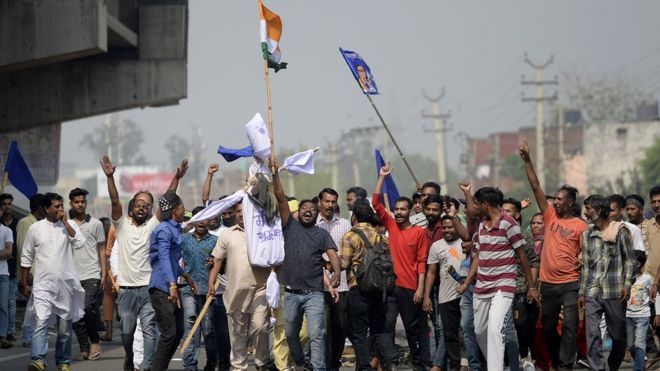
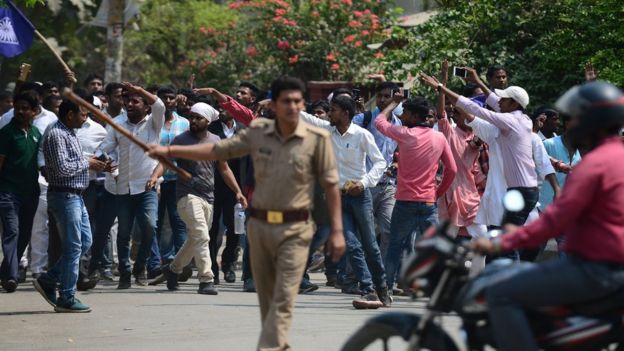
In its ruling, the court had stopped instant arrests and the automatic registration of criminal cases under the law. Critics said at the time that the decision would pave the way for officials to turn a blind eye to caste atrocities. They also warned that this would lead to increased violence against lower castes.
What is the SC/ST Act?
The Scheduled Caste and Scheduled Tribe (Prevention of Atrocities) Act, 1989 was brought into law to prevent crimes against people belonging to lower castes and tribes in India.
The act was passed as it was felt that the existing legal framework did not provide adequate protection to lower castes.
The law allows for instant arrests, severely limits opportunities for bail and the automatic registration of criminal cases against anyone accused of committing an offence against a member of a lower caste or tribe.
Image copyright AFPImage caption Despite the laws to protect them, discrimination remains a daily reality for Dalits
It also prescribes several other stringent measures such as the attachment and forfeiture of the property of an accused.
The act also allows public servants to be prosecuted for neglect of duties – a significant step given that many lower caste people allege that their complaints were often ignored by officials who belonged to the same communities as those they were accusing.
It was amended in 2015 to cover newer forms of discrimination and crimes against lower caste communities.
Why do Dalits need protection?
Dalits are some of India’s most downtrodden citizens because of an unforgiving Hindu caste hierarchy that condemns them to the bottom of the ladder.
Despite laws that protect them, discrimination remains a daily reality for the Dalit population, thought to number around 200 million.
Traditionally, they have been segregated from the upper castes and are not allowed to attend the same temples, schools or even drink from the same cups as upper caste people. They do not get equal access to education or jobs, and are often victims of exploitation, abuse and violence.
Lately, activists say that rising aspirations among young Dalits have improved their lives, but this has also increased violence against them by upper caste community members who are unable to accept this.
Chengdu school teaches boys to build model rockets while girls learn about knitting
Handicrafts show at school prompts question, ‘Why can’t boys knit and girls build rockets?’
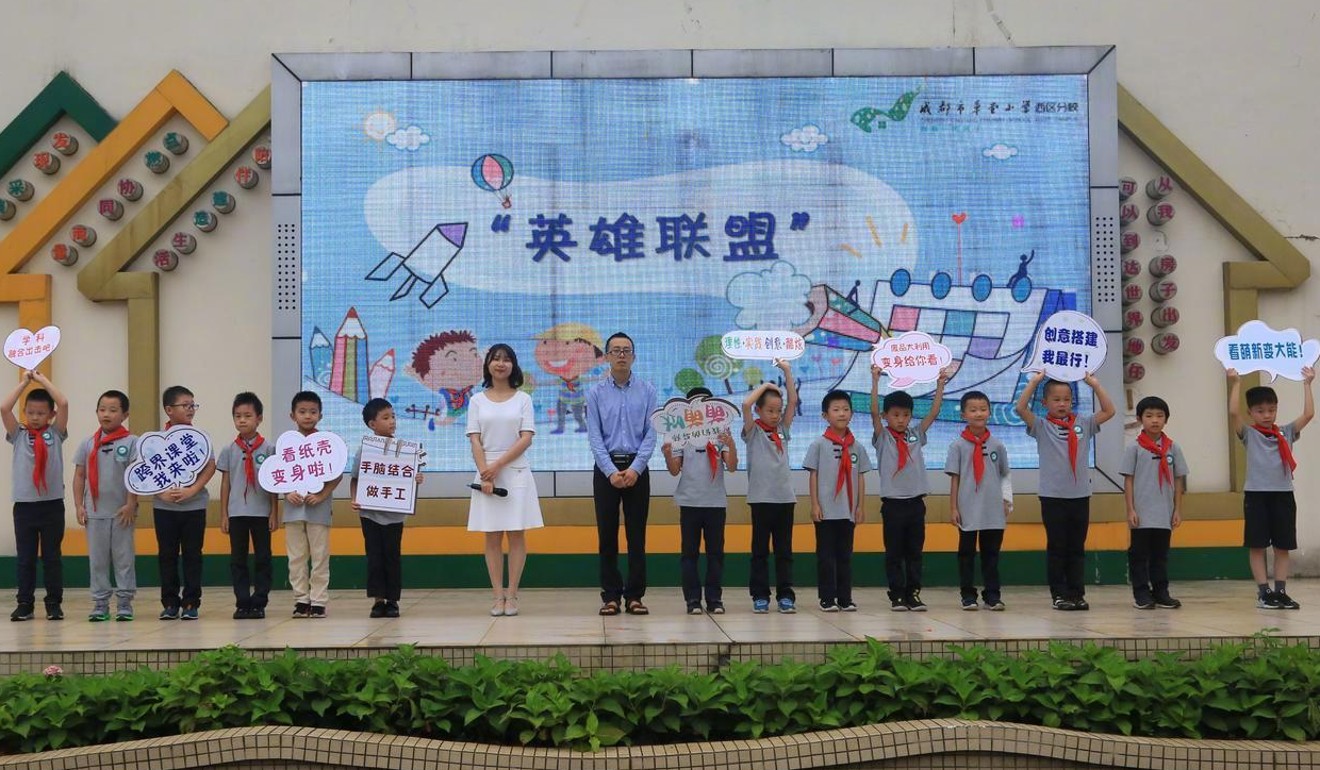
Pupils and staff at Chengdu Caotang Elementary School in Sichuan show off knitting from their Boys and Girls are Vastly Different class. Photo: Weibo
A school in southwest China that teaches boys to grow “heroically” and wants “tranquil feminine examples” for its girls has generated a heated debate about sexism.
Chengdu Caotang Elementary School in Sichuan province developed a course that teaches boys to build model rockets and girls to knit alongside mainstream subjects such as maths, languages and art, in the hope of “increasing their gender knowledge”.
The course, called Boys and Girls are Vastly Different, started last semester because school managers believed that “boys and girls have been shaped in the same way recently”, principal Fu Jin told the Chengdu Economic Daily on Monday.
That “led to boys lacking enough space to grow heroically and girls lacking gentle and tranquil feminine examples to follow, so there’s some gender dislocation”, she said.
Chengdu Caotang Elementary School wants its boys to be “heroic” and its girls to be “tranquil”. Photo: Weibo
Last semester, pupils learned the differences between female and male bodies. This semester, boys are learning how to build model planes, rockets and cars, while the girls are being taught knitting by teachers and mothers who volunteer to help out in classes.
On Monday, a show of handicrafts and jumpers hosted by the school to promote the class led to a backlash on social media, with members of the public criticising the school for sexism and enforcing gender stereotypes.
“They are tying the hands of girls when young, and when these girls grow up, people would say there are only a few female scientists because girls are born unfit for that role,” a Weibo user said.
What Chinese summer camps taught teens about gender values
“It’s typical gender discrimination,” another said. “Why can’t boys knit and girls build rockets?”
Authorities cracked down on controversial classes for Chinese children after some extreme examples of gender education. In December, a Weibo account highlighted a lurid “virtue” class where a sobbing woman was seen on video confessing to teenagers at a summer camp in Wenzhou, eastern Zhejiang province that “promiscuous women got gangrene”.
“I dressed myself up in a fashionable and revealing way, and that’s an invitation for others to insult me and rape me,” she told her audience.
“Three drops of sperm are equal to poison, and they will hurt unclean women,” she said. “I’m afraid my body will rot, will stink and ache, and they’ll have to amputate my legs.”
The camp was condemned and shut down by the local government.
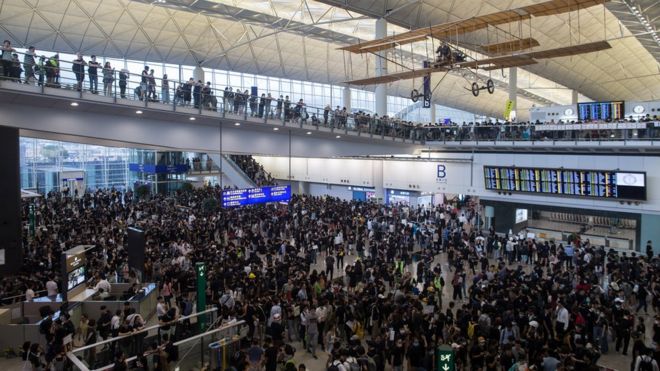
Image copyright EPAImage caption Officials say about 5,000 gathered for the fourth day of protests at the airport
Hong Kong International Airport cancelled all departures on Monday, as thousands of anti-government protesters occupied and caused disruption.
Passengers have been told not to travel to the airport, which is one of the world’s busiest transport hubs.
In a statement, officials blamed “seriously disrupted” operations.
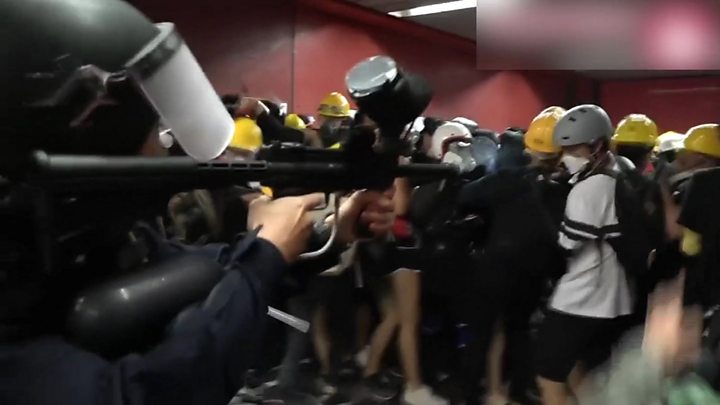
Many of those protesting are critical of the actions of police, who on Sunday were filmed firing tear gas and rubber bullets at close range.
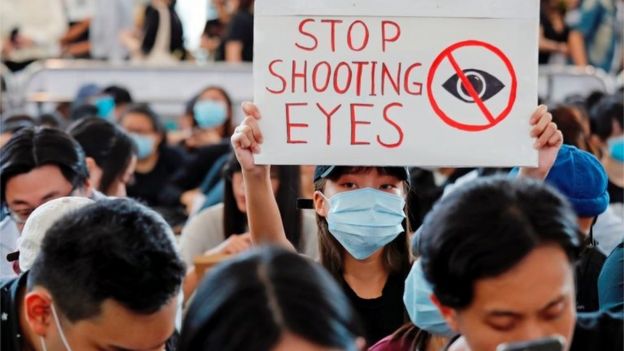
Some protesters wore bandages over their eyes in response to images of a woman bleeding heavily from her eye on Sunday, having reportedly been shot by a police projectile.
In a statement on Monday afternoon, Hong Kong’s Airport Authority said they were cancelling all flights that were not yet checked in.
More than 160 flights scheduled to leave after 18:00 local time (10:00 GMT) will now not depart.
Arrivals already heading into Hong Kong will still be allowed to land, but other scheduled flights have been cancelled.
Officials are now working to reopen the airport by 06:00 on Tuesday, a statement said.
Some passengers expressed annoyance at the disruption. “It’s very frustrating and scary for some people,” one man from Pakistan told the BBC. “We’ll just have to wait for our next flight.”
Helena Morgan, from the UK, said she was set to return to the UK to get her exam results on Thursday. “I’m hoping we get back for them and we’re not on a flight,” she said.
But others were more understanding of the protests. “I was expecting something, given all the news,” one arrival, Gurinda Singh, told Reuters news agency.
As rumours spread that police plan to move in on protesters on Monday evening, thousands opted to leave on foot. There are large backlogs for transport back into the centre, local reports say.
The BBC’s Stephen McDonell, who is at the scene, says the airport has effectively shut down while authorities work out how to deal with the crisis.
Hong Kong’s mass demonstrations and unrest show no sign of abating, more than two months after they were sparked by a controversial extradition bill.
Beijing officials have strongly condemned Sunday’s violence and linked violent protesters to “terrorism”.
Image copyright REUTERSImage caption Many of those who gathered carried signs condemning police conduct
What happened on Sunday?
On Sunday afternoon, a peaceful rally in the city’s Victoria Park led to clashes when protesters moved out of the area and marched along a major road despite a police ban.
There were confrontations in several central districts and police used rubber bullets in an attempt to disperse the demonstrators.
In the bustling central Wan Chai district, petrol bombs and bricks were thrown at police, who responded by charging at protesters.
A number of people, including a police officer, were injured in the clashes.
Videos on social media also showed officers storming enclosed railway stations and firing tear gas.
Footage inside another station showed officers firing what appeared to be rubber bullets at close range and several police officers beating people with batons.
Media caption Violence erupts in HK train stations
Local media outlets reported that suspected undercover police officers had dressed-up as protesters to make surprise arrests.
While protests in the city have turned increasingly violent, there were no reports of arrests during the three previous days of the airport sit-in.
What has the reaction been?
On Monday the Chinese authorities, who have not yet physically intervened to quell the unrest, used their strongest language yet to condemn violent protesters.
“Hong Kong’s radical demonstrators have repeatedly used extremely dangerous tools to attack police officers, which already constitutes a serious violent crime, and also shows the first signs of terrorism emerging,” Yang Guang, a spokesman for the Hong Kong and Macau Affairs Office (HKMAO), said at a press briefing.
“This wantonly tramples on Hong Kong’s rule of law and social order.”
Demonstrations started in June in opposition to a proposed extradition bill, which would have allowed suspected criminals to be sent to mainland China for trial.
Critics said it would undermine Hong Kong’s legal freedoms, and could be used to silence political dissidents.
Although the government has now suspended the bill, demonstrators want it to be fully withdrawn.
Their demands have broadened to include calls for an independent inquiry into alleged police brutality, and an amnesty for all arrested protesters.
Hong Kong is part of China but its citizens have more autonomy than those on the mainland.
It has a free press and judicial independence under the so-called “one country, two systems” approach – freedoms which activists fear are being increasingly eroded.
Police in Hong Kong have been fighting running battles with activists in a third consecutive day of protests, after a call for a general strike caused widespread disruption on Monday.
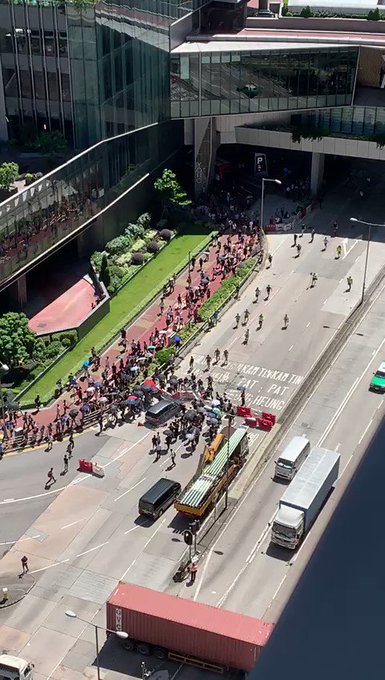
Protesters blocked roads and paralysed train services at peak times on a day of action across the city.
More than 200 flights were cancelled as the protests entered their ninth week.
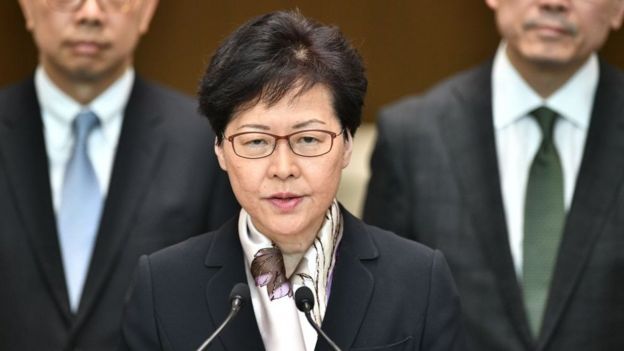
Hong Kong’s leader, Carrie Lam, has pledged to restore law and order, rejecting calls for her resignation.
Initially the demonstrations, which began on 9 June, focused on a controversial extradition law, which would have allowed the transfer of suspects to mainland China. However, the protests have now become a wider challenge to Beijing’s authority.
Ms Lam warned that Hong Kong was “on the verge of a very dangerous situation”.
Media caption Protests take place in Hong Kong for the ninth weekend – for and against the authorities
In her first media address in two weeks, Ms Lam said the protesters’ actions had challenged the principle of “one country, two systems” – the extra freedoms granted to Hong Kong when it was returned from British to Chinese rule in 1997.
She also accused activists of using the extradition bill as a cover for their real goals.
“We continue to allow these violent protesters to make use of the [extradition] bill to conceal their ulterior motives,” she said. “Those ulterior motives are going to destroy Hong Kong.”
Image copyright GETTY IMAGES
The Chinese foreign ministry said no one should underestimate China’s resolve to safeguard the stability of Hong Kong, Reuters news agency reports.
What happened on Monday?
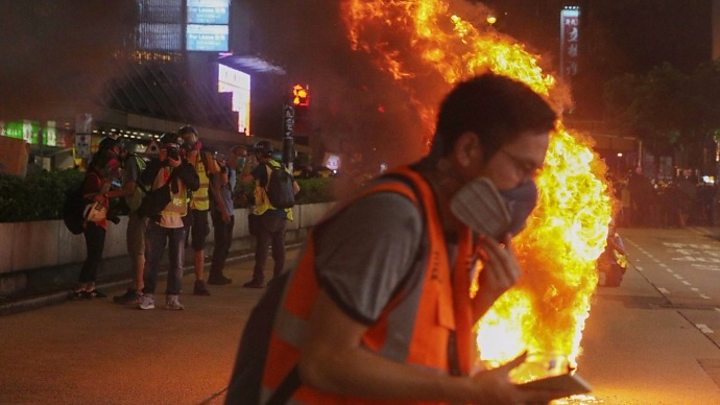
Police fired tear gas at several locations as protesters rallied into the night, setting fires and besieging police stations. In the North Point district, which has a reputation for pro-Beijing sympathies, men wielding long poles clashed with demonstrators before falling back.
More than 80 people were arrested, in addition to the 420 detained since 9 June. In that time, police said they had used more than 1,000 tear gas canisters and 160 rubber bullets.
Protest leaders had called for a general strike. While many people made it to work, in some areas protesters blocked trains from leaving stations and scuffled with commuters. Several lines of the Mass Transit Railway (MTR) were suspended for a time, and the Cross-Harbour Tunnel was also blocked.
One video circulating on Twitter reportedly showed a car in the district of Yuen Long forcefully hitting a barricade set up by protesters, injuring one person.
It is not clear how many joined the strike, but tens of thousands of protesters were out on the streets. Several shops and businesses were closed, including international fashion retailers like Topshop and Zara.
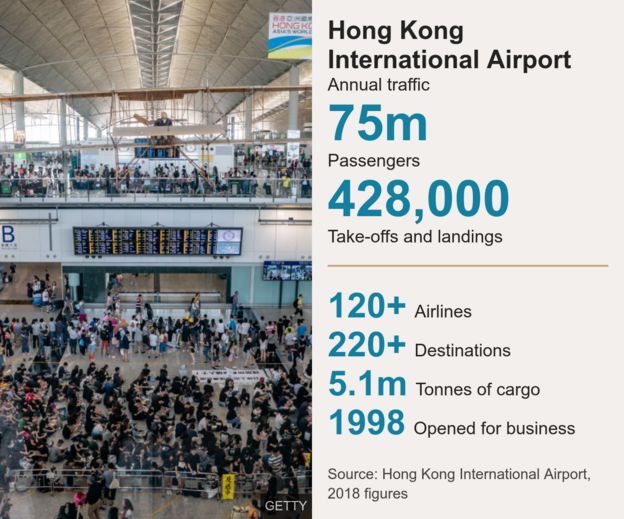
Hong Kong airport, one of the busiest in the world, said travellers should check its website and seek updates directly from the airlines.
Most of the cancelled flights were with local carriers Cathay Pacific and Hong Kong Airlines.
The protests were initially sparked by a controversial bill that would allow China to extradite suspects from Hong Kong to the mainland.
Critics said it would undermine the territory’s judicial independence and could be used to target those who spoke out against the Chinese government.
Although the bill has now been suspended, demonstrators want it fully withdrawn.
Their demands have broadened to include an independent inquiry into alleged police brutality, Ms Lam’s resignation, and the dropping of riot charges linked to the protests.
Last week, more than 40 activists appeared in court charged with rioting. If convicted, they could be jailed for up to 10 years.
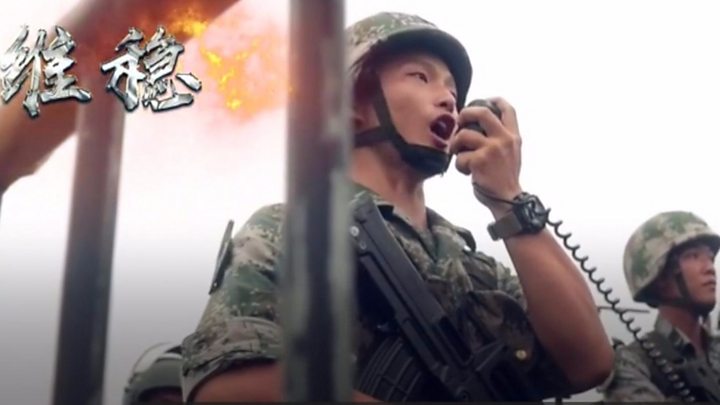
The Chinese army has so far stayed out of the dispute, but China’s top policy office in Hong Kong has previously condemned the protests, calling them “horrendous incidents” that have caused “serious damage to the rule of law”.


 Image copyright GETTY IMAGES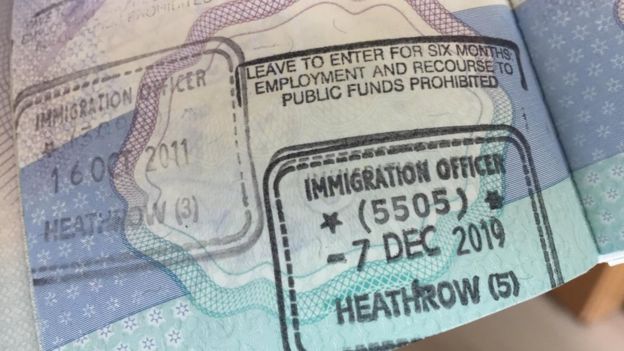






 CHINDIA ALERT: You'll be living in their world, very soon