Chindia Alert: You’ll be Living in their World Very Soon
aims to alert you to the threats and opportunities that China and India present. China and India require serious attention; case of ‘hidden dragon and crouching tiger’.
Without this attention, governments, businesses and, indeed, individuals may find themselves at a great disadvantage sooner rather than later.
The POSTs (front webpages) are mainly 'cuttings' from reliable sources, updated continuously.
The PAGEs (see Tabs, above) attempt to make the information more meaningful by putting some structure to the information we have researched and assembled since 2006.
Managers of the Leshan Giant Buddha and Jiuzhaigou National Park restrict ticket sales as millions head off for the holiday break
Park authorities in charge of the Leshan Giant Buddha in Sichuan have restricted visitor numbers in golden week. Photo: Xinhua
Several major tourist attractions in China have capped visitor numbers during this year’s National Day “golden week” holiday as millions take the chance to travel.
October 1 marked the start of a week-long break on the mainland, with an estimated 800 million people expected to go on trips in China or overseas, about 10 per cent more than last year, according to the China Tourism Academy.
The academy estimated that 726 million people would take domestic trips in this peak holiday period – a 9.4 per cent increase from last year, but that is the lowest level of growth since 2007 as pressure from China’s slowing economy and the trade war with the United States take their toll.
Managers at the scenic area surrounding the Leshan Giant Buddha – a 71-metre (233 feet) tall ancient statue carved into a cliff in southwestern Sichuan province – said last week that daily tickets would be capped at 22,400 during the holiday, which runs until Monday.
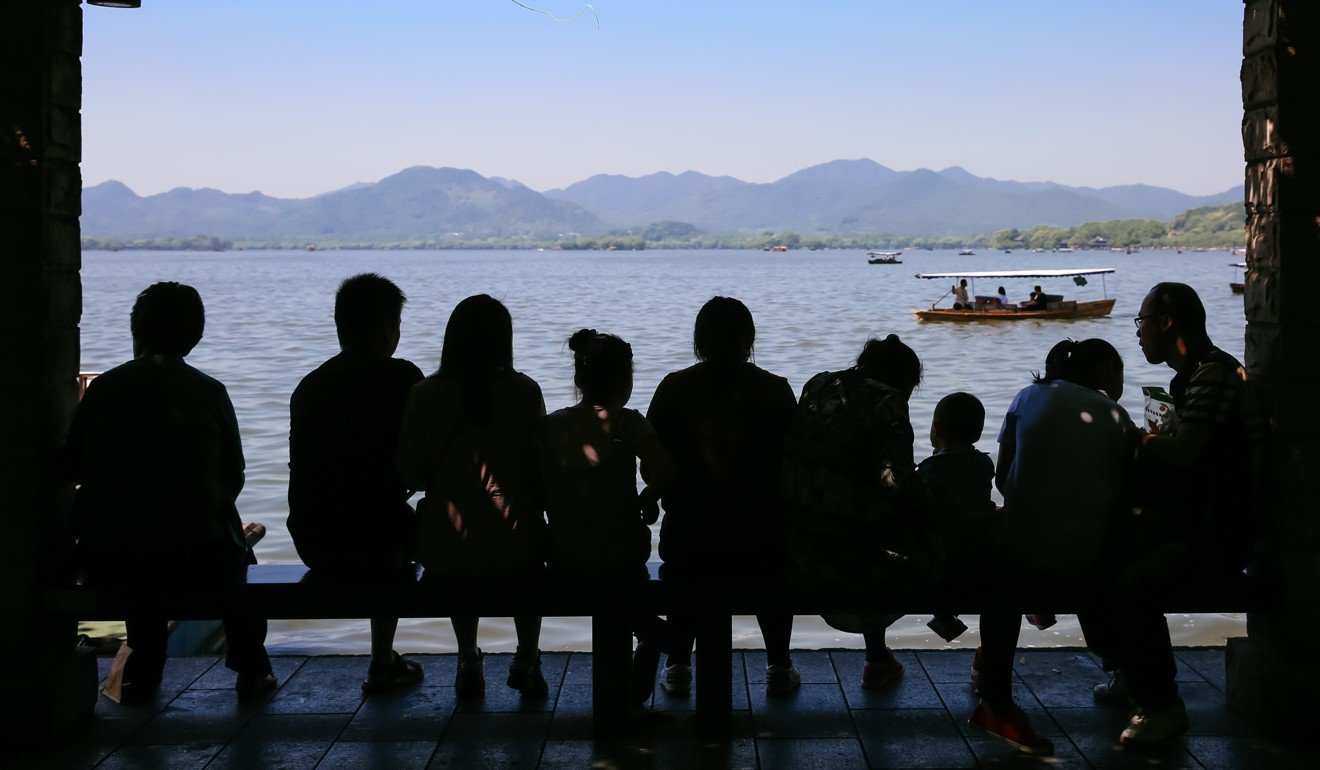
West Lake in Hangzhou, Zhejiang province, drew 300,400 visitors as golden week started. Photo: Xinhua
The park said it would update visitors on daily ticket sales through social media.
“Today’s tickets for the Giant Buddha have reached the limit and sales have stopped,” the park management committee said on its Weibo account on Tuesday. “To all tourists, please rearrange your itinerary. You can visit the areas surrounding the Giant Buddha scenic spot,” it said, adding that tickets could be booked online for any day for the rest of golden week.
“I expected it to be chock-full of people, but actually today it’s still relatively calm. I had lots of fun,” a visitor to the Giant Buddha told Pear Video on Tuesday.
Hong Kong protests leave ‘golden week’ tourist boom in tatters
Jiuzhaigou National Park in Sichuan said last week that it would be limiting visitors to 5,000 per day during golden week and said on Monday that tickets had sold out.
The network of valleys known for its natural scenery was devastated by an earthquake in August 2017, and reopened with limited access in March 2018.
However, there were no restrictions at other attractions. In eastern Zhejiang province, 340,400 visitors went through the gates at Hangzhou’s West Lake on Tuesday, the Global Times’ Chinese edition reported.
“There’s too many people. I have never seen so many of them in my life,” one tourist was quoted as saying.
A guide also said that instances of “uncivilised behaviour”, such as trampling on the gardens, were down compared to last year.
“During the major holidays, many tourist attractions are so crowded that tourists can barely move an inch,” Hangzhou Daily said in an editorial on Monday.
“Not only is the tourist experience bad, but there are also safety hazards such as being trampled on, and this puts a lot of pressure on nearby public transport and food establishments.”
Travel booking platform Ctrip said that tourists heading overseas were increasingly seeking out new destinations, with bookings to places such as the Czech Republic, Austria, Croatia, Malta and Cambodia up by 45 per cent this year.
However, bookings for Hong Kong had fallen substantially after nearly four months of anti-government protests, Ctrip said.
Tuesday’s reports in US media, which were based on anonymous sources including a car industry executive, said China outlined the plan on a recent telephone call between top trade negotiators from the two countries.
Bloomberg, which cited “people familiar with the matter”, said the step was not finalised and could still change.
The office of the US Trade Representative, which is leading the discussions, did not respond to a BBC request for comment.
In a tweet, Mr Trump said the two sides were having “very productive conversations”.
China’s commerce ministry confirmed that the two sides had spoken. In a statement it said the conversation concerned “pushing forward the timetable and road map for the next stage of economic and trade consultations work.”
Shares in car companies, including BMW, rose on the reports.
Image captionTesla, a US electric car-maker, has said its sales have been hurt by Chinese tariffs
Argentina meeting
The back-and-forth is the latest in a trade tow triggered by US claims that China engages in “unfair” trade practices, such as theft of intellectual property.
The dispute has prompted the US and China to impose new tariffs on billions of dollars worth of annual trade this year, measures that have contributed to economic worries in both countries.
The two sides, led by Mr Trump and President Xi Jinping, recently met in Argentina, where they agreed to a 90-day halt to any new tariffs.
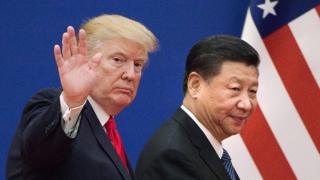
Image captionMr Trump (front right) met Mr Xi (front left) after the G20 summit in Buenos Aires
US officials later said they wanted to see China move to reduce the car tariffs “immediately” as a sign that negotiations would proceed in good faith.
Analysts remain sceptical that the two sides will be able to reach a resolution of the underlying issues by 1 March.
Those doubts increased after the recent arrest of a high-ranking Huawei official in Canada at the request of the US, which worsened relations between the two countries.
Deja vu?
White House officials have maintained that the two matters are separate, but apparent agreements have faltered before.
In May, after talks in Washington, the US agreed to hold off on tariff threats, while China said it would reduce the import duty on foreign cars from 25% to 15%.
However that deal fell apart within weeks, after Mr Trump decided to move ahead with tariffs.
In retaliation, China raised the duty on US car imports to 40%, though it proceeded with the lower rate on imports from other countries.



 CHINDIA ALERT: You'll be living in their world, very soon