Archive for ‘defence ministry spokesman’

26/03/2020

U.S. playing dangerous game, China says, after warship sails through Taiwan Strait

TAIPEI (Reuters) – China accused the United States on Thursday of playing a dangerous game with its support for Taiwan, after a U.S. warship passed through the sensitive Taiwan Strait following heightened military tension between China and Taiwan.

China has been angered by the Trump administration’s stepped-up support for the island it considers its own, such as more arms sales, U.S. patrols near Taiwan and last month’s visit to Washington by Taiwan Vice President-elect William Lai.

Anthony Junco, a spokesman for the U.S. Seventh Fleet, said the guided-missile destroyer USS McCampbell conducted “a routine Taiwan Strait transit” on March 25, in line with international law.

“The ship’s transit through the Taiwan Strait demonstrates the U.S. commitment to a free and open Indo-Pacific,” he added. “The U.S. Navy will continue to fly, sail and operate anywhere international law allows.”

Taiwan’s defence ministry said the ship sailed north through the waterway and was monitored by Taiwan’s armed forces, on what it called an “ordinary mission”, adding there was no cause for alarm.

In Beijing, Chinese defence ministry spokesman Ren Guoqiang denounced “continued negative actions” by the United States on Taiwan, including sailings through and flights over the Taiwan Strait.

“U.S. moves have seriously interfered in China’s internal affairs, severely harmed peace and stability in the Taiwan Strait and poisoned Sino-U.S. military ties,” Ren told a monthly news conference.

The actions were “extremely dangerous”, he added.

Taiwan is China’s most sensitive territorial and diplomatic issue and Beijing has never ruled out the use of force to bring the island under its control. The narrow Taiwan Strait that separates the island from China is a frequent source of tension.

In recent weeks China’s air force has conducted several exercises close to Taiwan, prompting its mostly U.S.-equipped military to scramble fighters to intercept and warn away the Chinese aircraft.

Taiwan has called the drills provocative, and urged China to pay more attention to fighting a coronavirus pandemic, rather than menace it.

The United States, like most countries, has no official relations with Taiwan, but is the island’s most important international supporter and main source of arms.

In January another U.S. warship sailed through the Taiwan Strait less than a week after President Tsai Ing-wen won re-election by a landslide on a platform of standing up to China.

Source: Reuters
30/07/2019

Taiwan responds to Beijing’s military exercises with drill of its own

  • Armed F-16 fighter jets simulate attack followed by medium and long-range missile launches into eastern waters
  • People’s Liberation Army launched two large-scale drills close to Taiwan Strait on Sunday
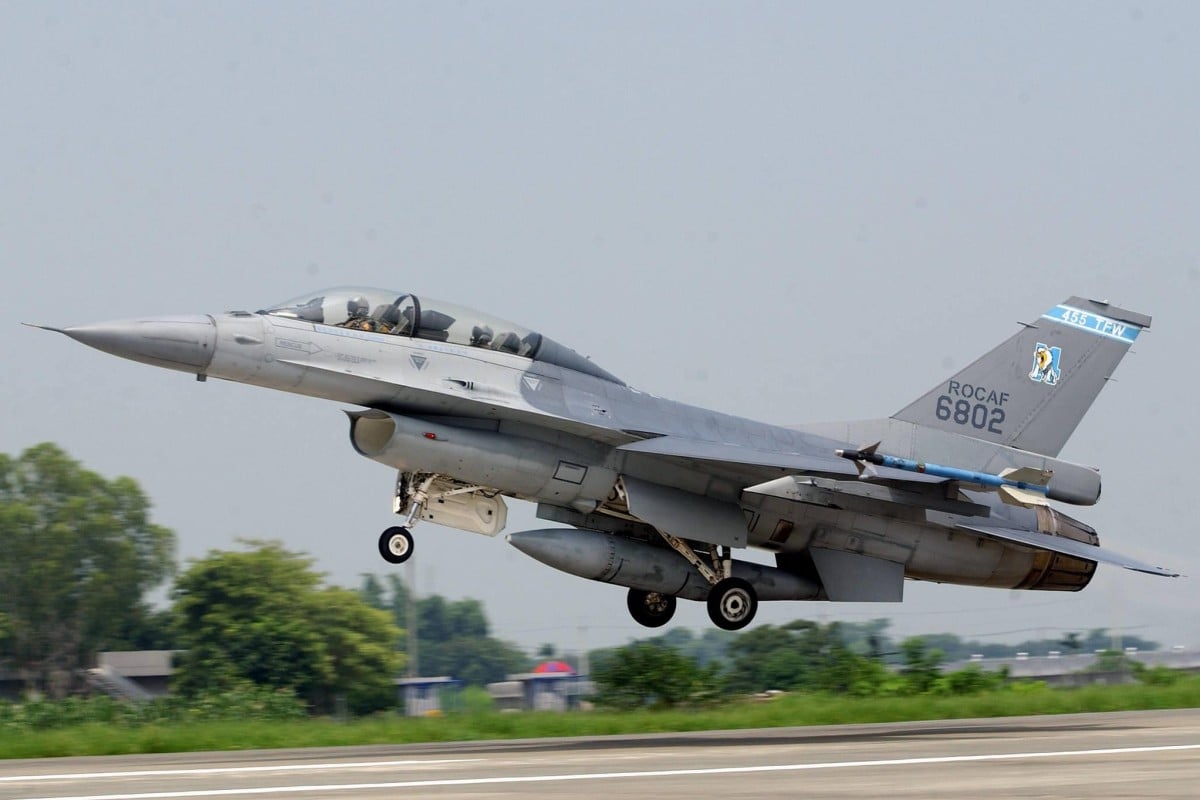
9Taiwan has launched a military exercise including F-16 fighter jets in response to Beijing’s war games, which began on Sunday. Photo: AFP
Taiwan has launched a military exercise including F-16 fighter jets in response to Beijing’s war games, which began on Sunday. Photo: AFP
Taiwan responded to Beijing’s military drill targeting the self-ruled island by deploying its most advanced fighter jets and firing 117 medium and long-range missiles on Monday and Tuesday.
Defence ministry spokesman Lee Chao-ming said the missiles were fired from the Jiupeng military base to waters off eastern Taiwan, with a range of 250km (155 miles), in an exercise covering five types of training for the island’s forces.
On Monday, Taiwan’s air force also dispatched two F-16 fighter jets armed with AGM-84 Harpoon missiles in a simulation of an attack off the island’s southeast coast.

Song Zhongping, a military commentator based in Hong Kong, said the Taiwan drill was aimed at the mainland Chinese exercise which began on Sunday. The location of the Taiwan drill meant its missiles’ electronic data could avoid detection by the People’s Liberation Army’s radar, he said.

Chinese military starts Taiwan Strait drills amid rising tension

“Taiwan is focusing on boosting self-defence, and building up a comprehensive air and sea defence network to counter military threats from the mainland,” Song said.

“The test firing of missiles is to boost the island’s self-defence capability. The military drill of the PLA has triggered a lot of concerns in Taiwan, and Taiwan is responding to it also through a strong military means.”

The PLA launched two large-scale military drills close to the Taiwan Strait on Sunday, after a notice issued by the Zhejiang Maritime Safety Administration prohibited ships from entering the waters off the coast of the eastern province between 6pm on Saturday and 6pm on Thursday.

The Guangdong Maritime Safety Administration said another set of military exercises would be held in the waters off Fujian province between Monday morning and Friday evening.

Observers said they expected PLA forces from the Southern and Eastern commands – whose area of responsibility includes Zhejiang and Fujian, which lie across the strait from Taiwan – to take part in the exercises.

Japan’s Ministry of Defence said on Monday that six Chinese warships had passed through the Miyako Strait – a waterway lying between Okinawa Island and Miyako Island – presumably in preparation for the drills.

Japanese military vessels said a Chinese class-three missile destroyer – a type 054A missile frigate – was sailing 240km north of Miyako Island on Saturday.

On Thursday, Japanese ships reported China’s type 052D destroyer Xining, type 054A missile frigate Daging, the guided missile frigate Rizhao, and the ocean comprehensive supply ship Hulun Lake, all entered the Pacific Ocean through the Miyako Strait.

This is China’s first war game to involve simultaneous exercises at two locations in waters near Taiwan since the 1995–96 Taiwan Strait Crisis, during which the PLA conducted a series of large-scale live-fire exercises in response to then-Taiwanese leader Lee Teng-hui’s visit to the United States, and ahead of the Taiwanese presidential election.

Source: SCMP

25/04/2019

Exclusive: In rare move, French warship passes through Taiwan Strait

WASHINGTON (Reuters) – A French warship passed through the strategic Taiwan Strait this month, U.S. officials told Reuters, a rare voyage by a vessel of a European country that is likely to be welcomed by Washington but increase tension with Beijing.

The passage, which was confirmed by China, is a sign that U.S. allies are increasingly asserting freedom of navigation in international waterways near China. It could open the door for other allies, such as Japan and Australia, to consider similar operations.

The French operation comes amid increasing tensions between the United States and China. Taiwan is one of a growing number of flashpoints in the U.S.-China relationship, which also include a trade war, U.S. sanctions and China’s increasingly muscular military posture in the South China Sea, where the United States also conducts freedom of navigation patrols.

Two officials, speaking on condition of anonymity, said a French military vessel carried out the transit in the narrow waterway between China and Taiwan on April 6.

One of the officials identified the warship as the French frigate Vendemiaire and said it was shadowed by the Chinese military. The official was not aware of any previous French military passage through the Taiwan Strait.

The officials said that as a result of the passage, China notified France it was no longer invited to a naval parade to mark the 70 years since the founding of China’s Navy. Warships from India, Australia and several other nations participated.

China said on Thursday it had lodged “stern representations” with France for what it called an “illegal” passage.

“China’s military sent navy ships in accordance with the law and the rules to identify the French ship and warn it to leave,” defence ministry spokesman Ren Guoqiang told a regularly scheduled media briefing, while declining to say if the sailing had led to the withdrawal of France’s invitation to the parade of ships this week.

“China’s military will stay alert to firmly safeguard China’s sovereignty and security,” he said.

Colonel Patrik Steiger, the spokesman for France’s military chief of staff, declined to comment on an operational mission.

The U.S. officials did not speculate on the purpose of the passage or whether it was designed to assert freedom of navigation.

MOUNTING TENSIONS

The French strait passage comes against the backdrop of increasingly regular passages by U.S. warships through the strategic waterway. Last month, the United States sent Navy and Coast Guard ships through the Taiwan Strait.

The passages upset China, which claims self-ruled Taiwan as part of its territory. Beijing has been ramping up pressure to assert its sovereignty over the island.

Chen Chung-chi, spokesman for Taiwan’s defence ministry, told Reuters by phone the strait is part of busy international waters and it is “a necessity” for vessels from all countries to transit through it. He said Taiwan’s defence ministry will continue to monitor movement of foreign vessels in the region.

“This is an important development both because of the transit itself but also because it reflects a more geopolitical approach by France towards China and the broader Asia-Pacific,” said Abraham Denmark, a former U.S. deputy assistant secretary of defence for East Asia.

The transit is a sign that countries like France are not only looking at China through the lens of trade but from a military standpoint as well, Denmark said.

Last month, France and China signed deals worth billions of euros during a visit to Paris by Chinese President Xi Jinping. French President Emmanuel Macron wants to forge a united European front to confront Chinese advances in trade and technology.

Source: Reuters

Law of Unintended Consequences

continuously updated blog about China & India

ChiaHou's Book Reviews

continuously updated blog about China & India

What's wrong with the world; and its economy

continuously updated blog about China & India