Archive for ‘Delhi’

06/03/2019

‘War’ and India PM Modi’s muscular strongman image

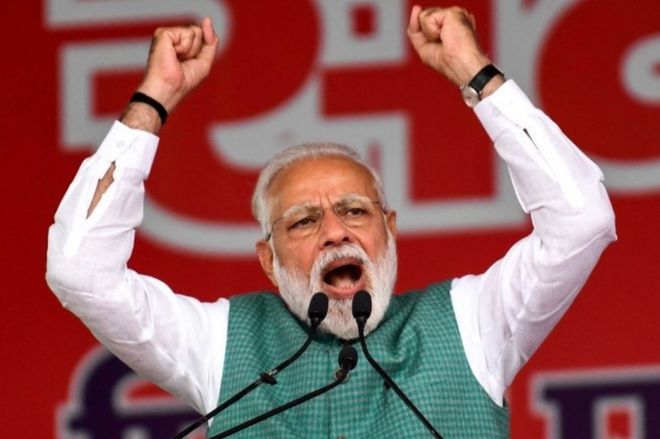
Indian Prime Minister Narendra Modi gestures as he speaks during the National Democratic Alliance (NDA) "Sankalp" rally in Patna in the Indian eastern state of Bihar on March 3, 2019.Image copyrightAFP
Image captionMr Modi is accused of exploiting India-Pakistan hostilities for political gain

A gaffe is when a politician tells the truth, American political journalist Michael Kinsley said.

Last week, a prominent leader of India’s ruling Hindu nationalist Bharatiya Janata Party (BJP) appeared to have done exactly that. BS Yeddyurappa said the armed aerial hostilities between India and Pakistan would help his party win some two dozen seats in the upcoming general election.

The remark by Mr Yeddyurappa, former chief minister of Karnataka, was remarkable in its candour. Not surprisingly, it was immediately seized upon by opposition parties. They said it was a brazen admission of the fact that Prime Minister Narendra Modi’s party was mining the tensions between the nuclear-armed rivals ahead of general elections, which are barely a month away. Mr Modi’s party is looking at a second term in power.

Mr Yeddyurappa’s plain-spokenness appeared to have embarrassed even the BJP. Federal minister VK Singh issued a statement, saying the government’s decision to carry out air strikes in Pakistan last week was to “safeguard our nation and ensure safety of our citizens, not to win a few seats”. No political party can afford to concede that it was exploiting a near war for electoral gains.
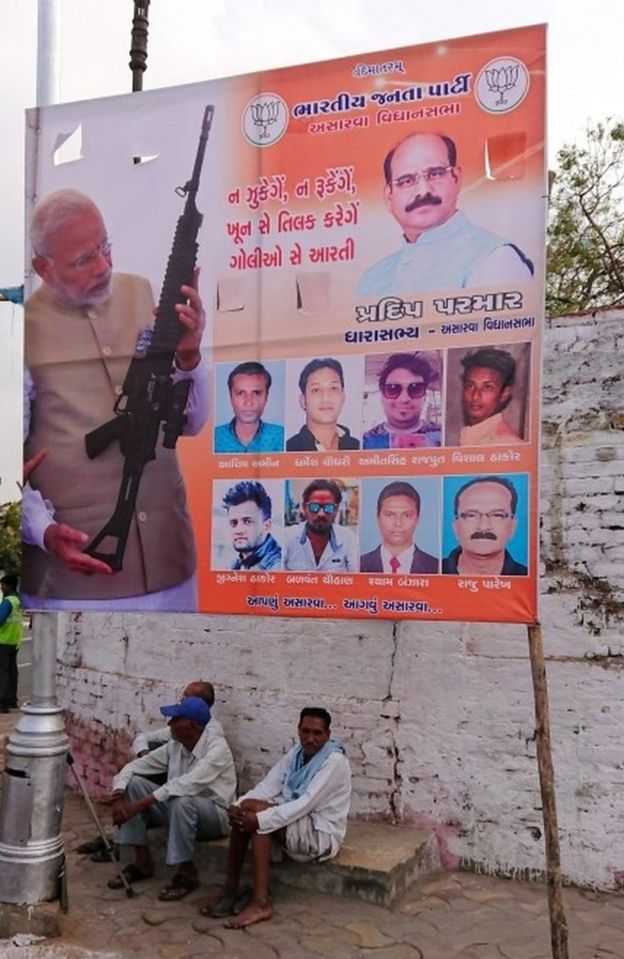
A billboard displaying an image of Indian Prime Minister Narendra Modi holding a rifle is seen on a roadside in Ahmedabad on March 3, 2019.Image copyrightAFP
Image captionThe BJP has put up election posters of Mr Modi posing with guns

Even as tensions between India and Pakistan ratcheted up last week, Mr Modi went on with business as usual. Hours after the Indian attack in Pakistan’s Balakot region, he told a packed election meeting that the country was in safe hands and would “no longer be helpless in the face of terror”. Next morning, Pakistan retaliated and captured an Indian pilot who ejected from a downed fighter jet. Two days later, Pakistan returned the pilot to India.

Mr Modi then told a gathering of scientists that India’s aerial strikes were merely a “pilot project” and hinted there was more to come. Elsewhere, his party chief Amit Shah said India had killed more than 250 militants in the Balakot attack even as senior defence officials said they didn’t know how many had died. Gaudy BJP posters showing Mr Modi holding guns and flanked by soldiers, fighter jets and orange explosions have been put up in parts of the country. “Really uncomfortable with pictures of soldiers on election posters and podiums. This should be banned. Surely the uniform is sullied by vote gathering in its name,” tweeted Barkha Dutt, an Indian television journalist and author.

Mr Modi has appealed to the opposition to refrain from politicising the hostilities. The opposition parties are peeved because they believe Mr Modi has not kept his word. Last week, they issued a statement saying “national security must transcend narrow political considerations”.

‘Petty political gain’

But can the recent conflict fetch more votes for Mr Modi? In other words, can national security become a campaign plank?

Many believe Mr Modi is likely to make national security the pivot of his campaign. Before last month’s suicide attack – claimed by Pakistan-based militants – killed more than 40 Indian paramilitaries in Kashmir, Mr Modi was looking a little vulnerable. His party had lost three state elections on the trot to the Congress party. Looming farm and jobs crises were threatening to hurt the BJP’s prospects.

Now, many believe, Mr Modi’s chances look brighter as he positions himself as a “muscular” protector of the country’s borders. “This is one of the worst attempts to use war to win [an] election, and to use national security as petty political gain. But I don’t know whether it will succeed or not,” says Yogendra Yadav, a politician and psephologist.
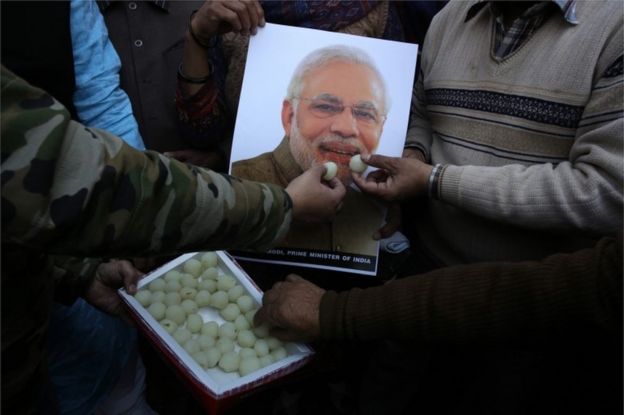
Indian people feed sweets to a poster of Indian Prime Minister Narendra Modi as they celebrate the Indian Air Force"s air strike across the Line of Control (LoC) near the international border with PakistanImage copyrightEPA
Image captionMany Indians have celebrated India’s strike in Pakistani territory

Evidence is mixed on whether national security helps ruling parties win elections in India. Ashutosh Varshney, a professor of political science at Brown University in the US, says previous national security disruptions in India were “distant from the national elections”.

The wars in 1962 (against China) and 1971 (against Pakistan) broke out after general elections. Elections were still two years away when India and Pakistan fought a war in 1965. The 2001 attack on the Indian parliament that brought the two countries to the brink of war happened two years after a general election. The Mumbai attacks in 2008 took place five months before the elections in 2009 – and the then ruling Congress party won without making national security a campaign plank.

Things may be different this time. Professor Varshney says the suicide attack in Kashmir on 14 February and last week’s hostilities are “more electorally significant than the earlier security episodes”.

For one, he says, it comes just weeks ahead of a general election in a highly polarised country. The vast expansion of the urban middle class means that national security has a larger constituency. And most importantly, according to Dr Varshney, “the nature of the regime in Delhi” is an important variable. “Hindu nationalists have always been tougher on national security than the Congress. And with rare exceptions, national security does not dominate the horizons of regional parties, governed as they are by caste and regional identities.”

Presentational grey line

Read more from Soutik Biswas

Presentational grey line

Bhanu Joshi, a political scientist also at Brown University, believes Mr Modi’s adoption of a muscular and robust foreign policy and his frequent international trips to meet foreign leaders may have touched a chord with a section of voters. “During my work in northern India, people would continuously invoke the improvement in India’s stature in the international arena. These perceptions get reinforced with an event like [the] Balakot strikes and form impressions which I think voters, particularly on a bipolar contest of India and Pakistan, care about,” says Mr Joshi.

Others like Milan Vaishnav, senior fellow and director of the South Asia Program at the Carnegie Endowment for International Peace, echo a similar sentiment. He told me that although foreign policy has never been a “mass” issue in India’s domestic politics, “given the proximity of the conflict to the elections, the salience of Pakistan, and the ability of the Modi government to claim credit for striking back hard, I expect it will become an important part of the campaign”.

But Dr Vaishnav believes it will not displace the economy and farm distress as an issue, especially in village communities. “Where it will help the BJP most is among swing voters, especially in urban constituencies. If there were fence-sitters unsure of how to vote in 2019, this emotive issue might compel them to stick with the incumbent.”

How the opposition counters Mr Modi’s agenda-setting on national security will be interesting to watch. Even if the hostilities end up giving a slight bump to BJP prospects in the crucial bellwether states in the north, it could help take the party over the winning line. But then even a week is a long time in politics.

Source: The BBC
25/02/2019

Oscars 2019: The Indian sanitary pad makers’ story wins award

Sneh
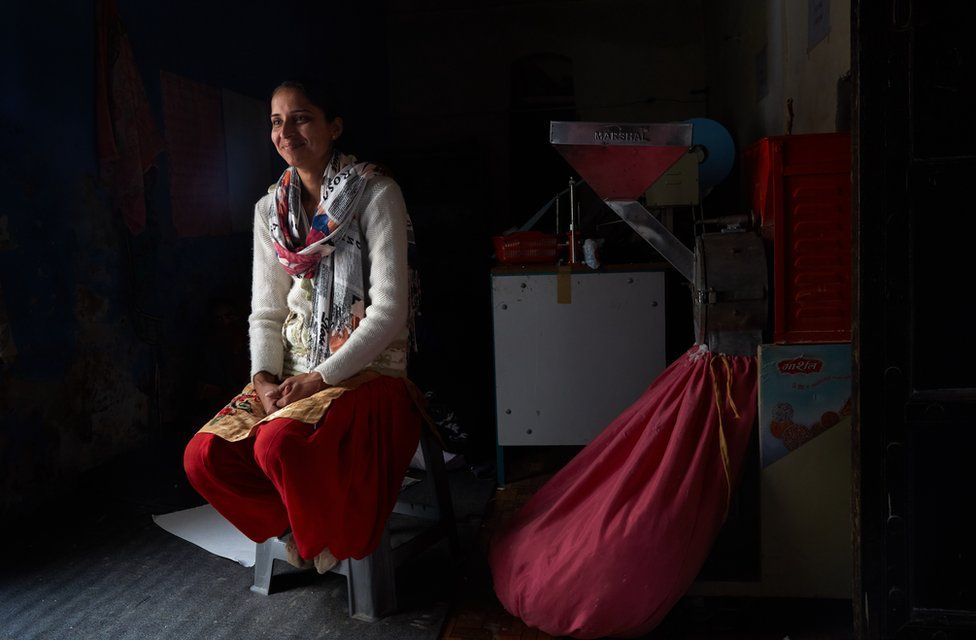
Image captionSneh, 22, attended the awards ceremony where the film won an Oscar
Presentational white space

A film based on young women in an Indian village who make sanitary pads has won an Oscar for best documentary short. The BBC’s Geeta Pandey met with the women in their village before the ceremony.

Sneh was 15 when she started menstruating. The first time she bled, she had no idea what was happening to her.

“I was very scared. I thought I was sick with something very serious and began crying,” she told me when I visited her home in Kathikhera village not far from Delhi earlier this week.

“I didn’t have the courage to tell my mother so I confided in my aunt. She said: ‘You’re a grown woman now, don’t cry, it’s normal.’ It was her who told my mother.”

Sneh, now 22, has travelled a long way from that point. She works in a small factory in her village that makes sanitary pads and is the protagonist of Period. End of Sentence., a documentary that has been nominated for an Oscar. She will be attending Sunday’s ceremony in Los Angeles.

The film came about after a student group in North Hollywood used crowdfunding to send a pad-making machine – and Iranian-American filmmaker Rayka Zehtabchi – to Sneh’s village.

Just 115km (71 miles) from Delhi, Kathikhera village in Hapur district is a world far removed from the glitzy malls and high-rises of the Indian capital. Normally, it’s a two-and-a-half-hour drive from Delhi, but construction work on the highway slows it down to four hours for us. And the final 7.5km drive to the village from Hapur town is a crawl, on narrow winding roads lined with open drains on both sides.

The documentary is filmed in the farms and fields – and classrooms – of Kathikhera. Like in the rest of India, periods are a taboo topic; menstruating women are considered impure and barred from entering religious places and often excluded from social events too.

Presentational white space
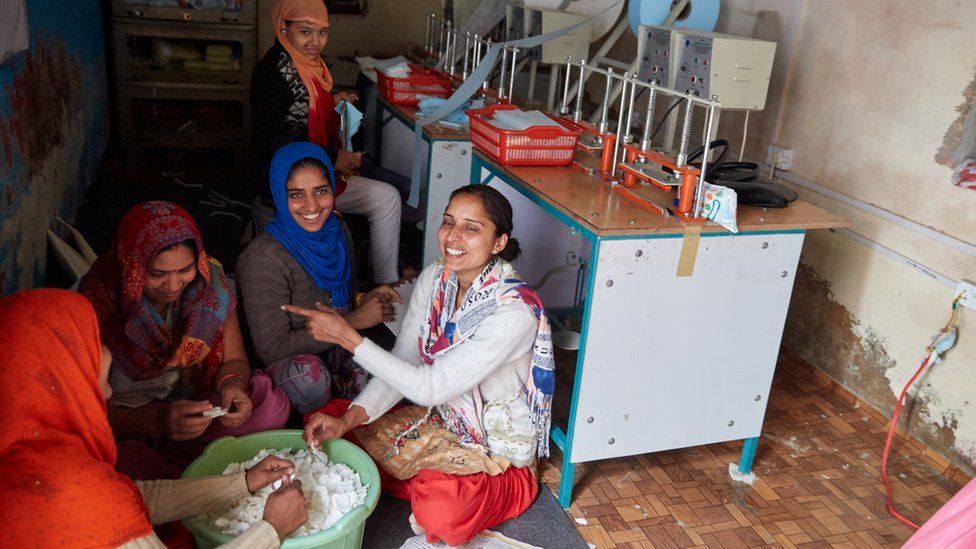
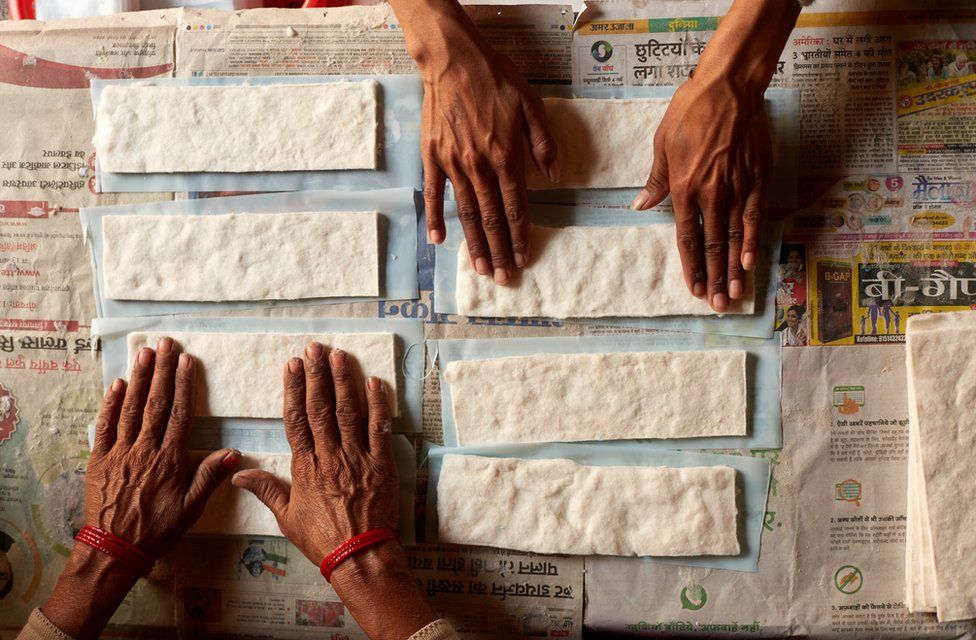
Women making sanitary pads
Image captionSneh says that previously, menstruation was not discussed – even among girls
Presentational white space

With so much stigma surrounding the issue, it’s no surprise that Sneh had never heard of periods before she started getting them herself.

“It was not a topic that was discussed – even among girls,” she says.

But things began to change when Action India, a charity that works on reproductive health issues, set up a sanitary napkin manufacturing unit in Kathikhera.

Presentational white space
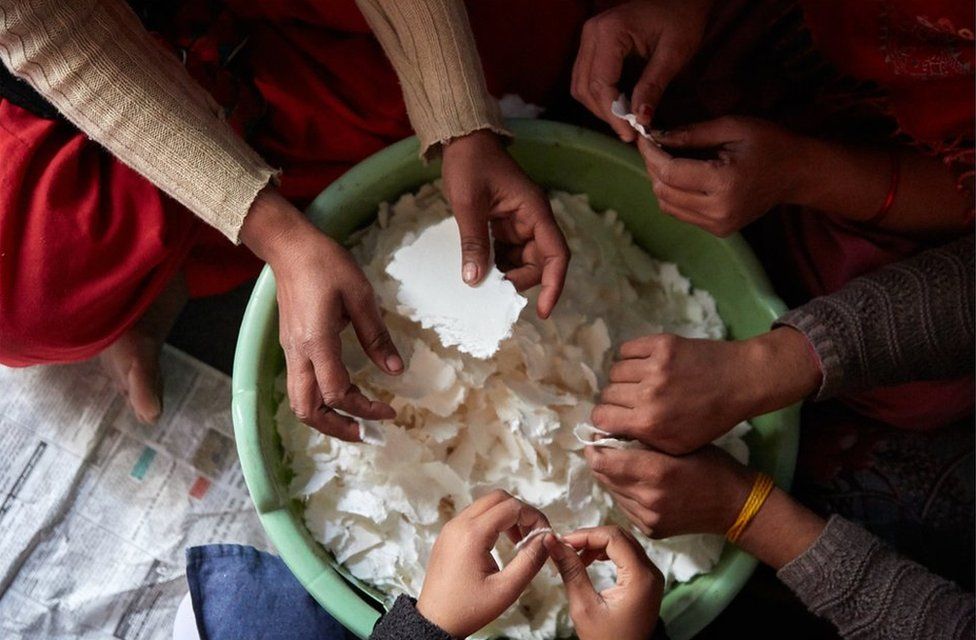
Women prepare the material for making sanitary napkins
Image captionThe women employees work from 9-5 six days a week
Presentational white space
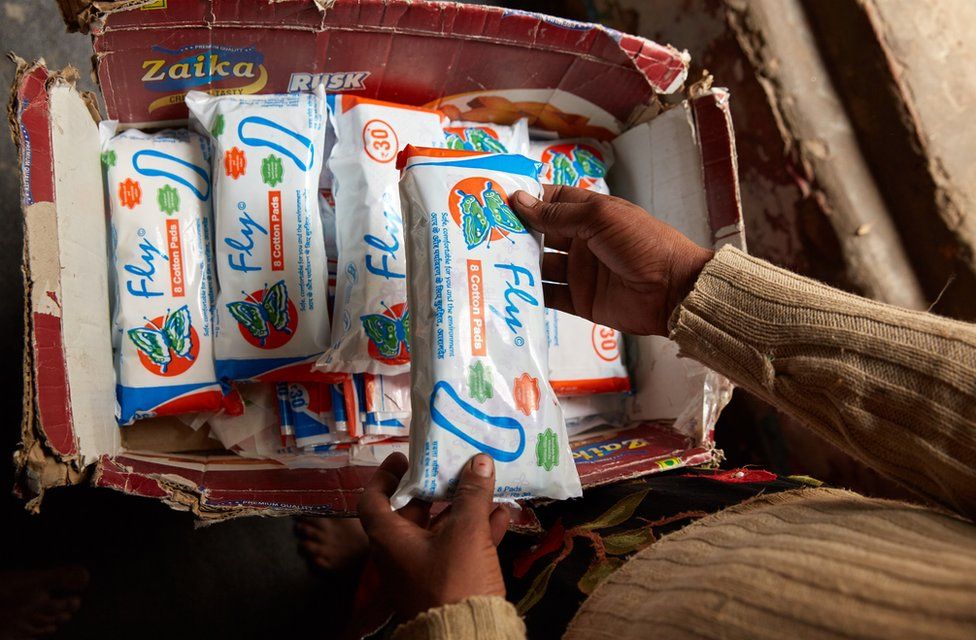
The final product
Image captionA pack is priced at 30 rupees ($0.40; £0.30)
Presentational white space

In January 2017, Sneh was asked by Suman, a neighbour who works with Action India, if she wanted to work in the factory.

A college graduate who dreams of working for the Delhi police one day, Sneh says she was excited. After all, there were “no other job opportunities” in the village.

“When I sought my mum’s permission, she said, ‘ask your father’. In our families, all important decisions are taken by men.”

She was too embarrassed to tell her father that she was going to be making pads so she told him that she would be making children’s diapers.

“It was two months into the job that mum told him that I was making pads,” she laughs. Much to her relief, he said, “That’s alright, work is work.”

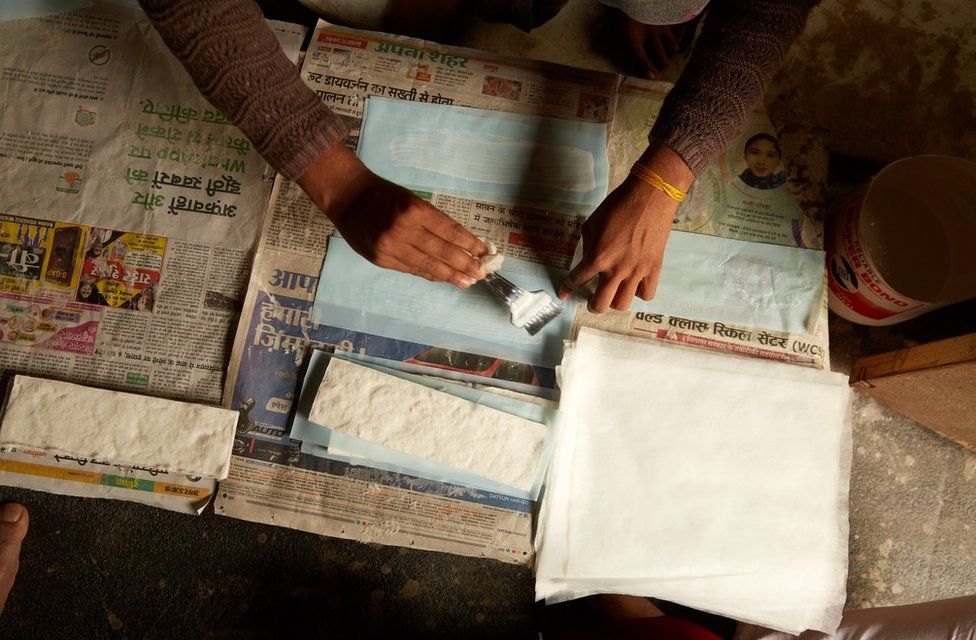
Today, the unit employs seven women, between 18 and 31 years of age. They work from 9-5, six days a week and are paid a monthly salary of 2,500 rupees ($35; £27). The centre produces 600 pads a day and they are sold under the brand name Fly.

Presentational white space
Women making sanitary pads
Image captionThe centre produces 600 pads a day
Presentational white space
Women making sanitary pads
Image captionMost women in the village used to use old clothes when they got their periods, now 70% use pads
“The biggest problem we face is power cuts. Sometimes we have to come back at night to work when the power is back to meet the targets,” Sneh says.

This little business, run from two rooms in a village home, has helped improve feminine hygiene. Until it was set up most women in the village were using pieces of cloth cut out from old saris or bedsheets when they had their period, now 70% use pads.

It’s also de-stigmatised menstruation and changed attitudes in a conservative society in ways that were unimaginable just a couple of years ago.

Sneh says menstruation is now discussed openly among women. But, she says, it’s not been an easy ride.

“It was difficult at the start. I had to help my mother with housework, I had to study and do this job. Sometimes during my exams, when the pressure became too much, my mother went to work instead of me,” she says.

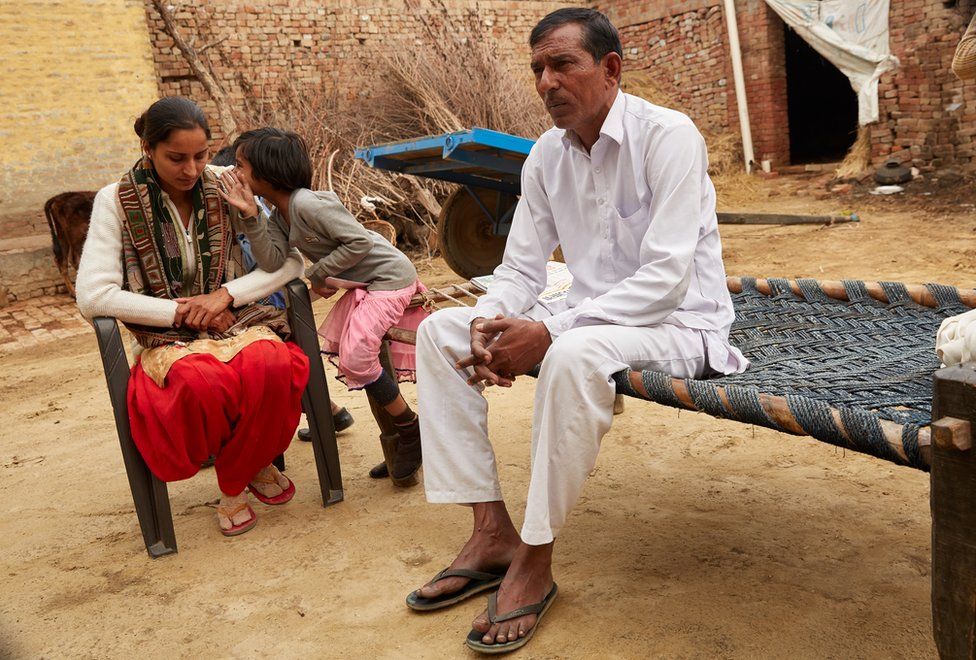
Her father, Rajendra Singh Tanwar, says he is “very proud” of his daughter. “If her work benefits the society, especially women, then I feel happy about it.”

Presentational white space
Sneh with her father
Image captionRajendra Singh Tanwar says he’s proud of what Sneh (left) has done
Presentational white space
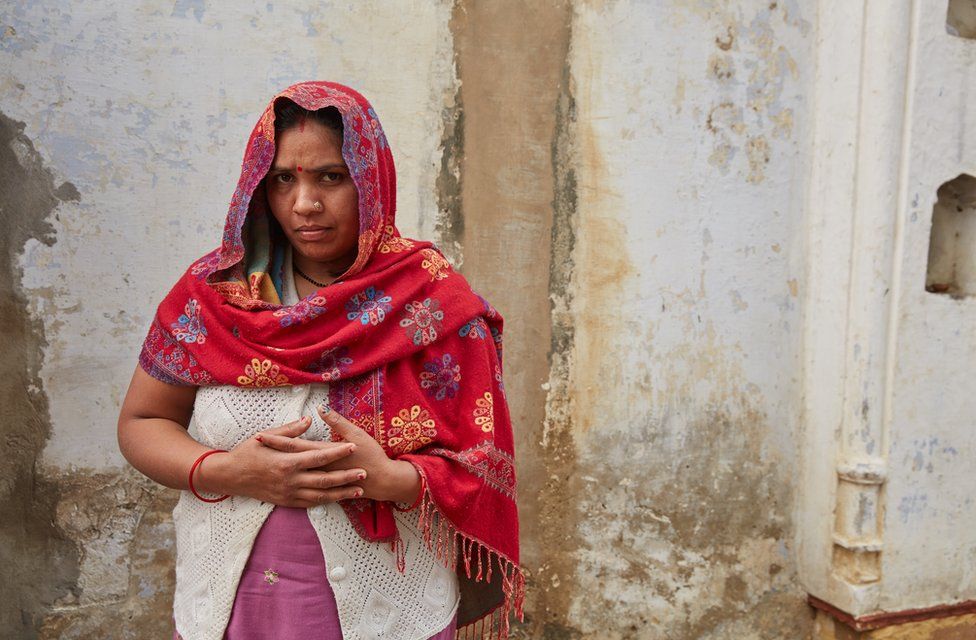
Sushma Devi
Image captionSushma Devi’s husband does not want her to work there – but she won’t give it up
Presentational white space

Initially, the women faced objections from some villagers who were suspicious about what was happening at the factory. And once the film crew arrived, there were questions about what they were doing.

And some, like 31-year-old Sushma Devi, still have to fight daily battles at home.

The mother-of-two says her husband agreed to let her work only after Sneh’s mother spoke to him. He also insisted that she finish all the housework before going to the factory.

“So I wake up at 05:00, clean the house, do the laundry, feed the buffaloes, make dung cakes which we use as cooking fuel, bathe, and make breakfast and lunch before I step out. In the evening, I cook dinner once I get back.”

But her husband is still unhappy with the arrangement. “He often gets angry with me. He says there’s enough work at home, why do you have to go out to work? My neighbours too say it’s not a good job, they also say the salary is low.”

Two of Sushma’s neighbours had worked at the factory too, but left after a few months. Sushma has no intention of doing the same: “Even if my husband beats me up, I will not give up my job. I enjoy working here.”

Presentational white space
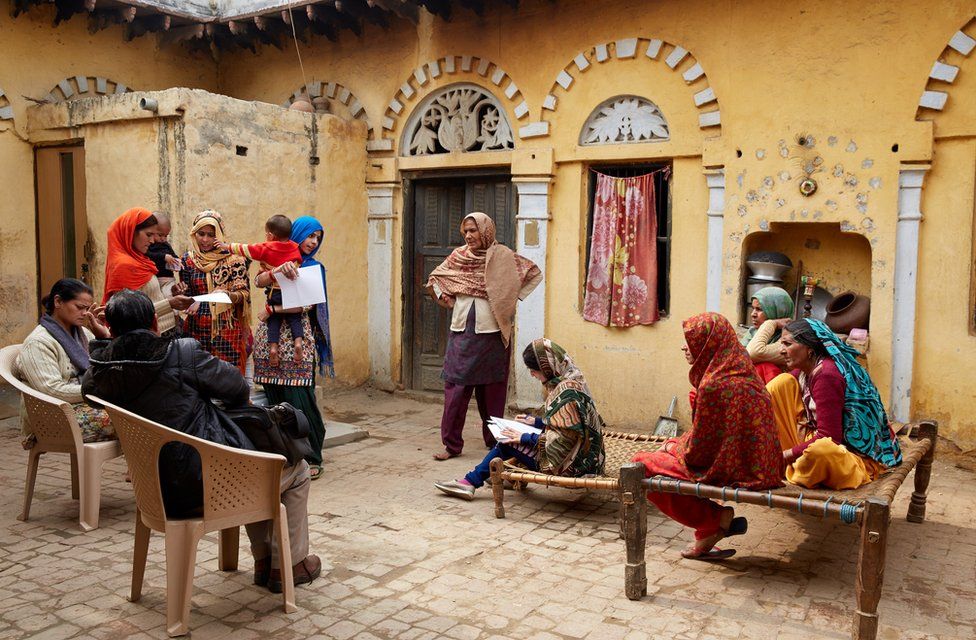
Members of Action India and some of the factory workers
Image captionAction India, a charity that works on reproductive health issues, set up the manufacturing unit two years ago
Presentational white space

In the documentary, Sushma is heard saying she’d spent some of her earnings to buy clothes for her younger brother. “If I’d known this was going to go to Oscars, I would have said something more intelligent,” she says, laughing.

For Sushma, Sneh and their fellow workers, the Oscar nomination has come as a big boost. The film, which is available on Netflix, is nominated in the Best Short Documentary category.

As Sneh prepares to leave for Los Angeles, her neighbours are appreciative of the “prestige and fame” she has brought the village.

“No-one from Kathikhera has ever travelled abroad so I’ll be the first one to do so,” she says. “I’m now recognised and respected in the village, people say they are proud of me.”

Sneh says she had heard of Oscars and knew they were the biggest cinema awards in the world. But she had never watched a ceremony, and certainly didn’t think that one day she would be on the red carpet.

“I never thought I would go to America. Even now I can’t fully process what’s happening. For me, the nomination itself is an award. It’s a dream that I’m dreaming with my eyes open.”

Source: The BBC

22/02/2019

“Don’t mess with Pakistan,” India is told amid Kashmir tension

RAWALPINDI, Pakistan (Reuters) – Pakistan will respond to any attack by India with “full force”, the army’s spokesman said on Friday, amid heightened tensions between the two nuclear-armed neighbours over Kashmir.

Major General Asif Ghafoor was speaking a week after a Pakistani-based militant group claimed responsibility for a suicide car bomb attack that killed 40 Indian paramilitary policemen the Himalayan region disputed between India and Pakistan.

India’s top military commander in the region has alleged Pakistan’s main Inter-Services Intelligence (ISI) spy agency was involved.

“We have no intention to initiate war, but we will respond with full force to full spectrum threat that would surprise you,” Ghafoor told reporters in the garrison city of Rawalpindi. “Don’t mess with Pakistan.”

The army’s response came two days after Prime Minister Imran Khan urged India to share any actionable evidence, offering full cooperation in investigating the blast.

He also offered talks with India on all issues, including terrorism, which India has always sought as a pre-requisite to any dialogue between the two arch-rivals.

India and Pakistan have fought two wars since independence in 1947 over Kashmir, which both the countries claim entirely.

Ghafoor also reiterated the talks offer.

“Kashmir is a regional issue,” he said. “Let us talk about it. Let us resolve it.”

India blames Pakistani Islamist militant groups for infiltrating into its part of Kashmir to fuel an insurgency and help separatist movements.

Washington and Delhi allege that the Pakistani army nurtures the militants to use them as a foreign policy tools to expand power in neighbouring India and Afghanistan. The army denies that.

One such group is Lashkar-e-Taiba (LeT), which India blamed for attacks in Mumbai in 2008 which killed 166 people, saying its founder, Hafiz Saeed, was the mastermind.

The United States has offered a $10 million reward for information leading to his conviction over the Mumbai attacks.

Pakistan has put him under house arrest several times and banned his Islamist groups, Jamaat-ud-Dawa (JuD) and Falah-e-Insaniat Foundation (FIF), which the United States and the United Nations say are terrorist fronts for the LeT.

Islamabad reinstated the ban on the groups yet again on Thursday, but Saeed remains free, allowed to roam the country and make public speeches and give sermons.

Source: Reuters

17/02/2019

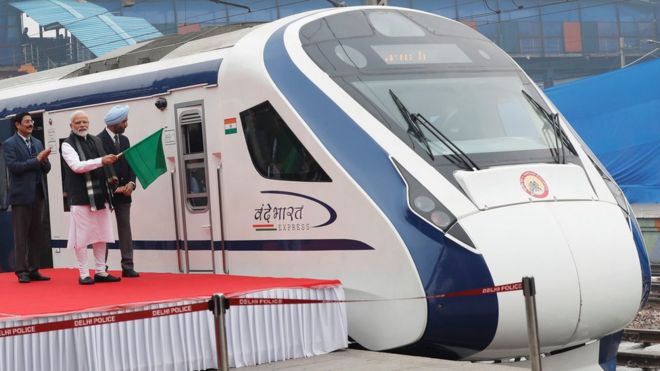
India high speed train breaks down on first trip

PM Modi flags off the Vande Bharat ExpressImage copyrightREUTERS
Image captionPM Narendra Modi flagged off the Vande Bharat Express on Friday

India’s fastest train has broken down on its first trip, a day after it was inaugurated by Prime Minister Modi.

The Indian-built semi high-speed Vande Bharat Express was returning to the capital Delhi from the city of Varanasi after its first outing when brakes in a carriage reportedly jammed.

Indian media quoted a railways spokesperson as saying the train may have struck cattle on the line.

The train reached a speed of 180km/hr (110mph) during trials.

Soon after the brakes failed, the drivers noticed smoke in the last four coaches and power was lost in all compartments.

Those on board, mostly railway officials and journalists, had to take another train to get back to Delhi.

Despite the railway ministry’s suggestion that the train may have hit a cow, NDTV reported that there were no signs of damage on the front of the train after the incident.

The new train service is expected to start its commercial run from Sunday. It is expected to reduce the travel time between Delhi and Varanasi by six hours.

Source: The BBC

15/02/2019

Fire alarms “faulty” at Delhi blaze hotel, prompting mass reinspections

NEW DELHI (Reuters) – A hotel that caught fire in the Indian capital on Tuesday, killing 17 people, passed safety checks 14 months ago, but an investigation has revealed breaches of regulations, such as faulty alarms, prompting a mass reinspection of other hotels.

Poorly enforced regulations lead to thousands of deaths in fires across India every year and officials in New Delhi say an overstretched fire service is hampering safety efforts.

The Hotel Arpit Palace passed a fire safety check in December 2017, but a copy of the initial police investigation seen by Reuters showed several breaches of fire regulations, including a lack of signs to guide guests to exits and fire alarms that did not work.

Delhi’s fire service, which is responsible for safety inspections as well as fighting fires, is now reviewing certificates issued to more than 1,500 hotels in one of India’s tourist hubs, a senior fire official told Reuters.

“Fire officers have to do a lot of work,” said Vipin Kental, Delhi’s chief fire officer. “We have to be inspectors and fight fires. We do not have the manpower.”

The city has around 1,700 firefighters, he said, which is less than an eighth of the number in New York, a city with less than half of Delhi’s population.

PREVENTABLE TRAGEDY

The fire is believed to have begun on the hotel’s first floor, spreading quickly through wood-panelled corridors, police say. Among the dead were members of a wedding party from Kerala and a two Buddhist pilgrims from Myanmar.

“From the outside, the building looked intact, but inside everything was completely charred,” a police officer told Reuters.

Two of the 17 died after jumping out of windows in desperation after failing to find emergency exits, added the officer, who declined to be named as he is not authorised to talk to the media.

“Fire preparedness is a matter of shockingly low priority in most parts of the country,” said an editorial in the Indian Express, one of the country’s leading newspapers.

A 2018 study by India’s home ministry that found the country had just 2,000 of more than 8,500 fire stations it needs.

More than 17,000 people died in fires in 2015, according to data from the ministry, the last year for which figures are available, one of the largest causes of accidental death in India.

Fire safety is an issue for shanty towns and some of the country’s most expensive real estate.

A day after the Arpit Palace disaster, more than 250 makeshift homes were destroyed in a slum in Paschim Puri, a poor area of New Delhi, though no one was killed.

In 2017, 14 people were killed during a birthday party at a high-end bar in India’s financial capital Mumbai.

In several upscale neighbourhoods in Delhi, police shut hundreds of shops and restaurants last year for trading on floors meant for residential use, though many continue to operate illegally, residents say.

By the boarded-up Arpit Palace in the Karol Bagh area of New Delhi, wires from adjacent hotels still trail across the street, though staff there told Reuters they were complying with fire regulations.

Adding to the safety problems, poorly paid staff in the hotel and restaurant industries are often unable to help guests when fires break out, Kental said.

“They are not trained. They don’t know what to do in the event of a fire,” he said.

Source: Reuters

09/02/2019

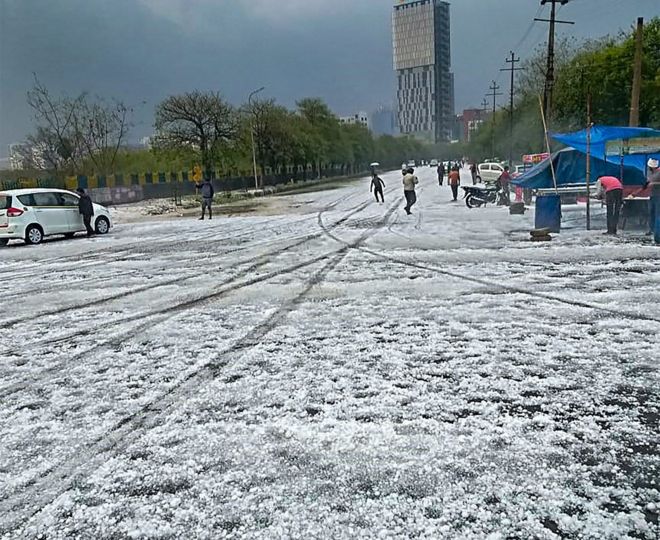
India capital Delhi enjoys unusual hail storm

Hail in NoidaImage copyrightPTI
Image captionMany people compared the unusual sight to scenes from Chicago or London
Presentational white space

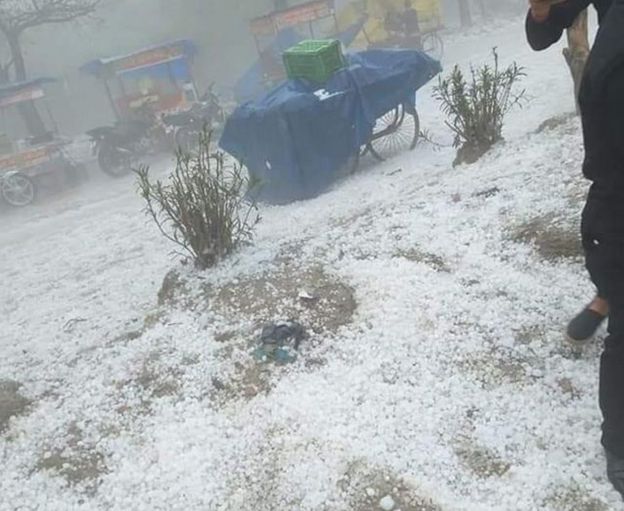
India’s capital Delhi was hit by a strong hailstorm on Thursday, turning the city white and leaving people stunned and delighted.

Pictures and videos posted on social media show cherry-sized ice balls and streets covered in white.

Many people compared the unusual sight to scenes from Chicago or London.

Hailstorms “are not rare for Delhi, but their occurrence is infrequent,” according to US website Accuweather’s senior meteorologist Jason Nicholls.

The severe weather also forced more than 30 flights to be diverted during the early hours of the evening.

However, the hail and rain storm did have an upside. Apart from delighting Delhi’s residents, it also helped improve the city’s notoriously toxic air quality.

Hail in NoidaImage copyrightZUBAIR AHMAD ANSARI
Image captionPictures and videos posted on social media show cherry-sized ice balls and streets covered in white
Presentational white space

The harsh weather in the country’s north has also led to avalanche warnings and schools closures.

Source: The BBC

08/02/2019

LIVE updates| Didi is eyeing Delhi, leaving West Bengal to middlemen: PM Modi

PM Modi addresses rally in West Bengal Live: Prime Minister Narendra Modi is addressing a public meeting in West Bengal’s Maynaguri district,

By HT Correspondent | Feb 08, 2019 16:48 IST

Prime Minister Narendra Modi addressed a public meeting in Chhattisgarh’s Raigarh district. The Prime Minister is also scheduled to address a rally in West Bengal’s Maynaguri on Friday,

This will be the prime minister’s first rally in Chhattisgarh after the BJP suffered a massive loss in the state assembly elections in December last year.

“All the preparations have been completed for the PM’s rally in Kodatarai village in Raigarh,” a spokesperson of the party said.

The rally is aimed at energising party workers and supporters ahead of the Lok Sabha elections, he said.

Also Read | For Congress, BC is before Cong, AD is after dynasty: PM Modi in Lok Sabha

In Bengal, the prime minister laid the foundation stone for the four laning of the Falakata-Salsalabari section of National Highway-31 D in Jalpaiguri. This 41.7 km-long section of National Highway falls in the Jalpaiguri district in West Bengal, and will be constructed at a cost of about Rs 1938 crore, a statement from the Prime Minister’s Office said.

Source: Hindustan Times

17/12/2018

Three-year-old assaulted on Delhi bus rape anniversary

A protest in India against child sex abuseImage copyrightAFP

A three-year-old Indian girl is in critical condition after she was allegedly raped by her neighbour in the capital Delhi.

The accused, a 40-year-old security guard who worked in the building the child lived in, has been arrested.

Police found the girl unconscious and rushed her to hospital where she is undergoing surgery.

The incident occurred on Sunday, which was the sixth anniversary of the brutal gang rape of a student on a Delhi bus.

Delhi Women’s Commissioner Swati Maliwal said the incident “let down” the bus rape victim, whose attack saw country-wide protests and a tightening of rape laws.

There is still no clarity on the condition of the girl or whether she will survive the attack, which local media have described as “brutal”.

Locals in the area found the accused and attacked him after the incident came to light, the Times of India newspaper said. It also quoted police as saying that the accused was treated for injuries before they arrested him.

The girl’s parents, who are daily wage labourers, were away when the incident occurred. The accused allegedly lured the girl with sweets and picked her up from outside her house.

Police have registered a case for rape under the Protection of Children from Sexual Offences (POSCO) Act, which could see the death penalty handed out to the accused.

The incident, which has prompted a fresh wave of anger and outrage in India, comes after a series of high-profile cases against children this year. In April, the brutal gang-rape and murder of an eight-year-old in Indian-administered Kashmir dominated headlines. In June, hundreds took to the streets in the central state of Madhya Pradesh over the rape of a seven-year-old girl.


The scale of abuse in India

  • A child under 16 is raped every 155 minutes, a child under 10 every 13 hours
  • The number of reported rapes of children increased from 8,541 in 2012 to 19,765 in 2016
  • More than 10,000 children were raped in 2015
  • 240 million women living in India were married before they turned 18
  • 53.22% of children who participated in a government study reported some form of sexual abuse
  • 50% of abusers are known to the child or are “persons in trust and care-givers”
17/12/2018

‘Carnage of unbelievable proportions’: Delhi High Court convicts Sajjan Kumar for 1984 riots

Sajjan Kumar,anti-Sikh riots case,1984 anti-sikh riots case
Congress’ Sajjan Kumar was convicted today by Delhi High Court in 1984 riots case(PTI)

The Delhi High Court on Monday called the anti-Sikh riots case of 1984 “communal frenzy” after the then prime minister Indira Gandhi was assassinated by her bodyguards as it sentenced Congress leader Sajjan Kumar to life imprisonment in one of the cases.

As it reversed the trial court’s order acquitting Kumar, the court also directed him to surrender by December 31, 2018, and slapped a fine of Rs 5 lakh on him and Rs 1 lakh on all other accused in the case.

The case relates to the murder of five members of a family during the anti-Sikh riots in the Raj Nagar area in the Delhi Cantonment on November 1, 1984.

“What happened in the aftermath of the assassination of the then Prime Minister was carnage of unbelievable proportions in which over 2,700 Sikhs were murdered in Delhi alone. The law and order machinery clearly broke down and it was literally a ‘free for all’ situation which persisted. The aftershocks of those atrocities are still being felt,” justice S Muralidhar and justice Vinod Goel said while handing the 203-page judgement.

Also watch | Congress’ Sajjan Kumar convicted in 1984 Sikh riots case, gets life term 

The judges also quoted a poem by Amrita Pritam on the violence after the Partition in 1947 in India and Pakistan. She escaped to India with her two children from Pakistan’s Lahore.

“She was moved to pen an “Ode to Waris Shah” in which she spoke of the fertile land of Punjab having “sprouted poisonous weeds far and near” and where “Seeds of hatred have grown high, bloodshed is everywhere/Poisoned breeze in forest turned bamboo flutes into snakes/Their venom has turned the bright and rosy Punjab all blue,” they said.

Also read | Congress’ Sajjan Kumar convicted in 1984 Sikh riots, gets life term

“The killings would continue in the streets of Delhi. Thirty-seven years later, the country was again witness to another enormous human tragedy. Following the assassination of Smt. Indira Gandhi, the then Prime Minister of India, on the morning of 31st October 1984 by two of her Sikh bodyguards, a communal frenzy was unleashed.”

‘Political patronage’

The judges recalled the violence in which thousands of Sikhs were killed, some burnt alive, as their houses were destroyed in Delhi and across the country.

“A majority of the perpetrators of these horrific mass crimes, enjoyed political patronage and were aided by an indifferent law enforcement agency … The criminals escaped prosecution and punishment for over two decades.”

“There was an abject failure by the police to investigate the violence which broke out in the aftermath of the assassination of the then Prime Minister Smt. Indira Gandhi is apparent from the several circumstances highlighted hereinabove.”

There was an “utter failure” to register separate first report information in the case of five deaths in which Congress leader Kumar and others were sentenced.

“The failure to record any incident whatsoever in the DDR and the lack of mention of PW-1’s statement therein, amongst other circumstances, established the apathy of the Delhi Police and their active connivance in the brutal murders being perpetrated.

Here is what they also said in the summary of their judgement:

1. This was an extraordinary case where it was going to be impossible to proceed against A-1 in the normal scheme of things because there appeared to be ongoing large-scale efforts to suppress the cases against him by not even recording or registering them. Even if they were registered they were not investigated properly and even the investigations which saw any progress were not carried to the logical end of a charge sheet actually being filed. Even the defence does not dispute that as far as FIR No.416/1984 is concerned, a closure report had been prepared and filed but was yet to be considered by the learned MM.

2. The trial Court completely omitted to address the charge of conspiracy despite detailed arguments submitted by the CBI in that regard. There was a two-pronged strategy adopted by the attackers. First was to liquidate all Sikh males and the other was to destroy their Crl.A. 1099/2013 & Connected Matters Page 200 of 203 residential houses leaving the women and children utterly destitute. The attack on the Raj Nagar Gurudwara was clearly a part of the communal agenda of the perpetrators.

Read | ‘Will pay for sins’: Arun Jaitley targets Congress after Sajjan Kumar conviction

3. The mass killings of Sikhs between 1st and 4th November 1984 in Delhi and the rest of the country, engineered by political actors with the assistance of the law enforcement agencies, answer the description of “crimes against humanity”. Cases like the present are to be viewed in the larger context of mass crimes that require a different approach and much can be learnt from similar experiences elsewhere.

4. Common to the instances of mass crimes are the targeting of minorities and the attacks spearheaded by the dominant political actors facilitated by the law enforcement agencies. The criminals responsible for the mass crimes have enjoyed political patronage and managed to evade prosecution and punishment. Bringing such criminals to justice poses a serious challenge to our legal system. Decades pass by before they can be made answerable. This calls for strengthening the legal system. Neither “crimes against humanity‟ nor genocide‟ is part of our domestic law of crime. This loophole needs to be addressed urgently.

5. The acquittal of A-1 by the trial Court is set aside. He is convicted of the offence of criminal conspiracy punishable under Section 120B read with Sections 302, 436, 295, and 153A (1) (a) and (b) IPC; for the offence punishable under Section 109 IPC of abetting the commission of the aforementioned offences; and for the offence of delivering provocative speeches instigating violence against Sikhs Crl.A. 1099/2013 & Connected Matters Page 201 of 203 punishable under Section 153A (1) (a) and (b) IPC.

15/12/2018

Is Delhi’s air causing lung cancer?

Air pollution levels in the Indian capital have been rising alarmingly in recent years. Today, in some parts of the city, breathing in the open air equals smoking 20 cigarettes a day.

Go to next video: Hair-raising drive through Delhi smog

Law of Unintended Consequences

continuously updated blog about China & India

ChiaHou's Book Reviews

continuously updated blog about China & India

What's wrong with the world; and its economy

continuously updated blog about China & India