31/05/2020
- China’s leadership has made it clear to its people that the world will become more dangerous and they must be prepared for hard times
- Beijing’s relatively small stimulus response to Covid-19 suggests it wants to save its economic policy ammunition for a bigger battle
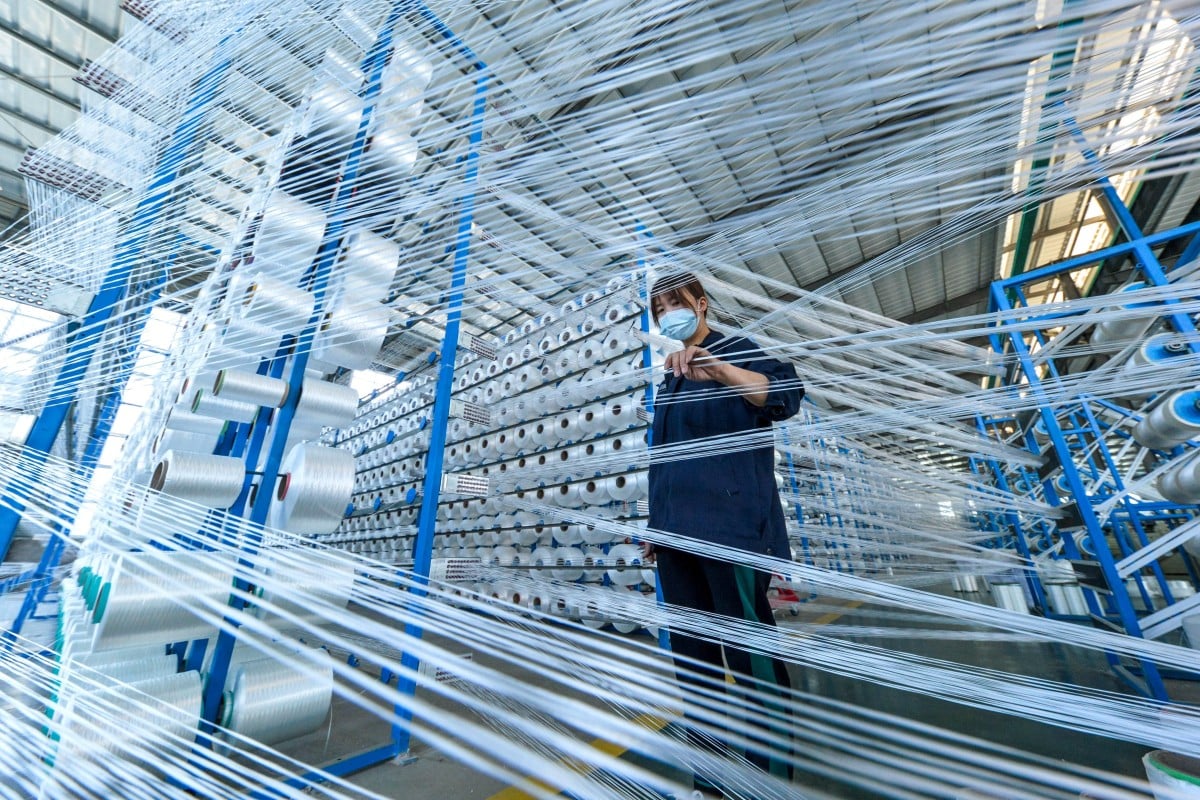
China opted not to set a GDP target for 2020. Photo: Xinhua
Beijing’s decision not to set an annual GDP target for 2020 – for the first time since 2002 – is a sign it is putting stability ahead of growth as part of its preparations for an escalating conflict with the
United States.
Economic development has always been the central theme for Beijing since it established diplomatic relations with the US in 1979. But this year it has given priority to job creation and tackling poverty. The coronavirus outbreak might appear to have been the reason for the shift, but the underlying factor is the tension with the US.
Covid-19 offered a preview of what a decoupling of China and US might look like: aircraft grounded, cargo flows disrupted, value chains broken, goodwill and cooperation lost, blame games started.
Both countries have suffered heavy human and economic losses from the coronavirus, yet that did not inspire them to work together. Instead, hostility and rivalry has thrived, and neither wants to blink first.
The Chinese leadership has made it clear to its people that the world will become more dangerous and they must be prepared for hard times. As such, the government is saving its economic policy ammunition.
While the stimulus plans introduced in the US, Germany, Japan and France exceed 10 per cent of their national GDP and interest rates have been cut to the bone, Beijing stopped at just 1 trillion yuan (US$140 billion) worth of special treasury bonds and 1.6 trillion yuan of additional local government bonds. In total, about 2.6 per cent of GDP.
Interest rates in China – 2.7 per cent on 10-year bonds – are some of the highest among major economies.
China’s 6.6 per cent defence spending boost lowest in three decades
China’s budget fiscal deficit has increased to 3.6 per cent of GDP for 2020, but the larger deficit is mainly from tax and fee cuts instead of increased fiscal expenses, except for an increased military spending.
Beijing is calling on provincial and local authorities to tighten their belts, which is unusual for a government that has huge assets and can increase spending at any time through quantitative easing.
So why is the government, which is known for intervening in the economy, being so restrained?
It is bracing itself for a perceived period of turbulence and hardship as its relationship with the US turns sour. It is putting jobs and social stability on top of its agenda, instead of growth.
Beijing is refraining from excessive spending, eliminating sources of potential instability, making appeals to the most vulnerable social groups, and saving its power for a bigger test.
Against that backdrop, the National People’s Congress passed the national security legislation on Hong Kong. Beijing knew the bill would anger the US, but did it anyway.
Hong Kong is known as China’s gateway to the international capital market and the largest offshore yuan market, but Beijing is ready to trade losses on the financial and economic front for potential gain on a fortified national security fence.
All this points to the suggestion that Beijing is preparing for the possibility of decoupling from the US, even if it doesn’t necessarily want to.
The threat of a new Cold War is clouding the world. The theme of life for one or two generations of people on both sides of the Pacific may shift from growth and prosperity to struggle and confrontation.
China and the US have yet to collide totally, but that moment is drawing near.
Source: SCMP
Posted in 1979, 2020, aircraft grounded, ammunition, ‘new cold war’, be prepared, Beijing, Beijing’s, bigger battle, blame games, cargo flows disrupted, central theme, Chinese leadership, collide, CONFRONTATION, cooperation, coronavirus, coronavirus outbreak, Decoupling, diplomatic relations, Economic development, economic losses, Economic policy, France, from, GDP target, Germany, goodwill, growth, hard times, hostility, Japan, leadership, lost, military spending, more dangerous, National People’s Congress, Pacific, People, preparing, prosperity, rivalry, small stimulus response, struggle, The US, thrived, to decouple, Uncategorized, United States, value chains broken, World |
1 Comment »
29/04/2020
BEIJING, April 28 (Xinhua) — China has achieved much progress in environmental protection and taken the lead in green development in recent years.
The efforts have exemplified Chinese President Xi Jinping’s proposal of “working together for a green and better future for all” made a year ago in his speech at the opening ceremony of the International Horticultural Exhibition 2019 Beijing.
In the keynote speech, Xi proposed a five-point initiative on promoting green development, namely pursuing harmony between man and nature, pursuing the prosperity based on green development, fostering a passion for nature-caring lifestyle, pursuing a scientific spirit in ecological governance, and joining hands to tackle environmental challenges.
China’s hard work on environment protection has paid off.
The ecological environment has improved significantly. People are enjoying more days of blue sky, cleaner water, and fertile land.
China has achieved the goal of zero growth of desertified land by 2030 set by the United Nations ahead of time. Besides, forest stock volume increased by 4.56 billion cubic meters compared with that of 2005.
Carbon dioxide emissions per unit of GDP in 2018 fell by 45.8 percent compared with that of 2005, exceeding the target set for the year.
After more than 30 years of hard work, the seventh largest desert in China, the Kubuqi Desert in Inner Mongolia Autonomous Region, once known as the “sea of death” difficult for birds to fly across, has turned into a green valley.
In January 2020, in a letter in reply to the student representatives of the Global Alliance of Universities on Climate, the Chinese president mentioned his thoughts about ecological civilization in his youth.
“Over four decades ago, I lived and worked for many years in a small village on the Loess Plateau in western China. Back then, the ecology and environment there was seriously damaged due to over-development and the local people were trapped in poverty as a result,” Xi wrote.
“This experience taught me that man and nature are a community of life and that the damage done to nature will ultimately hurt mankind,” said Xi.
China’s progress and achievements are recognized worldwide.
The ecological civilization and green development advocated by China are actually an endeavor to find a way to balance economic development and environmental protection, said John Cobb, Jr., the founding president of the Institute for Postmodern Development of China and member of the American Academy of Arts and Sciences.
Noting that the endeavor is a remarkable exploration, he expressed his hope that it will succeed.
China is on the right path in dealing with global climate change and achieving sustainable development, said Borge Brende, president of the World Economic Forum.
In addition to making efforts at home, China has also rolled out a series of measures to support the global combat against climate change.
In September 2015, ahead of the Paris climate change conference, Xi pledged a 20-billion-yuan (3-billion-U.S. dollars) China South-South Climate Cooperation Fund, which was dedicated to help other developing countries combat climate change.
China has also been fulfilling the obligations of the United Nations Framework Convention on Climate Change and the Paris Agreement, and achieved the goal of its intended nationally determined contributions submitted to the secretariat of the Climate Change Convention as scheduled.
UN Secretary-General Antonio Guterres expressed his appreciation for China’s important contributions to addressing the climate change and building a green “Belt and Road,” and said he expects China to continue to play a leading role in addressing the climate change and other issues.
“Lucid waters and lush mountains are invaluable assets,” a concept put forward by Xi in 2005 when he visited Yucun Village in southeast China’s Zhejiang Province as the party chief of the province, has become the motto of the Lao Ministry of Natural Resources and Environment.
In March 2020, when Xi returned to Yucun, he said that economic development should not be achieved at the expense of the ecological environment. To protect the ecological environment is to develop the productive forces, he said.
The history of civilizations shows that the rise or fall of a civilization is closely tied to its relationship with nature, Xi said at the International Horticultural Exhibition last year.
Only by joining hands can the humankind advance a global ecological civilization and march towards the bright future of building a community with a shared future for mankind.
Source: Xinhua
Posted in "lucid waters and lush mountains are invaluable assets.", "sea of death", "working together for a green and better future for all", 2005, 2015, 2018, 2019, 2020, 2030, 30, achieved, addressing, advance, ago, ahead of time, American Academy of Arts and Sciences, appreciation, Beijing, Belt and Road, Besides, between, billion cubic meters, blue sky, bright future, Building, carbon dioxide emissions, China, China South-South Climate Cooperation Fund, Chinese president, Chinese President Xi Jinping's, civilization, cleaner water, climate change, Climate Change Convention, closely tied, combat climate change, community, community of life, compared, concept, concrete actio, damaged, decades, dedicated, desertified land, developing countries, difficult, ecological civilization, ecological environment, ecological governance, Ecology, Economic development, efforts, enjoying, Environment, environmental challenges, Environmental protection, exceeding, exemplified, expense, experience, fell by, fertile land, five-point initiative, for birds to fly across, forest stock volum, fostering, four, GDP, global, Global Alliance of Universities on Climate, global combat, global ecological civilization, goal, green development, green valley, hard work, has improved, history of civilizations, humankind, hurt, important contributions, increased, inner mongolia autonomous region, Institute for Postmodern Development of China, International Horticultural Exhibition, January, joining hands, keynote speech, Kubuqi Desert, Lao Ministry of Natural Resources and Environment., last year, leads, lived, local people, Loess Plateau, man and nature, mankind, many years, March, mentioned, more days, motto, nature, nature-caring lifestyle, opening ceremony, over-development, Paris Agreement, Paris climate change conference, party chief, passion, People, per unit, percent, pledged, poverty, progress, proposal, prosperity, province, pursuing, pursuing harmony, put forward, recent years, relationship, result, rise or fall, scheduled, scientific spirit, September, seriously, seventh largest desert, shared future, significantly, small village, southeast China's, speech, taught, thoughts, to help, to tackle, trapped, turned into, ultimately, Uncategorized, United Nations, United Nations Framework Convention on Climate Change, Western China, with, worked, World Economic Forum, Xi, year ago, years, Youth, Yucun, zero growth, zhejiang province |
Leave a Comment »
10/04/2020
BEIJING, April 9 (Xinhua) — Chinese Vice Premier Hu Chunhua held a phone conversation on Thursday with British Chancellor of the Exchequer Rishi Sunak on advancing bilateral cooperation on epidemic prevention and economic development.
Hu, who leads the Chinese delegation to the China-UK Economic and Financial Dialogue (EFD), noted that Chinese President Xi Jinping and British Prime Minister Boris Johnson recently held two phone conversations and reached important consensus on jointly dealing with the pandemic and developing China-UK relations.
The Chinese side stands ready to work with the British side to implement the consensus reached by the two leaders, deepen practical cooperation in such fields as epidemic prevention and finance, and provide Britain with support and assistance within its capabilities in medical supplies and other fields, Hu said.
The vice premier expressed hope that the two sides will further strengthen cooperation under the framework of the United Nations and the Group of 20, promote macroeconomic policy coordination, cut tariff, remove barriers, and facilitate the flow of trade, so as to maintain the stability of the global industrial supply chain and promote sustainable growth of the world economy.
For his part, Sunak thanked China for its support and assistance, adding that Britain stands ready to strengthen bilateral cooperation in epidemic prevention, economy and finance through channels like the China-UK EFD, so as to continuously advance bilateral relations.
Source: Xinhua
Posted in advancing, bilateral cooperation, Britain, British Chancellor of the Exchequer, British Prime Minister, China-UK Economic and Financial Dialogue (EFD), China-UK EFD, China-UK relations, Chinese delegation, Chinese President Xi Jinping, Chinese Vice-Premier Hu Chunhua, cut tariff, Economic development, epidemic prevention, facilitate, flow of trade, global, Group of 20, industrial, macroeconomic policy coordination, phone conversation, Prime Minister Boris Johnson, promote, remove barriers, Rishi Sunak, stability, Supply chain, sustainable growth, Thursday, Uncategorized, United Nations, world economy. |
Leave a Comment »
14/10/2019
Nyima Cering (R), deputy director of the Standing Committee of the Tibet Autonomous Region People’s Congress, poses for a group photo with President of Zurich City Parliament Heinz Schatt in Zurich, Switzerland, Oct. 11, 2019. A Tibetan delegation of the Chinese National People’s Congress (NPC), led by Nyima Cering, visited Switzerland from Wednesday to Sunday. (Photo by Ruben Sprich/Xinhua)
ZURICH, Switzerland, Oct. 13 (Xinhua) — A Tibetan delegation of the Chinese National People’s Congress (NPC) visited Switzerland from Wednesday to Sunday and briefed Swiss lawmakers and officials on Tibet’s historic achievements in economic and social development.
The delegation, led by Nyima Cering, deputy director of the Standing Committee of the Tibet Autonomous Regional People’s Congress, met with First Vice President of the Swiss Council of States Hans Stockli, Deputy Governor of Canton of Bern Pierre Alain Schnegg, President of Zurich City Parliament Heinz Schatt and local Chinese compatriots.
Based on his personal experience and citing detailed figures, Nyima Cering recounted the major economic and social developments in Tibet in the past 60 years since the start of democratic reform there, thanks to the full support of the central government, assistance from all over the country and the concerted efforts of all ethnic groups in Tibet.
Stockli applauded the major economic and social developments in Tibet, and expressed the willingness to enhance mutual understanding to boost China-Switzerland exchanges and cooperation between legislative bodies.
Source: Xinhua
Posted in China-Switzerland exchanges, Chinese compatriots, Chinese National People's Congress (NPC), deputy director of the Standing Committee of the Tibet Autonomous Regional People's Congress, Deputy Governor of Canton of Bern, Economic development, First Vice President, Hans Stockli, Heinz Schatt, Nyima Cering, Pierre Alain Schnegg, President of Zurich City Parliament, social development, Swiss Council of States, Swiss lawmakers, Switzerland, Tibet's historic achievements, Tibetan delegation, Uncategorized |
Leave a Comment »
27/08/2019
Chinese Vice Premier Liu He, also a member of the Political Bureau of the Communist Party of China Central Committee, reads a congratulatory letter to the 2019 Smart China Expo sent by Chinese President Xi Jinping at the expo’s opening ceremony in southwest China’s Chongqing Municipality, Aug. 26, 2019. (Xinhua/Wang Quanchao)
CHONGQING, Aug. 26 (Xinhua) — Chinese Vice Premier Liu He on Monday called for seizing the new opportunities in technological development and promoting the healthy development of the intelligent industry.
Liu, also a member of the Political Bureau of the Communist Party of China Central Committee, made the remarks at the 2019 Smart China Expo that opened Monday in southwest China’s Chongqing Municipality.
At the opening ceremony, he read a congratulatory letter from President Xi Jinping.
The letter fully demonstrated that the president attaches great importance to the development of intelligent industry, and pointed the direction for the sector’s healthy development, Liu said.
Noting that China’s economy is switching from high-speed growth to high-quality development, Liu said the country’s dynamic microfundations and sufficient macro-policy tools can ensure the sound fundamentals of its economic development.
China’s intelligent industry is developing rapidly and emerging as a new economic growth point, Liu said.
To promote the sector’s development, efforts must be centered on promoting the well-being of humanity, maintain a balance between efficiency and job creation, respect and protect individual privacy, and uphold the ethical and moral bottom line, he said.
In underscoring China’s willingness to advance international cooperation in the intelligent sector, Liu said China welcomes enterprises from all over the world, including the United States, to invest and operate in China.
The country will continue to create an appealing investment environment and strengthen protection of property rights and intellectual property rights, he said.
China is willing to resolve problems calmly through consultation and resolutely opposes the escalation of the trade war, Liu said, adding that any escalation will run against the interests of the people of China, the United States and the whole world.
Source: Xinhua
Posted in 2019 Smart China Expo, Chinese Vice Premier, Chinese Vice Premier Liu He, Chongqing, congratulatory letter, dynamic microfundations, Economic development, economic growth point, efficiency, enterprises, ethical bottom line, fundamentals, high-quality development, high-speed growth, humanity, individual privacy, intelligent industry, international cooperation, job creation, macro-policy tools, member of the Political Bureau of the Communist Party of China Central Committee, moral bottom line, new opportunities, President Xi Jinping, technological development, Uncategorized, United States |
Leave a Comment »
14/08/2019
Participants pose for photos at the New Inclusive Asia Dialogue in Kuala Lumpur, Malaysia, Aug. 14, 2019. The China-proposed Belt and Road Initiative (BRI) was formulated with economic development agenda through increased connectivity, infrastructure and capacity building, according to academics and experts at the New Inclusive Asia Dialogue here on Wednesday. (Photo by Chong Voon Chung/Xinhua)
KUALA LUMPUR, Aug. 14 (Xinhua) — The China-proposed Belt and Road Initiative (BRI) was formulated with economic development agenda through increased connectivity, infrastructure and capacity building, according to academics and experts at a conference here on Wednesday.
Speaking at the New Inclusive Asia Dialogue, multiple experts said BRI, as a flexible economic oriented initiative, stood in contrast with attempts by certain country to piece together its own trade network, which was described as being focused on political agendas.
Dr S Mahmud Ali, an associate fellow with the University of Malaya’s Institute of China Studies, said countries like Malaysia, which aspired to reach developed nation status, had recognized the real gains to be had from participation in BRI.
Mahmud said once several on-going BRI related projects were completed in the country, the country’s economic capacity would be greatly boosted.
Malaysia does play a significant role and substantial amounts of Chinese investments funding projects will boost Malaysia’s productivity, total production capacity, its ability to export and produce good that will rise quite dramatically once these projects are completed, he said.
Proposed by China in 2013, the Belt and Road Initiative refers to the Silk Road Economic Belt and the 21st century Maritime Silk Road, which aims at building trade and infrastructure networks connecting Asia with Europe and Africa along the ancient trade routes of the Silk Road.
Chairman of the Committee of International Information of the Foreign Affairs Ministry of Kazakhstan Timur Shaimergenov said that the flexible, economically focused BRI had gained strong support due to the inclusive approach taken by China.
“The Belt and Road Initiative is a flexible economic oriented project. It does not come with political pressure but instead it is about giving participating countries the opportunity to take advantage of economic opportunities.”
Criticism against BRI has taken on a political dimension and they are completely ignoring that while BRI started as a Chinese initiative, it has really become a Eurasian initiative,” he said.
Olga Kuznetsova, a professor with the Moscow Lomonosov State University said infrastructure development had the potential to benefit countries along BRI route, calling on countries to formulate clear plans to take advantage of the economic spillover.
“Russia is interested in the development of Eurasian transport corridors and invests in the implementation of projects to create them,” she said.
Chinese Ambassador to Malaysia Bai Tian said China had made it clear that it would continue to be a supporter of fair and equitable international trade and globalization, especially in the backdrop of unilateral protectionism.
“We look forward to joining hands with Asian countries to promote trade and investment facilitation, to accelerate the process of regional free trade zone, and to deepen regional and sub-regional cooperation,” he said.
Hosted by the Center for New Inclusive Asia, a Malaysian based think tank, the two-day dialogue aims to foster better understanding of connectivity as a means to promote inclusive growth in Asia, bringing together prominent scholars, senior government officials and corporate leaders from some 10 countries and regions.
Source: Xinhua
Posted in 21st Century Maritime Silk Road,, africa, Asia, Asian countries, Belt and Road Initiative (BRI), BRI, capacity building, Center for New Inclusive Asia, Chairman of the Committee of International Information of the Foreign Affairs Ministry of Kazakhstan, China-proposed, Chinese Ambassador to Malaysia, designed, Economic development, Eurasian transport corridors, Europe, Institute of China Studies, Malaysia, Moscow Lomonosov State University, New Inclusive Asia Dialogue, Russia, Silk Road, Silk Road Economic Belt, Uncategorized, University of Malaya |
Leave a Comment »




 CHINDIA ALERT: You'll be living in their world, very soon