Archive for ‘migrant worker’

23/05/2020

Boy who lost a leg in China’s 2008 Sichuan earthquake now dances to inspire

  • Xie Haifeng’s story is one of luck and resilience and he has made it his mission to help others through adversity
  • Professional dancer owes part of his success to the city of Hong Kong and one of its doctors who helped survivors through recovery
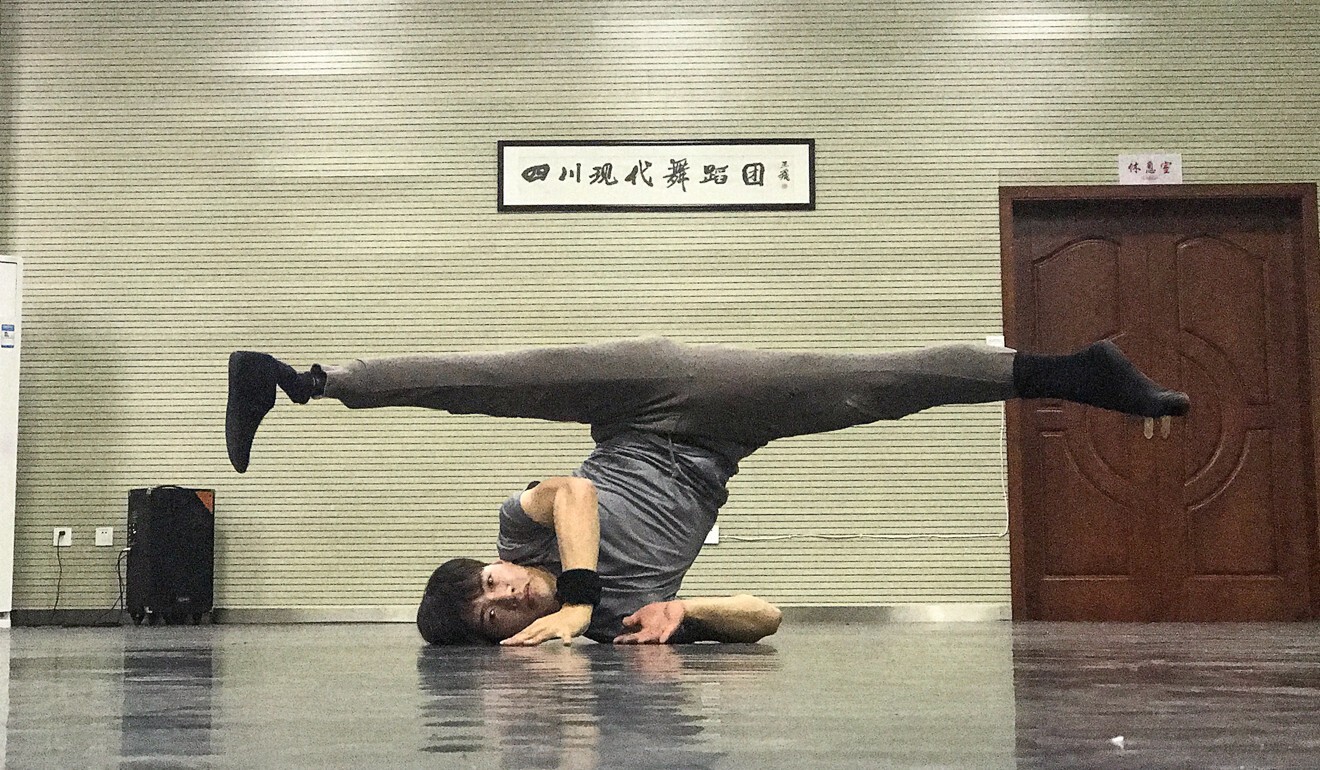
Xie Haifeng was 15 when he lost his leg in one of modern China’s most devastating disasters. Photo: Handout

When the rumbling began, Xie Haifeng thought someone was shaking his bed. Perhaps one of the other 800 children in the school dormitory was being naughty. Or maybe it was a small quake. Then came the unmistakable sound of screams.

Xie, then a 15-year-old pupil at Muyi Town Middle School in the southwestern Chinese province of Sichuan, started running. He fell as the dorm building collapsed around him. When he tried to stand up, he realised something was missing. His left leg was gone.

What Xie thought was a small quake turned out to be one of the most devastating disasters in modern Chinese history.
The Sichuan earthquake of May 2008 left at least 87,000 people dead and shook the country to its core. It was less than three month before Beijing would host its first Olympic Games, an opportunity to show the world its strength and ambition.
Instead, 7,444 schools had crumbled like tofu in an area known to be seismically active. Their rubble was a stark demonstration of the weak foundation of China’s progress and its tragic consequences. At Xie’s school, the shoddily built walls and ceilings crushed 600 children. Only 300 survived.

It still frightens me to recall the earthquake.Xie Haifeng, dancer

Xie considers himself lucky. “If I had run just one second more slowly, I would have been dead. If I had run one second faster, I would have been completely fine. But anyway, I am lucky to be alive,” he said. A dozen years later, his story is also one of resilience. Defying all the odds, Xie is now a professional dancer for a troupe in Sichuan and has made it his mission to help others through adversity.

The journey from his hospital bed to the stage was long and difficult and even though many years have passed, “it still frightens me to recall the earthquake”. But, he said: “I have forgiven fate and accepted the reality that I have only one leg.”

Xie’s trauma was a particularly difficult blow to his family. His older sister was already handicapped, after injuring her arm in an accident. When his mother, a migrant worker in the northwestern province of Gansu, arrived at the hospital a few days after the earthquake, she had no idea of the extent of Xie’s condition.

“When I woke up in the evening, I saw my mother weeping beside my bed. I told myself I should be strong,” Xie said, adding that his mother initially thought he had suffered only bruises. He was sent for treatment to a hospital in the prosperous southern city of Shenzhen, along with other survivors who had been left with disabilities by the earthquake.

Defying all the odds, Xie Haifeng is now a professional dancer. Photo: Handout
It was there that Xie was inspired to make the most of his life. A team of athletes visited the hospital and he was shocked to see one of them, a volleyball player, walking on a prosthetic leg.

Xie began to wear a prosthesis and after rehabilitation training returned to his hometown in 2009 where he was admitted to Qingchuan High School. At first, he was self-conscious and felt inferior to his peers. He did not dare to wear shorts in summer and said he seldom talked to the other students.

The following year he was introduced to members of the Chengdu Disabled People’s Art Troupe, where he found a new and welcoming home. Xie quit school and joined the troupe, despite his parents’ opposition. They were convinced study was the only way for rural students like their son to get out of poverty.

Xie learned Sichuan opera and was soon performing its art of bian lian, or 

face changing

– a skill that requires rapid mask changes in a dazzling sleight of hand – on stage until the troupe was disbanded in 2011, leaving him unemployed for six months.

China marks 10-year anniversary of Sichuan earthquake

But the misfortune led to an improbable opportunity when he was hired by the Sichuan Provincial Disabled People’s Art Troupe and trained to dance. At 19, and with no experience, Xie found the training far more difficult than those who had started at the more usual age of five or six.

His body was too stiff, he said, and in the first months he spent 10 hours each day just stretching and building flexibility. It was just the beginning of a long and often arduous process.

“That agony is too much to be described,” Xie said about the pain of dancing on a prosthetic leg. “During the first six months’ training, I broke three artificial legs.”

More than once, he wondered whether he had chosen the right path. But, ultimately, his gruelling effort paid off and Xie has performed in Singapore, Hong Kong and Macau. In 2013, he won a gold medal at a national dancing competition for people with disabilities.

“My dances won me applause and recognition from the audience. I feel relieved and I think my heart belongs to the stage,” he said.

Xie broke three artificial legs during his first six months of dance training. Photo: Handout
Xie said he owed part of his success to Hong Kong which in 2008 donated HK$20 billion (US$2.5 billion) in aid to Sichuan and sent doctors to treat the injured. Among the volunteers was Poon Tak-lun, a Hong Kong orthopaedist who flew to Sichuan every two weeks from 2008 to 2013 to treat patients.
At a gala show in 2013 to express gratitude from the people of Sichuan to Hong Kong, Xie met Poon and the two became good friends, thanks to their common interest in the arts.

“Dr Poon promised to pay for all the costs of installing and repairing my artificial leg in the future. He told me to focus on dancing without worrying about the leg’s costs,” Xie said.

Xie Haifeng (pictured left with friend Poon Tak-lun) gives a speech to students in Hong Kong. Photo: Handout
Grateful for the help he received from Poon and Hong Kong, Xie has sought to return the favour by doing what he does best.
“I have no other skills except dancing and performing. So I thought of sharing my experience to encourage young students in Hong Kong,” he said.
Xie travels to Hong Kong about twice a year to perform and visit schools. In 2019, he visited the city four times, performing dances and Sichuan opera, and giving speeches at more than 10 primary and secondary schools.
“I encourage them to study hard. I said there are many people in this world who have more difficulties than them but still insist on pursuing their dreams, so they should not give up their dreams,” Xie said.
When he is not dancing and giving inspirational speeches, Xie said he lived a life like everyone else – climbing mountains, swimming and proudly walking on the leg he gained after almost losing everything in Sichuan’s deadly earthquake.
Source: SCMP
31/03/2020

Coronavirus latest: New York begs for help; Indonesia bans foreigners entry; Italy extends lockdown

  • US death toll passes 3,000 as New York’s hospitals are pushed to breaking point
  • Italy extends lockdown as cases exceed 100,000; UN Security Council votes by email for first time
The USNS Comfort passes the Statue of Liberty as it enters New York Harbour on Monday. Photo: Reuters

Harsh lockdowns aimed at halting the march of the coronavirus pandemic extended worldwide Monday as the death toll soared toward 37,000 amid new waves of US outbreaks.

The tough measures that have confined some two-fifths of the globe’s population to their homes were broadened. Moscow and Lagos joined the roll call of cities around the globe with eerily empty streets, while Virginia and Maryland became the latest US states to announce emergency stay-at-home orders, followed quickly by the capital city Washington.

In a symbol of the scale of the challenge facing humanity, a US military medical ship sailed into New York to relieve the pressure on overwhelmed hospitals bracing for the peak of the pandemic.

France reported its highest daily number of deaths since the outbreak began, saying 418 more people had succumbed in hospital.

Spain, which announced another 812 virus deaths in 24 hours, joined the United States and Italy in surpassing the number of cases in China, where the disease was first detected in December.

On Tuesday, mainland China reported a rise in new confirmed coronavirus cases, reversing four days of declines, due to an uptick in infections involving travellers arriving from overseas.

Mainland China had 48 new cases on Monday, the National Health Commission said, up from 31 new infections a day earlier.

All of the 48 cases were imported, bringing the total number of imported cases in China to 771 as of Monday.

There was no reported new case of local infection on Monday, according to the National Health Commission. The total number of infections reported in mainland China stood at 81,518 and the death toll at 3,305. Globally, more than 760,000 have been infected, according to official figures.

Here are the developments:

Hospital ship arrives in New York

New York’s governor issued an urgent appeal for medical volunteers Monday amid a “staggering” number of deaths from the coronavirus, saying: “Please come help us in New York, now.”

The plea from Governor Andrew Cuomo came as the death toll in New York State climbed past 1,200 – with most of the victims in the big city – and authorities warned that the crisis pushing New York’s hospitals to the breaking point is just a preview of what other cities across the US could soon face.

Cuomo said the city needs 1 million additional health care workers.

“We’ve lost over 1,000 New Yorkers,” he said. “To me, we’re beyond staggering already. We’ve reached staggering.”

The governor’s plea came as a 1,000-bed US Navy hospital ship docked in Manhattan on Monday and a field hospital was going up in Central Park for coronavirus patients.

New York City reported 914 deaths from the virus as of 4:30pm local time Monday, a 16 per cent increase from an update six hours earlier. The city, the epicentre of the US outbreak, has 38,087 confirmed cases, up by more than 1,800 from earlier in the day.

Coronavirus field hospital set up in New York’s Central Park as city’s health crisis deepens

Gloom for 24 million people in Asia

The economic fallout from the coronavirus pandemic will prevent almost 24 million people from escaping poverty in East Asia and the Pacific this year, according to the World Bank.

In a report released on Monday, the Washington-based lender also warned of “substantially higher risk” among households that depend on industries particularly vulnerable to the impact of Covid-19. These include tourism in Thailand and the Pacific islands; manufacturing in Vietnam and Cambodia; and among people dependent on “informal labour” in all countries.

The World Bank urged the region to invest in expanding conventional health care and medical equipment factories, as well as taking innovative measures like converting ordinary hospital beds for ICU use and rapidly trining people to work in basic care.

Billionaire blasted for his Instagram-perfect isolation on luxury yacht

31 Mar 2020

Indonesia bans entry of foreigners

Indonesia barred foreign nationals from entering the country as the world’s fourth-most populous country stepped up efforts to contain the spread of the coronavirus pandemic.

The travel ban, to be effective soon, will also cover foreigners transiting through the country, Foreign Minister Retno Marsudi said after a cabinet meeting in Jakarta Tuesday. The curbs will not apply to holders of work permits, diplomats and other official visitors, she said.

The curbs on foreign citizens is the latest in a raft of measures taken by Indonesia to combat the deadly virus that’s sickened more than 1,400 people and killed 122. President Joko Widodo’s administration previously banned flights to and from mainland China and some of the virus-hit regions in Italy, South Korea and Iran. The president on Monday ordered stricter implementation of social distancing and health quarantine amid calls for a lockdown to contain the pandemic.

Indonesia has highest coronavirus mortality rate in Southeast Asia

First US service member dies

The first US military service member has died from the coronavirus, the Pentagon said on Monday, as it reported another sharp hike in the number of infected troops.

The Pentagon said it was a New Jersey Army National Guardsman who had tested positive for Covid-19 and had been hospitalised since March 21. He died on Saturday, it said.

Earlier on Monday, the Pentagon said that 568 troops had tested positive for the coronavirus, up from 280 on Thursday. More than 450 Defence Department civilians, contractors and dependents have also tested positive, it said.

US military has decided to stop providing more granular data about coronavirus infections within its ranks, citing concern that the information might be used by adversaries as the virus spreads.

The new policy, which the Pentagon detailed in a statement on Monday, appears to underscore US military concerns about the potential trajectory of the virus over the coming months – both at home and abroad.

School to resume in South Korea … online

South Korean children will start the new school year on April 9 with only online classes, after repeated delays due to the outbreak of the new coronavirus, the government said Tuesday.

Prime Minister Chung Sye Kyun said that despite the nation’s utmost efforts to contain the virus and lower the risk of infection, there is consensus among teachers and others that it is too early to let children go back to school.

The nation’s elementary schools, and junior and senior high schools were supposed to start the new academic year in early March, but the government has repeatedly postponed it to keep the virus from spreading among children.

The start was last postponed until April 6, but has now been delayed three more days to allow preparations to be made for online classes.

The nation now has 9,786 confirmed cases in total, with 162 deaths.

Italy extends lockdown as cases exceed 100,000

Italy’s government on Monday said it would extend its nationwide lockdown measures
against a coronavirus outbreak, due to end on Friday, at least until the Easter season in April.
The Health Ministry did not give a date for the new end of the lockdown, but said it would be in a law the government would propose. Easter Sunday is April 12 this year. Italy is predominantly Roman Catholic and contains the Vatican, the heart of the church.

Italians have been under lockdown for three weeks, with most shops, bars and restaurants shut and people forbidden from leaving their homes for all but non-essential needs.

Italy, which is the world’s hardest hit country in terms of number of deaths and accounts for more than a third of all global fatalities, saw its total death tally rise to 11,591 since the outbreak emerged in northern regions on February 21.

The death toll has risen by 812 in the last 24 hours, the Civil Protection Agency said, reversing two days of declines, although the number of new cases rose by just 4,050, the lowest increase since March 17, reaching a total of 101,739.

Deadliest day in Italy and Spain shows worst not over yet

28 Mar 2020
Women stand near the body of a man who died on the sidewalk in Guayaquil, Ecuador. Photo: Reuters

Ecuador struggles to collect the dead

Ecuadorean authorities said they would improve the collection of corpses, as delays related to the rapid spread of the new coronavirus has left families keeping their loved ones’ bodies in their homes for days in some cases.

Residents of Guayaquil, Ecuador’s largest city, have complained they have no way to dispose of relatives’ remains due to strict quarantine and curfew measures designed to prevent spread of the disease. Last week, authorities said they had removed 100 corpses from homes in Guayaquil.

But delays in collecting bodies in the Andean country, which has reported 1,966 cases of the virus and 62 deaths, were evident midday on Monday in downtown Guayaquil, where a man’s dead body lay on a sidewalk under a blue plastic sheet. Police said the man had collapsed while waiting in line to enter a store. Hours later, the body had been removed.

More than 70 per cent of the country’s coronavirus cases, which is among the highest tallies in Latin America, are in the southern province of Guayas, where Guayaquil is located.

Panama to restrict movement by gender

The government of Panama announced strict quarantine measures that separate citizens by gender in an effort to slow the spread of the novel coronavirus.

From Wednesday, men and women will only be able to leave their homes for two hours at a time, and on different days. Until now, quarantine regulations were not based on gender.

Men will be able to go to the supermarket or the pharmacy on Tuesdays, Thursdays and Saturdays, and women will be allowed out on Mondays, Wednesdays and Fridays.

No one will be allowed to go out on Sundays. The new measures will last for 15 days.

Police in Kenya use tear gas to enforce coronavirus curfew

Remote vote first for UN Security Council

The UN Security Council on Monday for the first time approved resolutions remotely after painstaking negotiations among diplomats who are teleworking due to the coronavirus pandemic.

The Security Council unanimously voted by email for four resolutions, including one that extended through April 2021 the expiring mandate of UN experts who are monitoring sanctions on North Korea, diplomats said.

The UN mission in Somalia was also prolonged, until the end of June, and the mission in Darfur until the end of May – two short periods decided due to uncertainty over the spread of the pandemic.

The Council also endorsed a fourth resolution aimed at improving the protection for peacekeepers.

The resolutions are the first approved by the Security Council since it began teleworking on March 12 and comes as Covid-19 rapidly spreads in New York, which has become the epicenter of the disease in the United States.

Congo ex-president dies in France

Former Republic of Congo president Jacques Joaquim Yhombi Opango died in France on Monday of the new coronavirus, his family said. He was 81.

Yhombi Opango, who led Congo-Brazzaville from 1977 until he was toppled in 1979, died at a Paris hospital of Covid-19, his son Jean-Jacques said. He had been ill before he contracted the virus.

Yhombi Opango was an army officer who rose to power after the assassination of president Marien Ngouabi.

Yhombi Opango was ousted by long-time ruler Denis Sassou Nguesso. Accused of taking part in a coup plot against Sassou Nguesso, Yhombi Opango was jailed from 1987 to 1990. He was released a few months before a 1991 national conference that introduced multiparty politics in the central African country.

When civil war broke out in Congo in 1997, Yhombi Opango fled into exile in France. He was finally able to return home in 2007, but then divided his time between France and Congo because of his health problems.

‘When I wake I cry’: France’s nurses face hell on coronavirus front line

31 Mar 2020

EU asks Britain to extend Brexit talks

The European Union expects Britain to seek an extension of its post-Brexit transition period beyond the end of the year, diplomats and officials said on Monday, as negotiations on trade have ground to a halt due to the coronavirus pandemic.

Europe has gone into a deep lockdown in a bid to curb the spread of the disease, with more than 330,000 infections reported on the continent and nearly 21,000 deaths.

In Britain, Prime Minister Boris Johnson and his health minister have both tested positive for the virus and the prime minister’s senior adviser Dominic Cummings – one of the masterminds behind Britain’s departure from the EU earlier this year – was self-isolating with symptoms.

London and the EU have been seeking to agree a new trade pact by the end of the year to kick in from 2021, even though the bloc has long said that such a time frame was extremely short to agree rules on everything from trade to security to fisheries.

The pyramid of Khufu, the largest of the Giza pyramid complex. Photo: Reuters

Great Pyramid in Egypt lights up in solidarity

Egypt’s famed Great Pyramid was emblazoned Monday evening with messages of unity and solidarity with those battling the novel coronavirus the world over.

“Stay safe”, “Stay at home” and “Thank you to those keeping us safe,” flashed in blue and green lights across the towering structure at the Giza plateau, southwest of the capital Cairo.

Egypt has so far registered 656 Covid-19 cases, including 41 deaths. Of the total infected, 150 reportedly recovered.

Egypt has carried out sweeping disinfection operations at archaeological sites, museums and other sites across the country.

In tandem, strict social distancing measures were imposed to reduce the risk of contagion among the country’s 100 million inhabitants.

Tourist and religious sites are shuttered, schools are closed and air traffic halted.

Myanmar braces for ‘big outbreak’ after migrant worker exodus from Thailand
30 Mar 2020

Saudi king to pay for all patients’ treatment

Saudi Arabia will finance treatment for anyone infected with the coronavirus in the country, the health minister said on Monday.

The kingdom has registered eight deaths among 1,453 infections, the highest among the six Gulf Arab states.

Health Minister Tawfiq Al Rabiah said King Salman would cover treatment for citizens and residents diagnosed with the virus, urging people with symptoms to get tested.

“We are all in the same boat,” he told a news conference, adding that Crown Prince Mohammed bin Salman was overseeing containment efforts “night and day”.

Denmark eyes gradual reopening after Easter

Denmark may gradually lift a lockdown after Easter if the numbers of coronavirus cases and deaths remain stable, Prime Minister Mette Frederiksen said on Monday.

The Nordic country, which has reported 77 coronavirus-related deaths, last week extended until after Easter a two-week lockdown to limit physical contact between its citizens that began on March 11.

The number of daily deaths slowed to five on Sunday from eight and 11 on Saturday and Friday respectively. Denmark has reported a total of 2,577 coronavirus infections.

“If we over the next two weeks across Easter keep standing together by staying apart, and if the numbers remain stable for the next two weeks, then the government will begin a gradual, quiet and controlled opening of our society again, at the other side of Easter,” Frederiksen said.

Source: SCMP

12/07/2015

13 Million Guangdong Migrants Could Gain Permanent Residence By 2020 – China Real Time Report – WSJ

Faced with a persistent influx of rural workers, China’s most populous province plans to allow more migrant residents to settle permanently in its cities, in its latest effort to ease decades-old curbs on rural-urban migration.

Under new guidelines published this week, Guangdong authorities aim to grant local household registration to roughly 13 million migrant workers by 2020, allowing them to access public services—spanning housing, health-care, social security and education—that are typically reserved for urban residents.

Guangdong has often taken the lead in efforts to liberalize the hukou system, a national household-registration regime that curbs rural-urban migration by tying benefits like health care and pensions to a person’s place of birth. Experts say the system forces many rural migrants to live as second-class citizens in urban areas, aggravating social inequality while fueling tensions between locals and outsiders.

Hukou reforms are a pressing matter for Guangdong, a southern Chinese manufacturing hub that hosts the country’s largest transient population. Among its roughly 110 million residents, more than 24 million are migrants from other regions, while another 10.6 million have relocated within the province.

“Reforming the household-registration system will speed up our province’s urbanization process, and facilitate the coordinated development of the Pearl River Delta region,” Peng Hui, deputy director-general of Guangdong’s public security department, told a news briefing this week.

As part of the reforms, provincial officials will aim to “equalize” the provision of public services and ensure “balanced” economic development between rural and urban areas, according to the new guidelines.

China has used the hukou system since the 1950s to keep people from moving to the cities and forming the sort of slums that plague other developing nations. In recent decades, however, rural migrants have increasingly bucked the system to seek better opportunities in urban areas, without approval to live there.

Beijing, for its part, has since changed tack and pushed to urbanize its population of nearly 1.4 billion people, of which about 45% still in live in rural areas. But experts say the government must speed up its dismantling of the hukou system, warning that social tensions could fester and even boil over in the coming decade as China’s “floating population” of more than 250 million continues to expand.

Last year, Beijing pledged some changes to the hukou system, with restrictions to be lifted first in small towns. More stringent requirements will remain on those who want to live in larger cities, which are generally more attractive to migrants.


Guangdong’s plan follows a similar approach. Provincial officials say they plan to “fully liberalize” settlement rules in small, county-level cities and so-called “administratively designated towns,” where migrants with legal and stable places of residence will be allowed to apply for permanent residency.

via 13 Million Guangdong Migrants Could Gain Permanent Residence By 2020 – China Real Time Report – WSJ.

12/12/2014

China’s Construction Workers: Abused and Unpaid – Businessweek

China’s millions of migrant construction workers are building the country’s new highways, stadiums, shopping malls, and rail lines. They often get little in return—sometimes not even their paychecks.

Migrant workers in Beijing

A new survey of 4,329 construction workers by two Chinese nonprofits, the Beijing Practitioner Cultural Development & Research Center for Migrant Workers and iLabor, found that only 5 percent of migrant laborers are offered work contracts. Most take ad hoc jobs, relying on the word of site managers about when and how much they will be paid. The survey documented at least 138 cases over seven years of companies failing to pay any workers on a site.

Zhang Kejian has worked as a construction laborer for 14 years. Every year he has been on the job, he’s had to contend with late or unpaid wages, as he told Caixin magazine. “I hope our society can be aware of what we’re going through,” he said, “and help us with a contract instead of making us slaves of our bosses.”

via China’s Construction Workers: Abused and Unpaid – Businessweek.

03/12/2014

China’s Left-Behind Children are Lonely, Underperforming, and Sad – Businessweek

China has an estimated 61 million “left-behind children”—youths in the countryside who grow up separated from migrant worker parents. A survey has just detailed the problems facing an alienated generation whose members are usually raised by relatives, educated in rural boarding schools, or even forced by circumstance to live alone.

China's Left-Behind Children Are Lonely, Underperforming, and Sad

Without proper attention, many regularly suffer injuries, says a report released on Nov. 30 by the China Youth & Children Research Center. Almost half of the group’s members (known in Chinese as liushou ertong) has been injured in accidents involving cuts, burns, animal bites, traffic accidents, and electric shocks. That was 5.3 percent higher than the rate of injury experienced by other children, the study said.

With most attending underfunded, overcrowded rural schools—or even dropping out—the academic problems facing left-behind children are particularly severe. More than four-fifths reported problems with declining scholastic performance, and 43.8 percent were not interested in studying.

Just under 70 percent of left-behind children reported being unable to understand their class lessons. About one-half had problems finishing homework, 40 percent were late for classes, and 5.5 percent were often absent—all higher rates than those experienced by children raised by their parents.

Without access to adequate social support, many reported experiencing negative feelings. Almost one-half were irritable, while around 40 percent said they were unhappy. One-fifth said they had problems losing their temper without good reason.

Left-behind girls were even more vulnerable than boys, repording higher rates of problems in each of these areas, as well as a lower sense of self-worth than their male counterparts. As for loneliness—a problem experienced by all the left-behind children— girls again suffered more: Some 42.9 percent of left-behind girls said they often feel lonely. That’s 6.2 percent higher than their male counterparts reported, and it’s 6.7 percent higher than girls who live with their parents.

via China’s Left-Behind Children are Lonely, Underperforming, and Sad – Businessweek.

19/11/2014

China’s Aging Migrant Workers – Businessweek

China’s migrant worker population is getting bigger and older and includes more families living together, a government report released today shows.

A Chinese migrant worker labors at the construction site of a real estate project in Jiujiang city, east Chinas Jiangxi province on March 3, 2014.

With 245 million migrant workers as of the end of 2013, China’s liudong renkou, or floating population, now amounts to one-sixth of all Chinese. That’s up from 236 million  a year earlier, says the study, released on Nov. 18 by the National Health and Family Planning Commission.

With China’s entire population aging, it’s no surprise that its migrants are getting older, too. The report says that the average age of migrant workers has gone from 33.1 years old in 2011 to 33.7 at the end of last year. And they are more likely to move with their families: The number of migrant worker parents bringing their children with them (6- to 15-year-olds) has risen to 62.5 percent, up 5.2 percentage points from 2011.

That’s good news. China has 61 million “left-behind children”, the offspring of migrant workers who are separated from their parents and still living in the countryside, according to some estimates. They make up more than one in five of all youth in China and often suffer from psychological problems, including juvenile delinquency, and are prone to high rates of dropping out of school.

The jump in children accompanying their worker parents may suggest that life for migrant families may be slowly starting to improve. China’s leaders have made urbanization a top goal and aim to lift the proportion of people living in cities from just over 53.7 percent now to 60 percent by 2020.

To encourage that, China’s economic planners announced last November that they will start to allow migrants to get more access to urban benefits including pensions, health care, and crucially education for their children. Progress on the complicated and expensive reforms, however, has been limited.

via China’s Aging Migrant Workers – Businessweek.

11/11/2014

Chinese Workers Get Nice Raises but Japanese Get Stiffed – Businessweek

American workers aren’t the only ones wondering when they’ll finally be getting a raise. In Japan, companies benefiting from the weak yen are enjoying record profits, but they’re still reluctant to agree to significant wage increases for their workers. In a survey of expected 2015 salary increases in 17 Asian countries, Japan comes in second-to-last, according to human resources consulting company ECA International. Only Macau, the Chinese gambling enclave hit by high inflation, will do worse.

Car manufacturing in Wuhan, China

Even what appears to be good news turns out to leave households struggling. Last week, the Japanese government announced average monthly wages increased 0.5 percent in September. While that was the best performance in more than six years, workers shouldn’t get too excited. After adjusting for price increases, total cash earnings (including bonuses and overtime payments) fell for the 15th consecutive month, dropping 2.9 percent.

Until recently, Japanese workers could at least rely on deflation to provide a boost to their earnings. But with the yen falling, taxes rising, and the Bank of Japan starting a new round of stimulus, that’s no longer the case. “With deflation going on, actually people were much better off than they were in previous years,” Lee Quane, ECA regional director for Asia, told Bloomberg TV on Monday. Now, however, “because of the impact of the consumption tax increases and other inflationary impacts, actually workers aren’t going to be very well off in 2015 vs. this year.”

via Chinese Workers Get Nice Raises but Japanese Get Stiffed – Businessweek.

05/11/2014

Poetry of a Former Foxconn Worker in China Evokes Images of Factory Life – Businessweek

Before he took his life in late September, 24-year-old Xu Lizhi was a regular contributor of poetry to Foxconn People, the internal newspaper at his sprawling factory complex in Shenzhen. Only after he died did his writing find a wider audience, as factory friends collected his poems for publication in the Shenzhen News.

Safety netting posted around a building in Foxconn City in Shenzhen, China

Like millions of other young Chinese, Xu left his home in rural Guangdong province in 2010 to find work in the big city; he had been working intermittently on Foxconn (2317:TT)’s electronics assembly line for four years.

Following a series of 14 suicides in 2010, the Taiwanese manufacturing giant installed safety nets to prevent workers from jumping off dormitory roofs at its Shenzhen plant. It tried to improve life for its workers: The company raised basic wages and installed basketball courts and Olympic-size swimming pools for recreation. Worker suicides declined but did not disappear.

Xu’s poetry gives voice to the alienation he and many others of his generation feel on the assembly line: “I swallowed a moon made of iron/ They refer to it as a nail/ I swallowed this industrial sewage, these unemployment documents/ Youth stooped at machines die before their time/ I swallowed the hustle and the destitution/ Swallowed pedestrian bridges, life covered in rust / I can’t swallow any more/ All that I’ve swallowed is now gushing out of my throat/ Unfurling on the land of my ancestors/ Into a disgraceful poem.”

A frequent theme is how he felt the monotony of factory life sapping away “the last graveyard of our youth.” In one poem, Xu wrote: “With no time for expression, emotion crumbles into dust/ They have stomachs forged of iron/ Full of thick acid, sulfuric and nitric/ Industry captures their tears before they have the chance to fall.”

Xu also described the desolate conditions of his rented room: “A space of ten square meters/ Cramped and damp, no sunlight all year/ Here I eat, sleep, sh–, and think/ Cough, get headaches, grow old, get sick but still fail to die/ Under the dull yellow light again I stare blankly, chuckling like an idiot.”

via Poetry of a Former Foxconn Worker in China Evokes Images of Factory Life – Businessweek.

11/09/2014

The Change in China’s Hukou Policy Is Slow to Help Migrant Families – Businessweek

On July 30, China’s State Council announced plans to abolish the old residence registration permit—or hukou—that distinguished rural from urban households. The move was long overdue.

Young Chinese children attend a kindergarten set up for migrant workers in Beijing

The hukou system was enacted in 1958 as away to limit movement between the countryside and cities. At that time, the Chinese Communist Party was explicitly anti-urban and antibusiness. After economic reform began in 1978, the hukou became increasingly anachronistic as millions of migrant workers left farms and villages for new jobs in factories and private companies in the cities. Yet they were penalized because, without local household registration papers, these migrants were denied access to public health care, education, and other social services.

The new system, however, will be only a partial fix. Discrepancies between rural and urban tax collection will gradually be phased out, but access to services will still be linked to location. While smaller cities may be willing to accept newly registered residents, the governments of China’s leading metropolises—including Beijing and Shanghai—are overburdened and still actively trying to discourage new residents (other than wealthy arrivals) from putting down roots.

via The Change in China’s Hukou Policy Is Slow to Help Migrant Families – Businessweek.

30/07/2014

China Focus: Hukou reforms to help 100 mln Chinese – Xinhua | English.news.cn

China plans to help about 100 million people without urban ID records to settle in towns and cities by 2020, as part of reforms to phase out its dual-household registration system, the State Council, China’s cabinet, said on Wednesday.

It issued a circular aimed at accelerating reform of the nation’s household registration, or “hukou,” system.

The document said the government will remove the limits on hukou registration in townships and small cities, relax restrictions in medium-sized cities, and set qualifications for registration in big cities.

The rights and benefits of residents who do not have urban ID records in the city where they live should be safeguarded, the document added.

At a press conference on Wednesday, vice public security minister Huang Ming said different approaches will be applied in the hukou system, based on the size and population of a city.

Authorities will set no limits for those who want to settle in small cities and towns. “Anyone who has a legal residence can register for permanent residence, even temporary tenants,” Huang said.

Medium-sized cities with a population between one million and three million will have a low threshold, while megacities with more than five million residents will try to strictly control the influx of new citizens.

People wishing to settle in megacities like Beijing and Shanghai will have to qualify through a “points system” based on their seniority in employment, their accommodation and social security, according to Huang.

Megacities “face a lot population pressure, with an annual floating population of hundreds of thousands,” the official said.

via China Focus: Hukou reforms to help 100 mln Chinese – Xinhua | English.news.cn.

Law of Unintended Consequences

continuously updated blog about China & India

ChiaHou's Book Reviews

continuously updated blog about China & India

What's wrong with the world; and its economy

continuously updated blog about China & India