Chindia Alert: You’ll be Living in their World Very Soon
aims to alert you to the threats and opportunities that China and India present. China and India require serious attention; case of ‘hidden dragon and crouching tiger’.
Without this attention, governments, businesses and, indeed, individuals may find themselves at a great disadvantage sooner rather than later.
The POSTs (front webpages) are mainly 'cuttings' from reliable sources, updated continuously.
The PAGEs (see Tabs, above) attempt to make the information more meaningful by putting some structure to the information we have researched and assembled since 2006.
Researchers will conduct tests at site in Gansu to see whether it will make a viable facility to store highly radioactive waste safely
Scientists say China has the chance to become a world leader in this field but has to find a way to ensure it does not leak
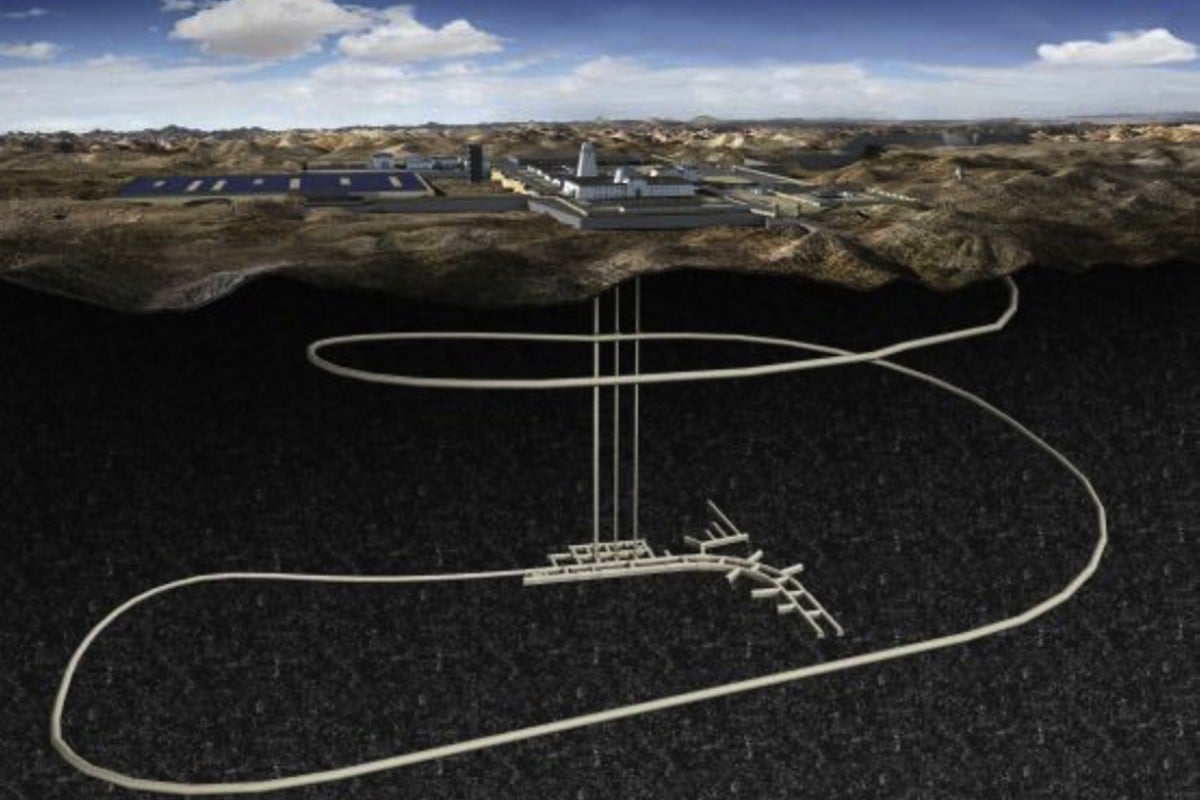
A preliminary design for the Beishan Underground Research Laboratory. Photo: Handout
China has chosen a site for an underground laboratory to research the disposal of highly radioactive waste, the country’s nuclear safety watchdog said on Wednesday.
Officials said work will soon begin on building the Beishan Underground Research Laboratory 400 metres underground in the northwestern province of Gansu.
Liu Hua, the head of the Chinese National Nuclear Safety Administration, said work would be carried out to determine whether it would be possible to build a repository for high-level nuclear waste deep underground.
“China sees radioactive waste disposal as a very important part [of the development nuclear energy],” said Liu. “To develop nuclear energy, we must have safe storage and disposal of nuclear waste.”
China condemns US blacklisting of nuclear firms and says American companies could be hurt as a result
The Chinese authorities see nuclear power an important source of energy that will help to curb carbon emissions and pollution as well as reducing its dependence on fuel imports.
But while the country has made great strides in the development of nuclear power, it needs to find a safe and reliable way of dealing with its growing stockpiles of nuclear waste.
Liu said the Gansu site had been identified as a possible location for a deep nuclear waste store after years of searching.
Once the laboratory is built, scientists and engineers will start experiments to confirm whether it will make a viable underground storage facility.
“Based on the data of the experiments, we can then decide if we are going to pick this as the final site,” he added.
China ‘actively promoting’ nuclear fuel processing plant with French Areva
Chinese officials usually stay tight-lipped about how nuclear waste is disposed of mainly because of fears that any discussion of the topic would trigger safety fears, although in recent years more efforts have been made to inform the public to win support.
Scientists say that nuclear waste can be divided into three categories depending on the level of radioactivity.
Low-level waste consists of minimally radioactive materials such as mop heads, rags, or protective clothing used in nuclear plants, while intermediate-level waste covers things such as filters and used reactor components.
High-level waste, however, is generated by the reprocessing of spent nuclear fuel and scientists generally agree that the safest way to dispose of it is to bury it deep underground in areas where the geology means it will have a minimal impact on the environment while it decays over thousands of years.
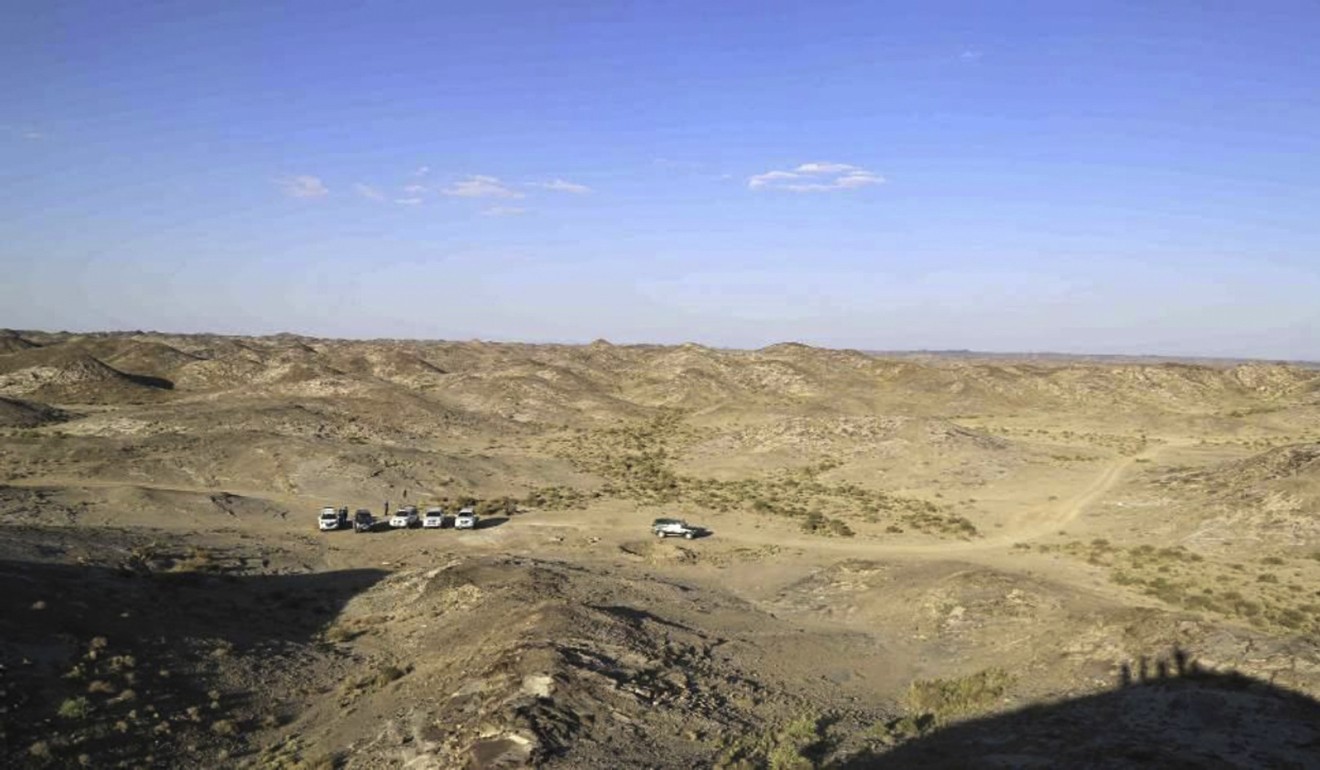
The facility will be built in a remote part of Gansu province. Photo: Handout
Some Chinese scientists said the country had the chance to lead the world in this area of research but others have expressed concerns about safety.
Jiang Kejun, a senior researcher at the Energy Research Institute of China’s National Development and Reform Commission, said that very few countries in the world are studying this form of nuclear waste disposal.
“It gives China an opportunity to be a leader in research in this area, plus China has the technology and financial means,” he said.
About a dozen countries including France, Switzerland, Japan, and the United States have carried out research in this area, but in recent years most have abandoned or scaled back their programmes.
At present there are storage sites operating in Finland and the US, but other countries such as Germany have abandoned plans to build similar facilities.
Washington blacklists Chinese nuclear firms for ‘helping military acquire US technology’
But despite broad scientific support for underground disposal, some analysts and many members of the public remain sceptical about whether it is really safe.
Lei Yian, an associate professor at the School of Physics at Peking University, said there was no absolute guarantee that the repositories would be safe when they are come into operation.
“Leakage has happened in [repositories] in the US and the former Soviet Union … it’s a difficult problem worldwide,” he said. “If China can solve it, then it will have solved a global problem.”
China is also building more facilities to dispose of low and intermediate level waste. Officials said new plants were being built in Zhenjiang, Fujian and Shandong, three coastal provinces that currently lack disposal facilities.
At present, two disposal sites for low and intermediate-level waste are in operation in Gansu and Guangdong provinces.
BEIJING, Aug. 25 (Xinhua) — The water quality of China’s major rivers, lakes and coastal waters is improving, while in general, the water ecology is not optimistic, an official report showed.
The report was made by an inspection team tasked with examining the enforcement of the water pollution prevention and control law, under the Standing Committee of the National People’s Congress, China’s top legislature.
From April to June, the law enforcement inspection team was divided into four groups and went to eight provinces, including Sichuan, Jiangsu, Hunan, Hebei, Guangdong, Anhui, Yunnan and Guizhou, to carry out law enforcement inspections.
The inspection groups visited 31 cities and carried out on-site inspections of 201 organizations, villages and projects.
At the same time, 23 other provincial-level regions were entrusted to carry out similar investigations to achieve full coverage of law enforcement inspections.
According to the report, in 2018, 71 percent of the national surface water sections were of good quality and the water quality of major rivers, lakes and coastal waters was stable and good.
However, the report also points out that inadequate law implementation is still prominent, and the overall situation of China’s water environment is not optimistic.
Scientists’ large-scale conversion of agricultural waste into fuel offers savings up to 60 per cent, they say
Discovery could slash military costs and bring civilian applications of hypersonic flight technology closer
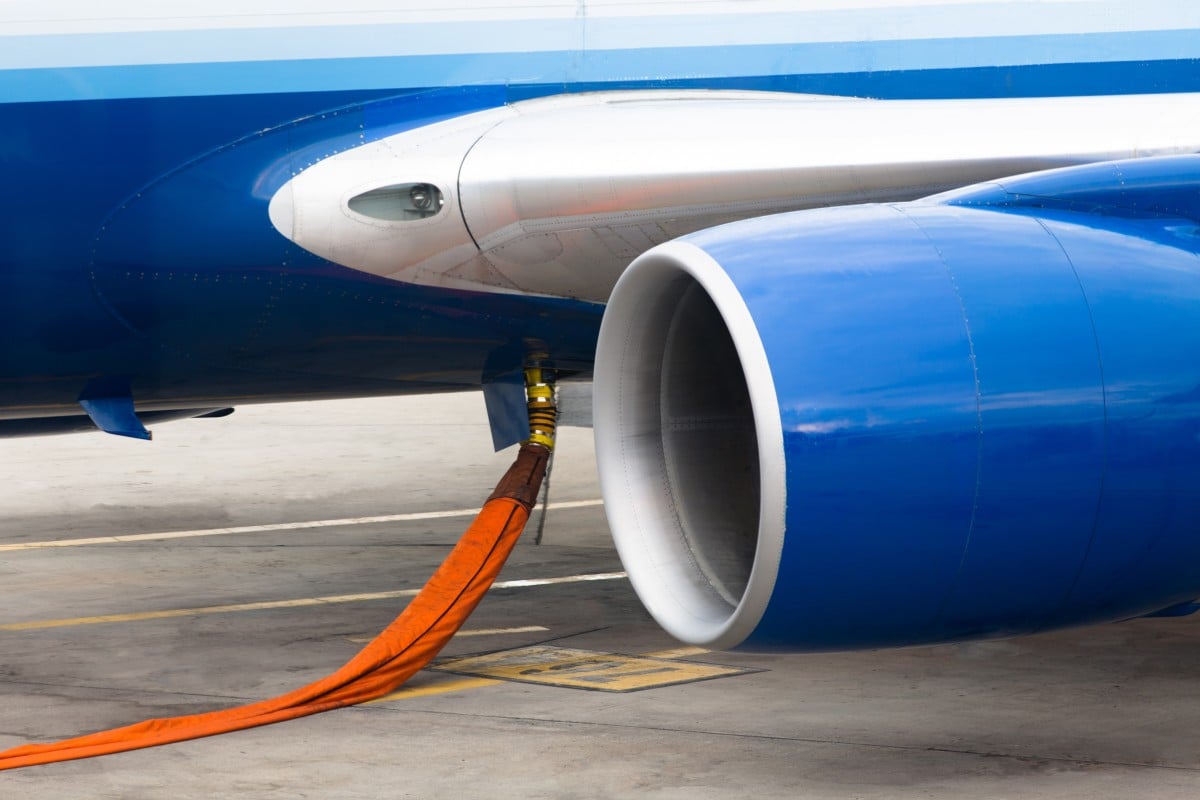
Super-fuel for military aircraft costs nearly 10 times as much as ordinary jet fuel for commercial planes. Photo: Shutterstock
Chinese scientists say they have developed a technology to convert bio-waste into fuel for missiles and hypersonic planes, reducing fuel costs by as much as 60 per cent.
The existing JP-10 super-fuel for military aircraft has numerous advantages including high energy density, good thermal stability and low freezing point, but it costs more than US$7,000 per tonne – nearly 10 times as much as ordinary jet fuel for commercial aircraft.
It is used mainly in cruise missiles and ramjet or scramjet engines on new-generation aircraft travelling at hypersonic speed, or five times faster than sound.
Scientists from the Dalian Institute of Chemical Physics, at the Chinese Academy of Sciences in the northeastern province of Liaoning, predicted using the new technology in the near future could reduce the cost to as low as US$2,547 per tonne.
The secret, according to their paper, published in the latest issue of German chemistry journal Angewandte Chemie, lies in cheap bio-waste.
Using agricultural and forestry residues including bran, chaff and mill dust, Professor Zhang Tao, Li Ning and colleagues discovered new chemical processes that can turn the waste to JP-10 fuel on a large scale with unprecedented efficiency.
At present, the super-fuel comes from coal tar or naphtha, and the synthesis is extremely costly and unfriendly to the environment.
The bio-JP-10 fuel can be produced by two different methods, one involving six steps of chemical reactions and the other only four, according to the paper.
China’s plan to make jet fuel from restaurant leftovers
Combining these methods with the latest technology in biomass conversion, the researchers said, the super-fuel can be mass-produced at a price equivalent to that of some of the bio-jet fuels already in commercial use, thanks to government subsidies provided for their environmental benefits.
“We believe that the future commercialisation of bio-JP-10 fuel is very promising, especially taking policy support and exemption from CO2 emission tax into consideration,” the authors wrote in the paper.
Liu Huoxing, professor at the school of energy and power engineering at Beijing University of Aeronautics and Astronautics, said civilian applications of hypersonic flight technology faced many challenges that remained to be solved, with the problem of high fuel prices being one of the headaches.
“No airline will buy a plane if the fuel costs too much, however fast it can fly,” he said.
Liu, who conducts research on engine technology forhypersonic vehicles but was not involved in the Dalian study, said the reduction of production costs for jet fuel was usually incremental and it was quite rare to see a significant drop.
“This can be an important development,” he said of the Dalian findings.
China is developing various models of hypersonic speed aircraft for military and civilian use. Some are aimed at flying distances such as Shanghai to Los Angeles in a couple of hours.
Image copyright GETTY IMAGESImage caption India wants to move to 30% electric cars by 2030
India is making a big push for electric vehicles, signalling a turning point in its clean energy policy, writes energy writer Vandana Gombar.
In 2017, Transport Minister Nitin Gadkari shocked the automobile industry (and the world) when he announced that he intended for India to move to 100% electric cars by 2030.
“I am going to do this, whether you like it or not. And I am not going to ask you. I will bulldoze it,” he said at an industry conference.
That was an ambitious target given that even the UK and France were hoping to phase out conventional combustion-engine cars only by 2040.
Mr Gadkari and his Bharatiya Janata Party or BJP-led government eventually diluted their plans for electric passenger cars – from 100% the target is now down to 30%.
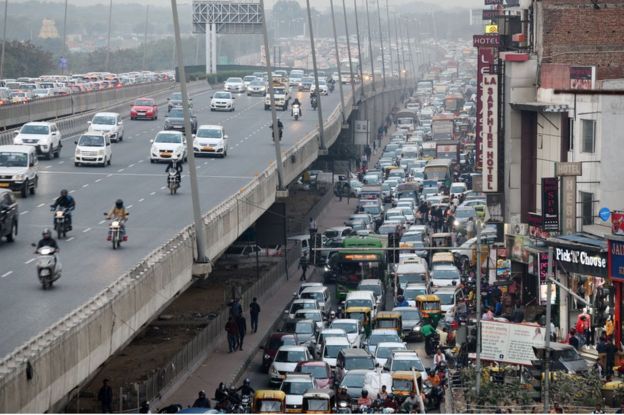
Image copyright GETTY IMAGESImage caption India has some of the world’s most polluted cities, including Delhi
A pushback by the industry and the fear of job losses were among the reasons for the government to do so.
The government has now decided to focus on the segment below cars: two-wheelers, where sales are much higher, and three-wheelers (largely auto-rickshaws).
In the financial year that ended in March, about 3.4 million passenger cars were sold in the country against 21.2 million two-wheelers, according to data released by Indian automobile manufacturers. The number of three-wheelers sold totalled 0.7 million.
The new proposal is to have only electric three-wheelers operating in the country by 2023, and only electric two-wheelers by 2025.
The government seems to have two dominant objectives – to control pollution and take the lead in an emerging industry.
Media caption How an electric car can make money
India wants to become a “global hub of manufacturing of electric vehicles”, Finance Minister Nirmala Sitharaman said in her budget speech earlier this month. The Economic Survey, a government forecast, released a day before the budget envisaged an Indian city possibly emerging as the “Detroit of electric vehicles” in the future.
But it will be a challenge to create a competitive advantage in electric vehicle manufacturing, or even a market for them, given that India does not have the infrastructure or deep pockets that the world’s current leader in electric mobility, China, has.
The American electric carmaker, Tesla, is setting up a manufacturing plant in Shanghai that is expected to be operational by the end of 2019.
India can perhaps learn a few lessons from China. The authorities there spurred sales partly by placing caps on the number of conventional combustion vehicles that can be sold in its most congested and polluted cities. Beijing has also limited the number of electric vehicles that can be sold. Further, car manufacturers now have to ensure that a specified share of their production is of so-called zero emission vehicles.
Another inspiration for India could be Norway, where electric vehicles accounted for half of last year’s total car sales. A phase-out of combustion vehicles in the country is planned by 2025.
Media caption Why is Norway the land of electric cars?
But there are many encouraging signs in India too.
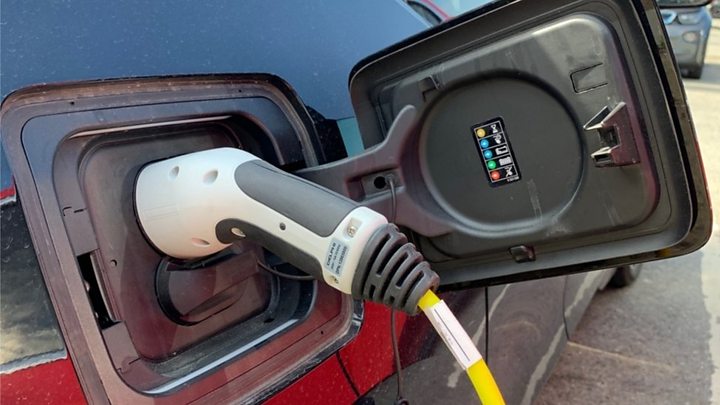
For one, charging stations are being built at government offices, malls and even within neighbourhoods. Government-owned power companies such as Bharat Heavy Electricals and Energy Efficiency Services plan to begin rolling out charging stations soon. The latter is looking at 10,000 stations over the next two years.
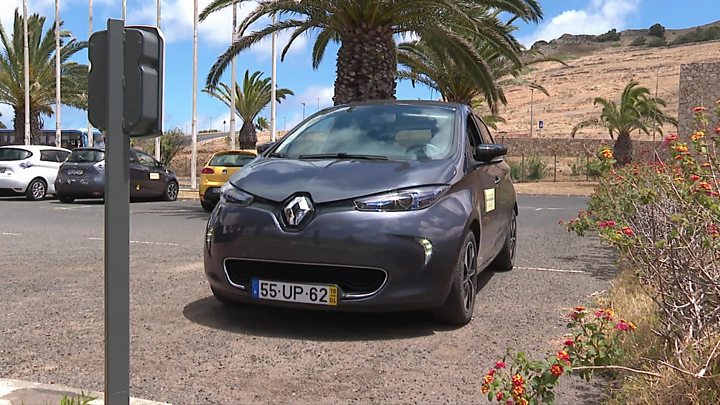
Second, electric vehicle models are proliferating. Hyundai launched its electric Kona car in India in July and Nissan is expected to launch its Leaf model soon. Indian carmakers Mahindra & Mahindra and Tata Motors both sell electric cars.
There are already several models of electric two-wheelers, and bike-sharing companies like Bounce are also going electric. Electric buses too can be spotted in many cities, partly fuelled by incentives. India’s capital, Delhi, is expected to have 1,000 electric buses running on its roads soon.
Even taxi-hailing apps and home delivery services have taken to ferrying parcels and passengers on electric bikes. After a pilot run with electric cabs, Indian ride-hailing giant Ola is now focussing on electric bikes and three-wheelers.
Instead of charging batteries, which could be a time-consuming task, it intends to opt for a battery swapping model where a fully charged battery would quickly replace the discharged one at swapping stations. Bounce too is experimenting with battery swaps.
Image copyright GETTY IMAGESImage caption India sold 3.4 million passenger cars this past financial year
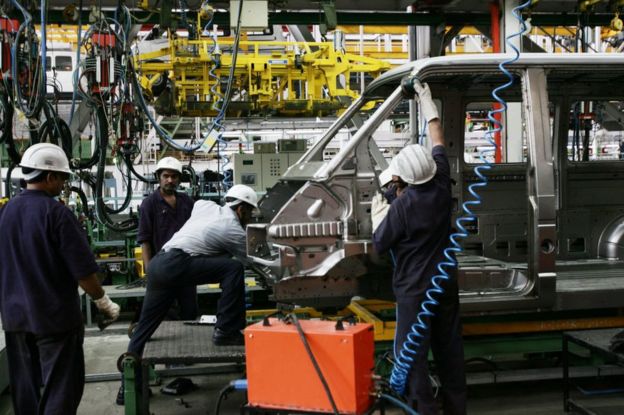
The government is also planning to offer incentives for manufacturing electric vehicles and batteries to boost economic growth and encourage local manufacturing under its Make in India initiative.
The falling cost of batteries could boost India’s electric mobility plans, and make it that much easier for electric vehicles to be competitive with those running on other fuels. And there is the added bonus of cleaner air.
That would push India towards electric mobility in its own unique style and at its own unique pace.
LHASA, July 6 (Xinhua) — Eighty buses using new energy have been put into use Saturday morning in Lhasa, the capital city of China’s southwest Tibet Autonomous Region, which will help reduce vehicle exhaust emissions and further improve the local air quality.
The new buses are all plug-in hybrid electric vehicles, equipped with Tibetan-Mandarin bilingual station announcements, driving monitoring and management systems, and auto-alarms, according to the city’s bus operation company.
The company purchased 110 new energy buses after the city’s 104 old buses reached their service lives. The other 30 buses are scheduled to be put into operation by the end of this month. By then, Lhasa will have 422 new energy buses, accounting for more than 80 percent of the city’s total buses.
“Our goal of vigorously promoting new energy vehicles is to implement the low-carbon and green way of traveling, to reduce greenhouse gas emissions, and to protect the clear water and blue sky of the snowy plateau,” said Gogyi, general manager of the company.
Lhasa plans to replace its old buses with new energy ones by batches, and all of the city’s buses are expected to be powered by new energy by 2021, said Gogyi.
Currently, Lhasa has 522 buses and 41 bus routes, covering the main urban areas, suburbs and surrounding counties, making it more and more convenient for locals to travel by public transportation.
Joyce Msuya of the UN Environment Programme is full of praise for Beijing’s success in tackling air pollution but says there is work still to be done
Commitment to environmental protection seen at home must be extended to infrastructure projects developed overseas, she says
Joyce Msuya, acting head of the UN Environment Programme, says bad infrastructure can have a negative environmental impact. Photo: Simon Song
The United Nations’ environment chief has appealed to China to apply the same environmental standards to infrastructure projects it develops overseas under its Belt and Road Initiative as it does to those built on its own soil.
“We know from history, bad infrastructure can lead to negative environmental impact,” said Joyce Msuya, acting executive director of the UN Environment Programme. “Given China’s record on and interest in environmental protection, we hope and expect they will apply the same spirit as they invest in developing countries.”
While acknowledging the value of infrastructure building in developing nations, Msuya said it was equally important to consider the environmental implications of
“We are interested in working with member countries that have been beneficiaries [of Chinese investment] to see what concerns, if any, what risks, if any, they see,” she said in an interview on the sidelines of an event in Hangzhou, capital of east China’s Zhejiang province, to mark World Environment Day, which fell on Wednesday.
Scores of countries are involved in Beijing’s multibillion-dollar belt and road plan in one way or another, but as it has expanded so too have the concerns over its environmental impact.
In late 2017, the WWF issued a report claiming that the development of two motorway projects in Myanmar would have a negative environmental impact on about half of its population.
China ‘facing uphill struggle’ in fight against pollution
On China’s efforts to tackle pollution at home, Msuya said that although the move towards a greener economy might require communities to make sacrifices in the short term, these would be outweighed by the long-term benefits.
China has been fighting a “war on pollution” since 2013 but as
have grown so too have concerns that industry unfriendly environmental efforts might be relegated to the back burner. The nation’s gross domestic product grew by just 6.6 per cent in 2018, its slowest rate since 1990, and for the past year it has been embroiled in a stinging trade war with the United States.
China has been fighting a “war on pollution” since 2013. Photo: Simon Song
Msuya said that while Beijing had done a good job in improving air quality, it still had some way to go on issues like water, soil and noise pollution.
“China is quite diverse, with many provinces … so the scale of the challenge of dealing with pollution is more complex,” she said. “[But] by building on its experience of cleaning the air, I have full confidence in the Chinese government.”
Pollution in northern China up 16 per cent in January as industrial activity spikes
According to a report issued by Beijing on Wednesday, average levels of PM2.5 – the tiny airborne particles that are particularly harmful to health – in more than 70 cities across
China fell by an average of 42 per cent in the five years through 2018.
Smog levels in the Chinese capital fell 43 per cent in the period, but the average reading in the city last year was still more than five times the World Health Organisation’s recommended safe level.
Air quality was the main theme of the Hangzhou event.
Msuya has first-hand experience of Beijing’s air quality having worked in the city as the World Bank Group’s regional coordinator for East Asia and the Pacific between 2011 and 2014.
“When I moved to Beijing in 2011, I honestly didn’t know how bad the air pollution was.
My son was six at the time and I always made sure he wore a mask when he went out to play,” she said.
“Fast forward to now, and China has shown us that the problem of air pollution can be tackled if everyone participates.”
Photo taken on June 20, 2019 shows scenery at Caohai National Nature Reserve in Weining County, southwest China’s Guizhou Province. Caohai Lake, a major wetland in southwest China and an important wintering place for black-necked cranes, has recovered its original size. The lake once shrank sharply due to pollution and farming practices. (Xinhua/Tao Liang)
Image copyright GETTY IMAGESImage caption Aarey forest is in Mumbai city
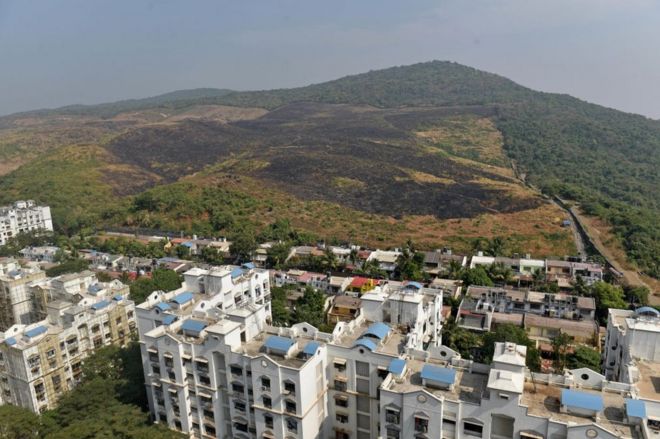
The Aarey forest, a verdant strip that lies at the heart of India’s bustling Mumbai city, is often referred to as its last green lung. But now, locals say, it’s under threat from encroachment. BBC Marathi’s Janhavee Moole reports.
As a child, Stalin Dayanand used to picnic in the Aarey forest.
“It was the only place where you could go and play, climb trees or just sit and eat under the shade of a tree and be close to nature,” says Stalin, who prefers to go by his first name.
Now the 54-year-old is the director of an NGO that works to protect forests and wetlands. He is fighting for Aarey.
On 6 June, the government cleared 40 hectares (99 acres) of the 1,300 hectare forest to build a zoo, complete with a night safari.
Another slice of it is being claimed by Mumbai’s new metro rail which is currently under construction. Thousands of trees will have to be felled to construct a new multi-level parking unit for the metro.
Media caption What happens if you ban plastic?
Stalin has petitioned India’s Supreme Court challenging the construction, but the case is still pending.
Locals and environmental activists like him are up in arms because they fear the government will eventually clear the way for private builders to encroach on the Sanjay Gandhi National Park, which lies to the north of Aarey. Spread over 104 sq km (40 sq miles), this protected area makes Mumbai one of the rare cities to have a jungle within its boundaries.
Their concern is partly fuelled by the fact that this is prime location in a city where land is scarce and real estate prices are among the most expensive in the world.
But officials dismiss these fears as unfounded and point out that the construction for the metro only requires 30 hectares of the 1,300 hectares that make up the Aarey forest.
“This is the most suitable land due to its size, shape and location,” says Ashwini Bhide, managing director of the Mumbai metro rail corporation.
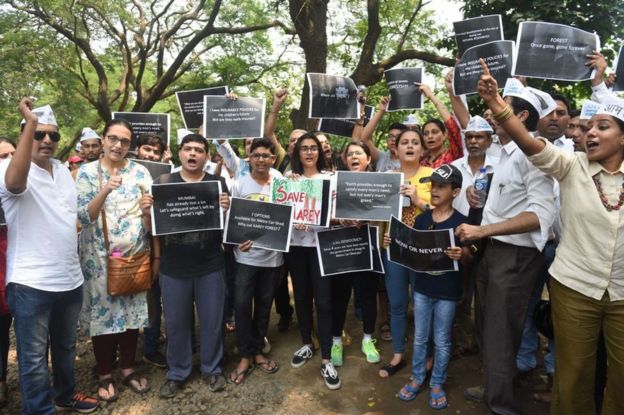
Image copyright GETTY IMAGESImage caption Plans to fell trees in the forest have led to protests
She adds that the city badly needs a “mass rapid transport system”. India’s financial hub is congested and infamous for its crawling traffic jams and its local train system heavily overburdened.
Officials say that the metro will eventually carry around 1.7 million passengers every day and bring down the number of vehicles on the road by up to 650,000. The city’s current colonial-era railway system, which is effectively its lifeline, ferries some 7.5 million people between Mumbai’s suburbs and its heart on a daily basis.
But they have been up against the city’s residents, including activists and conservationists, ever since news emerged in 2014 that trees would be cut to make way for the metro.
What makes the issue complicated is that the Aarey forest is the site of competing claims.
It’s locally known as the Aarey “milk colony” because most of the land was given to the department of dairy development in 1951. But they are allowed to grow cattle fodder only on a fraction of the land. The rest of it is densely forested and dotted with lakes, and the Mithi river flows through it.
Aarey is also home to tribal communities who live in settlements known as “padas”.
“We are not getting basic facilities here, and now metro authorities want to take away the jungle which belongs to us too,” says Asha Bhoye, who belongs to the Konkani tribe and lives in one of the 29 padas. Plans to relocate some of the tribal communities have also met with resistance and led to protests.
Stalin alleges that instead of declaring the Aarey forest a protected area, the state government has used the opportunity to parcel away pieces of it first to the dairy development department and now to other projects.
Image copyright GETTY IMAGESImage caption Tribals who live in Aarey demand that it be declared a protected area
“Aarey Forest is part of the same forest as Sanjay Gandhi National Park and we are fighting for the national park itself. In the name of public good, the land is being opened up for developers. It’s a systematic effort to destroy the forest.”
Activists fear that after the parking units are built, other projects will be permitted, further threatening the area’s ecology and wildlife, which includes leopards.
So locals have joined the fight enthusiastically, even leading hikes into the forest to raise awareness. “We bring people here, make them familiar with the forest – there are many species of spiders like trapdoor spiders, the site [of the parking unit] is a leopard site,” says Yash Marwa, a screenwriter who is among those campaigning for the forest.
“Mumbai needs to be liveable”, he adds. “We need to talk about good quality of air and life before talking about infrastructure and development.”
Stalin agrees, saying that “air quality and temperature seem to be last among people’s priorities.”
But he is determined to not give up.
“If I couldn’t do something for my city I’d consider I’ve failed myself.”
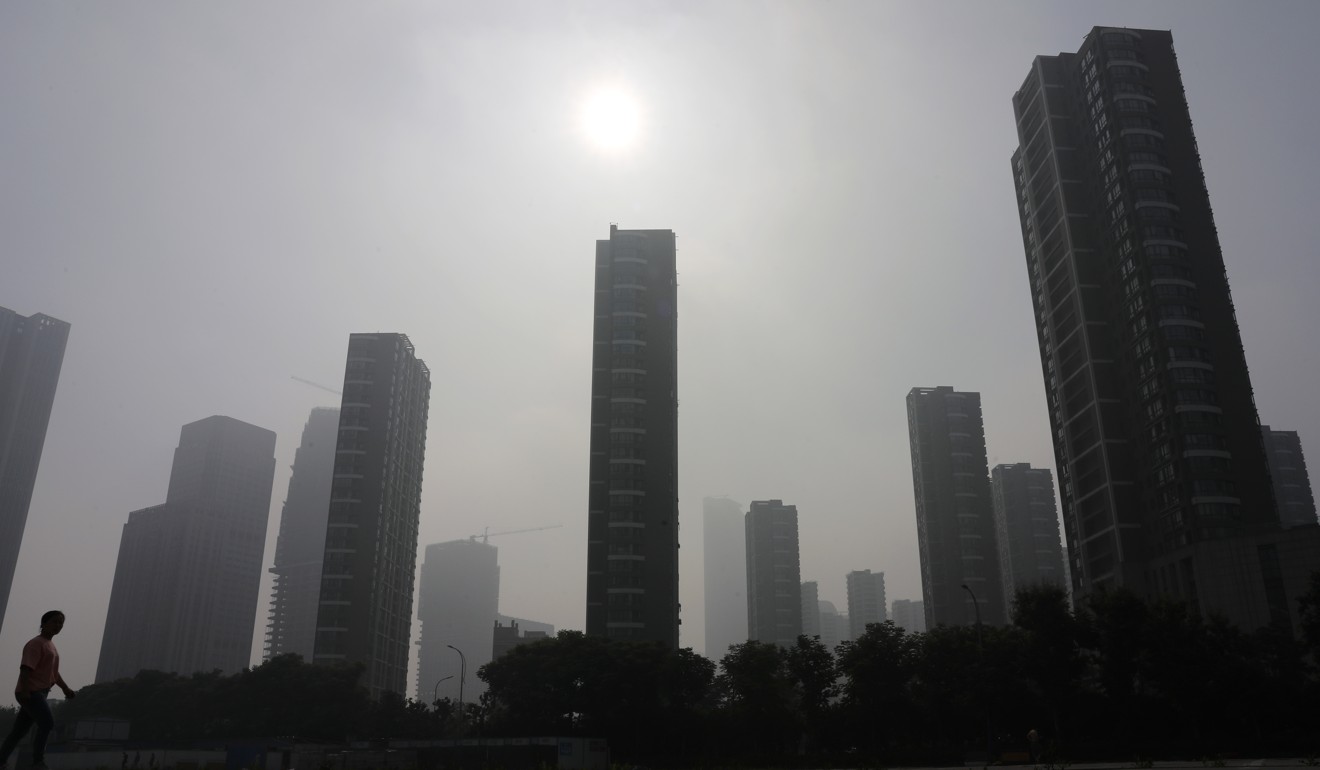
ANYANG/SANGPO, China (Reuters) – For years, China’s industrial heartland has been cloaked in smog, its waterways choked with pollution pumped from enormous clusters of factories churning out the mountains of cement and steel needed to build the Chinese economy.
Aiming to tackle what has become a huge public health problem, the authorities have cracked down on polluting industries, targeting provinces like Henan, which has a population of 100 million people and hundreds of factory towns.
According to interviews with factory and business owners, and consumers and workers across Henan, that crackdown – conducted with often heavy-handed local enforcement – is crippling the economies of towns and cities that depend on polluting industries.
Manufacturers across Henan have been particularly hard hit by the new environmental regulations, compounding the pressures the province faces from China’s slowing economy and a grinding trade war with the United States.
It also highlights the trade-off China faces between providing a healthier environment for its citizens and maintaining economic growth in a province whose climb from poverty has lagged that of coastal regions.
China does not provide statistics on the costs of the environmental crackdown, but it has said that short-term pain will lead to long-term growth through an economic “upgrade”.
The information office of the State Council, China’s cabinet, did not respond to a faxed request for comment on the economic effects of the new restrictions.
It’s difficult to get a full picture of Henan’s economy from unreliable official figures, as it is for the whole country. Henan’s official growth rate was 7.6% in 2018, higher than the national rate and down 0.2 of a percentage point from 2017.
But the interviews conducted by Reuters across Henan suggest consumers are spending less, cities are struggling to retool their economies and the pollution crackdown is hurting businesses and employment.
STEEL TOWN PAIN
The steel-producing centre of Anyang, which has long had some of the worst air in China, is one place that has been hit hard by the anti-pollution campaign.
The city of more than 5 million people, dominated by the infrastructure and insignia of the state-owned Anyang Iron and Steel Group, has forced local industry to upgrade equipment and curb pollution, and shut down companies that were unwilling or unable to comply.
Li Huifeng, president of Baoshun High-Tech Corporation, a coking coal company founded by his parents in 1983, said the cost of compliance had been painful.
Baoshun’s huge plant, built in the hills in the west of Anyang, was forced to implement production cuts last winter even though it had installed low-emissions equipment that exceeded required standards.
“Last year, business was really good but this year it is full of uncertainties,” said Li. He added that new efficiency guidelines were likely to result in the closure of many producers of coking coal, which is used in steel production.
Li Xianzhong, the owner of the Xinyuan Steel Mill in Anyang’s western outskirts, said he was facing curbs on production as well as spiralling costs because of the new environmental regulations.
According to industry estimates, environmental costs per tonne of steel produced have risen to around 150 yuan per tonne, up from less than 50 yuan per tonne when the war on pollution was launched in 2014.
“All this equipment needs a lot of capital, and after you’ve invested, the operation costs are also higher,” said Li. “If you don’t meet the standards, you aren’t allowed to operate.”
Near the sprawling Anyang steel plant in the city centre, residents and workers complained that the new environmental inspection rules had made it harder to make a living.
Many small workshops, which often use small metalworking furnaces, have also been targeted.
“Before we would just give them a pack of cigarettes or treat them to a meal and you’d then be fine for a year, but now it’s no use,” said a bicycle repairman, identifying himself by his surname Zhang, whose workshop near the plant was shut by inspectors.
Over the past years, Anyang has tried encouraging new and cleaner forms of economic growth. It has shut hundreds of small polluters in sectors like ceramics and cement, and tried to attract industries like solar panels and electric vehicles by offering incentives and building sprawling new industrial parks.
However, it has struggled to compete with numerous Chinese cities making similar bets, especially as China’s economy slows.
And the results of the anti-pollution efforts have been mixed.
Steel still accounts for more than half of Anyang’s economy – unchanged from a decade ago – and the environment is still bad. The taste of brimstone hangs in the air, and the fairy lights festooned on hundreds of cranes on the city’s skyline could only be dimly seen during a recent visit.
Part of the problem, according to Liu Bingjiang, who heads the Ministry of Ecology and Environment’s air pollution office, is that smog is also blowing in from neighbouring industrial regions, undermining local cleanup efforts.
“All these measures, all these plans are in place, but it still can’t solve the smog,” said Li, the steel mill owner.
SHUTTING DOWN THE BOOTMAKERS
The anti-pollution campaign is also hitting much smaller industrial centres.
Sangpo, a dusty two-street village in northeast Henan, used to live off scores of sheepskin processing factories cranking out winter boots modelled on UGG, the American brand with Australian roots.
While the industry was the main employer in the village, that came with a heavy environmental cost: treating the raw sheepskin consumed copious amounts of water and contaminated the local water supply.
Last July, the government moved to close most of the factories, sending dozens of police cars into Sangpo with sirens wailing to enforce the shutdown.
Government inspectors were installed to keep watch at each factory to ensure compliance with the order. Three factory owners were arrested for violating environmental regulations.
During a visit to Sangpo by Reuters, most factories were idle during what should have been peak production season. Hundreds of workers had left town in search of work elsewhere, leaving behind shuttered shopfronts and deserted roads.
“The village is at a tipping point,” said a former factory owner who only wanted to be identified by his surname, Ding. Most businesses were mostly “more dead than alive,” he added.
Before the factories were shut, the village of 6,500 people, mainly from the Hui Muslim minority, had been punching well above its weight.
It achieved national recognition as a thriving model of e-commerce, winning glowing write-ups in national newspapers after it was named in 2015 by the tech giant Alibaba as central China’s very first “Taobao village” – a designation for top rural sellers on the company’s internet retailing platform.
But that all changed last year as China’s pollution crackdown intensified. The top county-level official, factory owners said, held a town hall meeting and threatened to shut everyone down permanently. A deal was made for 19 of the 135 factories to remain.
Those wanting to stay open agreed to upgrade their businesses and invest in equipment to ensure they met water treatment standards. Factories that opted out were shut, their boilers and processing equipment destroyed.
The government of Mengzhou, which oversees Sangpo, declined to comment when reached by phone. But Mengzhou’s mayor said last year that the crackdown was necessary and in accordance with the popular will, according to a statement on the Mengzhou government website.
Sangpo village’s party chief declined to comment when reached via the Chinese messaging app WeChat. Calls to his cellphone went unanswered.
The county government’s plan is to corral remaining factories into a new industrial zone by the end of the year. But remaining business owners are worried about the slow pace of construction and fear they will be forced to shut.
Ding, the former factory owner, said business owners didn’t expect the crackdown – which has also discouraged lending from banks – to be so harsh.
“Everyone in the village was moaning and sighing but no one thought it would be this extreme,” Ding said. “We are at our wits’ end.”
Foreign lifestyle experiences are becoming more popular as citizens seek to escape pollution, food and medicine safety worries and authoritarian government controls
Citizens encountering more barriers to their dreams of travelling abroad, with severe limits on moving money overseas and restrictions on visiting foreign countries
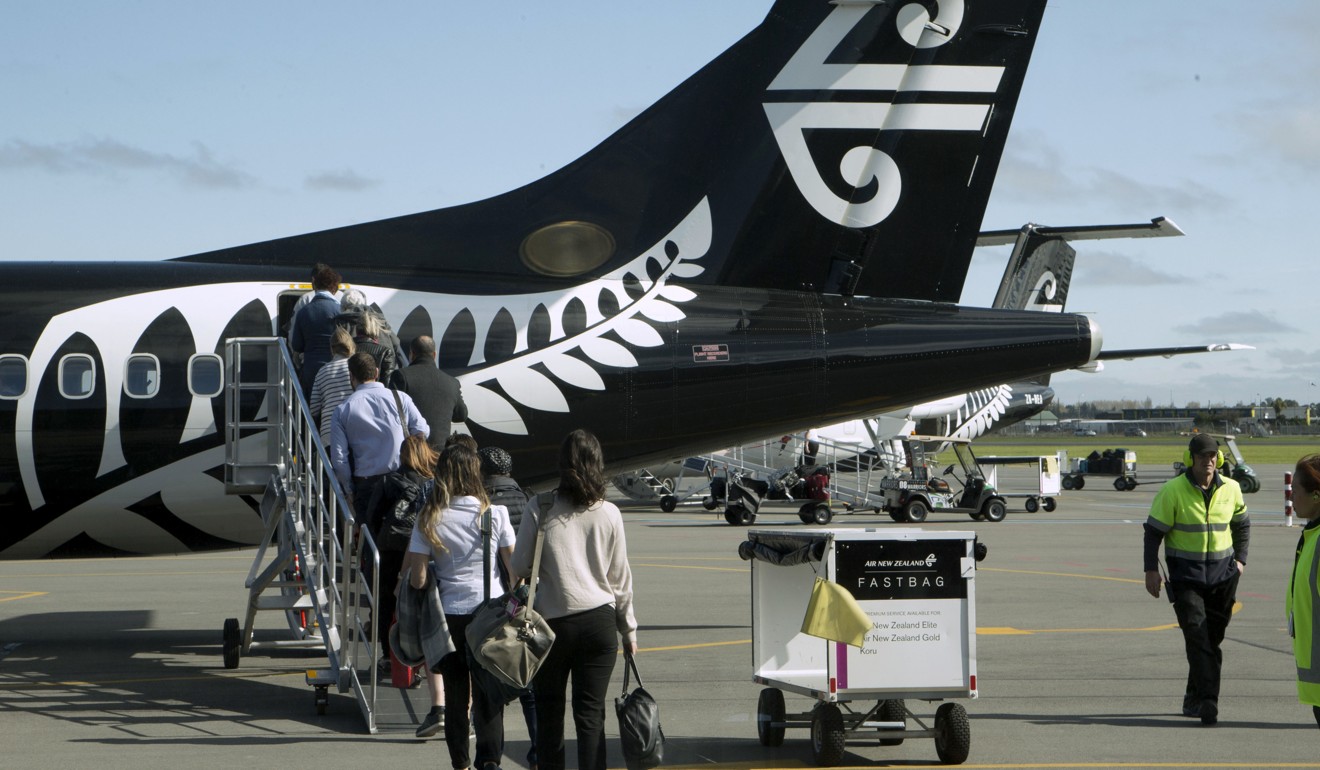
Thailand, including the likes of Chiang Mai, the United States, Australia, Canada, New Zealand are popular destinations for Chinese families. Photo: Shutteratock
Xu Zhangle and her husband and their two children are a typical middle-class couple from Shenzhen, and along with 60 other Chinese families, they are going on an extended holiday to Thailand in July, where they hope to enjoy an immigrant-like life experience.
The family have paid a travel agent around 50,000 yuan (US$7,473) for the stay in Chiang Mai in the mountainous north of the country, including transport, a three-week summer camp for their daughters at a local international school, rent for a serviced apartment and daily expenses.
Zhangle loves Chiang Mai’s relaxed lifestyle and easy atmosphere and wants to live as a local for a month or even longer, instead of having to rush through a short-term holiday.
“It would not be just [tourist] travelling but rather a life away from the mainland.” she said.
Recently, upper middle-class citizens have increased their efforts to safeguard their wealth and achieve more freedom by spending more time abroad.
They have invested considerable amounts of money in overseas properties and applied for long-stay visas, although many of their attempts have ended in failure.
Chinese citizens are encountering more barriers to their dreams of travelling abroad, with severe limits on moving money overseas and restrictions on visiting foreign countries.
Still, growing anxieties about air pollution, food and medicine safety and an increasingly authoritarian political climate are pushing middle class families to look for new ways to circumvent the obstacles so they can live outside China.
Among the options, there is growing demand for sojourns abroad of a month or more, to enjoy a foreign lifestyle for a brief period to make up for the fact that their emigration dreams may have stalled.
“I think this is becoming a trend. Chinese middle-class families are facing increasing difficulties to emigrate and own homes overseas. On the other hand, they still yearn for more freedom, for a better quality of life than what is found in first-tier cities in China.
They are eager to seek alternatives to give themselves and their children a global lifestyle,” said Cai Mingdong, founder of Zhejiang Newway, an online tour and education operator in Ningbo, south of Shanghai.
“First, the availability of multiple-entry tourist visas and the sharp drop in air ticket prices have made it convenient and practical to stay abroad for from a few weeks to up to three months each year.”
Blacklist labels millions of Chinese citizens and businesses untrustworthy
Now, many well-to-do Chinese middle class families can get a tourist visa for five or even 10 years that allows them to stay in a number of countries — including the United States, Australia, Canada, New Zealand and other Asian countries — for up to six months at a time.
“In 2011, a round-trip air ticket from Shanghai to New Zealand cost 14,000 yuan (US$2,000), but now is about 4,000 (US$598),” added Cai.
This opens up the possibility for many middle-class families who are not eligible to emigrate, to live abroad for short periods of time.
Many wealthy Chinese middle class families can get a tourist visa for five or even 10 years that allows them to stay in several countries including the United States, Australia, Canada, New Zealand and other Asian countries, for up to six months at a time. Photo: AP
Chinese tourists made more than 140 million trips outside the country in 2018, a 13.5 per cent increase from the previous year, spending an estimated US$120 billion, according to the China Tourism Academy, an official research institute under the Ministry of Culture and Tourism.
“In [the Thai cities of] Bangkok and Chiang Mai, there are more and more Chinese who stay there to experience the local lifestyle, which is different from theirs in China. The life there is very different from that in China,” said Owen Zhu, who now lives in the Bangkok condo he bought last year.
“The freedom, culture and community are diversified. The quality of air, food and services are much higher than in first-tier cities in China, but the prices are more affordable.
“In Bangkok, in many international apartment complexes where foreigners live, the monthly rent for a one-bedroom [apartment] is about 2,000 (US$298) to 3,000 yuan.”
China’s richest regions are also home to the most blacklisted firms
A one-bedroom apartment in Shenzhen in southern China is twice as expensive, with rents continuing to rise rapidly.
There are global goods, and it is easy to socialise with different people from around the world,” Zhu added
“Many Chinese people around me, really, come to Thailand to live for a while and go back to China, but then come back again after a few months.”
Both Cai and Zhu said they discovered the new phenomenon among China’s middle class and decided it was a business opportunity.
Growing anxieties about air pollution, food and medicine safety and an increasingly authoritarian political climate are pushing middle class families to look for new ways to circumvent the obstacles so they can live outside China. Photo: AP
Zhu is in the process of registering a company in Bangkok and plans to build an online platform to service the needs of Chinese citizens living abroad who do not own property or have immigration status, especially members of the LGBT community.
Cai said dozens of Chinese families in the Yangtze River Delta had paid him to send their children to schools in New Zealand or Europe for around three or four weeks in the middle of the school year, while the parents rent villas in the area, with New Zealand and Toronto in Canada among the most popular destinations.
Last year, Zheng Feng, a single mother and freelance writer from Beijing, rented a small villa in Australia for a month for them, a friend and their children to escape Beijing’s pollution and experience life overseas.
“To be honest, I don’t have enough money to invest in a property or a green card in Australia. But it’s very affordable for me and my son to pay about 30,000 yuan (US$4,484) to live abroad for one or two months.” Zheng said.
China says 2018 growth was worth more than Australia’s whole GDP
Zheng will join the Xu family in Chiang Mai later this year and she is also planning a similar trip to England next year.
Zheng’s friend, Alice Yu, invested in an American EB-5 investor visa a few years ago, and plans to make one or two month-long trips abroad each year until her family is finally able to move to the United States.
Demand for the EB-5 investor visa in China seems to be waning given heightened uncertainty about the future of the programme and US immigration law in general under US President Donald Trump.
Approval for the visa can now take up to 10 years, resulting in a huge backlog that has further dampened interest and led to a significant dip in investment inflows into the US from foreign individuals.
A one-bedroom apartment in Bangkok can cost around bout 2,000 (US$298) to 3,000 yuan a month. Photo: AFP
“Maybe it will soon become standard for a real Chinese middle-class family to have the time and money to enjoy a long stay at a countryside villa overseas,” said Yu.
“Regardless of whether we can get a long-term visa for the United States, I want my children grow up in a global lifestyle and with more freedom than just growing up on the mainland. So do all wealthy and middle class Chinese families, I think.”
Karen Gao’s son started studying at an international school in Chiang Mai in June, at the cost of about 70,000 yuan (US$10,462) a year, after she quit her job as a public relations manager in Shenzhen and moved to Thailand on a tourist visa.
For better or worse? China’s complicated employment explained
“A few months each year for good air, good food and no censorship and internet control, but cheaper living costs compared to Beijing, it sounds like a really good deal to go,” said Gao, who has now been offered a guardian visa to accompany her son, who has already been given a student visa.
“In Shenzhen, I wasn’t able to get him into school because I had no [local] residence permit.
“It would be the best choice for us because we feel so uncertain and worried about investing and living in the mainland.”
Last year, Gao, like thousands of other private investors mostly middle class people living in first-tier cities, suffered significant losses when their investments in hotels and inns in Dali, Yunnan province, were demolished amid the local government’s campaign to curb pollution and improve the environment around Lake Erhai.
“We were robbed by the officials without proper compensation,” Gao said.







 CHINDIA ALERT: You'll be living in their world, very soon