Archive for ‘Economics’

19/06/2019

Viewpoint: How the British reshaped India’s caste system

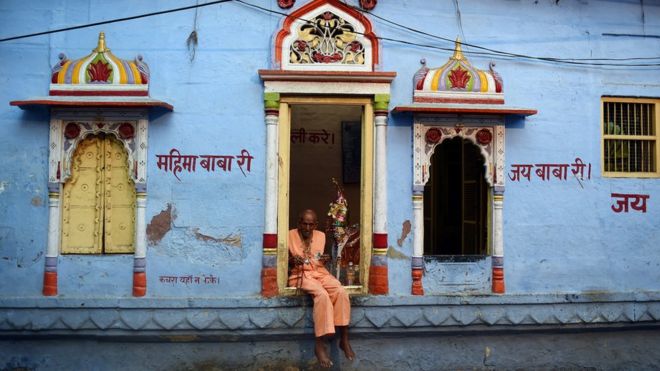
A priest sits in front of a Hindu templeImage copyright AFP

A Google search for basic information on India’s caste system lists many sites that, with varying degrees of emphasis, outline three popular tropes on the phenomenon.

First, the caste system is a four-fold categorical hierarchy of the Hindu religion – with Brahmins (priests/teachers) on top, followed, in order, by Kshatriyas (rulers/warriors), Vaishyas (farmers/traders/merchants), and Shudras (labourers). In addition, there is a fifth group of “Outcastes” (people who do unclean work and are outside the four-fold system).

Second, this system is ordained by Hinduism’s sacred texts (notably the supposed source of Hindu law, the Manusmriti), it is thousands of years old, and it governed all key aspects of life, including marriage, occupation and location.

Third, caste-based discrimination is illegal now and there are policies instead for caste-based affirmative action (or positive discrimination).

These ideas, even seen in a BBC explainer, represent the conventional wisdom. The problem is that the conventional wisdom has not been updated with critical scholarly findings.

The first two statements may as well have been written 200 years ago, at the beginning of the 19th Century, which is when these “facts” about Indian society were being made up by the British colonial authorities.

In a new book, The Truth About Us: The Politics of Information from Manu to Modi, I show how the social categories of religion and caste as they are perceived in modern-day India were developed during the British colonial rule, at a time when information was scarce and the coloniser’s power over information was absolute.
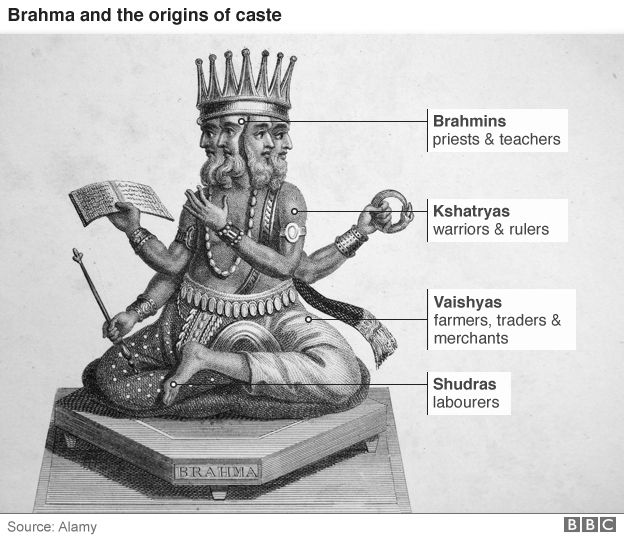
graphic
Image caption Conventional wisdom says the caste system is a four-fold categorical hierarchy of the Hindu religion

This was done initially in the early 19th Century by elevating selected and convenient Brahman-Sanskrit texts like the Manusmriti to canonical status; the supposed origin of caste in the Rig Veda (most ancient religious text) was most likely added retroactively, after it was translated to English decades later.

These categories were institutionalised in the mid to late 19th Century through the census. These were acts of convenience and simplification.

The colonisers established the acceptable list of indigenous religions in India – Hinduism, Sikhism, Jainism – and their boundaries and laws through “reading” what they claimed were India’s definitive texts.

The so-called four-fold hierarchy was also derived from the same Brahman texts. This system of categorisation was also textual or theoretical; it existed only in scrolls and had no relationship with the reality on the ground.

This became embarrassingly obvious from the first censuses in the late 1860s. The plan then was to fit all of the “Hindu” population into these four categories. But the bewildering variety of responses on caste identity from the population became impossible to fit neatly into colonial or Brahman theory.
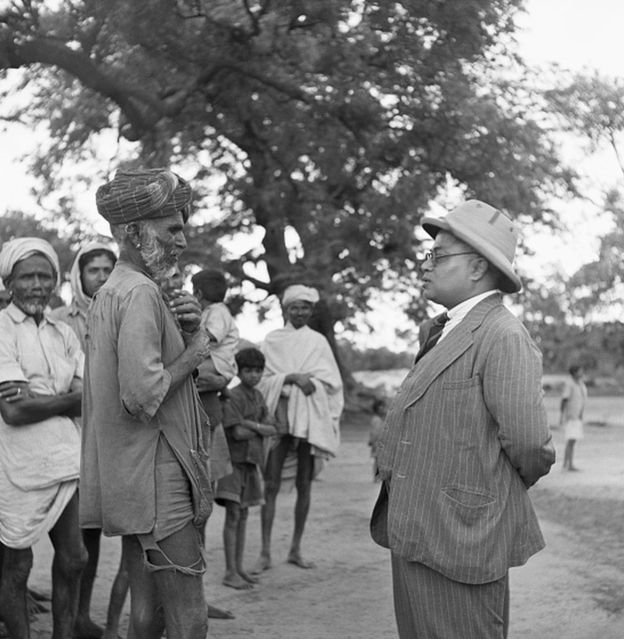
A leader of those formerly considered untouchable discusses a food shortage with a government official. Bengal Province, British India. | Location: Bengal Province, British IndiaImage copyright GETTY IMAGES
Image caption A leader of those formerly considered untouchable with a government official in British India

WR Cornish, who supervised census operations in the Madras Presidency in 1871, wrote that “… regarding the origin of caste we can place no reliance upon the statements made in the Hindu sacred writings. Whether there was ever a period in which the Hindus were composed of four classes is exceedingly doubtful”.

Similarly, CF Magrath, leader and author of a monograph on the 1871 Bihar census, wrote, “that the now meaningless division into the four castes alleged to have been made by Manu should be put aside”.

Anthropologist Susan Bayly writes that “until well into the colonial period, much of the subcontinent was still populated by people for whom the formal distinctions of caste were of only limited importance, even in parts of the so-called Hindu heartland… The institutions and beliefs which are now often described as the elements of traditional caste were only just taking shape as recently as the early 18th Century”.

In fact, it is doubtful that caste had much significance or virulence in society before the British made it India’s defining social feature.

Astonishing diversity

The pre-colonial written record in royal court documents and traveller accounts studied by professional historians and philologists like Nicholas Dirks, GS Ghurye, Richard Eaton, David Shulman and Cynthia Talbot show little or no mention of caste.

Social identities were constantly malleable. “Slaves” and “menials” and “merchants” became kings; farmers became soldiers, and soldiers became farmers; one’s social identity could be changed as easily as moving from one village to another; there is little evidence of systematic and widespread caste oppression or mass conversion to Islam as a result of it.

All the available evidence calls for a fundamental re-imagination of social identity in pre-colonial India.

The picture that one should see is of astonishing diversity. What the colonisers did through their reading of the “sacred” texts and the institution of the census was to try to frame all of that diversity through alien categorical systems of religion, race, caste and tribe. The census was used to simplify – categorise and define – what was barely understood by the colonisers using a convenient ideology and absurd (and shifting) methodology.
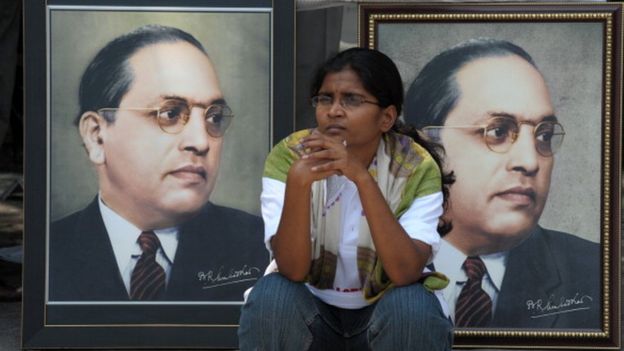
n Indian woman sits infront of portraits of Bhimrao Ramji Ambedkar during 122nd birth anniversary celebrations for Ambedkar in Hyderabad on April 14, 2012.Image copyright AFP
Image caption India’s constitution was written by BR Ambedkar, a member of the Dalit community which is at the bottom of the caste system

The colonisers invented or constructed Indian social identities using categories of convenience during a period that covered roughly the 19th Century.

This was done to serve the British Indian government’s own interests – primarily to create a single society with a common law that could be easily governed.

A very large, complex and regionally diverse system of faiths and social identities was simplified to a degree that probably has no parallel in world history, entirely new categories and hierarchies were created, incompatible or mismatched parts were stuffed together, new boundaries were created, and flexible boundaries hardened.
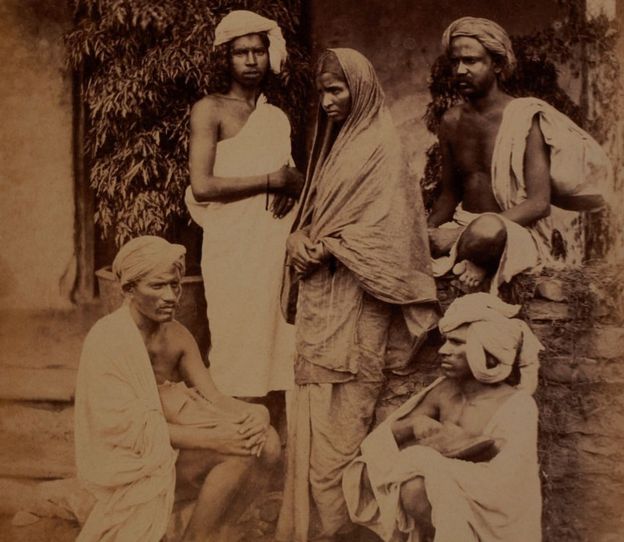
Group of Untouchables, India, circa 1890Image copyright GETTY IMAGES
Image caption Dalits, or untouchables, were at the bottom of the caste system

The resulting categorical system became rigid during the next century and quarter, as the made-up categories came to be associated with real rights. Religion-based electorates in British India and caste-based reservations in independent India made amorphous categories concrete. There came to be real and material consequences of belonging to one category (like Jain or Scheduled Caste) instead of another. Categorisation, as it turned out in India, was destiny.

The vast scholarship of the last few decades allows us to make a strong case that the British colonisers wrote the first and defining draft of Indian history.

So deeply inscribed is this draft in the public imagination that it is now accepted as the truth. It is imperative that we begin to question these imagined truths.

Source: The BBC
17/06/2019

India magician disappears in river after Houdini trick

Chanchal LahiriImage copyright EI SAMAY
Image caption Chanchal Lahiri went by the stage name Mandrake

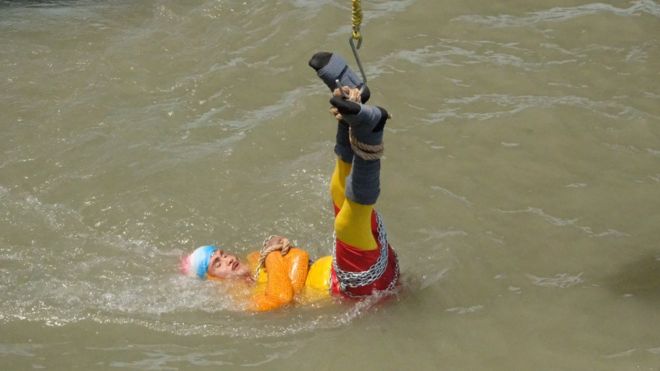
An Indian magician, who attempted to recreate Harry Houdini’s famed trick by jumping shackled into a river, is feared dead.

Chanchal Lahiri was meant to escape and swim to safety but did not emerge from the Hooghly river in West Bengal state.

Spectators who had gathered to watch him take the plunge on Sunday informed the police, who say they are searching for him.

Mr Lahiri, also known as Mandrake, was lowered into the river from a boat.

He was shackled with six locks and a chain as spectators on two boats watched him. Several people had also gathered by the shore and some stood on the landmark Howrah Bridge in Kolkata (formerly Calcutta).

Police and a team of divers canvassed the area but as of Sunday evening local time, they had been unable to find the magician. One officer told the Hindustan Times newspaper that Mr Lahiri could not be declared dead until the body was found.

Jayant Shaw, a photographer with a local newspaper, witnessed Mr Lahiri attempting the trick. He told the BBC that he spoke to him before the magician started his act.

“I asked him why he risked his life for magic,” Mr Shaw said. “He [Mr Lahiri] smiled and said, ‘If I do it right, it’s magic. If I make a mistake, it becomes tragic.'”

The magician told him that he wanted to do this trick in order “to revive interest in magic”.

This is not the first time that Mr Lahiri had attempted a risky underwater trick.

He was lowered into the same river inside a glass box more than 20 years ago but had managed to escape to safety.

Mr Shaw had also witnessed Mr Lahiri’s previous underwater trick.

“I never thought he would not come out of the water this time,” he said.

Source: The BBC
15/06/2019

Chinese, Turkish presidents vow to promote bilateral cooperation

TAJIKISTAN-DUSHANBE-XI JINPING-TURKISH PRESIDENT-MEETING

Chinese President Xi Jinping (R) meets with his Turkish counterpart Recep Tayyip Erdogan in Dushanbe, Tajikistan, June 15, 2019. (Xinhua/Wang Ye)

DUSHANBE, June 15 (Xinhua) — Chinese President Xi Jinping met his Turkish counterpart, Recep Tayyip Erdogan, here on Saturday, agreeing to promote bilateral cooperation on the sidelines of the fifth summit of the Conference on Interaction and Confidence Building Measures in Asia.

Xi said that he highly values China-Turkey relations and is willing to work with Erdogan to translate bilateral friendship into mutual trust, and constantly open new chapters in promoting the China-Turkey strategic cooperative relationship.

China and Turkey should give each other firm support on issues that touch their respective core interests and major concerns, and step up the anti-terrorism cooperation, Xi said.

Calling Turkey a traditional Silk Road country, Xi said that China stands ready to enhance their mutually beneficial cooperation within the Belt and Road framework.

The Chinese president also called on the two countries, both important members of the Group of 20 (G20), to strengthen their communication and coordination on multilateral arenas such as the G20.

Agreeing with Xi, Erdogan said that Turkey attaches great importance to relations with China, adding that Turkey is willing to strengthen high-level exchanges between the two countries and expand their cooperation in economy, trade, finance, infrastructure construction and other fields.

The Belt and Road Initiative is very important to Turkey, he said, adding that his country is willing to actively participate in its joint construction and cooperation.

Source: Xinhua

13/06/2019

Chinese tour guide barred after forced shopping trip in scenic Guilin

  • Visit to beauty spot spoiled as tourists ordered off the bus to spend, spend, spend
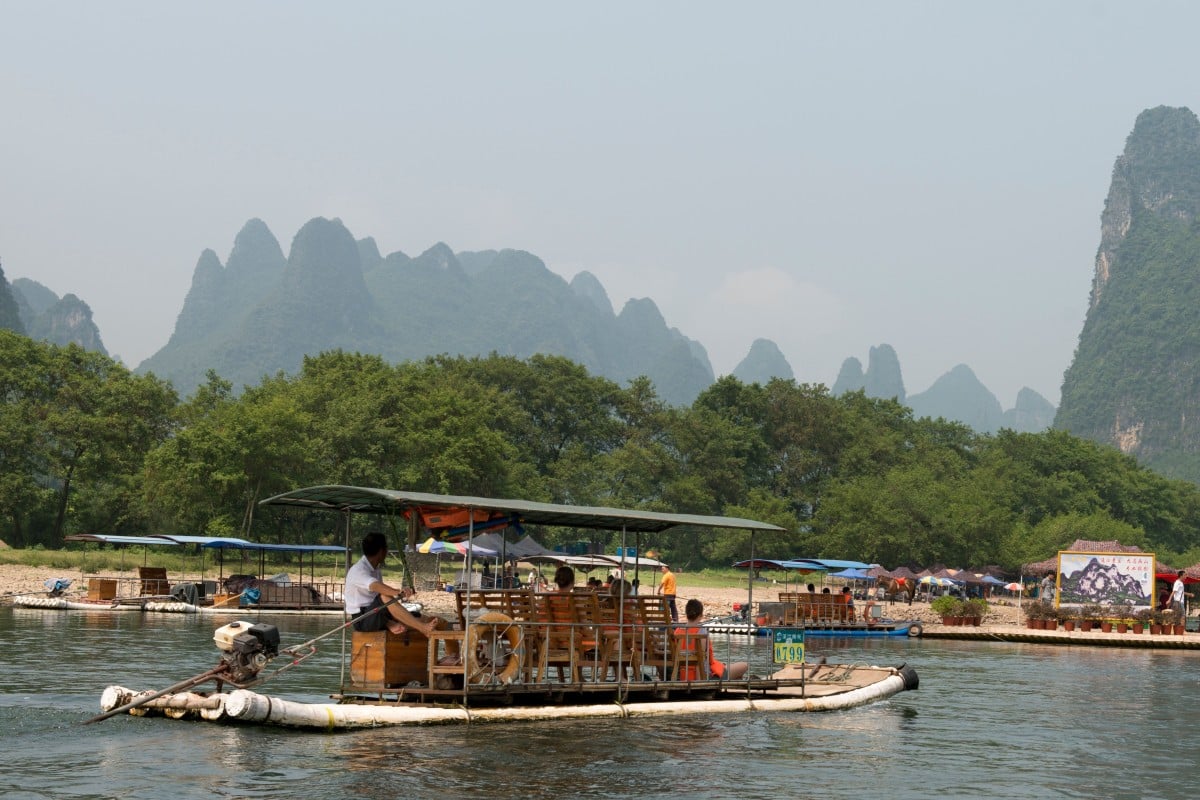
Guilin is renowned for its scenic cruises along the Li River, through magnificent karst mountains. But one tour group was forced on an unexpected shopping trip. Photo: Alamy
A tour guide in the scenic city of Guilin in southern China has been stripped of her licence after forcing tourists to spend at least 20,000 yuan (US$2,900) in local shops.
The tour guide, surnamed Zhao, was captured on video telling her customers they had an hour to spend the money and she would accept no excuses.
The short clip, which has been circulating widely on Chinese social media this week, was filmed on June 1, according to online news portal QQ.com.
“You might have thousands of reasons to refuse me, such as you already have this stuff at home,” Zhao said in the video. “I don’t care why you have come to Guilin. Now you have chosen this group … get off the bus and spend 20,000 yuan [in] an hour.”
Tiffany loses its shine with Chinese tourists as US sales fall 25 per cent
Some of the tourists can be heard on the video murmuring “how can it be like this?”

The 55 members of the tour group, from Hunan province in central China, had travelled to Guilin in the Guangxi Zhuang autonomous region from May 30 to June 2. According to their itinerary, they were supposed to visit three shops on the day the incident happened, but instead visited six, the QQ.com report said.

One of the tourists bought more than 10 quilts, at more than 4,000 yuan each.Guilin is among China’s most popular tourism destinations, famous for its boat cruises on the Li River, which winds through beautiful karst mountains along its banks.

The Guilin tourism bureau said on Tuesday it had ordered Zhao to apologise to the group, and had revoked her tour guide licence.

In its statement on microblogging platform Weibo, the authority also said it was investigating her employer.

Ferrying tourists along China’s Yellow River

Tour guides are banned from forcing tourists to shop or join programmes charging extra fees. A State Council regulation issued two years ago set a 10,000-50,000 yuan penalty for individuals violating the rule, and a further 100,000-500,000 yuan fine for their tour company.

Despite the crackdown in recent years, it is not uncommon for Chinese tourists to be coerced by tour guides into extra spending during their trips. China’s authorities have repeatedly reminded the public to be wary of companies that lure potential tourists with extremely low group fees.

In July last year, a group of 300 elderly people, from the central province of Henan, were reportedly forced to buy jewellery from a shop in Hong Kong. The tour agency charged them just 380 yuan for the whole package and promised there would be no forced shopping activity, according to Henan TV.

But, despite the assurance, they were taken to a jewellery shop where their tour guide told them, “Henan people, spend some money to earn face for your Henan folks.”

Those who did not spend as they were urged had to wait in the shop for hours and were cursed by the tour guide, according to the television report. It is not clear if the tour guide or the agency received any penalty.

Source: SCMP

11/06/2019

Aarey forest: The fight to save Mumbai’s last ‘green lung’

Aarey ForestImage copyright GETTY IMAGES
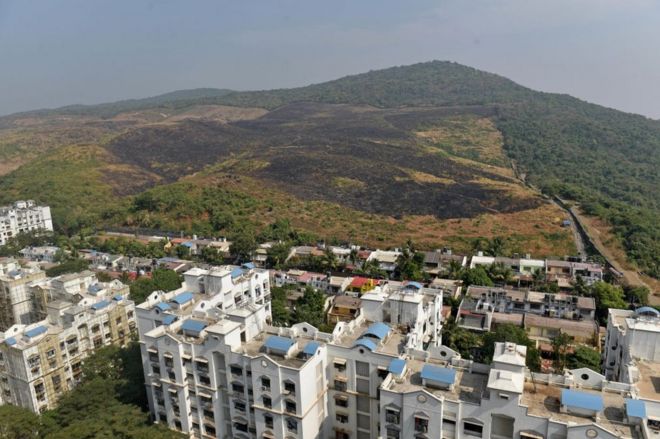
Image caption Aarey forest is in Mumbai city

The Aarey forest, a verdant strip that lies at the heart of India’s bustling Mumbai city, is often referred to as its last green lung. But now, locals say, it’s under threat from encroachment. BBC Marathi’s Janhavee Moole reports.

As a child, Stalin Dayanand used to picnic in the Aarey forest.

“It was the only place where you could go and play, climb trees or just sit and eat under the shade of a tree and be close to nature,” says Stalin, who prefers to go by his first name.

Now the 54-year-old is the director of an NGO that works to protect forests and wetlands. He is fighting for Aarey.

On 6 June, the government cleared 40 hectares (99 acres) of the 1,300 hectare forest to build a zoo, complete with a night safari.

Another slice of it is being claimed by Mumbai’s new metro rail which is currently under construction. Thousands of trees will have to be felled to construct a new multi-level parking unit for the metro.

Media caption What happens if you ban plastic?

Stalin has petitioned India’s Supreme Court challenging the construction, but the case is still pending.

Locals and environmental activists like him are up in arms because they fear the government will eventually clear the way for private builders to encroach on the Sanjay Gandhi National Park, which lies to the north of Aarey. Spread over 104 sq km (40 sq miles), this protected area makes Mumbai one of the rare cities to have a jungle within its boundaries.

Their concern is partly fuelled by the fact that this is prime location in a city where land is scarce and real estate prices are among the most expensive in the world.

But officials dismiss these fears as unfounded and point out that the construction for the metro only requires 30 hectares of the 1,300 hectares that make up the Aarey forest.

“This is the most suitable land due to its size, shape and location,” says Ashwini Bhide, managing director of the Mumbai metro rail corporation.

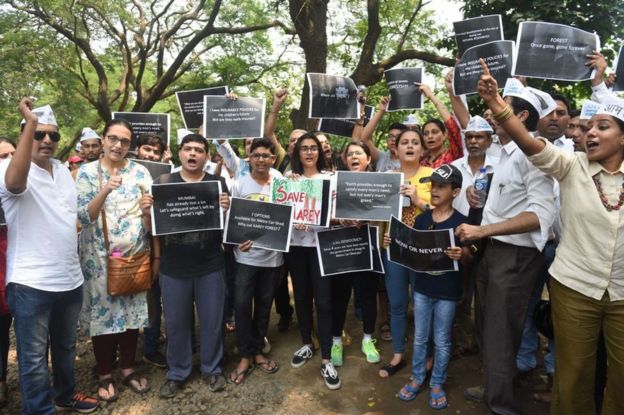
Residents of Aarey colony and Aam Aadmi Party members protest against cutting of trees to build a metro shed at Aarey Colony on 2 October 2018 in Mumbai, India.Image copyright GETTY IMAGES
Image caption Plans to fell trees in the forest have led to protests

She adds that the city badly needs a “mass rapid transport system”. India’s financial hub is congested and infamous for its crawling traffic jams and its local train system heavily overburdened.

Officials say that the metro will eventually carry around 1.7 million passengers every day and bring down the number of vehicles on the road by up to 650,000. The city’s current colonial-era railway system, which is effectively its lifeline, ferries some 7.5 million people between Mumbai’s suburbs and its heart on a daily basis.

But they have been up against the city’s residents, including activists and conservationists, ever since news emerged in 2014 that trees would be cut to make way for the metro.

Presentational grey line

Read more India stories

Presentational grey line

What makes the issue complicated is that the Aarey forest is the site of competing claims.

It’s locally known as the Aarey “milk colony” because most of the land was given to the department of dairy development in 1951. But they are allowed to grow cattle fodder only on a fraction of the land. The rest of it is densely forested and dotted with lakes, and the Mithi river flows through it.

Aarey is also home to tribal communities who live in settlements known as “padas”.

“We are not getting basic facilities here, and now metro authorities want to take away the jungle which belongs to us too,” says Asha Bhoye, who belongs to the Konkani tribe and lives in one of the 29 padas. Plans to relocate some of the tribal communities have also met with resistance and led to protests.

Stalin alleges that instead of declaring the Aarey forest a protected area, the state government has used the opportunity to parcel away pieces of it first to the dairy development department and now to other projects.

Aadivasi Halka Sanvardhan Samiti and Tribals of Aarey colony protesting to demand protection of Aare forest.Image copyright GETTY IMAGES
Image caption Tribals who live in Aarey demand that it be declared a protected area

“Aarey Forest is part of the same forest as Sanjay Gandhi National Park and we are fighting for the national park itself. In the name of public good, the land is being opened up for developers. It’s a systematic effort to destroy the forest.”

Activists fear that after the parking units are built, other projects will be permitted, further threatening the area’s ecology and wildlife, which includes leopards.

So locals have joined the fight enthusiastically, even leading hikes into the forest to raise awareness. “We bring people here, make them familiar with the forest – there are many species of spiders like trapdoor spiders, the site [of the parking unit] is a leopard site,” says Yash Marwa, a screenwriter who is among those campaigning for the forest.

“Mumbai needs to be liveable”, he adds. “We need to talk about good quality of air and life before talking about infrastructure and development.”

Stalin agrees, saying that “air quality and temperature seem to be last among people’s priorities.”

But he is determined to not give up.

“If I couldn’t do something for my city I’d consider I’ve failed myself.”

Source: The BBC
10/06/2019

‘There is no water. Why should people stay here?’

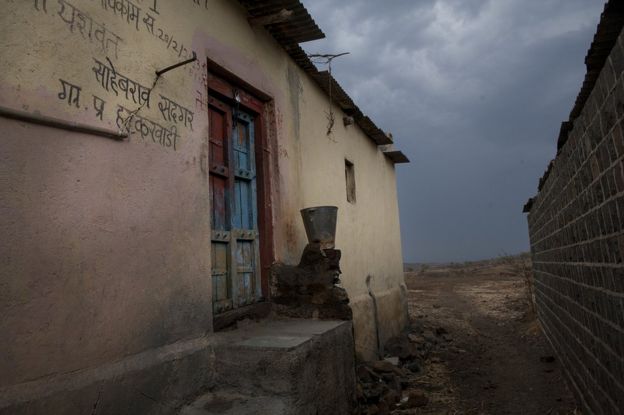
Hatkarwadi
Image caption Hatkarwadi hasn’t seen decent rains in three years

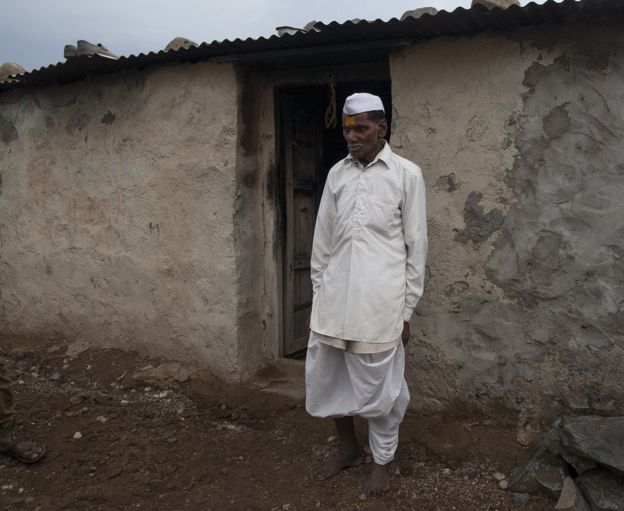
Every morning Dagadu Beldar, 75, wakes up and cooks rice and lentils in his village home in India’s western state of Maharashtra. After that, there’s little else to do.

For the past three years, Mr Beldar has lived alone in his gloomy one-room hut in Hatkarwadi, a stony hillside outback ringed by forests. Drought forced his wife and three sons out of the village. The earth was parched and the wells were dry. There was little water to drink and bathe in, and the family’s millet farm lay barren.

Two sons found work at a sugar factory in Sangli, a cane-growing district some 400km (248 miles) away. Their mother looked after the third son, who went to school there. Hatkarwadi had become a bad memory.

With age, Mr Beldare is going deaf. He mostly keeps to himself in his dark room.

“He’s a very lonely man. He hasn’t seen his family in three years. All because of water,” says Ganesh Sadgar, a neighbour.

Dagadu Beldar
Image caption Dagadu Beldar lives alone after his family left the village because of lack of water

Across the lane, 75-year-old Kishan Sadgar’s only son left home a decade ago to work in a sugar factory far away. He lives with his wife and a pet dog. “My son hardly comes home,” he says. “And when he comes he wants to leave after two or three days because there’s no water here.”

A few doors away, Saga Bai lives with her 14-year-old deaf mute daughter, Parvati. Her only son, Appa, left home years ago to work in a factory. “He hardly comes home. He says he will come only if it rains,” says Ms Bai.

And Ganesh Sadgar, the only graduate in the village, is unable to find a bride because “no woman wants to come here because there’s no water”.

Hatkarwadi is located in Beed, a sprawling sun-baked district which has been impoverished by lack of rain. Not long ago, more than 1,200 people lived in its 125 squat homes. More than half of them, mostly men, have left, leaving behind bolted, abandoned homes. These water refugees eke a living in faraway towns and cities, where they have found work in cane farms, sugar factories, construction sites or as taxi drivers.

Abandoned house in Hatkarwadi
Image caption Yashwant Sahibrao Sadgar locked his home and left the village a year ago because of lack of water

“There is no water. Why should people stay here?” says Bhimrao Beldar, the 42-year-old headman of the village.

The night before I arrived in the village, there had been a brief burst of rain. Next morning, promising grey clouds seemed to be the harbinger of bountiful rains. By mid-afternoon, however, the sky began burning again, extinguishing any such hopes. That’s how fickle hopes are here. The last time the village had “decent rains” was three years ago.

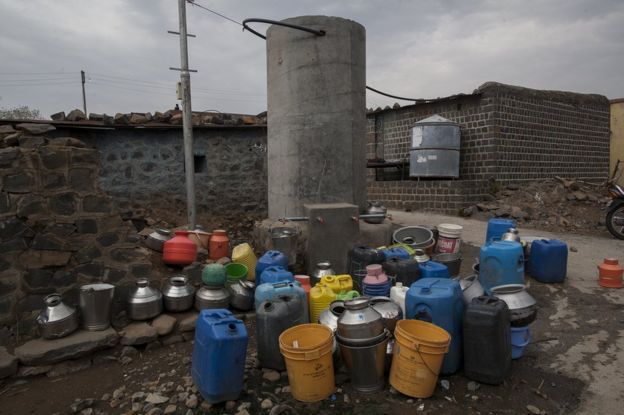
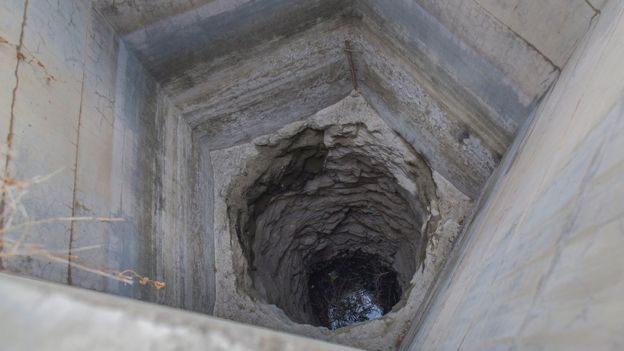
The cruel summer has sucked the life out of Hatkarwadi. The earth is brown and cracked. Cotton and millet farms have withered away. Only two of the 35 wells have some water left. There are a dozen borewells, but the fast receding water table is forcing farmers to drill deep – up to 650ft – to extract water.

Hatkarwadi pump
Image caption The only source of water is a few functioning borewells

Even a minor gale snaps electricity lines, so the borewells often don’t work. Water tankers – the lifeline of the drought-hit – refuse to supply because of the precarious state of the narrow strip of tar which serves as the connecting road to the village.

There’s nothing to feed the animals, so 300 buffaloes have been moved to a fodder camp uphill where the animals live with their owners under tarp. Some 75 new toilets built under a federal government programme to end open defecation lie unused because there’s no water. Most villagers borrow drinking and bathing water from well-to-do neighbours who own borewells.

Hatkarwadi is a speck on the map of Beed, where more than a million people have been hit by the drought. Deforestation has reduced forest cover to a bare 2% of the total area of the district. Only 16% of the farms are irrigated. When monsoons are good, the rain-fed farms yield cotton, soya bean, sugarcane, sorghum and millet for 650,000 farmers.

Hatkarwadi well
Image caption Most of the village’s 35 wells are dry

For the last six years, Beed has seen declining rainfall. Irregular rainfall patterns have been playing havoc with crops. A 10-day-pause in rainfall can end up damaging crops. Last year’s abundant rains – 99% of the average yearly rainfall of 690mm – still led to crop failure because there were four long interruptions.

The main Godavari river is running dry. Nearly all of the 140 big and small dams in Beed are out of water, as are the 800-odd wells. Two of the major dams now have what officials call “dead water” – low lying stored water, contaminated with sediments and mud. This is the water which is being pumped into ponds from where nearly a thousand tankers pick up supplies, spike them with chlorine and transport them to 300-odd thirsty villages.

Saga Bai
Image caption Saga Bai says her son returns to the village ‘only when it rains’

Half of Beed’s 800,000 cattle have been moved to more than 600 cattle camps because of lack of fodder. More than 40,000 people have taken up work under a jobs for work scheme, and officials are opening it up for others to prevent people from going into penury. The drought hasn’t spared people living in towns: the 250,000 residents of Beed town are getting piped water only once a week or sometimes a fortnight.

“This is the worst drought in a decade,” says Astik Kumar Pandey, the senior-most official of Beed. “We are hoping that our drinking water supplies last until end of July and then we have abundant rains”.

The crippling drought in Maharashtra is part of a larger climate catastrophe which has gripped India. More than 40% of the land, by one estimate, is facing drought and more than 500 million people living in at least 10 states are badly affected.

Media caption ‘Men don’t care about drought as women fetch the water’

P Sainath, the founder and editor of the online People’s Archive of Rural India, says the lack of water is an “explosive problem”. But drought alone has not contributed to the crisis, he says. It also has to do with the appropriation of water by the well-to-do at the expense of the poor, and the skewed allocation of water.

“The transfer of water from the farms to the industry, from food crops to water guzzling cash crops, from rural to urban areas, and from livelihood to lifestyle purposes for multiple swimming polls in urban high-rises has also led to this situation.”

Back in his office in Beed, Astik Kumar Pandey peers over a live map tracking the movement of GPS-tagged water tankers in the district. It’s a dense mass of red (stationary tankers picking up supplies) and green (tankers on their way with water) trucks clogging the heart of the district.

“This is how bad the situation is. We are hoping that the rains arrive soon”.

Source: The BBC

08/06/2019

Factbox: China, Africa to embrace closer economic, trade ties

BEIJING, June 8 (Xinhua) — China and African countries will see more intimate economic and trade ties as the first China-Africa Economic and Trade Expo will open on June 27 in Changsha, the capital city of Hunan Province.

A total of 53 African countries have confirmed to attend the expo, and international organizations including the United Nations Industrial Development Organization, the World Food Programme and the World Trade Organization will also send representatives to attend the event.

Here are some facts and figures revealing the growing vitality of trade between China and Africa as well as broader economic exchanges.

— China has been the largest trading partner of Africa for 10 consecutive years.

— In 2018, trade volume between China and Africa amounted to 204.2 billion U.S. dollars, up 20 percent year on year.

— China’s imports of non-resource products from Africa have increased significantly. In 2018, China’s imports from Africa went up 32 percent year on year, with the imports of agricultural products up 22 percent.

— China’s exports of mechanical, electrical and high-tech products accounted for 56 percent of its total exports to African countries.

— China has finished the negotiations of a free trade agreement with Mauritius.

— More than 3,700 Chinese enterprises have been set up in Africa by the end of 2018, with combined direct investment over 46 billion dollars.

— China’s financial institutions have established more than 10 branches in Africa.

— South Africa and seven other countries have included the Chinese currency renminbi (RMB), or the yuan, in their foreign exchange reserves.

— China has formed RMB clearing arrangements with Zambia and signed currency swap agreements with four African countries including Morocco.

Source: Xinhua

05/06/2019

Xinjiang’s vanishing mosques highlight pressure on China’s Muslims as Ramadan ends with a whimper

  • Few signs of Eid celebrations after crackdown that has seen a reported million Uygurs and other minorities interned in camps
  • Muslims in far western Chinese region say they are now ‘too scared’ to practise their faith in public
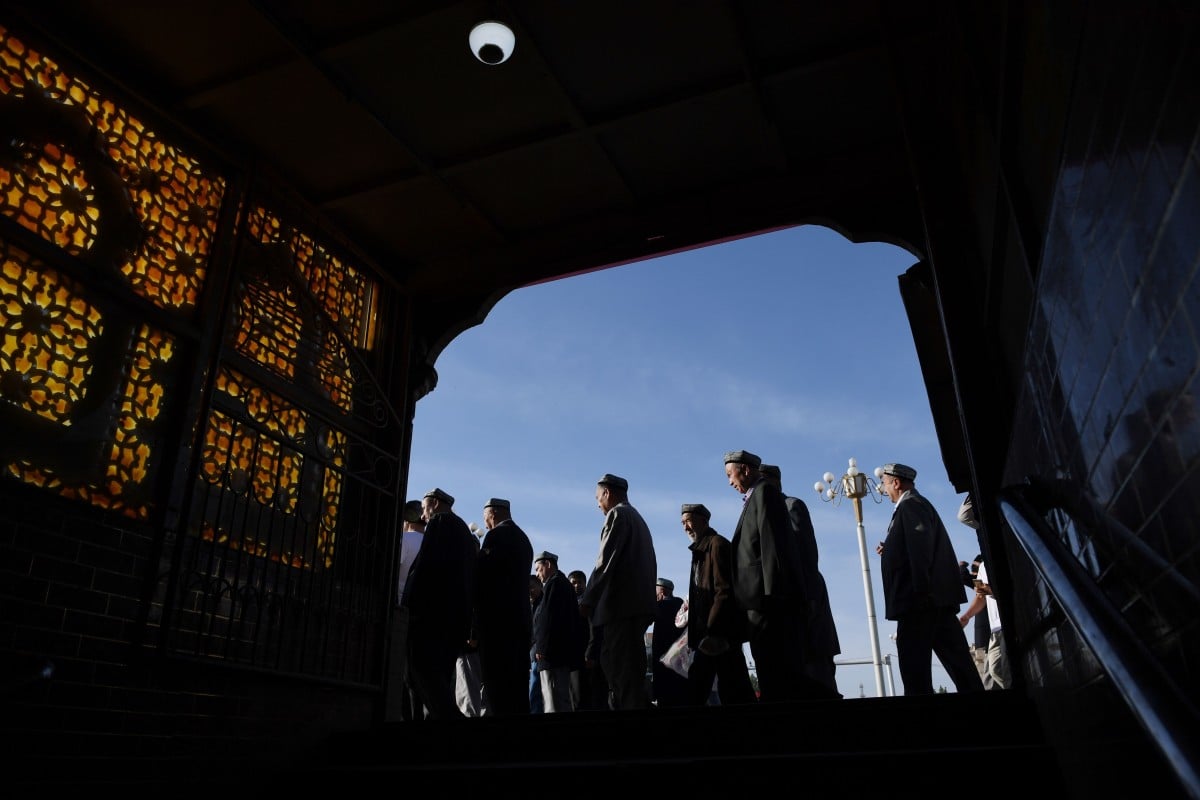
Worshippers leave a mosque in Kasghar after prayers on Wednesday. Photo: AFP
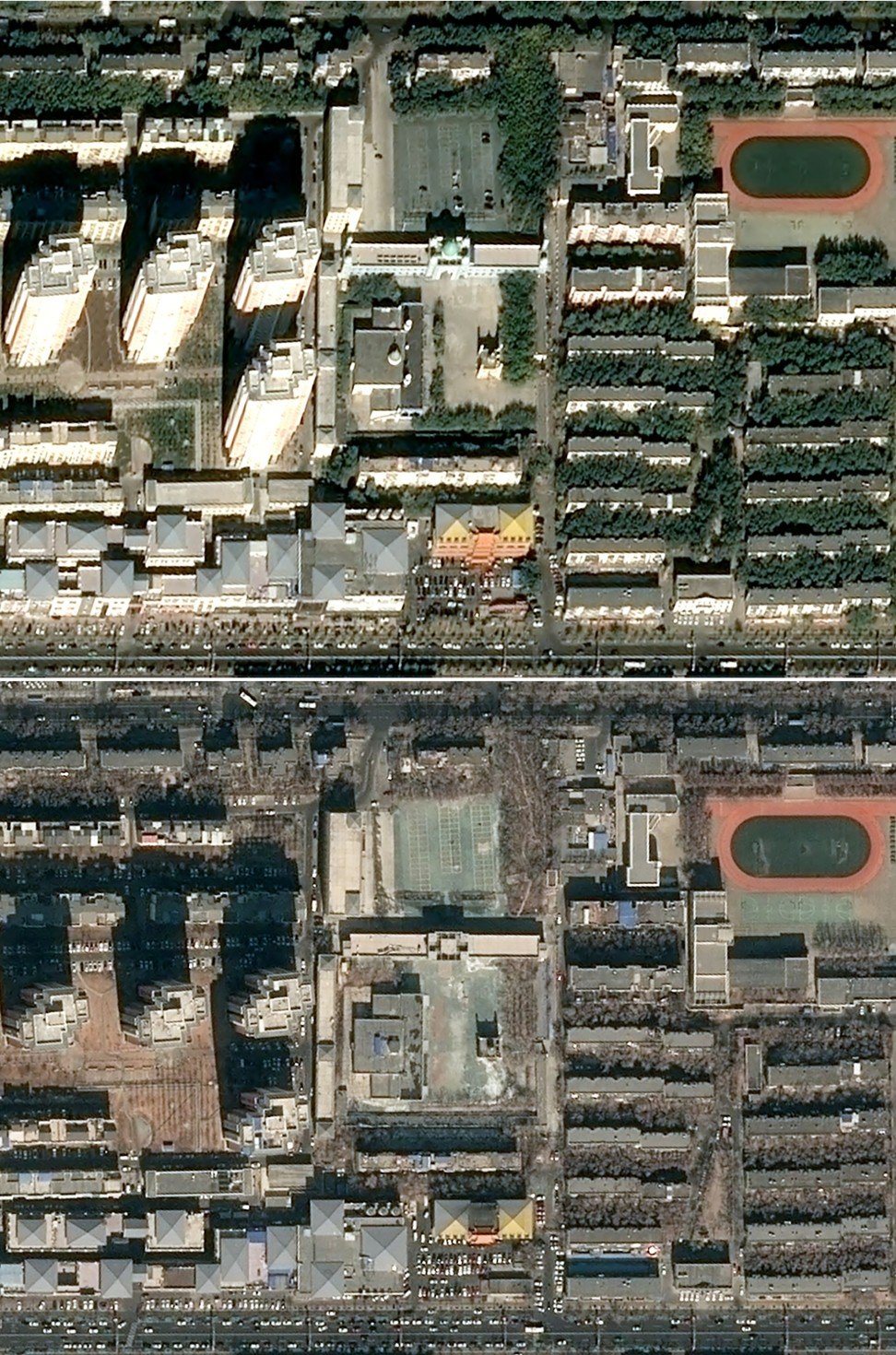
The corner where Heyitkah mosque in China’s far western region of Xinjiang once hummed with life is now a car park where all traces of the tall, domed building have been erased.
While Muslims around the world celebrated the end of Ramadan with prayers and festivities this week, the recent destruction of dozens of mosques in Xinjiang highlights the increasing pressure Uygurs and other ethnic minorities face in the heavily policed region.
Behind the car park in the city of Hotan, the slogan “Educate the people for the party” is emblazoned in red on the wall of a primary school where students must scan their faces upon entering the razor-wired gates.
The mosque “was beautiful,” recalled a vendor at a nearby bazaar. “There were a lot of people there.”
Satellite images reviewed by AFP and visual analysis non-profit Earthrise Alliance show that 36 mosques and religious sites have been torn down or had their domes and corner spires removed since 2017.
Satellite images from 2014 (top) and March this year show the disappearance of the dome of the Karamay West Mosque in Xinjiang. Photo: AFP/ Distribution Airbus Defence and Space/ CNES 2019/ Produced By Earthrise

In the mosques that are open, worshippers go through metal detectors while surveillance cameras monitor them inside.

“The situation here is very strict, it takes a toll on my heart,” said one Uygur, who requested anonymity for fear of reprisals. “I don’t go any more,” he added, referring to mosques. “I’m scared.”

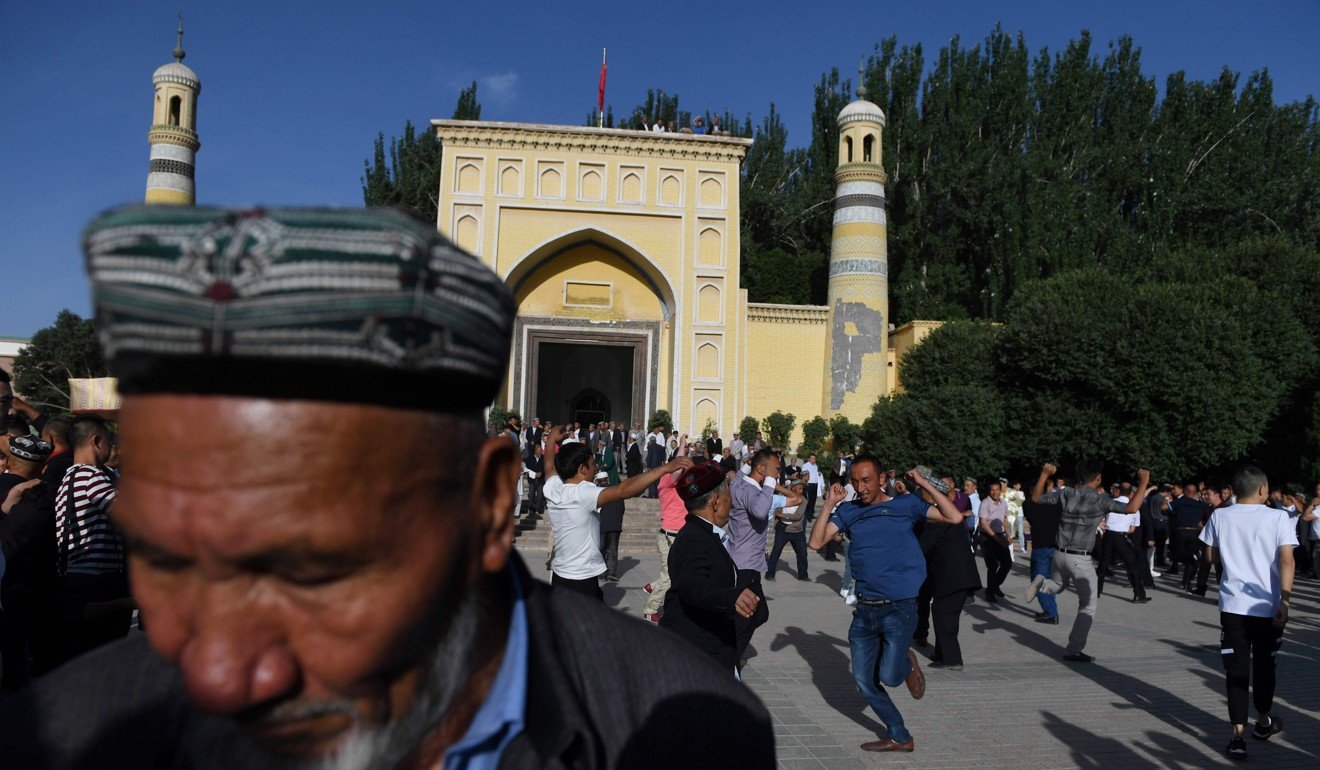
In the ancient Silk Road city of Kashgar, no longer does the sunrise call for prayer echo throughout the city – a ritual the manager of the city’s central mosque once proudly shared with touristsOn Wednesday, locals celebrating Eid al-Fitr quietly filed into the entrance of state-approved Idkah Mosque – one of the largest in China – as police and officials fenced off the wide square surrounding the building and plain clothes men monitored every person’s actions.

It was another low-key Ramadan for Muslims in Xinjiang, where restaurants were busy serving food to customers throughout the day, a time when practising Muslims fast.

In Hotan on Friday – a holy day for believers – the only mosque in the city was empty after sundown, an important prayer session when Muslim families typically break their daily Ramadan fast.

Earlier in the day, at least 100 people attended a midday session but the vast majority were elderly men.

Human Rights Watch decodes surveillance app used to classify people in China’s Xinjiang region

The ruling Communist Party “sees religion as this existential threat”, said James Leibold, an expert on ethnic relations and policy in China at La Trobe University.

Over the long term, the Chinese government wants to achieve “the secularisation of Chinese society,” he told AFP.

The Xinjiang government told AFP that it “protects religious freedoms” and citizens can celebrate Ramadan “within the scope permitted by law”, without elaborating.

The authorities have thrown a hi-tech security net across the region, installing cameras, mobile police stations and checkpoints in seemingly every street in response to a spate of deadly attacks blamed on Islamic extremists and separatists in recent years.

An estimated one million Uygurs and other Turkic-speaking ethnic groups are held in a vast network of internment camps.

After initially denying their existence, Chinese authorities last year acknowledged that they run “vocational education centres” aimed at steering people clear of religious extremism by teaching them Mandarin and China’s laws.

In those centres, it was a different Ramadan.

The Xinjiang government told AFP that people in the centres are not allowed to hold religious activities because Chinese law forbids it within education facilities, but they are free to do so “when they return home on weekends”.

Uygur men dance after Eid al-Fitr prayers in Kashgar. Photo: Greg Baker/ AFP

In recent years, Chinese authorities have ramped up controls on public displays of religion and Islamic traditions in Xinjiang.

AFP reporters did not see any veiled women and few men sporting long beards during a week-long visit to the region. Former internment camp inmates have said they were incarcerated for these outward signs of their religion.

Places of worship too have become targets of Beijing’s draconian security measures.

Human Rights Watch decodes surveillance app used to classify people in China’s Xinjiang region

In the satellite images analysed by AFP and Earthrise Alliance, 30 religious sites were completely demolished while six had their domes and corner spires removed.

AFP reporters visited about half a dozen sites, and found that some mosques had been repurposed into public spaces.

Police officers blocked journalists from entering Artux, just north of Kashgar, where the town’s grand mosque and dozens of other community mosques were destroyed.

The area is some 22 kilometres (14 miles) away from an enormous complex believed to be a re-education centre. Visible from a nearby village, the facility has razor-wired walls, watchtowers and imposing block buildings.In Kashgar, two cameras perched on the columns of a former mosque point at its entrance. There is no minaret or dome – instead, a shop selling dresses lies to its right alongside houses.

A demolished mosque in Hotan has been converted into a garden, paved with concrete walkways and sparsely planted trees.

On the outskirts of town, situated between a cemetery and sand dunes, two white flags and a pile of burned refuse and debris was all that was left of an old shrine named Imam Asim.

China’s top Xinjiang official Chen Quanguo should face sanctions over alleged abuses, US lawmakers say

Uygurs consider these mosques and shrines “their ancestral heritage,” said Omer Kanat, director of the Uygur Human Rights Project.

“The Chinese government just wants to erase everything … that is different from Han, everything which belongs to Uygur culture or Islamic culture in the region,” he said.

Juma Maimaiti, the official imam of Idkah Mosque, told AFP in an interview arranged by the propaganda department that the demolition of mosques “has never happened here”.

“But our government has proceeded to protect some key mosques,” he added, and said that the city of Kashgar has over 150 mosques.

A propaganda slogan and surveillance camera at a mosque in Yangisar, south of Kashgar. Photo: AFP

Though Beijing’s restrictions on religious piety, such as fasting, are not new, observers say conditions have deteriorated to the point where celebrations for the holy month in Xinjiang are reduced or largely invisible.

Islamic greetings and openly fasting in public are no longer permitted, said Darren Byler, a lecturer at the University of Washington who focuses on Uygur culture.

While there are Uygurs who continue to practise their faith, they are “internalising it at this moment – they’re not expressing it openly,” he said.

EU calls out Beijing on human rights but activists want harder line against China’s Xinjiang and Tibet policy

At state-backed mosques, religious activity is controlled as Beijing pursues a five-year plan to “Sinicise” Islam as the “only way for a healthy development of Islam” in the country, said Yang Faming, president.

Source: SCMP

05/06/2019

Do you believe in UFOs? China hints at test of new missile

BEIJING (Reuters) – With a cryptic message about UFOs and a picture of a missile launcher, China’s military has hinted that it has carried out a test of a new missile, after images of an object streaking towards the sky circulated on Chinese social media.

The People’s Liberation Army typically does not announce new missile tests, but occasionally drops hints about what it is up to, amid a massive modernisation push championed by President Xi Jinping to ramp up combat capabilities.
On Sunday, footage circulated on China’s Weibo microblogging service of an object travelling up into the sky, leaving a white trail behind it, over the Bohai Sea, partly closed at the time for military drills.
That caused some Chinese internet users to wonder if it was a UFO, though most thought it was probably the test of a new underwater launched ballistic missile.
In a short post on its official Weibo account late on Monday, the People’s Liberation Army Rocket Force showed a picture of what looked like a road mobile intercontinental ballistic missile launcher against a night sky.
“Do you believe in this world there are UFOs?” it wrote in the caption, without offering further explanation.
The navy then chimed in on its Weibo account with a picture of a missile being launched from underwater heading off into the blue sky above, with a similar caption: “Do you believe in UFOs?”
Defence publication Janes said on its website that the weekend pictures could have been China’s next generation submarine-launched ballistic missile, the JL-3.
The Ministry of Defence did not respond to a request for comment.
The development of the nuclear-armed JL-3 is being closely watched by the United States and its allies as it is expected to have a longer range than its predecessor and will significantly strengthen China’s nuclear deterrent.
In its latest annual survey of China’s military modernisation, the Pentagon said last month the new missile would likely to be fitted on China’s next generation nuclear missile submarines. Construction is due to start in the early 2020s.
Source: Reuters
04/06/2019

No time to waste in saving the world’s rivers from drying up – especially in China

  • Brahma Chellaney writes that excessive damming and drastic overuse of water resources are causing the world’s major waterways to run dry
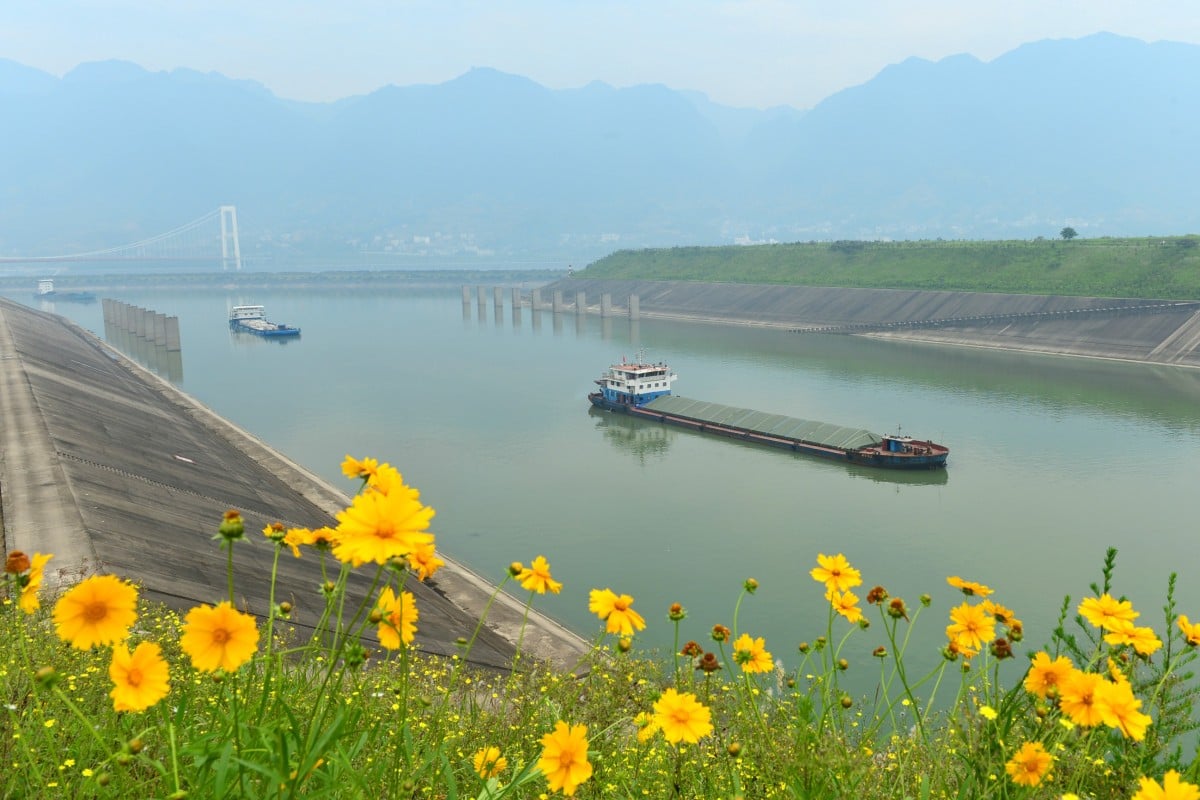
Vessels head for the lock of the Three Gorges Dam in Yichang, in central China's Hubei province. Sediment build-up in the dam’s reservoir stems from silt flow disruption in the Yangtze River, Brahma Chellaney writes. Photo: Xinhua
Vessels head for the lock of the Three Gorges Dam in Yichang, in central China’s Hubei province. Sediment build-up in the dam’s reservoir stems from silt flow disruption in the Yangtze River, Brahma Chellaney writes. Photo: Xinhua
Thanks to excessive damming and drastic overuse of water resources, an increasing number of major rivers across the world are drying up before reaching the sea.
Nowhere is this more evident than in China, where the old saying, “Follow the river and it will eventually lead you to a sea,” is no longer wholly true.
While a number of smaller rivers in China have simply disappeared, the Yellow River – the cradle of the Chinese civilisation – now tends to run dry before reaching the sea.
This has prompted Chinese scientists to embark on a controversial rainmaking project to help increase the Yellow’s flow. By sucking moisture from the air, however, the project could potentially affect monsoon rains elsewhere.
For large sections of the world’s population, major river systems serve as lifelines. The rivers not only supply the most essential of all natural resources – water – but also sustain biodiversity, which in turn supports human beings.
Yet an increasing number of rivers, not just in China, are drying up before reaching the sea.
A major new United Nations study published early this month offers grim conclusions: human actions are irremediably altering rivers and other ecosystems and driving increasing numbers of plant and animal species to extinction.

“Nature across the globe has now been significantly altered,” according to the study’s summary of findings.

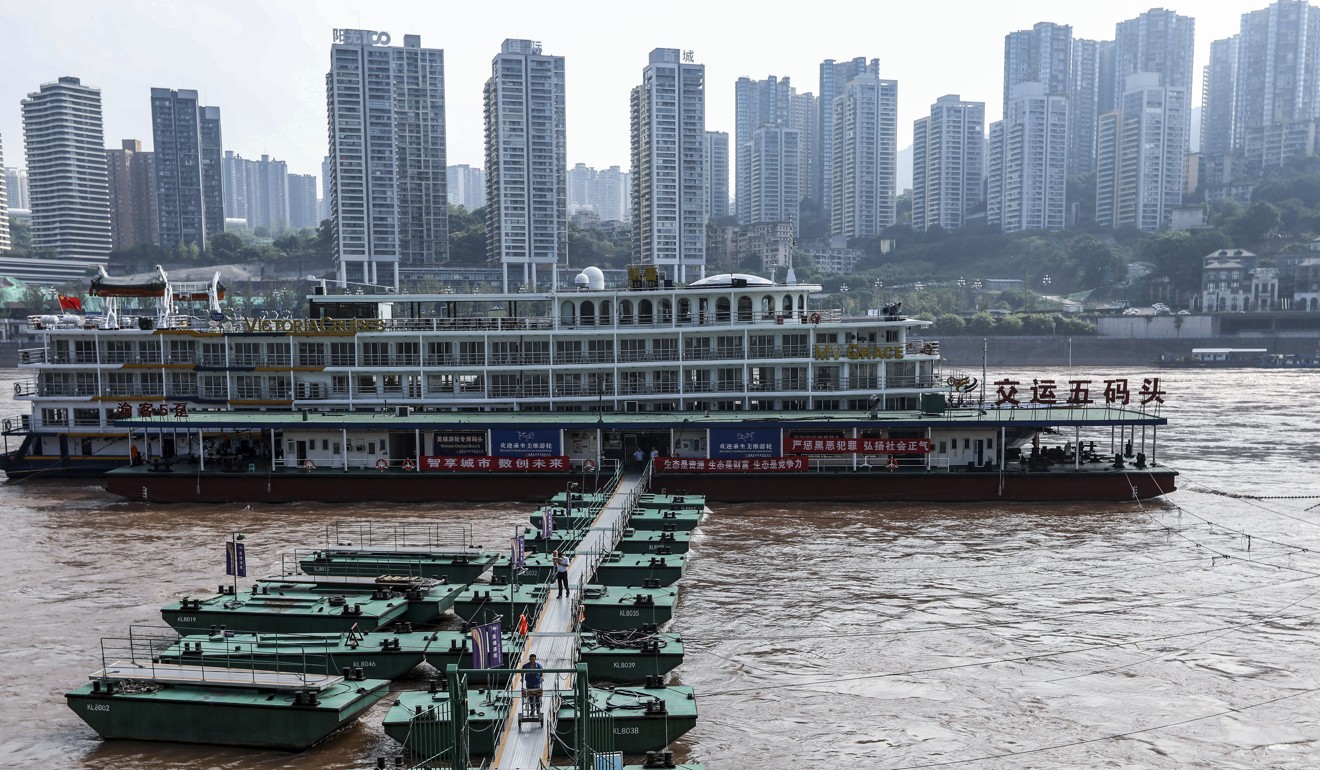
The Yangtze and Jialing rivers come together in the southwestern city of Chongqing. Photo: Simon Song

Water sustains life and livelihoods and enables economic development.

If the world is to avert a thirsty future and contain the risks of greater intrastate and interstate water conflict, it must protect freshwater ecosystems, which harbour the greatest concentration of species.

The Mekong is mighty no more: book charts river’s demise

Yet, according to another study published in Nature this month humans have modified the flows of most long rivers, other than those found in the remote regions of the

Amazon and Congo basins and the Arctic.

Consequently, only a little more than one-third of the world’s 246 long rivers are still free-flowing, meaning they remain free from dams, levees and other man-made water-diversion structures that leave them increasingly fragmented.

Humans have modified the flows of most long rivers, including the Yangtze, home to some of China’s most spectacular natural scenery. Photo: WWF

Such fragmentation is affecting river hydrology, flow of nutrient-rich sediment from the mountains where rivers originate, riparian vegetation, migration of fish and quality of water.

Take the Colorado River, one of the world’s most diverted and dammed rivers. Broken up by more than 100 dams and thousands of kilometres of diversion canals, the Colorado has not reached the sea since 1998.

Sinking sands along the Mekong River leave Vietnamese homeless

The river, which originates in the Rocky Mountains and is the lifeblood for the southwestern United States, used to empty into the Sea of Cortez in Mexico.

But now, owing to the upstream diversion of 9.3 billion cubic metres (328.4 billion cubic feet) of water annually, the Colorado’s flow into its delta has been reduced to a trickle.

Altering the flow characteristics of rivers poses a serious problem for sustainable development, because they affect the ecosystem services on which both humans and wildlife depend. Photo: AP

Other major rivers that run dry before reaching the sea include the Amu Darya and the Syr Darya, the two lifelines of Central Asia; the Euphrates and the Tigris in the Middle East; and the Rio Grande, which marks the border between Texas and Mexico before heading to the Gulf of Mexico.

The overused Murray in Australia and Indus in Pakistan are at risk of meeting the same fate.

Are China’s Mekong dams washing away Cambodian livelihoods?

More fundamentally, altered flow characteristics of rivers are among the most serious problems for sustainable development, because they seriously affect the ecosystem services on which both humans and wildlife depend.

Free-flowing rivers, while supporting a wealth of biodiversity, allow billions of fish – the main source of protein for the poor – to trek through their waters and breed copiously.

Urgent action is needed to save the world’s rivers, including improving agricultural practices, which account for the bulk of freshwater withdrawals

Free-flowing rivers also deliver nutrient-rich silt crucial to agriculture, fisheries and marine life.

Such high-quality sediment helps to naturally re-fertilise overworked soils in the plains, sustain freshwater species and, after rivers empty into seas or oceans, underpin the aquatic food chain supporting marine life.

China’s hyperactive dam building illustrates the high costs of river fragmentation. No country in history has built more dams than China. In fact, China today boasts more large dams than the rest of the world combined.

China’s chain of dams and reservoirs on each of its long rivers impedes the downstream flow of sediment, thereby denying essential nutrients to agricultural land and aquatic species.

A case in point is China’s Three Gorges Dam – the world’s largest – which has a problematic build-up of sediment in its own massive reservoir because it has disrupted silt flows in the Yangtze River.

Likewise, China’s cascade of eight giant dams on the Mekong, just before the river enters Southeast Asia, is affecting the quality and quantity of flows in the delta, in Vietnam.

Yangtze dams may spell end to sturgeon in a decade
Undeterred, China is building or planning another 20 dams on the Mekong.
How the drying up of rivers affects seas and oceans is apparent from the Aral Sea, which has shrunk 74 per cent in area and 90 per cent in volume, with its salinity growing nine-fold.
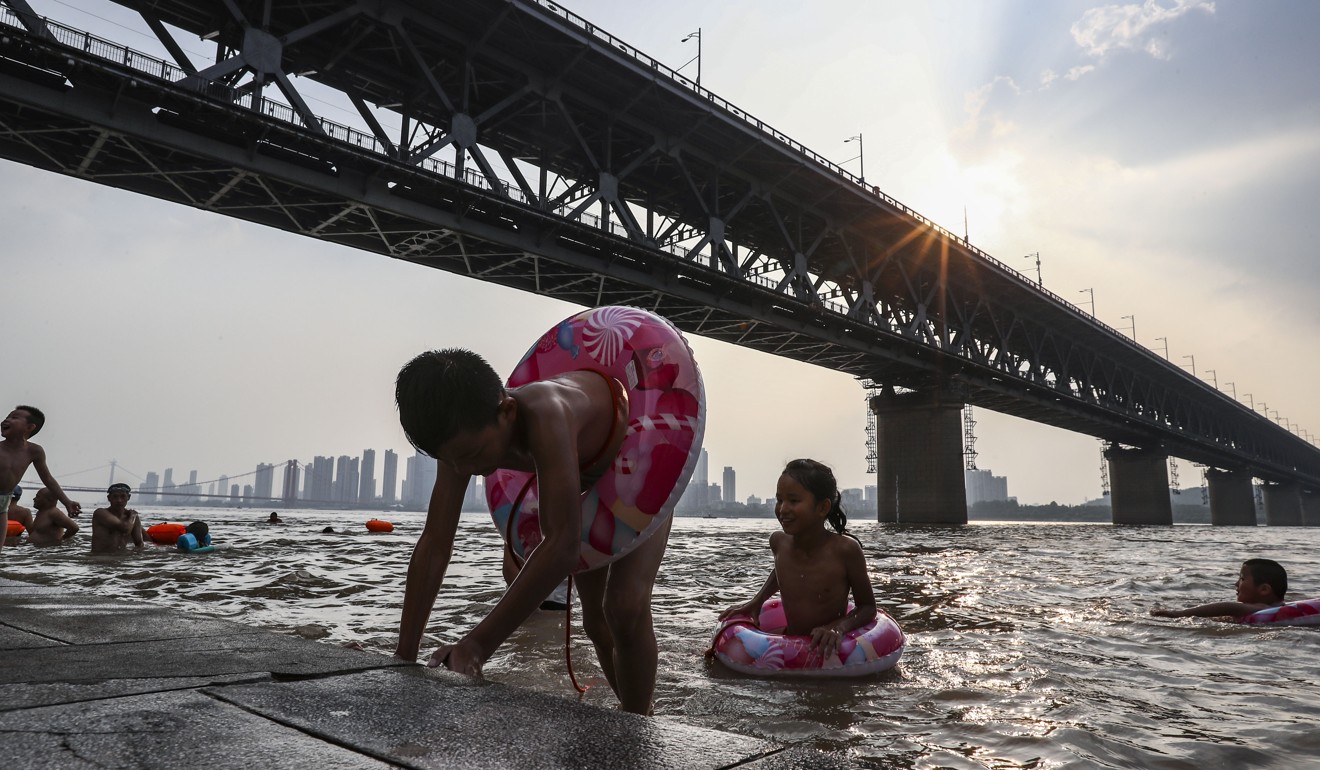
People beat the heat by cooling off in the Yangtze River in Wuhan, in central China’s Hubei province. Photo: Nora Tam

This change is the result of the Aral Sea’s principal water sources, the Amu Darya and Syr Darya, being so overexploited for irrigation that they are drying up before reaching what was once the world’s fourth-largest inland lake.

Compounding the challenges is the increasing pollution of rivers. Aquatic ecosystems have lost half of their biodiversity since the mid-1970s alone.

Chinese court jails nine for dumping toxic waste in Yangtze

Urgent action is needed to save the world’s rivers. This includes action on several fronts, including improving practices in agriculture, which accounts for the bulk of the world’s freshwater withdrawals.

Without embracing integrated water resource management and other sustainable practices, the world risks a parched future.

Source: SCMP

Law of Unintended Consequences

continuously updated blog about China & India

ChiaHou's Book Reviews

continuously updated blog about China & India

What's wrong with the world; and its economy

continuously updated blog about China & India