Chindia Alert: You’ll be Living in their World Very Soon
aims to alert you to the threats and opportunities that China and India present. China and India require serious attention; case of ‘hidden dragon and crouching tiger’.
Without this attention, governments, businesses and, indeed, individuals may find themselves at a great disadvantage sooner rather than later.
The POSTs (front webpages) are mainly 'cuttings' from reliable sources, updated continuously.
The PAGEs (see Tabs, above) attempt to make the information more meaningful by putting some structure to the information we have researched and assembled since 2006.
Chinese President Xi Jinping (R) meets with Italian Prime Minister Giuseppe Conte at the Great Hall of the People in Beijing, capital of China, April 27, 2019. (Xinhua/Huang Jingwen)
BEIJING, April 27 (Xinhua) — Chinese President Xi Jinping on Saturday met with Italian Prime Minister Giuseppe Conte, who attended the Second Belt and Road Forum for International Cooperation in Beijing.
China highly commends Italy’s signing of a memorandum of understanding with China on jointly building the Belt and Road, taking the lead among major Western countries, according to Xi.
The country is ready to work with Italy in advancing the Belt and Road Initiative (BRI), and make the bilateral relations a model of Belt and Road cooperation between China and European countries, Xi said.
Xi called on both sides to firmly grasp the strategic significance of the bilateral ties, step up coordination and collaboration in improving global governance system and safeguarding free trade and multilateralism, and forge a new form of international relations featuring mutual respect, fairness, justice and win-win cooperation.
Conte said the speeches delivered by Xi at the forum helped the international community understand the significant benefits of the BRI for the world.
Italy is firmly committed to participating in the BRI, he said, adding that the initiative is a good opportunity for the world and more countries will join.
Italy welcomes Chinese companies to invest in the country, and will not adopt discriminatory policies against them, Conte said, calling on the two countries to reinforce solidarity and cooperation, and safeguard multilateralism.
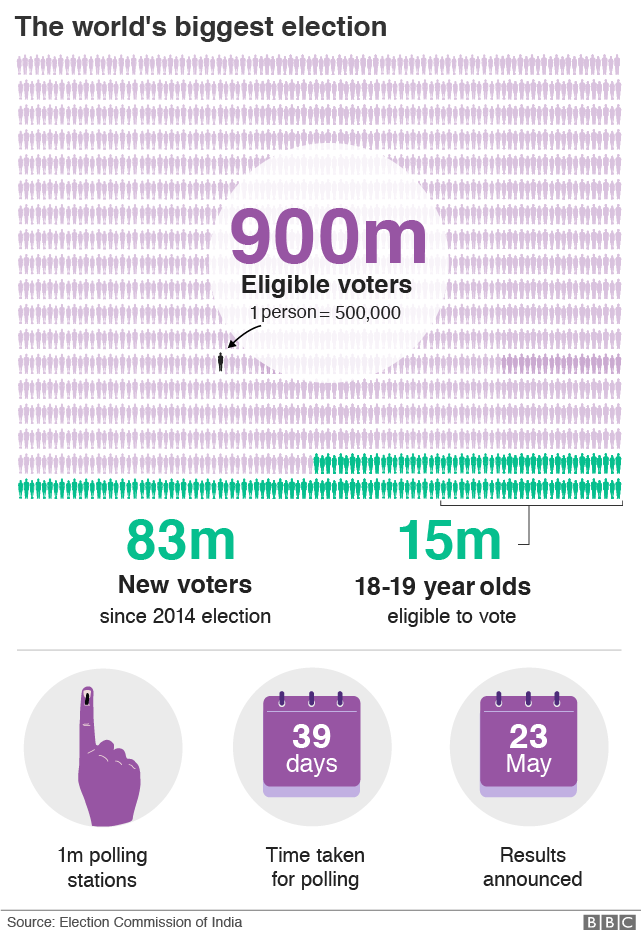
It is an election like no other. Those eligible to vote in India’s upcoming polls represent more than 10% of the world’s population and they will take part in the largest democratic exercise in history.
Voters will choose representatives for the Indian parliament, and in turn decide if Hindu nationalist Prime Minister Narendra Modi will run the country for another five years.
What is at stake?
Whoever wins these elections and forms a government will control the destiny of the world’s largest democracy.
While they are in charge, India’s economy is likely to overtake the UK’s and become the world’s fifth-largest.
Its population meanwhile – at more than 1.34bn people – is predicted to soon surpass China’s 1.39bn.
Hundreds of millions of Indians have escaped poverty since the turn of the millennium but huge challenges remain.
Unemployment is a major concern and is especially high among young people.
Millions of farmers are angry about low crop prices.
How the nuclear-armed country engages with the outside world – and manages a tricky relationship with its neighbour Pakistan – is also of immense importance to international security.
Who is being elected?
Indians are voting for members of parliament and the job of prime minister tends to go to the leader of the party or coalition with most seats. The current PM is Narendra Modi.
His main rival is opposition leader Rahul Gandhi.
Parliament has two houses: the Lok Sabha and the Rajya Sabha.
The lower house – Lok Sabha – is the one to watch.
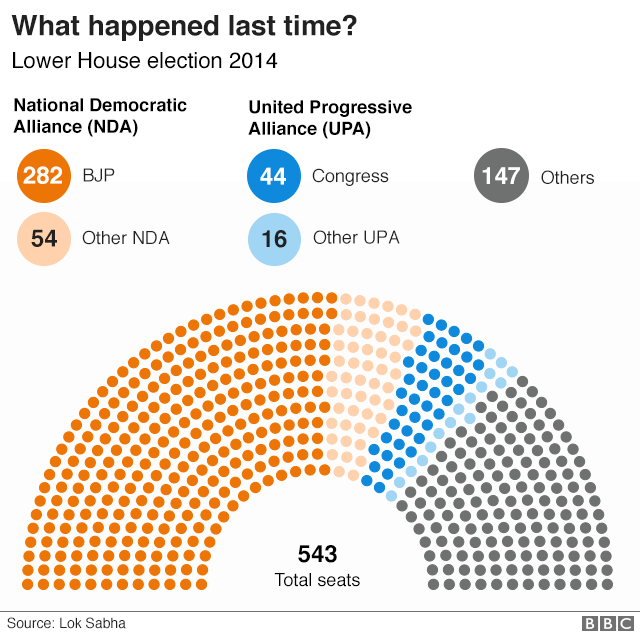
It has 543 elected seats and any party or coalition needs a minimum of 272 MPs to form a government.
At the last election in 2014, Mr Modi’s BJP won 282 seats.
Mr Gandhi’s Congress Party only took 44 seats in 2014 – down from 206 in 2009.
Why does voting take so long?
Because of the enormous number of election officials and security personnel involved, voting will take place in seven stages between 11 April and 19 May.
Different states will vote at different times.
Votes will be counted on 23 May and results are expected on the same day.
Who will win?
This election is being seen as a referendum on Mr Modi, a polarising figure adored by many but also accused of stoking divisions between India’s Hindu majority and the country’s 200 million Muslims.
Until a few months ago, Mr Modi and his BJP party were seen as the overwhelming favourites. But the loss of key states in December’s regional elections injected a sense of serious competition into the national vote.
Analysts are divided on whether Mr Modi will be able to win a simple majority again.
A recent escalation of tensions with Pakistan has given the BJP a new and popular issue to campaign on.
It will be hoping that a focus on patriotism will help the party to get past the serious challenge mounted by powerful regional parties and Congress.
BEIJING, April 26 (Xinhua) — The China-proposed Belt and Road Initiative (BRI) facilitates the compliance with the UN 2030 Agenda for Sustainable Development and the realization of the 17 Sustainable Development Goals in Latin America, said a senior official of a UN body based in Latin America.
Mario Cimoli, deputy executive secretary of the Economic Commission for Latin America and the caribbean (ECLAC), made the remarks in an interview with Xinhua.
Also as chief of the division of production, productivity and management of ECLAC, Cimoli has arrived in Beijing to participate in the second Belt and Road Forum for International Cooperation on April 25-27.
So far, 18 Latin American countries have signed the Memorandum of Understanding on jointly building the Belt and Road cooperation with China.
“The countries in Latin America view China as a fundamental actor,” he said. “The fact that 18 Latin American countries have joined the Belt and Road Initiative means that these countries think that China is necessary and China is also aware of the importance of dialogue. It’s a historical process.”
In his opinion, the BRI makes “greater integration, greater multilateralism and more dialogue” possible and “does good to Latin America.”
He said that both the 2030 Agenda and the BRI seek sustainable development and reduction of inequality and poverty, without contradicting with the proper model of each country.
“Given that the growth rates of Latin America will not be very high for the next few years, a rational process of cooperation such as the Belt and Road will surely help the region and allow each country to seek and improve their model of development and growth,” the ECLAC official said.
The BRI is a much more horizontal dialogue, a platform, in that sense that it is a process that helps and allows a much more positive coexistence despite current global tensions, he said.
In the dialogue with China, Latin America can demonstrate the importance of being an integrated area of trade, policies, and infrastructures in order to trade better with Asia, he said.
Cimoli also affirmed that the incorporation of new technologies in Latin America is a course under discussion, and dialogue with China can accelerate and improve the process.
Cimoli said his one observation of his ongoing China trip is the extensive use of electronic commerce among ordinary people.
He said when he went out to buy something, he found almost everyone use e-payments.
The way in which technologies immerge into the daily life of Chinese citizens is an example and would be a valuable contribution of China to the world and especially to Latin America, Cimoli said.
“The example of China shows the role that a state should play to trigger the technological development. In this dialogue with China, Latin America surely has to learn from the pragmatism of China,” he said.
The ECLAC official mentioned that China invests over 2 percent of its GDP in science and technology, while the average investment of Latin American countries in the field is between 0.4 and 0.5 percent of its GDP, plus, it appears to be swaying instead of stable state policies.
“There is a lot of cooperation to be done, much experience to be shared and much a platform for dialogue like the Belt and Road Initiative could do,” said Cimoli.
Li Zhanshu (R), chairman of the Standing Committee of the National People’s Congress, meets with Malaysian Prime Minister Mahathir Mohamad, who is here to attend the Second Belt and Road Forum for International Cooperation, in Beijing, capital of China, April 25, 2019. (Xinhua/Zhang Ling)
BEIJING, April 25 (Xinhua) — Li Zhanshu, chairman of the Standing Committee of the National People’s Congress, on Thursday met with Malaysian Prime Minister Mahathir Mohamad, who is here to attend the Second Belt and Road Forum for International Cooperation.
Li said China is willing to work with Malaysia to implement the consensus reached by the leaders of the two countries and outcomes to be achieved at the Second Belt and Road Forum for International Cooperation.
He asked for enhanced cooperation between the two countries in agriculture, fishery, e-commerce, technological innovation and people-to-people exchanges, as well as parliamentary exchange and mutual learning in state governance, legislation and supervision.
Mahathir said Malaysia welcomes the Belt and Road Initiative and is willing to learn from China’s development experience and strengthen bilateral cooperation in all areas.
Stiff penalties like those given to drink-drivers needed to make people wake up to the risks, newspaper says
Commentary comes after woman who died in high-speed crash is found to have used her phone 34 times in 30 minutes
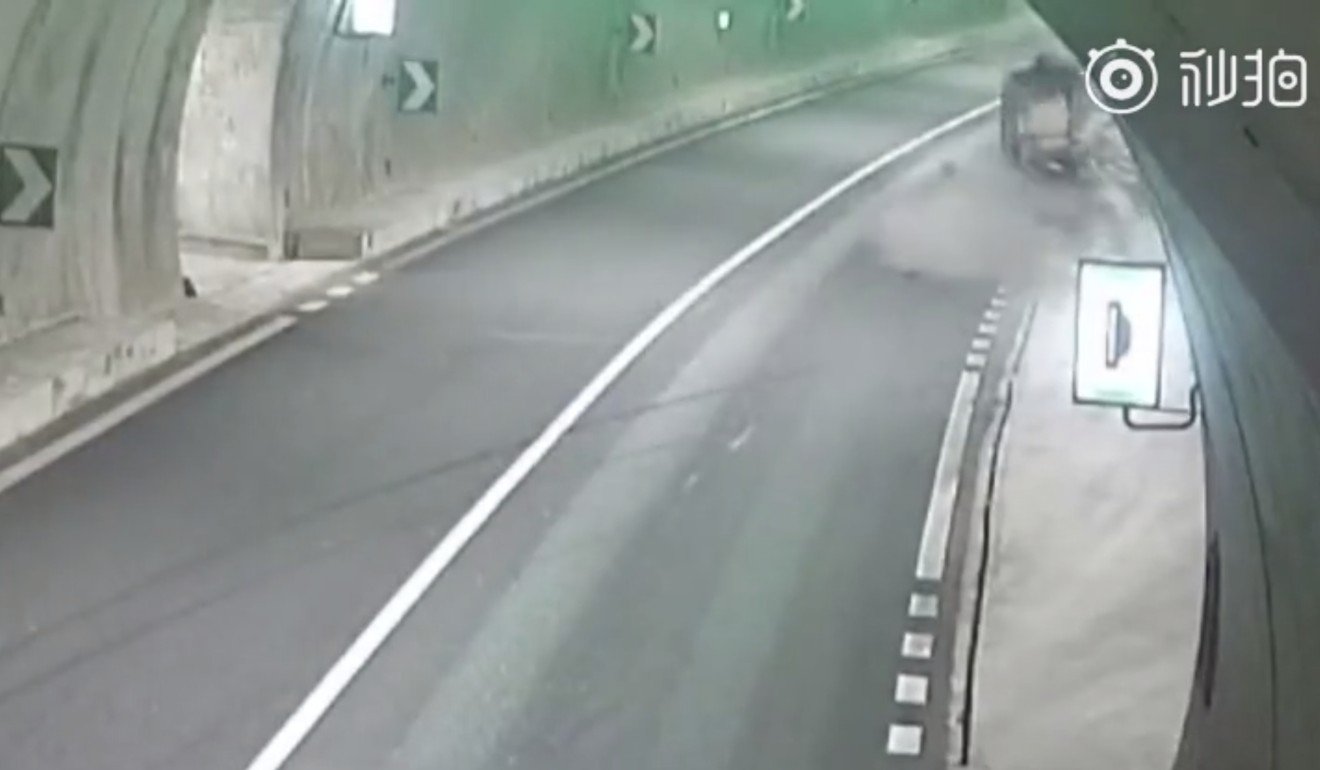
The fatal crash in Fujian province was caught on surveillance camera and the footage was shown by Pearvideo.com. Photo: Weibo
The death of a woman in a high-speed car accident who is believed to have been sending messages on her phone at the time of the crash has sparked calls in the Chinese media for harsher punishments for reckless driving.
“Death or causing death as the result of driving when using a phone is a very serious consequence of people becoming slaves to mobile phones,” Beijing Youth Daily said in a commentary on Thursday.
“To reverse the harm caused by this behaviour, they must be punished in line with the punishments for drink-driving.”
The article came after Pearvideo.com on Sunday published footage from a surveillance camera of the fatal accident in southeast China’s Fujian province. The film shows the woman’s car speeding through a tunnel before veering on to the wrong side of the road and crashing into a wall. It then flips over and bursts into flames.
The victim is believed to have been using her phone at the time of the crash. Photo: Weibo
A police officer interviewed in the video said the driver, who was not identified, had not been wearing a seat belt at the time of the accident and had been observed speeding, cutting in and out of lanes and using her phone 34 times in just 30 minutes.
“I think all four factors contributed to her accident,” he said. “But the fundamental ones were speeding and using a mobile phone when driving.”
Five children killed as driver crashes into group crossing road
The video report said the woman sent a total of 16 text and voice messages from behind the wheel, one of which said that she was driving at 120km/h (75mph).
While drink-driving is a criminal offence in China – with a maximum penalty of six months’ detention, loss of licence and a five-year ban – the top punishment for using a phone while behind the wheel is a 200 yuan (US$30) fine and the loss of two licence points. Drivers start with 12 points and can be suspended from driving if they lose them all.
The film shows the car crashing into a wall before flipping over and bursting into flames. Photo: Weibo
According to a Ministry of Transport survey cited by Beijing Youth Daily, people are 2.8 times more likely to have an accident if they make a phone call while driving and 23 times more likely if they look at their handset.
While the strict enforcement of drink-driving laws has helped to change motorists’ behaviour, using a phone behind the wheel is still widely regarded as acceptable behaviour, the commentary said.
“I don’t know how many disasters like the woman in Sanming [a city in Fujian] are needed to alert people,” it said.
“[But] amending the road traffic safety law to make [the offence of] driving while using a mobile phone equivalent to that of drink-driving and implementing corresponding penalties can … help to reduce the devastating consequences.”
A commentary on Gmw.com, the website of the official Guangming Daily newspaper, also called for the offence to be criminalised.
People know the risks but disregard them because the legal consequences are very small, it said.
BEIJING, April 20 (Xinhua) — The Belt and Road Initiative (BRI) will be an efficient way to address the imbalance in global infrastructure development, according to U.S. engineering firm AECOM.
Under the BRI, financing platforms including the Asian Infrastructure Investment Bank and the Silk Road Fund have emerged, which will help narrow the development gap, said Ian Chung, chief executive of AECOM for Greater China.
“The BRI is an opportunity for all. It is open, inclusive, and will bring economic development to the next level,” Chung told Xinhua.
According to Chung, countries and regions of different development phases can all benefit from the BRI, especially in infrastructure.
For developing economies, such as some in Africa, the BRI will significantly improve local infrastructure connectivity and boost economic growth, Chung said.
For fast-growing economies such as some in Southeast Asia, Chinese firms could share their experience in high efficiency and green construction via the BRI to meet the rising demand for sustainable infrastructure, he said.
As for many other developed countries, the demand for infrastructure still abounds, as many existing facilities are becoming aged, he added.
The BRI has opened plenty of opportunities for AECOM, as the company has been partnering with Chinese firms on many overseas projects, offering consulting services on design, local regulations, environmental and safety standards.
“Chinese firms excel in construction and financing, while we share a competitive edge in project design, knowledge of local regulations, procedures as well as culture. It’s a win-win for all of us,” Chung said.
Seeing business opportunities from the BRI, the company set up a new department in its Beijing office three years ago to work with Chinese firms on BRI projects.
The firm just opened its new offices in Chengdu and Changsha, following the set-up of its China headquarters in Shanghai last year, another sign that shows the company’s confidence in China’s development, Chung said.
“I am very optimistic that we will have more value-added cooperation with Chinese firms under the BRI,” Chung said.
PHNOM PENH, April 18 (Xinhua) — A Cambodian and Chinese entrepreneurs meeting was held here on Thursday, aiming at exploring opportunities for trade and investment, officials said.
The meeting brought together nearly 20 entrepreneurs from southwest China’s Sichuan province and about 20 Cambodian business executives.
Ek Sam Ol, president of the Cambodia-China Friendship Association, said that currently, many enterprises from Sichuan have been doing businesses in various sectors in Cambodia.
“The forum is a good opportunity for the entrepreneurs from both sides to exchange experiences and to explore opportunities for investments or business partnerships,” he said.
Sam Ol said China is currently the top foreign investor in Cambodia and Chinese investments have importantly contributed to socio-economic development in the country.
He said Chinese investments have focused on a variety of sectors including transport infrastructure, hydropower plants, industrial zones, garment and footwear factories, banking and finance, real estate and construction, agriculture, tourism, and airlines.
BEIJING, April 14 (Xinhua) — Chinese authorities on Sunday unveiled a guideline on reforming the country’s property rights system for natural resource assets.
By 2020, a system featuring confirmed ownership, clarified rights and responsibility, strict protection, smooth transfer and effective supervision should have been basically in place, reads the guideline released by the general offices of the Communist Party of China Central Committee and the State Council.
The efficiency of natural resource development and use, as well as resource protection, should have been significantly enhanced by then, providing strong support for improving ecological civilization, and guaranteeing national ecological security and resource security, the guideline says.
The system should play a fundamental role in strictly protecting resources and promoting ecological functions, and also play a key role in optimizing resource allocation, improving the efficiency of resource development and use, and promoting high-quality development.
China will explore more effective ways to realize the rights and interests of natural resource assets owners by giving play to the decisive role of the market in allocating resources, the guideline reads.
Meanwhile, the country must strengthen government supervision and administration, and promote the reasonable use of natural resources by natural resource rights holders, it says.
The country will improve the legal system for property rights over natural resource assets, protect the rights and interests of property rights holders on an equal footing, and give better play to the role of the property rights system as both an incentive and restraint in promoting ecological progress.
Local governments are encouraged to carry out bold explorations in accordance with local conditions to accumulate sufficient practical experience for reforming the property rights system, according to the guideline.
China will accelerate the formulation of unified classification standards for natural resources, and establish a unified investigation, monitoring and evaluation system.
It will make a balance sheet for natural resource assets, establish a dynamic monitoring system and keep track of changes in all types of natural resources in a timely manner, the document reads.
Efforts will also be made to accelerate the confirmation and registration of natural resource ownerships, with a focus on major ecological space including national parks, key state-owned forests, wetlands and major rivers.
The country will compile and implement a plan for the ecological restoration of natural space, and establish and improve a mechanism of restoration and comprehensive management of mountains, forests, land, lakes and grassland.
China will improve the system of compensation for damages to the ecological environment, with the persons liable taking the responsibility for restoration or compensation, according to the document.
Shanghai Zhenhua Heavy Industries now exports quay cranes, gantry cranes to more than 300 ports in 100 countries, with 70 per cent of the global market
China International Marine Containers Group (CIMC), took a little more than a decade to become the world’s largest maker of shipping containers
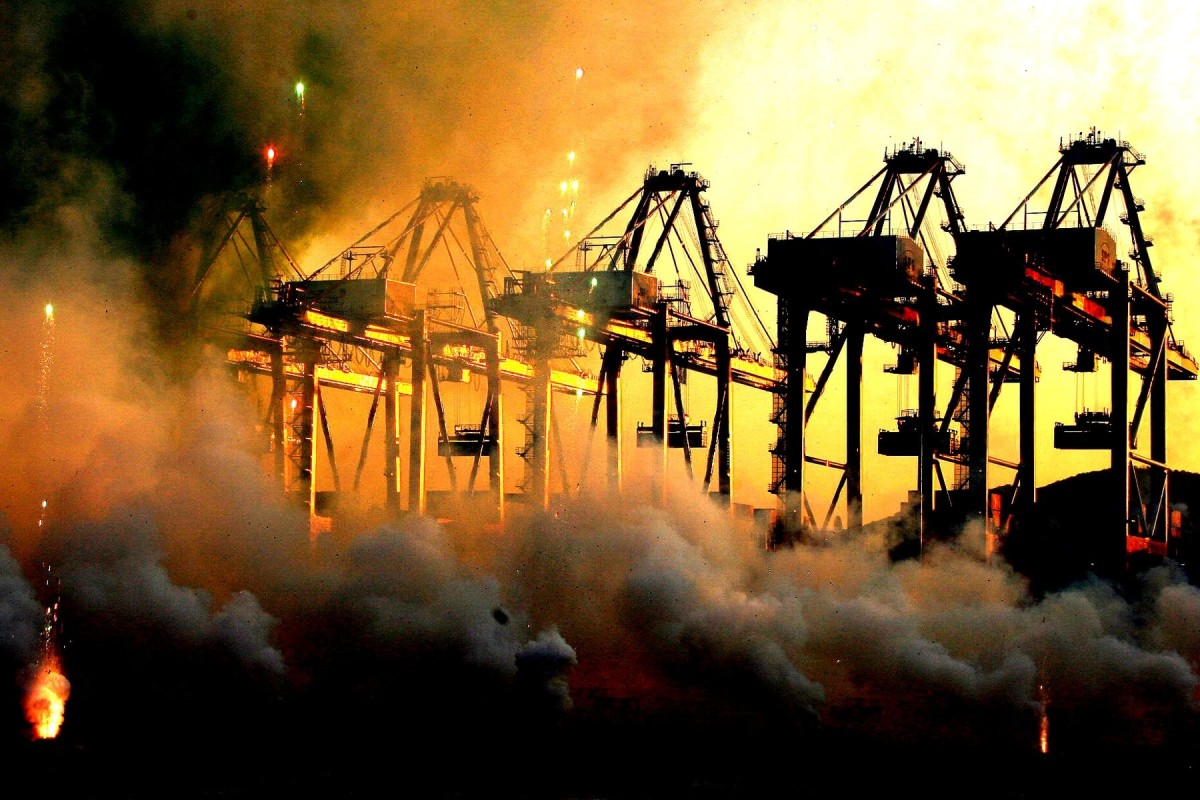
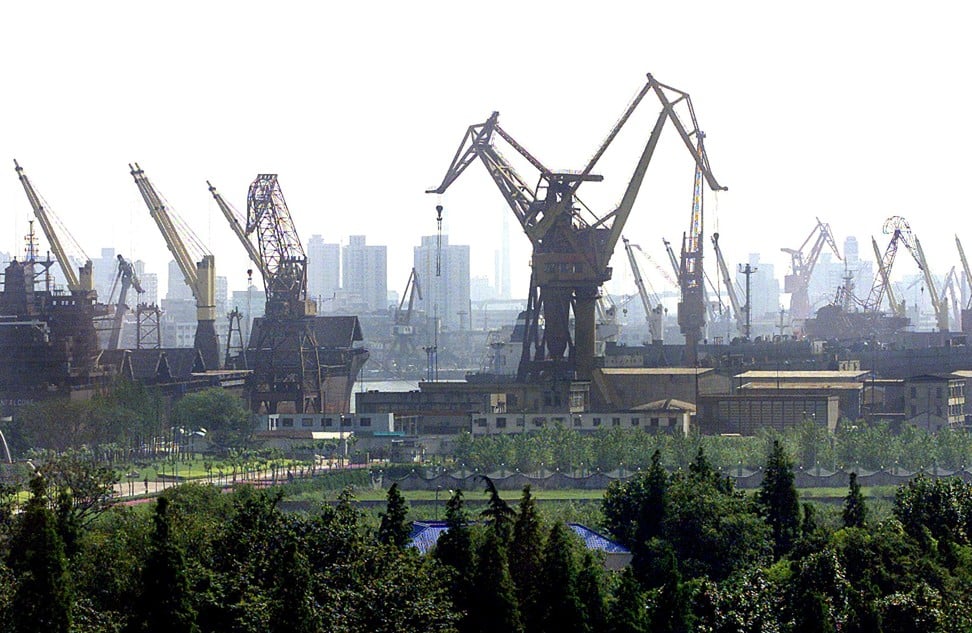
Quay cranes along a berth at the Yangshan deep-water port in Shanghai on September 14, 2011. Shanghai Zhenhua Heavy Machineries, established in 1992, has grown along with the explosive development of China’s ports to control 70 per cent of the global market for cranes, loaders and lifting equipment used in ports. Photo: Xinhua
The explosive growth of China’s container ports has turned one of the most important vendors in shipping into a best-in-class industry leader, whose cranes can now be found in 300 wharves in 100 countries, with 70 per cent of the global market share.
Shanghai Zhenhua Heavy Industries, a unit of China’s state-run construction behemoth China Communications Construction Company, makes quay cranes, gantry cranes, loaders and stackers used for loading and unloading shipping containers. It also developed the infrastructure for the automated berths in Phase IV of Shanghai’s Yangshan port, and in Qingdao.
Its net profit jumped 47.6 per cent last year to 443 million yuan, while sales was little changed at 21.8 billion yuan (US$3.25 billion).
“It is a major showcase of China’s manufacturing capability,” said Sun Can, a Chuancai Securities analyst. “The company has its own technologies and is a powerful player in the global port machinery industry.”
Why China now has six of the world’s 10 busiest container ports
Established in 1992, the company was formerly known as Zhenhua Port Machinery for its speciality in making lifting equipment on the harbourfront. Taking advantage of China’s low wages, Zhenhua quickly carved out a big chunk of the global market share by selling machines at lower prices than its competitors.
The company’s former chief executive Guan Tongxian, a confessed workaholic known for his hard-driving working ethic, retired at the age of 76 in 2009, the same year that the company renamed itself to reflect its forays into marine transport and installations, as well as the construction of special steel structures including the Las Vegas Ferris wheel, the San Francisco-Oakland Bay Bridge and Norway’s Hardangerfjord bridge.
Rows of gantry cranes standing along the Huangpu River in Shanghai on 26 June 2002. A consortium of Chinese domestic banks provided a 17 billion yuan (US$2 billion) credit line toward the construction of Shanghai’s Yangshan deep-sea container port. Photo: AFP
Share:
Listed on the Shanghai exchange in 1997, Zhenhua’s shares have risen 41 per cent in the past 12 months, ending 2.1 per cent lower at 4.46 yuan on Friday. All three analysts who cover the stock recommend their clients either “buy” or “accumulate” the stock, expecting Zhenhua to be a major winner in China’s megaplan to build infrastructure along the old Silk Road in its Belt and Road Initiative (BRI).
Another major company that has emerged with China’s rising tide was China International Marine Containers (Group), or CIMC, a unit of the state-run conglomerate China Merchants Group. Established in 1980, the company took a little more than a decade to dominate the global industry, becoming the world’s largest maker of shipping containers since 1996.
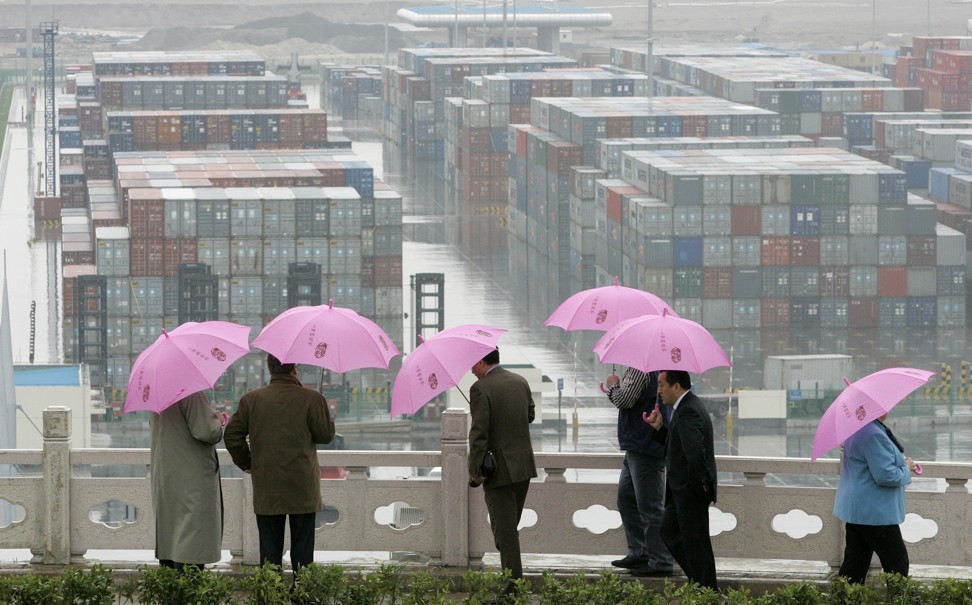
Visitors look at rows of containers at the Yangshan deep water port in Shanghai on April 6, 2006. Photo: AP
Share:
Net profit jumped 34.7 per cent to 3.38 billion yuan last year, while sales rose 22.5 per cent to 93.5 billion yuan.
The company has also diversified into land transport and vehicles, boarding bridges used in 200 airports around the world and even the development of industrial parks.
Guosen Securities said in a research report that CIMC would face lower profit margin this year amid rising raw material costs and fiercer competition from global rivals.
Its shares have risen 43.7 per cent in the past 12 months on the Shenzhen exchange to 15.20 yuan as of Friday.
Chinese State Councilor Wang Yong (C, back) speaks at a meeting ahead of the central government’s tour of inspection on provincial governments in production safety and fire control in Beijing, capital of China, April 10, 2019. (Xinhua/Ding Haitao)
BEIJING, April 10 (Xinhua) — Chinese State Councilor Wang Yong stressed Wednesday that major accidents must be prevented and contained.
Efforts should be made to stabilize and improve production safety and fire control, Wang said at a meeting ahead of the central government’s tour of inspection on provincial governments in these fields.
The tour of inspection is an important institutional arrangement that focuses on the implementation of the central authorities’ decisions and plans in production safety and fire control, Wang said.
Local governments which failed to rectify their problems and saw recurring accidents will be strictly held accountable, Wang said.
A specific inspection will be held for work related to dangerous chemical products, while checks will be made in coal and non-coal mines, transport, construction and fire control.
Local governments should live up to their supervision duties and take effective prevention measures to fundamentally keep safety accidents from happening, Wang said.








 CHINDIA ALERT: You'll be living in their world, very soon