24/05/2020

Chinese President Xi Jinping, also general secretary of the Communist Party of China Central Committee and chairman of the Central Military Commission, takes part in a deliberation with his fellow deputies from the delegation of Inner Mongolia Autonomous Region at the third session of the 13th National People’s Congress (NPC) in Beijing, capital of China, May 22, 2020. (Xinhua/Ju Peng)
BEIJING, May 23 (Xinhua) — “What is people first?” Chinese President Xi Jinping asked, before offering his own answer when he was talking with lawmakers at the ongoing national legislative session.
“So many people worked together to save a single patient. This, in essence, embodies doing whatever it takes (to save lives),” he said.
Xi, also general secretary of the Communist Party of China Central Committee and chairman of the Central Military Commission, is a deputy to the 13th National People’s Congress.
During his deliberations with fellow deputies from Inner Mongolia Autonomous Region on Friday, “people” was a keyword.
Xi referred to a story told by another deputy that morning. Luo Jie, from the COVID-19 hard-hit province of Hubei, told reporters at the session how medical workers in his hospital spent 47 days saving an 87-year-old COVID-19 patient.
“About 10 medical workers meticulously took care of the patient for dozens of days, and finally saved the patient’s life,” Xi said. “I am really impressed.”
In the COVID-19 pandemic, health workers around the world got to know the elderly are the most difficult to treat and require the most sophisticated medical resources. China has given every patient equal treatment irrespective of their age or wealth.

Chinese President Xi Jinping, also general secretary of the Communist Party of China Central Committee and chairman of the Central Military Commission, takes part in a deliberation with his fellow deputies from the delegation of Inner Mongolia Autonomous Region at the third session of the 13th National People’s Congress (NPC) in Beijing, capital of China, May 22, 2020. (Xinhua/Huang Jingwen)
In Hubei alone, more than 3,600 COVID-19 patients over the age of 80 have been cured. In the provincial capital Wuhan, seven centenarian patients have been cured.
“We mobilized from around the nation the best doctors, the most advanced equipment and the most needed resources to Hubei and Wuhan, going all out to save lives,” Xi said during the deliberations, adding that the eldest patient cured is 108 years old.
“We are willing to save lives at all costs. No matter how old the patients are and how serious their conditions have become, we never give up,” Xi said.
Xi joined political advisors and lawmakers on Thursday and Friday in paying silent tribute to the lives lost to COVID-19 as the top political advisory body and the national legislature opened their annual sessions.
This year’s government work report said China’s economy posted negative growth in the first quarter of this year, but it was “a price worth paying” to contain COVID-19 as life is invaluable.
“As a developing country with 1.4 billion people, it is only by overcoming enormous difficulties that China has been able to contain COVID-19 in such a short time while also ensuring our people’s basic needs,” the report said.
Epidemic response is a reflection of China’s governing philosophy.
The fundamental goal for the Party to unite and lead the people in revolution, development and reform is “to ensure a better life for them,” Xi said.
The nation’s average life expectancy reached 77 years in 2018, more than double that in 1949, when the people’s republic was founded.
Chinese people are not just living longer but better lives, with more material wealth and broader choices to pursue individual dreams. All rural poor will bid farewell to poverty this year as part of the goal of building a moderately prosperous society in all respects.
The Party’s long-term governance, Xi said, rests on “always maintaining close bond with the people.”
“We must always remain true to the people’s aspiration and work in concert with them through thick and thin,” Xi said.
Source: Xinhua
Posted in "a price worth paying", "What is people first?", 13th National People's Congress (NPC), 1949, 2018, advanced, age, around the world, at all costs, Beijing, better lives, broader choices, Building, capital of China, centenarian, Chairman of the Central Military Commission, China, China's, Chinese President Xi Jinping, close bond, COVID-19, Covid-19 pandemic, development, doctors, double, dreams, elderly, epidemic response, founded, fundamental goal, general secretary of the Communist Party of China Central Committee, goal, governing, health workers, Hubei, individual, inner mongolia autonomous region, irrespective, lead, Life expectancy, lives, living longer, long-term governance, maintaining, material wealth, medical workers, mobilized, moderately prosperous, nation, national legislature, negative growth, Party, Patient, People’s Republic, philosophy, political advisory body, poverty, provincial capital, pursue, reached, reflection, reform, reporters, revolution, rural poor, saves, society, sophisticated, thick and thin, this year, to unite, treatment, Uncategorized, wealth, Wuhan |
Leave a Comment »
02/05/2020
WINDHOEK, May 1 (Xinhua) — China’s poverty eradication policy and deliberate attempts to improve the lives of the rural population is a model for Namibia and Africa in general to follow in dealing with inequality in society, experts have said.
University of Namibia social and political analyst Ndumbah Kwamwayah said China has laid a strong foundation in dealing with poverty and emancipating its people since the days of Mao Zedong.
“Chinese literature especially the life journey of Chairman Mao is a good benchmark for developing countries that want to find ways of creating equal societies. If you check here in Namibia inequality and rural poverty are there despite our economy being agro-based.
“We need to take a cue from countries like China who have created better societies through improving agriculture production and mechanization through investing heavily in local people,” he said.
According to Kamwayah, China continues to value its agro-based economy as well as investment in rural development.
“China through its leaders in the past and present has come up with strong policies of decentralizing key services and also curbing rural urban drift through developing villages. Chinese literature also strongly captures the aspect of local development.
“In Namibia there are many regions including the Kunene, Zambezi and Kavango which are heavily affected by poverty. These need deliberate policies to be improved,” he said.
Political analyst from University of Namibia, Hoze Riruako said poverty eradication remains one of the biggest challenges confronting Namibia in contemporary times.
“What is more important is not to reproduce the Chinese way of doing things but to pick certain traits that can dent poverty and rural development from them,” he said.
Source: Xinhua
Posted in africa, agriculture production, agro-based, better societies, captures, chairman mao, challenges, China's, Chinese literature, confronting, contemporary, created, creating, dealing with poverty, decentralizing, deliberate attempts, developing, developing countries, economy, emancipating its people, equal societies, eradicate, especially, experts, find ways, good benchmark, improve, improving, inequality, Investing, Kavango, Kunene, leaders, life journey, lives, local people, Mao Zedong, mechanization, model, Namibia, policies, poverty, poverty eradication, poverty eradication policy, rural development, rural population, rural poverty, rural urban drift, social and political analyst, society, strong foundation, Uncategorized, University of Namibia, villages, WINDHOEK, Zambezi |
Leave a Comment »
02/05/2020

People work at a construction site of a utility tunnel in Wuhan, central China’s Hubei Province, April 30, 2020. (Xinhua/Xiao Yijiu)
BEIJING, May 1 (Xinhua) — China is getting the world’s largest workforce back to work as the nationwide battle against COVID-19 has secured major strategic achievements.
The unprecedented fight has nurtured new trends in the workplace. For example, more attention is being paid to public health and e-commerce to boost consumption and emerging sectors brought by new applications based on the country’s rapid new infrastructure development of 5G networks and data centers.

In this aerial photo taken on April 29, 2020, representatives of frontline health workers fighting COVID-19 attend a bell-ringing ceremony at the Yellow Crane Tower, or Huanghelou, a landmark in Wuhan, central China’s Hubei Province. (Xinhua/Xiao Yijiu)
ANGELS OF PUBLIC HEALTH
Ye Man, head nurse of gastrointestinal department of Hubei General Hospital East District, one of the five remaining COVID-19 designated hospitals in Wuhan, is taking her first weeklong vacation since January.
The 34-year-old mother of two started to take a week off on Monday, one day after her hospital cleared all remaining confirmed COVID-19 patients. The nine ICU wards in her hospital had been kept occupied over the past several months.
Friday marked International Workers’ Day, and the start of China’s five-day public holiday. Ye said she planned to visit urban parks with her family during the holiday.
At her busiest point, she and her colleagues took care of a ward filled with 40 COVID-19 patients.
“It was a really tough time,” she recalled. She had to wear a protective gown and a mask for nine hours a day and be separated from her family to avoid possible cross-infections.
Wuhan, capital of central China’s Hubei Province and once hard hit by COVID-19, cleared all confirmed cases in hospitals on April 26. Over 42,000 medical workers mobilized nationwide to aid Hubei have contributed to achieving a decisive outcome in the fight to defend Hubei and Wuhan.
In an inspection tour to Wuhan on March 10, President Xi Jinping, also general secretary of the Communist Party of China Central Committee and chairman of the Central Military Commission, lauded medical workers as “the most beautiful angels” and “messengers of light and hope.”
To reward brave and dedicated medics, major tourist sites in Hubei are offering free entry to medical staff over the following two years.

Chinese President Xi Jinping, also general secretary of the Communist Party of China Central Committee and chairman of the Central Military Commission, learns about development of the black fungus industry in Jinmi Village of Xiaoling Township in Zhashui County, Shangluo City, northwest China’s Shaanxi Province, April 20, 2020. (Xinhua/Xie Huanchi)
LIVESTREAMING ANCHORS
“We have a new batch of supplies today. Those who did not get the goods should hurry to buy now,” said Li Xuying, a livestreaming anchorwoman selling agaric mushrooms in Zhashui, a small county deep in the Qinling Mountains in northwest China’s Shaanxi Province.
Li has been prepared for a boom of online shopping in the holiday, because online buyers rushed to her livestreaming website to place orders, after Xi inspected the county and chatted with her in the village of Jinmi during a recent tour to Shaanxi.
“I used to sell goods worth about 50,000 yuan (7,070 U.S. dollars) on average after a six-hour livestreaming session. Now the sales are 10 times that,” she said.
Li was one of the 10 sales staff sent by the local agricultural e-commerce firm to Chinese e-commerce platform Taobao’s headquarters for livestreaming training. She said livestreaming is effective in bridging buyers and farmers, through which viewers can watch planting and harvesting online.
With the number of netizens in China reaching 904 million in March, e-commerce has been one of the popular means of promoting the sale of farm produce and helping farmers shake off poverty. Despite the impact of COVID-19, the country is determined to eradicate absolute poverty by the end of this year.

Workers work at the construction site of a 5G base station at Chongqing Hi-tech Zone in Chongqing, southwest China, April 15, 2020. (Xinhua/Wang Quanchao)
HI-TECH WORKERS IN “NEW INFRASTRUCTURE” BUILDING
As an elasticity calculation engineer of Alibaba Cloud, Zhao Kun and his colleagues always stay on alert for high data flow, for example, brought by the anticipated online shopping spike during the holiday.
“The profession, which may sound obscure, is actually closely connected to everyone’s life, as cloud computing is the infrastructure supporting high-tech applications of artificial intelligence and blockchain,” said Zhao.
The Chinese leadership has underscored expediting “new infrastructure” development to boost industrial and consumption upgrading and catalyze new growth drivers.
Seizing the opportunities of industrial digitization and digital industrialization, China needs to expedite the construction of “new infrastructure” projects such as 5G networks and data centers, and deploy strategic emerging sectors and industries of the future including the digital economy, life health services and new materials, President Xi has said.
During the epidemic, Zhao and his colleagues expanded more than 100,000 cloud servers to ensure the stable operation of “cloud classrooms” and “cloud offices” for millions of people working and studying from home.
In the “new infrastructure” building, people like Zhao contribute to constructing the virtual infrastructure of an ecosystem, which enables e-commerce, e-payment, online teaching and the digital transformation of manufacturing and supply chain management.
In early April, China released a plan on promoting the transformation of enterprises toward digitalization and intelligence by further expanding the application of cloud and data technologies, to nurture new business models of the digital economy.
Source: Xinhua
Posted in "cloud classrooms", "cloud offices", "messengers of light and hope.", "new infrastructure", "the most beautiful angels", 2020, 5G base station, 5G networks, achievements, against, agaric mushrooms, Alibaba Cloud, ANGELS, anticipated, application, April, Artificial intelligence, attend, attention, back, based on, battle, Beijing, bell-ringing ceremony, black fungus industry, blockchain, boost, brave, brought by, Building, busiest point, capital, central China's, Chairman of the Central Military Commission, China, China's, Chinese e-commerce platform, Chinese leadership, Chongqing, Chongqing Hi-tech Zone, cleared, cloud and data technologies, Cloud computing, cloud servers, colleagues, confirmed, connected, constructing, construction site, consumption, contribute, country's, COVID-19, data centers, dedicated, designated hospitals, digital economy, digital industrialization, digital transformation, digitalization, driving, E-commerce, e-payment, ecosystem, elasticity calculation engineer, emerging sectors, end of this year., endorses, enterprises, eradicate absolute poverty, everyone's life, expanding, expediting, Family, farm produce, farmers, fight, fighting, first, five, five-day, following, For example, free entry, Friday, frontline, gastrointestinal department, general secretary of the Communist Party of China Central Committee, getting, health workers, helping, HI-TECH WORKERS, high data flow, high-tech applications, Holiday, Home, Hospital, Huanghelou, Hubei, Hubei General Hospital East District, hubei province, ICU wards, industrial digitization, Infrastructure, intelligence, International Workers' Day, January, Jinmi Village, kept occupied, landmark, lauded, LIVESTREAMING ANCHORS, local agricultural e-commerce firm, Major, Management, Manufacturing, March, marked, mask, medical staff, medical workers, medics, mobilized, Monday, mother, nationwide, netizens, new applications, new business models, new growth, new infrastructure development, new trends, nine, northwest China's, nurtured, obscure, offering, on alert, Online shopping, online teaching, patients, plan, planned, popular, poverty, President Xi Jinping, professional, promoting, protective gown, Public health, public holiday, Qinling Mountains, rapid, released, remaining, representatives, reward, secured, selling, several months, shake off, Shangluo City, Southwest China, spike, stable operation, start, strategic, studying, Supply chain, Taobao's headquarters, to nurture, to work, tourist sites, transformation, two years, Uncategorized, underscored, unprecedented, urban parks, utility tunnel, virtual infrastructure, visit, ward, weeklong vacation, workers, working, workplace, world's largest workforce, Wuhan, Xi, Xiaoling Township, Yellow Crane Tower, Zhashui, Zhashui County |
Leave a Comment »
30/04/2020
– The last nine poverty-stricken county-level regions in east China’s Anhui Province have been removed from the country’s list of impoverished counties.
– This marks that all county-level regions in the Yangtze River Delta, consisting of Shanghai and the provinces of Jiangsu, Zhejiang and Anhui, have been officially lifted out of poverty for the first time in history.
HEFEI, April 29 (Xinhua) — Sitting in front of his smartphone, Zhang Chuanfeng touts dried sweet potatoes to viewers on China’s popular video-sharing app Douyin, also known as TikTok.
“These are made from sweet potatoes I grew myself. They are sweet and have an excellent texture,” said Zhang while livestreaming in Tangjiahui Township of Jinzhai County in east China’s Anhui Province. Tucked away in the boundless Dabie Mountains, the township used to have the biggest poor population in the county.

Aerial photo taken on April 16, 2020 shows residential buildings in Dawan Village of Jinzhai County, east China’s Anhui Province. (Xinhua/Liu Junxi)
Jinzhai County is among the last nine county-level regions in Anhui that have been removed from the country’s list of impoverished counties, according to an announcement issued by the provincial government Wednesday. They are also the last group of county-level regions that bid farewell to poverty in the Yangtze River Delta.
E-COMMERCE
Zhang might seem like a typical e-commerce businessman reaping success in China’s booming livestreaming industry. But his road to success has been a lot bumpier: he suffers from dwarfism.
A little more than 1.4 meters tall, Zhang has a babyface, making him “look like a junior school student,” he said. But the man, 38, is the father of a nine-year-old boy.
For Zhang, life was tough before 2014. “Nobody wanted me because of my ‘disabilities’ when I went out to look for jobs,” he said. “I was turned down again and again.”
Zhang was put on the government’s poverty list in 2014 as China implemented targeted poverty-relief measures. With the help of local officials, he got a bank loan of 10,000 yuan (about 1,400 U.S. dollars) and bought 22 lambs. He tended the animals whole-heartedly and seized every opportunity to learn how to raise them more professionally.

Zhang Chuanfeng feeds his lambs in Zhufan Village of Jinzhai County, east China’s Anhui Province, April 26, 2017. (Xinhua/Zhang Duan)
Within a year, the number of his lambs expanded to hundreds. In 2016, Zhang’s earnings exceeded 100,000 yuan, more than enough for him to cast off poverty.
Riding on this success, Zhang began to seek new opportunities. He rented a shop and started selling products online to embrace an e-commerce strategy the local government introduced in 2017.
More than 100 online shops, including Zhang’s, in the county have helped more than 7,000 poverty-stricken households sell about 73 million yuan worth of local specialties since 2018. Zhang alone earned 500,000 yuan from a sales revenue of 5 million yuan last year.

A villager arranges local specialties for sale at Dawan Village of Jinzhai County, east China’s Anhui Province, April 17, 2020. (Xinhua/Liu Junxi)
WICKERWORK SUCCESS
About 100 km north of Jinzhai lies Funan, a place that used to be vulnerable to constant floods.
Zhang Chaoling, who lives by the Huaihe River in Funan County, had to flee her hometown at a young age due to floods, but has flourished on a willow plantation along the river later.
“The land is largely covered by silt following continual flooding in the past. It is an ideal place to plant willows and make wickerwork,” Zhang said.
Zhang left her hometown for Guangzhou in 1993 and found a job in a garment factory. A few years later, she founded a trading company with her husband in Guangzhou, selling wickerwork products from her hometown to other countries.
Zhang returned to her hometown and set up a wickerwork production base in 2011. Funan is famous for its delicate wickerwork. Skilled craftsmen traditionally use local willow as a raw material to weave products such as baskets, furniture and home decorations.

A villager arranges wickerwork products in Funan County, east China’s Anhui Province, April 15, 2020. (Photo by Zhou Mu/Xinhua)
“The flood is well controlled now. I remember the last huge flood came in 2007,” Zhang said.
Taking advantage of the fertile land along the Huaihe River, she plants over 130 hectares of willow trees and employs hundreds of locals mostly in their 50s and 60s.
“I can process 100 to 150 kg of willow twigs per day, from which I make around 80 yuan,” said Geng Shifen, who peels willow twigs with a clamp next to the plantation.
A total of 130,000 people are engaged in the wickerwork industry in Funan, creating an output of nearly 9 billion yuan in 2019, and helping 15,000 locals shake off poverty, local statistics showed.
POVERTY REDUCTION FEAT
The Anhui provincial government Wednesday announced that its last nine county-level regions including Jinzhai and Funan are removed from the country’s list of impoverished counties.
This marks that all 31 impoverished county-level regions in Anhui have shaken off poverty, echoing China’s efforts to eradicate absolute poverty by the end of 2020.
With the announcement, all county-level regions in the Yangtze River Delta have been officially lifted out of poverty for the first time in history.

A bus runs on a rural road in Jinzhai County, east China’s Anhui Province, April 17, 2020. (Xinhua/Liu Junxi)
Covering a 358,000-square-km expanse, the Yangtze River Delta, consisting of Shanghai and the provinces of Jiangsu, Zhejiang and Anhui, is one of the most populated and economically dynamic areas in China, contributing one-fourth of the country’s GDP.
Anhui had a population of 63.65 million as of 2019, official data showed. The poor population in the province had decreased from 4.84 million in 2014 to 87,000 in 2019, and the poverty headcount ratio had been reduced from 9.1 percent to 0.16 percent during the period, according to the provincial poverty relief office.
A county can be removed from the list if its impoverished population drops to less than 2 percent, according to a national mechanism established in April 2016 to eliminate poverty in affected regions. The ratio can be loosened to 3 percent in the western region.
By the end of 2019, 5.51 million people in China were still living in poverty.
“We will continue our work to prevent people from returning to poverty, and help the remaining poor population shake off poverty by all means,” said Jiang Hong, director of the Anhui provincial poverty relief office.
Source: Xinhua
Posted in 100, 100,000, 1993, 2014, 2016, 2017, 2018, 7,000, also known as, Anhui, Anhui province, animals, announcement, £500,000, babyface, bank loan, baskets, began, bid farewell, biggest, booming, bought, boundless, boy, bumpier, businessman, cast off, China's, constant, continual, counties, country's, county, county-level, covered, Dabie Mountains, decorations, disabilities, dried sweet potatoes, dwarfism, E-commerce, e-commerce strategy, earnings, east China's, embrace, enough, exceeded, expanded, father, first time, flee, flooding, floods, flourished, following, Funan, Funan County, furniture, garment factory, Guangzhou, helped, History, hometown, households, Huaihe River, hundreds, ideal, impoverished, in front, including, industry, introduced, Jiangsu, Jinzhai County, jobs, lambs, land, last nine, last year, lifted out of poverty, list, livestreaming, Local government, local officials, local specialties, marks, more than, Nobody, officially, online, online shops, opportunity, out of poverty, past, place, Plant, plantation, poor population, popular, poverty, poverty-relief measures, poverty-stricken, products, professionally, provinces, provincial government, raise, reaping, regions, removed, rented, Revenue, Riding, River, road to success, seek, seized, selling, Shanghai, shop, silt, Sitting, Skilled craftsmen, smartphone, started, success, suffers, Tangjiahui Township, tended, TikTok, tough, touts, township, Tucked away, typically, Uncategorized, video-sharing app, viewers, vulnerable, Wednesday, whole-heartedly, WICKERWORK, willow, willows, worth, Xinhua Headlines, Yangtze River Delta, young age, yuan, Zhang, Zhang's, Zhejiang |
Leave a Comment »
29/04/2020
BEIJING, April 28 (Xinhua) — China has achieved much progress in environmental protection and taken the lead in green development in recent years.
The efforts have exemplified Chinese President Xi Jinping’s proposal of “working together for a green and better future for all” made a year ago in his speech at the opening ceremony of the International Horticultural Exhibition 2019 Beijing.
In the keynote speech, Xi proposed a five-point initiative on promoting green development, namely pursuing harmony between man and nature, pursuing the prosperity based on green development, fostering a passion for nature-caring lifestyle, pursuing a scientific spirit in ecological governance, and joining hands to tackle environmental challenges.
China’s hard work on environment protection has paid off.
The ecological environment has improved significantly. People are enjoying more days of blue sky, cleaner water, and fertile land.
China has achieved the goal of zero growth of desertified land by 2030 set by the United Nations ahead of time. Besides, forest stock volume increased by 4.56 billion cubic meters compared with that of 2005.
Carbon dioxide emissions per unit of GDP in 2018 fell by 45.8 percent compared with that of 2005, exceeding the target set for the year.
After more than 30 years of hard work, the seventh largest desert in China, the Kubuqi Desert in Inner Mongolia Autonomous Region, once known as the “sea of death” difficult for birds to fly across, has turned into a green valley.
In January 2020, in a letter in reply to the student representatives of the Global Alliance of Universities on Climate, the Chinese president mentioned his thoughts about ecological civilization in his youth.
“Over four decades ago, I lived and worked for many years in a small village on the Loess Plateau in western China. Back then, the ecology and environment there was seriously damaged due to over-development and the local people were trapped in poverty as a result,” Xi wrote.
“This experience taught me that man and nature are a community of life and that the damage done to nature will ultimately hurt mankind,” said Xi.
China’s progress and achievements are recognized worldwide.
The ecological civilization and green development advocated by China are actually an endeavor to find a way to balance economic development and environmental protection, said John Cobb, Jr., the founding president of the Institute for Postmodern Development of China and member of the American Academy of Arts and Sciences.
Noting that the endeavor is a remarkable exploration, he expressed his hope that it will succeed.
China is on the right path in dealing with global climate change and achieving sustainable development, said Borge Brende, president of the World Economic Forum.
In addition to making efforts at home, China has also rolled out a series of measures to support the global combat against climate change.
In September 2015, ahead of the Paris climate change conference, Xi pledged a 20-billion-yuan (3-billion-U.S. dollars) China South-South Climate Cooperation Fund, which was dedicated to help other developing countries combat climate change.
China has also been fulfilling the obligations of the United Nations Framework Convention on Climate Change and the Paris Agreement, and achieved the goal of its intended nationally determined contributions submitted to the secretariat of the Climate Change Convention as scheduled.
UN Secretary-General Antonio Guterres expressed his appreciation for China’s important contributions to addressing the climate change and building a green “Belt and Road,” and said he expects China to continue to play a leading role in addressing the climate change and other issues.
“Lucid waters and lush mountains are invaluable assets,” a concept put forward by Xi in 2005 when he visited Yucun Village in southeast China’s Zhejiang Province as the party chief of the province, has become the motto of the Lao Ministry of Natural Resources and Environment.
In March 2020, when Xi returned to Yucun, he said that economic development should not be achieved at the expense of the ecological environment. To protect the ecological environment is to develop the productive forces, he said.
The history of civilizations shows that the rise or fall of a civilization is closely tied to its relationship with nature, Xi said at the International Horticultural Exhibition last year.
Only by joining hands can the humankind advance a global ecological civilization and march towards the bright future of building a community with a shared future for mankind.
Source: Xinhua
Posted in "lucid waters and lush mountains are invaluable assets.", "sea of death", "working together for a green and better future for all", 2005, 2015, 2018, 2019, 2020, 2030, 30, achieved, addressing, advance, ago, ahead of time, American Academy of Arts and Sciences, appreciation, Beijing, Belt and Road, Besides, between, billion cubic meters, blue sky, bright future, Building, carbon dioxide emissions, China, China South-South Climate Cooperation Fund, Chinese president, Chinese President Xi Jinping's, civilization, cleaner water, climate change, Climate Change Convention, closely tied, combat climate change, community, community of life, compared, concept, concrete actio, damaged, decades, dedicated, desertified land, developing countries, difficult, ecological civilization, ecological environment, ecological governance, Ecology, Economic development, efforts, enjoying, Environment, environmental challenges, Environmental protection, exceeding, exemplified, expense, experience, fell by, fertile land, five-point initiative, for birds to fly across, forest stock volum, fostering, four, GDP, global, Global Alliance of Universities on Climate, global combat, global ecological civilization, goal, green development, green valley, hard work, has improved, history of civilizations, humankind, hurt, important contributions, increased, inner mongolia autonomous region, Institute for Postmodern Development of China, International Horticultural Exhibition, January, joining hands, keynote speech, Kubuqi Desert, Lao Ministry of Natural Resources and Environment., last year, leads, lived, local people, Loess Plateau, man and nature, mankind, many years, March, mentioned, more days, motto, nature, nature-caring lifestyle, opening ceremony, over-development, Paris Agreement, Paris climate change conference, party chief, passion, People, per unit, percent, pledged, poverty, progress, proposal, prosperity, province, pursuing, pursuing harmony, put forward, recent years, relationship, result, rise or fall, scheduled, scientific spirit, September, seriously, seventh largest desert, shared future, significantly, small village, southeast China's, speech, taught, thoughts, to help, to tackle, trapped, turned into, ultimately, Uncategorized, United Nations, United Nations Framework Convention on Climate Change, Western China, with, worked, World Economic Forum, Xi, year ago, years, Youth, Yucun, zero growth, zhejiang province |
Leave a Comment »
22/04/2020
- Documentary puts China’s literary hero into context: there is Dante, there’s Shakespeare, and there’s Du Fu
- Theatrical legend Sir Ian McKellen brings glamour to beloved verses in British documentary
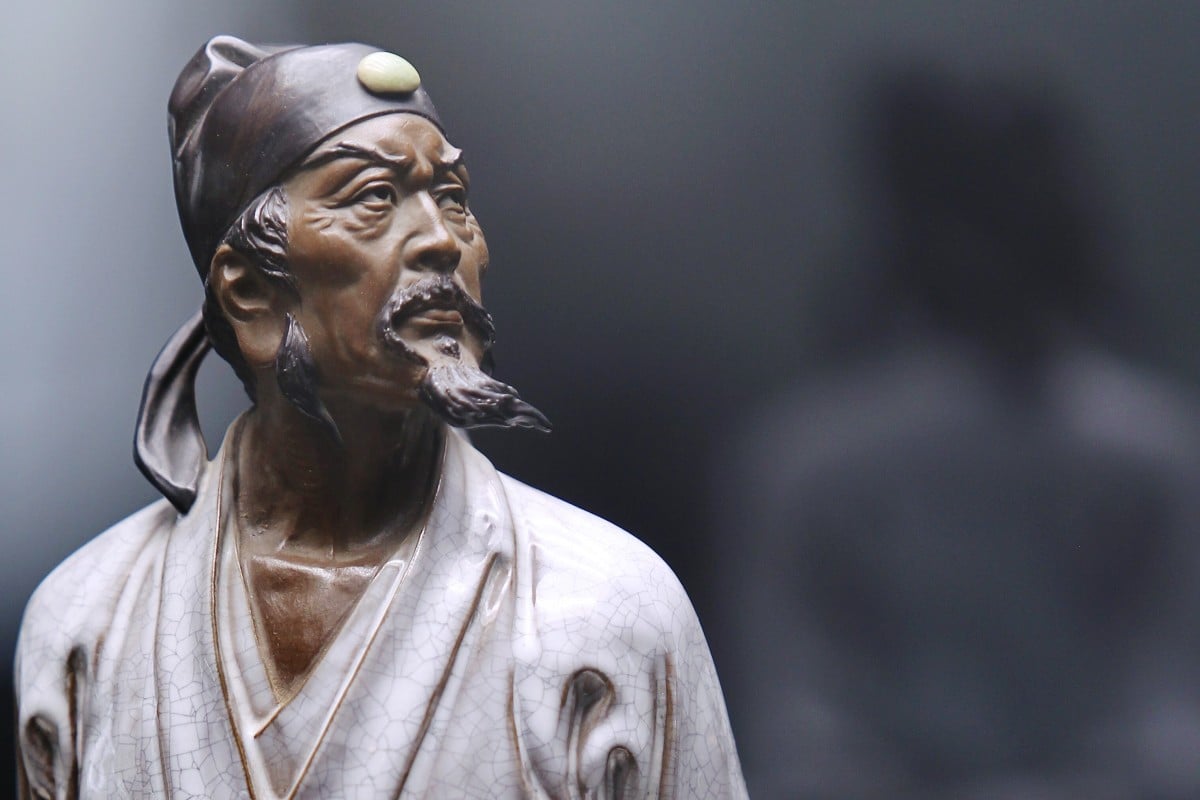
A ceramic figurine of Du Fu, a prominent Chinese poet of the Tang dynasty. Du is the subject of a new BBC documentary, thrilling devotees of his poetry. Photo: Simon Song
The resonant words of an ancient Chinese poet spoken by esteemed British actor Sir Ian McKellen have reignited in China discussion about its
literary history and inspired hope that Beijing can tap into cultural riches to help mend its image in the wake of
the coronavirus pandemic.
The BBC documentary Du Fu: China’s Greatest Poet has provoked passion among Chinese literature lovers about the poetic master who lived 1,300 years ago.
Sir Ian Mckellen read works of ancient Chinese poet Du Fu in Du Fu: China’s Greatest Poet. Photo: BBC Four / MayaVision International
The one-hour documentary by television historian Michael Wood was broadcast on television and aired online for British viewers this month but enthusiasm among Chinese audiences mean the trailer and programme have been widely circulated on video sharing websites inside mainland China, with some enthusiasts dubbing Chinese subtitles.
The documentary has drawn such attention in Du’s homeland that even the Communist Party’s top anti-graft agency has discussed it in its current affairs commentary column. Notably, Wood’s depiction of Du’s life from AD712 to 770 barely mentioned corruption in the Tang dynasty (618-907) government.
“I couldn’t believe it!!” Wood said in an email. “I’m very pleased of course … most of all as a foreigner making a film about such a loved figure in another culture, you hope that the Chinese viewers will think it was worth doing.”
Often referred to as ancient China’s “Sage of Poetry” and the “Poet Historian”, Du Fu witnessed the Tang dynasty’s unparalleled height of prosperity and its fall into rebellion, famine and poverty.
Writer, historian and presenter Michael Wood followed the footsteps of the ancient Chinese poet Du Fu in Yangtze River gorges. Photo: BBC Four / MayaVision International
Wood traced Du’s footsteps to various parts of the country. He interviewed Chinese experts and Western sinologists, offering historical and personal contexts to introduce some of Du’s more than 1,400 poems and verses chronicling the ups and downs of his life and China.
The programme used many Western reference points to put Du and his works into context. The time Du lived in was described as around the as the Old English poem
Beowulf was composed and the former Chinese capital, Changan, where
Xian is now, was described as being in the league of world cities of the time, along with Constantinople and Baghdad.
Harvard University sinologist Stephen Owen described the poet’s standing as such: “There is Dante, there’s Shakespeare, and there’s Du Fu.”
The performance of Du’s works by Sir Ian, who enjoyed prominence in China with his role as Gandalf in the Lord of the Rings movie series, attracted popular discussion from both media critics and general audiences in China, and sparked fresh discussion about the poet.
“To a Chinese audience, the biggest surprise could be ‘Gandalf’ reading out the poems! … He recited [Du’s poems] with his deep, stage performance tones in a British accent. No wonder internet users praised it as ‘reciting Du Fu in the form of performing a Shakespeare play,” wrote Su Zhicheng, an editor with National Business Daily.
A stone sculpture at Du Fu Thatched Cottage in Chengdu city, China. Photo: Handout
On China’s popular Weibo microblog, a viewer called Indifferent Onlooker commented on Sir Ian’s recital of Du’s poem My Brave Adventures: “Despite the language barrier, he conveyed the feeling [of the poet]. It’s charming.”
Some viewers, however, disagreed. At popular video-sharing website Bilibili.com, where uploads of the documentary could be found, a viewer commented: “I could not appreciate the English translation, just as I could not grasp Shakespeare through his Chinese translated works in school textbooks.”
Watching the documentary amid the coronavirus pandemic, some internet users drew comparisons of Du to Fang Fang, a modern-day award-winning poet and novelist who chronicled her life in Wuhan during the Covid-19 lockdown.

Shanghai pictured in April. Devastation wrought by the coronavirus pandemic has brought about a new suspicion of China. Photo: Bloomberg
The pandemic has infected more than 2.5 million people and killed more than 170,000. It has put the global economy in jeopardy, fuelling calls for accountability. British Foreign Secretary Dominic Raab last week called for a “deep dive” review and the asking of “hard questions” about how the coronavirus emerged and how it was not stopped earlier.
Steve Tsang, director of the SOAS China Institute at University of London, said the British establishment and wider public had changed its perception of Beijing as questions arose about outbreak misinformation and the political leverage of personal protective gear supply.
“The aggressive propaganda of the Chinese government is getting people in the UK to look more closely at China and see that it is a Leninist party-state, rather than the modernising and rapidly changing society that they want to see in China,” Tsang said.
On Sunday, a writer on the website of the National Supervisory Commission, China’s top anti-corruption agency, claimed – without citing sources – that the Du Fu documentary had moved “anxious” British audience who were still staying home under social distancing measures.
“If anyone wants to put the fear of the coronavirus behind them by understanding the rich Chinese civilisation, please watch this documentary on Du Fu,” it wrote, adding that promoting Du’s poems overseas could help “healing and uniting our shattered world”.
English-language state media such as CGTN and the Global Times reported on the documentary last week and some Beijing-based foreign relations publications have posted comments about the film on Twitter.
Wood said he had received feedback from both Chinese and British viewers that talked about “the need, especially now, of mutual understanding between cultures”.
“It is a global pandemic … we need to understand each other better, to talk to each other, show empathy: and that will help foster cooperation. So even in a small way, any effort to explain ourselves to each other must be a help,” Wood said.
He said the idea for producing a documentary about Du Fu started in 2017, after his team had finished the Story of China series for BBC and PBS.
Du Fu: China’s Greatest Poet first aired in Britain on April 7 on BBC Four, the cultural and documentary channel of the public broadcaster. It is a co-production between the BBC and China Central Television.
Wood said a slightly shorter 50-minute version would be aired later this month on CCTV9, Chinese state television’s documentary channel.
The film was shot in China in September, he said.
“I came back from China [at the] end of September, so we weren’t affected by the Covid-19 outbreak, though of course it has affected us in the editing period. We have had to recut the CCTV version in lockdown here in London and recorded two small word changes on my iPhone!” Wood said.
Source: SCMP
Posted in 1,300, accountability, Actor, aired, amid, among, ancient poetry, anti-corruption agency, April, “deep dive”, “hard questions”, “healing and uniting our shattered world”, “Poet Historian”, “Sage of Poetry”, Baghdad, BBC, BBC Four, Beijing, beloved, Beowulf, brings, British, British Foreign Secretary, broadcast, brought, CCTV9, ceramic figurine, Changan, Chengdu, China, China Central Television, China’s, Chinese, Chinese audiences, Chinese capital, Chinese civilisation, Chinese experts, Chinese poet, Chinese subtitles, chronicling, co-production, composed, Constantinople, context, coronavirus, Coronavirus pandemic, COVID-19 outbreak, cultural riches, Dante, Devastation, devotees, different, director, discussion, documentary, downs, Du Fu, Du Fu Thatched Cottage, Du Fu: China’s Greatest Poet, dubbing, earlier, email, emerged, enthusiasm, enthusiasts, esteemed, fall, famine, Film, followed, footsteps, former, Gandalf, glamour, global economy, Global Times, gorges, Harvard University, height of prosperity, help mend, historian, hope, image, inside, inspired, into, iPhones, jeopardy, league of world cities, legend, literary hero, literary history, literature lovers, lived, lockdown, London, Lord of the Rings, Mainland China, mean, Michael Wood, National Business Daily, National Supervisory Commission, new, Old English poem, online, passion, PBS, poems, poetic master, poetry, poverty, presenter, programme, prominent, provoked, puts, rebellion, recorded, recut, reignited, resonant, review, September, Shakespeare, Shanghai, shot, show, side, sinologist, Sir Ian McKellen, SOAS China Institute, spoken, stopped, Story of China, subject, Sunday, suspicion, tap, Television, television historian, Theatrical, there, there’s, this month, thrilling, trailer, Twitter, Uncategorized, unease, University of London, unparalleled, UPS, verses, video sharing, viewers, wake, websites, Weibo, Western sinologists, widely circulated, witnessed, words, writer, wrought, Xi’an, Yangtze River, years ago |
Leave a Comment »
21/04/2020
BEIJING, April 21 (Xinhua) — Chinese President Xi Jinping attaches great importance to poverty alleviation. He has addressed the issue on many occasions. The following are some highlights of his quotes.
— It is an essential requirement of socialism to eradicate poverty, improve people’s living standards and achieve common prosperity among the people.
— No single poor area or individual shall be left behind.
— Genuinely poor people are to genuinely shake off poverty. Poverty must be truly eliminated.
— The measurement for moderate prosperity lies in rural areas.
— Cadres play a key role in helping people shake off poverty.
— Eradicating poverty is a common mission of human beings.
— It will be the first time in the millennia-old history of the Chinese nation that absolute poverty is comprehensively eliminated.
— Being lifted out of poverty is not an end in itself but the starting point of a new life and a new pursuit.
Source: Xinhua
Posted in absolute, achieve, addressed, attaches, Beijing, Being, but, cadres, Chinese nation, Chinese President Xi Jinping, common, comprehensively, eliminated, eradicate, essential, first time, Genuinely, great importance, helping, highlights, History, human beings, improve, individual, issue, itself, key role, lies, lifted out of poverty, living standards, many, measurement, millennia-old, mission, moderate, new life, new pursuit, not an end, occasions, People, people's, play, poor people, poverty, poverty alleviation, prosperity, Quotable, quotes, requirement, rural areas, shake off, single poor area, Socialism, starting point, Uncategorized |
Leave a Comment »
09/03/2020
BEIJING, March 8 (Xinhua) — China has rolled out a slew of measures to strengthen social assistance for people most in need and fight against poverty, the Ministry of Civil Affairs said Sunday.
A census targeting poor people will be launched to ensure those eligible are covered by the social security system and have access to supportive policies, the ministry said at a teleconference on poverty relief.
Efforts will be intensified to support disadvantaged groups, including the elderly, the disabled and minors who are incapable of working, have no source of income, and have no others to rely on for support, it said.
The ministry also stressed encouraging social organizations to participate in poverty relief and accelerating the implementation of charity projects to combat poverty.
Targeted assistance will be provided for areas of extreme poverty, said the ministry, calling for more relief projects, financial support and personnel training for these regions.
Source: Xinhua
Posted in against, Census, China, fight, issues, Ministry of Civil Affairs, new, policies, poverty, Uncategorized |
Leave a Comment »
04/03/2020
Zunyi, a former revolutionary base of the Communist Party of China in southwest China’s Guizhou Province, has cast off poverty.
Thanks to burgeoning industries, improving infrastructure and distinctive cultural tours, more than eight million people in Zunyi are living better lives.
By Xinhua writers Zhong Qun, Wang Li, Li Jingya and Liu Zhiqiang
GUIYANG, March 3 (Xinhua) — Riding on the fast development of industries, improving infrastructure and distinctive cultural tours, a former revolutionary site of the Communist Party of China (CPC) has formally cast off poverty in China’s southwestern mountains.
On Tuesday, the government of Guizhou Province announced that Zheng’an County in the province has shaken off poverty. The county is under the jurisdiction of the city of Zunyi, where the CPC conducted its early revolutionary activities. The announcement means that more than 8 million people in the entire city of Zunyi have officially bid farewell to poverty.

A view of Huamao Village of Fengxiang Township in Zunyi City, southwest China’s Guizhou Province, Feb. 28, 2020. (Xinhua/Tao Liang)
Over the years, Zunyi has taken a variety of measures in answer to China’s campaign to eradicate absolute poverty in 2020.
Major industries such as guitar-making and tea plantations powered Zunyi’s economic growth, while roads, water projects and the revolution-themed tourism also put the city, once mired in grinding poverty, on a fast track toward modernization.
GUITARS STRIKE A CHORD IN REVOLUTIONARY HEARTLAND
When Zheng Chuanjiu decided to build a guitar-making factory in Zunyi’s Zheng’an County in 2013, he was a little nervous.
“There were no raw materials, and transportation was bad,” said Zheng, 42. “But the county had advantages in land and labor and there was government support.”
Zheng, a native of the county, had found success in the guitar industry in Guangzhou, capital of south China’s Guangdong Province. He and his brother established the Guangzhou Shenqu Musical Instruments, a Guangzhou-based guitar-making company, after years of hard work in the southern metropolis.
“The county government of my hometown wanted to develop the guitar-making industry after they found many local migrant workers were working in the industry in Guangzhou,” Zheng said. “They established an industrial park and we were the first to join.”

An employee works at the workshop of Guangzhou Shenqu Musical Instruments, a Guangzhou-based guitar-making company, in Zheng’an County of Zunyi City, southwest China’s Guizhou Province, March 28, 2017. (Xinhua/Tao Liang)
The government put forward a variety of preferential policies in rents, financing and taxes, to support guitar-making companies like Zheng’s and allow the sector to prosper.
Today, Zheng’s company in the county has grown into one with an annual production value of more than 30 million U.S. dollars. One of the country’s top five guitar makers, it employs more than 500 local farmers and more than 100 poverty-stricken residents.
Zheng’s company is part of a bigger picture. The company’s success has led many to jump on the bandwagon. After years of growth, the county is now home to 64 companies specializing in guitar-related fields, churning out about 7 million guitars a year to more than 30 countries and regions across the world and employing more than 15,000 locals.
The guitar industry forms part of the government’s efforts to develop local industries. Thanks to geological advantages, the county also saw the emergence of tea gardens and traditional Chinese medicine plantations. All these sectors drove local economic growth.

A group of children trying tea-picking at Hetaoba Village in Meitan County of Zunyi City, southwest China’s Guizhou Province, April 1, 2018. (Xinhua/Yang Wenbin)
BETTER INFRASTRUCTURE, BETTER LIVES
Given the mountainous landscape in Guizhou, authorities in Zunyi knew the importance of improving infrastructure projects if they wanted to bring the local economy to the next level. So they started building new roads to facilitate transportation.
Last year, Guizhou built 8,116 km of roadways. The Guizhou provincial government spent 29.34 billion yuan (4.2 billion U.S. dollars) building the roadways, including 7,386 km in rural areas, according to the provincial highway bureau. The province also upgraded many old roadways.

The construction site of Tuanjie Grand Bridge of Renhuai-Zunyi Highway, which has resumed construction amid strict prevention measures against the novel coronavirus, in southwest China’s Guizhou Province, Feb. 27, 2020. (Xinhua/Tao Liang)
In the county of Zheng’an, for example, several major highways not only enhanced logistics to bring specialties out of town but also allowed outside investment to flow to the county tucked in the lush green mountains.
“Thanks to improved transportation conditions, our guitars can easily reach many areas in the country and around the world,” said Zheng Chuanjiu.
In Huanglian Village, rural family inns have mushroomed, as more visitors come as more roads were built. Many tourists come to enjoy the countryside scenes during the holidays.
In addition, water projects also began, bringing safe drinking water to local households.
“We used to depend on the weather for water,” said Zunyi resident Zeng Fanyun. “Now we have clean water from the taps.”
For areas deemed inhabitable, authorities moved people out.
Statistics show that Guizhou relocated 1.88 million people from inhospitable areas in 2019.
RED TOURS, GOLDEN OPPORTUNITIES
As many cities in China scramble to modernize and adopt the latest technology to power growth, Zunyi seems to have found a new way to develop itself by looking to the past.
In January 1935, an enlarged meeting of the Political Bureau of the CPC Central Committee took place in Zunyi during the Long March.
The meeting focused on rectifying the left-leaning errors in military and organizational affairs and established the correct leadership of the new Central Committee, as represented by Mao Zedong.
The Zunyi Meeting is regarded as a crucial turning point of the Long March, leading to the ultimate success of the Chinese revolution.
Since then, Zunyi has become a sacred place for generations of CPC members, and the footprints of the Red Army are forever imprinted on the city’s culture and spirit.
Today, local authorities are promoting “red tours” in the locality, aiming to bolster the tourism sector as part of economic growth.

Tourists are seen at the Memorial of Zunyi Meeting in Zunyi, southwest China’s Guizhou Province, Oct. 16, 2018. (Xinhua/Tao Liang)
Yang Zhirong started a family homestay in the county of Tongzi in Zunyi. The homestay is called “The Red Army Road Inn,” because it is close to the command center of a famous battle during the 1930s.
“During the summer holidays, there are barely enough rooms to accommodate all the tourists,” Yang said. “Because the Red Army used to walk near here, the visitors feel they could sense history by staying here.”
Last year, Zunyi received more than 46 million visitors for red tours, generating a revenue of about 35.5 billion yuan, up 24.1 percent year on year, according to official figures.
The red tours also prompted sales of local cultural products, such as handmade soap, wallets and fragrances, all featuring Red Army themes. Forums, hiking and even marathons feature red themes as well in Zunyi.
“Zunyi serves as a good example of the CPC’s ability and responsibility to help people live prosperous lives,” said Zheng Dongsheng, a professor with the Party School of the Guizhou Provincial Committee of the CPC. “Zunyi’s success to cast off poverty highlights the Long March spirit in the modern era.”
Source: Xinhua
Posted in "The Red Army Road Inn,", 1930s, burgeoning, casts off, Communist Party of China, cultural tours, distinctive, famous battle, footprints, former, forums, fragrances, green mountains, Guangzhou Shenqu Musical Instruments, Guitars, Guizhou Province, handmade soap, hiking, Huanglian Village, improving infrastructure, industries, Long March, Mao Zedong, marathons, Party School of the Guizhou Provincial Committee of the CPC, plantations, Political Bureau of the CPC Central Committee, poverty, provincial highway bureau, red tours, roads, tea gardens, the Red Army, Tongzi, Traditional Chinese medicine, transportation, Uncategorized, wallets, Zheng'an |
Leave a Comment »
17/02/2020

Chinese State Councilor and Foreign Minister Wang Yi (R) meets with Japanese Foreign Minister Toshimitsu Motegi on the sidelines of the 56th Munich Security Conference in Munich, Germany, Feb. 15, 2020. (Xinhua/Shan Yuqi)
MUNICH, Germany, Feb. 16 (Xinhua) — Chinese State Councilor and Foreign Minister Wang Yi on Saturday met Japanese Foreign Minister Toshimitsu Motegi on the sidelines of the 56th Munich Security Conference, with both pledging mutual support in the fight against the novel coronavirus epidemic (COVID-19).
Wang thanked Japan for its understanding and support for China’s fight against COVID-19, noting that stories of many Japanese people extending a helping hand to China have been spreading on the Chinese Internet, from which the Chinese people have felt the friendship and warmth from Japan as a neighbor.
The mutual support between China and Japan in this fight against the epidemic fully reflects the tradition of mutual help among Eastern countries, Wang said, adding that he believes the friendship between the two peoples will be further deepened.
Wang said that with the joint efforts of China and all parties, he believes the epidemic will end soon. The Chinese economy has been affected by the epidemic, but efforts can be made to make up for the losses. China’s goals of building a moderately prosperous society in an all-round way and winning the battle against poverty this year will certainly be achieved.
China is willing to continue to strengthen mutually beneficial cooperation with Japan in economy, trade, personnel exchanges and other aspects to jointly push bilateral strategic relations of mutual benefit to a new level, and bring more benefits to the two countries and peoples, Wang said.
For his part, Motegi said that China has made great efforts to control the spread of the virus, which Japan highly appreciates, and that he believes China will be able to overcome the epidemic at an early date.
Japan is willing to continue to fully support and help China, work closely with China to further deepen cooperation in various fields, and jointly prepare for important high-level exchanges between the two countries this year, so as to score new developments in Japan-China relations, said Motegi.
Source: Xinhua
Posted in 56th Munich Security Conference, affected, battle, Chinese economy, Chinese Internet, Chinese State Councilor and Foreign Minister Wang Yi, COVID-19, epidemic, Japan, Japan-China relationship, Japanese Foreign Minister, Japanese people, mutual support, neighbor, novel coronavirus epidemic, pledging, poverty, prosperous society, Toshimitsu Motegi, Uncategorized |
Leave a Comment »






 CHINDIA ALERT: You'll be living in their world, very soon