 Aerial photo taken on May 2, 2020 shows villagers planting rice seedlings in a terraced field in Gongxian County, southwest China’s Sichuan Province. (Xinhua/Jiang Hongjing)
Source: Xinhua
continuously updated blog about China & India

You will be living in their world, very soon

Beware the Waking Dragon
Aerial photo taken on May 2, 2020 shows villagers planting rice seedlings in a terraced field in Gongxian County, southwest China’s Sichuan Province. (Xinhua/Jiang Hongjing)
Source: Xinhua

People work at a construction site of a utility tunnel in Wuhan, central China’s Hubei Province, April 30, 2020. (Xinhua/Xiao Yijiu)
BEIJING, May 1 (Xinhua) — China is getting the world’s largest workforce back to work as the nationwide battle against COVID-19 has secured major strategic achievements.
The unprecedented fight has nurtured new trends in the workplace. For example, more attention is being paid to public health and e-commerce to boost consumption and emerging sectors brought by new applications based on the country’s rapid new infrastructure development of 5G networks and data centers.

In this aerial photo taken on April 29, 2020, representatives of frontline health workers fighting COVID-19 attend a bell-ringing ceremony at the Yellow Crane Tower, or Huanghelou, a landmark in Wuhan, central China’s Hubei Province. (Xinhua/Xiao Yijiu)
ANGELS OF PUBLIC HEALTH
Ye Man, head nurse of gastrointestinal department of Hubei General Hospital East District, one of the five remaining COVID-19 designated hospitals in Wuhan, is taking her first weeklong vacation since January.
The 34-year-old mother of two started to take a week off on Monday, one day after her hospital cleared all remaining confirmed COVID-19 patients. The nine ICU wards in her hospital had been kept occupied over the past several months.
Friday marked International Workers’ Day, and the start of China’s five-day public holiday. Ye said she planned to visit urban parks with her family during the holiday.
At her busiest point, she and her colleagues took care of a ward filled with 40 COVID-19 patients.
“It was a really tough time,” she recalled. She had to wear a protective gown and a mask for nine hours a day and be separated from her family to avoid possible cross-infections.
Wuhan, capital of central China’s Hubei Province and once hard hit by COVID-19, cleared all confirmed cases in hospitals on April 26. Over 42,000 medical workers mobilized nationwide to aid Hubei have contributed to achieving a decisive outcome in the fight to defend Hubei and Wuhan.
In an inspection tour to Wuhan on March 10, President Xi Jinping, also general secretary of the Communist Party of China Central Committee and chairman of the Central Military Commission, lauded medical workers as “the most beautiful angels” and “messengers of light and hope.”
To reward brave and dedicated medics, major tourist sites in Hubei are offering free entry to medical staff over the following two years.

Chinese President Xi Jinping, also general secretary of the Communist Party of China Central Committee and chairman of the Central Military Commission, learns about development of the black fungus industry in Jinmi Village of Xiaoling Township in Zhashui County, Shangluo City, northwest China’s Shaanxi Province, April 20, 2020. (Xinhua/Xie Huanchi)
LIVESTREAMING ANCHORS
“We have a new batch of supplies today. Those who did not get the goods should hurry to buy now,” said Li Xuying, a livestreaming anchorwoman selling agaric mushrooms in Zhashui, a small county deep in the Qinling Mountains in northwest China’s Shaanxi Province.
Li has been prepared for a boom of online shopping in the holiday, because online buyers rushed to her livestreaming website to place orders, after Xi inspected the county and chatted with her in the village of Jinmi during a recent tour to Shaanxi.
“I used to sell goods worth about 50,000 yuan (7,070 U.S. dollars) on average after a six-hour livestreaming session. Now the sales are 10 times that,” she said.
Li was one of the 10 sales staff sent by the local agricultural e-commerce firm to Chinese e-commerce platform Taobao’s headquarters for livestreaming training. She said livestreaming is effective in bridging buyers and farmers, through which viewers can watch planting and harvesting online.
With the number of netizens in China reaching 904 million in March, e-commerce has been one of the popular means of promoting the sale of farm produce and helping farmers shake off poverty. Despite the impact of COVID-19, the country is determined to eradicate absolute poverty by the end of this year.

Workers work at the construction site of a 5G base station at Chongqing Hi-tech Zone in Chongqing, southwest China, April 15, 2020. (Xinhua/Wang Quanchao)
HI-TECH WORKERS IN “NEW INFRASTRUCTURE” BUILDING
As an elasticity calculation engineer of Alibaba Cloud, Zhao Kun and his colleagues always stay on alert for high data flow, for example, brought by the anticipated online shopping spike during the holiday.
“The profession, which may sound obscure, is actually closely connected to everyone’s life, as cloud computing is the infrastructure supporting high-tech applications of artificial intelligence and blockchain,” said Zhao.
The Chinese leadership has underscored expediting “new infrastructure” development to boost industrial and consumption upgrading and catalyze new growth drivers.
Seizing the opportunities of industrial digitization and digital industrialization, China needs to expedite the construction of “new infrastructure” projects such as 5G networks and data centers, and deploy strategic emerging sectors and industries of the future including the digital economy, life health services and new materials, President Xi has said.
During the epidemic, Zhao and his colleagues expanded more than 100,000 cloud servers to ensure the stable operation of “cloud classrooms” and “cloud offices” for millions of people working and studying from home.
In the “new infrastructure” building, people like Zhao contribute to constructing the virtual infrastructure of an ecosystem, which enables e-commerce, e-payment, online teaching and the digital transformation of manufacturing and supply chain management.
In early April, China released a plan on promoting the transformation of enterprises toward digitalization and intelligence by further expanding the application of cloud and data technologies, to nurture new business models of the digital economy.
Source: Xinhua

A farmer works in a field in Fanjiatai Village of Difang Town, Pingyi County, Linyi City, east China’s Shandong Province, April 18, 2020. The upcoming Guyu, literally meaning “Rain of Millet”, is the sixth of the 24 solar terms created by ancient Chinese to carry out agricultural activities. For the year 2020, the day of Guyu falls on April 19. (Photo by Wu Jiquan/Xinhua)
Source: Xinhua
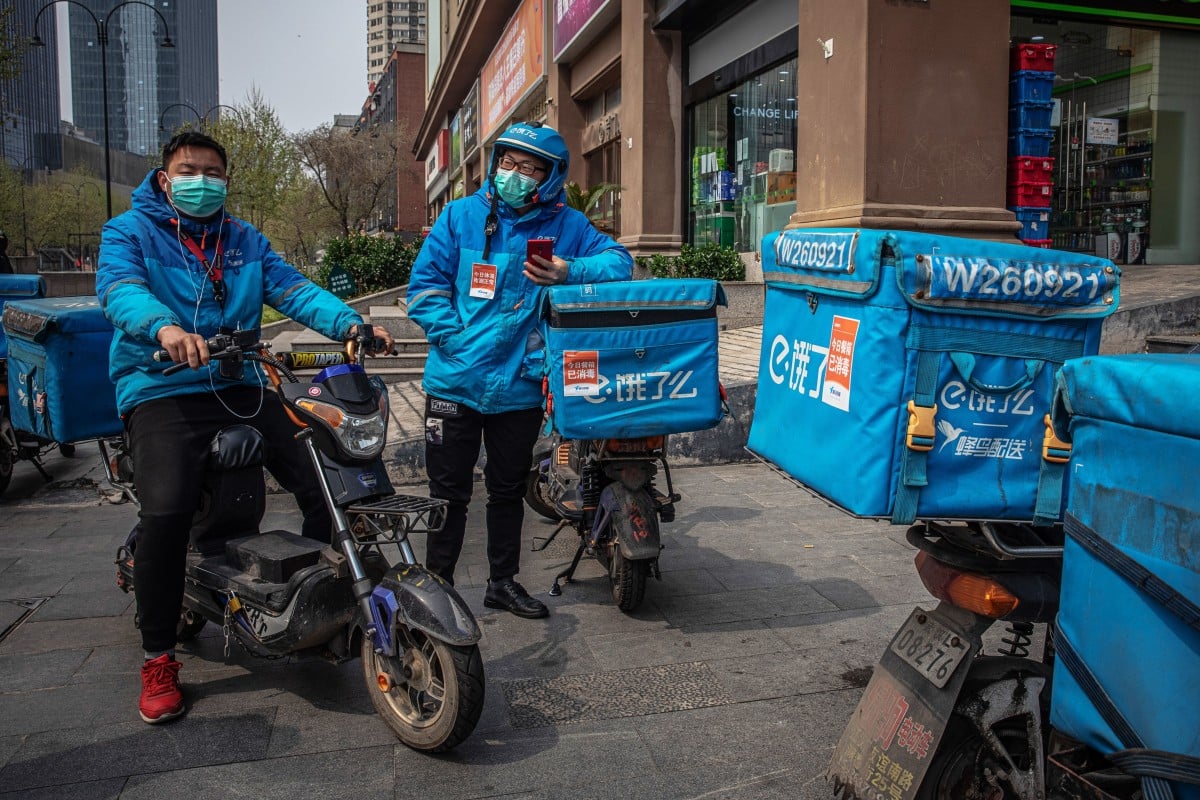
spreading in the central Chinese city he started to stock up on supplies such as rice, oil, noodles and dried pork and fish.
and shoppers flooded to the markets and malls to snap up supplies.
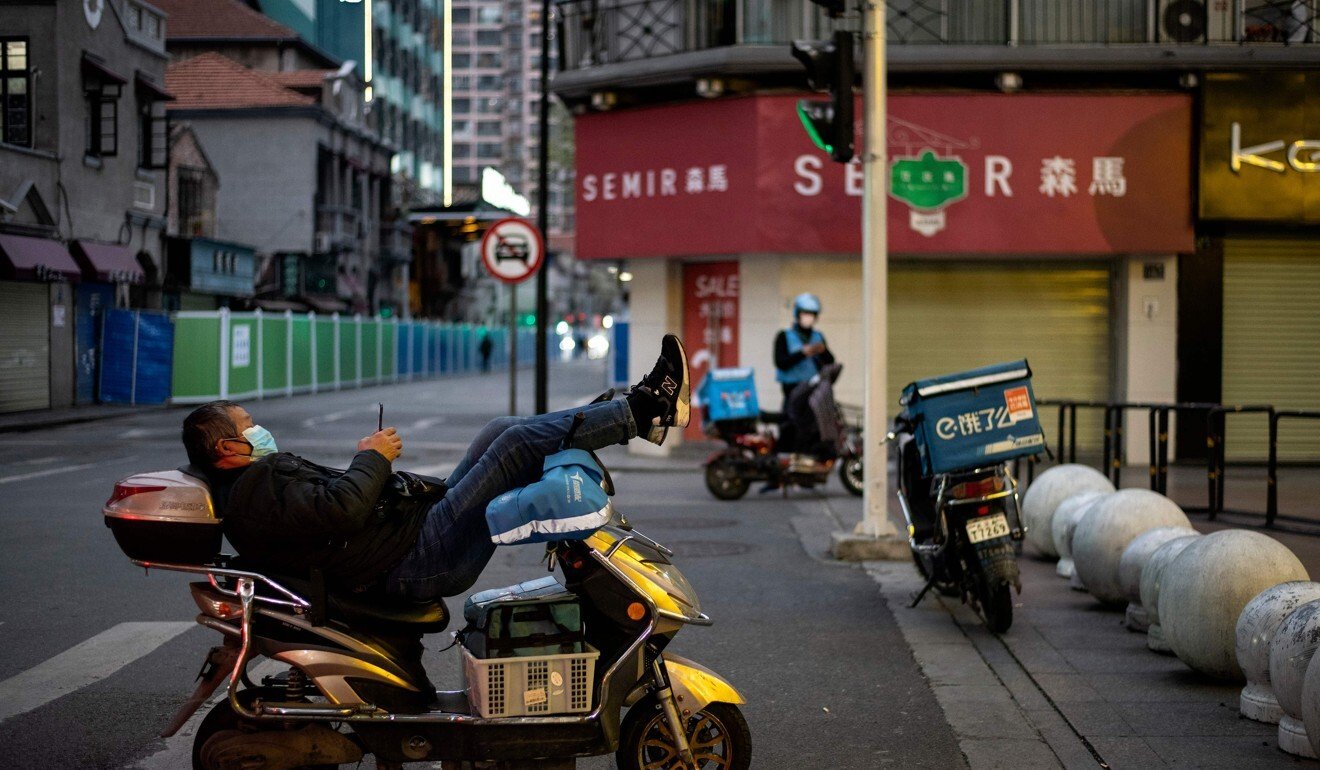
Hu Xingdou, a Beijing-based independent political economist said: “Home delivery played a very important role amid the coronavirus outbreak. To some extent, it prevented people from starving especially in cases when local governments took extreme measures to isolate people.”
According to Liu, people in Wuhan during the lockdown had to stay within their residential communities, with community workers guarding the exits.
Human contact was limited to the internet. Residents placed orders online with farmers, small merchants or supermarkets to buy daily necessities, and community workers helped distribute the goods from deliverymen.
Every morning, Liu passed a piece of paper with his name, phone number and order number to a community worker who would collect the items from a courier at the gate of the residential area.
Thanks to a high population density in urban areas, affluent labour force and people’s openness to digital life, China has built a well-developed home delivery network.
Extensive funding from technology companies has been invested in hardware infrastructure, software to improve logistics and big data and cloud computing to help predict consumers’ behaviour.
Mark Greeven, professor of innovation and strategy at IMD Business School in Lausanne, Switzerland, said: “Whether it is delivery of products, air parcels or fresh food or even medicine or materials for medical use, China has a very well developed system. Much better developed than I think almost any other places in the world.
“Well before the crisis, China had started to embrace digital technology in daily life whether it is in consumption, business, government and smart cities and use of third party payments. All of these things have been in place for a long time and the crisis tested its agility and capability to deal with peak demand.”
China’s e-commerce giants help revive sales of farm goods from Hubei

MUMBAI (Reuters) – India’s richest state is set to be ruled by parties opposed to Prime Minister Narendra Modi’s nationalist Bharatiya Janata Party, jeopardising a Japanese-backed bullet-train project opposed by farmers.
The BJP’s inability to pull together voters in the westerly state of Maharashtra, of which Mumbai is capital, has meant that three parties, including a former BJP ally, will form the government. That is a major setback for Modi after his landslide victory in general elections this year.
It could also hinder the bullet train project, a $17 billion investment largely financed by a long-term, low-cost loan from Japan. The BJP was in power in both Maharashtra and Gujarat states when work began on project in 2017.
“We have always opposed the bullet train,” said Manisha Kayande, a spokesperson for the Shiv Sena, a former BJP ally whose leader is now set to head Maharashtra. “Our state is giving a major chunk of money for the project, when most of the track is in another state. This will definitely be re-framed,” .
The train will run from Mumbai to Ahmedabad, the main city in Gujarat state, a distance of 508 kilometres (315 miles). But it has run into obstacles acquiring land amid opposition from fruit farmers.
Any delay of the project is likely to undermine investor confidence, at a time when growth has slowed to its weakest pace in years.
Critics say India does not need the high-speed train and investment should go instead to improve the existing network.
“We are not against development or infrastructure projects, but at the same time farmers’ interests can’t be ignored. We will rethink about projects that farmers are opposing,” said a senior leader of Nationalist Congress Party, which is a part of the coalition government.
National High Speed Rail Corporation (NHSRCL), the government agency overseeing the project, had no immediate comment.
The authorities have acquired 548 hectares land out of the total requirement 1,380 hectares and the project was targeted to be operational by 2023 , the government told parliament in July.
Protests against land acquisitions are common in India, where tens of millions of farmers till small holdings. A planned $44 billion refinery to be run by a consortium including Saudi Aramco, the world’s biggest oil producer, is also struggling to secure land in Maharashtra.
Source: Reuters

People walk in Huahongyuan residential area in Zhanyi District in Qujing, southwest China’s Yunnan Province, Nov. 22, 2019. In 2013, under the guidance of local government, farmers in Songlin community started to build a new residential area following the principle to integrate environmental improvement, infrastructure construction and industrial development into building beautiful countryside. In 2016, the farmers moved in the newly-built Huahongyuan residential area and conducted various ways to boost income. (Xinhua/Yang Zongyou)
Source: Xinhua
MANILA, Nov. 3 (Xinhua) — Chinese State Councilor and Foreign Minister Wang Yi has offered condolences for the people killed in the series of strong earthquakes that devastated central and eastern Mindanao in the southern Philippines last month, saying China is ready to help the Philippine government in its efforts to rehabilitate the region.
In a message of sympathy sent to Philippine Foreign Secretary Teodoro Locsin on Saturday, Wang said he was shocked to learn that strong earthquakes had hit Mindanao, resulting in casualties and property damage.
“He (Wang) would like to extend sincere sympathy to the victims and the bereaved families,” the Chinese Embassy in the Philippines said in a statement.
“China is willing to offer assistance to the Philippines within our capacity, and believes that under the strong leadership of the Philippine government, the Philippine people will overcome the disaster and return to normal life at an early date,” it quoted Wang as saying.
On Friday, China announced a donation of 3 million yuan (about 434,896 U.S. dollars) to help the quake victims, mostly poor farmers.
The Philippine National Disaster Risk Reduction and Management Council (NDRRMC) said in an updated report on Sunday that the Oct. 29 6.6-magnitude and the Oct. 31 6.5-magnitude earthquakes that hit several central and eastern Mindanao provinces had killed 21 people and injured more than 400 others.
Rescuers were still looking for two missing villagers, the country’s disaster agency said.
The agency said the two tremors also affected more than 178,000 people in 200 villages in the region. Nearly 22,000 displaced people were staying in makeshift tents, it added.
The agency said the quakes also damaged nearly 29,000 infrastructures in the region, mostly houses, school buildings, hospitals, roads and bridges.
Source: Xinhua
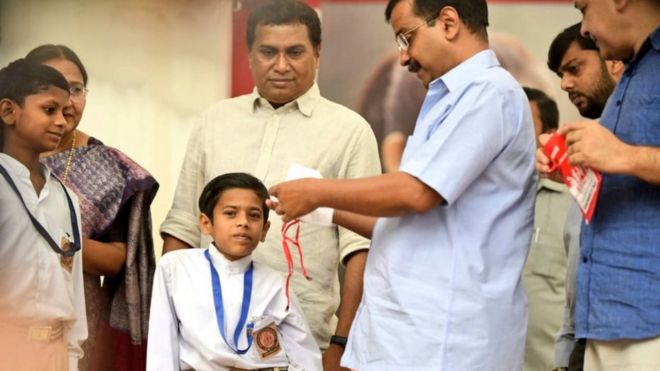 Image copyright TWITTER/@ARVINDKEJRIWAL
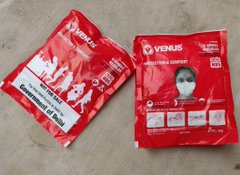
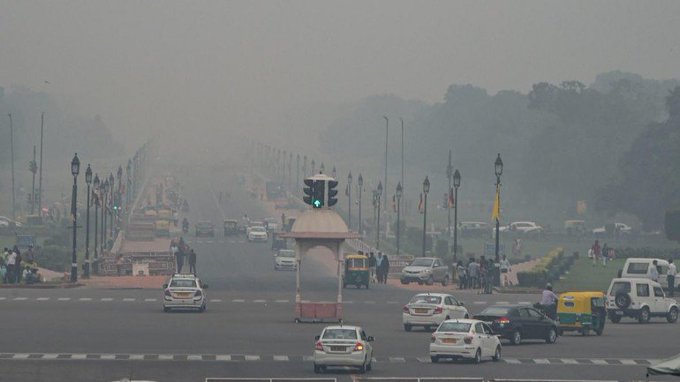
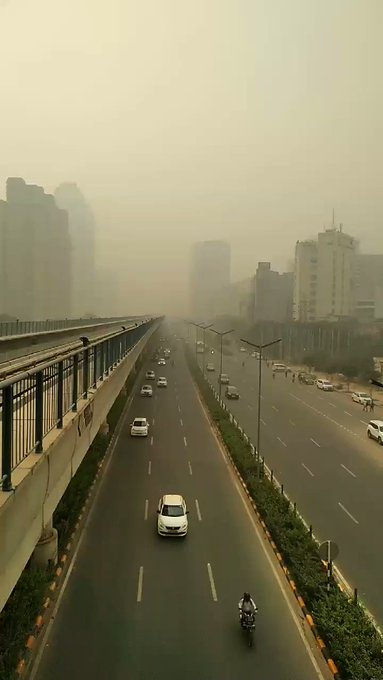
Five million masks are being distributed at schools in India’s capital, Delhi, after pollution made the air so toxic officials were forced to declare a public health emergency.
A Supreme Court mandated panel imposed several restrictions in the city and two neighbouring states, as air quality deteriorated to “severe” levels.
All construction has been halted for a week and fireworks have been banned.
The city’s schools have also been closed until at least next Tuesday.
Delhi’s Chief Minister Arvind Kejriwal said Delhi had been turned into a “gas chamber”.
 Arvind Kejriwal
✔@ArvindKejriwal
Delhi has turned into a gas chamber due to smoke from crop burning in neighbouring states
It is very imp that we protect ourselves from this toxic air. Through pvt & govt schools, we have started distributing 50 lakh masks today
I urge all Delhiites to use them whenever needed
End of Twitter post by @ArvindKejriwal
The masks are being handed out to students and their parents, and Mr Kejriwal has asked people to use them as much as possible.
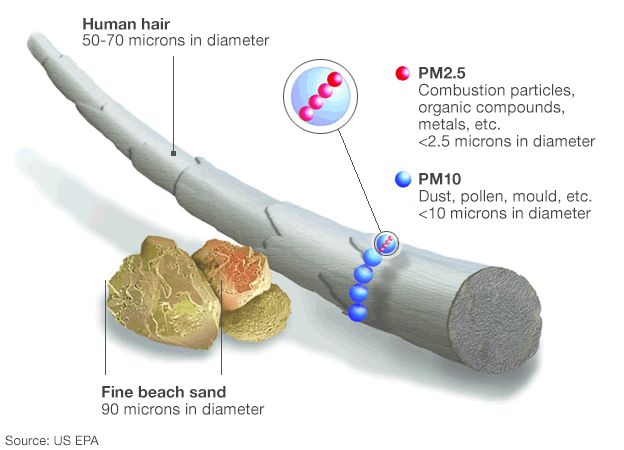
The levels of tiny particulate matter (known as PM2.5) that enter deep into the lungs are 533 micrograms per cubic metre in the city. The WHO recommends that the PM2.5 levels should not be more than 25 micrograms per cubic metre on average in 24 hours.
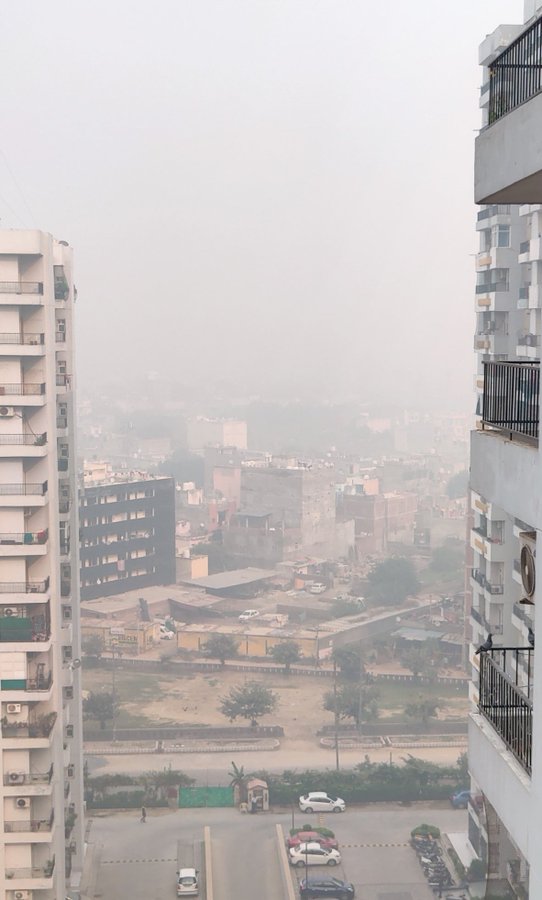
As thick white smog blanketed the city, residents started tweeting pictures of their surroundings. Many are furious that the situation remains the same year after year.
The hashtags #DelhiAirQuality and #FightAgainstDelhiPollition are trending on Twitter.
 Mrigshira Tripathi@MrigshiraT
#HappyHalloween
Best costume for Halloween ever ..!!#DelhiAirQuality
End of Twitter post by @MrigshiraT
 Kashish Garg@erkashishgarg01
Clean air is a basic right.
Chile, Bolivia, Lebanon, Hong Kong are all protesting for their rights.
Why are people in #Delhi and rest of India tolerating their families being poisoned year after year?
Have Indians accepted living in gas chambers?#DelhiAirQuality#DelhiSmog
End of Twitter post by @erkashishgarg01
 BihariBabu@mayanksledger
China reduced the Concentration of air pollutants in air by 32 % in just 4 years in 2018
America took dozen years to achieve the same in the 80s
India is still busy with Hindu Muslim debates
Nobody gives a damn about people’s lives here#DelhiAirQuality #LashkarENoida
End of Twitter post by @mayanksledger
 Vishal L@vishmlondhe
Gurugram pollution! There are pollution clouds not the actual one. #pollution #Gurugram #DelhiAirQuality
End of Twitter post by @vishmlondhe
There are other reasons too, including construction dust, factory and vehicular emissions, but farm fires remain the biggest culprit.

More than two million farmers burn 23 million tonnes of crop residue on some 80,000 sq km of farmland in northern India every winter.
The stubble smoke is a lethal cocktail of particulate matter, carbon dioxide, nitrogen dioxide and sulphur dioxide.
Using satellite data, Harvard University researchers estimated that nearly half of Delhi’s air pollution between 2012 and 2016 was due to stubble burning.
The burning is so widespread that it even shows up in satellite photos from Nasa.

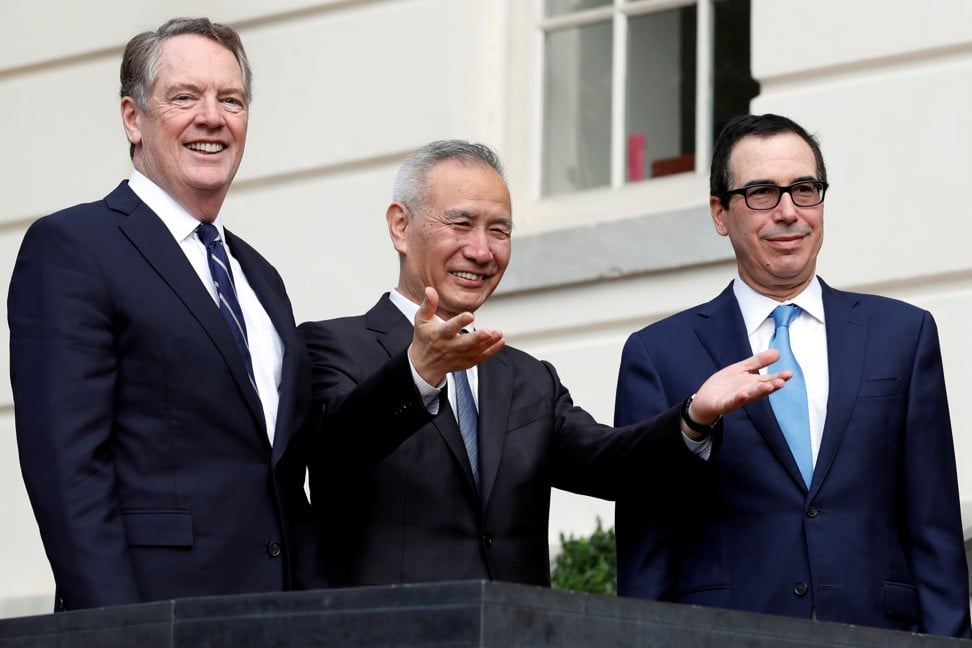
Chinese President Xi Jinping and US President Donald Trump are tentatively expected to meet on November 17 with the aim of signing an interim trade deal, a source briefed on the arrangements told the South China Morning Post.
The two leaders are expected to come face-to-face immediately after the Asia-Pacific Economic Cooperation (Apec) summit in Santiago, Chile, with a trade truce signed “if everything goes smoothly”, said the person, who declined to be identified.
Trade envoys from Beijing and Washington are still finalising the text for the two leaders to sign, but both sides have expressed optimism that Trump’s so-called phase one trade deal can be completed in time for the meeting.
Trump said on Monday that negotiations on the interim deal were running “ahead of schedule”.
“We are looking probably to be ahead of schedule to sign a very big portion of the China deal, and we’ll call it phase one but it’s a very big portion,” Trump said. “That would take care of the farmers. It would take care of some of the other things. It will also take care of a lot of the banking needs.
“So we’re about, I would say, a little bit ahead of schedule, maybe a lot ahead of schedule,” the president said, adding the deal would “probably” be signed.
Top trade negotiators for the two countries – US Treasury Secretary Steven Mnuchin, US trade representative Robert Lighthizer and Chinese Vice-Premier Liu He – spoke by telephone last Friday. The Office of the US Trade Representative released a statement after the call saying that the two sides “made headway on specific issues” and “are close to finalising some sections of the agreement”.
China’s official Xinhua News Agency said on Saturday negotiators have “agreed to properly resolve core concerns of each other” and had “basically completed technical discussions about parts of the text”. In particular, China would lift the current ban on US poultry imports and recognise the American public health certification system for meat product imports, Xinhua said.
The top trade envoys are expected to hold another conference call in the near future.
Taoran Notes, an account on Chinese social media platform WeChat run by the official Economic Daily newspaper, wrote over the weekend that Beijing and Washington had moved a step closer to agreement on a “temporary deal”.
“According to past experiences and practises, the negotiation will enter the stage of translation and legal review after the technical completion of the text,” the account said.
Geng Shuang, a Chinese foreign ministry spokesman, said that technical negotiations about part of the deal were finished but deputy-level talks were ongoing. “China hopes both sides can find a trade solution based upon mutual respect and benefits,” Geng said at a regular press conference on Tuesday.
If it goes ahead as planned, the summit between Trump and Xi in Chile next month would be the third time the two leaders have sat down to talk about ending the nearly 16-month-long trade war.
Last December, the two leaders met on the sidelines of the G20 Leaders’ Summit in the Argentinian capital Buenos Aires and agreed to a three-month tariff truce to allow time for the countries’ trade envoys to work out a comprehensive deal. But the talks collapsed in early May with the US blaming China for reneging on promises it made in negotiations, while China blamed the US for attempting to infringe on its economic sovereignty.
The pair met again in late June in the Japanese city of Osaka, where they agreed to restart trade negotiations.
A minor ceasefire was reached in October when Beijing promised to buy US$40 billion to US$50 billion worth of American agricultural products in exchange for Washington postponing indefinitely a tariff increase on US$250 billion of Chinese goods to 30 per cent from 25 per cent on October 15.
Analysts expect fresh 15 per cent duties on about US$160 billion of Chinese imports – including popular products like smartphones and consumer electronics – that are due to go into effect mid-December will also be postponed if a deal is signed, though this has not been officially confirmed.
The interim deal is also expected to contain a provision on intellectual property protection, a key US demand. China has taken steps to improve IP protection, including setting up a system to punish and compensate instances of infringement, and improve settlement disputes. But how well these measures will be implemented remains in question.
China and the US would also agree to avoid allowing currency devaluations to gain trade advantages, codifying a commitment both countries made as part of a G20 agreement several years ago. A currency agreement – similar to provisions in the yet-to-be-ratified US-Mexico-Canada Agreement – could pave the way for the US to remove its designation of China as a “currency manipulator”.
The deal may include a new dispute resolution mechanism to ensure both sides live up to commitments. The system, which will give both sides equal standing, would replace a contentious US-proposed enforcement mechanism that was a key reason for trade talks breaking down in May after China felt the demands too intrusive and one-sided. It is unclear how effective the proposal would be, but the US has insisted since talks began that a similar mechanism be implemented to ensure China did not backslide on promises as it had in the past.
In addition to large purchases of farm products, the interim agreement may contain commitments by China to buy US-built aircraft and energy products, particularly liquefied natural gas.
China will also agree to lift foreign ownership limits on Chinese financial firms under the deal, changes which are already underway.
However, the interim deal will not address broader US complaints about China’s economic model, particularly allegations that foreign firms are treated unfairly and heavy government subsidies favour some domestic industries. Nor will it contain any break for telecommunications equipment maker Huawei and other Chinese tech companies that were blacklisted by the US on national security concerns.
Source: SCMP

continuously updated blog about China & India
continuously updated blog about China & India
continuously updated blog about China & India




 CHINDIA ALERT: You'll be living in their world, very soon