Archive for ‘Hangzhou’

07/07/2019

Ancient Chinese city ruins become country’s latest Unesco World Heritage Site

  • Five thousand-year-old ruins in Zhejiang province are the earliest known example of Chinese civilisation
  • Country passes Italy to become home to the largest number of World Heritage Sites
The Liangzhu site in Zhejiang dates back to 3,500BC. Photo: Thepaper.cn
A 5,300-year old Chinese city that provides the earliest example of civilisation in the country has been named as the country’s latest Unesco World Heritage Site.
The Liangzhu Archaeological Site in Zhejiang province was designated a “cultural site” at the latest Unesco meeting in Azerbaijan, bringing the total number of Chinese heritage sites to 55 – passing Italy as the country with the largest number in the world.
The ruins, located on the outskirts of the modern city of Hangzhou, sits on the plain of river networks in the basin of the Yangtze River and date back to 3,300BC.
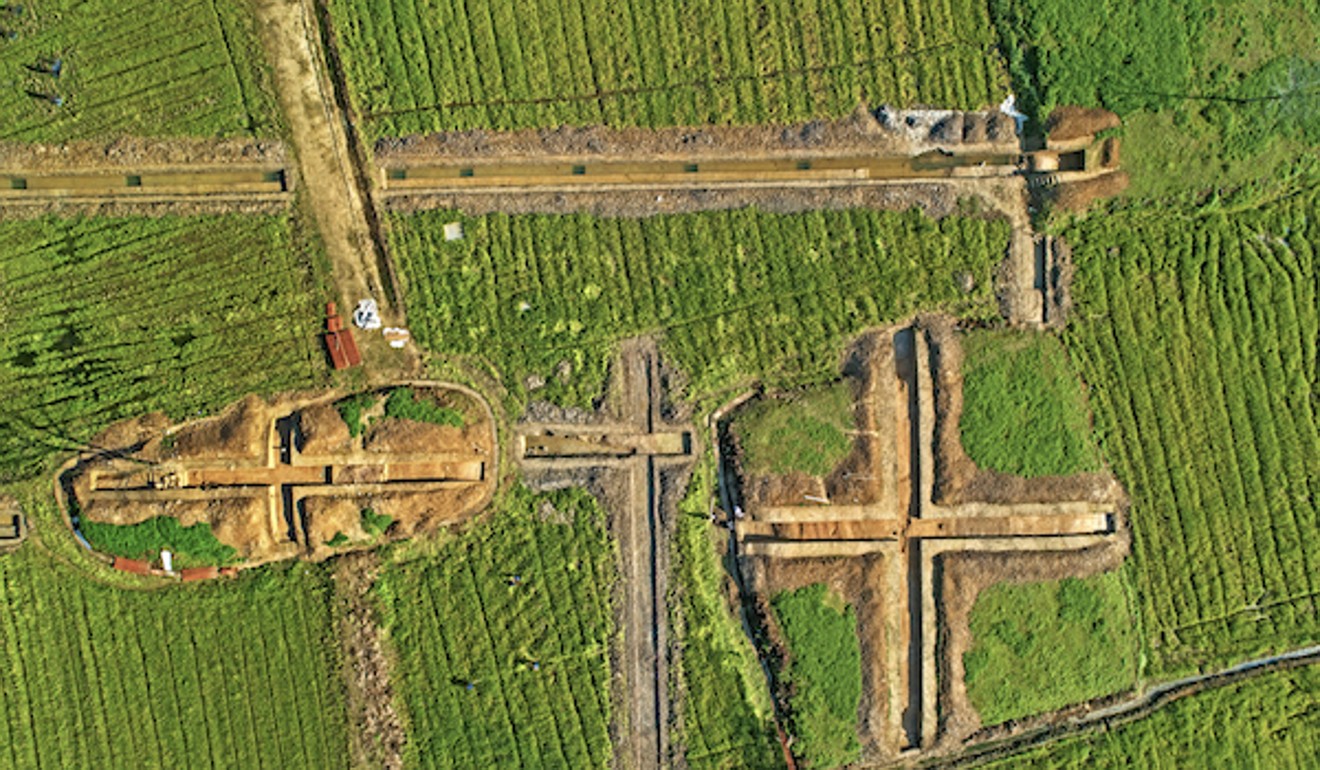
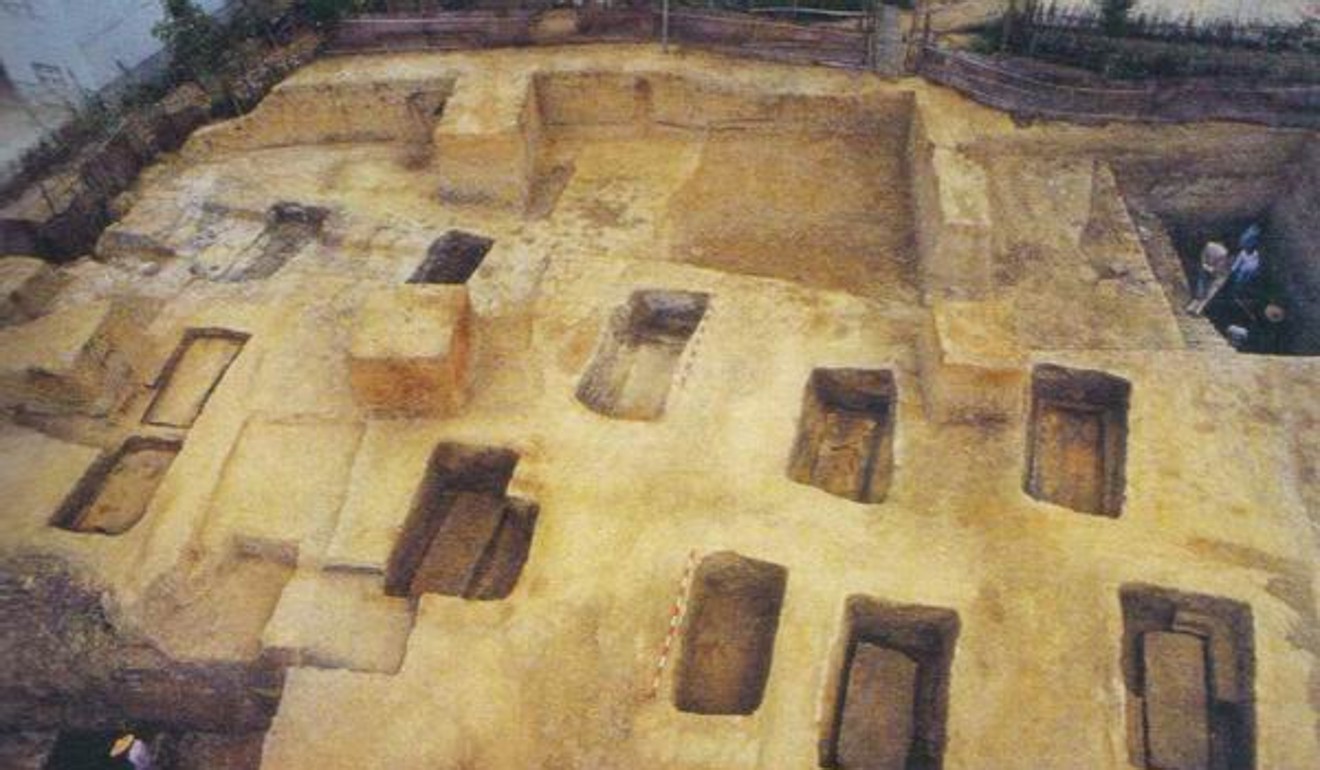
The site covers an area of 14.3 square kilometres, and mainly consists relics of 11 dams, cemetery sites, water conservancy system and walls that gives evidence to an early Chinese urban civilisation, with rice cultivation as the economic foundation.
An aerial view of the site. Photo: Thepaper.cn

The discovery of the site was of “primary importance” as it provides evidence of compelling evidence that Chinese civilisation started 5,000 years ago, 1,000 years earlier than previously thought, Colin Renfrew, a retired professor of archaeology at University of Cambridge, told state news agency Xinhua.

“So when we are talking of the origins of state society in China, we can think of the Liangzhu … instead of the Shang civilisation around 1,500BC.

The site was first discovered in 1936 when a team of archaeologists unearthed some pottery and began searching for further evidence

Liangzhu is China’s 55th Unesco World Heritage Site. Photo: Thepaper.cn

A breakthrough came in 1986 when a burial site with around 1,200 artefacts made from jade, pottery and ivory was uncovered.

The walls of the city were discovered in 2007 and the surrounding water conservancy system was unearthed in 2015.

Archaeologists estimate that it would have taken 4,000 people working for a decade to build the system, according to Xinhua.

The decision to add the site to the Unesco list is the culmination of more than two decades’ work, with preliminary work starting in 1994.

The site is now open to tourists, but a maximum number allowed to visit the site is limited to 3,000 a day and bookings must be made online.

Source: SCMP

06/07/2019

China claims 55 of UNESCO world heritages with elected new sit

AZERBAIJAN-BAKU-CHINA-LIANGZHU-WORLD HERITAGE

The Chinese delegation celebrate during the 43rd session of the UNESCO World Heritage Committee in Baku, Azerbaijan, July 6, 2019. The United Nations Educational, Scientific and Cultural Organization (UNESCO) World Heritage Committee inscribed China’s Archaeological Ruins of Liangzhu City on the World Heritage List as a cultural site here on Saturday, bringing the total number of World Heritage Sites in China to 55, the highest in the world. (Xinhua/Tofik Babayev)

BAKU, July 6 (Xinhua) — China’s Archaeological Ruins of Liangzhu City was on Saturday inscribed to the UNESCO World Heritage List as a cultural site, bringing the total number of the Asian country’s sites on the list to 55.

The decision to add the Chinese cultural site, located in the eastern Chinese city of Hangzhou, to the United Nations Educational, Scientific and Cultural Organization’s (UNESCO) World Heritage List was approved by the World Heritage Committee at its ongoing 43rd session in the Azerbaijani capital of Baku.

“It is considered to be a supreme achievement of prehistoric rice-cultivating civilization of China and East Asia over 5,000 years ago and an outstanding example of early urban civilization,” said a report by the International Council on Monuments and Sites (ICOMOS), the committee’s official advisory body.

Sitting on a plain crossed by river networks in the Yangtze River Basin, the nominated property of Archaeological Ruins of Liangzhu City includes the archaeological remains of Liangzhu City (3300 BC-2300 BC), which was once the center of power and belief of an early regional state in the lower reaches of the Yangtze River during the Late Neolithic China period.

The property testifies to the existence of a regional state with a unified belief system and supported by a rice-cultivating agriculture in late Neolithic China. It also represents an early urban civilization with complex functions and structures.

“Archaeological Ruins of Liangzhu City is a major archaeological discovery of China in the 20th century and an important cultural site that witnessed the 5,000-year civilization of the country,” said Liu Yuzhu, head of China’s National Cultural Heritage Administration, at the committee session.

“We are proud that after 25 years of preparation, our efforts have finally led to the successful inscription of this exceptionally important property, which is the most concrete testimony of 5,000 years of Chinese civilization,” said Shen Yang, ambassador and permanent delegate of China to the UNESCO, following the announcement of the decision.

“We are keenly aware that the inscription also entails an enormous responsibility for conserving this heritage of humanity,” he added.

Zhou Jiangyong, Hangzhou’s municipal committee secretary of the Communist Party of China, said the Chinese city will spare no effort to “protect and make proper use of the enormous cultural heritage before passing it on to the the future generations.”

The Chinese side also pledged continued efforts and strengthened international cooperation in the protection and management of the world heritages in China.

The 43rd convention of the World Heritage Committee, held from June 30 to July 10, started on Friday to examine world heritage nominations. According to its agenda, it will also review the state of conservation of 166 sites on the World Heritage List, 54 of which are also on the List of World Heritage in Danger.

On Friday, China’s Migratory Bird Sanctuaries along the Coast of the Yellow Sea-Bohai Gulf (Phase I) was inscribed to the World Heritage List as a natural site.

At present, China has 55 world heritage sites, including 37 cultural sites, 14 natural sites, and 4 cultural and natural heritages.

Source: Xinhua

27/06/2019

UN’s environment chief urges China to keep belt and road projects green and clean

  • Joyce Msuya of the UN Environment Programme is full of praise for Beijing’s success in tackling air pollution but says there is work still to be done
  • Commitment to environmental protection seen at home must be extended to infrastructure projects developed overseas, she says
Joyce Msuya, acting head of the UN Environment Programme, says bad infrastructure can have a negative environmental impact. Photo: Simon Song
The United Nations’ environment chief has appealed to China to apply the same environmental standards to infrastructure projects it develops overseas under its Belt and Road Initiative as it does to those built on its own soil.
“We know from history, bad infrastructure can lead to negative environmental impact,” said Joyce Msuya, acting executive director of the UN Environment Programme. “Given China’s record on and interest in environmental protection, we hope and expect they will apply the same spirit as they invest in developing countries.”
While acknowledging the value of infrastructure building in developing nations, Msuya said it was equally important to consider the environmental implications of 
belt and road

schemes.

“We are interested in working with member countries that have been beneficiaries [of Chinese investment] to see what concerns, if any, what risks, if any, they see,” she said in an interview on the sidelines of an event in Hangzhou, capital of east China’s Zhejiang province, to mark World Environment Day, which fell on Wednesday.
Scores of countries are involved in Beijing’s multibillion-dollar belt and road plan in one way or another, but as it has expanded so too have the concerns over its environmental impact.
In late 2017, the WWF issued a report claiming that the development of two motorway projects in Myanmar would have a negative environmental impact on about half of its population.
China ‘facing uphill struggle’ in fight against pollution

On China’s efforts to tackle pollution at home, Msuya said that although the move towards a greener economy might require communities to make sacrifices in the short term, these would be outweighed by the long-term benefits.

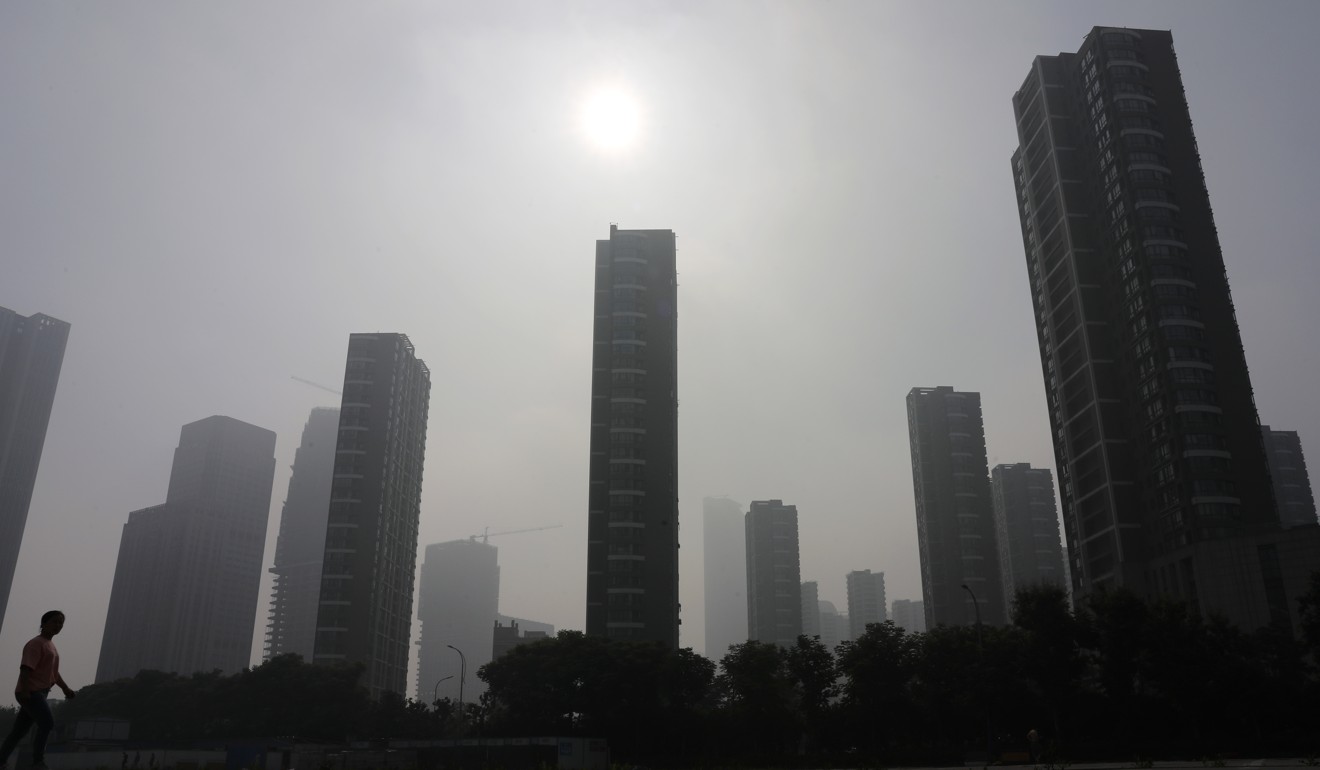
China has been fighting a “war on pollution” since 2013 but as 

economic pressures

have grown so too have concerns that industry unfriendly environmental efforts might be relegated to the back burner. The nation’s gross domestic product grew by just 6.6 per cent in 2018, its slowest rate since 1990, and for the past year it has been embroiled in a stinging trade war with the United States.

China has been fighting a “war on pollution” since 2013. Photo: Simon Song

Msuya said that while Beijing had done a good job in improving air quality, it still had some way to go on issues like water, soil and noise pollution.

“China is quite diverse, with many provinces … so the scale of the challenge of dealing with pollution is more complex,” she said. “[But] by building on its experience of cleaning the air, I have full confidence in the Chinese government.”

Pollution in northern China up 16 per cent in January as industrial activity spikes

According to a report issued by Beijing on Wednesday, average levels of PM2.5 – the tiny airborne particles that are particularly harmful to health – in more than 70 cities across

China fell by an average of 42 per cent in the five years through 2018.

Smog levels in the Chinese capital fell 43 per cent in the period, but the average reading in the city last year was still more than five times the World Health Organisation’s recommended safe level.

Air quality was the main theme of the Hangzhou event.

Msuya has first-hand experience of Beijing’s air quality having worked in the city as the World Bank Group’s regional coordinator for East Asia and the Pacific between 2011 and 2014.

“When I moved to Beijing in 2011, I honestly didn’t know how bad the air pollution was.

My son was six at the time and I always made sure he wore a mask when he went out to play,” she said.

“Fast forward to now, and China has shown us that the problem of air pollution can be tackled if everyone participates.”

Source: SCMP

04/06/2019

Will China’s 600km/h maglev train bring air travellers down to earth?

  • Unveiled in Shandong, prototype will be a first step towards ground-breaking high-speed travel that will rival passenger jets, project engineer says
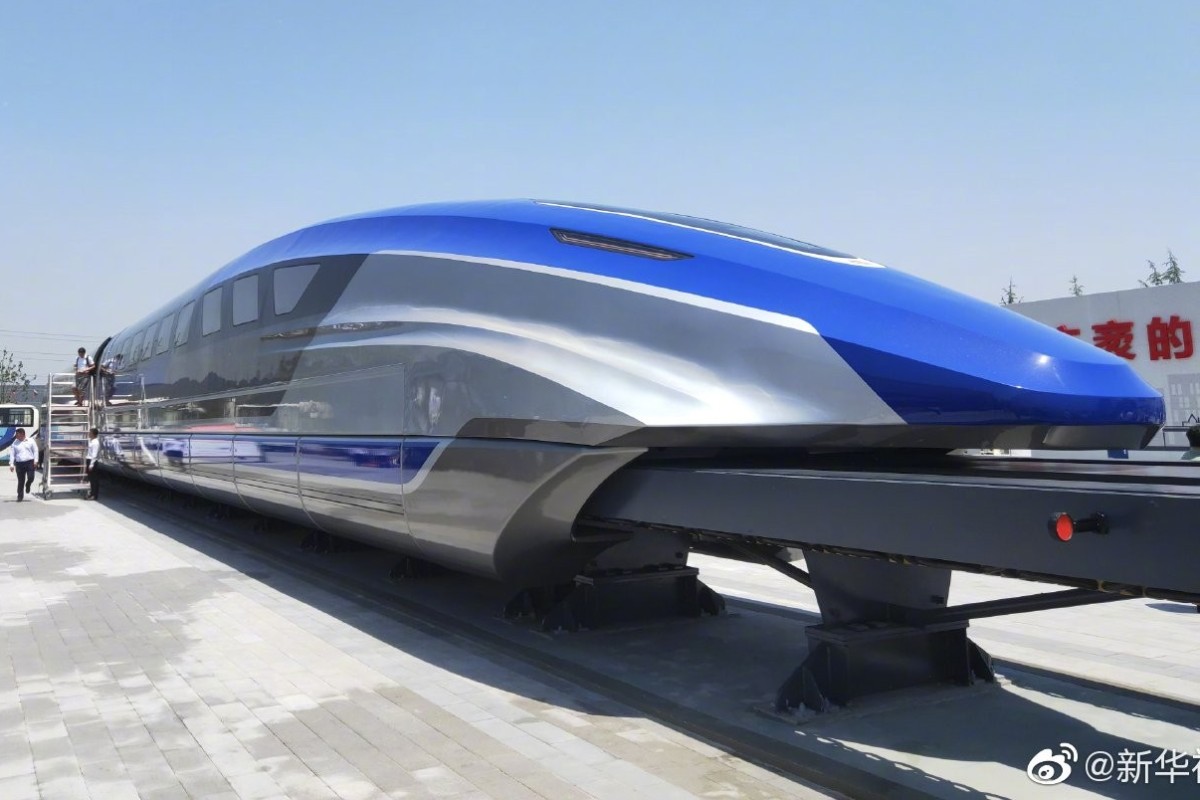
One possible future for rapid transport in China is unveiled in the form of a magnetic levitation train at Qingdao in Shandong province. Photo: Weibo
An experimental magnetic levitation train capable of travelling at 600km/h went on show at Qingdao in eastern Shandong province on Thursday, state media said.
Powerful electromagnets hold the Qingdao prototype at a thumb’s width from the rail, giving a quiet, smooth ride at speeds close to those involved in air travel, developers said.
While China operates the world’s fastest conventional train service, which can reach a speed of 350km/h, the Shanghai Maglev has been in commercial operation since the end of 2002 and can reach a top speed of 430km/h. It operates on one 30-kilometre (19-mile) line between two stations.
Ding Sansan, deputy chief engineer with developer the CRRC Sifang Corporation, said China achieved breakthroughs in maglev technology during the “three-year-battle” to build the new train that involved cooperation between more than 30 enterprises, universities and government research institutes.
The construction of a train body with ultra-lightweight, high-strength materials was a challenge, Ding said. Complex physical problems created by high speeds also needed to be solved in new ways if the Qingdao prototype was to reach peak performance.

China was a leader in technologies that included suspension, guidance, control and high-powered traction, Ding told Qingdao Daily.

“The test vehicle has been powered up and is in good order,” Ding was quoted by the newspaper as saying.

Chinese maglev train capable of travelling at 600km/h on track for 2020 test run as design completed
The prototype promised to eliminate the advantages jet passenger planes had over ground vehicles over a distance of 1,500km, he said.

Taking Beijing-to-Shanghai by plane as an example, Ding suggested: “It takes about four-and-a-half hours by plane including preparation time for the journey; about five-and-a-half hours by high-speed rail, and [would] only [take] about three-and-a-half hours by maglev.”

While earlier reports suggested the prototype was expected to begin full-scale testing by 2020, it was unclear what Thursday’s unveiling meant for this timetable.

China’s latest prototype high-speed maglev train factors the comfort of paying customers into its test operations. Photo: Weibo

More maglevs would join the development project in the coming months, the team leader was quoted as saying, while mass production of the technology was likely by 2021.

In contrast to the optimism of the team at Qingdao, Chen Peihong, professor of economics at Beijing Jiaotong University and a transport analyst, was more circumspect about the future of maglev trains.

“The market has to be bigger. Technology alone cannot make [the concept] a success,” she said.

Plane or train: as high-speed rail link connects Hong Kong to 44 mainland Chinese cities, what are cheapest and fastest ways to get where you are going?

Public transport relied heavily on economies of scale, Chen said. Chinese cities including Jinan, Hangzhou and Chongqing were considering maglev lines, but even the longest – from Jinan to Taian – would not exceed 50 kilometres.

Chen said that electromagnetic fields from maglevs were greater than those from the lines that powered high-speed trains, while environmental worries might keep maglevs out of densely-populated areas.

There was a debate in China in the early 2000s about the benefits of a developing a maglev compared to high-speed rail, researchers on that project said. Rail was preferred by the government because it was an established technology and one that was cheaper to realise.

By the end of last year, China’s high-speed rail network extended to most of the country at a distance in excess of 29,000 kilometres, according to government figures, twice as long as the rest of the world’s high-speed rail lines combined. Spain’s high-speed AVE network was the second-longest at 3,100km.

Elsewhere, researchers in Chengdu, Sichuan province, said a vehicle inside a vacuum tube powered by a superconductor coil from a maglev train – a hyperlink – was in development. They expected the vehicle to reach speeds in excess of 1,000km/h as air was pumped from the tube and resistance to the speeding object gradually eliminated.

Source: SCMP

20/05/2019

Across China: Beekeeping goes digital

HANGZHOU, May 19 (Xinhua) — Beekeepers in China’s high-tech powerhouse of Zhejiang Province have developed a smart way of using intelligent beehives to revolutionize bee farming.

Over 300 apiculture insiders and experts convened in Chun’an County on Saturday to witness the pilot.

More than 2,600 artificial beehives have been arranged in mountains in the western outskirts of Hangzhou, the provincial capital.

Chen Pinghua, chair of Qiandao Lake Mozhidao Biotechnology Co. Ltd., which operates the bee farm, said the smart hives were installed with sensors at the bottom, which can monitor and regulate the temperature and humidity and send the data on the number of times the bees enter and leave as well as the weight of the hive for technicians to determine whether the honey has matured.

Each hive is also pasted with a unique QR code that traces the source of the honey to ensure food safety, Chen said.

He said staff could open an app on their mobile phones to monitor the real-time data of each hive, which greatly improves efficiency.

Saturday coincided with World Honey Bee Day designated by the United Nations in 2017 to spread awareness on the significance of bees, which pollinate one-third of the world’s grain-producing plants.

“Beekeeping has a long history in China, but it has remained as a very low-end business without standards for hives and on how bees are raised and how honey is harvested,” said Yang Yibo, deputy secretary-general of the Eco-Apiculture Committee of the China Association for the Promotion of Quality.

He said the smart hive system had significance in digitizing the information of honey sources, bee colonies and beekeepers, and forming visualized big data to help analyze the quality in each procedure.

The annual output of honey in China exceeds 400,000 tonnes, and the country’s output of propolis, bee pollen and beeswax rank first in the world. More than 300,000 people are employed in the business.

Wang Fuchun, a veteran bee farmer in Chun’an, said with the high-tech bee farming, a hive could produce more than 30 kg of honey a year, almost quadrupling the amount produced in the traditional way.

The company plans to put 10,000 more smart hives in the mountain region this year.

Source: Xinhua

11/05/2019

Exclusive: China’s BAIC seeks to buy 5 percent Daimler stake – sources

BEIJING/FRANKFURT (Reuters) – China’s BAIC Group is seeking to buy a stake of up to 5 percent in Daimler as a way to secure its investment in Chinese Mercedes-Benz manufacturing company Beijing Benz Automotive, three sources familiar with the matter told Reuters.

BAIC informed Daimler of its intention to buy a 4-5 percent stake in the German maker of Mercedes-Benz cars earlier this year, two of the three sources said.

BAIC has asked local authorities in Beijing to support a 4-5 percent stake purchase, two of these sources said.

BAIC has started acquiring Daimler shares on the open market, one source said.

“Daimler’s share price is currently being underpinned by a buyer who appears to be building a stake,” a person familiar with the matter said.

BAIC did not respond to repeated phone calls and text messages seeking comment outside regular business hours. Daimler declined to comment.

It remains unclear whether BAIC Group can raise the nearly 3 billion euros (£2.6 billion) that a 5 percent stake in Daimler would cost, based on the German carmaker’s closing market value on Friday of 57.6 billion euros, two of these sources said.

German regulatory filings do not show BAIC as a significant shareholder of Daimler. German takeover rules allow a buyer to acquire a stake of up to 3 percent before a regulatory disclosure is required.

Daimler has ruled out issuing new stock to help an outside party build a stake, forcing potential buyers to acquire shares on the market.

BAIC signalled its interest in buying a Daimler stake as far back as 2015, and has redoubled its effort after Li Shufu, chairman of rival Chinese carmaker Zhejiang Geely Holding Group built a 9.69 percent stake in Stuttgart-based Daimler in early 2018.

By using Hong Kong shell companies, derivatives, bank financing and structured share options, Li kept the plan under wraps until he was able, at a stroke, to become Daimler’s single largest shareholder.

The Germans in March agreed to build the next generation of Smart-branded city cars together with Geely, which is based in Hangzhou. Daimler has also reassured BAIC that any new industrial alliances involving Mercedes and a Chinese partner would only happen after a consensus is found with BAIC.

Source: Reuters

15/04/2019

China’s online authors grow 3.82 mln in 3 years

HANGZHOU, April 14 (Xinhua) — China had 8.62 million online authors as of 2018, a significant increase from 4.8 million in 2015, according to a national conference on digital reading.

Among the digital reading materials, original online works took up 79.8 percent last year, up from 69 percent three years ago, while Liu Shu, vice president of Amazon China, said that e-book readers still love classic works.

An industry report released by the China Audio-Video and Digital Publishing Association at the conference showed that the value of China’s digital reading market reached 25.4 billion yuan last year, a 19.6 percent yearly growth.

About 432 million Chinese read digital publications on electronic devices during the year, averaging 12.4 digital publications per person and 71.3 minutes per read, the report said.

Over 66 percent of the respondents of the report were willing to pay for digital publications, up from 60.3 percent in 2016.

Since 2015, the conference has been held annually in east China’s city of Hangzhou, Zhejiang Province before World Book Day, which falls on April 23.

Source: Xinhua

05/04/2019

China Focus: Funeral reform fosters new trends in China

BEIJING, April 5 (Xinhua) — “The air and environment in the cemetery have been notably improved, with less people burning joss paper,” said Wang Fang, a tomb sweeper from Yinchuan, Ningxia Hui Autonomous Region.

This year’s Tomb Sweeping Day, which falls on Friday, witnesses more changes, as China has made various efforts to reform funeral traditions in recent years, and ecological burial and environmentally friendly tomb sweeping practices are increasingly popular.

GREENER BURIAL

In a tea garden in Hangzhou in east China’s Zhejiang Province, there stands a hidden cemetery where burial plots are built under tea trees in a bid to enlarge its green area as well as conserve land.

“It would be good to return to nature here after I pass away,” said a local resident surnamed Wu.

China has seen progress in ecological burials in recent years, especially in developed cities. The first model ecological cemetery of Beijing has been built in Babaoshan Revolutionary Cemetery, with a green coverage rate of nearly 90 percent.

Currently, ecological burials in first-tier cities, including Beijing, Shanghai and Guangzhou, takes up more than 20 percent of the total. It is expected that by 2020, the share of ecological burial across the country reach over 50 percent.

In addition, tomb sweeping practices have become greener. Most tomb sweepers would rather present flowers at tombstones than burn joss paper to pay tribute to their deceased families and friends.

On Tomb Sweeping Day, some cemeteries hold cultural activities, such as calligraphy and painting exhibitions as well as poetry recitals as an alternative to tomb sweeping.

LAND CONSERVATIVE

Besides the “tea garden burial,” other ecological burial methods in China include tree, flower, wall and sea burials.

Replacing traditional tombstones with trees and flower beds, putting urns on shelves in walls or just dropping ashes into the sea requires less or even no land.

“At first people said it was for those in financial difficulties to save money, but as time changes, the popularity of ecological burials have increased,” said Zhao Quansheng, manager of a Yinchuan-based cemetery.

“A customer told us that his father voluntarily asked for an ecological burial to conserve land,” Zhao said.

Non-profit cemeteries are also thriving in places of separate burial traditions. In Yishui County, east China’s Shandong Province, 110 non-profit cemeteries have been built, leading to conservation of large areas of land that otherwise would be utilized for burial sites.

Xue Feng, Party secretary of Yishui, said it used to take about 20 to 27 hectares of land to accommodate all the private tombs in the county, but now it only needs 10 percent of that.

LESS MONEY

China has beefed up funeral infrastructure and public services, with the number of funeral parlours and cemeteries reaching 1,760 and 1,420, respectively.

Since 2009, the Ministry of Civil Affairs has pushed forward fee reduction in basic public funeral services as well as other preferential policies, benefiting low-income groups. For example, commercial cemeteries in Chongqing, Gansu and Ningxia were required to set aside part of their burial sites as non-profits for those with financial difficulties.

“Now the whole funeral is free, including the urn and burial site, which is a great help for households with low incomes like us,” said Yuan Li, a rural resident from Yishui, where funeral services have been free of charge since 2017.

Xue said the fee-reduction policy could save the public nearly 200 million yuan (about 30 million U.S. dollars) annually.

The Ministry of Civil Affairs issued a pilot plan for funeral reform in 2017, and released guidelines with another 14 authorities on further reform in 2018.

“The funeral reforms help encourage fine and up-to-date practices and trends, and make contributions to land and ecological conservation,” said Ma Guanghai, sociology professor of Shandong University. “It is an important aspect of social progress.”

Source: Xinhua

13/03/2019

Chinese woman pays $44,710 back to crowdfunders who helped her father and ‘gives 300 people a warm hug’

  • When truck driver dad needed money to compensate pedestrian after accident, Hai Lin raised it online in one night and she paid it back two years before her deadline
In 2015, Hai Lin posted an appeal for 300 donations of 1,000 yuan on WeChat with a promise to pay lenders back within five years. Photo: Xinhua
A woman from southeastern China has returned 300,000 yuan (US$44,710) to 300 people – many of them strangers – who donated money to a crowdfunding appeal she started four years ago.
In 2015, Hai Lin posted an appeal for 300 donations of 1,000 yuan on WeChat, with a promise to pay lenders back within five years. She kept her promise – and paid back all her loans two years early.
The internet was abuzz with the story of Hai’s crowdfunder, which was reported by Pearvideo.com on Tuesday. Many people said it warmed their hearts and restored their confidence in society.

Shortly before that, Hai’s mother was admitted to hospital with bleeding on the brain.

“The man [hit by her father] was in critical condition,” Hai, then 27 and from Hangzhou, Zhejiang province, was quoted in the Pearvideo.com as saying. “We had to hide the accident from my mother so that her rehabilitation won’t be affected.”

‘Social media queen’ closes WeChat account after fake story outrage

Hai said the accident was a big blow and, for the first time in her life, she felt frightened.

“My father told me that if we couldn’t afford the compensation, he would run away to escape the debt,” said Hai. “I said I would try my best to keep that from happening.”

In her post on WeChat, she wrote that she was looking for 300 people to lend her 1,000 yuan each. She planned to pay back those debts in five years by returning money to five lenders each month.

“It’s because I couldn’t find someone who could lend me 300,000 yuan at a one time,” said Hai. “Some friends said they could have loaned me 100,000 yuan, but I refused their kindness because that was too big an amount.”

Resourceful Hai Lin asked 300 people online for 1,000 yuan each to help her father out and was true to her word in repaying the money. Photo: Weibo

To her surprise, 300 WeChat contacts, many of whom were not acquaintances, came up with the funds in one night.

In July 2015, Hai began to pay back the money she had borrowed. By July of last year, two years ahead of schedule and thanks to pay rises and year-end bonuses, the debt was cleared.

Some creditors had deleted Hai’s WeChat details, so she had to track them down.

“Girl, thank you for restoring trust which I thought I’d lost and for warm feelings that will stay with me,” one of her creditors wrote on WeChat.

Another said that when he received Hai’s money transfer he thought someone was joking. After recalling Hai’s appeal, he said he was touched by her gesture.

“You gave us 300 people a warm hug,” he said on WeChat.

Travel nightmares and how strangers crowdfund for injured tourists

The report on pearvideo.com has scored more than 40,000 “likes” on Sina Weibo, China’s

Twitter-like, while users added 10,000 combined reposts and comments.

“In her [Hai’s] mind there was a debt while other people would treat it as donation,” an internet user wrote. “I think many people wouldn’t expect her to return the money.”

“It shows this woman is a nice person in her everyday life and deserves credits. I would lend money to people like her,” another wrote.

One cautious Weibo user said: “I’ve never loaned money to people whom I never met face-to-face and only chatted with online.”

“Is it a big thing that you borrow money and pay it back?” asked another user. “You borrow 1,000 yuan from a person and return it years later. Is it something to feel proud of?”

Source: SCMP

18/02/2019

Wooden-bench dragon dance performed to celebrate Chinese Lantern Festival in east China’s Zhejiang

CHINA-HANGZHOU-LANTERN FESTIVAL-CELEBRATION

Aerial photo shows members of a rural female dancing team performing wooden-bench dragon dance to celebrate the upcoming Chinese Lantern Festival, which falls on Feb. 19 this year, at Yaokou Village of Huyuan Township in Hangzhou, capital city of east China’s Zhejiang Province, on Feb. 17, 2019.

Yaokou Village is famous for its wooden-bench dragon dance, which is originated from the Qing Dynasty (1644-1911). The wooden-bench dragon is 130 meters long with 58 wooden benches linked together, on which various lantern decorations are installed. People dressed in traditional costumes would dance the wooden-bench dragon at major festival events to pray for good luck in a new year. (Xinhua/Xu Yu)

Source: Xinhua

Law of Unintended Consequences

continuously updated blog about China & India

ChiaHou's Book Reviews

continuously updated blog about China & India

What's wrong with the world; and its economy

continuously updated blog about China & India