Archive for ‘Hebei province’

13/05/2019

Beijing’s new airport completes 1st passenger plane test flight

BEIJING, May 13 (Xinhua) — Beijing Daxing International Airport completed its first test flight of passenger planes as four aircraft landed safely on the runway Monday morning.

China Southern Airlines, China Eastern Airlines, Air China and Xiamen Airlines sent their flagship models A380, A350-900, B747-8 and B787-9, respectively, for the test.

“The test shows that the new airport has now turned its focus from infrastructure construction to operation preparations,” said Wan Xiangdong, chief pilot of Civil Aviation Administration of China.

The test followed the airport’s first flight of verification planes on Jan. 22 this year. The airport is scheduled to take low-visibility flight test in August and go into operation before Sept. 30.

Located 46 km south of downtown Beijing, the new airport is aimed at taking pressure off the overcrowded Beijing Capital International Airport in the northeastern suburbs. It sits at the junction of Beijing’s Daxing District and Langfang, a city of neighboring Hebei Province.

It is expected to handle 45 million passengers annually by 2021 and 72 million by 2025.

Source: Xinhua

12/05/2019

Various activities feature 1000-day countdown to Beijing 2022

BEIJING, May 11 (Xinhua) — With the official 1000-day countdown timer of the Beijing 2022 Olympic Winter Games having been launched at Beijing’s iconic Olympic Park on Friday evening, various commemorative activities related to winter sports and Olympic culture were held across China on Saturday.

At Beijing’s Shijingshan District, where the 2022 Beijing Organizing Committee of Winter Olympic and Paralympic Games (BOCWOG) located, Gaojinglu community was named as the first Winter Olympic Community for its efforts in developing winter sports among the residents.

Supported by the community since 2018, people living in the area were provided with the chances to experience winter sports like skating and curling. Many have shown great interests and established their own teams.

In the Yanqing District, which serves as one of the three competition zones of Beijing 2022, lectures about the Games were taken into schools and students are learning more about Olympic culture through the course.

At Zhangjiakou competition zone in Hebei province, a video which tells the story of Zhangjiakou engaging in the bidding and preparing work of Beijing 2022 came to the public.

Except for Beijing and Hebei, other parts of China also engaged in the milestone moment of Beijing 2022. In Altay of northwestern Chinese Xinjiang Uygur Autonomous Region, a skiing competition was held to promote Olympic culture in the area.

Altay has a long history of skiing as discoveries have shown that ancient people there already skied 12,000 years ago. In recent years, the local government has spent a lot of efforts in promoting winter sports, especially in schools. Over 9,000 students have benefited from a plan which aims to bring PE lessons to the skiing resorts.

Source: Xinhua

25/04/2019

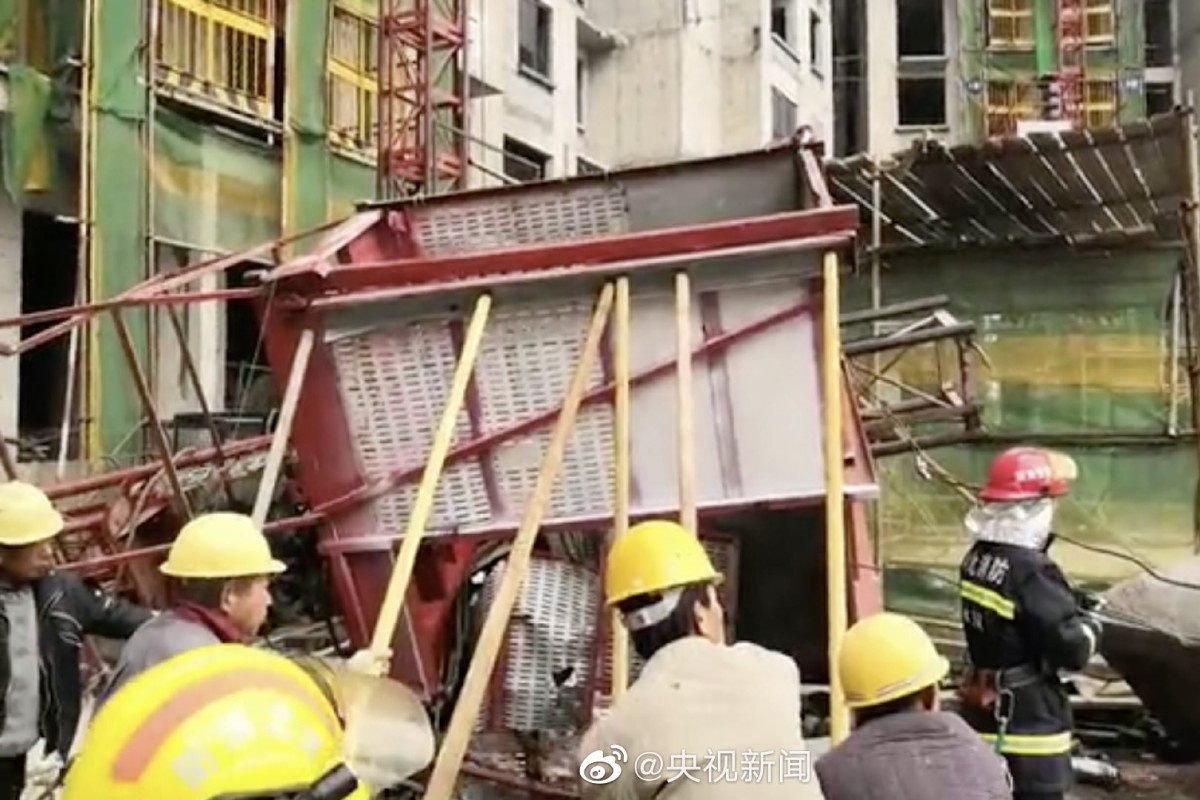
11 killed, two seriously hurt in lift crash at north China building site

  • Accident happened about 7.20am at residential development in Hengshui, Hebei province, authorities say
  • Injured pair said to be in stable condition in hospital
Eleven people were killed when a lift fell at a construction site in Hengshui, Hebei province. Photo: Weibo
Eleven people were killed and two others seriously injured when a lift fell at a construction site in northern China on Thursday morning, municipal authorities said.
The accident happened at about 7.20am on the site of the Jade Huating compound, a residential property development under construction in the Taocheng district of Hengshui, Hebei province, according to a statement issued by the city government.
The two people hurt were being treated at a local hospital and in a stable condition, it said.

Police, work safety officials and construction authorities have begun an investigation to determine the cause of the accident, the statement said.

The accident happened at about 7.20am on the site of the Jade Huating compound. Photo: Weibo

A witness was quoted by The Beijing News as saying the crash happened in a matter of seconds.

“I heard a big bang and saw the lift had fallen,” the witness said. “Then six or seven ambulances arrived on the scene.”

Kindergarten flattened by falling debris from building site

The housing project is being developed by Hengshui Youhe Real Estate Development.

The firm said on WeChat earlier this month that the project was making good progress thanks to “reasonable construction with maximum efficiency”, despite work having to be suspended several times for environmental reasons. The post was later deleted.

Source: SCMP

17/04/2019

Across China: Favorable ethnic policies bring benefits for Tibetan children

XINING, April 16 (Xinhua) — Every morning, Sonam Tsering takes his backpack and earphones, boards the subway and arrives in a commercial bank — his workplace in Beijing.

Sonam, 30, is doing a successful job in the international business unit of the bank. His success in the capital city is inseparable from his education background.

Sonam was born in Jone County of Gannan Tibetan Autonomous Prefecture of northwest China’s Gansu Province. Thanks to China’s favorable ethnic policies, Sonam was able to study in a middle school in the northern Hebei Province.

“There were many ethnic classes in our school, and many of my classmates were from ethnic minority groups,” he said. After graduation, Sonam went for further study in Britain.

“I am from a small town, but education truly broadened my horizons,” he said.

Over the past decades, favorable policies have brought benefits for many children living in Tibetan areas.

In Sonam’s spare time, he likes watching NBA games. Sonam, who is fluent in Chinese, Tibetan and English, is also a fan of Tibetan rap, and he occasionally hangs out with friends at a bar in downtown Beijing.

When he was studying abroad, he met the love of his life. Now both Sonam and his wife are working in Beijing while raising a one-year-old baby girl.

“We plan to let our child study in Beijing,” he said. “We want her to get in touch with avant-garde thoughts, broaden her horizons and pursue a life she likes,” he said.

Like Sonam Tsering, Tsering Lhakyi also benefited from the country’s ethnic policies.

In the 1980s, due to a lack of talents and poor education foundation in southwest China’s Tibet Autonomous Region, the government decided to open classes for Tibetan children. In 1985, the first batch of Tibetan pupils went inland to study. Since then, an increasing number of Tibetan children came to pursue study in more developed areas in China.

Tsering Lhakyi, born in the 1990s, was raised in Tibet’s Nagqu Prefecture with an average altitude of at least 4,500 meters. Her parents sent her to primary school in Lhasa, the regional capital. After that, she got high scores in the entrance exam and was admitted to an inland Tibetan class. After the national college entrance exam, she applied for a university in Yantai City of eastern China’s Shandong Province because she “wanted to see the sea.”

“The inland class truly taught me a lot about many new things,” she said. As a fan of music, Tsering was once a singer in a bar and released two singles in Tibetan. She currently works for a state-own enterprise.

“After work, I love to write music with a bunch of friends,” she said.

In 2017, she went to a popular talent show called “Sing! China” and became quite a sensation in the music industry thanks to her unique style and great music. Before Tsering, there were no other Tibetan contestants on the show, she said.

“People thought Tibetan singers were all about ethnic music, but I wanted to break that stereotype,” she said.

After the show, Tsering became a celebrity, but she was quite patient in releasing new music.

“I don’t want to make music just to cater to the market,” she said. “I have been trying different styles of music recently, and I want to create something different.”

Liu Hua, with Qinghai’s ethnic and religious affairs committee, said that China’s favorable ethnic policies not only brought quality education to students in ethnic areas but also changed their lives.

“These graduates are using their wide range of knowledge and images to influence people around them and generations to come,” Liu said.

Source: Xinhua

02/04/2019

Gas explosion injures 66 at funeral in China after cooking canisters leak

  • Two people under criminal detention after guests suffer serious burns
  • Initial investigation finds the blast was caused by leakage from liquefied gas being used by a chef
Chairs were left strewn as people fled after the explosion. Photo: Weibo
Two people have been detained after more than 60 were injured in northern China on Sunday when gas canisters being used to cook for them at a funeral exploded.
Sixty-six people suffered burns in the blast, which an initial investigation found was caused by leakage of liquefied gas from tubes that were worn out, the local government said on Tuesday.
A cook was using the gas at around noon to prepare food for funeral guests gathering in a village in Bazhou, Hebei province, when a gas leak triggered an explosion, according to a government statement on WeChat, China’s most popular social media platform.

Some of the injured had sustained serious burns but none were critically injured, the statement said.

An unspecified number of people have been held responsible for the incident, and two of these were under criminal detention, it said.

Korean BBQ gas tank explodes in China, killing one and injuring 10

In a video showing the explosion’s aftermath, posted by ifeng.com, people can be seen running to vacate the scene as dozens of chairs lie scattered on a road in the village where two lines of dinner tables had been set up for guests, with cooking equipment and two gas canisters alongside.

In September, five people died after a liquefied gas tank exploded in a residential building in Hebei’s Baoding city, official media reported.

A total of at least 80 people were killed and over 900 were injured in blasts related to the commonly used cooking fuel last year, according to a report by Gas Explosion, a WeChat public account specialising in data analysis of such incidents.

Source: SCMP

25/02/2019

Chinese kidnap victim reunited with parents after 31 years

  • Tears of joy as hundreds turn out to welcome home the lost boy of their village
  • DNA samples crack the case after decades of heartache

Chinese kidnap victim reunited with parents after 31 years

25 Feb 2019

16 Feb 2019

The tearful moment a man is finally reunited with his parents 31 years after he was abducted as a three-year-old. Photo: Weibo

A man who was abducted as a child 31 years ago was finally reunited with his parents in a celebration which included hundreds of people from surrounding villages in Sichuan province, southwest China.

Qin Yujie – whose given name was Cheng Xueping – knelt and sobbed as he hugged his long-lost parents in Chengjiawan village, surrounded by “Welcome Home” banners and the noise of firecrackers.

“I have been looking for you for years and couldn’t find a clue,” Qin told his weeping parents Cheng Jiguang and Gaolingzhen at their reunion on Friday, according to the Western China City Daily newspaper.

As well as the joy of seeing their son again, the Chengs were also able to meet Qin’s wife and children for the first time as hundreds of people gathered around them, many of them in tears.

Qin was three years old in 1988 when he was snatched from a construction site in Guizhou province, southern China, where his parents were working. They searched frantically for their son over many hours that day and, since then, have spent their life savings and borrowed money to travel all over China looking for traces of their son.

Eventually they provided DNA samples to a national database established by the police to assist in the search for China’s many abducted children.

In 2018, a DNA sample Qin provided to his employers yielded an unexpected result. Sichuan police were alerted to a match between Qin’s DNA sample and Cheng’s, his birth father.

Police tracked him down and contacted the Chengs to provide another DNA sample to be sure of the results and, in February this year, the new test confirmed that Cheng and Gao were indeed Qin’s biological parents.

A video of their emotional reunion has been making the rounds on Chinese social media.

The abduction of women and children is a common crime in China. In December 2018 two child traffickers, Zhang Weiping and Zhou Rongping, were sentenced to death for their role in eight separate cases, involving the sale of nine children between 2003 and 2005.

In one particularly brutal case, their gang broke into a rented home, tied up a woman and took away her son to be sold through a middleman, police said. Zhang, Zhou and the other gang members were finally detained in 2016.

In recent years, there have been several official as well as grassroots efforts to help abducted children find their parents. The Ministry of Public Security established an official system called Tuanyuan in 2016 which sends alerts of missing children’s information through social media platforms and mobile phone texts, similar to the “Amber Alert” system in the US.

As of May 2018, Chinese media reported the system had published information about 3,053 missing children and helped find 2,980 of them.

On Baobeihuijia, a grassroots website run by volunteers, there are still 43,858 families looking for their children and 39,446 people looking for their families.

Source: SCMP

21/02/2019

Chinese schools under fire after demanding parents pay for tablets

  • Students at one middle school were told they could join an ‘experimental class’ if they paid US$590 for a designated device
  • That class was later scrapped because of a lack of interest, while the principal of the other school clarified that its plan was not compulsory

Chinese schools under fire after demanding parents pay for tablets

21 Feb 2019

Parents took to social media asking why they had to buy a new tablet when they already had one, and questioning why a specific model was needed. Photo: Alamy
Two schools in northern China have come under fire from parents after they were asked to spend thousands of yuan on tablets for their children’s studies, with one forced to cancel its plan for an “experimental class” due to a lack of interest.

At that school, paying for the device would have given a student a place in a top class where they had access to the best resources.

Earlier this week, Yuying School in Yongnian county, Hebei province demanded 3,000 yuan (US$450) from parents of Year Seven students so that tablets could be bought to assist their studies, Red Star News reported on Wednesday.

They were told via a message on social network WeChat from one of the teachers. It said students should bring the money on Thursday – the first day of the new term – because the private school wanted to “teach using tablets to improve classroom efficiency”. Screenshots of the message have been circulating on social media.

Chinese high school students create daring sex education game, earning positive reviews on Steam

But some parents were against the idea, asking on the WeChat group why they had to buy a new tablet when they already had one, and questioning why a specific model was needed.

“We have several tablets at home – can’t my child use one of them at school?” one parent asked.

Another wrote: “I’m just wondering if this tablet is really worth 3,000 yuan.”

The reaction prompted school principal Li Jinxi to clarify on Wednesday that the tablet purchase was not mandatory, and staff had “misunderstood the policy”, according to the report.

“There could be some minor impact for those students who don’t buy the tablet but it won’t be a big deal because we will also continue to use traditional teaching methods,” he was quoted as saying.

Meanwhile, at Gongyi No 1 Senior High school in Henan province, students were told they could join an “experimental class” if they paid 3,980 yuan for a designated tablet, according to a report on news app Kuaibao on Tuesday.

The school had contacted some of its top students to take part in its “smart class cloud teaching experiment”, the report said.

But the Gongyi education bureau later posted a statement on Weibo, saying only about 70 of the school’s 520 students had signed up for the plan so the school had decided to scrap the idea and would refund the money to parents.

Huawei video in Chinese school exam sparks product placement row

The school was not the first in China to give students a chance to enter a top class if they bought tablets. In 2015, a school in Longkou, Shandong province told students that those who did not pay for a tablet would end up in “ordinary classes”. After the move caused uproar, the school ended up offering a free three-month trial of the devices, with students then able to choose whether to buy one or not – a decision that would not affect which class they got put in.

Source: SCMP

Law of Unintended Consequences

continuously updated blog about China & India

ChiaHou's Book Reviews

continuously updated blog about China & India

What's wrong with the world; and its economy

continuously updated blog about China & India