Archive for ‘hindu nationalist’

30/05/2020

China-India border: Why tensions are rising between the neighbours

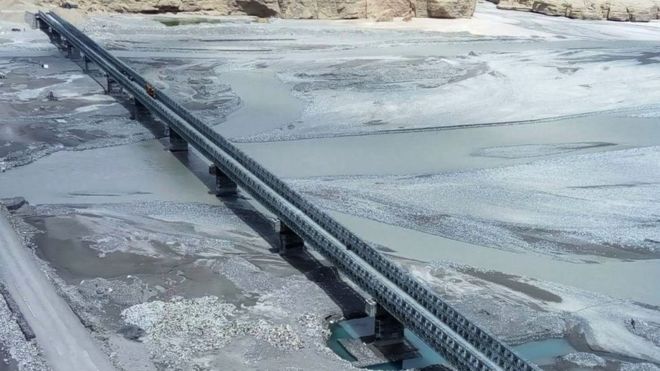
'Col Chewang Rinchen Setu', a bridge built by Border Roads Organisation (BRO) over River Shyok, connecting Durbuk and Daulat Beg Oldie in Eastern LadakhImage copyright PRESS INFORMATION BUREAU
Image caption The area has become a hotspot in part because of a road India has built

The armies of the world’s two most populous nations are locked in a tense face-off high in the Himalayas, which has the potential to escalate as they seek to further their strategic goals.

Officials quoted by the Indian media say thousands of Chinese troops have forced their way into the Galwan valley in Ladakh, in the disputed Kashmir region.

Indian leaders and military strategists have clearly been left stunned.

The reports say that in early May, Chinese forces put up tents, dug trenches and moved heavy equipment several kilometres inside what had been regarded by India as its territory. The move came after India built a road several hundred kilometres long connecting to a high-altitude forward air base which it reactivated in 2008.

The message from China appears clear to observers in Delhi – this is not a routine incursion.

“The situation is serious. The Chinese have come into territory which they themselves accepted as part of India. It has completely changed the status quo,” says Ajai Shukla, an Indian military expert who served as a colonel in the army.

China takes a different view, saying it’s India which has changed facts on the ground.

Reports in the Indian media said soldiers from the two sides clashed on at least two occasions in Ladakh. Stand-offs are reported in at least three locations: the Galwan valley; Hot Springs; and Pangong lake to the south.
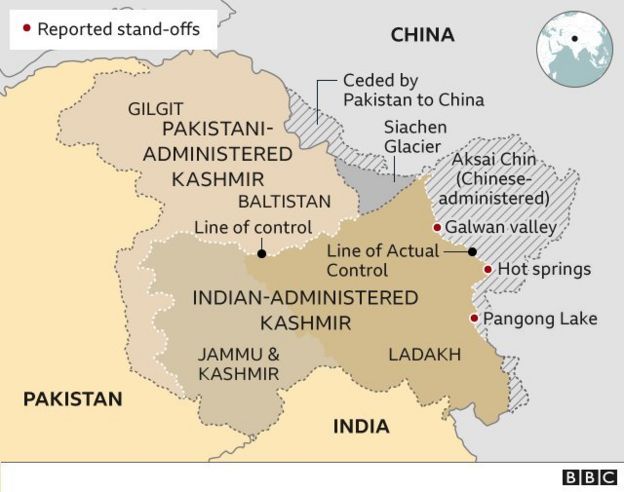
A map showing the disputed area

India and China share a border more than 3,440km (2,100 miles) long and have  overlapping territorial claims. Their border patrols often bump into each other, resulting in occasional scuffles but both sides insist no bullet has been fired in four decades.

Their armies – two of the world’s largest – come face to face at many points. The poorly demarcated Line of Actual Control (LAC) separates the two sides. Rivers, lakes and snowcaps mean the line separating soldiers can shift and they often come close to confrontation.

The current military tension is not limited to Ladakh. Soldiers from the two sides are also eyeball-to-eyeball in Naku La, on the border between China and the north-eastern Indian state of Sikkim. Earlier this month they reportedly came to blows.

And there’s a row over a new map put out by Nepal, too, which accuses India of encroaching on its territory by building a road connecting with China.

Why are tensions rising now?

There are several reasons – but competing strategic goals lie at the root, and both sides blame each other.

“The traditionally peaceful Galwan River has now become a hotspot because it is where the LAC is closest to the new road India has built along the Shyok River to Daulet Beg Oldi (DBO) – the most remote and vulnerable area along the LAC in Ladakh,” Mr Shukla says.

India’s decision to ramp up infrastructure seems to have infuriated Beijing.
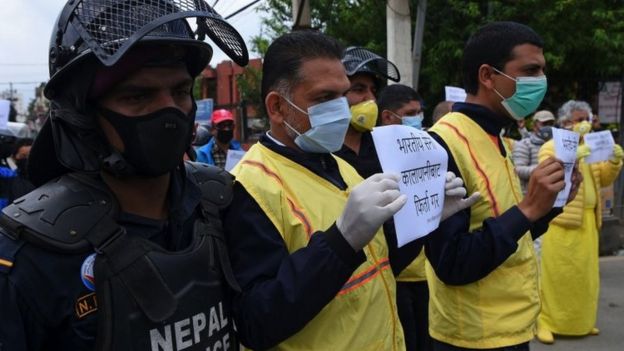
Human rights activists hold placards during a protest against India"s newly inaugurated link road to the Chinese border, near Indian embassy in Kathmandu on May 12, 2020.Image copyright AFP
Image caption There have been protests in Nepal against Indi’s new road link

Chinese state-run media outlet Global Times said categorically: “The Galwan Valley region is Chinese territory, and the local border control situation was very clear.”

“According to the Chinese military, India is the one which has forced its way into the Galwan valley. So, India is changing the status quo along the LAC – that has angered the Chinese,” says Dr Long Xingchun, president of the Chengdu Institute of World Affairs (CIWA), a think tank.

Michael Kugelman, deputy director of the Asia programme at the Wilson Center, another think tank, says this face-off is not routine. He adds China’s “massive deployment of soldiers is a show of strength”.

The road could boost Delhi’s capability to move men and material rapidly in case of a conflict.

Differences have been growing in the past year over other areas of policy too.

When India controversially decided to end Jammu and Kashmir’s limited autonomy in August last year, it also redrew the region’s map.

The new federally-administered Ladakh included Aksai Chin, an area India claims but China controls.

Senior leaders of India’s Hindu-nationalist BJP government have also been talking about recapturing Pakistan-administered Kashmir. A strategic road, the Karakoram highway, passes through this area that connects China with its long-term ally Pakistan. Beijing has invested about $60bn (£48bn) in Pakistan’s infrastructure – the so-called China Pakistan Economic corridor (CPEC) – as part of its Belt and Road Initiative and the highway is key to transporting goods to and from the southern Pakistani port of Gwadar. The port gives China a foothold in the Arabian Sea.
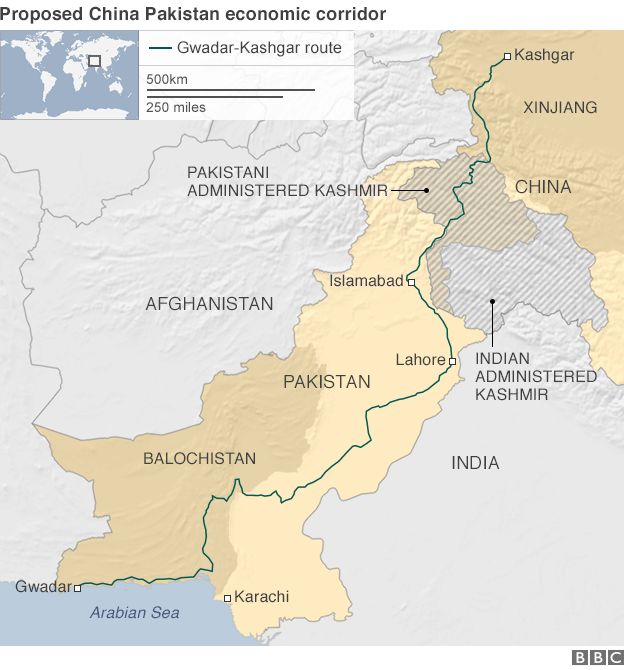
map
In addition, China was unhappy when India initially banned all exports of medical and protective equipment to shore up its stocks soon after the coronavirus pandemic started earlier this year.

How dangerous could this get?

“We routinely see both armies crossing the LAC – it’s fairly common and such incidents are resolved at the local military level. But this time, the build-up is the largest we have ever seen,” says former Indian diplomat P Stobdan, an expert in Ladakh and India-China affairs.

“The stand-off is happening at some strategic areas that are important for India. If Pangong lake is taken, Ladakh can’t be defended. If the Chinese military is allowed to settle in the strategic valley of Shyok, then the Nubra valley and even Siachen can be reached.”

In what seems to be an intelligence failure, India seems to have been caught off guard again. According to Indian media accounts, the country’s soldiers were outnumbered and surrounded when China swiftly diverted men and machines from a military exercise to the border region.

This triggered alarm in Delhi – and India has limited room for manoeuvre. It can either seek to persuade Beijing to withdraw its troops through dialogue or try to remove them by force. Neither is an easy option.

“China is the world’s second-largest military power. Technologically it’s superior to India. Infrastructure on the other side is very advanced. Financially, China can divert its resources to achieve its military goals, whereas the Indian economy has been struggling in recent years, and the coronavirus crisis has worsened the situation,” says Ajai Shukla.

What next?

History holds difficult lessons for India. It suffered a humiliating defeat during the 1962 border conflict with China. India says China occupies 38,000km of its territory. Several rounds of talks in the last three decades have failed to resolve the boundary issues.

China already controls the Aksai Chin area further east of Ladakh and this region, claimed by India, is strategically important for Beijing as it connect its Xinjiang province with western Tibet.
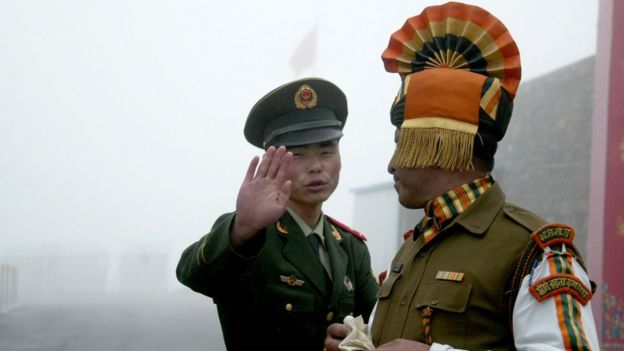
File photo of an Indian and Chinese soldier on the borderImage copyright GETTY IMAGES
Image caption India and China have a long history of border disputes

In 2017 India and China were engaged in a similar stand-off lasting more than two months in Doklam plateau, a tri-junction between India, China and Bhutan.

India objected to China building a road in a region claimed by Bhutan. The Chinese stood firm. Within six months, Indian media reported that Beijing had built a permanent all-weather military complex there.

This time, too, talks are seen as the only way forward – both countries have so much to lose in a military conflict.

“China has no intention to escalate tensions and I think India also doesn’t want a conflict. But the situation depends on both sides. The Indian government should not be guided by the nationalistic media comments,” says Dr Long Xingchun of the CIWA in Chengdu. “Both countries have the ability to solve the dispute through high-level talks.”

Chinese media have given hardly any coverage to the border issue, which is being interpreted as a possible signal that a route to talks will be sought.

Pratyush Rao, associate director for South Asia at Control Risks consultancy, says both sides have “a clear interest in prioritising their economic recovery” and avoiding military escalation.

“It is important to recognise that both sides have a creditable record of maintaining relative peace and stability along their disputed border.”

Source: The BBC
16/03/2020

In Indian capital, riots deepen a Hindu-Muslim divide

NEW DELHI (Reuters) – For years, Hindus and Muslims lived and worked peacefully together in Yamuna Vihar, a densely populated Delhi district.

But the riots that raged through the district last month appear to have cleaved lasting divisions in the community, reflecting a nationwide trend as tensions over the Hindu nationalist agenda of Prime Minister Narendra Modi boil over.

Many Hindus in Yamuna Vihar, a sprawl of residential blocks and shops dotted with mosques and Hindu temples, and in other riot-hit districts of northeast Delhi, say they are boycotting merchants and refusing to hire workers from the Muslim community. Muslims say they are scrambling to find jobs at a time when the coronavirus pandemic has heightened pressure on India’s economy.

“I have decided to never work with Muslims,” said Yash Dhingra, who has a shop selling paint and bathroom fittings in Yamuna Vihar. “I have identified new workers, they are Hindus,” he said, standing in a narrow lane that was the scene of violent clashes in the riots that erupted on Feb. 23.

The trigger for the riots, the worst sectarian violence in the Indian capital in decades, was a citizenship law introduced last year that critics say marginalises India’s Muslim minority. Police records show at least 53 people, mostly Muslims, were killed and more than 200 were injured.

Dhingra said the unrest had forever changed Yamuna Vihar. Gutted homes with broken doors can be seen across the neighbourhood; electricity cables melted in the fires dangle dangerously above alleys strewn with stones and bricks used as makeshift weapons in the riots.

Most Hindu residents in the district are now boycotting Muslim workers, affecting everyone from cooks and cleaners to mechanics and fruit sellers, he said.

“We have proof to show that Muslims started the violence, and now they are blaming it on us,” Dhingra said. “This is their pattern as they are criminal-minded people.”

Those views were widely echoed in interviews with 25 Hindus in eight localities in northeast Delhi, many of whom suffered large-scale financial damages or were injured in the riots. Reuters also spoke with about 30 Muslims, most of whom said that Hindus had decided to stop working with them.

Suman Goel, a 45-year-old housewife who has lived among Muslim neighbours for 23 years, said the violence had left her in a state of shock.

“It’s strange to lose a sense of belonging, to step out of your home and avoid smiling at Muslim women,” she said. “They must be feeling the same too but it’s best to maintain a distance.”

Mohammed Taslim, a Muslim who operated a business selling shoes from a shop owned by a Hindu in Bhajanpura, one of the neighbourhoods affected by the riots, said his inventory was destroyed by a Hindu mob.

He was then evicted and his space was leased out to a Hindu businessman, he said.

“This is being done just because I am a Muslim,” said Taslim.

Many Muslims said the attack had been instigated by hardline Hindus to counter protests involving tens of thousands of people across India against the new citizenship law.

“This is the new normal for us,” said Adil, a Muslim research assistant with an economic think tank in central Delhi. “Careers, jobs and business are no more a priority for us. Our priority now is to be safe and to protect our lives.”

He declined to disclose his full name for fear of reprisals.

Emboldened by Modi’s landslide electoral victory in 2014, hardline groups began pursuing a Hindu-first agenda that has come at the expense of the country’s Muslim minority.

Vigilantes have attacked and killed a number of Muslims involved in transporting cows, which are seen as holy animals by Hindus, to slaughterhouses in recent years. The government has also adopted a tough stance with regard to Pakistan, and in August withdrew semi-autonomous privileges for Jammu and Kashmir, India’s only Muslim-majority state.

In November, the Supreme Court ruled that a Hindu temple could be built at Ayodhya, where a right-wing mob tore down a 16th-century mosque in 1992, a decision that was welcomed by the Modi government.

The citizenship law, which eases the path for non-Muslims from neighbouring Muslim-majority nations to gain citizenship in India, was the final straw for many Muslims, as well as secular Indians, sparking nationwide protests.

Modi’s office did not respond to questions from Reuters about the latest violence.

NIGHT VIGILANTES

During the day, Hindus and Muslims shun each other in the alleys of the Delhi districts that were hardest hit by the unrest in February. At night, when the threat of violence is greater, they are physically divided by barricades that are removed in the morning.

And in some areas, permanent barriers are being erected.

On a recent evening, Tarannum Sheikh, a schoolteacher, sat watching two welders install a high gate at the entrance of a narrow lane to the Muslim enclave of Khajuri Khas, where she lives. The aim was to keep Hindus out, she said.

“We keep wooden batons with us to protect the entrance as at any time, someone can enter this alley to create trouble,” she said. “We do not trust the police anymore.”

In the adjacent Hindu neighbourhood of Bhajanpura, residents expressed a similar mistrust and sense of insecurity.

“In a way these riots were needed to unite Hindus, we did not realise that we were surrounded by such evil minds for decades,” said Santosh Rani, a 52-year-old grandmother.

She said she had been forced to lower her two grandchildren from the first floor of her house to the street below after the building was torched in the violence, allegedly by a Muslim.

“This time the Muslims have tested our patience and now we will never give them jobs,” said Rani who owns several factories and retail shops. “I will never forgive them.”

Hasan Sheikh, a tailor who has stitched clothing for Hindu and Muslim women for over 40 years, said Hindu customers came to collect their unstitched clothes after the riots.

“It was strange to see how our relationship ended,” said Sheikh, who is Muslim. “I was not at fault, nor were my women clients, but the social climate of this area is very tense. Hatred on both sides is justified.”

Source: Reuters

25/02/2020

After raucous welcome in India, Trump clinches $3 billion military equipment sale

NEW DELHI (Reuters) – U.S. President Donald Trump said on Tuesday that India will buy $3 billion worth of military equipment, including attack helicopters, as the two countries deepen defence and commercial ties in an attempt to balance the weight of China in the region.

India and the United States were also making progress on a big trade deal, Trump said. Negotiators from the two sides have wrangled for months to narrow differences on farm goods, medical devices, digital trade and new tariffs.

Trump was accorded a massive reception in Indian Prime Minister Narendra Modi’s home state on Monday, with more than 100,000 people filling into a cricket stadium for a “Namaste Trump” rally.

On Tuesday, Trump sat down for one-on-one talks with Modi followed by delegation-level meetings to try and move forward on issues that have divided them, mainly the festering trade dispute.

After those meetings, Trump said his visit had been productive with the conclusion of deals to buy helicopters for the Indian military. India is buying 24 SeaHawk helicopters from Lockheed Martin equipped with Hellfire missiles worth $2.6 billion and also plans a follow-on order for six Apache helicopters.

India is modernising its military to narrow the gap with China and has increasingly turned to the United States over traditional supplier, Russia.

Trump said the two countries were also making progress on a trade deal, which had been an area of growing friction between them.

“Our teams have made tremendous progress on a comprehensive trade agreement and I’m optimistic we can reach a deal that will be of great importance to both countries,” said Trump in remarks made alongside Modi.

The two countries had initially planned to produce a “mini deal”, but that proved elusive.

Instead both sides are now aiming for a bigger package, including possibly a free trade agreement.

Trump said he also discussed with Modi, whom he called his “dear friend”, the importance of a secure 5G telecoms network in India, ahead of a planned airwaves auction by the country.

The United States has banned Huawei, arguing the use of its kit creates the potential for espionage by China – a claim denied by Huawei and Beijing – but India, where telecoms companies have long used network gear from the Chinese firm, is yet to make a call.

Trump described Monday’s rally in Ahmedabad and again praised Modi and spoke of the size of the crowd, claiming there were “thousands of people outside trying to get in..

“I would even imagine they were there more for you than for me, I would hope so,” he told Modi. “The people love you…every time I mentioned your name, they would cheer.”

In New Delhi, Trump was given a formal state welcome on Tuesday at the red sandstone presidential palace with a 21-cannon gun salute and a red coated honour guard on horseback on a smoggy day.

HUG GETS TIGHTER

India is one of the few big countries in the world where Trump’s personal approval rating is above 50% and Trump’s trip has got wall-to-wall coverage with commentators saying he had hit all the right notes on his first official visit to the world’s biggest democracy.

They were also effusive in their praise for Modi for pulling off a spectacular reception for Trump.

“Modi-Trump hug gets tighter,” ran a headline in the Times of India.

But in a sign of the underlying political tensions in India, violent protests broke out in Delhi on Monday over a new citizenship law that critics say discriminates against Muslims and is a further attempt to undermine the secular foundations of India’s democracy. They say the law is part of a pattern of divisiveness being followed by Modi’s Hindu nationalist Bharatiya Janata Party.

At least 7 people were killed and about 150 injured in the clashes that took place in another part of the capital, away from the centre of the city where Modi is hosting Trump.

In his speech on Monday, Trump extolled India’s rise as a stable and prosperous democracy as one of the achievements of the century. “You have done it as a tolerant country. And you have done it as a great, free country,” he said.

Delhi has also been struggling with high air pollution and on Tuesday the air quality was moderately poor at 193 on a government index that measures pollution up to a scale of 500. The WHO considers anything above 60 as unhealthy.

Source: Reuters

23/09/2019

‘Howdy, Modi!’: Trump hails Indian PM at ‘historic’ Texas rally

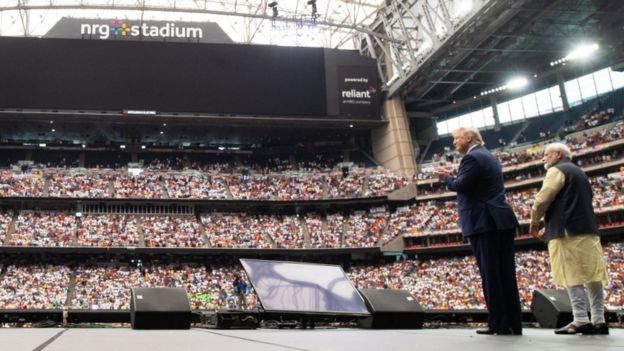
US President Donald Trump and Indian Prime Minister Narendra Modi exchanged warm words of friendship in Texas at a rare mass rally for a foreign leader.

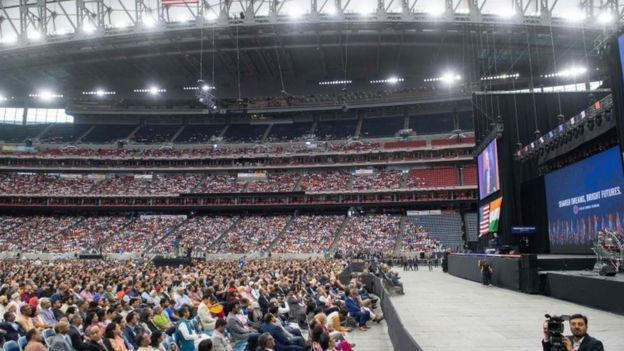
Around 50,000 people gathered for what Mr Trump called a “profoundly historic event” on Sunday in Houston.

The “Howdy, Modi!” event was billed as one of the largest ever receptions of a foreign leader in the US.

Mr Modi, however, may face a frostier reception at the UN General Assembly.

He is likely to face criticism over tensions in Indian-administered Kashmir, which he stripped of its special status last month, promising to restore the region to its “past glory”.

The region has been in lockdown for more than a month with thousands of activists, politicians and business leaders detained.

Trade talks and the UN General Assembly are on the Indian prime minister’s agenda during his week-long visit to the United States.

Pakistani Prime Minister Imran Khan, who has been the most vocal international leader to oppose India’s Kashmir move, is also in the US for the UN conference. Like Mr Modi, he will have a one-on-one meeting with Mr Trump on the sidelines of the summit.

A 90-minute show, featuring 400 performers, warmed up the crowd before Mr Modi and Mr Trump shared the stage.

“I’m so thrilled to be here in Texas with one of America’s greatest, most devoted and most loyal friends, Prime Minister Modi of India,” Mr Trump told the crowd.

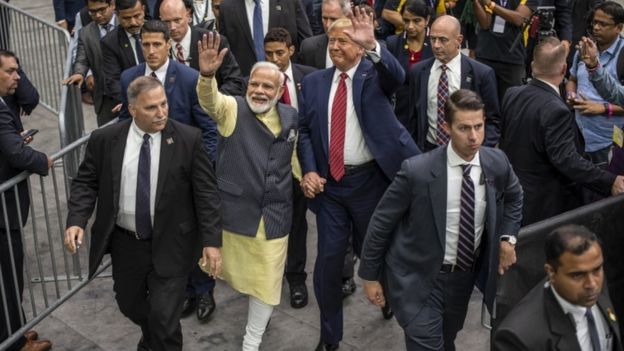
Narendra Modi and Donald Trump leave the stage holding hands at NRG Stadium, HoustonImage copyright GETTY IMAGES
Image caption Narendra Modi and Donald Trump leave the stage holding hands at Houston’s NRG Stadium

In his speech, Mr Modi said India has a “true friend” in the White House, describing Mr Trump as “warm, friendly, accessible, energetic and full of wit”.

“From CEO to commander-in-chief, from boardrooms to the Oval Office, from studios to the global stage… he has left a lasting impact everywhere,” Mr Modi said.

Presentational grey line

Personal-touch diplomacy played to perfection

Brajesh Upadhyay, BBC News, Houston

This was exactly the kind of crowd size and energy President Trump loves at his rallies.

Only here the chants were for Indian Prime Minister Narendra Modi and Mr Trump was the superstar invited to the party. But the crowd did not disappoint him either and greeted him with chants of “USA!”, most heard at Trump rallies.

The personal-touch diplomacy with Mr Modi’s trademark bear hugs was played to perfection.

This rally has been called a win-win for both the leaders. For President Trump, it was a chance to court Indian-Americans for the 2020 presidential election race where Texas could emerge as a battleground state. For Mr Modi, a PR triumph and picture with the president of the United States may help him shrug off the criticism over his recent strong-arm policies at home.

Presentational grey line

Houston’s NRG Stadium, where the event was hosted, was the first stop for Mr Modi, whose Hindu nationalist Bharatiya Janata Party (BJP) won a landslide victory in this year’s Indian elections.

Greeted by a standing ovation, Mr Trump used his speech to heap praise on Mr Modi, who he said was doing a “truly exceptional job for India” and its people.

Mr Trump also paid tribute to the Indian-American community, telling them “we are truly proud to have you as Americans”.

The US has a population of about 4 million Indians who are seen as an increasingly important vote bank in the country.

Apart from Mr Trump, organisers also invited Democrats to the event – House Majority Leader Steny Hoyer was among those who spoke.

The 2010 US census shows that Texas is home to the fourth-largest Indian-American population in the country after California, New York and New Jersey.

Analysis of voting patterns shows the community tends overwhelmingly to support the Democrat party.

Narendra Modi said Donald Trump attend a mass rally in TexasImage copyright GETTY IMAGES
Image caption The event, dubbed “Howdy, Modi!”, was attended by an estimated 50,000 people

No stranger to nationalist rhetoric himself, Mr Trump compared security at the US-Mexico border to the tensions between India and Pakistan in the tinderbox Kashmir region.

“Both India and US also understand that to keep our communities safe, we must protect our borders,” Trump said.

Donald Trump described Narendra Modi as one of America's most "loyal friends"Image copyright GETTY IMAGES
Image caption Donald Trump described Narendra Modi as one of America’s most “loyal friends”

In India, the rally was closely watched, with most mainstream media outlets running live news updates of what was transpiring on stage.

The event had been making headlines for days before as well.

On Twitter, many people shared instant analysis and opinions of what was taking place on the stage with the sentiment being overwhelmingly positive. Many praised Mr Modi for what they saw as his statesmanship and diplomatic acumen with a lot of praise coming in for the US president as well.

Source: The BBC

28/04/2019

A really simple guide to India’s general election

Indian electionsImage copyright GETTY IMAGES

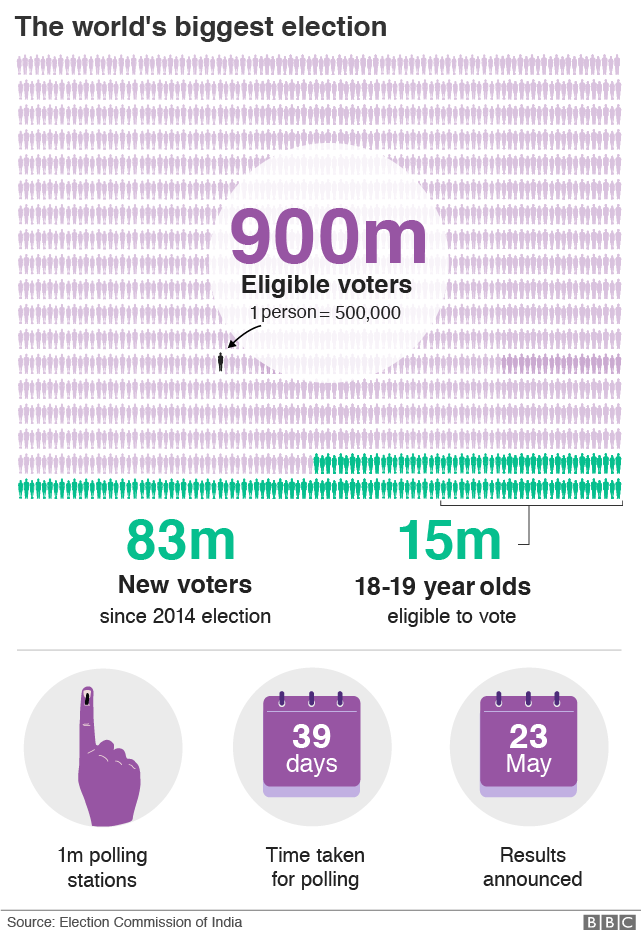
It is an election like no other. Those eligible to vote in India’s upcoming polls represent more than 10% of the world’s population and they will take part in the largest democratic exercise in history.

Voters will choose representatives for the Indian parliament, and in turn decide if Hindu nationalist Prime Minister Narendra Modi will run the country for another five years.

What is at stake?

Whoever wins these elections and forms a government will control the destiny of the world’s largest democracy.

While they are in charge,  is likely to overtake the UK’s and become the world’s fifth-largest.

Its population meanwhile – at more than 1.34bn people – is predicted to soon surpass China’s 1.39bn.

Hundreds of millions of Indians have escaped  since the turn of the millennium but huge challenges remain.

 is a major concern and is especially high among young people.

Millions of  about low crop prices.

How the nuclear-armed country engages with the outside world – and manages a tricky  – is also of immense importance to international security.

Graphic: The immense scale of India's elections

Who is being elected?

Indians are voting for members of parliament and the job of prime minister tends to go to the leader of the party or coalition with most seats. The current PM is .

His main rival is opposition leader .

Parliament has two houses: the Lok Sabha and the .

The lower house –  – is the one to watch.

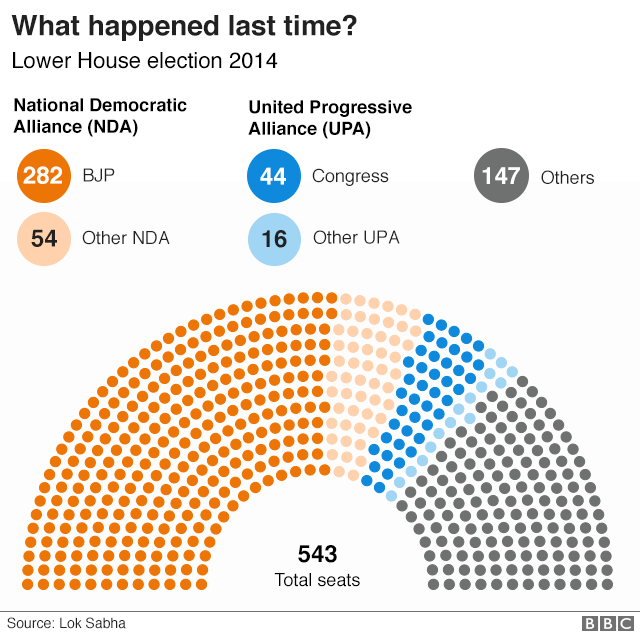
It has 543 elected seats and any party or coalition needs a minimum of 272 MPs to form a government.

At the last election in 2014, Mr Modi’s  won 282 seats.

Mr Gandhi’s  only took 44 seats in 2014 – down from 206 in 2009.

Graphic: The battle for the Lower House of the Indian Parliament

Why does voting take so long?

Because of the enormous number of election officials and security personnel involved, voting will take place in seven stages between 11 April and 19 May.

Different states will vote at different times.

Votes will be counted on 23 May and results are expected on the same day.

Who will win?

This election is being seen as a referendum on Mr Modi, a polarising figure adored by many but also accused of stoking divisions between  and the country’s 200 million Muslims.

Until a few months ago, Mr Modi and his BJP party were seen as the overwhelming favourites. But the  in December’s regional elections injected a sense of serious competition into the national vote.

Analysts are divided on whether Mr Modi will be able to win a simple majority again.

A recent escalation of tensions with Pakistan has given the BJP a new and popular issue to campaign on.

It will be hoping that a focus on patriotism will help the party to get past the serious challenge mounted by powerful regional parties and Congress.

Source: The BBC

23/02/2019

Rakbar Khan: Did cow vigilantes lynch a Muslim farmer?

Members of Nawal Kishore Sharma's cow vigilante gang pictured in 2015Image copyrightGETTY IMAGES (ALLISON JOYCE)
Image captionCow vigilantes in Ramgarh in 2015
Presentational white space

A Muslim dairy farmer was stopped late one night last July as he led two cows down a track in rural Rajasthan, south of the Indian capital, Delhi. Within hours he was dead, but who killed him, asks the BBC’s James Clayton – the “cow vigilantes” he met on the road, or the police?

It’s 4am and Dr Hassan Khan, the duty doctor at Ramgarh hospital, is notified of something unusual.

The police have brought in a dead man, a man they claim not to know.

“What were the police like when they brought him in? Were they calm?” I ask him.

“Not calm,” he says. “They were anxious.”

“Are they usually anxious?” I ask.

“Not usually,” he says, laughing nervously.

The dead man is later identified by his father as local farmer Rakbar Khan.

This was not a random murder. The story illustrates some of the social tensions bubbling away under the surface in India, and particularly in the north of the country.

And his case raises questions for the authorities – including the governing Hindu nationalist BJP party.

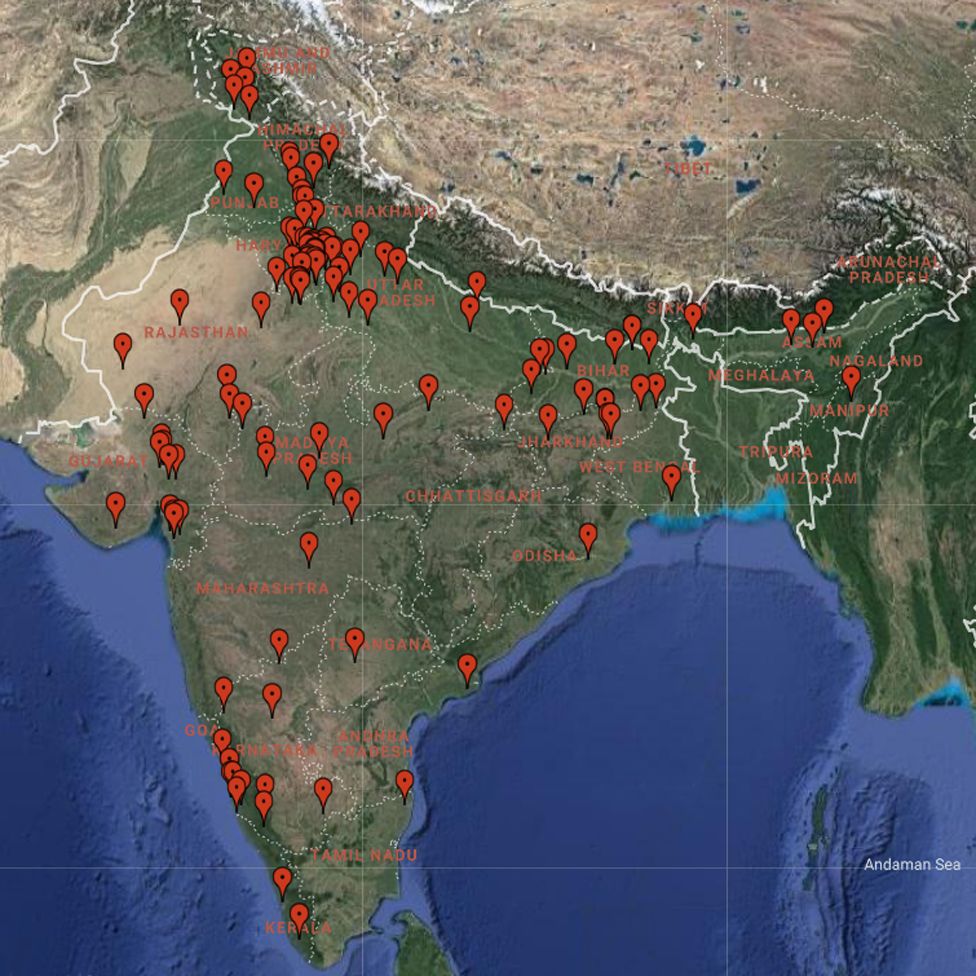
Cow-related violence – 2012-2019

IndiaSpend map of cow violenceImage copyrightINDIASPEND
Rakbar Khan was a family man. He had seven children.

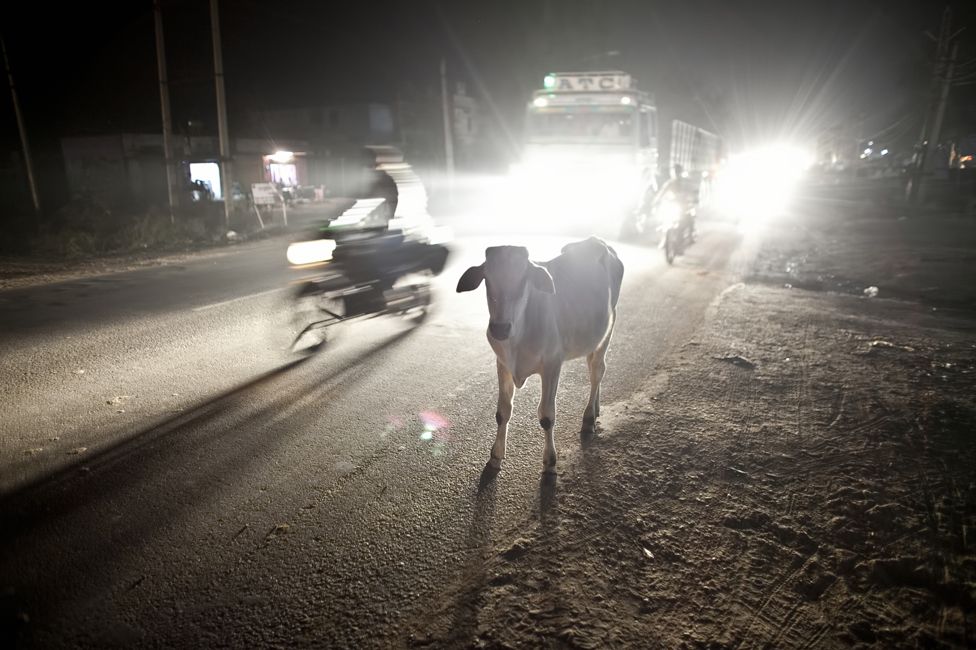
He kept cows and he also happened to be a Muslim. That can be a dangerous mix in India.

“We have always reared cows, and we are dependent on their milk for our livelihood,” says Rakbar’s father, Suleiman.

“No-one used to say anything when you transported a cow.”

That has changed. Several men have been killed in recent years while transporting cows in the mainly Muslim region of Mewat, not far from Delhi, where Rakbar lived.

“People are afraid. If we go to get a cow they will kill us. They surround our vehicle. So everyone is too scared to get these animals,” says Suleiman.

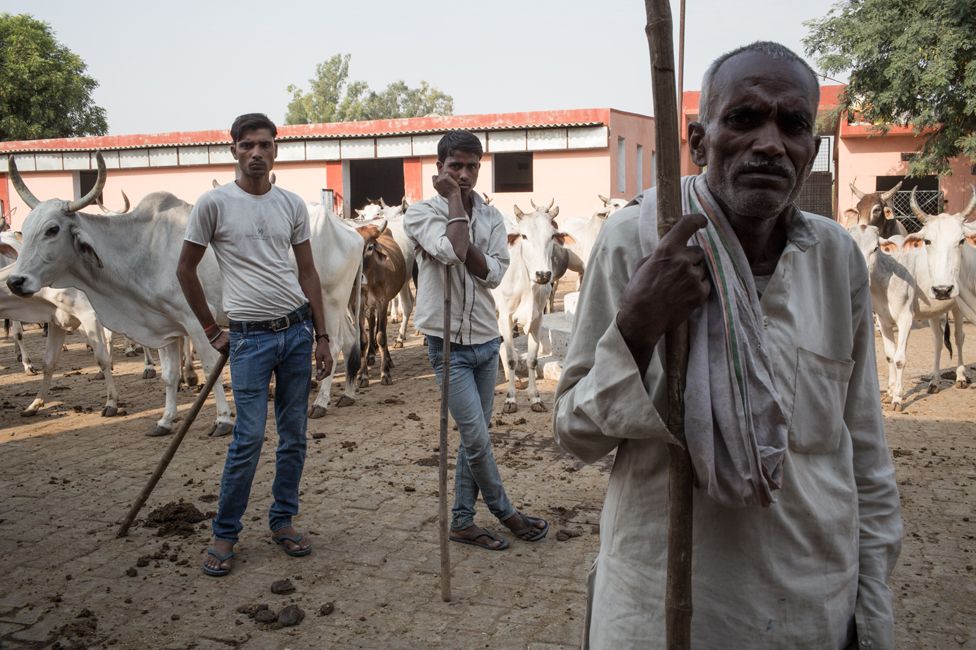
Everyone I speak to in the village where the Khans live is afraid of gau rakshaks – cow protection gangs.

Nawal Kishore Sharma's cow vigilante gangImage copyrightGETTY IMAGES (ALLISON JOYCE)
Image captionNawal Kishore Sharma’s cow protection group in 2015
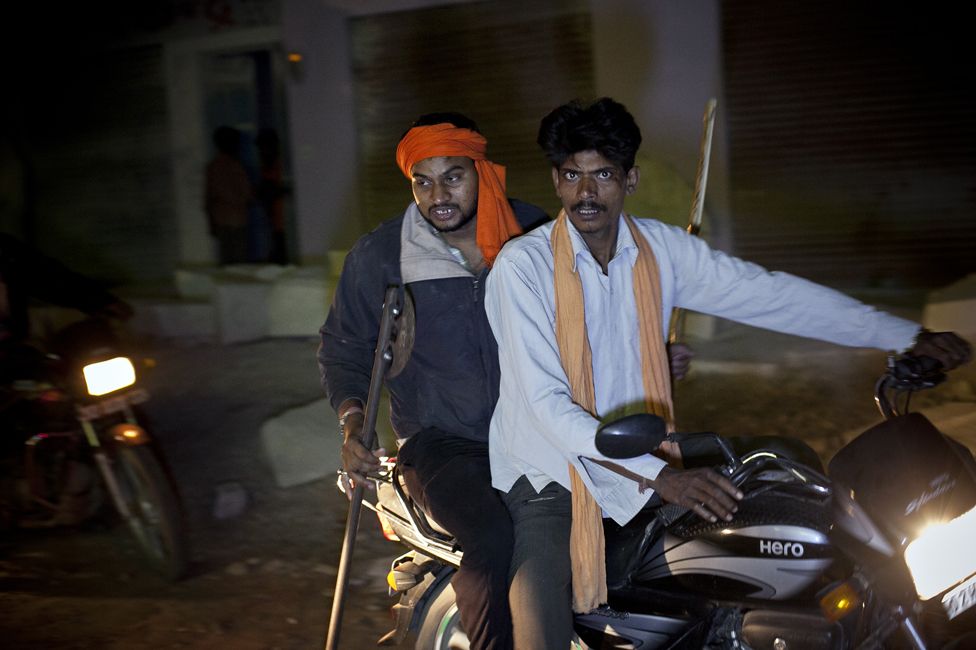
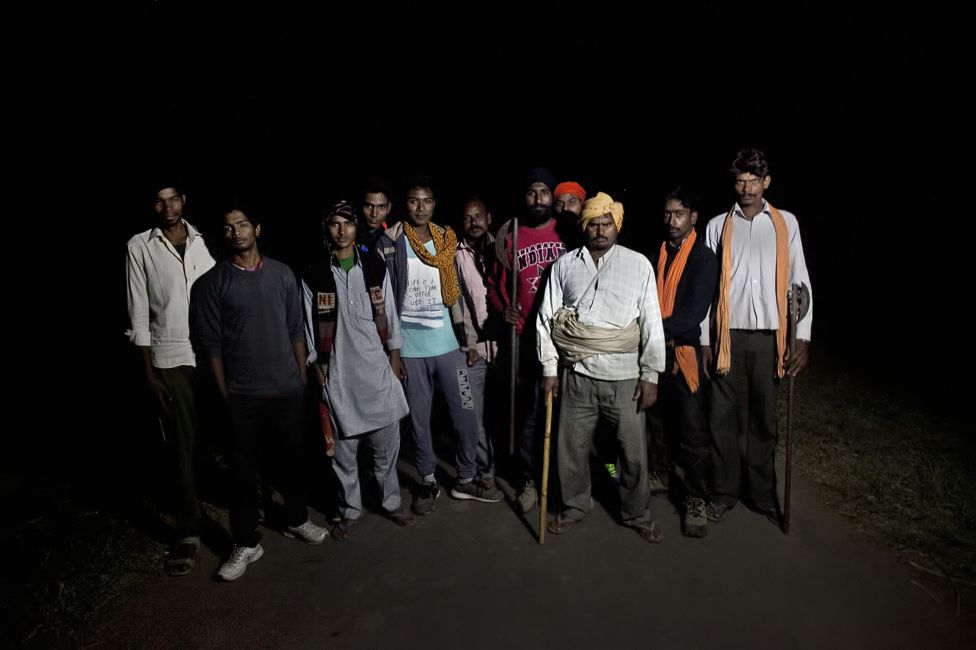
Presentational white spaceThe gangs often consist of young, hardline Hindus, who believe passionately in defending India’s holy animal.

They believe that laws to protect cows, such as a ban on slaughtering the animals, are not being fully enforced – and they hunt for “cow smugglers”, who they believe are taking cows to be killed for meat.

Often armed, they have been responsible for dozens of attacks on farmers in India over the last five years, according to data analysis organisation IndiaSpend, which monitors reports of hate crimes in the media.

On 21 July 2018, Rakbar Khan met the local gau rakshak.

presentational grey line

There are some things we know for certain about what happened that night.

Rakbar was walking down a small road with two cows. It was late and it was raining heavily.

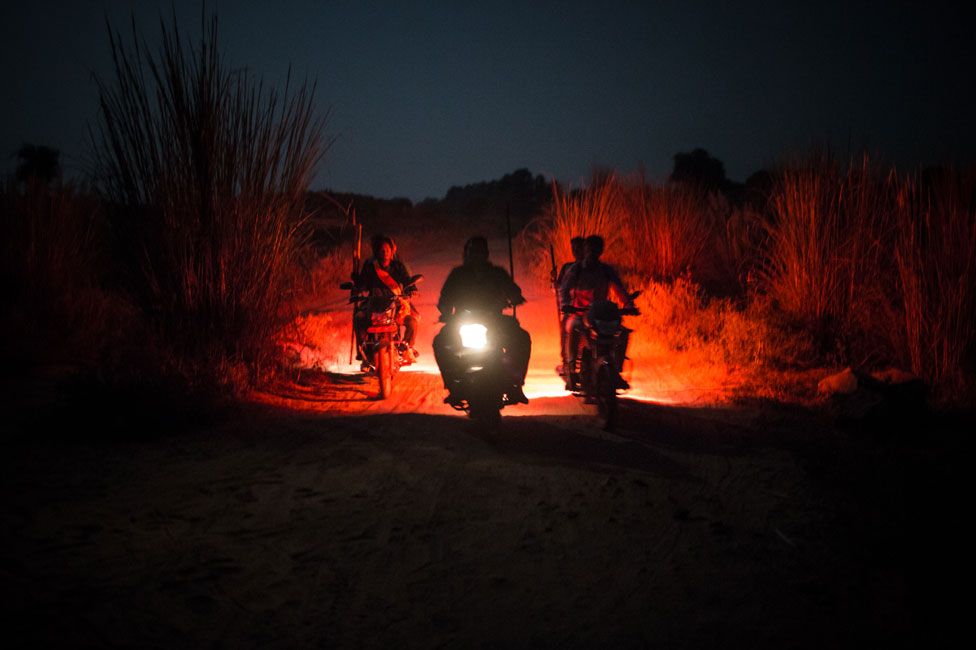
Then, out of the dark, came the lights of motorbikes. We know this, because Rakbar was with a friend, who survived.

Cow vigilantes on motorbikes in Yadavnagar, RajasthanImage copyrightGETTY IMAGES (ENRICO FABIAN)
At this point the details become a little sketchier. There are three versions of the story.

The gang managed to catch Rakbar, but his friend, Aslam, slipped away. He lay on the ground, in the mud and prayed he wouldn’t be found.

“There was so much fear inside me, my heart was hurting,” he says.

“From there I heard the screams. They were beating him. There wasn’t a single part of his body that wasn’t broken. He was beaten very badly.”

presentational grey line

Find out more

Watch James Clayton’s report for Newsnight, on BBC Two

The documentary India’s Cow Vigilantes can be seen on Our World on BBC World Newsand on the BBC News Channel (click for transmission times)

presentational grey line

Aslam says that Rakbar was killed then and there.

But there is evidence that suggests otherwise.

Much of what happened next focuses around the leader of the local cow vigilante group, Nawal Kishore Sharma.

Aslam claims he heard the gang address him by name that night, but when I speak to Sharma, he denies he was there at all.

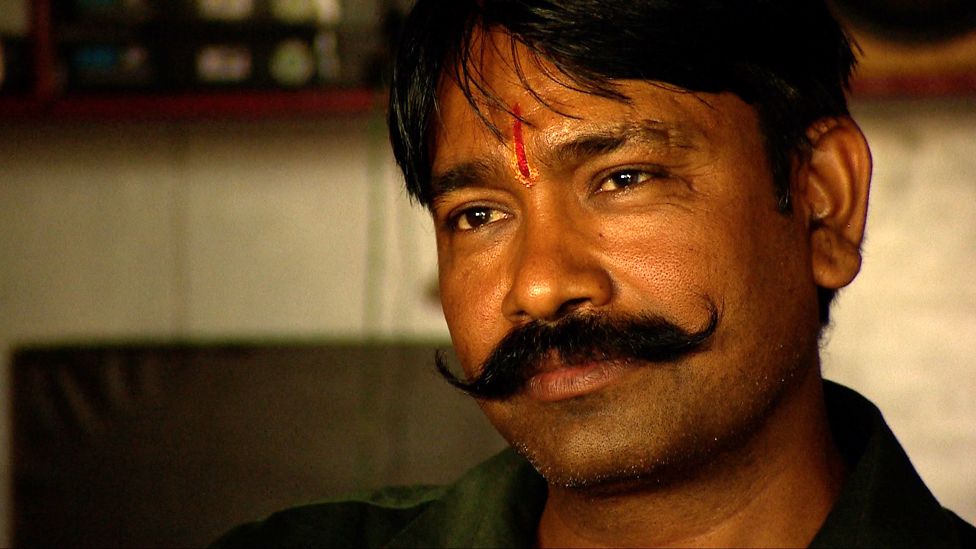
Nawal Kishore Sharma
Image captionNawal Kishore Sharma

“It was about 00:30 in the morning and I was sleeping in my house… Some of my group phoned me to say they’d caught some cow smugglers,” he says.

According to Nawal Kishore Sharma, he then drove with the police to the spot. “He was alive and he was fine,” he says.

But that’s not what the police say.

In their “first incident report” they say that Rakbar was indeed alive when they found him.

“Nawal Kishore Sharma informed the police at about 00:41 that some men were smuggling two cows on foot,” the report says.

“Then the police met Nawal Kishore outside the police station and they all went to the location.

“There was a man who was injured and covered in mud.

“He told the police his name, his father’s name, his age (28) and the village he was from.

“And as he finished these sentences, he almost immediately passed out. Then he was put in the police vehicle and they left for Ramgarh.

“Then the police reached Ramgarh with Rakbar where the available doctor declared him dead.”

Ramgarh at nightImage copyrightGETTY IMAGES (ALLISON JOYCE)
Image captionRamgarh at night
But this version of events is highly dubious.

I go to the hospital in Ramgarh, where Rakbar was taken. Hospital staff are busily going through bound books of hospital records – looking for Rakbar’s admission entry.

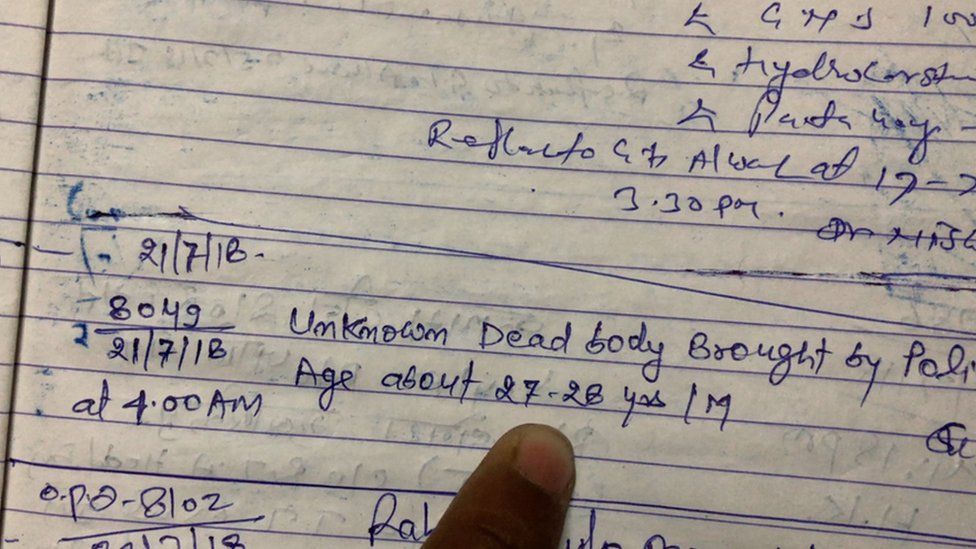
And then, there it is. “Unknown dead body” brought in at 04:00 on 21 July 2018.

Hospital record of unknown dead body

It’s not a long entry, but it contradicts the police’s story, and raises some serious questions.

For a start, Rakbar was found about 12 minutes’ drive away from the hospital. Why did it take more than three hours for them to take him there?

And if the police say Rakbar gave them his name, why did they tell the hospital they didn’t know who he was?

Nawal Kishore Sharma claims to know why. He paints a very different picture of what happened to Rakbar.

He tells me that after picking up Rakbar, they changed his clothes.

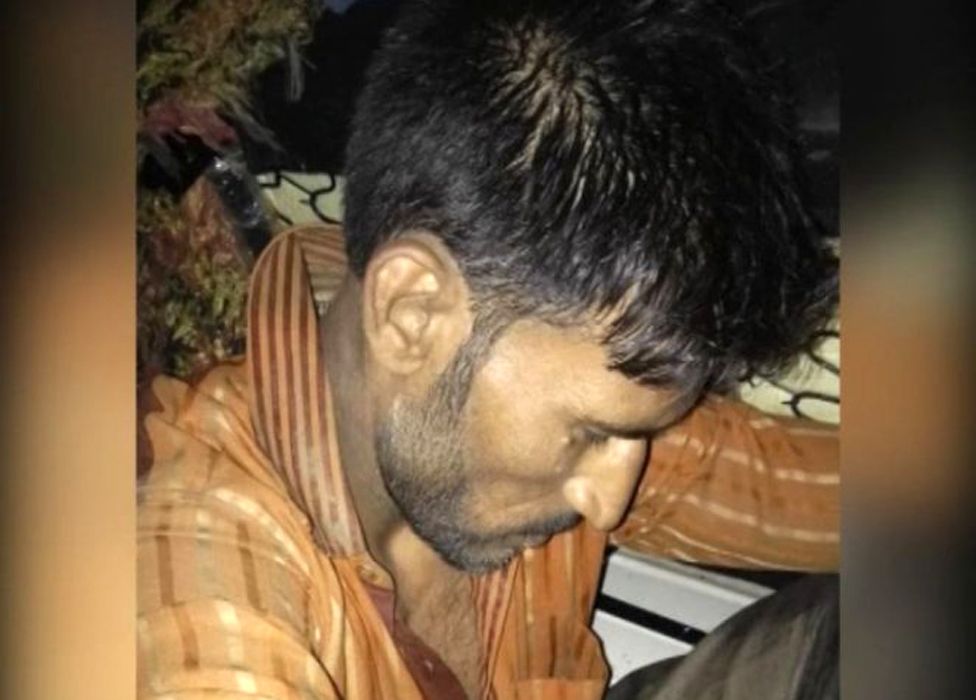
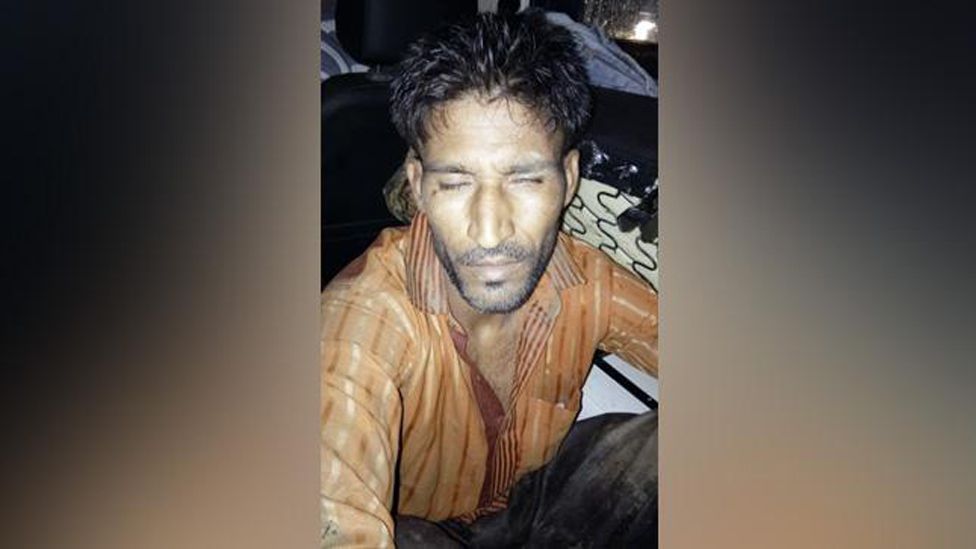
He then claims to have taken two photos of Rakbar – who at this point was with the police.

Nawal Kishore Sharma's photograph of Rakbar Khan
Presentational white space
Nawal Kishore Sharma's photograph of Rakbar Khan

Sharma says that he went to the police station with the police. He claims that’s when the beating really began.

“The police injured him badly. They even beat him with their shoes,” he says.

“They kicked him powerfully on the left side of his body four times. Then they beat him with sticks. They beat him here (pointing at his ribs) and even on his neck.”

At about 03:00 Nawal Kishore Sharma says he went with some police officers to take the two cows to a local cow shelter. When he returned, he says, the police told him that Rakbar had died.

Rakbar’s death certificate shows that his leg and hand had been broken. He’d been badly beaten and had broken his ribs, which had punctured his lungs.

According to his death certificate he died of “shock… as a result of injuries sustained over body”.

I ask the duty doctor at the hospital whether he remembers what Rakbar’s body was like when the police brought it in.

“It was cold,” he says.

I ask him how long it would take for a body to become cold after death.

“A couple of hours,” he replies.

presentational grey line

“I don’t want to talk about Rakbar’s case,” says Rejendra Singh, chief of police of Alwar district, which includes Ramgarh.

Since Rakbar’s murder several police officers have been suspended. I want to know why.

He looks uneasily at me.

“There were lapses on the police side,” he says.

I ask him what those lapses were.

“They had not followed the regular police procedure, which they were supposed to do,” he says. “It was one big lapse.”

Three men from Nawal Kishore Sharma’s vigilante group have been charged with Rakbar’s murder. Sharma himself remains under investigation.

The vigilante group and the police blame each other for Rakbar’s death, but neither denies working together that night.

The way Sharma describes it, the police cannot be everywhere, so the vigilantes help them out. But it’s the police that “take all the action” he says.

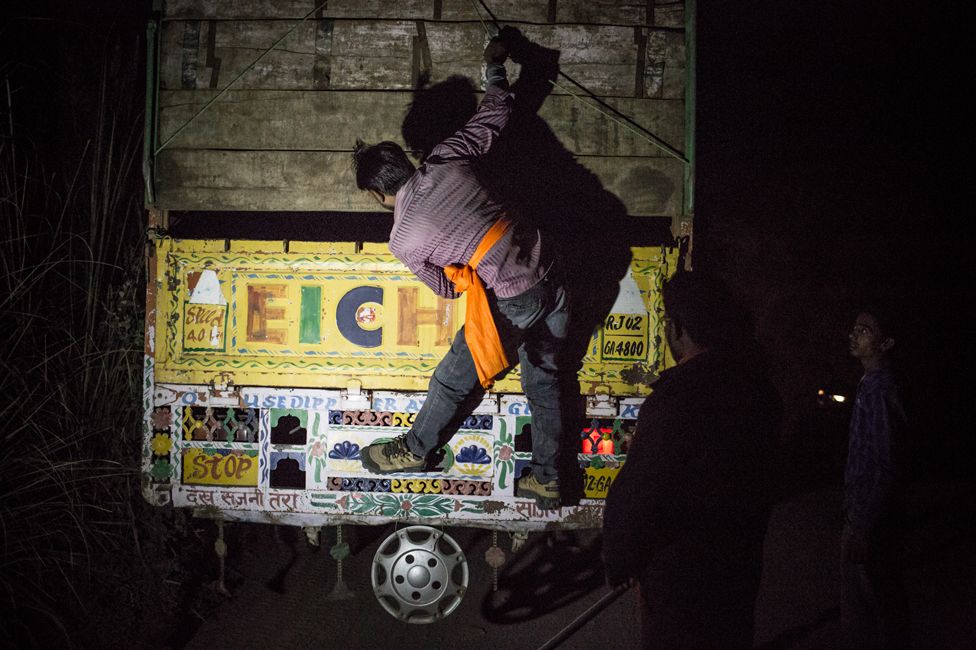
Nawal Kishore Sharma investigates a lorry outside Bilaspur, near Ramgarh, in 2015Image copyrightGETTY IMAGES (ENRICO FABIAN)
Image captionNawal Kishore Sharma inspects a lorry transporting cows (October 2015)
Much police activity in Rajasthan is focused on stopping cow slaughter.

Across the state there are dozens of formal cow checkpoints, where police stop vehicles looking for smugglers who are taking cows to be killed.

I visited one of the checkpoints. Sure enough police were patiently stopping vehicles and looking for cows.

The night before officers had had a gun battle with a group of men after a truck failed to stop.

These checkpoints have become common in some parts of India. Sometimes they are run by the police, sometimes by the vigilantes, and sometimes by both.

This gets to the heart of Rakbar’s case.

Human rights groups argue that his murder – and others like his – show that in some areas the police have got too close to the gangs.

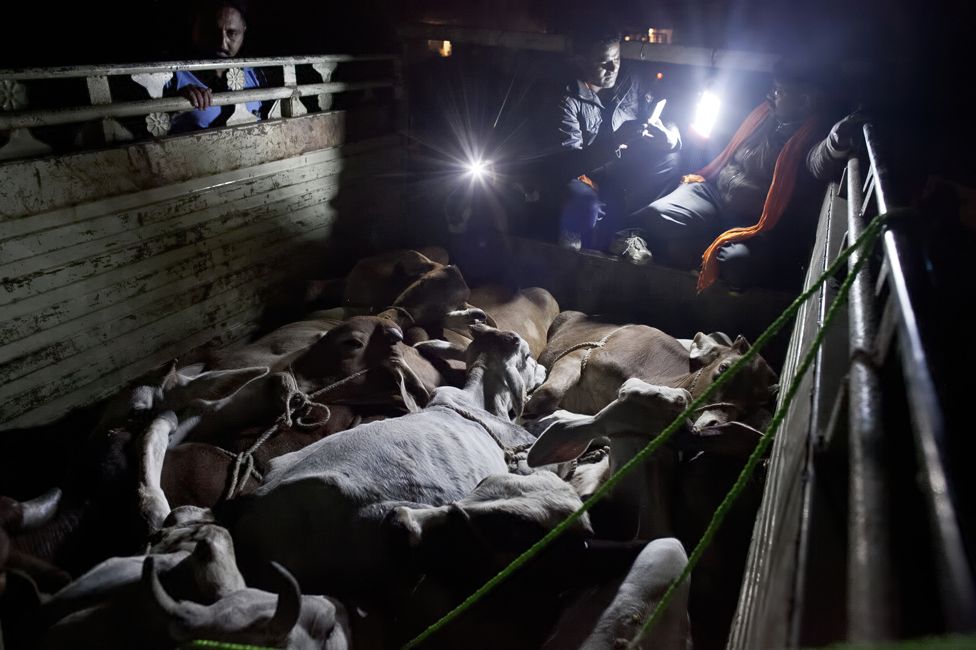
Cow vigilantes in Ramgarh check a suspicious load in November 2015Image copyrightGETTY IMAGES (ALLISON JOYCE)
Image captionThe vigilantes find what they are looking for (November 2015)
“Unfortunately what we’re finding too often is that the police are complicit,” says Meenakshi Ganguly of Human Rights Watch, which published a 104-page report on cow-related violence in India this week.

In some areas, police have been reluctant to arrest the perpetrators of violence – and much faster to prosecute people accused of either consuming or trading in beef, he says.

Human Rights Watch has looked into 12 cases where it claims police have been complicit in the death of a suspected cow smuggler or have covered it up. Rakbar’s is one of them.

But this case doesn’t just illustrate police failings. Some would argue that it also illustrates how parts of the governing BJP party have inflamed the problem.

Gyandev Ahuja is a larger-than-life character. As the local member of parliament in Ramgarh at the time when Rakbar was killed he’s an important local figure.

He has also made a series of controversial statements about “cow smugglers”.

After a man was badly beaten in December 2017 Ahuja told local media: “To be straightforward, I will say that if anyone is indulging in cow smuggling, then this is how you will die.”

After Rakbar’s death he said that cow smuggling was worse than terrorism.

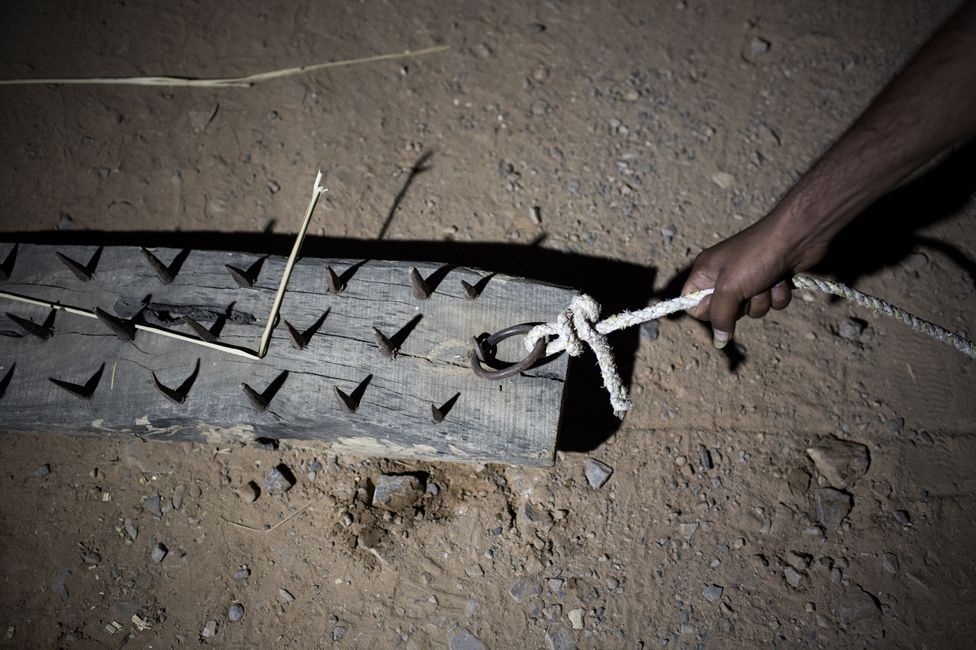
Nails used by cow vigilantes to force lorries to stopImage copyrightGETTY IMAGES (ENRICO FABIAN)
Image captionNails used by the vigilantes to force lorries to stop
Gyandev Ahuja is just one of several BJP politicians who have made statements that are supportive of the accused in so-called “cow lynchings”.

One of Prime Minister Narendra Modi’s ministers was even photographed garlanding the accused murderers in a cow vigilante case. He has since apologised.

Meenakshi Ganguly of Human Rights Watch says it is “terrifying” that elected officials have defended attackers.

“It is really, at this point of time, something that is a great concern, because it is changing a belief into a political narrative, and a violent one,” he says.

The worry is that supportive messages from some of the governing party’s politicians have emboldened the vigilantes.

No official figures are kept on cow violence, but the data collected by IndiaSpend suggests that it started ramping up in 2015, the year after Narendra Modi was elected.

IndiaSpend says that since then there have been 250 injuries and 46 deaths related to cow violence. This is likely to be an underestimate because farmers who have been beaten may be afraid to go to the police – and when a body is found it may not be clear what spurred the attack. The vast majority of the victims are Muslims.

A cow shelter in RamgarhImage copyrightGETTY IMAGES (ENRICO FABIAN)
Image captionA cow shelter in Ramgarh
A BJP spokesman, Nalin Kohli, emphatically rejects any connection between his party and cow violence.

“To say the BJP is responsible is perverse, inaccurate and absolutely false,” he tells me.

“Many people have an interest in building a statement that the BJP is behind it. We won’t tolerate it.”

I ask him about Gyandev Ahuja’s inflammatory statements.

“Firstly that is not the party’s point of view and we have very clearly and unequivocally always said an individual’s point of view is theirs, the point of view of the party is articulated by the party.

“Has the BJP promoted him or protected him? No.”

But a month after this interview, Ahuja was made vice-president of the party in Rajasthan.

Shortly afterwards, Prime Minister Narendra Modi visited Rajasthan – publicly slapping Ahuja on the back and waving together at crowds of BJP supporters.

presentational grey line

In Mewat I speak to Rakbar’s wife, Asmina.

“Show me how you raise seven children without a husband. How will I be able to raise them?” she says, wiping away tears.

“My youngest daughter says that my father went to God. If you ask her, ‘How did he go to God?’ she says, ‘My father was bringing a cow and people killed him.’

“The life of an animal is so important but that of a human is not.”

The trial of the three men accused of his murder has yet to take place, but perhaps we will never know what really happened to Rakbar.

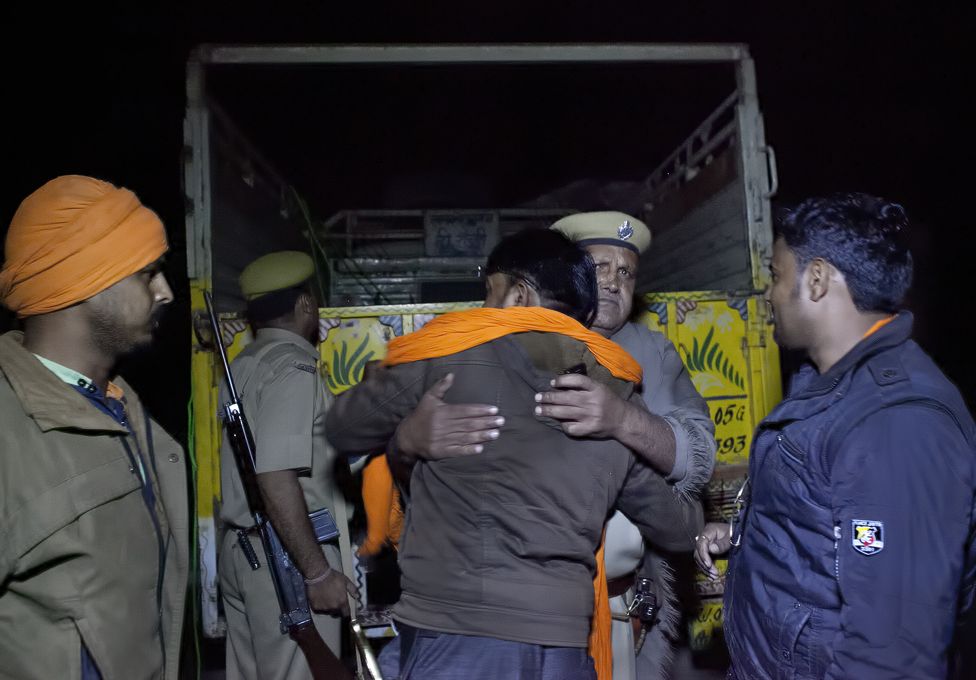
In November 2015, photographer Allison Joyce spent a night following Nawal Kishore Sharma’s vigilantes in the countryside near Ramgarh. One of her photographs shows a police officer embracing Sharma after a shootout between the vigilantes and a suspected cow smuggler.

Though the police now accuse the cow vigilantes of killing Rakbar Khan, and the vigilantes accuse the police, the photograph illustrates just how closely they worked together.

A policeman embraces Nawal Kishore Sharma after his group chases down a lorry in November 2015Image copyrightGETTY IMAGES (ALLISON JOYCE)
In the Indian media there have been claims that the police took the two cows that Rakbar had been transporting to a cow shelter, as Rakbar lay dead or dying in a police vehicle.

There are also claims that the police stopped and drank tea instead of taking Rakbar to hospital.

Whatever they did, they did not take Rakbar to hospital immediately.

Source: The BBC

Law of Unintended Consequences

continuously updated blog about China & India

ChiaHou's Book Reviews

continuously updated blog about China & India

What's wrong with the world; and its economy

continuously updated blog about China & India