Chindia Alert: You’ll be Living in their World Very Soon
aims to alert you to the threats and opportunities that China and India present. China and India require serious attention; case of ‘hidden dragon and crouching tiger’.
Without this attention, governments, businesses and, indeed, individuals may find themselves at a great disadvantage sooner rather than later.
The POSTs (front webpages) are mainly 'cuttings' from reliable sources, updated continuously.
The PAGEs (see Tabs, above) attempt to make the information more meaningful by putting some structure to the information we have researched and assembled since 2006.
US billionaire says it will take time to solve problems like air pollution but China is taking action
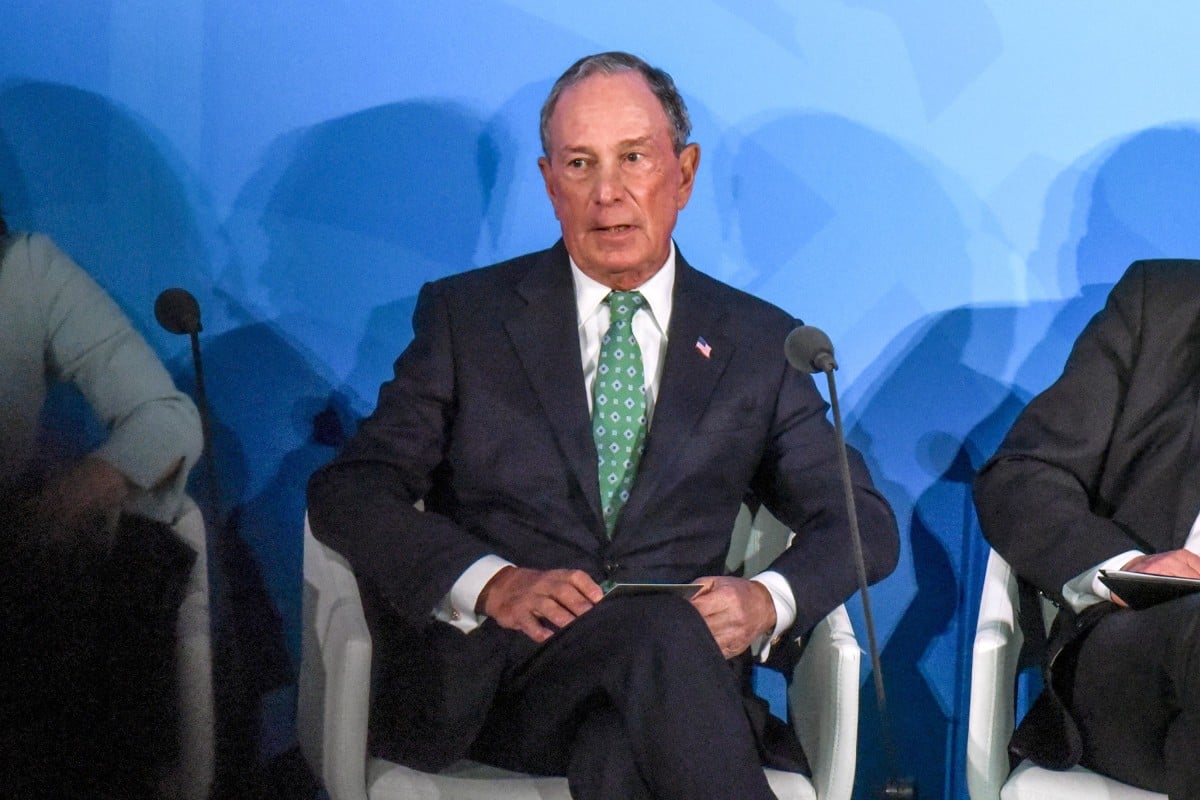
Billionaire Michael Bloomberg says it will take time for China to resolve problems like air pollution. Photo: AFP
US billionaire Michael Bloomberg has spoken out in support of Chinese President Xi Jinping, saying Xi is “not a dictator” and the Communist Party “listens to the public” on issues like air pollution.
Bloomberg made the comments in an interview on the weekend with Margaret Hoover, host of PBS’ Firing Line public affairs show, ahead of November’s Bloomberg New Economy Forum in Beijing, an event designed to rival the World Economic Forum in Davos.
When asked whether China could be a good partner in the fight against climate change, Bloomberg said “China is doing a lot”.
“Yes, they are still building a bunch of coal-fired power plants. Yes, they are [burning coal]. But they are now moving plants away from the cities. The Communist Party wants to stay in power in China and they listen to the public,” he said.
“When the public says ‘I can’t breathe the air’, Xi Jinping is not a dictator. He has to satisfy his constituents, or he’s not going to survive … The trouble is you can’t overnight move cement plants and power plants just outside the city that are polluting the air and you have to have their product. So some of it takes time.”
China prepares for next round of nationwide inspections in ‘war on pollution’
Hoover countered, saying China was not a democracy and Xi was not answerable to voters.
“He doesn’t have a vote, he doesn’t have a democracy. He [isn’t held] accountable by voters. Is the check on him just a revolution?” she said.
“You’re not going to have a revolution. No government survives without the will of the majority of its people,” Bloomberg said. “He has to deliver services.”
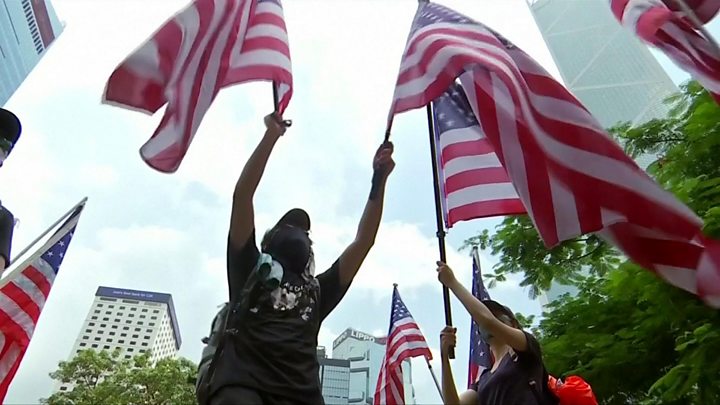
Hoover then said: “I’m looking at people in Hong Kong who are protesting and wondering whether the Chinese government cares what they have to say.”
Bloomberg said that in government – “even governments that aren’t what we could call a democracy” – there were many stakeholders with vested interests and “they have an impact”.
Smog in northern China rises in first four months of 2019 as anti-pollution drive loses ‘momentum’
Bloomberg’s comments come seven years after his news service published an investigative story about the finances of the extended family of Xi, then vice-president.
The story was published at a sensitive time, with China holding a once-a-decade leadership transition that saw Xi become president.
China banned the use of Bloomberg financial data tracking terminals but the company’s relations warmed gradually after three years.
In August 2015, Bloomberg was given a high-profile reception by then vice-premier Zhang Gaoli. He also published an opinion piece in party mouthpiece People’s Daily.
70th anniversary of the founding of the People’s Republic of China marked by its biggest ever military parade and huge civilian parade
Xi says no force can stop China ‘marching forward’ and vows to protect the long-term stability of Hong Kong
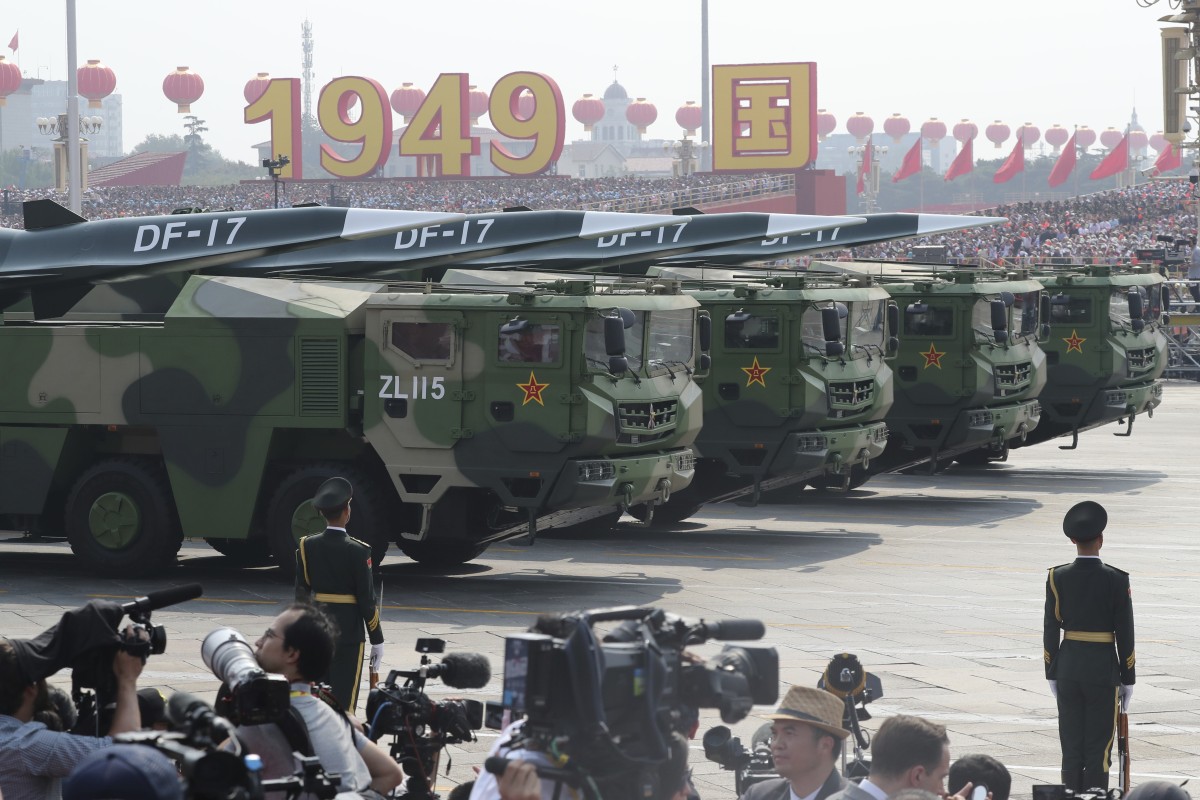
Military vehicles carry DF-17 missiles capable of reaching the US mainland during the parade to mark 70 years of the People’s Republic. Photo: AP
China staged a massive military parade in Beijing on Tuesday to mark the 70th anniversary of the founding of the People’s Republic, with much of the smog-shrouded capital city under a security lockdown.
President Xi Jinping inspected over 15,000 troops, more than 160 aircraft and 580 weapon systems in a show of the country’s growing military might and his drive to modernise the People’s Liberation Army.
He also delivered a bullish eight-minute speech hailing the accomplishments of seven decades of Communist rule and pledging to achieve his vision of a “Chinese dream” of national rejuvenation and global prominence.
Here are some of the key takeaways from a day of celebration in Beijing:
A show of unity
Xi presided over the ceremony in Tiananmen Square flanked by his predecessors Jiang Zemin and Hu Jintao, along with other retired and present party elders.
The rare appearance of Jiang and Hu – on the rostrum of the Gate of Heavenly Peace, where the country’s founding father Mao Zedong declared Communist rule on October 1, 1949 – was clearly aimed at projecting unity and solidarity in the face of daunting domestic and international challenges.
China’s National Day parade, as it happened
Hu had been absent from the funeral of former premier Li Peng in late July, although the ailing Jiang attended.
Former vice-president Zeng Qinghong and Song Ping, the oldest party elder in attendance, also appeared on the rostrum.
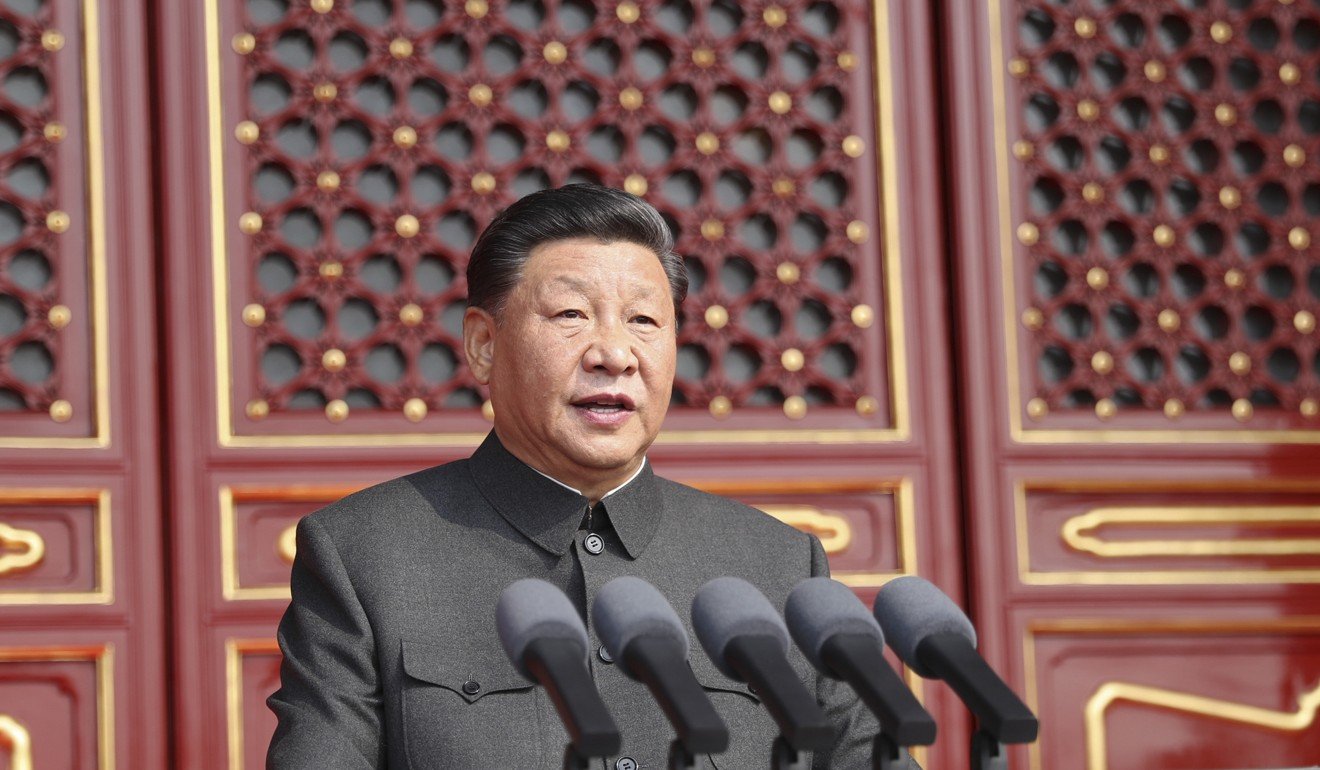
President Xi Jinping speaks in Tiananmen Square during Tuesday’s celebrations. Photo: Xinhua
But notably, while former premier Wen Jiabao was present, his predecessor Zhu Rongji was not.
‘No force can shake China’
Dressed in a Mao suit, Xi’s nationally televised speech invoked China’s “century of humiliation” and praised the achievements of its people, saying there was no force that could stop it forging ahead.
“No force can shake the status of our great motherland, and no force can stop the Chinese people and the Chinese nation from marching forward,” he said.
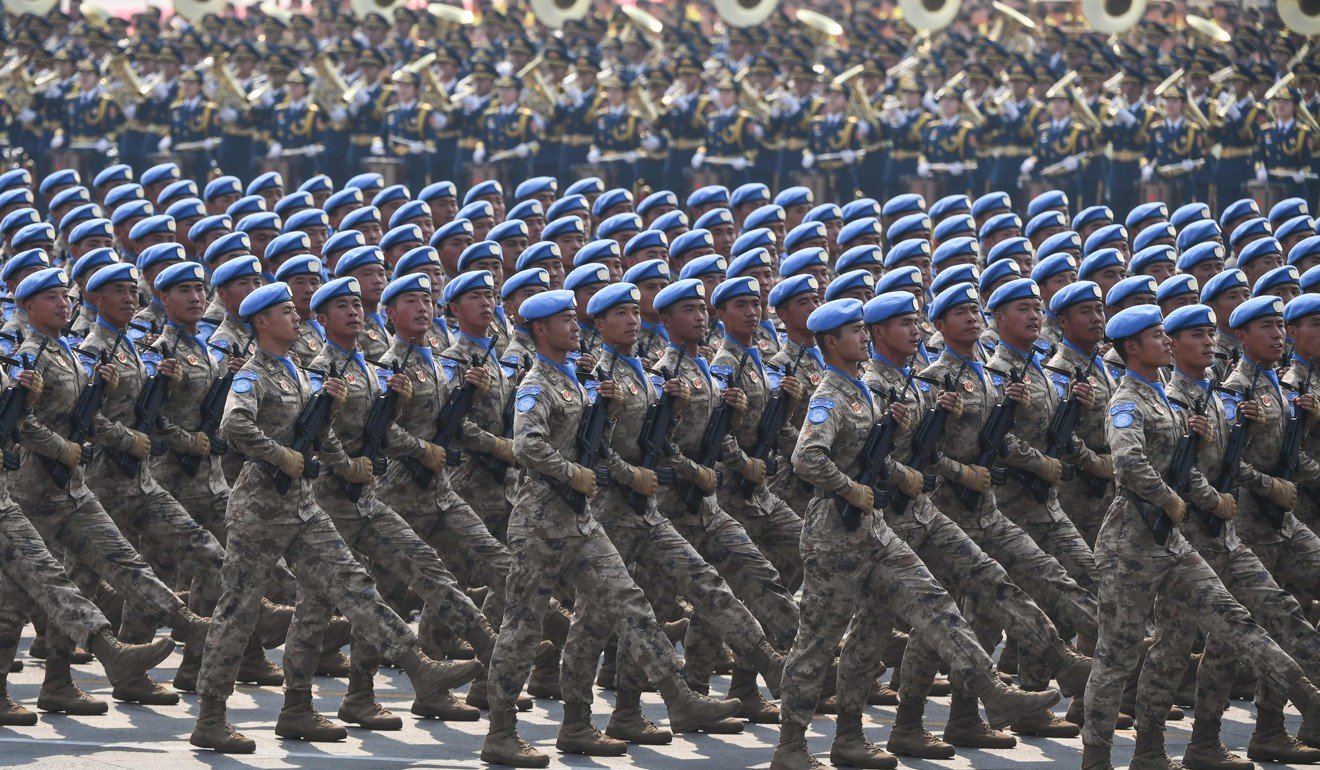
Chinese troops take part in the Republic’s largest ever military parade. Photo: AFP
“The People’s Liberation Army [PLA] will serve its purpose in safeguarding the sovereignty, security and development interests of the country, and world peace,” he said, at a time when Beijing has expanded its military footprint globally, including with its first overseas military base in Djibouti.
Xi called on the Communist Party and the country to unite and continue to fight for the realisation of what he called the “Chinese dream” – the nation’s rejuvenation.
One country, two systems
Amid escalating unrest in Hong Kong, which has plunged the city into a deepening crisis and threatened to overshadow the National Day celebrations, Xi vowed that the central government would uphold “one country, two systems”.
He said the central government would protect the long-term stability of Hong Kong and Macau, and stressed the goal of “peaceful reunification” with the self-ruling Taiwan, repeating a message frequently used by his predecessors, including Deng Xiaoping, Jiang and Hu.
The theme of one country, two systems later appeared in a National Day parade for the first time, with placards forming the words: “Hong Kong’s tomorrow will be better.”
Hong Kong Chief Executive Cheng Yuet-ngor attended the ceremony, as did 10 Hong Kong police officers involved in suppressing anti-government protests in the city.
Showing off new weapons
China’s advancement in military weaponry was on full display, with almost half of the items featured being shown to the public for the first time.
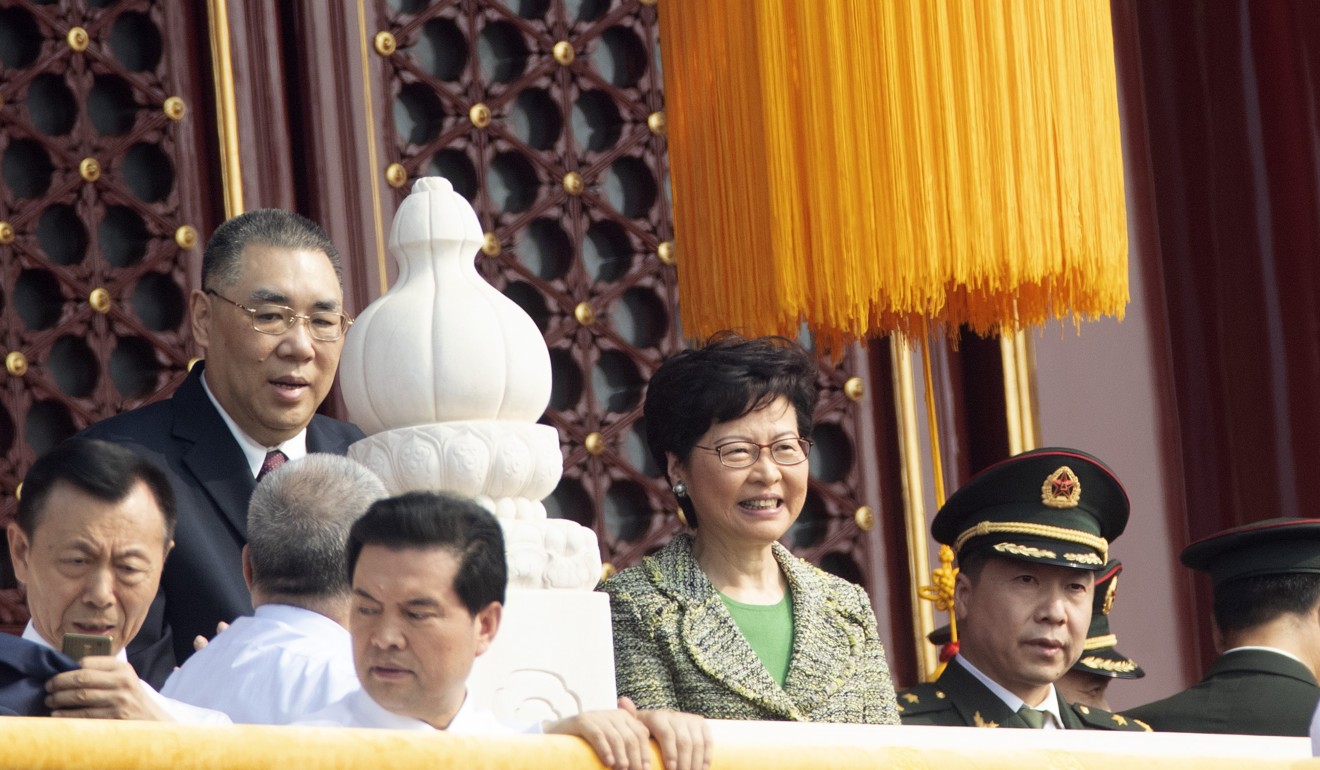
Hong Kong leader Carrie Lam was among the guests in Beijing on Tuesday. Photo: AP
The morning’s celebrations included an 80-minute military parade – the biggest since the founding of the People’s Republic – in an apparent effort to showcase the prowess of the PLA, the world’s biggest military with 2 million personnel.
Among the weapons shown were DF series missiles, including the DF-17, a nuclear-capable glider that has the capacity to strike the US mainland, and the DF-41, which has a range of up to 15,000km, making it the world’s longest-range military missile.
Signalling Xi’s status
A 100,000-strong civilian parade featuring huge portraits of Xi and predecessors including Mao, Deng, Jiang and Hu wrapped up the morning celebration.
The procession was divided into three parts, representing three eras of the People’s Republic: the Mao era, Deng’s reform and opening up, and Xi’s era, which seeks global prominence on a par with that of the United States.
Xi appeared keen to project his supreme status in the party, reinforced since he abolished the constitutional term limit a year ago, allowing him potentially to remain leader for life.
He waved at his own portrait, unveiled alongside a sign reading “Carry out Xi Jinping Thought on Socialism with Chinese Characteristics for a New Era”.
It took China less than 70 years to emerge from isolation and become one of the world’s greatest economic powers.
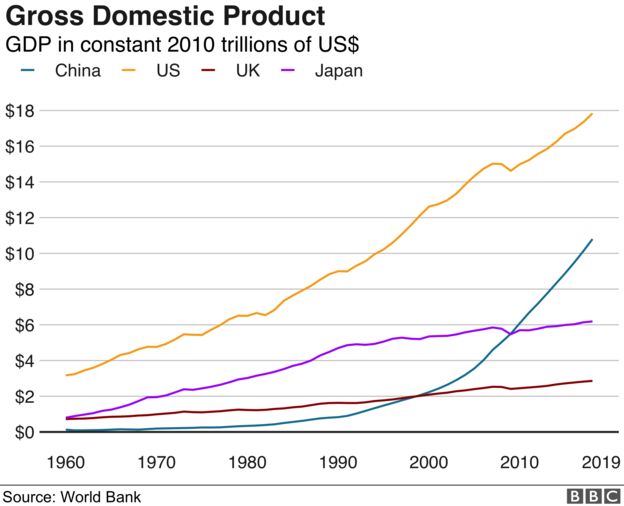
As the country celebrates the anniversary of the founding of the People’s Republic of China, we look back on how its transformation spread unprecedented wealth – and deepened inequality – across the Asian giant.
“When the Communist Party came into control of China it was very, very poor,” says DBS chief China economist Chris Leung.
“There were no trading partners, no diplomatic relationships, they were relying on self-sufficiency.”
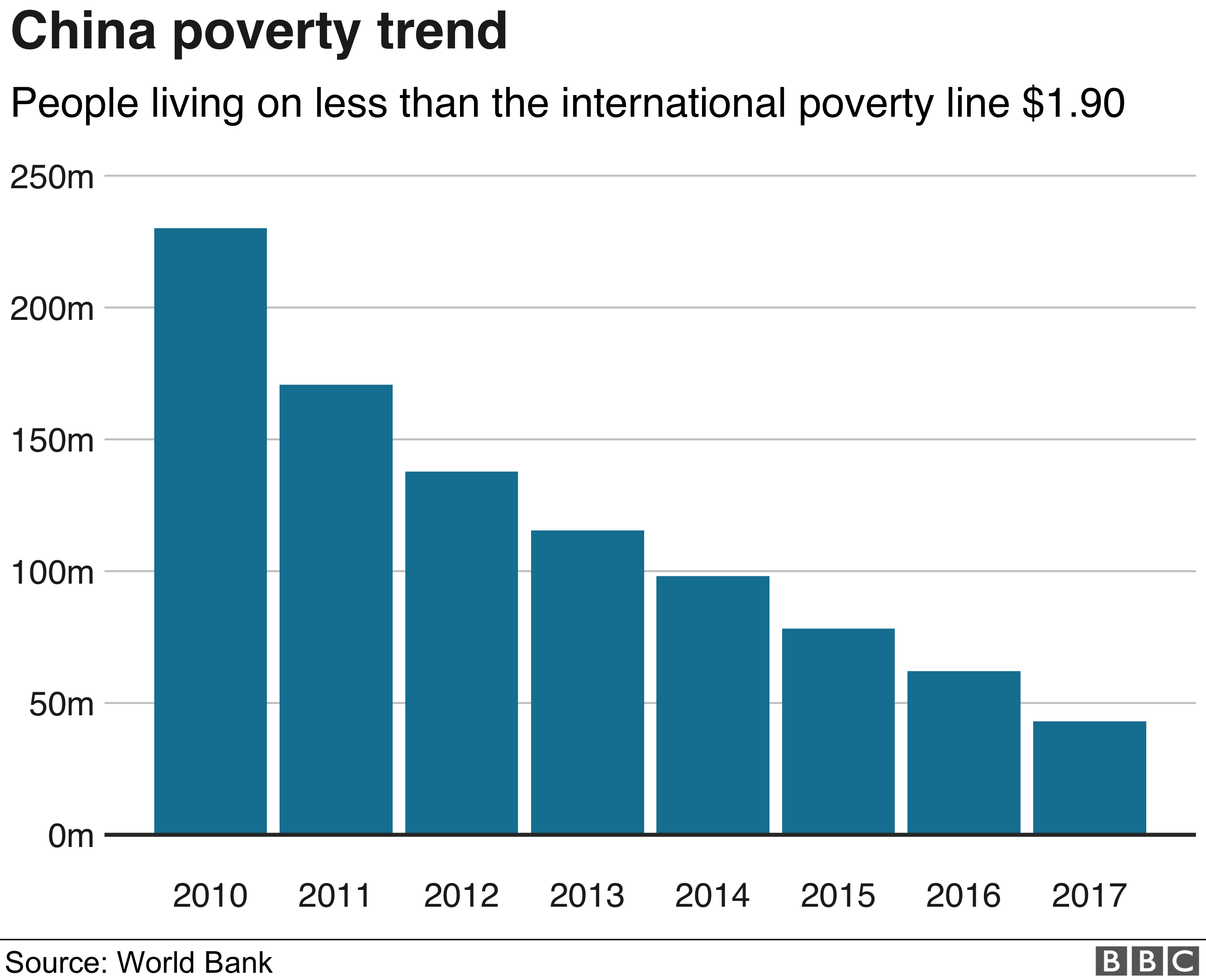
Over the past 40 years, China has introduced a series of landmark market reforms to open up trade routes and investment flows, ultimately pulling hundreds of millions of people out of poverty.
The 1950s had seen one of the biggest human disasters of the 20th Century. The Great Leap Forward was Mao Zedong’s attempt to rapidly industrialise China’s peasant economy, but it failed and 10-40 million people died between 1959-1961 – the most costly famine in human history.
This was followed by the economic disruption of the Cultural Revolution in the 1960s, a campaign which Mao launched to rid the Communist party of his rivals, but which ended up destroying much of the country’s social fabric.
‘Workshop of the world’
Yet after Mao’s death in 1976, reforms spearheaded by Deng Xiaoping began to reshape the economy. Peasants were granted rights to farm their own plots, improving living standards and easing food shortages.
The door was opened to foreign investment as the US and China re-established diplomatic ties in 1979. Eager to take advantage of cheap labour and low rent costs, money poured in.
“From the end of the 1970s onwards we’ve seen what is easily the most impressive economic miracle of any economy in history,” says David Mann, global chief economist at Standard Chartered Bank.
Through the 1990s, China began to clock rapid growth rates and joining the World Trade Organization in 2001 gave it another jolt. Trade barriers and tariffs with other countries were lowered and soon Chinese goods were everywhere.
“It became the workshop of the world,” Mr Mann says.
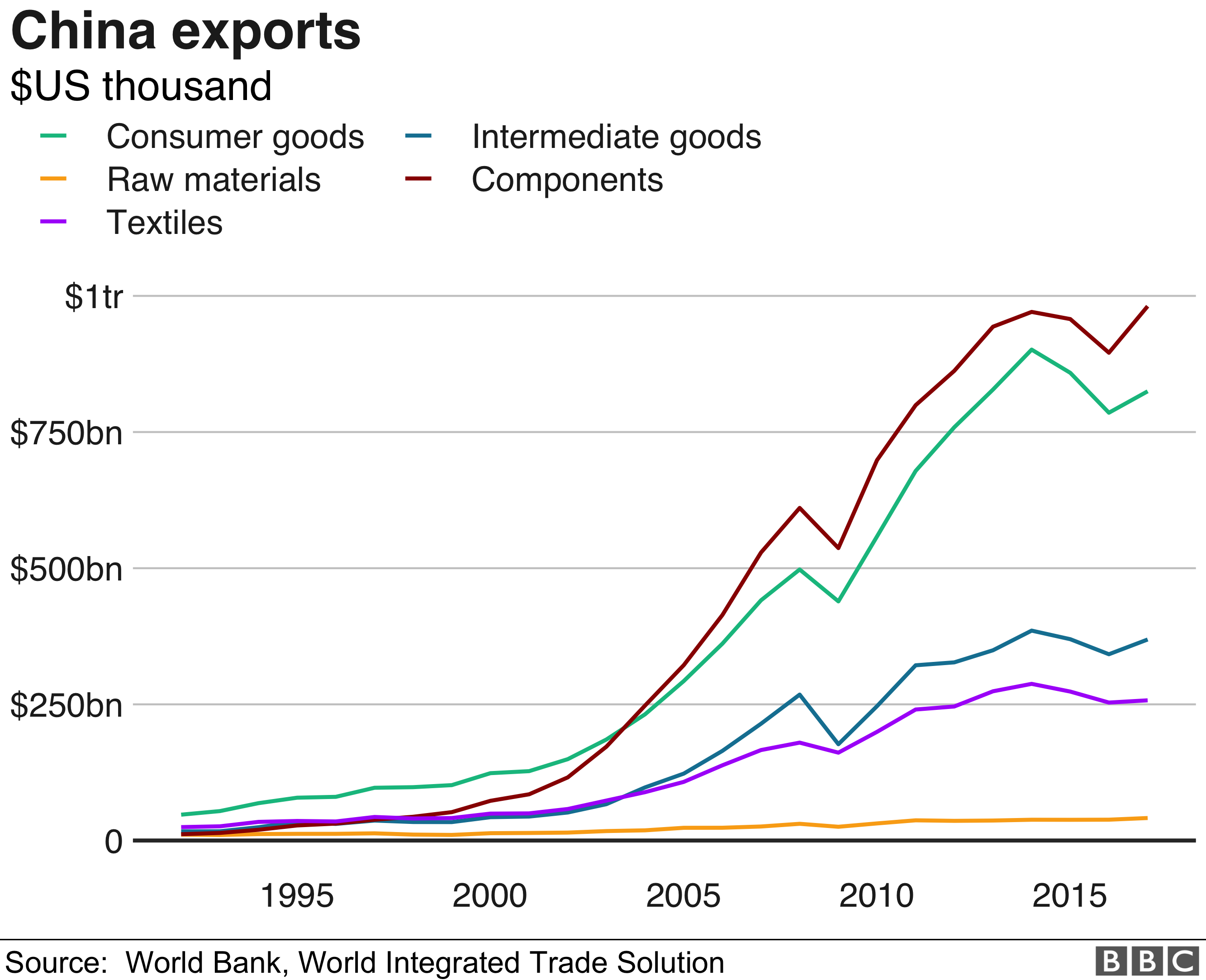
Take these figures from the London School of Economics: in 1978, exports were $10bn (£8.1bn), less than 1% of world trade.
By 1985, they hit $25bn and a little under two decades later exports valued $4.3trn, making China the world’s largest trading nation in goods.
Poverty rates tumble
The economic reforms improved the fortunes of hundreds of millions of Chinese people.
The World Bank says more than 850 million people been lifted out of poverty, and the country is on track to eliminate absolute poverty by 2020.
At the same time, education rates have surged. Standard Chartered projects that by 2030, around 27% of China’s workforce will have a university education – that’s about the same as Germany today.
Rising inequality
Still, the fruits of economic success haven’t spread evenly across China’s population of 1.3 billion people.
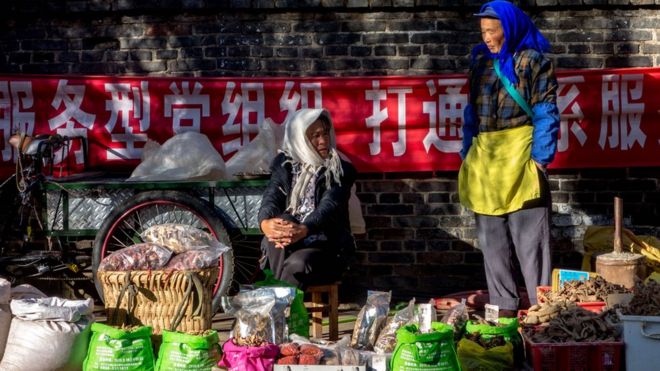
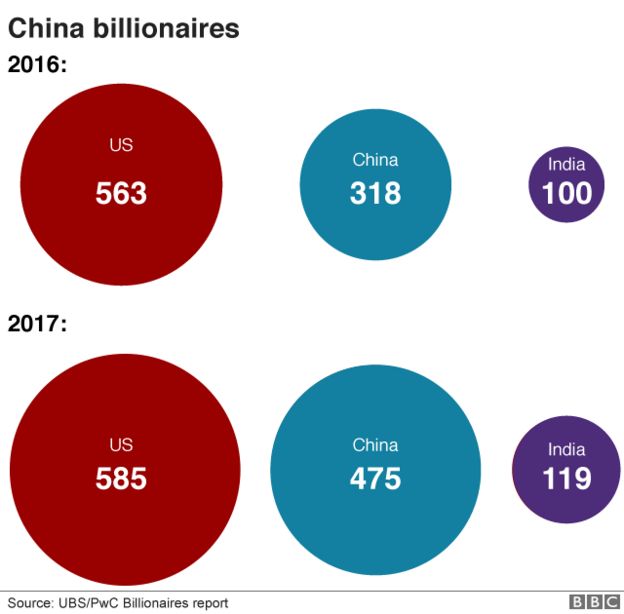
Examples of extreme wealth and a rising middle class exist alongside poor rural communities, and a low skilled, ageing workforce. Inequality has deepened, largely along rural and urban divides.
“The entire economy is not advanced, there’s huge divergences between the different parts,” Mr Mann says.
The World Bank says China’s income per person is still that of a developing country, and less than one quarter of the average of advanced economies.
China’s average annual income is nearly $10,000, according to DBS, compared to around $62,000 in the US.
Slower growth
Now, China is shifting to an era of slower growth.
For years it has pushed to wean its dependence off exports and toward consumption-led growth. New challenges have emerged including softer global demand for its goods and a long-running trade war with the US. The pressures of demographic shifts and an ageing population also cloud the country’s economic outlook.
Still, even if the rate of growth in China eases to between 5% and 6%, the country will still be the most powerful engine of world economic growth.
“At that pace China will still be 35% of global growth, which is the biggest single contributor of any country, three times more important to global growth than the US,” Mr Mann says.
The next economic frontier
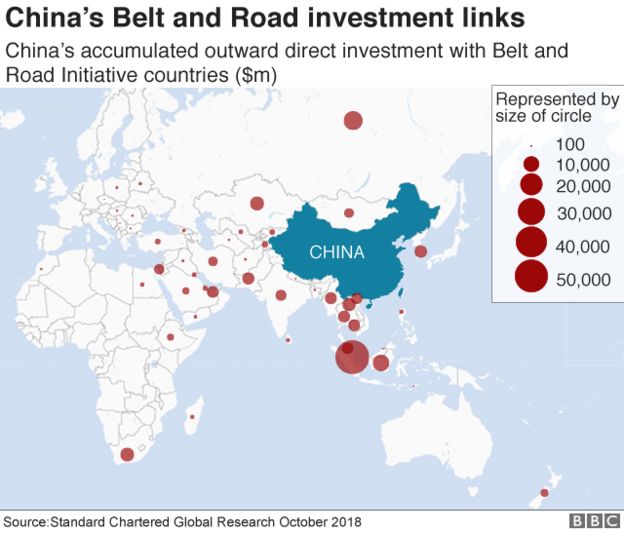
China is also carving out a new front in global economic development. The country’s next chapter in nation-building is unfolding through a wave of funding in the massive global infrastructure project, the Belt and Road Initiative.
The so-called new Silk Road aims to connect almost half the world’s populations and one-fifth of global GDP, setting up trade and investment links that stretch across the world.
Train trips, Xinjiang and chartered flights among the growing holiday trends, travel agents say
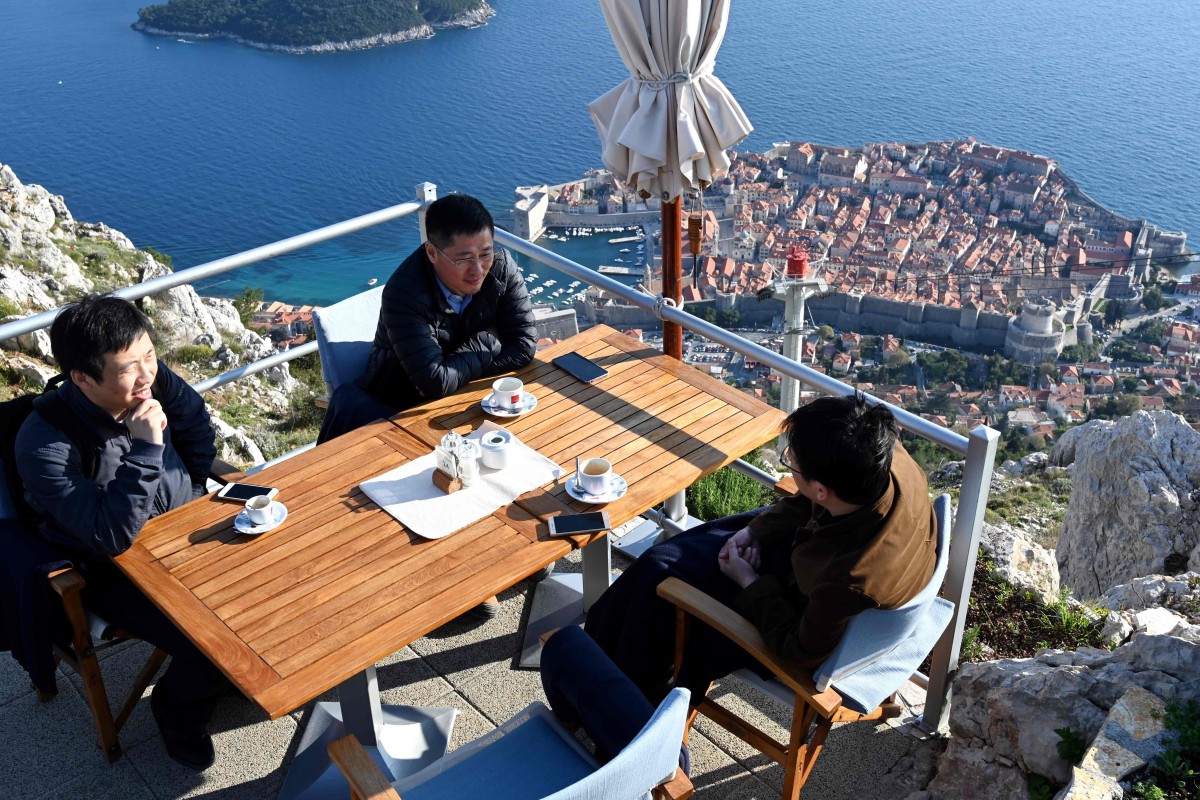
Destinations such as Dubrovnik, Croatia, are becoming more popular among mainland Chinese tourists, according to one of China’ s biggest travel services. Photo: AFP
Chartered flights and niche destinations such as Croatia and Malta are growing in popularity as Hong Kong falls out of favour for mainland Chinese holidaymakers over the National Day “golden week” break.
Japan has overtaken Thailand as the most searched overseas destination on the website of travel agency Ctrip, followed by Malaysia, the United States, Singapore, Australia, Macau, France, Italy and Russia.
Within the mainland places such as Beijing and Shanghai continued to be among the most popular searches but Urumqi, capital of Xinjiang Uygur autonomous region, is a fast-growing term, especially among people in Shanghai and Guangzhou.
“It could be that tourists want to see autumn leaves,” a Ctrip spokesman told the South China Morning Post.
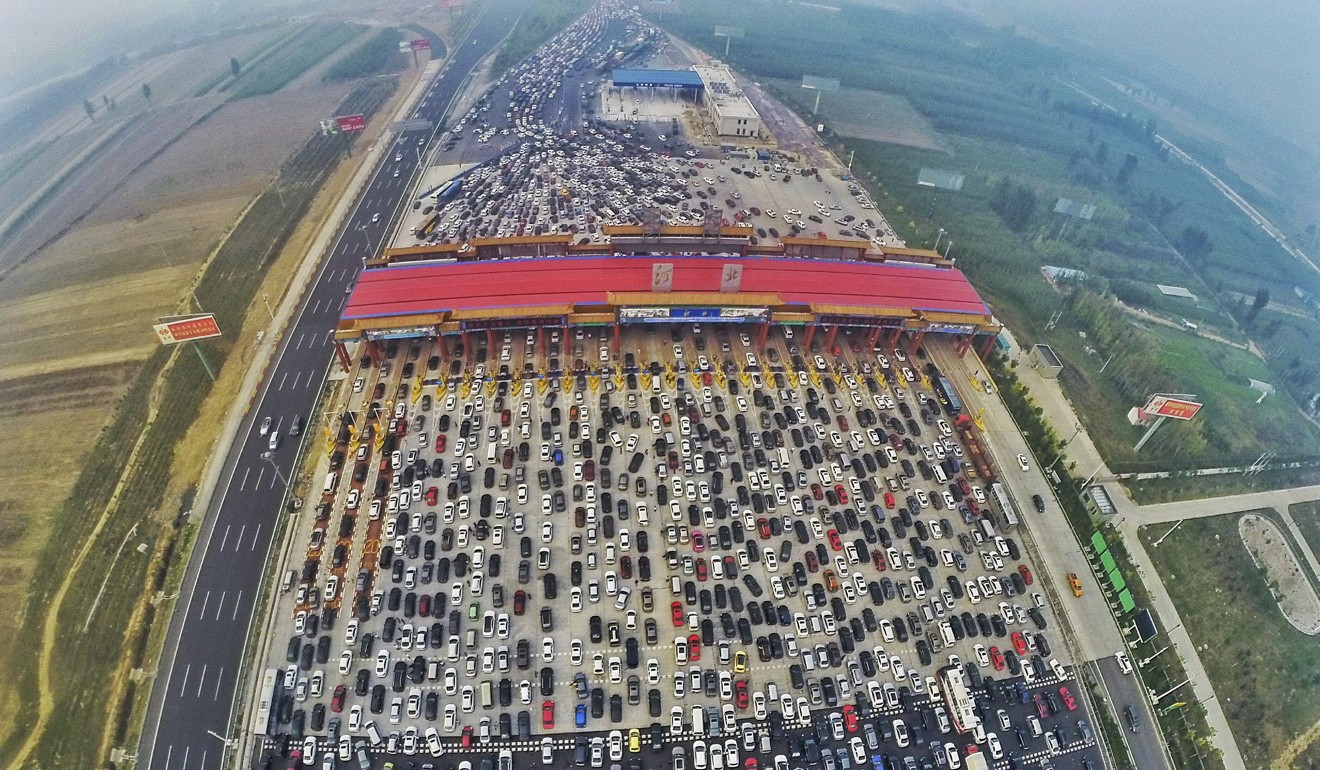
October 1 marks the start of a week-long break on the mainland when millions of Chinese take the chance to travel. This year, an estimated 800 million people are expected to go on trips in China or overseas, about 10 per cent more than last year.
The country’s motorways are expected to be jammed from about 2pm on Monday, reaching a peak at around midnight, and again from 10am Tuesday, according to web mapping service Tencent Map.
China’s highways can expect heavy traffic as travellers head out for the holiday. Photo: Reuters
Ctrip said people heading overseas were increasingly seeking out new destinations, with bookings to places such as the Czech Republic, Austria, Croatia, Malta and Cambodia growing by 45 per cent this year.
“As Chinese people travel outside the country more and their experience of travel grows, many are more willing to go to smaller eastern European countries, such as the Czech Republic,” the spokesman said.
“Popular movies also have a strong influence. Many young people are willing to travel to see where films are shot, such as Croatia, one of the locations for Game of Thrones.”
Other noticeable trends this year include more people travelling with pets, by train and on chartered flights. The site said it sold 60 per cent more European train tickets and 10 times the number of train tickets for Japan for this golden week compared to last year.
The most popular routes in Asia were Tokyo to Kyoto in Japan, and Seoul to Busan in South Korea.
Hong Kong protests leave ‘golden week’ tourist boom in tatters as visitor arrivals during Chinese holiday period are set to be slashed by a third
Thousands of users also chose chartered flights, a service Ctrip introduced in September.
Ji Yu, head of chartered flights for Ctrip said most people thought chartered flights or helicopters were something only millionaires could afford, but in the internet age, they had become cheaper and more accessible.
“In the internet era, consumer needs vary from person to person, especially in terms of travel. There are products on the market to satisfy each customer’s personal needs.”
Among the more popular chartered routes were from Beijing or Shanghai to Tokyo, Bangkok, the Maldives and London.
More people are also going away for longer. Digital travel services giant Qunar said that 80 per cent of the travellers booking flights or hotels through its services were heading off for more than five days. And of those 41 per cent were travelling for more than a week.
Meanwhile, trips to Hong Kong have fallen substantially, with just 15 group tours expected to enter the city each day, down from 110 last year, according to the Travel Industry Council of Hong Kong.
Efforts to promote Hong Kong attractions have also increased in Shenzhen in recent weeks, with advertising videos scenic spots, popular restaurants and malls in Hong Kong playing on cross-border buses. Passengers can also get discounts to some stores and services with their tickets.
New system to enable businesses and government agencies to verify mainland-issued travel permits
The new system is expected to expand access to the public transport system on the mainland. Photo: Roy Issa
Hong Kong and Macau residents and “overseas Chinese” may soon be able to have full access to public services on the mainland using their China-issued travel documents, state news agency Xinhua reported.
Xinhua reported on Wednesday that the National Immigration Administration was putting a platform in place to enable government agencies and businesses to verify mainland-issued travel permits for Hong Kong and Macau residents.
“As soon as the platform becomes operational, these overseas travellers can, from October, have access to 35 public services, ranging from transport, to finance, education, communications, medical care and accommodation,” the report said.
According to the report, “overseas travellers” cover Hong Kong and Macau residents and ethnic Chinese living overseas.
But it did not say why the new measures did not apply to people from Taiwan.
The administration did not respond to requests for comment on Thursday.
Will Hong Kong anti-government protests ruin city’s role in Beijing’s Greater Bay Area plan? Depends on whom you ask
The new measure appears to be part of a long-term strategy by Beijing to foster closer ties between the mainland and Hong Kong and Macau.
In the last few years, the central government has launched a host of incentives for Hong Kong and Macau residents and businesses, including opportunities in the Greater Bay Area development plan in southern China.
Ivan Zhai, executive director of the Hong Kong Chamber of Commerce in China-Guangdong, welcomed the new measure.
“If such an arrangement can be fully implemented, Hong Kong businesspeople who operate on the mainland will be thrilled,” Zhai said.
The Hong Kong business community has long lobbied for relaxation over areas such as train ticketing and hotel registration.
Zhai said that although Hong Kong and Macau residents could now book high-speed train tickets with their mainland-issued travel permits, there were few ticket machines that could automatically read the permits, complicating the process.
“There are also hotels on the mainland that can only entertain guests with Chinese identity cards and currently Hong Kong travellers can only go to hotels that are authorised to accept the mainland-issued travel permits,” he said.
China’s regulator relaxes currency conversion rules throughout Shenzhen, sharpening city’s edge in Greater Bay Area
According to the report, there will be stiff penalties for departments or businesses misusing information collected through the platform.
Zhai said Hong Kong businesspeople who travelled to the mainland often were more likely to be concerned about convenience than the risk of invasion of privacy.
“If you are a frequent traveller in China, you would have expected that the relevant departments of the Chinese government already have information about you anyway,” he said.
Shanghai’s authorities have doubled the free-trade zone to 240 square kilometres by including part of Lingang, a previously untapped area linked to the Yangshan deep water port
The expansion reflected the city’s renewed efforts to build a free marketplace that can rival regional business hubs such as Hong Kong and Singapore
Aerial photo taken on March 9, 2017 shows the Shanghai free trade zone (FTZ). Photo: Xinhua
Shanghai’s ambitious plan to turn Lingang into a Hong Kong-style free-trade port has yet to impress European companies due to a slow pace of enforcement with a series of liberalisations subject to Beijing’s approval.
The European Union Chamber of Commerce in Shanghai said on Tuesday that the business lobby group was expecting concrete measures to be implemented at the 119.5-square kilometre newly expanded free-trade zone (FTZ), which would whet European companies’ investment appetite, but it also vented dismay towards the slow progress.
It was advisable for the government to carry out planned reforms sooner to convince foreign investors of the golden opportunities inside the zone, said Carlo Diego D’Andrea, the chamber’s Shanghai chairman, who is also vice-president of the EU business chamber in China.
“After so many years [of waiting], we would like to see reform happen soon, not just the talks,” he said in an interview with South China Morning Post.
Shanghai doubled the size of the free-trade zone last month to about 240 sq km by including part of Lingang, a previously untapped area that is linked to the Yangshan deep water port.
The expansion reflected the city’s renewed efforts to build a free marketplace that can rival regional business hubs such as Hong Kong and Singapore.
Shanghai plans to impose zero tariffs on imported goods inside the Lingang FTZ, but the reform measures cannot be implemented unless the General Administration of Customs gives a green light.
Shanghai’s city government had proposed a series of incentives aimed at building Lingang into a world-class investment magnet, the free-trade zone’s deputy director Wu Wei said at a Friday press conference, without elaborating on when the policies might be endorsed by the relevant ministry-level authorities.
Professor Zhou Zhenhua, president of Shanghai Academy of Global Cities, said the central government was still cautious of taking drastic steps in quickly liberalising the Lingang FTZ amid worries of rampant capital and cargo flows.
US bestselling electric vehicle maker Tesla has built its Gigafactory 3 at the Lingang FTZ after it secured an approval from Beijing to establish a wholly owned assembly plant late last year.
The approval for the first wholly-owned foreign car factory on mainland China coincided with a sales drop in the country’s automobile market, the first contraction in nearly three decades.
“Why could not you have opened the market before when the market was booming,” said D’Andrea.
He said that the timing of scrapping the foreign ownership cap amid the first negative growth of the domestic car market in three decades was not enough to show Beijing’s determinations in drawing overseas funds.
Beijing has been harping on its resolution in further opening up the markets to foreign businesses as a way of amid the US-China trade war that began in 2018.
Image copyright EPAImage caption China is getting dressed up for its big birthday party
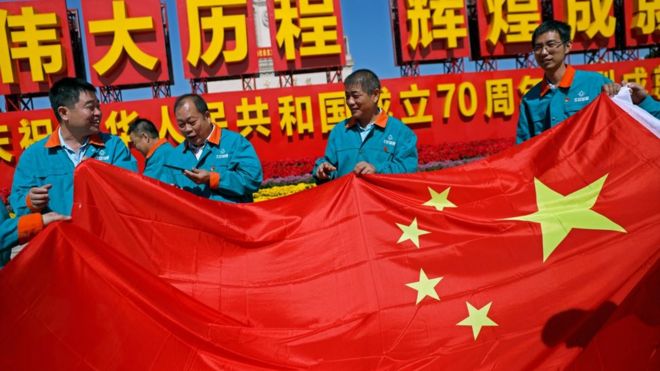
One week from now, the People’s Republic of China will mark its 70th anniversary with celebrations on a scale not seen in China in decades.
Beijing is pulling out all stops and 1 October will be flush with fireworks, fanfare and a huge military parade.
To ensure it goes smoothly, authorities have been ramping up security in the capital – and online – for weeks.
But with yet more protests expected in Hong Kong, the territory might just rain on China’s parade.
What is it all about?
The birth of modern China was declared on 1 October 1949, after the communists under Mao Zedong won the civil war that followed World War Two.
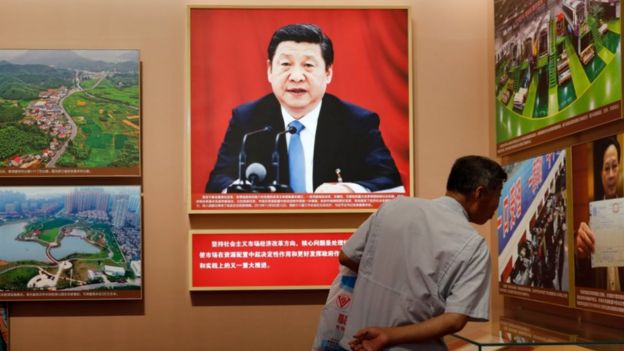
Image copyright EPAImage caption Exhibitions are highlighting the achievements of the Communist Party
The date is marked every year, but celebrations for this 70th anniversary are expected to eclipse previous events.
It’s the first big anniversary since China has emerged as a global power. While 10 years ago China was a superpower in the making, it is now the world’s second largest economy, almost eye-to-eye with the United States.
What to expect?
The main celebrations will take place in the capital, Beijing, where there will be a grand military parade with “advanced weapons” on display, followed by a “mass pageant”.
President Xi Jinping – considered the most powerful Chinese leader since Mao – will address the Chinese people. His speech is expected to celebrate China’s rapid growth and which will be closely watched for any indication of the country’s direction in the coming years.
The president will also hand out honours for contributions to the country and in the evening there will be a grand gala and fireworks show.
All official Chinese celebrations are carefully choreographed and the success of this one is particularly important to the government.
The Dos and Don’ts
The parade – open to invited guests only – will take place around Tiananmen Square in central Beijing. The surrounding area will be practically under lockdown, and in fact has been so several times already.
During rehearsals leading up to the big day, hotels near Tiananmen Square told guests that for several hours each day, no-one would be able to leave the hotel or return to it should they be out, leading to much travel chaos and rebookings.
Many shops and restaurants in the centre are also closed or have shortened hours and some subway stations are temporarily shut.
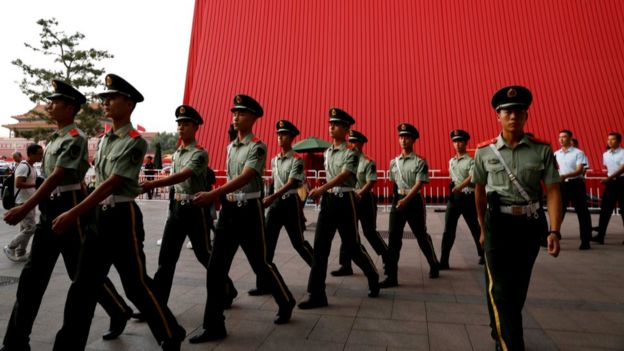
Image copyright EPAImage caption Security is tight ensure the party goes to plan
Trains to Beijing are running numerous safety checks on their passengers and vehicles going into the city are also being tightly watched.
On the big day itself, areas around Tiananmen Square will be blocked and guarded. Local residents will need to identify themselves if they want to pass.
To ensure the sun will shine brightly on the celebration in notoriously polluted Beijing, several coal plants and construction sites in and around the city have been ordered to stop work for the duration.
There’s also a ban on any low-flying aerial vehicles in place. That means anything from light aircraft to drones, balloons and even racing pigeons.
Censorship galore
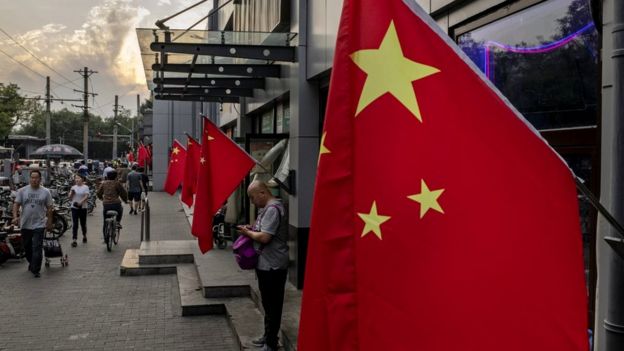
Across much of the city centre, there are national flags set up at every door. Voluntary inspectors are monitoring the streets and locals have told the BBC they’re being questioned after having even brief conversations with foreigners
One person said she was asked by an inspector: “Who were those foreigners? Why were they here?”
The tight control naturally extends online as well. Popular social media platform Weibo said it was deleting content that “distorts” or “insults” the country’s history ahead of the anniversary.
Image copyright GETTY IMAGESImage caption Every house and every shop is sporting a national flag
Chinese journalists are always expected to toe the party line anyway, but starting in October they will have to pass an extra test to prove they are versed particularly in Xi Jinping’s teachings, officially called Xi Jinping Thought on Socialism with Chinese Characteristics, which has been written into the constitution.
Whether or not they pass the exam will then determine whether they’ll be accredited as journalists.
“The fundamental point with this ‘training’ and indoctrination process isn’t so much about the content,” David Bandurski of China Media Watch told the BBC.
“It is about reinforcing the message and understanding among journalists that they work, first and foremost, for the Chinese Communist Party, and serve its agenda.”
So not only will the events be choreographed – the domestic coverage of them will also be tightly guarded.
What about Hong Kong?
Despite Beijing’s determination to let its achievements shine on 1 October, there’s a good chance Hong Kong will pull focus.
Anti-Beijing protests always take place in Hong Kong on China’s National Day, but this time, the activists know that the world is watching.
Anti-government protests have rocked the city for months and the situation shows no sign of dying down.
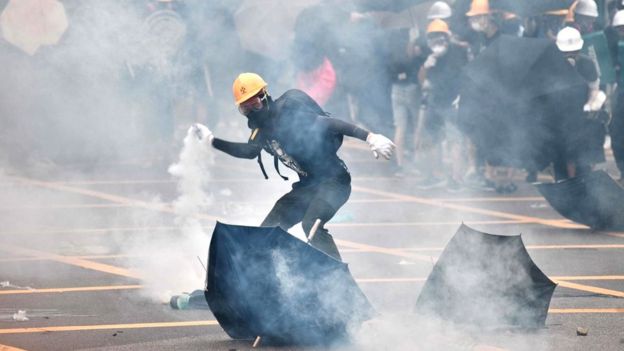
Clashes between police and activists have been becoming increasingly violent, with police using tear gas and activists storming parliament.
Image copyright AFPImage caption The protests have often escalated into violent clashes
That means two things for 1 October: official celebrations in the territory are being toned down to avoid clashes – the annual fireworks display has been cancelled – while at the same time, activists are planning to step up their protests.
On Sunday 29 September, a “Global Anti Totalitarianism March” is scheduled to take place at various locations around the world in support of Hong Kong.
On 1 October itself, a march in central Hong Kong is planned with everyone asked to wear black.
If the past weeks’ demonstrations are anything to go by, the smiles and celebrations in Beijing will be competing for media space with pictures of tear gas and angry young protesters in Hong Kong.
October 1 event is intended to be a showcase for military’s progress under Xi Jinping, with J-20 stealth fighters set to take pride of place
Domestically developed weapons are main focus of event despite long-standing problems in building aircraft engines
Chinese J-10 jets perform at the Dubai air show in 2017. Photo: AFP
China has stepped up intensive rehearsals for the upcoming National Day parade, which military insiders say is designed to showcase the achievements of Chinese President Xi Jinping’s modernisation drive.
The parade on October 1 will mark the 70th anniversary of the founding of the People’s Republic and will focus on weapons developed since Xi came to power in late 2012, despite long-standing problems in aircraft engine development.
Video clips circulating on mainland social media in recent days have shown at least seven types of aircraft – including the KJ-2000 airborne early warning and control aircraft and J-10 and J-11B fighter jets – taking part in rehearsals over the countryside around Beijing.
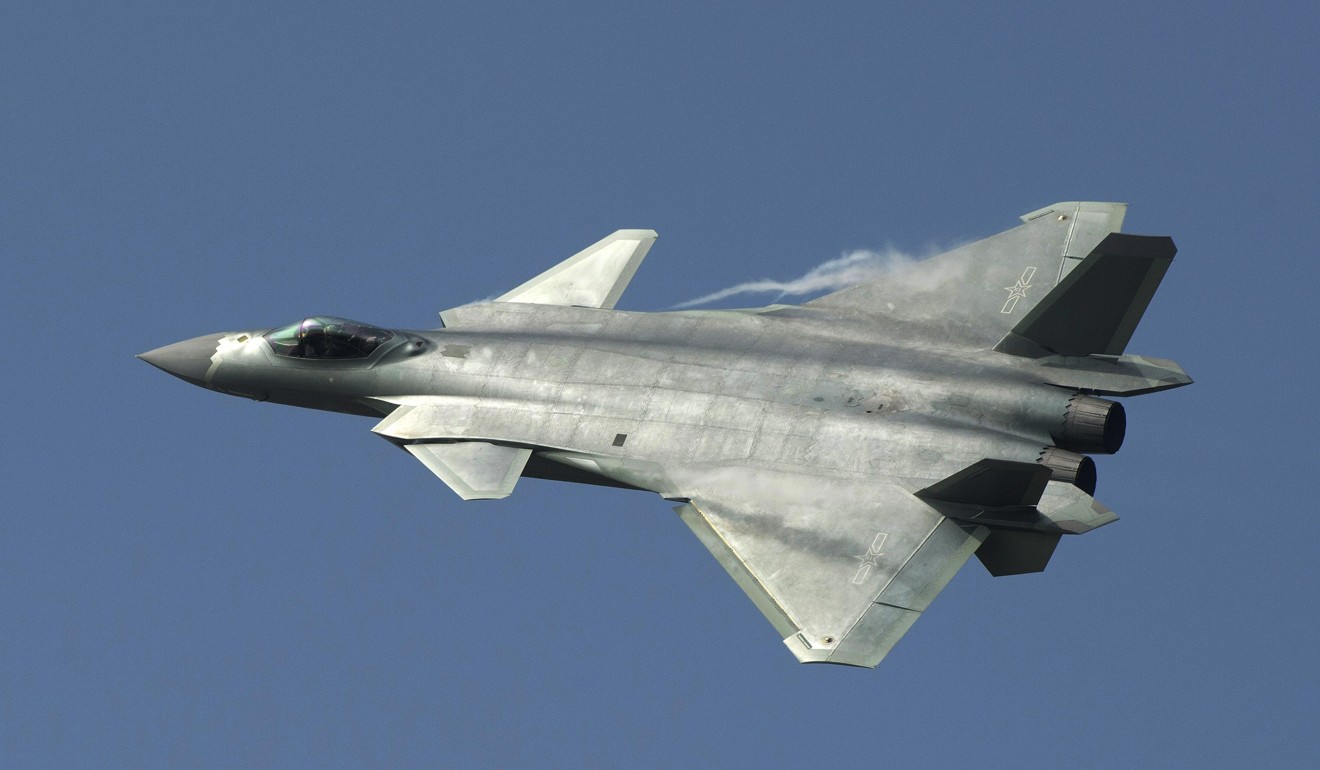
A military insider said the country’s first stealth fighter jet, the J-20, had been rehearsing over the western suburbs of the capital since April.
“There will be up to seven J-20 displayed in the military parade, which is the largest formation since its formal deployment to the Chinese air force in 2017,” the military insider said.
“The J-20 has entered mass production. So far at least 70 J-20s have been made, even though all of them are still equipped with Russian AL-31 engines.”
Earlier this month, the People’s Liberation Army Air Force released a video of a flight of seven J-20s, the largest formation seen so far, suggesting that the fifth-generation warplane has gone into mass production as an arms race with the United States mounts in the region.
The second-largest J-20 formation was shown in an air force video for PLA Day on August 1, when five of the jets were shown.
China has been forced to deploy the J-20 ahead of its schedule since the US has increased the deployment of its fifth-generation stealth fighter jets like the F-22 and F-35s in the Asia-Pacific region.
The US and its allies, including Japan and South Korea, will have more than 200 F-35s by 2025, which means China also needs a similar number of stealth fighters.
To meet demand, China has been working on the development of a purpose-built thrust engine for its stealth fighter since the early 2000s, but has yet to achieve international quality control standards due to problems that include single-crystal turbine blade technology.
China’s air force spreads its wings in 70th anniversary video
Hong Kong-based military commentator Song Zhongping said aircraft engine development had been a long-standing shortcoming but it would not affect the practical fighting capacity of the J-20, which currently uses Russian engines.
“The J-20 hasn’t used the domestic engines so far because it wants a better one, and it still has time,” Song said.
“Other [Chinese-developed] warplanes like the J-10, J-11 and multipurpose attack helicopters are all modified and advanced types, indicating comprehensive achievements amid China’s military modernisation over the past years.”
A Chinese J-20 stealth fighter has entered mass production. Photo: EPA-EFE
Besides the domestically developed aircraft, Beijing is going to display its strategic nuclear missiles, such as the DF-41 intercontinental ballistic missile and the JL-2 submarine-launched ballistic missile, as centrepieces of its National Day military parade, according to a Beijing-based military source.
Xi, who also chairs the powerful Central Military Commission, inspected the country’s biggest military parade at the Zhurihe Combined Tactics Training Base in Inner Mongolia in 2017 to celebrate the 90th anniversary of the PLA, but the source said the weapons displayed in Zhurihe had been developed under the leadership of Xi’s predecessor, Hu Jintao.
“Xi needs to highlight his personal achievements in his era, that’s why this year’s parade has political aims more than military significance,” the source said.
The source also highlighted the significance of the People’s Republic marking its 70th anniversary because the Soviet Union did not survive for that length of time.
“Xi is attempting to tell the outside world that Chinese communist regime has been consolidated under his leadership.”
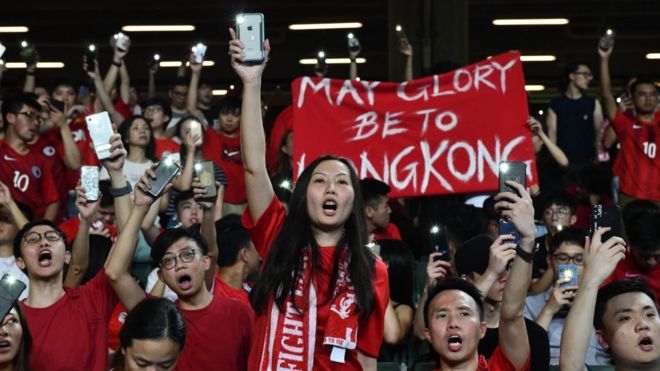
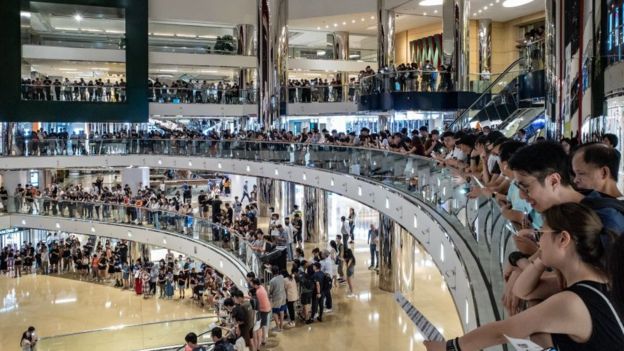
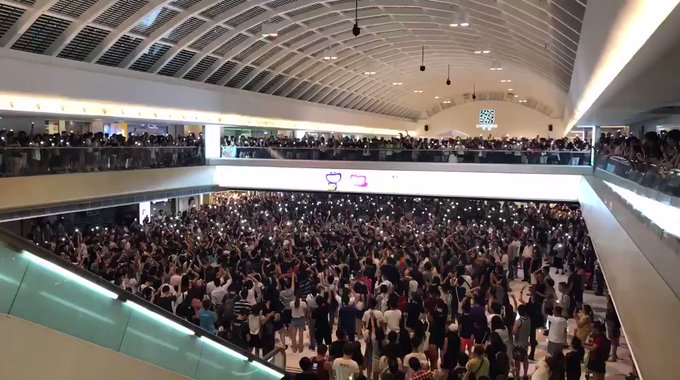
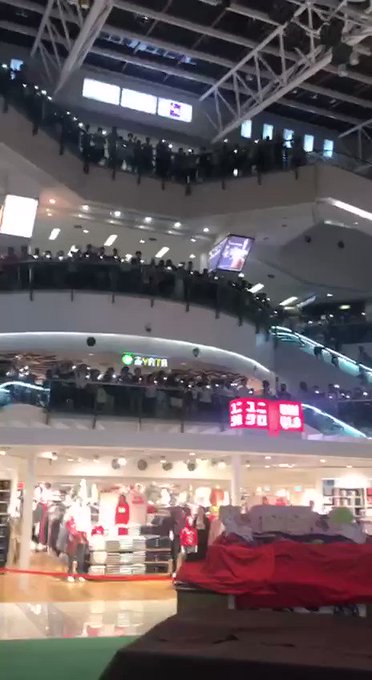
On Tuesday night, thousands of protesters gathered in shopping malls across Hong Kong chanting slogans and singing Glory to Hong Kong.
Image copyright GETTY IMAGESImage caption Many protesters flooded shopping malls
In the popular shopping district of Mongkok, a sea of protesters dressed in black were seen congregating across the different levels of one mall.
Jason Y. Ng
✔@jasonyng
Hundreds of shoppers spontaneously assembled at a mall atrium and broke into song. They sang “Glory to Hong Kong,” an ersatz national anthem (coz we aren’t a national and haven’t the right to an anthem). People ask what Communist China is most afraid of—the answer is right here.
Another video showed protesters chanting “Go Hong Kong” – a phrase that has been used frequently as a sign of encouragement.
Shopping malls have been the scene of clashes in recent weeks, with one incident in July seeing riot police fight battles with protesters inside a mall in the district of Sha Tin.
Without true democracy, HKer shall never surrender! This video shows citizens are gathered in a mall and cheering each other up after singing the song of #HKprotest “Glory to Hong Kong”.
The new rallying cry has joined other popular songs used by the protest movement, including Do You Hear the People Sing? from musical Les Miserables and the Christian hymn Sing Hallelujah to the Lord.
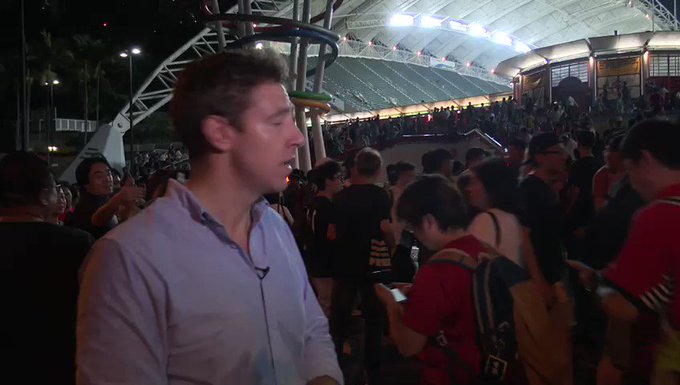
It was also heard at the Hong Kong v Iran football match on Tuesday at Hong Kong Stadium.
#Hongkong soccer fans booing the #Chinese national anthem tonight. Footy fans also have their backs to the field. Carrie Lam’s administration had been planning to introduce tough new penalties for booing the anthem but this can’t be easy to bring in in the city’s current climate. https://twitter.com/SCMPHongKong/status/1171411414801534977 …
The 2022 Fifa World Cup qualifier saw thousands of protesting booing when the Chinese national anthem played before the start of the game.
The jeering, which could be heard from outside the stadium, was intended as a clear “message” to Beijing that they do not want to be part of China in the future, says the BBC’s Nick Beake who was at the game.
Nick Beake
✔@Beaking_News
VIDEO: The moment #HongKong football fans began booing #China national anthem before the start of their @FIFAWorldCup qualifier against #Iran. #CarrieLam ‘s govt has delayed (another) controversial new law that could give 3 year prison term for disrespecting anthem. @BBCWorld
Hong Kong, formerly a British colony, returned to Chinese rule in 1997.
Under the “one country, two systems” rule, the city is granted a high level of autonomy, an independent judiciary and rights such as freedom of speech.
But those freedoms – the Basic Law – expire in 2047 and it is not clear what Hong Kong’s status will then be.
There has been growing anti-mainland sentiment in recent years, and anger at what many feel is increasing mainland interference in Hong Kong affairs.
Media caption Protesters sang the US anthem outside the consulate
This reached a tipping point when the Hong Kong parliament proposed a new law that would have enabled suspects in Hong Kong to be extradited to China.
Hundreds of thousands of people marched on the streets in protest of the law, demanding that it be abandoned. The government initially suspended in June, and then finally dropped earlier this week – almost three months after protests first begun.
But protesters have said this is “too little, too late”, and their demands have evolved into calls for a much wider set of reforms, including a call for universal suffrage.
Police in Fujian ask people who picked up notes to ‘be rational and return the money’
Impulse move caused traffic jams as pedestrians ran into road to grab what they could
The man from Shishi city in Fujian province who tossed US$14,000 into the air after a bad day at work has asked for help in getting it back. Photo: Weibo
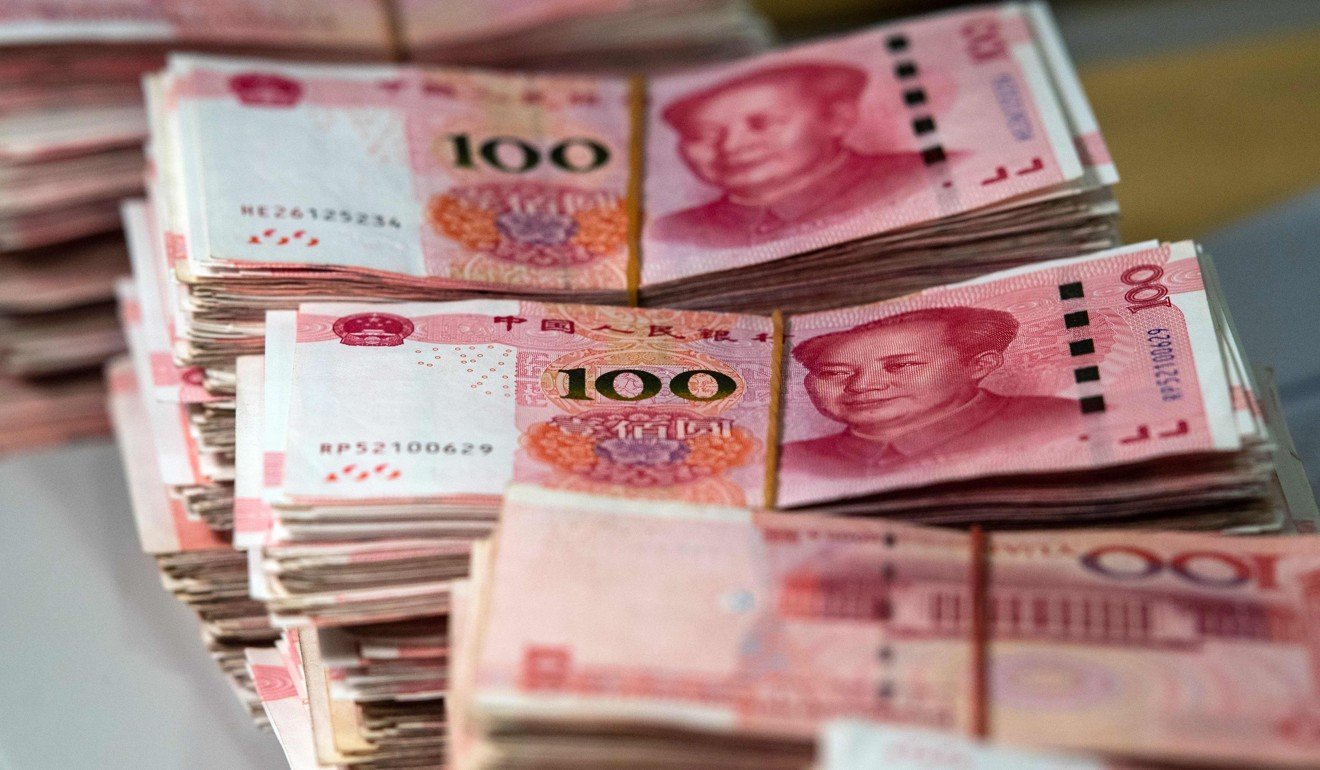
The man from southeastern China who caused a cash frenzy on the street after he threw more than 100,000 yuan (US$14,052) into the air because he’d had a bad day at work is asking for his money back, authorities said.
Huang, 42, said he acted on impulse after he withdrew cash from a bank in Shishi city, Fujian province, on Monday.
His actions caused a traffic jam and passers-by fell over each other to grab what they could, the municipal police bureau said on Tuesday.
The man, who said he was having trouble at work, now regrets what he did and is hoping he will get the money back, the police statement issued on Weibo, China’s Twitter-like microblogging platform, said.
Police in Fujian said Huang’s impulsive move had caused him a lot of trouble and asked the public to return the money he threw away. Photo: AFP
Officers criticised Huang for his “inappropriate behaviour” and urged those who picked up the cash to take it to the police.
A video clip shared on Weibo on Tuesday showed motorists pulling up sharply in the street to pick 100 yuan banknotes off the road.
In another video, pedestrians were seen rushing into the middle of the road to join in the frenzy.
Banknotes falling from the sky send crowd into a frenzy in Hong Kong neighbourhood of Sham Shui Po
Some of the money had been returned by Tuesday evening, the Shishi police Weibo account said.
“Huang is from an ordinary family and not rich at all. A sudden impulse has caused big trouble for himself and his family. Please be rational and return the money,” it said.
On December 24, 2014, Hong Kong Police appealed to the public for help after a G4S Hong Kong van carrying HK$525 million (US$66.9 million) crashed on a main road near Wan Chai district, causing major traffic jams as motorists abandoned their cars to collect notes.
While armed police were quickly on the scene and closed off two lanes of the road, witnesses reported money being taken. One office worker said she saw a “regular Hong Kong lady” walking briskly away from the scene with 10 bricks of notes.
In March 2017, a woman threw away more than 16,000 yuan (US$2,250) in cash at a busy crossing in southwestern Chongqing municipality, but passers-by simply looked on instead of scrambling to pick up the money, the Chongqing Morning Post reported.
Police collected the bills quickly and found the owner. She said she threw the money because she was “in a bad mood”.












 CHINDIA ALERT: You'll be living in their world, very soon