Chindia Alert: You’ll be Living in their World Very Soon
aims to alert you to the threats and opportunities that China and India present. China and India require serious attention; case of ‘hidden dragon and crouching tiger’.
Without this attention, governments, businesses and, indeed, individuals may find themselves at a great disadvantage sooner rather than later.
The POSTs (front webpages) are mainly 'cuttings' from reliable sources, updated continuously.
The PAGEs (see Tabs, above) attempt to make the information more meaningful by putting some structure to the information we have researched and assembled since 2006.
(Reuters) – Consumer goods giant Unilever Plc (ULVR.L) (UNA.AS) withdrew its full-year forecast on Thursday, saying the hit from lockdowns in China and India, as well as lower ice cream sales, offset strong U.S. and European sales of cleaning items, sending its shares down 5%.
Underlying sales across Asia, the Middle East and Russia, fell 3.7%, as lockdowns in the quarter restricted restaurant visits and shopping in China and led to factory shutdowns that halted production in India.
In Europe, Turkey and Latin America, Unilever’s 3 billion euro ice cream business was hit by national efforts to prevent the spread of the coronavirus, deterring distributors in holiday destinations from buying stock.
“Many of our classic out-of-home retailers like leisure sites, travel hubs, beaches and tourist destinations were closed,” Chief Financial Officer Graeme Pitkethly said on a call.
These factors countered increased sales in the United States and Europe, where consumers stocked up on laundry detergents, Domestos bleach, Cif cleaning products and personal hygiene items, as the virus spread to those regions.
Overall, first-quarter turnover rose 0.2% to 12.40 billion euros ($13.42 billion), slightly missing the estimate of 12.77 billion euros based on analysts polled by Factset.
The company withdrew its sales performance targets for the year, which forecast growth at the lower end of a 3%-5% range, saying it could not “reliably assess the impact” of the virus, , although it said it would still pay its interim dividend.
Jefferies analysts said investors would be asking why Unilever “has apparently been hit so badly, and early, by the negative impacts of COVID-19 without seeing much of the positives. We expect a difficult day for the shares.”
Shares in Unilever, which joins spirits maker Diageo (DGE.L) and other consumer goods companies in withdrawing guidance, was down 5.5% at 4,008 pence in early trading.
The Anglo-Dutch company’s report follows results from larger U.S. rival Procter & Gamble (PG.N), which last week said its U.S. sales had seen their biggest rise in decades.
Unilever also said underlying sales grew strongly in North America, rising 4.8% as shoppers stocked up on personal hygiene products, Knorr soups and Hellmann’s dressings.
In Europe, sales growth was led by Germany and Britain, although prices across the region fell.
“We are adapting to new demand patterns and are preparing for lasting changes in consumer behaviour, in each country, as we move out of the crisis and into recovery,” Unilever Chief Executive Alan Jope said in a statement.
The company said it was directing a chunk of its 500 million euro package to support suppliers towards its ice cream distribution partners, which Pitkethly called the “jewel” in its supplier relationships.
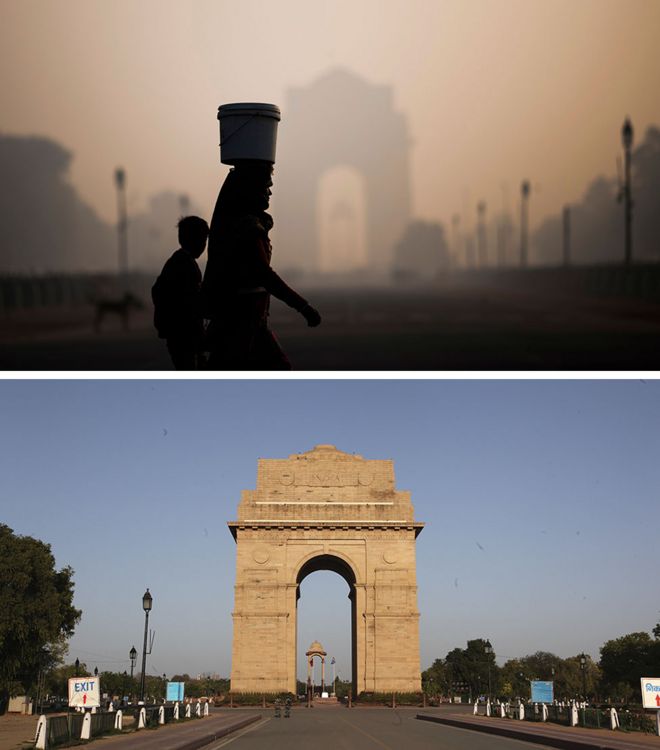
Image copyright GETTY IMAGESImage caption Delhi’sair quality has improved remarkably during the shutdown
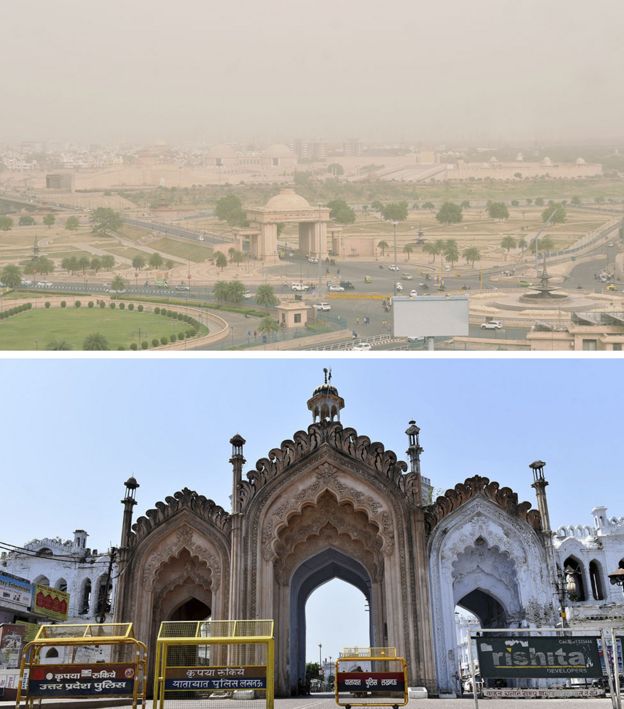
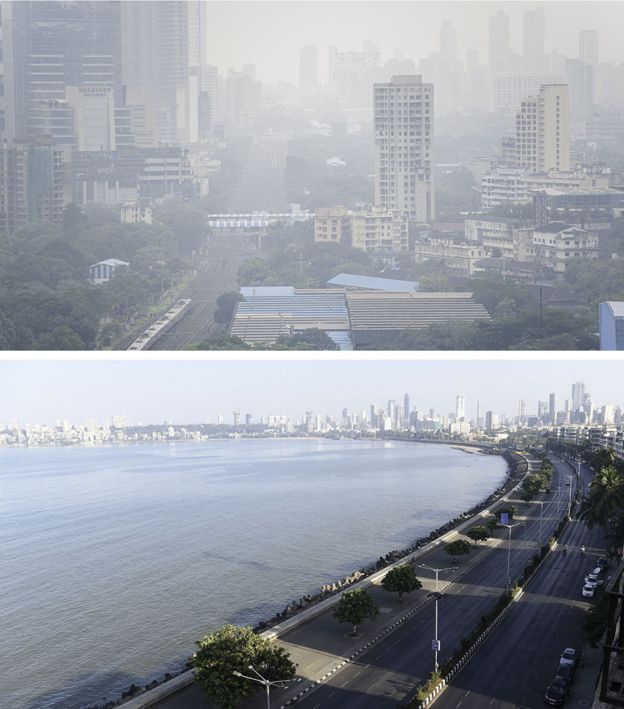
When India shut down last month and suspended all transport to contain the spread of coronavirus, the skies over its polluted cities quickly turned an azure blue, and the air, unusually fresh.
As air pollution plummeted to levels unseen in living memory, people shared pictures of spotless skies and even Himalayan peaks from cities where the view had been obscured by fog for decades.
On one social messaging group, a resident of the capital, Delhi, which regularly records some of the foulest air in the world, celebrated the city’s “alpine weather“. Politician and author Shashi Tharoor wrote that the “blissful sight of blue skies and the joy of breathing clean air provides just the contrast to illustrate what we are doing to ourselves the rest of the time”.
Media caption India coronavirus lockdown cleans up Ganges river
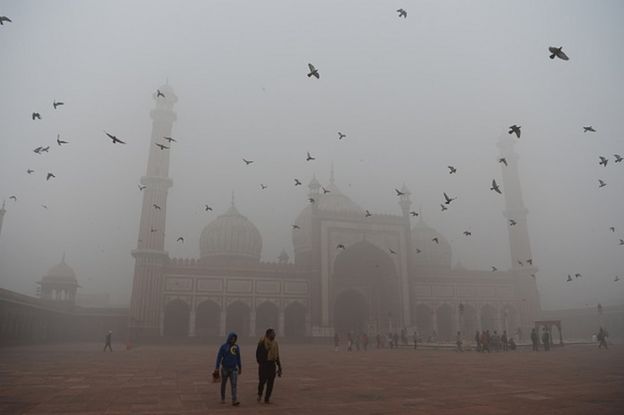
Less than six months ago, Delhi was gasping for breath. Authorities said air quality had reached “unbearable levels”. Schools were shut, flights were diverted, and people were asked to wear masks, avoid polluted areas and keep doors and windows closed.
Delhi and 13 other Indian cities feature on a list of the world’s 20 most polluted. It is estimated that more than a million Indians die every year because of air pollution-related diseases. Industrial smoke, vehicular emissions, burning of trash and crop residue, and construction and road dust are the major contributors.
As urban Indians gazed at the skies and breathed clean air inside their homes, researchers hunkered down to track data on how the grinding lockdown – now extended to 3 May – was impacting air pollution across the country.
Image copyright GETTY IMAGESImage caption Lucknow is another city on the top 20 world’s most polluted list
“This was an unprecedented opportunity for us to take a close look at how air pollution levels have responded to an extraordinary development,” Sarath Guttikunda, who heads Urban Emissions, an independent research group that provides air quality forecasts, told me.
Dr Guttikunda and his team of researchers looked at the data spewed out by the 100-odd air quality monitoring stations all over India. They decided to concentrate on the capital Delhi and its suburbs – a massive sprawl called the National Capital region, where more than 20 million people live. Last winter, air pollution here had reached more than 20 times the World Health Organization’s safe limit.
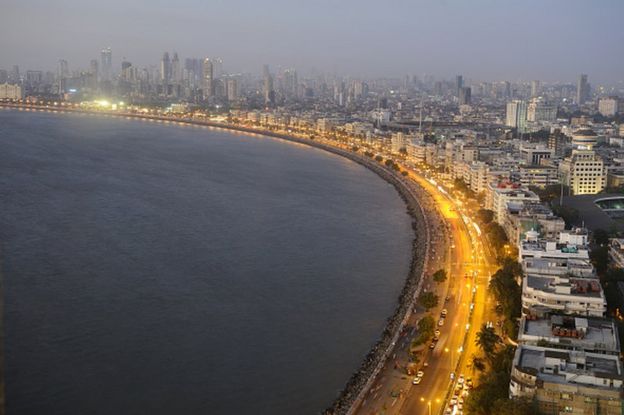
Image copyright HINDUSTAN TIMESImage caption The financial capital Mumbai also seems very different
The deadliest particle in Delhi’s foul air is the tiny but deadly PM 2.5, which increases the likelihood of respiratory and cardiovascular diseases. They primarily come from combustion – fires, automobiles and power plants.
Urban Emissions found the levels of PM 2.5 in Delhi during the lockdown plummeted to 20 micrograms per cubic metre with a 20-day average of 35.
To put this into context, between 2017 and 2019, the monthly average of PM 2.5 in the capital was up to four times higher. (The national standard is set at 40, and the WHO has an annual average guideline of just 10 micrograms per cubic metre.)
“If 35 is the average lowest available PM2.5 with limited local emissions, it means that at least 70% of the pollution is locally generated,” Mr Guttikunda told me.
Media caption India coronavirus lockdown cleans up Ganges river
His study also found a marked dip in PM 10, caused mainly by road and construction dust, and nitrogen dioxide, which comes mainly from vehicular emissions, and nearly 90% of vehicles are off the road.
“The current crisis has shown us that clear skies and breathable air can be achieved very fast if concrete action is taken to reduce burning of fossil fuels,” says Sunil Dahiya, of the Centre for Research on Energy and Clean Air, which has also been tracking air pollution levels during the lockdown.
But will this prompt change? After all, urban Indians’ and the media’s panic and outrage during the deadly winter pollution every year soon gets lost in the fog of summer heat and concerns over monsoon rains and droughts.
“We don’t yet have a democratic demand for clean air,” Arunabha Ghosh, Chief Executive Officer of the Council on Energy, Environment and Water, a leading climate think tank, told me. Orders to clean up the air have almost always come from the courts, responding to pleas by NGOs.
Image copyright GETTY IMAGESImage caption Pollution in Delhi peaks during winter
However, Dr Ghosh still hopes that “the experience of blue skies and fresh air could be a trigger to create a democratic demand for clean air in India”.
Crises often trigger life changing reforms. A fatal four-day “pea-souper” that engulfed London in 1952 and killed thousands provoked the passing of the Clean Air Act to reduce the use of smoky fuels.
China tried to clean up its air several times before hosting marquee international events – like the Beijing Olympics in 2008, the World Expo in Shanghai and the Guangzhou Asian Games in 2010 – before sliding back to grey, smoky skies.
But many believe the 2014 Apec meeting in Beijing, when China hosted 21 heads of Asia-Pacific economies, was a turning point. The rare blue skies over Beijing spawned the phrase ‘Apec blue‘. In a rush to clean its air, China introduced a set of far-reaching measures. Over the next four years, this resulted in a 32% drop in average pollution across major Chinese cities.
So could a lockdown to prevent the spread of a pandemic, which has imperilled the health and livelihoods of millions, trigger similar policy changes to clean up India’s air?
Image copyright GETTY IMAGESImage caption The movement for clean air has been sporadic and mainly pushed by NGOs
Could it move to a shift in reducing traffic on the road by asking people to work from home in shifts now that millions have experienced clean air for the first time in years? (Facing energy shortages after the loss of the Fukushima nuclear power plant, Japan unleashed a Cool Biz campaign to cut down air conditioning in workplaces and reduce carbon emissions by asking office workers to shed their suits.)
Or can India use some of the money from an inevitable stimulus to help kick-start the economy go towards helping green industries? Renewables, experts say, creates more jobs than coal: India has already created nearly 100,000 jobs in solar and wind energy firms.
Can the country use the windfall revenues accruing from the steep decline in oil prices – most of India’s oil is imported – to provide rebates to polluting factories to set up much-needed emission control equipment?
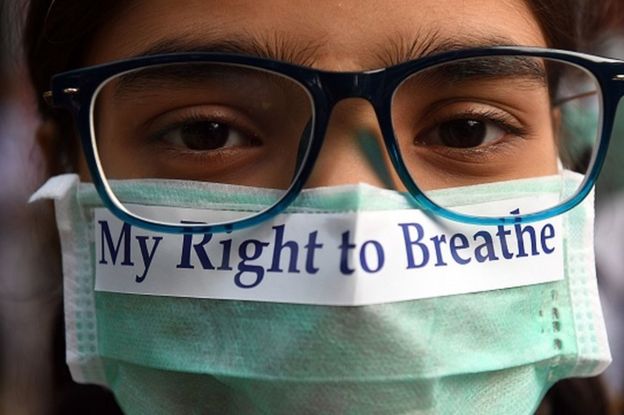
“We have to learn lessons to deploy the economic recovery from the pandemic. We need growth, jobs and sustainable development,” says Dr Ghosh. Cleaning up the air could be the key. For too long, India – and Indians – have ignored their right to breathe easy.
What’s more, if China can reduce air pollution by 32% in four-and-a-half years, why can’t India pledge to reduce pollution by 80% in 80 cities by 2027, which is our 80th anniversary of Independence? asks Dr Ghosh.
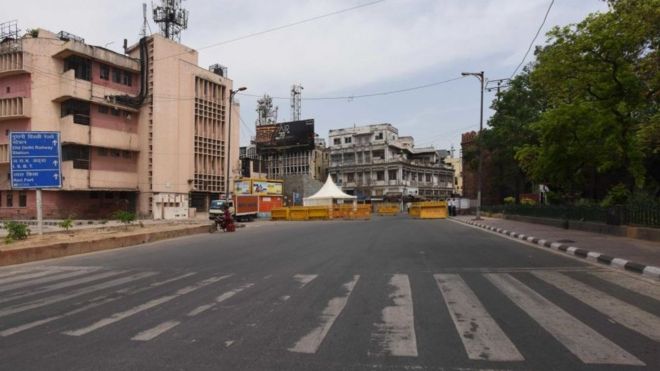
Image copyright GETTY IMAGESImage caption An empty stretch of the road and Delhi Police barricades to screen commuters during lockdown, at Delhi Gate on April 16, 2020 in New Delhi, India.
India has eased some restrictions imposed as part of a nationwide lockdown to curb the spread of the coronavirus.
Most of the new measures are targeted at easing pressure on farming, which employs more than half the nation’s workforce.
Allowing farms to operate again has been seen as essential to avoid food shortages.
But some other measures announced last week, will not be implemented.
This includes the delivery of non-essential items such as mobile phones, computers, and refrigerators by e-commerce firms – the government reversed its decision on that on Sunday.
And none of the restrictions will be lifted in areas that are still considered “hotspots” for the virus – this includes all major Indian cities.
Domestic and international flights and inter-state travel will also remain suspended.
So what restrictions are being eased?
Most of the new measures target agricultural businesses – farming, fisheries and plantations. This will allow crops to be harvested and daily-wagers and others working in these sectors to continue earning.
To restore the supply chain in these industries, cargo trucks will also be allowed to operate across state borders to transport produce from villages to the cities.
Essential public works programmes – such as building roads and water lines in rural areas – will also reopen, but under strict instructions to follow social distancing norms. These are a huge source of employment for hundreds of thousands of daily-wage earners, and farmers looking to supplement their income.
Banks, ATMs, hospitals, clinics, pharmacies and government offices will remain open. And the self-employed – such as plumbers, electricians and carpenters – will also be allowed to work.
Some public and even private workplaces have been permitted to open in areas that are not considered hotspots.
But all businesses and services that reopen are expected to follow social distancing norms.
Who decides what to reopen?
State governments will decide where restrictions can be eased. And several state chief ministers, including Delhi’s Arvind Kejriwal, have said that none of the restrictions will be lifted in their regions.
Mr Kejriwal said the situation in the national capital was still serious and the decision would be reviewed after one week.
India’s most populous state, Uttar Pradesh, will also see all restrictions in place, as will the southern states of Andhra Pradesh, Telangana and Karnataka.
The southern state of Kerala, which has been widely acknowledged for its success in dealing with the virus, has announced a significant easing of the lockdown in areas that it has demarcated as “green” zones.
This includes allowing private vehicular movement and dine-in services at restaurants, with social distancing norms in place. However, it’s implementing what is known as an “odd-even” scheme – private cars with even and odd number plates will be allowed only on alternate days, to limit the number of people on the road.
Indian defence officials have reported a coronavirus outbreak at a key naval base in the western city of Mumbai.
Twenty-one personnel have tested positive for Covid-19 at INS Angre, which is the seat of the force’s western command, the navy said in a statement on Saturday.
It added that there are no infections aboard any ships or submarines.
India has 11,906 active infections and 480 deaths, according to the latest data from the ministry of health.
The Navy said that they had tested a number of personnel who had come into contact with a soldier who had tested positive earlier this month. Many of those who had tested positive for the virus, the statement added, were asymptomatic.
All 21 personnel live in the same residential block, which has been declared a containment zone and has been placed under lockdown.
In a video message to personnel last week, Navy Chief Admiral Karambir Singh stressed the importance of keeping ships and submarines free of the virus.
“The coronavirus pandemic is unprecedented and it has never been seen before. Its impact has been extraordinary across the globe, including India,” he said.
The navy has been playing an active role in India’s response to the Covid-19 outbreak.
It has set up isolation facilities to treat patients at one of its premier hospital units and is also running quarantine camps.
The outbreak aboard the Indian naval base follows reports of outbreaks aboard vessels belonging to other nations.
More than 500 sailors on the USS Roosevelt have tested positive for the virus and one of them died earlier this week. And nearly a third of the sailors serving with France’s aircraft carrier Charles de Gaulle – 668 out of nearly 2,000 – have been infected with coronavirus.
Image copyright ANIImage caption People participating in the chariot-pulling festival
Indian officials have suspended a local magistrate and a police official for allowing large crowds to attend a chariot-pulling festival at a Hindu temple on Thursday morning.
A case has also been filed against the trustees of the temple and another 20 people, police told the BBC.
Pictures of the crowds caused outrage after they surfaced on social media.
It comes weeks after Covid-19 clusters were linked to a Muslim religious gathering in the capital, Delhi.
Revoor village, which is in the state’s Kalburagi district, has been sealed off and officials are rushing teams of medical personnel to set up fever clinics there, the deputy commissioner of the district, told the BBC.
Kalburagi recorded India’s first coronavirus-related death – it is also the first district to implement “containment areas”, which involves sealing off villages where infections are reported.
Revoor is also close to another village that has been sealed off after a two-year-old tested positive for coronavirus.
The festival was held despite temple trustees giving officials an undertaking that it would not go ahead, a state lawmaker, Priyank Kharge, told the BBC.
Officials say that the daily rituals were performed at the temple on Wednesday evening in the presence of a few priests and temple trustees.
But early the next morning, the chariot was brought out of the temple premises and was pulled by “hundreds of people,” according to one official. They estimate that under 1,000 devotees attended the event.
SRINAGAR, India (Reuters) – Shelling across the border between India and Pakistan killed three Indian civilians and wounded two Pakistani civilians, military officials from the two sides said on Sunday.
Indian and Pakistani troops exchanged mortar and artillery shelling along the de facto border known as the Line of Control (LoC) that divides the disputed Kashmir region. The sporadic exchanges began on Saturday and continued into Sunday.
Both countries claim the region in full, but rule only parts, and often accuse each other of breaching a 2003 ceasefire pact by shelling and firing across the LoC.
Pakistani troops targeted civilians living near the LoC, killing three people, including a child and a woman, and wounding five, Vijay Kumar, police chief of Kashmir, told Reuters.
Pakistan blames Indian troops for ceasefire violations and targeting civilians in Kashmir.
Two Pakistani civilians were injured due to shelling from India, Major-General Babar Iftikhar of the public relations wing of the Pakistan Army, said in a Tweet.
Tension between the two countries was renewed when New Delhi withdrew the autonomy of the Kashmir region in 2019 and split it into territories federally administered by India. Until then, it had had autonomy over all matters except defence, communications and foreign affairs.
India accuses its neighbour of training and then sending militants across the border to launch attacks and support a separatist movement against Indian rule.
Pakistan denies giving material support to militants in Kashmir but says it provides moral and diplomatic backing for the self-determination of Kashmiri people.
NEW DELHI (Reuters) – Indian and Pakistani troops in disputed Kashmir are engaged in their most frequent cross-border fighting of at least two years, official data shows, even as both nuclear-armed rivals battle surging coronavirus outbreaks.
Kashmir has long been a flashpoint between the neighbours but tension was renewed after New Delhi withdrew the autonomy of the Himalayan region last August and split it into federally-administered territories.
Both countries claim the region in full, but rule only parts, and often accuse each other of breaching a 2003 ceasefire pact by shelling and firing across the Line of Control (LoC), an informal border in Kashmir, and of killing dozens every year.
Indian Army data reviewed by Reuters shows 411 ceasefire violations by Pakistan’s military in March, the highest number in a single month since at least 2018. That compares with 267 violations in March last year recorded by the Indian Army.
“(The) Pakistan Army never initiates ceasefire violations along LoC, but it has always responded befittingly to Indian Army’s unprovoked firing,” said Major-General Babar Iftikhar, of the public relations wing of the Pakistan Army.
Iftikhar said Pakistan’s military had recorded 705 ceasefire violations by the Indian Army since the beginning of the year.
The Indian Army data showed 1,197 Pakistani violations during the same period.
Reuters is not in a position to independently verify the competing claims.
Four Indian army officials said the heightened border activity was a cover to help militants from Pakistan-backed groups infiltrate into Indian Kashmir, as some troops help to run health camps and hand out food in the battle on the virus.
“The increase in ceasefire violations is an indication that Pakistan is trying to push militants into the Kashmir valley,” said one of the officials, who all sought anonymity because they were not authorised to speak to media.
India has 5,734 infections, including 166 deaths, while Pakistan has reported 4,072 cases and 58 deaths, with the military of each helping its government’s efforts against the virus.
As summer approaches, infiltration into Kashmir typically picks up. An Indian security official said between 250 and 300 militants were estimated to be ready to cross over from Pakistan, citing intelligence reports.
“This is the time when our (border) fence is the weakest,” with damage caused by winter snows, said the official, who sought anonymity.
On Monday, the Indian Army said in a statement it killed five Pakistan-backed militants at the LoC during a firefight in heavy snow, with five of its special forces soldiers also killed.
Pakistan denies giving material support to militants in Kashmir but says it provides moral and diplomatic backing for the self-determination of Kashmiri people.
Image copyright GETTY IMAGESImage caption More than a billion people have been staying at home during the lockdown
Will India extend its rigorous 21-day lockdown to slow the spread of coronavirus beyond its end date next week? By all accounts, yes.
On 24 March, India shut its $2.9 trillion economy, closing its businesses and issuing strict stay-at-home orders to more than a billion people. Air, road and rail transport systems were suspended.
Now, more than two months after the first case of Covid-19 was detected in the country, more than 5,000 people have tested positive and some 150 people have died. As testing has ramped up, the true picture is emerging. The virus is beginning to spread through dense communities and new clusters of infection are being reported every day. Lifting the lockdown could easily risk triggering a fresh wave of infections.
A harsh lockdown is certain to slow down the disease. Virologists I spoke to believe India is still at an early stage of the infection. The country still doesn’t have enough data on the transmissibility of the virus or even how many people could have been infected and recovered to develop adequate herd immunity. (It is slowly beginning finger prick blood tests to look at the presence of protective antibodies.)
More than 250 of India’s 700-odd districts have reported the infection. Reports say at least seven states have a third of all infections, and want the lockdown extended. Six states have reported clusters of rapidly growing infections – from the capital Delhi in the north to Maharashtra in the west and Tamil Nadu in the south.
Economic fallout
Not surprisingly, the lockdown is already hurting the economy. Many of the early hotspots are economic growth engines and contribute heavily in revenues to the exchequer. Mumbai, India’s financial capital and Maharashtra’s main city, accounts for more than a third of overall tax collection. The densely populated city has reported more than 500 cases and 45 deaths, and numbers are steadily rising. Authorities say the infection is now spreading through the community. Mumbai has made wearing face masks mandatory.
Image copyright GETTY IMAGESImage caption India has ramped up testing during the lockdown
Many of these hotspot clusters are also thriving manufacturing bases. The spread of infection means that they will be under lockdown for a longer period of time.
The services industry, which generates almost half of India’s GDP, is also likely to remain shut for some more time. Construction, which employs a bulk of migrant workers, will remain similarly suspended. The unemployment rate may have already climbed to more than 20% after the lockdown, according to a report by the Center for Monitoring Indian Economy.
For the moment, economists say, the government will have to prioritise farming over everything else to ensure the livelihoods of millions and secure the country’s future food supplies.
Half of India’s labour force work on farms. The lockdown happened at a time when a bumper winter crop had to be harvested and sold, and the rain-fed summer crop had to be sowed. The immediate challenge is to harvest and market the first crop, and secure the second.
Moving trucks to pick up produce and take them to markets, with adequate social distancing and hand washing will be something the government will have to move on quickly.
“The immediate challenge is to ensure that rural India is not hit,” says Rathin Ray, an economist. “Realistically, a complete lockdown cannot be continuously maintained beyond early May. We don’t have a choice but to reopen gradually after that.”
Image copyright GETTY IMAGESImage caption India has been under a lockdown from 24 March
There is little doubt about that. For his part, SK Sarin, who heads a government advisory panel on combating the disease, says the lockdown can be only eased in a “graded manner in areas that are not hotspots” and that the hotspots remained cordoned off.
Like other affected countries, India will have to prepare itself for what Gabriel Leung, an infectious disease epidemiologist and dean of medicine at the University of Hong Kong, describes as several rounds of “suppress and lift” cycles.
During these periods “restrictions are applied and relaxed, applied again and relaxed again, in ways that can keep the pandemic under control but at an acceptable economic and social cost.”
Also, Dr Leung observes, “how best to do that will vary by country, depending on its means, tolerance for disruption and its people’s collective will. In all cases, however, the challenge essentially is a three-way tug of war between combating the disease, protecting the economy and keeping society at an even keel”.
It is now clear that shutdowns need to continue until transmission has slowed down markedly, and testing and health infrastructure has been scaled up to manage the outbreak.
Experts from the southern state of Kerala, a striking outlier that is containing the infection thanks to a transparent government and a robust public health system, say it isn’t time to lift the lockdown yet and have recommended a three-phase relaxation.
For most countries, easing the lockdown is a tricky policy choice. It sparks fears of triggering a fresh wave of infection and presents the inevitable trade-off between lives and livelihoods. French Prime Minister Edouard Phillipe, says relaxing the lockdown in his country is going to be “fearsomely complex”. In a crisis like this, according to his Dutch counterpart Mark Rutte, leaders have to “make 100% of the decisions with 50% of the knowledge, and bear the consequences.”
Image copyright GETTY IMAGESImage caption India’s financial capital, Mumbai, is emerging as a hotspot
It is going to be tougher for India with its vast size, densely packed population and enfeebled public health system. Also, no country in the world possibly has so much inter-state migration of casual workers, who are the backbone of the services and construction industries.
How will India manage to return these workers to their work places – factories, farms, building sites, shops – without a substantial easing of public transport at a time when crowded trains and buses can be a vector of transmission and easily neutralise the gains of the lockdown? Even allowing restricted mobility – allowing social distancing, temperature checks and passenger hygiene – would put considerable pressure on the public transport system.
The policy choices are fiendishly tough, and the answers are far from easy. India bungled the lockdown by not anticipating the exodus of millions of migrant workers from cities. The weeks ahead will tell whether the fleeing men, women and children carried the infection to their villages. The country simply cannot afford to make similar mistakes again while trying to relax the lockdown. Nitin Pai of The Takshashila Institution, a think tank, believes states should be left to decide on easing restrictions, and decisions “should be based on threat [of infection], which should be determined by extensive testing”.
This week Prime Minister Narendra Modi said that the “situation in the country is akin to a social emergency”. His government now needs make sure that the looming threat to the nation’s health and economic progress is tackled skilfully.
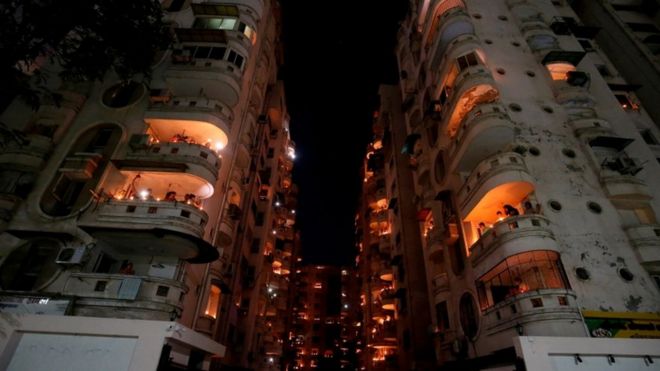
Image copyrigh tREUTERSImage caption India’s prime minister called on the country to “challenge the darkness” of coronavirus
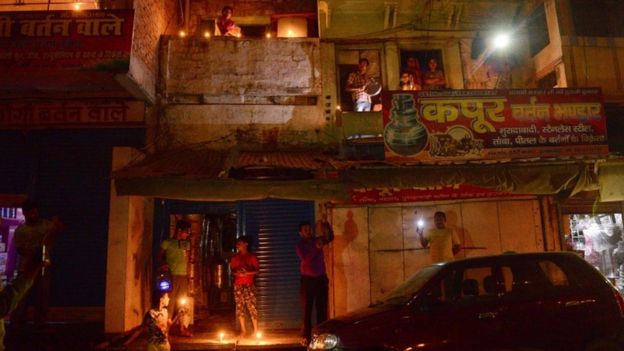
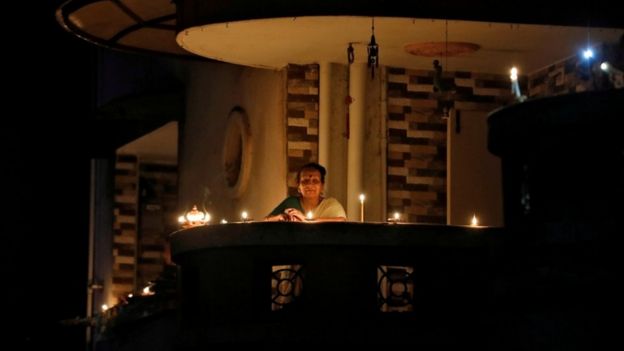
Indians have turned off their lights for a nationwide candle-lit vigil, heeding a call for unity as the country battles coronavirus.
Prime Minister Narendra Modi asked India’s 1.3 billion citizens to observe nine minutes without electricity at 21:00 local time (16:30 GMT) on Sunday.
He urged them to “challenge the darkness” of Covid-19 by lighting candles and lamps.
Millions responded, lighting up the night sky in a show of unity.
“Salute to the light of the lamp which brings auspiciousness, health and prosperity, which destroys negative feelings,” Mr Modi tweeted at the time of the vigil.
But critics have dismissed the event as a stunt, arguing it distracted from the health and economic crisis caused by the coronavirus pandemic.
Mr Modi imposed a nationwide lockdown on 25 March, announced with little warning, leaving millions stranded and without food.
Image copyright GETTY IMAGESImage caption Millions of Indians observed the nine-minute vigil called for by Mr Modi
The true figures, however, are thought to be far higher. India has one of the lowest testing rates in the world, although efforts are under way to ramp up capacity.
Image copyright REUTERSImage caption India has been under lockdown since 25 March
There are fears that a major outbreak in the country – one of the world’s most densely populated – could result in a humanitarian catastrophe.
People are banned from leaving their homes under the lockdown measures. All non-essential businesses have been closed and almost all public gatherings are banned.
Media caption As cases of coronavirus rise and the virus hits India’s congested slums, will the country cope?
But the shutdown sparked an exodus from major cities such as Delhi, forcing thousands of migrant labourers to walk hundreds of kilometres to their native villages.
Last week, Mr Modi apologised for the impact of the strict stay-at-home measures, saying there was “no other way” to stop the spread of the virus.
The US saw 1,169 deaths in 24 hours and its infections are 20 per cent of the global total
China to hold day of mourning for victims; Singapore announces fifth death and school closures; Boris Johnson says he’s still ill; Angela Merkel ends quarantine
A group of nurses gather in the Bronx, New York, for a strike about the lack of personal protective equipment, on April 2, 2020. Photo: EPA-EFE
The number of confirmed coronavirus cases around the world soared past one million on Thursday and deaths topped 50,000 as Europe reeled from the pandemic and the
reported the highest daily death toll so far of any country.
Despite more than half the planet imposing some form of lockdown, the virus claimed thousands more lives, with the US, Spain and Britain seeing the highest number of daily fatalities yet.
Covid-19 is currently spreading the most rapidly in the US, where there have been 243,453 infections and 5,926 deaths, according to a tally by Johns Hopkins University.
The US saw 1,169 deaths in 24 hours, the highest one-day toll recorded in any country since the global pandemic began. The grim record was previously held by Italy, where 969 people died on March 27.
Here are other developments:
Singapore shuts schools, workplaces in ‘circuit-breaking’ move
Singapore’s coronavirus case number hits 1,000 after city state reports biggest single-day spike
Singapore Prime Minister Lee Hsien Loong on Friday afternoon announced most workplaces would be shut from April 7, and schools would be closed from April 8, in its
The city state has 1,114 infections and five people have died. More than 200 have recovered.
Essential services such as food establishments, markets and supermarkets, clinics, hospitals, utilities, transport and banking services will remain open.
Coronavirus: what’s behind Singapore’s U-turn on wearing masks?
4 Apr 2020
Lee on Friday said instead of tightening measures incrementally over the next few weeks, Singapore should “make a decisive move now, to pre-empt escalating infections”.
“Looking at the trend, I am worried that unless we take further steps, things will gradually get worse, or another big cluster may push things over the edge,” Lee said, describing the new measures as a “circuit breaker”.
Medical experts say the stringent measures require the cooperation of citizens to stay at home, given that local infection clusters have ballooned from six at the end of February to more than 20 currently.
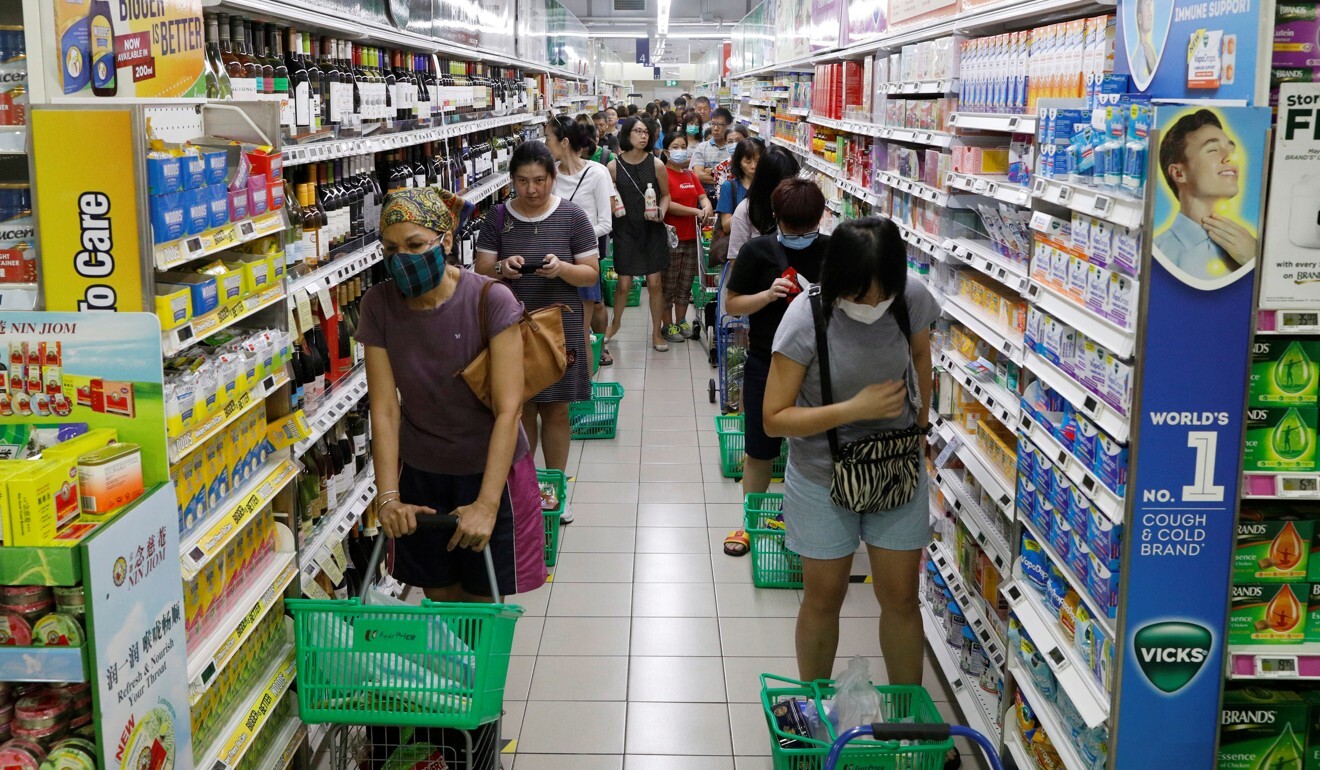
People stand behind markers as they practice physical distancing while queuing up to buy food at a Singapore supermarket on April 3, 2020. Photo: Reuters
The Lion City has launched a website to help individuals with symptoms that might be related to Covid-19 decide whether they should see a doctor or not.
On the Covid-19 Symptom Checker website, individuals will be prompted to answer a short list of questions including their age, if they have any chronic diseases, if they have travelled outside Singapore in the past 14 days, or have been in touch with a suspected or confirmed Covid-19 case.
They will also be asked to choose which symptoms they are experiencing from a predetermined list including symptoms such as cough, difficulty breathing and the loss of taste/smell. The site will then recommend what the person should do next. This includes whether they should see a doctor or continue to monitor their symptoms.
China to hold day of mourning for Covid-19 victims
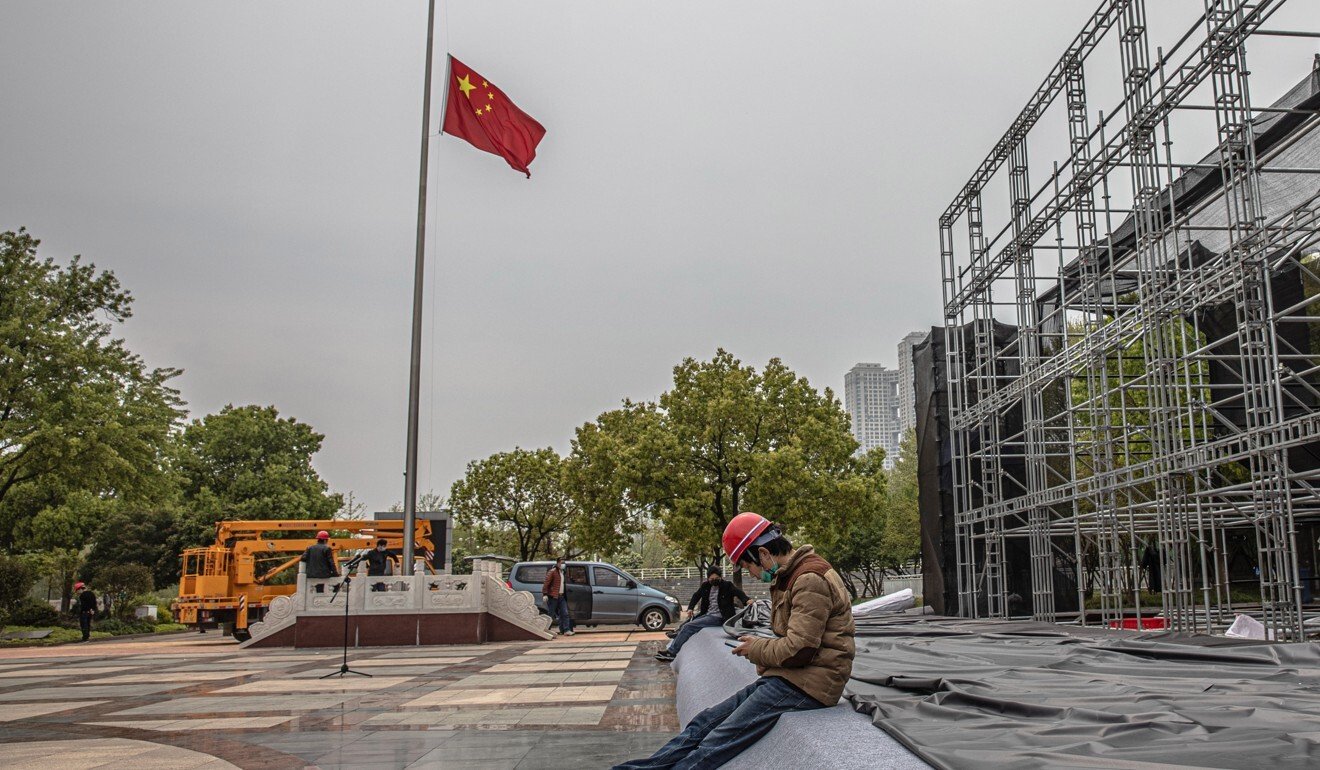
At 10am on April 4, 2020, the public will be asked to observe three minutes of silence. Photo: EPA-EFE
Flags will be flown at half-mast across the country and at embassies overseas, while all public entertainment will be halted for the day, said the State Council, China’s cabinet, on Friday.
At 10am, the public will be asked to observe three minutes of silence, during which sirens will blast out across the country and the owners of cars and boats should sound their vehicles’ horns, the council said.
Saturday also coincides with Ching Ming, or the Tomb-sweeping Festival, when Chinese traditionally gather to remember their ancestors.
China to stage day of mourning for the thousands lost to Covid-19
4 Apr 2020
Mainland China on Friday reported 31 new confirmed coronavirus cases, including two locally transmitted infections, the country’s National Health Commission said.
It also reported four new deaths as of Thursday, all in Wuhan, the city where the outbreak began, the commission said in a statement. The total number of infections now stands at 81,620 and 3,322 deaths have been reported from mainland China to date.
The commission said 60 new asymptomatic coronavirus patients were also reported on Thursday.
UK’s Boris Johnson still ill with virus fever
Boris Johnson #StayHomeSaveLives
✔@BorisJohnson
Another quick update from me on our campaign against #coronavirus.
You are saving lives by staying at home, so I urge you to stick with it this weekend, even if we do have some fine weather.#StayHomeSaveLives
British Prime Minister Boris Johnson remains in isolation with a high temperature, more than a week after testing positive for coronavirus.
Johnson made the announcement in a video posted on Twitter on Friday, saying that even after seven days, “alas I still have one of the symptoms, a minor symptom: I still have a temperature”.
“In accordance with government advice I must continue my self-isolation,” he said.
As virus rages, British love for NHS could make or break Boris Johnson
3 Apr 2020
With coronavirus deaths still rising, the PM is anxious to drum home his message that Britons must obey government orders to stay in their homes as much as possible.
On March 23 he ordered a national lockdown, with the closure of schools, stores, restaurants and leisure facilities. Under emergency laws, police have the power to fine individuals who flout the rules and break up gatherings of more than two people in public.
Germany to crack down on people flouting physical distancing rules
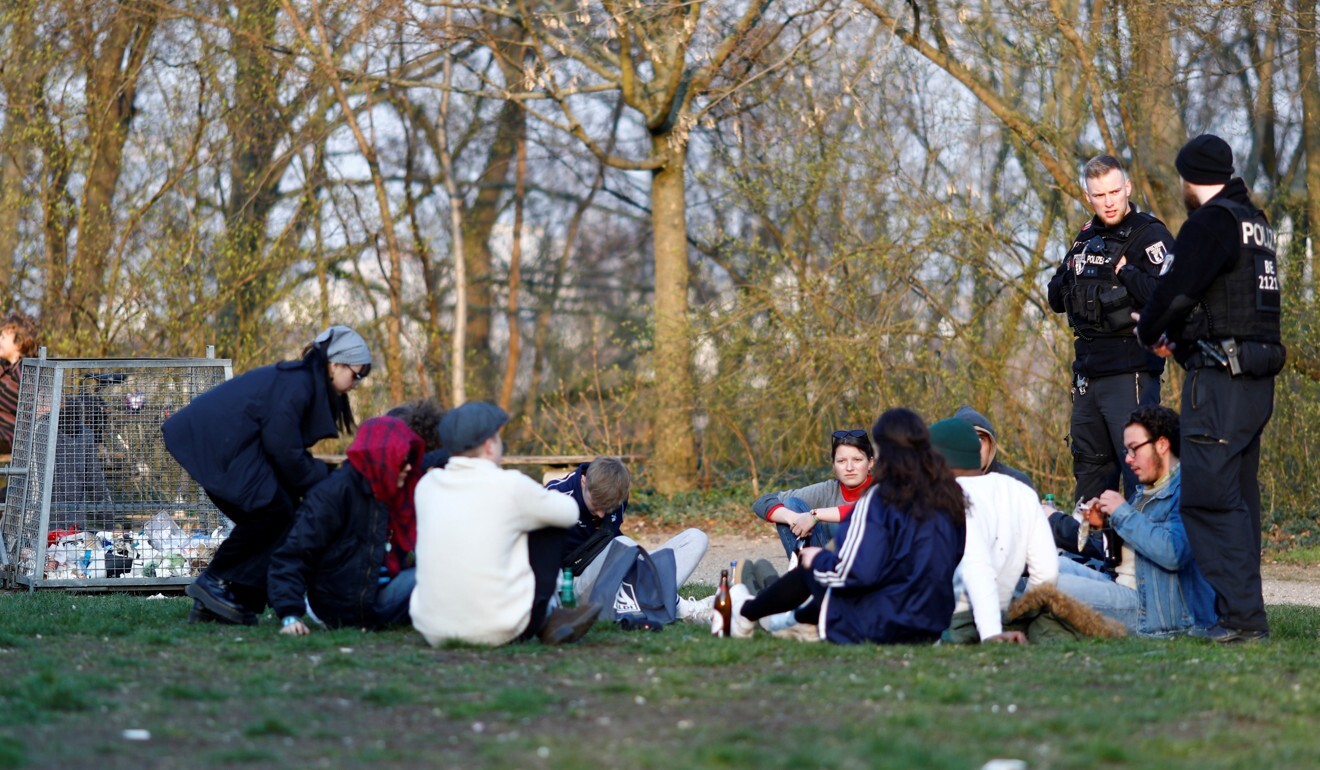
Police officers ask people to disperse as they gather at a park in Berlin, Germany, on March 28, 2020. Photo: Reuters
People in Germany risk being fined up to €500 (US$540) for standing too close to each other from Friday, as officials crack down on people flouting rules brought in to control the coronavirus outbreak.
Chancellor Angela Merkel’s government has ordered people not leave their homes unless they have an exceptional reason such as grocery shopping, exercise or medical appointments.
Gatherings of more than two people are banned and a distance of at least 1.5 metres must be kept from others at all times.
Local governments have the power to set fines for transgressors, with city officials in Berlin saying their fines would be as high as 500 euros. Similar announcements have come from across Germany’s 16 states.
Bow ties to face masks: German firms shift gears in virus crisis
2 Apr 2020
According to figures by the Robert Koch Institute (RKI) on Friday, Germany has recorded more than 79,000 cases of the novel coronavirus, and 1,017 deaths, although RKI president Lothar Wieler warned on Friday that the actual number of casualties could be much higher.
“We won’t manage to test every single person … I assume we will have more deaths than are officially recorded,” he said.
Wieler said the mortality rate would “continue to rise” in Germany. German minister’s suicide linked to coronavirus crisis
30 Mar 2020
Meanwhile, Merkel on Friday left her Berlin home for the first time in almost two weeks, after she was forced into quarantine following contact with an infected doctor.
Merkel was tested several times, with all tests coming back negative.
The 65-year-old leader has returned to her office, where she will continue to observe social distancing rules and lead the country via video and audio conferencing, her spokesman said.
Spain records over 900 virus deaths
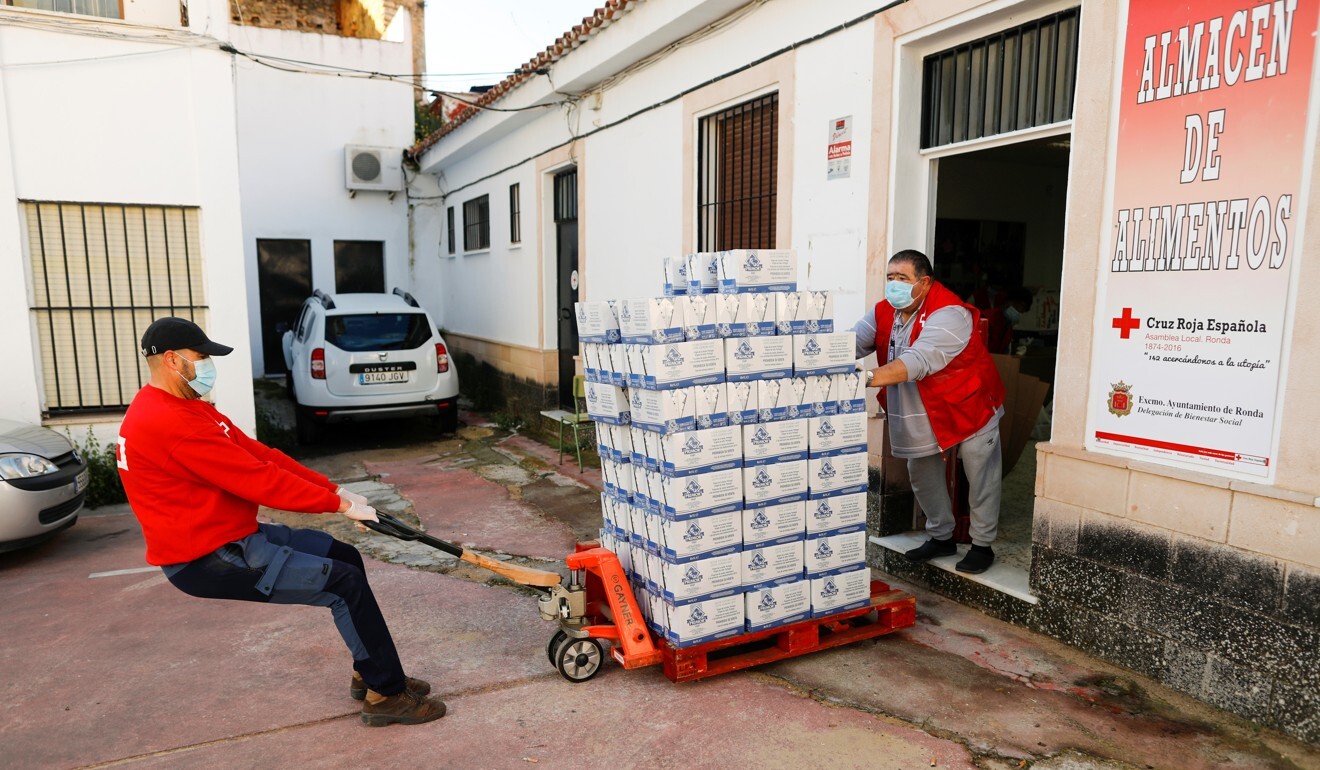
Members of the Red Cross prepare food for families in need at a food bank in Ronda, Spain, on April 3, 2020. Photo: Reuters
on Friday recorded over 900 new coronavirus deaths over the past day, bringing the number of casualties to 10,935, in the first decline in new Covid-19 deaths in four days.
The country has the world’s second-highest death toll after Italy, but health ministry figures confirm a consistent downward trend in the rate of new cases and fatalities.
The 932 deaths on Friday was a smaller gain than Thursday’s 950, according to Health Ministry data. The number of confirmed cases also increased by less than the previous day, with 7,472 new infections taking the total to 117,710.
Why Europe’s hospitals – among world’s best – are struggling with virus
1 Apr 2020
Prime Minister Pedro Sanchez’s government has been struggling to bring the virus under control. Hospitals are overwhelmed, nursing homes have been especially hard hit in a nation with one of the world’s oldest populations, and the army has been mobilised.
Sanchez may extend the current four-week lockdown for another two weeks beyond April 11, Spanish media reported on Friday. The stay-at-home order limits people’s movement to shopping for food and essentials, while some workers are also allowed to circulate.
Passengers disembark from virus-hit cruise ship in Florida
The Zaandam cruise ship docked in Florida on Friday. Photo: TNS via ZUMA Wire/dpa
Passengers from an ill-fated cruise were carefully freed from their cabins and allowed to disembark on Friday, following the removal of 14 critically-ill people who were wheeled off to Florida hospitals bracing for an onslaught of coronavirus patients.
The exodus from the Zaandam and its sister ship the Rotterdam, both operated by Holland America Line, was expected to continue throughout the day.
Floridians were getting off first, followed by other passengers. Buses were taking people healthy enough to travel directly to the airport, where they will board chartered flights home without going through the terminal.
Coronavirus nightmare for passengers stuck on MS Zaandam ‘death ship’
30 Mar 2020
“This is a humanitarian situation, and the County Commission’s top priority is protecting our 1.9 million residents while providing a contained disembarkation option for people on board who need to get safely home,” Broward County Mayor Dale Holness said in a statement late on Thursday.
Four people have died on the Zaandam, for reasons not yet disclosed. All told, 107 passengers and 143 crew reported flu-like symptoms during the voyage, but many have since recovered.
It was unclear when the bodies of four passengers who died on the Zaandam would be removed from the ship, which set sail on March 7, the day before the US State Department warned people against cruising during the pandemic.
South Korea’s infections top 10,000
South Korean hospital’s ‘phone booth’ coronavirus tests
on Friday said the number of confirmed coronavirus cases in the country has surpassed 10,000, with 174 deaths linked to Covid-19, the disease caused by the new virus.
The Health and Welfare Ministry reported 86 new coronavirus infections over 24 hours to the end of Thursday, taking the total to 10,062 cases. It also logged five more deaths.
The numbers confirmed an encouraging stabilisation of numbers, which have hovered around the 100 mark for the past three weeks, a clear downward trend which began in March after numbers peaked at the end of February with over 900 cases recorded in a day.
South Korea’s virus response is the opposite of China’s – and it works
15 Mar 2020
For a fourth straight day, more new cases were recorded from Seoul and the surrounding Gyeonggi province, than in what has so far been the outbreak epicentre in the country – North Gyeongsang province and city of Daegu – with the capital area registering 34 new cases, and the latter recording 23.
Imported cases in patients recently returned from abroad also continued to increase, with 22 new infections bringing the total to 264.
Japan to give US$2,800 payouts to households
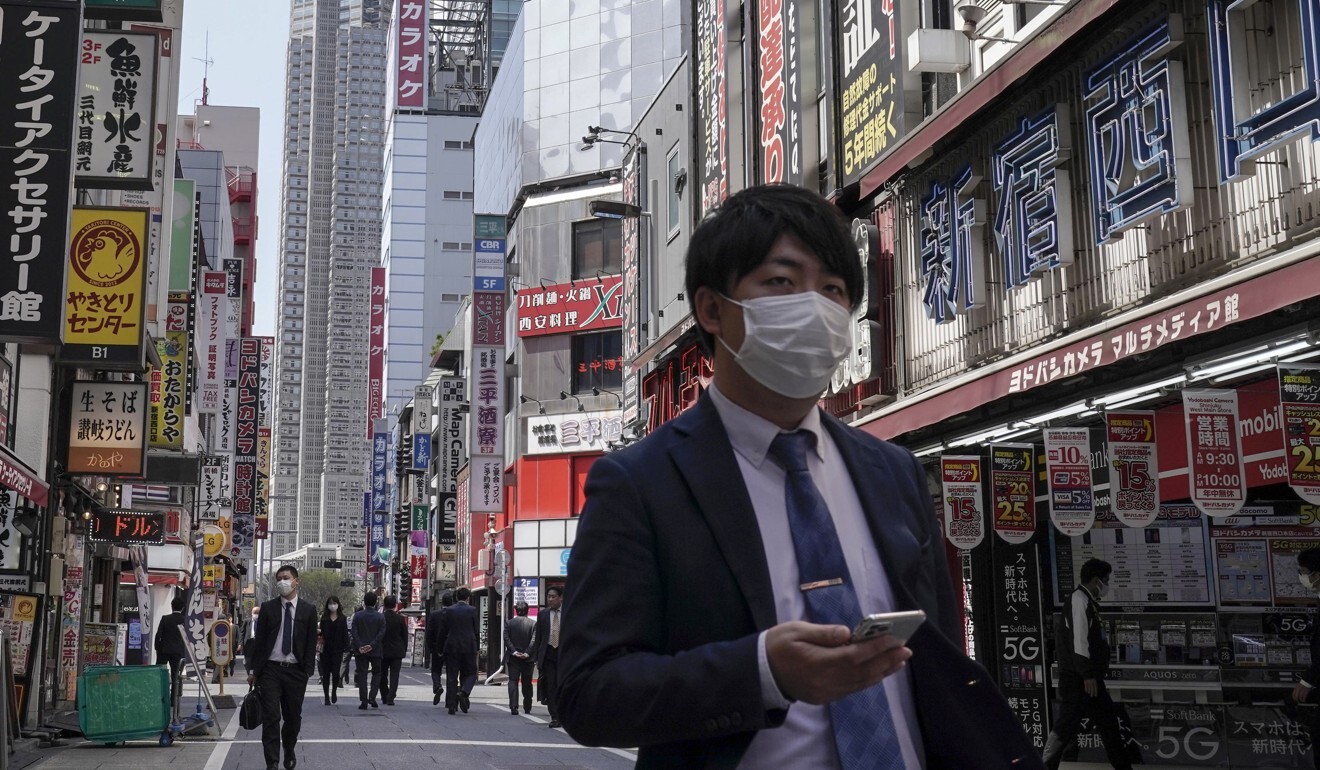
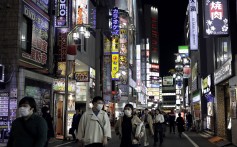
A man seen in a protective mask at Shinjuku in Tokyo, Japan, on April 2, 2020. Photo: EPA-EFE
Japanese ruling party executive Fumio Kishida said on Friday he has agreed with Prime Minister Shinzo Abe to offer 300,000 yen (US$2,800) in cash payments per household that suffers a certain degree of income declines from the coronavirus pandemic.
About 10 million of Japan’s 58 million households are expected to be eligible for the cash programme, a key pillar of an emergency economic package that the government plans to compile possibly on Tuesday.
The relief measure will be funded by a supplementary budget for this fiscal year that the government wants to pass in parliament before Japan’s Golden Week holiday starts in early May.
Coronavirus: Tokyo’s nightlife districts linked to rise in cases
2 Apr 2020
The government will not set a household income limit for the cash handout, which will be tax free, officials said.
“If we set an income limit, we would have to check individual incomes, which would take a lot of time,” Yasutoshi Nishimura, minister in charge of economic and fiscal policy, told a press conference. “Instead of that, we’ll come up with an unprecedented way (to judge who should receive cash).”
Nishimura said recipients will be limited to those who are facing livelihood difficulties, and that civil servants, politicians and major corporate executives who have not been significantly affected by the economic impact of the virus outbreak, for example, will be excluded from the scheme.
Japan weighs cost of Tokyo lockdown and Wagyu beef coupons for households
31 Mar 2020
Abe said the government will provide cash “as soon as possible” not only to households but also to small-and mid-sized business operators that have seen their revenues drop.
Abe has said the package to tackle the coronavirus will be larger than the 56.8 trillion yen emergency package compiled in April 2009 following the previous year’s global financial crisis.
Indonesian Muslims banned from travelling home for Eid al-Fitr
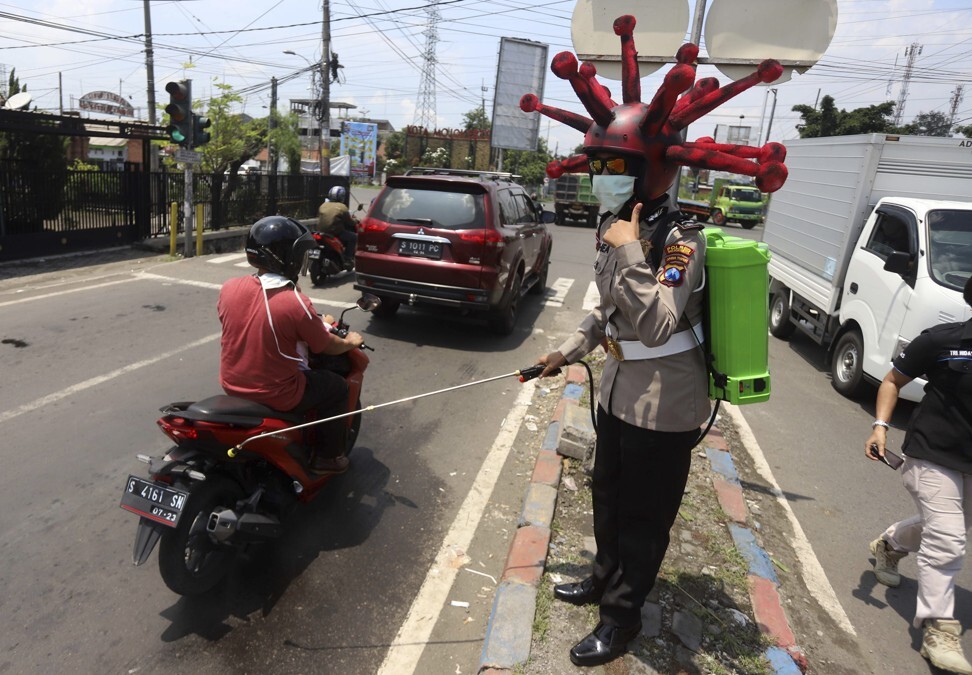
A police officer in a coronavirus helmet sprays disinfectant at a motorcycle in East Java, Indonesia, on April 3, 2020. Photo: AP
Islamic scholars in Indonesia on Friday issued an edict to forbid people from travelling home for Eid al-Fitr, the festival marking the end of the Muslim fasting month of Ramadan, as the country recorded nearly 2,000 infections during the
decided to allow millions of Muslims to travel to celebrate Eid in their hometowns next month, despite fears that they could spread the Covid-19 disease.
“The virus spreads very easily. Doing something like that at a time of a pandemic is haram [forbidden],” the council’s sectary general Anwar Abbas said.
Eid al-Fitr is expected to start on May 23, depending on the sighting of the new moon.
Indonesia frees 18,000 prisoners as virus death toll surges to 170
2 Apr 2020
Indonesia confirmed 196 new infections on Friday, bringing the total number of cases to 1,986.
The death toll rose to 181 after 11 new deaths, making Indonesia the the country with the highest number of fatalities in Asia outside China.
The State Intelligence Agency warned that the outbreak in Indonesia could peak in June with more than 105,000 cases.
Thailand’s night curfew to begin; people banned from making virus pranks
An officer checks the temperature of a passenger in a bus at a health checkpoint in Bangkok, Thailand, on April 3, 2020. Photo: AP
Thailand will on Friday night begin a daily nationwide curfew to try to curb the spread of the coronavirus.
The 10pm-4am curfew, which will run indefinitely, is the latest measure by the government to curb gatherings and have people stay at home as much as possible.
Exceptions include those people transporting medical supplies and health workers travelling to and from work, Prime Minister Prayuth Chan-ocha said.
“We prioritise health over freedom,” Prayuth said. “We might not feel as comfortable as before, but we all need to adapt for survival and have social responsibility, so that we can make it through this crisis.”
In a televised address, Prayuth also asked all Thai citizens abroad to “delay” returning to
until after April 15 in a bid to stop imported cases.
Thai king remains in Germany during pandemic, prompting criticism online
23 Mar 2020
Thais have also been banned from making public gatherings, in an order signed on Friday by defence forces chief General Pornpipat Benyasri.
The order prohibits people from public gatherings, carrying out activities, or gathering for unlawful purposes in a manner that risks spreading the coronavirus.
It also bans any act that aggravates people’s suffering and pranks to spread the virus. Family gatherings at residences and civic activities carried out according to safe social distancing guidelines are allowed.
Violation of the order carries a maximum penalty of two years’ imprisonment and a fine of 40,000 baht (US$1,215).
Pakistan’s mosques remain open amid shutdowns
Coronavirus: In Pakistan food aid is distributed to the poor in Karachi
Mosques in Pakistan were allowed to remain open on Friday, when adherents gather for weekly prayers, even as much of the country had shut down.
Pakistan, with 2,450 confirmed coronavirus cases and 35 deaths, has been sharply criticised for moving too slowly to curb large gatherings.
Prime Minister Imran Khan was relying on restricting the size of congregations attending mosques and advice to stay at home from religious groups like the country’s Islamic Ideology Council.
Coronavirus: Pakistan quarantines pilgrims returning from Iran
4 Mar 2020
However, some provinces had issued their own lockdown orders to prevent Muslims from gathering for Friday prayers.
In southern Sindh province, a complete lockdown was being enforced from noon until 3pm, the time when the faithful gather for prayers. Anyone found on the streets would be arrested, according to the provincial local government minister in a statement.
In eastern Punjab province, where 60 per cent of Pakistan’s 220 million people live, checkpoints had been set up in major cities stopping people from congregating.
Tunisia ‘robocop’ enforces virus lockdown
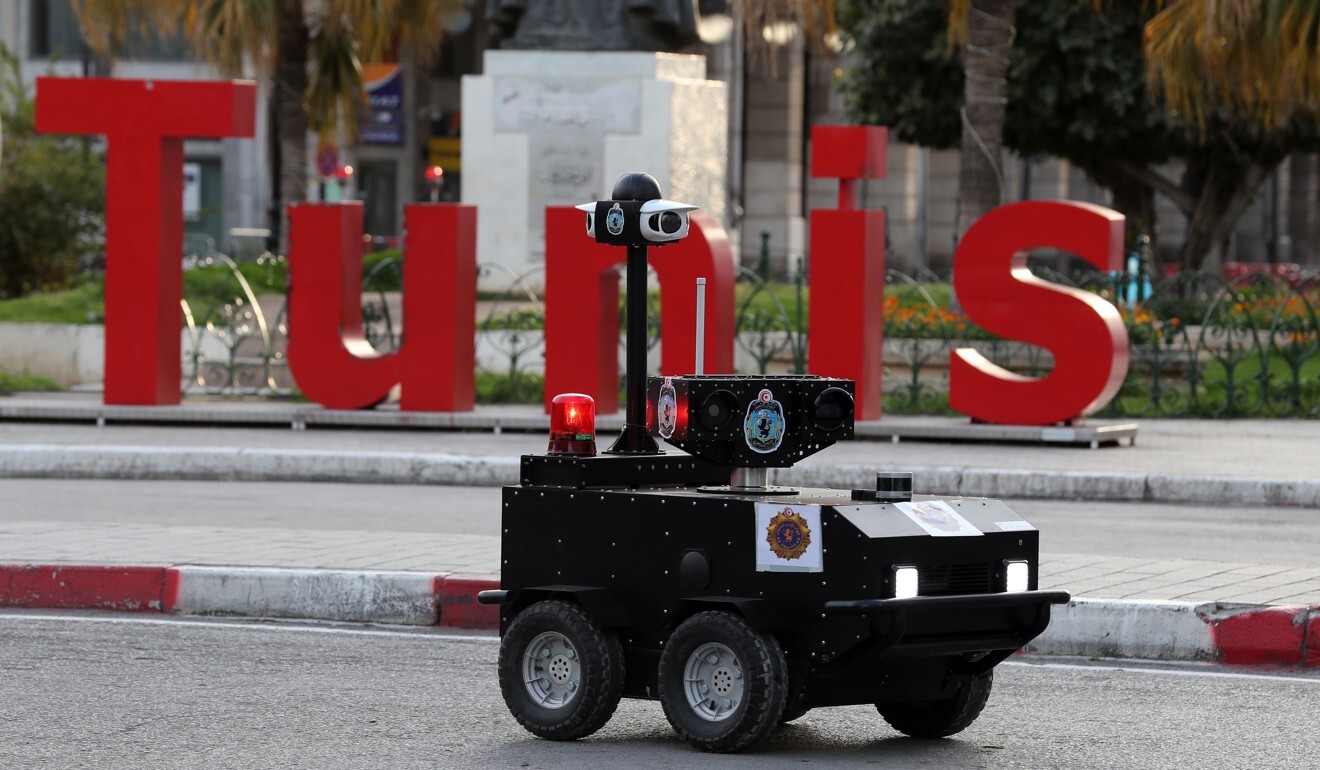
The PGuard robot patrols the streets of Tunis, in Tunisia, on April 1, 2020. Photo: EPA-EFE
Tunisia’s interior ministry has deployed a police robot to patrol the streets of the capital and enforce a lockdown as the country battles the spread of coronavirus.
Known as PGuard, the “robocop” is remotely operated and equipped with infrared and thermal imaging cameras, in addition to a sound and light alarm system.
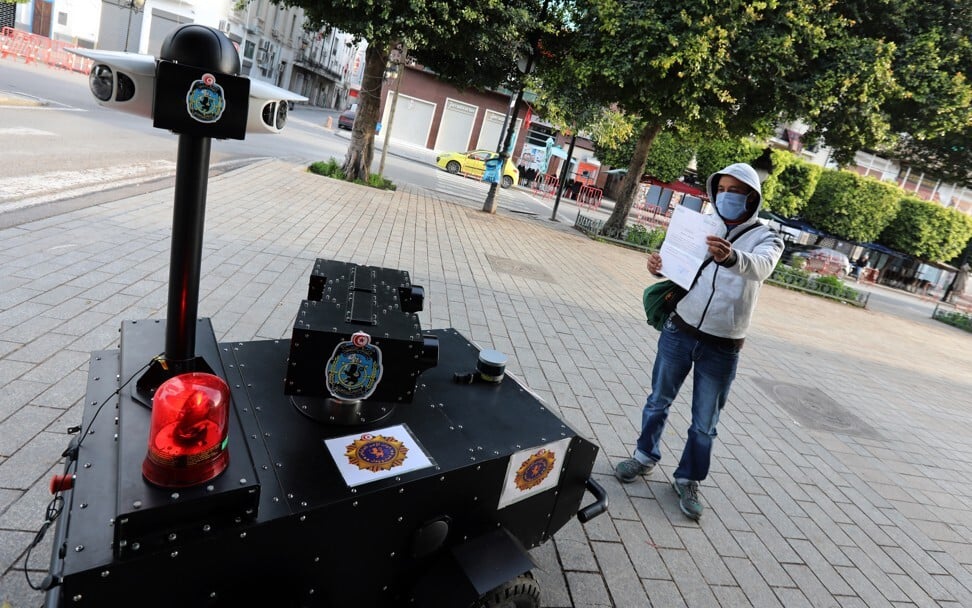
In images and a soundtrack posted on the interior ministry’s website last month, PGuard calls out to suspected violators of the lockdown: “What are you doing? Show me your ID. You don’t know there’s a lockdown?”
The PGuard robot checks the exit permit of a citizen in Tunis on April 1, 2020. Photo: EPA-EFE
Tunisia has been under night-time curfew since March 17 and authorities imposed stricter lockdown orders from March 22.
Fourteen people have died from coronavirus in Tunisia, where 455 confirmed cases have tested positive for the disease.
The robot’s Tunisian creator Anis Sahbani said the machine was first produced in 2015 essentially to carry out security patrols and it also operates autonomously through artificial intelligence.
The robot, built by Sahbani’s Enova Robotics firm, costs between 100,000 and 130,000 euros (US$100,000 and $140,000), and has been selling mostly overseas to companies for security uses.
France death tally passes 5,000
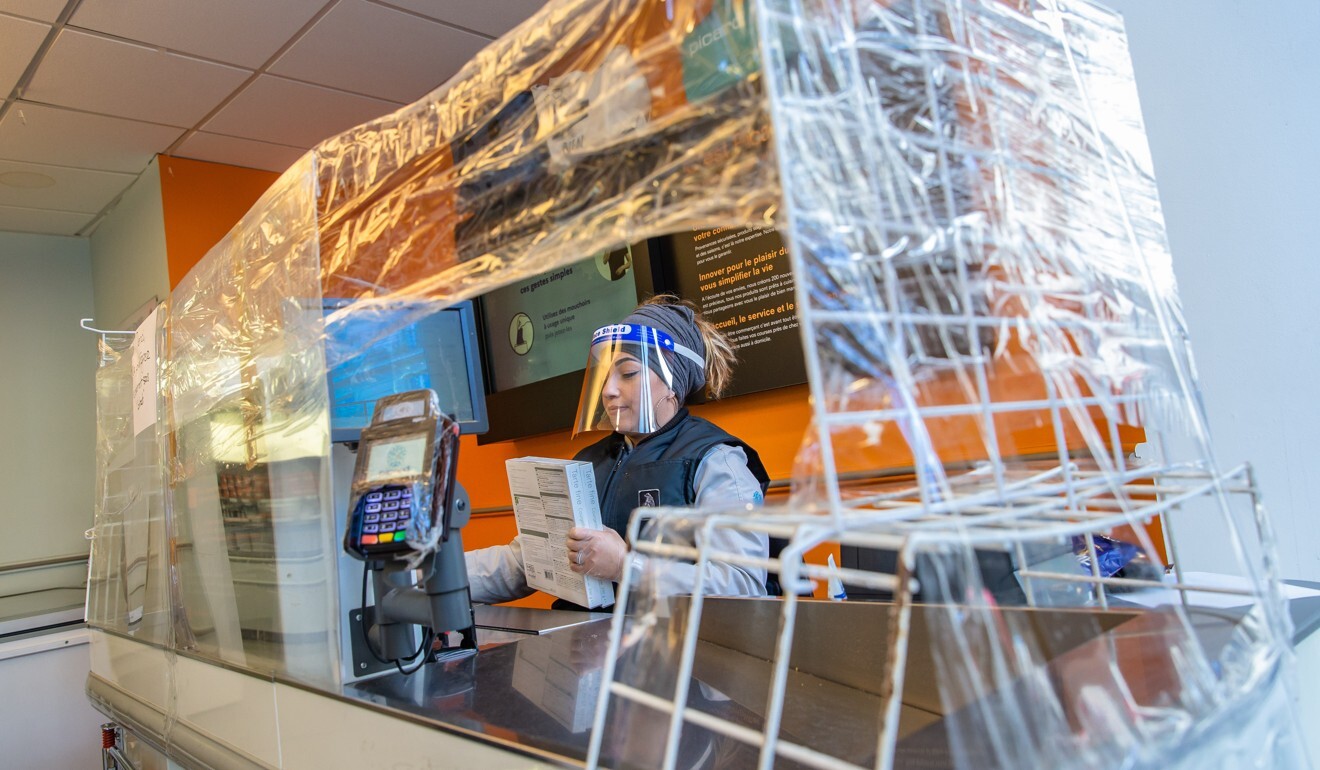
A cashier runs a store counter covered up with a plastic barrier in Paris, France, on April 3, 2020. Photo: Xinhua
reported a jump in coronavirus deaths on Thursday as the country included fatalities in some nursing homes for the first time. Still, a decline in intensive-care admissions suggest the country’s lockdown is starting to slow the pace of the outbreak.
The health ministry reported 471 new hospital deaths from the coronavirus on Thursday. In addition, it reported 884 deaths in a partial count from nursing homes, bringing the total number to 5,387. Nursing homes were not previously included in the statistics.
in number of deaths, behind Italy and Spain. The number of confirmed cases is now at 59,105.
Italy reported another 760 fatalities on Thursday. Its death toll, already the world’s highest, now stands at 13,915. Total infections, including recoveries and deaths, have reached 115,242.
Spain reported 950 more deaths from the coronavirus, the most in a single day, taking the total to 10,003.
India plans staggered exit from lockdown
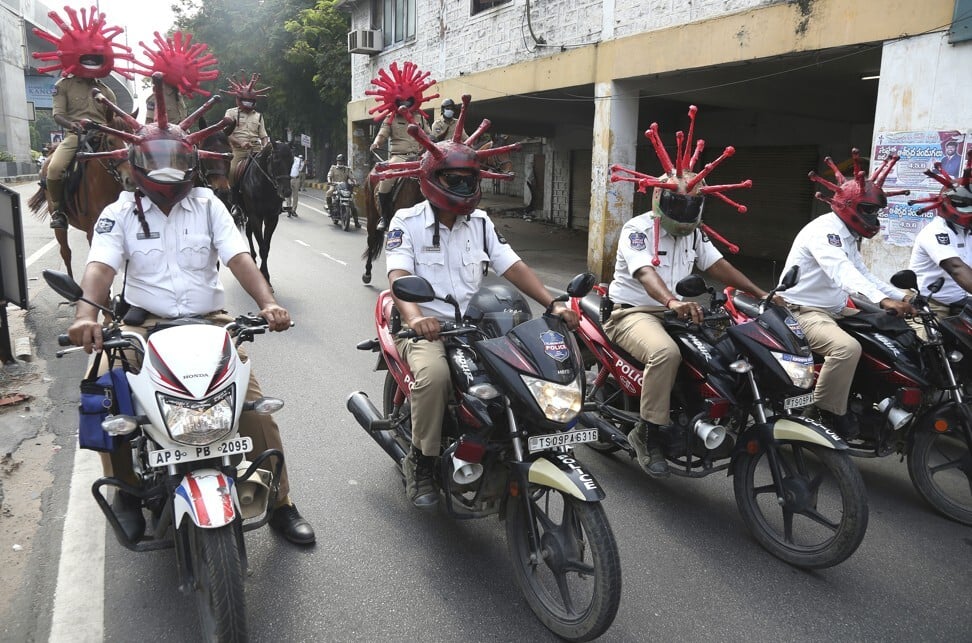
Indian policemen in Hyderabad, India, wear virus-themed helmets for a campaign to raise awareness at preventing the spread of the coronavirus on April 2, 2020. Photo: AP
infections, but the world’s biggest shutdown has left millions without jobs and forced migrant workers to flee to their villages for food and shelter.
After violence, Indian police try humour to enforce virus lockdown
2 Apr 2020
He told state chief ministers that the shutdown had helped limit infections but that the situation remained far from satisfactory around the world and there could be a second wave.
“Prime minister said that it is important to formulate a common exit strategy to ensure staggered re-emergence of the population once lockdown ends,” the government quoted him as saying in a video conference.
India has had 2,069 confirmed infections, of whom 53 have died, low figures by comparison with the US, China, Italy and Spain. But the big worry is the
because of a gathering held by a Muslim missionary group last month that has spawned dozens of cases across the country, officials said.
Five-minute virus tests ‘may give inaccurate results’
A Chinese drug and diagnostic firm has cautioned that the slew of new test kits that promise to detect the coronavirus in just a few minutes may not be as accurate as conventional kits, a potential setback for countries seeking to rapidly test their citizens.
“Such rapid testing is not as accurate as the traditional nucleic acid test that takes about two hours to turn out results,” Wu Yifang, Shanghai Fosun Pharmaceutical Group’s chief executive officer, said. The drugmaker also has a swift testing technology but it’s working on making the results more accurate, according to Wu.
Coronavirus nightmare of China’s ‘recovered’ patients
2 Apr 2020
Abbott Laboratories unveiled a coronavirus test on March 28 that can confirm if someone is infected in as little as five minutes. Shenzhen Bioeasy Biotechnology has been supplying its version of rapid testing kits to the European Union even before getting regulatory approval in China for domestic use.
The faster and easy-to-deploy diagnostic kits seemingly save time and resources for nations under pressure to widen their testing efforts. But there have been reports of faulty kits, like those bought by Spain and the Czech Republic.
Shenzhen Bioeasy, which sold thousands of test kits to Spain, said in a statement on March 27 that false results could be due to improper use of its kits or faulty specimen collection.
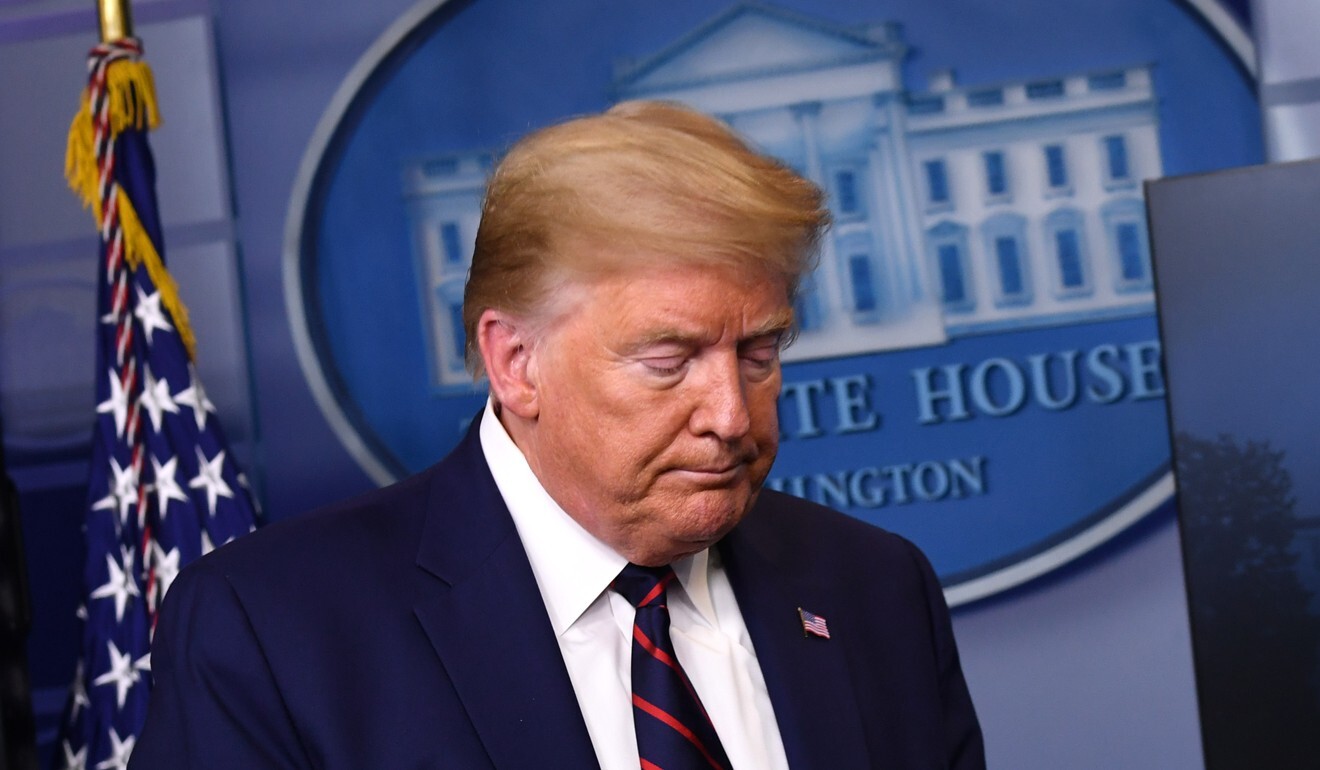
Trump tests negative again
US President Donald Trump was was first tested last month after coming into contact with a Brazilian official who later tested positive. Photo: UPI/Bloomberg
US President Donald Trump on Thursday was tested again to determine whether he had been infected by the coronavirus, and the test came back negative, the White House said.
A letter from Trump’s doctor, Sean Conley, said Trump had undergone what was a second test for coronavirus. He was tested last month after coming into contact with a Brazilian official who later tested positive.
Trump to urge Americans to wear masks when outside
3 Apr 2020
Conley said in a letter released by the White House that Trump was tested with a new, rapid point-of-contact test and the result came back in 15 minutes.
“He is healthy and without symptoms,” Conley said.
Trump said Americans should wear protective face masks if they wish. “If people want to wear them, they can” he said. Scarves work just as well, he said.
NRA sues NY governor over closure of gun stores
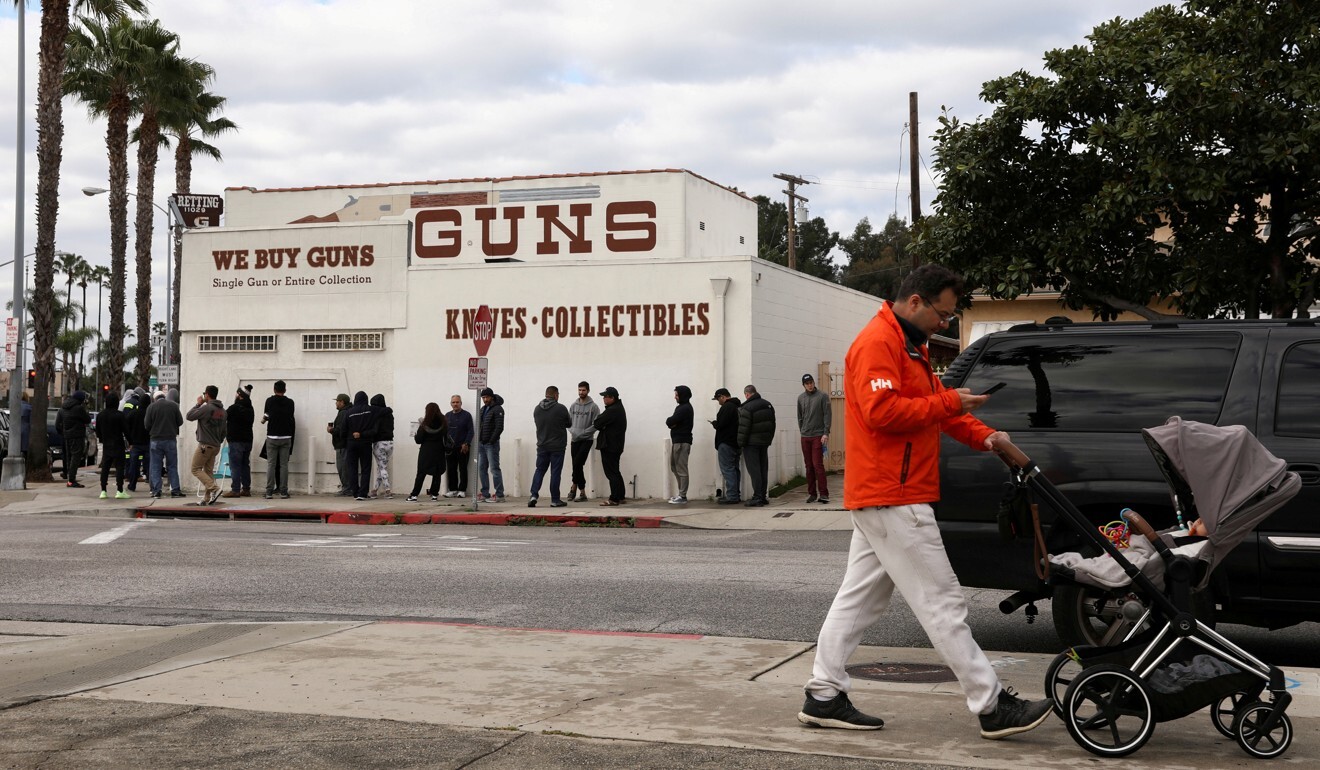
A pedestrian pushes a stroller as people wait in line outside a gun store to buy supplies on March 15, 2020. Photo: Reuters
The National Rifle Association (NRA) sued New York Governor Andrew Cuomo for closing gun shops during the coronavirus pandemic, saying the restriction is unconstitutional and leaves citizens defenceless while prisoners are being released early as a result of the crisis.
Cuomo’s March 20 executive order that included firearms retailers as non-essential businesses, which must close is a “pointless and arbitrary attack on the constitutional rights of New York citizens and residents,” the NRA said in a complaint filed late Thursday in Syracuse, New York.
New York ordered most businesses to close to prevent the spread of the virus, but deemed grocery stores, liquor stores, pharmacies and restaurants that do take-out as essential and allowed them to remain open.
The New York lawsuit follows similar action the NRA took in Northern California, where it sued several cities including San Jose for ordering gun stores to close.
Corona beer producer halts brewing
The Mexican brewer of Corona beer said on Thursday it was suspending production because of the health emergency in the country over the Covid-19 pandemic.
Grupo Modelo said the measure was in line with the Mexican government’s order to suspend all non-essential activities until April 30 to slow the spread of coronavirus.
“We are in the process of lowering production at our plants to the bare minimum,” the company said in a statement, adding it would complete the suspension in the following days.
Mexico’s government has said that only key sectors such as agribusiness will be able to continue to function.
US stops issuing passports, except in emergencies
The US State Department will not be processing new passports and renewals except for emergency cases because of the coronavirus pandemic, the agency’s website said.
“Due to public health measures to limit the spread of Covid-19, effective March 20, 2020, we are only able to offer service for customers with a qualified life-or-death emergency and who need a passport for immediate international travel within 72 hours,” said a March 27 online statement.
How elite US university students brought coronavirus home from campus
3 Apr 2020
Passport applications received on or before March 19 will be processed.
Travellers who paid extra for expedited service can expect to receive their passport in the next two to three weeks.
If you applied in-person at a passport agency or centre before March 19, the agency will contact you about getting your passport.


















 CHINDIA ALERT: You'll be living in their world, very soon