Chindia Alert: You’ll be Living in their World Very Soon
aims to alert you to the threats and opportunities that China and India present. China and India require serious attention; case of ‘hidden dragon and crouching tiger’.
Without this attention, governments, businesses and, indeed, individuals may find themselves at a great disadvantage sooner rather than later.
The POSTs (front webpages) are mainly 'cuttings' from reliable sources, updated continuously.
The PAGEs (see Tabs, above) attempt to make the information more meaningful by putting some structure to the information we have researched and assembled since 2006.
WASHINGTON/NEW DELHI (Reuters) – U.S. President Donald Trump said on Wednesday he had offered to mediate a standoff between India and China at the Himalayan border, where soldiers camped out in a high-altitude region have accused each other of trespassing over the disputed border.
“We have informed both India and China that the United States is ready, willing and able to mediate or arbitrate their now raging border dispute,” Trump said in a Twitter post.
The standoff was triggered by India’s construction of roads and air strips in the region as it competes with China’s spreading Belt and Road initiative, involving infrastructure development and investment in dozens of countries, Indian observers said on Tuesday.
Both were digging defences and Chinese trucks have been moving equipment into the area, the officials said, raising concerns about an extended standoff.
There was no immediate response from either India or China to Trump’s offer. Both countries have traditionally opposed any outside involvement in their matters and are unlikely to accept any U.S. mediation, experts said.
China’s ambassador to India, Sun Weidong, struck a conciliatory note, saying the two Asian countries should not let their differences overshadow the broader bilateral relationship.
“We should adhere to the basic judgment that China and India are each other’s opportunities and pose no threat to each other. We need to see each other’s development in a correct way and enhance strategic mutual trust,” he said, speaking in a webinar on China’s experience of fighting COVID-19.
“We should correctly view our differences and never let the differences shadow the overall situation of bilateral cooperation.”
The two countries are engaged in talks to defuse the border crisis, an Indian government source said. “These things take time, but efforts are on at various levels, military commanders as well as diplomats,” the source said.
The Chinese side has been insisting that India stop construction near the Line of Actual Control or the de facto border. India says all the work is being done on its side of the border and that China must pull back its troops.
Trump in January offered to “help” in another Himalayan trouble spot, the disputed region of Kashmir that is at the center of a decades-long quarrel between India and Pakistan.
But the U.S. offer triggered a political storm in India, which has long bristled at any suggestion of third-party involvement in tackling Kashmir which it considers an integral part of the country.
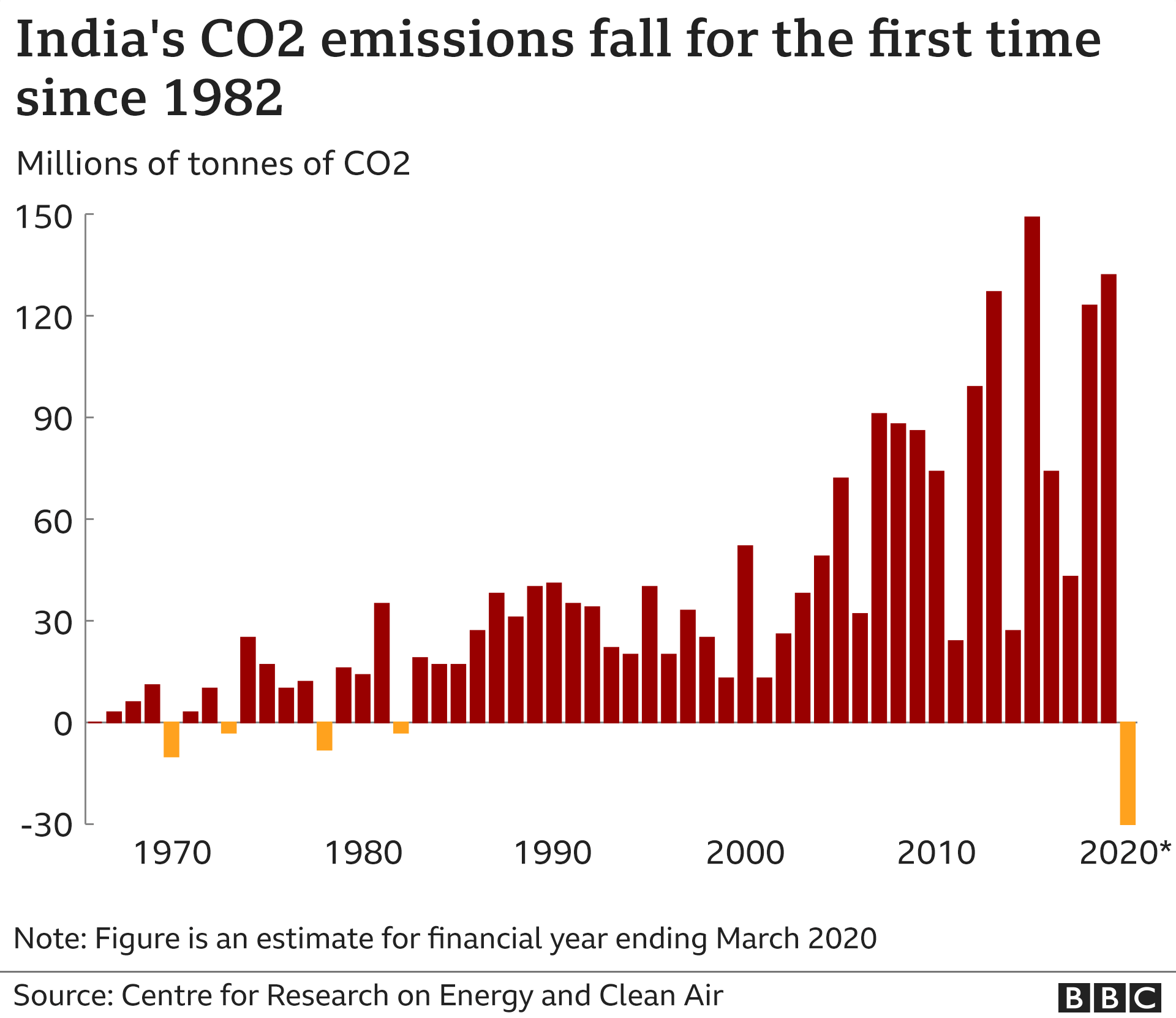
India’s CO2 emissions have fallen for the first time in four decades – and not just as a result of the country’s coronavirus lockdown.
Falling electricity use and competition from renewables had weakened the demand for fossil fuels even before the coronavirus hit, according to analysis by the environmental website, Carbon Brief. However, it was the sudden nationwide lockdown in March that finally tipped the country’s 37-year emissions growth trend into reverse.
The study finds that Indian carbon dioxide emissions fell 15% in March, and are likely to have fallen by 30% in April.
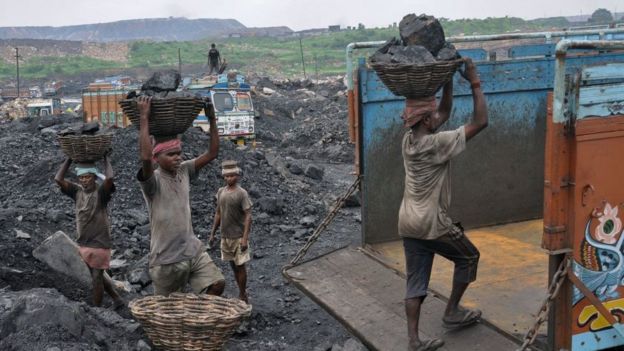
Virtually all of the drop-off in power demand has been borne by coal-fired generators, which explains why the emissions reductions have been so dramatic.
Coal-fired power generation was down 15% in March and 31% in the first three weeks of April, according to daily data from the Indian national grid.
But even before India’s sudden coronavirus lockdown, the demand for coal was weakening.
The study finds that in the fiscal year ending March 2020, coal deliveries were down by around 2%, a small but significant reduction when set against the trend – an increase in thermal power generation of 7.5% a year set over the previous decade.
Indian oil consumption shows a similar reduction in demand growth.
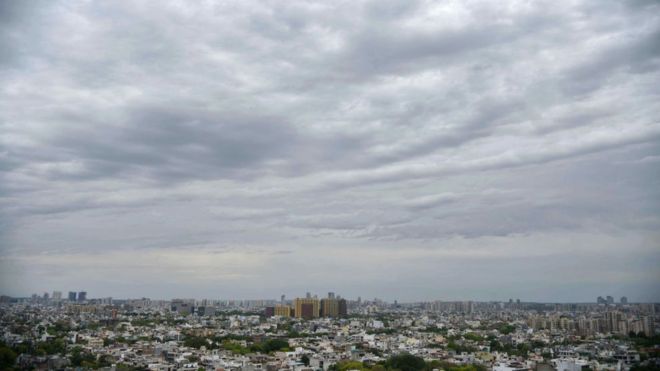
Image copyright GETTY IMAGESImage caption The nationwide lockdown finally tipped a 37-year emissions growth trend into reverse
It has been slowing since early 2019.
And, once again, the trend has been compounded by the impact of the Covid-19 lockdown measures on the transport industry.
Oil consumption was down 18% year-on-year in March 2020.
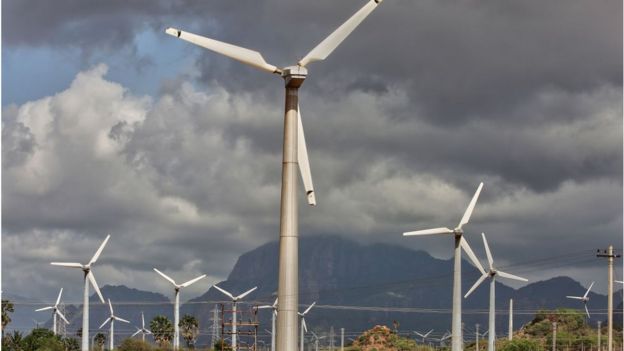
Meanwhile, the supply of energy from renewables has increased over the year and has held up since the pandemic struck.
This resilience the renewables energy sector shows in the face of the sudden reduction in demand caused by coronavirus is not confined to India.
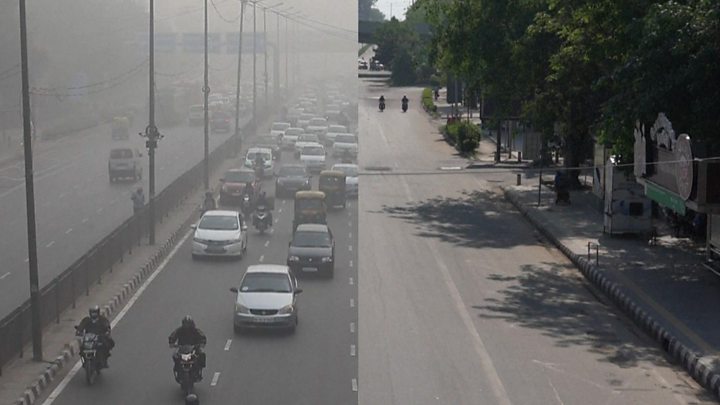
Media caption Delhi smog disappears during India’s lockdown
According to figures published by the International Energy Agency (IEA) at the end of April, the world’s use of coal was down 8% in the first quarter of the year.
By contrast, wind and solar power saw a slight uptick in demand internationally.
A key reason that coal has taken the brunt of the fall in electricity demand is that it cost more to run on a day-to-day basis.
Once you have installed a solar panel or a wind turbine, operating costs are very low and, therefore, tend to get priority on electricity grids.
Image copyright GETTY IMAGESImage caption India’s use of coal has plummeted, in line with that of other countries
Thermal power stations – those powered by coal, gas or oil – by contrast, require you to buy fuel in order to generate power.
But analysts warn that the decline in fossil fuel use may not last.
They say when the pandemic subsides, there is a risk that emissions will soar again as countries attempt to kick-start their economies.
The US has already started to relax environmental regulations and the fear is other nations could follow suit.
However, the analysis from Carbon Brief suggests there are reasons to think India could buck this trend.
The coronavirus crisis has brought the long-brewing financial troubles in the Indian coal sector to a head, and the Indian government is finalising a relief package which could top 900bn rupees ($12bn; £9.6bn).
But, at the same time, the government is talking about supporting renewable energy as part of the recovery.
Image copyright GETTY IMAGESImage caption Renewables have the economic edge in India, offering far cheaper electricity than coal
Renewables have the economic edge in India, offering far cheaper electricity than coal.
The report claims that new solar capacity can cost as little 2.55 rupees per kilowatt hour, while the average cost for electricity generated from coal is 3.38 rupees per hour.
Investing in renewables is also consistent with the country’s National Clean Air Programme, launched in 2019.
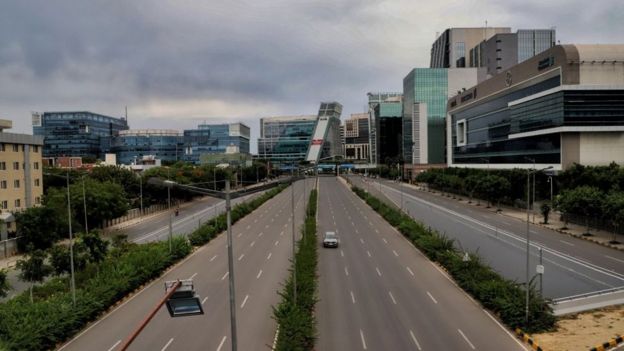
Environmentalists hope the clean air and clear skies Indians have enjoyed since lockdown will increase public pressure on the government to clean up the power sector and improve air quality.
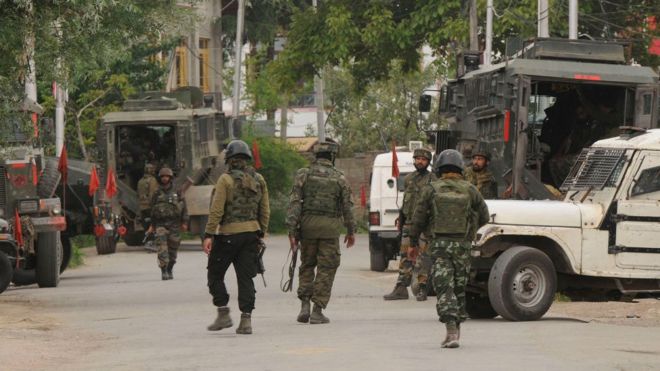
Indian security forces have killed a prominent militant leader in disputed Kashmir, officials say.
Riyaz Naikoo had taken over command of the banned Hizbul Mujahideen group, succeeding Burhan Wani who was killed by security forces in 2016.
Wani’s death triggered massive protests in the region, which is claimed in its entirety by both India and Pakistan.
The region has seen an armed insurgency against Indian rule since 1989, which has flared following Wani’s killing.
Naikoo was shot dead in his home village of Beigh Pora in Pulwama district after militants killed eight security personnel in two separate attacks, part of a recent surge of violence in Indian-administered Kashmir.
Locals said the militant leader had been trapped in a joint siege laid by army, paramilitary and police forces. He had been on the run for eight years.
“At least 76 militants including Naikoo have been killed since January this year. But we also lost 20 soldiers including senior army and police officers,” a security official told BBC Urdu on condition of anonymity.
Under a new policy, militants who are killed are not identified and their bodies are not handed over to their families.
Officials had accused Riyaz Naikoo of plotting attacks against the security establishment in the valley.
Disputed Kashmir has been a flashpoint for more than 60 years, sparking two wars between India and Pakistan.
In August 2019, the Indian government stripped the region of its semi-autonomous status and split it into two federally-run territories.
Thousands of people were detained and the region remains under severe security restrictions.
NEW DELHI/MUMBAI (Reuters) – The Indian government ordered mobile carriers on Friday to immediately pay billions of dollars in dues after the Supreme Court threatened the companies and officials with contempt proceedings for failing to implement an earlier ruling.
The court, which had ordered companies including Vodafone Idea (VODA.NS) and Bharti Airtel (BRTI.NS) to pay 920 billion Indian rupees ($13 billion) in overdue levies and interest by Jan. 23, last month rejected petitions seeking a review of the order it issued back in October.
“This is pure contempt, 100% contempt,” Justice Arun Mishra told lawyers for the companies and the government on Friday.
Later in the day, the Department of Telecommunications called for “immediate payments” from the telcos. A second order instructed relevant offices to stay open on Saturday to “facilitate the Telecom Licensees to make payments or contact them with respect to any matter related to that.”
The companies had contested the government’s definition of revenues subject to tax and Vodafone Idea and Bharti Airtel both flagged risks to their ability to continue as ongoing concerns following the October order. They did not immediately respond to calls seeking comment on the new ruling.
The companies, along with Reliance Jio, which is backed by Asia’s richest man, Mukesh Ambani, control more than 90% of India’s mobile market.
Jio, a relatively new entrant which has disrupted the market with its cut-price offerings, has paid its dues.
Shares in Vodafone Idea, in which Britain’s Vodafone Group (VOD.L) owns a sizable stake, closed down 24.4% after the order. The company’s future is in doubt, with Vodafone Group having said it has no plans to commit any more equity into India.
Shares in Bharti Airtel rose 4.64%, as many investors expect it will be able to survive the payment, leaving it and Jio with a potential opportunity to win market share and enjoy an effective duopoly in the sector. In a letter to the government, Bharti Airtel said it would deposit 100 billion rupees by Thursday and pay the balance “well before” the next hearing on March 17.
Justice Mishra rebuked the government for having failed to implement the court order on collecting the dues. “A desk officer in the government stays a Supreme Court order … Is there any law left in the country?,” he said.
“We will draw up contempt against everyone,” he added, implying that both company and government officials could be fined or jailed if the dues are not paid by March 17.
Analysts said the court’s move could harm the government more broadly, as well as the companies.
“It can’t be in anybody’s interest if a company as high profile as Vodafone Idea shuts shop. Also, the government’s own dues from the sector are at risk,” said Mahesh Uppal, director at ComFirst, a telecom consultancy firm.
BANKS BURDENED
Indian banks are burdened with nearly $140 billion of bad loans and face another huge hit if Vodafone Idea is forced into bankruptcy.
Banks in India are owed roughly 300 billion rupees by Vodafone Idea, according to a Macquarie report from last year.
“Banks were yet to make additional provisioning for these loans as they were expecting some sort of a relief from the court,” said Siddharth Purohit, an analyst at SMC Institutional Equities.
Banks that have the highest exposure to Vodafone Idea include State Bank of India (SBI.NS), Punjab National Bank (PNBK.NS), Canara Bank (CNBK.NS) and Bank of India (BOI.NS), among others, the Macquarie report said.
Vodafone Idea, which owes the government about $4 billion in dues related to the ruling, has seen its shares slide more than 40% since the court ruling in October.
The broader Indian stock market also reversed early gains to trade lower after the ruling as investors worried about the fallout.
Still, some analysts remained hopeful the government could appeal to the court to review its decision.
“Let’s see how the government reacts and what they do. If the government appeals to the court they could still settle it out, and we may see some positives emerge for everyone,” said a senior industry analyst, who asked not to be named.
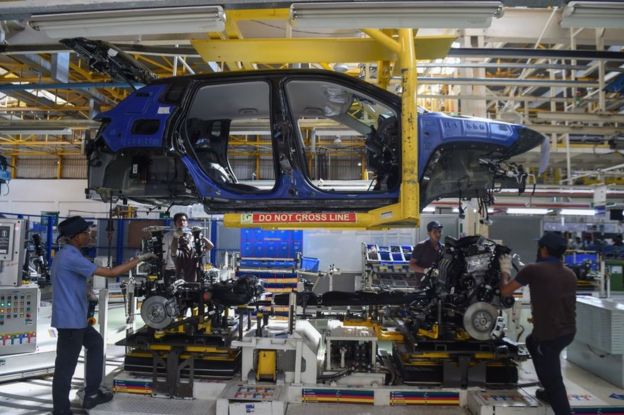
India’s second-biggest manufacturer of commercial vehicles, Ashok Leyland, is suspending production at several units from five to 18 days in September, triggering fears that the slump in the automotive sector shows no sign of letting up. The BBC’s Nitin Srivastava reports.
Ram Mardi is worried he may lose his job. He works for a company that makes spare parts for cars and heavy vehicles in Jamshedpur, an industrial city in eastern India. But he has worked only 14 days in August.
“We had a comfortable life until recently. Now, it’s hard to arrange food or pay for the children’s education,” Mr Mardi says.
The factory he works at temporarily suspended production for half of the month to reduce inventory in the face of shrinking demand.
Industry heavyweights such as Maruti, Tata Motors and Mahindra & Mahindra have all announced production cuts over the past several months.
Image copyright GETTY IMAGESImage caption India’s automotive industry employs some 35 million people
India’s economy is facing a slowdown. It grew at 5% in the quarter ending June 2019 – its lowest in five years. This – along with a drop in private investment and a banking crisis that has made it hard to access credit – has weakened consumer demand.
The Indian government is also pushing for a transition to electric vehicles over the next decade, which some experts believe, has contributed to falling vehicle sales.
As the automotive industry declined for the 10th month in a row in August, car sales dropped by 41% – the steepest fall in two decades.
The industry is one of India’s biggest, considering it employs some 35 million people, directly or indirectly, and contributes more than 7% to the country’s GDP.
By some estimates, more than 100,000 workers, many of them contractual, have lost their jobs so far. Now fears are rising that if demand continues to fall, forcing lower production, more jobs could disappear.
Small and medium businesses – thousands of ancillary units that supply to the big manufacturers – have been hit the hardest. And daily wage labourers such as Mr Mardi are the most vulnerable.
And employers are also concerned. “I have never had so much trouble keeping my factory up and running”, says Sameer Singh, who heads a family-owned business in Jamshedpur that makes spare parts for vehicles.
“My employees are jobless for a few weeks and I feel for them. If this continues they may move out, perhaps find another job. But I can’t even look out for a job. My life starts and ends here”.
Mr Singh says it’s also been hard for business owners, companies and consumers to borrow money because banks have tightened credit lines after a spike in bad loans in recent years dented their balance sheets.
Image copyright GETTY IMAGESImage caption Car sales in India have dropped to their lowest in 20 years
“The fall [in production] is so large and so dramatic that it has affected every single product – two-wheelers, car, commercial vehicles,” says Sanjay Sabherwal, member of the Automotive Component Manufacturers Association of India, an industry body.
Auto executives have been demanding tax cuts and easier access to financing for manufacturers, sellers and consumers. The government recently announced a slew of measures – this includes a delay in increasing the registration fees for new vehicles and asking banks to lower interest rates on loans for cars and two-wheelers.
But, will that be enough? That is hard to say with experts calling this the worst downturn to ever hit India’s automotive industry.
SRINAGAR (Reuters) – The leader of disputed Kashmir’s largest separatist group said it was ready for talks with India’s government on Monday, after the state governor said he was optimistic about dialogue.
The Muslim-majority Kashmir valley is at the heart of more than seven decades of hostility between nuclear arch-rivals India and Pakistan. Both claim it in full but rule it in part.
Rhetoric from both sides, as well as Kashmiri separatists, some of whom want to join Pakistan, has been highly charged since a February suicide car bomb attack by a Pakistan-based militant group killed more than 40 Indian police in the part of the region it controls.
Any talks to resolve the conflict would be hugely difficult.
But on Saturday, Satya Pal Malik, the governor of Jammu and Kashmir state where Indian-controlled Kashmir lies, told a news conference he had seen a softening in approach from separatist leaders, including the influential Hurriyat Conference.
“I feel happy that the temperature in the valley has gone down as compared to what it was during my arrival in Kashmir,” he told a news conference.
Malik has governed the state since August 2018, shortly after India’s ruling Bharatiya Janata Party (BJP) withdrew from a coalition with a local party, imposing direct rule from New Delhi.
“Today Hurriyat, who once closed their doors… are ready for the talks with the Government of India,” Malik added.
In response, Mirwaiz Umar Farooq, the chairman of Hurriyat, a political movement that wants independence from India, told Reuters on Monday he would welcome talks.
“Hurriyat Conference has always been in favour of talks as the means of resolution,” he said.
“Kashmiris, being the most affected party for the past 72 years, naturally want its resolution.”
Kashmir, whose fate was left unresolved during partition in 1947, is a key focus for the BJP government led by Prime Minister Narendra Modi, that won a second term in power with an increased majority in May.
It launched a huge crackdown on separatists and militants operating in the region after the February attack, with gun battles between security forces and armed militants becoming an almost daily occurrence.
The BJP also wants to abolish special privileges for Jammu and Kashmir, India’s only Muslim majority state, to the fury of many Kashmiris.
Image copyright GETTY IMAGESImage caption Tamils argue that imposing Hindi will jeopardise their language
The Indian government has revised a controversial draft bill to make Hindi a mandatory third language to be taught in schools across the country.
The draft bill had met particularly strong opposition in the southern state of Tamil Nadu, which has always resisted the “imposition” of Hindi.
In 1965, it saw violent protests against a proposal that Hindi would be India’s only official language.
Tamil is one of the oldest languages and evokes a lot of pride in the state.
However the government decision has not calmed tensions in Tamil Nadu.
The two main political parties in the state, the DMK and AIADMK, have both said that simply revising the draft to say Hindi would not be mandatory is not enough.
The state teaches only two languages – Tamil and English – in the government school curriculum, and the parties do not want a third language introduced at all.
A DMK spokesman told the NDTV news channel that the third language clause would be used as a “back door” to introduce Hindi anyway.
Their rivals, the AIADMK, which allied with the Bharatiya Janata Party (BJP) in the general elections but lost badly in the state, had a similar view.
“Our party has always been clear in our stand. We have always followed a two-language policy. Though mandatory Hindi has been revised in the draft now, we still cannot support this three-language system. Our government will talk to the union government for our rights,” former state education minister and AIADMK spokesman Vaigaichelvan told BBC Tamil.
On Monday, #HindiIsNotTheNationalLanguage began trending on Twitter in India, which saw many from Tamil Nadu facing off against people from other parts of the country and asserting their right not to have the language “imposed” on them.
The BJP government’s real face is beginning to emerge…Hindi is being imposed on South Indians. Tamil Nadu has rebelled against BJP-Govt. Let’s join them to fight the imposition of Hindi! #HindiIsNotTheNationalLanguage
Picture speaks a thousand words! In a diverse country like India, learning a new language should be a choice and not compulsion/imposition.
Declaring any Indian language as a national language will be a joke. #HindiImposition#HindiIsNotTheNationalLanguage
“There is no opposition to actually learning Hindi. In fact with the recent IT boom in the south, so many people from the north have migrated here that its use has become more widespread here. It is true that if you know Hindi you will find it easier to get work in other parts of India, so there are also many people here who willingly learn it. But that should be their choice. What people are opposing is the imposition of it,” senior journalist and political analyst KN Arun told the BBC.
Mr Arun also warned that there was a chance that the issue could lead to further protests in the state, saying that a few hardline Tamil groups had been using the issue to whip up anger among the people.
It is also a particularly emotive issue. Politics in the state is still centred around the ideas and principles of the Dravidian movement, which among other things reveres the Tamil language and links it closely to regional identity.
“Tamil is very rich in literature and different to other languages like Hindi which branched out of Sanskrit. There is fear that the Indian government is trying to slowly introduce Hindi, which will threaten the status of Tamil,” author and journalist Vaasanthi told the BBC.
AHMEDABAD/NEW DELHI (Reuters) – PepsiCo Inc has sued four Indian farmers for cultivating a potato variety that the snack food and drinks maker claims infringes its patent, the company and the growers said on Friday.
Pepsi has sued the farmers for cultivating the FC5 potato variety, grown exclusively for its popular Lay’s potato chips. The FC5 variety has a lower moisture content required to make snacks such as potato chips.
The company is seeking more than 10 million rupees (£110,669) each for alleged patent infringement.
The farmers grow potatoes in the western state of Gujarat, a leading producer of India’s most consumed vegetable.
“We have been growing potatoes for a long time and we didn’t face this problem ever, as we’ve mostly been using the seeds saved from one harvest to plant the next year’s crop,” said Bipin Patel, one of the four farmers sued by Pepsi.
Patel did not say how he came by the PepsiCo variety.
A court in Ahmedabad, the business hub of Gujarat, on Friday agreed to hear the case on June 12, said Anand Yagnik, the farmers’ lawyer.
“In this instance, we took judicial recourse against people who were illegally dealing in our registered variety,” a PepsiCo India spokesman said.
“This was done to protect our rights and safeguard the larger interest of farmers that are engaged with us and who are using and benefiting from seeds of our registered variety.”
PepsiCo, which set up its first potato chips plant in India in 1989, supplies the FC5 potato variety to a group of farmers who in turn sell their produce to the company at a fixed price.
The company said the four farmers could join the group of growers who exclusively grow the FC5 variety for its Lay’s potato chips.
“PepsiCo India has proposed to amicably settle with the people who were unlawfully using the seeds of its registered variety. PepsiCo has also proposed that they may become part of its collaborative potato farming programme,” the company spokesman said in a statement.
If the farmers do not wish to grow the FC5 potato variety for PepsiCo, they can simply sign an agreement with the company to cultivate other available varieties, he added.
The All India Kisan Sabha, or All India Farmers’ Forum, has asked the Indian government to protect the farmers.
The forum has also called for a boycott of Lay’s chips and PepsiCo’s other products.
The Ministry of Agriculture & Farmers’ Welfare did not immediately respond to an email seeking comment.
PepsiCo is the second large U.S. company to face patent infringement issues in India.
Stung by a long-standing intellectual property dispute, seed maker Monsanto, now owned by German drugmaker Bayer AG, withdrew from some businesses in India over a cotton-seed dispute with farmers, Reuters reported in 2017. (reut.rs/2ncBknn)
In the run-up to the Indian election, which gets under way on 11 April, BBC Reality Check is examining claims and pledges made by the main political parties.
One of the most dramatic actions taken by the ruling BJP was the withdrawal in 2016 of all high-value banknotes from circulation, almost overnight.
This effectively removed 85% of all cash notes from the economy.
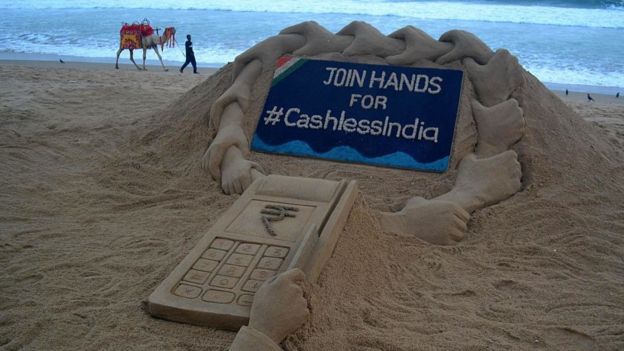
It also said it would help move India towards an economy less dependent on cash.
However, Reality Check has found that there’s little evidence the ban has helped root out illegally held assets.
And compared with other emerging economies, the level of cash in circulation in India has remained high.
What actually happened?
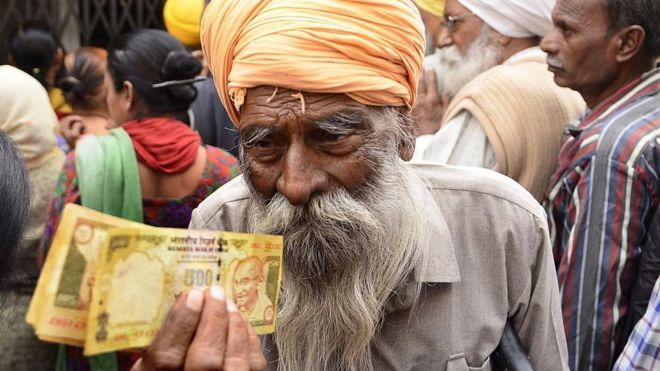
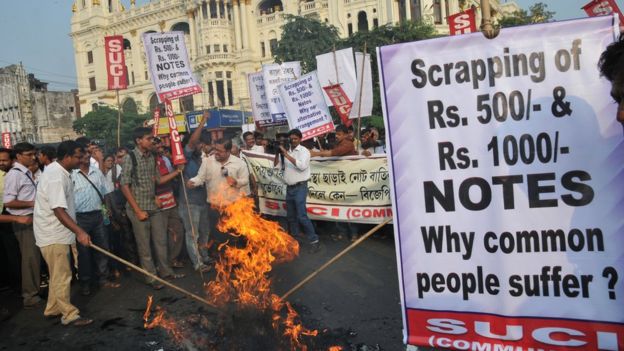
In November 2016, the two highest notes in circulation – 500 and 1,000 Indian rupees (£11) – were scrapped.
The surprise move – referred to in India as “demonetisation” – caused widespread confusion and led to street protests.
Image copyrightGETTY IMAGES
For a limited period only, the withdrawn notes could be exchanged for legal currency at banks – but there was a limit of 4,000 rupees per person.
What impact did it have?
Critics said the policy severely disrupted the economy, badly affecting the poor and rural communities that relied on cash.
The government said it was targeting illegal wealth held outside the formal economy, which fuelled corruption and other illegal activity and had not been declared for tax purposes.
It was assumed that those with large amounts of such cash would now find it difficult to exchange for legal tender.
But by August 2018, a report published by India’s central bank said that more than 99% of the old banknotes in circulation prior to the ban had been accounted for.
It was suggested that there had not been much unaccounted for wealth held in cash in the first place – or if there had been, the owners had found ways to convert it to legal tender.
Image copyrightGETTY IMAGES
Did the policy achieve the objective of exposing counterfeit currency?
Not really, according to India’s central bank.
The number of fake 500 and 1,000 rupee notes found after the ban was only marginally higher than the amount from the previous year.
In the two years before the currency withdrawal, tax collection growth rates had been in single digits.
Then in 2016-17, the amount of direct taxes collected increased by 14.5% over the previous year.
The following year, collections rose by 18%.
But the rate of growth in collecting direct taxes had seen a similar increase between 2008-09 and 2010-11, when the Congress party was in power.
And it’s likely that other policies – such as an income tax amnesty in 2016 and a new goods and services tax the following year – may have contributed as much to the growing tax take as demonetisation.
What about a cashless society?
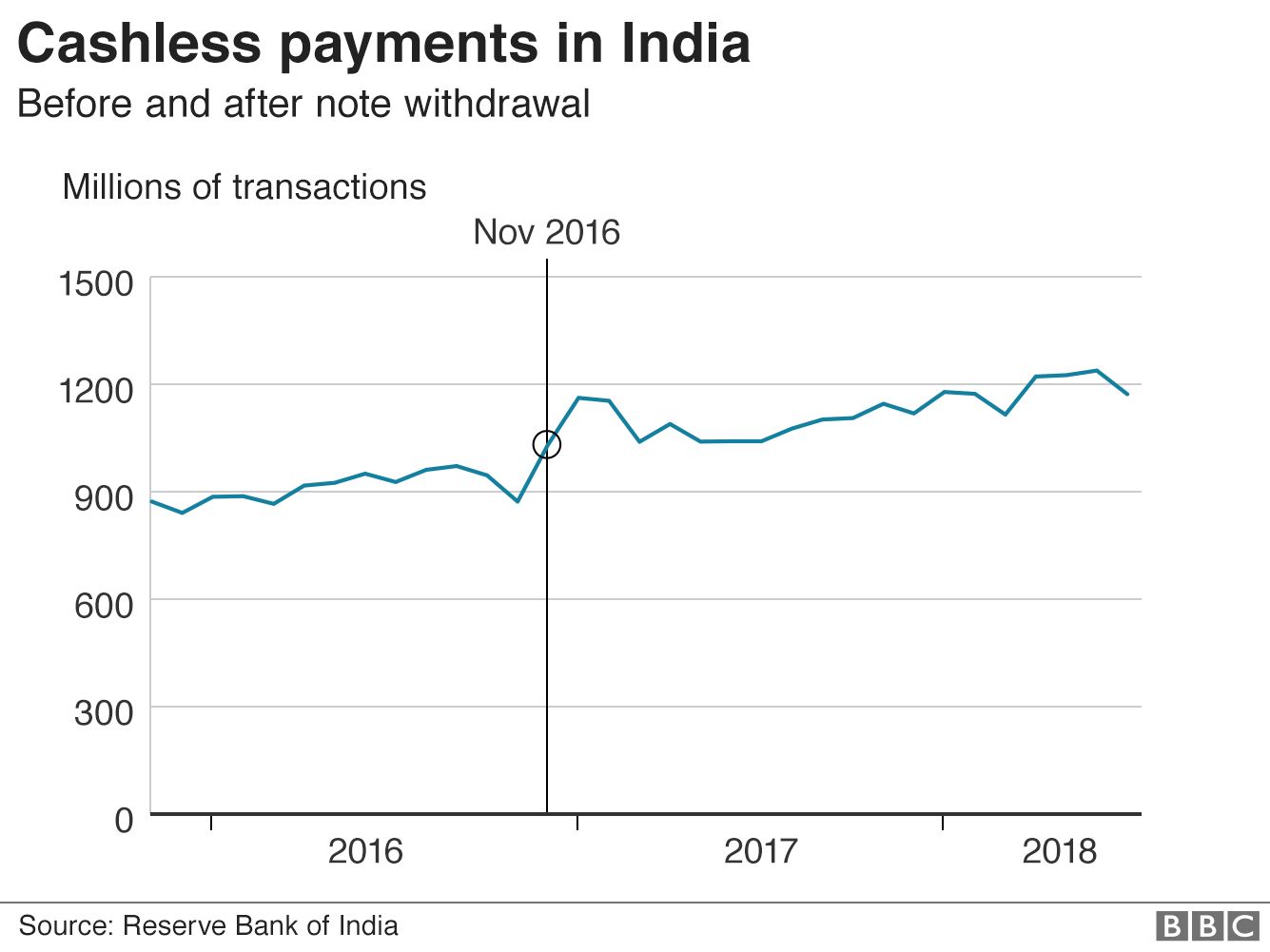
Against a long-term trend of a gradual rise in cashless payments, there is a significant jump at the end of 2016, when the notes were withdrawn.
But this reverted soon afterwards to the steady rising trend.
The overall increase over time may have less to do with government policy and more to do with changing technology and easier cashless payments.
As to whether the overall amount of cash in the economy has fallen, we can look at India’s currency to gross domestic product (GDP) ratio over time.
This is a measure of the amount of currency in circulation in proportion to the total value of goods and services produced.
This took a sharp dive immediately following the withdrawal of the 500 and 1,000 rupee notes – but by the following year, currency in circulation had reverted to pre-2016 levels.






 CHINDIA ALERT: You'll be living in their world, very soon