Chindia Alert: You’ll be Living in their World Very Soon
aims to alert you to the threats and opportunities that China and India present. China and India require serious attention; case of ‘hidden dragon and crouching tiger’.
Without this attention, governments, businesses and, indeed, individuals may find themselves at a great disadvantage sooner rather than later.
The POSTs (front webpages) are mainly 'cuttings' from reliable sources, updated continuously.
The PAGEs (see Tabs, above) attempt to make the information more meaningful by putting some structure to the information we have researched and assembled since 2006.
MUMBAI (Reuters) – India’s rural inflation rate surged faster than urban inflation for the first time in 19 months in January, and economists are optimistic that signals something the country desperately needs – a revival in demand in the rural economy.
Around two-thirds of India’s population depends on the rural sector with agriculture accounting for near 15% of India’s $2.8 trillion economy, and rising inflation suggests pricing power is returning to the hands of the farmers, say economists.
“This augurs well for farmers’ cash flows in the coming months. I expect early signs of demand revival to emerge from the rural belts, going ahead,” said Rupa Rege Nitsure, chief economist at L&T Financial Holdings.
Rural inflation rose to 7.73% in January, higher than the urban inflation rate – which was 7.39% – for the first time since June 2018. The latest data, released on Wednesday, also showed that overall inflation was 7.59% – its highest level in more than six years.
While the higher inflation readout, which comes at a time when India’s growth has likely slumped to 11-year lows, has fanned some concerns around stagflation, economists say the inflation numbers could also signal some momentum returning to rural growth.
The central bank is mandated to keep the retail inflation rate between 2-6% and it targets a medium-term inflation rate of 4%.
Rural inflation has been falling over the last year and half as a lack of proper infrastructure for storage and transport had left rural India with a glut of grains and the floods in several states in 2019 made matters worse for goods transportation.
“Better returns on food prices could improve the prolonged period of unfavourable terms of trade faced by the rural sector,” said Radhika Rao, economist with DBS Bank.
This could bring a glimmer of good news for the government, which has been trying to revive growth and boost consumption.
In its budget earlier this month, the government allocated 5.6% higher spends on agriculture and allied activities for the fiscal year 2020/21, as it seeks to kick-start demand.
While higher rural inflation could help kickstart economic growth, economists caution that urban demand revival remains a concern.
“To that extent that high inflation hurts urban spending, the overall demand dynamics stay unchanged,” Rao said.
NEW DELHI (Reuters) – India’s ruling party was projected to lose a key state election on Tuesday, the vote count showed, in its first electoral test since deadly anti-government protests erupted nearly two months ago.
The Hindu-nationalist Bharatiya Janata Party (BJP) led by Prime Minister Narendra Modi won a bigger majority in a general election in May, but it has lost a string of state elections since then.
The protests, in which at least 25 people have been killed, erupted across the country in mid-December, after the BJP passed a new citizenship law critics say violates India’s secular constitution and discriminates against minority Muslims.
In counting for state polls held in India’s capital New Delhi, data from India’s Election Commission showed the liberal Aam Aadmi Party, led by the city’s chief minister, Arvind Kejriwal, leading 57 out of 70 seats.
The BJP ran a campaign accusing protesters of supporting India’s arch-rival Pakistan and was projected to win 13 seats, up from three in 2015 but far below its own expectations. The party’s local chief Manoj Tiwari had predicted it would win a majority.
AAP activists in distinctive white boat-shaped caps danced outside party headquarters in New Delhi as the result became clear, TV channels showed.
Neelanjan Sircar, an assistant professor at Ashoka University near New Delhi, said that local issues, including delivery of basic services like education and health, appeared to sway voters towards the AAP, even as the BJP ran a polarising campaign on the back of Modi’s image.
“Modi is a larger than life character at the national level, which obviously gives the BJP a huge advantage in national politics,” Sircar said.
“But it doesn’t translate to state level politics, where the BJP often doesn’t have a charismatic face.”
Bespectacled former bureaucrat Kejriwal, 51, formed AAP in 2012 amid an anti-corruption movement that swept India.
The party won a stunning victory in 2015 state elections in the capital, wiping out the BJP and Congress, the party that has ruled India for half its post-independence history.
The Congress – the main opposition at national level – was projected to win no seats in Delhi on Tuesday, data showed, reflecting the deep decline in its fortunes.
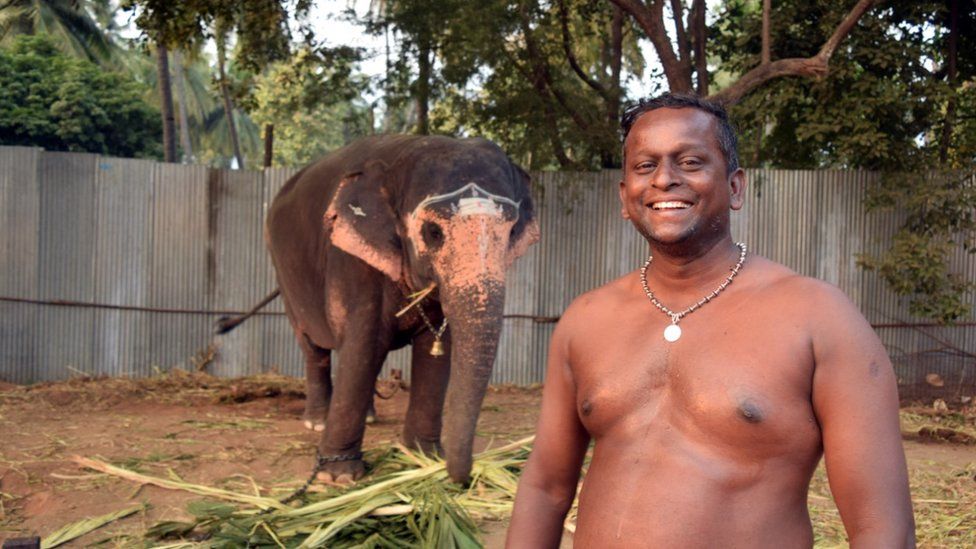
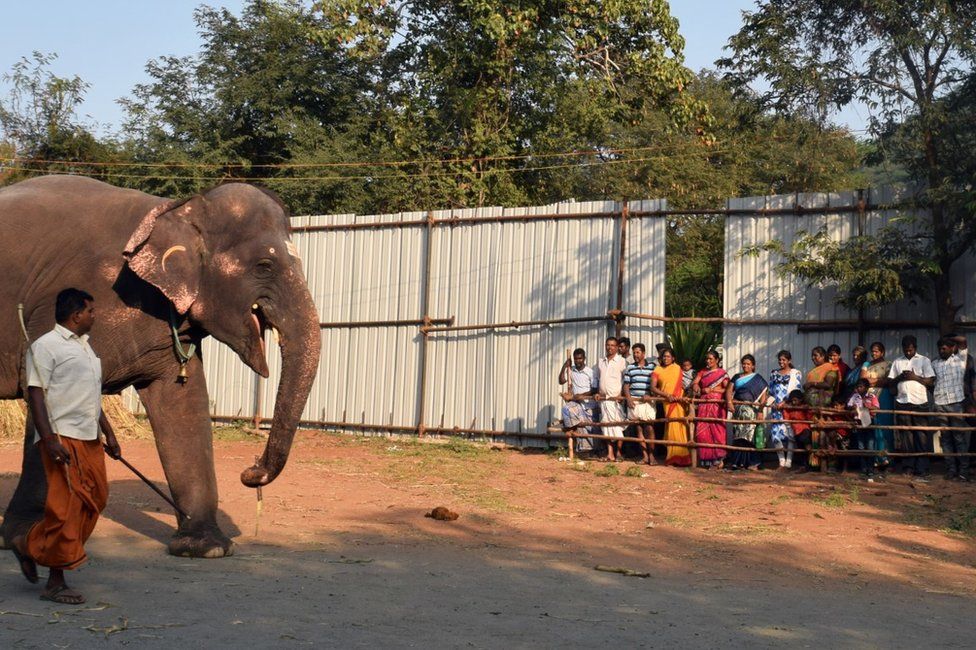
Image caption Arjun, the caretaker, pictured above with temple elephant, Akila
Once a year, some of India’s captive elephants are whisked off to a “rejuvenation camp”, where they are pampered and cared for by their caretakers. Omkar Khandekar visited one such retreat in the southern state of Tamil Nadu.
After seven years of being a local celebrity, Akila the elephant knows how to pose for a selfie. She looks at the camera, raises her trunk and holds still when the flash goes off.
It can get tiring, especially when there are hundreds of requests every day.
Despite this, Akila, performs her daily duties diligently at the Jambukeswarar temple. These include blessing devotees, fetching water for rituals in which idols of the deity are bathed, and leading temple processions around the city, decked up in ceremonial finery.
And, of course, the selfies.
But every December, she gets to take a break.
“When the truck rolls in, I don’t even have to ask her to hop in,” Akila’s caretaker B Arjun said. “Soon, she will be with her friends.”
Image caption Elephants sold to temples in Tamil Nadu are brought to this camp every year
India is home to some 27,000 wild elephants. A further 2,500 elephants are held in captivity across the states of Assam, Kerala, Rajasthan and Tamil Nadu.
The country is widely believed to be the “birthplace of taming elephants for use by humans”. Elephants here have been held in captive by Indians for millennia. But 17 years ago, after protests by animal rights activists over instances of handlers abusing and starving captive elephants, the government stepped in to give the animals a bit of respite.
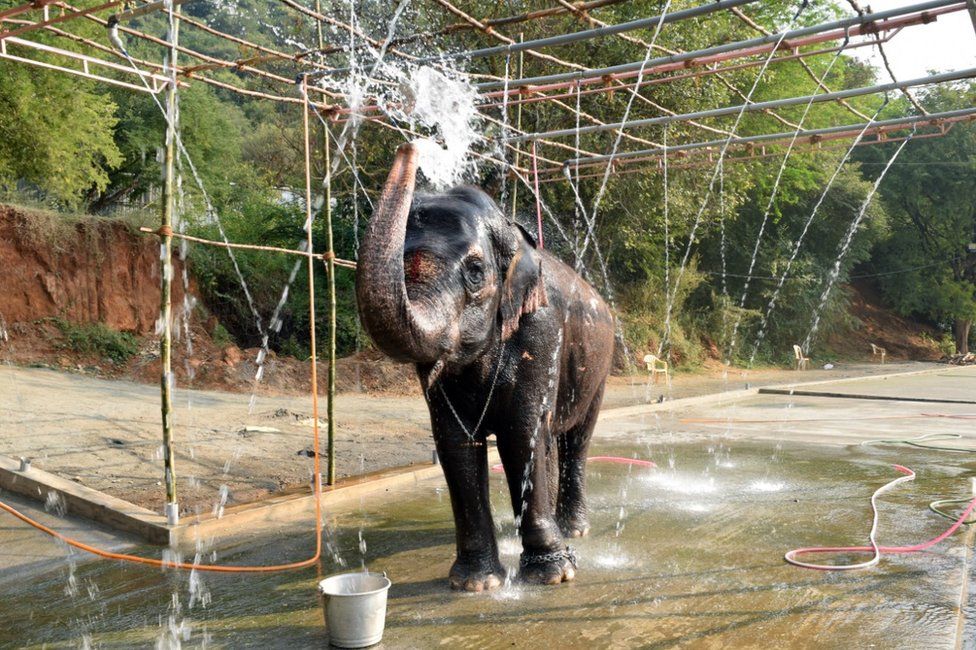
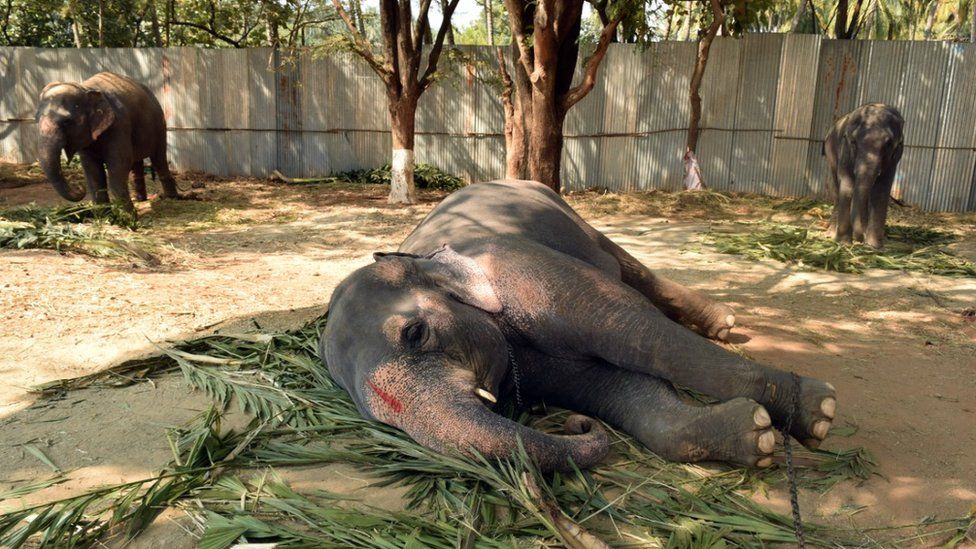
As a result, Akila and numerous other elephants held in temples around India are now brought to a “rejuvenation camp” each year, their caretakers in tow. For several weeks, the animals unwind in a sprawling six-acre clearing in a forest at the foothills of Nilgiris, part of the country’s Western Ghats.
Image caption India has more than 2,000 captive elephants
The camps were described as an animal welfare initiative and have become a popular annual event for the state’s temple elephants.
The one Akila and 27 other elephants are attending currently opened on 15 December last year, and will go on until 31 January, costing about $200,000 (£153,960) to run.
Supporters argue it is money well spent. A break from the city for these elephants is therapeutic, explains S Selvaraj, a forest officer in the area.
“Wild elephants live in herds of up to 35 members but there’s only one elephant in a temple,” he says. “For 48 days here, they get to be around their own kind and have a normal life.”
Image caption It costs about $200,000 to run the six-week annual camp
Akila, who is 16 years old, has been a regular at the camp since 2012, the year she was sold to the temple. Arjun, who has accompanied her every year, is a fourth-generation elephant caretaker.
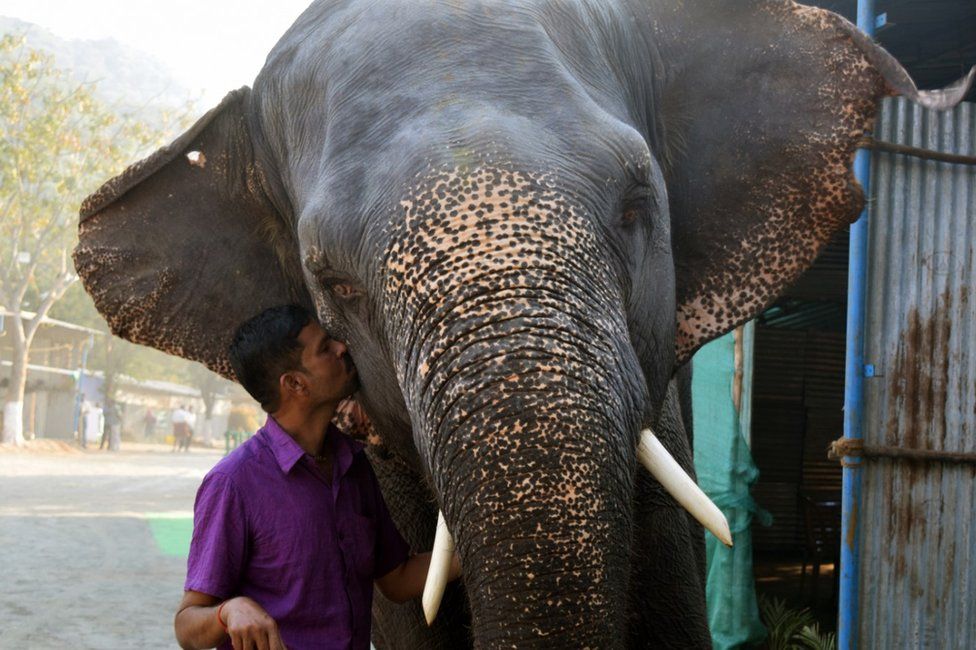
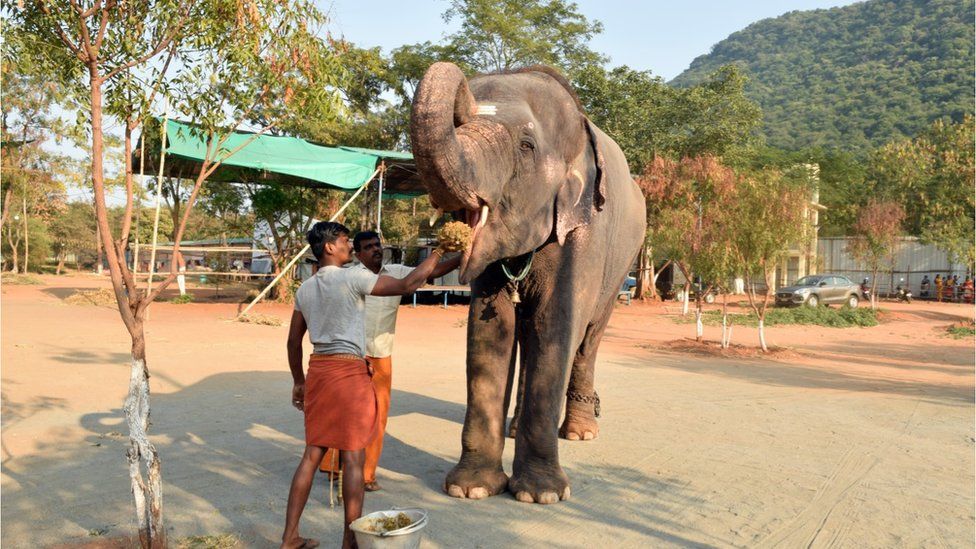
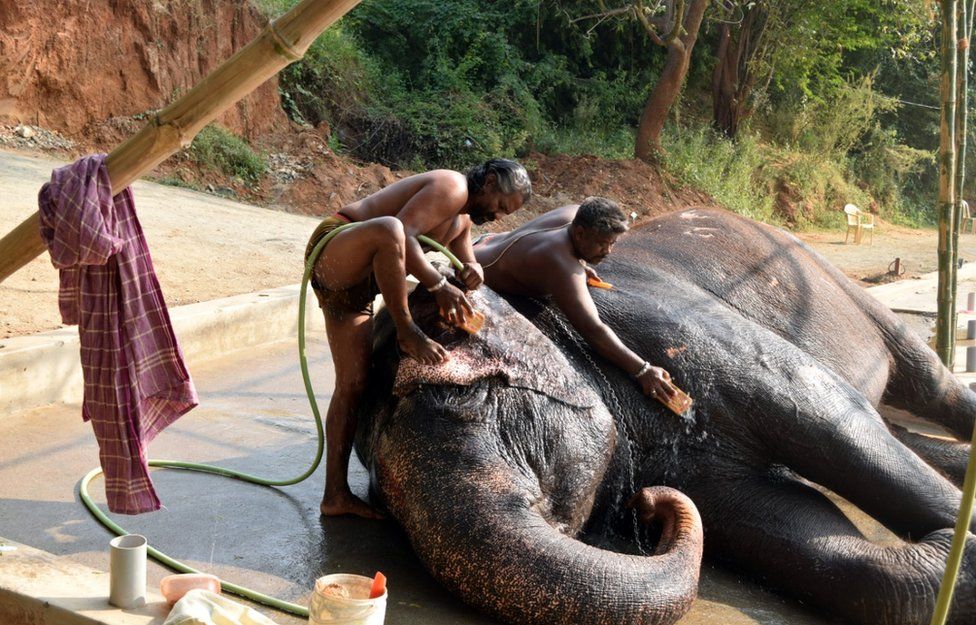
At the camp, he bathes Akila twice a day, feeds her a special mix of grains, fruits and vegetables mixed with vitamin supplements and takes her for a walk around the grounds. A team of vets are on hand to monitor the health of the camp’s large guests, while at the same time tutoring their handlers in subjects like elephant diet and exercise regimes.
Akila has even forged a friendship with Andal, an older elephant from another temple in the state, said Arjun.
But despite the shady trees and quiet, the getaway is a far cry from an elephant’s “normal life”.
Image caption The government initiated such camps after protests over instances of handlers abusing captive elephants
The walled campus has eight watchtowers and a 1.5km (0.93 miles) electric fence around its perimeter. While the elephants appear well cared for, they spend most of their time in chains and are kept under the close eye of their caretakers.
And one six-week rejuvenation camp a year does little to assuage the stress of temple elephants’ everyday lives, activists say.
“Elephants belong in jungles, not temples. A six-week ‘rejuvenation camp’ is like being let out on parole while being sentenced for life imprisonment,” argues Sunish Subramanian, of the Plant and Animals Welfare Society in the western city of Mumbai.
“Even at these camps, the animals are kept in chains and often in unhygienic conditions,” he adds. “If you must continue with the tradition, temple elephants should be kept in the camps for most of the year – in much better conditions – and taken to the temples only during festivals.”
Image caption The camps have been described as an animal welfare initiative
Even among the company of their own, the elephants – like Andal and Akila – aren’t allowed to get too close.
“I have to make sure the two keep their distance – otherwise, it’ll be difficult to separate them when we go back,” Arjun explains.
It is not just the animal rights activists who have concerns, however.
The camp has become a tourist spot in recent years, attracting a steady stream of visitors from neighbouring villages. Most watch, wide-eyed, from the barricades. But not everyone outside the camp is happy.
In 2018, a farmers’ union representing 23 villages nearby, petitioned a court to relocate the camp elsewhere. The petition claimed that the scent of the animals – all female, as is the norm among temple elephants – attracted male elephants from the wild.
This has caused them to go on the rampage, often destroying crops that farmers depend on for their livelihood. The union says 16 people have died in such incidents.
Image caption The camp has also become a popular tourist spot in recent years
But the court rejected the petition. Instead, it asked why there were human settlements in what was identified as an elephant corridor. It also criticised the state government’s tokenism of rejuvenation camps.
“Some day,” it said, “this court is going to ban the practice of keeping elephants in temples.”
But Arjun can’t bear the thought of parting with Akila.
“I love her like my mother,” he says. “She feeds my family, just like my mother used to. Without her, I don’t know what to do.”
But he also understands that his elephant can get lonely. “And that’s why I work twice as hard to make sure she doesn’t.”
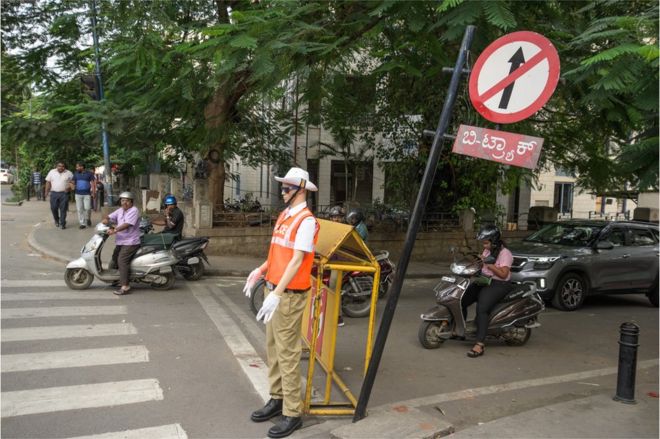
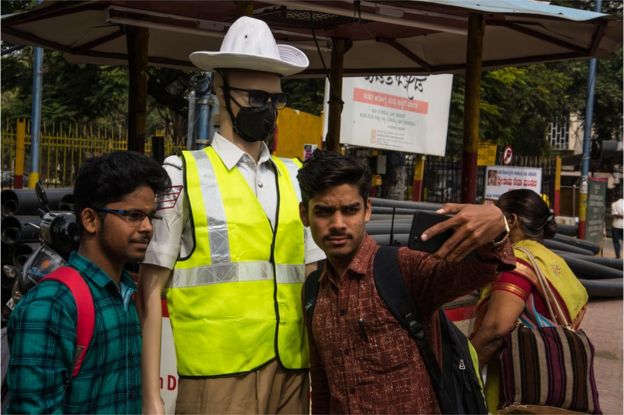
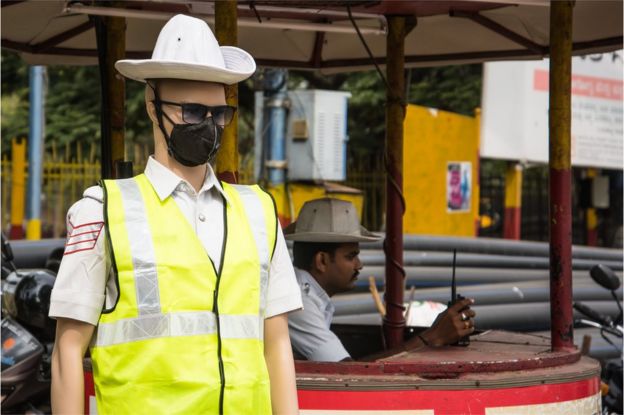
Image copyright ASIF SAUDImage caption The mannequins have been installed at major traffic crossings
One of India’s most gridlocked cities has come up with an unconventional solution to rein in errant drivers.
Mannequins dressed up as traffic police have been placed on roads in the southern city of Bangalore.
Dressed in police caps, white shirts and brown trousers, and wearing sunglasses, the mannequins are now on duty at congested junctions.
It’s hoped drivers will mistake them for real police and think twice about breaking the rules of the road.
Home to India’s IT industry, Bangalore has eight million registered vehicles on its streets. This number is expected to grow to more than 10 million by 2022.
At 18.7 km/h (11.61 mph) traffic speeds in the city are the second slowest in the country after Mumbai (18.5 km/h), according to a study by an office commute platform, MovinSync Technology Solutions. Cameras at traffic junctions have recorded more than 20,000 traffic violations every day.
But commuters have mixed feelings on whether mannequins can actually step in to help their real police counterparts.
Some feel they do.
“They look good. It is only when you look closely that you feel it is not a real police constable. So it is making people wear their helmets at traffic junctions and drive their two-wheelers,” says Gautam T, a college student.
Gautam and his college mate Talah Fazal had taken a selfie with one of the mannequins placed in the southern part of the city.
Image copyright ASIF SAUD
Similarly, Saravana – who goes by a single name – and drives a three-wheeled auto-rickshaw, had parked his vehicle near a no-parking sign board right next to a mannequin in the central business district. But he said: “It makes you not jump the traffic signal.”
On Twitter, the tone has been largely one of amusement and derision.
Saleela Kappan, a public relations professional, said she found the concept “ridiculous”.
“These mannequins look too fit and fair compared to our Indian policemen to be posted on the road. I don’t think it will serve any purpose because people violate traffic rules even when policemen themselves are present at these junctions.”
Image copyright ASIF SAUD
BR Ravikante Gowda, a senior traffic police officer in Bangalore, explaining the reasoning behind this initiatives said: “The idea of placing these mannequins at a different location every day is because people behave differently when there is a policeman present at the junction. When he is not there, their behaviour is different.”
A constable, who did not want to be named, said that police also confuse drivers by mixing things up.
“It’s been a couple of weeks since we got them here. There is some hesitancy in jumping the traffic lights. They are confused when we replace the mannequin daily with one of our colleagues.”
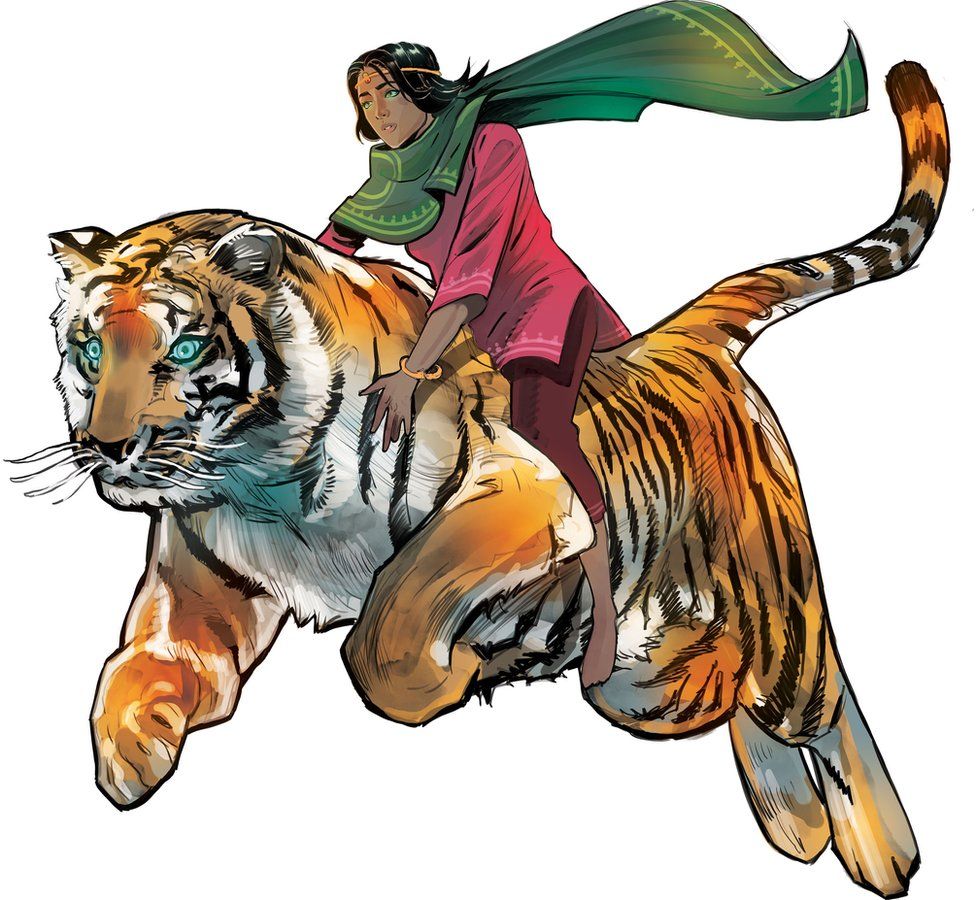
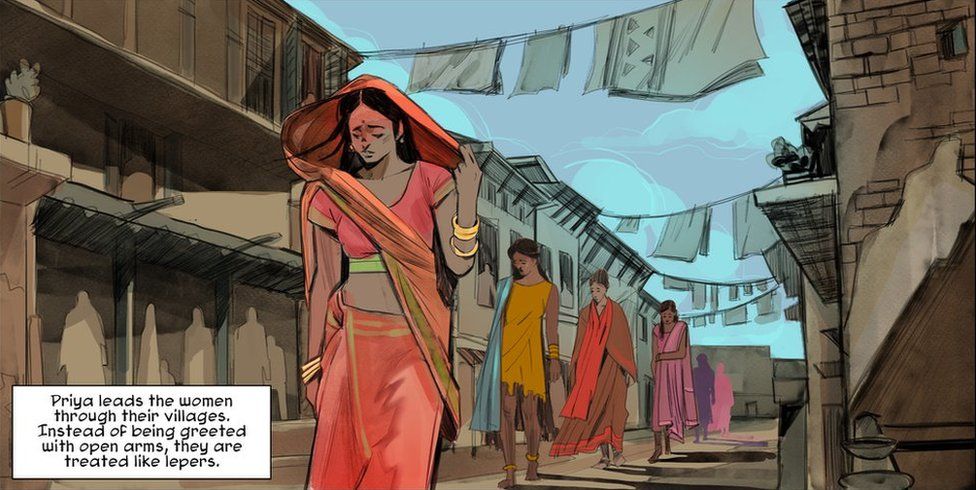
Comic crusader Priya, a gang-rape survivor who earlier campaigned against rape and acid attack, is back in a new avatar. This time she is fighting the trafficking of girls and women for sex.
The “modern-day female superhero” was first launched in December 2014, exactly two years after the horrific gang rape of a young woman on a bus in Delhi, to focus attention on the problems of gender and sexual violence in India.
In the latest edition – Priya and the Lost Girls – she takes on the powerful sex-trafficker Rahu, the evil demon who runs an underworld brothel city where he has entrapped many women, including Priya’s sister Lakshmi.
Indian-American actor and writer Dipti Mehta, who wrote the script of the comic, draws on ancient Indian mythology to create larger-than-life fantastical characters and delivers a powerful feminist statement.
The story of Lost Girls begins when the protagonist returns home to find that there are no girls in her village.
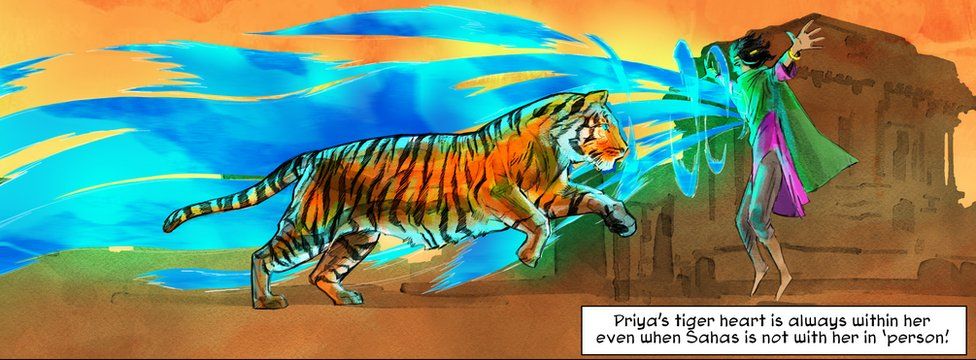
She then mounts her flying tiger Sahas (Hindi for courage) and arrives in Rahu’s den. It’s a city ruled by greed, jealousy and lust, where women exist only to serve and please men – and those who resist are turned into stone.
Image copyright PRIYASHAKTI
Priya is threatened and attacked, a woman who works for Rahu tries to lure her into the sex trade saying: “If you work for us, you’d serve only five to six men and not 20”, but in the end, good wins over evil and she manages to vanquish Rahu and liberate her sister and all the other trafficked girls.
But victory still eludes her. The families of rescued girls refuse to take them back. The survivors are treated like “lepers”, facing stigma, scorn and ridicule.
But Priya and the other girls stand up to confront patriarchy, says Ms Mehta, “just as women have broken their silence to talk about MeToo”, the campaign against sexual harassment and abuse that started in Hollywood in October 2107 and later spread to many other parts of the world.
“I was very clear from the start that Lost Girls can’t be just another comic book where good guy wins and evil dies, it had to be much more than that,” Ms Mehta says.
Image copyright PRIYASHAKTI
Ram Devineni, the Indian-American creator of the comic series, told the BBC that he had decided to focus on sex trafficking in this edition after visiting Sonagachi, India’s largest red-light area in the eastern city of Kolkata, where he met several women engaged in sex work.
“Half of them told me they had been tricked into coming there and, once there, they were forced into the sex trade. The other half said they’d agreed to do this for a living because they were dirt poor and they had no alternative.
“Often there were two to three women sharing a small dingy room, many of them had young children who lived with them, and some of them said their children slept in the same bed where they serviced clients.
Mr Devineni says that from his conversations with them, he realised that many of the women there could leave, but chose not to.
“Most believed in the idea of sacrifice, for the sake of their families, their children. The shackles that hold them back are mostly emotional and psychological coercion.”
Some of their stories, he says, have found their way into the Lost Girls, which will be launched digitally on Monday to coincide with the start of United Nation’s 16 Days of Activism Against Gender-based Violence.
Image copyright PRIYASHAKTIAccording to the United Nations Office on Drugs and Crime, human trafficking is the second largest organised criminal business in the world after the arms trade. It is even ahead of the drugs trade.
“It’s a multi-billion-dollar industry,” anti-trafficking activist Ruchira Gupta told the BBC on the phone from New York.
Ms Gupta, who supports trafficked girls and women in India through her charity Apne Aap Women Worldwide, says there are 100 million people trapped in human trafficking globally, of which 27 million are in India alone, and most of the trafficking is in girls and young women.
India, Bangladesh and Nepal, she says, make up “the epicentre” of global sex trafficking.
Ms Gupta, who collaborated on Priya and the Lost Girls, says she plans to take the comic to schools and colleges in India and the US to use it as a talking tool, “as a conversation starter on what is a very difficult topic”.
The only way to fight trafficking, she believes, is to “de-normalise” sex trade – and cinema, art and pop culture are tools that can help do that.
The comic is made to appeal to young people. After its launch, it can be downloaded for free anywhere in the world; it also has “augmented reality features”, which means people can see special animation and movies by scanning the artwork with their smartphones.
Image copyright PRIYASHAKTI
“People often make flippant comments to say that prostitution is the oldest occupation in the world, but they don’t realise that trafficking is not some poor woman getting money in exchange for having sex with a man. It is the extreme exploitation of most vulnerable girls,” Ms Gupta says.
To stop this “commodification” of girls, she adds, we need to create revulsion in men’s minds about sex trade – and it’s best to catch them young.
“We must work with young boys and teenagers, 13 to 14 year olds, through storytelling and pop culture. They learn about sex from porn sites which portray sex workers as happy hookers, and no-one sees the girl behind her.
“I want to demolish that myth of the happy hooker. I want to ensure that people see the girl behind her.”
Artwork by Syd Fini and Neda Kazemifar
You may also be interested in…
Media caption Freida Pinto: Why I made a film about sex slaves
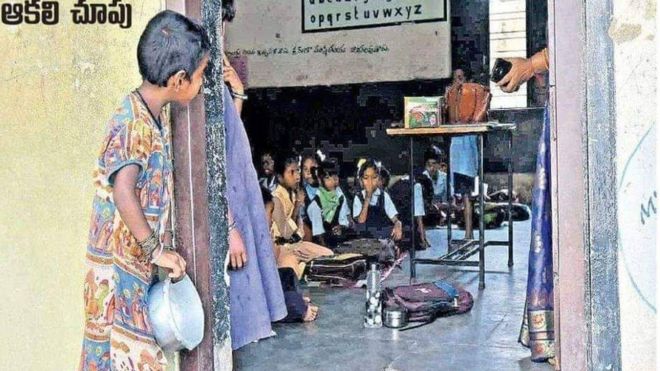
Image copyright EENADU NEWSPAPER/A SRINIVASImage caption The photo that sparked an outcry
A five-year-old in the southern city of Hyderabad was enrolled in school after a photo of her peeking into a classroom sparked an outcry. BBC Telugu’s Deepthi Bathini reports on why the photo doesn’t tell the full story.
Divya is something of a local celebrity in the slum where she lives. The shy five-year-old was the subject of a recent photo which went viral – it showed her clutching a bowl and peeking into a classroom at the local government school.
The touching image was published in a Telugu newspaper on 7 November with a caption that translates from the Telugu as “hungry gaze”.
It quickly grabbed people’s attention: a children’s rights activist shared it on Facebook, lamenting that yet another child was being denied the right to food and education.
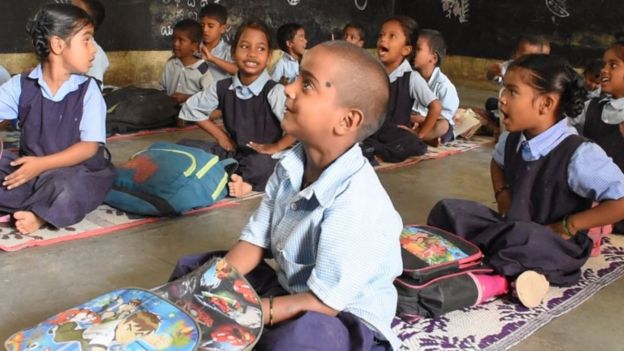
It had such an impact, the school enrolled Divya the following day.
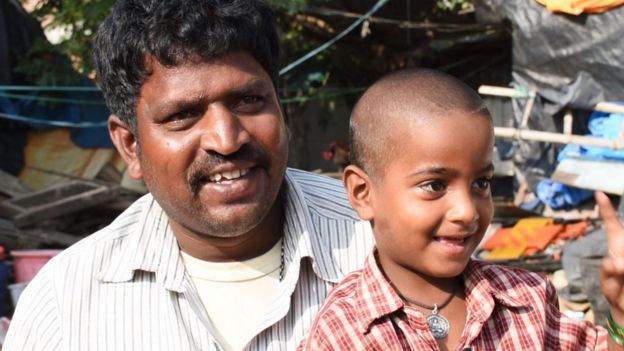
But her father, M Lakshman, says the photo and the outcry it provoked was in fact unfair to him and his wife, Yashoda, who works as a sweeper.
Image caption Five-year-old Divya enrolled in school after a photo of her in a newspaper went viral
“I felt sad when I saw the photo,” he told the BBC. “Divya has parents and we are working so hard to give her a good future – but she was portrayed as a hungry orphan.”
Mr Lakshman says he was waiting for Divya to turn six so he could enrol her in a government hostel where his other two daughters are studying. The couple also have a son, who has finished school and is now applying to college while helping Mr Lakshman, who works as a rag picker.
Breaking the cycle
Divya and her parents live in a one-room hut in a shanty town in the heart of Hyderabad. The slum is about 100 metres from the government school, where Divya was photographed. Most of the 300 families living here are daily wage labourers and their children attend the school nearby.
The home is sparse and plastic and glass are piled outside, ready to be sold for recycling. He says between him and his wife, they earn about 10,000 rupees ($139; £108) a month, which pays for their food and clothes. Education, however, is free for the children, since they are all enrolled in government-run schools.
Mr Lakshman knows what it is to struggle: he himself grew up without parents and always battled to earn a decent living. “I never wanted my children to have the life I had. So I made sure they all go to school.”
The photo, he adds, was especially hurtful because he has also been taking care of his brother’s five children.
Image caption Divya’s father said the outcry over the photo was “unfair” to his family
“My brother and sister-in-law passed away sometime ago. I didn’t want their five children to grow up as orphans. So, I enrolled all of them in a hostel and I take care of them.”
When asked why Divya had gone to the government school with a bowl in hand, Mr Lakshman explains that a lot of the younger children from the slum go there around lunch time to take advantage of the free midday meal – a government programme which provides cooked meals to children in more than a million schools – which they know about because their older brothers and sisters are already enrolled.
“Divya doesn’t go every day but she happened to go on that day and someone photographed her,” he explained.
This was confirmed by teachers at the school who told the BBC that some children brought lunch from home, so leftovers over from the free meal scheme would be given to the younger children who had not yet joined.
“Children are children. And there is no day-care centre, so a lot of these children hang around the school anyway,” says one teacher, who spoke on the condition of anonymity.
Image caption Divya says she’s excited to go to school
Mr Lakshman and his neighbours acknowledged the lack of an anganwadi, or government-sponsored day-care centre, in the neighbourhood was a major problem as parents had no place to leave their children so they could go to work.
The local school inspector, SU Shivram Prasad, says he hopes the attention generated by the Divya’s photo will hasten the process of setting up one up.
“It will help the parents and the children can eat a nutritious meal,” he adds.
Teachers at the school also hope that the media spotlight will improve facilities. They say there is an acute shortage of staff and teaching materials, and the school did not even have a compound wall, which meant they have to constantly watch the children during their breaks.
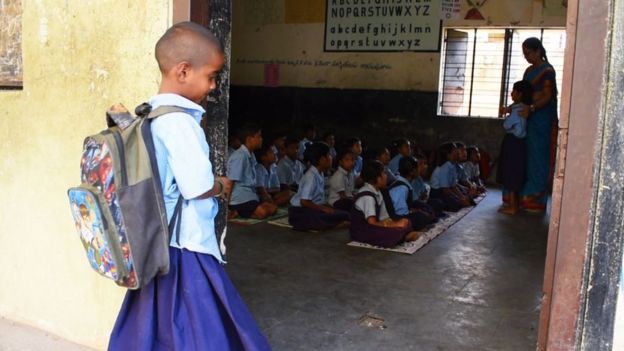
Divya, however, is excited to be going to school. She insists on taking her school bag with her everywhere, even to the playground. Other than saying her name, she does not answer any questions.
“She is a very calm child,” says Mr Lakshman, as his daughter holds his hand and kisses it.
And he admits that despite everything, the photo did do some good.
“Now other children who are Divya’s age are also enrolling in school. So that makes me happy.”
India’s oldest exponent and teacher of yoga, V Nanammal, has died at her home near Coimbatore, in the southern state of Tamil Nadu.
She was 99 and still teaching a hundred students a day until a few months ago.
Born into an agricultural family, she was taught yoga by her father.
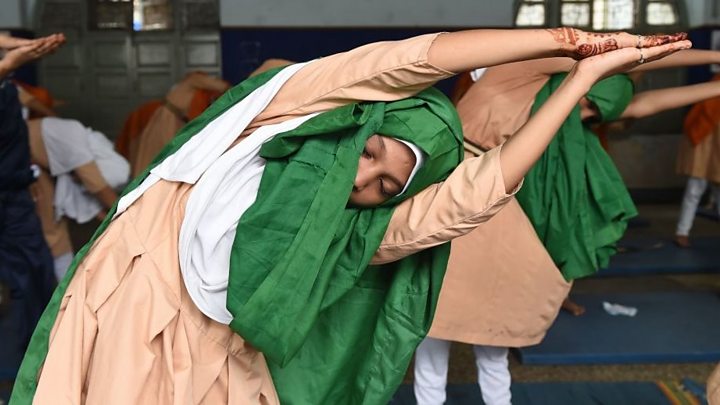
She went on to master more than 50 postures or asanas, and trained more than a million students – hundreds of them now yoga instructors themselves around the world.
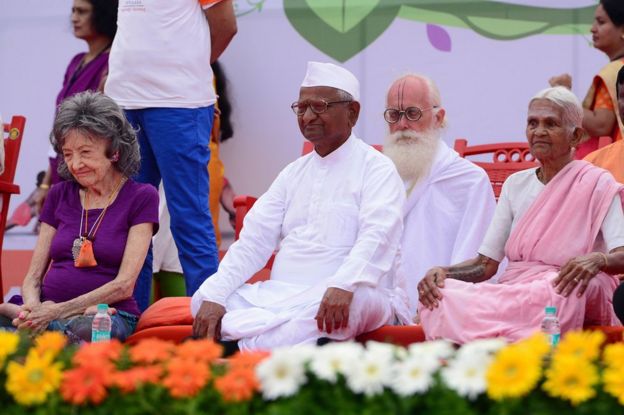
Image copyright GETTY IMAGESImage caption V Nanammal (right) was known for her trademark pink sari
Known affectionately as “Yoga Grandma”, Nanammal received the Padma Shri – one of India’s highest civilian honours.









 CHINDIA ALERT: You'll be living in their world, very soon