Chindia Alert: You’ll be Living in their World Very Soon
aims to alert you to the threats and opportunities that China and India present. China and India require serious attention; case of ‘hidden dragon and crouching tiger’.
Without this attention, governments, businesses and, indeed, individuals may find themselves at a great disadvantage sooner rather than later.
The POSTs (front webpages) are mainly 'cuttings' from reliable sources, updated continuously.
The PAGEs (see Tabs, above) attempt to make the information more meaningful by putting some structure to the information we have researched and assembled since 2006.
American destroyer’s mission comes a week before Taiwanese president officially starts second term in office
Increased military activity in the region could have unintended consequences but unlikely to lead to direct conflict, observer says
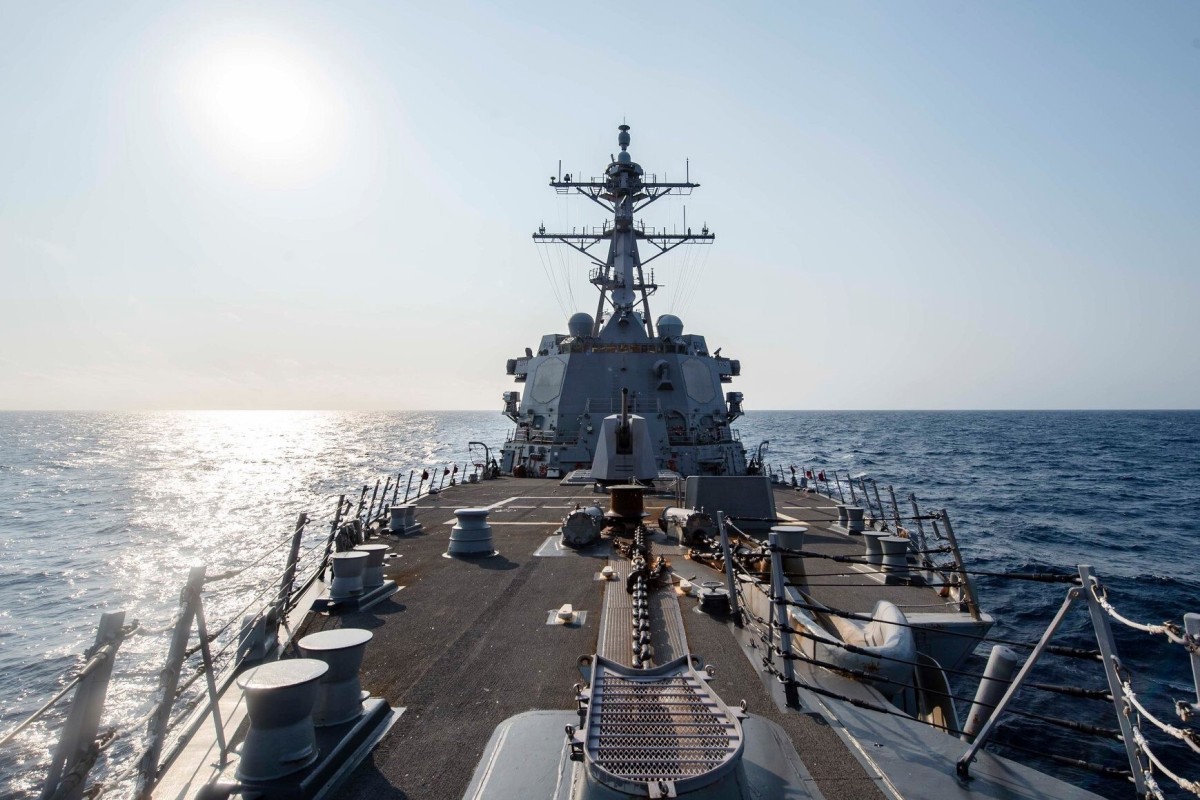
The guided-missile destroyer USS McCampbell made a transit through the Taiwan Strait on Thursday. Photo: US Navy
The United States sent a warship through the Taiwan Strait on Thursday as the Chinese military embarked on more than two months of live-fire naval drills off the mainland’s northern coast.
According to Taiwan’s defence ministry, the Arleigh Burke-class guided-missile destroyer transited the narrow body of water separating Taiwan from mainland China from north to south “in a routine mission”.
“It is continuing its southward voyage and the military is monitoring its movement through the intelligence it has gathered,” the ministry said.
In a statement on its Facebook page, the US Pacific Fleet said the McCampbell transited the Taiwan Strait as part of ongoing operations in the Indo-Pacific.
Analysts said the passage was a response to the People’s Liberation Army’s increasing military activity near Taiwan and in the wider region.
“This will become a new routine as a kind of US security commitment to maintain stability in the Indo-Pacific region,” said Soong Hseik-wen, professor of strategic studies and international relations at National Chung Cheng University in Taiwan.
Beijing urges France to cancel contract to sell arms to Taiwan
13 May 2020
The PLA has staged a series of war games, including fly-bys and warship transits through the strait, in recent months in response to what Beijing sees as growing pro-independence moves by the Tsai government and her party. China has also warned the US against supplying weapons to the island, which Beijing considers to be a wayward province that must return to the mainland fold, by force if necessary.
Mainland China has suspended official exchanges with Taiwan since Tsai was first elected president in 2016 and refused to accept the one-China policy, which Beijing says must be the foundation for any talks.
The PLA has embarked on 11 weeks of naval exercises off the coast of Tangshan in northern China, barring all other vessels from a 25km (15 mile) radius of the drill area, according to the China Maritime Safety Administration.
Taiwanese support closer ties with US over China, few identify as solely Chinese, Pew Research survey finds
13 May 2020
Both Beijing and Washington have ramped up military activities near Taiwan in recent months during the coronavirus pandemic, moves that some observers say run the risk of miscommunication.
Alexander Huang Chieh-cheng, professor of strategic studies and international relations at Tamkang University in Taipei, said no one could exclude the possibility of unintended incidents when both the US and the mainland were stepping up their presence in the region.
“Rational analysts would however argue that the two nuclear powers are not likely to engage in or escalate to direct military conflict,” he said.
Huang said he believed cross-strait relations would worsen during Tsai’s second term in office, which begins on May 20.
“The already damaged relationship between Taiwan and mainland China has worsened since the pandemic mainly due to travel bans and Taiwan’s increased international visibility,” he said.
On Tuesday, Japan’s Kyodo News reported that the PLA was planning a large-scale beach landing exercise near Hainan province in August, simulating a takeover of the Pratas Islands, which are controlled by Taiwan and also known as the Dongsha Islands.
In Taipei, Major General Lin Wen-huang said Taiwan was monitoring the PLA movements and “has contingency plans in place for the South China Sea to strengthen combat readiness and defence preparedness on both the Spratly and Pratas islands”.
Taiwan’s coastguard also announced on Wednesday that its Pratas Islands Garrison was scheduled to conduct an annual live-fire exercise in June to ensure the “effectiveness of various mortar and machine-gun positions”.
Taiwan shows off its military power after presidential election
Shanghai-based military commentator Ni Lexiong said that both the US Navy and PLA were increasing activities during the pandemic because neither side could afford to show weaknesses that the other might take advantage of.
The destroyer’s passage and the PLA’s drills were all part of such efforts, Li said.
But he agreed that both countries were unwilling, unable, and unlikely to have a real conflict.
“They are both bluffing. It’s a fake crisis,” he said. “A pandemic always ends or prevents a war if you look at history.
“I also don’t believe the PLA would want to take over the Dongsha or Taiping islands [in the South China Sea], because these islets alone are not worth a military campaign and all the consequences of that. The only target valuable enough for the PLA is Taiwan.”
Japan’s Prime Minister Shinzo Abe and EC President Jean-Claude Juncker mark first anniversary of EU-Asia Connectivity scheme with swipes at China
Partners reach out to countries in Balkans and Africa and agree US$65.5 billion development plan
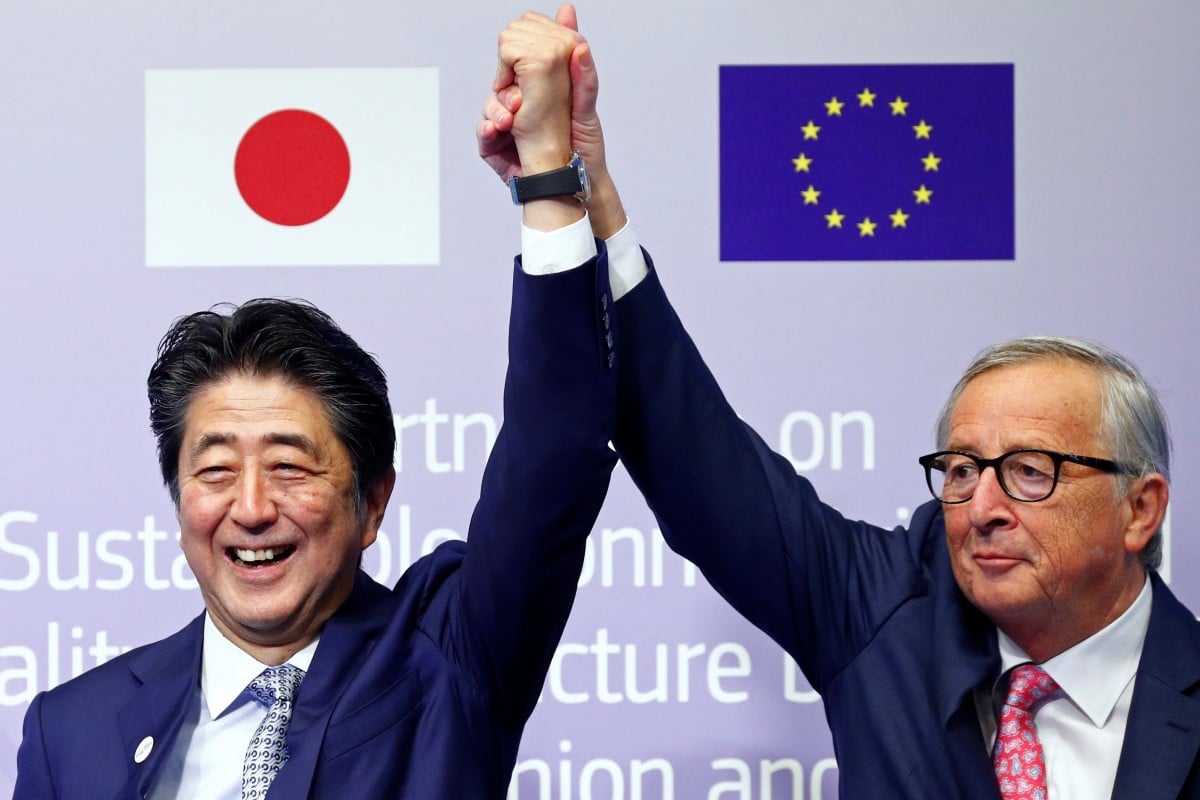
Japan’s Prime Minister Shinzo Abe (left) and European Commission President Jean-Claude Juncker mark the anniversary of the EU-Asia Connectivity scheme in Brussels, Belgium. Photo: Reuters
The European Union and Japan are stepping up their efforts to counter China’s
, with their leaders vowing to be “guardians of universal values” such as democracy, sustainability and good governance.
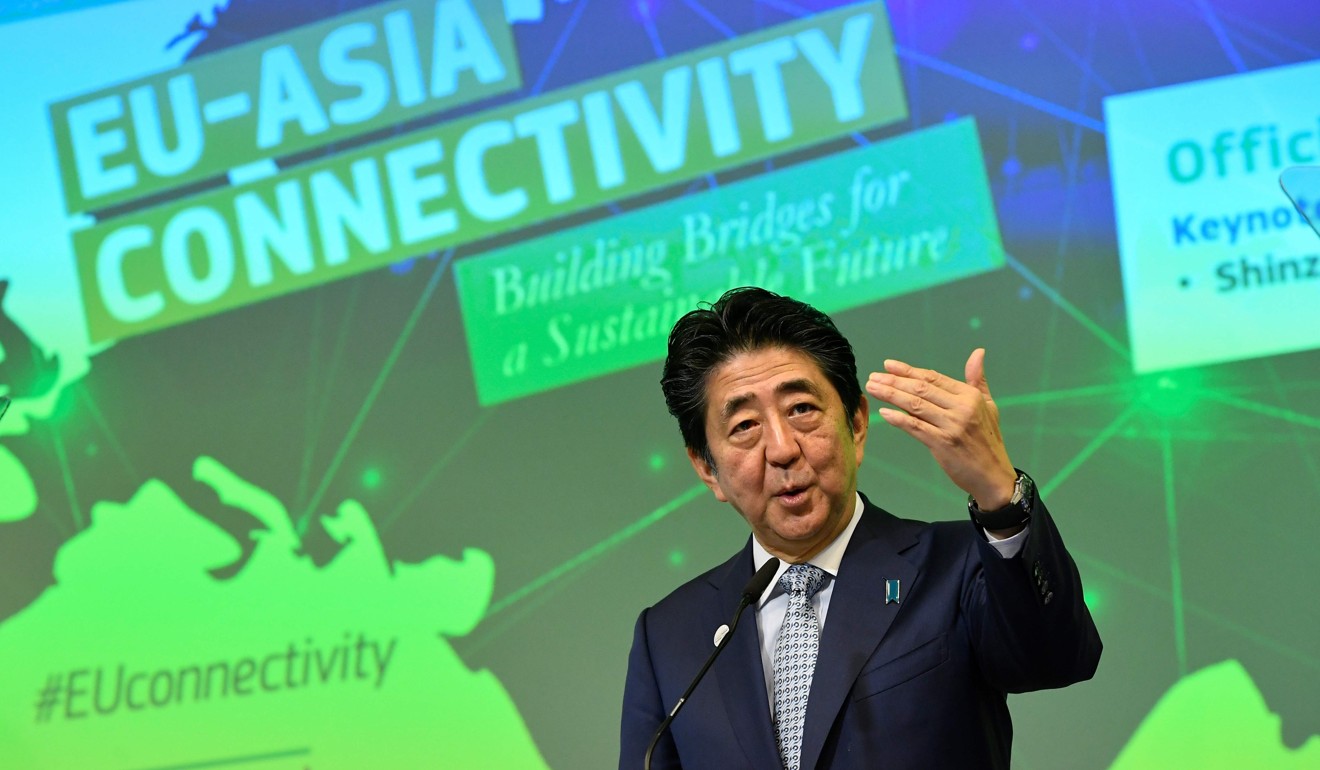
Speaking in Brussels on Friday, Japanese Prime Minister Shinzo Abe said the world’s third-biggest economy would work with the EU to strengthen their transport, energy and digital ties to Africa and the Balkans – key regions for China’s flagship trade and development project.
At a forum to mark the first anniversary of the EU-Asia Connectivity scheme, Abe and European Commission President Jean-Claude Juncker signed an agreement formalising Japan’s involvement in the Europe-Asia plan that will be backed by a €60 billion (US$65.54 billion) EU guarantee fund, development banks and private investors.
Abe said Japan would ensure that officials from 30 African countries would be trained in sovereign debt management over the next three years, a veiled attack on what Western diplomats claim is China’s debt trap for its belt and road partners.
“The EU and Japan are linked through and through,” Abe said. “The infrastructure we build from now on must be [high] quality infrastructure.
“Whether it be a single road or a single port, when the EU and Japan undertake something, we are able to build sustainable, comprehensive and rules-based connectivity, from the Indo-Pacific to the west Balkans and Africa.”
Japan wants to extend its business reach through its alliance with the EU as its economy slows and geopolitical competition from China takes its toll.
Japan indicates China is bigger threat than North Korea in latest defence review
China’s low-key delegation to the forum was led by Guo Xuejun, deputy director general of international affairs at the foreign ministry.
The US was represented by its deputy assistant secretary of state for cyber policy, Robert Strayer, who was in Europe to lobby against Chinese telecoms giant Huawei Technologies and its involvement in fifth-generation telecoms networks.
Abe and Juncker made cybersecurity the highlight of their addresses. Juncker, who will step down from the presidency by the end of October, repeated his attack on China’s trade policies without naming the country.
“Openness is reciprocal, based on high standards of transparency and good governance, especially for public procurement, and equal access to businesses while respecting intellectual property rights,” he said.
Prime Minister Shinzo Abe says Japan will train officials from 30 African countries in sovereign debt management in three years. Photo: AFP
European policymakers and businesses have for years complained about China’s refusal to allow foreign companies in without a Chinese joint venture partner, a practice that critics claimed involved forced transfer of intellectual property to the Chinese side.
“One of the keys to successful connectivity is to respect basic rules and common sense,” Juncker said, stressing that EU-Japanese cooperation focused on the “same commitment to democracy, rule of law, freedom and human dignity”.
European businesses urge EU to take ‘defensive’ measures against China’s state-owned enterprises
When the commission proposed improved transport, energy and digital infrastructure links with Asia last year, it denied it was seeking to stymie Chinese ambitions.
The EU plan, which would be backed by additional funds from the EU’s common budget from 2021, private sector loans and development banks, amounted to a response to China’s largesse in much of central Asia and south-eastern Europe, where Beijing has invested billions of dollars.
WASHINGTON (Reuters) – The U.S. military said it sent two Navy ships through the Taiwan Strait on Wednesday, its latest transit through the sensitive waterway, angering China at a time of tense relations between the world’s two biggest economies.
Taiwan is one of a growing number of flashpoints in the U.S.-China relationship, which also include a bitter trade war, U.S. sanctions and China’s increasingly muscular military posture in the South China Sea, where the United States also conducts freedom-of-navigation patrols.
The voyage will be viewed by self-ruled Taiwan as a sign of support from the Trump administration amid growing friction between Taipei and Beijing, which views the island as a breakaway province.
The transit was carried out by the destroyer Preble and the Navy oil tanker Walter S. Diehl, a U.S. military spokesman told Reuters.
“The ships’ transit through the Taiwan Strait demonstrates the U.S. commitment to a free and open Indo-Pacific,” Commander Clay Doss, a spokesman for the U.S. Navy’s Seventh Fleet, said in a statement.
Doss said all interactions were safe and professional.
Chinese Foreign Ministry spokesman Lu Kang said Beijing had lodged “stern representations” with the United States.
“The Taiwan issue is the most sensitive in China-U.S. relations,” he told a daily news briefing in Beijing.
Taiwan’s Defense Ministry said the two U.S. ships had sailed north through the Taiwan Strait and that they had monitored the mission.
Taiwan President Tsai Ing-wen said there was no cause for alarm.
“Nothing abnormal happened during it, please everyone rest assured,” she wrote on her Facebook page.
U.S. warships have sailed through the Taiwan Strait at least once a month since the start of this year. The United States restarted such missions on a regular basis last July.
The United States has no formal ties with Taiwan but is bound by law to help provide the island with the means to defend itself and is its main source of arms.
The Pentagon says Washington has sold Taipei more than $15 billion in weaponry since 2010.
China has been ramping up pressure to assert its sovereignty over the island, which it considers part of “one China” and sacred Chinese territory, to be brought under Beijing’s control by force if needed.
Beijing said a recent Taiwan Strait passage by a French warship, first reported by Reuters, was illegal.
China has repeatedly sent military aircraft and ships to circle Taiwan on exercises in the past few years and worked to isolate it internationally, whittling down its few remaining diplomatic allies.
The U.S. Defense Intelligence Agency released a report earlier this year describing Taiwan as the “primary driver” for China’s military modernization, which it said had made major advances in recent years.
On Sunday, the Preble sailed near the disputed Scarborough Shoal claimed by China in the South China Sea, angering Beijing.
The state-run China Daily said in an editorial on Wednesday that China had shown “utmost restraint”.
“With tensions between the two countries already rife, there is no guarantee that the presence of U.S. warships on China’s doorstep will not spark direct confrontation between the two militaries,” it said.
Military watchers can expect ‘something new’ at this year’s National Day parade in October, Professor Jin Canrong tells forum in Hong Kong
As tensions rise over Taiwan, Beijing is building a naval and missile force as powerful as any in the world, he says
Beijing’s military build-up just starting – a lot more to come, expert warns
24 Feb 2019
Submarine arms race seen heating up in Indo-Pacific amid China ‘threat’
16 Feb 2019
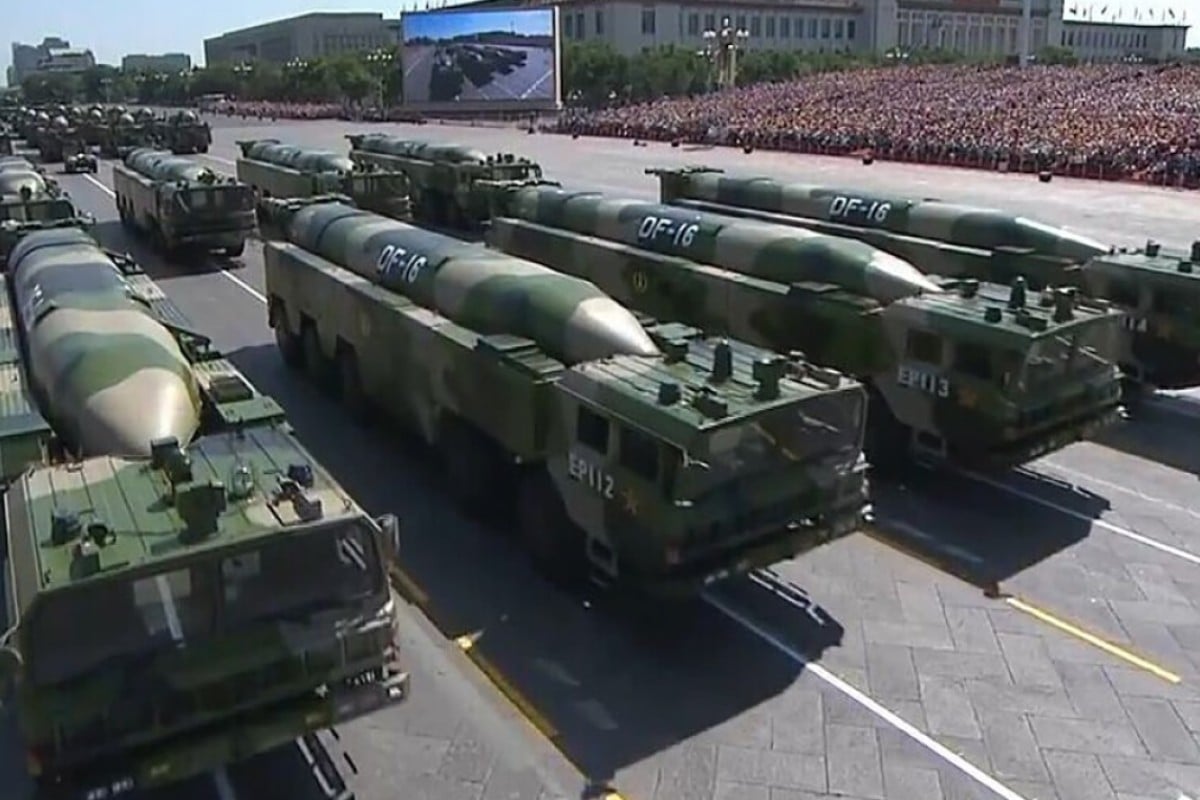
Military vehicles carrying DF-16 ballistic missiles take part in China’s National Day parade. Taiwan says Beijing has such missiles trained on the self-ruled island. Photo: Handout
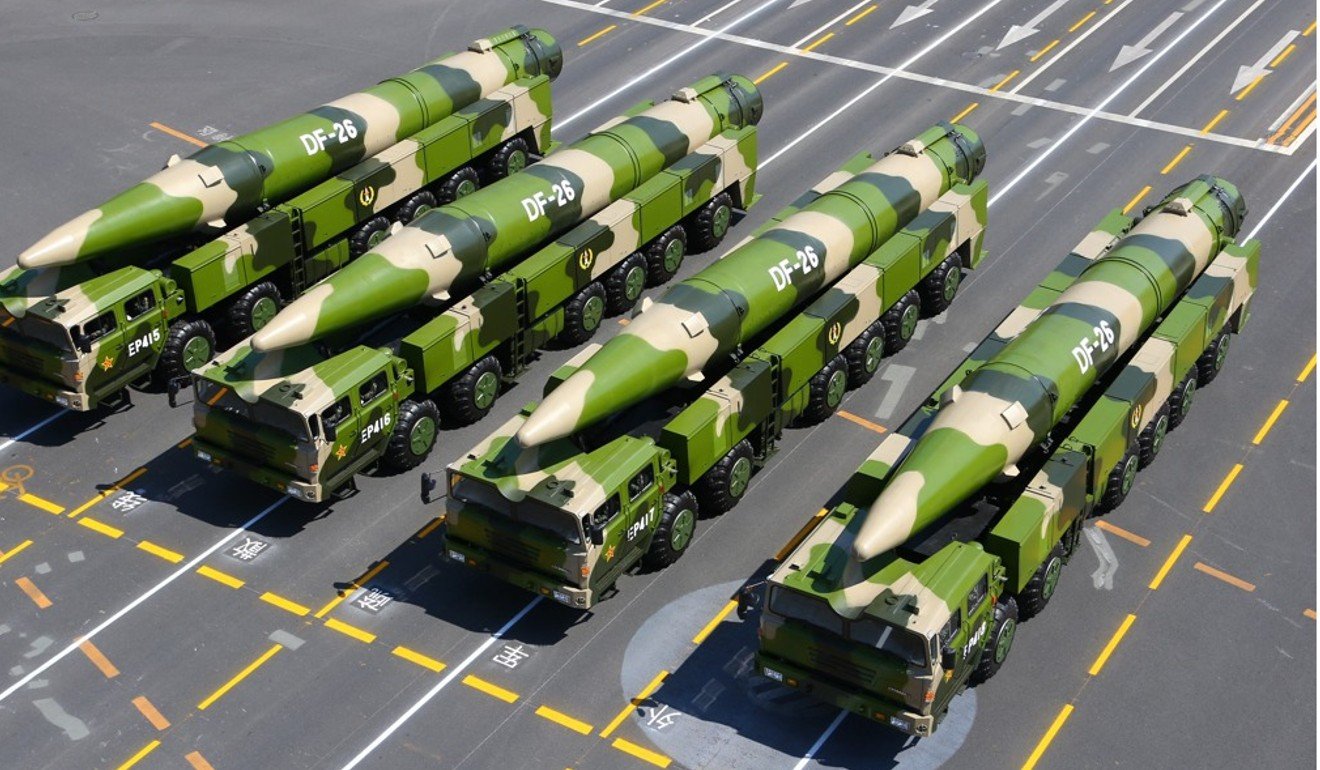
Beijing will show the world “something new” when it rolls out its arsenal of short- to medium-range ballistic missiles at its National Day military parade in October, according to a Chinese expert on international relations.
Speaking at a seminar at the University of Hong Kong on Saturday, Professor Jin Canrong, associate dean of the school of international studies at Renmin University in Beijing, said China had made great strides in expanding its military capability, but there was a lot more to come.
US commander pushes for more funding to counter China’s influence in Indo-Pacific
While he did not elaborate on what the “something new” might be, he said the country was gearing up for a possible conflict over Taiwan, the self-ruled island that Beijing regards as a wayward province awaiting reunification.
Over the next five or 10 years, Taiwan could provide the “biggest uncertainty” for Beijing, he said, especially if the United States decided to “ignite” the situation.
Known for being outspoken on sensitive issues, Jin said that while Beijing wanted a peaceful reunification, it was wary of “pro-independence factions [on the island] and right-wing American [politicians] creating trouble”.
By registering for these newsletters you agree to our T&C and Privacy Policy
In a speech on January 2 to mark the 40th anniversary of Beijing’s call to end military confrontation across the Taiwan Strait, Chinese President Xi Jinping said that “the political division across the strait … cannot be passed on from generation to generation”, apparently signalling his determination to bring it to an end.
Xi said China would not abandon the use of force in reunifying Taiwan, but stressed the military would target only external elements and those seeking independence for the island.
In 2017, Taipei said that it had detected the deployment of DF-16 ballistic missiles on the mainland that were aimed at Taiwan.
Jin said China was rapidly expanding its missile capabilities. The People’s Liberation Army had already stockpiled about 3,000 short- and medium-range missiles, he said, even though it had been using just 15 per cent of its production capacity.
“Just imagine if we were running at 100 per cent,” he said.
Beijing will show the world “something new” when it rolls out its ballistic missiles at its National Day military parade in October, an expert says. Photo: Xinhua
Share:
Under its plan for military modernisation China had achieved “great advancements in space, electronics and cyberwarfare”, the academic said, but its achievements to date were only the beginning.
As well as the expansion of its missile force, Beijing was investing heavily in its navy, he said.
Is China about to abandon its ‘no first use’ nuclear weapons policy?
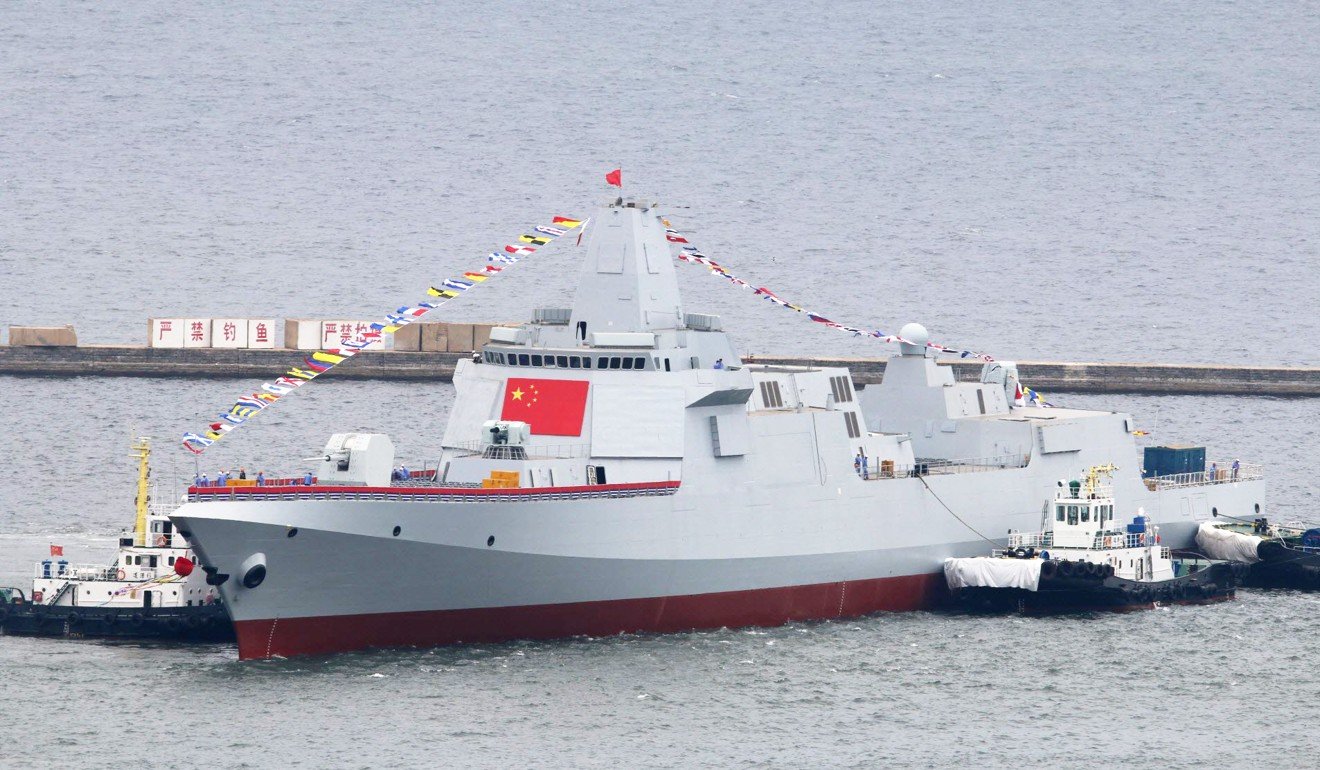
With the deployment of the new Type 055 guided-missile destroyer – which some Chinese military experts have said is as good as anything in the US Navy – the balance of power was shifting, he said.
“For the first time in 500 years, the East has combat equipment that is at least as good as the West’s.”
With the deployment of the new Type 055 guided-missile destroyer, the balance of power between China and the US is shifting, according to Jin Canrong. Photo: Handout
Share:
And as the navy continued to modernise and expand, the US might be forced to rethink its position in the region, he said.
“When we have dozens of destroyers and four or five [aircraft] carriers the US will not be able to meddle in Taiwan.”
China’s first aircraft carrier may become test bed for electromagnetic warplane launcher
Jin said that China would also soon have all the scientific, academic and research personnel it needed to achieve its military ambitions.
“China had nearly 30 million university students in 2018, which is twice as many as the US. More than half of them are studying science or engineering,” he said.
“Every year we produce about 4 million science and engineering graduates, while America produces just 440,000.”
Professor Jin Canrong speaks at a forum in Hong Kong. Photo: Handout
Share:
Beijing also had the money to support its plans, Jin said. Based on his own calculations, he said China allocated about 1.4 per cent of its gross domestic product to military spending, which was lower than “Germany’s 1.5 per cent”, and less than half the “3 per cent in Britain and France”.
“The tax paid by Chinese smokers is more than enough to cover [the country’s] military expenses,” Jin said.
According to figures from Nato, Britain spent 2.1 of its GDP on defence in 2017, France 1.8 per cent and Germany 1.2 per cent. Both the World Bank and the United Nations put China’s military spending in 2017 at 1.9 per cent of its GDP.






 CHINDIA ALERT: You'll be living in their world, very soon