Chindia Alert: You’ll be Living in their World Very Soon
aims to alert you to the threats and opportunities that China and India present. China and India require serious attention; case of ‘hidden dragon and crouching tiger’.
Without this attention, governments, businesses and, indeed, individuals may find themselves at a great disadvantage sooner rather than later.
The POSTs (front webpages) are mainly 'cuttings' from reliable sources, updated continuously.
The PAGEs (see Tabs, above) attempt to make the information more meaningful by putting some structure to the information we have researched and assembled since 2006.
GUANGZHOU, April 30 (Xinhua) — The United Nations World Food Program (WFP) has launched a global humanitarian hub in the southern Chinese city of Guangzhou to help the global fight against COVID-19.
Established earlier this month, the hub will support the global COVID-19 emergency response for the international community, including the UN, national governments and other humanitarian partners, according to the WFP.
It will provide strategic sourcing and stock consolidation services, facilitate the movement of life-saving humanitarian cargo, and operate aviation services to transport humanitarian workers.
The first consignment of humanitarian cargo consisting of COVID-19 medical supplies has arrived at the Guangzhou hub, from where it will be shipped to other UN hubs worldwide as well as directly to virus-affected countries and regions,
“With its leading manufacturing industry, supply chain expertise and technological innovations, China is uniquely advantaged to host this global humanitarian hub which will play a catalytic role in responding to COVID-19,” said WFP’s Country Director in China Qu Sixi.
As one of WFP’s global network of humanitarian hubs, the one in Guangzhou is supported by Alibaba Group’s Cainiao Smart Logistics Network.
“We will fully leverage our global logistics resources to support WFP in facilitating the safe and fast delivery of humanitarian goods,” said James Zhao, general manager of Cainiao Global Supply Chain.
Photo taken with a mobile phone on April 24, 2020 shows a handover ceremony of medical equipment donated by China Railway Rolling Stock Corporation (CRRC) Zhuzhou Locomotive Co. Ltd. in Berlin, Germany. China Railway Rolling Stock Corporation (CRRC), the world’s largest rolling stock manufacturer by production volume, donated a shipment of medical equipment to Germany via the German Red Cross on Friday to help the country fight the coronavirus. Responding to the call from the German government and the Chinese Embassy in Germany, and in accordance with an arrangement between CRRC and CRRC Zhuzhou Locomotive Co. Ltd. (CRRC ZELC), the company donated 1,000 protective suits, 20,000 FFP2 masks and 80,000 surgical masks. (CRRC ZELC/Handout via Xinhua)
BERLIN, April 24 (Xinhua) — China Railway Rolling Stock Corporation (CRRC), the world’s largest rolling stock manufacturer by production volume, donated a shipment of medical equipment to Germany via the German Red Cross on Friday to help the country fight the coronavirus.
Responding to the call from the German government and the Chinese Embassy in Germany, and in accordance with an arrangement between CRRC and CRRC Zhuzhou Locomotive Co. Ltd. (CRRC ZELC), the company donated 1,000 protective suits, 20,000 FFP2 masks and 80,000 surgical masks.
CRRC ZELC said that the donated materials will be distributed to medical staff and volunteers who are fighting the pandemic on the frontlines.
Cheng Jian, general manager of CRRC ZELC Verkehrstechnik GmbH, said that the only way to overcome the crisis is to unite strengths and meet the challenges together.
“We wish to undertake our social responsibility as part of the community. We firmly believe that with joint efforts of the international community, Germany will quickly overcome the crisis, and production and life will return to normal soon,” Cheng said.
According to Jens Quade, president of the Mueggelspree regional branch of the German Red Cross, the risk of new coronavirus infections could be reduced through the generous donation from CRRC ZELC.
“The donated material will be distributed to the Berlin Red Cross, Berlin hospitals and/or medical institutions. We will do our best to provide the necessary assistance to the people who are most in need,” Quade said.
GENEVA, March 10 (Xinhua) — China urges relevant parties to immediately lift unilateral sanctions against Iran to prevent further harm to the human rights of the Iranian people, a senior Chinese diplomat has said.
Liu Hua, Special Representative for Human Rights of the Chinese Foreign Ministry, told the on-going 43rd session of the UN Human Rights Council on Monday that imposing external mechanisms without the consent of the countries concerned is not conducive to dialogue and cooperation, and does not play a role in promoting and protecting human rights.
Liu said that the international community should treat the human rights situation of Iran in an objective and fair manner, understand the challenges Iran faces as a developing country in promoting and protecting human rights, and listen more to the Iranian government and the demands of its people.
The unilateral sanctions imposed by relevant countries on Iran have had a significant negative impact on the human rights of the Iranian people, and have also restricted the United Nations and other organizations from providing humanitarian assistance to Iran, she said.
The Chinese diplomat highlighted that it is crucial time at this moment for the Iranian government and its people to fight the COVID-19 epidemic.
“China is providing support to the Iranian side within its capacity, including providing testing kits and other anti-epidemic materials, and sending a team of volunteer experts to help Iran fight the epidemic. China also calls on all parties to strengthen cooperation with Iran on epidemic prevention,” Liu said.
She also highlighted that China has always advocated that all countries should address human rights issues through constructive dialogue and cooperation, oppose politicization, selectivity, double standards, and confrontational practices, and does not support the practice of “naming and shaming” and publicly pressuring.
GENEVA, March 10 (Xinhua) — A senior Chinese diplomat said here that China advocates that Myanmar and Bangladesh properly resolve the Rakhine State issue through dialogue and consultation and start the process of repatriating people at an early date.
Liu Hua, Special Representative for Human Rights of the Ministry of Foreign Affairs of China, told the on-going 43rd session of the UN Human Rights Council on Monday that the international community should provide more constructive help to Myanmar and Bangladesh to create a favorable external environment for the two sides to implement bilateral repatriation agreements.
Liu pointed out that the international community should respect Myanmar’s sovereignty and treat Myanmar’s human rights progress in a comprehensive, impartial and objective manner.
On the issue of Myanmar, she said, the United Nations should take a fair and objective position, and related work should help promote the solution to the Rakhine state issue, not the contrary.
The Chinese diplomat also highlighted that China has always advocated that all countries should address human rights issues through constructive dialogue and cooperation, oppose politicization, selectivity, double standards, and confrontational practices, and does not support the practice of “naming and shaming” and publicly pressuring.
Chinese State Councilor and Foreign Minister Wang Yi addresses the 2020 new year reception of Chinese Foreign Ministry at the Diaoyutai State Guesthouse in Beijing, capital of China, Jan. 20, 2020. (Xinhua/Li Xiang)
BEIJING, Jan. 21 (Xinhua) — Chinese State Councilor and Foreign Minister Wang Yi on Monday reiterated China’s resolve on reunification.
The historical and legal fact that Taiwan is an inalienable part of China will not change no matter how the situation in Taiwan may evolve, Wang said when addressing the 2020 New Year reception hosted by the Chinese Foreign Ministry.
Nothing will shake the resolve and confidence of the Chinese government and people in advancing the reunification, he said.
The one-China principle has been a consensus shared by the international community and a universally recognized norm governing international relations, Wang said.
The annually reception was attended by nearly 400 diplomatic envoys and representatives of relevant Chinese departments.
BEIJING, March 5 (Xinhua) — China will lower its defense budget growth rate to 7.5 percent in 2019, from last year’s 8.1 percent, according to a draft budget report submitted to the annual session of the National People’s Congress (NPC) Tuesday.
The 2019 defense budget will be 1.19 trillion yuan (about 177.61 billion U.S. dollars), figures from the report show.
The rate marks the fourth straight year for the budgeted growth rate remaining single digit, following five consecutive years of double-digit increases.
China’s budgeted defense spending growth rate stood at 8.1 percent in 2018, 7 percent in 2017, and 7.6 percent in 2016.
“The Chinese government has always paid attention to controlling the scale of defense expenditure,” said He Lei, former deputy head of the Academy of Military Sciences.
Describing China’s defense budget increase as reasonable and appropriate, Zhang Yesui, spokesperson for the legislative session, said the rise aimed to “meet the country’s demand in safeguarding national security and military reform with Chinese characteristics.”
“China’s limited defense spending, which is for safeguarding its national sovereignty, security and territorial integrity, poses no threat to any other country,” Zhang said at a press conference Monday.
The expenditure has been mainly used for advancing defense and military reforms, supporting military training and diverse tasks, modernizing weapons and equipment, and improving welfare of service personnel, according to He, who is also a deputy to the NPC.
“The defense budget increase is appropriate against the backdrop of profound changes in the country’s overall strength, its security environment, and the global strategic situation,” He said.
China’s defense budget takes up a fairly small share of its GDP and national fiscal expenditure compared with other major countries, said He, noting that its military spending per capita and per soldier was also very low.
While the national defense spending in a number of major developed countries accounts for more than 2 percent of their GDP, the ratio was only about 1.3 percent for China in 2018.
The United States has increased its national defense expenditure for the fiscal year 2019 to 716 billion dollars, about four times the budget of China, the world’s second largest economy.
China’s military spending per capita is only about one-nineteenth of that of the United States.
“When it comes to whether a country poses a threat to other countries, the key is not that country’s national strength and armed forces, but the policies it adopts,” said Chen Zhou, research fellow with the Academy of Military Sciences.
“China has always been following the path of peaceful development and firmly adheres to a defense policy that is defensive in nature,” Chen said, noting that China’s development would not pose a threat to any other country.
He Lei highlighted China’s role in providing public security goods for the international community, saying the Chinese military had actively participated in UN peacekeeping missions, maintained security of marine passages, and engaged in international rescue and security cooperation.
“The growth in China’s defense spending is the growth of forces for world peace,” he noted.
BEIJING/GUANGZHOU, March 1 (Xinhua) — The world’s attention is on China as the country is to open its most important annual political meetings next week, known as the “two sessions.”
Foreign business leaders, observers and China watchers have expressed high hopes of seeing a more open China during the meetings and look forward to greater opportunities its development will bring to the world.
Harley Seyedin, president of American Chamber of Commerce in South China, said foreign businesses in China would keep a close eye on the discussion of the draft of foreign investment law, as it will “create a level playing field where everyone can participate,” once it is adopted and enforced.
“It will help China open up more,” Seyedin said.
A draft of China’s foreign investment law will be submitted to the upcoming plenary session of the National People’s Congress (NPC), which is scheduled to open on March 5.
Seyedin noted that foreign businesses in China have already sensed a positive signal last year, with the shortened negative list, and have confidence investing in China, fueled by the country’s efforts to protect intellectual property rights.
Mizumoto Shinji, president of Hitachi Elevator (China), said the anticipated adoption of the foreign investment law will help build a more law-based business environment in China.
“China’s business environment has greatly improved in recent years,” said Mizumoto. “We hope that China will further ease its management of foreign capital, so as to create a more stable, transparent and predictable investment environment.”
Once adopted, the unified foreign investment law will become a basic law in the field, replacing three existing laws on Chinese-foreign equity joint ventures, non-equity joint ventures (or contractual joint ventures) and wholly foreign-owned enterprises.
Pablo Rovetta Dubinsky, general manager of Spanish firm Tecnicas Reunidas’s China branch, said the law would help dispel misgivings among some foreign businesses over China’s determination to open up further.
“The foreign investment law to be discussed at the annual legislative session will mark a new beginning in China’s opening-up to the world,” Rovetta said. “It is a clear demonstration of China’s resolve to open up.”
In an interview with Xinhua ahead of the “two sessions,” Argentine ambassador to China Diego Ramiro Guelar hailed China’s spirit of cooperation as the country has been expanding its presence in commerce and investment across the globe.
“Compared to some western countries, China has a much more open attitude toward sharing and transferring its technology, which, in my opinion, is the core spirit of the Belt and Road Initiative,” Guelar said.
The ambassador added that as a region, Latin America had established a close association and mutual trust with China, and was keen to maintain the robust cooperation.
Khalifa Mohammed Alkhorafi, the consul-general of the State of Kuwait in the southern Chinese city of Guangzhou, expressed hope that the upcoming “two sessions” would send more positive signals on the Chinese economy. He added that Kuwait, which is strategically situated in the Persian Gulf region, would provide a lot of business opportunities for Chinese companies.
“There is a very strong relationship between China and Kuwait. There will be many big projects coming soon,” he said.
Lusa news agency reporter Joao Pimenta said that China’s economic achievements and its efforts on poverty alleviation had impressed the world.
“More and more Chinese families are enjoying a relatively comfortable life. China has also made remarkable achievements in poverty reduction in the process of reform and opening-up,” Pimenta said.
Diego Garcia, a Brazilian expert with China Radio International, believes that the international community is paying more attention to China’s diplomacy in global affairs.
“China is playing a constructive role on international issues, especially those concerning developing countries,” Garcia said. “In particular, the Belt and Road Initiative and the China International Import Expo have served the interests of many developing countries.”
PM Modi said that he told him ‘let us fight against poverty and illiteracy’ and Khan gave his word saying he is a Pathan’s son, ‘but went back on it’.
SNS Web | New Delhi | February 25, 2019 10:53 am
Pakistan Prime Minister Imran Khan on Sunday asked his Indian counterpart Narendra Modi to “give peace a chance” and assured him that he “stands by” his words and will “immediately act” if New Delhi provides Islamabad with “actionable intelligence” on the Pulwama attack.
Khan’s remarks came a day after PM Modi in a rally in Rajasthan, recalled his conversation with the Pakistan PM during a congratulatory call after he became the country’s premier.
PM Modi had told him “let us fight against poverty and illiteracy” and Khan gave his word saying he is a Pathan’s son “but went back on it”.
“There is consensus in the entire world against terrorism. We are moving ahead with strength to punish the perpetrators of terrorism…The scores will be settled this time, settled for good…This is a changed India, this pain will not be tolerated…We know how to crush terrorism,” PM Modi further said.
A statement released by the Pakistan Prime Minister’s Office said, “PM Imran Khan stand by his words that if India gives us actionable intelligence, we will immediately act.”
PM Modi should “give peace a chance”, Khan said in the statement.
In his first statement issued since the February 14 attack, Pakistani Prime Minister Imran Khan had on Tuesday accused India of blaming his country “without evidence” and warned of retaliation against any military action by India.
However, he assured India that he would act against the perpetrators of the deadly Pulwama terror attack, carried out by Pakistan-based Jaish-e-Mohammad (JeM) terror group and said that the issue between the two countries can be solved through dialogue.
India had called Khan’s offer to investigate the attack if provided proof as a “lame excuse”.
The already sour relations between India and Pakistan have worsened over the past few weeks as New Delhi accused Islamabad of the Pulwama attack.
India has accused Islamabad’s spy agency ISI of being involved in the attack and has maintained that the terror group JeM is a “child of the Pakistan Army”.
Following the attack, India immediately withdrew the ‘Most Favoured Nation’ status granted to Pakistan and initiated steps to isolate the neighbouring country from the international community.
Earlier, India had also announced its decision to stop the flow of its share of water from the Beas, Ravi and Sutlej to Pakistan.
Prime Minister Narendra Modi had in many of his public speeches after the attack, said that the security forces have been given full freedom to decide the future course of action regarding the terrorist attack in Pulwama.
India’s neighbours, including Sri Lanka, Maldives, Nepal, Bangladesh, Afghanistan and Bhutan—and other countries like Saudi Arabia, UAE, Iran, Russia, Germany, Canada, UK, Australia and Canada came out in strong support of New Delhi following the terror attack.
Over 44 CRPF personnel were killed and many injured on February 14 in one of the deadliest terror strikes in Jammu-Kashmir when a Jaish-e-Mohammad (JeM) suicide bomber blew up an explosive-laden vehicle near their bus in Pulwama district.
The bus was part of a convoy of 78 vehicles carrying around 2500 CRPF personnel from Jammu to Srinagar.
Four soldiers have been killed in Indian-administered Kashmir in a gun battle with militants, police say.
The clash occurred in Pulwama district, where more than 40 Indian paramilitary police were killed in a suicide attack on Thursday, raising tensions between nuclear-armed India and Pakistan.
A civilian and two alleged militants were also killed as Indian troops searched for suspects.
Meanwhile Pakistan recalled its ambassador for consultations.
India had already recalled its top diplomat from Pakistan in the wake of Thursday’s attack – in which it said the Pakistani state was complicit.
Pakistan denies any role in the bombing, which was claimed by a group based on its soil – Jaish-e-Mohammad (JeM)
What’s happening in Pulwama?
Police say two militants who were trapped in Pinglena village were killed in Monday’s operation. Both are JeM members and one is a Pakistani national, authorities said.
Heavy gunfire has been heard, and Indian security officials are appealing to villagers to stay indoors.
Police told BBC Urdu that when they fired “warning shots” at the house where the alleged militants were hiding, they fired back. One officer critically injured was taken to hospital.
The owner of the house was killed during the exchange of fire, police added.
Indian security forces have been hunting for militants with suspected links to JeM following Thursday’s bombing, which saw a vehicle packed with explosives ram a convoy of 78 buses carrying Indian security forces.
The suicide bomber was identified as a local Kashmiri aged between 19 and 21.
More than 20 people were detained on Sunday, according to police.
How high are tensions?
Kashmir has been a flashpoint between India and Pakistan since independence.
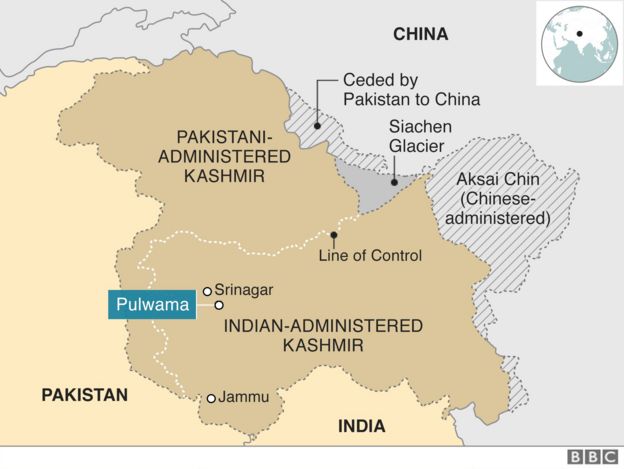
Both countries claim all of Muslim-majority Kashmir but control only parts of it. They have fought two wars and a limited conflict in the region.
Thursday’s attack was the deadliest attack against Indian forces since an Islamist-led insurgency began in 1989. It sparked anti-Pakistan protests in some Indian cities and angry mobs targeted Kashmiri students and businessmen.
Mobile internet services in Indian-administered Kashmir were cut over the weekend and the Indian government has pulled security normally provided to at least five Kashmiri separatist leaders.
Isolated incidents of students from Kashmir being beaten up or evicted from their accommodation in northern Indian states have also been reported.
India’s Central Reserve Police Force (CRPF) offered help to students in need, but also warned of false reports.
In broader terms, there has has been a spike in violence in Indian-administered Kashmir since Indian forces killed a popular militant in 2016. Significant numbers of young men have joined the insurgency in recent years and the funerals of well-known militants draw huge crowds who want to pay respects to “martyrs”.
India has been accused of using excessive force to control protests with thousands of people suffering eye injuries or being blinded by pellet guns.
How might India retaliate?
Indian Prime Minister Narendra Modi, who is facing an election later this year, has vowed a strong response and says he will give the military free rein.
This time analysts say heavy snow in the region could make that kind of limited ground response impossible. But there are fears that going further, for example with air strikes, could lead to Pakistani retaliation and a significant escalation.
So far India has focused on retaliation by economic and diplomatic means. It has revoked Pakistan’s Most Favoured Nation trading status, raised customs duties to 200% and vowed to isolate it in the international community.
Despite tensions Pakistan is calm
By Secunder Kermani, BBC Pakistan correspondent
The threat of Indian military action has not provoked widespread concern amongst the general public in Pakistan. Previous attacks by militants like JeM, believed to have close links to the intelligence services, have been seen as attempts by the Pakistani military to prevent the civilian government developing too friendly a relationship with India.
However, since Imran Khan was elected as prime minister here, many have begun to believe both the army and his administration were united in wanting to improve cross border ties.
Whether Pakistan was involved in the attack or not, it seems unlikely concerted action will now be taken against JeM. Its leader has been in “protective custody” since another attack in 2016, but still regularly releases audio messages to followers.
The group has in the past been a useful tool for Pakistan’s intelligence services wanting to foment unrest across the border, and authorities may now be reluctant to confront them, in case they turn against the Pakistani state as some of their members have done in the past.
India has said it will ensure the “complete isolation” of Pakistan after a suicide bomber killed 46 soldiers in Indian-administered Kashmir.
Federal Minister Arun Jaitley said India would take “all possible diplomatic steps” to cut Pakistan off from the international community.
India accuses Pakistan of failing to act against the militant group which said it carried out the attack.
This is the deadliest attack to hit the disputed region in decades.
Both India and Pakistan claim all of Muslim-majority Kashmir but only control parts of it.
An insurgency has been ongoing in Indian-administered Kashmir since the late 1980s and there has been an uptick in violence in recent years.
How will India ‘punish’ Pakistan?
India says that Jaish-e-Mohammad, the group behind the attack, has long had sanctuary in Pakistan and accuses its neighbour of failing to crack down on it.
It has called for global sanctions against the group and has said it wants its leader, Masood Azhar, to be listed as a terrorist by the UN security council.
Although India has tried to do this several times in the past, its attempts were repeatedly blocked by China, an ally of Pakistan.
Mr Jaitley set out India’s determination to hold Pakistan to account when speaking to reporters after attending a security meeting early on Friday.
He also confirmed that India would revoke Most Favoured Nation status from Pakistan, a special trading privilege granted in 1996.
Pakistan said it was gravely concerned by the bombing but rejected allegations that it was in any way responsible.
But after Prime Minister Narendra Modi said in a speech that those behind the attack would pay a “heavy price”, many analysts expect more action from Delhi.
After a 2016 attack on an Indian army base that killed 19 soldiers, Delhi said it carried out a campaign of “surgical strikes” in Pakistan-administered Kashmir, across the de facto border. But a BBC investigation found little evidence militants had been hit.
However analysts say that even if the Indian government wants to go further this time, at the moment its options appear limited due to heavy snow across the region.
How did the attack unfold?
The bomber used a vehicle packed with explosives to ram into a convoy of 78 buses carrying Indian security forces on the heavily guarded Srinagar-Jammu highway about 20km (12 miles) from the capital, Srinagar.
“A car overtook the convoy and rammed into a bus,” a senior police official told BBC Urdu.
It stands as the deadliest militant attack on Indian forces in Kashmir since the insurgency began in 1989.
The bomber is reported to be Adil Dar, a high school dropout who left home in March 2018. He is believed to be between the ages of 19 and 21.
Soon after the attack Jaish-e-Mohammad released a video, which was then aired on the India Today TV channel. In it, a young man identified as Adil Dar spoke about what he described as atrocities against Kashmiri Muslims. He said he joined the banned group in 2018 and was eventually “assigned” the task of carrying out the attack in Pulwama.
He also said that by the time the video was released he would be in jannat (heaven).
Dar is one of many young Kashmiri men who have been radicalised in recent years. On Thursday, main opposition leader Rahul Gandhi said that the number of Kashmiri men joining militancy had risen from 88 in 2016 to 191 in 2018.
India has been accused of using brutal tactics to put down protests in Kashmir – with thousands of people sustaining eye injuries from pellet guns used by security forces.
What’s the reaction?
“We will give a befitting reply, our neighbour will not be allowed to de-stabilise us,” said Prime Minister Modi.
Mr Gandhi and two former Indian chief ministers of Jammu and Kashmir all condemned the attack and expressed their condolences.
The attack has also been widely condemned around the world, including by the US and the UN Secretary General.
The White House called on Pakistan to “end immediately the support and safe haven provided to all terrorist groups operating on its soil”.
Pakistan said it strongly rejected any attempts “to link the attack to Pakistan without investigations”.
What’s the background?
There have been at least 10 suicide attacks since 1989 but this is only the second suicide attack to use a car.
Prior to Thursday’s bombing, the deadliest attack on Indian security forces in Kashmir this century came in 2002, when militants killed at least 31 people at an army base in Kaluchak near Jammu, most of them civilians and relatives of soldiers.
The latest attack also follows a spike in violence in Kashmir that came about after Indian forces killed a popular militant, 22-year-old Burhan Wani, in 2016.
More than 500 people were killed in 2018 – including civilians, security forces and militants – the highest such toll in a decade.
India and Pakistan have fought three wars and a limited conflict since independence from Britain in 1947 – all but one were over Kashmir.
Who are Jaish-e-Mohammad?
Started by cleric Masood Azhar in 2000, the group has been blamed for attacks on Indian soil in the past, including one in 2001 on the parliament in Delhi which took India and Pakistan to the brink of war.
Most recently, the group was blamed for attacking an Indian air force base in 2016 near the border in Punjab state. Seven Indian security personnel and six militants were killed.
It has been designated a “terrorist” organisation by India, the UK, US and UN and has been banned in Pakistan since 2002.
However Masood Azhar remains at large and is reportedly based in the Bahawalpur area in Pakistan’s Punjab province.
India has demanded his extradition from Pakistan but Islamabad has refused, citing a lack of proof.




 CHINDIA ALERT: You'll be living in their world, very soon