Archive for ‘Kashmir’

22/02/2019

Pulwama attack: India government must protect Kashmiris – top court

Protests against attacks on Kashmiris in Srinagar on 20 FebruaryImage copyrightGETTY IMAGES
Image captionProtests have been held in Indian-administered Kashmir over attacks on Kashmiris in other parts of India

India’s top court has ordered the government to protect Kashmiri people from attacks in apparent retaliation for last week’s deadly bombing in Indian-administered Kashmir.

There have been several reports of Kashmiri students and businessmen being harassed or beaten up in recent days.

The Supreme Court has also sought a response from the states where these alleged incidents happened.

The attack has sparked anger and anti-Pakistan protests across India.

The suicide bombing of an Indian security convoy in Pulwama on 14 February was claimed by a Pakistan-based militant group and has led to a war of words between nuclear-armed India and Pakistan.

But in some cases the anger has been directed against Kashmiri people living in other parts of India. The attack, which killed more than 40 Indian paramilitary police, was the deadliest against Indian forces in Kashmir in decades.

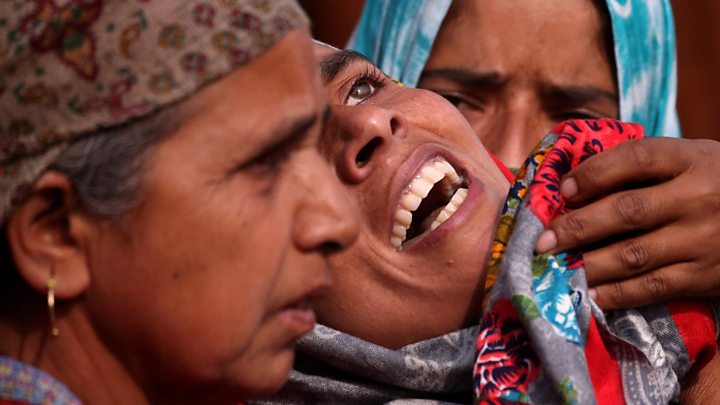
Hundreds of Kashmiri students, traders and businessmen have returned to Kashmir from various Indian cities out of fear that they could face harassment or attack.

Many Indians have expressed sympathy towards the Kashmiri students on social media, with some offering shelter in their own homes.

India has long had a volatile relationship with Muslim-majority Kashmir, where there has been an armed insurgency against Indian rule since the late 1980s.

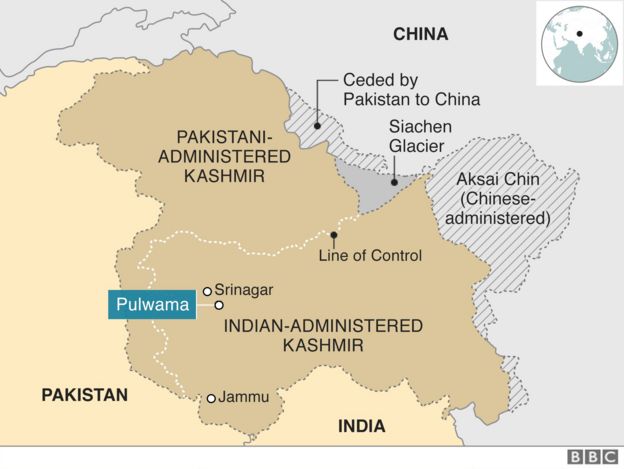
The region has been a flashpoint between India and Pakistan since independence. Both countries claim all of Kashmir but control only parts of it. They have fought two wars and a limited conflict over the territory.
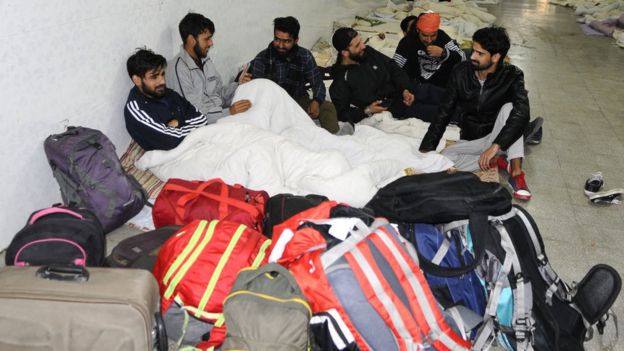
Kashmiri students from Dehradun, Ambala, Banur and Mohali leaving for Kashmir in Mohali, India.Image copyrightGETTY IMAGES
Image captionKashmiri students living in Dehradun and other cities have returned home since the attack

What did the court say?

The court’s decision singled out the federal government as well as governments in 10 states which are home to a sizeable Kashmiri population.

It asked authorities to widely publicise the details of officials who Kashmiris can contact if they face threats or violence.

The order was in response to a petition seeking protection for Kashmiris living across India. Tehseen Poonawala, one of the petitioners, told the BBC that he was moved to act because he was “disturbed” after reading reports of Kashmiris being attacked.

“It’s not about Kashmiris. It’s about human beings. We cannot be a country that responds with mob violence,” he said.

What happened to Kashmiri students?

In the days following the attack, isolated incidents of students from Kashmir being beaten up or evicted from their accommodation in northern Indian states were reported in local media. Kashmiri Muslims were warned to stay vigilant and India’s Central Reserve Police Force (CRPF) offered help to those in need, but also warned of false reports.

Twenty Kashmiri girls in the northern city of Dehradun were forced to lock themselves in their hostel after protesters gathered outside to demand their eviction, according to the Times of India.

Two other colleges in the city issued public statements saying they would not admit Kashmiri students in the next academic year.

“We did so to provide protection to the [Kashmiri] students,” the college principal, Aslam Siddidqu, told the BBC, adding that he had faced pressure from right-wing groups.

Federal education minister Prakash Javadekar has denied that “incidents” have taken place involving Kashmiri students.

But a police official in Dehradun told the BBC that 22 students had been arrested for protesting and demanding that Kashmiri students be expelled from colleges in the city.
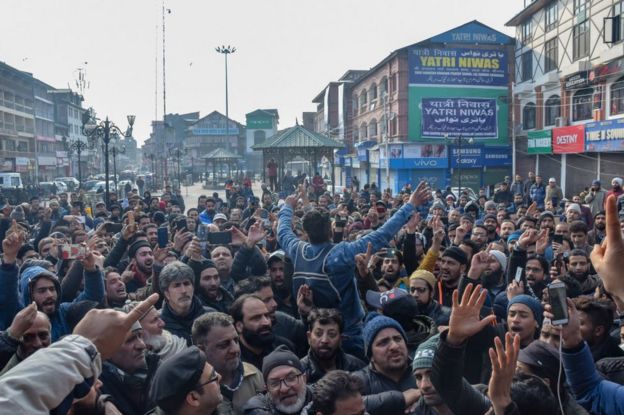
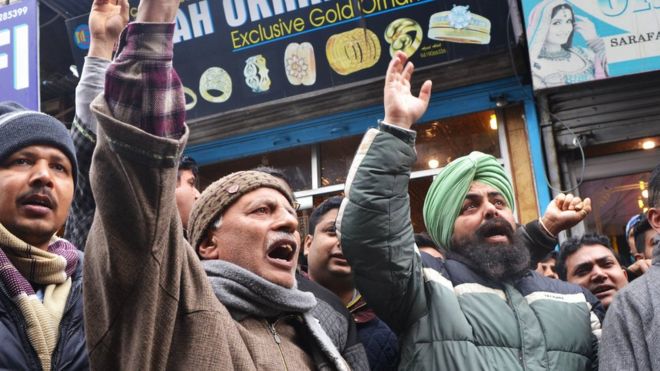
Kashmiri traders are seen shouting slogans during the protest. Traders in Lal Chowk and adjoining markets closed their shops as a mark of protest against attacks on Kashmiris elsewhere in India.Image copyrightGETTY IMAGES
Image captionMarkets and businesses were closed to protest against violence

What’s the bigger picture?

The attack has raised tensions between India and Pakistan, which have fought two wars and a limited conflict in the region and are both nuclear powers.

India has accused Pakistani intelligence services of having a hand in the attack, which was claimed by militant group Jaish-e-Mohammad.

Pakistan denies this and has warned that it will retaliate if India takes military action. In his first comments addressing the attack, Prime Minister Imran Khan said India should “stop blaming Pakistan without any proof or evidence” and urged Indian authorities to share any “actionable intelligence”.

India has moved to impose trade restrictions on Pakistan. It has also said it will build dams to reduce the flow of water to Pakistan from three rivers in India. Similar plans were announced in 2016, after a deadly militant attack on an Indian base in Kashmir.

The tensions between the neighbours may also have an impact on cricket, a national obsession in both India and Pakistan. Amid outrage over the attack, there have been calls for India to boycott its much anticipated match against Pakistan at the World Cup in June.

Indian cricket administrators say no decision has yet been made.

Source: The BBC

22/02/2019

“Don’t mess with Pakistan,” India is told amid Kashmir tension

RAWALPINDI, Pakistan (Reuters) – Pakistan will respond to any attack by India with “full force”, the army’s spokesman said on Friday, amid heightened tensions between the two nuclear-armed neighbours over Kashmir.

Major General Asif Ghafoor was speaking a week after a Pakistani-based militant group claimed responsibility for a suicide car bomb attack that killed 40 Indian paramilitary policemen the Himalayan region disputed between India and Pakistan.

India’s top military commander in the region has alleged Pakistan’s main Inter-Services Intelligence (ISI) spy agency was involved.

“We have no intention to initiate war, but we will respond with full force to full spectrum threat that would surprise you,” Ghafoor told reporters in the garrison city of Rawalpindi. “Don’t mess with Pakistan.”

The army’s response came two days after Prime Minister Imran Khan urged India to share any actionable evidence, offering full cooperation in investigating the blast.

He also offered talks with India on all issues, including terrorism, which India has always sought as a pre-requisite to any dialogue between the two arch-rivals.

India and Pakistan have fought two wars since independence in 1947 over Kashmir, which both the countries claim entirely.

Ghafoor also reiterated the talks offer.

“Kashmir is a regional issue,” he said. “Let us talk about it. Let us resolve it.”

India blames Pakistani Islamist militant groups for infiltrating into its part of Kashmir to fuel an insurgency and help separatist movements.

Washington and Delhi allege that the Pakistani army nurtures the militants to use them as a foreign policy tools to expand power in neighbouring India and Afghanistan. The army denies that.

One such group is Lashkar-e-Taiba (LeT), which India blamed for attacks in Mumbai in 2008 which killed 166 people, saying its founder, Hafiz Saeed, was the mastermind.

The United States has offered a $10 million reward for information leading to his conviction over the Mumbai attacks.

Pakistan has put him under house arrest several times and banned his Islamist groups, Jamaat-ud-Dawa (JuD) and Falah-e-Insaniat Foundation (FIF), which the United States and the United Nations say are terrorist fronts for the LeT.

Islamabad reinstated the ban on the groups yet again on Thursday, but Saeed remains free, allowed to roam the country and make public speeches and give sermons.

Source: Reuters

22/02/2019

‘Does not represent a judgement’: China on mention of JeM in UNSC statement

China has been repeatedly blocking India and several other countries’ efforts to bring about a global ban on JeM chief Masood Azhar in the UN’s anti-terror 1267 committee.

WORLD Updated: Feb 22, 2019 16:35 IST

Press Trust of India
Beijing
Jaish-e-Muhammad,Pulwama terror attack,UN Security Council
Lethpora: Security agencies inspect the site of suicide bomb attack at Lethpora area, in Pulwama district of south Kashmir, Friday, Feb. 15, 2019. At least 37 CRPF personnel were killed yesterday in one of the deadliest terror attacks in Jammu and Kashmir when a Jaish suicide bomber rammed a vehicle carrying over 100 kg of explosives into their bus in Pulwama district. (PTI Photo/S Irfan)(PTI2_15_2019_000037B)(AP)

China, a permanent member of the UN Security Council, Friday sought to downplay the scathing statement issued by the powerful organ of the world body naming Jaish-e-Muhammad in the Pulwama terror attack, saying the mention of the Pakistan-based outfit was only in “general terms” and “does not represent a judgement”.

Forty Central Reserve Police Force personnel were killed in a suicide attack by Pakistan-based Jaish-e-Mohammed (JeM) in Jammu and Kashmir’s Pulwama district on February 14, sparking outrage in the country.

The powerful UN Security Council (UNSC) on Thursday strongly condemned the “heinous and cowardly” terror attack.

“The members of the Security Council condemned in the strongest terms the heinous and cowardly suicide bombing in Jammu and Kashmir, which left 40 Indian paramilitary forces dead and dozens wounded on February 14, 2019, for which Jaish-e-Mohammed has claimed responsibility,” it said in a statement.

Asked about the statement highlighting the role of JeM claiming the responsibility of the Pulwama attack, China’s foreign ministry spokesman Geng Shuang told reporters that Beijing was closely following the developments related to the terror incident.

“Yesterday, the UN Security Council issued a press statement that mentioned that a particular organisation but only in general terms. It does not represent a judgment on the attack,” Geng said.

His remarks were seen as an attempt by China, without whose endorsement the UNSC statement could not have been released, aimed at placating its close ally Pakistan and play down the indictment of the JeM.

China has been repeatedly blocking India and several other countries’ efforts to bring about a global ban on JeM chief Masood Azhar in the UN’s anti-terror 1267 committee.

While China’s endorsement of the UNSC statement was reflection of wariness on the part of Beijing to repeatedly defend JeM in the UN body, which casts a shadow on its relations with India, observers say it is to be seen what stand Beijing would take when France moves its resolution seeking to list Azhar as a global terrorist in the UN.

France, also member of the permanent five of the UNSC, has officially announced that it would move a resolution soon in the 1267 committee seeking Azhar’s listing.

Since 2016, China has consistently blocked moves first by India and later by the US, the UK and France to designate Azhar as a global terrorist by putting repeated technical holds.

In his response on Friday Geng said that “China also noted that the Pakistani government showed readiness to cooperate with India on the investigation and that it is also ready to resolve differences with India through dialogue”.

“China hopes all parties will work to find the truth about this attack. We hope Pakistan and India will engage in dialogue to jointly safeguard regional peace and stability,” he said.

The UN statement also underlined the need to hold perpetrators, organisers, financiers and sponsors of these “reprehensible acts of terrorism” accountable and bring them to justice”.

The UN condemnation came a day after Pakistan’s Permanent Representative to the UN Maleeha Lodhi met top UN leaders including with Secretary-General Antonio Guterres to brief them about the escalating tensions in the region in the wake of the Pulwama attack.

Source: hindustan Times

21/02/2019

India withdraws security for Kashmir separatist leaders

NEW DELHI (Reuters) – India’s Jammu and Kashmir state withdrew the security details for 18 separatist leaders and 155 other opposition figures on Wednesday after an Islamist suicide bomber killed 40 paramilitary troopers last week.

The restive mountain state is currently administered by India’s federal government after Prime Minister Narendra Modi’s Bharatiya Janata Party walked out a coalition with a major Kashmiri party.

The separatist leaders had been allocated security personnel to protect them from militants after they entered talks with the federal government.

In a statement, the Jammu and Kashmir state government said it “felt that providing security to these separatist leaders is a wastage of scarce state resources which could be better utilized elsewhere”.

Besides the separatist leaders, the security of 155 political figures and activists – some from mainstream opposition parties – was also withdrawn, the statement said.

“Through this (step), over 1,000 police personnel and over 100 vehicles are freed to do regular police work,” it said.

Both India and Pakistan lay claim to Kashmir and have twice gone to war over it since independence from Britain in 1947. India accuses Pakistan of fomenting decades of sporadic insurgency in its only Muslim-majority state.

Pakistan denies that, saying it only offers political support to the Kashmiri people.

Source: Reuters

18/02/2019

Pulwama attack: Four Indian soldiers killed in Kashmir gun battle

Four soldiers have been killed in Indian-administered Kashmir in a gun battle with militants, police say.

The clash occurred in Pulwama district, where more than 40 Indian paramilitary police were killed in a suicide attack on Thursday, raising tensions between nuclear-armed India and Pakistan.

A civilian and two alleged militants were also killed as Indian troops searched for suspects.

Meanwhile Pakistan recalled its ambassador for consultations.

India had already recalled its top diplomat from Pakistan in the wake of Thursday’s attack – in which it said the Pakistani state was complicit.

Pakistan denies any role in the bombing, which was claimed by a group based on its soil – Jaish-e-Mohammad (JeM)

What’s happening in Pulwama?

Police say two militants who were trapped in Pinglena village were killed in Monday’s operation. Both are JeM members and one is a Pakistani national, authorities said.

Heavy gunfire has been heard, and Indian security officials are appealing to villagers to stay indoors.

Police told BBC Urdu that when they fired “warning shots” at the house where the alleged militants were hiding, they fired back. One officer critically injured was taken to hospital.

The owner of the house was killed during the exchange of fire, police added.

Indian security forces have been hunting for militants with suspected links to JeM following Thursday’s bombing, which saw a vehicle packed with explosives ram a convoy of 78 buses carrying Indian security forces.

map

The suicide bomber was identified as a local Kashmiri aged between 19 and 21.

More than 20 people were detained on Sunday, according to police.

How high are tensions?

Kashmir has been a flashpoint between India and Pakistan since independence.

Both countries claim all of Muslim-majority Kashmir but control only parts of it. They have fought two wars and a limited conflict in the region.

Thursday’s attack was the deadliest attack against Indian forces since an Islamist-led insurgency began in 1989. It sparked anti-Pakistan protests in some Indian cities and angry mobs targeted Kashmiri students and businessmen.

Mobile internet services in Indian-administered Kashmir were cut over the weekend and the Indian government has pulled security normally provided to at least five Kashmiri separatist leaders.

Isolated incidents of students from Kashmir being beaten up or evicted from their accommodation in northern Indian states have also been reported.

India’s Central Reserve Police Force (CRPF) offered help to students in need, but also warned of false reports.

In broader terms, there has has been a spike in violence in Indian-administered Kashmir since Indian forces killed a popular militant in 2016. Significant numbers of young men have joined the insurgency in recent years and the funerals of well-known militants draw huge crowds who want to pay respects to “martyrs”.

India has been accused of using excessive force to control protests with thousands of people suffering eye injuries or being blinded by pellet guns.

How might India retaliate?

Indian Prime Minister Narendra Modi, who is facing an election later this year, has vowed a strong response and says he will give the military free rein.

The last time an attack on Indian forces close to this magnitude occurred in Kashmir was in 2016, when 19 soldiers were killed at a base. In response to that, India carried out “surgical strikes” which involved Indian soldiers crossing the de facto border to hit Pakistani posts.

This time analysts say heavy snow in the region could make that kind of limited ground response impossible. But there are fears that going further, for example with air strikes, could lead to Pakistani retaliation and a significant escalation.

So far India has focused on retaliation by economic and diplomatic means. It has revoked Pakistan’s Most Favoured Nation trading status, raised customs duties to 200% and vowed to isolate it in the international community.

Presentational grey line

Despite tensions Pakistan is calm

By Secunder Kermani, BBC Pakistan correspondent

The threat of Indian military action has not provoked widespread concern amongst the general public in Pakistan. Previous attacks by militants like JeM, believed to have close links to the intelligence services, have been seen as attempts by the Pakistani military to prevent the civilian government developing too friendly a relationship with India.

However, since Imran Khan was elected as prime minister here, many have begun to believe both the army and his administration were united in wanting to improve cross border ties.

Whether Pakistan was involved in the attack or not, it seems unlikely concerted action will now be taken against JeM. Its leader has been in “protective custody” since another attack in 2016, but still regularly releases audio messages to followers.

The group has in the past been a useful tool for Pakistan’s intelligence services wanting to foment unrest across the border, and authorities may now be reluctant to confront them, in case they turn against the Pakistani state as some of their members have done in the past.

Source: The BBC

17/02/2019

Kashmiri Muslims evicted, threatened after deadly attack on Indian forces

SRINAGAR (Reuters) – India has warned against rising communal tensions across the country as Kashmiris living outside their state faced property evictions, job suspensions and attacks on social media after a suicide bomber killed 44 policemen in the region.

The car bomb attack on a security convoy on Thursday, claimed by Pakistan-based Islamist militant group Jaish-e-Mohammad and carried out by a 20-year-old Kashmiri man, was the worst in decades of insurgency in the disputed area, which is claimed in full by both the nuclear-armed neighbours but ruled in part.

As the bodies of the paramilitary policemen who died in the attack were returned to families across India this weekend, passionate crowds waving the Indian flag gathered in the streets to honour them and shouted demands for revenge. Pakistan has denied any role in the killings.

Kashmiri Muslims, meanwhile, are facing a backlash in Hindu-majority India, mainly in the northern states of Haryana and Uttarakhand, forcing the federal interior ministry to issue an advisory to all states to “ensure their safety and security and maintain communal harmony”.

Aqib Ahmad, a Kashmiri student in Uttarakhand capital Dehradun, said the owner of the house he was staying in had asked him to move out fearing an attack on his property. Rates for air tickets to Kashmir have sky-rocketed as tensions escalate, he said.

Two other students in Dehradun said they also had been asked to vacate their rooms immediately.


Local media reported that some Kashmiri students were assaulted by members of Hindu right-wing groups in Uttarakhand, while a Kashmiri man had been booked by the police in the southern city of Bengaluru under a colonial-era sedition law for a post allegedly backing the militants. Reuters was not able to independently verify the reports.

Police in Jammu and Kashmir (J&K) state said they were providing temporary accommodation to people returning to Kashmir. The police urged Kashmiris to contact their hotline for “speedy assistance in case they face any difficulties/harrasment”.

“TRAITOR”

Fear has engulfed Kashmiri students in Haryana’s Ambala district after a video on social media showed a village headman asking people to evict Kashmiri students in the area.

“In case it is not done, the person in whose residence such students are living will be considered as a traitor,” the man says in the video, whose authenticity Reuters has not been able to independently verify.


Police said they were investigating the matter.

Since the video surfaced on social media on Saturday, at least half a dozen Kashmiri students have been shifted to the hostel of a university campus in Ambala.

A Facebook user named Anshul Saxena, meanwhile, has claimed credit for getting people fired or suspended for posts he calls “anti-national”.

Saxena uploaded a screengrab of a suspension letter handed out to a Kashmiri employee of a pharmaceutical company who had allegedly written in favour of the attack.

The attack on India’s paramilitary police follows the deadliest year in Kashmir for security personnel since Prime Minister Narendra Modi’s Hindu nationalist Bharatiya Janata Party came to power nearly five years ago.

44 killed in worst Kashmir attack in decades
Government data shows 91 officers lost their lives in Kashmir last year, about 14 percent more than 2017. Thousands of people, including militants and civilians, have died since the insurgency began in late 1980s.
Political leaders from Kashmir appealed to the government to ensure security of Kashmiris across India, while many people on Twitter said their homes were open to Kashmiris seeking shelter.
“Understand the pain and anguish,” Mehbooba Mufti, former chief minister of J&K, said in a tweet. “But we must not allow such mischievous elements to use this as an excuse to persecute/harass people from J&K. Why should they suffer for somebody else’s action?”
Source: Reuters
17/02/2019

‘Won’t let Assam turn into another Kashmir’, says Amit Shah on citizen register

Addressing a rally in Assam’s North Lakhimpur, Amit Shah said that the NRC had been brought in to identify infiltrators and that the BJP would identifiy and deport all such infiltrators.

INDIA Updated: Feb 17, 2019 15:49 IST

HT Correspondent
HT Correspondent
Hindustan Times, New Delhi
assam,citizens' register,amit shah
Saying that the NRC had been brought in to identify infiltrators, Amit Shah said, the BJP will rid Assam of all such aliens by deporting them.(HT Photo)

BJP chief Amit Shah on Sunday said that Modi-led government at the Centre will not allow Assam to become another Kashmir and that is why it has brought about the National Register of Citizens (NRC).

Saying that the NRC had been brought in to identify infiltrators, he said, the BJP will rid Assam of all such aliens by deporting them.

“We won’t let Assam become another Kashmir, this is our commitment. We’ll repeat the NRC exercise as many times as required to, but we’ll identify and deport each infiltrator from Assam,” Shah said while addressing a public rally at North Lakhimpur in Assam.

Shah criticised the Congress and its former ally Asom Gana Parishad (AGP), and said both the parties had done nothing to implement the Assam Accord despite ruling most of the period since the pact was signed in 1985.

Read | ‘If Opposition wins, expect six PMs a week, country on holiday on Sundays’: Amit Shah

Referring to the contentious Citizenship (Amendment) Bill, which the Centre couldn’t present in Rajya Sabha, he said misinformation was being spread as if it was only for Assam and other parts of the Northeast.

“It was not for Northeast alone, but for all refugees across the country. The way demography is changing in Assam, without the Citizenship Bill, the people of the state will be in danger,” he added.

He also spoke about the Pulwama attack in which 40 CRPF jawans were killed in a suicide bombing on Thursday.

“This cowardly act was done by Pakistani terrorists. Their (jawans’) sacrifices will not go in vain, because there is no Congress government at the Centre. It is BJP government and the Narendra Modi government will not compromise on any security issue,” he added.

Also Read | ‘Tragic’, say political parties as they unite against harassment of Kashmiris

Saying that the government at the Centre was not that of the Congress, Shah said that the current government was that of the BJP and was led by Modi, who he said was determined to uproot terrorism from the country.

Source: Hindustan Times

16/02/2019

U.S. backs India’s right to self-defence over Kashmir attack – Indian government

NEW DELHI (Reuters) – The United States supports India’s right to self-defence against cross-border attacks, India’s foreign ministry said on Saturday after a deadly car bombing in disputed Kashmir raised tensions with rival neighbour Pakistan.

Prime Minister Narendra Modi has promised a strong response after a Pakistan-based militant group claimed responsibility for the suicide attack on a military convoy on Thursday that killed 44 paramilitary policemen.

India’s government said it had evidence the group, Jaish-e-Mohammad (JeM), had the backing of Pakistan and demanded Islamabad take action. Pakistan has condemned the attack and rejected India’s allegations.U.S. National Security Adviser John Bolton spoke to his Indian counterpart Ajit Doval on Friday night, promising to help bring those behind the attack to justice, the foreign ministry said in a readout of the phone call.

“The two NSAs vowed to work together to ensure that Pakistan cease to be a safe haven for JeM and terrorist groups that target India, the U.S. and others in the region,” the foreign ministry said.

“They resolved to hold Pakistan to account for its obligations under U.N. resolutions,” it added.

India has for years accused Muslim Pakistan of backing separatist militants in divided Kashmir, which the neighbours both claim in full but rule in part.

Pakistan denies that, saying it only offers political support to the Himalayan region’s suppressed Muslim people.

Modi, who is facing an election in the next few months, has called a meeting of political parties on Saturday to build support for action against Pakistan.

Indians have poured onto social media to vent their fury over the suicide bombing in Kashmir, with many of them calling for swift retribution against Pakistan as TV news shows hosted jingoistic debates.

When he swept to power at the head of a Hindu nationalist-led alliance in 2014, Modi vowed to pursue a tough line with Pakistan. The two countries have gone to war three times since independence from Britain in 1947, twice over Kashmir.

The attack comes at a difficult time for Pakistan, which is struggling to attract foreign investment and avert a payments crisis, with its swiftly diminishing foreign currency reserves at less than $8 billion, equivalent to two months of import payments.

Source: Reuters

15/02/2019

Pulwama attack: India will ‘completely isolate’ Pakistan

India has said it will ensure the “complete isolation” of Pakistan after a suicide bomber killed 46 soldiers in Indian-administered Kashmir.

Federal Minister Arun Jaitley said India would take “all possible diplomatic steps” to cut Pakistan off from the international community.

India accuses Pakistan of failing to act against the militant group which said it carried out the attack.

This is the deadliest attack to hit the disputed region in decades.

Both India and Pakistan claim all of Muslim-majority Kashmir but only control parts of it.

An insurgency has been ongoing in Indian-administered Kashmir since the late 1980s and there has been an uptick in violence in recent years.

How will India ‘punish’ Pakistan?

India says that Jaish-e-Mohammad, the group behind the attack, has long had sanctuary in Pakistan and accuses its neighbour of failing to crack down on it.

It has called for global sanctions against the group and has said it wants its leader, Masood Azhar, to be listed as a terrorist by the UN security council.

Although India has tried to do this several times in the past, its attempts were repeatedly blocked by China, an ally of Pakistan.

Mr Jaitley set out India’s determination to hold Pakistan to account when speaking to reporters after attending a security meeting early on Friday.

He also confirmed that India would revoke Most Favoured Nation status from Pakistan, a special trading privilege granted in 1996.

Pakistan said it was gravely concerned by the bombing but rejected allegations that it was in any way responsible.

But after Prime Minister Narendra Modi said in a speech that those behind the attack would pay a “heavy price”, many analysts expect more action from Delhi.

After a 2016 attack on an Indian army base that killed 19 soldiers, Delhi said it carried out a campaign of “surgical strikes” in Pakistan-administered Kashmir, across the de facto border. But a BBC investigation found little evidence militants had been hit.

However analysts say that even if the Indian government wants to go further this time, at the moment its options appear limited due to heavy snow across the region.

map

How did the attack unfold?

The bomber used a vehicle packed with explosives to ram into a convoy of 78 buses carrying Indian security forces on the heavily guarded Srinagar-Jammu highway about 20km (12 miles) from the capital, Srinagar.

“A car overtook the convoy and rammed into a bus,” a senior police official told BBC Urdu.

It stands as the deadliest militant attack on Indian forces in Kashmir since the insurgency began in 1989.

The bomber is reported to be Adil Dar, a high school dropout who left home in March 2018. He is believed to be between the ages of 19 and 21.

Soon after the attack Jaish-e-Mohammad released a video, which was then aired on the India Today TV channel. In it, a young man identified as Adil Dar spoke about what he described as atrocities against Kashmiri Muslims. He said he joined the banned group in 2018 and was eventually “assigned” the task of carrying out the attack in Pulwama.

He also said that by the time the video was released he would be in jannat (heaven).

Dar is one of many young Kashmiri men who have been radicalised in recent years. On Thursday, main opposition leader Rahul Gandhi said that the number of Kashmiri men joining militancy had risen from 88 in 2016 to 191 in 2018.

India has been accused of using brutal tactics to put down protests in Kashmir – with thousands of people sustaining eye injuries from pellet guns used by security forces.

What’s the reaction?

“We will give a befitting reply, our neighbour will not be allowed to de-stabilise us,” said Prime Minister Modi.

Mr Gandhi and two former Indian chief ministers of Jammu and Kashmir all condemned the attack and expressed their condolences.

The attack has also been widely condemned around the world, including by the US and the UN Secretary General.

The White House called on Pakistan to “end immediately the support and safe haven provided to all terrorist groups operating on its soil”.

Pakistan said it strongly rejected any attempts “to link the attack to Pakistan without investigations”.

What’s the background?

There have been at least 10 suicide attacks since 1989 but this is only the second suicide attack to use a car.

Prior to Thursday’s bombing, the deadliest attack on Indian security forces in Kashmir this century came in 2002, when militants killed at least 31 people at an army base in Kaluchak near Jammu, most of them civilians and relatives of soldiers.

At least 19 Indian soldiers were killed when militants stormed a base in Uri in 2016. Delhi blamed that attack on the Pakistani state, which denied any involvement.

The latest attack also follows a spike in violence in Kashmir that came about after Indian forces killed a popular militant, 22-year-old Burhan Wani, in 2016.

More than 500 people were killed in 2018 – including civilians, security forces and militants – the highest such toll in a decade.

India and Pakistan have fought three wars and a limited conflict since independence from Britain in 1947 – all but one were over Kashmir.

Who are Jaish-e-Mohammad?

Started by cleric Masood Azhar in 2000, the group has been blamed for attacks on Indian soil in the past, including one in 2001 on the parliament in Delhi which took India and Pakistan to the brink of war.

Most recently, the group was blamed for attacking an Indian air force base in 2016 near the border in Punjab state. Seven Indian security personnel and six militants were killed.

It has been designated a “terrorist” organisation by India, the UK, US and UN and has been banned in Pakistan since 2002.

However Masood Azhar remains at large and is reportedly based in the Bahawalpur area in Pakistan’s Punjab province.

India has demanded his extradition from Pakistan but Islamabad has refused, citing a lack of proof.

Source: The BBC

15/02/2019

Kashmir attack: Pak envoy summoned, ‘verifiable’ action against JeM sought

Foreign Secretary Vijay Gokhale told the high commissioner that Pakistan must take “immediate and verifiable action” against the Jaish-e-Mohammed terror group that has claimed responsibility for Thursday’s attack in Kashmir.

INDIA Updated: Feb 15, 2019 15:12 IST

HT Correspondent
HT Correspondent
Hindustan Times, New Delhi
PM Modi Jhansi,Modi Pulwama attack,Pulwama attack
Prime Minister Narendra Modi(PTI file photo)

India on Friday summoned Pakistan envoy Sohail Mahmood to lodge a strong protest over the suicide bombing in south Kashmir’s Pulwama by Pakistan-based terror group Jaish-e-Mohammad (JeM).

Foreign Secretary Vijay Gokhale told the high commissioner that Pakistan must take “immediate and verifiable action” against the Jaish-e-Mohammed terror group that has claimed responsibility for Thursday’s attack in Kashmir.

A Jaish suicide bomber on Thursday rammed a car packed with explosives into a CRPF convoy on the Jammu-Srinagar highway. The CRPF has confirmed 38 deaths in the suicide bombing, counted among the bloodiest in Kashmir. Initial reports, quoting security officials, had said 44 jawans were feared to have been killed in the attack.

The foreign secretary also told Pakistan that it must “immediately stop” groups or individuals linked to terrorism operating from its territories.

In the hours after Thursday’s attack, New Delhi had issued a strong statement that accused Pakistan of giving “full freedom” to the terror group to operate and expand its terror infrastructure to carry out attacks in India and elsewhere with impunity.

Islamabad responded with a two-line statement that said it had “always condemned heightened acts of violence” in Kashmir. Pakistan also said it will “strongly reject any insinuation by elements in the Indian government and media circles that seek to link the attack to the State of Pakistan without investigations”.

Foreign Secretary Gokhale rejected this statement by the Pakistan foreign office.

Source: Hindustan Times

Law of Unintended Consequences

continuously updated blog about China & India

ChiaHou's Book Reviews

continuously updated blog about China & India

What's wrong with the world; and its economy

continuously updated blog about China & India