Chindia Alert: You’ll be Living in their World Very Soon
aims to alert you to the threats and opportunities that China and India present. China and India require serious attention; case of ‘hidden dragon and crouching tiger’.
Without this attention, governments, businesses and, indeed, individuals may find themselves at a great disadvantage sooner rather than later.
The POSTs (front webpages) are mainly 'cuttings' from reliable sources, updated continuously.
The PAGEs (see Tabs, above) attempt to make the information more meaningful by putting some structure to the information we have researched and assembled since 2006.
In his “verbal message of thanks”, Mr Xi said he highly appreciated Mr Kim’s support during China’s outbreak and “showed his personal attention to the situation of the pandemic and people’s health” in North Korea, according to state media.
Mr Xi called for more efforts to strengthen co-operation in preventing the spread of the coronavirus, and said China was “willing to continue to provide assistance within its own capacity for [North Korea] in the fight against Covid-19”.
On Friday, North Korean state media reported that Mr Kim had sent a verbal message to the president that “congratulated him, highly appreciating that he is seizing a chance of victory in the war against the unprecedented epidemic”.
Image copyright REUTERSImage caption Kim Jong-un disappeared from public view for 20 days, before visiting a factory on 2 May
Mr Kim recently went 20 days without appearing in public, and missed the celebration of his grandfather’s birthday – one of the biggest events of the year.
Some media reports claimed he was “gravely ill”, or even dead.
But he then appeared at a fertiliser factory on 2 May – apparently in good health.
On Wednesday, South Korea’s National Intelligence Service told a parliamentary committee that there had been no signs the health rumours were true.
“He was performing his duties normally when he was out of the public eye,” a member of the committee, Kim Byung-kee, told reporters afterwards.
The lawmaker said the North Korean leader’s absence could have been down to a Covid-19 outbreak that the authorities in Pyongyang had not reported.
Analysis
By Celia Hatton, Asia Pacific Editor, BBC World Service
For months, North Korea-watchers have questioned Pyongyang’s claims that it has managed to isolate itself from Covid-19.
Admittedly, North Korea was the first country to suspend travel in response to the virus. There are unconfirmed reports that North Korean guards have been ordered to shoot at those who try to cross the lengthy border the North shares with China. However, it will be difficult to completely seal that dividing line for long. North Korea’s underground economy relies on illicit trade with Chinese entrepreneurs.
Beijing has a few good reasons for wanting to help North Korea. On a practical level, China needs to suppress a possible Covid-19 outbreak there if it wants to keep its own population healthy. Beijing also worries about what might happen inside North Korea if the virus takes hold. The North’s decrepit health system would quickly be overwhelmed by an outbreak of Covid-19, and that could threaten the fragile Kim Jong-un regime. Beijing has been Pyongyang’s biggest aid donor for decades, and it will continue to do what it can to keep Mr Kim in power. The alternatives to Kim Jong-un are much riskier for China, which does not want change on its doorstep.
China’s global political interests are also at play. Diplomatically, Mr Xi’s public exchange with Kim Jong-un underlines the seemingly close ties between China and North Korea. Pyongyang has been slow to accept public offers of help from the United States, and peace talks with Washington have stalled. If North Korea appeared to accept Beijing’s help, China would reassert itself as North Korea’s “true” ally in a time of need.
South Korea itself reported 18 new confirmed cases of Covid-19 on Saturday.
Seventeen of them are linked to a 29-year-old man who tested positive after spending time at five nightclubs and bars in Seoul’s Itaewon leisure district last weekend, the Yonhap news agency said.
Mayor Park Won-soon ordered nightclubs, bars and hostess venues across the capital to suspend business in response.
“Carelessness can lead to an explosion in infections – we clearly realised this through the group infections seen in the Itaewon club case,” Mr Park said.
Health officials have urged people who have visited the five venues in Itaewon to self-isolate and get tested to prevent additional transmissions. At least 1,500 people signed their entry logs, according to Yonhap.
The new infections brought the nationwide total to 10,840, while the death toll remained unchanged at 256.
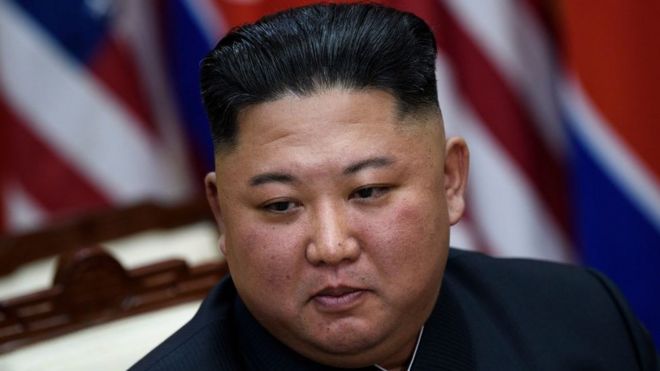
Image copyright BRENDAN SMIALOWSKIImage caption Kim Jong-un has not been seen in public for more than two weeks
Speculation and rumour about Kim Jong-un’s health may amount to nothing, but questions about who might succeed him in the short or long term will always be there. The BBC spoke to analysts about the contenders and whether history is on their side.
A male member of the Kim family has been in charge of North Korea ever since its founding by Kim Il-sung in 1948 – and the mythology of this family runs deep throughout society.
Propaganda about its greatness begins for citizens before they can even read: pre-schoolers sing a song called: “I want to see our leader Kim Jong-un.”
So how can you imagine a North Korea without this symbolic and political figure at the top? How would elites organise themselves, as well as society as a whole?
The easy answer is: we don’t know. More interestingly, they don’t know either. They have never had to do it.
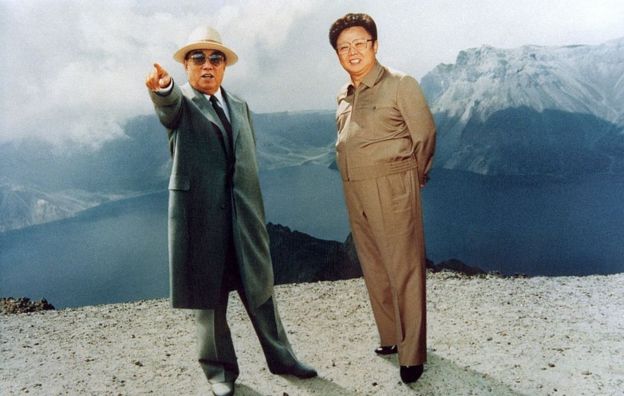
Image copyrightXINHUAImage captionKim Il-sung is the founder of North Korea and his son Kim Jong-il took over
As Kim Jong-un was being prepared for power, they even began using the term “Paektu Bloodline” to help legitimise his rule. Paektu is the sacred and mythologised mountain where Kim Il-sung is said to have waged guerrilla war and where Kim Jong-il was reportedly born. Kim Jong-un still goes there when he wants to emphasise important policy decisions.
There has always been a Kim at the ideological heart of the country.
What would North Korea be like without such an heir? Kim Jong-un, 36, is believed to have children – but they are far too young. It is thought he has three children, the oldest being 10 and the youngest three. Kim Jong-un himself was considered young when he took power – he was 27.
It is likely that some sort of group leadership would emerge, perhaps as in Vietnam, that leans heavily on the founder’s teachings and legitimacy to boost their own standing.
Observers can track who holds certain key positions and can follow news and open-source intelligence about important institutions, but can’t really tell how factions are developing, nor who is holding power through personal rather than institutional bonds. Moreover, sometimes vice or deputy directors wield more real power than the titular heads of institutions. This makes all predictions extremely difficult.
The three remaining Kims
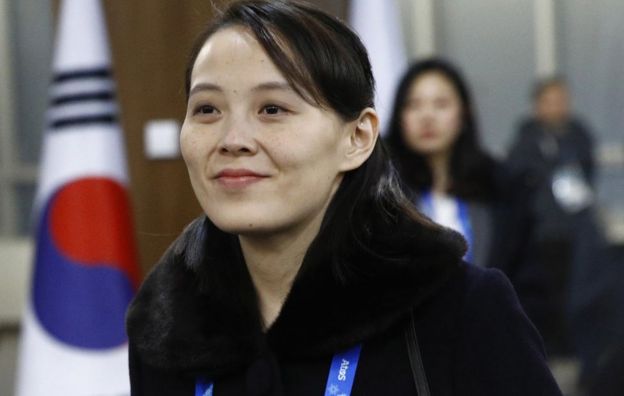
Image copyrightPATRICK SEMANSKY – POOL /GETTY IMAGESImage captionKim Yo-jong, as the only woman in the top leadership, has sparked fascination
The are three Kims who could potentially be involved in the political make-up of North Korea if Kim Jong-un were to disappear. They all face limitations in carrying on family rule.
The first is Kim Yo-jong, Kim Jong-un’s younger sister. She is said to have been a favourite of her father who commented on her precocity, her interest in politics from a young age. Her manner is efficient, mild and one suspects rather observant. Much has been made of her closeness to her brother. At the Singapore Trump-Kim summit she was famously on hand to pass him a pen to sign the agreement with, and at the next summit in Hanoi, was pictured peeking out from behind corners as her brother posed for statesman-like photos.
Yet she was not above a temporary demotion after the Hanoi summit – purportedly because of its failure although this will never be confirmed. She doesn’t sit on the top policy-making body, the State Affairs Commission, but is an alternate member of the Politburo and vice director of the Propaganda and Agitation Department (PAD) of the Workers’ Party of Korea. These may seem like incomprehensible acronyms but the PAD is a powerful organisation that ensures ideological loyalty in the system.
She is a woman, however, and this makes it hard to imagine her occupying the top position in such a deeply patriarchal country. North Korea is an extremely male state, in which gender carries rigid expectations. Being supreme leader, and certainly running the military, does not fit in the range of womanly duties.
The second is Kim Jong-chul. He is Kim Jong-un’s older brother, but has never appeared interested in politics or power. (He is known to be interested in Eric Clapton.) At most, he could be a symbolic link to the Kim family: perhaps made the head of a foundation and put forward to read the odd speech.
The final one is Kim Pyong-il, Kim Jong-il’s half-brother. His mother – Kim Jong-il’s stepmother – was angling to have him become Kim Il-sung’s successor. She failed and was sidelined by Kim Jong-il as he rose in influence. Kim Pyong-il was sent to Europe in 1979, where he has held various ambassadorships, returning to North Korea only last year. This means it is very unlikely he has the network to be a central player in elite politics in Pyongyang.
The second-most powerful man in North Korea right now
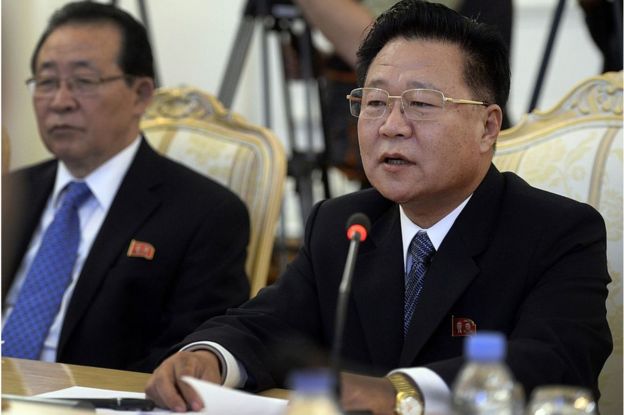
Image copyrightALEXANDER NEMENOV/AFP VIA GETTY IMAGESImage captionAs special envoy for Kim Jong-un Choe Ryong-hae (right) has met foreign dignitaries
There are other individuals who have been central in the Kim Jong-un era, but it is difficult to know who among them would form co-operative relationships and who would compete with one another.
One is Choe Ryong-hae. He has had his ups and downs under Kim Jong-un, but having weathered a few storms currently sits on the presidium of the politburo and is also first vice chairman of the State Affairs Commission. Last year he became the first new president in 20 years, replacing the aging Kim Yong-nam – so he is the person who represents the North at international engagements.
Choe has also held high positions in the military and the Organization and Guidance Department (OGD) of the Worker’s Party of Korea, responsible for enforcing loyalty throughout the regime. This is an extremely powerful organisation: it enforces the adherence of all citizens to North Korea’s ideology. He is probably the second most powerful man in North Korea.
The old spymasters and rising political grandees
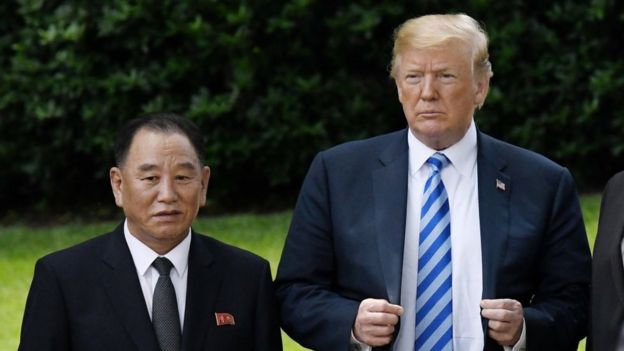
Image copyrightOLIVIER DOULIERY-POOL/GETTY IMAGESImage captionKim Yong-chol travelled to Washington DC to meet Donald Trump
Another is Kim Yong-chol. This general paved the way for the Trump-Kim summits, meeting US Secretary of State Mike Pompeo several times. He has been head of the United Front Department (responsible for relations with South Korea) and the Reconnaissance General Bureau, the country’s main intelligence service. He seems to have suffered a demotion following the collapse talks with the United States, but it is unlikely this spymaster will remain obscure for long.
Yet another is Kim Jae-ryong. As well as being on the State Affairs Commission, he is Premier of the Cabinet, a moderately influential position. Relatively little is known about him, but his star has risen in the past years as others have fallen. He is known for managing industries and ran the most isolated province, home to key military-industrial sites, for several years. This may mean he has been closely involved in the nuclear program.
Jong Kyong-taek is responsible for the State Security Department, which investigates and punishes political crimes. It also helps physically protect the leadership. These are crucial responsibilities that help enforce stability in the system.
Hwang Pyong-so is another official who has held top military posts and has run the OGD in the Kim Jong-un era. Like Choe (and many others) he has been disciplined; he doesn’t seem to have been rehabilitated in the same way, however. Other 2010s foreign policy stalwarts Ri Yong-ho and Ri Su-yong have also seen roles diminish recently. They have been replaced by Ri Son-gwon and Kim Hyung-jun. The former is said to be an ally of Kim Yong-chol.
The military enforcers
A handful of top generals of the Korean People’s Army (KPA) would also certainly exert influence in any transition period. Currently, two men sit atop the General Political Bureau of the KPA, Kim Su-gil and Kim Won-hong. This bureau enforces political loyalty in the military, something that would be absolutely crucial during periods of uncertainty.
Kim Won-hong, helps illustrate how difficult it is to predict how power would be shared if Kim Jong-un were no longer there. Kim Won-hong and Hwang Pyong-so had been thought to be rivals, competing to influence Kim Jong-un at the other’s expense.
Amongst top elites, who would clash and who would ally? Would there be pro and anti-Kim Yo-jong factions? Would the fear of instability stop rivalries from getting out of hand? After all, it is in no elite politician’s interest to see the state collapse, opening the door for some kind of takeover by South Korea, or even China.
There is currently no perfect contender: his sister would have to overcome the sexism and the break from tradition of a male heir. Anybody else is not directly descended from that all-important Paektu bloodline. but in the end, they will all have to think of the unity of the state they have defied every international norm to preserve.
Leaders exchange congratulatory messages on 70th anniversary of diplomatic relations amid speculation that Kim Jong-un will visit China soon
It comes after Pyongyang’s denuclearisation negotiations with Washington broke off in Stockholm without any breakthroughs
North Korean leader Kim Jong-un (left) may soon visit China again. He last met Xi Jinping during the Chinese leader’s trip to Pyongyang in June. Photo: AFP
China and North Korea on Sunday vowed to continue strengthening their ties that have “stood the test of time”, hours after another squabble broke out between Pyongyang and Washington over the breakdown of their first nuclear talks in eight months.
Chinese President Xi Jinping exchanged congratulatory messages with North Korean leader Kim Jong-un on the 70th anniversary of diplomatic ties, according to state media in both countries, amid speculation that Kim will soon pay another visit to China.
Observers said the communist neighbours’ warm exchanges and Kim’s possible visit showed Beijing and Pyongyang shared mutual interests and needed each other in their respective geopolitical plans to counter Washington – especially as they both come under pressure from US President Donald Trump.
The two countries are said to be preparing for Kim to visit China as early as Sunday, which would be his fifth China trip since March last year and the first since Xi’s state visit to Pyongyang in June.
But given Pyongyang’s denuclearisation negotiations with Washington on Saturday – which broke off in Stockholm without any breakthroughs – China and North Korea may need to reconsider or delay Kim’s visit to avoid criticism of Beijing’s role in the nuclear talks, one expert suggested.
“The triangular ties between China, the United States and North Korea are of immense importance in finding a solution to the nuclear issue on the Korean peninsula and Beijing’s role in the talks has always been sensitive, especially in the eyes of the US and its allies,” said Wang Sheng, a North Korea specialist at Jilin University.
“While China will almost certainly reiterate its stance to support continued dialogue and talks between Pyongyang and Washington, it may not be a good time for Kim’s high-profile visit just a day after their talks broke down, which would inevitably make it more difficult for China to play a mediating role,” he said.
On Sunday, Xi said the traditional friendship between the two countries had “stood the test of time and changes in the international landscape, growing stronger with the passage of time” and “made important and positive contributions to regional peace and stability”, according to Chinese state news agency Xinhua.
Citing his five recent meetings with Kim, Xi said bilateral ties had entered a new era and China would promote “long-term, healthy and stable” relations with North Korea.
Kim also hailed the special relationship between the two countries, which he said had been forged “at the cost of blood” and “weathered all tempests while sharing weal and woe with each other”, the Korean Central News Agency reported.
North Korean mouthpiece Rodong Sinmun meanwhile said in a commentary that bilateral ties with Beijing were “fully in accordance” with the interests of the two sides and would develop “regardless of the international situation”, according to South Korea’s Yonhap news agency.
The lavish praise for Sino-North Korean relations comes as a group of working-level officials from North Korea are working with the Chinese side for a possible visit by Kim in the next few days, according to South Korea’s Dong-A Ilbo.
China and North Korea have set aside their differences as both countries come under pressure from US President Donald Trump. Photo: AFP
North Korea was among the first countries to recognise the People’s Republic of China
70 years ago and Xi has exchanged three messages with Kim in the past month, repeatedly pledging to move closer despite lingering grievances over Pyongyang’s nuclear brinkmanship.
In the face of Trump’s increasingly antagonistic approach, the former communist allies – whose relationship deteriorated over Beijing’s support for the UN sanctions against the North, led by Washington – have set aside their differences to patch up ties in recent months.
Meanwhile, Pyongyang’s first nuclear talks with Washington in eight months ended on Saturday with the two sides offering conflicting assessments of their first formal discussion since the failed Trump-Kim summit in Vietnam in February.
North Korea’s top negotiator Kim Myong-gil expressed his “great displeasure” with the discussions, blaming Washington and urging the Trump administration to correct its course and keep the talks alive or “forever close the door to dialogue”, according to Yonhap.
North Korean negotiator Kim Myong-gil expressed his “great displeasure” with the discussions on Saturday. Photo: AP
But the US State Department issued a rebuke hours later, claiming the negotiators had a “good discussion”. State Department spokeswoman Morgan Ortagus said in a statement that the US had put forward “creative ideas” and “a number of new initiatives that would allow us to make progress in each of the four pillars of the Singapore joint statement”.
The two countries were not expected to “overcome a legacy of 70 years of war and hostility on the Korean peninsula through the course of a single Saturday”, she said, adding that Washington would return for more discussions with Pyongyang in two weeks at Sweden’s invitation.
As Trump administration enters survival mode, foreign policy moves are anyone’s guess
Wang from Jilin University said the breakdown of another round of talks had again laid bare the huge gap between the two sides over a long list of issues, from the definition of denuclearisation to their vastly different, often conflicting, demands and interests.
“It’s very likely that Washington has again rejected some of Pyongyang’s key demands in the recent talks, such as providing a security guarantee for Kim’s regime and a range of economic sanctions relief,” he said.
And with North Korea a polarising issue in the looming US presidential poll for Trump as he seeks to score diplomatic points for his re-election bid, it might become even more challenging for the two sides to narrow their differences.
“The breakdown of the talks should not be seen as a failure,” Wang said. “It simply underscores the difficulty of reaching any consensus in the nuclear talks, which still have a long way to go.”
Stalled denuclearisation talks also expected to be on the agenda when Chinese president meets Kim Jong-un this week
Analysts say Korean peninsula has become intense diplomatic battleground between Beijing and Washington
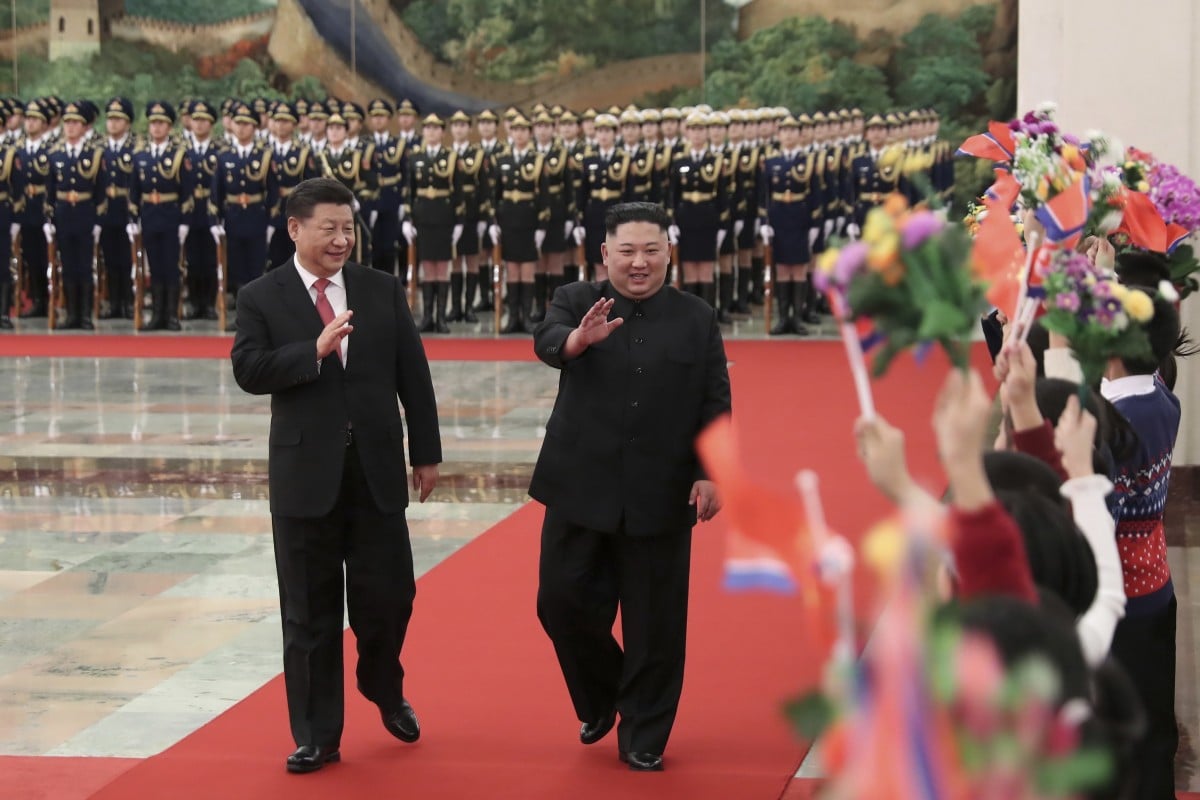
North Korean leader Kim Jong-un (right) attends a welcome ceremony in Beijing with Chinese President Xi Jinping in January. Xi will begin a visit to Pyongyang on Thursday. Photo: AP
will be a state visit – a higher status than the last trip to the hermit kingdom by a Chinese president, highlighting the close bilateral ties between Beijing and Pyongyang.
, is the first by a Chinese president to North Korea in 14 years and comes just a week before he is due to meet US President Donald Trump for talks on the sidelines of the Group of 20 summit in Japan.
“Leaders of the two countries will review the development of the bilateral relationship and carry out an in-depth exchange of opinions on the development of Sino-North Korean relations in the new era, and chart the future course of development,” state news agency Xinhua reported on Tuesday.
Xi’s predecessor, Hu Jintao, went to North Korea in October 2005 on a three-day trip described as an “official goodwill” visit.
Speaking at a regular press briefing in Beijing on Tuesday, foreign ministry spokesman Lu Kang said Xi’s visit aimed to “inject new impetus” into relations in the year the two countries marked the 70th anniversary of establishing diplomatic ties, and to give stalled denuclearisation talks a much needed push.
“Regarding the progress on denuclearisation, as I said, the result of the Hanoi leaders’ meeting in February was indeed a little unexpected. But after that, everyone actually looks forward to the resumption of dialogue in a good direction,” Lu said, referring to the failed talks between Trump and North Korean leader Kim Jong-un in the Vietnamese capital four months ago.
Trump hinted at the possibility of another meeting with Kim after receiving what he called “a beautiful letter” from the North Korean leader last week. On Tuesday, South Korea’s chief nuclear negotiator, Lee Do-hoon, said the US had been in contact with the North.
Life in North Korea the ‘admiration and envy’ of others, state media says
Washington will also send US Special Representative for North Korea Stephen Biegun to South Korea next week, days after Xi’s visit to Pyongyang, to fully align its position on North Korea with its ally.
Meanwhile, Trump confirmed he would meet Xi for talks in Osaka next week, saying in a tweet on Tuesday they had “a very good telephone conversation” and would hold “an extended meeting” at the G20 summit, where they are
Had a very good telephone conversation with President Xi of China. We will be having an extended meeting next week at the G-20 in Japan. Our respective teams will begin talks prior to our meeting.
Analysts said the Korean peninsula had become an intense diplomatic battleground between Beijing and Washington.
Cha Du-hyeogn, a visiting research fellow at the Asan Institute for Policy Studies in Seoul, said China and the US were competing for influence over the peninsula.
“The US and China are seeking a greater sphere of influence in the region. After the Singapore summit between Trump and Kim last year, the US and North Korea are the only key players on peninsula matters. China may want to restore its influence and become a major player,” Cha said.
“But China is less likely to have a so-called strategic competition with the US – that is to say, it won’t challenge the US-led sanctions regime and its goal in achieving North Korea’s denuclearisation. In fact, it is likely to persuade Kim to come to the negotiating table for complete denuclearisation.”
Chinese tourists flood North Korea as Beijing remains Pyongyang’s key ally
Pyongyang has demanded the lifting of sanctions imposed on the regime following its nuclear and missile tests, while Beijing has said the livelihoods of North Koreans should not be affected. But Washington insists full sanctions should remain in place.
The US has also voiced scepticism about Chinese compliance with the sanctions. At a security summit in Singapore earlier this month, US acting Pentagon chief Patrick Shanahan – who on Wednesday stepped down from his role
– presented his Chinese counterpart Wei Fenghe with photographs and satellite images of North Korean ships transferring oil near China’s coast.
Analysts said Xi would seek to use the visit to boost China’s diplomatic leverage on the North Korean nuclear front, strengthening its hand in dealing with the US.
Exports from North Korea to China, which account for the bulk of its trade, plunged 87 per cent last year from 2017, and the country has faced other economic problems at a time when Kim has vowed to deliver on the economy.
A diplomatic source said China was expected to offer a large amount of humanitarian assistance, such as food and fertiliser, to North Korea, which could weaken the impact of sanctions.
China’s goal of denuclearisation on the Korean peninsula is unwavering and will not changeLu Chao, North Korean affairs expert at Liaoning Academy of Social Sciences
Communist Party mouthpiece People’s Daily on Tuesday said via its social media account that Xi would discuss economic and trade cooperation with Kim during the visit.
Quoting Zheng Jiyong, director of the Centre for Korean Studies at Fudan University in Shanghai, the newspaper said Pyongyang had taken steps to reform its economy and introduced China’s industrial manufacturing blueprint.
In September, Beijing proposed building a rail link from the city of Dandong, in China’s northeastern Liaoning province, to Pyongyang and then on to Seoul and Busan in the South, as well as a new road between Dandong and Pyongyang through Sinuiju.
Lu Chao, a North Korean affairs expert at the Liaoning Academy of Social Sciences, said large-scale economic cooperation between China and North Korea was unlikely because of the sanctions, but smaller moves were possible.
Chinese tourists flood North Korea as Beijing remains Pyongyang’s key ally
“For example, China may export daily necessities to North Korea. And if it’s needed, China is very likely to provide [food] assistance to North Korea,” Lu said. “I believe the UN sanctions on North Korea should change, because it has shown a more substantive approach to [achieving] denuclearisation.”
But analysts said Beijing remained firm on the need for Pyongyang to honour its pledges so that denuclearisation could be achieved.
“China’s goal of denuclearisation on the Korean peninsula is unwavering and will not change … China supports [North Korea] and the US continuing to hold talks,” Lu said.
Beijing also had an important part to play in the peace process, according to Boo Seung-chan, an adjunct professor at the Yonsei Institute for North Korean Studies in Seoul.
“China can have a positive role as a mediator to facilitate the peace process on the Korean peninsula,” Boo said.
‘Traditional friendship’ between two nations will continue whatever the future brings, Xi says ahead of two-day trip to Pyongyang
Visit comes amid rising tensions between Beijing and Washington, and stalled negotiations on the denuclearisation of the Korean peninsula
Chinese President Xi Jinping says China will continue to “firmly support” North Korean leader Kim Jong-un. Photo: AP
Chinese President Xi Jinping has pledged his full support for North Korean leader Kim Jong-un and promised to play an active role in efforts to bring peace and stability to the region, a day ahead of his
Xi’s comments, in an editorial published by North Korean newspaper Rodong Sinmunon Wednesday, come as China remains locked in a trade and technology war with the United States, and after a second summit between US President Donald Trump and Kim in Hanoi in February failed to achieve any progress on the denuclearisation of the Korean peninsula.
“No matter how the international situation changes”, China would “firmly support Chairman Kim Jong-un to lead the North Korean party and people to implement the new strategic line”, the article said.
As well as expressing the two sides’ desire to strengthen “strategic communication and exchanges”, Xi said Beijing would continue to support Pyongyang in its negotiations with other countries.
Xi Jinping (left) says China will “contribute to peace, stability, development and prosperity in the region”. Photo: EPA-EFE
“We will actively contribute to peace, stability, development and prosperity in the region by strengthening communication and coordination with the Democratic People’s Republic of Korea,” he said, referring to the country by its official name.
China would also engage with other stakeholders “by jointly expediting progress on dialogue and negotiations on the issues of the Korean peninsula”, he said.
Xi’s state visit to North Korea aims for ‘new impetus’ in ties
Speaking ahead of Xi’s two-day trip to Pyongyang, which starts on Thursday, Chinese foreign ministry spokesman Lu Kang said on Tuesday that the outcome of the Trump-Kim summit in Hanoi was “a little unexpected” and that China was encouraging both sides to continue their dialogue.
” from Kim that had “reset” the tone between the two countries. In May, he said Pyongyang was “not ready to negotiate”.
One of the major stumbling blocks in the negotiation process has been the United Nations sanctions. Pyongyang has stipulated that they should be lifted as a precondition of the denuclearisation process while Washington has insisted they should remain in place until North Korea provides clear evidence the process is under way.
China, meanwhile, has been accused of providing large amounts of humanitarian aid to its neighbour to help offset the impact of the sanctions.
Xi said China would continue to support North Korea in raising “legitimate concerns through dialogue”.
“No matter how the wind and clouds of the international situation change, our two parties and two peoples inherit and carry forward the traditional friendship between China and the DPRK,” he said.
Zhao Tong, a fellow at the Carnegie-Tsinghua Centre for Global Policy, said that while the main aim of Xi’s visit was to reaffirm ties, its timing, amid the US-China dispute, was designed to show Beijing still had a role to play in the negotiations.
“As China-US strategic rivalry grows, China wants to maintain its geopolitical influence on the Korean peninsula. By demonstrating its unique relations with the DPRK at a time when neither Washington nor Seoul is able to resume high-level engagements with Pyongyang, Beijing is signalling to Washington that it is still a helpful, constructive and indispensable partner to resolve important regional problems,” he said.
Xi’s visit to North Korea will be the first by a Chinese leader since Hu Jintao in 2005.
Buses from the North make return trip to China on Monday, according to South Korean media
Opening of Jian-Manpo border crossing had been delayed during heightened tension over sanctions on the North
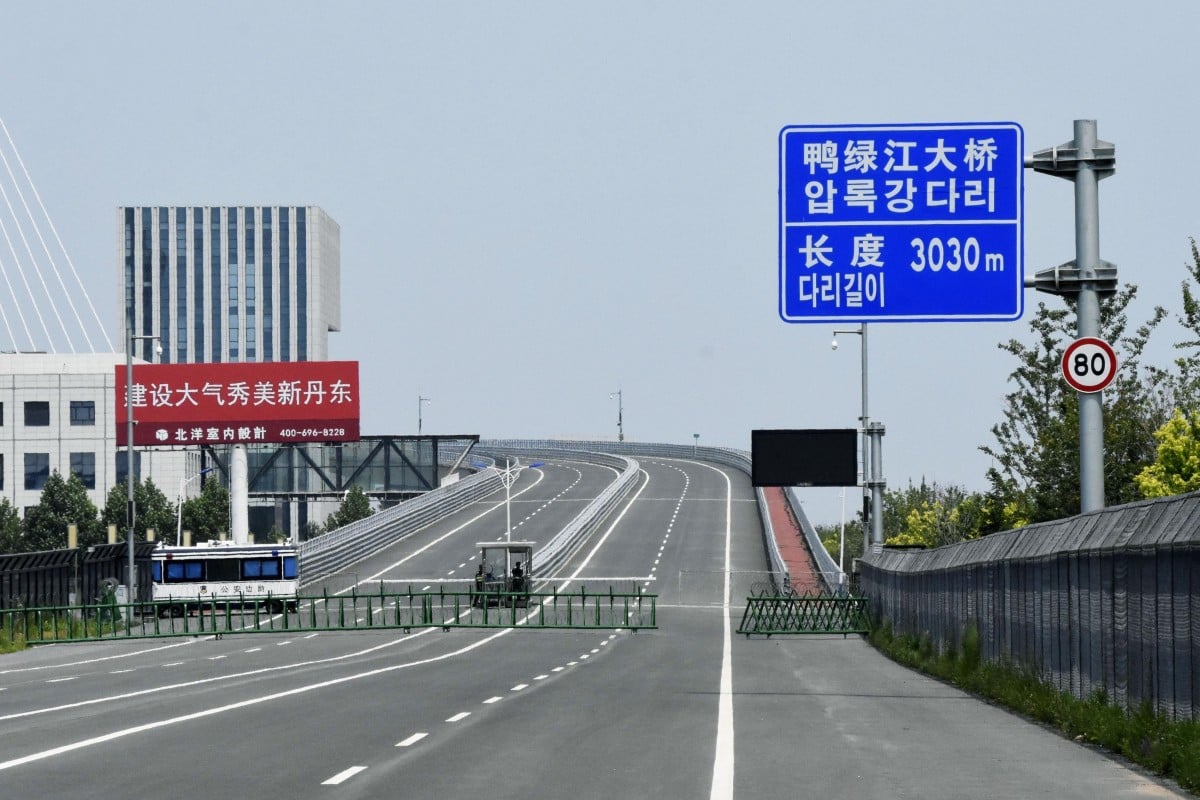
The bridge crosses the Yalu River on the border between China and North Korea. Photo: Kyodo
China and North Korea have finally opened a border bridge built between the two countries in 2016, in a potential boost to the North’s economy as Beijing tries to balance its concerns about its neighbour against ongoing international pressure for it to denuclearise.
A border checkpoint and bridge connecting the Chinese city of Jian with North Korea’s Manpo were open on Monday, following three years of delays since they were built.
Four buses crossed the border from North Korea in the morning and returned to the hermit kingdom about an hour later carrying about 120 people, who included tourists, according to South Korean media. It was not known whether the people travelled from North Korea or boarded the buses in China.
The bridge had remained closed on its completion in 2016, with Beijing taking a cautious approach at a time when it faced international scrutiny of whether it was fully implementing UN Security Council sanctions on the North.
to enforce the sanctions after a UN committee accused it and South Korea of being reluctant to enforce a ban on coal exports from the North.
But there has been a change in the status of the Jian-Manpo border crossing – built near to where Kim’s father, the former leader Kim Jong-il, was reported to have crossed the border in 2010 in a rare trip outside his country.
Kim’s second summit with Trump in February collapsed against a backdrop of continued economic struggles for North Korea. Beijing is wary of instability around the North Korean regime posing a threat to the security of China’s northeast, fearing an influx of refugees into one of its poorest regions.
North Korea’s trade has suffered to the extent that the Korea Development Institute said in February it had almost collapsed.
The North’s exports to China – which accounts for the bulk of its trade – plunged 87 per cent year-on-year in 2018, according to data compiled by South Korea’s Korea
International Trade Association, while there have been myriad other economic problems at a time when Kim has vowed to deliver on the economy.
In April last year, Kim announced that Pyongyang was moving away from its twin-track “byungjin” policy of developing nuclear weapons and the economy simultaneously to focus exclusively on rebuilding the economy.
Boo Seung-chan, adjunct professor at the Yonsei Institute for North Korean Studies in Seoul, said the bridge’s primary use would be to boost tourism in North Korea, which is not restricted by the UN sanctions.
“Tourism is the only sector left for the North Koreans to earn foreign revenue,” Boo said. “Besides, China can only offer its financial help through the tourism sector as it does not wish to violate UN sanctions.
“China’s Korean peninsula policy is to maintain the stability of the region. It may also be drawing a road map for when sanctions may be lifted, finding its means to accelerate its economic engagement to increase its sphere of influence.”
President Donald Trump has said that the US and China are “very very close” to signing a trade agreement, potentially ending the long-running feud between the two countries.
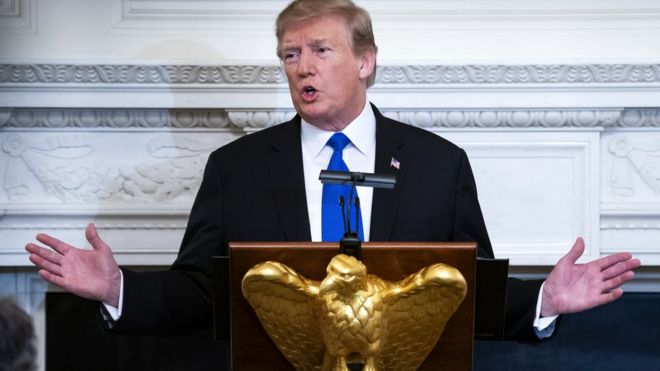
Mr Trump told US governors on Monday that both nations “are going to have a signing summit”.
“Hopefully, we can get that completed. But we’re getting very, very close,” he said.
It follows a decision to delay imposing further trade tariffs on Chinese goods.
Mr Trump’s decision to delay tariff increases on $200bn (£153bn) worth of Chinese goods was seen as a sign that the two sides were moving ahead in settling their damaging trade war.
Last week, Mr Trump noted progress in the latest round of negotiations in Washington, including an agreement on currency manipulation, though no details were disclosed.
Sources told CNBC on Friday that China had committed to buying up to $1.2 trillion in US goods, but there had been no progress on the intellectual property issues.
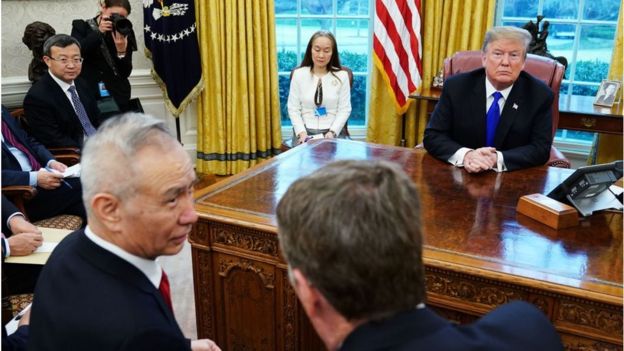
Image copyrightAFPImage captionPresident Trump met China’s Vice Premier Liu He on Friday
Gregory Daco, chief US economist at Oxford Economics, said: “We had anticipated such a delay and believe a handshake agreement in which China will promise to import more agricultural products, work towards a stable currency and reinforce intellectual property rights protection will be achieved in the coming weeks.
“However, we don’t foresee a significant rollback of existing tariffs, and see underlying tensions regarding China’s strategic ambitions, its industrial policy, technological transfers and ‘verification and enforcement’ mechanisms remaining in place.”
What has happened in the trade war so far?
Mr Trump initiated the trade war over complaints of unfair Chinese trading practices.
That included accusing China of stealing intellectual property from American firms, forcing them to transfer technology to China.
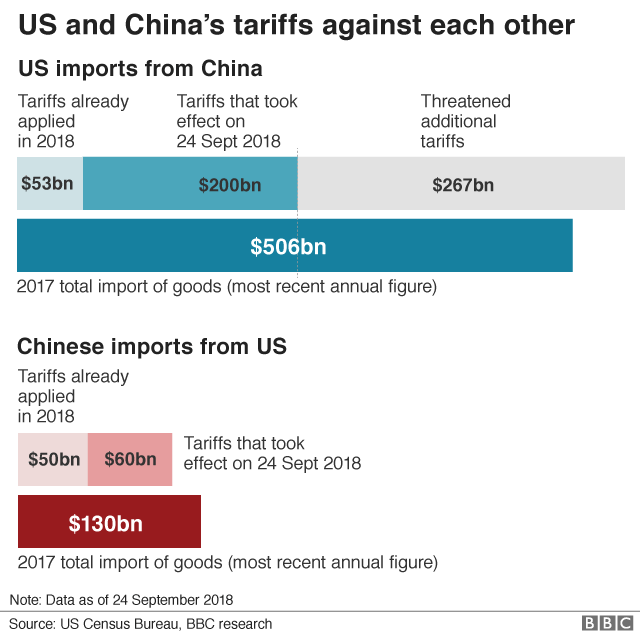
The US has imposed tariffs on $250bn worth of Chinese goods, and China has retaliated by imposing duties on $110bn of US products.
Mr Trump has also threatened further tariffs on an additional $267bn worth of Chinese products – which would see virtually all of Chinese imports into the US become subject to duties.
SEOUL/HANOI (Reuters) – North Korean leader Kim Jong Un made his way across China by train on Sunday, media reported, bound for a high-stakes second nuclear summit with U.S. President Donald Trump in Vietnam’s capital of Hanoi.
Few details of Kim’s trip have been announced but he left Pyongyang by train on Saturday afternoon for the Feb. 27-28 summit accompanied by senior North Korean officials as well as his influential sister, North Korea’s state media reported.
RELATED COVERAGE
Vietnam relishes role as peace maker as it seeks to balance ties
Vietnam’s Bamboo Airways to buy 10 Boeing planes during Trump-Kim summit
‘Chilling the atmosphere’ – North Korea media condemns U.S. Democrats ahead of summit
Trump and Kim will meet in Hanoi eight months after their historic summit in Singapore, the first between a sitting U.S. president and a North Korean leader, where they pledged to work towards the complete denuclearisation of the Korean peninsula.
With little progress since then, the two leaders are expected to focus on what elements of North Korea’s nuclear programme it might begin to give up, in exchange for U.S. concessions.
In rare, revealing coverage of Kim’s travel, while it is still going on, the North’s Rodong Sinmun newspaper featured photographs of him getting a red-carpet send-off in Pyongyang and waving from a train carriage door while holding a cigarette.
He was accompanied by top officials also involved in the Singapore summit, including Kim Yong Chol, a former spy chief and Kim’s top envoy in negotiations with the United States, as well as senior party aide Ri Su Yong, Foreign Minister Ri Yong Ho and defence chief No Kwang Chol.
The North Korean leader’s sister, Kim Yo Jong, who acted as a close aide in Singapore, is again part of the delegation, the North’s KCNA news agency reported. It made no mention of his wife, Ri Sol Ju.
The extensive coverage in the secretive North’s official media was a contrast to the limited reporting that has traditionally prevailed during his foreign trips.
Other senior officials, such as his de facto chief of staff Kim Chang Son and Kim Hyok Chol, negotiations counterpart to U.S. envoy Stephen Biegun, were already in Hanoi to prepare for the summit.
With scant progress since the June summit, the two leaders are likely to try to build on their personal connection to push things forward in Hanoi, even if only incrementally, analysts said.
Both sides are under pressure to forge more specific agreements than were reached in Singapore, which critics, especially in the United States, said lacked detail.
“They will not make an agreement which breaks up the current flow of diplomacy. (President Trump) has mentioned that they’ll meet again; even if there is a low-level agreement, they will seek to keep things moving,” said Shin Beom-chul, a senior fellow at the Asan Institute for Policy Studies.
LEARNING FROM VIETNAM
The Trump administration has pressed the North to give up its nuclear weapons programme, which, combined with its missile capabilities, poses a threat to the United States, before it can expect any concessions.
North Korea wants an easing of punishing U.S.-led sanctions, security guarantees and a formal end of the 1950-1953 Korean War, which ended in a truce, not a treaty.
Few details of summit arrangements have been released.
Some lamp posts on Hanoi’s tree-lined streets are decked with North Korean, U.S. and Vietnamese flags fluttering above a handshake design, and security has been stepped up at locations that could be the summit venue, or where the leaders might stay.
It could take Kim at least 2-1/2 days to travel to Vietnam by train.
Some carriages of a green train were spotted at Beijing’s station on Sunday, but it was not confirmed it was Kim’s.
South Korea’s Yonhap news agency said Kim’s train had passed through a station in China’s port city of Tianjin, southeast of Beijing, at around 1 p.m. (0500 GMT).
China has given no details of his trip. Its foreign ministry did not immediately respond to a request for comment.
Two top North Korean officials who were not in Singapore but will be in Hanoi are Kim Phyong Hae and O Su Yong, vice chairmen of the party’s Central Committee, respectively in charge of personnel management and industrial affairs, KCNA reported.
O is a former minister of electronics and vice minister of metals and machine building. He might try to learn about Vietnam’s development of manufacturing, analysts said.
Kim Jong Un may tour some economic facilities while in Vietnam.
Vietnam, like North Korea, fought a war against the United States and keeps tight control over its people and economy. It has been touted as a model for North Korea’s development.
Vietnamese media reported that a North Korean cargo plane arrived on Sunday carrying personnel who appeared to be Kim’s security guards and state media workers. They were driven under police escort to a downtown hotel.
The usual cast of characters were back at the negotiating table, trying to find a way to stem another round of US tariff increases that were stayed in December after the Buenos Aires G20 meeting between US President Donald Trump and Chinese President Xi Jinping.
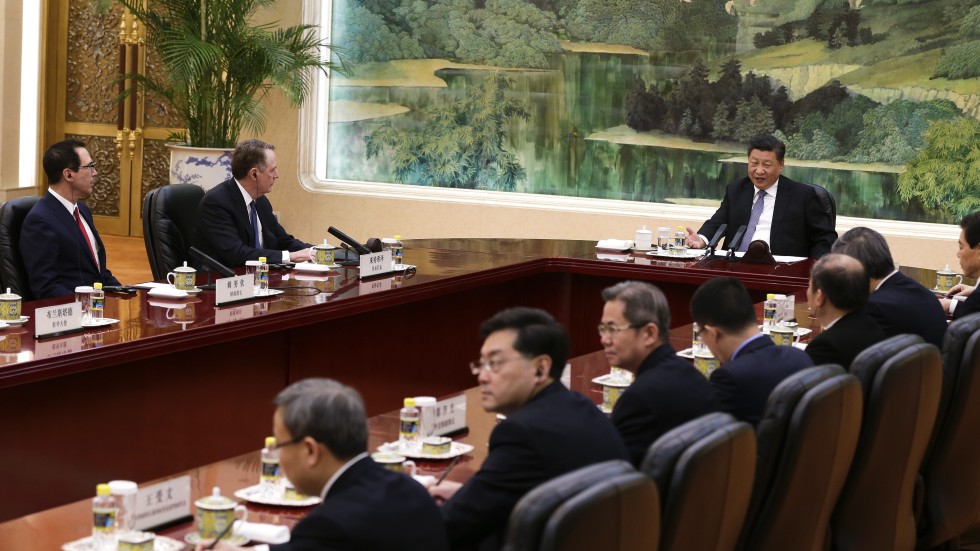
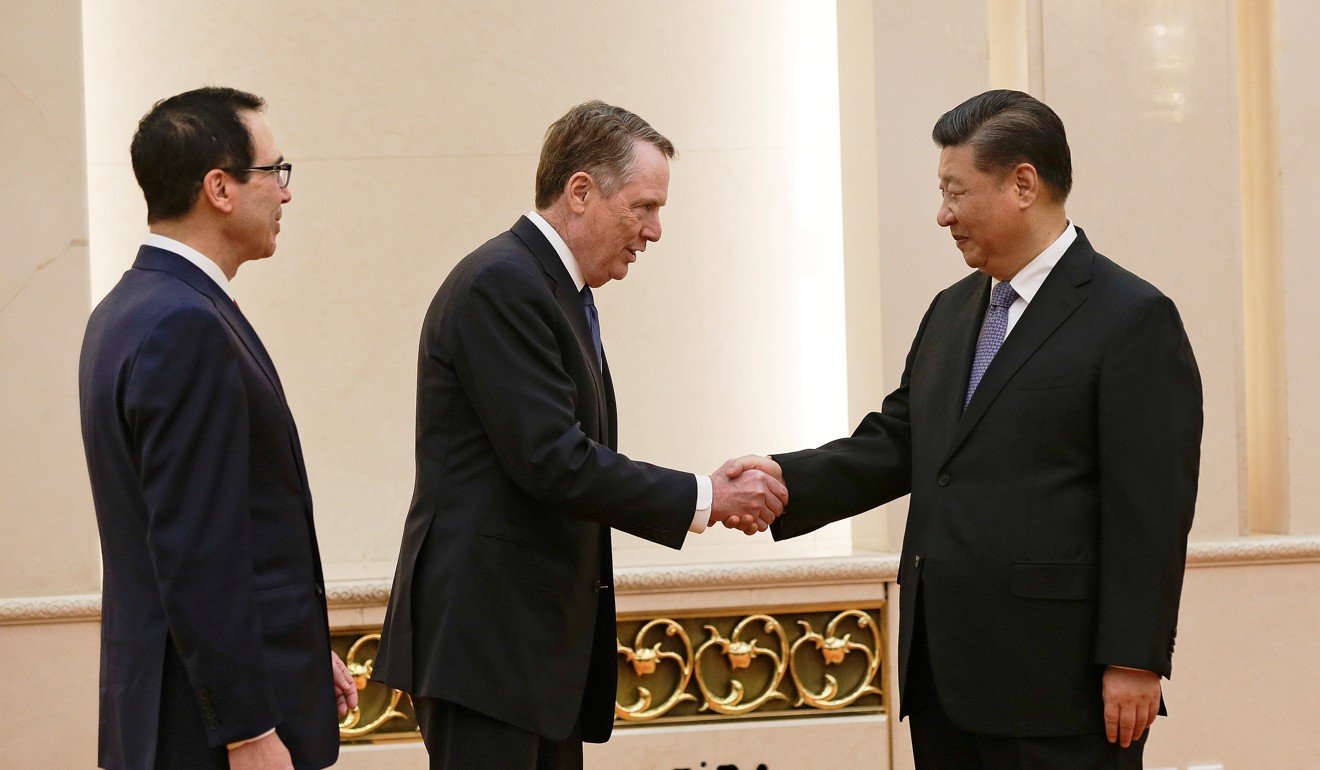
US Treasury Secretary Steven Mnuchin and Trade Representative Robert Lighthizer were back in Beijing, where they again sat across the table from Vice-Premier Liu He, China’s lead trade negotiator. The US delegation also met Xi himself at the end of the talks on Friday.
Both nations said they had made progress to settle their disputes, but admitted there were still difficult issues to deal with. Negotiators will continue the talks in Washington next week.
The stakes are clear and the clock is ticking. The two sides need to arrive at an understanding by March 2, the day on which Trump has said he will move forward with an increase in tariffs.
At least that was the idea. In recent days, Trump has made multiple remarks that suggest the March deadline is anything but absolute. He has hinted he would be open to pushing it back if he sensed that a deal was around the corner. Reports have even suggested the White House is considering another 60-day extension of the tariff truce.
Already articulated US concerns cover a broad range of Chinese practices. The ideal short-term measures the American side would like to see include unconditional market access for US firms in China; a less insulated environment for state-owned enterprise decision making; greater regulatory transparency; and fairer legal protections for American businesses in China.
As with so many aspects of the Trump administration’s foreign policy, the US president’s personality is taking over the process, leaving his deputies who are doing the negotiating in a disadvantageous position. For China, the obvious answer then becomes not to discuss the nuances of what kinds of structural reform might be necessary with Lighthizer, but to simply get Xi in the room with Trump.
This mirrors the lesson that North Korea’s Kim has taken away over the course of nearly a year of negotiations with the US. Instead of expending any serious diplomatic capital in a detail oriented negotiation with the secretary of state or the president’s special representative, the key is to simply meet Trump and work out high-level arrangements mano a mano.
In this climate, we can’t expect a real resolution on the core issues. Everything from American misgivings about Beijing’s interventionist industrial policies that protect Chinese enterprises to broader structural shifts in the nature of the US-China economic relationship since the turn of the century are on the table today – and they’ll stay there.
Xi and Trump may well find a temporary way out of the impasse, giving global investors the runway necessary to avert the panic that would likely ensue if the US pushed ahead with a tariff increase on US$200 billion in Chinese goods. Even if China doesn’t quite give the United States a down payment on structural reforms, Xi can promise Trump that he will chip away at the trade deficit while leaving untouched the issues that a more detail oriented negotiator like Lighthizer might zero in on.
If there is a “win-win” outcome here, it would be for Trump and Xi to find an agreeable arrangement that would allow the US president to walk away looking tough to his base while leaving China’s core, long-term industrial policy trajectory unharmed. That would strip away any remaining negotiating leverage the US side might have within the trade war, and it’s not unlikely.
Speculation had grown on Monday that Mr Kim was possibly making his way to China after South Korea’s Yonhap news reported that a North Korean train had been seen crossing the border.
Dozens of security vehicles and officials blocked roads around the train station in the border town of Dandong.
Hotel guests in Dandong had also not been allowed to enter rooms that faced the border, with news outlet Kyodo calling this an “apparent move to prevent the train from being seen”.
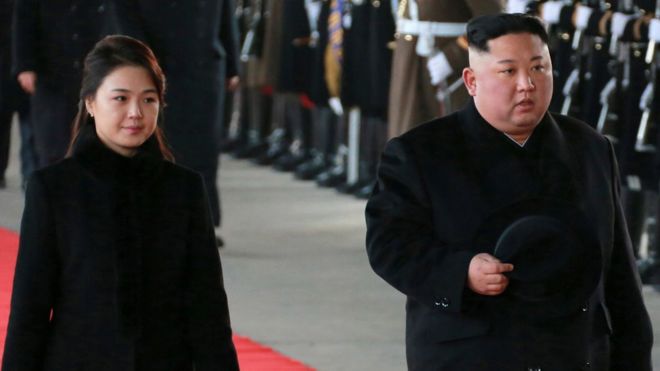
Image copyrightREUTERS
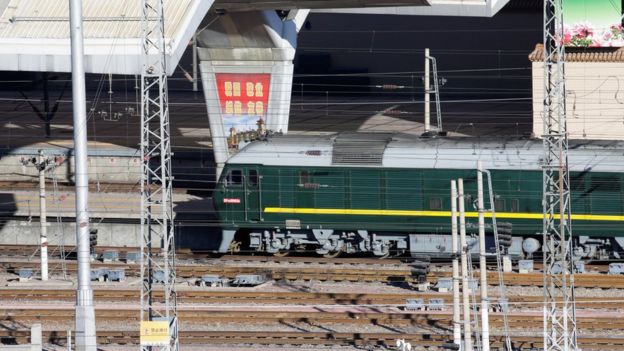
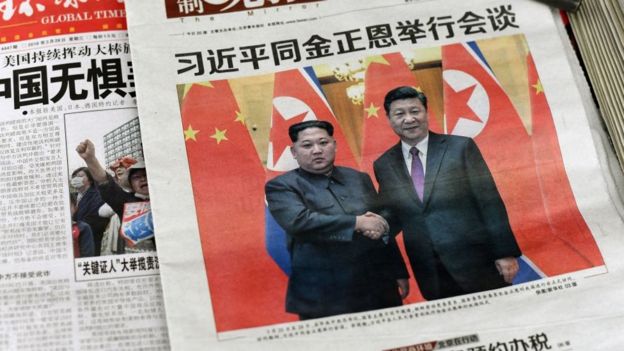
Both countries’ media confirmed the visit on Tuesday morning. Mr Kim’s distinctive green and yellow train arrived at a station in Beijing later in the day.
The train, the same one used during Mr Kim’s first visit to China, resembles the one used by his father Kim Jong-il during his visits to China and Russia in 2011.
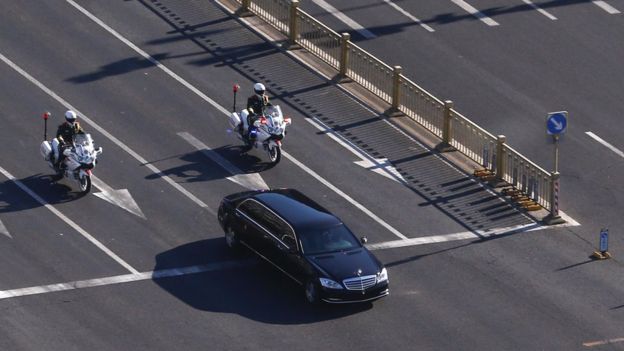
A motorcade with heavy security was later seen driving through central Beijing.
Image copyrightREUTERSImage captionMr Kim travelled to Beijing on his distinctive personal train
Mr Kim’s visit, during which he is being accompanied by several leading North Korean officials, is his fourth to China in less than a year.
Tuesday is also reportedly Mr Kim’s 35th birthday, though his date of birth has never been confirmed by Pyongyang.
China is an important diplomatic ally for North Korea, and one of its main sources of trade and aid.
“[Mr] Kim is eager to remind the Trump administration that he does have diplomatic and economic options besides what Washington and Seoul can offer,” Harry J Kazianis, director of defence studies at the Centre for the National Interest told Reuters.
Image copyrightGETTY IMAGESImage captionMr Kim’s first visit to China came in March last year
Mr Kim, unusually, did not meet Mr Xi for the first six years of his leadership of North Korea.
But last year, he visited China three times. None of the trips was announced in advance.
The BBC’s Laura Bicker in Seoul says two of the trips, which took place ahead of the historic summits with the South Korean leader Moon Jae-in and Mr Trump, were seen by some as a chance to co-ordinate strategy.
The latest three-day visit, our correspondent says, is likely to fuel speculation that a second US-North Korean summit will take place soon.
Earlier this week, Mr Trump said a location for another meeting between the two would be announced in the not-too-distant-future.
In his annual new year’s speech last week, Mr Kim said he was committed to denuclearisation, but warned that he would change course if US sanctions remained.
Diplomatic progress between Mr Trump and Mr Kim has stalled since the Singapore summit. Both parties signed a pledge at the time to denuclearise the Korean peninsula, though it was never clear what this would entail.


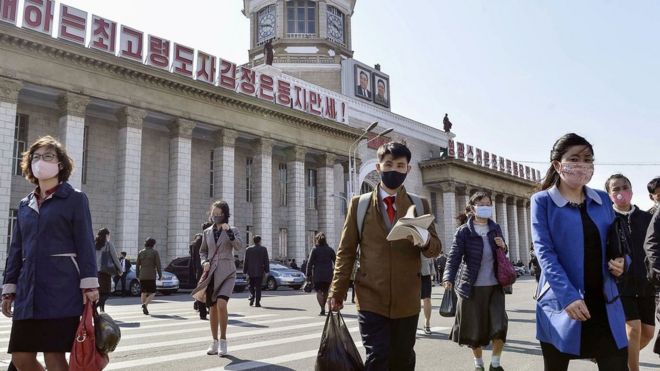 Image copyright REUTERS
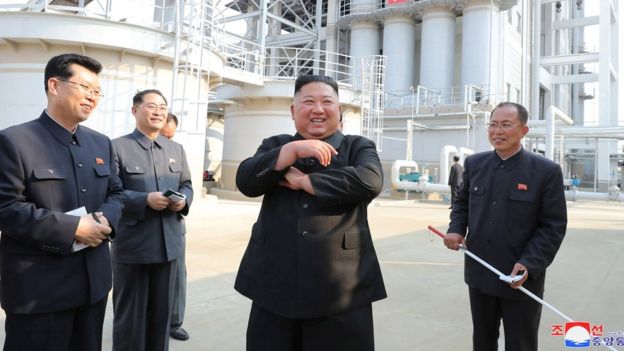 Image copyright REUTERS





 CHINDIA ALERT: You'll be living in their world, very soon
COMMENTS: