Chindia Alert: You’ll be Living in their World Very Soon
aims to alert you to the threats and opportunities that China and India present. China and India require serious attention; case of ‘hidden dragon and crouching tiger’.
Without this attention, governments, businesses and, indeed, individuals may find themselves at a great disadvantage sooner rather than later.
The POSTs (front webpages) are mainly 'cuttings' from reliable sources, updated continuously.
The PAGEs (see Tabs, above) attempt to make the information more meaningful by putting some structure to the information we have researched and assembled since 2006.
BEIJING, Dec. 2 (Xinhua) — China has selected 30 outstanding grass-roots police officers, plus five awardees of special respect and 35 for nomination awards.
The list was selected in a campaign jointly launched by the Publicity Department of the Communist Party of China Central Committee and the Ministry of Public Security in August this year.
The campaign was aimed at encouraging police across the country to work hard to maintain political security and social stability and to improve public understanding of the police work, according to a joint statement by the two departments.
The five awardees of special respect include a group of police officers in east China’s Zhejiang Province who risked their own lives in evacuating vehicles and personnel trapped in a tunnel after fire broke out.
They also include police officers who died on duty – one of them was guiding vehicles on an icy road in Fujian Province, southeast China, but was hit by an out-of-control heavy truck while trying to save passengers nearby.
The 30 outstanding police officers include criminal police, police with special duties, anti-drug police, police who remove explosives, plainclothes police, among others, who have worked diligently for years under dangerous circumstances.
They also include officers who have worked seemingly ordinary jobs but have demonstrated extraordinary perseverance or devotion in serving the public. Officers who have worked in difficult situations for a long time, such as the gobi desert and prisons with criminals living with HIV/AIDS, have also been selected.
Also on the list are some officers who actively seek innovations to incorporate the Internet, satellite and other new technologies into police work.
In addition, several female officers who have worked at a prison or as a forensic expert have received the award.
HONG KONG (Reuters) – Staff at Cathay Pacific Airways, Hong Kong’s flagship airline, are on edge.
A Cathay Pacific Boeing 777-300ER plane lands at Hong Kong airport after it reopened following clashes between police and protesters, in Hong Kong, China August 14, 2019. REUTERS/Thomas Peter
Their city has been gripped by months of anti-government protests, and their company is feeling the wrath of China’s aviation regulator after some staff members took part or expressed support.
Since an Aug.9 directive by the Civil Aviation Authority of China (CAAC) that called for the suspension of staff who supported or participated in the demonstrations, the regulator has rejected some entire crew lists without explanation, two sources with knowledge of the matter told Reuters.
The rejections have forced Cathay to scramble, pulling pilots and flight attendants off standby while it investigates social media accounts in an effort to determine which crew member has been deemed a security threat, one of the sources said.
Other disruptions have come in the form of a huge jump in the number of plane inspections upon landing, four pilots said.
The flexing of regulatory muscle has contributed to a climate of fear within the airline, with employees telling Reuters they felt Cathay’s longer-term future as an independent company was highly uncertain and subject to Beijing’s whims.
The CAAC’s labelling of employees who support the protest as a security risk and its demand that they be suspended from flying over mainland airspace has been a de facto career killer.
Around three quarters of Cathay flights use mainland airspace and due to the directive, 30 rank-and-file staff, including eight pilots and 18 flight attendants, have been fired or resigned under pressure, according to the Hong Kong Cabin Crew Federation.
Cathay CEO Rupert Hogg and his top deputy also resigned in August amid the mounting regulatory scrutiny on the 73-year-old airline, one of the region’s most high-profile brands that draws on Hong Kong’s British heritage.
“Things changed very quickly,” said Jeremy Tam, a pro-democracy lawmaker and pilot who resigned from the airline after the CAAC directive, likening the atmosphere to a political trial. “The threat is huge and it’s almost like zero to 100 in two seconds.”
Reuters talked to 14 current and former employees for this article. Nearly all declined to be identified for fear of being fired or due to the sensitivity of the matter.
The CAAC did not respond Reuters requests for comment on the rejections of crew lists or the increase in plane checks.Cathay said in a statement it must comply with all regulatory requirements. “Quite simply, this is our licence to operate; there is no ground for compromise,” it said.
The airline declined to comment on the number of employee departures, but said any terminations took into account factors such as a person’s ability to perform their role.
DEMERIT SYSTEM
Aviation regulators around the world conduct occasional plane inspections at airports to ensure an airline is in compliance with safety regulations.
But after the CAAC’s Aug. 9 directive, the once-infrequent inspections occurred almost daily and included the new and unusual step of checking phones owned by crew for anti-China photos and messages, the pilots said, adding that this had led to flight delays.
The step-up in checks has increased the likelihood of regulators finding minor issues to write up, which pilots said had included dirt on the plane’s exterior and scratches on a fire extinguisher.
Infractions can have outsized consequences under the CAAC’s strict demerit points system, they said, noting the regulator could force Cathay to reduce its number of flights, cut destinations or in a worst-case scenario, revoke the airline’s right to fly to mainland China.
Management has urged staff to do their utmost to avoid infractions.
“It is nothing less than the survival of the airline at stake,” said a senior employee. “Management have made that abundantly clear at meetings.”
Executives are particularly sensitive after seven incidents outside mainland China in the past two months in which pre-flight checks found emergency oxygen bottles for crew were depleted.
The CAAC is more public than many regulatory peers about disclosing safety violations, warnings and punishments.
In 2017, Emirates was banned from expanding its operations for six months following two safety incidents, while flag carrier Air China Ltd was ordered last year to cut Boeing Co 737 flights by 10% after an emergency descent linked to a pilot smoking an e-cigarette in the cockpit.
Cathay declined to provide information on its points under the CAAC system but said it wanted to emphasise that there had been no impact on its flight services into mainland China.
The pilots said the high frequency of airplane checks, which one described as “very intimidatory”, was starting to recede.
A THOUSAND CUTS
Employees are also feeling pressure from other regulatory bodies.
Last week, ahead of China’s National Day on Oct.1, immigration officers at some mainland airports requested photos of crew with the Chinese flag, said a pilot at regional arm Cathay Dragon who flies to the mainland regularly.
He said to his knowledge, most pilots – many of whom are expats from Western countries – had refused but Hong Kong cabin crew were “too nervous to say no” given the scrutiny on their actions by the company and the Chinese government.
“Everyone is walking on eggshells in China,” the pilot said.
Cathay did not respond to a request for comment, while China’s Ministry of Public Security, which oversees immigration, did not respond to a request for comment during a week of public holidays.
There has been no let-up in the widespread, sometimes violent, unrest that has beset Hong Kong. Triggered by a now-withdrawn extradition bill, it has morphed into an outpouring of opposition to the former British colony’s Beijing-backed government.
The crisis has also meant a sharp drop in travel demand to Hong Kong, putting more pressure on Cathay.
Cathay’s overall passenger numbers were down 11.3% in August. Flights at Cathay Dragon, which does most of Cathay’s mainland flying, were on average 60-65% full in September, down from the usual 80%, according to estimates from two pilots.
The pilots said while the sharp drop in demand was in some ways similar in scale to that weathered by Cathay during the SARS epidemic and the global financial crisis, there were key differences that felt more threatening to the company’s future.
Some state-controlled firms such as China CITIC Bank International and Huarong International have told employees to avoid flying with Cathay, and it has been attacked by Chinese state news organisations as well as by many mainland consumers on social media.
CAAC’s Aug.9 statement which called staff who supported the protests a security risk has also put Cathay’s reputation as one of the world’s safest airlines under a cloud it does not deserve, employees said.
Many acknowledged the new management team, which oversees around 33,000 employees, has few palatable options in dealing with the situation given the sway Beijing holds over the airline’s operations.
But they lamented the loss of freedom of speech and sense of job security, saying employees are afraid to speak about anything even vaguely political or voice support for protests on social media for fear of being reported by colleagues under a whistleblower policy.
“It has become a Hong Kong company with mainland employment terms,” a pilot at Cathay Dragon said. “The risk is death by a thousand cuts.”
TIANJIN, Sept. 21 (Xinhua) — Just scan a QR code on a vending machine, then you will be given a drink. The special vending machine placed at the ongoing cybersecurity expo held in Tianjin has attracted many people to try it out.
Once you scan the code, you will receive a message in a second, reminding you that “arbitrary code-sweeping will endanger personal property safety,” as your personal information might have been illegally collected.
This machine was installed by 360 Security Technology Inc.
The expo is a part of a cybersecurity publicity campaign held in north China’s Tianjin Municipality, aiming to promote public awareness of the issue
In fact, it is also a part of the 2019 China Cybersecurity Week, held from Sept. 16 to 22 nationwide.
The campaign was jointly launched by the Publicity Department of the Communist Party of China Central Committee, the Office of the Central Cyberspace Affairs Commission and the ministries of education, public security and industry and information technology.
Over 100 cybersecurity and Internet enterprises have attended various activities held during the week.
There will also be themed activities to promote cybersecurity issues related to students, the telecommunication sector and financial sector.
Personal information protection is a major theme of this year’s campaign.
In Tianjin, an interactive experience area has been set up at the expo, which allowed visitors to raise their cybersecurity awareness through taking part in different activities.
“I’ve learned a lot about cybersecurity through these activities. Do not click strange links or download mobile software from unofficial platforms,” said a 64-year-old visitor surnamed Zhang.
Statistics released showed that China has more than 200 app stores providing nearly 5 million apps. They bring convenience for many people, but some of them become “information funnels,” leaking people’s mobile phone numbers, call records, text messages, consumption records and other private information.
According to a report on netizen’s satisfaction on cybersecurity issued during the event, 51.25 percent of surveyed Chinese netizens believe the Internet is safe, up 12.91 percentage points from last year. About 37 percent of the respondents believe there are personal information leaks on the Internet, and 58 percent experienced personal information infringement.
More than 82 percent of the respondents also urge legislation on individual information protection.
Early in January, the Office of the Central Cyberspace Affairs Commission, the Ministry of Industry and Information Technology, the Ministry of Public Security and the State Administration for Market Regulation teamed up to launch a campaign to crackdown on illegal collection of personal information in mobile apps.
So far, more than 600 popular apps have been evaluated, with over 200 apps asked to make improvements in personal information protection.
Police in Shenzhen look for clues to accident in driver’s medical records
Motorist complains of ‘sudden attack’ at time of accident
Police in Shenzhen, Guangdong province, are investigating a driver’s medical history after a fatal accident on Thursday. Photo: Weibo
Police in southern China have detained a motorist after three people were killed and seven injured in a car accident on Thursday night.
Officers said a car went out of control and struck pedestrians on a road in Nanshan district in Shenzhen, Guangdong province, at about 7.20pm. The 23-year-old driver, surnamed Liu, was taken into custody.
In a statement online, the Shenzhen public security bureau said blood and urine tests showed the driver was sober and drug-free. They said medicine for epilepsy was found in the vehicle.
Two dead, six injured in Japan after bus drives through pedestrians in Kobe
During questioning, Liu told officers he lost control of car because he had had “a sudden attack”, but did not elaborate.
Police said they were examining Liu’s medical records.
In China, people with epilepsy are not allowed to apply for a driving licence, according to regulations from the Ministry of Public Security.
Major highways gridlocked for hours at start of four-day break
Chaos at railway stations as ticket-holding passengers turned away
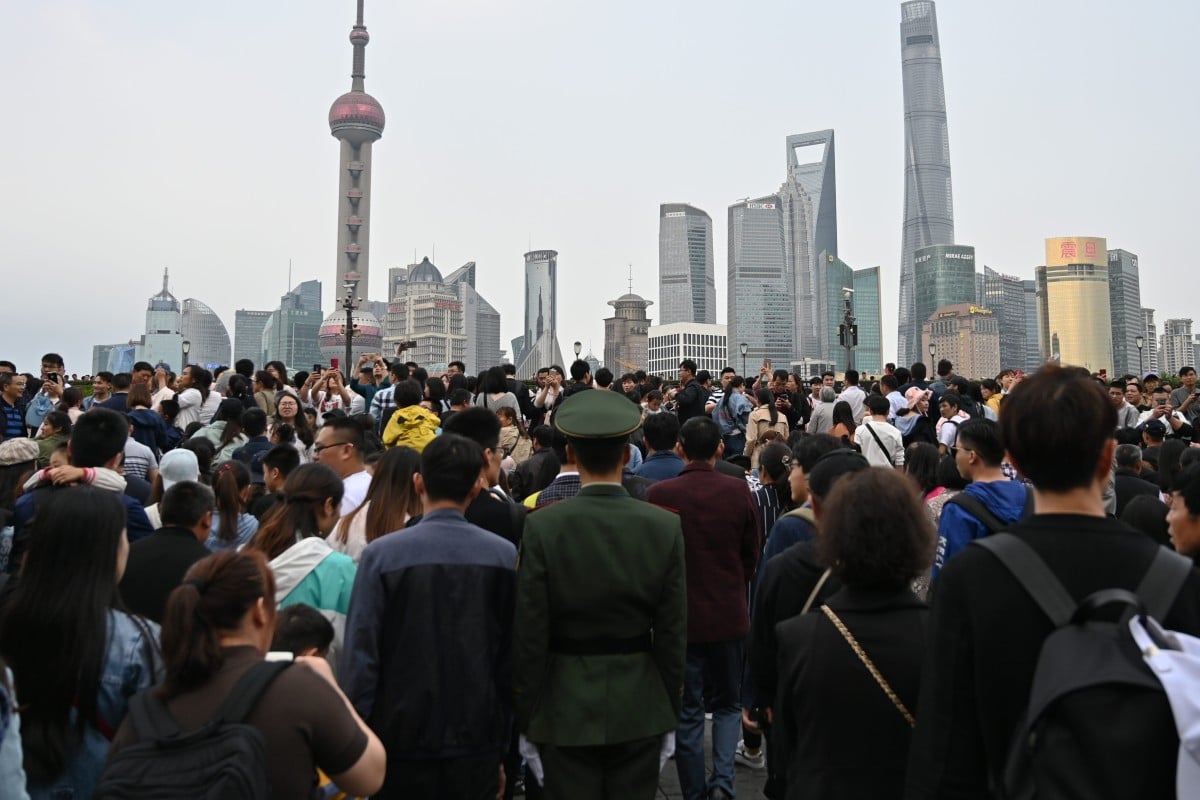
Holiday crowds pack the promenade on the Bund along the Huangpu River in Shanghai on the first day of China’s May break. Photo: AFP
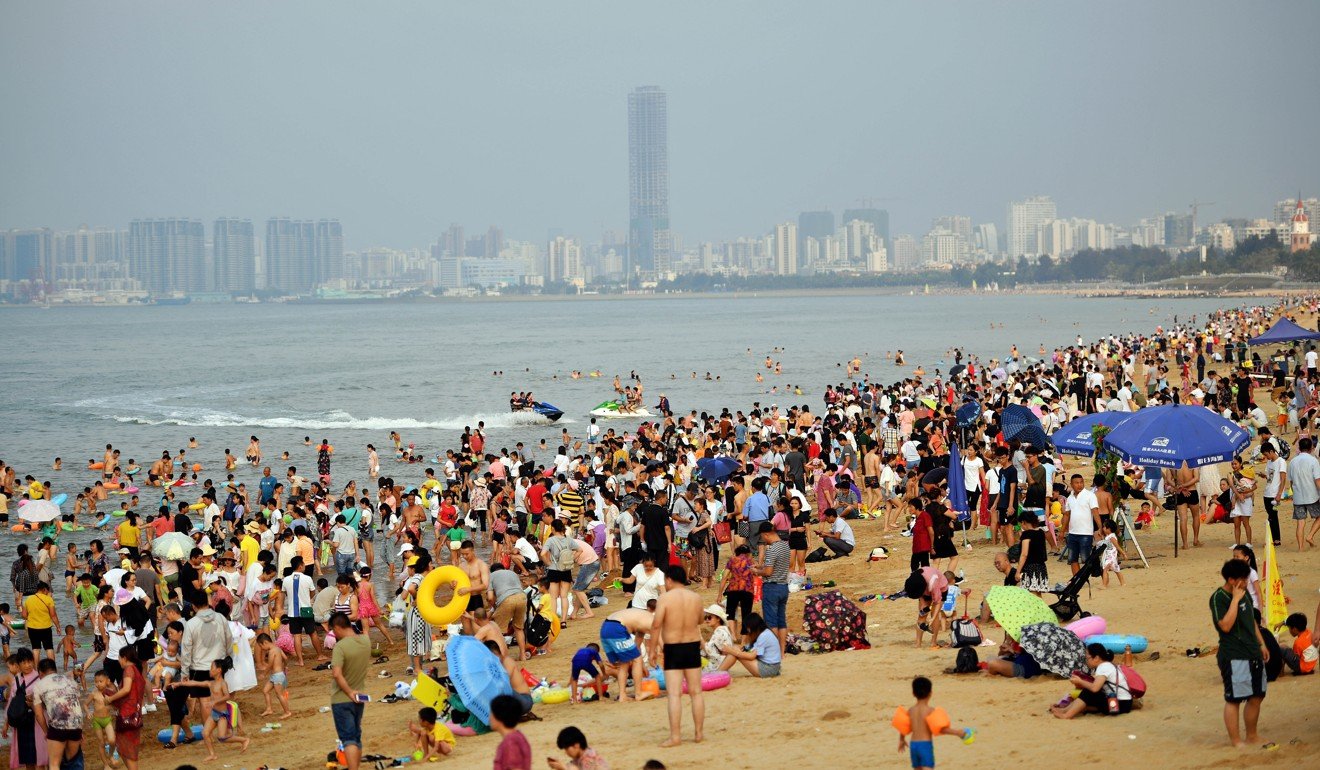
China’s Labour Day holiday started on Wednesday with gridlocked roads and chaos at railway stations as millions of people took advantage of this year’s unusually long break.
Motorists reported being stuck in traffic jams which did not move for hours, while ticket-holding passengers were turned away from some trains due to severe overcrowding on the first day of the holiday.
Travel agency Ctrip estimated that around 160 million domestic tourists would be travelling over the four-day break, according to data from travel booking platforms.
Forty major highways recorded a 75 per cent spike in traffic on Wednesday, according to Xinhua, as toll fares for cars were suspended for the holiday.
Tourists enjoy the first day of China’s four-day May holiday on a beach in Haikou, Hainan province, southern China. Photo: Xinhua
Monitoring stations on major routes – including the Beijing-Tibet Expressway, the Shanghai-Shaanxi Expressway, Shanghai’s Humin Elevated Road and the Beijing section of the Beijing-Hong Kong-Macau Expressway – recorded a 200 per cent increase in traffic from Tuesday onwards, Xinhua said.
The Ministry of Public Security’s traffic management bureau has warned holiday motorists to drive safely, especially on winding mountainside routes.
Online news portal The Paper reported on Thursday that traffic jams on some major routes were so severe that the drive from Shanghai to Hangzhou, capital of neighbouring Zhejiang province, took some travellers seven hours instead of the usual two.
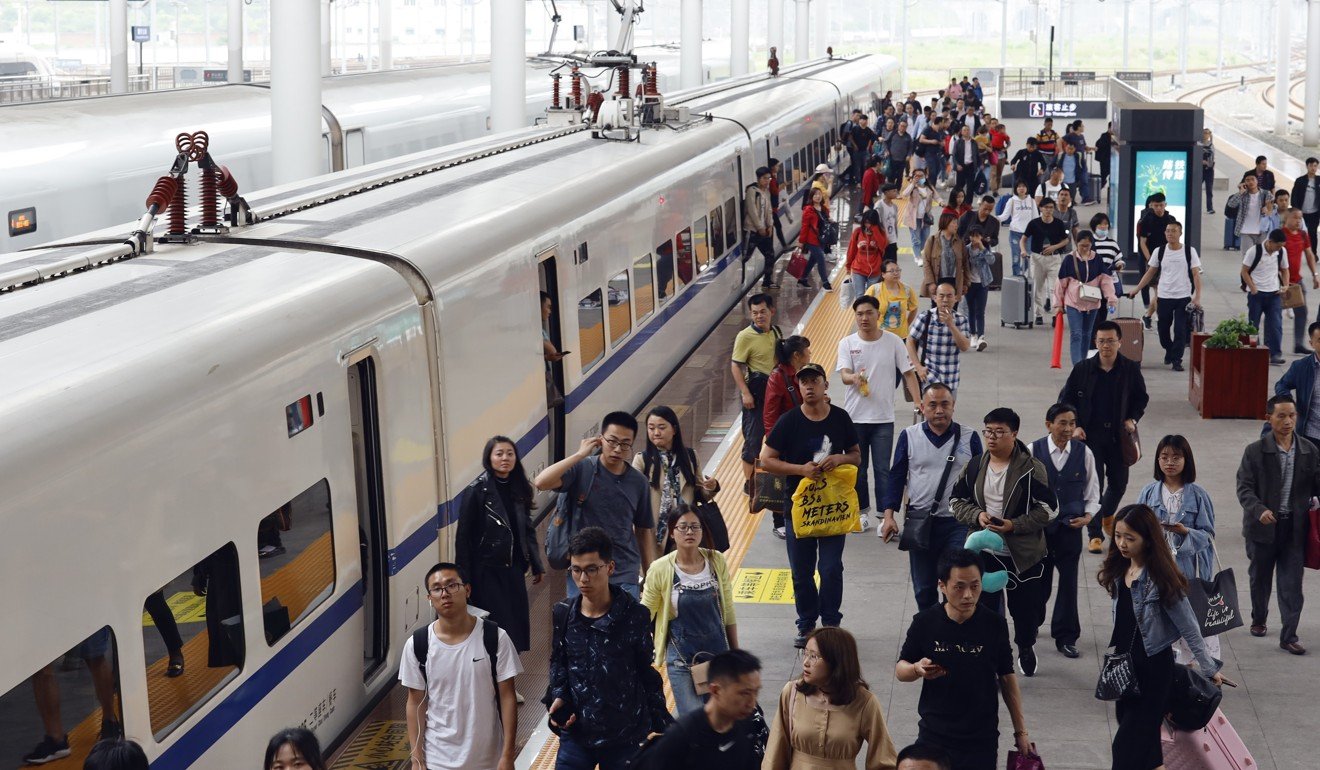
Passengers board the train at Chongqing North Railway Station in southwest China on Tuesday, hoping to beat the May holiday travel rush. Photo: Xinhua
Meanwhile, more than 54,000 tourists visited the popular Badaling section of the Great Wall on Wednesday, according to Beijing Youth Daily. The attraction’s management team had increased the number of volunteers, parking spaces and shuttle buses to prepare for the influx, the report said.
More than 53,000 tourists had visited the Shanghai International Tourism Resort and Shanghai Disneyland by 4pm on Wednesday, according to data from the Shanghai municipal government’s real-time visitor tracker. The Shanghai Zoo attracted more than 24,000 people, and more than 9,200 visited the Shanghai Science and Technology Museum.
Despite the crowds, no records were broken at the Shanghai attractions, which reached about 70 per cent of their maximum visitor numbers recorded, The Paper reported.
At railway stations, ticket-holding passengers were stopped from boarding trains between Nanjing and the city of Zibo in Shandong province, eastern China, due to severe overcrowding, Beijing Youth Daily reported on Wednesday.
Station staff promised full refunds to customers with pre-booked tickets who were refused entry.
Fusion reactor built by Chinese scientists in eastern Anhui province has notched up a series of research firsts
There are plans to build a separate facility that could start generating commercially viable fusion power by 2050, official says
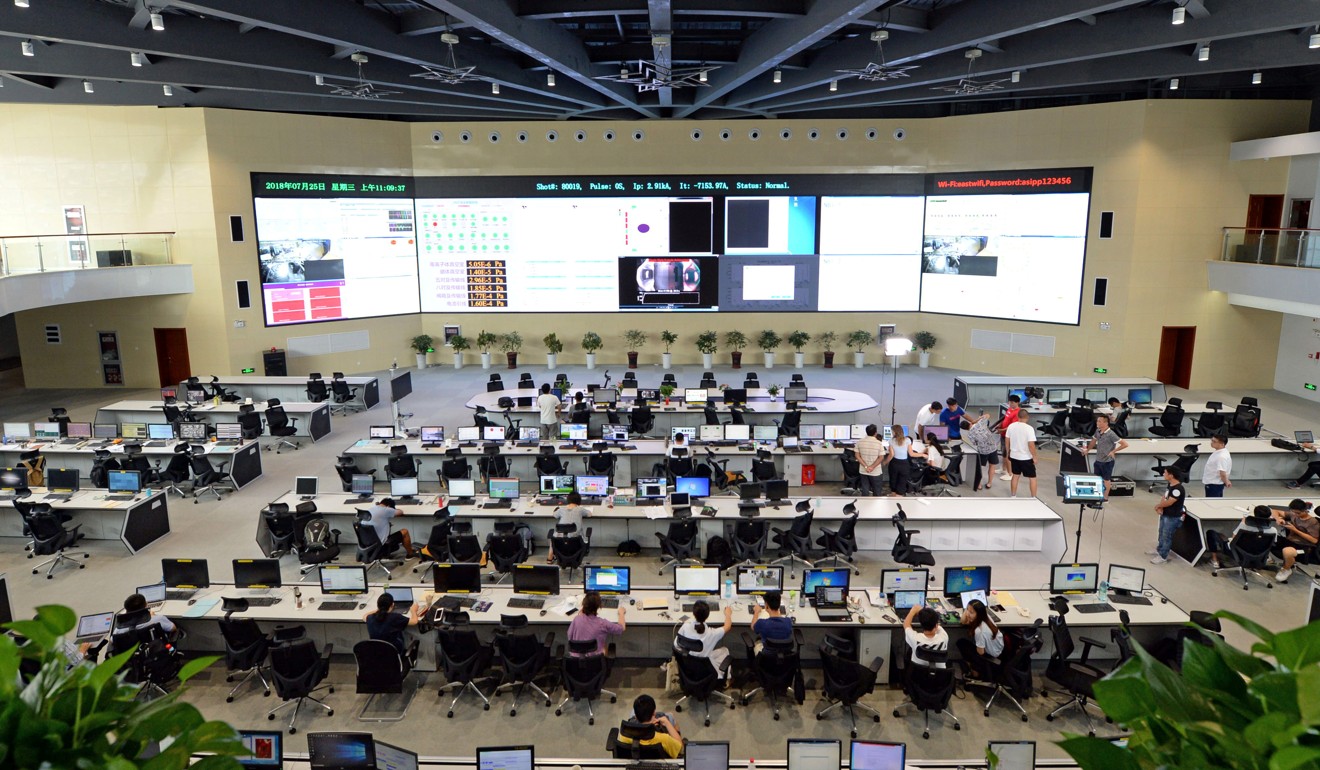
The Experimental Advanced Superconducting Tokamak (EAST) device – or “artificial sun” – in Hefei, Anhui province. Photo: AFP/Chinese Academy of Sciences
A groundbreaking fusion reactor built by Chinese scientists is underscoring Beijing’s determination to be at the core of clean energy technology, as it eyes a fully functioning plant by 2050.
Sometimes called an “artificial sun” for the sheer heat and power it produces, the doughnut-shaped Experimental Advanced Superconducting Tokamak (EAST) that juts out on a spit of land into a lake in eastern Anhui province, has notched up a succession of research firsts.
In 2017 it became the world’s first such facility to sustain certain conditions necessary for nuclear fusion for
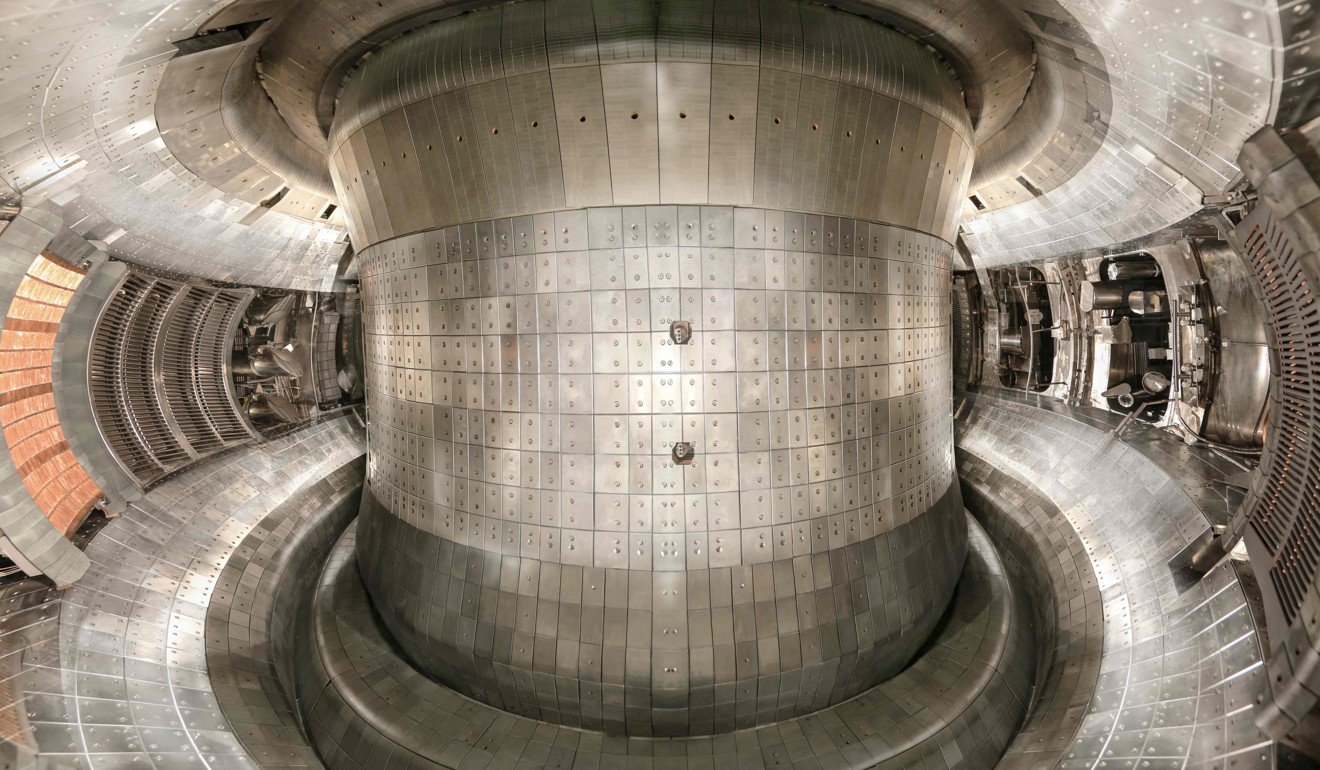
of 100 million degrees Celsius (212 million Fahrenheit) – six times as hot as the sun’s core.
Such mind-boggling temperatures are crucial to achieving fusion reactions, which promise an inexhaustible energy source.
EAST’s main reactor stands within a concrete structure, with pipes and cables spread outward like spokes connecting to a jumble of censors and other equipment encircling the core. A red Chinese flag stands on top of the reactor.
A vacuum vessel inside the fusion reactor, which has achieved a temperature of 100 million degrees Celsius – six times as hot as the sun’s core. Photo: AFP/Chinese Academy of Sciences
“We are hoping to expand international cooperation through this device [EAST] and make Chinese contributions to mankind’s future use of nuclear fusion,” said Song Yuntao, a top official involved in the project, on a recent tour of the facility.
China is also aiming to build a separate fusion reactor that could begin generating commercially viable fusion power by mid-century, he added.
Some 6 billion yuan (US$891.5 million) has been promised for the ambitious project.
EAST is part of the International Thermonuclear Experimental Reactor (ITER) project, which seeks to prove the feasibility of fusion power.
Funded and run by the European Union, India, Japan, China, Russia, South Korea and the United States, the multibillion-dollar project’s centrepiece will be a giant cylindrical fusion device, called a tokamak.
Now under construction in Provence in southern France, it will incorporate parts developed at the EAST and other sites, and draw on their research findings.
China is “hoping to expand international cooperation” through EAST. Photo: Reuters
Fusion is considered the Holy Grail of energy and is what powers our sun.
It merges atomic nuclei to create massive amounts of energy – the opposite of the fission process used in atomic weapons and nuclear power plants, which splits them into fragments.
Unlike fission, fusion emits no greenhouse gases and carries less risk of accidents or the theft of atomic material.
But achieving fusion is both extremely difficult and prohibitively expensive – the total cost of ITER is estimated at €20 billion (US$22.3 billion).
Wu Songtao, a top Chinese engineer with ITER, conceded that China’s technical capabilities on fusion still lag behind more developed countries, and that US and
Japanese tokamaks have achieved more valuable overall results.
But the Anhui test reactor underlines China’s fast-improving scientific advancement and its commitment to achieve yet more.
China’s capabilities “have developed rapidly in the past 20 years, especially after catching the ITER express train”, Wu said.
In an interview with state-run Xinhua news agency in 2017, ITER’s director general Bernard Bigot lauded China’s government as “highly motivated” on fusion.
“Fusion is not something that one country can accomplish alone,” Song said.
“As with ITER, people all over the world need to work together on this.”




 CHINDIA ALERT: You'll be living in their world, very soon