Chindia Alert: You’ll be Living in their World Very Soon
aims to alert you to the threats and opportunities that China and India present. China and India require serious attention; case of ‘hidden dragon and crouching tiger’.
Without this attention, governments, businesses and, indeed, individuals may find themselves at a great disadvantage sooner rather than later.
The POSTs (front webpages) are mainly 'cuttings' from reliable sources, updated continuously.
The PAGEs (see Tabs, above) attempt to make the information more meaningful by putting some structure to the information we have researched and assembled since 2006.
BEIJING/SHANGHAI (Reuters) – China expects to import more soybeans and pork this year following the novel coronavirus outbreak and African swine fever, which has decimated its pig herds.
Soybean imports are forecast at 92.48 million tonnes this year, rising to 96.62 million tonnes in 2025 and 99.52 million tonnes in 2029, an official from the agriculture ministry told a video conference on the outlook for agriculture released on Monday.
Pork imports this year are seen rising to 2.8 million tonnes, a 32.7% increase from the previous year.
China is a key buyer and consumer of soybeans and pork globally, and typically imports millions of tonnes of soybeans per year to crush for meal to feed its livestock.
The African swine fever outbreak, however, had slashed China’s pig herd by over 40% last year, reducing supplies in the world’s biggest pork consumer.
Combined with the coronavirus outbreak, which hit the transport of pigs and delayed the restart of slaughtering plants, prices of China’s favourite meat rose to record levels in February.
China has been increasing pork imports in recent months to make up for the drop in domestic supply.
Despite the expected surge in imports, China’s 2020 pork consumption is forecast to fall to 42.06 million tonnes, down 5.6% year-on-year, hit by high prices and a fall in consumer demand due to the coronavirus outbreak, according to the agriculture ministry.
In line with the slowing consumption, China’s slaughtered pig herd this year will fall 7.8% year-on-year to 501.49 million heads. Pork output this year will also decline to 39.34 million tonnes from 2019, but will rebound to around 54 million tonnes in 2022.
In the longer term, however, pork imports are expected to gradually fall, the ministry forecast, while beef and mutton imports are set to increase in the next decade.
Meanwhile, China’s domestic soybean output is seen at 18.81 million tonnes in 2020, a 3.9% gain from the previous year, while crushing volumes were pegged at 85.98 million tonnes.
Soybean consumption will increase steadily and continue to rely mainly on imports in the next 10 years, said a ministry official.
The ministry also said China’s corn acreage and output are both set to increase in 2020, with production forecast to reach over 260 million tonnes this year, while annual rice output is expected to hold steady above 200 million tonnes per year in the next 10 years.
Young people starting out in the jobs market face a hit to their prospects that could endure years after the Covid-19-induced downturn has run its course
A generation of angry youth raises the spectre of political instability
Freelance filmmaker Anita Reza Zein had grown used to jam-packed production schedules requiring her to put in long hours and run on little sleep. Until Covid-19 struck.
Today, the talented Indonesian is suddenly free. With five projects on hold and many more potentially cancelled, she now spends her time working on a personal project, doing research for her work and occasionally going for a ride on a bicycle.
“I feel calm and patient although I’m jobless. Maybe because it’s still the third week [of social distancing] and I still have enough savings from my previous work,” said the 26-year-old, who is from Yogyakarta. “But I imagine life will become tougher in the next few months if the situation gets worse.”
Like her, millions of youths are now part of a job market in Southeast Asia that has been ravaged by the coronavirus pandemic. They are the unlucky cohort of 2020 whose fortunes have changed so drastically, so quickly.
Freelance filmmaker Anita Reza Zein now spends most of her time at home as her projects have all been frozen due to the spread of Covid-19. Photo: Anita Reza Zein
Just three months ago, many eager graduates were about to partake in a strong economy and possibly land decent pay cheques.
Today, job offers are being withdrawn and hiring halted, leading to a spike in regional youth unemployment in the short term. In the long term, the effects on the Covid-19 cohort could lead to wider social and political problems.
JOB MARKETS SHUT
The virus’ impact on economies and the job market in the region has been swift and devastating. Borders have been slammed shut, workers ordered to stay at home, and thousands of companies closed every week.
The biggest problem is the lack of certainty about how long this will last – the longer the governments keep their countries on lockdown, the worse the economic impact.
In Indonesia, for example, the virus has caused almost 2.8 million people to lose their jobs, according to the Manpower Ministry and the Workers Social Security Agency. Likewise, in Malaysia, an estimated 2.4 million people are expected to lose their jobs, going by data from the Malaysian Institute of Economic Research (MIER).
is bracing itself for a 5.3 per cent contraction in GDP for the full year, the worst since the Asian financial crisis in 1997.
“We think about seven million jobs have been lost already, and the figure will hit 10 million if the outbreak drags on for two to three more months,” said Kalin Sarasin, council member and head of the Thai Chamber of Commerce.
Lockdown for 34 million people in capital Jakarta as Indonesia fights surge in coronavirus deaths
For young jobseekers, the outbreak of the Covid-19 pandemic could hurt even more, with companies unwilling to open up new jobs for them.
“My clients who were open to fresh graduates previously have realigned searches [for candidates] who have at least one year of experience, as it’s a lot faster for someone with experience to scale up quickly and contribute,” said Joanne Pek, a recruiter at Cornerstone Global Partners’ Singapore office.
For many small and medium-sized enterprises (SMEs) such as Singapore-based restaurant chain The Soup Spoon, saving jobs – rather than recruiting – is the priority.
“We don’t want to let anyone go during this period, so we’re focused on protecting jobs,” said co-founder and director Benedict Leow, who employs some 250 workers.
THE COVID-19 COHORT
The looming economic downturn could have distinct consequences for the Class of 2020 that will outlast the economic downturn itself.
For one thing, the paucity of jobs could result in the Covid-19 cohort becoming a “lost generation” of sorts, said Achim Schmillen, a senior economist at the World Bank Social Protection and Jobs Global Practice.
“Research from around the globe shows that graduating in a recession can have significant and long-lasting impacts that can affect the entire career. In particular, it can lead to large initial earnings losses which only slowly recede over time,” he said.
Coronavirus: why there’s no quick fix for a Covid-19 vaccine
12 Apr 2020
Economics professor Jeff Borland of the University of Melbourne said that international studies showed that what happened to people when they first entered the labour market would affect them for the rest of their working lives.
“Many international studies have shown that trying to move into employment during a major economic downturn cuts the probability of employment and future earnings for a decade or more.
“Why this occurs is less well-established. Reasons suggested include being forced to take lower-quality jobs, losing skills and losing psychological well-being,” he said in a piece published on The Conversation website.
Malaysia sets up Covid-19 test zones in the capital to hunt for ‘hidden’ coronavirus cases
This could create “lasting scarring” on the graduates this year, said labour economist Walter Theseira.
“If their careers start badly, it would affect their earnings for a number of years because they would lack the same experience as peers who started in a more secure position,” the associate professor of economics at Singapore University of Social Sciences said.
Shrinking salaries and the downsizing of companies mean that graduates might have to seek out professions outside their areas of study to survive, said Grace Lee Hooi Yean, head of the Economics Department at Monash University, Malaysia.
She said youth unemployment in the country, which stands at 11.67 per cent, could rise sharply.
“This looming crisis could trap a generation of educated and capable youth in a limbo of unmet expectations and lasting vulnerability if the graduates are not ready to face reality and adapt to the new challenges,” she said.
How long will a coronavirus vaccine take? A Q&A with Jerome Kim
12 Apr 2020
This is fast becoming the reality for final-year medical student Rebecca K. Somasundaram, who has been left without a job due to the pandemic.
After being offered a residency programme at a top specialist hospital in Kuala Lumpur, she was notified a month ago that her placement had been made void until further notice. This has thrown the 24-year-old’s plans into disarray as she was hoping to enter the workforce soon to pay off her student debts. Her plans to get married next year have also been put on hold temporarily.
“I am in constant talks with the hospital to see if there is any way I can join them soon but seeing how things are unfolding so quickly, I am slowly losing hope,” she said.
Over in Indonesia, the pandemic will trigger job losses on a national scale. To combat this, the government would need to introduce strong fiscal measures and beef up its social protection policies, said the country’s former minister of finance Muhamad Chatib Basri.
Many people on lower incomes tend to work in the extraction industry, such as mining and palm oil, and these are the first industries hit due to the global slowdown.
“The rich will be able to brave the storm, but the poor have no means to do so,” he said.
Singapore migrant workers under quarantine as coronavirus hits dormitories
SPECTRE OF 1997
With partial lockdowns imposed in the capital of Jakarta, more needs to be done to ensure that vulnerable citizens have access to food and financial support.
Without government intervention, economic woes could soon translate into political instability, a scenario last seen in the Asian financial crisis.
In 1997, waves of discontent sparked racial riots in Indonesia that toppled the country’s long-time strongman Suharto, while in Thailand a political crisis created the conditions for populist leader Thaksin Shinawatra to rise.
Rising discontent could have serious implications at the ballot boxes, warned Basri, who said young voters were a key voting bloc for President Joko “Jokowi” Widodo.
Coronavirus: food security, Asia’s next battle in a post-Covid world
6 Apr 2020
In last year’s general elections, Jokowi proved a hit among the lower-educated youth who had benefited from the creation of largely unskilled jobs during his tenure.
“With more young people expected to become unemployed in the coming months, things will only get worse from here,” said Basri, who added that the country’s youth unemployment stood at almost 20 per cent in 2018.
Indonesia, which has 268 million people and is Southeast Asia’s largest economy, had 133 million workers as of last August, according to official data.
Close to 10 per cent or about 12.27 million are university graduates but among this group, about 5.67 per cent or some 730,000 were unemployed. This was higher than the country’s overall unemployment rate at that time, which was 5.28 per cent.
‘Ghosts’ deployed to scare Indonesians into staying home to slow spread of the coronavirus
GETTING IT RIGHT
Economists say, however, that all is not lost. Much will depend on policy and how governments focus on battling the virus on the public health and economic fronts. They point to Singapore, which has launched a robust response to the crisis.
On April 6, the Singapore government announced its third budget in two months to help companies and households tide over the crisis. In all, Singapore’s total stimulus package, which aims to save jobs and keep funds flowing to companies, will cost the government a massive S$59.9 billion (US$42 billion).
The Singapore government was also preparing for a labour market that would be reluctant to hire fresh graduates on a full-time basis, said Theseira.
“There are plans to implement large-scale subsidised traineeships, which may be more palatable to companies which are worried about taking on permanent headcount this year,” he noted. “As the economic situation improves, they can be converted to permanent positions.”
The next coronavirus: how a biotech boom is boosting Asian defences
4 Mar 2020
While jobs were being created for fresh graduates, many would still have to temper their expectations, such as taking jobs with lower starting pay, said DBS Bank economist Irvin Seah.
“There are still some jobs to go around. There are still some companies that may need workers. But they will need to be realistic,” he said.
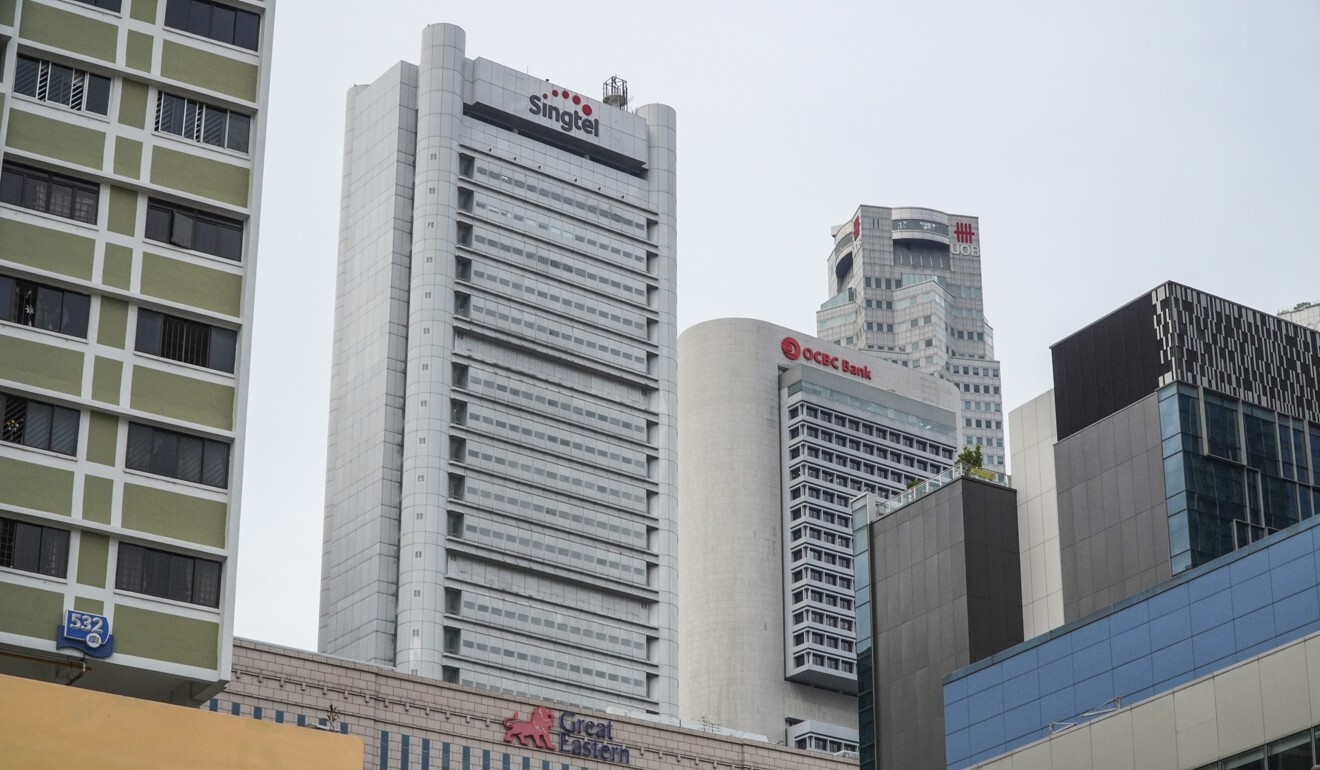
For instance, despite the downturn, Singapore telco Singtel expects to recruit over 300 fresh graduates for various permanent positions this year, according to Aileen Tan, the company’s Group Chief Human Resources Officer. Many of the new hires will be in new growth areas such as the Internet of Things, analytics and cloud.
The Singtel Comcentre building in Singapore. Photo: Roy Issa
Other companies that continue to hire include those in tech across the region, including e-commerce giant Shopee, food-delivery service Foodpanda and Amazon.
In Australia, Borland suggested helping young people to remain plugged into the labour market through government-funded paid internships, or even offering them loans to go for further studies and prevent a spell of unemployment.
For now, while some young jobseekers are taking a wait-and-see approach, the reality is hitting hard for others.
Final-year National University of Singapore student H.P. Tan had all but secured a job at a public relations firm last month, after three rounds of interviews.
The Faculty of Arts and Social Sciences undergraduate was rejected via an email from the agency, which said that they could no longer hire after Covid-19 started to drastically cut business.
“When I got that rejection, it was a turning point. I didn’t think I would be directly impacted,” said the 23-year-old.
“I also applied to a few other agencies but the response has been slow, so I am now freaking out at the possibility of not being able to find a job after graduation.”
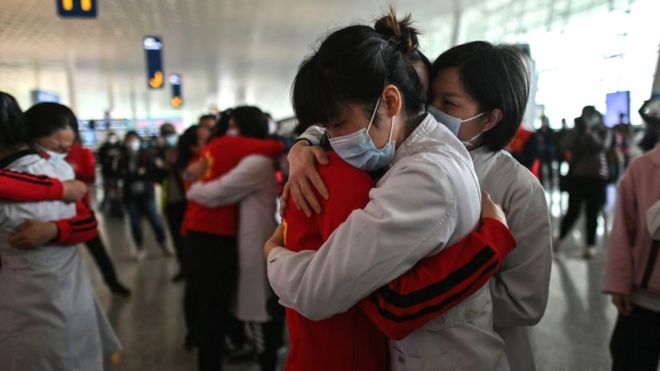
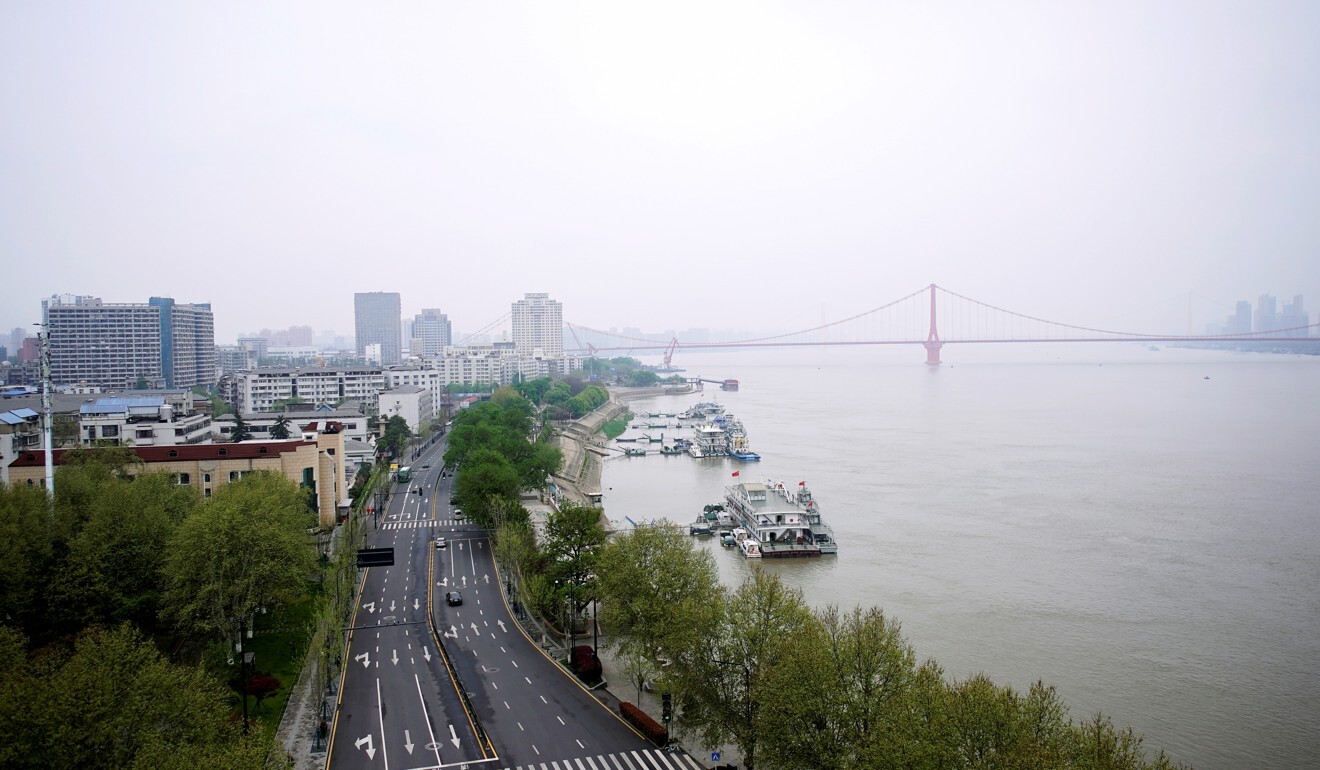
Image copyright GETTY IMAGESImage caption The Chinese city of Wuhan recently lifted its strict quarantine measures
The Chinese city of Wuhan, where the coronavirus originated last year, has raised its official Covid-19 death toll by 50%, adding 1,290 fatalities.
Wuhan officials attributed the new figure to updated reporting and deaths outside hospitals. China has insisted there was no cover-up.
It has been accused of downplaying the severity of its virus outbreak.
Wuhan’s 11 million residents spent months in strict lockdown conditions, which have only recently been eased.
The latest official figures bring the death toll in the city in China’s central Hubei province to 3,869, increasing the national total to more than 4,600.
China has confirmed nearly 84,000 coronavirus infections, the seventh-highest globally, according to Johns Hopkins University data.
What’s China’s explanation for the rise in deaths?
In a statement released on Friday, officials in Wuhan said the revised figures were the result of new data received from multiple sources, including records kept by funeral homes and prisons.
Deaths linked to the virus outside hospitals, such as people who died at home, had not previously been recorded.
Media caption Learn how Wuhan dealt with the lockdown
The “statistical verification” followed efforts by authorities to “ensure that information on the city’s Covid-19 epidemic is open, transparent and the data [is] accurate”, the statement said.
It added that health systems were initially overwhelmed and cases were “mistakenly reported” – in some instances counted more than once and in others missed entirely.
A shortage of testing capacity in the early stages meant that many infected patients were not accounted for, it said.
A spokesman for China’s National Health Commission, Mi Feng, said the new death count came from a “comprehensive review” of epidemic data.
In its daily news conference, the foreign ministry said accusations of a cover-up, which have been made most stridently on the world stage by US President Donald Trump, were unsubstantiated. “We’ll never allow any concealment,” a spokesman said.
Why are there concerns over China’s figures?
Friday’s revised figures come amid growing international concern that deaths in China have been under-reported. Questions have also been raised about Beijing’s handling of the epidemic, particularly in its early stages.
In December 2019, Chinese authorities launched an investigation into a mysterious viral pneumonia after cases began circulating in Wuhan.
China reported the cases to the World Health Organization (WHO), the UN’s global health agency, on 31 December.
But WHO experts were only allowed to visit China and investigate the outbreak on 10 February, by which time the country had more than 40,000 cases.
The mayor of Wuhan has previously admitted there was a lack of action between the start of January – when about 100 cases had been confirmed – and 23 January, when city-wide restrictions were enacted.
Around that time, a doctor who tried to warn his colleagues about an outbreak of a Sars-like virus was silenced by the authorities. Dr Li Wenliang later died from Covid-19.
Wuhan’s death toll increase of almost exactly 50% has left some analysts wondering if this is all a bit too neat.
For months questions have been asked about the veracity of China’s official coronavirus statistics.
The inference has been that some Chinese officials may have deliberately under-reported deaths and infections to give the impression that cities and towns were successfully managing the emergency.
If that was the case, Chinese officials were not to know just how bad this crisis would get in other countries, making its own figures now seem implausibly small.
The authorities in Wuhan, where the first cluster of this disease was reported, said there had been no deliberate misrepresentation of data, rather that a stabilisation in the emergency had allowed them time to revisit the reported cases and to add any previously missed.
That the new death toll was released at the same time as a press conference announcing a total collapse in China’s economic growth figures has led some to wonder whether this was a deliberate attempt to bury one or other of these stories.
Then again, it could also be a complete coincidence.
China has been pushing back against US suggestions that the coronavirus came from a laboratory studying infectious diseases in Wuhan, the BBC’s Barbara Plett Usher in Washington DC reports.
US President Donald Trump and some of his officials have been flirting with the outlier theory in the midst of a propaganda war with China over the origin and handling of the pandemic, our correspondent says.
Mr Trump this week halted funding for the World Health Organization (WHO), accusing it of making deadly mistakes and overly trusting China.
“Do you really believe those numbers in this vast country called China, and that they have a certain number of cases and a certain number of deaths; does anybody really believe that?” Mr Trump said at the White House on Wednesday.
On Thursday, UK Foreign Secretary Dominic Raab said: “We’ll have to ask the hard questions about how [coronavirus] came about and how it couldn’t have been stopped earlier.”
But China has also been praised for its handling of the crisis and the unprecedented restrictions that it instituted to slow the spread of the virus.
BEIJING (Reuters) – For Zhang Yu, who runs a cafe in one of Beijing’s top tourist spots, business has never been so bad.
To contain the spread of the coronavirus, bars and cafes in the Wudaoying hutong – a top Lonely Planet destination built around a narrow lane – are permitted to provide take-away services only. Non-residents must show proof they have an appointment to enter the area.
Added to which, tourism has plummeted.
“Don’t mention it! This is supposed to be the peak season,” said Zhang, who has run her cafe for five years. “But there are almost no customers as they (authorities) don’t want to have people hanging around here.”
While China’s manufacturing and retail sectors are starting to get back to work as the pace of new infections slows sharply, tourism sites in Beijing remain a shadow of their former and bustling self.
China’s capital city has maintained the highest level of emergency response to the outbreak, so tourist attractions like the Forbidden City remain closed. A 14-day quarantine for new arrivals has stifled travel.
As a result, small business owners running restaurants, souvenir shops and tourism agencies are struggling.
Only a little over 20% of tourism-related businesses in Beijing had resumed operation as of the three-day Qingming national holiday in early April, a survey by on-demand delivery service giant Meituan Dianping showed.
HANGING ON
The only people present in Wudaoying on a recent afternoon were a few elderly residents sitting outside to enjoy the spring sunshine. A cat made its way lazily through empty rooftop bars.
“We used to see more customers in one hour in pre-virus days than we see in a whole day right now,” said a worker at a sandwich restaurant in Wudaoying.
In another popular area, Khazzy, a 32-year-old doctoral student who opened a restaurant last October, has had only four customers all day.
“There are almost no tourists coming to Beijing and the remaining locals have concerns about eating out,” Khazzy said as sunset approached.
Khazzy said he has let five of his 13 staff go and has no idea how long he can stay afloat financially even though his landlord has agreed to waive one month’s rent on the property in Qianmen, near Beijing’s Tiananmen Square.
More than half of the shops in Qianmen remain closed. The manager of a state-backed noodle restaurant said most of the closed stores are privately owned small businesses that can’t secure enough business to support their daily operations.
She said revenues at the noodle restaurant have plunged more than 80%, but staff salaries have not been cut.
Zhang, the cafe owner in Wudaoying, reckoned small businesses could hold on for the next three months.
Vietnamese vessels last year spent months shadowing the Chinese Haiyang Dizhi 8 survey vessel in resource-rich waters that are a potential global flashpoint as the
China and Vietnam ‘likely to clash again’ as they build maritime militias
12 Apr 2020
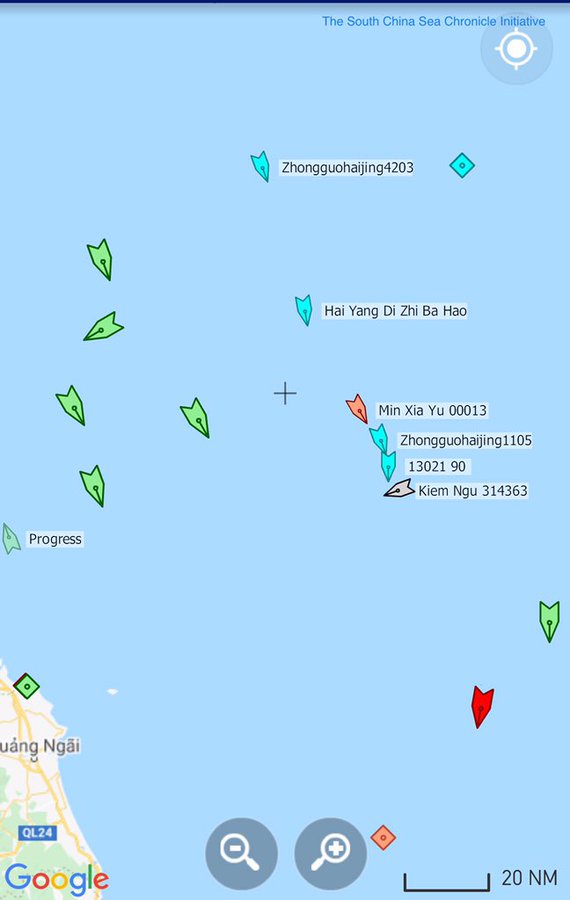
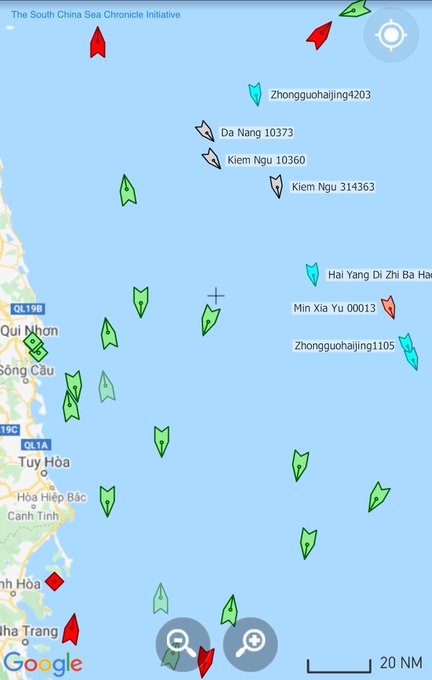
On Tuesday, the ship, which is used for offshore seismic surveys, appeared again 158km off Vietnam’s coast, within its exclusive economic zone (EEZ), flanked by at least one Chinese coastguard vessel, according to data from Marine Traffic, a website that tracks shipping.
At least three Vietnamese vessels were moving with the Chinese ship, according to data issued by the Marine Traffic site.
South China Sea News@SCS_news
·
Haiyang Dizhi 8 is heading toward #SouthChinaSea with several escort ships.
South China Sea News@SCS_news
About 50 nm ahead of Haiyang Dizhi 8 is a group of at least 3 #China Coast Guard ships, including the largest 5901. #SouthChinaSea
The presence of the Haiyang Dizhi 8 in Vietnam’s EEZ comes towards the scheduled end of a 15-day nationwide lockdown in Vietnam aimed at curbing the spread of the coronavirus.
“We call on the PRC to remain focused on supporting international efforts to combat the global pandemic, and to stop exploiting the distraction or vulnerability of other states to expand its unlawful claims in the South China Sea,” the US State Department said in a statement, referring to China.
Vietnam pulls DreamWorks’ ‘Abominable’ over South China Sea map
, which also has disputed claims in the South China Sea, has raised its concerns too.
On Saturday, the Global Times, published by the official People’s Daily newspaper of China’s ruling Communist Party, said Vietnam had used the fishing boat incident to distract from its “ineptitude” in handling the coronavirus.
Vietnam’s Ministry of Foreign Affairs did not immediately respond to a request for comment.
Helped by a mass quarantine and aggressive contact-tracing, Vietnam has recorded 265 cases of the novel coronavirus and no deaths. Nearly 122,000 coronavirus tests have been carried out in Vietnam.
China and Vietnam have for years been at loggerheads over the potentially energy-rich waters, called the East Sea by Vietnam.
China’s U-shaped “nine-dash line” on its maps marks a vast expanse of the waters that it claims, including large parts of Vietnam’s continental shelf where it has awarded oil concessions.
and Brunei claim some of the waters that China claims to the south.
During the stand-off last year, at least one Chinese coastguard vessel spent weeks in waters close to an oil rig in a Vietnamese oil block, operated by Russia’s Rosneft, while the Haihyang Dizhi 8 conducted suspected oil exploration surveys in large expanses of Vietnam’s EEZ.
“The deployment of the vessel is Beijing’s move to once again baselessly assert its sovereignty in the South China Sea,” said Ha Hoang Hop, at the Singapore-based ISEAS-Yusof Ishak Institute.
“China is using the coronavirus distraction to increase its assertiveness in the South China Sea, at a time when the US and Europe are struggling to cope with the new coronavirus.”
Between January 20 and April 4, PM2.5 levels across the country fell by more than 18 per cent, according to the environment ministry
But observers say that as soon as the nation’s factories and roads get back to normal, so too will the air pollution levels
Blue skies were an unexpected upside of locking down cities and halting industrial production across China. Photo: AFP
China’s air quality has improved dramatically in recent weeks as a result of the widespread city lockdowns and strict travel restrictions introduced to contain the
. But experts say the blue skies could rapidly disappear as factories and roads reopen under a government stimulus plan to breathe new life into a stalled economy.
According to the Ministry of Ecology and Environment, between January 20 and April 4 the average concentration of PM2.5 – the tiny particles that pose the biggest risk to health – fell by 18.4 per cent from the same period of last year.
Meanwhile, the average number of days with good air quality – determined as when the air pollution index falls below 100 – rose by 7.5 per cent, it said.
Satellite images released by Nasa and the European Space Agency showed a dramatic drop in nitrogen dioxide emissions in major Chinese cities in the first two months of 2020, compared with a year earlier.
According to Nasa, the changes in Wuhan – the central China city at the epicentre of the initial coronavirus outbreak – were particularly striking, while nitrogen dioxide levels across the whole of eastern and central China were 10 to 30 per cent lower than normal.
The region is home to hundreds of factories, supplying everything from steel and car parts to microchips. Wuhan, which has a population of 11 million, was placed under lockdown on January 23, but those restrictions were lifted on Wednesday
.
Air pollution is likely to return to China’s cities once the lockdowns are lifted. Photo: Reuters
Nitrogen dioxide is produced by cars, power plants and other industrial facilities and is thought to exacerbate respiratory illnesses such as asthma.
The space agency said the decline in air pollution levels coincided with the restrictions imposed on transport and business activities.
That was consistent with official data from China’s National Development and Reform Commission, which recorded a 25 per cent fall in road freight volume and a 14 per cent decline in the consumption of oil products between January and February.
Guangzhou cases prompt shutdown in ‘Little Africa’ trading hub
8 Apr 2020
Liu Qian, a senior climate campaigner for Greenpeace based in Beijing, said the restrictions on industry and travel were the primary reasons for the improvement in air quality.
According to official data, in February, the concentrations of PM2.5, nitrogen dioxide and sulphur dioxide – a toxic gas that comes mostly from industrial burning of coal and other fossil fuels – all fell, by 27 per cent, 28 per cent and 23 per cent, respectively.
“The causes of air pollution are complicated, but the suspension of industrial activity and a drop in public transport use will have helped to reduce levels,” Liu said.
As the epicentre of the Covid-19 pandemic has shifted to the United States and
, human and industrial activity in China is gradually picking back up, and so is air pollution.
Lauri Myllyvirta, lead analyst with the Centre for Research on Energy and Clean Air in Helsinki, said that levels of nitrogen dioxide pollution, measured both by Nasa satellites and official stations in China, started inching back up in the middle of March and had returned to normal levels by the end of the month.
That coincided with the centre’s findings – published on Carbon Brief, a British website on climate change – that coal consumption at power plants and oil refineries across China returned to their normal levels in the fourth week of March.
How the Wuhan experience could help coronavirus battle in US and Europe
10 Apr 2020
Ma Jun, director of the Institute of Public & Environmental Affairs, a Beijing-based charity, said a stimulus plan to kick-start the economy would have a significant impact on air pollution.
“Once industrial production is fully resumed, so are the emission levels,” he said. “Unless another outbreak happens and triggers another lockdown, which would be terrible, the improvement achieved under the pandemic is unstable and won’t last long.”
After the 2008 financial crisis, Beijing launched a 4 trillion yuan (US$567.6 billion) stimulus package that included massive infrastructure investment, but also did huge damage to the environment. In the years that followed, air pollution rose to record highs and sparked a public backlash.
Even before the Covid-19 outbreak, China’s economy was slowing – it grew by 6.1 per cent in 2019, its slowest for 29 years – and concerns are now growing that policymakers will go all out to revive it.
“Local governments have been under huge pressure since last year, and there are fears that environmental regulations will be sidelined [in the push to boost economic output],” Ma said.
But Beijing had the opportunity to get it right this time by investing more in green infrastructure projects rather than high-carbon projects, he said.
“A balance between economic development and environmental protection is key to achieving a green recovery, and that is what China needs.”
MUMBAI (Reuters) – At least 11 people have been killed and six are missing after the Western Indian city of Pune and its neighbouring areas were hit by heavy rain and flash floods, a government official said on Wednesday.
More than 28,000 people have been evacuated from low-lying areas and the local administration is on alert for more rain, Deepak Mhaisekar told Reuters.
Pune, which is around 200 kilometres (124 miles) east of India’s financial hub of Mumbai, has received 113% more rainfall than average since the start of the monsoon season in early June, a weather department official said.
Of the 11 deaths, five occurred in Pune when a wall collapsed, said Mhaisekar.
South Asia gets monsoon rain annually during the June-September months which cause fatalities and mass displacement.
India’s monsoons, which deliver more than 70% of the country’s annual rainfall, are crucial for farm output and economic growth, but rainfall often weakens the foundations of poorly built walls and buildings resulting in deaths.

















 CHINDIA ALERT: You'll be living in their world, very soon