Chindia Alert: You’ll be Living in their World Very Soon
aims to alert you to the threats and opportunities that China and India present. China and India require serious attention; case of ‘hidden dragon and crouching tiger’.
Without this attention, governments, businesses and, indeed, individuals may find themselves at a great disadvantage sooner rather than later.
The POSTs (front webpages) are mainly 'cuttings' from reliable sources, updated continuously.
The PAGEs (see Tabs, above) attempt to make the information more meaningful by putting some structure to the information we have researched and assembled since 2006.
Image copyrightGETTY IMAGESImage captionAn Indian man watches the news broadcasting images of the released Indian pilot
As tensions between India and Pakistan escalated following a deadly suicide attack last month, there was another battle being played out on the airwaves. Television stations in both countries were accused of sensationalism and partiality. But how far did they take it? The BBC’s Rajini Vaidyanathan in Delhi and Secunder Kermani in Islamabad take a look.
It was drama that was almost made for television.
The relationship between India and Pakistan – tense at the best of times – came to a head on 26 February when India announced it had launched airstrikes on militant camps in Pakistan’s Balakot region as “retaliation” for a suicide attack that had killed 40 troops in Indian-administered Kashmir almost two weeks earlier.
A day later, on 27 February, Pakistan shot down an Indian jet fighter and captured its pilot.
Abhinandan Varthaman was freed as a “peace gesture”, and Pakistan PM Imran Khan warned that neither country could afford a miscalculation, with a nuclear arsenal on each side.
Suddenly people were hooked, India’s TV journalists included.
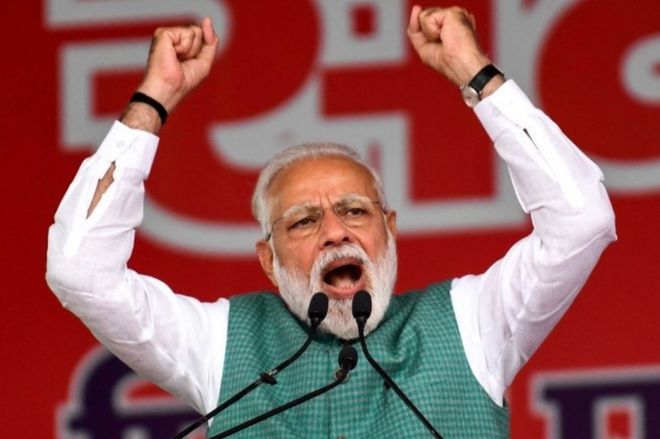
Image copyrightAFPImage captionIndian PM Narendra Modi is accused of exploiting India-Pakistan hostilities for political gain
So were they more patriots than journalists?
Rajini Vaidyanathan: Indian television networks showed no restraint when it came to their breathless coverage of the story. Rolling news was at fever pitch.
The coverage often fell into jingoism and nationalism, with headlines such as “Pakistan teaches India a lesson”, “Dastardly Pakistan”, and “Stay Calm and Back India” prominently displayed on screens.
Some reporters and commentators called for India to use missiles and strike back. One reporter in south India hosted an entire segment dressed in combat fatigues, holding a toy gun.
And while I was reporting on the return of the Indian pilot at the international border between the two countries in the northern city of Amritsar, I saw a woman getting an Indian flag painted on her cheek. “I’m a journalist too,” she said, as she smiled at me in slight embarrassment.
Print journalist Salil Tripathi wrote a scathing critique of the way reporters in both India and Pakistan covered the events, arguing they had lost all sense of impartiality and perspective. “Not one of the fulminating television-news anchors exhibited the criticality demanded of their profession,” she said.
Media captionIndia and Pakistan’s ‘war-mongering’ media
Secunder Kermani: Shortly after shooting down at least one Indian plane last week, the Pakistani military held a press conference.
As it ended, the journalists there began chanting “Pakistan Zindabad” (Long Live Pakistan). It wasn’t the only example of “journalistic patriotism” during the recent crisis.
Two anchors from private channel 92 News donned military uniforms as they presented the news – though other Pakistani journalists criticised their decision.
But on the whole, while Indian TV presenters angrily demanded military action, journalists in Pakistan were more restrained, with many mocking what they called the “war mongering and hysteria” across the border.
In response to Indian media reports about farmers refusing to export tomatoes to Pakistan anymore for instance, one popular presenter tweeted about a “Tomatical strike” – a reference to Indian claims they carried out a “surgical strike” in 2016 during another period of conflict between the countries.
Media analyst Adnan Rehmat noted that while the Pakistani media did play a “peace monger as opposed to a warmonger” role, in doing so, it was following the lead of Pakistani officials who warned against the risks of escalation, which “served as a cue for the media.”
What were they reporting?
Rajini Vaidyanathan: As TV networks furiously broadcast bulletins from makeshift “war rooms” complete with virtual reality missiles, questions were raised not just about the reporters but what they were reporting.
Indian channels were quick to swallow the government version of events, rather than question or challenge it, said Shailaja Bajpai, media editor at The Print. “The media has stopped asking any kind of legitimate questions, by and large,” she said. “There’s no pretence of objectiveness.”
In recent years in fact, a handful of commentators have complained about the lack of critical questioning in the Indian media.
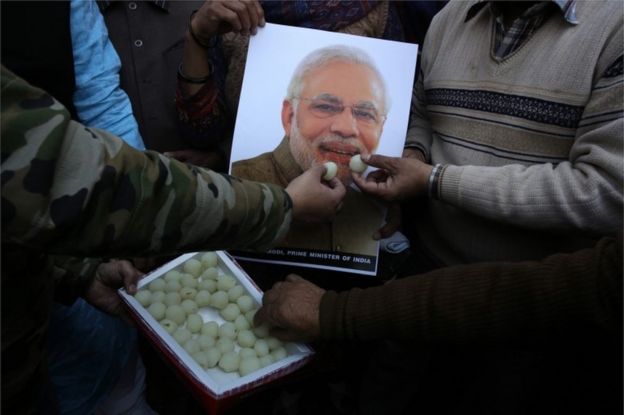
Image copyrightAFPImage captionIndians celebrated news of the strikes
“For some in the Indian press corps the very thought of challenging the ‘official version’ of events is the equivalent of being anti-national”, said Ms Bajpai. “We know there have been intelligence lapses but nobody is questioning that.”
Senior defence and science reporter Pallava Bagla agreed. “The first casualty in a war is always factual information. Sometimes nationalistic fervour can make facts fade away,” he said.
This critique isn’t unique to India, or even this period in time. During the 2003 Iraq war, western journalists embedded with their country’s militaries were also, on many occasions, simply reporting the official narrative.
Secunder Kermani: In Pakistan, both media and public reacted with scepticism to Indian claims about the damage caused by the airstrikes in Balakot, which India claimed killed a large number of Jaish-e-Mohammad (JeM) militants in a training camp.
Hamid Mir, one of the most influential TV anchors in the country travelled to the area and proclaimed, “We haven’t seen any such (militant) infrastructure… we haven’t seen any bodies, any funerals.”
“Actually,” he paused, “We have found one body… this crow.” The camera panned down to a dead crow, while Mr Mir asked viewers if the crow “looks like a terrorist or not?”
There seems to be no evidence to substantiate Indian claims that a militant training camp was hit, but other journalists working for international outlets, including the BBC, found evidence of a madrassa, linked to JeM, near the site.
Image copyrightPLANET LABS INC./HANDOUT VIA REUTERSImage captionThe satellite image shows a close-up of a madrassa near Balakot in Pakistan’s Khyber Paktunkhwa
A photo of a signpost giving directions to the madrassa even surfaced on social media. It described the madrassa as being “under the supervision of Masood Azhar”. Mr Azhar is the founder of JeM.
The signpost’s existence was confirmed by a BBC reporter and Al Jazeera, though by the time Reuters visited it had apparently been removed. Despite this, the madrassa and its links received little to no coverage in the Pakistani press.
Media analyst Adnan Rehmat told the BBC that “there was no emphasis on investigating independently or thoroughly enough” the status of the madrassa.
In Pakistan, reporting on alleged links between the intelligence services and militant groups is often seen as a “red line”. Journalists fear for their physical safety, whilst editors know their newspapers or TV channels could face severe pressure if they publish anything that could be construed as “anti-state”.
Who did it better: Khan or Modi?
Rajini Vaidyanathan: With a general election due in a few months, PM Narendra Modi continued with his campaign schedule, mentioning the crisis in some of his stump speeches. But he never directly addressed the ongoing tensions through an address to the nation or a press conference.
This was not a surprise. Mr Modi rarely holds news conference or gives interviews to the media. When news of the suicide attack broke, Mr Modi was criticised for continuing with a photo shoot.
Image copyrightAFPImage captionImran Khan was praised for his measured approach
The leader of the main opposition Congress party, Rahul Gandhi, dubbed him a “Prime Time Minister” claiming the PM had carried on filming for three hours. PM Modi has also been accused of managing his military response as a way to court votes.
At a campaign rally in his home state of Gujarat he seemed unflustered by his critics, quipping “they’re busy with strikes on Modi, and Modi is launching strikes on terror.”
Secunder Kermani: Imran Khan won praise even from many of his critics in Pakistan, for his measured approach to the conflict. In two appearances on state TV, and one in parliament, he appeared firm, but also called for dialogue with India.
His stance helped set the comparatively more measured tone for Pakistani media coverage.
Officials in Islamabad, buoyed by Mr Khan’s decision to release the captured Indian pilot, have portrayed themselves as the more responsible side, which made overtures for peace.
On Twitter, a hashtag calling for Mr Khan to be awarded a Nobel Peace Prize was trending for a while. But his lack of specific references to JeM, mean internationally there is likely to be scepticism, at least initially, about his claims that Pakistan will no longer tolerate militant groups targeting India.
NEW DELHI (Reuters) – India’s election commission issued a notice asking political parties not to use images of the country’s armed forces in their campaign posters and other advertising during its upcoming general election.
The notice followed pictures posted to social media recently showing the ruling Bharatiya Janata Party used images in their campaign posters of a captured Indian Air Force pilot recently returned by Pakistan after a clash with India over the disputed Kashmir territory.
The Election Commission said in a notice on its website on Saturday that political parties must refrain from using photographs of defence personnel in advertisements or their election campaign propaganda as the armed forces are “apolitical and neutral stakeholders in a modern democracy.”
The commission cited a 2013 order that said photographs of defence personnel should not be used “in any manner in advertisement/propaganda/campaigning or in any another other manner in connections with elections by political parties and candidates.”
It called for “strict compliance” with the order.
The pilot, Abhinandan Varthaman, was shot down on Feb. 27 by Pakistani aircraft during clashes between the two nuclear-armed powers that began after a terror attack last month in Kashmir that killed 40 Indian paramilitary police.
India blamed Pakistan for the attack and harbouring the militants that claimed responsibility for the attack. Pakistan denies the charges.
India later attacked a site inside Pakistan it claimed was a militant training camp. That triggered aerial clashes that led to Varthaman’s capture. Pakistan released him last week as a peace gesture.
Indian Prime Minister Narendra Modi hailed his release and claimed the clashes with Pakistan were an Indian victory. Nationalistic passions in India have risen since the terror attack.
Recent social media posts showed a campaign poster on a billboard in Indian capital of New Delhi with Varthaman’s face alongside Modi’s, along with the words: “If Modi is in power, it is possible! NaMo again 2019!” NaMo is an acronym for Modi.
Later on Sunday, the Election Commission is due to announce the polling schedule for the upcoming general election, which will be the world’s biggest democratic exercise.
Prime Minister Narendra Modi on Sunday praised the Central Industrial Security Force (CISF) for playing a major role in ensuring the security of the country’s national assets.
SNS Web | New Delhi | March 10, 2019 2:18 pm
Prime Minister Narendra Modi on Sunday praised the Central Industrial Security Force (CISF) for playing a major role in ensuring the security of the country’s national assets.
At the 50th Raising Day ceremony of the central armed police force, the PM pointed at the threat from Pakistan.
“Enough is enough,” he said, while referring to the terror attacks in Pulwama and Uri, adding, “We cannot keep suffering till eternity.”
The PM said that protecting nation is a challenging thing because of the hostile neighbour.
“Your achievement is important because when neighbour is hostile, incapable to fight war, conspiracies to hit the nation internally find a safe haven there, and terrorism shows its face in different forms then protecting the nation becomes challenging,” said the PM.
He acknowledged that providing security to establishments where lakhs of people come daily is a task that is incomparable to any.
“The task of providing security to an establishment where over 30 lakh people come daily and every face is different is far more than security to a VIP,” he said at the golden jubilee ceremony in Indirapuram in Uttar Pradesh’s Ghaziabad.
The PM added that there was a need to spread awareness among the public regarding the security aspect.
“There is a need to educate the citizens because if they do not cooperate then the task of CISF becomes even more difficult,” he said.
Recalling the services of the CISF in the rescue efforts following the Kerala floods, the PM said that the force has given an invaluable contribution in tackling natural calamities and humanitarian crises in India and abroad.
“Your contribution in natural calamities is praiseworthy. You saved the lives of thousands in the recent Kerala floods,” he said, adding, “CISF has also played its role whenever humanity has come under threat in the world.”
Before addressing the CISF personnel, the PM laid a wreath at the Martyr’s Memorial.
He also reviewed the parade of the CISF and presented the Police and Fire Service Medals for distinguished and meritorious services.
The event was attended by Minister of State for External Affairs VK Singh, Ministers of State for Home Affairs Kiren Rijiju and Hansraj Gangaram Ahir.
Raised in 1969, the CISF has currently over 1.5 lakh personnel who provide security to vital installations of the country, including 61 airports, seaports, Delhi Metro and various state-owned industries.
NEW DELHI (Reuters) – India said on Saturday Pakistan had “plenty to hide” by preventing journalists from accessing the site of an air strike by Indian fighter jets inside Pakistan.
Citing “security concerns”, Pakistani security officials on Thursday barred a Reuters team from climbing a hill in northeastern Pakistan to the site of a madrasa, or religious school, and a group of surrounding buildings that was targeted by Indian warplanes last week.
“The fact that Pakistan has now refused access to journalists from visiting the site means that they have plenty to hide,” Indian foreign ministry spokesman Raveesh Kumar told reporters.
He reiterated the government’s stand that India’s air strikes were “successful and achieved the desired objectives”, after being asked about a Reuters report that said high-resolution satellite images reviewed by Reuters showed that the madrasa appeared to be still standing.
Visitors are seen at a tulip fair at Baiwankui garden in Nansha free trade zone in south China’s Guangdong Province, Feb. 9, 2019. (Xinhua/Liu Dawei)
BEIJING, March 7 (Xinhua) — China expects to see wider opening-up as it pledges to do more to attract foreign investment and promote global cooperation at the ongoing annual “two sessions.”
“We will promote all-round opening-up and foster new strengths in international economic cooperation and competition,” Chinese Premier Li Keqiang said when delivering the government work report to the annual legislative session Tuesday.
At the session, further relax of controls over market access has been announced, a draft foreign investment law will be deliberated, and the Belt and Road cooperation has been promoted.
UNVEILING OPPORTUNITIES
The government will further shorten the negative list which outlines fields off-limits to foreign investors, Ning Jizhe, deputy director of the National Development and Reform Commission, told a press conference on the sidelines of the annual legislative session Wednesday.
China will roll out more opening measures to the agriculture, mining, manufacturing and service sectors, and allow wholly foreign-funded enterprises to operate in more sectors, Ning said.
John Huang with the British information service provider Experian believes that international investors will welcome China’s further opening-up.
“Some core industries, once considered to be ‘the most difficult areas to open up,’ such as automobile manufacturing and financial services, are now welcoming foreign investment,” said Huang, managing director for decision analytics of Experian Greater China.
“The Chinese government’s consistent commitment to opening-up has given foreign enterprises confidence about the business environment here,” said SangBoem Han, CEO of LG Display from the Republic of Korea.
In July 2018, LG Display opened an OLED panel factory in south China’s Guangdong Province with a total investment of 46 billion yuan (6.9 billion U.S. dollars).
China saw a record foreign direct investment of 135 billion U.S. dollars in 2018 despite a global economic downturn and rising protectionism.
“In the early days, foreign firms received preferential policies regarding land, electricity and taxes in China,” Han said, “but more recently, the government has increased its protection of intellectual property and improved efficiency.”
FOREIGN INVESTMENT LAW
On Tuesday, Premier Li emphasized opening up based on rules and related institutions.
This will help China better conform with the international rules, said Zhang Jin, a national political advisor and businessman from Guangdong.
“This is also in line with China’s further integration with globalization and engagement in international competition,” Zhang said.
A highlight at this year’s “two sessions” is the draft foreign investment law, which is to be submitted to this year’s session of the 13th National People’s Congress (NPC) for review.
Once adopted, the unified law will replace three existing laws on Chinese-foreign equity joint ventures, non-equity joint ventures (or contractual joint ventures) and wholly foreign-owned enterprises.
The foreign investment law would be highly significant to protect legitimate rights and interests of foreign investors and ensure fair competition, said Loh Jen Yuh, president of China & Investment Management of CapitaLand Group, one of Asia’s largest real estate companies.
“The law shows China’s openness and the rule of law,” said Han, who hoped that the enact of the law would further improve China’s business environment.
PROMOTING GLOBAL COOPERATION
Along with the efforts to attract foreign businesses, China is also stepping up the implementation of the Belt and Road Initiative (BRI) to benefit more participants.
To date, a total of 152 countries and international organizations have signed cooperation documents with China on the BRI.
“Many countries along the Belt and Road have shown their intention to cooperate with Chinese manufacturers,” said Wu Gang, a national political advisor and chairman of wind power firm Xinjiang Goldwind Science & Technology.
“We are more confident in going global under the government’s favorable policies related to the BRI,” said Wu, whose business has gained great market shares in Pakistan and Australia.
According to the government work report, China will continue to “promote the joint pursuit” of the BRI, aiming at “shared growth through discussion and collaboration.”
China has signed free trade agreements with over 20 countries and regions. According to Zhao Ji, a national political advisor and president of China’s Northeastern University, the country’s efforts to strengthen the opening-up are especially important against the weak global economic growth.
“The development of China, which has been closely connected with the world, will continue to play a key role in promoting globalization,” Zhao said.
NEW DELHI (Reuters) – Indian cricketers wore army camouflage-style caps in a match with Australia on Friday in solidarity with Indian paramilitary police killed in a militant attack by a Pakistan-based group and in an unusually strong display of patriotic fervour in sport.
The suicide bombing last month killed 40 in Indian-controlled Kashmir, a region also claimed by Pakistan. The attack prompted India to launch an air strike inside Pakistan, which responded with an aerial attack the next day.
The Board of Control for Cricket in India (BCCI) has in recent days tried unsuccessfully to isolate Pakistan in the cricketing world. The International Cricket Council rejected India’s calls to boycott games against Pakistan, whose prime minister is former cricketing hero Imran Khan.
But there are still calls within India for the national team to pull out of a World Cup match against Pakistan in June in England.
The idea to sport the olive-and-black caps bearing the BCCI’s logo came from former Indian cricket captain and current player Mahendra Singh Dhoni, one of the game’s biggest stars and an honorary lieutenant colonel with the Indian army.
“It’s a special cap,” Indian captain Virat Kohli said before the third in a five-match one-day series with Australia. “This is to pay respect to the martyrs … and their families.”
He said all the players would donate their fees from the match to a national defence fund to help out the families of defence personnel who die on duty. Kohli also urged all Indians to contribute to the fund.
The BCCI posted a clip on Twitter of commentators for the match also wearing the caps, signing off the tweet with “#JaiHind”, or “Hail India”.
The board has scrapped the opening ceremony for the Indian Premier League Twenty20 tournament, which begins on March 23, and will donate the money saved to the families of those who died in the bomb attack.
Cricket historian Boria Majumdar said he could not remember seeing any Indian cricket team in the past making such a gesture, which he called a “peaceful political stand”.
“(Indian cricket) teams have expressed solidarity in the past but not this kind of public display of that solidarity,” Majumdar told Reuters.
“Sport has always been meshed with politics and people have often used it to make very strong points. This is yet another one. This is a peaceful way of expressing solidarity in a manner which I don’t see problematic at all.”
But Pakistani lawyer Abdullah Nizamani said on Twitter the BCCI and international cricket board should keep “sports away from petty politics”. Some Pakistanis even asked on social media if Indian cricketers would turn up for the World Cup match with Pakistan in military fatigues.
Nuclear-armed neighbours India and Pakistan have fought two of their three wars since independence over Kashmir, which both sides claim in full but rule in part.
ISLAMABAD (Reuters) – Pakistan intensified its crackdown against Islamist militants on Thursday, with the government announcing it had taken control of 182 religious schools and detained more than 100 people as part of its push against banned groups.
The move represents Pakistan’s biggest move against banned organisations in years and appears to be targeting Islamic welfare organisations that the United States says are a front for militant activities.
Pakistan is facing pressure from global powers to act against groups carrying out attacks in India, including Jaish-e-Mohammed (JeM), which claimed responsibility for the Feb. 14 attack that killed at least 40 Indian paramilitary police.
The escalating tension in the wake of the bombing led to a major confrontation between the nuclear-armed rivals, with both countries carrying out aerial bombing missions and even engaging in a brief dogfight that prompted fears of a war.
Pakistani officials say the crackdown is part of a long-planned drive and not a response to Indian anger over what New Delhi calls Islamabad’s failure to rein in militant groups operating on Pakistani soil.
Previous large-scale crackdowns against anti-India militants have broadly been cosmetic, with the proscribed groups able to survive and continue operations.
The interior ministry said law enforcement agencies had placed 121 people in “preventive detention” as part of the crackdown that began this week.
“Provincial governments have taken in their control management and administration of 182 seminaries (madaris)”, the ministry said in a statement, referring to religious schools.
What to do with madrasas is a thorny issue in Pakistan, a deeply conservative Muslim nation where religious schools are often blamed for radicalisation of youngsters but are the only education available to millions of poor children.
The interior ministry said other institutions from different groups had been taken over, including 34 schools or colleges, 163 dispensaries, 184 ambulances, five hospitals and eight offices of banned organisations.
Many banned groups such as JeM run seminaries, which counter-terrorism officials say are used as recruiting grounds for militant outfits
Jamaat-ud-Dawa (JuD), which operates hospitals and a fleet of ambulances, is estimated to run about 300 madrasas across the country. Pakistan’s government banned the group this week.
JuD calls itself a humanitarian charity but the U.S. State Department has designated it a “foreign terrorist organisation” and calls it a front for Lashkar-e-Taiba (LET), a Pakistan-based group accused of orchestrating attacks in India, including the 2008 Mumbai attack that killed 166 people.
JuD called the crackdown unfair and said it would seek to counter the government action in courts.
“The whole nation is asking that what message the government wants to send by sealing welfare organisations and kicking students out,” said JuD spokesman Yahya Mujahid.
Pakistan has long used Islamist groups to pursue its aims in the region, but it has denied New Delhi’s accusations it actively supports militants fighting Indian forces in India’s part of Muslim-majority Kashmir.
The South Asian neighbours have fought three wars since independence from Britain in 1947, two of them over Kashmir which they both claim in whole but rule in part.
The Chinese foreign ministry on Thursday released a statement in Chinese following the visit of vice-foreign minister Kong Xuanyou to Pakistan, lauding Islamabad’s response.
WORLDUpdated: Mar 07, 2019 16:42 IST
Sutirtho Patranobis
Hindustan Times, Beijing
Kong visited Pakistan as Islamabad faced pressure from global powers to act against groups carrying out attacks in India, including Jaish-e-Mohammed (JeM), which claimed responsibility for the February 14 attack that killed 40 CRPF personnel in Pulwama.(REUTERS File Photo)
China has praised Pakistan for its handling of the tense situation with India, appreciating Islamabad’s “restraint” in the aftermath of the Pulwama terror attack in Jammu and Kashmir in February.
The Chinese foreign ministry on Thursday released a statement in Chinese following the visit of vice-foreign minister Kong Xuanyou to Pakistan, lauding Islamabad’s response.
“China has paid close attention to the present situation between Pakistan and India, and appreciates Pakistan remaining calm and exercising restraint from the beginning, and persisting in pushing to lower the temperature with India via dialogue,” the foreign ministry statement said.
It paraphrased Kong’s discussions with Pakistan’s leadership comprising Prime Minister Imran Khan, army chief General Qamar Javed Bajwa and foreign minister Shah Mehmood Qureshi.
In turn, the statement quoted the Pakistani side thanking China’s “objective and fair position” on the situation and for its efforts to promote the “cooling” of the situation.
Kong visited Pakistan as Islamabad faced pressure from global powers to act against groups carrying out attacks in India, including Jaish-e-Mohammed (JeM), which claimed responsibility for the February 14 attack that killed 40 CRPF personnel in Pulwama.
The Pulwama suicide attack – the worst in Kashmir in decades – led to the most serious conflict in years between the nuclear-armed neighbours with India carrying out a strike on a JeM camp in Balakot and then a dogfight over the skies of Kashmir.
The crisis seems to have eased after Pakistan returned IAF Wing Commander Abhinandan Varthaman last Friday, nearly two days after he was captured.
Kong was quoted as telling the Pakistani leadership that China maintains that the sovereignty and territorial integrity of all countries should be earnestly respected and that Beijing is unwilling to see acts that violate the norms of international relations.
The statement quoted Kong as saying that China calls on Pakistan and India to refrain from taking actions to aggravate the situation, show goodwill and flexibility, launch dialogue as soon as possible, and work together to maintain regional peace and stability.
China is willing to continue to play a constructive role in this regard, Kong is quoted to have said.
According to the statement, the Pakistani leaders appreciated China’s objective and fair position on the situation in Pakistan and India and thanked China for its efforts to promote the cooling of the situation.
It added that the Pakistani side reiterated that it is unwilling to see an escalation of the situation and is willing to resolve the contradictions and differences between the two sides through dialogue and peacefully, and welcomes China and the international community to play an active role in this regard.
The incident comes less than a month after over 44 CRPF personnel were killed and many injured on February 14 in Jammu and Kashmir’s Pulwama.
SNS Web | New Delhi | March 7, 2019 12:47 pm
Security personnel carry out investigation at the site where a blast took place after a grenade attack by militants at the busy main bus terminus in Jammu and Kashmir, on March 7, 2019. (Photo: IANS)
One person was killed and 29, including a woman injured in a blast after a grenade was tossed at a bus in the general bus stand in the heart of Jammu on Thursday. The condition of five injured is said to be serious.
The killed youth has been identified as a 17-year-old Mohammad Sharik of Haridwar in Uttrakhand.
Minister of State for Defence Subhash Bhamre said a local investigation has been initiated into the incident. He further said the government has given complete liberty to the forces to take all necessary steps.
The Jammu and Kashmir Police has been rushed to the site of the blast.
The Chinese grenade exploded in the bus at about 12 noon. The driver and conductor were among the injured rushed to the Government Medical College, Jammu. The injured include passengers belonging to Bihar, Punjab, Haryana, Uttrakhand, Jammu and the Kashmir valley.
Visuals from the blast site showed the damaged bus of the J&K Road Transport Corporation (JKSRTC) in which the grenade exploded.
The area has been cordoned off by the security personnel. Nature and the cause is being ascertained, police said.
Fifteen suspects have been rounded up for interrogation.
The grenade attack has coincided with the shifting of detained separatist Yasin Malik to the Jammu’s Kot-Bhalwal jail.
Police suspected the JeM outfit behind the attack. Some radicals had threatened of revenge during the recent communal tension here when about six cars were burnt.
K Vijay Kumar and KK Sharma, both advisors to the Governor, visited the spot to take stock of the situation. The divisional commissioner, deputy commissioner and senior police and civil officers also visited the spot.
This is the third grenade attack in the bus stand during the past few months.
The blast comes at a time when Jammu and Kashmir is on a high alert following the heightened tensions between India and Pakistan in the wake of the Pulwama terror attack.
Former chief minister Mehbooba Mufti condemned the incident and called for unity to defeat terror elements in the state.
“I condemn this act of terror in the strongest possible terms. My prayers for speedy recovery of those injured. The perpetrators are out there to inflict pain and divide us. Our unity has to be our tool to defeat them,” Mufti tweeted.
The provincial president of National Conference, Devender Rana, visited the hospital to inquire about the wellbeing of injured persons.
The incident comes less than a month after over 44 CRPF personnel were killed and many injured on February 14 in one of the deadliest terror strikes in Jammu-Kashmir when a Jaish-e-Mohammad (JeM) suicide bomber blew up an explosive-laden vehicle near their bus in Pulwama district.
The bus was part of a convoy of 78 vehicles carrying around 2500 CRPF personnel from Jammu to Srinagar.
Image copyrightAFPImage captionMr Modi is accused of exploiting India-Pakistan hostilities for political gain
A gaffe is when a politician tells the truth, American political journalist Michael Kinsley said.
Last week, a prominent leader of India’s ruling Hindu nationalist Bharatiya Janata Party (BJP) appeared to have done exactly that. BS Yeddyurappa said the armed aerial hostilities between India and Pakistan would help his party win some two dozen seats in the upcoming general election.
The remark by Mr Yeddyurappa, former chief minister of Karnataka, was remarkable in its candour. Not surprisingly, it was immediately seized upon by opposition parties. They said it was a brazen admission of the fact that Prime Minister Narendra Modi’s party was mining the tensions between the nuclear-armed rivals ahead of general elections, which are barely a month away. Mr Modi’s party is looking at a second term in power.
Mr Yeddyurappa’s plain-spokenness appeared to have embarrassed even the BJP. Federal minister VK Singh issued a statement, saying the government’s decision to carry out air strikes in Pakistan last week was to “safeguard our nation and ensure safety of our citizens, not to win a few seats”. No political party can afford to concede that it was exploiting a near war for electoral gains.
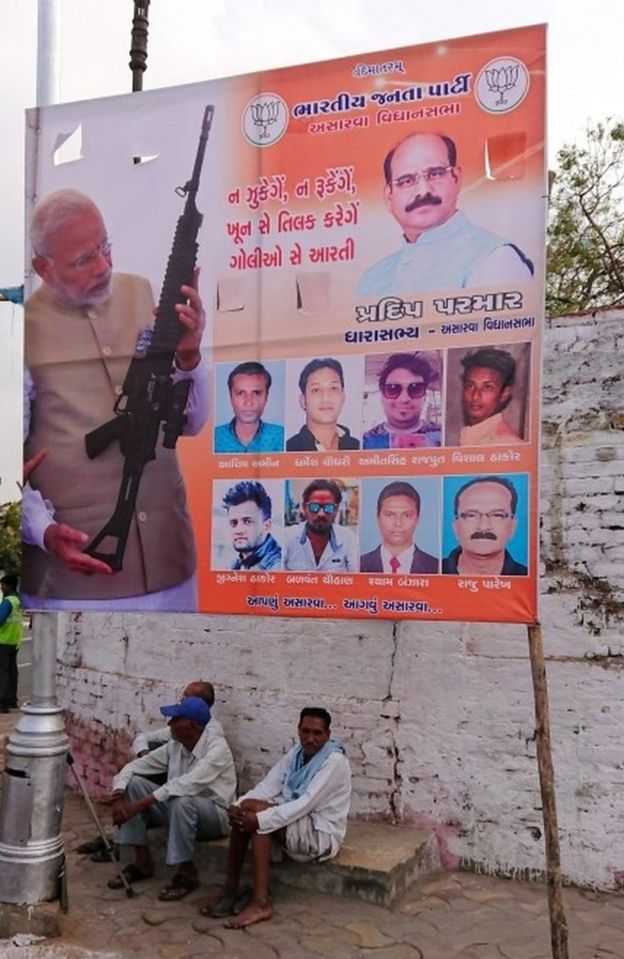
Image copyrightAFPImage captionThe BJP has put up election posters of Mr Modi posing with guns
Even as tensions between India and Pakistan ratcheted up last week, Mr Modi went on with business as usual. Hours after the Indian attack in Pakistan’s Balakot region, he told a packed election meeting that the country was in safe hands and would “no longer be helpless in the face of terror”. Next morning, Pakistan retaliated and captured an Indian pilot who ejected from a downed fighter jet. Two days later, Pakistan returned the pilot to India.
Mr Modi then told a gathering of scientists that India’s aerial strikes were merely a “pilot project” and hinted there was more to come. Elsewhere, his party chief Amit Shah said India had killed more than 250 militants in the Balakot attack even as senior defence officials said they didn’t know how many had died. Gaudy BJP posters showing Mr Modi holding guns and flanked by soldiers, fighter jets and orange explosions have been put up in parts of the country. “Really uncomfortable with pictures of soldiers on election posters and podiums. This should be banned. Surely the uniform is sullied by vote gathering in its name,” tweeted Barkha Dutt, an Indian television journalist and author.
Mr Modi has appealed to the opposition to refrain from politicising the hostilities. The opposition parties are peeved because they believe Mr Modi has not kept his word. Last week, they issued a statement saying “national security must transcend narrow political considerations”.
‘Petty political gain’
But can the recent conflict fetch more votes for Mr Modi? In other words, can national security become a campaign plank?
Many believe Mr Modi is likely to make national security the pivot of his campaign. Before last month’s suicide attack – claimed by Pakistan-based militants – killed more than 40 Indian paramilitaries in Kashmir, Mr Modi was looking a little vulnerable. His party had lost three state elections on the trot to the Congress party. Looming farm and jobs crises were threatening to hurt the BJP’s prospects.
Now, many believe, Mr Modi’s chances look brighter as he positions himself as a “muscular” protector of the country’s borders. “This is one of the worst attempts to use war to win [an] election, and to use national security as petty political gain. But I don’t know whether it will succeed or not,” says Yogendra Yadav, a politician and psephologist.
Image copyrightEPAImage captionMany Indians have celebrated India’s strike in Pakistani territory
Evidence is mixed on whether national security helps ruling parties win elections in India. Ashutosh Varshney, a professor of political science at Brown University in the US, says previous national security disruptions in India were “distant from the national elections”.
The wars in 1962 (against China) and 1971 (against Pakistan) broke out after general elections. Elections were still two years away when India and Pakistan fought a war in 1965. The 2001 attack on the Indian parliament that brought the two countries to the brink of war happened two years after a general election. The Mumbai attacks in 2008 took place five months before the elections in 2009 – and the then ruling Congress party won without making national security a campaign plank.
For one, he says, it comes just weeks ahead of a general election in a highly polarised country. The vast expansion of the urban middle class means that national security has a larger constituency. And most importantly, according to Dr Varshney, “the nature of the regime in Delhi” is an important variable. “Hindu nationalists have always been tougher on national security than the Congress. And with rare exceptions, national security does not dominate the horizons of regional parties, governed as they are by caste and regional identities.”
Bhanu Joshi, a political scientist also at Brown University, believes Mr Modi’s adoption of a muscular and robust foreign policy and his frequent international trips to meet foreign leaders may have touched a chord with a section of voters. “During my work in northern India, people would continuously invoke the improvement in India’s stature in the international arena. These perceptions get reinforced with an event like [the] Balakot strikes and form impressions which I think voters, particularly on a bipolar contest of India and Pakistan, care about,” says Mr Joshi.
Others like Milan Vaishnav, senior fellow and director of the South Asia Program at the Carnegie Endowment for International Peace, echo a similar sentiment. He told me that although foreign policy has never been a “mass” issue in India’s domestic politics, “given the proximity of the conflict to the elections, the salience of Pakistan, and the ability of the Modi government to claim credit for striking back hard, I expect it will become an important part of the campaign”.
But Dr Vaishnav believes it will not displace the economy and farm distress as an issue, especially in village communities. “Where it will help the BJP most is among swing voters, especially in urban constituencies. If there were fence-sitters unsure of how to vote in 2019, this emotive issue might compel them to stick with the incumbent.”
How the opposition counters Mr Modi’s agenda-setting on national security will be interesting to watch. Even if the hostilities end up giving a slight bump to BJP prospects in the crucial bellwether states in the north, it could help take the party over the winning line. But then even a week is a long time in politics.




 CHINDIA ALERT: You'll be living in their world, very soon
India and Pakistan: How the war was fought in TV studios
As tensions between India and Pakistan escalated following a deadly suicide attack last month, there was another battle being played out on the airwaves. Television stations in both countries were accused of sensationalism and partiality. But how far did they take it? The BBC’s Rajini Vaidyanathan in Delhi and Secunder Kermani in Islamabad take a look.
It was drama that was almost made for television.
The relationship between India and Pakistan – tense at the best of times – came to a head on 26 February when India announced it had launched airstrikes on militant camps in Pakistan’s Balakot region as “retaliation” for a suicide attack that had killed 40 troops in Indian-administered Kashmir almost two weeks earlier.
A day later, on 27 February, Pakistan shot down an Indian jet fighter and captured its pilot.
Abhinandan Varthaman was freed as a “peace gesture”, and Pakistan PM Imran Khan warned that neither country could afford a miscalculation, with a nuclear arsenal on each side.
Suddenly people were hooked, India’s TV journalists included.
So were they more patriots than journalists?
Rajini Vaidyanathan: Indian television networks showed no restraint when it came to their breathless coverage of the story. Rolling news was at fever pitch.
The coverage often fell into jingoism and nationalism, with headlines such as “Pakistan teaches India a lesson”, “Dastardly Pakistan”, and “Stay Calm and Back India” prominently displayed on screens.
Some reporters and commentators called for India to use missiles and strike back. One reporter in south India hosted an entire segment dressed in combat fatigues, holding a toy gun.
And while I was reporting on the return of the Indian pilot at the international border between the two countries in the northern city of Amritsar, I saw a woman getting an Indian flag painted on her cheek. “I’m a journalist too,” she said, as she smiled at me in slight embarrassment.
Print journalist Salil Tripathi wrote a scathing critique of the way reporters in both India and Pakistan covered the events, arguing they had lost all sense of impartiality and perspective. “Not one of the fulminating television-news anchors exhibited the criticality demanded of their profession,” she said.
Secunder Kermani: Shortly after shooting down at least one Indian plane last week, the Pakistani military held a press conference.
As it ended, the journalists there began chanting “Pakistan Zindabad” (Long Live Pakistan). It wasn’t the only example of “journalistic patriotism” during the recent crisis.
Two anchors from private channel 92 News donned military uniforms as they presented the news – though other Pakistani journalists criticised their decision.
But on the whole, while Indian TV presenters angrily demanded military action, journalists in Pakistan were more restrained, with many mocking what they called the “war mongering and hysteria” across the border.
In response to Indian media reports about farmers refusing to export tomatoes to Pakistan anymore for instance, one popular presenter tweeted about a “Tomatical strike” – a reference to Indian claims they carried out a “surgical strike” in 2016 during another period of conflict between the countries.
Media analyst Adnan Rehmat noted that while the Pakistani media did play a “peace monger as opposed to a warmonger” role, in doing so, it was following the lead of Pakistani officials who warned against the risks of escalation, which “served as a cue for the media.”
What were they reporting?
Rajini Vaidyanathan: As TV networks furiously broadcast bulletins from makeshift “war rooms” complete with virtual reality missiles, questions were raised not just about the reporters but what they were reporting.
Indian channels were quick to swallow the government version of events, rather than question or challenge it, said Shailaja Bajpai, media editor at The Print. “The media has stopped asking any kind of legitimate questions, by and large,” she said. “There’s no pretence of objectiveness.”
In recent years in fact, a handful of commentators have complained about the lack of critical questioning in the Indian media.
“For some in the Indian press corps the very thought of challenging the ‘official version’ of events is the equivalent of being anti-national”, said Ms Bajpai. “We know there have been intelligence lapses but nobody is questioning that.”
Senior defence and science reporter Pallava Bagla agreed. “The first casualty in a war is always factual information. Sometimes nationalistic fervour can make facts fade away,” he said.
This critique isn’t unique to India, or even this period in time. During the 2003 Iraq war, western journalists embedded with their country’s militaries were also, on many occasions, simply reporting the official narrative.
Secunder Kermani: In Pakistan, both media and public reacted with scepticism to Indian claims about the damage caused by the airstrikes in Balakot, which India claimed killed a large number of Jaish-e-Mohammad (JeM) militants in a training camp.
Hamid Mir, one of the most influential TV anchors in the country travelled to the area and proclaimed, “We haven’t seen any such (militant) infrastructure… we haven’t seen any bodies, any funerals.”
“Actually,” he paused, “We have found one body… this crow.” The camera panned down to a dead crow, while Mr Mir asked viewers if the crow “looks like a terrorist or not?”
There seems to be no evidence to substantiate Indian claims that a militant training camp was hit, but other journalists working for international outlets, including the BBC, found evidence of a madrassa, linked to JeM, near the site.
A photo of a signpost giving directions to the madrassa even surfaced on social media. It described the madrassa as being “under the supervision of Masood Azhar”. Mr Azhar is the founder of JeM.
The signpost’s existence was confirmed by a BBC reporter and Al Jazeera, though by the time Reuters visited it had apparently been removed. Despite this, the madrassa and its links received little to no coverage in the Pakistani press.
Media analyst Adnan Rehmat told the BBC that “there was no emphasis on investigating independently or thoroughly enough” the status of the madrassa.
In Pakistan, reporting on alleged links between the intelligence services and militant groups is often seen as a “red line”. Journalists fear for their physical safety, whilst editors know their newspapers or TV channels could face severe pressure if they publish anything that could be construed as “anti-state”.
Who did it better: Khan or Modi?
Rajini Vaidyanathan: With a general election due in a few months, PM Narendra Modi continued with his campaign schedule, mentioning the crisis in some of his stump speeches. But he never directly addressed the ongoing tensions through an address to the nation or a press conference.
This was not a surprise. Mr Modi rarely holds news conference or gives interviews to the media. When news of the suicide attack broke, Mr Modi was criticised for continuing with a photo shoot.
The leader of the main opposition Congress party, Rahul Gandhi, dubbed him a “Prime Time Minister” claiming the PM had carried on filming for three hours. PM Modi has also been accused of managing his military response as a way to court votes.
At a campaign rally in his home state of Gujarat he seemed unflustered by his critics, quipping “they’re busy with strikes on Modi, and Modi is launching strikes on terror.”
Secunder Kermani: Imran Khan won praise even from many of his critics in Pakistan, for his measured approach to the conflict. In two appearances on state TV, and one in parliament, he appeared firm, but also called for dialogue with India.
His stance helped set the comparatively more measured tone for Pakistani media coverage.
Officials in Islamabad, buoyed by Mr Khan’s decision to release the captured Indian pilot, have portrayed themselves as the more responsible side, which made overtures for peace.
On Twitter, a hashtag calling for Mr Khan to be awarded a Nobel Peace Prize was trending for a while. But his lack of specific references to JeM, mean internationally there is likely to be scepticism, at least initially, about his claims that Pakistan will no longer tolerate militant groups targeting India.
Source: The BBC
Posted in Adnan Rehmat, airstrikes, airwaves, Al Jazeera, Balakot, BBC, BBC reporter, campaign schedule, casualty, combat fatigues, commentators, congress party, critical questioning, Dastardly Pakistan, Delhi, escalation, factual information, fought, general election, Hamid Mir, hashtag, Imran Khan, India alert, Indian jet fighter, international border, Islamabad, Islamist militant groups, Jaish-e-Mohammad (JeM), JeM, jingoism and nationalism, Journalist, Kashmir, madrassa, Masood Azhar, Media analyst, media editor, militant camps, militants, missiles, nationalistic fervour, Nobel Peace Prize, Pakistan, Pakistani, Pakistani military, Pallava Bagla, pilot, PM Narendra Modi, press, press conference, Prime Time Minister, rahul gandhi, Rajini Vaidyanathan, red line, retaliation, Reuters, Salil Tripathi, Secunder Kermani, Senior defence and science reporter, sensationalism and partiality, Shailaja Bajpai, signpost's, suicide attack, Surgical strike, The Print, Tomatical strike, toy gun, training camp, TV anchors, TV journalists, TV studios, Twitter, Uncategorized, war, war mongering and hysteria, warmonger, Wg Cdr Abhinandan Varthaman | Leave a Comment »