

 Image copyright PRESS INFORMATION BUREAU
The armies of the world’s two most populous nations are locked in a tense face-off high in the Himalayas, which has the potential to escalate as they seek to further their strategic goals.
Officials quoted by the Indian media say thousands of Chinese troops have forced their way into the Galwan valley in Ladakh, in the disputed Kashmir region.
Indian leaders and military strategists have clearly been left stunned.
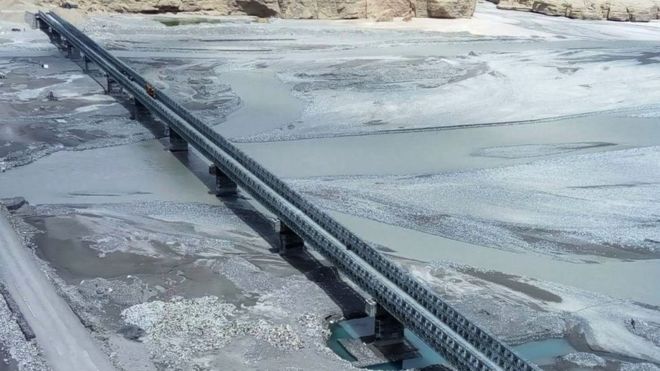
The reports say that in early May, Chinese forces put up tents, dug trenches and moved heavy equipment several kilometres inside what had been regarded by India as its territory. The move came after India built a road several hundred kilometres long connecting to a high-altitude forward air base which it reactivated in 2008.
The message from China appears clear to observers in Delhi – this is not a routine incursion.
“The situation is serious. The Chinese have come into territory which they themselves accepted as part of India. It has completely changed the status quo,” says Ajai Shukla, an Indian military expert who served as a colonel in the army.
China takes a different view, saying it’s India which has changed facts on the ground.
Reports in the Indian media said soldiers from the two sides clashed on at least two occasions in Ladakh. Stand-offs are reported in at least three locations: the Galwan valley; Hot Springs; and Pangong lake to the south.
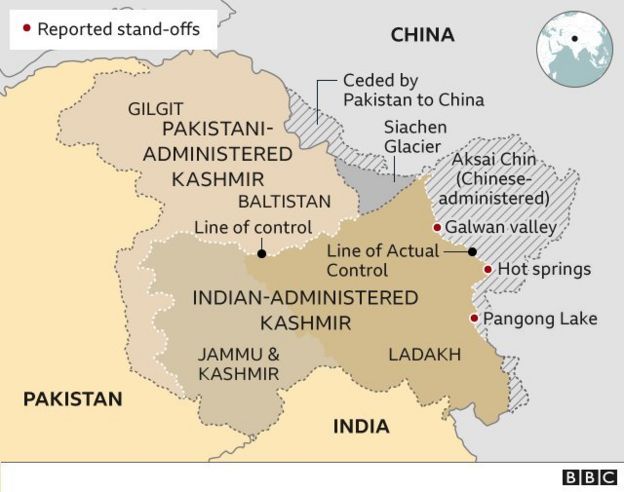
India and China share a border more than 3,440km (2,100 miles) long and have overlapping territorial claims. Their border patrols often bump into each other, resulting in occasional scuffles but both sides insist no bullet has been fired in four decades.
Their armies – two of the world’s largest – come face to face at many points. The poorly demarcated Line of Actual Control (LAC) separates the two sides. Rivers, lakes and snowcaps mean the line separating soldiers can shift and they often come close to confrontation.
The current military tension is not limited to Ladakh. Soldiers from the two sides are also eyeball-to-eyeball in Naku La, on the border between China and the north-eastern Indian state of Sikkim. Earlier this month they reportedly came to blows.
And there’s a row over a new map put out by Nepal, too, which accuses India of encroaching on its territory by building a road connecting with China.
Why are tensions rising now?
There are several reasons – but competing strategic goals lie at the root, and both sides blame each other.
“The traditionally peaceful Galwan River has now become a hotspot because it is where the LAC is closest to the new road India has built along the Shyok River to Daulet Beg Oldi (DBO) – the most remote and vulnerable area along the LAC in Ladakh,” Mr Shukla says.
India’s decision to ramp up infrastructure seems to have infuriated Beijing.
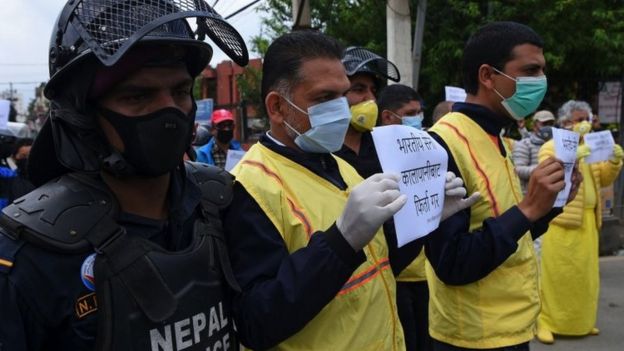 Image copyright AFP
Chinese state-run media outlet Global Times said categorically: “The Galwan Valley region is Chinese territory, and the local border control situation was very clear.”
“According to the Chinese military, India is the one which has forced its way into the Galwan valley. So, India is changing the status quo along the LAC – that has angered the Chinese,” says Dr Long Xingchun, president of the Chengdu Institute of World Affairs (CIWA), a think tank.
Michael Kugelman, deputy director of the Asia programme at the Wilson Center, another think tank, says this face-off is not routine. He adds China’s “massive deployment of soldiers is a show of strength”.
The road could boost Delhi’s capability to move men and material rapidly in case of a conflict.
Differences have been growing in the past year over other areas of policy too.
When India controversially decided to end Jammu and Kashmir’s limited autonomy in August last year, it also redrew the region’s map.
The new federally-administered Ladakh included Aksai Chin, an area India claims but China controls.
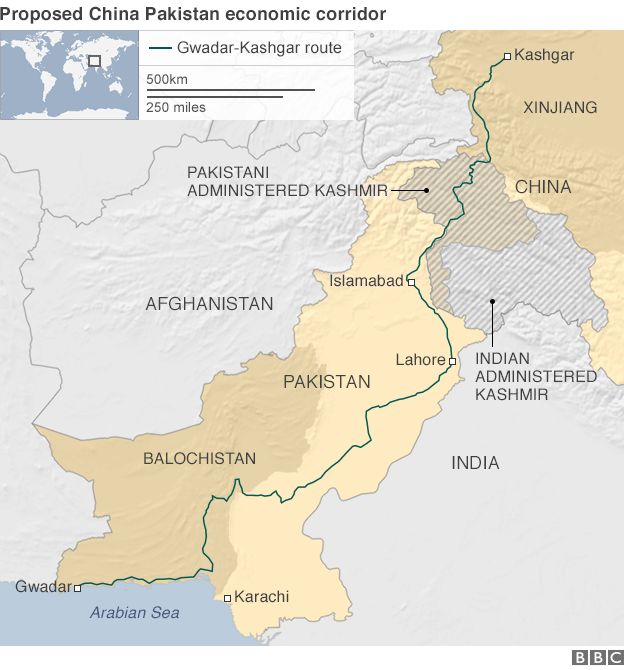
Senior leaders of India’s Hindu-nationalist BJP government have also been talking about recapturing Pakistan-administered Kashmir. A strategic road, the Karakoram highway, passes through this area that connects China with its long-term ally Pakistan. Beijing has invested about $60bn (£48bn) in Pakistan’s infrastructure – the so-called China Pakistan Economic corridor (CPEC) – as part of its Belt and Road Initiative and the highway is key to transporting goods to and from the southern Pakistani port of Gwadar. The port gives China a foothold in the Arabian Sea.
How dangerous could this get?
“We routinely see both armies crossing the LAC – it’s fairly common and such incidents are resolved at the local military level. But this time, the build-up is the largest we have ever seen,” says former Indian diplomat P Stobdan, an expert in Ladakh and India-China affairs.
“The stand-off is happening at some strategic areas that are important for India. If Pangong lake is taken, Ladakh can’t be defended. If the Chinese military is allowed to settle in the strategic valley of Shyok, then the Nubra valley and even Siachen can be reached.”
- New images show Doklam plateau build-up
- The forgotten victims of the world’s highest war
- What was behind the China-India border row?
- Bhutan’s ‘Shangri-La’ caught between rivals
In what seems to be an intelligence failure, India seems to have been caught off guard again. According to Indian media accounts, the country’s soldiers were outnumbered and surrounded when China swiftly diverted men and machines from a military exercise to the border region.
This triggered alarm in Delhi – and India has limited room for manoeuvre. It can either seek to persuade Beijing to withdraw its troops through dialogue or try to remove them by force. Neither is an easy option.
“China is the world’s second-largest military power. Technologically it’s superior to India. Infrastructure on the other side is very advanced. Financially, China can divert its resources to achieve its military goals, whereas the Indian economy has been struggling in recent years, and the coronavirus crisis has worsened the situation,” says Ajai Shukla.
What next?
History holds difficult lessons for India. It suffered a humiliating defeat during the 1962 border conflict with China. India says China occupies 38,000km of its territory. Several rounds of talks in the last three decades have failed to resolve the boundary issues.
China already controls the Aksai Chin area further east of Ladakh and this region, claimed by India, is strategically important for Beijing as it connect its Xinjiang province with western Tibet.
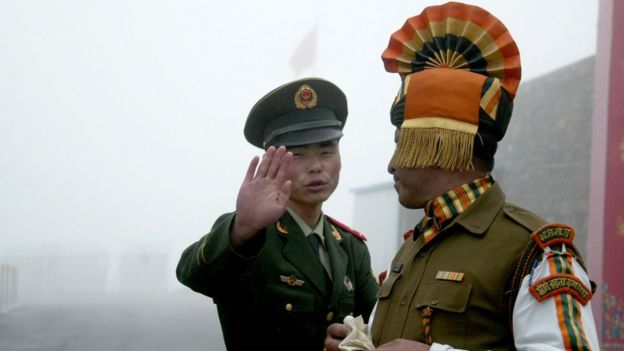 Image copyright GETTY IMAGES
In 2017 India and China were engaged in a similar stand-off lasting more than two months in Doklam plateau, a tri-junction between India, China and Bhutan.
India objected to China building a road in a region claimed by Bhutan. The Chinese stood firm. Within six months, Indian media reported that Beijing had built a permanent all-weather military complex there.
This time, too, talks are seen as the only way forward – both countries have so much to lose in a military conflict.
“China has no intention to escalate tensions and I think India also doesn’t want a conflict. But the situation depends on both sides. The Indian government should not be guided by the nationalistic media comments,” says Dr Long Xingchun of the CIWA in Chengdu. “Both countries have the ability to solve the dispute through high-level talks.”
Chinese media have given hardly any coverage to the border issue, which is being interpreted as a possible signal that a route to talks will be sought.
Pratyush Rao, associate director for South Asia at Control Risks consultancy, says both sides have “a clear interest in prioritising their economic recovery” and avoiding military escalation.
“It is important to recognise that both sides have a creditable record of maintaining relative peace and stability along their disputed border.”
Source: The BBC


 CHINDIA ALERT: You'll be living in their world, very soon
India and Pakistan: How the war was fought in TV studios
As tensions between India and Pakistan escalated following a deadly suicide attack last month, there was another battle being played out on the airwaves. Television stations in both countries were accused of sensationalism and partiality. But how far did they take it? The BBC’s Rajini Vaidyanathan in Delhi and Secunder Kermani in Islamabad take a look.
It was drama that was almost made for television.
The relationship between India and Pakistan – tense at the best of times – came to a head on 26 February when India announced it had launched airstrikes on militant camps in Pakistan’s Balakot region as “retaliation” for a suicide attack that had killed 40 troops in Indian-administered Kashmir almost two weeks earlier.
A day later, on 27 February, Pakistan shot down an Indian jet fighter and captured its pilot.
Abhinandan Varthaman was freed as a “peace gesture”, and Pakistan PM Imran Khan warned that neither country could afford a miscalculation, with a nuclear arsenal on each side.
Suddenly people were hooked, India’s TV journalists included.
So were they more patriots than journalists?
Rajini Vaidyanathan: Indian television networks showed no restraint when it came to their breathless coverage of the story. Rolling news was at fever pitch.
The coverage often fell into jingoism and nationalism, with headlines such as “Pakistan teaches India a lesson”, “Dastardly Pakistan”, and “Stay Calm and Back India” prominently displayed on screens.
Some reporters and commentators called for India to use missiles and strike back. One reporter in south India hosted an entire segment dressed in combat fatigues, holding a toy gun.
And while I was reporting on the return of the Indian pilot at the international border between the two countries in the northern city of Amritsar, I saw a woman getting an Indian flag painted on her cheek. “I’m a journalist too,” she said, as she smiled at me in slight embarrassment.
Print journalist Salil Tripathi wrote a scathing critique of the way reporters in both India and Pakistan covered the events, arguing they had lost all sense of impartiality and perspective. “Not one of the fulminating television-news anchors exhibited the criticality demanded of their profession,” she said.
Secunder Kermani: Shortly after shooting down at least one Indian plane last week, the Pakistani military held a press conference.
As it ended, the journalists there began chanting “Pakistan Zindabad” (Long Live Pakistan). It wasn’t the only example of “journalistic patriotism” during the recent crisis.
Two anchors from private channel 92 News donned military uniforms as they presented the news – though other Pakistani journalists criticised their decision.
But on the whole, while Indian TV presenters angrily demanded military action, journalists in Pakistan were more restrained, with many mocking what they called the “war mongering and hysteria” across the border.
In response to Indian media reports about farmers refusing to export tomatoes to Pakistan anymore for instance, one popular presenter tweeted about a “Tomatical strike” – a reference to Indian claims they carried out a “surgical strike” in 2016 during another period of conflict between the countries.
Media analyst Adnan Rehmat noted that while the Pakistani media did play a “peace monger as opposed to a warmonger” role, in doing so, it was following the lead of Pakistani officials who warned against the risks of escalation, which “served as a cue for the media.”
What were they reporting?
Rajini Vaidyanathan: As TV networks furiously broadcast bulletins from makeshift “war rooms” complete with virtual reality missiles, questions were raised not just about the reporters but what they were reporting.
Indian channels were quick to swallow the government version of events, rather than question or challenge it, said Shailaja Bajpai, media editor at The Print. “The media has stopped asking any kind of legitimate questions, by and large,” she said. “There’s no pretence of objectiveness.”
In recent years in fact, a handful of commentators have complained about the lack of critical questioning in the Indian media.
“For some in the Indian press corps the very thought of challenging the ‘official version’ of events is the equivalent of being anti-national”, said Ms Bajpai. “We know there have been intelligence lapses but nobody is questioning that.”
Senior defence and science reporter Pallava Bagla agreed. “The first casualty in a war is always factual information. Sometimes nationalistic fervour can make facts fade away,” he said.
This critique isn’t unique to India, or even this period in time. During the 2003 Iraq war, western journalists embedded with their country’s militaries were also, on many occasions, simply reporting the official narrative.
Secunder Kermani: In Pakistan, both media and public reacted with scepticism to Indian claims about the damage caused by the airstrikes in Balakot, which India claimed killed a large number of Jaish-e-Mohammad (JeM) militants in a training camp.
Hamid Mir, one of the most influential TV anchors in the country travelled to the area and proclaimed, “We haven’t seen any such (militant) infrastructure… we haven’t seen any bodies, any funerals.”
“Actually,” he paused, “We have found one body… this crow.” The camera panned down to a dead crow, while Mr Mir asked viewers if the crow “looks like a terrorist or not?”
There seems to be no evidence to substantiate Indian claims that a militant training camp was hit, but other journalists working for international outlets, including the BBC, found evidence of a madrassa, linked to JeM, near the site.
A photo of a signpost giving directions to the madrassa even surfaced on social media. It described the madrassa as being “under the supervision of Masood Azhar”. Mr Azhar is the founder of JeM.
The signpost’s existence was confirmed by a BBC reporter and Al Jazeera, though by the time Reuters visited it had apparently been removed. Despite this, the madrassa and its links received little to no coverage in the Pakistani press.
Media analyst Adnan Rehmat told the BBC that “there was no emphasis on investigating independently or thoroughly enough” the status of the madrassa.
In Pakistan, reporting on alleged links between the intelligence services and militant groups is often seen as a “red line”. Journalists fear for their physical safety, whilst editors know their newspapers or TV channels could face severe pressure if they publish anything that could be construed as “anti-state”.
Who did it better: Khan or Modi?
Rajini Vaidyanathan: With a general election due in a few months, PM Narendra Modi continued with his campaign schedule, mentioning the crisis in some of his stump speeches. But he never directly addressed the ongoing tensions through an address to the nation or a press conference.
This was not a surprise. Mr Modi rarely holds news conference or gives interviews to the media. When news of the suicide attack broke, Mr Modi was criticised for continuing with a photo shoot.
The leader of the main opposition Congress party, Rahul Gandhi, dubbed him a “Prime Time Minister” claiming the PM had carried on filming for three hours. PM Modi has also been accused of managing his military response as a way to court votes.
At a campaign rally in his home state of Gujarat he seemed unflustered by his critics, quipping “they’re busy with strikes on Modi, and Modi is launching strikes on terror.”
Secunder Kermani: Imran Khan won praise even from many of his critics in Pakistan, for his measured approach to the conflict. In two appearances on state TV, and one in parliament, he appeared firm, but also called for dialogue with India.
His stance helped set the comparatively more measured tone for Pakistani media coverage.
Officials in Islamabad, buoyed by Mr Khan’s decision to release the captured Indian pilot, have portrayed themselves as the more responsible side, which made overtures for peace.
On Twitter, a hashtag calling for Mr Khan to be awarded a Nobel Peace Prize was trending for a while. But his lack of specific references to JeM, mean internationally there is likely to be scepticism, at least initially, about his claims that Pakistan will no longer tolerate militant groups targeting India.
Source: The BBC
Posted in Adnan Rehmat, airstrikes, airwaves, Al Jazeera, Balakot, BBC, BBC reporter, campaign schedule, casualty, combat fatigues, commentators, congress party, critical questioning, Dastardly Pakistan, Delhi, escalation, factual information, fought, general election, Hamid Mir, hashtag, Imran Khan, India alert, Indian jet fighter, international border, Islamabad, Islamist militant groups, Jaish-e-Mohammad (JeM), JeM, jingoism and nationalism, Journalist, Kashmir, madrassa, Masood Azhar, Media analyst, media editor, militant camps, militants, missiles, nationalistic fervour, Nobel Peace Prize, Pakistan, Pakistani, Pakistani military, Pallava Bagla, pilot, PM Narendra Modi, press, press conference, Prime Time Minister, rahul gandhi, Rajini Vaidyanathan, red line, retaliation, Reuters, Salil Tripathi, Secunder Kermani, Senior defence and science reporter, sensationalism and partiality, Shailaja Bajpai, signpost's, suicide attack, Surgical strike, The Print, Tomatical strike, toy gun, training camp, TV anchors, TV journalists, TV studios, Twitter, Uncategorized, war, war mongering and hysteria, warmonger, Wg Cdr Abhinandan Varthaman | Leave a Comment »