Chindia Alert: You’ll be Living in their World Very Soon
aims to alert you to the threats and opportunities that China and India present. China and India require serious attention; case of ‘hidden dragon and crouching tiger’.
Without this attention, governments, businesses and, indeed, individuals may find themselves at a great disadvantage sooner rather than later.
The POSTs (front webpages) are mainly 'cuttings' from reliable sources, updated continuously.
The PAGEs (see Tabs, above) attempt to make the information more meaningful by putting some structure to the information we have researched and assembled since 2006.
BEIJING (Reuters) – China’s central province of Hubei, excluding the provincial capital Wuhan, has reported zero new cases of coronavirus over 24 hours for the first time in the outbreak, as authorities seek to stem imported infections in other areas.
Wuhan, the centre of the epidemic, reported 126 new confirmed cases on Thursday but there were no new infections elsewhere in the province, the National Health Commission said on Friday.
Elsewhere in China, schools in provinces reporting no new cases for a number of days started to set reopening dates.
Qinghai, a northwesterly that had reported no new infections for 29 days as of March 5, said it would stagger the start date of different schools between March 11 and March 20, according to a notice posted on an official website.
The southwesterly province of Guizhou has said its schools will start reopening from March 16.
Outside of Hubei, there were 17 new confirmed cases, bringing the total new infections in mainland China to 143 on Thursday, up from 139 cases a day earlier.
Of the 17 new cases, 16 were imported from outside of China – 11 in Gansu province, four in Beijing and one in Shanghai.
A total of 311 passengers arriving at Gansu’s provincial capital Lanzhou from Iran were quarantined, state television reported late on Thursday.
Beijing’s four new cases had come from Italy. On Friday, one of the city’s government officials described its epidemic control campaign as being at its most challenging period, adding that roughly 827,000 people who had returned to the capital from outside – most of them from extended Lunar New Year holidays – were currently undergoing home observation.
Last month, Gansu became the first province to lower its emergency response measures from level I to level III, reflecting the lack of new infections.
Tibet became the latest region to lower its emergency response level on Friday, announcing on an official website that some areas had eased to level II and others to level III.
OPTIMISM FOR WUHAN
Health authorities in Shanghai said that the city had recorded three new cases in the first 12 hours of Friday. All were Chinese nationals who had studied in Iran, state media reported. [B9N28E04N]
All three had been transferred by Shanghai customs to quarantine on March 3, a spokeswoman for the city’s health commission told a news briefing.
Despite the fresh cases in Wuhan, senior Chinese government officials expressed optimism about its situation as the city shut its second makeshift hospital on Friday afternoon, state radio reported.
“As the situation in Wuhan and Hubei improves, relevant authorities, with approvals, will make timely adjustments according to China’s Infectious Diseases Law and public health emergency regulations,” Ding Xiangyang, vice secretary general at the State Council, told a news briefing.
“When I went out in the morning, the cherry blossoms were blooming in front of my door, telling us that winter has passed and spring has come. I think the day everyone has been looking forward to is not far away,” he said.
As new cases dwindle in China, attention has turned to potential infections arriving from overseas.
Authorities in Beijing, Shanghai and Guangdong have all vowed to quarantine travellers from countries hit the hardest by the coronavirus, which Beijing identified as South Korea, Japan, Iran and Italy.
The overall accumulated number of confirmed cases in mainland China stood at 80,552 as of Thursday.
The death toll from the outbreak in mainland China was 3,042 as of the end of Thursday, up by 30 from the previous day.
Hubei reported 29 new deaths, while in Wuhan, 23 people died.
Image copyright GETTY IMAGESImage caption Cases of coronavirus have risen sharply in South Korea, where the outbreak is worsening
The head of the World Health Organization (WHO) has expressed concern at the number of coronavirus cases with no clear link to China or other confirmed cases.
Dr Tedros Adhanom Ghebreyesus said the window of opportunity to contain the virus was “narrowing”.
Chinese health authorities reported a decrease in deaths and new cases of the coronavirus on Saturday.
But cases are on the rise in South Korea, Italy, Iran and other countries.
Outside China, more than 1,200 cases of the virus have been confirmed in 26 countries and there have been eight deaths, the WHO says.
They include two deaths in South Korea, which has the biggest cluster of confirmed cases apart from China and a cruise ship quarantined in Japan.
On Saturday, South Korea reported 142 new confirmed cases of the coronavirus, bringing the national tally to 346.
On Friday, doctors in Italy said a 78-year-old man became the first person in the country to die from the new coronavirus, Ansa news agency reported.
Earlier Italy had announced 16 more cases and its health minister said schools and offices would be closed and sports events cancelled in the affected regions.
China has reported 76,288 cases including 2,345 deaths. The new virus, which originated last year in Hubei province in China, causes a respiratory disease called Covid-19.
What did the WHO chief say?
Dr Tedros said the number of coronavirus cases outside China was “relatively small” but the pattern of infection was worrying.
“We are concerned about the number of cases with no clear epidemiological link, such as travel history to or contact with a confirmed case,” he said.
The new deaths and infections in Iran were “very concerning”, he said.
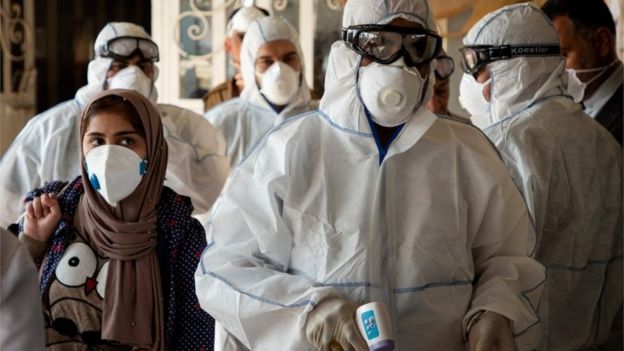
Image copyright AFPImage caption Iraq has been checking people at its border with Iran
But he insisted that the measures China and other countries had put in place meant there was still a “fighting chance” of stopping further spread and called on countries to put more resources into preparing for possible outbreaks.
What is the latest in South Korea?
Prime Minister Chung Sye-kyun declared a public health emergency as the total number of cases surpassed 300 on Saturday.
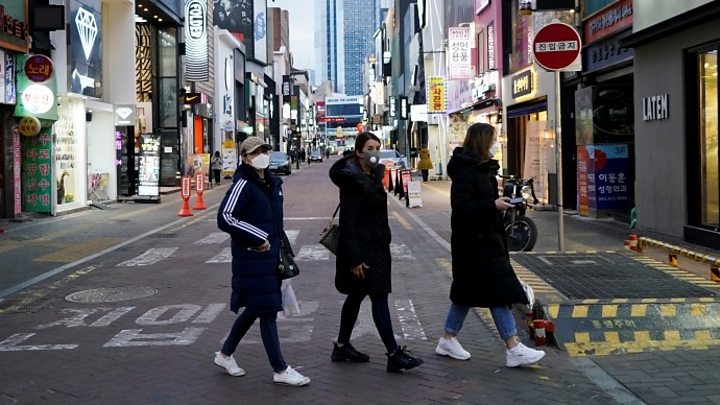
The southern cities of Daegu and Cheongdo have been declared “special care zones”. The streets of Daegu are now largely abandoned.
The nation’s capital, Seoul, banned demonstrations in central areas.
Two cases were also reported in Busan, South Korea’s second-largest city, and one on the Island of Jeju on Saturday – the first in both places.
Media caption People in Daegu have voiced concern over the spread of the virus
All military bases are in lockdown after three soldiers tested positive.
The authorities suspect the current outbreak in South Korea originated in Cheongdo, pointing out that a large number of sect followers attended the funeral of the founder’s brother from 31 January to 2 February.
The sect – known as Shincheonji – which has been accused of being a cult, said it had now shut down its Daegu branch and that services in other regions would be held online or individually at home.
As of Friday, more than 400 members of the church were showing symptoms of the disease, though tests were still ongoing, the city mayor said.
Can we answer your question on the coronavirus?
Here’s what others have been asking
Once you’ve had coronavirus, will you be immune?
Could the coronavirus become a pandemic?
Is the coronavirus worse than flu or Sars?
Hand sanitizers and warning signs
By Hyung Eun Kim, BBC Korean Service, Seoul
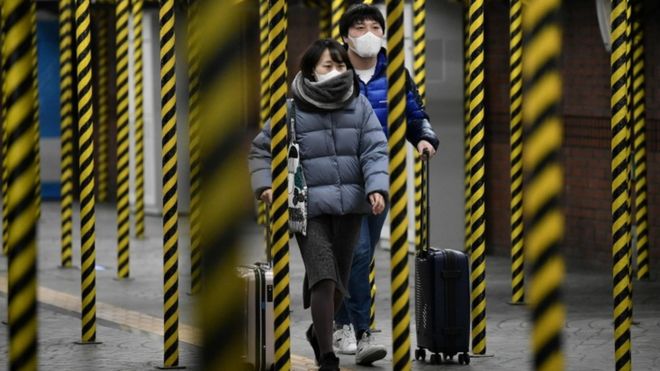
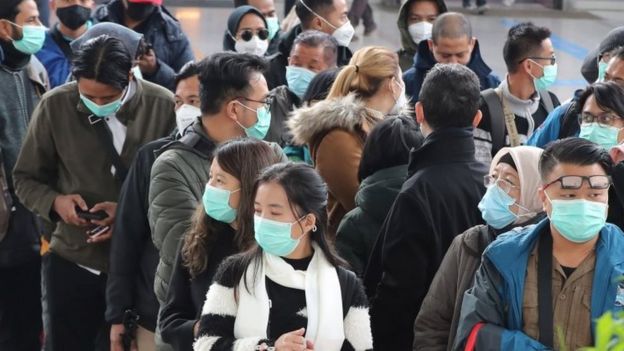
Many people in South Korea are wearing masks on a daily basis.
Hand sanitizers have been placed at public transport stops and building entrances.
Warning government signs are everywhere. They say: “Three ways to prevent further infection: wear a mask at all times; wash your hands properly with soap for more than 30 seconds; and cover yourself when coughing.”
Image copyright EPAImage caption New norm: Mask-wearing crowd in Seoul
Koreans have also developed several apps and websites that tell you how much risk you face where you are. They show where the infected people are within a 10km radius.
“I can’t miss work, what I can do is minimise contact with others and stay at home during the weekend,” Seung-hye Lim, a Seoul resident, told the BBC.
“I do wonder if we reacted too laxly initially or if it really is because of the specific service practices of the Shincheonji sect.”
So-young Sung, a mother of two in Seoul, told the BBC: “It feels like my daily life is collapsing.”
She said she was struggling to find pharmacies that had masks.
She added that checking coronavirus-related alarms from her children’s schools and kindergartens was now a daily routine for her.
What about the Iran cases?
In Iran the outbreak is centred on the holy city of Qom, south of the capital Tehran, which is a popular destination for Shia Muslims in the region.
Iran reported two more deaths in Qom on Friday, adding to the two deaths it reported on Thursday. A total of 18 cases have been confirmed in the country.
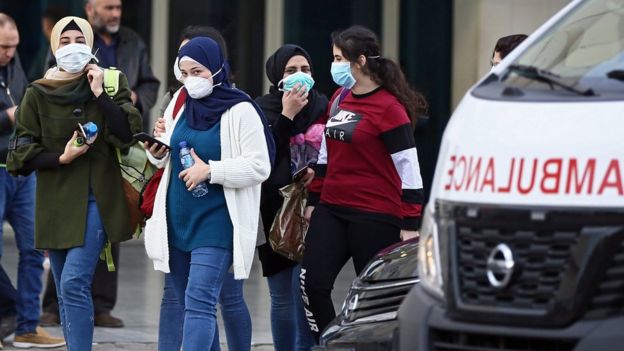
Lebanon has reported its first confirmed case – a 45-year-old woman who was detected as she arrived in Beirut from Qom. The UAE, Israel and Egypt have also reported cases.
Image copyright EPAImage caption Lebanon has confirmed its first case – a woman returning from the Iranian city of Qom
Meanwhile Canadian officials said one of the nine cases there was a woman who had recently returned from Iran.
WHO officials said both Iran and Lebanon had the basic capacity to detect the virus and the WHO was contacting them to offer further assistance.
But Dr Tedros said the organisation was concerned about the virus’s possible spread in countries with weaker health systems.
What about China and elsewhere?
The virus has now hit the country’s prison system, with more than 500 inmates confirmed infected.
They include 230 patients in a women’s prison in Wuhan. More cases have been found in a prison in the eastern province of Shandong and the south-eastern province of Zhejiang.
Some 36 people at a hospital in Beijing have also tested positive.
Senior officials have been sacked for mishandling management of the outbreak.
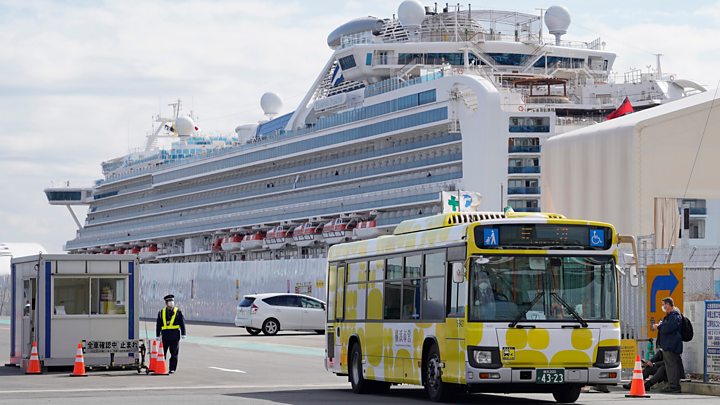
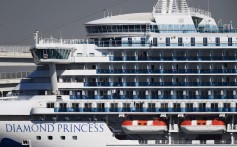
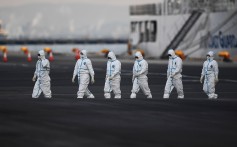
Passengers of the Diamond Princess cruise ship who have tested negative continue to disembark the ship in Yokohama after more than 14 days quarantined on board.
However, 18 American evacuees from the ship tested positive after arriving in the US, officials said. More than 300 other US nationals have arrived back in the US after disembarking.
Media caption Coronavirus: Quarantined passengers released from Japan ship
More than 150 Australian passengers have been evacuated from the ship and have already arrived in Darwin, where they will begin two more weeks of quarantine.
Australian officials said on Friday that six people had reported feeling unwell on arrival in Darwin and were immediately tested. Two of those people tested positive despite having received negative tests before leaving Japan.
The first batch of people from Hong Kong have also flown back to the city, where they will similarly be quarantined.
It started with a cough by a passenger who had visited China, leading to the two-week quarantine of some 3,700 passengers and crew
At least 218 cases have been detected on board the Diamond Princess, which has been described as ill-equipped to prevent the spread of infections
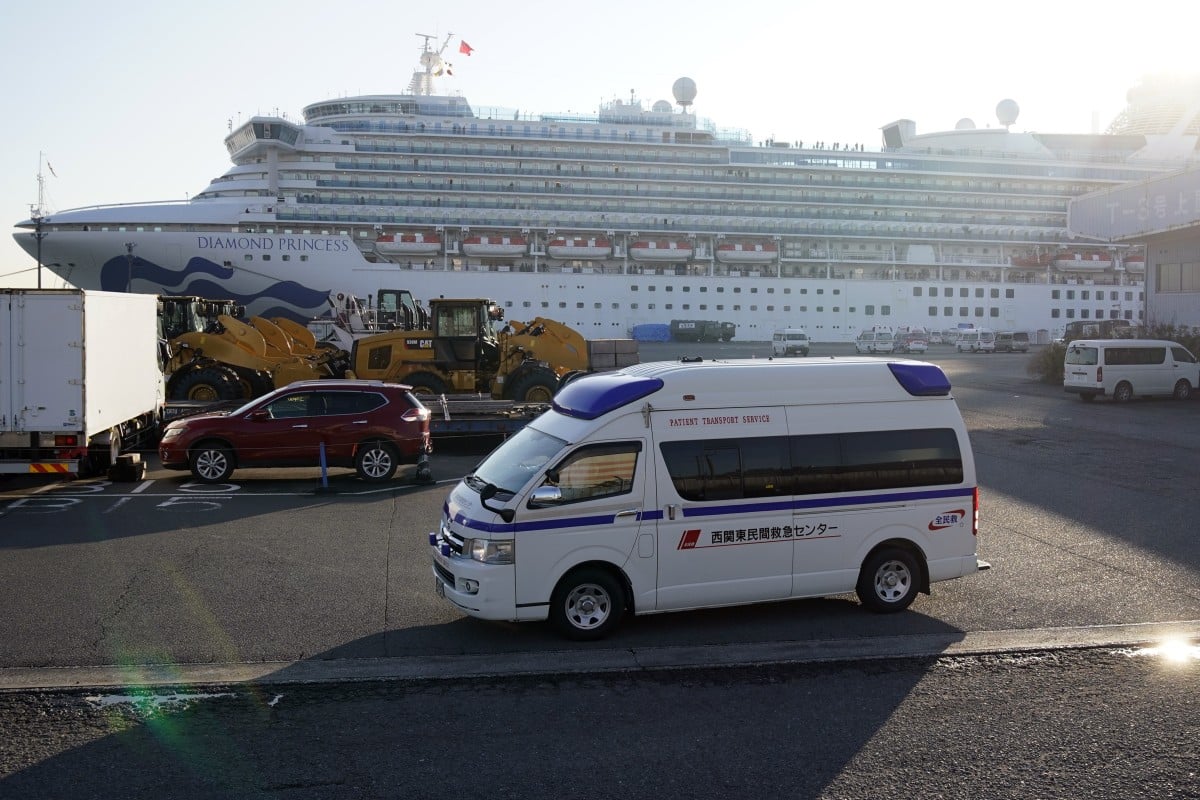
Passengers and crew on the Diamond Princess cruise liner are under quarantine until February 19, 2020. Photo: Reuters
For almost a fortnight and counting, the Diamond Princess has resembled a floating hospital more than a luxury cruise liner, as 3,711 passengers and crew have remained under quarantine in Japan due to an outbreak of the deadly coronavirus on board.
The UK-flagged vessel, which set out on a 29-day voyage from Singapore to Yokohama on January 6, has been in lock-down since arriving at the Japanese city on February 3, after an elderly passenger who disembarked in Hong Kong tested positive for the virus, which causes the respiratory disease officially known as Covid-19.
Along the way, the ship had stopped at 14 ports, including Ho Chi Minh City in
Kobe and Osaka in Japan, and Taipei in Taiwan, with repeat visits to a number of destinations, including Hong Kong.
How did the outbreak start?
While the exact source of the outbreak on the Diamond Princess is yet to be determined, it is suspected to be linked to a 80-year-old man from Hong Kong who had recently made a brief visit to mainland China.
The man boarded the ship on January 20 in Yokohama before disembarking five days later in Hong Kong, where he tested positive for the virus after seeking medical attention for symptoms including a cough.
Coronavirus: 44 more cases on Diamond Princess cruise ship
13 Feb 2020
How many people have tested positive for the coronavirus on board?
Japanese Health Minister Katsunobu Kato announced on Thursday that 44 new cases
of the virus had been detected on the Diamond Princess, including a quarantine officer who tested positive, bringing the total number of infections on board to at least 218.
The hike in infections came after officials announced 40 fresh cases on Wednesday. Authorities have so far tested 713 people on board, fewer than one-fifth of the total, but the outbreak already ranks as the largest single cluster of infections outside mainland
Japan has confirmed 247 cases overall since the virus was first detected in the Chinese city of Wuhan in late December.
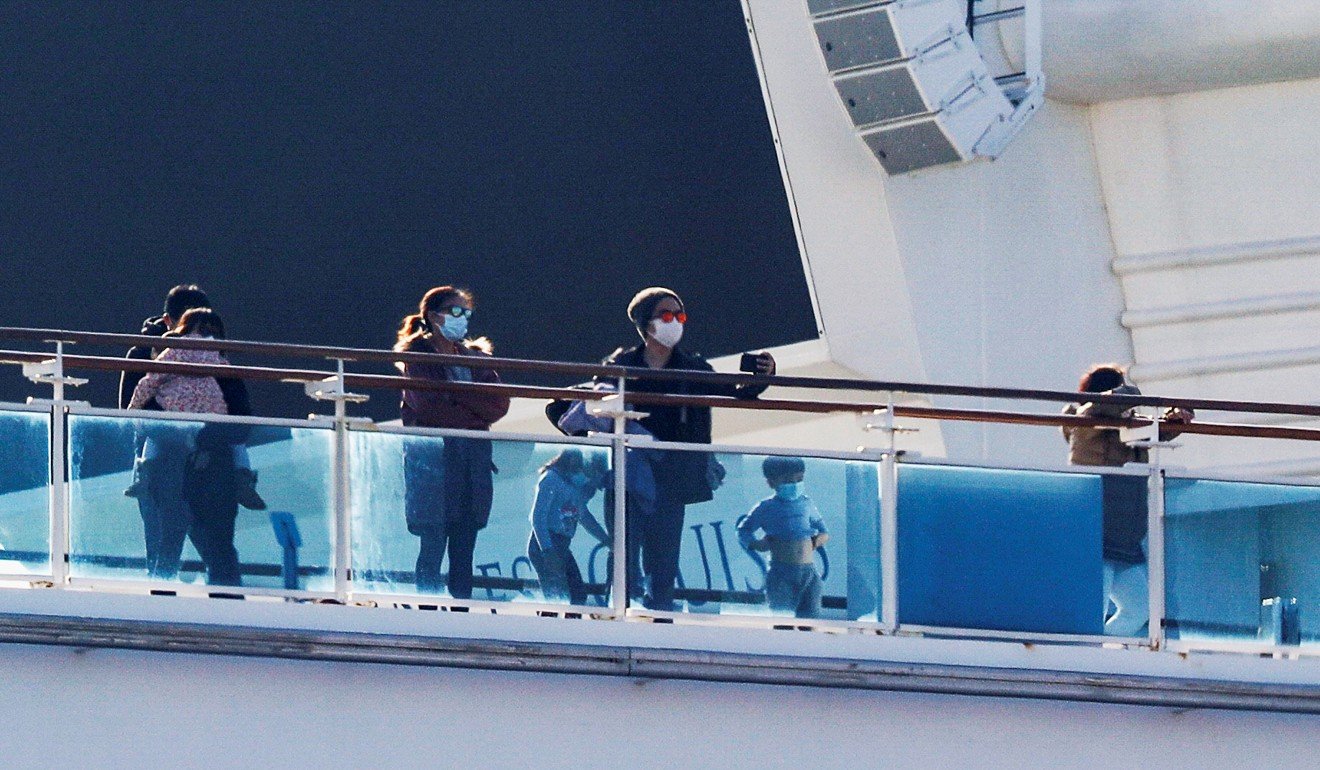
Passengers are allowed short visits above deck for fresh air. Photo: Reuters
What has it been like for passengers on board?
Passengers who have not been diagnosed with the coronavirus have been asked to stay in their cabins, except for short visits above deck for fresh air, until the quarantine period ends on February 19.
Those who have tested positive have been evacuated to onshore medical facilities. Health officials announced on Thursday that they intended to move elderly people and those with pre-existing conditions off the ship in the coming days even if they tested negative.
Many of those on board have described the tedium of being confined to their cabins and anxiety about the virus spreading further, or expressed frustration at the lack of timely information about the outbreak coming from Japanese authorities.
“It’s getting tougher by the day, and certainly for passengers with the inside cabins, it’s not easy,” said British passenger David Abel in a Facebook live-stream on Thursday.
The sorry state of Hongkongers stuck aboard quarantined cruise ship in Japan
11 Feb 2020
Some passengers have praised the efforts of the crew to keep up people’s spirits, including putting together videos featuring magic tricks and dance and stretching routines.
Matthew Smith, a passenger from the United States, has racked up thousands of followers on Twitter with his regular upbeat appraisals of the ship’s food.
“Don’t believe the honeymooners who would rather be in an American hospital,” he wrote in one post last week. “You might have to drag me off the ship when the quarantine ends.”
The event on the Diamond Princess cruise would fit the description of a super spreading event. David Hui, infectious diseases expert
Why has Japan’s handling of the outbreak been so controversial?
Some medical experts have questioned the wisdom of placing the passengers and crew in quarantine in the close confines of a ship, rather than removing them to dedicated facilities on the shore.
“Ideally, the crew members and the passengers should be quarantined at holiday camps,” said David Shu-Cheong Hui, the director of the Stanley Ho Centre for Emerging Infections Diseases in Hong Kong. “The event on the Diamond Princess cruise would fit the description of a super spreading event.”
Panic buying, mistrust and economic woes as Japan reels from coronavirus
12 Feb 2020
Kumar Visvanathan, an infectious diseases expert at the University of Melbourne, said a cruise liner such as the Diamond Princess would be ill-equipped to prevent the spread of infections.
“It seems that though isolation in individual cabins is somewhat effective, the increasing numbers of symptomatic infections seems to suggest active infections even with the best precautions are occurring,” Visvanathan said.
“It is clear that cruise ships and their individual cabins are not made for isolation purposes and depend heavily on individual participation in the isolation procedures, including respiratory hygiene, cough etiquette and hand hygiene,” he said.
Japanese city encourages travellers in coronavirus quarantine after return from China
Visvanathan said, however, that gauging the correct response was difficult as authorities had to consider the welfare of both the general public and those on the ship.
“I think the way to look at it is there are two disparate concerns that need to be balanced,” he said. “The first is the protection of the outside community which I think the Japanese government is taking as most important, and in this case isolation on board is the most efficient way to prevent infection of the Japanese population.”
Criticism has also been levelled at authorities for not testing all of those on board from the start. After initially insisting that they did not have the resources to test everyone on board, health officials said on Thursday that they were now aiming to test 1,000 people a day.
The World Health Organisation, however, has defended Japan’s handling of the situation, saying the country was ensuring those who were ill received proper treatment, the most important consideration during such an outbreak.
MANILA (Reuters) – The Philippines on Tuesday allowed Filipino workers to travel to Hong Kong and Macau, relaxing the travel ban it imposed on China and its special administrative regions to control the spread of the coronavirus.
The Philippines announced its decision before Hong Kong reported that a Filipina domestic helper became its 61st case of coronavirus in the country.
There are more than 180,000 Filipinos in Hong Kong, many working as helpers, according to the Philippines Labour Ministry.
The Philippines had imposed a travel ban on China and its special administrative regions Hong Kong and Macau. It later included Taiwan in the ban, but lifted it a few days after.
There was no immediate comment from Philippine officials on how the latest development in Hong Kong will affect its decision to relax its travel restriction.
The Philippines also said it would allow foreign spouses or children of Filipinos and holders of diplomatic visas travelling from China, Macau and Hong Kong to enter the country but they will be subjected to a 14-day quarantine.
Initially, only Filipinos and holders of permanent resident visas travelling from these areas were allowed entry.
Recruiters have appealed to the government to exempt Filipino workers from the travel ban because many of them are breadwinners. They could also lose their visas if they failed to report for work on time, the Society of Hong Kong Accredited Recruiters of the Philippines has said.
In 2019, Filipino workers in Hong Kong sent home $801 million in foreign exchange remittances, central bank data showed.
Filipinos leaving for Hong Kong and Macau for study and employment will be required to sign a declaration that they know the risks of going there, health officials said.
The Philippine government also said it will repatriate Filipino crew and passengers from the quarantined cruise ship Diamond Princess who wish to come home.
The cruise ship, owned by Carnival Corp and carrying some 3,700 passengers and crew, has been quarantined in Yokohama since Feb. 3, after a man who disembarked in Hong Kong before it travelled to Japan was diagnosed with the virus.
The Philippine Foreign Ministry said 35 of the 538 Filipinos onboard had tested positive for the coronavirus, including the eight new cases, who are all crew members.
In the Philippines, there have been three confirmed cases of coronavirus, including one death.
Media caption Americans are taken from the docked ship to Haneda airport in Tokyo
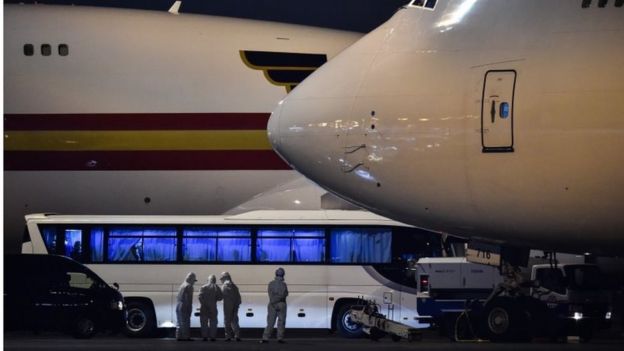
Two planes carrying hundreds of US citizens from a coronavirus-hit cruise ship have left Japan, officials say.
One plane has landed at a US Air Force air base in California, and its passengers will be isolated at military facilities for 14 days.
There were some 400 Americans on board the Diamond Princess. The ship with some 3,700 passengers and crew has been in quarantine since 3 February.
Meanwhile, China reported a total of 2,048 new cases on Monday.
Of those new cases, 1,933 were from Hubei province, the epicentre of the outbreak.
More than 70,500 people across China have been infected by the virus. In Hubei alone, the official number of cases stands at 58,182, with 1,692 deaths. Most new cases and deaths have been reported in Wuhan, Hubei’s largest city.
In other developments:
In Japan, a public gathering to celebrate the birthday of new Emperor Naruhito later this week has been cancelled, due to concerns over the spread of the virus while organisers of the Tokyo marathon due to take place on 1 March are considering whether to cancel the amateur part of the race, reports say
In China, the National People’s Congress standing committee said it would meet next week to discuss a delay of this year’s Congress – the Communist Party’s most important annual gathering – because of the outbreak
At the weekend, an American woman tested positive for the virus in Malaysia after leaving a cruise liner docked off the coast of Cambodia
A Russian court has ordered a woman who escaped from a quarantine facility to go back and stay there until she is confirmed to be disease-free, Fontanka news agency reports. Alla Ilyina has until Wednesday to return
What’s happening on the Diamond Princess?
The cruise ship was put in quarantine in Japan’s port of Yokohama after a man who disembarked in Hong Kong was found to have the virus.
On Monday, Japanese officials said there were 99 new cases of infections on board the ship, bringing the total to 454 confirmed cases. It is the largest cluster of cases outside China.
A Russian woman who was on board and tested positive is thought to be the first Russian national to contract the virus after the two previous cases found in Russia were Chinese nationals, Reuters news agency reports.
She will be taken to a hospital for treatment, the Russian embassy in Japan said.
At least 40 US citizens who were on board are infected and will be treated in Japan, Dr Anthony Fauci, Director of the National Institute of Allergy and Infectious Diseases told US broadcaster CBS.
Image copyright AFPImage caption Those bound for the US left from Tokyo’s Haneda Airport
The two aircraft chartered by the US government left Tokyo’s Haneda Airport in the early hours of Monday. The second flight was due to land at another base in Texas.
More than 300 passengers are being repatriated voluntarily, the US state department said. Fourteen of them were reported during transit to have tested positive for the virus and were being kept separate from the other passengers, it said.
we would like to just finish the quarantine on the ship as planned, decompress in a non-quarantine environment in Japan for a few days, then fly back to the U.S. pursuant to our own arrangements. What’s wrong with that?
The smartphones were distributed so people could use an app, created by Japan’s health ministry, which links users with doctors, pharmacists and mental health counsellors. Phones registered outside of Japan are unable to access the app.
Other evacuation flights have been arranged to repatriate residents of Israel, Hong Kong and Canada. On Monday, Australia announced that it would evacuate 200 of its citizens too.
What is happening in China?
According to official figures for 16 February, 100 people died from the virus in Hubei, down from 139 on Saturday.
The Chinese authorities are tightening curbs on movement to combat the outbreak. People in Hubei province, which has 60 million people, have been ordered to stay at home, though they will be allowed to leave in an emergency.
In addition, a single person from each household will be allowed to leave the building or compound they live in every three days to buy food and essential items.
On housing estates, one entrance will be kept open. It will be guarded to ensure that only residents can enter or leave.
All businesses will stay closed, except chemists, hotels, food shops and medical services.
“The effects of epidemic prevention and control in various parts of the country can already be seen.”
The proportion of infected patients considered to be in a “serious condition” has dropped nationwide from more than 15% to just over 7%, according to China’s State Council.
Taiwan has reported a death from the illness – a taxi driver, 61, who had not travelled abroad recently but had diabetes and hepatitis B, Health Minister Chen Shih-chung said.
The minister said many of his passengers had come from China.
Outside China, there have been more than 500 cases in nearly 30 countries. Four others have died outside mainland China – in France, Hong Kong, the Philippines and Japan.
Meanwhile, a plane carrying 175 evacuated Nepalis, mostly students, has arrived in Kathmandu from Wuhan.
BEIJING/SINGAPORE (Reuters) – China reported on Wednesday its smallest number of coronavirus cases since January, lending weight to a prediction by its top medical adviser for the outbreak to end by April, but a global infectious diseases expert warned of the spread elsewhere.
Financial markets took heart from the outlook of the Chinese official, epidemiologist Zhong Nanshan, who said on Tuesday the number of new cases was falling in some provinces, and forecast the epidemic would peak this month, even as the death toll in China rose to more than 1,100 people.
World stocks, which had seen rounds of sell-offs over the virus, surged to record highs on hopes of a peak in cases. The Dow industrials, S&P 500 and Nasdaq all hit new highs, and Asian shares nudged higher on Wednesday.
But the World Health Organization (WHO) has warned that the epidemic poses a global threat akin to terrorism and one expert coordinating its response said while the outbreak may be peaking at its epicentre in China, it was likely to spread elsewhere in the world, where it had just begun.
RELATED COVERAGE
Chess, squabbles aboard cruise ship cast away by coronavirus fears
Singapore’s DBS evacuates 300 staff after employee contracts coronavirus
See more stories
“It has spread to other places where it’s the beginning of the outbreak,” the official, Dale Fisher, head of the Global Outbreak Alert and Response Network coordinated by the WHO, said in an interview in Singapore.
“In Singapore, we are at the beginning of the outbreak.”
Singapore has reported 47 cases and worry about the spread is growing. Its biggest bank, DBS (DBSM.SI), evacuated 300 staff from its head office on Wednesday after a confirmed coronavirus case in the building.
Hundreds of cases have been reported in dozens of other countries and territories around the world, but only two people have died outside mainland China – one in Hong Kong and another in the Philippines.
WHO chief Tedros Adhanom Ghebreyesus said on Tuesday the world had to “wake up and consider this enemy virus as public enemy number one” and the first vaccine was 18 months away.
In China, total infections have hit 44,653, health officials said, including 2,015 new confirmed cases on Tuesday. That was the lowest daily rise in new cases since Jan. 30.
The number of deaths on the mainland rose by 97 to 1,113 by the end of Tuesday.
But doubts have been aired on social media about how reliable the figures are, after the government last week amended guidelines on the classification of cases.
‘STAY HOPEFUL’
The biggest cluster of cases outside China is aboard the Diamond Princess cruise ship quarantined off Japan’s port of Yokohama, with about 3,700 people on board. Japanese officials on Wednesday said 39 more people had tested positive for the virus, taking the total to 175.
One of the new cases was a quarantine officer.
Thailand said it was barring passengers from another cruise ship, MS Westerdam, from disembarking, the latest country to turn it away amid fears of the coronavirus, despite no confirmed infections on board.
“We try to stay hopeful,” American passenger Angela Jones told Reuters in a video recording. “But each day, that becomes a little bit more difficult, when country after country rejects us.”
Echoing the comparison with the fight against terrorism, China’s state news agency Xinhua said late on Tuesday the epidemic was a “battle that has no gunpowder smoke but must be won”.
The epidemic was a big test of China’s governance and capabilities and some officials were still “dropping the ball” in places where it was most severe, it said, adding: “This is a wake-up call.”
The government of Hubei, the central province at the outbreak’s epicentre, dismissed the provincial health commission’s Communist Party boss, state media said on Tuesday, amid mounting public anger over the crisis.
China’s censors had allowed criticism of local officials but have begun cracking down on reporting of the outbreak, issuing reprimands to tech firms that gave free rein to online speech, Chinese journalists said.
The pathogen has been named COVID-19 – CO for corona, VI for virus, D for disease and 19 for the year it emerged. It is suspected to have come from a market that illegally traded wildlife in Hubei’s capital of Wuhan in December.
The city of 11 million people remains under virtual lockdown as part of China’s unprecedented measures to seal infected regions and limit transmission routes.
Travel restrictions that have paralysed the world’s second-biggest economy have left Wuhan and other Chinese cities resembling ghost towns.
Even if the epidemic ends soon, it has taken a toll of China’s economy, with companies laying off workers and needing loans running into billions of dollars to stay afloat. Supply chains for makers of items from cars to smartphones have broken down.
ANZ Bank said China’s first-quarter growth would probably slow to 3.2% to 4.0%, down from a projection of 5.0%.
The likely slowdown in China could shave 0.1 to 0.2 percentage points off both euro zone and British growth this year, credit rating agency S&P Global estimated.
BEIJING, Feb. 6 (Xinhua) — A slew of preventive measures have been taken to contain the novel coronavirus as a growing number of Chinese people hit the road and return to work after the Spring Festival holiday, the Ministry of Transport (MOT) said Thursday.
According to big data analysis, passenger flow is expected to pick up around this weekend, said Cai Tuanjie, an official with the MOT, at a press conference.
To contain virus infections during the trips, railways, airports and other public transportation operators have intensified disinfection, ventilation and sanitation of vehicles and stations, Cai said.
Passengers will go through body temperature screening at both entrances and exits of operating public transportation stations across the country. People found to have caught a fever above 37.3 degrees Celsius will be transferred to health departments.
Meanwhile, steps have been taken to make sure vehicles are not fully booked to allow a safe distance between passengers, Cai said, adding that temporary isolation areas had been set in the vehicles to avoid cross-infections in case of emergency during the journey.
Sinkhole suddenly opened up near subway station in city of Xiamen but no one is killed or injured
Taxi driver whose vehicle was swallowed up says he and his passenger were able to pull themselves free unaided
The hole opened up at a site in Xiamen. Photo: Weibo
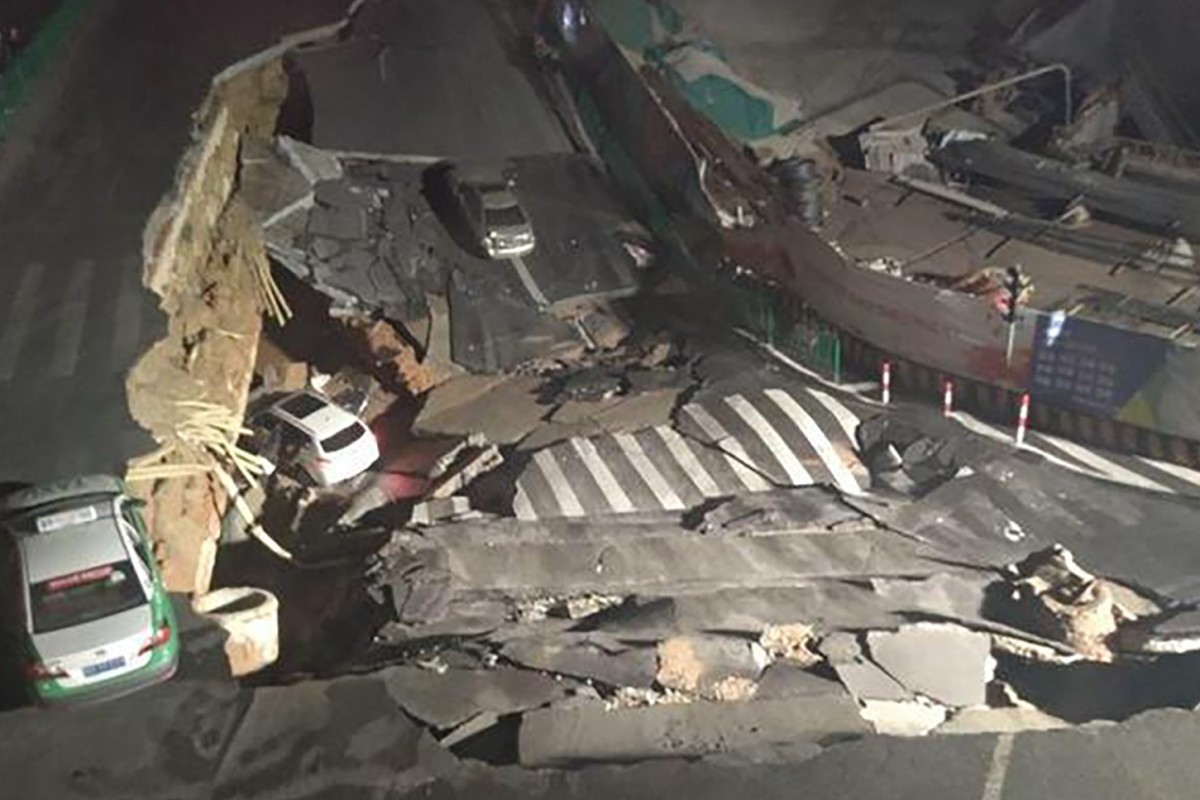
Two cars have been swallowed by a hole that opened up in the ground near a subway station in southeast China.
It is the latest of a string of ground collapses involving subway projects in mainland cities this year.
The 500 square metre hole opened up just before 10pm on Thursday near Lucuo station in Xiamen, a city in Fujian province.
The city’s subway operator said no one had died or been injured in the accident and the people in the two cars had been able to get out on their own.
The accident also caused water pipes to burst, flooding the station.
No injuries were reported after the incident. Photo: Weibo
The road and station were temporarily closed after the accident, but normal services resumed on Friday morning.
One of the cars swallowed was a taxi, and the driver told Beijing News he had been driving along the road when he suddenly found the vehicle falling into the hole.
The man, surnamed Chang, dragged his passenger free and they were able to climb out of the pit unaided. He said the car had not been seriously damaged.
Three people are still missing after a similar accident in the southern city of Guangzhou earlier this month that swallowed a truck and electric bike.
Five workers were also killed in the eastern port city of Qingdao in May in an accident at a subway construction site.
BEIJING, Oct. 6 (Xinhua) — While fireworks and festivities drew the largest crowds during this year’s National Day holiday, many Chinese chose to celebrate the occasion with a bowl of patriotic noodles and homegrown films.
This year marks the 70th anniversary of the People’s Republic of China which was founded on Oct. 1, 1949. The weeklong National Day holiday, introduced in 1999 by the State Council, or China’s cabinet, saw “National Day noodles” become a popular choice among some Chinese this year.
Birthday noodles are to Chinese people what birthday cakes are to Westerners. In accordance with the Chinese custom, people enjoy a bowl of noodles on their birthday as a symbol of longevity. Many restaurants will prepare a bowl of birthday noodles for free if there is a diner celebrating their birthday.
Beijing Huatian Catering Group, a leading catering company in Beijing that has more than 20 time-honored brands, sold more than 25,000 bowls of National Day noodles and gave away more than 120 bowls of birthday noodles, according to a Saturday report by Beijing Daily.
Beijing Honghua Dahaiwan Catering Group said that it has sold 3,800 bowls of noodles during the first three days of the National Day holiday, up 25 percent compared to the same period of last year.
Moviegoers meanwhile got their fill of National Day celebrations in an entirely different manner.
“My People, My Country,” “The Climbers” and “The Captain” were all set for theatrical release on the Chinese mainland on Sept. 30, a day ahead of the weeklong National Day holiday, according to the China Film Distribution and Exhibition Association.
Featuring seven short stories from seven directors, “My People, My Country” draws on important historical moments since the founding of the PRC, aiming to awaken the shared memories of Chinese around the world.
“The Climbers” dramatizes the real-life expedition of Chinese mountaineers to ascend Mount Qomolangma in 1960 and 1975.
“The Captain” is a cinematic portrayal of a real-life event that occurred on May 14, 2018, when a captain of Sichuan Airlines managed a successful emergency landing after the windshield of his plane broke in the air, safely bringing home the 119 passengers and nine crew members on board.
According to the real-time statistics of MaoYan Movie, the leading online movie ticketing platform in China, the three movies ranked as the top three films at the box office over the holiday. “My People, My Country” has raked in more than 2 billion yuan (around 279.8 million U.S. dollars) as of Sunday, “The Captain,” 1.7 billion yuan, and “The Climbers,” 743 million yuan.









 CHINDIA ALERT: You'll be living in their world, very soon