Chindia Alert: You’ll be Living in their World Very Soon
aims to alert you to the threats and opportunities that China and India present. China and India require serious attention; case of ‘hidden dragon and crouching tiger’.
Without this attention, governments, businesses and, indeed, individuals may find themselves at a great disadvantage sooner rather than later.
The POSTs (front webpages) are mainly 'cuttings' from reliable sources, updated continuously.
The PAGEs (see Tabs, above) attempt to make the information more meaningful by putting some structure to the information we have researched and assembled since 2006.
Couple received bad news as the Hainan Airlines plane was taxiing but returned to departure gate so they could get off
The Hainan Airlines flight returned to the departure gate to let the couple off. Photo: Reuters
A Chinese plane turned round on the runway after a couple on board suffered a sudden bereavement.
The Hainan Airlines flight was due to fly from Hangzhou to Sanya on Sunday when the passengers asked to be let off so they could make alternative travel plans.
“The flight was due to take off on time, all preparations had been made. The plane was already taxiing,” one unnamed passenger told Pear Video.
“The air stewardess immediately comforted the elderly couple, told them not to worry and said that she had already contacted the captain … then an in-flight announcement was made so that everyone could understand the situation.”
“[W]e were moments before take-off. Someone suddenly said their relative had passed away and wanted to get off the plane,” the passenger wrote on social media in a post shared by Pear Video.
Chinese woman opens plane’s emergency exit for some fresh air, delaying flight
“Cabin crew contacted the captain and we are now returning to the departure terminal. I can only say that the deceased must have been important.”
The plane returned to the departure gate, where the elderly couple got off and made other travel arrangements. The flight was able to continue after a 50-minute delay.
An unnamed flight attendant told video news outlet Kankan News that they often encountered unexpected situations during flights, and that everyone was able to understand Sunday’s situation.
However, some social media users were not so sympathetic.
“I want to know, did they get the consent of all the passengers before the plane was turned around? If not, then I feel like the flight should take off at the scheduled time … otherwise people might think that these elderly passengers pulled some strings behind the scenes with the cabin crew,” wrote one user on Weibo.
Managers of the Leshan Giant Buddha and Jiuzhaigou National Park restrict ticket sales as millions head off for the holiday break
Park authorities in charge of the Leshan Giant Buddha in Sichuan have restricted visitor numbers in golden week. Photo: Xinhua
Several major tourist attractions in China have capped visitor numbers during this year’s National Day “golden week” holiday as millions take the chance to travel.
October 1 marked the start of a week-long break on the mainland, with an estimated 800 million people expected to go on trips in China or overseas, about 10 per cent more than last year, according to the China Tourism Academy.
The academy estimated that 726 million people would take domestic trips in this peak holiday period – a 9.4 per cent increase from last year, but that is the lowest level of growth since 2007 as pressure from China’s slowing economy and the trade war with the United States take their toll.
Managers at the scenic area surrounding the Leshan Giant Buddha – a 71-metre (233 feet) tall ancient statue carved into a cliff in southwestern Sichuan province – said last week that daily tickets would be capped at 22,400 during the holiday, which runs until Monday.
West Lake in Hangzhou, Zhejiang province, drew 300,400 visitors as golden week started. Photo: Xinhua
The park said it would update visitors on daily ticket sales through social media.
“Today’s tickets for the Giant Buddha have reached the limit and sales have stopped,” the park management committee said on its Weibo account on Tuesday. “To all tourists, please rearrange your itinerary. You can visit the areas surrounding the Giant Buddha scenic spot,” it said, adding that tickets could be booked online for any day for the rest of golden week.
“I expected it to be chock-full of people, but actually today it’s still relatively calm. I had lots of fun,” a visitor to the Giant Buddha told Pear Video on Tuesday.
Hong Kong protests leave ‘golden week’ tourist boom in tatters
Jiuzhaigou National Park in Sichuan said last week that it would be limiting visitors to 5,000 per day during golden week and said on Monday that tickets had sold out.
The network of valleys known for its natural scenery was devastated by an earthquake in August 2017, and reopened with limited access in March 2018.
However, there were no restrictions at other attractions. In eastern Zhejiang province, 340,400 visitors went through the gates at Hangzhou’s West Lake on Tuesday, the Global Times’ Chinese edition reported.
“There’s too many people. I have never seen so many of them in my life,” one tourist was quoted as saying.
A guide also said that instances of “uncivilised behaviour”, such as trampling on the gardens, were down compared to last year.
“During the major holidays, many tourist attractions are so crowded that tourists can barely move an inch,” Hangzhou Daily said in an editorial on Monday.
“Not only is the tourist experience bad, but there are also safety hazards such as being trampled on, and this puts a lot of pressure on nearby public transport and food establishments.”
Travel booking platform Ctrip said that tourists heading overseas were increasingly seeking out new destinations, with bookings to places such as the Czech Republic, Austria, Croatia, Malta and Cambodia up by 45 per cent this year.
However, bookings for Hong Kong had fallen substantially after nearly four months of anti-government protests, Ctrip said.
Animal bursts into private room, causing customers to flee
Police shoot it dead to bring end to the panic
The boar was filmed by surveillance cameras wandering around the karaoke parlour. Photo: Weibo
A 315-pound (143kg) wild boar went on the rampage at a karaoke parlour in northeast China, scaring customers before staff managed to trap the animal in a room for local police to handle.
The incident happened at an unnamed karaoke establishment in Jixian county, Heilongjiang province on Monday evening, video news site Pear Video reported on Thursday.
Surveillance camera footage shows that the creature charged into the parlour before running into a private room, scaring two customers who ran out of the room. Several more frightened customers were seen running out of other rooms on the same corridor.
“The wild boar managed to enter the establishment because the door wasn’t closed, and it damaged the main bar counter by charging into it,” an unnamed KTV parlour staff member was quoted as saying by Pear Video. “Then it ran into a customer’s private karaoke room and scared them out.”
Frightened customers reported the incident to staff, who trapped the animal in a room.
“Wild boars definitely have an aggressive nature and they can seriously harm people,” a local police officer was quoted as saying. “After receiving instructions from our boss, we used a sniper gun to kill the boar. We had to shoot it three times before it finally died.”
Surveillance camera footage also showed several police officers dragging the dead animal down the karaoke parlour’s corridor.
China has a large population of wild boar, estimated to be about 33.5 million, Reuters has reported.
In 2014, a villager in Heilongjiang died after being attacked by a 100kg wild boar as he was herding cattle on a mountain.
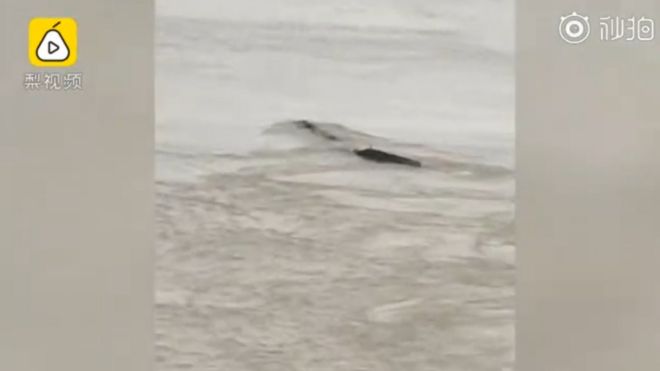
Image copyright PEAR VIDEOImage caption Grainy footage showed something that appeared to have a tail slithering back and forth in the water
Something is lurking in the deep in China’s famous Yangtze River – and social media discussion is rife over what it might be.
On Friday, footage appeared on China’s popular Sina Weibo microblog of what appeared to be a long, black creature, manoeuvring through the waters, and it has dominated online discussion ever since.
Footage has quickly racked up millions of views, and theories are rife.
Specialists have weighed in – but some think there may be a simple, and less murky, explanation.
Excitement over footage
A video filmed off the coast of the city of Yichang in western Hubei province, close to the Three Gorges Dam, captured the unusual scene.
Locals are filmed watching the creature from the shore – and social media users have similarly been captivated over theories about what the creature might be.
Many have posted using the hashtag #ThreeGorgesMonsterPhotos, and specialists have begun to weigh in with their thoughts.
In an interview with Pear Video, Professor Wang Chunfang from the Huazhong Agricultural University dismissed the idea of it being a new species, saying it was likely a simple “water snake”.
Some users said that “external factors such as pollution” could have a role to play in a sea snake growing to an extraordinary size. But not everyone was convinced.
Separate footage has led some users to question whether the unidentified object is actually a living creature at all.
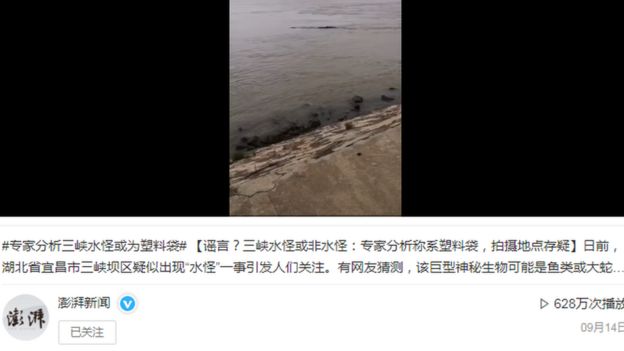
Image copyright THE PAPERImage caption Millions have watched footage of the item, but some think it might be a piece of simple rubbish
Popular news website The Paper shared separate footage of something long and black moving in the water that appeared to be less animated.
It asked if the whole thing was simply “a rumour” – and interviewed a biologist, Ding Li, who said that the object was neither a fish nor a snake, but simply “a floating object”.
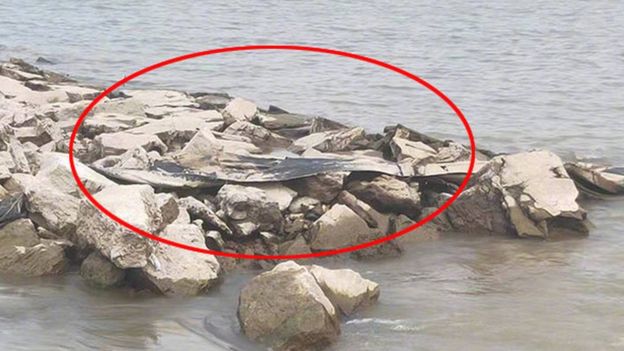
A picture has since gone viral showing a long piece of black cloth washed up on some rocks, fuelling discussion this might have been the mysterious object.
Image copyright THE PAPERImage caption The appearance of some cloth washed up on some rocks has got users asking if they were mistaken
Both have led to jokes about whether the local government was trying to attract tourism to the area, given the millions of dollars involved in building and maintaining the Three Gorges Dam.
Others have made jokes about the quality of the footage, despite the rapid development in China of high quality smartphones.
Some joked that the user obviously didn’t have a Huawei phone. Another said: “Monsters always appear only when there are few pixels.”
So what does live in the Yangtze?
Image copyright AFPImage caption Giant Chinese salamanders live in the Yangtze river. They can grow to 1.8 metres in length
The Yangtze River is the longest river in Asia, and at 3,900 miles in length (6,300km), is the third longest in the world.
But pollution has severely affected the river in recent years, meaning that its ecosystem has become narrower, rather than wider.
The largest creature thought to exist in the waters at present is the Chinese giant salamander, which can reach some 1.8m in length.
This species is critically endangered, largely as a result of pollution.
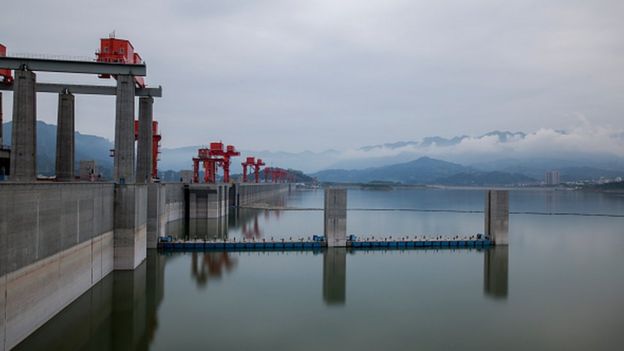
Image copyright ZHANG PENG/GETTY IMAGESImage caption The Three Gorges Dam is the world’s latest hydroelectric dam
China’s other ‘Nessies’
China is no stranger to conspiracy theories about mythical creatures lurking in the deep.
Since 1987, questions have been asked about whether a “Lake Monster” exists in the Kanas Lake in north-western Xinjiang, following numerous reports of sightings.
However, specialists believe that this is a giant taimen, a species of salmon that can grow to 180cm long, the official China Daily said.
Man says his pay packet takes a hit every time cabbies flick butts onto the street
Zhengzhou city management says supervisors are too zealous with staff fines
Local authorities say a street cleaner in Henan province fined for the cigarette butts left by smokers on his beat may be the victim of a zealous supervisor. Photo: Weibo
A street cleaner in eastern China who was filmed complaining about the hefty fines he had to pay for the cigarette ends found littering his section of road has won a hearing for his case and the support of internet users, social media site Pear Video said on Tuesday.
In the video taken on Saturday, the elderly man from Zhengzhou in Henan province claimed that he was once fined 260 yuan (US$38) – 7 yuan (about US$8) per cigarette end – from an 86 yuan per day pay packet.
“Today, I had to clean up five or six thousand cigarette butts,” the man said in the video while working outside a subway station.
“All the fines come out of my salary. This month they docked me a few hundred yuan.”
The Zhengzhou street cleaner says he can pick up thousands of cigarette ends off the street each day but the littering in his section does not stop. Photo: Weibo
The man blamed littering on unauthorised taxi drivers who throw cigarette ends into the street.
“These black cab drivers come here every day, again and again. They never stop coming here,” the cleaner was quoted as saying.
Pear Video spoke to other street cleaners in Zhengzhou, who confirmed that they were fined 7 yuan per cigarette butt found after cleaning.
It’s a dirty job, but don’t treat them like trash: Hong Kong’s cleaners are an aged, overlooked group
However, city authorities denied that the penalty system was strictly enforced and blamed overzealous monitoring officers.
“[Management patrol] will say things like this because they want to supervise the street cleaners. But there are no detailed written guidelines, and this was never formally implemented,” a representative from the Zhengzhou City Management Command Centre was quoted as saying in the report.
“It is just for the purpose of verbal supervision and encouragement.”
The Zhengzhou official said the centre would investigate further and speak to the street cleaners about fines.
In response to the cleaner’s complaints, city authorities in Zhengzhou say they will investigate and speak to staff about fines. Photo: Weibo
The video stirred up angry reactions on Weibo, China’s Twitter-like platform.
“When [Pear Video] investigated they say it hasn’t been implemented. If they didn’t investigate, they would have just carried on giving fines,” read one comment that attracted more than 17,000 likes.
Street cleaners in China often earn meagre salaries for gruelling manual labour for long periods of time.
Last month, it emerged that more than 500 street cleaners in the city of Nanjing were ordered to wear GPS tracking bracelets that would alert authorities if they stayed in the same place for more than 20 minutes. The manufacturer removed the feature after a backlash inside and outside China.









 CHINDIA ALERT: You'll be living in their world, very soon