Chindia Alert: You’ll be Living in their World Very Soon
aims to alert you to the threats and opportunities that China and India present. China and India require serious attention; case of ‘hidden dragon and crouching tiger’.
Without this attention, governments, businesses and, indeed, individuals may find themselves at a great disadvantage sooner rather than later.
The POSTs (front webpages) are mainly 'cuttings' from reliable sources, updated continuously.
The PAGEs (see Tabs, above) attempt to make the information more meaningful by putting some structure to the information we have researched and assembled since 2006.
TOKYO (Reuters) – Uncertainty over Japan’s economic outlook is “extremely high” as the coronavirus pandemic hits output and consumption, central bank Governor Haruhiko Kuroda said, stressing his readiness to take additional monetary steps to prevent a deep recession.
While aggressive central bank actions across the globe have eased financial market tensions somewhat, corporate funding strains were worsening, Kuroda told a quarterly meeting of the Bank of Japan’s regional branch managers on Thursday.
“The spread of the coronavirus is having a severe impact on Japan’s economy through declines in exports, output, demand from overseas tourists and private consumption,” he said.
Japan recorded 503 new coronavirus infections on Wednesday – its biggest daily increase since the start of the pandemic – as a state of emergency took effect giving governors stronger legal authority to urge people to stay home and businesses to close.
In contrast to stringent lockdowns in some countries, mandating fines and arrests for non-compliance, enforcement will rely more on peer pressure and a deep-rooted Japanese tradition of respect for authority.
RELATED COVERAGE
Head of Japan junior coalition partner wants to consider more economic steps
Some firms in central Japan cutting back on capex: BOJ official
The balancing act underscores the difficulty authorities have in trying to contain the outbreak without imposing a mandatory lockdown that could deal a major blow to an economy already struggling to cope with the virus outbreak.
Hideaki Omura, the governor of the central Japan prefecture of Aichi, said he would declare a state of emergency for his prefecture on Friday.
Omura said Aichi, which includes the city of Nagoya and hosts Toyota Motor Corp, was talking with the central government about being included in the national state of emergency as well, but felt he could not wait any longer to restrict movement.
“Looking at things the past week and watching the situation – the rise in patients, the number without any traceable cause – we judged that it was a very dangerous situation and wanted to make preparations,” he told a news conference.
Even with less stringent restrictions compared with other countries, analysts polled by Reuters expect Japan to slip into a deep recession this year as the virus outbreak wreaks havoc on business and daily life.
Shares of Oriental Land Co (4661.T) fell on Thursday after the operator of Tokyo Disneyland said it would keep the amusement park shut until mid-May.
Entertainment facility operator Uchiyama Holdings (6059.T) said it was closing 43 karaoke shops and 11 restaurants until May 6.
“For the time being, we won’t hesitate to take additional monetary easing steps if needed, with a close eye on developments regarding the coronavirus outbreak,” Kuroda said.
Kuroda’s remarks highlight the strong concern policymakers have over the outlook for Japan’s economy and how companies continue to struggle to generate cash, despite government and central bank promises to flood the economy with funds.
At its policy meeting later this month, the BOJ is likely to make a rare projection that the world’s third-largest economy will shrink this year, sources have told Reuters.
The BOJ eased monetary policy in March by pledging to boost purchases of assets ranging from government bonds, commercial paper, corporate bonds and trust funds investing in stocks.
The government also rolled out a nearly $1 trillion stimulus package to soften the economic blow.
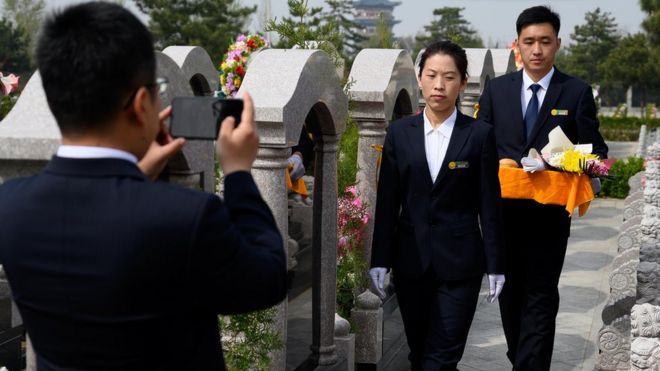
Image copyright GETTY IMAGESImage caption Staff film a tomb sweeping ceremony for a customer
People in China are paying their respects to dead ancestors digitally as the country continues to face the coronavirus outbreak.
The Qingming festival, also known as Tomb Sweeping Day, is usually a time when people visit the graves of friends and family, sprucing up the area and making offerings to their spirits.
But amid fears of another outbreak, the government has advised people to stay away and maintain social distancing.
That’s led to some cemeteries allowing people to come as long as they’ve booked a slot, while others are banning visits completely.
But other companies and burial places have turned to modern technology as they look for ways for families to continue the centuries-old tradition.
Li Quanxi, an official at Beijing’s civil affairs bureau, said: “We want to encourage people to transform social traditions amid the coronavirus outbreak.”
What is Qingming festival?
Qingming festival is one of the most important events in the calendar to commemorate ancestors who are no longer with you.
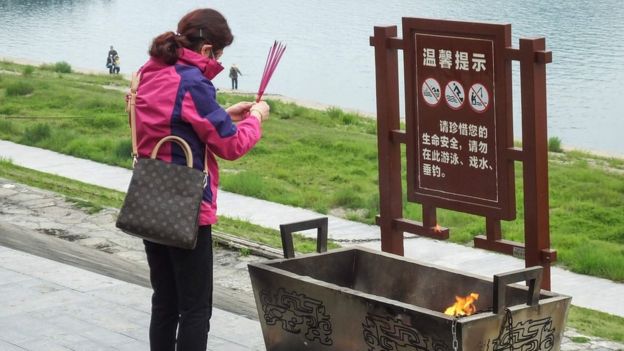
People clean the graves and burn items such as joss sticks and paper offerings – sometimes quite large ones – to honour the dead and transmit money and other goods to loved ones in the afterlife.
Image copyright AFPImage caption A woman burns incense ahead of the tomb sweeping festival
The tomb sweeping period falls between 28 March and 12 April.
Making offerings online
It is not completely unknown for pay their respects online, however, with the spread of Covid-19, there are now people who have no other option.
“Cloud tomb sweeping” allows people to “virtually” clean graves and make offerings to spirits.
One website providing this service is Heavenly Cemetery. On the surface, the website looks like any usual shopping site, although it also allows people to have their own memorial halls for their loved one so family and friends can join.
Relatives can light a candle, burn money and offer objects such as Chinese rice wine and beer. There is even an option for online tomb cleaning.
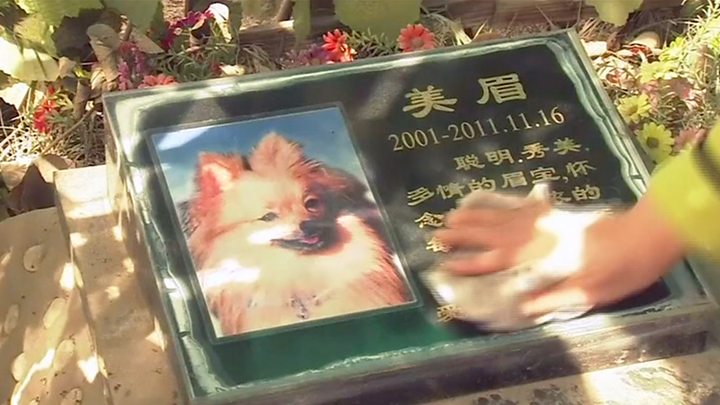
Media caption Watch: People pay respect to their deceased pets ahead of Tomb Sweeping Day
Funeral company Fu Shou Yuan International launched its own online tomb sweeping service on 12 March. It operates in more than 30 Chinese cities. In its first week, its website had about 87,000 visitors.
George Chen, whose grandparents are buried in Shanghai, visits their tombs every year but will be marking this year’s Tomb Sweeping Day online for the time being.
He told Shanghai Daily: “Old traditions are deeply rooted, but it is quite understandable because it is a special period. I will pay virtual respect and visit the scene once the epidemic ends.”
Getting someone to do it for you via livestream
While taking part in “cloud tomb sweeping” does mean you get to send offerings, it does not include the physical cleaning of a loved one’s tomb.
So some burial spots are now offering relatives a chance to watch a member of staff clean the tomb via a live stream. Others will send you photographs of the cleaned grave.
One cemetery in Shanghai is offering packages where a “valet sweep” starts from as little as 35 yuan (£4).
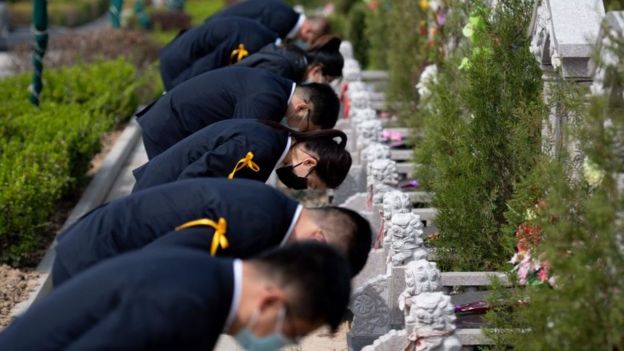
Image copyright GETTY IMAGESImage caption Staff hold a ceremony on behalf of a customer
Babaoshan funeral parlour, in Beijing, also offers live stream services.
Zhou Weihua, deputy director of the parlour, told Chinese news agency Xinhua that live streaming could become a future trend.
“Helping clients sweep tombs and holding online commemorative activities not only meets the demand in this special period but also offers more options for people to remember their deceased family members in the future.”
What about Wuhan?
China reported 3,199 deaths from coronavirus with 2,559 of those in Wuhan, where the first cases were recorded late last year.
The city is still in a lockdown which is expected to end on 8 April, and the government has announced that cemeteries will remain closed until 30 April.
Wuhan’s civil affairs department said it would make “unified arrangements to organise staff at cemeteries to hold a collective ceremony to pay tribute to the deceased”.
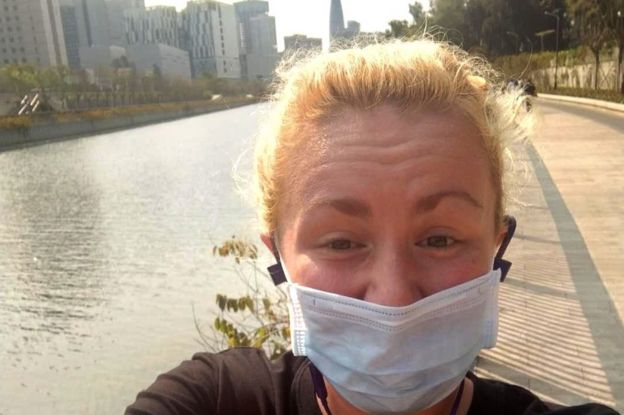
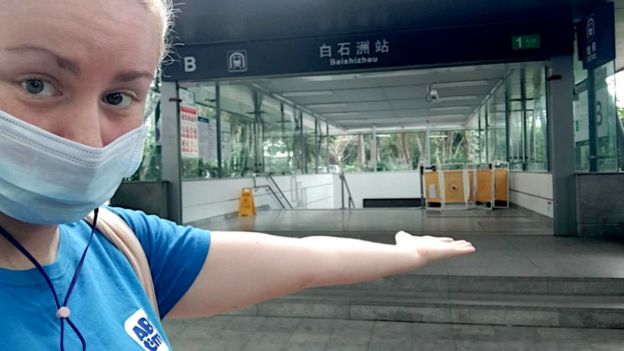
Image copyright JEN SMITHImage caption Jen Smith lives in Shenzhen, where it’s compulsory to wear a mask outside at all times
My Money is a series looking at how people spend their money – and the sometimes tough decisions they have to make. Here, Jen Smith, a children’s TV presenter from Shenzhen in southern China, takes us through a week in her life, as the country slowly emerges from the coronavirus pandemic.
Over to Jen…
Since being in lockdown I’ve been bingeing on Keeping Up With the Kardashians. It starts with one episode after dinner, blink, and suddenly it’s 3am. YouTube, Facebook, Google and Instagram are all banned here, so you’d think I’d be a binge-free socialite after a year and a half living in China. Well, those sites are banned unless you have a VPN – I pay $120 (£97) a year for mine, so Sunday was a late night, with a lie-in until 10.30 this morning.
I go for a run – mask and all, as it’s currently illegal to be outside without one. I make my coffee (bought in the UK), fruit smoothie (about 20 yuan, $2.82, £2.27) and cereal (80 yuan a packet) before cycling to work.
Today is a bit of a crazy day in the studio. I work as a children’s TV presenter. My company has profited from the lockdown as more children are watching the shows non-stop – meaning a rapid turnaround for us.
We shoot two shows from 2-6pm then “break” for a meeting. We discuss tomorrow’s shoot while I eat dinner – homemade aubergine curry. It is normal for the Chinese to eat breakfast, lunch and dinner at work. Normally the company gives all staff 25 yuan through a food-ordering app, and the whole company would eat together. However, because of the current social distancing, that social time is in the far distant past!
I make it home for 8pm, order some deep-fried cauliflower as a snack (45 yuan) and start the inevitable Kardashian binge.
Total spend: 65 yuan ($9.10, £7.37)
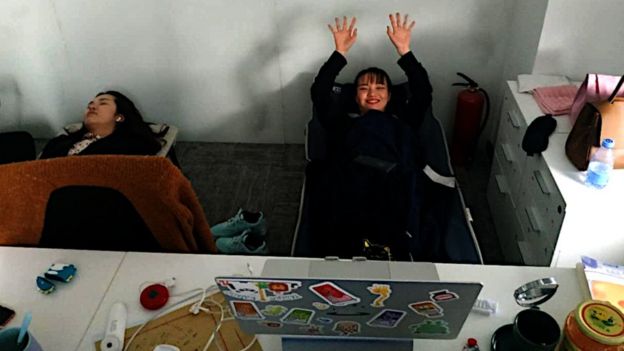
Image copyright JEN SMITHImage caption Workers often have a midday nap in the office
It’s a much earlier start (7.30am), but the same morning routine. On my cycle to work I notice that the traffic is almost back to normal – Shenzhen is inhabited by well over 12 million people, so as you can imagine rush hour is intense. This doesn’t change the fact that everywhere you go you have to scan a QR code – leaving my apartment, using the walkway by the river, and getting into the building I work in.
After a morning of shooting I eat homemade potato curry and settle down for a nap. Naptime is such a commonality in China that people store camp beds at the office. I order a coffee and banana chips (20 yuan) for a pick-me-up before the afternoon’s shooting.
It’s St Paddy’s Day so I head to the local pubs area, catch dinner at a French restaurant (222 yuan), then a few drinks (25 yuan – mainly bought by men at the bar for us) before a very tipsy cycle home.
Total spend: 242 yuan ($34, £25)
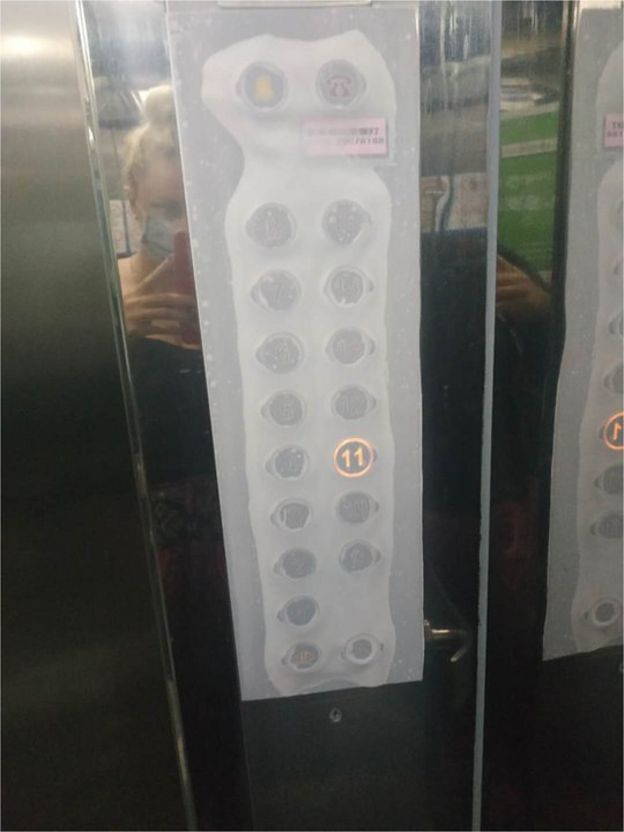
Image copyright JEN SMITHImage caption A disposable cover reduces the risk of transmitting the virus by touching lift buttons
The morning’s shoot (thankfully) was cancelled, so I nursed a hangover in bed until around 11am, at which point I had a phone meeting for a company that I do “plus-size” modelling for (for context I’m a UK size 12). I eat a bowl of cereal and order more cauliflower (45 yuan) while I watch a film.
At 2.30pm an intern picks me up, and we head to the government building to apply for a new work visa. Ironically, the image taken for my visa is Photoshopped to remove wrinkles, freckles and my frizzy hair. When I ask why this is being done for an identification document, the intern replies that the government wants it to be neat, and “the Chinese way” is to have altered photos.
I don’t argue, and have an interview before I hand in my passport. The whole process takes around two hours, so I order food to my house while on the way home (150 yuan for burger, salad and cake!) I take a taxi across town which ends up being 39.05 yuan.
The day starts at 8.30am with coffee and reading, before I get a manicure (280 yuan). My nail lady has been very worried about the state of my hands during the virus, so she spends a whopping two and a half hours treating them while I watch a film (0.99 yuan – bought by her). Because the manicure was so long I don’t have time to eat lunch before our fitness shoot, which runs from 2-5.30pm. I then have an appointment to sign into a building which I’ll shoot in tomorrow.
The building is near a supermarket called Ole (one of the only western supermarkets), and I pick up groceries for 183 yuan before heading home to cook, listen to podcasts and prep for the big day of shooting on Friday.
Total spend: 463 yuan ($64, £52.5)
Image copyright JEN SMITHImage caption Jen filming in front of a green screen – a more colourful digital background will be added later in post-production
Fridays are generally my busiest day. The way the Chinese seem to function, is a boss will say “I want this done now” and then employees rush to finish it. Generally, they will write scripts on Monday and Tuesday, discuss Wednesday, then we shoot later in the week. The poor editors, despite mandatory office hours during the week, then have to work tirelessly through the weekend to achieve a Sunday evening deadline.
I start with mashed avocado and a hard-boiled egg before work. The morning shoot runs from 9.30-11.40am, and I have an early lunch – homemade curry again, before my regular nap time. The afternoon shoot is three hours, so I have time to pop home and shower before a live stream at 6pm. I take a taxi to and from the live stream which ends up being 28 yuan.
Total spend: 28 yuan ($3.92, £3.18)
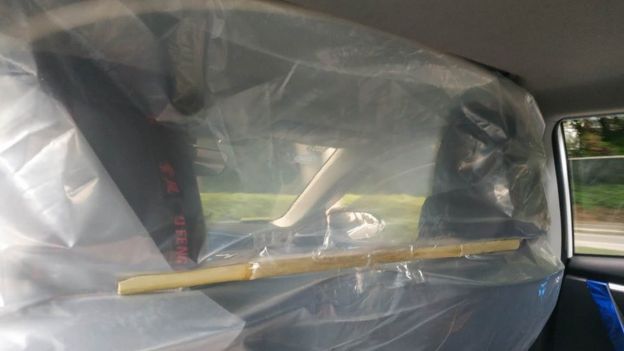
Image copyright JEN SMITHImage caption A taxi driver has improvised a screen to reduce the risk of picking up Covid-19 from a passenger
Finally the weekend! Although things are slowly getting better in China after the coronavirus outbreak, there’s still not too much to do. So I use this time to write, play my piano and generally chill inside. Around 3pm, I venture outside to the shops to pick up some snacks (159.60 yuan) before settling in to ring my family back in the UK with a homemade cocktail – a friend of mine in Canada is doing a daily live stream, “quarantinis” where he teaches you how to make cocktails!
What’s interesting is that a lot of people have started leaving their houses again, but it is still illegal to go outside without a mask on, and temperature checks are taken everywhere. I was even refused entry to a building due to being foreign. I imagine this is because recently the only new cases are being brought in by non-Chinese travelling back to China.
Total spend: 159.60 yuan ($22, £18)
Image copyright JEN SMITHImage caption Shenzhen’s Metro system is still very quiet
It’s another slow day for me as many foreigners have not yet returned to China, so most of my friends are out of the country. I start the day by reviewing potential scripts.
This takes me to 1.30pm without realising I haven’t eaten. I decide to go for a quick run and I return to eat mashed avocado and a hard-boiled egg.
I home-bleach my hair with products bought in the UK, then head back to editing again. About half way through the afternoon I take a little break to practice Chinese. I use an app which is fantastic and free! Definitely worth everyone downloading this during social distancing so you can learn new skills!
For dinner I order online again, a three-dish meal for 160 yuan.
The US saw 1,169 deaths in 24 hours and its infections are 20 per cent of the global total
China to hold day of mourning for victims; Singapore announces fifth death and school closures; Boris Johnson says he’s still ill; Angela Merkel ends quarantine
A group of nurses gather in the Bronx, New York, for a strike about the lack of personal protective equipment, on April 2, 2020. Photo: EPA-EFE
The number of confirmed coronavirus cases around the world soared past one million on Thursday and deaths topped 50,000 as Europe reeled from the pandemic and the
reported the highest daily death toll so far of any country.
Despite more than half the planet imposing some form of lockdown, the virus claimed thousands more lives, with the US, Spain and Britain seeing the highest number of daily fatalities yet.
Covid-19 is currently spreading the most rapidly in the US, where there have been 243,453 infections and 5,926 deaths, according to a tally by Johns Hopkins University.
The US saw 1,169 deaths in 24 hours, the highest one-day toll recorded in any country since the global pandemic began. The grim record was previously held by Italy, where 969 people died on March 27.
Here are other developments:
Singapore shuts schools, workplaces in ‘circuit-breaking’ move
Singapore’s coronavirus case number hits 1,000 after city state reports biggest single-day spike
Singapore Prime Minister Lee Hsien Loong on Friday afternoon announced most workplaces would be shut from April 7, and schools would be closed from April 8, in its
The city state has 1,114 infections and five people have died. More than 200 have recovered.
Essential services such as food establishments, markets and supermarkets, clinics, hospitals, utilities, transport and banking services will remain open.
Coronavirus: what’s behind Singapore’s U-turn on wearing masks?
4 Apr 2020
Lee on Friday said instead of tightening measures incrementally over the next few weeks, Singapore should “make a decisive move now, to pre-empt escalating infections”.
“Looking at the trend, I am worried that unless we take further steps, things will gradually get worse, or another big cluster may push things over the edge,” Lee said, describing the new measures as a “circuit breaker”.
Medical experts say the stringent measures require the cooperation of citizens to stay at home, given that local infection clusters have ballooned from six at the end of February to more than 20 currently.
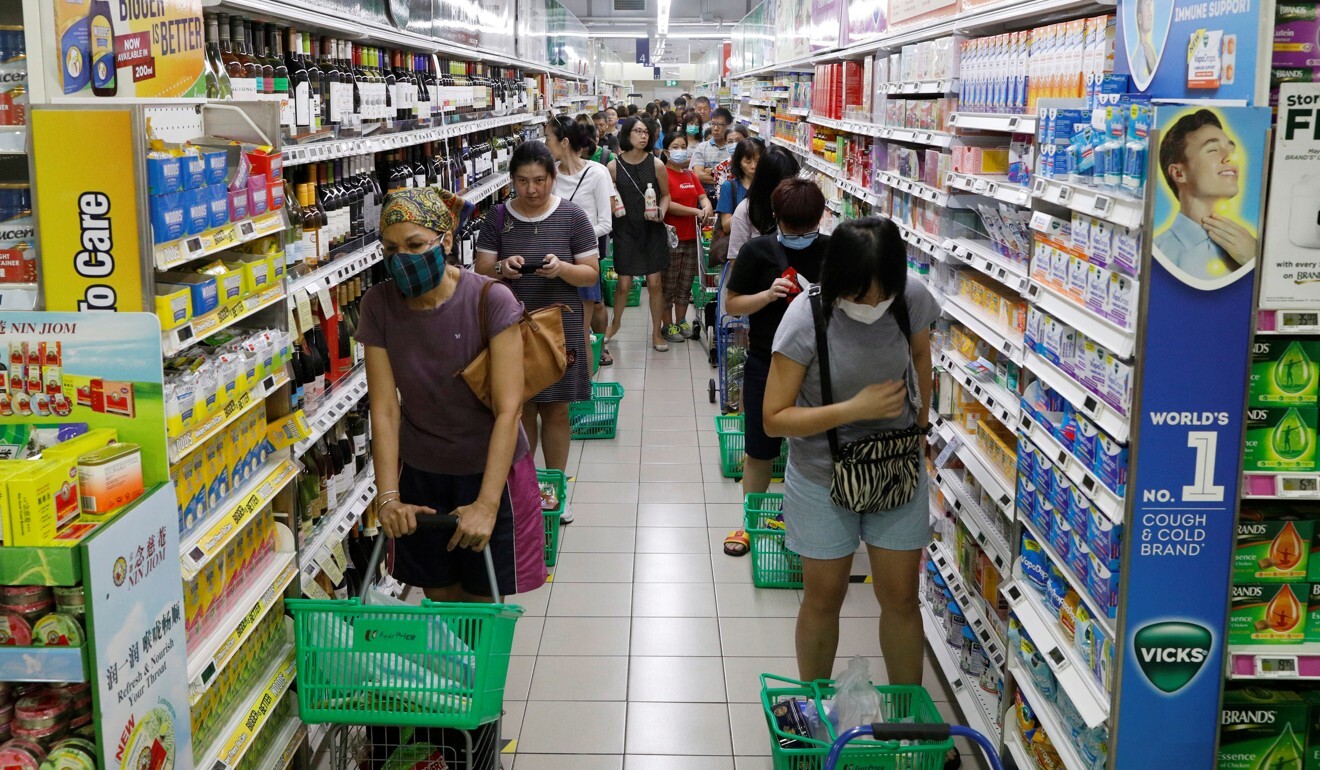
People stand behind markers as they practice physical distancing while queuing up to buy food at a Singapore supermarket on April 3, 2020. Photo: Reuters
The Lion City has launched a website to help individuals with symptoms that might be related to Covid-19 decide whether they should see a doctor or not.
On the Covid-19 Symptom Checker website, individuals will be prompted to answer a short list of questions including their age, if they have any chronic diseases, if they have travelled outside Singapore in the past 14 days, or have been in touch with a suspected or confirmed Covid-19 case.
They will also be asked to choose which symptoms they are experiencing from a predetermined list including symptoms such as cough, difficulty breathing and the loss of taste/smell. The site will then recommend what the person should do next. This includes whether they should see a doctor or continue to monitor their symptoms.
China to hold day of mourning for Covid-19 victims
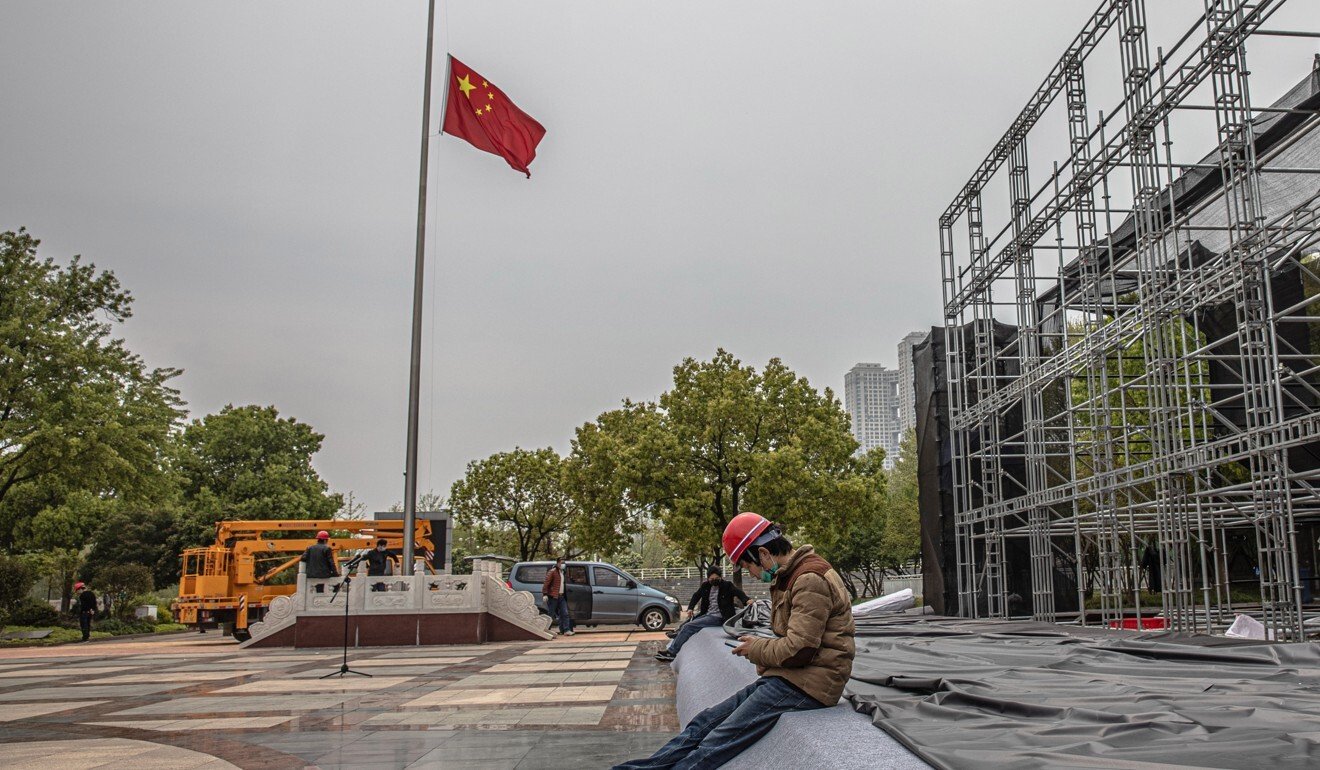
At 10am on April 4, 2020, the public will be asked to observe three minutes of silence. Photo: EPA-EFE
Flags will be flown at half-mast across the country and at embassies overseas, while all public entertainment will be halted for the day, said the State Council, China’s cabinet, on Friday.
At 10am, the public will be asked to observe three minutes of silence, during which sirens will blast out across the country and the owners of cars and boats should sound their vehicles’ horns, the council said.
Saturday also coincides with Ching Ming, or the Tomb-sweeping Festival, when Chinese traditionally gather to remember their ancestors.
China to stage day of mourning for the thousands lost to Covid-19
4 Apr 2020
Mainland China on Friday reported 31 new confirmed coronavirus cases, including two locally transmitted infections, the country’s National Health Commission said.
It also reported four new deaths as of Thursday, all in Wuhan, the city where the outbreak began, the commission said in a statement. The total number of infections now stands at 81,620 and 3,322 deaths have been reported from mainland China to date.
The commission said 60 new asymptomatic coronavirus patients were also reported on Thursday.
UK’s Boris Johnson still ill with virus fever
Boris Johnson #StayHomeSaveLives
✔@BorisJohnson
Another quick update from me on our campaign against #coronavirus.
You are saving lives by staying at home, so I urge you to stick with it this weekend, even if we do have some fine weather.#StayHomeSaveLives
British Prime Minister Boris Johnson remains in isolation with a high temperature, more than a week after testing positive for coronavirus.
Johnson made the announcement in a video posted on Twitter on Friday, saying that even after seven days, “alas I still have one of the symptoms, a minor symptom: I still have a temperature”.
“In accordance with government advice I must continue my self-isolation,” he said.
As virus rages, British love for NHS could make or break Boris Johnson
3 Apr 2020
With coronavirus deaths still rising, the PM is anxious to drum home his message that Britons must obey government orders to stay in their homes as much as possible.
On March 23 he ordered a national lockdown, with the closure of schools, stores, restaurants and leisure facilities. Under emergency laws, police have the power to fine individuals who flout the rules and break up gatherings of more than two people in public.
Germany to crack down on people flouting physical distancing rules
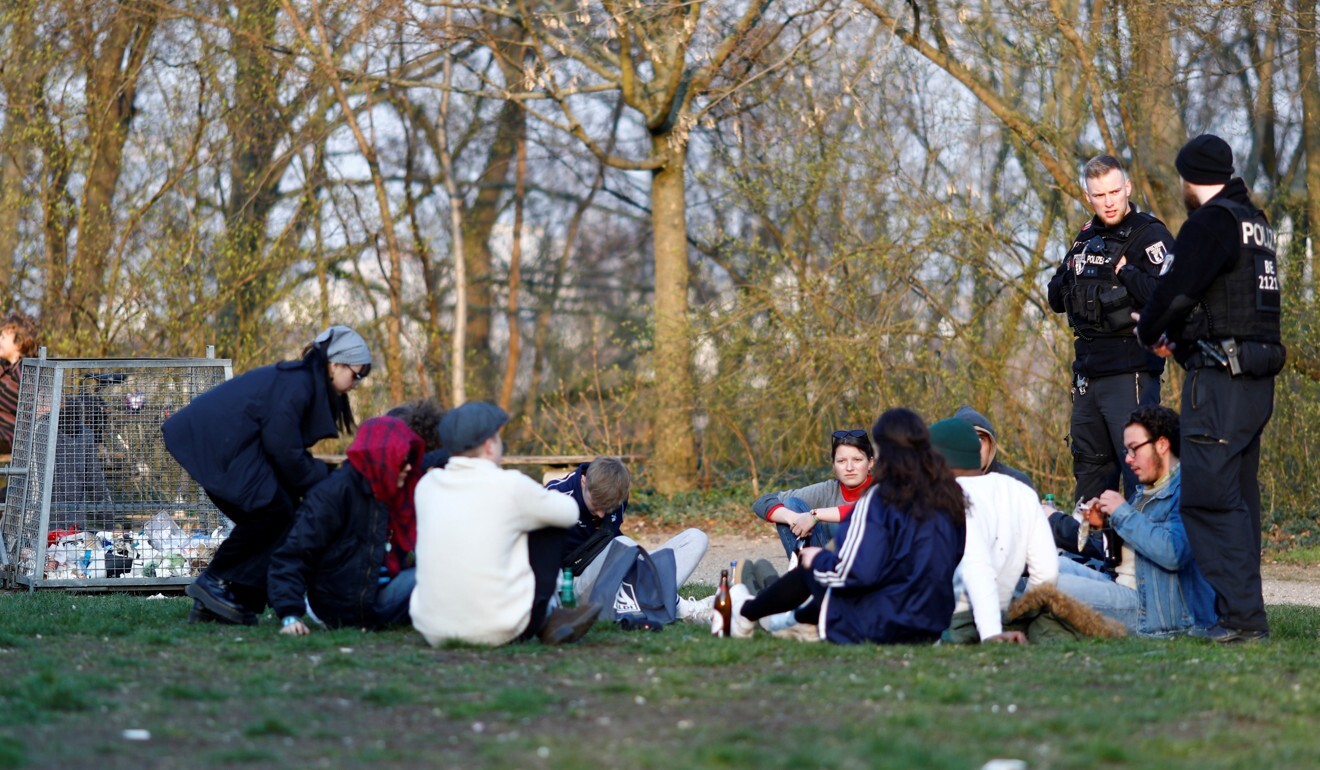
Police officers ask people to disperse as they gather at a park in Berlin, Germany, on March 28, 2020. Photo: Reuters
People in Germany risk being fined up to €500 (US$540) for standing too close to each other from Friday, as officials crack down on people flouting rules brought in to control the coronavirus outbreak.
Chancellor Angela Merkel’s government has ordered people not leave their homes unless they have an exceptional reason such as grocery shopping, exercise or medical appointments.
Gatherings of more than two people are banned and a distance of at least 1.5 metres must be kept from others at all times.
Local governments have the power to set fines for transgressors, with city officials in Berlin saying their fines would be as high as 500 euros. Similar announcements have come from across Germany’s 16 states.
Bow ties to face masks: German firms shift gears in virus crisis
2 Apr 2020
According to figures by the Robert Koch Institute (RKI) on Friday, Germany has recorded more than 79,000 cases of the novel coronavirus, and 1,017 deaths, although RKI president Lothar Wieler warned on Friday that the actual number of casualties could be much higher.
“We won’t manage to test every single person … I assume we will have more deaths than are officially recorded,” he said.
Wieler said the mortality rate would “continue to rise” in Germany. German minister’s suicide linked to coronavirus crisis
30 Mar 2020
Meanwhile, Merkel on Friday left her Berlin home for the first time in almost two weeks, after she was forced into quarantine following contact with an infected doctor.
Merkel was tested several times, with all tests coming back negative.
The 65-year-old leader has returned to her office, where she will continue to observe social distancing rules and lead the country via video and audio conferencing, her spokesman said.
Spain records over 900 virus deaths
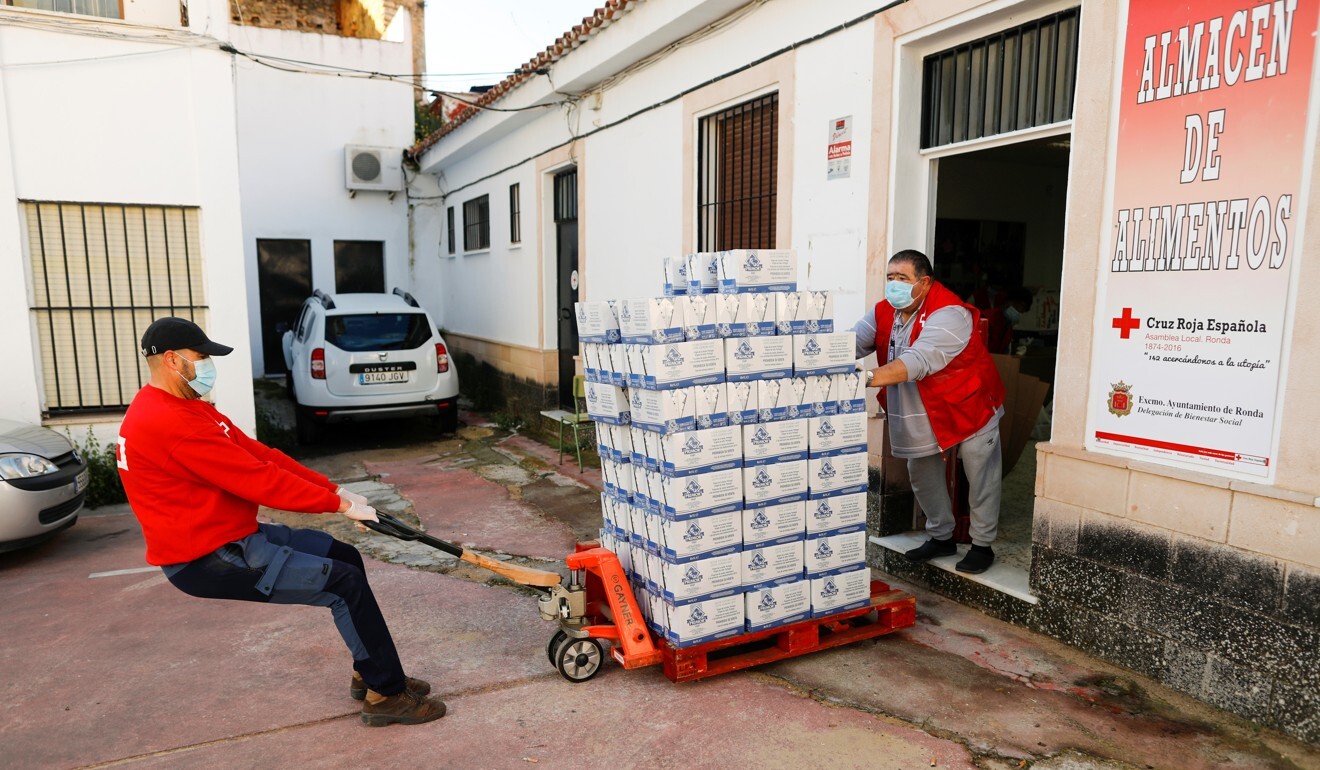
Members of the Red Cross prepare food for families in need at a food bank in Ronda, Spain, on April 3, 2020. Photo: Reuters
on Friday recorded over 900 new coronavirus deaths over the past day, bringing the number of casualties to 10,935, in the first decline in new Covid-19 deaths in four days.
The country has the world’s second-highest death toll after Italy, but health ministry figures confirm a consistent downward trend in the rate of new cases and fatalities.
The 932 deaths on Friday was a smaller gain than Thursday’s 950, according to Health Ministry data. The number of confirmed cases also increased by less than the previous day, with 7,472 new infections taking the total to 117,710.
Why Europe’s hospitals – among world’s best – are struggling with virus
1 Apr 2020
Prime Minister Pedro Sanchez’s government has been struggling to bring the virus under control. Hospitals are overwhelmed, nursing homes have been especially hard hit in a nation with one of the world’s oldest populations, and the army has been mobilised.
Sanchez may extend the current four-week lockdown for another two weeks beyond April 11, Spanish media reported on Friday. The stay-at-home order limits people’s movement to shopping for food and essentials, while some workers are also allowed to circulate.
Passengers disembark from virus-hit cruise ship in Florida
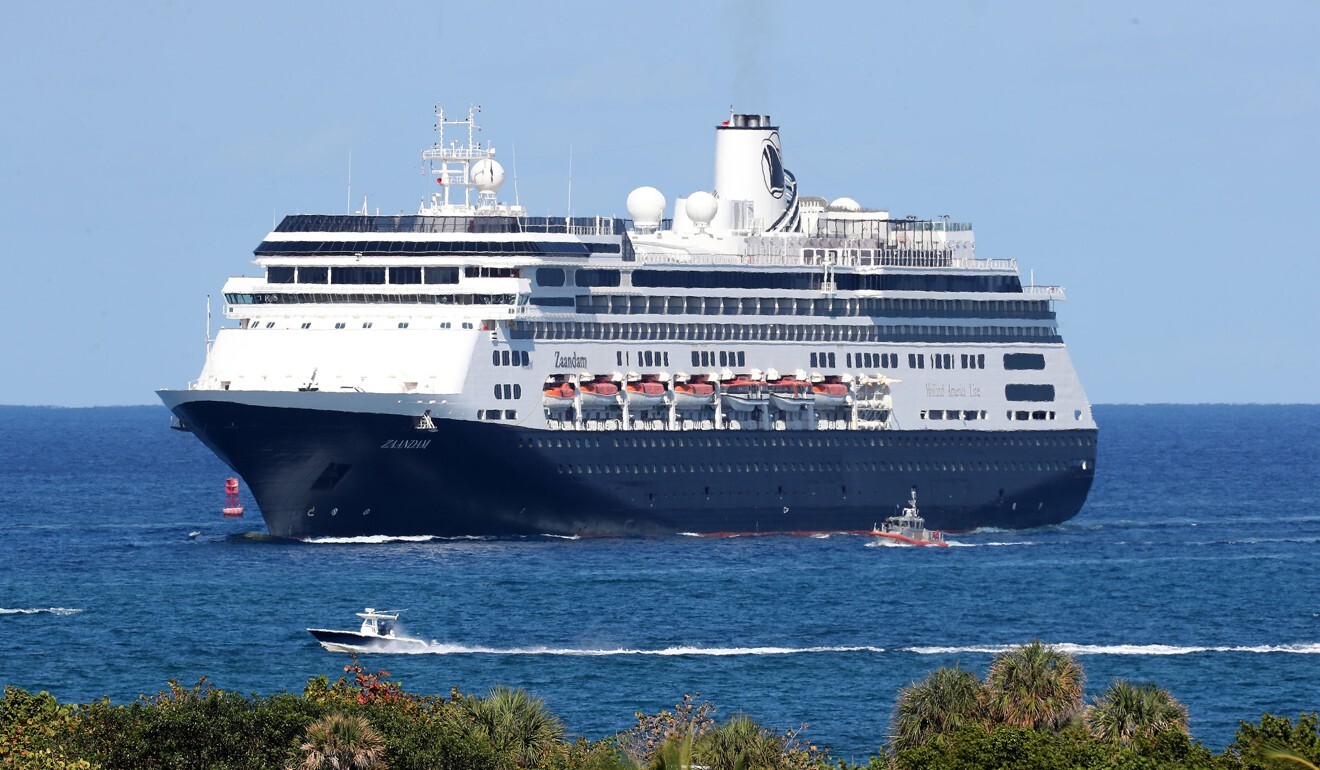
The Zaandam cruise ship docked in Florida on Friday. Photo: TNS via ZUMA Wire/dpa
Passengers from an ill-fated cruise were carefully freed from their cabins and allowed to disembark on Friday, following the removal of 14 critically-ill people who were wheeled off to Florida hospitals bracing for an onslaught of coronavirus patients.
The exodus from the Zaandam and its sister ship the Rotterdam, both operated by Holland America Line, was expected to continue throughout the day.
Floridians were getting off first, followed by other passengers. Buses were taking people healthy enough to travel directly to the airport, where they will board chartered flights home without going through the terminal.
Coronavirus nightmare for passengers stuck on MS Zaandam ‘death ship’
30 Mar 2020
“This is a humanitarian situation, and the County Commission’s top priority is protecting our 1.9 million residents while providing a contained disembarkation option for people on board who need to get safely home,” Broward County Mayor Dale Holness said in a statement late on Thursday.
Four people have died on the Zaandam, for reasons not yet disclosed. All told, 107 passengers and 143 crew reported flu-like symptoms during the voyage, but many have since recovered.
It was unclear when the bodies of four passengers who died on the Zaandam would be removed from the ship, which set sail on March 7, the day before the US State Department warned people against cruising during the pandemic.
South Korea’s infections top 10,000
South Korean hospital’s ‘phone booth’ coronavirus tests
on Friday said the number of confirmed coronavirus cases in the country has surpassed 10,000, with 174 deaths linked to Covid-19, the disease caused by the new virus.
The Health and Welfare Ministry reported 86 new coronavirus infections over 24 hours to the end of Thursday, taking the total to 10,062 cases. It also logged five more deaths.
The numbers confirmed an encouraging stabilisation of numbers, which have hovered around the 100 mark for the past three weeks, a clear downward trend which began in March after numbers peaked at the end of February with over 900 cases recorded in a day.
South Korea’s virus response is the opposite of China’s – and it works
15 Mar 2020
For a fourth straight day, more new cases were recorded from Seoul and the surrounding Gyeonggi province, than in what has so far been the outbreak epicentre in the country – North Gyeongsang province and city of Daegu – with the capital area registering 34 new cases, and the latter recording 23.
Imported cases in patients recently returned from abroad also continued to increase, with 22 new infections bringing the total to 264.
Japan to give US$2,800 payouts to households
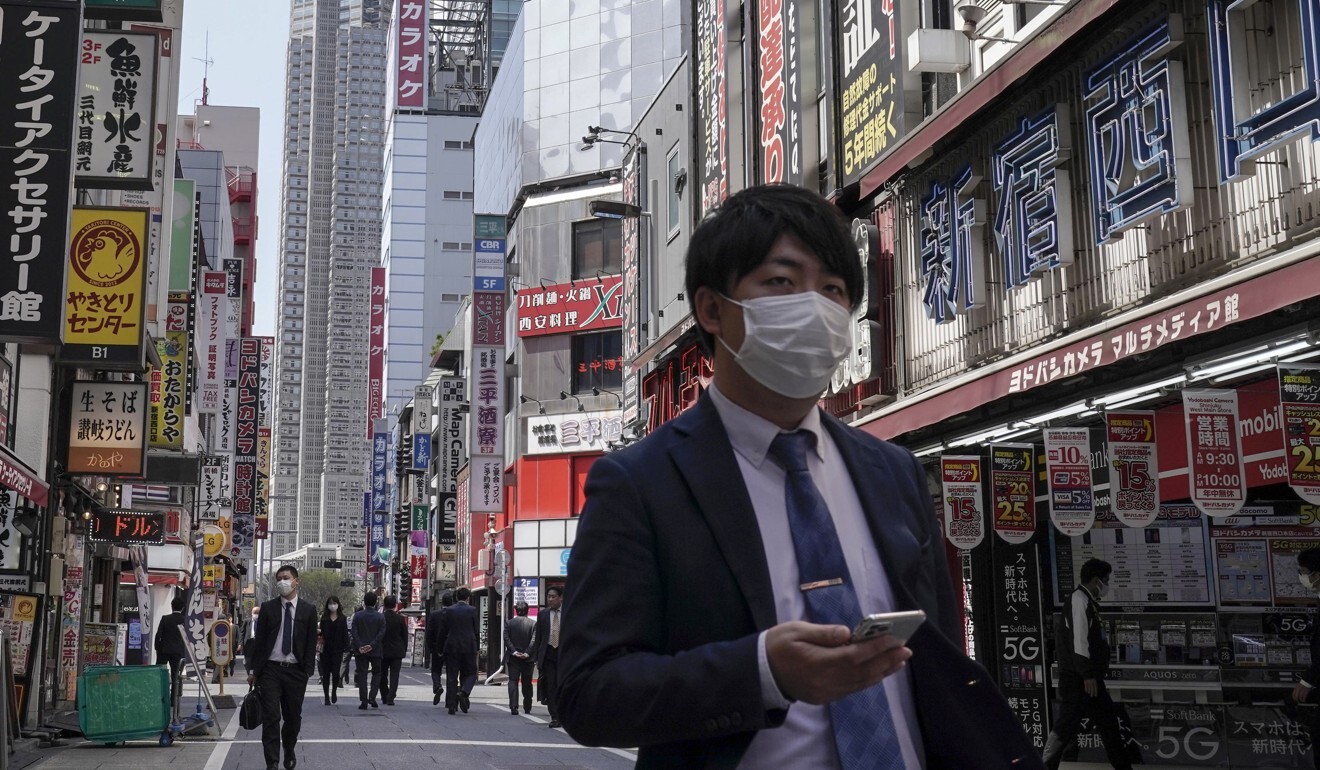
A man seen in a protective mask at Shinjuku in Tokyo, Japan, on April 2, 2020. Photo: EPA-EFE
Japanese ruling party executive Fumio Kishida said on Friday he has agreed with Prime Minister Shinzo Abe to offer 300,000 yen (US$2,800) in cash payments per household that suffers a certain degree of income declines from the coronavirus pandemic.
About 10 million of Japan’s 58 million households are expected to be eligible for the cash programme, a key pillar of an emergency economic package that the government plans to compile possibly on Tuesday.
The relief measure will be funded by a supplementary budget for this fiscal year that the government wants to pass in parliament before Japan’s Golden Week holiday starts in early May.
Coronavirus: Tokyo’s nightlife districts linked to rise in cases
2 Apr 2020
The government will not set a household income limit for the cash handout, which will be tax free, officials said.
“If we set an income limit, we would have to check individual incomes, which would take a lot of time,” Yasutoshi Nishimura, minister in charge of economic and fiscal policy, told a press conference. “Instead of that, we’ll come up with an unprecedented way (to judge who should receive cash).”
Nishimura said recipients will be limited to those who are facing livelihood difficulties, and that civil servants, politicians and major corporate executives who have not been significantly affected by the economic impact of the virus outbreak, for example, will be excluded from the scheme.
Japan weighs cost of Tokyo lockdown and Wagyu beef coupons for households
31 Mar 2020
Abe said the government will provide cash “as soon as possible” not only to households but also to small-and mid-sized business operators that have seen their revenues drop.
Abe has said the package to tackle the coronavirus will be larger than the 56.8 trillion yen emergency package compiled in April 2009 following the previous year’s global financial crisis.
Indonesian Muslims banned from travelling home for Eid al-Fitr
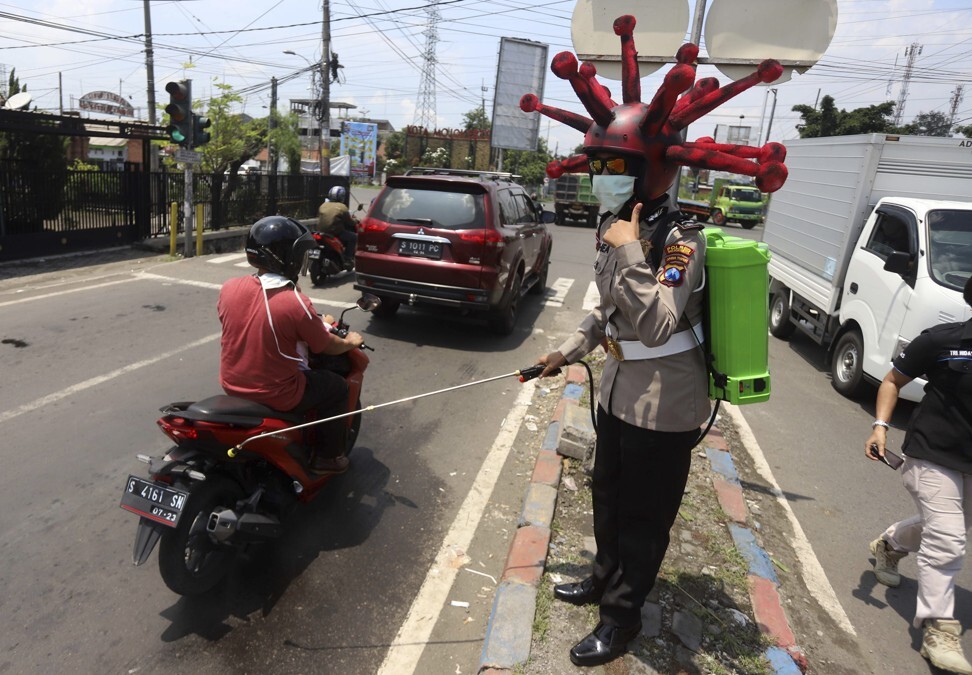
A police officer in a coronavirus helmet sprays disinfectant at a motorcycle in East Java, Indonesia, on April 3, 2020. Photo: AP
Islamic scholars in Indonesia on Friday issued an edict to forbid people from travelling home for Eid al-Fitr, the festival marking the end of the Muslim fasting month of Ramadan, as the country recorded nearly 2,000 infections during the
decided to allow millions of Muslims to travel to celebrate Eid in their hometowns next month, despite fears that they could spread the Covid-19 disease.
“The virus spreads very easily. Doing something like that at a time of a pandemic is haram [forbidden],” the council’s sectary general Anwar Abbas said.
Eid al-Fitr is expected to start on May 23, depending on the sighting of the new moon.
Indonesia frees 18,000 prisoners as virus death toll surges to 170
2 Apr 2020
Indonesia confirmed 196 new infections on Friday, bringing the total number of cases to 1,986.
The death toll rose to 181 after 11 new deaths, making Indonesia the the country with the highest number of fatalities in Asia outside China.
The State Intelligence Agency warned that the outbreak in Indonesia could peak in June with more than 105,000 cases.
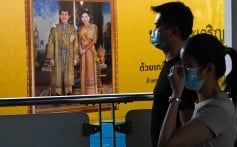
Thailand’s night curfew to begin; people banned from making virus pranks
An officer checks the temperature of a passenger in a bus at a health checkpoint in Bangkok, Thailand, on April 3, 2020. Photo: AP
Thailand will on Friday night begin a daily nationwide curfew to try to curb the spread of the coronavirus.
The 10pm-4am curfew, which will run indefinitely, is the latest measure by the government to curb gatherings and have people stay at home as much as possible.
Exceptions include those people transporting medical supplies and health workers travelling to and from work, Prime Minister Prayuth Chan-ocha said.
“We prioritise health over freedom,” Prayuth said. “We might not feel as comfortable as before, but we all need to adapt for survival and have social responsibility, so that we can make it through this crisis.”
In a televised address, Prayuth also asked all Thai citizens abroad to “delay” returning to
until after April 15 in a bid to stop imported cases.
Thai king remains in Germany during pandemic, prompting criticism online
23 Mar 2020
Thais have also been banned from making public gatherings, in an order signed on Friday by defence forces chief General Pornpipat Benyasri.
The order prohibits people from public gatherings, carrying out activities, or gathering for unlawful purposes in a manner that risks spreading the coronavirus.
It also bans any act that aggravates people’s suffering and pranks to spread the virus. Family gatherings at residences and civic activities carried out according to safe social distancing guidelines are allowed.
Violation of the order carries a maximum penalty of two years’ imprisonment and a fine of 40,000 baht (US$1,215).
Pakistan’s mosques remain open amid shutdowns
Coronavirus: In Pakistan food aid is distributed to the poor in Karachi
Mosques in Pakistan were allowed to remain open on Friday, when adherents gather for weekly prayers, even as much of the country had shut down.
Pakistan, with 2,450 confirmed coronavirus cases and 35 deaths, has been sharply criticised for moving too slowly to curb large gatherings.
Prime Minister Imran Khan was relying on restricting the size of congregations attending mosques and advice to stay at home from religious groups like the country’s Islamic Ideology Council.
Coronavirus: Pakistan quarantines pilgrims returning from Iran
4 Mar 2020
However, some provinces had issued their own lockdown orders to prevent Muslims from gathering for Friday prayers.
In southern Sindh province, a complete lockdown was being enforced from noon until 3pm, the time when the faithful gather for prayers. Anyone found on the streets would be arrested, according to the provincial local government minister in a statement.
In eastern Punjab province, where 60 per cent of Pakistan’s 220 million people live, checkpoints had been set up in major cities stopping people from congregating.
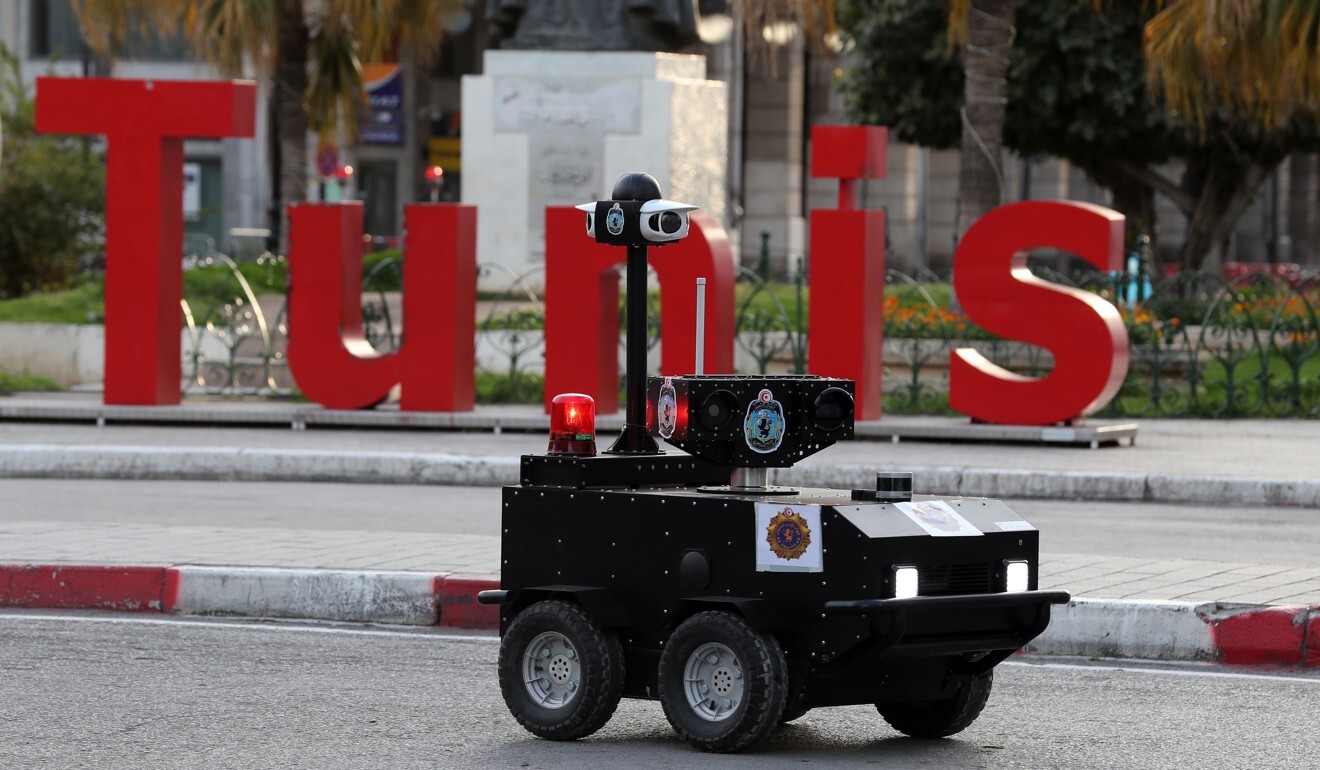
Tunisia ‘robocop’ enforces virus lockdown
The PGuard robot patrols the streets of Tunis, in Tunisia, on April 1, 2020. Photo: EPA-EFE
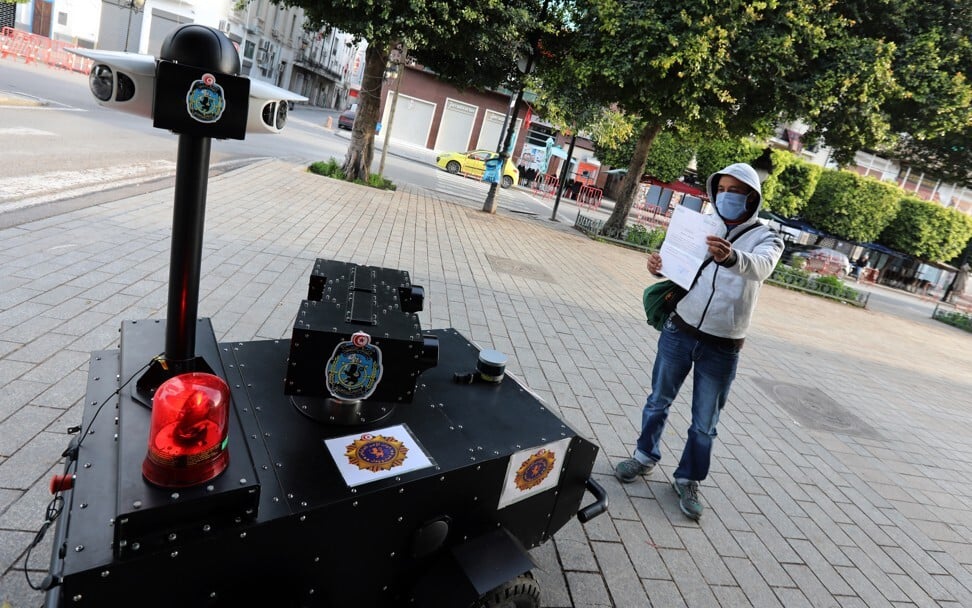
Tunisia’s interior ministry has deployed a police robot to patrol the streets of the capital and enforce a lockdown as the country battles the spread of coronavirus.
Known as PGuard, the “robocop” is remotely operated and equipped with infrared and thermal imaging cameras, in addition to a sound and light alarm system.
In images and a soundtrack posted on the interior ministry’s website last month, PGuard calls out to suspected violators of the lockdown: “What are you doing? Show me your ID. You don’t know there’s a lockdown?”
The PGuard robot checks the exit permit of a citizen in Tunis on April 1, 2020. Photo: EPA-EFE
Tunisia has been under night-time curfew since March 17 and authorities imposed stricter lockdown orders from March 22.
Fourteen people have died from coronavirus in Tunisia, where 455 confirmed cases have tested positive for the disease.
The robot’s Tunisian creator Anis Sahbani said the machine was first produced in 2015 essentially to carry out security patrols and it also operates autonomously through artificial intelligence.
The robot, built by Sahbani’s Enova Robotics firm, costs between 100,000 and 130,000 euros (US$100,000 and $140,000), and has been selling mostly overseas to companies for security uses.
France death tally passes 5,000
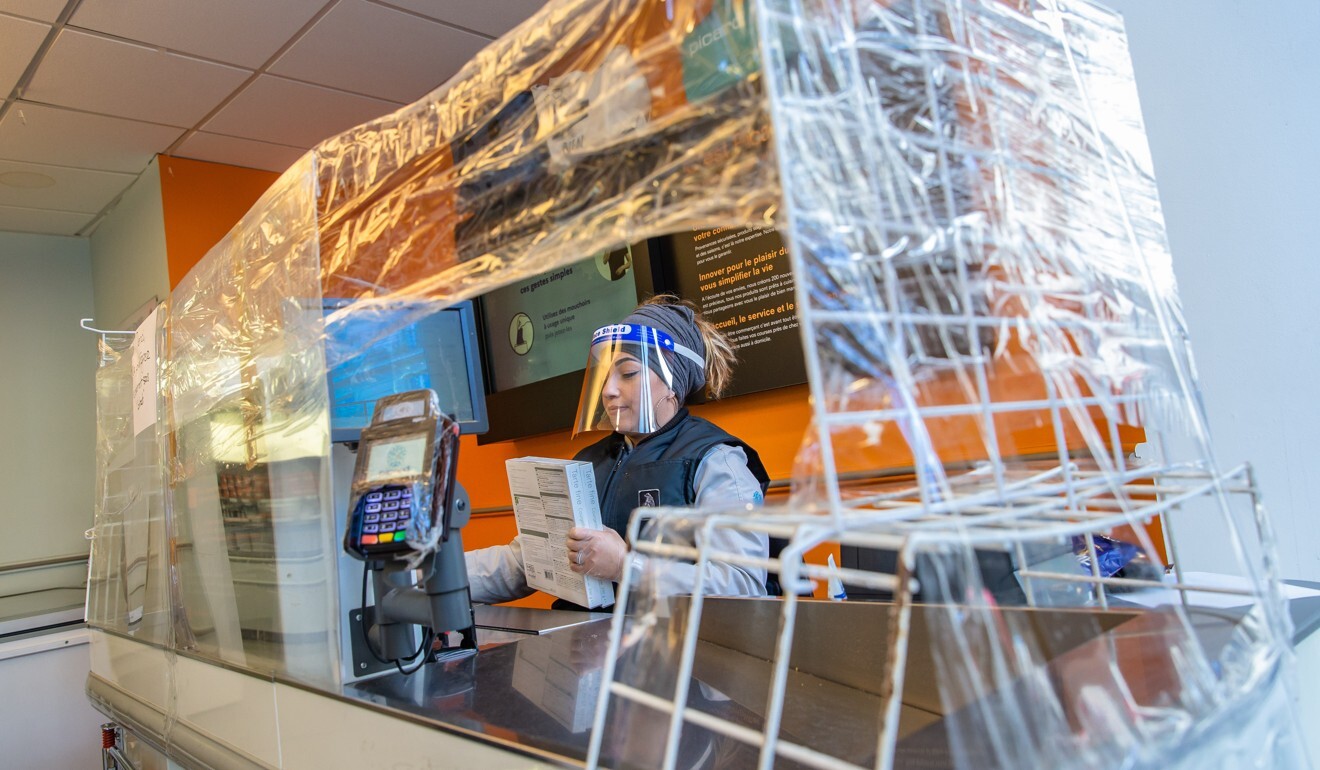
A cashier runs a store counter covered up with a plastic barrier in Paris, France, on April 3, 2020. Photo: Xinhua
reported a jump in coronavirus deaths on Thursday as the country included fatalities in some nursing homes for the first time. Still, a decline in intensive-care admissions suggest the country’s lockdown is starting to slow the pace of the outbreak.
The health ministry reported 471 new hospital deaths from the coronavirus on Thursday. In addition, it reported 884 deaths in a partial count from nursing homes, bringing the total number to 5,387. Nursing homes were not previously included in the statistics.
in number of deaths, behind Italy and Spain. The number of confirmed cases is now at 59,105.
Italy reported another 760 fatalities on Thursday. Its death toll, already the world’s highest, now stands at 13,915. Total infections, including recoveries and deaths, have reached 115,242.
Spain reported 950 more deaths from the coronavirus, the most in a single day, taking the total to 10,003.
India plans staggered exit from lockdown
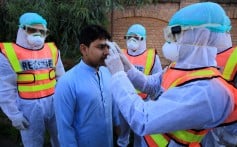
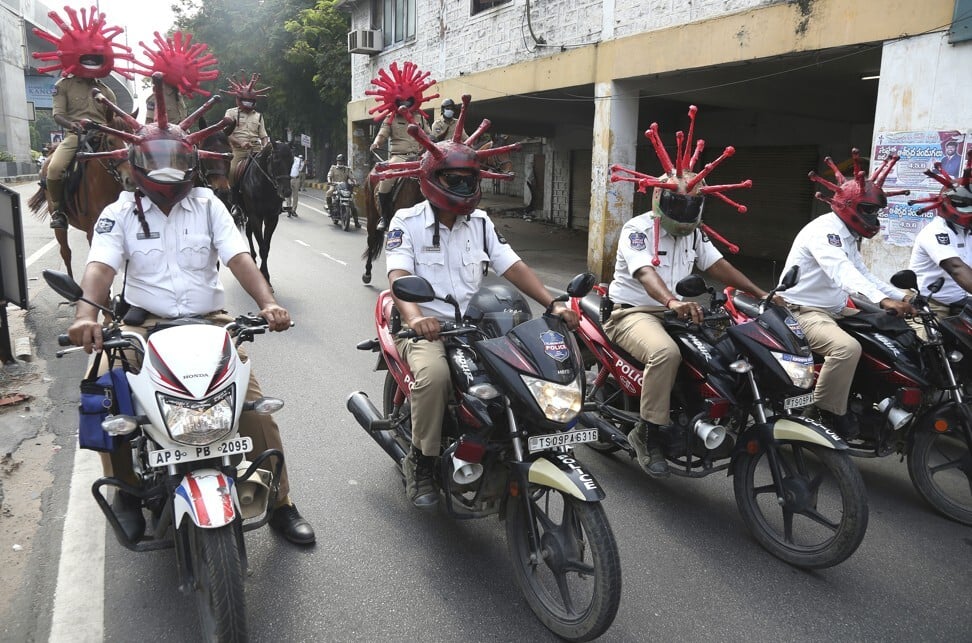
Indian policemen in Hyderabad, India, wear virus-themed helmets for a campaign to raise awareness at preventing the spread of the coronavirus on April 2, 2020. Photo: AP
infections, but the world’s biggest shutdown has left millions without jobs and forced migrant workers to flee to their villages for food and shelter.
After violence, Indian police try humour to enforce virus lockdown
2 Apr 2020
He told state chief ministers that the shutdown had helped limit infections but that the situation remained far from satisfactory around the world and there could be a second wave.
“Prime minister said that it is important to formulate a common exit strategy to ensure staggered re-emergence of the population once lockdown ends,” the government quoted him as saying in a video conference.
India has had 2,069 confirmed infections, of whom 53 have died, low figures by comparison with the US, China, Italy and Spain. But the big worry is the
because of a gathering held by a Muslim missionary group last month that has spawned dozens of cases across the country, officials said.
Five-minute virus tests ‘may give inaccurate results’
A Chinese drug and diagnostic firm has cautioned that the slew of new test kits that promise to detect the coronavirus in just a few minutes may not be as accurate as conventional kits, a potential setback for countries seeking to rapidly test their citizens.
“Such rapid testing is not as accurate as the traditional nucleic acid test that takes about two hours to turn out results,” Wu Yifang, Shanghai Fosun Pharmaceutical Group’s chief executive officer, said. The drugmaker also has a swift testing technology but it’s working on making the results more accurate, according to Wu.
Coronavirus nightmare of China’s ‘recovered’ patients
2 Apr 2020
Abbott Laboratories unveiled a coronavirus test on March 28 that can confirm if someone is infected in as little as five minutes. Shenzhen Bioeasy Biotechnology has been supplying its version of rapid testing kits to the European Union even before getting regulatory approval in China for domestic use.
The faster and easy-to-deploy diagnostic kits seemingly save time and resources for nations under pressure to widen their testing efforts. But there have been reports of faulty kits, like those bought by Spain and the Czech Republic.
Shenzhen Bioeasy, which sold thousands of test kits to Spain, said in a statement on March 27 that false results could be due to improper use of its kits or faulty specimen collection.
Trump tests negative again
US President Donald Trump was was first tested last month after coming into contact with a Brazilian official who later tested positive. Photo: UPI/Bloomberg
US President Donald Trump on Thursday was tested again to determine whether he had been infected by the coronavirus, and the test came back negative, the White House said.
A letter from Trump’s doctor, Sean Conley, said Trump had undergone what was a second test for coronavirus. He was tested last month after coming into contact with a Brazilian official who later tested positive.
Trump to urge Americans to wear masks when outside
3 Apr 2020
Conley said in a letter released by the White House that Trump was tested with a new, rapid point-of-contact test and the result came back in 15 minutes.
“He is healthy and without symptoms,” Conley said.
Trump said Americans should wear protective face masks if they wish. “If people want to wear them, they can” he said. Scarves work just as well, he said.
NRA sues NY governor over closure of gun stores
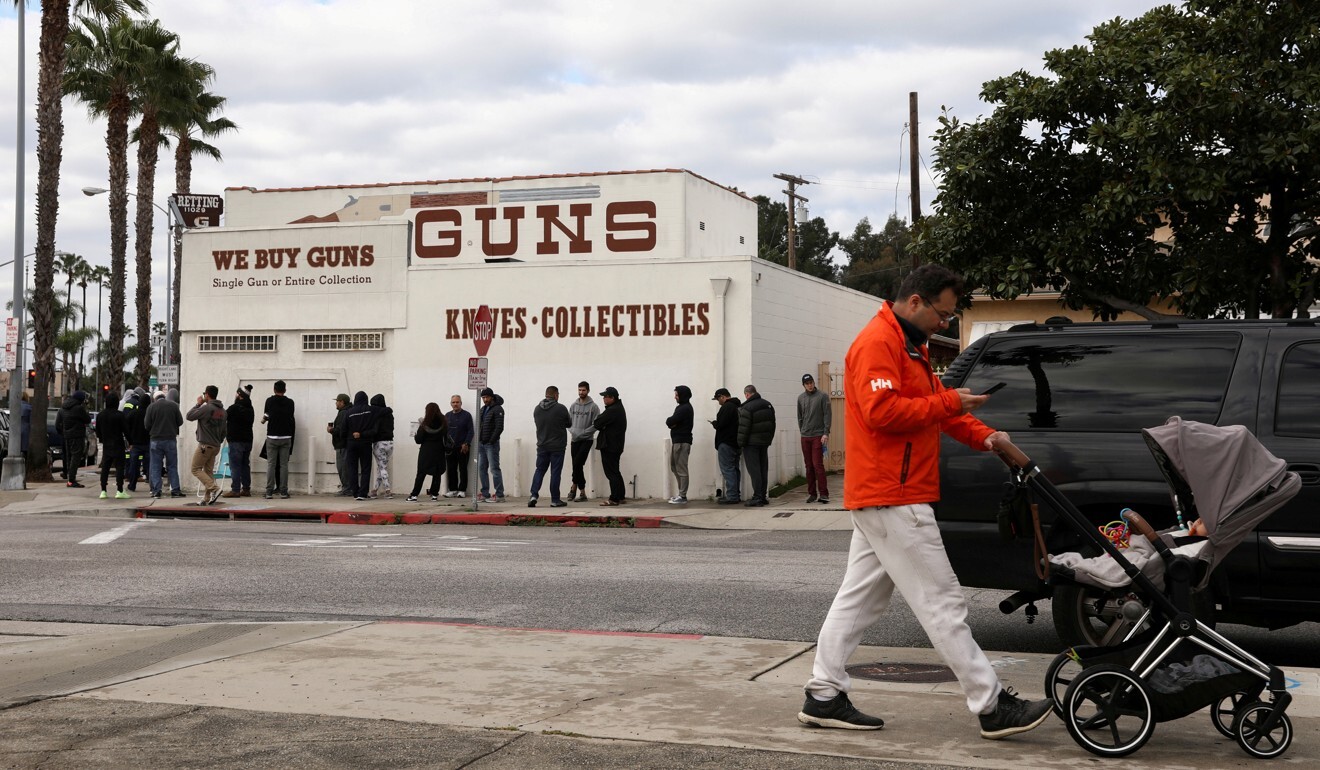
A pedestrian pushes a stroller as people wait in line outside a gun store to buy supplies on March 15, 2020. Photo: Reuters
The National Rifle Association (NRA) sued New York Governor Andrew Cuomo for closing gun shops during the coronavirus pandemic, saying the restriction is unconstitutional and leaves citizens defenceless while prisoners are being released early as a result of the crisis.
Cuomo’s March 20 executive order that included firearms retailers as non-essential businesses, which must close is a “pointless and arbitrary attack on the constitutional rights of New York citizens and residents,” the NRA said in a complaint filed late Thursday in Syracuse, New York.
New York ordered most businesses to close to prevent the spread of the virus, but deemed grocery stores, liquor stores, pharmacies and restaurants that do take-out as essential and allowed them to remain open.
The New York lawsuit follows similar action the NRA took in Northern California, where it sued several cities including San Jose for ordering gun stores to close.
Corona beer producer halts brewing
The Mexican brewer of Corona beer said on Thursday it was suspending production because of the health emergency in the country over the Covid-19 pandemic.
Grupo Modelo said the measure was in line with the Mexican government’s order to suspend all non-essential activities until April 30 to slow the spread of coronavirus.
“We are in the process of lowering production at our plants to the bare minimum,” the company said in a statement, adding it would complete the suspension in the following days.
Mexico’s government has said that only key sectors such as agribusiness will be able to continue to function.
US stops issuing passports, except in emergencies
The US State Department will not be processing new passports and renewals except for emergency cases because of the coronavirus pandemic, the agency’s website said.
“Due to public health measures to limit the spread of Covid-19, effective March 20, 2020, we are only able to offer service for customers with a qualified life-or-death emergency and who need a passport for immediate international travel within 72 hours,” said a March 27 online statement.
How elite US university students brought coronavirus home from campus
3 Apr 2020
Passport applications received on or before March 19 will be processed.
Travellers who paid extra for expedited service can expect to receive their passport in the next two to three weeks.
If you applied in-person at a passport agency or centre before March 19, the agency will contact you about getting your passport.
BEIJING/WUHAN, China (Reuters) – China on Saturday mourned the thousands of “martyrs” who have died in the new coronavirus outbreak, flying the national flag at half mast throughout the country and suspending all forms of entertainment.
The Chinese national flag flies at half-mast at Tiananmen Square in Beijing, as China holds a national mourning for those who died of the coronavirus disease (COVID-19), on the Qingming tomb sweeping festival, April 4, 2020. REUTERS/Carlos Garcia Rawlins
The day of mourning coincided with the start of the annual Qingming tomb-sweeping festival, when millions of Chinese families pay respects to their ancestors.
At 10 a.m. (0200 GMT) Beijing time, the country observed three minutes of silence to mourn those who died, including frontline medical workers and doctors. Cars, trains and ships sounded their horns and air raid sirens wailed.
In Zhongnanhai, the seat of political power in Beijing, President Xi Jinping and other Chinese leaders paid silent tribute in front of the national flag, with white flowers pinned to their chest as a mark of mourning, state media reported.
More than 3,300 people in mainland China have died in the epidemic, which first surfaced in the central province of Hubei late last year, according to statistics published by the National Health Commission.
In Wuhan, the capital of Hubei province and the epicentre of the outbreak, all traffic lights in urban areas turned red at 10 a.m. and all road traffic ceased for three minutes.
Some 2,567 people have died in Wuhan, a megacity of 11 million people located in the middle reaches of the Yangtze river. The Wuhan deaths account for more than 75% of the country’s fatalities.
Among those who died was Li Wenliang, a young doctor who tried to raise the alarm about the disease. Li was honoured by the Hubei government earlier this week, after initially being reprimanded by police in Wuhan for “spreading rumours”.
Gui Yihong, 27, who was among thousands of Wuhan locals who volunteered to deliver food supplies to hospitals during the city’s months-long lockdown, recalled the fear, frustration and pain at Wuhan Central Hospital, where Li worked.
“If you weren’t at the frontlines you wouldn’t be able to experience this,” said Gui, as he laid some flowers next to Wuhan’s 1954 flood memorial by the Yangtze.
“I had to (come) and bear witness. For the last 80 days we had fought between life and death, and finally gained victory. It was not easy at all to come by.”
While the worst was behind Wuhan, the virus has spread to all corners of the globe since January, sickening more than a million people, killing more than 55,000 and paralysing the world economy.
Wuhan banned all tomb-sweeping activities in its cemeteries until at least April 30, curtailing one of the most important dates in the traditional Chinese lunar new year calendar which usually sees millions of families travel to tend to their ancestral graves, offer flowers and burn incense.
They have also told residents, most stuck at home due to lockdown restrictions, to use online streaming services to watch cemetery staff carry out those tasks live.
ASYMPTOMATIC CASES
Online, celebrities including “X-Men: Days of Future Past” star Fan Bingbing swapped their glamorous social media profile pictures for sombre photos in grey or black, garnering millions of “likes” from fans.
Chinese gaming and social media giant Tencent (0700.HK) suspended all online games on Saturday.
As of Friday, the total number of confirmed cases across the country stood at 81,639, including 19 new infections, the National Health Commission said.
Eighteen of the new cases involved travellers arriving from abroad. The remaining one new infection was a local case in Wuhan, a patient who was previously asymptomatic.
Asymptomatic people exhibit few signs of infection such as fevers or coughs, and are not included in the tally of confirmed cases by Chinese authorities until they do.
However, they are still infectious, and the government has warned of possible local transmissions if such asymptomatic cases are not properly monitored.
China reported 64 new asymptomatic cases as of Friday, including 26 travellers arriving in the country from overseas. That takes the total number of asymptomatic people currently under medical observation to 1,030, including 729 in Hubei.
Image copyright GETTY IMAGESImage caption Punjab has 30 confirmed cases of the virus
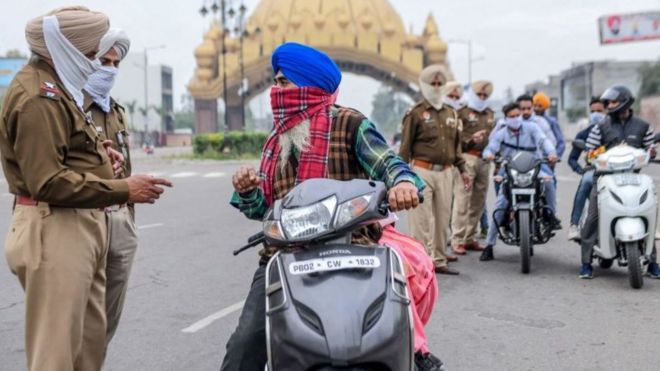
Indian authorities in the northern state of Punjab have quarantined around 40,000 residents from 20 villages following a Covid-19 outbreak linked to just one man.
The 70-year-old died of coronavirus – a fact found out only after his death.
The man, a preacher, had ignored advice to self quarantine after returning from a trip to Italy and Germany, officials told BBC Punjabi’s Arvind Chhabra.
India has 640 confirmed cases of the virus, of which 30 are in Punjab.
However, experts worry that the real number of positive cases could be far higher. India has one of the lowest testing rates in the world, although efforts are under way to ramp up capacity.
There are fears that an outbreak in the country of 1.3 billion people could result in a catastrophe.
The man, identified as Baldev Singh, had visited a large gathering to celebrate the Sikh festival of Hola Mohalla shortly before he died.
The six-day festival attracts around 10,000 people every day.
A week after his death, 19 of his relatives have tested positive.
“So far, we have been able to trace 550 people who came into direct contact with him and the number is growing. We have sealed 15 villages around the area he stayed,” a senior official told the BBC.
Another five villages in an adjoining district have also been sealed.
This is not the first time that exposure has resulted in mass quarantining in India.
In Bhilwara, a textile city in the northern state of Rajasthan, there are fears that a group of doctors who were infected by a patient could have spread the disease to hundreds of people.
Seven thousand people in villages neighbouring the city are under home quarantine.
India has also declared a 21-day lockdown, although people are free to go out to buy essential items like food and medicine.
SEOUL/TOKYO (Reuters) – With more employees working from home to help slow the spread of the coronavirus, demand is surging for laptops and network peripherals as well as components along the supply chain such as chips, as companies rush to build virtual offices.
Many firms have withdrawn earnings forecasts, anticipating a drop in consumer demand and economic slump, but performance at electronics retailers and chipmakers is hinting at benefits from the shift in work culture.
Over the past month, governments and companies globally have been advising people to stay safe indoors. Over roughly the same period, South Korea – home of the world’s biggest memory chip maker, Samsung Electronics Co Ltd – on Monday reported a 20% jump in semiconductor exports.
Pointing to further demand, nearly one in three Americans have been ordered to stay home, while Italy – where deaths have hit 5,476 – has banned internal travel. Worldwide, the flu-like virus has infected over 300,000 people and led to almost 15,000 deaths since China first reported the outbreak in December.
“With more people working and learning from home during the outbreak, there has been rising demand for internet services … meaning data centres need bigger pipes to carry the traffic,” said analyst Park Sung-soon at Cape Investment & Securities.
A South Korean trade ministry official told Reuters that cloud computing has boosted sales of server chips, “while an increase in telecommuting in the United States and China has also been a main driver of huge server demand.”
In Japan, laptop maker Dynabook reported brisk demand which it partly attributed to companies encouraging teleworking. Rival NEC Corp said it has responded to demand with telework-friendly features such as more powerful embedded speakers.
Australian electronics retailer JB Hifi Ltd also said it saw demand “acceleration” in recent weeks from both commercial and retail customers for “essential products they need to respond to and prepare” for the virus, such as devices that support remote working as well as home appliances.
CHINA LEAD
China is leading chip demand, analysts said, as cloud service providers such as Alibaba Group Holding Ltd, Tencent Holdings Ltd and Baidu Inc quickly responded to the government’s effort to contain the virus.
“Cloud companies opened their platforms, allowing new and existing customers to use more resources for free to help maintain operations,” said analyst Yih Khai Wong at Canalys.
“This set the precedent for technology companies around the world that offer cloud-based services in their response to helping organisations affected by coronavirus.”
China’s cloud infrastructure build-up has helped push up chip prices, with spot prices of DRAM chips rising more than 6% since Feb. 20, showed data from price tracker DRAMeXchange.
UBS last week forecast average contract prices of DRAM chips to rise as much as 10% in the second quarter from the first, led by a more than 20% jump in server chips.
It said it expects DRAM chips to be modestly under supplied until the third quarter of 2021, with demand from server customers rising 31% both in 2020 and 2021.
SUPPLY DISRUPTION
Concerns over supply disruption has also contributed to a price rise.
“You’ve got lots of OEMs and systems integrators in the global market who have intense demand for memory now,” said Andrew Perlmutter, chief strategy officer at ITRenew, a company that buys and reworks used data centre equipment for resale.
“Nobody is shutting down their factories – it is still production as normal – but people worry about memory supply in particular, so they want to get out ahead of production.”
About 69% of electronics manufacturers have flagged possible supplier delays averaging three weeks, showed a poll on March 13 by industry trade group IPC International.
Half of those polled expected business to normalise by July, and nearly three-quarters pointed to at least October.
Materials can bought cheaply online and combined to filter out germs, while people exchange tips in online chat groups
Urgent demand has forced individuals and hospitals alike to get to work to meet the shortfall
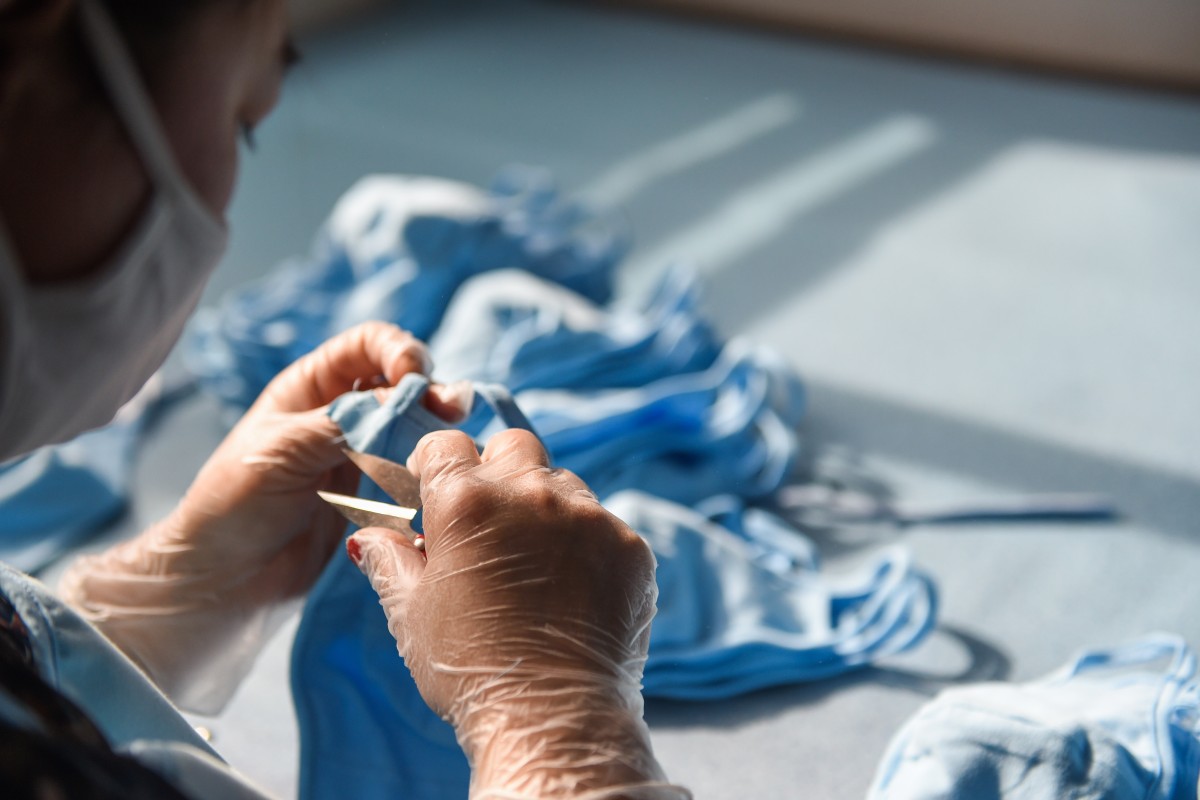
A worker in northern China makes a face mask as companies strive to match demand – but some people are buying similar materials to assemble at home. Photo: Xinhua
Living in the scenic Puer city in southwestern China’s Yunnan province, 30-year-old Zhang Jianing had thought the coronavirus outbreak in Hubei was far away and irrelevant, until cases were confirmed in her province and then her city at the end of January.
Heeding the warnings to protect herself, Zhang rushed out to buy masks, only to find them all snapped up. When she plucked up the courage to go out to buy groceries, she realised she needed to have a mask on to be allowed to enter shops.
After doing some research online, Zhang made a mask herself: two layers of cotton on the outside, with a sheet of plastic food wrap inside.
“The mask fit my face well and protected me from droplets,” Zhang said. “There was just one thing: it was too difficult to breathe through.”
Experts devise do-it-yourself face masks to help people battle coronavirus
When a nation of 1.4 billion people was suddenly alerted and in many cases ordered to wear masks not only in public indoor places but also in the open air, the huge demand quickly exhausted supply.
Mask production capacity in China was 22 million a day – insufficient for the country’s population. There were hopes that the supply of masks would pick up after a Lunar New Year holiday that was extended to help prevent further spread of infection, but things did not look promising after factories reopened. By Monday, despite mask manufacturers making 10 per cent more than in early February, masks remained a rare commodity.
Making DIY masks became the top trending topic on Chinese online shopping site Taobao for several days. Materials became much sought-after, from nose bars to the non-woven fabric used in disposable surgical masks to filter out viral droplets. An online shop based in Fujian, southeast China, said it had sold more than 5,500 packages of DIY mask materials that can make 50 to 200 surgical masks apiece.
Surgical masks ‘protect more from germs on fingers than viruses in the air’
16 Feb 2020
Zhang spent 200 yuan (US$29) on materials online, from which she made 60 surgical masks when they arrived last week. She is a qipao designer and has a sewing machine at home. The outer layer was a blue waterproof non-woven fabric, over a layer of melt-blown fabric that can filter out most germs and droplets. The inner layer was made with a face flannel.
Hongkongers make reusable fabric masks as Covid-19 epidemic leads to shortages and sky-high prices
“I sent some to my parents and relatives,” Zhang said. “I am not sure how protective they are, but the good thing is our city hasn’t had any new cases for a long time.”
DIY mask production is being taken very seriously, spawning online chat groups to discuss reliability of materials and disinfection methods as people try to make theirs as safe and professional as possible.
Alex Zhang, an office worker in Shanghai, donated her N95 masks to Wuhan, the epicentre of the coronavirus outbreak, when hospitals in the city appealed to the public for protective gear amid an acute shortage – but soon found herself short of masks herself.
Shanghai companies begin production of first reusable face masks
25 Feb 2020
The Shanghai government allowed households to buy a certain number of surgical masks, but it was not enough for her family. Taking apart an N95 mask to see what it was made of, she felt assembling the layers of fabric required no special technique, and decided to do it herself.
Zhang spent 45 yuan on two square metres of melt-blown fabric to stop viruses, and sandwiched it with two layers of nonwoven fabric and an air pad. She sewed the layers together and put them in an electric oven at 70 degrees Celsius (158 Fahrenheit) for a minute, for disinfection. The finished mask is attached using a plastic band.
“Each mask cost about 3 yuan [43 US cents] and was almost like an N95 filter,” Zhang said. “I didn’t find it difficult. I am quite satisfied with my masks and feel very safe to wear them in crowded places.”
How to properly remove and discard face masks to reduce the risk of infection
She later bought nursing pads, which are already disinfected, to replace the layer closest to the face.
DIY masks have also been used where large amounts of protective gear are needed. Garment manufacturer Shenzhou International, in the coastal Zhejiang province, assigned 100 staff to make masks with melt-blown non-woven fabric to meet the needs of its factory workforce of nearly 15,000, who needed two masks each per day, according to a report by Ningbo Daily.
Hospitals short of masks have mobilised nurses to make their own using a non-woven fabric used to wrap disinfected medical products. At least three hospitals, in Xian in central China and in Jinhua, Zhejiang, have tried making masks for medical staff not serving on the front line, according to media reports.
DIY handmade face masks in Hong Kong
The World Health Organisation has said that wearing masks alone is not sufficient protection against the coronavirus, and should be combined with precautions including hand-washing with soap or an alcohol-based hand rub.
However, facing a shortage that will not end any time soon, health authorities have changed from saying people should discard masks every four hours to advising recycling them when possible.
A guideline issued by the National Health Commission said healthy people could wear masks repeatedly and for a longer time.
Chinese driver wears 12 face masks amid coronavirus outbreak
“Masks for repeat use can be hung in clean, dry and airy places or put in a clean paper bag,” its guidelines said. “The masks must be placed separately to avoid contact with other masks.”
Making masks with layers of cotton bandage is acceptable, because they can stay dry when breathed on, but plastic wrap is not recommended, because it blocks the ability to breathe entirely, according to Cai Haodong, an infectious diseases specialist at Beijing’s Ditan Hospital.
Coronavirus: Thais urged to make their own masks, sanitisers due to shortage
7 Feb 2020
Cai said her hospital did not have surgical masks, nor N95s, during the severe acute respiratory syndrome (Sars) outbreak in 2003, and hospital staff made masks for use by front-line medics, disinfecting them with boiling water and drying them in the sun.
“The key is to keep the mask dry,” Cai said. “Self-made masks offer some degree of protection and it is better to wear them than nothing.”
The new coronavirus has been declared a global emergency by the World Health Organization, as the outbreak continues to spread outside China.
“The main reason for this declaration is not what is happening in China but what is happening in other countries,” said WHO chief Tedros Adhanom Ghebreyesus.
The concern is that it could spread to countries with weaker health systems.
Meanwhile, the US has told its citizens not to travel to China.
The state department issued a level four warning – having previously urged Americans to “reconsider” travel to China – and said any citizens in China “should consider departing using commercial means”.
China has said it will send charter plans to bring back Hubei province residents who are overseas “as soon as possible”.
A foreign ministry spokesman said this was because of the “practical difficulties” Chinese citizens have faced abroad. Hubei is where the virus emerged.
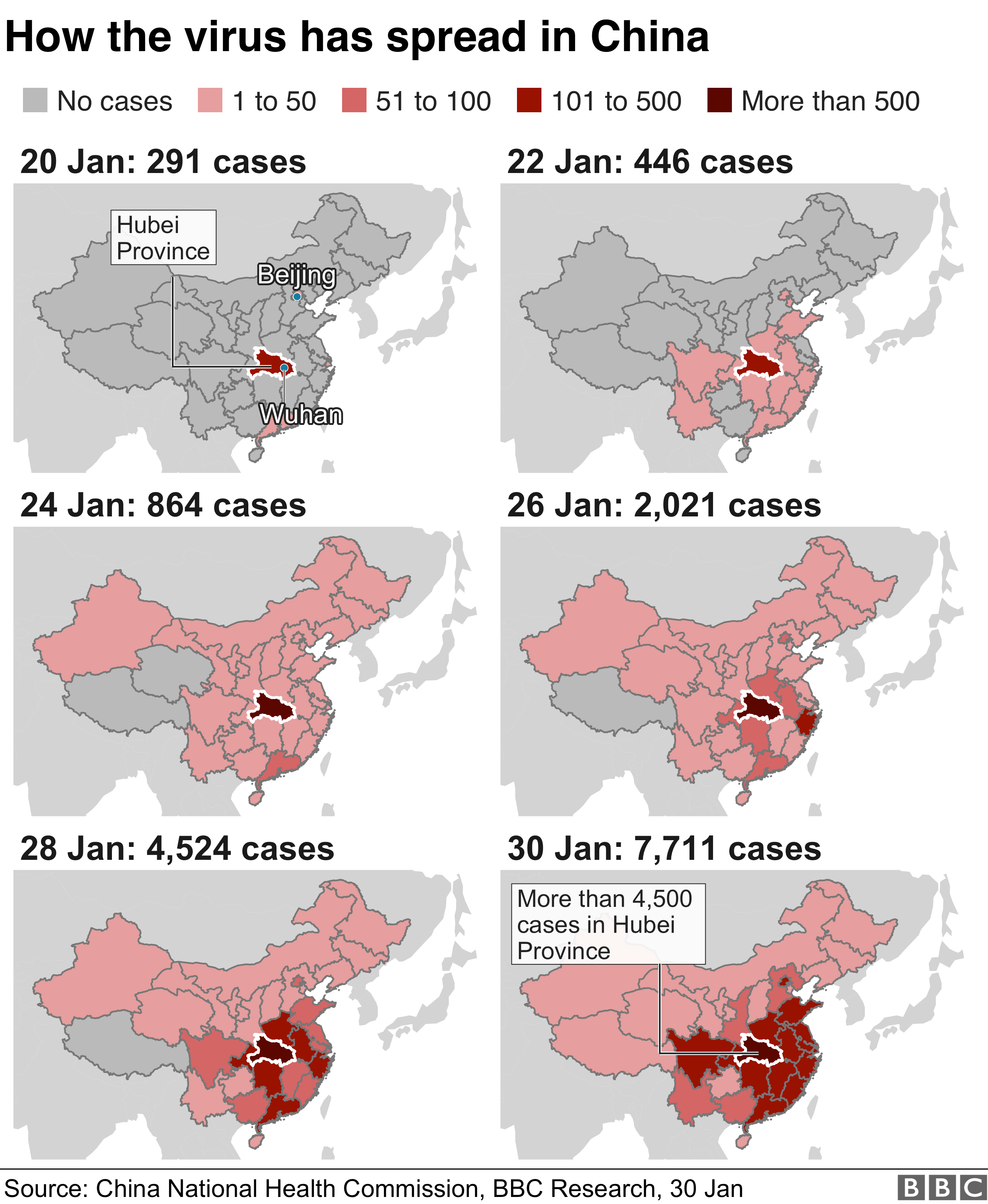
At least 213 people in the China have died from the virus, mostly in Hubei, with almost 10,000 cases nationally.
The WHO said there had been 98 cases in 18 other countries, but no deaths.
Most international cases are in people who had been to Wuhan in Hubei.
However in eight cases – in Germany, Japan, Vietnam and the United States – patients were infected by people who had travelled to China.
Getty Coronavirus outbreak outside China
18 The number of countries with cases
14 Cases in Thailand and Japan
13 Singapore
11 South Korea
8 Australia and Malaysia
5 France and USA
Source: WHO and local authorities
Speaking at a news conference in Geneva, Dr Tedros described the virus as an “unprecedented outbreak” that has been met with an “unprecedented response”.
He praised the “extraordinary measures” Chinese authorities had taken, and said there was no reason to limit trade or travel to China.
The US Commerce Secretary, Wilbur Ross, has said the outbreak could “accelerate the return of jobs to North America”.
Preparing other countries
What happens if this virus finds its way into a country that cannot cope?
Many low- and middle-income countries simply lack the tools to spot or contain it. The fear is it could spread uncontrollably and that it may go unnoticed for some time.
Remember this is a disease which emerged only last month – and yet there are already almost 10,000 confirmed cases in China.
The 2014 Ebola outbreak in West Africa – the largest in human history – showed how easily poorer countries can be overwhelmed by such outbreaks.
And if novel coronavirus gets a significant foothold in such places, then it would be incredibly difficult to contain.
We are not at that stage yet – 99% of cases are in China and the WHO is convinced the country can control the outbreak there.
But declaring a global emergency allows the WHO to support lower- and middle-income countries to strengthen their disease surveillance – and prepare them for cases.
How unusual is this declaration?
The WHO declares a Public Health Emergency of International Concern when there is “an extraordinary event which is determined… to constitute a public health risk to other states through the international spread of disease”.
It has previously declared five global public health emergencies:
Swine flu, 2009 – The H1N1 virus spread across the world in 2009, with death toll estimates ranging from 123,000 to 575,400
Polio, 2014 – Although closer than ever to eradication in 2012, polio numbers rose in 2013
Zika, 2016 – The WHO declared Zika a public health emergency in 2016 after the disease spread rapidly through the Americas
Ebola, 2014 and 2019 – The first emergency over the virus lasted from August 2014 to March 2016 as almost 30,000 people were infected and more than 11,000 died in West Africa. A second emergency was declared last year as an outbreak spread in DR Congo
Media caption Inside the US laboratory developing a coronavirus vaccine
How is China handling the outbreak?
A confirmed case in Tibet means the virus has reached every region in mainland China. According to the country’s National Health Commission, 9,692 cases have tested positive.
The central province of Hubei, where nearly all deaths have occurred, is in a state of lockdown. The province of 60 million people is home to Wuhan, the heart of the outbreak.
The city has effectively been sealed off and China has put numerous transport restrictions in place to curb the spread of the virus.
People who have been in Hubei are also being told to work from home until it is considered safe for them to return.
The virus is affecting China’s economy, the world’s second-largest, with a growing number of countries advising their citizens to avoid all non-essential travel to the country.
How is the world responding?
Voluntary evacuations of hundreds of foreign nationals from Wuhan are under way.
The UK, Australia, South Korea, Singapore and New Zealand are expected to quarantine all evacuees for two weeks to monitor them for symptoms and avoid contagion.
Australia plans to quarantine its evacuees on Christmas Island, 2,000km (1,200 miles) from the mainland in a detention centre that has been used to house asylum seekers.
In other recent developments:
Italy suspended flights to China after two Chinese tourists in Rome were diagnosed with the virus; earlier 6,000 people on board a cruise ship were temporarily barred from disembarking
In the US, Chicago health officials have reported the first US case of human-to-human transmission. Around 200 US citizens have been flown out of Wuhan and are being isolated at a Californian military base for at least 72 hours
Russia has decided to close its 4,300km (2,670-mile) far-eastern border with China
Two flights to Japan have already landed in Tokyo. Japan has now raised its infectious disease advisory level for China
Some 250 French nationals have been evacuated from Wuhan
India has confirmed its first case of the virus – a student in the southern state of Kerala who was studying in Wuhan
Israel has barred all flight connections with China
Papua New Guinea has banned all visitors from “Asian ports”
NEW DELHI (Reuters) – Violent clashes erupted in Delhi between police and hundreds of university students on Friday over the enactment of a new citizenship law that critics say undermines India’s secular foundations.
The unrest has already led Japanese Prime Minister Shinzo Abe to cancel a planned visit to India from Sunday.
The new law offers a way to Indian citizenship for six minority religious groups from neighbouring Bangladesh, Pakistan and Afghanistan including Hindus and Christians, but not Muslims.
RELATED COVERAGE
Explainer: What does India’s new citizenship law mean?
Clashes erupt in New Delhi between students, police over citizenship law
See more stories
Police fired tear gas and used baton charges to disperse scores of students demonstrating at Jamia Millia Islamia university in the heart of Delhi over the law.
Protesters attacked cars in the capital, and several people were injured and taken to hospital.
Zakir Riyaz, a PhD student in social work, said the new law made a mockery of India’s religious openness.
“It goes against the whole idea of a secular India,” he said, speaking by phone from the Holy Family Hospital in New Delhi where 15 of his fellow students were admitted after being injured in a police baton charge.
Police barricades were knocked down and streets were strewn with shoes and broken bricks. An official at the university dispensary said that more than 100 students had been brought in with injuries but all had been discharged.
Parvez Hashmi, a local politician who went to the protest site to speak to police, said about 50 students had been detained.
Students said it was meant to be a peaceful protest, with them trying to go from Jamia University to Parliament Street to show their opposition to the legislation. But police pushed them back, leading to clashes.
Critics of Prime Minister Narendra Modi’s government say it is promoting a Hindu-first agenda for India and that the citizenship law excluding Muslims showed a deep-seated bias against India’s 170 million Muslims.
Imran Chowdhury, a researcher, said “either give citizenship to refugees of all religions or none at all. The constitution is being tampered with in the name of religion.”
Modi’s ruling Bharatiya Janata Party denies any religious bias but says it is opposed to the appeasement of one community. It says the new law is meant to help minority groups facing persecution in the three nearby Muslim countries.
ABE CANCELS
The United Nations human rights office voiced concern that the new law is “fundamentally discriminatory in nature”, and called for it to be reviewed.
Two people were killed in India’s Assam state on Thursday when police opened fire on mobs torching buildings and attacking railway stations in protest at the new citizenship rules signed into law on Thursday.
Japan’s Prime Minister Shinzo Abe cancelled a trip to Assam for a summit with his Indian counterpart Narendra Modi that had been due to begin on Sunday.
Japan has stepped up infrastructure development work in Assam in recent years, which the two sides were expected to highlight during the summit. Abe had also planned to visit a memorial in the nearby state of Manipur where Japanese soldiers were killed in World War Two.
“With reference to the proposed visit of Japanese PM Abe Shinzo to India, both sides have decided to defer the visit to a mutually convenient date in the near future,” Indian foreign ministry spokesman Raveesh Kumar said in a tweet.
Japan’s Chief Cabinet Secretary Yoshihide Suga said both countries would decide on the appropriate timing for the visit although nothing has been decided yet.
A movement against immigrants from Bangladesh has raged in Assam for decades. Protesters there say granting Indian nationality to more people will further strain the state’s resources and lead to the marginalisation of indigenous communities.

























 CHINDIA ALERT: You'll be living in their world, very soon