Chindia Alert: You’ll be Living in their World Very Soon
aims to alert you to the threats and opportunities that China and India present. China and India require serious attention; case of ‘hidden dragon and crouching tiger’.
Without this attention, governments, businesses and, indeed, individuals may find themselves at a great disadvantage sooner rather than later.
The POSTs (front webpages) are mainly 'cuttings' from reliable sources, updated continuously.
The PAGEs (see Tabs, above) attempt to make the information more meaningful by putting some structure to the information we have researched and assembled since 2006.
KATHMANDU, April 19 (Xinhua) — A German scholar has recently found that the right to education for Uygurs and people of other ethnic groups is well protected in China’s Xinjiang region, as young people there enjoy increasingly better opportunities.
Michael Heinrich, who has been teaching German in Minzu University of China for more than five years, said in an article published on Online Khabar news website in March that he has “paid close attention to the development of Chinese education in recent years, especially the education situation in ethnic minority areas.”
Heinrich said he has taught a Xinjiang Uygur student, who often talks with him about the education situation in her hometown and appreciates government policies on education.
The Uygur student has told Heinrich that she lives in a place where she receives Islamic religious education and China’s nine-year compulsory education, and the Uygur students in Xinjiang can enjoy preferential policies, such as extra points in college entrance examination, special policies for college admissions, and employment policy support.
In recent years, the Chinese government has intensified policy support on education in Xinjiang Uygur Autonomous Region, and increased investment in educational resources, especially those on vocational education, the article read.
“Through vocational education, more Uyghur Muslim students can enhance their survival skills and work harder by themselves and improve their living standards with these hands,” it said.
For some time, Xinjiang has been plagued by terrorism, religious extremism and separatism, according to the passage, and carrying out vocational education and training in Xinjiang is an effective measure to promote the rule of law and a practical action to protect the vital interests of people of all ethnic groups there.
It is also a just move in fighting extremism and terrorism to contribute to the stability in Xinjiang, it added.
Some Western media outlets as well as some U.S. politicians often slander the Chinese government under the guise of “human rights,” which does not only disregard the facts but also interferes with China’s sovereignty, Heinrich pointed out.
The situation in Xinjiang that they saw was completely different from the stories told by some Western politicians and media, Heinrich quoted some people who have visited Xinjiang and witnessed its development as saying.
The rights to life and development of people of all ethnic groups in Xinjiang are protected to the largest extent, Heinrich added.
Hong Kong’s rule of law has been pushed to the “brink of total collapse” after more than five months of protests, police have warned.
The warning came as protesters clashed with police across the city on Tuesday.
At the Chinese University of Hong Kong, police fired tear gas and rubber bullets at protesters who built barricades on the campus.
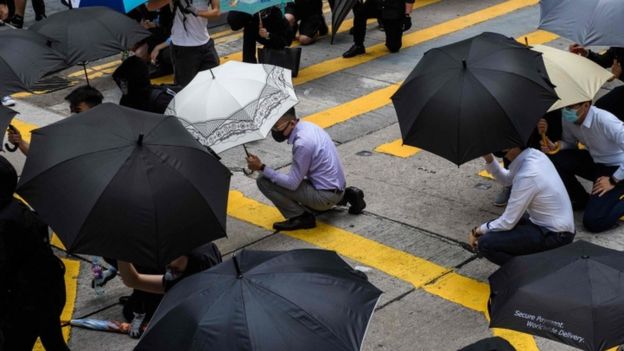
Earlier in the day, around 1,000 protesters rallied in central Hong Kong during the lunch hour blocking roads
Protesters, wearing office clothes, were seen chanting: “Fight for freedom, stand with Hong Kong!”
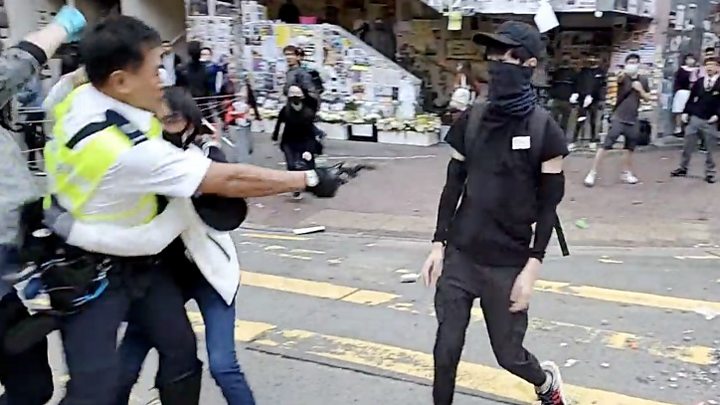
The demonstrations come just a day after the territory saw a marked escalation in violence, with police shooting one activist in the torso. A pro-Beijing supporter was set on fire by anti-government protesters.
The protests started in June against a now-withdrawn plan to allow extradition to mainland China, but have since morphed into wider demonstrations, with activists demanding greater democracy and police accountability in Hong Kong.
On Tuesday afternoon, police spokesman Kong Wing-cheung hit out at the protesters, saying they had “countless examples of rioters using random and indiscriminate violence against innocent” people.
“Hong Kong’s rule of law has been pushed to the brink of total collapse as masked rioters recklessly escalate their violence under the hope that they can get away with it,” he told reporters, adding that Monday’s attack on the pro-Beijing supporter was being investigated as attempted murder.
Image copyright AFPImage caption Protesters and office workers were seen blocking roads in Hong Kong’s financial district
Speaking at the same conference, Supt Li Kwai-wah defended the officer’s decision to shoot the protester on Monday.
“We found out that our colleague did not only face threat from one person, instead it was a group of people with an organised plan attempting to steal the gun,” he said.
“In a situation like this, we believe our police are reacting according to the guideline, to protect themselves as well as the people around them.”
Both the protester and the pro-Beijing supporter remain in hospital, with the latter in a critical condition.
What happened on Tuesday?
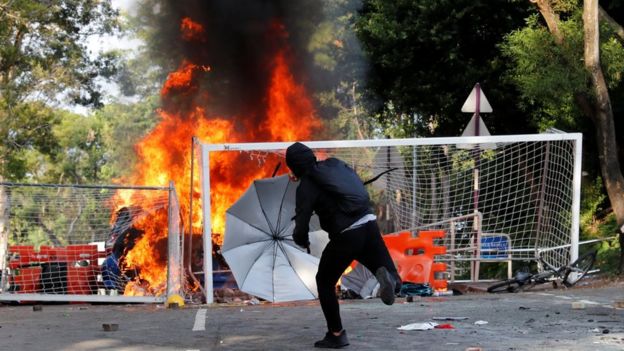
Clashes erupted at the Chinese University of Hong Kong, with police firing tear gas to disperse students, while at City University there was a standoff between students and riot police which continued into the evening.
Police continued to use tear gas to try to disperse the protesters who responded with bricks and petrol bombs. Hundreds of protesters remain at the Chinese University of Hong Kong.
Image copyright REUTERSImage caption Students at Hong Kong’s Chinese University fought with police throughout the day
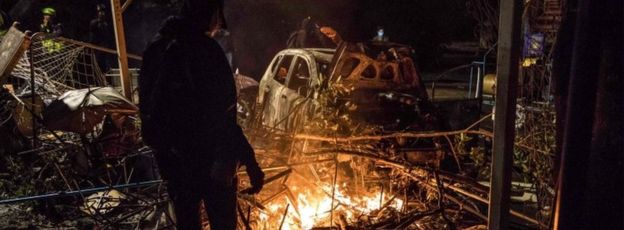
Students built roadblocks on streets in and around City University campus to stop police from entering. At one stage, a van used as part of a street barricade was set on fire.
Students at Hong Kong Polytechnic also tried to disrupt traffic near their campus.
In the morning, suspended railway services and road closures had already led to long traffic jams in the early rush hour. At noon, protesters moved into the city’s central business district for a flash mob protest.
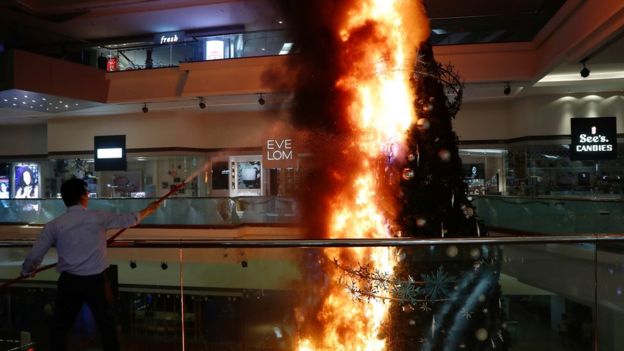
Image copyright REUTERSImage caption At Festival Walk shopping mall, a Christmas tree was set on fire
Protests continued to intensify throughout the day. A Christmas tree inside Festival Walk shopping mall was set on fire by protesters while others were seen smashing a glass railing with hammers.
Train stations were closed across the city.
Media caption This Hong Kong protester’s shooting was livestreamed on Facebook
Eight universities have announced they will suspend classes on Wednesday.
Monday’s protests saw 260 people arrested bringing the number to more than 3,000 since the protests began in June.
Students swear they will not surrender
Grace Tsoi, BBC World Service, at the Chinese University of Hong Kong
Image copyright AFPImage caption Hundreds of protesters remain at the university
The ground was strewn with bricks. The air was filled with the smell of tear gas. Fire was raging on campus. Hundreds of protesters, most of them clad in black, formed human chains to pass bricks and petrol bombs to the front line.
One of the best universities in Hong Kong has turned into a battlefield after another day of intense clashes between students, who have been at the forefront of anti-government protests, and police.
The Chinese University students have been putting up resistance since the morning. On Monday, police seemed to change strategy by deploying forces to campuses. Students told me they should not be allowed there.
The university’s management has tried to deescalate the situation. Vice-chancellor Rocky Tuan was also tear gassed as he was negotiating with police.
Dozens of students have been injured, including at least one hit in the eye by a projectile. The night is young and students swear they will not surrender.
Fears are growing in the city that the military could be called in to quell unrest
But the costs and complexities of doing so mean Beijing is highly unlikely to give the orders, observers say
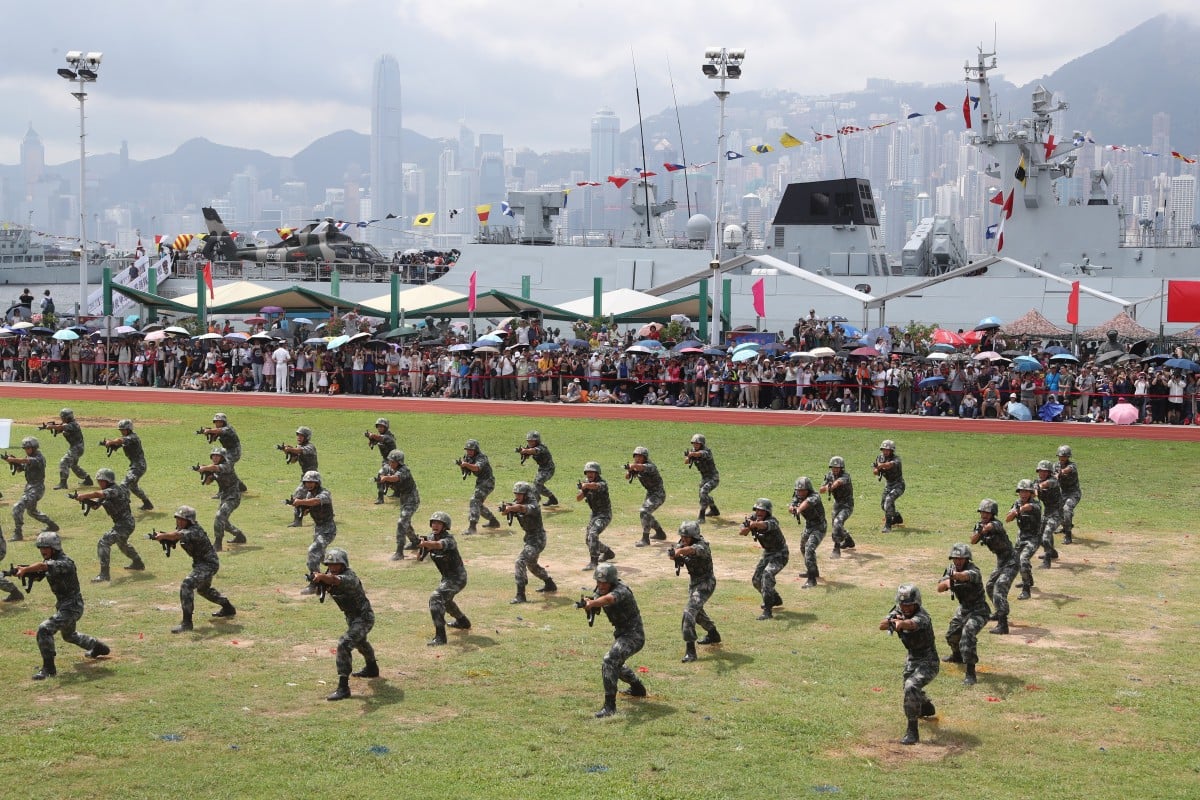
PLA soldiers show their skills during a naval base open day in Hong Kong. The PLA has had a presence in Hong Kong since the city’s return to Chinese sovereignty. Photo: K.Y. Cheng
It is a prospect dreaded by many in Hong Kong, but debate is growing in mainland China about whether the central government should end weeks of upheaval in the city by sending in the People’s Liberation Army (PLA).
The PLA has had a presence in Hong Kong since the city’s return to Chinese sovereignty but – unlike in mainland China – memories of the military’s bloody suppression of pro-democracy students and activists in Beijing in 1989 are still strong in the city three decades on.
Still, images of protesters vandalising Beijing’s liaison office in downtown Hong Kong on Sunday have fanned nationalist anger across the mainland, prompting calls for PLA intervention.
Concerns only deepened on Wednesday when defence ministry spokesman Wu Qian commented on the recent clashes and protests in Hong Kong. Without suggesting any action or plans by the PLA, Wu made clear that the Garrison Law, which governs the operations of PLA troops in Hong Kong, already stipulates that the PLA is legally allowed to help the city maintain law and order at the request of Hong Kong’s government.
“We are closely following the developments in Hong Kong, especially the violent attack against the central government’s liaison office by radicals on July 21,” Wu said.
“Some behaviour of the radical protesters is challenging the authority of the central government and the bottom line of ‘one country, two systems’,” he warned, referring to the formula that grants Hong Kong a high degree of autonomy for 50 years. “This is intolerable.”
Both Article 14 and Article 18 of the Basic Law – the city’s mini-constitution – spell out how and under what circumstances the PLA troops in Hong Kong can be used.
While the legality is clear, analysts still believe that given the exorbitant political cost and complexities involved, using the military would remain an unlikely last resort.
Even Hu Xijin, editor-in-chief of China’s nationalist tabloid Global Times, has spoken out against the idea, citing its “huge political cost” and the “severe uncertainty” it might bring to the situation.
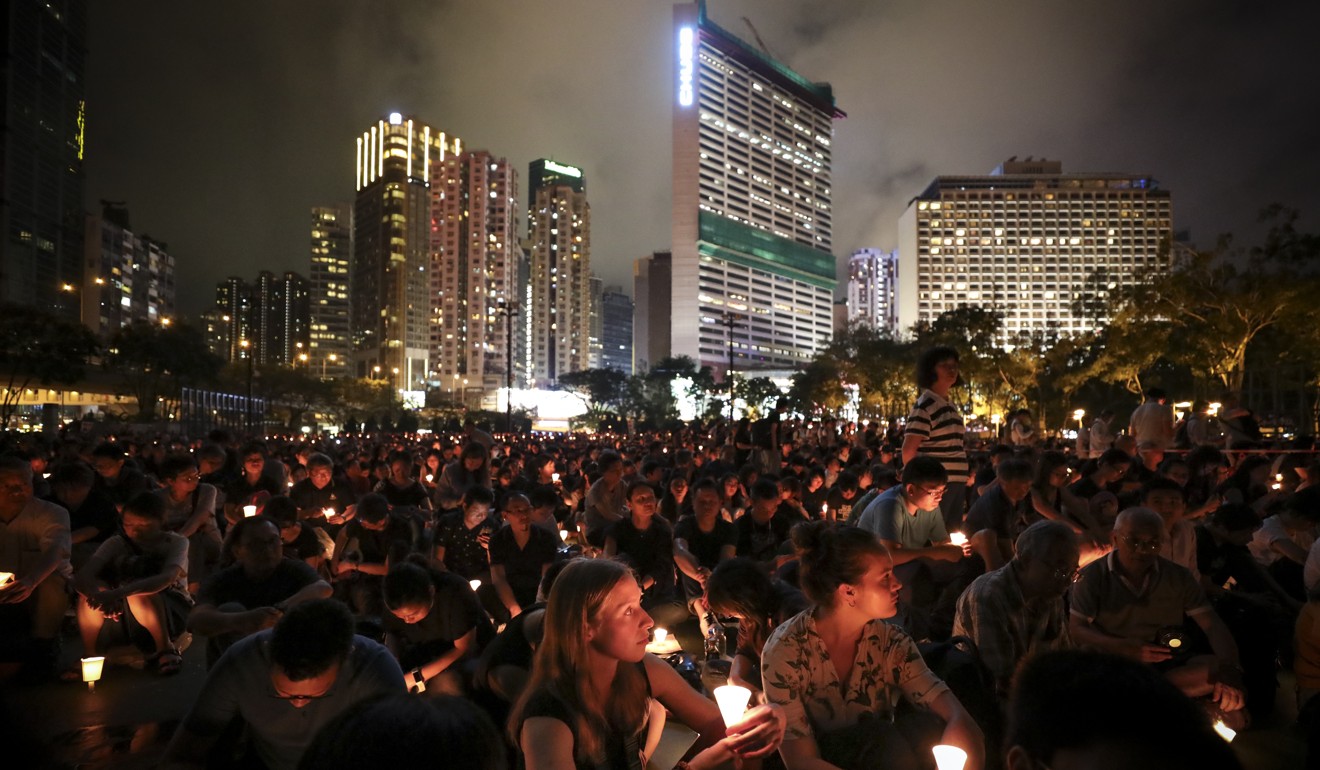
Crowds hold candles at a vigil in Victoria Park in Hong Kong in June to mark the 30th anniversary of the Tiananmen Square crackdown. Photo: James Wendlinger
“Once the PLA has taken charge of the situation in Hong Kong and quelled the riots, what’s next?” Hu said in a social media post on Monday.
Hu said there were no governance procedures in place that would allow the PLA to operate in Hong Kong and return things to normal. He also warned that any such action would be followed by international condemnation and a severe backlash among the Hong Kong public.
“The [PLA’s] Hong Kong garrison is the symbol of national sovereignty. It is not a fire brigade for law and order in Hong Kong,” he said.
Any move to use the Chinese troops will create a furore in the US Congress … They will re-examine the Hong Kong Policy Act very carefully Larry Wortzel, senior fellow at American Foreign Policy Council
The South China Morning Post reported last week that military force was not an option for mainland leaders working on a strategy to resolve the city’s biggest political crisis in decades.
And in June Major General Chen Daoxiang, commander of the Hong Kong garrison, assured David Helvey, US principal deputy assistant secretary of defence for Indo-Pacific security affairs, that Chinese troops would not interfere in the city’s affairs, according to Reuters.
The comments support analysts’ assessments that deploying the PLA is not a viable solution to Hong Kong’s crisis.
“Will the mobilisation of PLA troops further inflame the situation? There might be people who will resist or even revolt against the PLA, and that may lead to bloodshed,” said Lau Siu-kai, vice-chairman of the Chinese Association of Hong Kong and Macau Studies, a semi-official think tank.
The last time Beijing sent in troops to quell pro-democracy protests was during the Tiananmen Square crackdown on June 4, 1989 – bloodshed that has stained the PLA and the Communist Party to this day, despite decades of efforts to wipe it from public memory.
The last time Beijing sent in troops to quell pro-democracy protests was during the Tiananmen Square crackdown in 1989. Photo: Reuters
“Although they don’t like to admit it, they know they made a mistake in the way they used the PLA [in 1989],” said Larry Wortzel, a long-time PLA watcher, who witnessed the crackdown as an assistant military attache at the US embassy in Beijing 30 years ago.
“In subsequent years, when there were major demonstrations, they managed to handle them with either the People’s Armed Police [PAP] or the Public Security Bureau [PSB], or in some cases a combination of both,” said Wortzel, now a senior fellow in Asian security at the American Foreign Policy Council in Washington.
If the military was deployed [in Hong Kong], it would mean China was ready to shut its doors completely Chen Daoyin, a Shanghai-based political analyst
The PAP is a 1.5 million-strong paramilitary police force tasked with maintaining domestic security and order, while the PSB is the country’s police force.
The June 4 crackdown is still widely remembered in Hong Kong, where tens of thousands gather every year on its anniversary for a candlelight vigil in the heart of the city.
“The activities in Hong Kong and the Chinese Communist Party’s conduct there have really had a profound impact on thinking in Taiwan. It has killed any chance with any political party of [supporting] the one country, two systems,” Wortzel said.
Chinese military can be deployed at Hong Kong’s request to contain protests, Beijing says
“The last thing President Xi Jinping and the Politburo Standing Committee would want to do, if they can avoid it, is to use the PLA [in Hong Kong].”
The situation in Hong Kong is also being closely watched in the West, with many international firms basing regional headquarters in the Asian financial hub, thanks to its capitalist system and rule of law.
Deploying the PLA to Hong Kong would certainly spark an international outcry and draw huge pressure from Western countries, said Liang Yunxiang, an international affairs expert at Peking University.
“Britain, of course, would have the harshest criticism since it governed Hong Kong for a long time and signed treaties with China to ensure Beijing would keep its commitment to one country, two systems,” Liang said.
In the United States, the repercussions could go beyond verbal condemnation to a shift in policy that might fundamentally change Hong Kong’s status as an international financial centre and prompt an exodus of businesses, according to Wortzel.
“Any move to use the Chinese troops will create a furore in the US Congress … They will re-examine the Hong Kong Policy Act very carefully,” he said, referring to the bill passed in 1992 that allows Hong Kong to be treated as a non-sovereign entity distinct from mainland China on trade and economic matters.
Hong Kong head blasts violence, amid further extradition bill unrest
“They will simply treat Hong Kong like another Chinese city, which affects export controls and how the financial industry operates.”
Just last month, members of Congress reintroduced the bipartisan Hong Kong Human Rights and Democracy Act. If the legislation is passed, the US could revoke Hong Kong’s special status under American law if Beijing fails to ensure the city has “sufficient autonomy”.
The crisis comes as Beijing’s ties with Washington are already strained by a year-long trade war that has spilled into other areas of bilateral relations.
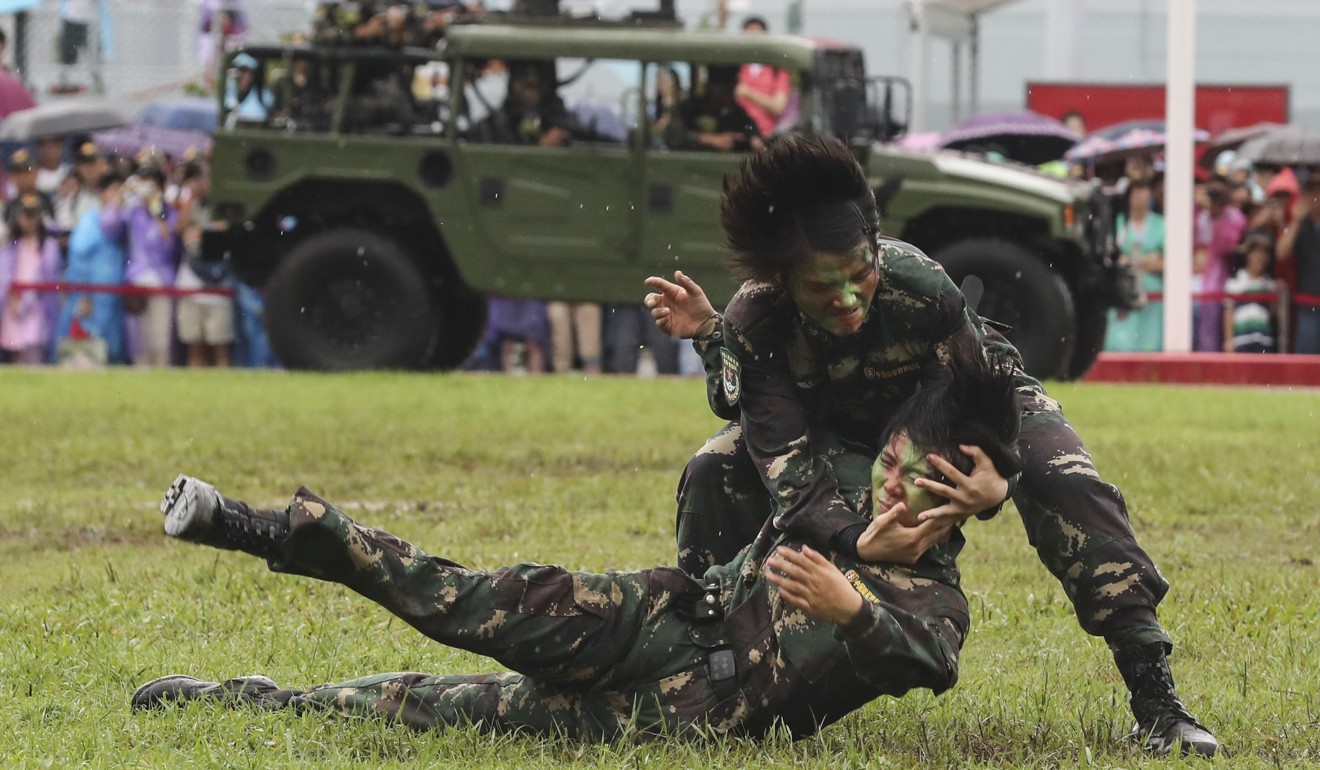
PLA troops go through their paces for the public at their Hong Kong barracks during an open day. Photo: Edward Wong
There is also mounting international pressure on China over issues such as its mass internment and political indoctrination of an estimated million or more members of Muslim minorities in Xinjiang, despite the Chinese government’s repeated denials of ill-treatment of the inmates and attempts to defend its policies.
Chen Daoyin, a Shanghai-based political analyst, said the increasing scrutiny China faced from Western countries – whether in the form of punitive tariffs or restrictions on technology – made it all the more important for China to keep Hong Kong as an open channel to connect with the world.
“If the military was deployed [in Hong Kong], it would mean China was ready to shut its doors completely,” Chen said.
Lau, from the Chinese Association of Hong Kong and Macau Studies, said the PLA should only be deployed as a last resort.
Two calls per second ‘jammed emergency lines’ during Hong Kong violence
“It would be a huge blow to the principle of ‘letting Hong Kong people govern Hong Kong with a high degree of autonomy’, since it will prove that Hong Kong people are not up to the task of governing themselves,” he said.
Hu, from Global Times, said the PLA troops could be used only if the authorities lost control of the city or an armed rebellion broke out.
Short of that, he said, the central government should let the chaos in Hong Kong run its course and wait for the public mood to flip.
This strategy of sitting it out hinges on the city’s police force holding the line and stopping Hong Kong’s slide into total anarchy.
Wortzel also warned that there were lines protesters should not cross – or risk provoking the use of military force.
“For instance, to this point, demonstrators have not gone up against the PLA garrison or any of its outposts. If they did that, I think it’s possible – actually it is very likely – that there will be a limited mobilised response [to defend the facilities],” he said.
While most analysts said the chance of Beijing resorting to military force was slim, the very idea – ludicrous to even discuss three months ago – has become a popular topic on social media on the mainland, where the discussion is not censored and many commenters support it.
The official media have been careful not to touch the subject but they too have stepped up rhetoric against the protests in Hong Kong.
In a rare move, state-run China Central Television has run commentaries and reports about protests in Hong Kong during its main evening news for five days in a row.
Only the most politically important issues receive such unusual treatment.
India is making progress on the openness of its government but it needs to improve security and reduce political violence, a new report on the rule of law says.
The latest “Rule of Law Index,” released Thursday by World Justice Project, a Washington-based nonprofit, ranks India 66th among 113 countries.
The report, based on a survey of 1,000 people and local experts, looked into Indians’ dealings with their government, the police, courts and other state institutions in their day-to-day lives.
Compared with the same countries included in the study last year, India’s rank improved three places in 2016. However, once 11 more countries were added for this year’s survey, India slipped seven places to 66th. The 2016 survey compared 113 countries over six subject areas, including “constraints on government power,” “order and security” and “fundamental rights,” among others.India’s average score for “open government” improved from 0.53 in 2014 to 0.66 in 2016. Prime Minister Narendra Modi has made communication with citizens a priority, launching the engagement portal mygov.in in 2014, which allows citizens to make suggestions on key government programs.
India also scored better than last year in “constraints on government powers”–measuring the effectiveness of institutional checks on government power by the legislature, judiciary, and independent auditing and review agencies.
But the South Asian nation’s score declined for “order and security,” where it ranked in the “bottom tercile” with Uganda, Kenya, Afghanistan and Pakistan for “conventional crime, political violence, and violence as a means to redress personal grievances.
”India also did poorly compared with last year in safeguarding fundamental rights, including “effective enforcement of the right to life, rights of the accused and fundamental labor rights,” among others, said the report.
In South Asia, Nepal came 63rd, three places ahead of India. Pakistan was ranked 106th in the bottom eight of the global rankings. The country was judged to have the worst access to civil justice and to be the least orderly and secure out of the 66 countries ranked in the index in 2011.
The rule of law is important to the progress of countries, said Alejandro Ponce, chief research officer of The World Justice Project.“In broad terms, a lack of rule of law discourages investment and economic growth,” said Mr. Ponce.
China has announced a new drive to phase out outdated rules.
The State Council, the country’s cabinet, said on Tuesday that it will put all government rules and regulations since the founding of the New China under scrutiny.
A statement from the State Council said the new undertaking, which will take approximately three years, is crucial to cutting red tape and devolving power while improving regulation, and to building a law-based government.
In particular, authorities will focus on removing obsolete government regulations that now run counter to the Constitution and laws, impede deepening reform and opening up, and those that infringe on citizens’ rights and interests.
The government should make sure that “anything the law does not authorize is not done, while all duties and functions assigned by law are performed”, the statement said, adding that details of rules to be abolished will be made public and that the campaign will be based on “scientific evaluation”, so as not to leave room for “regulation vacuums”.
China will spend about 26 billion yuan (HK$33 billion) to help identify and register the contractual rights over the nation’s arable land to pave the way for rural reforms.
More than 200 million rural households around the nation will be interviewed to help prepare the accurate record of farming rights.
Calling the task a “massive systematic project”, the Ministry of Agriculture said on Friday that clarifying land tenure and issuing certificates to farmers would form the basis of a series of expected reforms which aimed to help free up the rural land market.
Nearly 200,000 villages around the country – or one third of the total – have begun with the task, by aerial photography or site measurement, said MOA officials in a press conference.
Zhao Kun, a deputy inspector of the ministry’s rural economic system department, said local governments had appropriated a total of 8 billion yuan to carry out the job.
The central government has promised to provide 10 yuan for each mu of arable land – the Chinese unit of land area, which measures 666 square metres – a total of 18 billion yuan according to official data that states the mainland had 1.82 billion mu of farmland up to the end of 2011.
The Land Administration Law states that the ownership of rural land belongs to village collectives, with farmers given contractual rights to the land they farm for 30 years.
The central authorities decided to increase the security of land tenure in 2008. A directive issued that year said that contractual land management rights for farmers should “remain unchanged for a very long time”.
However, unlike urban home owners, rural residents do not yet hold any certification to prove their legal rights to their homes and farmland.
This makes it hard for them to transfer the land, which is forbidden by existing regulations but now being reformed in order to encourage larger scale farming and improve utilization efficiency of rural land.
Zhang Hongyu, head of the rural economic system department, said when farmers were given contractual rights of farmland in the first round of rural reform a few of decades ago, there were only rough estimates made about the size of their land plots owing to limitations over measuring methods at the time.
“Any related document the farmers previously had – either a contract or some other sort of certificate – showed different figures from what we are now finding,” he said.
Zhao said the project was not only a technical issue of measurement.
“It also involves interviews with each of the more than 200 million rural households [around the nation], which are really important for farmers as they need to know how big their plots are and where they’re located,” he said.
China’s top court set a five-year deadline on Thursday for legal reforms to protect the rights of individuals, prevent miscarriages of justice and make its judiciary more professional as the ruling Communist Party seeks to quell public discontent.
A statement on the Supreme Court’s website promised specific deadlines for each goal, including support for a “social atmosphere of justice” by 2018.
It gave more details of a decision reached at a four-day meeting last year, when the party pledged to speed up legislation to fight corruption and make it tougher for officials to exert control over the judiciary.
Despite the legal reforms, Chinese PresidentXi Jinping‘s administration has shown no interest in political change and has detained dozens of dissidents, including lawyers.
China’s top court stressed that one of the five basic principles of legal reform was adhering to the party’s leadership and “ensuring the correct political orientation”.
He Xiaorong, the director of the Supreme People’s Court‘s reform division, said the court “would make officials bear responsibility for dereliction of duty” for cases that have a wide impact.
“Only through the establishment of such a system can we ensure that we can guarantee social fairness and justice in every case,” He told a news conference, according to a transcript on the court’s website.
The measures reflect worries about rising social unrest. Anger over land grabs, corruption and pollution – issues often left unresolved by courts – have resulted in violence between police and residents in recent years, threatening social order.
A court in China’s southern city of Fuzhou ordered compensation of 1.14 million yuan ($182,000) to a former death row prisoner who was acquitted on charges of poisoning two children, state media said on Tuesday.
The rare acquittal of Nian Bin, a former food stall owner who was freed in August after a court in Fujian province found there was insufficient evidence, prompted renewed calls for the abolition of the death penalty in China.
Nian, 39, was accused of poisoning his neighbors with rat poison, leading to the death of two children and injuries to four others in July 2006.
But he said he was tortured into confessing during police interrogations and had pursued his appeals for years, an effort closely watched by human rights lawyers in China and global rights groups.
He was convicted several times and spent 8 years in prison before being acquitted.
The intermediate court made the ruling on Sunday, and on Tuesday announced that Nian “should be paid 589,000 yuan for loss of personal freedom and another 550,000 yuan for mental suffering,” the official Xinhua news agency reported.
China’s ruling Communist Party has said it aims to prevent “extorting confessions by torture” and halt miscarriages of justice with a “timely correction mechanism”, after a series of corruption investigations involving torture outraged the public.
The Chinese government provided free legal aid services for nearly 1.39 million people in 2014 to help them safeguard their rights, the Economic Daily reported on Monday.
More than one-third of them are migrant workers who are vulnerable to job dismissal and withheld wages and know little about the legal system, the report said, quoting the Ministry of Justice.
The ministry’s statistics showed that about 10 percent more migrant workers than last year said they would like to seek legal assistance if their rights are violated.
Legal service centers have been springing up in streets, communities and prisons across China. The number of new legal service centers in 2014 totaled 70,000, the ministry said. The country will guide more legal service agencies to provide assistance to suspects and defendants in prisons.
It also promised to lower the eligibility standard for people to receive legal assistance and expand services for military personnel.
Former Chinese judge Jianwei Fang doesn’t mince words about the country’s practice of using arrest and conviction quotas to measure the performance of the country’s police, prosecutors and judges.
“It’s very stupid,” he says.
The Communist Party would appear to agree. This week, the party agency in charge of legal affairs, the Central Political and Legal Committee, called on the country’s legal institutions to “firmly abolish” the inclusion of goals for arrests, indictments, guilty verdicts and case conclusions in assessments of staff, the official Xinhua News Agency reported on Wednesday.
The demand from the committee appeared to reinforce a decision by the Supreme People’s Court in December to do away with court performance rankings based on quotas and lessen the importance of quotas in assessing performance.
Xinhua’s report drew a connection between performance standards in the Chinese legal system and a proliferation of wrongful convictions, including in death penalty cases. Some of those cases, it said, “were affected by the presumption of guilt, and were caused by an emphasis on confession over evidence, even torture.”
Mr. Fang, who worked as a junior judge in eastern China’s Zhejiang province in the mid-2000s, described the elimination of quotas as one of the most encouraging reforms to be announced following a major Communist Party meeting on rule of law in October.
“Different judges and different courts are competing based on these targets, which are highly unscientific and unreasonable,” he said. “They don’t mean anything.”
Conviction rates for criminal cases in China are well over 90%. It sometimes happens, according to Mr. Fang, that judges and prosecutors may suspect a defendant is innocent but still find him guilty and impose a suspended sentence in order to maintain good conviction numbers.





 CHINDIA ALERT: You'll be living in their world, very soon