Chindia Alert: You’ll be Living in their World Very Soon
aims to alert you to the threats and opportunities that China and India present. China and India require serious attention; case of ‘hidden dragon and crouching tiger’.
Without this attention, governments, businesses and, indeed, individuals may find themselves at a great disadvantage sooner rather than later.
The POSTs (front webpages) are mainly 'cuttings' from reliable sources, updated continuously.
The PAGEs (see Tabs, above) attempt to make the information more meaningful by putting some structure to the information we have researched and assembled since 2006.
NEW YORK (Reuters) – China and the Pacific island state of Kiribati restored diplomatic ties on Friday after the former diplomatic ally of Taiwan abandoned Taipei.
A poor but strategic country which is home to a mothballed Chinese space tracking station, Kiribati announced last week that it was cutting relations with self-ruled Taiwan in favour of China, which claims Taiwan as a wayward province with no right to state-to-state ties.
China and Kiribati had ties until 2003, when Tarawa established relations with Taipei, causing China to break off diplomatic relations.
Up until that time, China had operated a space tracking station in Kiribati, which played a role in tracking China’s first manned space flight.
The Chinese government’s top diplomat State Councillor Wang Yi and Kiribati’s President Taneti Maamau signed a communique on restoring diplomatic relations at the Chinese mission to the United Nations in New York.
“We highly prize this important and the correct decision,” Wang told a news conference. “Let’s hope for our friendship to last forever. We will work together to grow together towards a bright and prosperous future.”
Speaking alongside Wang, Maamau said there was much to learn from China.
“I do believe that there is much to learn and gain from the People’s Republic of China and the re-establishment of our diplomatic relations is just the beginning,” he said.
There was no mention of the space tracking station at the news conference, nor in the joint communique between the two countries released by China’s Foreign Ministry.
China’s space programme is overseen by the military.
China’s Defence Ministry this week declined comment on the Kiribati facility.
Last week was difficult for Taiwan, as the Solomon Islands also ditched it for Beijing. The Solomon Islands foreign minister signed a deal on diplomatic ties in China last Saturday.
Both the Solomon Islands and Kiribati are small developing nations but lie in strategic waters that have been dominated by the United States and its allies since World War Two. China’s moves to expand its influence in the Pacific have angered Washington.
A former Taiwanese ambassador to Kiribati, Abraham Chu, told Taiwan’s Central News Agency last weekend that China had never fully removed the tracking station in Kiribati and that it “could come back at any time”.
Taiwan now has formal relations with just 15 countries, mostly small and poor nations in Latin America and the Pacific, including Nauru, Tuvalu and Palau. China has signalled it is coming for the rest of Taiwan’s allies.
BEIJING, Sept. 25 (Xinhua) — Achieving the country’s greatness, national rejuvenation and cross-Strait reunification is the trend of history, which can never be blocked by anyone or any force, said a Chinese mainland spokesperson Wednesday.
“The past 70 years of relations across the Taiwan Strait have witnessed compatriots on both sides of the Strait breaking down their isolation and engaging in increasingly extensive exchanges and cooperation,” said Ma Xiaoguang, a spokesperson with the State Council Taiwan Affairs Office, at a press conference.
By the end of 2018, 135 million cross-Strait visits were logged, including more than 100 million made by people from Taiwan; two-way trade reached 226 billion U.S. dollars in 2018; and by July 2019, the mainland had approved over 110,000 investment projects by businessmen from Taiwan, with the actual investment exceeding 69 billion U.S. dollars.
Over the past 70 years, the two sides across the Strait have conducted equal consultation, sought common ground while shelving differences, and improved and developed cross-Strait relations on the basis of the 1992 Consensus, Ma noted.
“The past 70 years are also a history of opposing and deterring separatist elements advocating ‘Taiwan independence,’ resolutely safeguarding China’s sovereignty and territorial integrity, promoting the peaceful development of cross-Strait relations, and advancing the peaceful reunification of the motherland,” he added.
BEIJING (Reuters) – China will formally resume ties soon with Kiribati, the foreign ministry said on Monday, following the Pacific island state’s decision to ditch relations with Taiwan.
But it did not say what will happen to a space tracking station that China used to operate in Kiribati and is now closed.
Kiribati announced last week that it was cutting relations with self-ruled Taiwan in favour of China, which claims Taiwan as a wayward province with no right to state-to-state ties.
China and Kiribati had ties until 2003, when Tarawa established relations with Taipei, causing China to break off diplomatic relations.
Until then, China had operated the space tracking station in Kiribati, which played a role in tracking China’s first manned space flight in 2003, just before the suspension of ties.
Speaking in Beijing, Chinese Foreign Ministry spokesman Geng Shuang did not answer a question about what would happen with the former space tracking station.
On the timing of when China and Kiribati will formally resume diplomatic relations, Geng said: “What should happen will come sooner or later. Everybody should remain patient.”
“We look forward to resuming diplomatic relations with Kiribati and opening a new page in the two countries’ relations,” Geng said.
He said China also believed this would serve both countries’ people and would be beneficial for peace, stability and prosperity for Pacific island countries.
China has welcome Kiribati’s decision though the two have not yet officially signed an agreement to resume ties.
Last week was a difficult one for Taiwan, as the Solomon Islands also ditched Taipei for Beijing. The Solomon Islands foreign minister signed a deal on diplomatic ties with Beijing in China on Saturday.
Both the Solomon Islands and Kiribati are small developing nations but lie in strategic waters that have been dominated by the United States and its allies since World War Two, and China’s moves to expand its influence in the Pacific have angered Washington.
A former Taiwanese ambassador to Kiribati, Abraham Chu, told Taiwan’s Central News Agency over the weekend that China had never fully removed the tracking station in Kiribati and said China’s then-ambassador in Kiribati was a space expert.
The equipment was locked away and guarded by four fishermen, Chu said.
“It seems it can come back at any time,” he added, referring to the tracking station.
The Kiribati government did not respond to a request for comment.
China’s space programme is overseen by the military. China’s Defence Ministry did not respond to a request for comment.
Taiwan now has formal relations with just 15 countries, mostly small and poor nations in Latin America and the Pacific, including Nauru, Tuvalu and Palau. China has signalled it is coming for the rest of its allies.
Chinese State Councilor and Foreign Minister Wang Yi and Solomon Islands’ Minister of Foreign Affairs and External Trade Jeremiah Manele sign a joint communique on the establishment of diplomatic relations after their talks in Beijing, capital of China, Sept. 21, 2019. (Xinhua/Xie Huanchi)
BEIJING, Sept. 21 (Xinhua) — China and the Solomon Islands signed a joint communique in Beijing Saturday on the establishment of diplomatic relations.
The communique was signed by Chinese State Councilor and Foreign Minister Wang Yi and Solomon Islands’ Minister of Foreign Affairs and External Trade Jeremiah Manele after they held talks.
The communique stated that the two countries have decided to recognize each other and establish diplomatic relations at the ambassadorial level effective from the date of signature of this communique, in keeping with the interests and desire of the two peoples.
China and the Solomon Islands agree to develop friendly relations on the basis of the principles of mutual respect for sovereignty and territorial integrity, mutual non-aggression, non-interference in each other’s internal affairs, equality, mutual benefit and peaceful coexistence.
The government of Solomon Islands recognizes that there is but one China in the world, that the Government of the People’s Republic of China is the sole legal government representing the whole of China, and that Taiwan is an inalienable part of China’s territory, according to the communique.
“The Government of the Solomon Islands shall sever ‘diplomatic relations’ with Taiwan as of this day and undertakes that it shall no longer develop any official relations or official exchanges with Taiwan. The Government of the People’s Republic of China appreciates this position of the Government of the Solomon Islands,” the communique said.
Prior to the signing of the communique, the Solomon Islands announced in a statement that it recognized the one-China principle and severed the so-called “diplomatic ties” with Taiwan.
SYDNEY (Reuters) – A Solomon Islands task force recommended to the government on Friday that the South Pacific archipelago sever its long-standing ties with Taiwan and normalise diplomatic relations with Beijing.
The recommendation is likely to help Beijing peel away another ally from self-ruled Taiwan, which Beijing considers a wayward province with no right to state-to-state ties.
The parliamentary task force advised the government to switch ties to China and invite it to establish a diplomatic mission in the capital, Honiara, on the island of Guadalcanal, according to a copy of its report obtained by Reuters.
“The findings reveal that Solomon Islands stands to benefit a lot if it switches and normalizes diplomatic relations with PRC,” the task force said, referring to China by its official name of the People’s Republic of China.
The recommendation was discussed at a cabinet meeting on Friday, two sources with direct knowledge of the issue said. It has not been presented to parliament.
Prime Minister Manasseh Sogavare has repeatedly said the government would not make a formal decision until reviewing the findings of the task force, which has toured the Pacific studying Chinese aid and bilateral financing.
Taiwan’s representative office in the Solomon Islands called the report a “fallacy” in a Facebook post and said the task force members did not conduct proper fact-finding.
The government of the Solomon Islands did not respond to questions.
China’s foreign ministry did not immediately comment.
A diplomatic switch by the Solomons would reduce the number of countries that recognise Taiwan to 16, after El Salvador in Central America, Burkina Faso in West Africa and the Dominican Republic in the Caribbean, all switched to Beijing last year.
The South Pacific has been a diplomatic stronghold for Taiwan, where formal ties with six island nations make up more than a third of its total alliances, though China has in recent years been expanding its influence in the region.
Solomon Island lawmakers who support maintaining ties with Taiwan will want the report to be made public, and to get feedback before any decision is made, according to one of the sources.
Taiwan’s supporters, who include many university students, would like the decision delayed until Sogavare travels to the U.N. General Assembly meeting in New York later this month, in the hope talks he has there might save the Taiwan alliance.
The issue has divided loyalties in the former British protectorate, an archipelago of just over 600,000 people.
The United States has criticised China for pushing poor countries into debt, mainly through lending for large-scale infrastructure projects, and accused China of using “predatory economics” to destabilise the Indo-Pacific region.
China denies that.
One Solomon Islands province has said it would not be responsible for repaying any debts incurred by the government, according to media reports.
BEIJING (Reuters) – China and Malaysia have agreed to set up a joint dialogue mechanism for the disputed South China Sea, the Chinese government’s top diplomat said on Thursday after meeting Malaysia’s foreign minister.
Recent Chinese naval deployments in the strategic waterway, through which more than $3.4 trillion worth of goods are transported annually, have reignited tension with Vietnam and the Philippines. Malaysia, Brunei and Taiwan also have competing claims in the South China Sea.
Malaysia had been critical of China’s South China Sea position, but has not been excessively outspoken recently, especially after China pumped in billions of dollars into infrastructure projects under its Belt and Road Initiative.
Malaysia regularly tracked Chinese naval and coastguard vessels entering Malaysia’s territorial waters, but China respects Malaysia and had “not done anything that caused us trouble, so far”, Defence Minister Mohamad Sabu told Reuters last month.
Chinese State Councillor Wang Yi told a news conference with Malaysian Foreign Minister Saifuddin Abdullah that this year, tensions in the South China Sea had dropped.
Littoral states and China were committed to continue appropriately handling the South China Sea issue and jointly safeguard peace and stability there, said Wang, who is the Chinese government’s top diplomat.
“To this end, our two sides have agreed to set up a bilateral consultation mechanism for maritime issues, a new platform for dialogue and cooperation for both sides,” he said.
Abdullah, who referred to Wang as “my brother”, said the mechanism would be led by the two countries’ foreign ministries.
“Our officers will be discussing the details, but I think this is one important outcome of the meeting today and also the 45 years of our diplomatic relations,” he said.
China is debt-heavy Malaysia’s biggest trade partner and the countries have close cultural ties too.
In July, China and Malaysia resumed construction on a train project in northern Malaysia, which is part of China’s Belt and Road plan, after a year-long suspension and following a rare agreement to cut its cost by nearly a third, to about $11 billion.
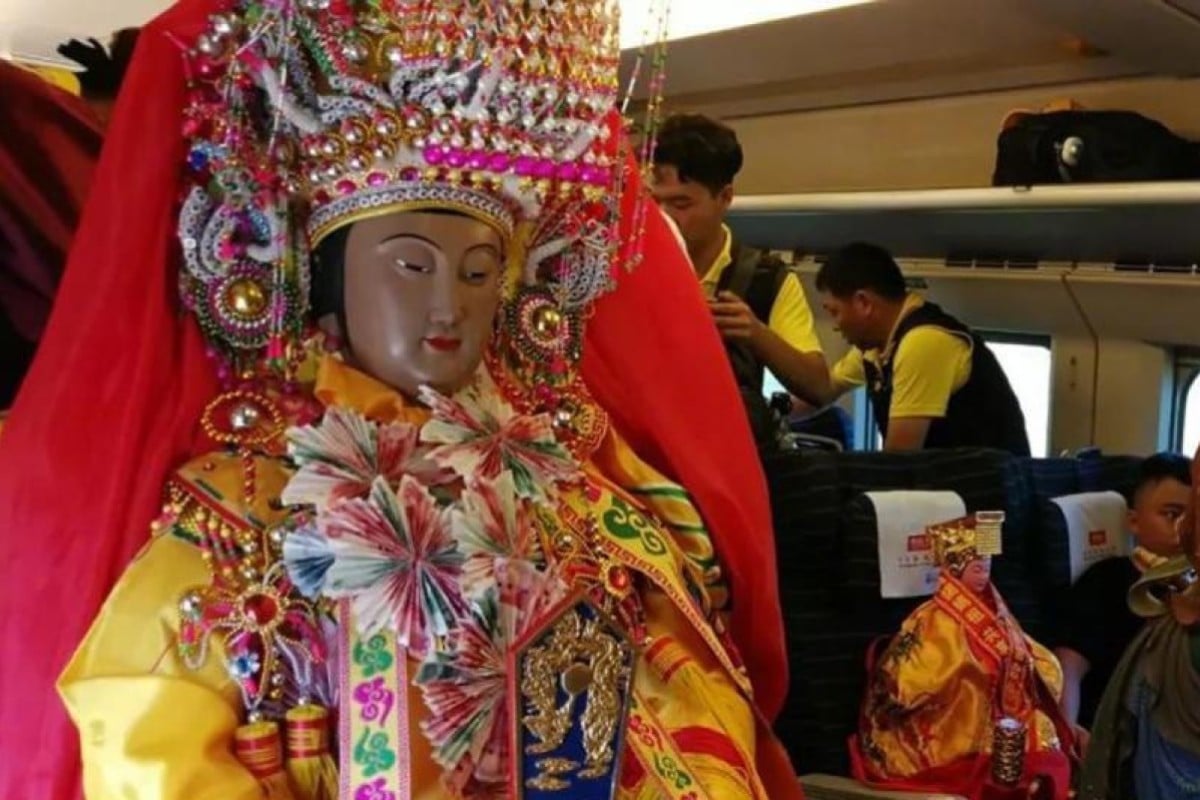
Deity has all the necessary travel documents for seven-day journey bringing blessings to coastal communities
The statue of Chinese sea goddess Mazu on board the train for her seven-day tour of eastern China. Photo: Weibo
High-speed rail travellers in eastern China may find themselves in exalted company this week as one of China’s most beloved deities is on a seven-day tour.
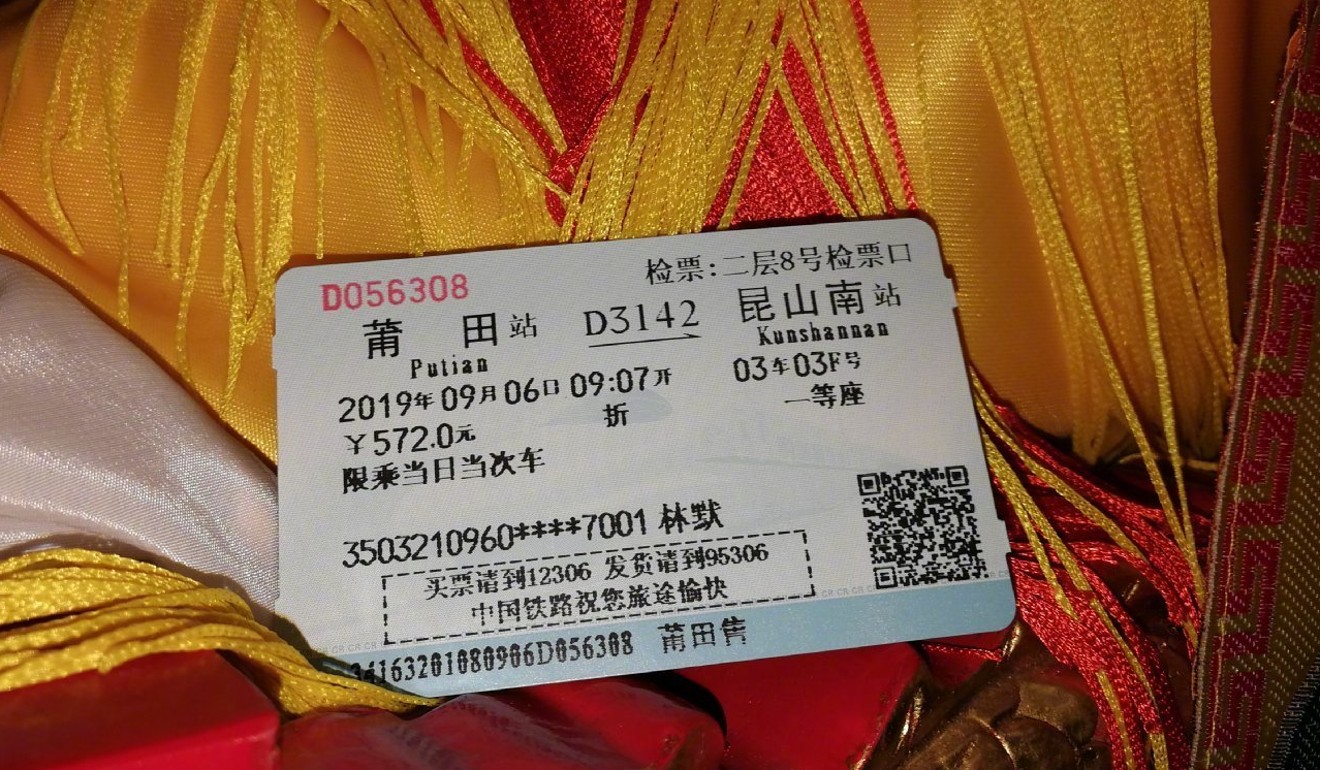
Mazu, protector of seafarers, boarded the train at Putian in Fujian province on Friday with an entourage of 230 worshippers for one of her regular “inspection tours”. And, like any modern traveller, the sea goddess had the necessary identity card and ticket for the journey.
Mazu, known as Tin Hau in Hong Kong, began life more than 1,000 years ago as a mortal named Lin Mo, according to Chinese folk belief. As a girl she is said to have saved some of her family members when they were caught in a typhoon while out fishing. In another version of the myth, Lin Mo died while trying to rescue shipwreck victims.
She fell out of favour in mainland China during the Cultural Revolution, when her ancestral temple on Meizhou Island in the southeastern province of Fujian was destroyed to make way for a People’s Liberation Army garrison. In the late 1970s the temple was rebuilt and in 2009 the beliefs and customs surrounding Mazu were recognised as an Intangible Cultural Heritage of Humanity by Unesco.
Inspectors on China’s high speed rail will find everything in order if they ask to see the goddess Mazu’s ticket during her seven-day tour. Photo: Weibo
Staff at the Meizhou Mazu Temple applied for an ID card for the goddess, in her earthly name of Lin Mo. Tickets were also organised for two other fairy figures who traditionally protect her, according to Chinese folklore.
“Not only Mazu but Thousand-Mile Eye and Wind-Accompanying Ear were all bought tickets,” a temple representative told the Southern Metropolis News.
This is not the first time the trio have been bought travel tickets. Two years ago their airfares were paid for when they visited Malaysia and Singapore and, a year later, they took a cruise ship to the Philippines.
This year’s tour includes a visit to Kunshan in Jiangsu and Shanghai, before Mazu returns to her home temple on the island of Meizhou. At each stop, devotees believe Mazu blesses the location with her presence and protects its residents from harm.
Taiwanese tycoon Gou thanks sea goddess for presidential inspiration
The tour has been organised jointly by the Meizhou Temple as well as the Huiju Mazu Temple in Kunshan and the Lugang Mazu Temple in Taiwan.
News of the celestial train journey quickly went viral on Chinese social media, with posts on Mazu receiving 460 million views on Weibo, the Twitter-like microblogging platform, since Monday. “First, respect. Second, she takes up a seat so it’s not crazy to buy her a ticket,” one comment read.
Material that generates heat from sunlight could provide self-maintaining water supply on remote islands
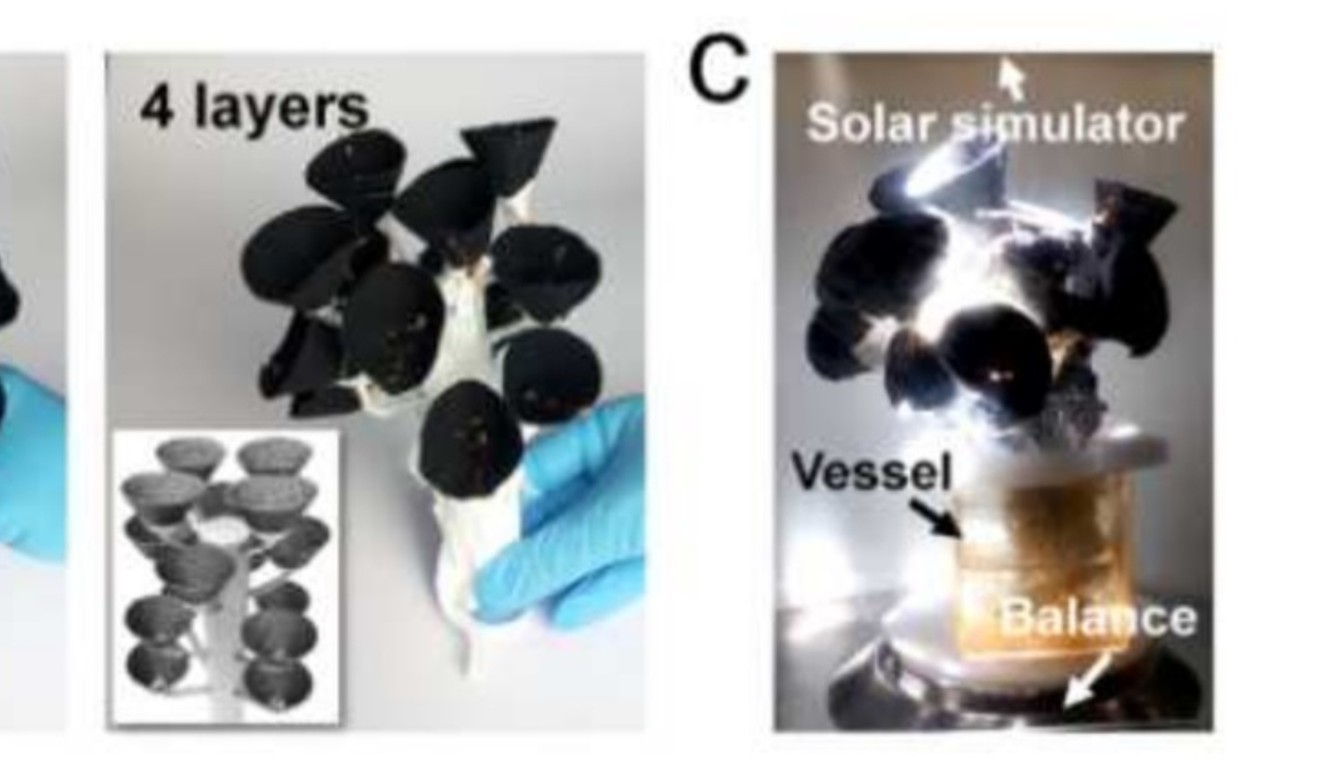
An international research team used solar power to generate a supply of drinking water. Photo: Chinese Academy of Sciences
A Chinese-led international research team has created a “tree” that can generate clean drinking water.
Drawing its energy entirely from the sun just like a real tree, the “water tree” has a root made of cotton fabric that can absorb water from its surroundings, such as from sand on a beach.
After water moves up the stem, it is vaporised by “leaves” made of black-carbon paper cones that convert light energy to heat, reaching nearly 50 degrees Celsius (122 Fahrenheit). The tree sits in a glass chamber with a relatively cool surface that collects the vapour.
Using standard cotton fabric and a new nanomaterial that can be cheaply mass-produced from charcoal, a paper cone with a surface area as large as 1 square metre would cost only US$2, according to the researchers.
The cones, which function like leaves, could be mass-produced cheaply, researchers say. Photo: Chinese Academy of Sciences
A cone that size can generate up to 3.4kg (7.5lbs) of condensed water per hour, faster than any other solar-powered desalination methods previously reported.
Even on a cloudy day, the total output in seven hours of sunlight can reach 5.4kg, or three times the amount the typical adult needs to stay hydrated.
One tree can have multiple layers of branches, each with several cones to increase the vapour-producing surface area.
The study, published this month in the journal Nano Energy, was led by Professor Chen Tao at the Chinese Academy of Sciences’ Ningbo Institute of Material Technology and Engineering in Zhejiang province, and also involved researchers from Singapore and Taiwan.
World’s thirst for fresh water is causing a big toxic problem
One of the paper’s co-authors, Dr Ouyang Jianyong, associate professor at the National University of Singapore’s department of materials science and engineering, told the South China Morning Post that the technology could be applied in remote places such as on islands in the South China Sea.
“It is particularly useful for isles far away without a stable drinking water supply,” Ouyang said. “These ‘trees’ may not be able to quench the thirst of a large city, but they can meet the critical demand of a small community, especially in emergencies.
“We are already in contact with some companies [to commercialise the technology],” he added.
The material used to make the cone has several advantages, according to Ouyang. The cones can absorb a wide spectrum of sunlight, maximising the amount of energy they can collect, and their porous structure allows them to release vapour quickly.
Lawmakers endorse plan for HK$7.7 billion desalination plant
When used to desalinate a supply of seawater, the trees would be self-cleaning at night, by water washing away salt residue without being vaporised as it would during sunlight hours.
The vapour-producing fabric is as thin and lightweight as a few sheets of paper. It can be folded and sewn into almost any shape, or cleaned in a washing machine, and can operate effectively for several years in a harsh environment, the researchers say.
The condensed water meets stringent safety standards for direct drinking set by the World Health Organisation, according to the researchers.
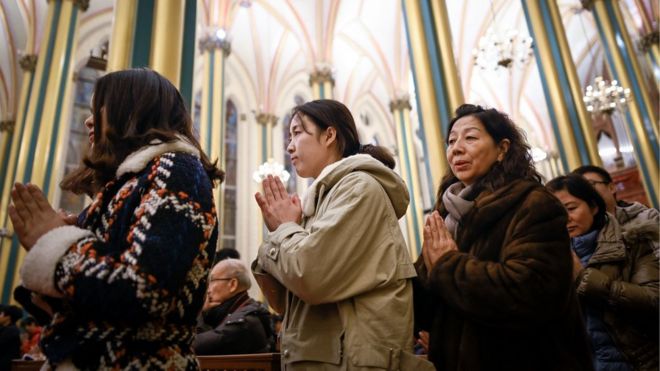
Image copyright GETTY IMAGESImage caption Christmas in Beijing: Catholics attend mass on 24 December 2018
A bishop has been ordained with the blessing of both the Pope and the Chinese state for the first time under a new deal.
Religious organisations in China must be approved by the state, leading to a decades-long row with the Vatican.
But a deal was agreed last September, giving the Vatican a say in the bishops appointed by the state church.
Yao Shun received the papal mandate for his ordination as bishop in China’s Inner Mongolia region.
The country is home to about 12 million Catholics – split between the Chinese Patriotic Catholic Association and an underground church loyal to the Vatican.
For decades, members of the underground church have only recognised the authority of the pope, while members of the state church have refused it. The relationship between the Holy See and Beijing has been strained by the disagreement since the 1950s.
In practice, the Vatican has recognised many Chinese bishops over the years on an individual, informal basis, including several last year as part of the deal.
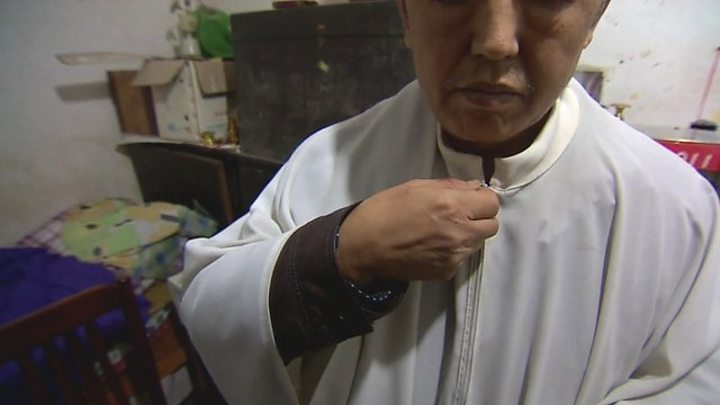
Media caption Father Dong Guanhua has been kicked out of the Chinese Catholic church for calling himself a bishop
The Vatican confirmed the new bishop’s ordination – referring to him as Antonio Yao Shun – as “the first to take place in the framework of the Provisional Agreement between the Holy See and the People’s Republic of China”.
But the deal between the two remains controversial among some Catholics.
Cardinal Joseph Zen from Hong Kong – where Chinese rules on state churches do not apply – accused the Vatican of “selling out” when details of the deal became clear in January 2018.
He said that the decision to reconcile with Beijing meant that retiring bishops of the underground church, faithful to Rome, would now be replaced by state-approved appointees.
Catholic news outlet Crux, meanwhile, reported that Bishop Shun had been chosen by the Vatican some time ago, before the agreement came into effect – and so his ordination is not a true test of the new mechanism.
But Bishop Shun’s ordination may be a notable moment in the reconciliation between the two countries.
In the past, Chinese state bishops were excommunicated from the Catholic Church for their role in ordaining new bishops outside of the papal mandate.
The relationship between China and the Vatican is further complicated by the Vatican’s diplomatic relations with Taiwan, which China considers to be a breakaway province destined for reunification at some future date.
World’s third largest helicopter assault ship could be launched in a few months, military expert says
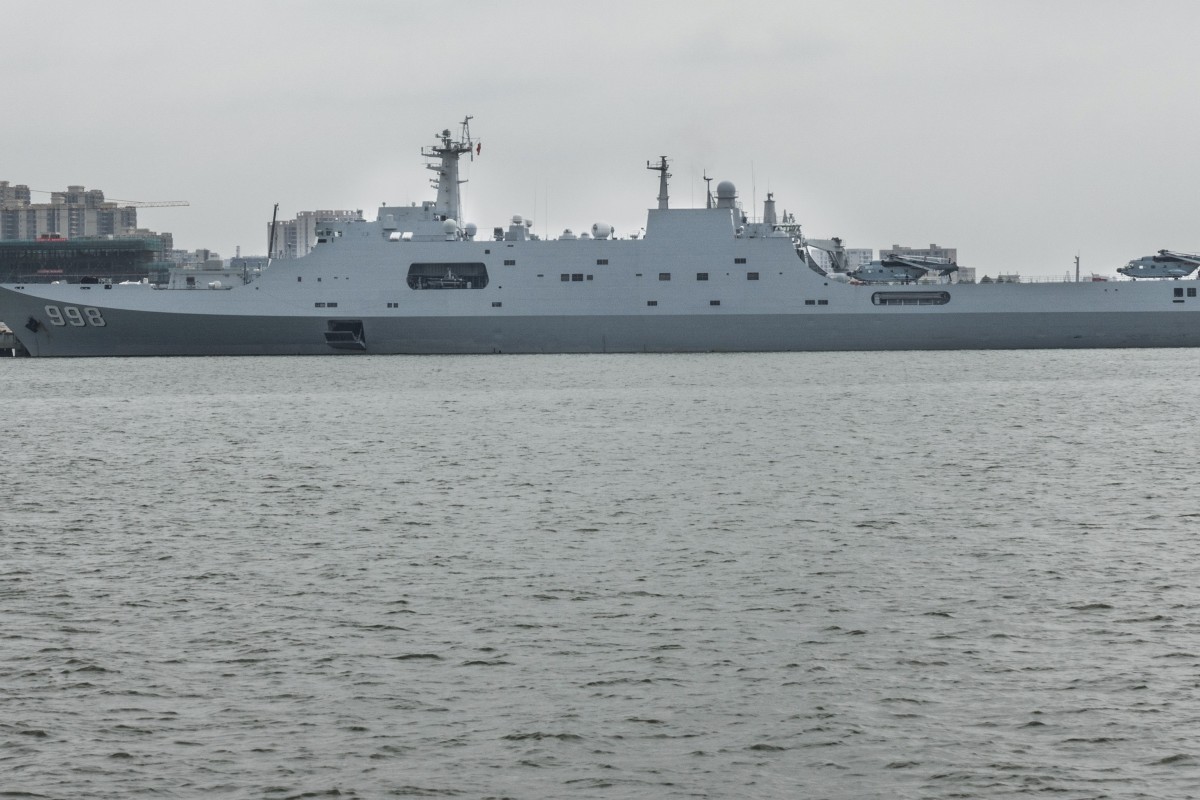
One of China’s previous generation amphibious vessels, the Type 071 Kunlun Shan, launched in 2016. Photo: Chow Chung-yan
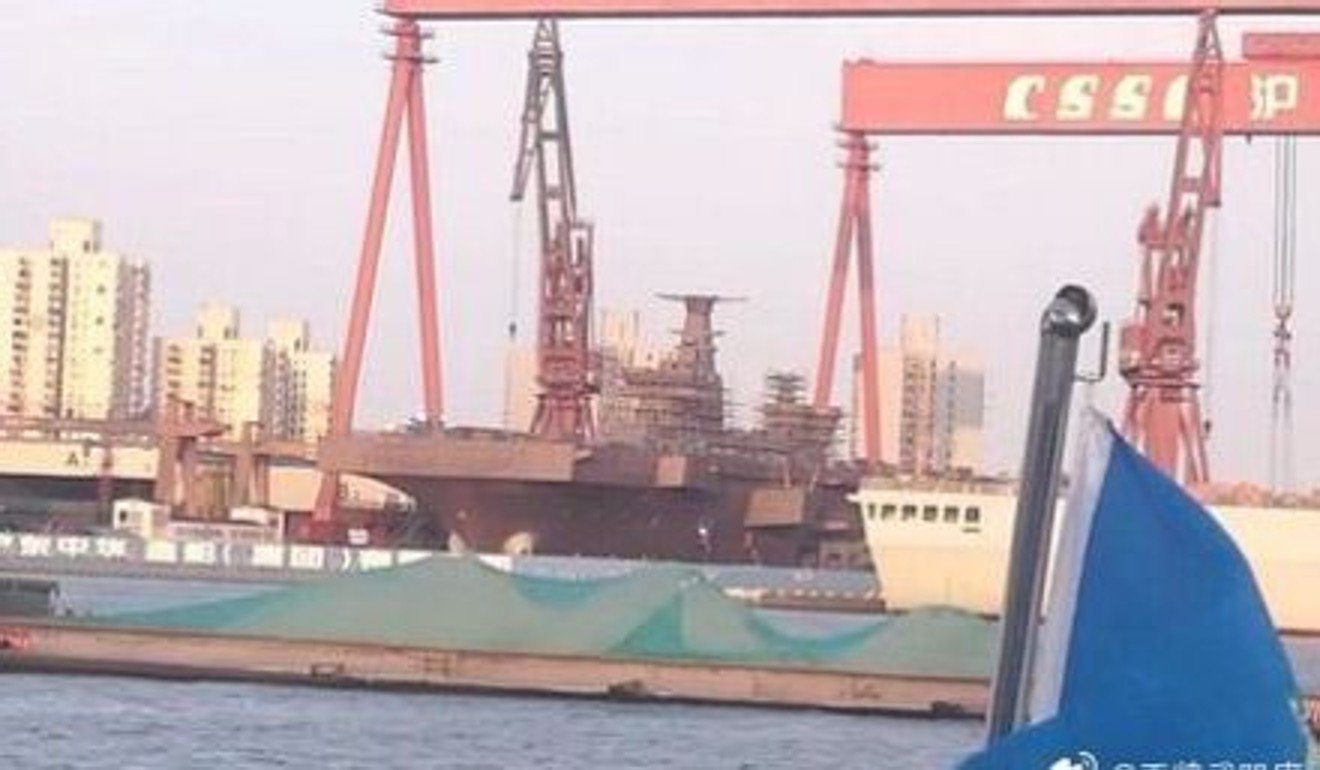
Pictures taken by military enthusiasts earlier this week appear to show that construction of China’s first Type 075 amphibious helicopter assault ship is moving quickly.
The images, taken outside the dry dock at Shanghai’s Hudong-Zhonghua shipyard, were circulated on Chinese social media and showed scaffolding around two separate superstructures above the flight deck, suggesting the estimated 40,000 tonne ship may have two islands.
In June, commercial satellite images showed the vessel had a 32-metre wide beam, with bow and stern sections yet to be added. In the most recent pictures the bow of the vessel is clearly visible.
The status of the construction suggested the ship would probably be launched in the next few months, according to Song Zhongping, a Hong Kong-based military affairs commentator.
An image of China’s first Type 075 amphibious helicopter assault ship suggests the vessel may be completed in the next few months. Photo: Weibo
Share:
Song said large landing helicopter docks (LHDs) like the Type 075 could play an even more important role than aircraft carriers in the future, following last month’s defence white paper released in Beijing which named protecting China’s overseas interests as one of the key missions of its military forces.
“LHDs are a central part of a blue water navy, because an LHD has a full range of weapons with a lot more marine troops for potential ground operations, whereas an aircraft carrier is just a mobile airbase,” he said. “Each time the Americans deploy their forces overseas, LHDs always serve as the vanguard.”
The PLA Navy has ordered several LHDs in recent years, at the same time as Beijing’s claim to the disputed South China Sea has been challenged and the relationship with Taiwan strained
China claims almost all islands and reefs in the South China Sea, many of which are occupied by rival claimants, and reserves the right to use force to reunify Taiwan, which it sees as a breakaway province.
Five Type 071 25,000 tonne amphibious landing dock ships have been launched since 2016, of which three have been commissioned and two are on sea trials.
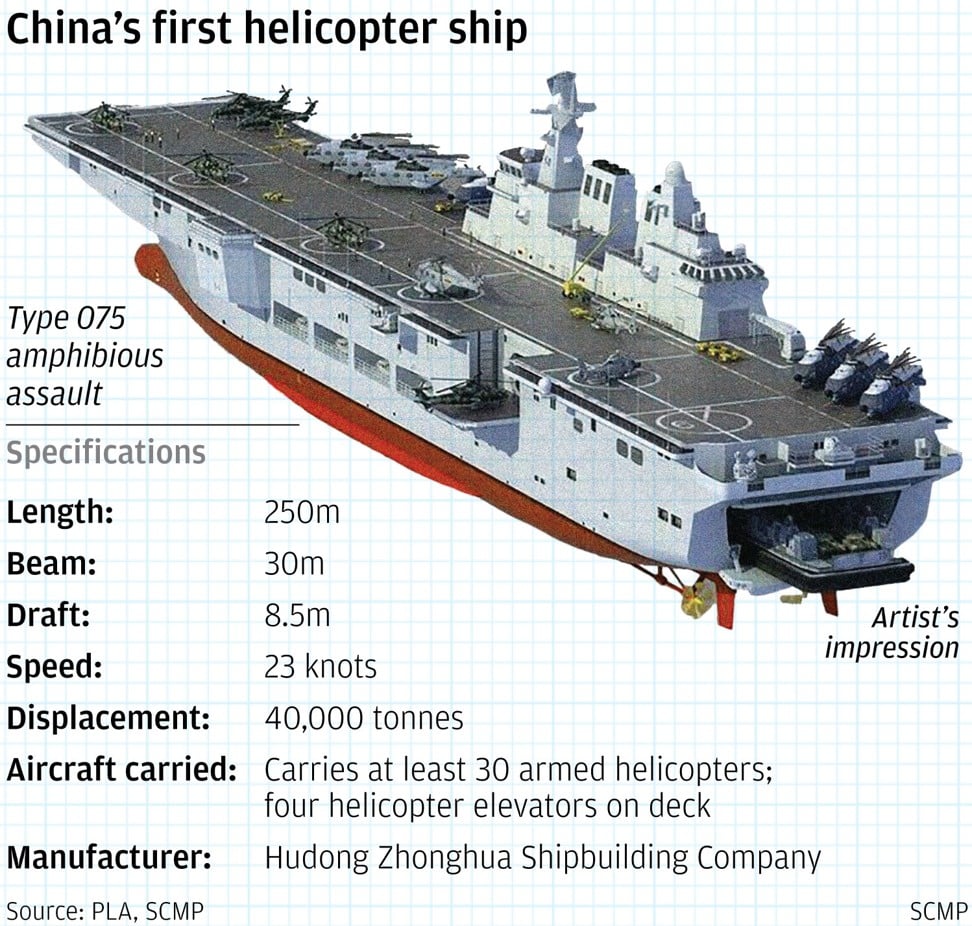
It is believed China’s first batch of Type 075 craft will consist of three ships. The Type 075 will be the world’s third largest amphibious assault ship, behind only the US Wasp-class (41,000 tonnes) and America-class (45,000 tonnes). It is significantly bigger than Japan’s Izumo-class (26,000 tonnes), and France’s Mistral-class (21,000 tonnes).
The Type 075 will be able to carry up to 30 helicopters, as well as a number of amphibious tanks, armoured vehicles, jet boats, and hundreds of marine troops.
Its massive flat deck could also accommodate vertical take-off and landing fighters such as the F-35B. This capability would enable the ship to operate as a light aircraft carrier, in a similar function to the way the US military uses LHDs. However, China currently does not yet have any vertical take-off jets.




 CHINDIA ALERT: You'll be living in their world, very soon