Archive for ‘Prime Minister Boris Johnson’

10/04/2020

Chinese vice premier talks with British finance minister on bilateral cooperation

BEIJING, April 9 (Xinhua) — Chinese Vice Premier Hu Chunhua held a phone conversation on Thursday with British Chancellor of the Exchequer Rishi Sunak on advancing bilateral cooperation on epidemic prevention and economic development.

Hu, who leads the Chinese delegation to the China-UK Economic and Financial Dialogue (EFD), noted that Chinese President Xi Jinping and British Prime Minister Boris Johnson recently held two phone conversations and reached important consensus on jointly dealing with the pandemic and developing China-UK relations.

The Chinese side stands ready to work with the British side to implement the consensus reached by the two leaders, deepen practical cooperation in such fields as epidemic prevention and finance, and provide Britain with support and assistance within its capabilities in medical supplies and other fields, Hu said.

The vice premier expressed hope that the two sides will further strengthen cooperation under the framework of the United Nations and the Group of 20, promote macroeconomic policy coordination, cut tariff, remove barriers, and facilitate the flow of trade, so as to maintain the stability of the global industrial supply chain and promote sustainable growth of the world economy.

For his part, Sunak thanked China for its support and assistance, adding that Britain stands ready to strengthen bilateral cooperation in epidemic prevention, economy and finance through channels like the China-UK EFD, so as to continuously advance bilateral relations.

Source: Xinhua

31/03/2020

Coronavirus latest: New York begs for help; Indonesia bans foreigners entry; Italy extends lockdown

  • US death toll passes 3,000 as New York’s hospitals are pushed to breaking point
  • Italy extends lockdown as cases exceed 100,000; UN Security Council votes by email for first time
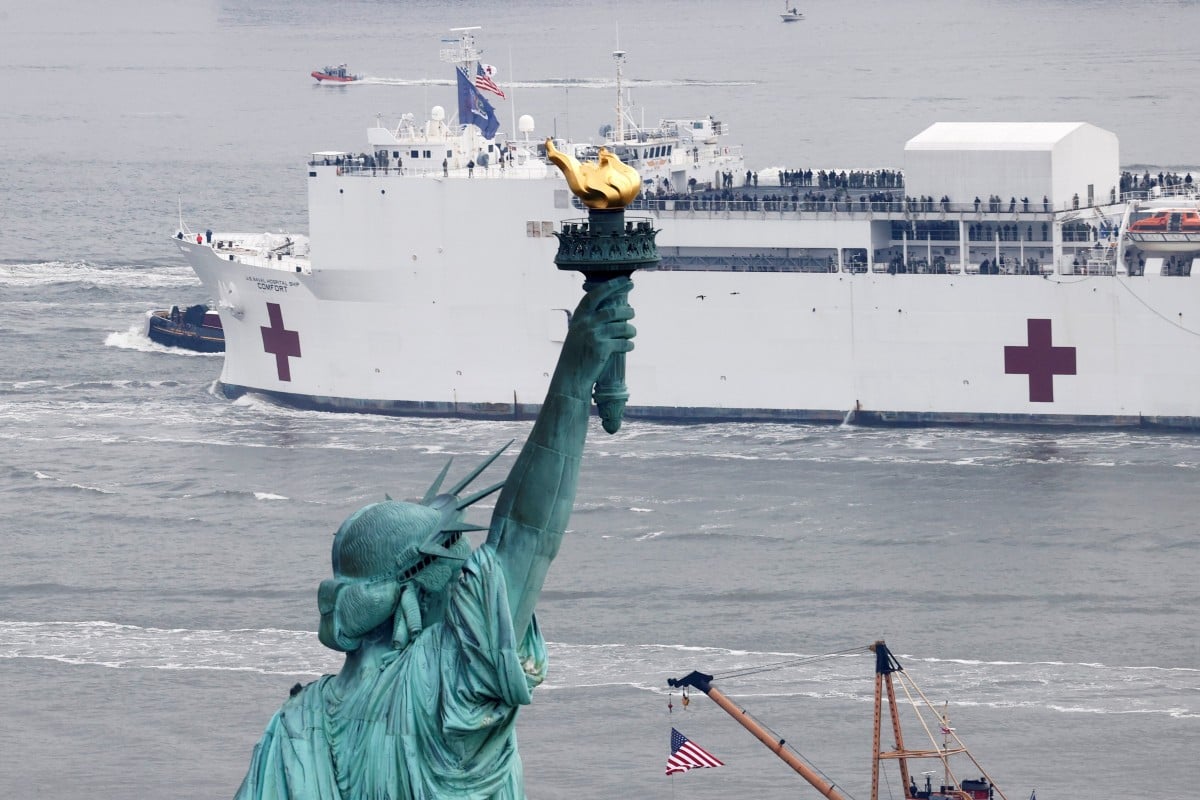
The USNS Comfort passes the Statue of Liberty as it enters New York Harbour on Monday. Photo: Reuters

Harsh lockdowns aimed at halting the march of the coronavirus pandemic extended worldwide Monday as the death toll soared toward 37,000 amid new waves of US outbreaks.

The tough measures that have confined some two-fifths of the globe’s population to their homes were broadened. Moscow and Lagos joined the roll call of cities around the globe with eerily empty streets, while Virginia and Maryland became the latest US states to announce emergency stay-at-home orders, followed quickly by the capital city Washington.

In a symbol of the scale of the challenge facing humanity, a US military medical ship sailed into New York to relieve the pressure on overwhelmed hospitals bracing for the peak of the pandemic.

France reported its highest daily number of deaths since the outbreak began, saying 418 more people had succumbed in hospital.

Spain, which announced another 812 virus deaths in 24 hours, joined the United States and Italy in surpassing the number of cases in China, where the disease was first detected in December.

On Tuesday, mainland China reported a rise in new confirmed coronavirus cases, reversing four days of declines, due to an uptick in infections involving travellers arriving from overseas.

Mainland China had 48 new cases on Monday, the National Health Commission said, up from 31 new infections a day earlier.

All of the 48 cases were imported, bringing the total number of imported cases in China to 771 as of Monday.

There was no reported new case of local infection on Monday, according to the National Health Commission. The total number of infections reported in mainland China stood at 81,518 and the death toll at 3,305. Globally, more than 760,000 have been infected, according to official figures.

Here are the developments:

Hospital ship arrives in New York

New York’s governor issued an urgent appeal for medical volunteers Monday amid a “staggering” number of deaths from the coronavirus, saying: “Please come help us in New York, now.”

The plea from Governor Andrew Cuomo came as the death toll in New York State climbed past 1,200 – with most of the victims in the big city – and authorities warned that the crisis pushing New York’s hospitals to the breaking point is just a preview of what other cities across the US could soon face.

Cuomo said the city needs 1 million additional health care workers.

“We’ve lost over 1,000 New Yorkers,” he said. “To me, we’re beyond staggering already. We’ve reached staggering.”

The governor’s plea came as a 1,000-bed US Navy hospital ship docked in Manhattan on Monday and a field hospital was going up in Central Park for coronavirus patients.

New York City reported 914 deaths from the virus as of 4:30pm local time Monday, a 16 per cent increase from an update six hours earlier. The city, the epicentre of the US outbreak, has 38,087 confirmed cases, up by more than 1,800 from earlier in the day.

Coronavirus field hospital set up in New York’s Central Park as city’s health crisis deepens

Gloom for 24 million people in Asia

The economic fallout from the coronavirus pandemic will prevent almost 24 million people from escaping poverty in East Asia and the Pacific this year, according to the World Bank.

In a report released on Monday, the Washington-based lender also warned of “substantially higher risk” among households that depend on industries particularly vulnerable to the impact of Covid-19. These include tourism in Thailand and the Pacific islands; manufacturing in Vietnam and Cambodia; and among people dependent on “informal labour” in all countries.

The World Bank urged the region to invest in expanding conventional health care and medical equipment factories, as well as taking innovative measures like converting ordinary hospital beds for ICU use and rapidly trining people to work in basic care.

Billionaire blasted for his Instagram-perfect isolation on luxury yacht

31 Mar 2020

Indonesia bans entry of foreigners

Indonesia barred foreign nationals from entering the country as the world’s fourth-most populous country stepped up efforts to contain the spread of the coronavirus pandemic.

The travel ban, to be effective soon, will also cover foreigners transiting through the country, Foreign Minister Retno Marsudi said after a cabinet meeting in Jakarta Tuesday. The curbs will not apply to holders of work permits, diplomats and other official visitors, she said.

The curbs on foreign citizens is the latest in a raft of measures taken by Indonesia to combat the deadly virus that’s sickened more than 1,400 people and killed 122. President Joko Widodo’s administration previously banned flights to and from mainland China and some of the virus-hit regions in Italy, South Korea and Iran. The president on Monday ordered stricter implementation of social distancing and health quarantine amid calls for a lockdown to contain the pandemic.

Indonesia has highest coronavirus mortality rate in Southeast Asia

First US service member dies

The first US military service member has died from the coronavirus, the Pentagon said on Monday, as it reported another sharp hike in the number of infected troops.

The Pentagon said it was a New Jersey Army National Guardsman who had tested positive for Covid-19 and had been hospitalised since March 21. He died on Saturday, it said.

Earlier on Monday, the Pentagon said that 568 troops had tested positive for the coronavirus, up from 280 on Thursday. More than 450 Defence Department civilians, contractors and dependents have also tested positive, it said.

US military has decided to stop providing more granular data about coronavirus infections within its ranks, citing concern that the information might be used by adversaries as the virus spreads.

The new policy, which the Pentagon detailed in a statement on Monday, appears to underscore US military concerns about the potential trajectory of the virus over the coming months – both at home and abroad.

School to resume in South Korea … online

South Korean children will start the new school year on April 9 with only online classes, after repeated delays due to the outbreak of the new coronavirus, the government said Tuesday.

Prime Minister Chung Sye Kyun said that despite the nation’s utmost efforts to contain the virus and lower the risk of infection, there is consensus among teachers and others that it is too early to let children go back to school.

The nation’s elementary schools, and junior and senior high schools were supposed to start the new academic year in early March, but the government has repeatedly postponed it to keep the virus from spreading among children.

The start was last postponed until April 6, but has now been delayed three more days to allow preparations to be made for online classes.

The nation now has 9,786 confirmed cases in total, with 162 deaths.

Italy extends lockdown as cases exceed 100,000

Italy’s government on Monday said it would extend its nationwide lockdown measures
against a coronavirus outbreak, due to end on Friday, at least until the Easter season in April.
The Health Ministry did not give a date for the new end of the lockdown, but said it would be in a law the government would propose. Easter Sunday is April 12 this year. Italy is predominantly Roman Catholic and contains the Vatican, the heart of the church.

Italians have been under lockdown for three weeks, with most shops, bars and restaurants shut and people forbidden from leaving their homes for all but non-essential needs.

Italy, which is the world’s hardest hit country in terms of number of deaths and accounts for more than a third of all global fatalities, saw its total death tally rise to 11,591 since the outbreak emerged in northern regions on February 21.

The death toll has risen by 812 in the last 24 hours, the Civil Protection Agency said, reversing two days of declines, although the number of new cases rose by just 4,050, the lowest increase since March 17, reaching a total of 101,739.

Deadliest day in Italy and Spain shows worst not over yet

28 Mar 2020
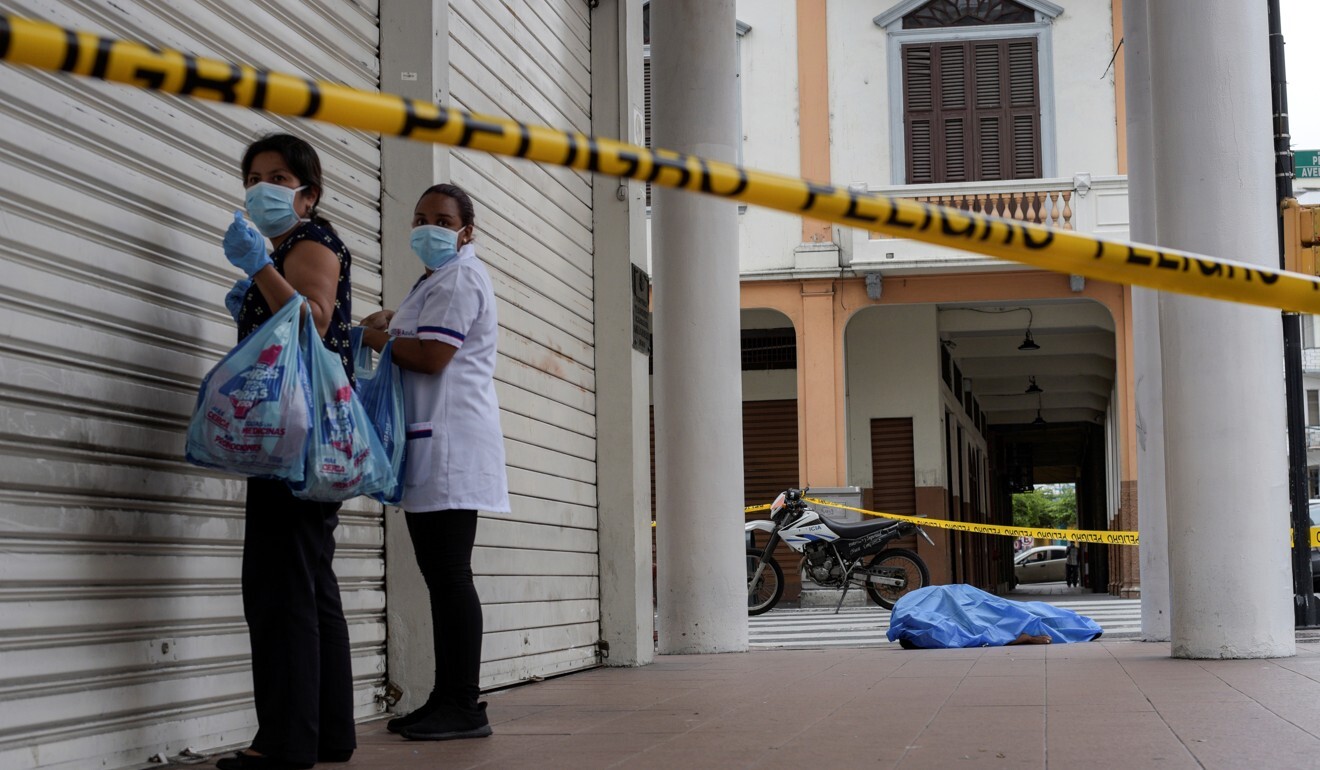
Women stand near the body of a man who died on the sidewalk in Guayaquil, Ecuador. Photo: Reuters

Ecuador struggles to collect the dead

Ecuadorean authorities said they would improve the collection of corpses, as delays related to the rapid spread of the new coronavirus has left families keeping their loved ones’ bodies in their homes for days in some cases.

Residents of Guayaquil, Ecuador’s largest city, have complained they have no way to dispose of relatives’ remains due to strict quarantine and curfew measures designed to prevent spread of the disease. Last week, authorities said they had removed 100 corpses from homes in Guayaquil.

But delays in collecting bodies in the Andean country, which has reported 1,966 cases of the virus and 62 deaths, were evident midday on Monday in downtown Guayaquil, where a man’s dead body lay on a sidewalk under a blue plastic sheet. Police said the man had collapsed while waiting in line to enter a store. Hours later, the body had been removed.

More than 70 per cent of the country’s coronavirus cases, which is among the highest tallies in Latin America, are in the southern province of Guayas, where Guayaquil is located.

Panama to restrict movement by gender

The government of Panama announced strict quarantine measures that separate citizens by gender in an effort to slow the spread of the novel coronavirus.

From Wednesday, men and women will only be able to leave their homes for two hours at a time, and on different days. Until now, quarantine regulations were not based on gender.

Men will be able to go to the supermarket or the pharmacy on Tuesdays, Thursdays and Saturdays, and women will be allowed out on Mondays, Wednesdays and Fridays.

No one will be allowed to go out on Sundays. The new measures will last for 15 days.

Police in Kenya use tear gas to enforce coronavirus curfew

Remote vote first for UN Security Council

The UN Security Council on Monday for the first time approved resolutions remotely after painstaking negotiations among diplomats who are teleworking due to the coronavirus pandemic.

The Security Council unanimously voted by email for four resolutions, including one that extended through April 2021 the expiring mandate of UN experts who are monitoring sanctions on North Korea, diplomats said.

The UN mission in Somalia was also prolonged, until the end of June, and the mission in Darfur until the end of May – two short periods decided due to uncertainty over the spread of the pandemic.

The Council also endorsed a fourth resolution aimed at improving the protection for peacekeepers.

The resolutions are the first approved by the Security Council since it began teleworking on March 12 and comes as Covid-19 rapidly spreads in New York, which has become the epicenter of the disease in the United States.

Congo ex-president dies in France

Former Republic of Congo president Jacques Joaquim Yhombi Opango died in France on Monday of the new coronavirus, his family said. He was 81.

Yhombi Opango, who led Congo-Brazzaville from 1977 until he was toppled in 1979, died at a Paris hospital of Covid-19, his son Jean-Jacques said. He had been ill before he contracted the virus.

Yhombi Opango was an army officer who rose to power after the assassination of president Marien Ngouabi.

Yhombi Opango was ousted by long-time ruler Denis Sassou Nguesso. Accused of taking part in a coup plot against Sassou Nguesso, Yhombi Opango was jailed from 1987 to 1990. He was released a few months before a 1991 national conference that introduced multiparty politics in the central African country.

When civil war broke out in Congo in 1997, Yhombi Opango fled into exile in France. He was finally able to return home in 2007, but then divided his time between France and Congo because of his health problems.

‘When I wake I cry’: France’s nurses face hell on coronavirus front line

31 Mar 2020

EU asks Britain to extend Brexit talks

The European Union expects Britain to seek an extension of its post-Brexit transition period beyond the end of the year, diplomats and officials said on Monday, as negotiations on trade have ground to a halt due to the coronavirus pandemic.

Europe has gone into a deep lockdown in a bid to curb the spread of the disease, with more than 330,000 infections reported on the continent and nearly 21,000 deaths.

In Britain, Prime Minister Boris Johnson and his health minister have both tested positive for the virus and the prime minister’s senior adviser Dominic Cummings – one of the masterminds behind Britain’s departure from the EU earlier this year – was self-isolating with symptoms.

London and the EU have been seeking to agree a new trade pact by the end of the year to kick in from 2021, even though the bloc has long said that such a time frame was extremely short to agree rules on everything from trade to security to fisheries.

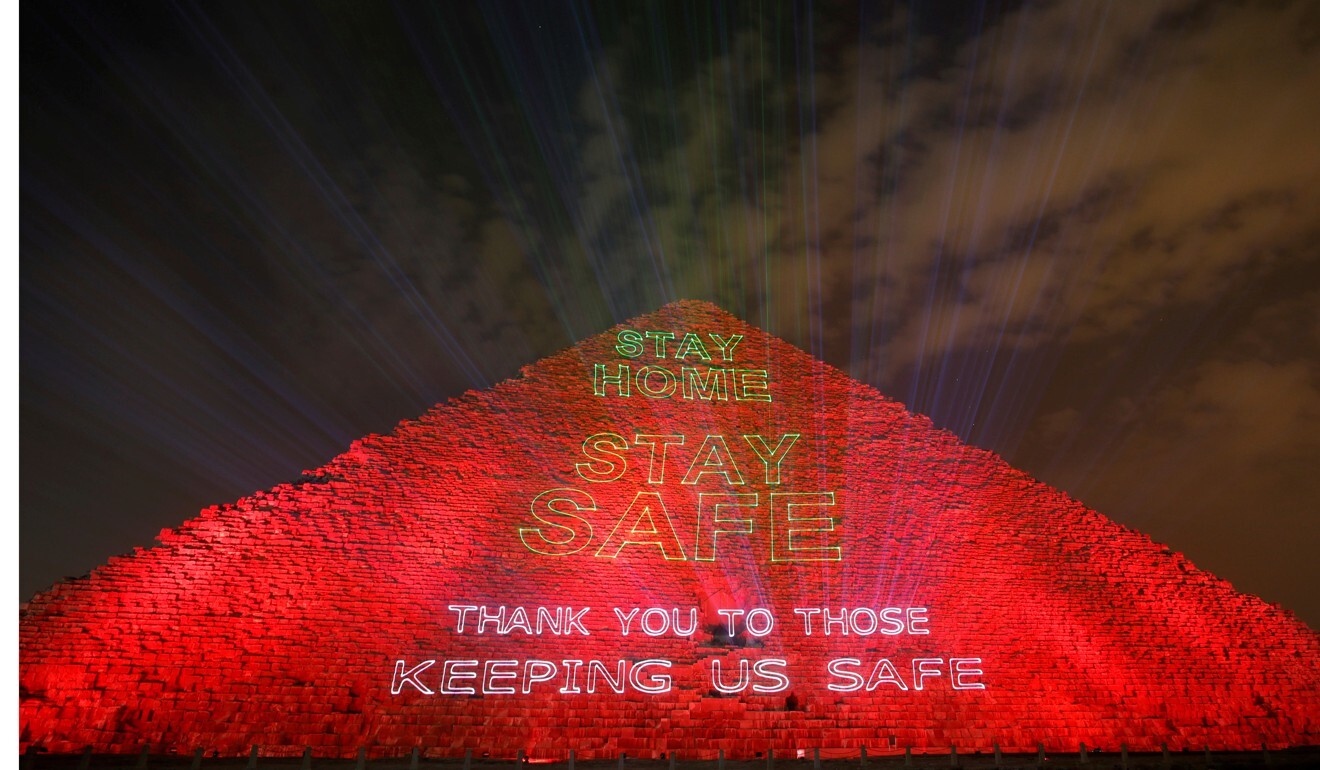
The pyramid of Khufu, the largest of the Giza pyramid complex. Photo: Reuters

Great Pyramid in Egypt lights up in solidarity

Egypt’s famed Great Pyramid was emblazoned Monday evening with messages of unity and solidarity with those battling the novel coronavirus the world over.

“Stay safe”, “Stay at home” and “Thank you to those keeping us safe,” flashed in blue and green lights across the towering structure at the Giza plateau, southwest of the capital Cairo.

Egypt has so far registered 656 Covid-19 cases, including 41 deaths. Of the total infected, 150 reportedly recovered.

Egypt has carried out sweeping disinfection operations at archaeological sites, museums and other sites across the country.

In tandem, strict social distancing measures were imposed to reduce the risk of contagion among the country’s 100 million inhabitants.

Tourist and religious sites are shuttered, schools are closed and air traffic halted.

Myanmar braces for ‘big outbreak’ after migrant worker exodus from Thailand
30 Mar 2020

Saudi king to pay for all patients’ treatment

Saudi Arabia will finance treatment for anyone infected with the coronavirus in the country, the health minister said on Monday.

The kingdom has registered eight deaths among 1,453 infections, the highest among the six Gulf Arab states.

Health Minister Tawfiq Al Rabiah said King Salman would cover treatment for citizens and residents diagnosed with the virus, urging people with symptoms to get tested.

“We are all in the same boat,” he told a news conference, adding that Crown Prince Mohammed bin Salman was overseeing containment efforts “night and day”.

Denmark eyes gradual reopening after Easter

Denmark may gradually lift a lockdown after Easter if the numbers of coronavirus cases and deaths remain stable, Prime Minister Mette Frederiksen said on Monday.

The Nordic country, which has reported 77 coronavirus-related deaths, last week extended until after Easter a two-week lockdown to limit physical contact between its citizens that began on March 11.

The number of daily deaths slowed to five on Sunday from eight and 11 on Saturday and Friday respectively. Denmark has reported a total of 2,577 coronavirus infections.

“If we over the next two weeks across Easter keep standing together by staying apart, and if the numbers remain stable for the next two weeks, then the government will begin a gradual, quiet and controlled opening of our society again, at the other side of Easter,” Frederiksen said.

Source: SCMP

25/03/2020

Coronavirus: Wuhan to ease lockdown as world battles pandemic

Medical staff clean up the empty hospital after all patients were discharged at Wuchang Fangcang hospital, a temporary hospital set up at Hongshan gymnasium to treat people infected with the coronavirus and Covin-19 disease, in Wuhan, Hubei Province, China, 10 March 2020 (issued 11 March 2020)Image copyright EPA
Image caption Wuhan has been sealed off since mid-January

The lockdown in Wuhan, the Chinese city where the global coronavirus outbreak began, will be partially lifted on 8 April, officials say.

Travel restrictions in the rest of Hubei province, where Wuhan is located, will be lifted from midnight on Tuesday – for residents who are healthy.

A single new case of the virus was reported in Wuhan on Tuesday following almost a week of no reported new cases.

Countries around the world have gone into lockdown or imposed severe curbs.

The UK is getting to grips with sweeping new measures to tackle the spread of coronavirus, including a ban on public gatherings of more than two people and the immediate closure of shops selling non-essential goods.

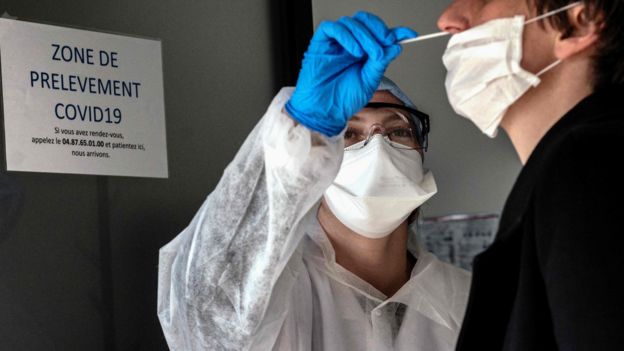
A person is tested for the Covid-19 virus in Villeurbanne, France (23 March 2020)Image copyright AFP
Image caption The WHO has urged the G20 group of nations to boost production of protective equipment

Meanwhile, health experts say Americans must limit their social interactions or the number of infections will overwhelm the health care system in the US.

Spanish soldiers helping to fight the coronavirus pandemic have found elderly patients in retirement homes abandoned and, in some cases, dead in their beds, the defence ministry has said.

An ice rink in Madrid is to be used as a temporary mortuary for Covid-19 victims.

The World Health Organization (WHO) has warned that the pandemic is accelerating, with more than 300,000 cases now confirmed. It is urging countries to adopt rigorous testing and contact-tracing strategies.

Wuhan has been shut off from the rest of the world since the middle of January. But officials now say anyone who has a “green” code on a widely used smartphone health app will be allowed to leave the city from 8 April.

Earlier, the authorities reported a new case of coronavirus in Wuhan, ending a five-day run of no reported new cases in the city.

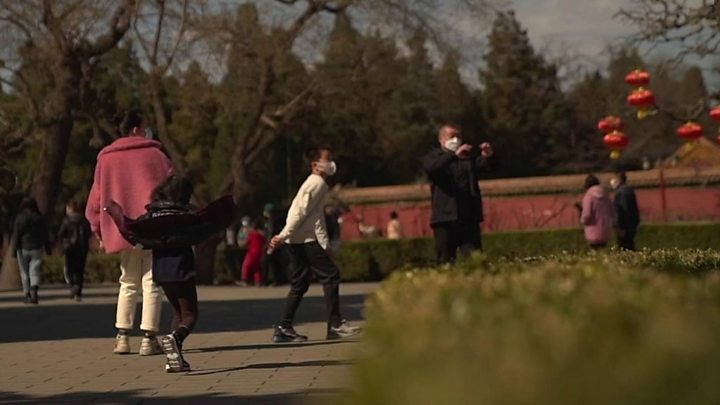
Media caption Coronavirus: People in Beijing begin to head outdoors

It comes after health officials there confirmed that they were not counting cases of people who were positive but had not been admitted to hospital or did not show any symptoms of the disease.

Official government figures say there have been 78 new cases reported on the Chinese mainland in the last 24 hours. All but four of them were caused by infected travellers arriving from abroad.

This so-called “second wave” of imported infections is also affecting countries like South Korea and Singapore, which had been successful in stopping the spread of disease in recent weeks.

South Korea has been seeing a drop in its daily tally of new cases. On Tuesday it reported its lowest number since 29 February.

Presentational grey line

China looks to repair its reputation

By Robin Brant, BBC News, Shanghai

China considers itself to be – very nearly – a “post corona” country.

In the last week we’ve heard Wuhan medics warning the UK and others that they need to do more to protect frontline health workers, citing the mistakes they made early on when some treated patients without wearing proper protective clothing.

But there’s also been reporting in state media of the reported death toll in Italy surpassing that in China. This has been combined with some commentary from prominent media figures that has appeared distasteful, almost triumphalist.

At the same time there is a panic about the threat of a second wave from imported cases – travellers arriving from abroad. This has fuelled the view – right or wrong – that some other countries aren’t taking the threat seriously because they aren’t doing what China did. (Almost all the cases in Beijing that have been made public are of Chinese nationals returning home).

Meanwhile, well away from senior leaders, there are some high-profile diplomatic figures using international-facing social media to spread theories that the US may have weaponised and dumped the virus in China. Or that Italy had cases that may have been Covid-19 earlier than China. China is sowing seeds of doubt and questioning assumed truths as it looks to repair its reputation.

Presentational grey line
Banner image reading 'more about coronavirus'
Banner

What’s the latest from around Asia?

  • Almost all of India with its 1.3bn people is under lockdown. Buses, trains and other forms of public transport are suspended. On Monday, the authorities said domestic flights would also stopped. The country has reported 485 cases and nine people have died. Prime Minister Narendra Modi will address the nation again this evening.
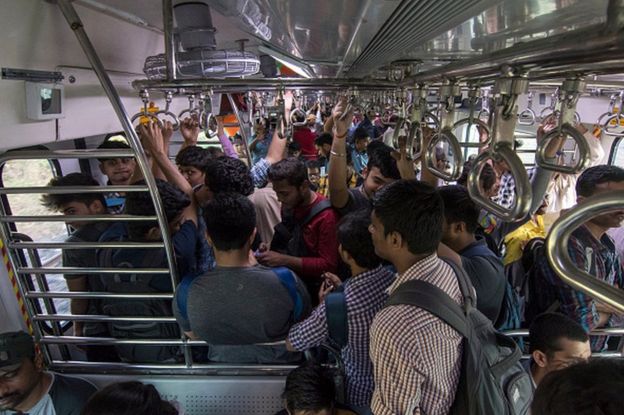
People travel in Central Railway's first air-conditioned EMU local train, on January 30, 2020, in Mumbai, India.Image copyright GETTY IMAGES
Image caption Mumbai’s suburban train network carries eight million passengers a day
  • Neighbouring Pakistan has almost twice as many confirmed cases – 878 as of Monday evening. Sweeping restrictions are in place although the government has stopped short of imposing a nationwide lockdown. However, several provinces have announced them independently. The army is being brought in to help enforce the restrictions.
  • Bangladesh, which has reported 33 cases and three deaths, is also deploying its armed forces to help maintain social distancing and boost Covid-19 preventive measures. The soldiers will also monitor thousands of quarantined expatriate returnees. Across South Asia, there are concerns that the actual number of cases could be much higher than is being reported.
  • Indonesia, which has 49 confirmed Covid-19 deaths – the highest in South-East Asia – has converted an athlete’s village built for the 2018 Asian Games into a makeshift hospital for coronavirus patients. A state of emergency was declared in Jakarta on Monday.
  • In Thailand, a month-long state of emergency which will include curfews and checkpoints will begin on Thursday. The government has been criticised for failing to take strong action so far. Four people have died and nearly 900 tested positive.
  • Talks between the Japanese PM and the International Olympic Committee are expected this evening.
  • The most populous country that was without a case until now – Myanmar – has announced two cases.

Europe’s battle against virus intensifies

UK Prime Minister Boris Johnson announced on Monday night that, with immediate effect, “people will only be allowed to leave their home…for very limited purposes”. They include shopping for basic necessities, taking one form of exercise per day, fulfilling any medical need, or travelling to work if working from home is impossible.

Media caption Reality Check tackles misleading health advice being shared online

The number of people who have died in the UK rose to 335 on Monday.

In Italy, the worst-hit country in the world, the authorities said 602 people with Covid-19 had died in the past 24 hours, bringing the total death toll there to 6,077.

But the daily increase in cases was the smallest since Thursday, raising hope that the stringent restrictions imposed by the government were starting to have an effect.

Spain, however, said on Tuesday that its death toll had risen by 514 to 2,696. Nearly 40,000 are infected, about 5,400 of them healthcare workers.

Source: The BBC

25/03/2020

Coronavirus: India enters ‘total lockdown’ after spike in cases

People panicked after the prime minister said everyone should “forget about” leaving their homes for any reason

India’s Prime Minister Narendra Modi has imposed a nationwide lockdown in an attempt to slow the spread of the coronavirus.

The restrictions came into force at midnight local time (18:30 GMT) and will be enforced for 21 days.

“There will be a total ban on venturing out of your homes,” Mr Modi said in a televised address.

He appealed for people not to panic – but crowds quickly mobbed stores in the capital, Delhi, and other cities.

Correspondents say it is not clear how – or even if – people will now be allowed out to buy food and other essentials.

The new measures follow a sharp increase in cases in recent days. There have been 519 confirmed cases across India and 10 reported deaths.

India – which has a population of 1.3bn – joins a growing list of countries that have imposed similar measures.

Nearly 400,000 people have tested positive for the virus worldwide, and around 17,000 have died.

Banner image reading 'more about coronavirus'
Banner

“The entire country will be in lockdown, total lockdown,” Mr Modi said on Tuesday.

He added: “To save India, to save its every citizen, you, your family… every street, every neighbourhood is being put under lockdown.”

Mr Modi warned that if India does not “handle these 21 days well, then our country… will go backwards by 21 years”.

“This is a curfew,” he said. “We will have to pay the economic cost of this but [it] is the responsibility of everyone.”

Media caption We explain why staying in is a matter of life and death

Mr Modi later warned that panic-buying would only spread the disease. He said the government would ensure supplies.

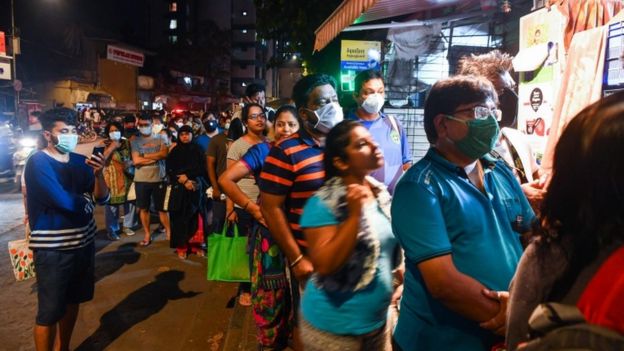
But in Delhi and the financial capital, Mumbai, people fearing shortages quickly thronged shops and pharmacies.

“I have never witnessed such a chaos in my life,” the owner of one store in the Shakarpur district of Delhi said, quoted by the Press Trust of India.

“All our stocks, including rice, flour, bread, biscuits, edible oils, have been sold out.”

Police in the busy city of Ghaziabad, in Uttar Pradesh state, patrolled the streets with megaphones to tell residents to stay indoors.

People line up outside a store in Mumbai on March 24, 2020.Image copyright AFP
Image caption People in Mumbai rushed to stock up on essentials following Mr Modi’s address

Under the new measures, all non-essential businesses will be closed but hospitals and other medical facilities will continue to function as normal. Schools and universities will remain shut and almost all public gatherings will be banned.

Anyone flouting the new rules faces up to two years in prison and heavy fines.

In his address, Prime Minister Modi also:

  • Stressed that the 21-day lockdown was “very necessary to break the chain of coronavirus”
  • Emphasised the seriousness of the situation and said that even developed countries had faced problems in combating it
  • Said that “social distancing was the only way to stop” the virus spreading
  • Announced that nearly $2bn (£1.8bn) would be made available to boost the country’s health infrastructure
  • Called on people not to “spread rumours” and to follow instructions

His announcement came after several Indian states introduced measures of their own, such as travel restrictions and the closure of non-essential services.

India has already issued a ban on international arrivals and grounded domestic flights. The country’s rail network has also suspended most passenger services.

Presentational grey line
Analysis box by Rajini Vaidyanathan, South Asia correspondent

Many parts of India, including cities such as Delhi and Mumbai, are already under tight restrictions. But this move extends those provisions to every corner of the country.

An earlier one-day curfew, which was seen as a trial, was flouted by many.

Mr Modi called on Indians to clap and cheer the emergency services from their balconies on Sunday. But many misunderstood the call and congregated in the streets as they danced and chanted.

“It’s impossible to fathom the cost that India may have to pay if such irresponsible behaviour continues,” Mr Modi warned at the time. “Social distancing is the only option to combat coronavirus.”

The implications of a total lockdown in India are huge, not just economically, but socially.

This is a nation where community is everything. Going to worship at a temple, mosque or church is an essential part of daily life for so many.

This is a seismic cultural shift but – like the rest of the world facing similar restrictions – a necessary one.Presentational grey line

What’s the latest from around Asia?

  • Neighbouring Pakistan has almost twice as many confirmed cases – 878 as of Monday evening. Sweeping restrictions are in place although the government has stopped short of imposing a nationwide lockdown. However, several provinces have announced them independently. The army is being brought in to help enforce the restrictions
  • Bangladesh, which has reported 33 cases and three deaths, is also deploying its armed forces to help maintain social distancing and boost Covid-19 preventive measures. The soldiers will also monitor thousands of quarantined expatriate returnees. Across South Asia, there are concerns that the actual number of cases could be much higher than is being reported.
  • Indonesia, which has 49 confirmed Covid-19 deaths – the highest in South East Asia – has converted an athlete’s village built for the 2018 Asian Games into a makeshift hospital for coronavirus patients. A state of emergency was declared in Jakarta on Monday
  • In Thailand, a month-long state of emergency which will include curfews and checkpoints will begin on Thursday. The government has been criticised for failing to take strong action so far. Four people have died and nearly 900 tested positive
  • The most populous country that was without a case until now – Myanmar – has announced two cases

And what about the rest of the world?

  • Elsewhere, governments are continuing to work to stem the spread of the virus which has now affected more than 190 countries worldwide
  • More than 2.6 billion people are in lockdown now India has introduced its new measures, according to a tally by the AFP news agency
Media caption Reality Check tackles misleading health advice being shared online
  • Europe remains at the epicentre of the pandemic. On Tuesday, the death toll jumped by 514 in a single day in Spain and other European countries also reported sharp increases
  • Italy is the worst affected country in the world in terms of deaths. The virus has killed almost 7,000 people there over the past month
  • The UK, meanwhile, is spending its first day under tight new restrictions. Prime Minister Boris Johnson announced unprecedented measures on Monday and ordered the immediate closure of shops selling non-essential goods
  • And in the US, New York’s governor has said the federal government is not sending enough equipment to combat the crisis. The state has been hit especially hard by the virus
  • The World Health Organization (WHO) has warned that the US has the potential to become the new epicentre of the pandemic
  • In other developments, Japanese Prime Minister Shinzo Abe said the International Olympic Committee has agreed that the 2020 Tokyo Olympics should be postponed by a year
  • Source: The BBC
02/03/2020

Coronavirus: South Korea church leader apologises for virus spread

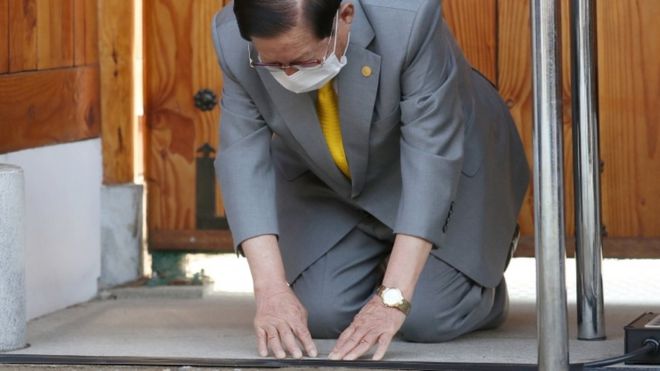
Leader of the Shincheonji Church of Jesus holds press conference in South KoreaImage copyright EPA
Image caption Lee Man-hee is the founder of the Shincheonji Church

The head of the religious sect that has been at the centre of the coronavirus outbreak in South Korea has apologised to the nation for the disease’s spread.

Lee Man-hee, the leader of the Shincheonji Church of Jesus, got on his knees and bowed at a news conference.

About 60% of the country’s more than 4,000 confirmed cases are sect members.

On Monday, South Korea – the biggest hotspot outside China – reported 476 new cases, bringing the total number to 4,212. It has recorded 26 deaths.

Prosecutors have been asked to investigate Mr Lee on possible charges of gross negligence.

“Although it was not intentional, many people have been infected,” said the 88-year-old leader. “We put our utmost efforts, but were unable to prevent it all.”

Media caption Empty shelves as coronavirus ‘panic-buying’ hits Australia

Of the confirmed cases, 3,081 are from the southern city of Daegu and 73% of these cases have been linked to the Shincheonji Church near there.

In the capital Seoul, the mayor urged the city’s 10 million residents to work from home and to avoid crowded places.

Why is the Shincheonji Church of Jesus in the spotlight?

Members of the fringe Christian group are believed to have infected one another and then travelled around the country, apparently undetected.

The group has been accused of keeping its members’ names secret, making it harder to track the outbreak.

But church spokesman Kim Shin-chang told the BBC they had provided a list of members, students, and buildings to authorities.

“We were worried about releasing this information because of the safety of our members,” Mr Kim said.

Media caption ‘We’re often persecuted’: Spokesman for virus-hit S Korean church defends secrecy

Mr Lee claims he is the second coming of Jesus Christ and identifies as “the promised pastor” mentioned in the Bible who will take 144,000 people to heaven with him.

The Shincheonji Church is labelled as a cult within South Korea and also in the Christian community, which results in the group often being discriminated against, persecuted or criticised, Mr Kim told the BBC.

What’s the global situation?

The number of people killed worldwide by the coronavirus has exceeded 3,000, as China reported 42 more deaths. More than 90% of the total deaths are in Hubei, the Chinese province where the virus emerged late last year.

But there have also been deaths in 10 other countries, including more than 50 in Iran and more than 30 in Italy.

Worldwide, there have been almost 90,000 confirmed cases, with the numbers outside China now growing faster than inside China.

In other developments:

  • In the UK, where there are 36 confirmed cases, Prime Minister Boris Johnson has called a meeting of the emergency Cobra committee on Monday
  • Indonesia – one of the world’s most populous countries – has announced its first confirmed cases of coronavirus, a 64-year-old woman and her 31-year-old daughter, currently being treated at a Jakarta hospital
  • Iceland and Andorra also reported their first confirmed cases on Monday
  • Share prices in Asia and in Europe rose after central banks pledged to intervene to help protect markets from the impact of the coronavirus. Concerns about the outbreak last week wiped more than $5tn (£3.9tn) from global stocks
  • US sportswear giant Nike has closed its European headquarters in Hilversum city in the Netherlands after an employee tested positive for the virus

In the European hotspot of Italy, the number of infections doubled in 48 hours, the head of the country’s civil protection body said on Sunday.

There have been at least 34 deaths and 1,694 confirmed cases. Amazon said two of its employees in Italy have the virus and are under quarantine.

Countries including Qatar, Ecuador, Luxembourg and Ireland all confirmed their first cases over the weekend. On Monday, Ecuador reported five new cases of the disease, bringing the total number of infected patients in the country to six.

The US state of New York has also confirmed its first case. The patient is a woman in her 30s who contracted the virus during a recent trip to Iran. Two people have died in the US, both in the state of Washington.

Presentational grey line

What do I need to know about the coronavirus?

Presentational grey line

What’s the situation in China?

China on Monday reported 42 more deaths, all in Hubei. There were also 202 confirmed new cases – only six of which were outside Hubei.

A total of 2,912 people have died inside China, with more than 80,000 confirmed cases of the virus.

A spokesman from China’s National Health Commission said the next stop would be to “focus on the risks brought by the resumption of work”.

China’s economy has taken a hit – with factory activity falling at a record rate.

On Monday, a man was sentenced to death by a Chinese court for fatally stabbing two officials at a virus checkpoint, news agency AFP reported.

Ma Jianguo, 23, refused to co-operate with officials – though it is not clear what he was told to do – and stabbed two checkpoint officials.

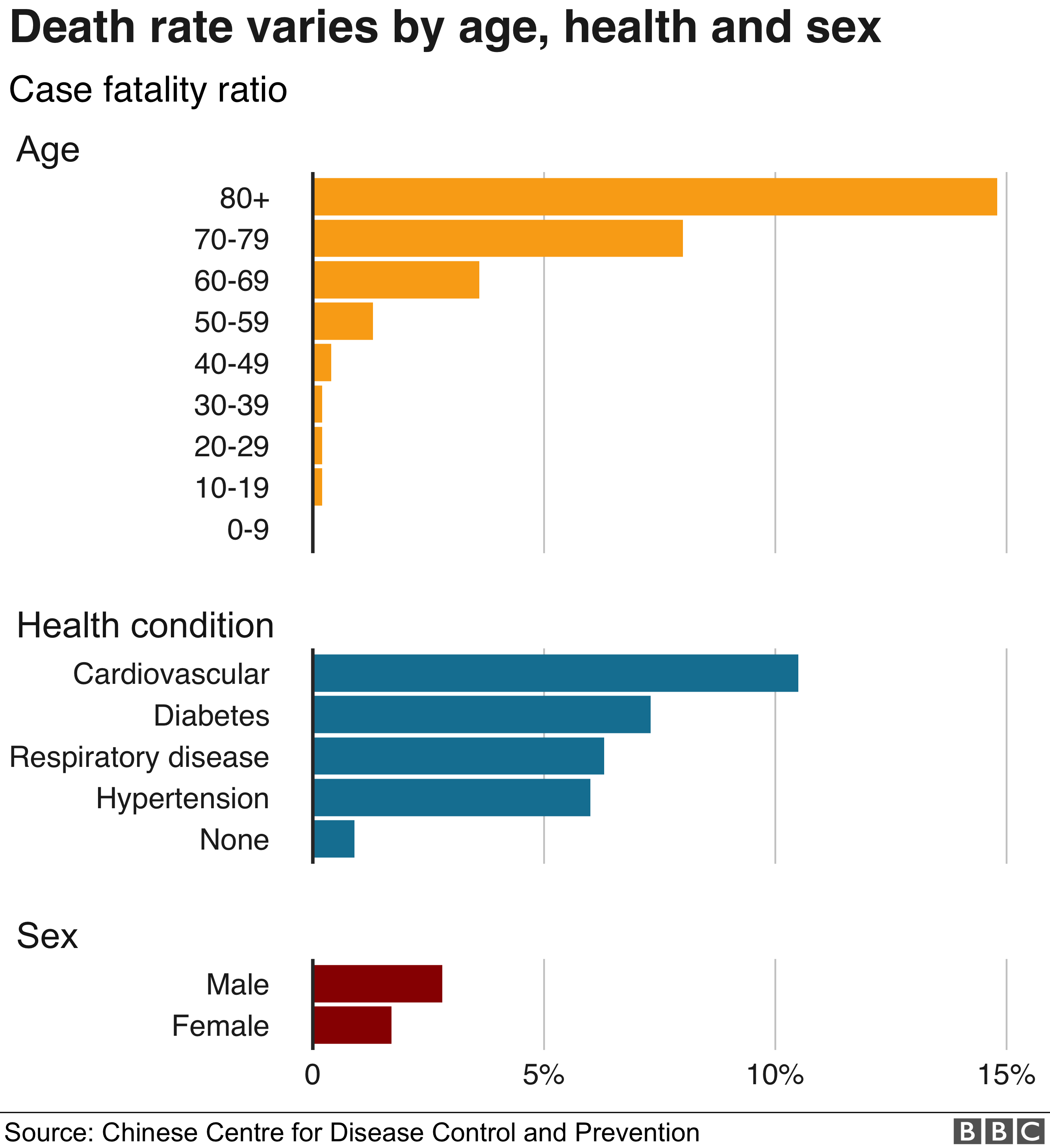
Death rates for different groupsPresentational white spaceWhat has the WHO said?

On Sunday, the World Health Organization (WHO) said the virus appears to particularly affect those over 60, and people already ill.

It urged countries to stock up on ventilators, saying “oxygen therapy is a major treatment intervention for patients with severe Covid-19”.

In the first large analysis of more than 44,000 cases from China, the death rate was 10 times higher in the very elderly compared to the middle-aged.

But most patients have only mild symptoms and the death rate appears to be between 2% and 5%, the WHO said.

By comparison, the seasonal flu has an average mortality rate of about 0.1%, but is highly infectious – with up to 400,000 people dying from it each year.

Other strains of coronavirus, such as Severe Acute Respiratory Syndrome (Sars) and Middle East Respiratory Syndrome (Mers), have much higher death rates than Covid-19.

Source: The BBC

28/01/2020

UK grants Huawei a limited role in 5G, defying President Trump

LONDON (Reuters) – Prime Minister Boris Johnson on Tuesday granted China’s Huawei a limited role in Britain’s 5G mobile network, resisting U.S. pressure to exclude the company from next generation communications on fears China could use it to steal secrets.

In the biggest test of his post-Brexit foreign policy to date, Johnson ruled that “high-risk vendors” would be allowed into the “non-sensitive” parts of 5G networks, but their involvement would be capped at 35%.

They would be excluded from the sensitive core of networks, where data is processed, and banned from all critical networks and sensitive locations such as nuclear sites and military bases, the government said.

The decision will dismay President Donald Trump’s administration which fears China could use Huawei to steal secrets and which has warned that if London gives Huawei a role then it could scale back intelligence cooperation.

“This is a UK-specific solution for UK-specific reasons and the decision deals with the challenges we face right now,” Communications Secretary Nicky Morgan said following a meeting of the National Security Council chaired by Johnson.

Huawei was not mentioned by name in the British government’s statement, but British cyber security officials said they had always treated the company as a “high risk” vendor.

The White House and U.S. state department did not immediately respond for a request to comment.

Huawei, though, was happy.

“Huawei is reassured by the UK government’s confirmation that we can continue working with our customers to keep the 5G roll-out on track,” said Victor Zhang, Vice-President, Huawei.

“This evidence-based decision will result in a more advanced, more secure and more cost-effective telecoms infrastructure that is fit for the future. It gives the UK access to world-leading technology and ensures a competitive market.”

Sources told Reuters last week senior British officials had proposed granting Huawei a limited role in the 5G network – a “calculated compromise” which could be presented to Washington as a tough restriction but also accepted by British operators already using the company’s equipment.

Huawei, the world’s biggest producer of telecoms equipment, says the United States wants it blocked from Britain’s 5G network because no U.S. company can offer the same range of technology at a competitive price.

The United States has argued that as 5G technology evolves, the distinction between the “edge” and “core” will blur as data is processed throughout the network, making it difficult to contain any security risks.

Huawei’s equipment is already used by Britain’s biggest telecoms companies such as BT (BT.L) and Vodafone (VOD.L), but it has been largely deployed at the “edge” of the network and excluded in the “core” where data is processed.

Source: Reuters

11/12/2019

Queen Elizabeth greeted Melania Trump at the Nato summit – did the US first lady dress to impress?

In June, the US first lady joined US President Donald Trump and his children on a trip to Buckingham Palace, but this year she and Trump went alone

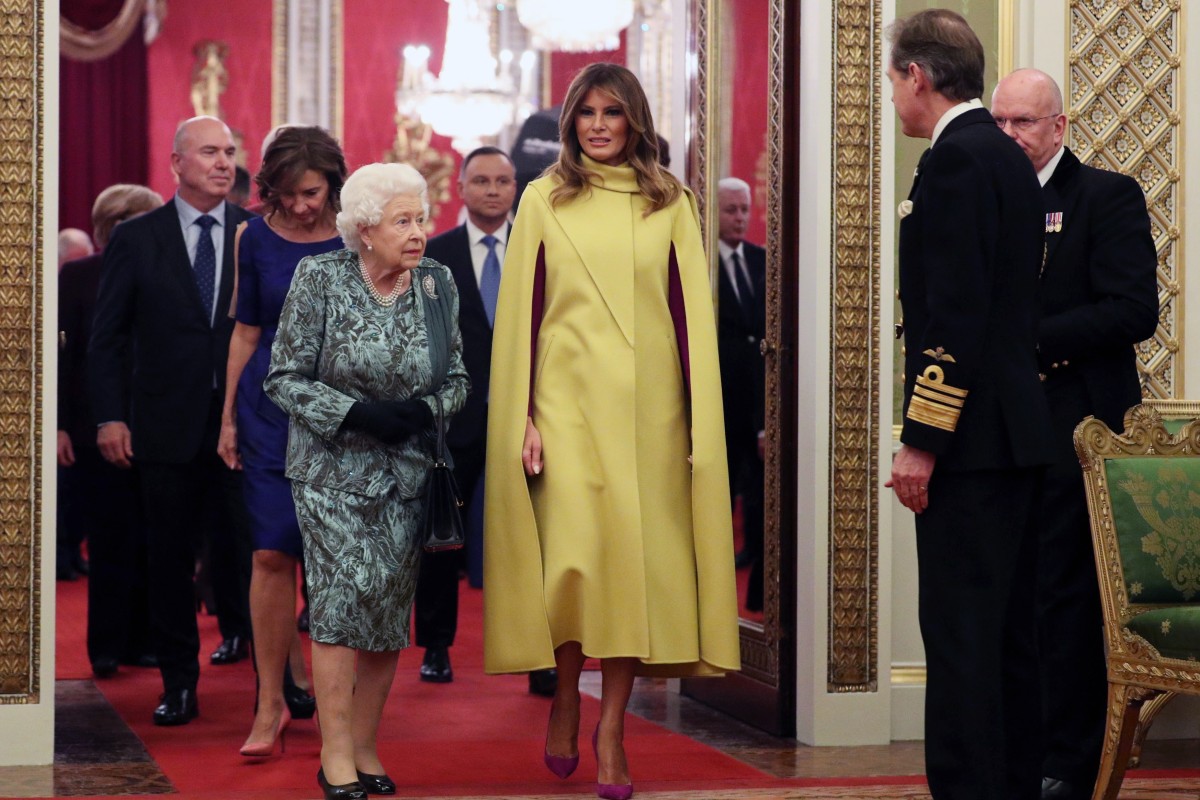
Queen Elizabeth with first lady Melania Trump during a reception at Buckingham Palace. Photo: Yui Mok/EPA-EFE
Away from the developing impeachment inquiry at home, US president Donald Trump flew to Britain for the 70th Nato summit. In the middle of a series of meetings with senior leaders from the world, Trump attended an anniversary event at Buckingham Palace on December 3 hosted by Queen Elizabeth.
From Trump to Lam – dissecting the style statements of 6 women in politics

Compared to his last royal visit in June when he was accompanied by his wife, first lady Melania, and children, Donald Jr, Eric, Ivanka and Tiffany, this time, the US president was only joined by the first lady.

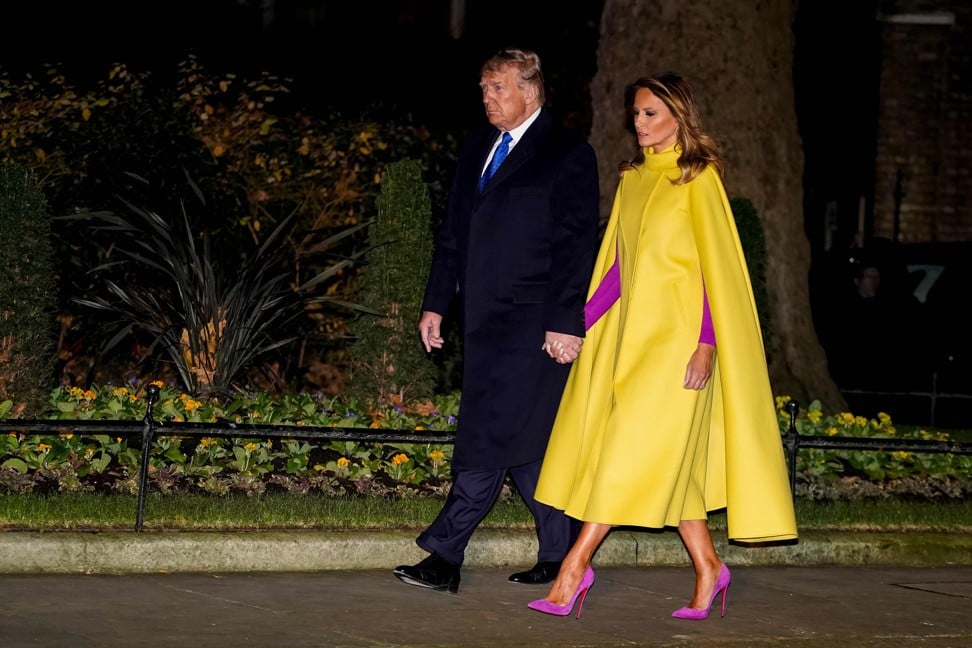
US President Donald Trump and first lady Melania Trump arrive at 10 Downing Street in central London to attend a reception hosted by Britain’s Prime Minister Boris Johnson ahead of the Nato alliance summit. Photo: Niklas Halle’n/AFP
What should you wear when you meet the queen?

Turning up at the reception, the first lady, a former model, was dressed in a striking yellow coat with a dropping cape from Italian fashion house Valentino, matched with a long-sleeve magenta-pink dress underneath. She paired the sleek outfit with a pair of suede Christian Louboutin So Kate pumps that matched the hue of her dress.

Source: SCMP

Law of Unintended Consequences

continuously updated blog about China & India

ChiaHou's Book Reviews

continuously updated blog about China & India

What's wrong with the world; and its economy

continuously updated blog about China & India