Chindia Alert: You’ll be Living in their World Very Soon
aims to alert you to the threats and opportunities that China and India present. China and India require serious attention; case of ‘hidden dragon and crouching tiger’.
Without this attention, governments, businesses and, indeed, individuals may find themselves at a great disadvantage sooner rather than later.
The POSTs (front webpages) are mainly 'cuttings' from reliable sources, updated continuously.
The PAGEs (see Tabs, above) attempt to make the information more meaningful by putting some structure to the information we have researched and assembled since 2006.
Image copyright GETTY IMAGESImage caption Churu in Rajasthan state recorded a temperature of 50C
The Indian capital, Delhi, saw temperatures rise to 47.6C on Tuesday, as most of north India faced severe heatwave conditions.
The heatwave, which officials say is likely to last until the weekend, comes even as the region struggles with rising Covid-19 infections and swarms of locusts that are ravaging crops.
Churu in Rajasthan state recorded a temperature of 50C – India’s highest.
Officials have warned people to stay indoors as far as possible.
The temperatures are the highest that the country has seen in decades for this time of the year. In fact, global weather tracking website El Dorado said the region was the hottest in the world on Tuesday.
Weather officials told local media that part of the reason for the heatwave was the powerful storm – Cyclone Amphan – that struck parts of eastern India and Bangladesh last week.
“Super cyclone Amphan sucked out all the moisture from other parts of the country,” Kuldeep Shrivastava, the head of the regional weather forecasting centre told the Hindustan Times newspaper.
Heat waves in recent years have caused a number of deaths across India. There is still no data about the impact of the current temperatures on people.
However, they come even as thousands of migrants are walking on the highways after fleeing cities to try and go back to their villages. Many are walking with little food and water, and will be among the most exposed to the weather.
Previously, those who have died have included people like daily-wage labourers, rickshaw operators and vegetable vendors – those most exposed to the sun.
In addition to that, the heatwave has affected efforts to combat swarms of locusts that are destroying crops in parts of the country, including Rajasthan.
More than 100 workers are battling the insects, using vehicle-mounted sprayers, pesticides and drones in the searing heat.
Image copyright GETTY IMAGESImage caption Millions are workers are defying a curfew and returning home
When I spoke to him on the phone, he had just returned home to his village in the northern state of Rajasthan from neighbouring Gujarat, where he worked as a mason.
In the rising heat, Goutam Lal Meena had walked on macadam in his sandals. He said he had survived on water and biscuits.
In Gujarat, Mr Meena earned up to 400 rupees ($5.34; £4.29) a day and sent most of his earnings home. Work and wages dried up after India declared a 21-day lockdown with four hours notice on the midnight of 24 March to prevent the spread of coronavirus. (India has reported more than 1,000 Covid-19 cases and 27 deaths so far.) The shutting down of all transport meant that he was forced to travel on foot.
“I walked through the day and I walked through the night. What option did I have? I had little money and almost no food,” Mr Meena told me, his voice raspy and strained.
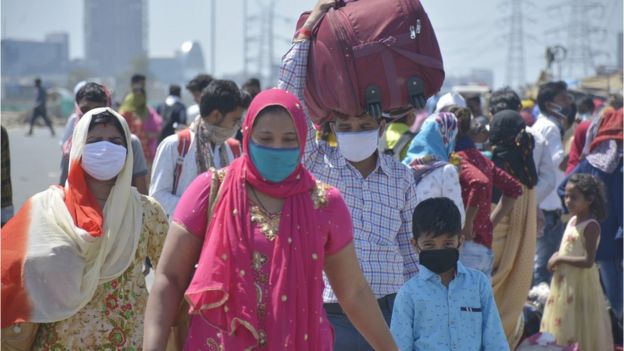
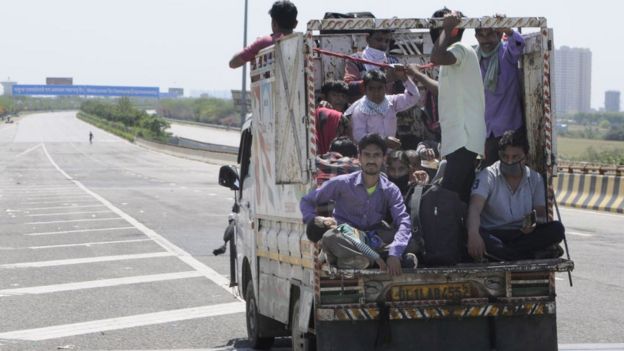
He was not alone. All over India, millions of migrant workers are fleeing its shuttered cities and trekking home to their villages.
These informal workers are the backbone of the big city economy, constructing houses, cooking food, serving in eateries, delivering takeaways, cutting hair in salons, making automobiles, plumbing toilets and delivering newspapers, among other things. Escaping poverty in their villages, most of the estimated 100 million of them live in squalid housing in congested urban ghettos and aspire for upward mobility.
Image copyright GETTY IMAGESImage caption Informal workers are the backbone of India’s big city economies
Last week’s lockdown turned them into refugees overnight. Their workplaces were shut, and most employees and contractors who paid them vanished.
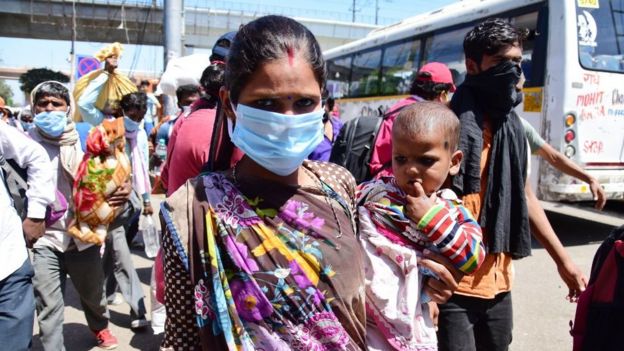
Sprawled together, men, women and children began their journeys at all hours of the day last week. They carried their paltry belongings – usually food, water and clothes – in cheap rexine and cloth bags. The young men carried tatty backpacks. When the children were too tired to walk, their parents carried them on their shoulders.
They walked under the sun and they walked under the stars. Most said they had run out of money and were afraid they would starve. “India is walking home,” headlined The Indian Express newspaper.
The staggering exodus was reminiscent of the flight of refugees during the bloody partition in 1947. Millions of bedraggled refugees had then trekked to east and west Pakistan, in a migration that displaced 15 million people.
Image copyright GETTY IMAGESImage caption Migrant labourers feel they have more social security in their villages
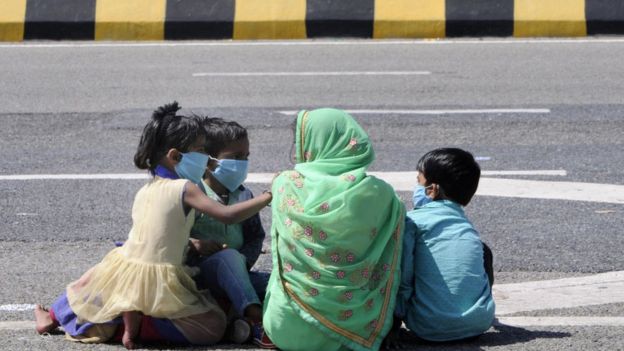
This time, hundreds of thousands of migrant workers are desperately trying to return home in their own country. Battling hunger and fatigue, they are bound by a collective will to somehow get back to where they belong. Home in the village ensures food and the comfort of the family, they say.
Clearly, a lockdown to stave off a pandemic is turning into a humanitarian crisis.
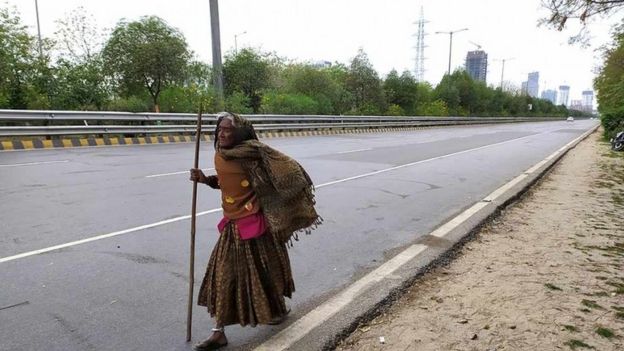
Among the teeming refugees of the lockdown was a 90-year-old woman, whose family sold cheap toys at traffic lights in a suburb outside Delhi.
Kajodi was walking with her family to their native Rajasthan, some 100km (62 miles) away. They were eating biscuits and smoking beedis, – traditional hand-rolled cigarettes – to kill hunger. Leaning on a stick, she had been walking for three hours when journalist Salik Ahmed met her. The humiliating flight from the city had not robbed her off her pride. “She said she would have bought a ticket to go home if transport was available,” Mr Ahmed told me.
Others on the road included a five-year-old boy who was on a 700km (434 miles) journey by foot with his father, a construction worker, from Delhi to their home in Madhya Pradesh state in central India. “When the sun sets we will stop and sleep,” the father told journalist Barkha Dutt. Another woman walked with her husband and two-and-a-half year old daughter, her bag stuffed with food, clothes and water. “We had a place to stay but no money to buy food,” she said.
Then there was Rajneesh, a 26-year-old automobile worker who walking 250km (155 miles) to his village in neighbouring Uttar Pradesh. It would take him four days, he reckoned. “We will die walking before coronavirus hits us,” the man told Ms Dutt.
He was not exaggerating. Last week, a 39-year-old man on a 300km (186 miles) trek from Delhi to Madhya Pradesh complained of chest pain and exhaustion and died; and a 62-year-old man, returning from a hospital by foot in Gujarat, collapsed outside his house and died. Four other migrants, turned away at the borders on their way to Rajasthan from Gujarat, were mowed down by a truck on a dark highway.
As the crisis worsened, state governments scrambled to arrange transport, shelter and food.
Image copyright SALIK AHMED/OUTLOOKImage caption Ninety-year-old Kajodi Devi is walking from Delhi to her village
But trying to transport them to their villages quickly turned into another nightmare. Hundreds of thousands of workers were pressed against each other at a major bus terminal in Delhi as buses rolled in to pick them up.
Delhi chief minister Arvind Kejriwal implored the workers not to leave the capital. He asked them to “stay wherever you are, because in large gatherings, you are also at risk of being infected with the coronavirus.” He said his government would pay their rent, and announced the opening of 568 food distribution centres in the capital. Prime Minister Narendra Modi apologised for the lockdown “which has caused difficulties in your lives, especially the poor people”, adding these “tough measures were needed to win this battle.”
Whatever the reason, Mr Modi and state governments appeared to have bungled in not anticipating this exodus.
Mr Modi has been extremely responsive to the plight of Indian migrant workers stranded abroad: hundreds of them have been brought back home in special flights. But the plight of workers at home struck a jarring note.
“Wanting to go home in a crisis is natural. If Indian students, tourists, pilgrims stranded overseas want to return, so do labourers in big cities. They want to go home to their villages. We can’t be sending planes to bring home one lot, but leave the other to walk back home,” tweeted Shekhar Gupta, founder and editor of The Print.
Image copyright GETTY IMAGESImage caption There is a precedent for this kind of exodus during crisis
The city, says Chinmay Tumbe, author of India Moving: A History of Migration, offers economic security to the poor migrant, but their social security lies in their villages, where they have assured food and accommodation. “With work coming to a halt and jobs gone, they are now looking for social security and trying to return home,” he told me.
Also there’s plenty of precedent for the flight of migrant workers during a crisis – the 2005 floods in Mumbai witnessed many workers fleeing the city. Half of the city’s population, mostly migrants, had also fled the city – then Bombay – in the wake of the 1918 Spanish flu.
When plague broke out in western India in 1994 there was an “almost biblical exodus of hundreds of thousands of people from the industrial city of Surat [in Gujarat]”, recounts historian Frank Snowden in his book Epidemics and Society.
Half of Bombay’s population deserted the city, during a previous plague epidemic in 1896. The draconian anti-plague measures imposed by the British rulers, writes Dr Snowden, turned out to be a “blunt sledgehammer rather than a surgical instrument of precision”. They had helped Bombay to survive the epidemic, but “the fleeing residents carried the disease with them, thereby spreading it.”
More than a century later, that same fear haunts India today. Hundreds of thousands of the migrants will eventually reach home, either by foot, or in packed buses. There they will move into their joint family homes, often with ageing parents. Some 56 districts in nine Indian states account for half of inter-state migration of male workers, according to a government report. These could turn out to be potential hotspots as thousands of migrants return home.
Image copyright GETTY IMAGESImage caption The fleeing migrants could spread the disease all over the country
Partha Mukhopadhyay, a senior fellow at Delhi’s Centre for Policy Research, suggests that 35,000 village councils in these 56 potentially sensitive districts should be involved to test returning workers for the virus, and isolate infected people in local facilities.
In the end, India is facing daunting and predictable challenges in enforcing the lockdown and also making sure the poor and homeless are not fatally hurt. Much of it, Dr Snowden told me, will depend on whether the economic and living consequences of the lockdown strategy are carefully managed, and the consent of the people is won. “If not, there is a potential for very serious hardship, social tension and resistance.” India has already announced a $22bn relief package for those affected by the lockdown.
The next few days will determine whether the states are able to transport the workers home or keep them in the cities and provide them with food and money. “People are forgetting the big stakes amid the drama of the consequences of the lockdown: the risk of millions of people dying,” says Nitin Pai of Takshashila Institution, a prominent think tank.
“There too, likely the worst affected will be the poor.”
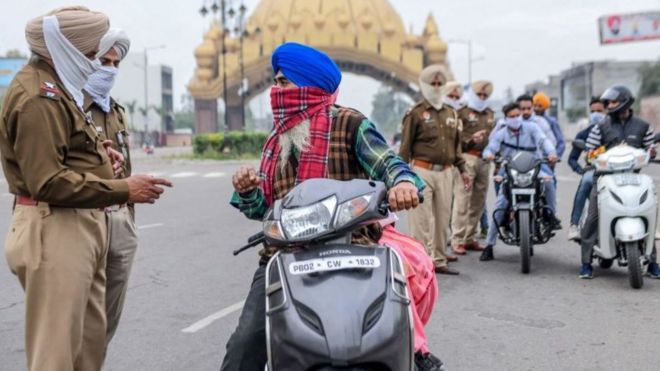
Image copyright GETTY IMAGESImage caption Punjab has 30 confirmed cases of the virus
Indian authorities in the northern state of Punjab have quarantined around 40,000 residents from 20 villages following a Covid-19 outbreak linked to just one man.
The 70-year-old died of coronavirus – a fact found out only after his death.
The man, a preacher, had ignored advice to self quarantine after returning from a trip to Italy and Germany, officials told BBC Punjabi’s Arvind Chhabra.
India has 640 confirmed cases of the virus, of which 30 are in Punjab.
However, experts worry that the real number of positive cases could be far higher. India has one of the lowest testing rates in the world, although efforts are under way to ramp up capacity.
There are fears that an outbreak in the country of 1.3 billion people could result in a catastrophe.
The man, identified as Baldev Singh, had visited a large gathering to celebrate the Sikh festival of Hola Mohalla shortly before he died.
The six-day festival attracts around 10,000 people every day.
A week after his death, 19 of his relatives have tested positive.
“So far, we have been able to trace 550 people who came into direct contact with him and the number is growing. We have sealed 15 villages around the area he stayed,” a senior official told the BBC.
Another five villages in an adjoining district have also been sealed.
This is not the first time that exposure has resulted in mass quarantining in India.
In Bhilwara, a textile city in the northern state of Rajasthan, there are fears that a group of doctors who were infected by a patient could have spread the disease to hundreds of people.
Seven thousand people in villages neighbouring the city are under home quarantine.
India has also declared a 21-day lockdown, although people are free to go out to buy essential items like food and medicine.
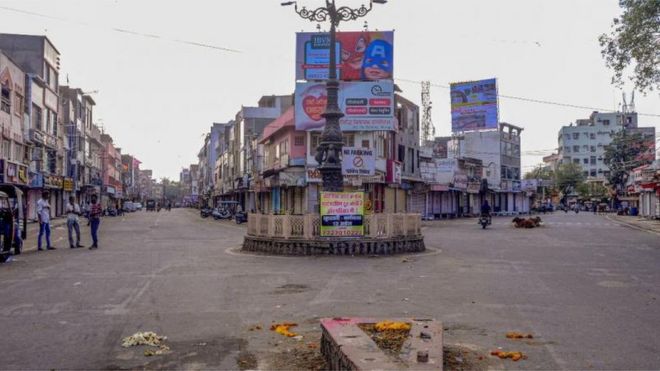
Image copyright PTIImage caption This city of five million people has been under a lockdown since last week
At 05:00 local time (23:30 GMT) of 8 March, the intensive care unit of a private hospital in the northern Indian state of Rajasthan received a 68-year-old man suffering from pneumonia. He was also having problems breathing.
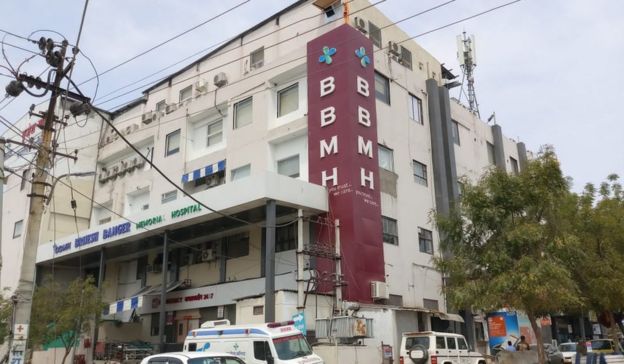
At the Brijesh Bangar Memorial Hospital in Bhilwara, the new patient was examined by 58-year-old Alok Mittal, a doctor of internal medicine, and his team. The patient wasn’t asked about any travel history; nor did he disclose anything. There were six other patients in the ICU.
The man’s condition did not improve much, and two days later, he was sent to a private hospital in Jaipur, some 250km (155 miles) away, for specialised treatment. In Jaipur, he was treated in two hospitals. “We had no idea what was in store,” Shantilal Acharya, an intensive care nurse who received the patient in the Bhilwara hospital, told me.
For reasons that are still unclear, even the hospitals in Jaipur didn’t test a patient with severe pneumonia for coronavirus. His condition deteriorated swiftly and he died a few days later, on 13 March. The news of his death was conveyed to Dr Mittal and his team.
Image copyright SHAUKAT AHMEDImage caption The infection possibly spread from a private hospital in Bhilwara
Strangely enough, the doctors didn’t appear to comprehend the gravity of the situation even though it was clear that India was facing an imminent outbreak of Covid-19. The country has reported more than 460 confirmed cases and nine deaths so far, and testing remains low. On 9 March, according to reports, Dr Mittal and a few others travelled to the city of Udaipur, put up in a resort and played Holi, the Indian spring festival of colours. (Repeated attempts at getting through to Dr Mittal by phone and text yielded no results.)
Days after the death of the pneumonia patient, Dr Mittal and a colleague checked themselves into an isolation ward of a government hospital. Over the next few days, a few more colleagues from the hospital joined them in isolation. Twelve of them, including Dr Mittal, tested positive for Covid-19.
Next day, as news of the infections leaked, all hell broke loose. The private hospital was popular with its residents, and many regularly visited its thriving out-patient department for treatment. As people panicked and began blaming the doctors for spreading the infection, authorities moved swiftly.
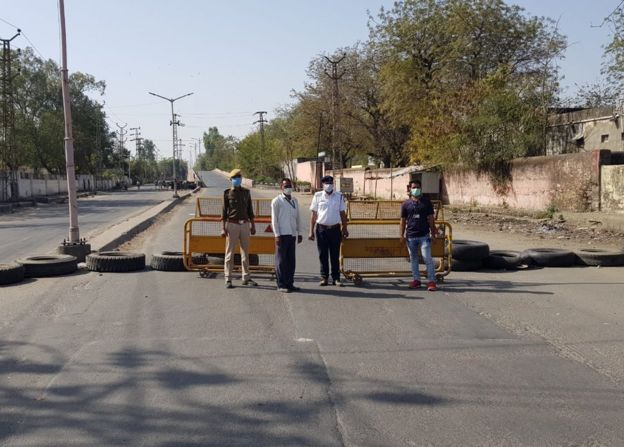
Image copyright SHAUKAT AHMEDImage caption People have been stopped from entering or leaving Bhilwara
They imposed a “civil curfew”, prohibiting people from coming out of their homes and banning public gatherings. They shut schools, colleges, offices, and stopped people from leaving or entering the district. The private hospital was sealed and its 88 patients moved to other healthcare facilities in the area. “Officials were telling us the threat was serious and there was a chance of an outbreak,” local journalist Pramod Tiwari told me.
So Bhilwara, fearing a serious outbreak, did everything that India did a few days later. So could this city of 400,000 people and a major textile making hub, turn out to be India’s first coronavirus “hotspot”?
Of the 69 people tested in the city until Sunday evening, 13 people – including doctors and paramedics – aged between 24 and 58, have tested positive. They include three doctors and nine health workers. Thirty-one people – mostly hospital workers – are in isolation. “Most of them are doing fine,” Dr Arun Gaur, the chief medical officer of the district, told me.
But things could get really bad.
Between 20 February and before going into isolation last week, Dr Mittal and his team of doctors at the hospital saw 6,192 patients who came from 13 districts of Rajasthan and 39 patients belonging to four other states. Drawing from the experience in China and Italy, doctors now know that hospitals might turn out to be the “main source” of Covid-19 transmission. Also, both MERS and SARS had high transmission rates within hospitals. The potential for community transmission of the infection across a large geographical area from the Bhilwara hospital is real, officials fear.
Image copyright SHAUKAT AHMEDImage caption The city’s borders have been sealed
So did the virus reach this city through the patient who was treated at three hospitals and went untested before he died? Or did one of the more than 80 patients admitted in the hospital transmit it? Or was it spread by another patient in the intensive care? Or had one of the doctors picked up the infection separately and spread it unknowingly?
Nobody will know until all the contact tracing and testing is complete, and that’s the scary part.
The lack of early credible information on the transmission meant that rumours had a field day. Local media reported that one of the infected doctors had received guests from Saudi Arabia at home and had contracted the infection. He had then gone to the hospital and spread the infection to co-workers, the reports added.
Dr Niyaz Khan had to record a mobile phone video from his intensive care bed to squelch the rumour. With monitors beeping around him, Dr Khan, masked and breathless, implored: “Just to set the record straight, I have no relative in Saudi Arabia. I have a son and a wife. None of them is positive. Please don’t believe what is coming in the media.” Another doctor said it was unfair to blame the hospital: “The patient fooled us and told us he didn’t travel outside the country for the two days he was in the ICU with us.” And Dr Mittal himself – his wife has also tested positive – recorded videos in isolation saying that he had tested positive, and he was doing well. “Please do not panic,” the well-known doctor said.
Image copyright GETTY IMAGESImage caption Residents in the city have begun panicking
That is easier said than done.
Realising the gravity of the situation, 300 teams of government workers and volunteers have fanned out in Bhilwara city. They are knocking on the doors of some 78,000 houses, and asking residents whether they’ve had a guest from outside the country, been treated in the hospital or know anyone who has tested positive. The survey began on 18 March and will finish on 25 March. “They are asking if we have cold, cough and fever and telling us if we have any of the symptoms we should report for tests at the government hospital,” a resident told me.
Another 1,900 similar teams have travelled out into neighbouring villages where more than 2.5 million people live. People in homes with suspect cases are being put into quarantine. Seven thousand people have been put into home quarantine so far.
Fearing a surge in infections, 20 more beds are being added to the hospital’s 30-bed isolation ward, which is already full. Six private hospitals have promised to provide an additional 35 beds for isolation. Thirteen places with 450 beds – extendable to 2,000 beds – where people can be quarantined have also been identified, Rajendra Bhatt, the senior-most official of the district told me. “It’s like fighting a war, but we have been agile and alert,” he said.
Meanwhile the residents, like elsewhere in India, are enduring an extended lockdown and curfew. Rajkumar Jain, a professor of computer science, is locked down with 14 members of his joint family in a two-storey home. “We are in complete panic,” he told me. “People are saying here that Bhilwara is going to become India’s Italy.”
Media captionWATCH: Millions of Indians bang pots and pans in support of health workers
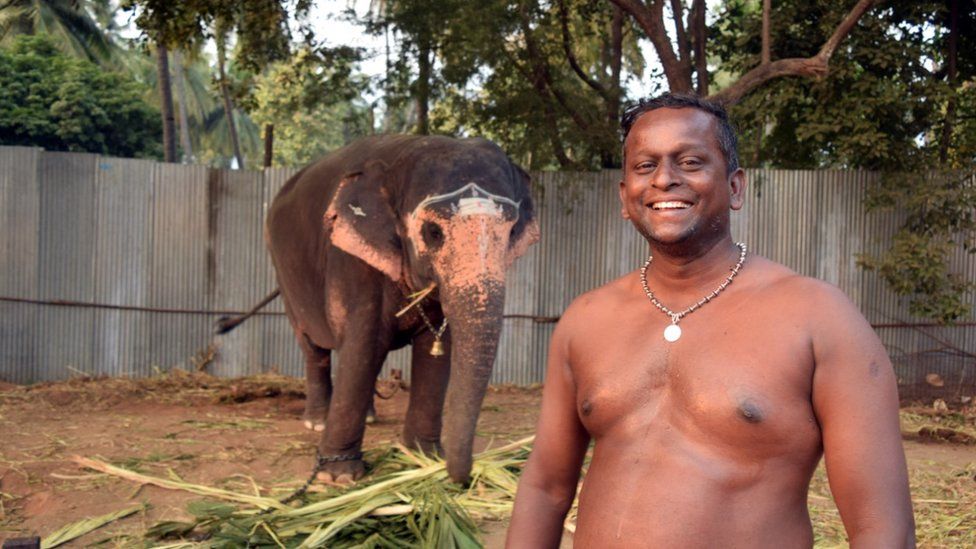
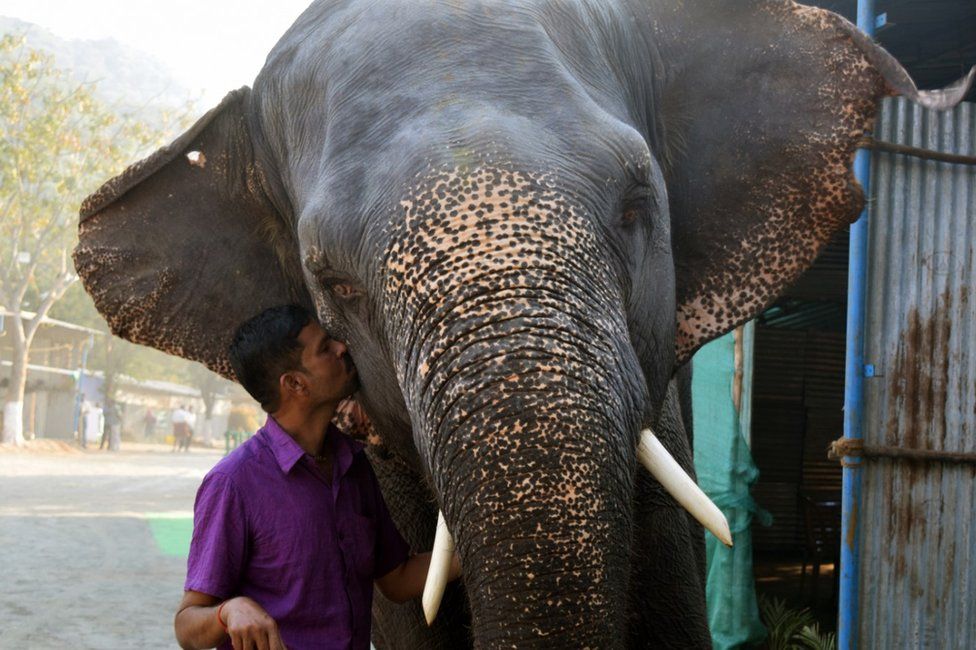
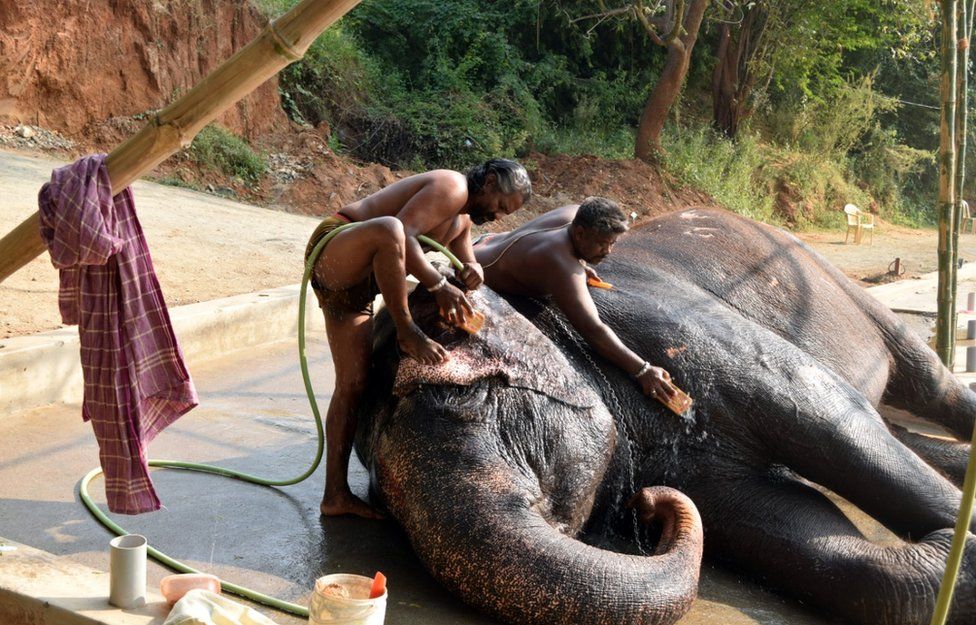
Image caption Arjun, the caretaker, pictured above with temple elephant, Akila
Once a year, some of India’s captive elephants are whisked off to a “rejuvenation camp”, where they are pampered and cared for by their caretakers. Omkar Khandekar visited one such retreat in the southern state of Tamil Nadu.
After seven years of being a local celebrity, Akila the elephant knows how to pose for a selfie. She looks at the camera, raises her trunk and holds still when the flash goes off.
It can get tiring, especially when there are hundreds of requests every day.
Despite this, Akila, performs her daily duties diligently at the Jambukeswarar temple. These include blessing devotees, fetching water for rituals in which idols of the deity are bathed, and leading temple processions around the city, decked up in ceremonial finery.
And, of course, the selfies.
But every December, she gets to take a break.
“When the truck rolls in, I don’t even have to ask her to hop in,” Akila’s caretaker B Arjun said. “Soon, she will be with her friends.”
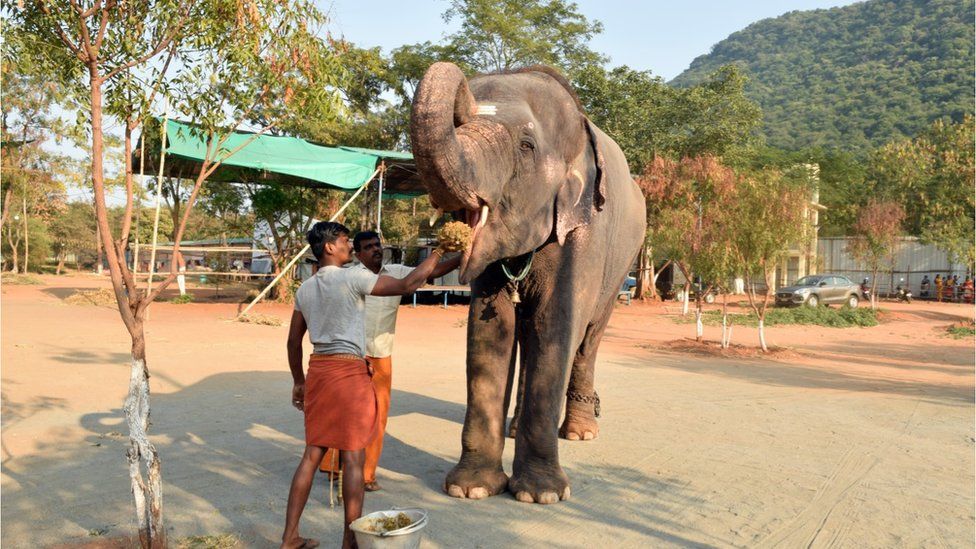
Image caption Elephants sold to temples in Tamil Nadu are brought to this camp every year
India is home to some 27,000 wild elephants. A further 2,500 elephants are held in captivity across the states of Assam, Kerala, Rajasthan and Tamil Nadu.
The country is widely believed to be the “birthplace of taming elephants for use by humans”. Elephants here have been held in captive by Indians for millennia. But 17 years ago, after protests by animal rights activists over instances of handlers abusing and starving captive elephants, the government stepped in to give the animals a bit of respite.
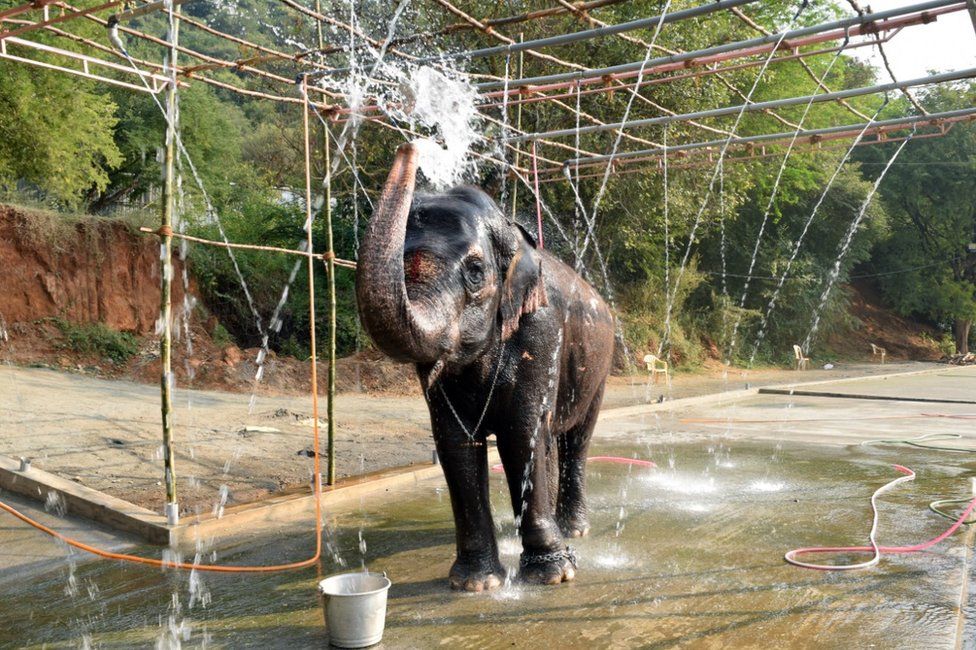
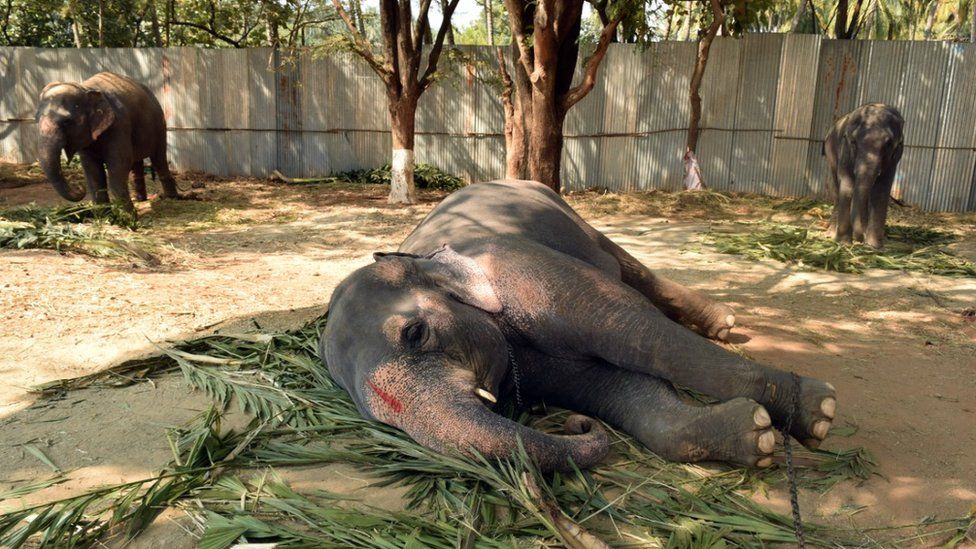
As a result, Akila and numerous other elephants held in temples around India are now brought to a “rejuvenation camp” each year, their caretakers in tow. For several weeks, the animals unwind in a sprawling six-acre clearing in a forest at the foothills of Nilgiris, part of the country’s Western Ghats.
Image caption India has more than 2,000 captive elephants
The camps were described as an animal welfare initiative and have become a popular annual event for the state’s temple elephants.
The one Akila and 27 other elephants are attending currently opened on 15 December last year, and will go on until 31 January, costing about $200,000 (£153,960) to run.
Supporters argue it is money well spent. A break from the city for these elephants is therapeutic, explains S Selvaraj, a forest officer in the area.
“Wild elephants live in herds of up to 35 members but there’s only one elephant in a temple,” he says. “For 48 days here, they get to be around their own kind and have a normal life.”
Image caption It costs about $200,000 to run the six-week annual camp
Akila, who is 16 years old, has been a regular at the camp since 2012, the year she was sold to the temple. Arjun, who has accompanied her every year, is a fourth-generation elephant caretaker.
At the camp, he bathes Akila twice a day, feeds her a special mix of grains, fruits and vegetables mixed with vitamin supplements and takes her for a walk around the grounds. A team of vets are on hand to monitor the health of the camp’s large guests, while at the same time tutoring their handlers in subjects like elephant diet and exercise regimes.
Akila has even forged a friendship with Andal, an older elephant from another temple in the state, said Arjun.
But despite the shady trees and quiet, the getaway is a far cry from an elephant’s “normal life”.
Image caption The government initiated such camps after protests over instances of handlers abusing captive elephants
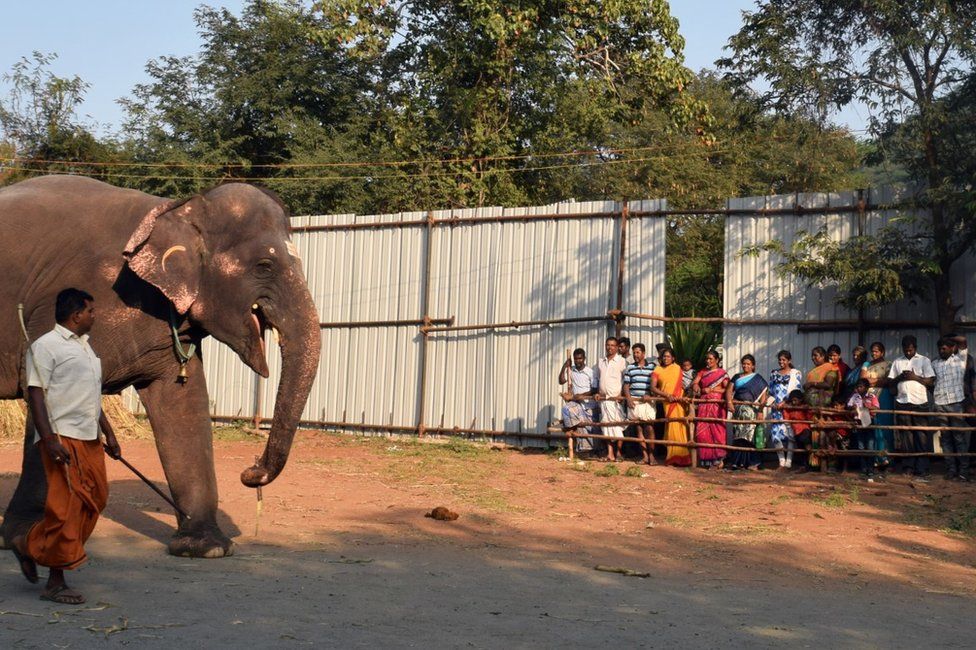
The walled campus has eight watchtowers and a 1.5km (0.93 miles) electric fence around its perimeter. While the elephants appear well cared for, they spend most of their time in chains and are kept under the close eye of their caretakers.
And one six-week rejuvenation camp a year does little to assuage the stress of temple elephants’ everyday lives, activists say.
“Elephants belong in jungles, not temples. A six-week ‘rejuvenation camp’ is like being let out on parole while being sentenced for life imprisonment,” argues Sunish Subramanian, of the Plant and Animals Welfare Society in the western city of Mumbai.
“Even at these camps, the animals are kept in chains and often in unhygienic conditions,” he adds. “If you must continue with the tradition, temple elephants should be kept in the camps for most of the year – in much better conditions – and taken to the temples only during festivals.”
Image caption The camps have been described as an animal welfare initiative
Even among the company of their own, the elephants – like Andal and Akila – aren’t allowed to get too close.
“I have to make sure the two keep their distance – otherwise, it’ll be difficult to separate them when we go back,” Arjun explains.
It is not just the animal rights activists who have concerns, however.
The camp has become a tourist spot in recent years, attracting a steady stream of visitors from neighbouring villages. Most watch, wide-eyed, from the barricades. But not everyone outside the camp is happy.
In 2018, a farmers’ union representing 23 villages nearby, petitioned a court to relocate the camp elsewhere. The petition claimed that the scent of the animals – all female, as is the norm among temple elephants – attracted male elephants from the wild.
This has caused them to go on the rampage, often destroying crops that farmers depend on for their livelihood. The union says 16 people have died in such incidents.
Image caption The camp has also become a popular tourist spot in recent years
But the court rejected the petition. Instead, it asked why there were human settlements in what was identified as an elephant corridor. It also criticised the state government’s tokenism of rejuvenation camps.
“Some day,” it said, “this court is going to ban the practice of keeping elephants in temples.”
But Arjun can’t bear the thought of parting with Akila.
“I love her like my mother,” he says. “She feeds my family, just like my mother used to. Without her, I don’t know what to do.”
But he also understands that his elephant can get lonely. “And that’s why I work twice as hard to make sure she doesn’t.”
NEW DELHI (Reuters) – India warned of severe heat in northern and central areas on Monday, following similar extreme weather on Sunday.
Of the 15 hottest places in the world in the past 24 hours, eight were in India with the others in neighbouring Pakistan, according to weather monitoring website El Dorado.
Churu, a city in the west of the northern state of Rajasthan, recorded the country’s highest temperature of 48.9 Celsius (120 Fahrenheit) on Monday, according to the Meteorological Department.
Churu has issued a heat wave advisory and government hospitals have prepared emergency wards with extra air conditioners, coolers and medicines, said Ramratan Sonkariya, additional district magistrate for Churu.
Water is also being poured on the roads of Churu, known as the gateway to the Thar desert, to keep the temperature down and prevent them from melting, Sonkariya added.
A farmer from Sikar district in Rajasthan died on Sunday due to heatstroke, state government officials said.
Media reported on Friday that 17 had died over the past three weeks due to a heatwave in the southern state of Telangana. A state official said it would confirm the number of deaths only after the causes had been ascertained.
The temperature in New Delhi touched 44.6C (112.3F) on Sunday. One food delivery app, Zomato, asked its customers to greet delivery staff with a glass of cold water.
Heat wave warnings were issued on Monday for some places in western Rajasthan and Madhya Pradesh state.
The monsoon, which brings down the heat, is likely to begin on the southern coast on June 6, the weather office said last month.
The three-month, pre-monsoon season, which ended on May 31, was the second driest in the last 65 years, India’s only private forecaster, Skymet, said, with a national average of 99 mm of rain against the normal average of 131.5 mm for the season.
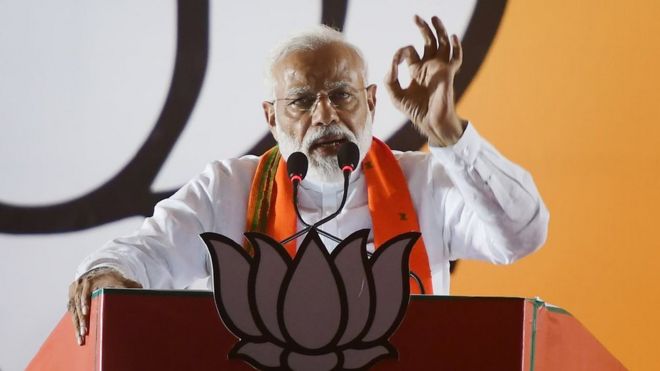
Image copyright GETTY IMAGESImage caption Mr Modi said he will not forgive Pragya Thakur
India is in full election mode: voting began on 11 April, and the final ballot will be cast on 19 May with results out on 23 May. Every day, the BBC will be bringing you all the latest updates on the twists and turns of the world’s largest democracy.
What happened?
Indian Prime Minister Narendra Modi has attended first ever press conference at the Bharatiya Janata Party (BJP) head office in Delhi – days before Indians take part in the final stage of voting.
But journalists were left disappointed as he did not take any questions, and instead largely talked about his government’s achievements.
“I have come to thank the country for blessing me. I have seen a lot of ups and downs but the country stayed with me,” he said.
Mr Modi also spoke of his pride in India’s democratic process and said he needs to show the world “how diverse our democracy is”.
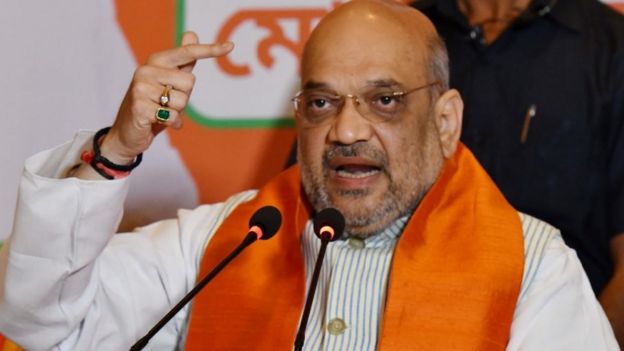
Mr Modi was seated next to party president Amit Shah. He said he would not take questions because the press conference was Mr Shah’s.
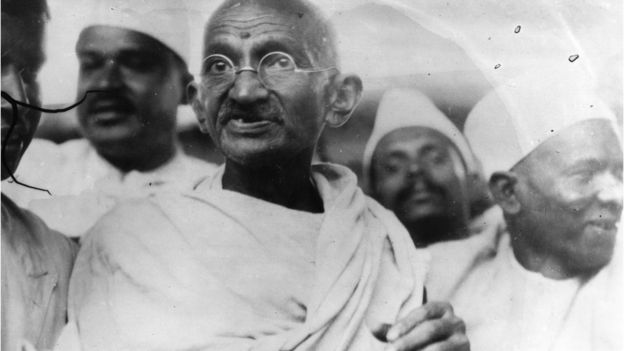
Earlier, the prime minister said he would “never be able to forgive” those who have “insulted” Mahatma Gandhi.
Mr Modi’s statement comes after controversial Bharatiya Janata Party (BJP) politician Pragya Thakur called Nathuram Godse – the man who assassinated Mahatma Gandhi – a “patriot”.
Ms Thakur apologised after several leaders, including those from the BJP, criticised her.
“Such statements should be condemned. There is no place in society for such comments. She [Ms Thakur] may have apologised, but I will never be able to forgive her,” he said in an interview to News24 TV channel.
Why does this matter?
This is the first time Mr Modi has attended a press conference as prime minister while in India. Most of his press conferences have been on state visits to other countries and often involved little more than reading out an official statement.
He has given some one-on-one interviews to Indian media, though critics say that these have largely been tightly controlled and given to journalists seen as sympathetic to him. However in recent weeks he has given a flurry of interviews to several leading publications and television channels, including those that have been critical of him.
But if people were expecting a complete about-turn in his media policy this time, they would have been disappointed.
This caused some frustration among journalists on Twitter.
Also on Friday, a BJP candidate apologised for calling Gandhi’s killer a patriot
Image copyright GETTY IMAGES
What is happening?
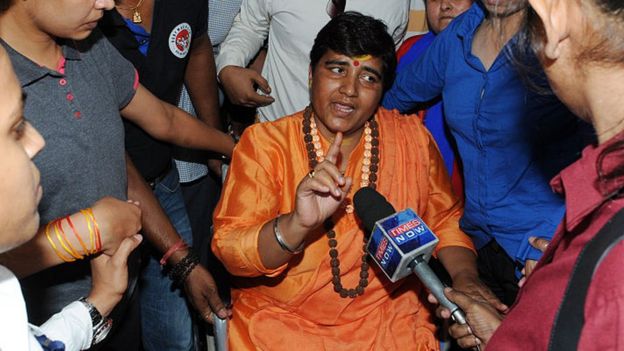
Bharatiya Janata Party (BJP) politician Pragya Thakur has apologised after calling Nathuram Godse – the man who assassinated Mahatma Gandhi – a “patriot”.
Several political parties had criticised her comment and her own party demanded that she should publicly apologise.
“It was my personal opinion. My intention was not to hurt anyone’s sentiments. If I’ve hurt anyone, I do apologise. What Gandhi Ji has done for the country cannot be forgotten. My statement has been twisted by the media,” Ms Thakur said on Thursday evening.
She made the comment after actor-turned politician Kamal Haasan said Godse was India’s first Hindu “extremist” earlier this week.
Why does this matter?
The BJP as well as opposition parties immediately reacted to her comment, which also caused a storm on social media.
BJP spokesperson GVL Narasimha Rao said that the party does not agree with her statement, and asked her to publicly apologise.
The main opposition Congress party demanded an apology from Prime Minister Narendra Modi and said that the BJP should take “punitive action” against Ms Thakur.
Congress spokesperson Randeep Surjewala said that “insulting martyrs is in the BJP DNA” and that the “soul of the nation” has been hurt by her remarks.
Congress party leader Priyanka Gandhi also lashed out at the BJP.
Political analysts also say that her comments have put the BJP in a tough spot, since Mr Modi and BJP president Amit Shah defended their decision to field her as a candidate despite terror charges against her.
Her candidature caused outrage as she is an accused of involvement in a blast that killed seven people and injured 100 others. Ms Thakur denies all charges against her.
However, Ms Thakur’s comments do reflect the views of some right-wing Hindus who support the BJP and have long seen Gandhi as too moderate.
Godse, who shot Gandhi in the chest three times at point-blank range on 30 January 1948, was also an activist with nationalist right-wing groups, including those closely associated with the BJP.
Hindu hardliners in India accuse Gandhi of having betrayed Hindus by being too pro-Muslim, and even for the division of India and the bloodshed that marked Partition, which saw India and Pakistan created after independence from Britain in 1947.
On Thursday, a ruling party candidate called Gandhi’s killer a patriot
What happened?
Controversial Bharatiya Janata Party (BJP) politician Pragya Thakur made headlines again. This time it was for calling Nathuram Godse – the man who assassinated Mahatma Gandhi – a “patriot”.
Her comment was made in response to a statement by southern actor-turned politician Kamal Haasan who had said India’s first “extremist” was a Hindu”, referring to Godse.
His statement, made on Monday, was heavily criticised by the BJP, which accused him of indulging in “divisive politics” and filed a complaint against him with the Election Commission of India.
Why does this matter?
The BJP responded by criticising Ms Thakur and asking her to publicly apologise.
“BJP does not agree with this statement, we condemn it. Party will ask her for clarification, she should apologise publicly for this statement,” party spokesperson GVL Narasimha Rao told reporters.
Image copyright GETTY IMAGES
Ms Thakur has seen her fair share of controversy. Her candidature caused outrage as she is an accused of involvement in a blast that killed seven people and injured 100 others. On 18 April, she said that police officer Hemant Karkare had died in the November 2008 Mumbai terror attacks because she had “cursed” him. She was then banned from campaigning for 72 hours as a result.
A team led by Mr Karkare had arrested her for questioning in connection with the Malegaon blast.
During her campaign, she also said she was “proud” of her part in the demolition of the 16th Century Babri mosque. In 1992, right-wing Hindu mobs razed the mosque to the ground, claiming it was built on the site of a temple destroyed by Muslim rulers. The site, which is in the city of Ayodhya, has been a religious flashpoint for Hindus and Muslims for decades.
Campaigning ended in West Bengal a day before deadline
What happened?
The Election Commission (EC) told political parties to end their campaigning in West Bengal state, a day before the deadline in the wake of poll-related violence.
The campaign will end on Thursday at 10pm local time, and voting will be held on Sunday.
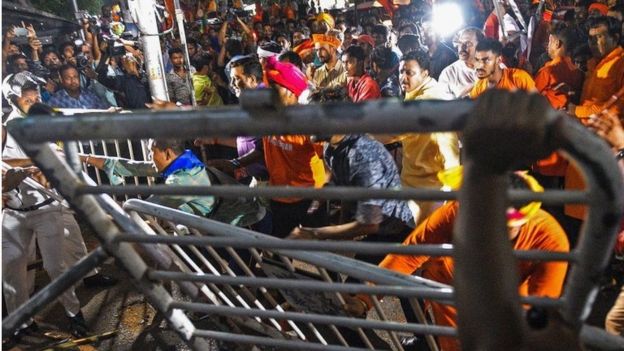
The decision comes after clashes broke out between the Bharatiya Janata Party (BJP) workers and protesters believed to be from the ruling Trinamool Congress (TMC) in Kolkata (formerly Calcutta) on Tuesday.
It happened during a roadshow of BJP chief Amit Shah. Several people were injured and vehicles were set on fire. A statue of renowned Bengali reformer Iswarchandra Vidyasagar was also vandalised in the clashes.
Both parties have accused each other of starting the violence.
Why does this matter?
Image copyright GETTY IMAGESImage caption Violence took place during BJP chief Amit Shah’s rally in Kolkata on Tuesday
The BJP welcomed the decision, saying it validated their argument that the state had “descended into anarchy” under the leadership of chief minister Mamata Banerjee.
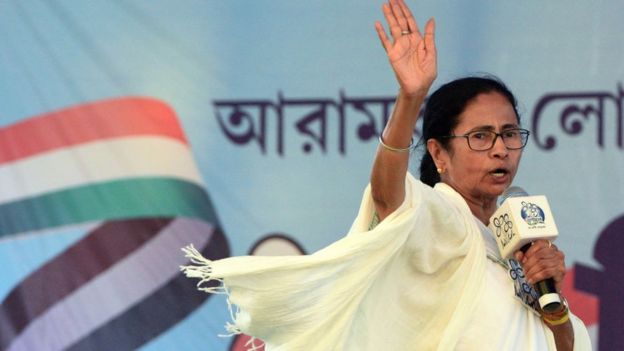
Ms Banerjee said that the move was “undemocratic” and “it had insulted the people of Bengal”.
“Tomorrow, [Prime Minister Narendra] Modi has two meetings in Bengal. When he finishes, the campaigning also ends… Instead of punishing Amit Shah, the Election Commission has given a gift to the BJP,” she said.
Image copyright AFPImage caption Several people were injured and vehicles were set on fire during the violence
Both parties are locked into a fierce election battle to win most out West Bengal’s 42 seats. Ms Banerjee has ambitions of becoming the prime minister in case a nationwide coalition of regional parties wins enough seats.
The state has also become crucial for the BJP as it’s trying to expand its reach in the eastern state. It won only two seats in the 2014 election.
The BJP performed well in northern states like Uttar Pradesh and Rajasthan in 2014, but this time it’s expected to suffer loses against a coalition of regional parties and the main opposition Congress.
So the party is trying to make up for the losses in West Bengal.
On Wednesday, the TMC and the BJP accused each other of poll violence
Image copyright GETTY IMAGES
What happened?
The war of words between West Bengal state chief minister Mamata Banerjee and the governing Bharatiya Janata Party (BJP) intensified ahead of voting on Sunday.
The latest verbal duel comes after violence was reported during BJP chief Amit Shah’s roadshow in Kolkata (formerly Calcutta) on Tuesday.
Clashes broke out between BJP supporters and protesters who were holding “Amit Shah go back” posters.
Some people suffered minor injuries and a few vehicles were set on fire.
The BJP said the protest was “orchestrated” and called it an “attempt to strangulate democracy”.
Why does this matter?
The eastern state has become politically crucial for the BJP as it has intensified campaigning in the past few days.
And that has sparked a feverish electoral battle between the BJP and Ms Banerjee’s Trinamool Congress (TMC).
“What does Amit Shah think of himself? Is he above everything? Is he god that no one can protest against him?” Ms Banerjee said.
In reply, Mr Shah accused the TMC of not following democratic norms during elections.
“Have faith in the people of Bengal that they’d face the TMC goons,” he said.
Prime Minister Narendra Modi is scheduled to hold more rallies in the coming days, so one can expect more verbal fireworks from the two leaders.
On Tuesday, the saga of the morphed Mamata meme continued
What happened?
India’s top court stepped in to release an activist belonging to India’s governing Bharatiya Janata Party (BJP) who was sent to prison for sharing a doctored image of West Bengal Chief Minister Mamata Banerjee.
Priyanka Sharma was sentenced to two weeks in prison on 10 May after she shared a picture of Bollywood star Priyanka Chopra and her husband Nick Jonas at the Met Gala – but with Ms Banerjee’s head superimposed on to Chopra’s body.
Earlier the court had said Ms Sharma could be released only if she apologised to Ms Banerjee, but later waived this condition.
Why does this matter?
The battle for West Bengal in this general election has been absolutely bruising.
The BJP, led by Prime Minister Narendra Modi himself, has been campaigning hard for votes in the state. This has brought them toe-to-toe with the state’s feisty chief minister. The fact that voting for West Bengal’s 42 seats has been split across all nine phases of voting has meant that the battle has been long and drawn-out.
And with just one phase to go before voting finally ends, the gloves are well and truly off. The two parties have traded insults on the campaign stage, their workers have attacked each other, and the violence on the ground has intensified. And now the battle has spread to cyberspace as well.
The country’s finance minister Arun Jaitley jumped at news of Ms Sharma’s release to call Ms Banerjee a dictator.
Analysts say that this political row is so bitter because the BJP has clearly identified West Bengal as one of the states where they may be able to make gains this election. This becomes more important for the party in the context of their fight in the politically crucial state of Uttar Pradesh, which sends the most number of MPs (80) to parliament.
They are up against a powerful coalition of regional parties there, and many expect them to lose seats as a result.
And PM Modi said Rahul Gandhi should be ashamed of 1984 riots
What happened?
Prime Minister Narendra Modi said that main opposition Congress party chief Rahul Gandhi should be “ashamed of himself” over his colleague’s remark on the 1984 anti-Sikh riots.
Mr Modi was replying to a controversial statement made by Sam Pitroda, who is a strategist of the Congress party.
In his reply to a question about the Congress’ role in the riots, Mr Pitroda had said “so what?”.
“I don’t think so, this is also another lie, and what about 1984? You speak about what you [Mr Modi] have done in five years. It [the riots] happened in 1984, so what?” he said.
Mr Gandhi said he was “ashamed” of Mr Pitroda’s statement, and asked him to apologise.
Mr Pitroda later said his statement was “twisted” and he did not mean to hurt sentiments.
But Mr Modi said the Congress chief “must apologise”.
“I was watching that naamdar [the dynast] told his guru that he should be ashamed of what he said. I want to ask naamdar, you pretended to scold your mentor for what? Because he exposed what was always in the Congress’s heart, and in the discussions of the naamdar family? Because he made public a family secret? Naamdar, it is you who should be ashamed,” Mr Modi said.
Why does this matter?
The controversy matters because it comes days ahead of voting for the 13 seats in the northern state of Punjab.
The BJP, which has formed a coalition with regional Shiromani Akali Dal, is locked in a bitter electoral battle with the ruling Congress in the state.
Sikhs are a majority in the state and the 1984 riots is still an emotional issue for many of them.
More than 3,000 Sikhs were killed in 1984 after the assassination of former prime minister Indira Gandhi by her Sikh bodyguards.
They were angry at her decision to send the army into the Golden Temple – Sikhism’s holiest shrine – to flush out militants earlier in the year.
The killing of Mrs Gandhi, who belonged to the Congress, saw mobs attack and murder members of the Sikh community across the country.
And both parties appear to be trying to come across as pro-Sikh ahead of the vote on 19 May.
On Sunday, Delhi voted but not enthusiastically
Image copyright GETTY IMAGESImage caption Delhi’s voter turnout was lower than in 2014
What happened?
Sunday saw India’s capital Delhi vote along with several other states in the polls – the penultimate phase of the country’s mammoth general election.
Voters turned out to vote, but in fewer numbers than they did in 2014. The election commission said that around 60% of the capital’s registered voters had actually cast ballots, which was about a five percent drop from 2014.
Delhi Chief Electoral Officer Ranbir Singh expressed disappointment, saying that the turnout did not match expectations.
Why does this matter?
The election commission is right to be disappointed – it had run a series of campaigns in the city, encouraging more people to vote.
But it was not as though polling in Delhi was an entirely smooth process. Some voters complained that their names were missing from electoral lists even though they had all the necessary documents. There were also reports that around 1,200 Electronic Voting Machines (EVMs) had malfunctioned across the city, delaying the polling process.
The fact that Delhi became a three-cornered contest after the main opposition Congress and the Aam Aadmi Party (AAP), which controls the Delhi state assembly, failed to stitch up an alliance may also have put voters off. Many analysts believe that this failure will only split voters who were against prime minister Narendra Modi’s Bharatiya Janata Party (BJP) and effectively hand them victory.
So they may have decided to just stay home, and not bother queuing up in the blistering heat – it touched 40C on Sunday.
No other injuries reported following accident on southern island of Hainan
Military is currently intensifying training for pilots as it looks to strengthen capabilities
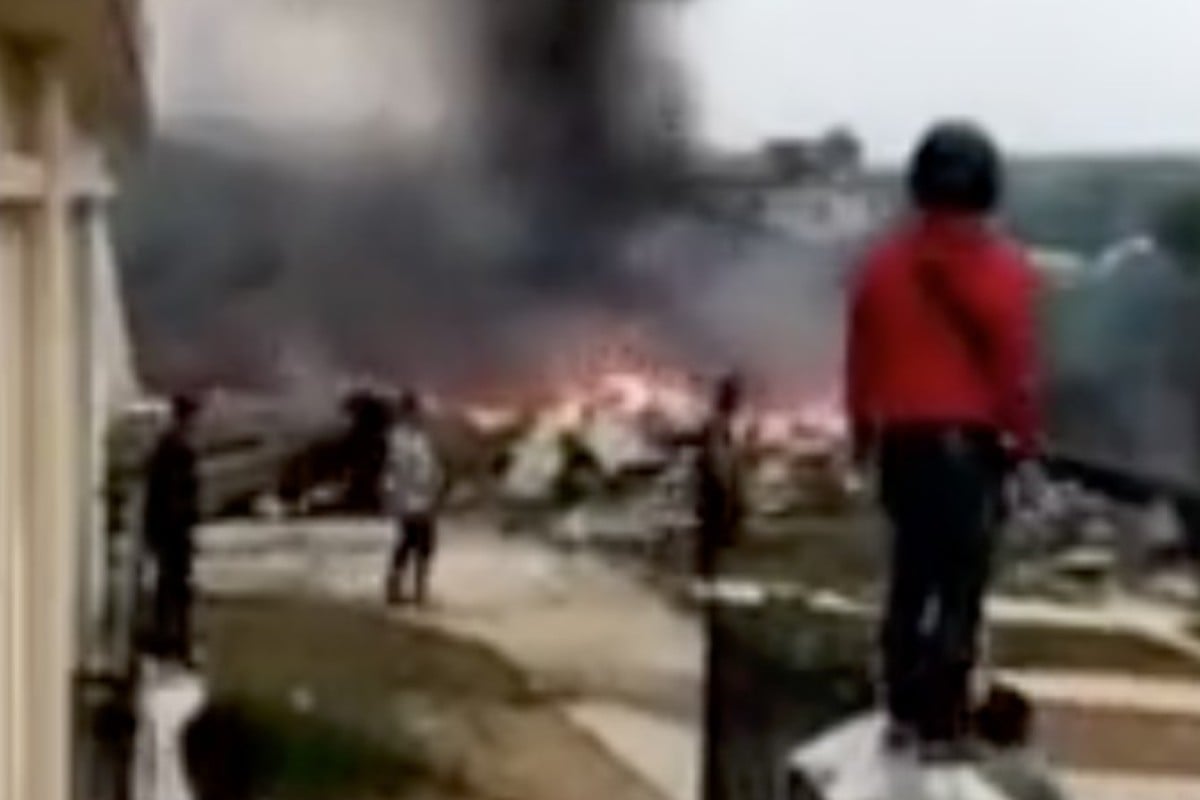
Mobile phone footage believed to be taken from the crash site. Photo: Handout
A Chinese navy plane crashed in Hainan province on Tuesday killing two crew members, the military said.
A short statement said the crash happened during a training exercise over rural Ledong county in the southern island province.
No one else was reported to have been injured after the plane hit the ground and the cause of the incident is being investigated.
Footage that purported to be taken from the crash site started circulating on social media after the accident.
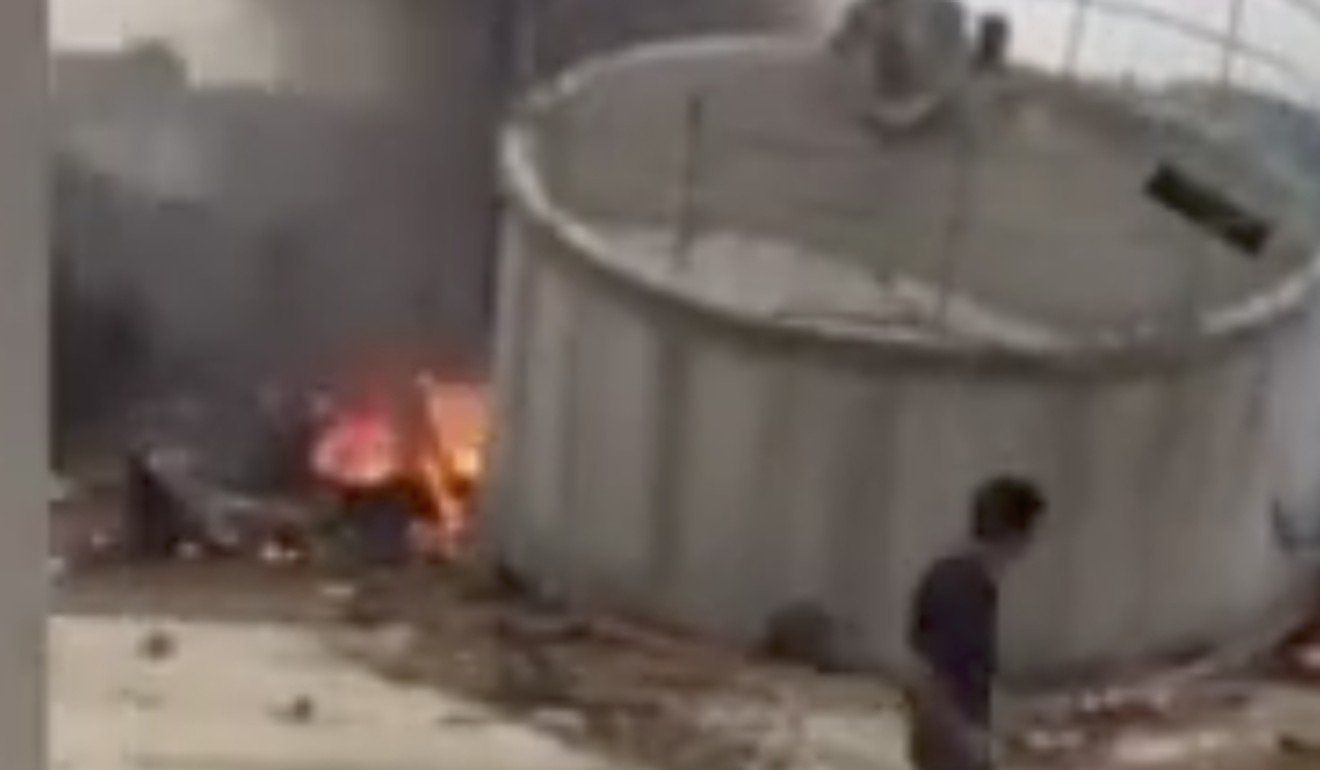
The mobile phone footage, which news portal 163.com said was taken in Hainan, showed smoke rising from piles of wreckage next to a damaged water tower as bystanders gathered at the site.
Footage apparently taken at the crash site. Photo: Handout
The person who uploaded the footage said the plane had hit the water tower before crashing into the ground.
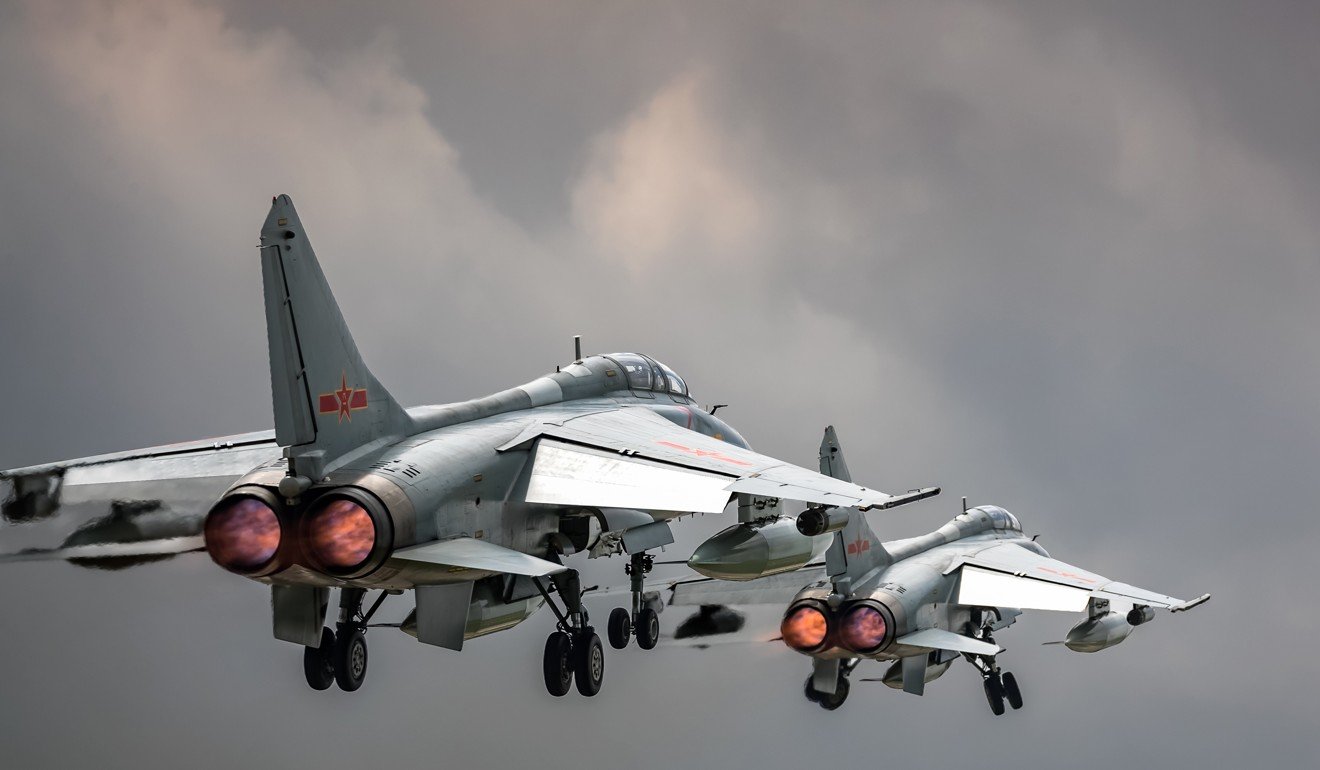
The PLA’s official statement did not specify the type plane that crashed, although unverified witness account online said it was a twin-seat Xian JH-7 “Flying Leopard”.
The JH-7, which entered service with the navy and air force in the 1990s, has been involved in a number of fatal accidents over the years.
The country’s worst military air accident in recent years happened in January 2018. At least 12 crew members died when a PLA Air Force plane, believed to be an electronic reconnaissance aircraft, crashed in Guizhou in the southwest of the country.
Between 2016 and 2017, there were at least four accidents involving the navy’s J-15 “Flying Sharks”, one of them resulting in the death of the pilot.
Military commentators have previously said that China’s drive to improve its combat readiness, which includes the building of new aircraft carriers and warplanes, has resulted in a serious shortage of qualified pilots.
To fill the vacancies the Chinese military has started a major recruitment drive and intensive training programme for pilot pilots.
One unverified report said the plane that crashed was a JH-7 “Flying Leopard”. Photo. Xinhua
Currently China has one aircraft carrier, the Liaoning, in service, which can carry a maximum of 24 J-15s as well as other aircraft.
Meanwhile, the new home-grown carrier Type 001A will soon be commissioned, which is designed to accommodate to carry eight more fighters.
In addition, construction is believed to have started on another carrier that will be able to carry heavier and more advanced warplanes.
According to figures from the end of 2016, there were only 25 pilots qualified to fly the J-15 while 12 others were in training.
Most of the Chinese navy’s pilots have been redeployed from the air force, which is itself in need of more trained pilots.
This year the navy for the first time began a nation-wide programme to scout out potential pilots.
Speaking on the sidelines of the ongoing legislative meeting in Beijing Feng Wei, a PLA pilot from the Western Theatre, said the military was currently intensifying its pilots’ training as increasing amounts of new equipment entered service.
“Personnel quality is the key to everything,” he added.
The plane was on a routine training sortie and hence was unarmed.(Mint/ Representative Image)
A MiG-21 fighter jet of the Indian Air Force crashed in Rajasthan’s Bikaner on Friday. The plane crashed after it reportedly suffered a bird hit.
The plane had taken off from Nal near Bikaner. The pilot is said to have ejected safely.
Bikaner SP Pradeep Mohan Sharma said the MIG aircraft crashed in Shobhasar ki Dhani, 12 km from Bikaner city, news agency PTI reported.
Sharma said police teams have rushed the spot to cordon off the area. No loss of life has been reported.
A statement by the IAF said that the MiG-21 had taken off from the Indian Air Force’s Nal airbase in Rajasthan and that it was on a routine mission.
The IAF statement said, “Today afternoon a MiG-21 aircraft on a routine mission crashed after getting airborne from Nal near Bikaner. Initial inputs indicate the likely cause as bird hit after take off. Pilot of the aircraft ejected safely. A CoI [Court of Inquiry] will investigate the cause of the accident.”
In recent times, the IAF has witnessed a series of crashes involving fighter jets and choppers.
On February 1, a Mirage 2000 fighter jet had crashed during a routine testing flight. Both the pilots in the jet had died after their safety equipment gave way. The pilots were on an “acceptance sortie” of the Mirage 2000 trainer aircraft after it was overhauled by the Bengaluru-based Hindustan Aeronautics Limited (HAL).
Barely a fortnight later, two Surya Kiran Hawks were involved in a collision that led to the death of one pilot. The crash had taken place barely days before the 12 edition of Aero India.
On February 12, a MiG-27 fighter jet had crashed at the Pokhran firing range after taking off from the Jaisalmer air base. The jet was on a training mission. The pilot managed to eject safely from the jet before it crashed.
More recently, on February 27, a Mi17 helicopter of the Indian Air Force had crashed at Budgam in Kashmir. All six IAF personnel on board the chopper were killed. A civilian was also killed in the crash.
The MiG-21 fighter jet has been in the news recently after Wing Commander Abhinandan Varthaman, who was flying a similar aircraft shot down a Pakistani F-16 before crashing in Pakistan.
The MiG-21 is a supersonic jet fighter and interceptor aircraft, designed by the Mikoyan-Gurevich Design Bureau in the erstwhile Soviet Union.
The Prime Minister had earlier in the day chaired the Cabinet Committee on Security (CCS) after India carried out ‘non-military pre-emptive’ airstrikes targeting the JeM camp across the LoC.
Hours after India’s offensive on Pakistan-based terror camps across the LoC, Prime Minister Narendra Modi “assured that the country was in safe hands”.
“Today I assure the countrymen, the country is in safe hands,” PM Modi said while addressing a public rally in Rajasthan’s Churu.
“I pledge on this soil, I will not let the country die, I will not let the country stop, I will not let the country bend. It is my promise to Mother India, I will protect your honour,” he added.
Speaking on the One Rank One Pension (OROP), PM Modi said he was happy that the scheme had benefited over 20 lakh military families across the country including thousands of families of Churu and Rajasthan.
The Prime Minister had earlier in the day chaired the Cabinet Committee on Security (CCS) after India carried out “non-military pre-emptive” air strikes targeting the JeM camp across the LoC.
Foreign Secretary Vijay Gokhale addressing the media said India had received credible information on JeM attempting other attacks in the country and therefore a pre-emptive strike had become necessary.
He said the non-military pre-emptive action was targeted specifically at the JeM camp adding that the selection of the target was also conditioned to avoid civilian casualties.
In a 21-minute offensive, 12 Mirage 2000 jets carried out the strike at around 3.30 am and dropped 1000 Kg bombs on terror camps across LOC, completely destroying it.
The IAF jets struck terror camps and launch pads across the LoC in Balakot at around 3.45 am, Muzaffarabad at around 3.48 am and Chakoti at around 3.58 am.
The camp in Balakot was led by Maulana Yusuf Azhar alias Ustad Ghauri, brother-in-law of JeM Chief Masood Azhar. Yusuf Azhar was on the Interpol list and among the most wanted in India.
Following the airstrikes, many leaders including that of the opposition lauded the action of the IAF and praised the PM for giving a free hand to the security forces after the Pulwama terror attack.
Over 44 CRPF personnel were killed and many injured on February 14 in one of the deadliest terror strikes in Jammu-Kashmir when a Jaish-e-Mohammad (JeM) suicide bomber blew up an explosive-laden vehicle near their bus in Pulwama district.


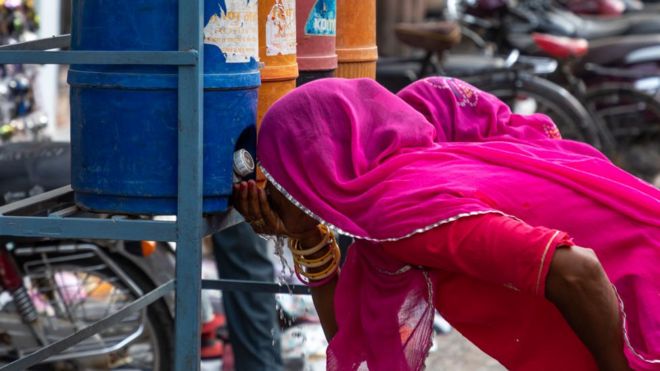 Image copyright GETTY IMAGES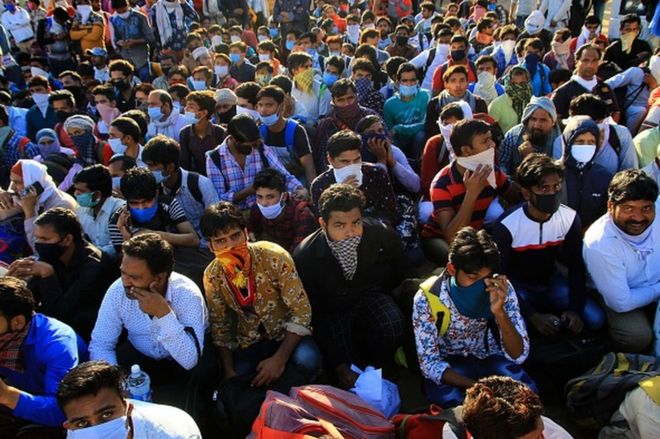




 CHINDIA ALERT: You'll be living in their world, very soon