22/04/2020
SEOUL/BEIJING (Reuters) – China has allowed 200 employees from South Korea’s Samsung Electronics Co Ltd (005930.KS) to enter the country to work on an expansion of the firm’s NAND memory chip factory, the company said on Wednesday.
The move came after China said on Tuesday that it was in talks with some countries to establish fast-track procedures to allow travel by business and technical personnel to ensure the smooth operation of global supply chains.
China said it has reached a consensus on such an arrangement with South Korea, without elaborating on the terms, including whether individuals entering China will be subject to quarantine.
China, where the virus first emerged late last year, blocked entry last month for nearly all foreigners in an effort to curb risks of coronavirus infections posed by travellers from overseas. After bringing the local spread under control with tough containment measures, it is trying to restart its economic engines after weeks of near paralysis.
A chartered China Air Ltd (601111.SS) plane flew in the Samsung Electronics employees on Wednesday, a company spokeswoman said.
Samsung said its employees will follow the local government’s policy upon arrival, without elaborating.
Shaanxi province, where Samsung’s NAND memory chip plant is located, requires people travelling from overseas to undergo a 14-day quarantine, according to South Korea’s foreign ministry.
“Samsung employees will not be exempted from the 14-day quarantine rule imposed by the Shaanxi province. They will get coronavirus tests at the airport upon arrival and will be transported to a local hotel designated by Chinese authorities,” an official at the Consulate General of South Korea in Xi’an told Reuters.
Samsung Electronics in December increased investment at its chip factory in China by $8 billion to boost production of NAND flash memory chips.
Source: Reuters
Posted in $8 billion, 14-day quarantine, 200, according, after, Airport, allow, allowed, allows, Arrangement, arrival, Beijing, billion, blocked, boost, bringing, Business, came, chartered, China, China Air Ltd, chinese authorities, chip factory, Company, consensus, Consulate General, containment, control, coronavirus infections, coronavirus tests, countries, Country, curb, December, designated, economic engines, effort, elaborating, emerged, employees, ensure, enter, entering, entry, establish, exempted, expansion, Factory, fast-track, firms, flash memory chips, flew, Foreign Ministry, Foreigners, from, from overseas, global supply chains, including, increased, individuals, Investment, last month, late last year, local governments, local hotel, local spread, located, measures, memory chip, move, NAND, near, nearly, Official, operation, overseas, paralysis, People, personnel, plane, Plant, policy, posed, procedures, production, quarantine, reached, requires, restart, Reuters, Risks, rule, Samsung Elec, Seoul, shaanxi province, smooth, South Korea, South Korea’s, spokeswoman, staff, subject, talks, technical, terms, tough, transported, travel, travellers, travelling, trying, Tuesday, Uncategorized, undergo, upon, Virus, Wednesday, weeks, whether, without, work, Xi'an |
Leave a Comment »
20/04/2020
BEIJING/SHANGHAI (Reuters) – China expects to import more soybeans and pork this year following the novel coronavirus outbreak and African swine fever, which has decimated its pig herds.
Soybean imports are forecast at 92.48 million tonnes this year, rising to 96.62 million tonnes in 2025 and 99.52 million tonnes in 2029, an official from the agriculture ministry told a video conference on the outlook for agriculture released on Monday.
Pork imports this year are seen rising to 2.8 million tonnes, a 32.7% increase from the previous year.
China is a key buyer and consumer of soybeans and pork globally, and typically imports millions of tonnes of soybeans per year to crush for meal to feed its livestock.
The African swine fever outbreak, however, had slashed China’s pig herd by over 40% last year, reducing supplies in the world’s biggest pork consumer.
Combined with the coronavirus outbreak, which hit the transport of pigs and delayed the restart of slaughtering plants, prices of China’s favourite meat rose to record levels in February.
China has been increasing pork imports in recent months to make up for the drop in domestic supply.
Despite the expected surge in imports, China’s 2020 pork consumption is forecast to fall to 42.06 million tonnes, down 5.6% year-on-year, hit by high prices and a fall in consumer demand due to the coronavirus outbreak, according to the agriculture ministry.
In line with the slowing consumption, China’s slaughtered pig herd this year will fall 7.8% year-on-year to 501.49 million heads. Pork output this year will also decline to 39.34 million tonnes from 2019, but will rebound to around 54 million tonnes in 2022.
In the longer term, however, pork imports are expected to gradually fall, the ministry forecast, while beef and mutton imports are set to increase in the next decade.
Meanwhile, China’s domestic soybean output is seen at 18.81 million tonnes in 2020, a 3.9% gain from the previous year, while crushing volumes were pegged at 85.98 million tonnes.
Soybean consumption will increase steadily and continue to rely mainly on imports in the next 10 years, said a ministry official.
The ministry also said China’s corn acreage and output are both set to increase in 2020, with production forecast to reach over 260 million tonnes this year, while annual rice output is expected to hold steady above 200 million tonnes per year in the next 10 years.
Source: Reuters
Posted in 2019, 2020, 2022, 2025, 2029, 40, African swine fever, agriculture, Agriculture ministry, Aid, beef, Beijing, biggest, buyer, challenges, China, China’s, Combined, Consumer, consumer demand, coronavirus outbreak, crush, decade, decimated, decline, delayed, despite, domestic supply, drop, due, expected, expects, fall, favourite, February, feed, following, forecast, from, globally, gradually, heads, herds, high, higher, hit, However, imports, increasing, industry, key, levels, Livestock, longer term, make up, meal, Meat, million, ministry, Monday, months, more, mutton, next, novel coronavirus outbreak, Official, outbreak, outlook, output, over, per year, Pig, pig herd, plants, Pork, previous, prices, rebound, recent, record, reducing, released, restart, rising, rose, sees, Shanghai, slashed, slaughtered, slaughtering, Soybean, supplies, surge, this year, to import, told, tonnes, Transport, typically, Uncategorized, video conference, while, world’s, year-on-year |
Leave a Comment »
10/04/2020
BEIJING (Reuters) – China’s factory gate prices fell the most in five months in March, with deflation deepening and set to worsen in coming months as the economic damage wrought by the coronavirus outbreak at home and worldwide shuts down many countries.
The world’s second-largest economy is trying to restart its engines after weeks of near paralysis to contain the pandemic that had severely restricted business activity, flow of goods and the daily life of people.
Friday’s data from the National Bureau of Statistics suggested a durable recovery was some way off, with China’s producer price index (PPI) falling 1.5% from a year earlier, the biggest decline since October last year. It compared with a median forecast of a 1.1% fall tipped by a Reuters poll of analysts and a 0.4% drop in February.
Headline consumer inflation also eased somewhat last month, partly led by government control measures, while core prices remained benign, leaving more room for monetary easing, some analysts said.
The overall decline in the factory gate gauge was exacerbated by a slump in global oil and commodities prices, which filtered through to crude oil, steel and non-ferrous metal industries, the statistics bureau said in a statement accompanying the data.
“The issue of having more supply than demand, and persistently low oil prices, will intensify deflationary pressures,” said Yang Yewei, a Beijing-based analyst with Southwest Securities.
“Work resumptions on the production side are faster than the repair in demand. Downstream demand is recovering slowly and still remains weak,” he said.
The oil and gas extraction sector had the biggest year-on-year price fall of 21.7%, among the 40 major industrial sectors surveyed, deteriorating sharply from a 0.4% drop in the previous month.
The stringent travel and transport curbs have now been lifted across much of the country including Wuhan, the epicentre of the outbreak where the virus first emerged in late 2019. So far the virus has killed more than 3,300 and infected over 81,000 people in the country.
Analysts expect a deep first-quarter economic contraction in China and have grown increasingly pessimistic about the country’s prospects for 2020 due to the pandemic’s sweeping global impact.
Many economists and policymakers are forecasting a steep global recession this year as numerous countries are forced into lockdowns to contain the spread of the coronavirus, severely curtailing business activity in a major blow to jobs and incomes.
Worldwide, the virus has killed around 95,000 people and infected more than 1.5 million. Policymakers globally have responded to the crisis by launching an unprecedented package of stimulus measures, injecting trillions of dollars to backstop their economies that have been brought to a virtual standstill.
Beijing has also rolled out a series of fiscal and monetary support steps, and sources have told Reuters that policymakers are readying more stimulus in the coming months to stabilise growth and prevent mass unemployment.
China’s consumer prices rose 4.3% from a year earlier in March, compared with a 4.8% gain tipped by a Reuters poll and a 5.2% increase in February, as logistics and transport conditions improved and government price control measures kicked in.
But food prices still rose over 18% from a year earlier, led by a 116.4% jump in pork prices, the data showed. The virus outbreak has pushed up prices of some food items, such as pork and vegetables.
Core inflation – which excludes food and energy prices – remained benign last month at 1.2%,but it still edged up from 1% in February.
Source: Reuters
Posted in auto sale, benign, China, China’s, commodities prices, Core inflation, coronavirus, coronavirus outbreak, countries, crude oil, deepens, Deflation, Downstream, economy, energy, engines, factory gate, February, Food, food items, food prices, Friday’s, global, Home, industries, July, March, May, national bureau of statistics, non-ferrous metal, October, Ocyober, oil and gas extraction sector, pandemic, paralyses, paralysis, Pork, Pork prices, prices, restart, Reuters Poll, Southwest Securities, Steel, travel and transport curbs, Uncategorized, vegetables, Work resumptions, world’s second-biggest economy, worldwide, wrought |
Leave a Comment »
09/04/2020
MILAN/DETROIT (Reuters) – Global automakers reeling from the COVID-19 pandemic are accelerating efforts to restart factories from Wuhan to Maranello to Michigan, using safety protocols developed for China and U.S. ventilator production operations launched in recent weeks.
Certain safety measures differ from manufacturer to manufacturer. Italian sports car maker Ferrari NV (RACE.MI) said on Wednesday it would offer voluntary blood tests to employees who wanted to know if they had been exposed to the virus.
General Motors Co’s (GM.N) head of workplace safety, Jim Glynn, told Reuters on Wednesday GM is not persuaded blood tests are useful. But Glynn said GM has studied and adapted measures taken by Amazon.com Inc (AMZN.O) to protect warehouse workers, such as temperature screening to catch employees with fevers before they enter the workplace.
Auto manufacturers and suppliers are converging on a consensus that temperature screening, daily health questionnaires, assembly lines redesigned to keep workers 3 to 6 feet (0.9 m to 1.8 m) apart, and lots and lots of masks and gloves can enable large-scale factories to operate safely.
“We know the protocols to keep people safe,” Gerald Johnson, GM’s executive vice president for global manufacturing, told Reuters in an interview. GM has relaunched vehicle plants in China and kept factories running in South Korea, he said.
GM has not said when it will reopen assembly plants in the United States. Other automakers are putting dates out in public, even though health officials and federal and state policymakers are wary of lifting lockdowns too soon.
“You see vehicle manufacturers … putting a stake in the ground,” said Brian Collie, head of Boston Consulting Group’s automotive practice. By setting a public date to restart production, they signal suppliers to get ready to ramp up, he said.
The COVID-19 pandemic has thrown the global auto industry into the worst tailspin since the 2008-2009 financial crisis. Consumer demand for vehicles has collapsed as governments have enforced lockdowns in China, and then in Europe and the United States. For the Detroit automakers and their suppliers, the shutdown of profitable truck and sport utility vehicle plants in North America has choked off cash flow.
In Europe, major automakers have said they hope to begin building vehicles again in mid-to-late April. In the United States, several big automakers, including Fiat Chrysler Automobiles NV (FCHA.MI) (FCAU.N), Honda Motor Co Ltd (7267.T) and Toyota Motor Corp (7203.T), are aiming to restart production during the first week of May.
Fiat Chrysler (FCA) and unions are discussing plans for beefed-up health measures at Italian plants to pave the way for production to restart as soon as the government eases a national lockdown due to expire on April 13, unions said on Wednesday.
Among the proposals from Fiat Chrysler’s Italian unions: move meals to the end of shifts, allowing employees to chose to avoid canteens, eat their food elsewhere and leave half an hour earlier without losing pay.
FCA did not comment on specific measures.
In the United States, some non-union automakers have also said they hope to restart vehicle plants as soon as next week.
Tire maker Bridgestone said on Wednesday it plans to restart U.S. production on April 13.
But the Trump administration has said people should continue to practice social distancing until April 30.
VENTILATOR ASSEMBLY
For the Detroit automakers, the United Auto Workers union will play a key role in deciding when and how plants will restart.
UAW President Rory Gamble said in a statement on Wednesday the union is in “deep discussions with all three companies to plan ahead over the implementation of CDC [Centers for Disease Control and Prevention] safety standards and using all available technologies to protect all UAW members, their families and the public.”
Among the union’s concerns is that members who report being ill can take time away from work without penalty, Gamble added.
The UAW has supported GM and Ford Motor Co’s (F.N) efforts to launch production of ventilators in U.S. plants – operations that have allowed the companies and the union to road-test safety measures at small scale.
At GM’s ventilator assembly plant in Kokomo, Indiana, workers and managers have been fine-tuning details such as when employees are handed masks, and when they step in front of a temperature screening device.
At first, ventilator assemblers in training at Kokomo walked down a hall before getting a mask, said Debby Hollis, one of the UAW-represented workers. Last week, she said, “They met us at the door and had us get in the masks there.”
Source: Reuters
Posted in accelerating, Amazon.com Inc (AMZN.O), automakers, Bridgestone, China, Covid-19 pandemic, Detroit, developed, efforts, factories, Ferrari NV (RACE.MI), Fiat Chrysler (FCA), Ford Motor Co’s (F.N), General Motors Co’s (GM.N), global, Honda Motor Co Ltd (7267.T), Indiana, Italian unions, Kokomo, lockdowns, Maranello, masks, Michigan, Milan, plants, protect, push, reeling, reopen, restart, safety protocols, testing, Tire maker, U.S. ventilator production operations, Uncategorized, United Auto Workers, United States, warehouse, workers, Wuhan |
Leave a Comment »
08/04/2020
- Wuhan, where the first cases of the novel coronavirus were detected, is ending a 76-day lockdown
- A day before the lockdown was fully lifted, Tencent announces a slew of initiatives focused on helping to revive the digital industry in the city
Passengers leaving Wuhan city are pictured at the Hankou Railway Station in Wuhan city, central China’s Hubei province, on Wednesday morning, April 08, 2020. Photo: SCMP/Simon Song
A day before China
lifted a months-long lockdown of Wuhan city, the initial epicentre of the coronavirus pandemic, Chinese internet giant
Tencent Holdings pledged to invest in digital government, online education and artificial intelligence (AI) in the city, among other fields.
“During the epidemic, Tencent has been supporting Hubei and Wuhan’s fight against the virus through funds and technology,” the company best known for its gaming business said in a statement posted on Tuesday on WeChat. “In the future, we will also fully support Wuhan’s post-pandemic reconstruction and continue to support the development of Wuhan’s digital industry.”
China’s major tech companies have played a big role in the fight against the coronavirus, and are now playing their part in the economic recovery of Wuhan and other areas that have suffered under extended travel restrictions and business closures.
Last week, China’s biggest e-commerce services providers Alibaba Group Holding,
and Pinduoduo each announced their own initiatives to help revive sales of farm goods from Hubei as the province emerges from its months-long lockdown.
Popular mobile payments app Alipay also created a dedicated section for Wuhan merchants to allow users to buy from merchants in the city, and offered loans to small local merchants in need of financial support, according to an Alipay statement. Alipay is operated by Ant Financial, an affiliate of Alibaba, which owns the South China Morning Post.
How tech has helped China in its public health battle with coronavirus
Wuhan, an industrial powerhouse for the steel, semiconductors and automotive sectors, is emerging from an unprecedented lockdown which began on January 23 and prevented people from moving in and out of the city.
Since restrictions began easing gradually in late March, business activity has shown signs of recovery: Tencent’s mobile payment platform WeChat Pay recorded a 162 per cent increase in offline transactions in a 10-day period from March 25, compared to the same period the previous month, according to a separate statement by Tencent on Wednesday.
Searches for “work resumption certificates” – which businesses need to submit to local authorities to prove their staff can safely restart work – also increased 320 per cent on Baidu, China’s biggest search engine, in the past month, Baidu said in a report on Wednesday.
Tencent declined to provide specific details regarding the size of its latest investment in Wuhan or a timeline for its implementation, but said in the statement that it will involve closer cooperation with city authorities in the areas of digital government, education, smart mobility, AI and cybersecurity to help the city with its digital industries.
Among these initiatives, it will push ahead with a plan to build a headquarters focusing on digital industries in Wuhan, specifically digitalisation for the government and smart city initiatives.
It will also establish a base in Wuhan for its online education initiatives, set up an AI lab and cybersecurity academy and build a school focusing on smart mobility in collaboration with Chinese carmaker Dongfeng Motor Corporation, the company said in the statement.
Source: SCMP
Posted in academy, AI, Alibaba, Alibaba Group Holding, Alipay, artificial intelligence (AI), automotive, “work resumption certificates”, Baidu, businesses, carmaker, City, coronavirus, Coronavirus pandemic, cybersecurity, digital government, digital industries, digitalisation, Dongfeng Motor Corporation, E-commerce, economic recovery, education, emerges, epicentre, financial support, Hankou Railway Station, headquarters, hubei province, Internet giant Tencent, invest, JD.com, loans, local authorities, lockdown, merchants, mobile payments app, online education, Pinduoduo, pledges, reconstruction, restart, school, search engine, sectors, Semiconductors, services providers, small local merchants, smart mobility, south china morning post, Steel, TENCENT, Uncategorized, WeChat, work, Wuhan |
Leave a Comment »
29/03/2020
- Chinese president is fighting ‘two tough battles’ to reboot industry and defeat Covid-19, Xinhua says
- Choice of industrial powerhouse for official visit shows the importance Xi gives to reviving the economy, observers say
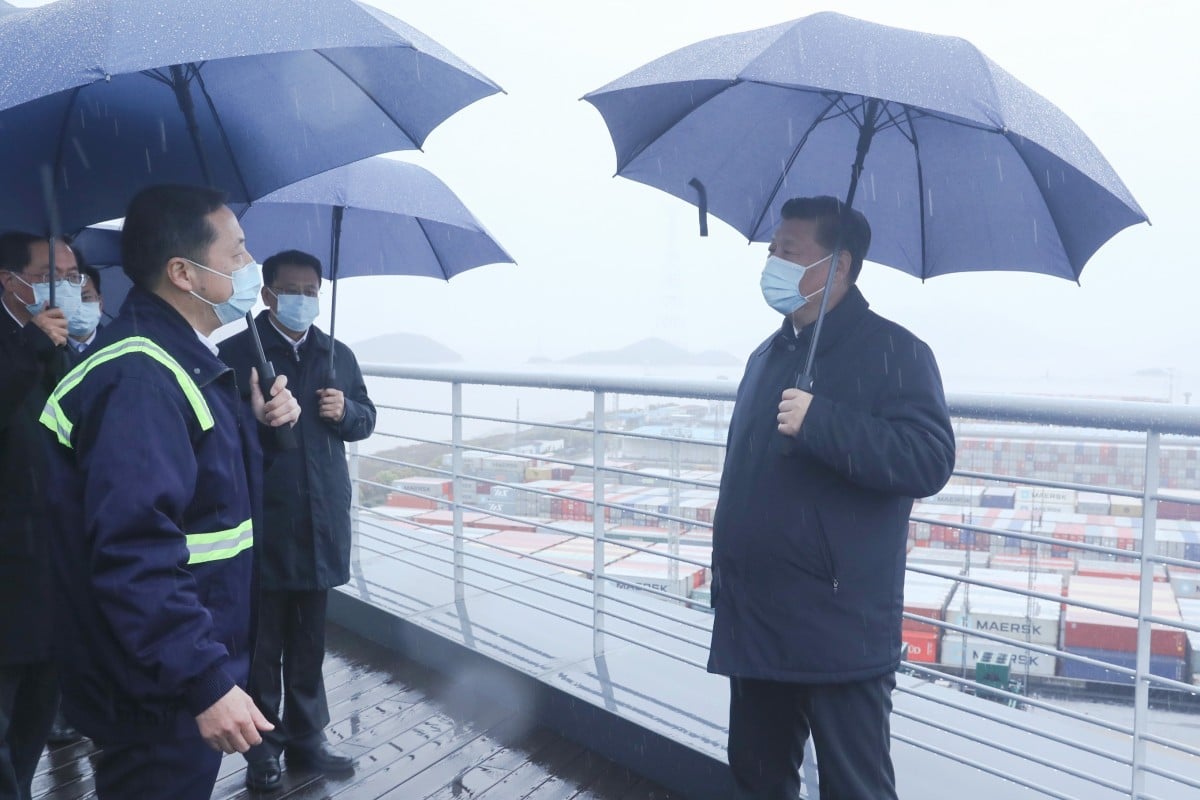
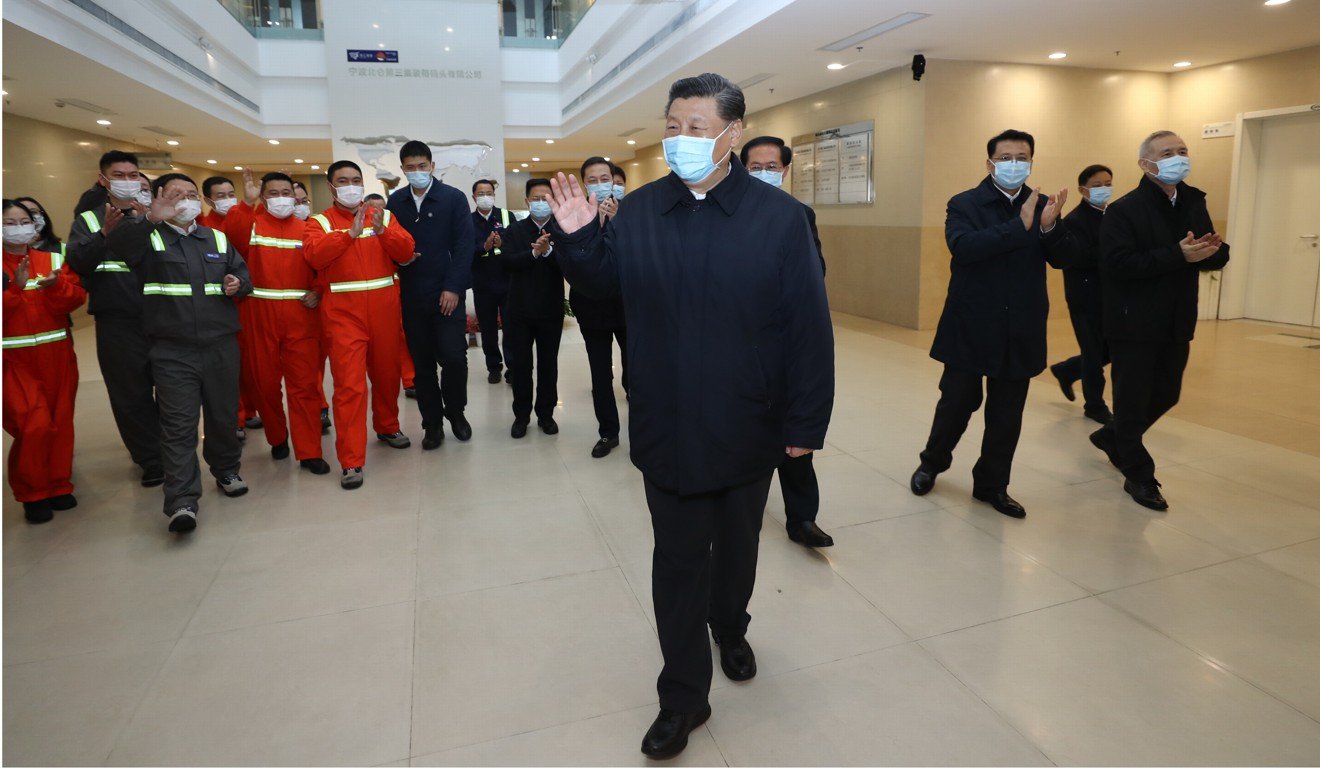
Chinese President Xi Jinping chats to workers and officials at Ningbo port in east China on Sunday. Photo: Xinhua
visited the industrial powerhouse of Zhejiang province on Sunday in a move state media described as a clear message the country was ready to get the economy back on track amid the “new normal” of dealing with the coronavirus.
The trip, to Ningbo – one of the world’s busiest ports and a trade hub for eastern China – was Xi’s first outside Beijing since he visited Wuhan, the initial epicentre of the Covid-19 outbreak, earlier in the month.
As well as a visiting the port, he spoke to workers at an industrial zone for car part manufacturers, where he learned about the latest efforts to restart production, Xinhua said in a brief report.
The visit came after two months of almost total lockdown in many parts of the country that disrupted businesses, transport and people’s daily lives, and ground the economy to a near standstill.
While local transmissions of the coronavirus in China appear to be under control, Beijing has implemented strict measures to prevent imported cases, including slashing international flights and banning most foreigners from entering the country.
In a separate report, Xinhua said Xi’s visit sent “a clear message” that China was resuming its industrial production and social activities, and described the fight against the coronavirus as the “new normal”.
Reviving the economy and battling a deadly disease were Xi’s “two tough battles”, it said.
Xi’s choice of destination was a clear message that restarting the economy is a top priority. Photo: Xinhua
Zhejiang is something of a power base for Xi, who spent nearly five years there during his climb through the ranks of the Communist Party.
One of the country’s biggest trading hubs, the province generated 3 trillion yuan (US$423.2 billion) in foreign trade last year, or more than 13 per cent of the national total, according to official figures.
“It’s a highly export-oriented economy … which has made it crucial not only to China’s development plan but also to safeguarding the stability of the global supply chain,” Xinhua said.
Observers said Xi’s visit was evidence of Beijing’s determination to get the economy back up and running as soon as possible.
Zhao Xijun, an economics professor at Renmin University, said Ningbo was a key part of the export economy and a base for many local and foreign entrepreneurs.
“It is a clear signal that China, after getting domestic infections under control, is now prioritising economic growth,” he said.
“It also shows the country will keep developing its economy and opening up its markets.”
But hopes of a quick recovery for the Chinese economy have been dashed by the spread of the coronavirus across Europe and the United States, causing a sharp decline in demand for Chinese goods.
Xi spent five years in Zhejiang while climbing the ranks of the Communist Party. Photo: Xinhua
In a meeting on Friday, the Communist Party’s Politburo said it would step up macroeconomic policy adjustments and pursue a more proactive fiscal policy while optimising measures to control the coronavirus to speed up the restoration of production, doing whatever it could to “minimise the losses caused by the epidemic”.
“China has successfully reopened much of its economy from the extremes of the coronavirus lockdown, but now faces a new problem: an impending collapse in demand for its exports as its customers go into lockdowns of their own,” Gavekal Dragnomics said in a research report.
“That shock to industry and manufacturing employment means that China will not enjoy the hoped-for V-shaped recovery in growth.”
Source: SCMP
Posted in 'total lockdown', ‘clear message’, ‘two tough battles’, back on its feet, banning, Beijing, Beijing’s, busiest ports, businesses, car part manufacturers, Chinese economy, Chinese goods, Communist Party, Communist Party’s Politburo, coronavirus, Country, COVID-19 outbreak, dashed, decline, defeat Covid-19, demand, determination, disrupted, economics professor, economy, employment, entering, epicentre, Europe, export-oriented, Foreigners, Gavekal Dragnomics, global, global supply chain, growth, industrial powerhouse, industrial zone, industry, international flights, it’s time, local transmissions, macroeconomic policy, Manufacturing, Ningbo, observers, optimising measures, people’s daily lives, power base, proactive fiscal policy, production, reboot industry, Renmin University, restart, Safeguarding, sends, stability, standstill, trade hub, Transport, Uncategorized, United States, V-shaped recovery, visit, workers, Wuhan, Xi, Xi Jinping’s, Xinhua, zhejiang province |
Leave a Comment »
07/02/2020
TOKYO (Reuters) – Toyota Motor Corp (7203.T) on Friday said production at all of its China plants would remain suspended through Feb. 16, joining a growing number of automakers facing stoppages due to supply chain issues as the coronavirus spreads.
The Japanese automaker, which operates 12 vehicle and components factories in China, said it would extend its production stoppage “after considering various factors, including guidelines from local and region governments, parts supply, and logistics.
“For the week of Feb. 10, we will be preparing for the return to normal operation from Feb. 17 and beyond,” it said in a statement.
The decision extends Toyota’s initial plans to suspend operations through Sunday, and comes as the threat from the coronavirus crisis closes in on the global auto industry.
South Korea’s Hyundai Motor (005380.KS) and affiliate Kia Motors (000270.KS) said on Friday that they plan to restart production at their Chinese factories on Feb. 17, from a previously planned Feb.9.
“We will take preventive measures against infection at factories,” a spokeswoman said.
A growing number of car makers, including those who do not make cars in China, are flagging the possibility that their global operations could take a hit if they cannot access parts supplies from the country, where there are transportation bans to stop the virus spreading.
Suzuki Motor Corp said it was looking at the possibility of procuring “made in China” car parts from other regions if it cannot access parts due to ongoing stoppages.
The Japanese automaker does not produce or sell any cars in China, but procures some components there for its plants in India, where it controls around half of the passenger vehicle market via its local unit Maruti Suzuki India Ltd (MRTI.NS).
Fiat Chrysler Automobiles NV (FCHA.MI) on Thursday said one of its European plants could close within two to four weeks if Chinese parts suppliers cannot get back to work soon, while Hyundai Motor Co (005380.KS) earlier this week suspended production at its South Korean plants due to a shortage of China-made parts.
Parts made in China are used in millions of vehicles assembled elsewhere, and China’s Hubei province – the epicentre of the coronavirus outbreak – is a major hub for vehicle parts production and shipments.
To limit the spread of the virus, Chinese authorities have announced an extended holiday period in Hubei and 10 other provinces, which account for more than two-thirds of the country’s vehicle production.
IHS Automotive projects plant closures through Feb. 10 would result in a 7% cut in vehicle production in China for the first quarter.
In a note, its analysts said extended closures into March may result in lost production of over 1.7 million vehicles for the period, a decline of roughly one-third of pre-virus output expectations.
“If the situation lingers into mid-March, and plants in adjacent provinces are also idled, the China-wide supply chain disruption caused by parts shortages from Hubei, a major component hub, could have a wide-reaching impact,” they said.
Other industry experts said suppliers had built up a cushion of parts in inventory and in-transit ahead of the long Lunar New Year holiday in late January. Those will start to run out if factories cannot get back to work next week, or if flights to and from China remain limited.
Toyota said its plants outside China were operating as normal for the moment but it has said it was also considering the possibility of manufacturing parts commonly made in China in other regions.
Source: Reuters
Posted in affiliate, automakers, bans, China, coronavirus, epicentre, factories, Fiat Chrysler Automobiles NV (FCHA.MI), global operations, hits, hubei province, Hyundai Motor Co (005380.KS), IHS Automotive, keeps, logistics, Lunar New Year holiday, Made in China, major hub, manufacturing parts, Maruti Suzuki India Ltd (MRTI.NS), output, parts production, Plant, procuring, production, restart, shipments, South Korea, spreads, stoppages, stopped, supply, supply chain issues, suspended, Suzuki Motor Corp, Tokyo, transportation, Uncategorized, vehicle, Virus |
Leave a Comment »
21/10/2019
- Vice-ministerial meeting was last held in 2014 as Seoul agreed to the deployment of a US anti-missile system
China and South Korea are expected to resume their vice-ministerial strategic defence dialogue after a five-year break. Photo: Reuters
China and
South Korea are set to hold high-level defence talks on Monday for the first time since 2014, when tensions emerged over Seoul’s plans to allow deployment of a US anti-missile system.
Lieutenant General Shao Yuanming, deputy chief of the Joint Staff Department of the Central Military Commission, is expected to meet South Korean defence vice-minister Park Jae-min in Beijing, according to Yonhap News Agency.
They will talk on the sidelines at the Xiangshan Forum, a three-day gathering on Asia-Pacific security and defence which started on Sunday.
The defence ministry in Seoul said the officials were expected to “have in-depth discussions on the Korean peninsula security conditions and issues of mutual concern”, Yonhap reported.
Lieutenant General Shao Yuenming is expected to resume China’s part in a high-level defence dialogue with South Korea. Photo: Minnie Chan
Relations between China and South Korea were strained by Seoul’s decision to host American Terminal High-Altitude Area Defence system (THAAD) but ties have warmed as both countries have pushed back against pressure from the US.
Washington and Seoul are at odds over a cost-sharing agreement for the US military, with US President Donald Trump demanding South Korea contribute more for the presence of US forces.
Hwang Jae-ho, director of the Global Security Cooperation Centre at Hankuk University of Foreign Studies in Seoul, said the meetings, formally known as the China-South Korea vice-ministerial strategic defence dialogue, resumed mainly because the countries now had more mutual interests.
Seoul fears US is delaying envoy’s approval in retaliation for scrapping of security pact, sources say
“Now China has to make more friends in the international community as its ties with the United States have gone bad, and South Korea is looking for China to help rein in Pyongyang. At a time like this, it’s inevitable for the two countries to want to move closer,” Hwang said.
The deployment of THAAD, a proposed military hotline, and South Korea’s air defence identification zone are expected to be high on the agenda.
First held in 2011, the defence dialogue was hosted alternately by Seoul and Beijing. It was suspended in 2015 when South Korea, then under president Park Geun-hye, said it was considering THAAD as a deterrent against North Korea’s nuclear ambitions.
Beijing disapproved and said China was the real target. Each country then placed unofficial economic and cultural bans on the other. These included Chinese sanctions against South Korea’s Lotte supermarket chain and a ban on TV airtime for South Korean bands.
Tensions began to slowly ease after November 2017, when the two countries said they had decided to set aside their differences and advance their strategic partnership. Seoul also promised not to host additional THAAD missiles nor join a US-led missile defence system that involved Japan.
Source: SCMP
Posted in annual, Asia-Pacific security and defence, Beijing, China alert, defence talks, five-year break, Global Security Cooperation Centre, Hankuk University, Japan, Joint Staff Department of the Central Military Commission, Lotte supermarket chain, North Korea’s nuclear ambitions, restart, Seoul, South Korea, South Korean defence vice-minister, Terminal High Altitude Area Defence system (THAAD), Uncategorized, US President Donald Trump, Washington, Xiangshan forum, Yonhap news agency |
Leave a Comment »






 CHINDIA ALERT: You'll be living in their world, very soon