Chindia Alert: You’ll be Living in their World Very Soon
aims to alert you to the threats and opportunities that China and India present. China and India require serious attention; case of ‘hidden dragon and crouching tiger’.
Without this attention, governments, businesses and, indeed, individuals may find themselves at a great disadvantage sooner rather than later.
The POSTs (front webpages) are mainly 'cuttings' from reliable sources, updated continuously.
The PAGEs (see Tabs, above) attempt to make the information more meaningful by putting some structure to the information we have researched and assembled since 2006.
City at centre of outbreak finally able to declare itself clear of disease after months in lockdown and thousands of deaths
Risk of infection remains, however, with some patients testing positive for coronavirus that causes disease without showing symptoms
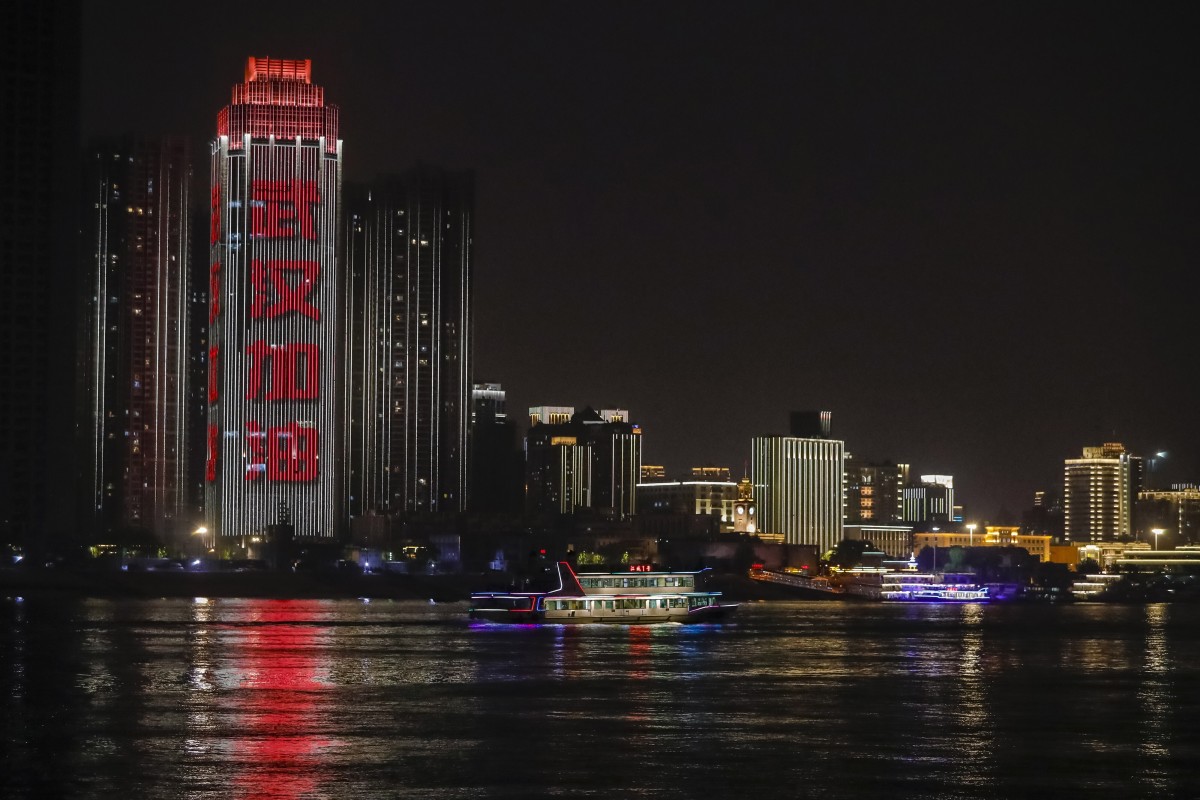
Ferries and other public transport services resumed in Wuhan last week. Photo: Xinhua
The city of Wuhan, the initial epicentre of the coronavirus pandemic, no longer has any Covid-19 patients in hospital after the last 12 were discharged on Sunday.
Their release ended a four-month nightmare for the city, where the disease was first detected in December. The number of patients being treated for Covid-19, the disease caused by a new coronavirus, peaked on February 18 at 38,020 – nearly 10,000 of whom were in severe or critical condition.
“With the joint efforts of Wuhan and the national medical aid given to Hubei province, all cases of Covid-19 in Wuhan were cleared as of April 26,” Mi Feng, a spokesman for the National Health Commission said on Sunday afternoon.
The announcement came only one day after the city discharged the last patient who had been in a severe condition. That patient also was the last severe case in Hubei province.
The last patient discharged from Wuhan Chest Hospital, a 77-year-old man surnamed Ding, twice tested negative for Sars-CoV-2, the virus that causes Covid-19, and was released at noon on Sunday.
“I missed my family so much!” Ding told Changjing Daily.
Another unidentified patient exclaimed as he left the hospital: “The air outside is so fresh! The weather is so good today!”
Wuhan faced a long journey to bring its patient count down to zero.
The city of 11 million, the capital of Hubei province and a transport hub for central China, was put under a strict lockdown on January 23 that barred anyone from entering or exiting the city without official approval for 76 days until it was officially lifted on April 8.
Coronavirus: Wuhan, Los Angeles officials discuss getting back to work after lockdown
22 Apr 2020
Residents were ordered to stay in their apartments as the city stopped public transport and banned private cars from city streets. As the epidemic worsened, more than 42,000 medical staff from across the country were sent to the city and to Hubei province to help ease the burden on the local health care system.
Wuhan was the hardest hit city in China, accounting for 50,333 of the 82,827 locally transmitted Covid-19 cases recorded in China. More than 4,600 died in the country from the disease.
On March 13, the city reported for the first time that there were no new suspected cases of the infection, and five days later there were no confirmed cases.
The number of discharged patients bottomed out at 39.1 per cent at the end of February, gradually climbing to 92.2 per cent by last Thursday.
“Having the patients in the hospital cleared on April 26 marks a major achievement for the city’s Covid-19 treatment,” the Wuhan Health Commission said in a statement.
However, having no severe cases in hospital does not mean all the discharged patients will require no further treatment as they may still need further care.
“Clearing all the severe cases marks a decisive victory for the battle to safeguard Wuhan,” health minister Ma Xiaowei told state broadcaster China Central Television on Saturday.
“Some patients who have other conditions are being treated in specialised hospitals. It has been properly arranged.”
Coronavirus: Chinese writer hit by nationalist backlash over diary about Wuhan lockdown
18 Apr 2020
Ten patients aged between 42 and 85 who have been declared coronavirus-free are still in intensive care at the city’s Tongji Hospital where they are being treated for kidney problems and other complications arising from Covid-19. Some still need ventilators to help them breathe.
These 10 patients are under 24-hour care, with 190 nurses on four-hour rotations. There are other patients in a similar condition in two other hospitals in Wuhan, according to the Hubei Broadcasting and Television Network.
However, the discharge of the last batch of Covid-19 patients does not mean that the risk of infection is gone.
The city reported 20 new cases of people testing positive for Sars-CoV-2, the official name for the coronavirus that causes the disease, but who do not yet show symptoms.
There are 535 such carriers under medical observation. Past data shows some of these asymptomatic carriers will develop symptoms, and so will be counted as Covid-19 patients under China’s diagnosis and treatment plan.
China’s coronavirus infection curve has flattened out with about 694 imported cases of Covid-19 on top of about 800 locally transmitted ones now under treatment.
The national health commission spokesman warned that people still need to be on high alert as the virus is continuing to spread around the globe, with no sign yet of a slowdown.
“[We] must not drop our guard and loosen up. [We] must discover cases in time and deal with them quickly,” Mi said, citing the continued pressure from cases imported by people returning from overseas.
“The next step will be to implement the requirements of the central government and continue to guard against imported cases and a rebound of domestic transmitted cases.”
But trade with partner countries might not be as badly affected as with countries elsewhere in the world, observers say
China’s trade with belt and road countries rose by 3.2 per cent in the January-March period, but second-quarter results will depend on how well they manage to contain the pathogen, academic says
China’s investment in foreign infrastructure as part of its Belt and Road Initiative has been curtailed because of the coronavirus pandemic. Photo: Xinhua
The coronavirus pandemic is set to cause a slump in Chinese investment in its signature
and a dip in trade with partner countries that could take a year to overcome, analysts say.
But the impact of the health crisis on China’s economic relations with nations involved in the ambitious infrastructure development programme might not be as great as on those that are not.
China’s total foreign trade in the first quarter of 2020 fell by 6.4 per cent year on year, according to official figures from Beijing.
Trade with the United States, Europe and Japan all dropped in the period, by 18.3, 10.4 and 8.1 per cent, respectively, the commerce ministry said.
By comparison, China’s trade with belt and road countries increased by 3.2 per cent in the first quarter, although the growth figure was lower than the 10.8 per cent reported for the whole of 2019.
China’s trade with 56 belt and road countries – located across Africa, Asia, Europe and South America – accounts for about 30 per cent of its total annual volume, according to the commerce ministry.
Despite the first-quarter growth, Tong Jiadong, a professor of international trade at Nankai University in Tianjin, said he expected China’s trade with belt and road countries to fall by between 2 and 5 per cent this year.
His predictions are less gloomy than the 13 to 32 per cent contraction in global trade forecast for this year by the World Trade Organisation.
“A drop in [China’s total] first-quarter trade was inevitable but it slowly started to recover as it resumed production, especially with Southeast Asian, Eastern European and Arab countries,” Tong said.
“The second quarter will really depend on how the epidemic is contained in belt and road countries.”
Nick Marro, Hong Kong-based head of global trade at the Economist Intelligence Unit, said he expected China’s total overseas direct investment to fall by about 30 per cent this year, which would be bad news for the belt and road plan.
“This will derive from a combination of growing domestic stress in China, enhanced regulatory scrutiny over Chinese investment in major international markets, and weakened global economic prospects that will naturally depress investment demand,” he said.
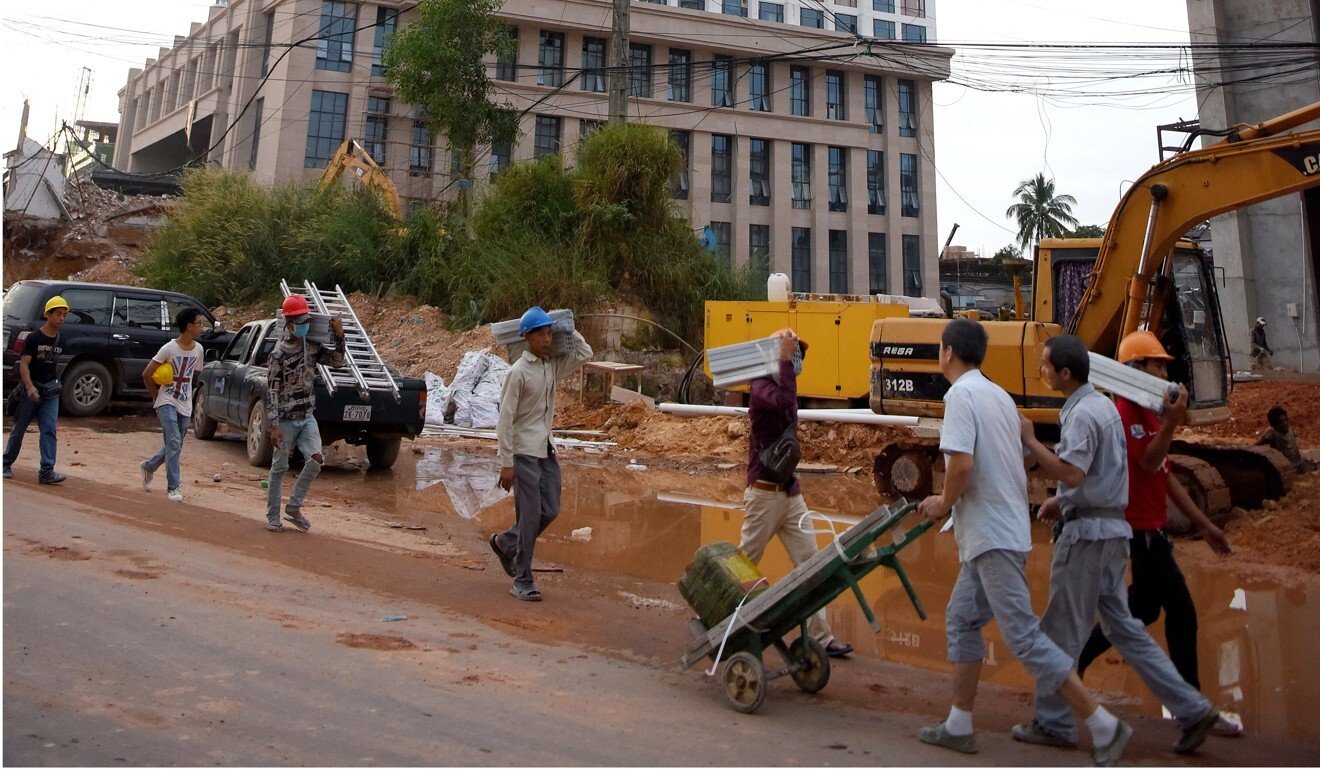
The development of the Chinese built and operated special economic zone in the Cambodian town of Sihanoukville is reported to have slowed, while infrastructure projects in Bangladesh, including the Payra coal-fired power plant, have been put on hold.
The development of the Chinese built and operated special economic zone in the Cambodian town of Sihanoukville is reported to have slowed. Photo: AFP
Marro said the reduction of capital and labour from China might complicate other projects for key belt and road partner, like Pakistan, which is home to infrastructure projects worth tens of billions of US dollars, and funded and built in large part by China.
“Pakistan looks concerning, particularly in terms of how we’ve assessed its sovereign and currency risk,” Marro said.
“Public debt is high compared to other emerging markets, while the coronavirus will push the budget deficit to expand to 10 per cent of GDP [gross domestic product] this year.”
Last week, Pakistan asked China for a 10-year extension to the repayment period on US$30 billion worth of loans used to fund the development of infrastructure projects, according to a report by local newspaper Dawn.
China’s overseas investment has been falling steadily from its peak in 2016, mostly as a result of Beijing’s curbs on capital outflows.
Last year, the direct investment by Chinese companies and organisations other than banks in belt and road countries fell 3.8 per cent from 2018 to US$15 billion, with most of the money going to South and Southeast Asian countries, including Singapore, Vietnam, Indonesia and Pakistan.
Tong said the pandemic had made Chinese investors nervous about putting their money in countries where disease control measures were becoming increasingly stringent, but added that the pause in activity would give all parties time to regroup.
“Investment in the second quarter will decline and allow time for the questions to be answered,” he said.
“Past experience along the belt and road has taught many lessons to both China and its partners, and forced them to think calmly about their own interests. The epidemic provides both parties with a good time for this.”
Dr Frans-Paul van der Putten, a senior research fellow at Clingendael Institute in the Netherlands, said China’s post-pandemic strategy for the belt and road in Europe
might include a shift away from investing in high-profile infrastructure projects like ports and airports.
Investors might instead cooperate with transport and logistics providers rather than invest directly, he said.
“Even though in the coming years the amount of money China loans and invests abroad may be lower than in the peak years around 2015-16, I expect it to maintain the belt and road plan as its overall strategic framework for its foreign economic relations,” he said.
BENGALURU (Reuters) – The Indian economy is likely to suffer its worst quarter since the mid-1990s, hit by the ongoing lockdown imposed to stem the spread of coronavirus, according to a Reuters poll, which predicted a mild and gradual recovery.
Over 2.6 million people tmsnrt.rs/3aIRuz7 have been infected by the coronavirus worldwide and more than 180,000 have died. Business and household lockdowns have disrupted supply chains globally, bringing growth to a halt.
The April 17-22 Reuters poll predicted the economy expanded at an annual pace of 3.0% last quarter but will shrink 5.2% in the three months ending in June, far weaker than expectations in a poll published last month for 4.0% and 2.0% growth, respectively.
The predicted contraction would be the first – under any gross domestic product calculation, which has changed a few times – since the mid-1990s, when official reporting for quarterly data began.
“The extended lockdown until early May adds further downside risk to our view of a 5% year-on-year GDP fall in the current quarter, the worst in the last few decades,” said Prakash Sakpal, Asia economist at ING.
“We don’t consider economic stimulus as strong enough to position the economy for a speedy recovery once the pandemic ends,” he said.
(Graphic: Reuters poll graphic on coronavirus impact on the Indian economy IMAGE link: here)
The Indian government announced a spending package of 1.7 trillion rupees in March to cushion the economy from the initial lockdown, which has been extended until May 3.
In an emergency meeting last week, the Reserve Bank of India cut its deposit rate again, after reducing it on March 27 and lowering the main policy rate by 75 basis points. It also announced another round of targeted long-term repo operations to ease liquidity.
But even with those measures, 40% of economists, or 13 of 32 – who provided quarterly figures – predicted an outright recession this year. Only one had expected a recession last month.
In the worst case, a smaller sample of respondents predicted, the economy would contract 9.3% in the current quarter. That compares with 0.5% growth in the previous poll’s worst-case forecast in late March, underscoring how rapidly the outlook has deteriorated.
The latest poll’s consensus view still shows the economy recovering again slowly in the July-September quarter, growing 0.8%, then 4.2% in October-December and 6.0% in the final quarter of the fiscal year, in early 2021.
But that compares with considerably more optimistic near-term forecasts of 3.3%, 5.0% and 5.6%, respectively, in the previous poll.
“A rebound in economic activity following the disruption is expected, but the low starting point of growth implies a gradual recovery,” said Upasana Chachra, chief India economist at Morgan Stanley.
“Indeed, before disruptions related to COVID-19, growth was slowing, with domestic issues of risk aversion in financial sector … (and) those concerns will likely stay after the COVID-19 disruptions have passed unless the policy response is much larger than expected,” she said.
The unemployment rate has tripled to 23.8% since the lockdown started on March 25, according to the Centre for Monitoring Indian Economy, a Mumbai-based research firm.
The Indian economy was now forecast to expand 1.5% in the fiscal year ending on March 31, 2021 – the weakest since 1991 and significantly lower than 3.6% predicted in late March. It probably grew 4.6% in the fiscal year that just ended.
Under a worst-case scenario, the median showed the economy shrinking 1.0% this fiscal year. That would be the first officially reported economic contraction for a 12-month period since GDP was reported to have contracted for calendar year 1979.
“Unless fiscal policy is also loosened aggressively alongside monetary policy, there is a big risk the drastic economic slowdown currently underway morphs into an annual contraction in output and that the recovery is hampered,” said Shilan Shah, senior India economist at Capital Economics.
All 37 economists who answered a separate question unanimously said the RBI would follow up with more easing, including lowering the repo and reverse repo rates and expanding the new long-term loans programme.
The RBI was expected to cut its repo rate by another 40 basis points to 4.00% by the end of this quarter. Already lowered twice over the past month by a cumulative 115 basis points, the reverse repo rate was forecast to be trimmed by another 25 points by end-June to 3.50%.
BEIJING, April 13 (Xinhua) — Chinese authorities have released a circular, only allowing outdoor tourist attractions to reopen amid the COVID-19 epidemic.
The tourist sites that resume operation should receive no more than 30 percent of their daily visitor capacity, according to the circular jointly released by the Ministry of Culture and Tourism and the National Health Commission.
The reopened tourist attractions should take measures to prevent the number of visitors from exceeding the limit, said the circular, adding that indoor tourist sites should remain closed amid the epidemic.
The circular required tourist sites to encourage visitors to reserve visiting slots in advance to control visitor flows and prevent large gatherings of people.
While noting some tourist attractions have seen large crowds of tourists after resuming operation, which increased the risk of virus transmission, the circular demanded temperature checking at the entrance of tourist sites and major scenic spots.
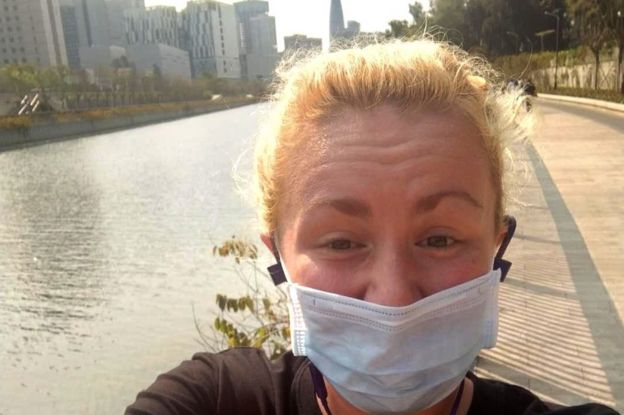
Image copyright JEN SMITHImage caption Jen Smith lives in Shenzhen, where it’s compulsory to wear a mask outside at all times
My Money is a series looking at how people spend their money – and the sometimes tough decisions they have to make. Here, Jen Smith, a children’s TV presenter from Shenzhen in southern China, takes us through a week in her life, as the country slowly emerges from the coronavirus pandemic.
Over to Jen…
Since being in lockdown I’ve been bingeing on Keeping Up With the Kardashians. It starts with one episode after dinner, blink, and suddenly it’s 3am. YouTube, Facebook, Google and Instagram are all banned here, so you’d think I’d be a binge-free socialite after a year and a half living in China. Well, those sites are banned unless you have a VPN – I pay $120 (£97) a year for mine, so Sunday was a late night, with a lie-in until 10.30 this morning.
I go for a run – mask and all, as it’s currently illegal to be outside without one. I make my coffee (bought in the UK), fruit smoothie (about 20 yuan, $2.82, £2.27) and cereal (80 yuan a packet) before cycling to work.
Today is a bit of a crazy day in the studio. I work as a children’s TV presenter. My company has profited from the lockdown as more children are watching the shows non-stop – meaning a rapid turnaround for us.
We shoot two shows from 2-6pm then “break” for a meeting. We discuss tomorrow’s shoot while I eat dinner – homemade aubergine curry. It is normal for the Chinese to eat breakfast, lunch and dinner at work. Normally the company gives all staff 25 yuan through a food-ordering app, and the whole company would eat together. However, because of the current social distancing, that social time is in the far distant past!
I make it home for 8pm, order some deep-fried cauliflower as a snack (45 yuan) and start the inevitable Kardashian binge.
Total spend: 65 yuan ($9.10, £7.37)
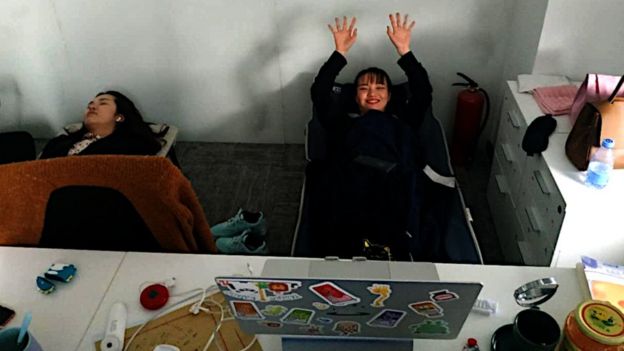
Image copyright JEN SMITHImage caption Workers often have a midday nap in the office
It’s a much earlier start (7.30am), but the same morning routine. On my cycle to work I notice that the traffic is almost back to normal – Shenzhen is inhabited by well over 12 million people, so as you can imagine rush hour is intense. This doesn’t change the fact that everywhere you go you have to scan a QR code – leaving my apartment, using the walkway by the river, and getting into the building I work in.
After a morning of shooting I eat homemade potato curry and settle down for a nap. Naptime is such a commonality in China that people store camp beds at the office. I order a coffee and banana chips (20 yuan) for a pick-me-up before the afternoon’s shooting.
It’s St Paddy’s Day so I head to the local pubs area, catch dinner at a French restaurant (222 yuan), then a few drinks (25 yuan – mainly bought by men at the bar for us) before a very tipsy cycle home.
Total spend: 242 yuan ($34, £25)
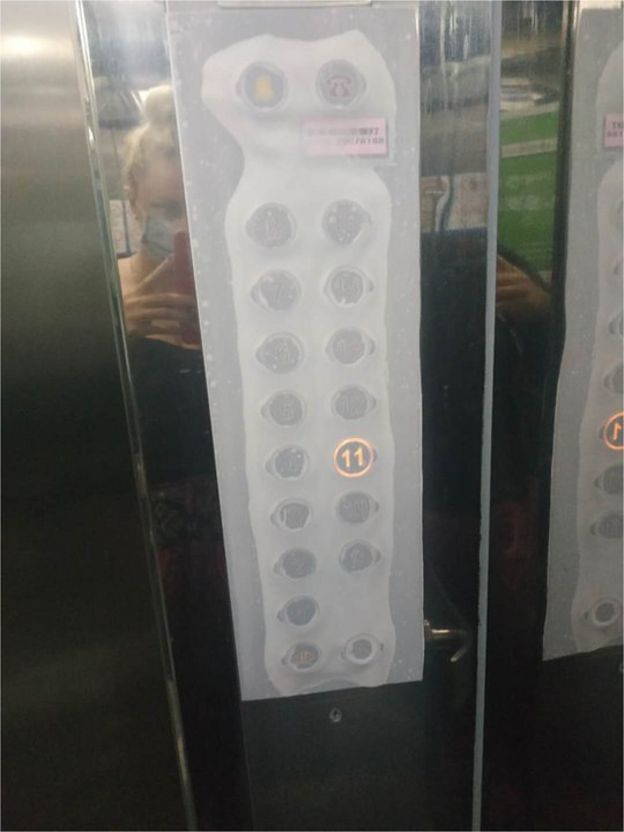
Image copyright JEN SMITHImage caption A disposable cover reduces the risk of transmitting the virus by touching lift buttons
The morning’s shoot (thankfully) was cancelled, so I nursed a hangover in bed until around 11am, at which point I had a phone meeting for a company that I do “plus-size” modelling for (for context I’m a UK size 12). I eat a bowl of cereal and order more cauliflower (45 yuan) while I watch a film.
At 2.30pm an intern picks me up, and we head to the government building to apply for a new work visa. Ironically, the image taken for my visa is Photoshopped to remove wrinkles, freckles and my frizzy hair. When I ask why this is being done for an identification document, the intern replies that the government wants it to be neat, and “the Chinese way” is to have altered photos.
I don’t argue, and have an interview before I hand in my passport. The whole process takes around two hours, so I order food to my house while on the way home (150 yuan for burger, salad and cake!) I take a taxi across town which ends up being 39.05 yuan.
The day starts at 8.30am with coffee and reading, before I get a manicure (280 yuan). My nail lady has been very worried about the state of my hands during the virus, so she spends a whopping two and a half hours treating them while I watch a film (0.99 yuan – bought by her). Because the manicure was so long I don’t have time to eat lunch before our fitness shoot, which runs from 2-5.30pm. I then have an appointment to sign into a building which I’ll shoot in tomorrow.
The building is near a supermarket called Ole (one of the only western supermarkets), and I pick up groceries for 183 yuan before heading home to cook, listen to podcasts and prep for the big day of shooting on Friday.
Total spend: 463 yuan ($64, £52.5)
Image copyright JEN SMITHImage caption Jen filming in front of a green screen – a more colourful digital background will be added later in post-production
Fridays are generally my busiest day. The way the Chinese seem to function, is a boss will say “I want this done now” and then employees rush to finish it. Generally, they will write scripts on Monday and Tuesday, discuss Wednesday, then we shoot later in the week. The poor editors, despite mandatory office hours during the week, then have to work tirelessly through the weekend to achieve a Sunday evening deadline.
I start with mashed avocado and a hard-boiled egg before work. The morning shoot runs from 9.30-11.40am, and I have an early lunch – homemade curry again, before my regular nap time. The afternoon shoot is three hours, so I have time to pop home and shower before a live stream at 6pm. I take a taxi to and from the live stream which ends up being 28 yuan.
Total spend: 28 yuan ($3.92, £3.18)
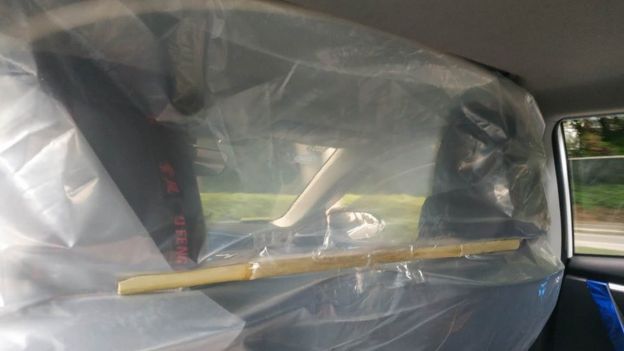
Image copyright JEN SMITHImage caption A taxi driver has improvised a screen to reduce the risk of picking up Covid-19 from a passenger
Finally the weekend! Although things are slowly getting better in China after the coronavirus outbreak, there’s still not too much to do. So I use this time to write, play my piano and generally chill inside. Around 3pm, I venture outside to the shops to pick up some snacks (159.60 yuan) before settling in to ring my family back in the UK with a homemade cocktail – a friend of mine in Canada is doing a daily live stream, “quarantinis” where he teaches you how to make cocktails!
What’s interesting is that a lot of people have started leaving their houses again, but it is still illegal to go outside without a mask on, and temperature checks are taken everywhere. I was even refused entry to a building due to being foreign. I imagine this is because recently the only new cases are being brought in by non-Chinese travelling back to China.
Total spend: 159.60 yuan ($22, £18)
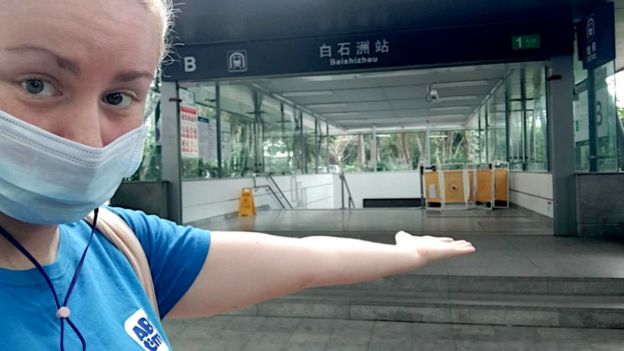
Image copyright JEN SMITHImage caption Shenzhen’s Metro system is still very quiet
It’s another slow day for me as many foreigners have not yet returned to China, so most of my friends are out of the country. I start the day by reviewing potential scripts.
This takes me to 1.30pm without realising I haven’t eaten. I decide to go for a quick run and I return to eat mashed avocado and a hard-boiled egg.
I home-bleach my hair with products bought in the UK, then head back to editing again. About half way through the afternoon I take a little break to practice Chinese. I use an app which is fantastic and free! Definitely worth everyone downloading this during social distancing so you can learn new skills!
For dinner I order online again, a three-dish meal for 160 yuan.
World’s largest coal consumer shows little sign of ending its dependency even though it is also the biggest market for renewable energy sources
UN climate summit is meeting to discuss ways to limit future warming, but hopes are fading that China will commit to further curbs on emissions
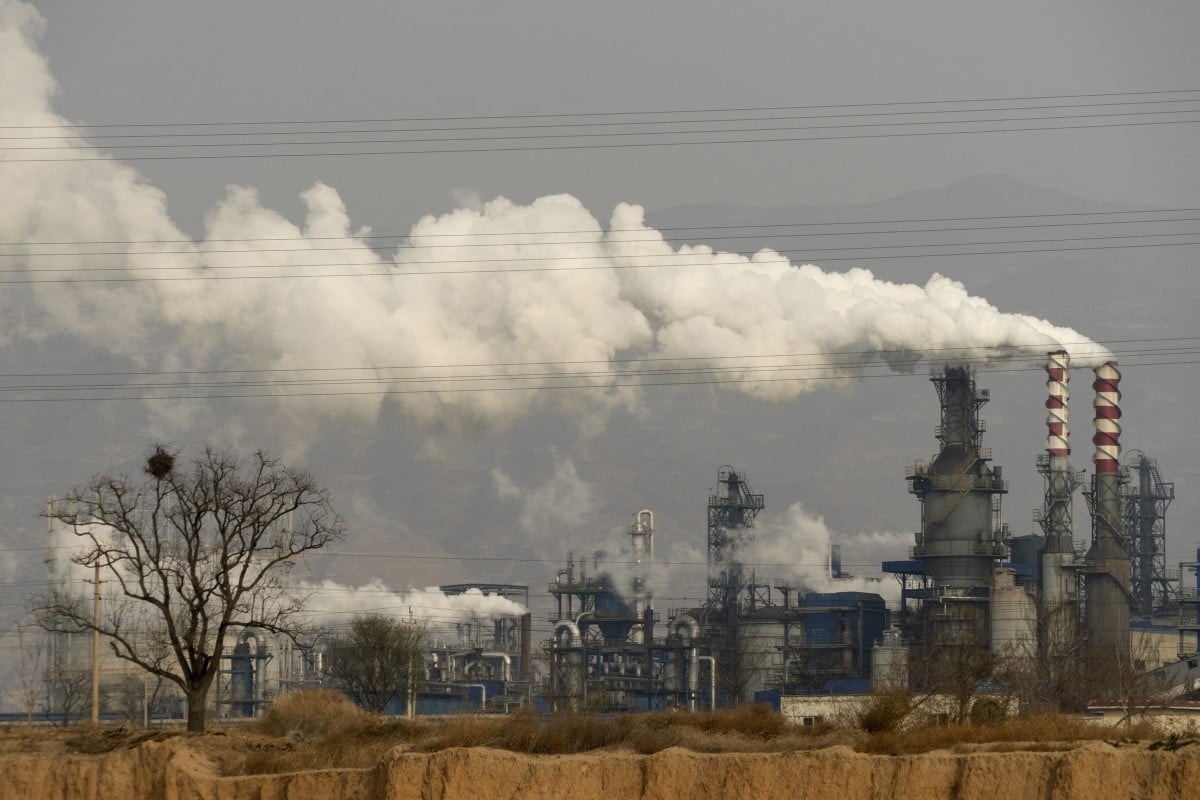
China now accounts for around 30 per cent of the world’s carbon emissions. Photo: AP
As world leaders gather in Spain to discuss how to slow the warming of the planet, the spotlight has fallen on China – the top emitter of greenhouse gases.
China burns about half the coal used globally each year. Between 2000 and 2018, its annual carbon emissions nearly tripled, and it now accounts for about 30 per cent of the world’s total.
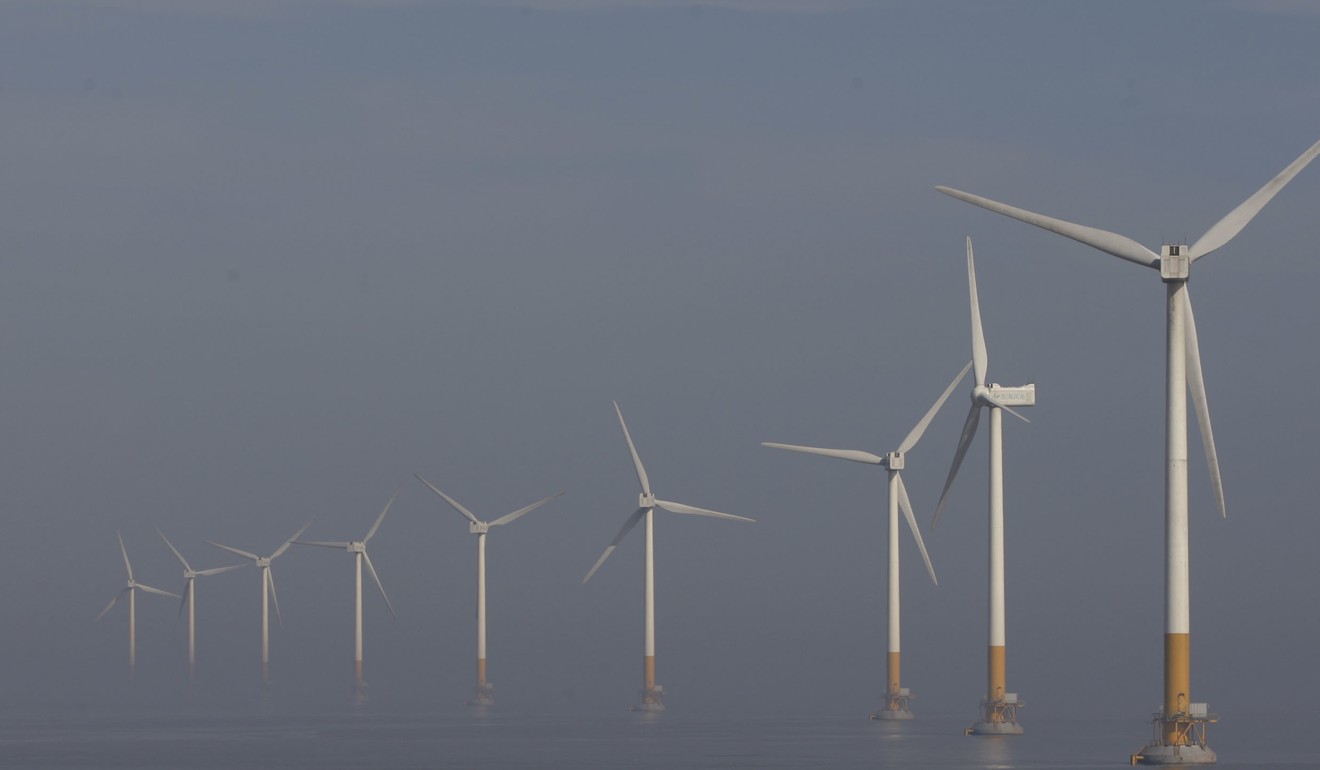
Yet it is also the leading market for solar panels, wind turbines and electric vehicles, and it manufactures about two-thirds of solar cells installed worldwide.
“We are witnessing many contradictions in China’s energy development,” said Kevin Tu, a Beijing-based fellow with the Centre on Global Energy Policy at Columbia University. “It’s the largest coal market and the largest clean energy market in the world.”
That apparent paradox is possible because of the sheer scale of China’s energy demands.
Pollution alarm as tourism businesses contaminate home of China’s hairy crab
But as China’s economy slows to the lowest level in a quarter century – around 6 per cent growth, according to government statistics – policymakers are doubling down on support for coal and other heavy industries, the traditional backbones of China’s energy system and economy. At the same time, the country is reducing subsidies for renewable energy.
At the annual United Nations climate summit, this year in Madrid, government representatives will put the finishing touches on implementing the 2015 Paris Agreement, which set a goal to limit future warming to 1.5 to 2 degrees Celsius above pre-industrial levels.
Nations may decide for themselves how to achieve it.
China had previously committed to shifting its energy mix to 20 per cent renewables, including nuclear and hydroelectric energy.
Climate experts generally agree that the initial targets pledged in Paris will not be enough to reach the goal, and next year nations are required to articulate more ambitious targets.
Hopes that China would offer to do much more are fading.
Recent media reports and satellite images suggest that China is building or planning to complete new coal power plants with total capacity of 148 gigawatts – nearly equal to the entire coal-power capacity of the European Union within the next few years, according to an analysis by Global Energy Monitor, a San Francisco-based non-profit.
China is the world’s leading market for wind turbines and other renewables – but is still a major source of emissions. Photo: Chinatopix via AP
Meanwhile, investment in China’s renewable energy dropped almost 40 per cent in the first half of 2019 compared with the same period last year, according to Bloomberg New Energy Finance, a research organisation. The government slashed subsidies for solar energy.
Last week in Beijing, China’s vice-minister of ecology and environment told reporters that non-fossil-fuel sources already account for 14.3 per cent of the country’s energy mix. He did not indicate that China would embrace more stringent targets soon.
“We are still faced with challenges of developing our economy, improving people’s livelihood,” Zhao Yingmin said.
As a fast-growing economy, it was always inevitable that China’s energy demands would climb steeply. The only question was whether the country could power a sufficiently large portion of its economy with renewables to curb emissions growth.
Many observers took hope from a brief dip in China’s carbon emissions between 2014 and 2016. Today the country’s renewed focus on coal comes as a disappointment.
“Now there’s a sense that rather than being a leader, China is the one that is out of step,” said Lauri Myllyvirta, lead analyst at the Centre for Research on Energy and Clean Air in Helsinki.
He notes that several developed countries – including Germany, South Korea and the United States – are rapidly reducing their reliance on coal power.
After climbing sharply for two decades, China’s emissions stalled around 2013 and then declined slightly in 2015 and 2016, according to Global Carbon Budget, which tracks emissions worldwide.
This dip came as Chinese leaders declared a “war on pollution” and suspended the construction of dozens of planned coal power plants, including some in Shanxi.
Pollution scandal near China nature reserve at Tengger desert’s edge
At the same time, the government required many existing coal operators to install new equipment in chimneys to remove sulphur dioxide, nitrous oxide and other hazardous substances. About 80 per cent of coal plants now have scrubbers, said Alvin Lin, Beijing-based China climate and energy policy director for the Natural Resources Defence Council, a non-profit.
As a result, the air quality in many Chinese cities, including Beijing, improved significantly between 2013 and 2017. Residents long accustomed to wearing face masks and running home air-filter machines enjoyed a reprieve of more “blue sky days,” as low-pollution days are known in China.
In the past three years, China’s carbon emissions have begun to rise again, according to Global Carbon Budget.
The coming winter in Beijing may see a return of prolonged smog, as authorities loosen environmental controls on heavy industry – in part to compensate for other slowing sectors in the economy.
The UN Climate Change Conference is taking place in Madrid this month. Photo: AFP
Permits for new coal plants proliferated after regulatory authority was briefly devolved from Beijing to provincial governments, which see construction projects and coal operations as boosts to local economies and tax bases, said Ted Nace, executive director of Global Energy Monitor.
“It’s as though a boa constrictor swallowed a giraffe, and now we’re watching that bulge move through the system,” said Nace. In China, it takes about three years to build a coal plant.
The world has already warmed by 1 degree Celsius. All scenarios envisioned by the Intergovernmental Panel on Climate Change for holding planetary warming to around 1.5 degrees Celsius involve steep worldwide reductions in coal-power generation.
In that effort, other countries rely on Chinese manufacturing to hold down prices on solar panels. wind turbines and lithium-ion batteries.
“China has a really mixed record. On the one hand, it’s seen rapidly rising emissions over the past two decades,” said Jonas Nahm, an energy expert at Johns Hopkins University.
“On the other hand, it’s shown it’s able to innovate around manufacturing – and make new energy technologies available at scale, faster and cheaper.”
Li Keqiang tells senior officials to step up efforts to channel water from Yangtze River to arid regions
Impact of pollution and rising population has prompted increased efforts to improve efficiency and supply
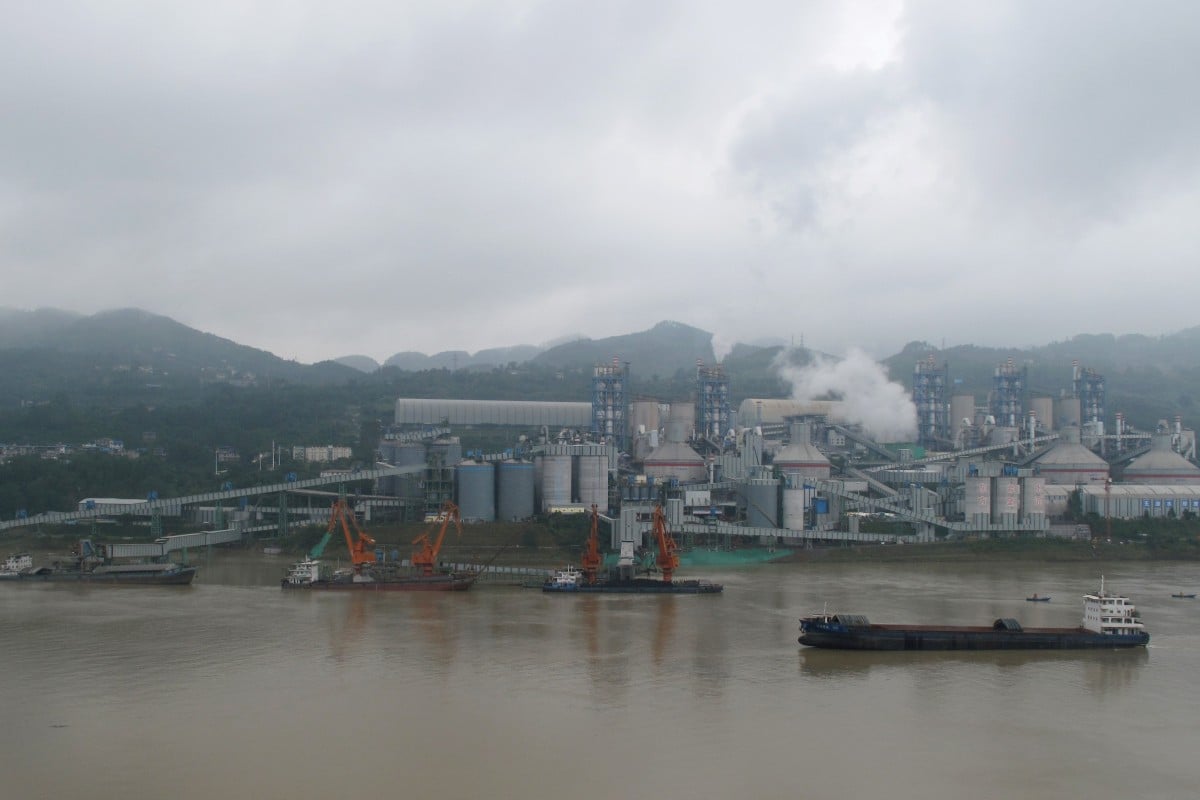
A cement plant on the banks of the Yangtze in Chongqing. The authorities are now trying to stop further development along the river. Photo: Reuters
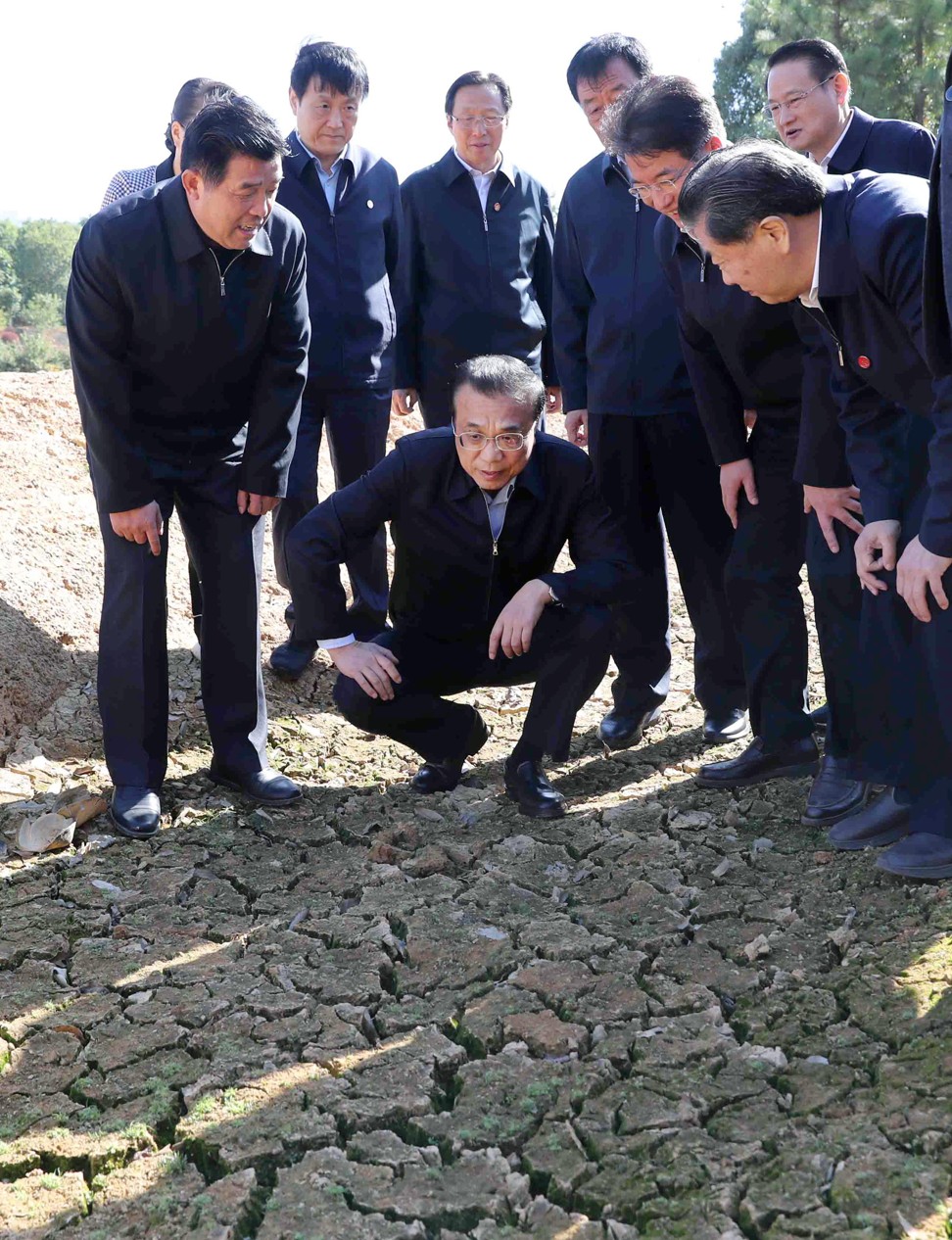
China needs to divert more water to its arid northern regions and invest more in water infrastructure as shortages get worse because of pollution, overexploitation and rising population levels, Premier Li Keqiang has said.
China’s per capita water supplies are around a quarter of the global average. With demand still rising, the government has sought to make more of scarce supplies by rehabilitating contaminated sources and improving efficiency.
Water remained one of China’s major growth bottlenecks, and persistent droughts this year underlined the need to build new infrastructure, Li told a meeting of senior Communist Party officials on Monday. An account of the meeting was published by China’s official government website.
Local government bonds should be “tilted” in the direction of water infrastructure, he said, and innovative financing tools were also needed.
He also called for research into new pricing policies to encourage conservation.
Li said China’s water supply problems had been improved considerably as a result of the South-North Water Diversion Project, a plan to divert billions of cubic metres of water to the north by building channels connecting the Yangtze and Yellow rivers.
World ‘woefully unprepared’ for climate change’s effects on drinking water supplies drawn from mountains
He said opening up more channels to deliver water to regions north of the Yangtze River Delta would support economic and social development and optimise China’s national development strategy, according to a summary of the meeting on the government website.
China is in the middle of a wide-reaching programme to clean up the Yangtze River, its biggest waterway, and put an end to major development along its banks.
Chinese Premier Li Keqiang inspects an empty reservoir during a visit to Jiangxi province last week. Photo: Xinhua
Local governments have been under pressure to dismantle dams, relocate factories and even ban fishing and farming in ecologically fragile regions.
But experts say the ongoing campaign to divert the course of the Yangtze to other regions is still causing long-term damage to the river’s environmental health.
Many cities that had polluted their own water sources had drawn replacement supplies from the Yangtze, exceeding the river’s environmental capacity, said Ma Jun, founder of the Institute of Public and Environmental Affairs, which monitors water pollution.
Beijing already relied on diversion channels from the Yangtze to supply 70 per cent of its water, but had done little to improve conservation or reduce per capita consumption, which was higher than many Western countries, he said.
“[Diversion] has caused so much suffering and needs so many dams to keep up supply, and that has impacted biodiversity,” he said.
BEIJING (Reuters) – Eighteen people were killed and 14 were missing in eastern China on Saturday in a landslide triggered by a major typhoon, which caused widespread transport disruptions and the evacuation of more than one million people, state broadcaster CCTV reported.
Typhoon Lekima made landfall early on Saturday in the eastern province of Zhejiang with maximum winds of 187 km (116 miles) per hour, although it had weakened from its earlier designation as a “super” typhoon, the official Xinhua news agency reported.
Thousands of flights were cancelled in eastern China, according to the country’s aviation regulator, with most flights into and out of Shanghai’s two major airports cancelled on Saturday afternoon, their websites showed.
China’s weather bureau on Saturday issued an orange alert, its second highest, after posting a red alert on Friday, when the storm forced flight cancellations in Taiwan and shut markets and businesses on the island.
The deadly landslide occurred about 130 km north of the coastal city of Wenzhou, when a natural dam collapsed in an area deluged with 160 millimetres (6.3 inches) of rain within three hours, CCTV reported.
The storm was moving northward at 15 kph and was gradually weakening, Xinhua reported, citing the weather bureau.
High winds and heavy rains battered the financial hub of Shanghai on Saturday afternoon, and Shanghai Disneyland was shut for the day.
Nearly 200 hundred trains through the city of Jinan in Shandong province had been suspended until Monday, Xinhua reported.
More than 250,000 residents in Shanghai and 800,000 in Zhejiang province had been evacuated due to the typhoon, and 2.72 million households in Zhejiang had power blackouts as strong wind and rain downed electricity transmission lines, state media reported.
Some 200 houses in six cities in Zhejiang had collapsed, and 66,300 hectares (163,830 acres) of farmland had been destroyed, CCTV said.
The storm was predicted to reach Jiangsu province by the early hours of Sunday and veer over the Yellow Sea before continuing north and making landfall again in Shandong province, CCTV said.
Coastal businesses in Zhejiang were shut and the Ministry of Emergency Management warned of potential risk of fire, explosions and toxic gas leaks at chemical parks and oil refineries.















 CHINDIA ALERT: You'll be living in their world, very soon
