Chindia Alert: You’ll be Living in their World Very Soon
aims to alert you to the threats and opportunities that China and India present. China and India require serious attention; case of ‘hidden dragon and crouching tiger’.
Without this attention, governments, businesses and, indeed, individuals may find themselves at a great disadvantage sooner rather than later.
The POSTs (front webpages) are mainly 'cuttings' from reliable sources, updated continuously.
The PAGEs (see Tabs, above) attempt to make the information more meaningful by putting some structure to the information we have researched and assembled since 2006.
Image copyright ANIImage caption Millions of people across India have been stranded by the lockdown
The first train carrying migrant workers stranded by a nationwide lockdown in India has left the southern state of Telangana.
The 24-coach train, carrying 1,200 passengers, is travelling non-stop to eastern Jharkhand state.
Earlier this week, India said millions of people stranded by the lockdown can return to their home states.
The country has been in lockdown to curb the spread of coronavirus since 24 March.
However, the movement of people will be only possible through state government facilitation, which means people cannot attempt to cross state borders on their own.
This train is a “one-off special train” to transport the workers on the request of the Telangana state government, Rakesh Ch, the chief public relations officer of South-Central Railways, told the BBC.
The train left Lingampally, a suburb of the southern city of Hyderabad, early on Friday and is expected to reach Hatia in Jharkhand on Saturday.
Mr Rakesh said that adequate social distancing precautions had been taken and food was being served to the passengers.
Image copyright ANIImage caption Railways officials said that adequate social distancing precautions had been taken and food was being served to the passengers.
He said each carriage was carrying 54 passengers instead of its 72-seat capacity.
“The middle berth is not being used in the sleeper coaches and only two people are sitting in the general coaches,” Mr Rakesh said.
Before the train pulled out of the station, all the passengers were screened for fever and other symptoms.
They had all been employed at a construction site at the Indian Institute of Technology, a top engineering school, in Hyderabad city.
The workers had earlier protested at the site against the non-payment of wages by their contractor.
Senior official M Hanumantha Rao said the contractor was asked to pay their salaries and arrangement made to send them back home.
The journey was organised at “very short notice”, senior police official S Chandra Shekar Reddy told BBC Telugu.
“We screened them at the labour camp itself and transported them to the railway station in buses,” he said.
India’s migrant workers are the backbone of the big city economy, constructing houses, cooking food, serving in eateries, delivering takeaways, cutting hair in salons, making automobiles, plumbing toilets and delivering newspapers, among other things.
Image copyright ANIImage caption Before the train pulled out of the station, all the passengers were screened for fever and other symptoms.
Most of the country’s estimated 100 million migrant workers live in squalid conditions.
When industries shut down overnight, many of them feared they would starve.
For days, they walked – sometimes hundreds of kilometres – to reach their villages because bus and train services were shut down overnight. Several died trying to make the journey.
Some state governments tried to facilitate buses, but these were quickly overrun. Thousands of others have been placed in quarantine centres and relief camps.
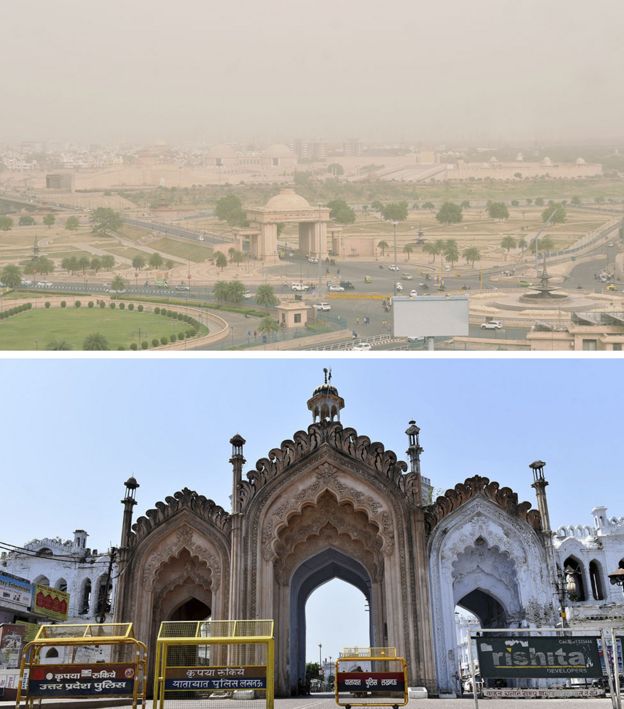
Image copyright GETTY IMAGESImage caption Delhi’sair quality has improved remarkably during the shutdown
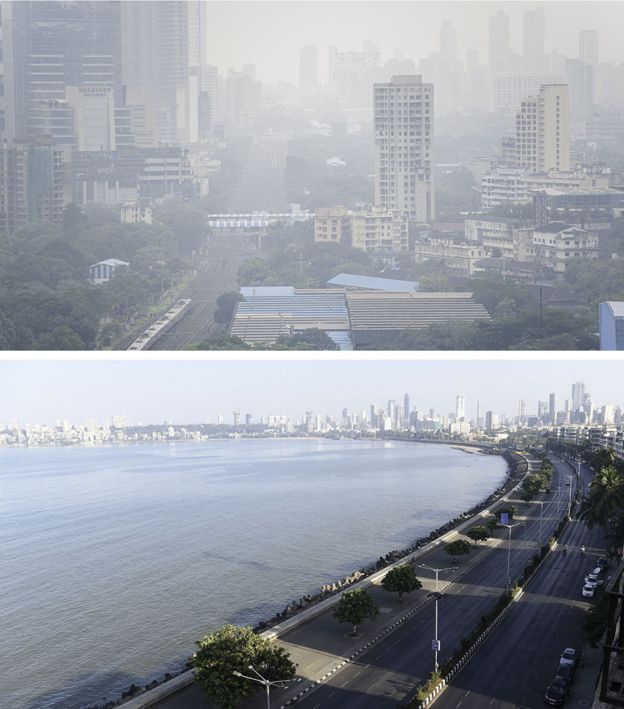
When India shut down last month and suspended all transport to contain the spread of coronavirus, the skies over its polluted cities quickly turned an azure blue, and the air, unusually fresh.
As air pollution plummeted to levels unseen in living memory, people shared pictures of spotless skies and even Himalayan peaks from cities where the view had been obscured by fog for decades.
On one social messaging group, a resident of the capital, Delhi, which regularly records some of the foulest air in the world, celebrated the city’s “alpine weather“. Politician and author Shashi Tharoor wrote that the “blissful sight of blue skies and the joy of breathing clean air provides just the contrast to illustrate what we are doing to ourselves the rest of the time”.
Media caption India coronavirus lockdown cleans up Ganges river
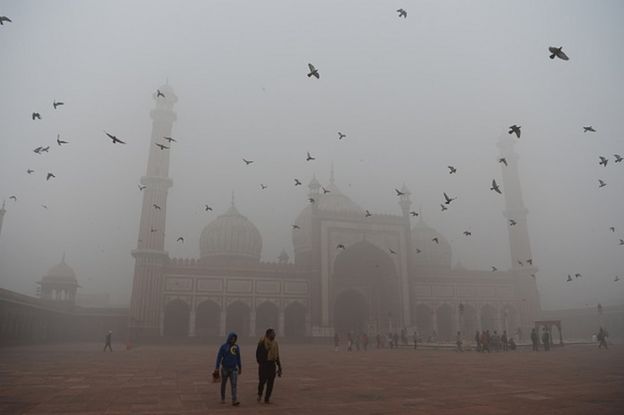
Less than six months ago, Delhi was gasping for breath. Authorities said air quality had reached “unbearable levels”. Schools were shut, flights were diverted, and people were asked to wear masks, avoid polluted areas and keep doors and windows closed.
Delhi and 13 other Indian cities feature on a list of the world’s 20 most polluted. It is estimated that more than a million Indians die every year because of air pollution-related diseases. Industrial smoke, vehicular emissions, burning of trash and crop residue, and construction and road dust are the major contributors.
As urban Indians gazed at the skies and breathed clean air inside their homes, researchers hunkered down to track data on how the grinding lockdown – now extended to 3 May – was impacting air pollution across the country.
Image copyright GETTY IMAGESImage caption Lucknow is another city on the top 20 world’s most polluted list
“This was an unprecedented opportunity for us to take a close look at how air pollution levels have responded to an extraordinary development,” Sarath Guttikunda, who heads Urban Emissions, an independent research group that provides air quality forecasts, told me.
Dr Guttikunda and his team of researchers looked at the data spewed out by the 100-odd air quality monitoring stations all over India. They decided to concentrate on the capital Delhi and its suburbs – a massive sprawl called the National Capital region, where more than 20 million people live. Last winter, air pollution here had reached more than 20 times the World Health Organization’s safe limit.
Image copyright HINDUSTAN TIMESImage caption The financial capital Mumbai also seems very different
The deadliest particle in Delhi’s foul air is the tiny but deadly PM 2.5, which increases the likelihood of respiratory and cardiovascular diseases. They primarily come from combustion – fires, automobiles and power plants.
Urban Emissions found the levels of PM 2.5 in Delhi during the lockdown plummeted to 20 micrograms per cubic metre with a 20-day average of 35.
To put this into context, between 2017 and 2019, the monthly average of PM 2.5 in the capital was up to four times higher. (The national standard is set at 40, and the WHO has an annual average guideline of just 10 micrograms per cubic metre.)
“If 35 is the average lowest available PM2.5 with limited local emissions, it means that at least 70% of the pollution is locally generated,” Mr Guttikunda told me.
Media caption India coronavirus lockdown cleans up Ganges river
His study also found a marked dip in PM 10, caused mainly by road and construction dust, and nitrogen dioxide, which comes mainly from vehicular emissions, and nearly 90% of vehicles are off the road.
“The current crisis has shown us that clear skies and breathable air can be achieved very fast if concrete action is taken to reduce burning of fossil fuels,” says Sunil Dahiya, of the Centre for Research on Energy and Clean Air, which has also been tracking air pollution levels during the lockdown.
But will this prompt change? After all, urban Indians’ and the media’s panic and outrage during the deadly winter pollution every year soon gets lost in the fog of summer heat and concerns over monsoon rains and droughts.
“We don’t yet have a democratic demand for clean air,” Arunabha Ghosh, Chief Executive Officer of the Council on Energy, Environment and Water, a leading climate think tank, told me. Orders to clean up the air have almost always come from the courts, responding to pleas by NGOs.
Image copyright GETTY IMAGESImage caption Pollution in Delhi peaks during winter
However, Dr Ghosh still hopes that “the experience of blue skies and fresh air could be a trigger to create a democratic demand for clean air in India”.
Crises often trigger life changing reforms. A fatal four-day “pea-souper” that engulfed London in 1952 and killed thousands provoked the passing of the Clean Air Act to reduce the use of smoky fuels.
China tried to clean up its air several times before hosting marquee international events – like the Beijing Olympics in 2008, the World Expo in Shanghai and the Guangzhou Asian Games in 2010 – before sliding back to grey, smoky skies.
But many believe the 2014 Apec meeting in Beijing, when China hosted 21 heads of Asia-Pacific economies, was a turning point. The rare blue skies over Beijing spawned the phrase ‘Apec blue‘. In a rush to clean its air, China introduced a set of far-reaching measures. Over the next four years, this resulted in a 32% drop in average pollution across major Chinese cities.
So could a lockdown to prevent the spread of a pandemic, which has imperilled the health and livelihoods of millions, trigger similar policy changes to clean up India’s air?
Image copyright GETTY IMAGESImage caption The movement for clean air has been sporadic and mainly pushed by NGOs
Could it move to a shift in reducing traffic on the road by asking people to work from home in shifts now that millions have experienced clean air for the first time in years? (Facing energy shortages after the loss of the Fukushima nuclear power plant, Japan unleashed a Cool Biz campaign to cut down air conditioning in workplaces and reduce carbon emissions by asking office workers to shed their suits.)
Or can India use some of the money from an inevitable stimulus to help kick-start the economy go towards helping green industries? Renewables, experts say, creates more jobs than coal: India has already created nearly 100,000 jobs in solar and wind energy firms.
Can the country use the windfall revenues accruing from the steep decline in oil prices – most of India’s oil is imported – to provide rebates to polluting factories to set up much-needed emission control equipment?
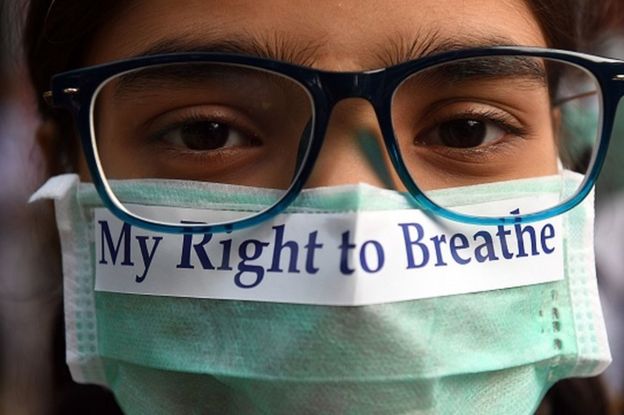
“We have to learn lessons to deploy the economic recovery from the pandemic. We need growth, jobs and sustainable development,” says Dr Ghosh. Cleaning up the air could be the key. For too long, India – and Indians – have ignored their right to breathe easy.
What’s more, if China can reduce air pollution by 32% in four-and-a-half years, why can’t India pledge to reduce pollution by 80% in 80 cities by 2027, which is our 80th anniversary of Independence? asks Dr Ghosh.
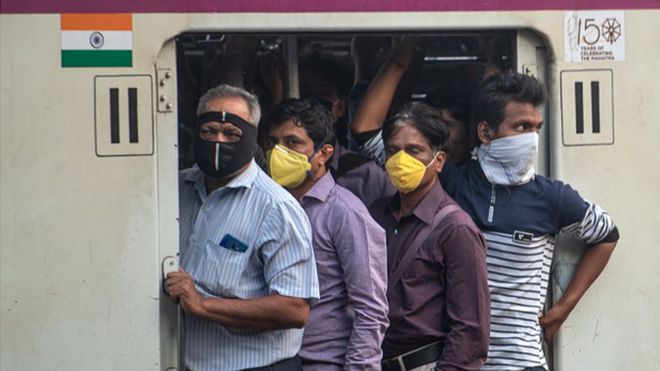
Image copyright GETTY IMAGESImage caption Many passengers have been wearing masks while travelling on the network
One of the world’s busiest urban rail systems will be shut down for ordinary commuters from Monday morning to prevent the spread of coronavirus infection in Mumbai, one of India’s most populous cities. Only government workers in “essential services” will be allowed to travel on a truncated service.
This was waiting to happen.
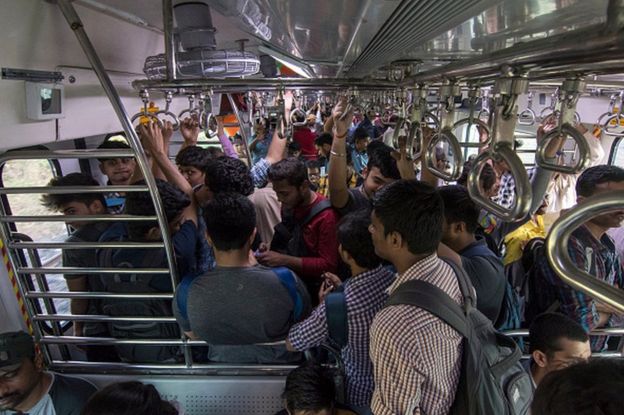
Consider this. Eight million people take Mumbai’s crowded suburban train network every day. Packed to nearly three times its capacity, this is one of the busiest railway systems in the world.
The 459km (285-mile) network is the lifeline of India’s financial and entertainment capital, accounting for nearly 80% of all commuting trips in the populous western city. The suburban trains “cover almost the distance up to [the] moon in one week,” the network’s website says.
The 66-year-old network carries 60,000 passengers per km per day, the highest among all the leading commuter rail systems in the world, say officials. The coaches are sturdy enough to carry a “super dense crush load”, a phrase coined by the railways to describe the intense crowding on Mumbai’s trains. This means that a nine-car train designed for 1,800 standing passengers will often carry up to 7,000 passengers, according to Monisha Rajesh, author of Around India in 80 Trains. “Mumbai’s local trains were certainly not for the fainthearted,” she wrote.
Image copyright GETTY IMAGESImage caption Mumbai’s suburban train network carries eight million passengers every day
Now consider this. The western state of Maharashtra, of which Mumbai is the capital, has confirmed more than 60 coronavirus infections, the highest in India so far. Scores of long distance trains out of the city have been cancelled, but the suburban network has continued to rumble on, raising fears of the mass spread of the virus on these packed trains. The crowded service was an easy target of a terror attack in 2006 when serial blasts ripped though a number of trains. At least 180 people were killed and more than 800 injured – the high casualty figure was attributed to overcrowding.
“From ports and landing places the local transport networks, particularly the railways, carried the virus from large cities to the smallest, remotest settlements,” said a report on the spread of the flu in Britain in 1918-1919.
So should one of the world’s busiest rail networks be shut down to stop a possible spread of the virus in a city that many fear could turn into a coronavirus hotspot?
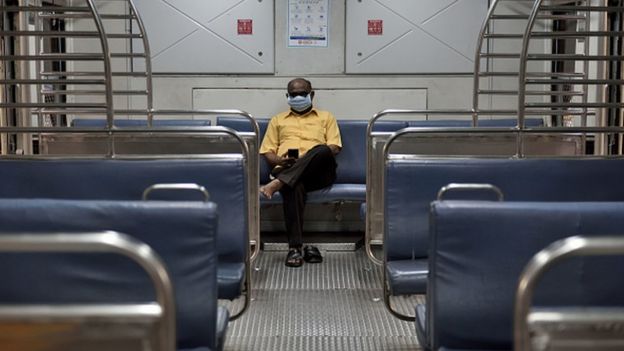
Image copyright GETTY IMAGESImage caption Officials say ridership on the trains has dropped by 17% after the coronavirus scare
Economists like Shruti Rajagopalan believe so.
“India is conducting the fewest tests per million at the moment. If the virus is truly within the community, then given these two issues, the Mumbai outbreak cannot be contained and people will die without healthcare.
“Mumbai trains are the fastest and surest way to spread the virus (if it is within the community) to the densest parts of the city,” she told me.
There is enough precedent: China stopped trains, ferries, planes and buses from leaving the city of Wuhan; and on Thursday, London officials announced that up to 40 stations on the London Underground network are to be shut as the city attempts to contain the outbreak.
Others are not so sure about linking the spread of a pandemic to public transport systems. One study does not support the effectiveness of suspending mass urban transport systems to reduce or slow down a pandemic because, “whatever the relevance of public transport is to individual-level risk, household exposure most likely poses a greater threat”.
“I have not seen any data on the relative risk of public transportation compared with [dense places like] workplaces or schools,” Timothy Brewer, a professor of epidemiology at the University of California Los Angeles told Vox.com.
He said data from China suggested that “household contact was an important means of transmission outside of Wuhan, suggesting that prolonged contact [with a sick person] increases the risk of transmission”.
“If correct, then the time spent commuting and the density of people commuting could be important factors in assessing if public transportation is a risk factor for the disease’s transmission.”
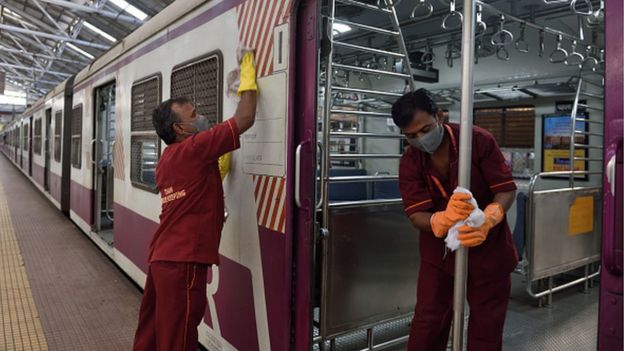
Image copyright GETTY IMAGESImage caption Trains on the network are being scrubbed clean to avoid the spread of infection
Shivaji Sutar, a senior communications officer of the railways, told me that the network was running an aggressive campaign to ease the rush: awareness announcements, posters and videos containing virus information.
They were also monitoring crowds, scrubbing the trains, taking the temperature of willing passengers and embarking on a drive against public spitting, he said.
A combination of awareness and panic has already led to a 27% drop in traffic on the network. But millions of people continue to take the train to work and home every day.
“This is more because of fear than anything else. Most of us have to take the network because we have to come to work. There is still no government directive to all companies to work from home. And apart from passengers wearing masks, I haven’t seen any other precautions being taken,” Rekha Hodge, who has been using the network for three decades, told me. That is bad news.


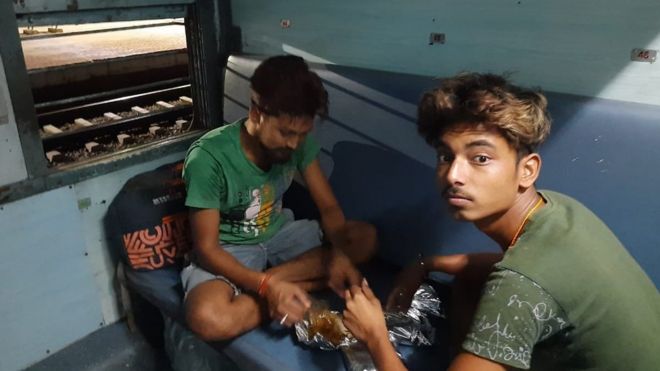 Image copyright ANI
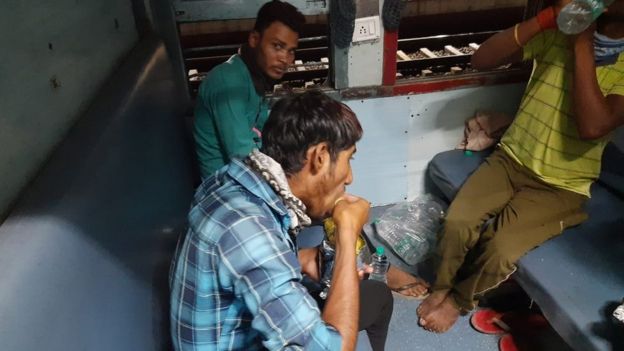 Image copyright ANI
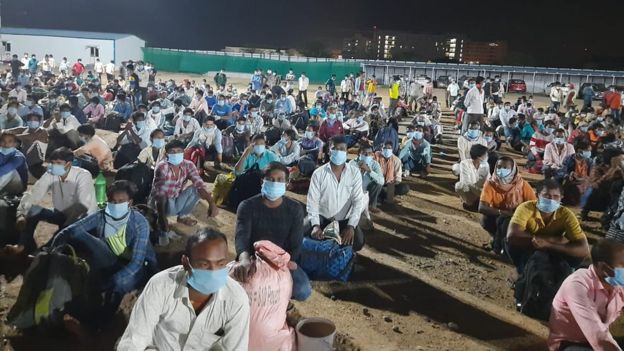 Image copyright ANI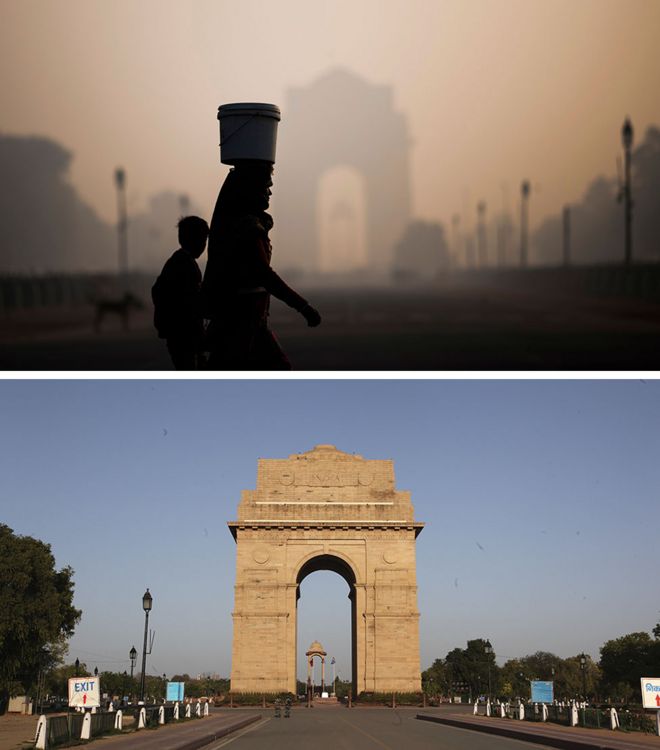


 CHINDIA ALERT: You'll be living in their world, very soon