26/08/2019
- Associate professor caused ‘vicious social impact’ in comments to student in social media chat room
- Ethics committee suspends him from teaching for two years
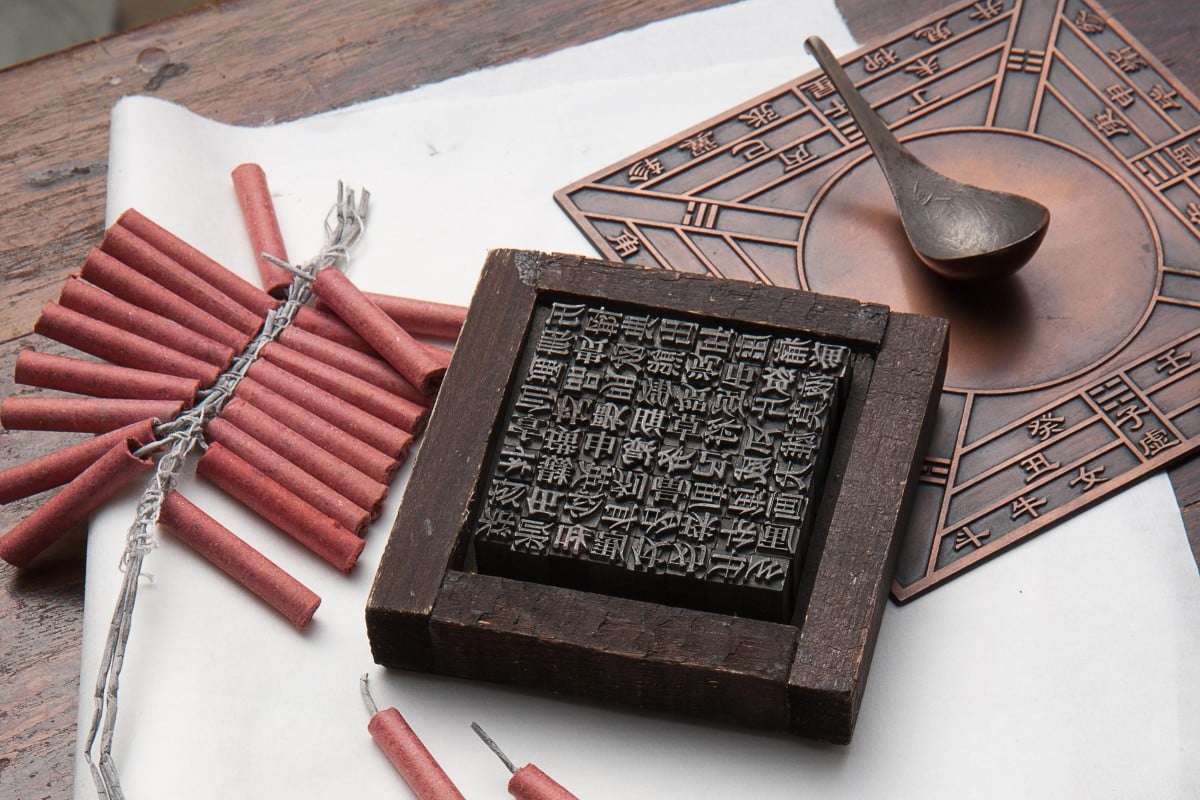
The four great inventions of ancient China: Paper, gunpowder, the compass and printing. Photo: Alamy
An associate professor has been suspended by his university in southwestern China for causing “vicious social impact” by belittling the four great ancient Chinese inventions of papermaking, printing, gunpowder and the compass.
Zheng Wenfeng was suspended from teaching for 24 months by the University of Electronic Science and Technology of China in Chengdu, Sichuan province, for his comments in June to a student in an online group discussion on Chinese social media platform WeChat.
Zheng told the student, who wanted to choose the four great inventions as a thesis topic on innovation, that “ancient China did not have any substantial innovations” and that the four great inventions were “not advanced in the world and did not generate any productivity or cooperation in reality”.
The four inventions are extolled in China as important contributions to the development of world civilisation.
The student’s boyfriend put a screenshot of the conversation on Zhihu.com, a Quora-style knowledge-sharing website, where it generated wide attention.
First day at university in China now means a face scan to enrol
In July, the university issued a statement saying that Zheng had expressed mistaken opinions in the online chat room which had “caused vicious social impact”. The university went on to say that its teachers’ ethics committee had determined Zheng had violated ethics regulations and he would be suspended from teaching, recruitment of master’s degree candidates, and promotion for the next 24 months.
Academics began speaking out in support of Zheng last week, with some university teachers alleging on social media that Zheng had been ambushed by his students. Others felt his punishment went too far.
Huang Shaoqin, an associate professor of the Antai School of Economics and Management at Shanghai Jiao Tong University, called for a boycott of Zheng’s university in response to his treatment and demanded a public apology from the students involved.
“Until you rectify your wrongdoings, I cannot have any academic communication with you,” Huang said. “I call on teachers at Chinese universities to boycott this university.”
College entrance exam boot camp accused of fake advertising
In an editorial on Saturday, GMW.cn – a news website targeting China’s intelligentsia – defended academic debate, saying people could provide their own evidence on the significance of the four great innovations, and this was how academic issues should be argued.
“Students ignored the basic rules of academic discussions and they exaggerated the teacher’s errors. They released the private chat record to the public, no doubt with an intention of making a fuss,” the editorial said. “Their meticulous thought is really horrible.”
Chinese state broadcaster CCTV addressed the issue in an editorial on Friday, saying schools should distinguish correctly between politics and academic issues, and should not magnify the seriousness of the teacher’s opinions.
“This kind of case involves how freely university teachers can talk and the boundary between academic freedom and political red lines,” it said. “The university should give a clear explanation about its punishment so that the public and the teacher involved will be convinced.”
The Ministry of Education promoted 10 principles for university teachers at the end of last year, with “sticking to correct political direction” at the top of the list.
Zheng said he accepted the university’s punishment and did not need to make any clarification or self-justification, according to online news portal Sohu.com last week.
“I will focus on scientific research. This incident is over, is my attitude,” he was quoted as saying.
Source: SCMP
Posted in Antai School of Economics and Management, Chengdu, compass, four great inventions of ancient China, GMW.cn – a news website, gunpowder, intelligentsia, paper, Printing, punishment, Quora-style knowledge-sharing website, Shanghai Jiao Tong University, sichuan province, Uncategorized, University of Electronic Science and Technology of China, WeChat, world civilisation, Zhihu.com |
Leave a Comment »
18/08/2019
BEIJING, Aug. 17 (Xinhua) — The central government has offered financial support of 920 million yuan (about 131 million U.S. dollars) to local governments to help counter typhoon, flood control and drought relief.
An emergency relief fund of 600 million yuan has been offered to 11 provincial regions including Henan, Sichuan and Gansu to help them control flood and deal with drought, according to the Ministry of Finance and the Ministry of Emergency Management.
Another fund worth 320 million yuan was used to support Hebei, Liaoning, Jilin and Heilongjiang provinces in flood control and typhoon relief.
Typhoon Lekima landed in east China’s Zhejiang on Aug. 10, wreaking havoc as a super typhoon. About 13 provincial regions have been affected by the typhoon.
China announced the second-highest level in China’s four-level typhoon emergency response system to deal with Typhoon Lekima and minimize casualties and losses.
Source: Xinhua
Posted in Beijing, Central government, China alert, control flood, drought, emergency relief fund, financial support, flood, flood control, Gansu Province, Hebei province, Heilongjiang province, Henan province, Jilin, Liaoning province, local governments, Ministry of Emergency Management, Ministry of Emergency Management (MEM), Ministry of Finance, sichuan province, Typhoon, Typhoon Lekima, typhoon relief, Uncategorized, wreaking havoc, zhejiang province |
Leave a Comment »
14/08/2019
- Researchers at academy of science believe electromagnetic wave model is key that will herald new era in radar detection and avoidance for military ships and aircraft
China’s J-20 stealth fighter. Photo: AFP
Chinese scientists have achieved a series of breakthroughs in stealth materials technology that they claim can make fighter jets and other weaponry lighter, cheaper to build and less vulnerable to radar detection.
Professor Luo Xiangang and colleagues at the Institute of Optics and Electronics, Chinese Academy of Sciences in Chengdu, Sichuan province, said they had created the world’s first mathematical model to precisely describe the behaviour of electromagnetic waves when they strike a piece of metal engraved with microscopic patterns, according to a statement posted on the academy’s website on Monday.
With their new model and breakthroughs in materials fabrication, they developed a membrane, known as a meta surface, which can absorb radar waves in the widest spectrum yet reported.
At present, stealth aircraft mainly rely on special geometry – their body shape – to deflect radar signals, but those designs can affect aerodynamic performance. They also use radar absorbing paint, which has a high density but only works against a limited frequency spectrum.
In one test, the new technology cut the strength of a reflected radar signal – measured in decibels – by between 10 and nearly 30dB in a frequency range from 0.3 to 40 gigahertz.
A stealth technologist from Fudan University in Shanghai, who was not involved in the work, said a fighter jet or warship using the new technology could feasibly fool all military radar systems in operation today.
“This detection range is incredible,” the researcher said. “I have never heard of anyone even coming close to this performance. At present, absorbing technology with an effective range of between 4 and 18 GHz is considered very, very good.”
China’s new radar system could spot stealth aircraft from at long range
The lower the signal frequency, the longer a radar’s detection range. But detailed information about a moving target can only be obtained with higher frequency radio waves. Militaries typically use a combination of radars working at different frequencies to establish lines of defence.
The Medium Extended Air Defence System, Nato’s early warning radar, operates at a frequency range of 0.3 to 1 GHz. The American Terminal High Altitude Area Defence system, the missile defence radar that caught Beijing’s attention when it was deployed in South Korea in 2017, operates at frequencies around 10 GHz.
Some airports use extremely short-range, high-frequency radars running at 20 GHz or above to monitor vehicle and plane movements on the ground, but even they might not be able to see a jet with the new stealth technology until it is overhead.
“Materials with meta surface technology are already found on military hardware in China, although what they are and where they are used remains largely classified,” the Fudan researcher said.
Professor Luo Xiangang. Photo: Baidu
Luo and his colleagues could not be reached for comment. But according to the academy’s statement and a paper the team published in the journal Advanced Science earlier this year, the stealth breakthroughs were based upon a discovery they made several years ago.
They found that the propagation pattern of radio waves – how they travelled – in extremely narrow metallic spaces was similar to a catenary curve, a shape similar to that assumed by chains suspended by two fixed points under their own weight.
China tests stealth ‘invisibility cloaks’ on regular fighter jets
Inspired by catenary electromagnetics, the team developed a mathematical model and designed meta surfaces suitable for nearly all kinds of wave manipulation.
These included energy-absorbing materials for stealth vehicles and antennas that can be used on satellites or military aircraft.
Zhu Shining, a professor of physics specialising in meta materials at Nanjing University, said the catenary model was a “novel idea”.
“The Institute of Optics and Electronics in Chengdu has conducted long-term research in this area which paved a solid foundation for their discoveries. They have done a good job,” Zhu said.
“Scientists are exploring new features of metal materials, some of them are already in real-life applications.”
Source: SCMP
Posted in Advanced Science, aerodynamic, airports, American, blind, body shape, breakthroughs, catenary electromagnetics, Chengdu, Chinese Academy of Sciences, Chinese scientists, discovery, early warning radar, fabrication, fighter jets, Fudan University, ground, hail, incredible, Institute of Optics and Electronics, invisibility cloaks, J-20 stealth fighter, materials, Medium Extended Air Defence System, membrane, meta surface, Military, Nanjing University, NATO, paint, performance, plane movements, radar absorbing, radar systems, Shanghai, sichuan province, South Korea, stealth breakthrough, Terminal High Altitude Area Defence system, Uncategorized, vehicle movements, warship |
Leave a Comment »
09/08/2019
- Chinese and US researchers take inspiration from the hardy insect to design a robot that moves fast and is hard to squash
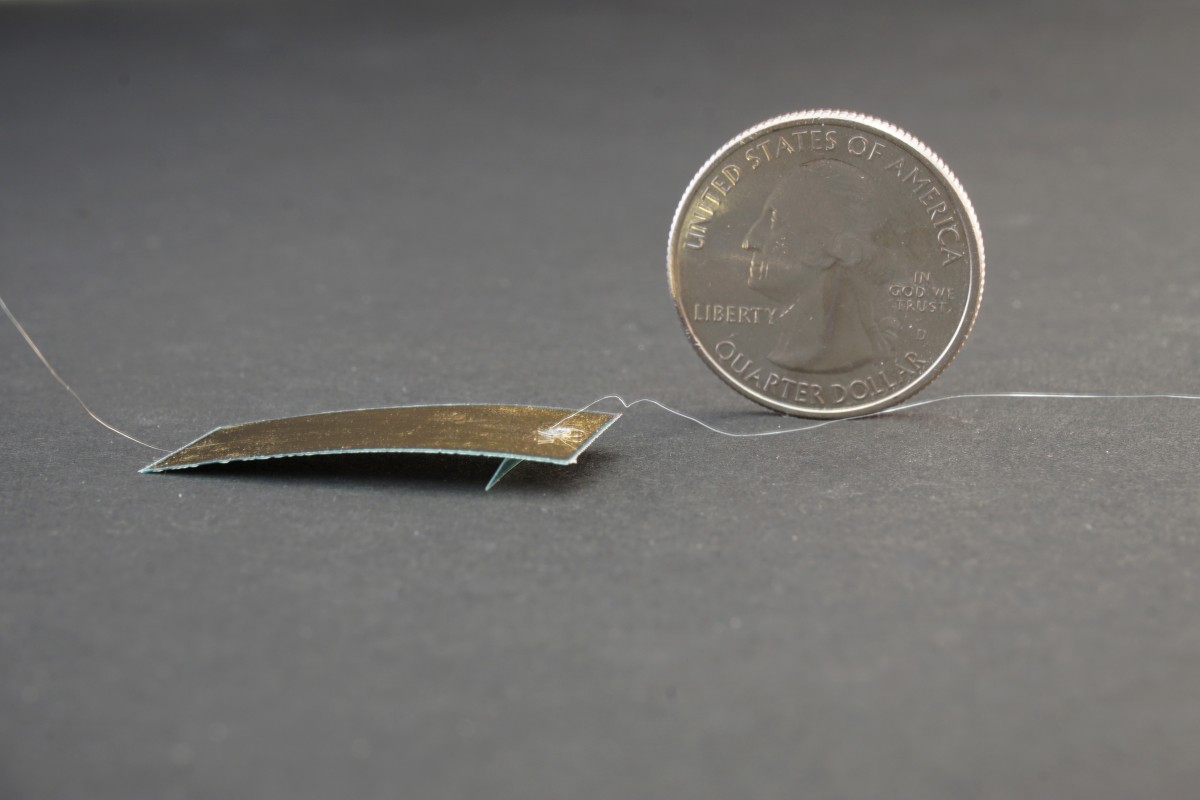
A prototype soft robot, which is about the size of a postage stamp, was developed by a group of researchers from China and the US. Its design was inspired by the capabilities of the hardy cockroach. Photo: Handout
Cockroaches are near-indestructible little creatures. These hardy insects have existed since at least 320 million years ago, outliving dinosaurs. A cockroach can also carry loads of up to 900 times its body weight, shrink to a quarter of its height to fit into small crevices and live for a week without its head.
Inspired by the qualities of this humble bug, a group of researchers from China and the United States have created a prototype of a fast-moving and near-indestructible miniature robot, which could potentially replace sniffer dogs in detecting people trapped in a rubble after a major earthquake or similar disastrous event.
Researchers from China’s Tsinghua University and the University of California, Berkeley, published their study on so-called soft robots in the academic journal Science Robotics last week.
“Although the cockroach is an annoying pest, it has certain interesting features, including the ability to move fast in a narrow space and being hard to squash,” said Zhang Min, an assistant professor at Tsinghua University’s Graduate School in Shenzhen and one of the study’s authors, in an email interview. “These features inspired us to develop a fast-moving and robust soft robot.”
Their work on soft robots was conducted under the Tsinghua-Berkeley Shenzhen Institute partnership, an initiative to collaborate with global researchers on fields such as environmental science and new energy technology.
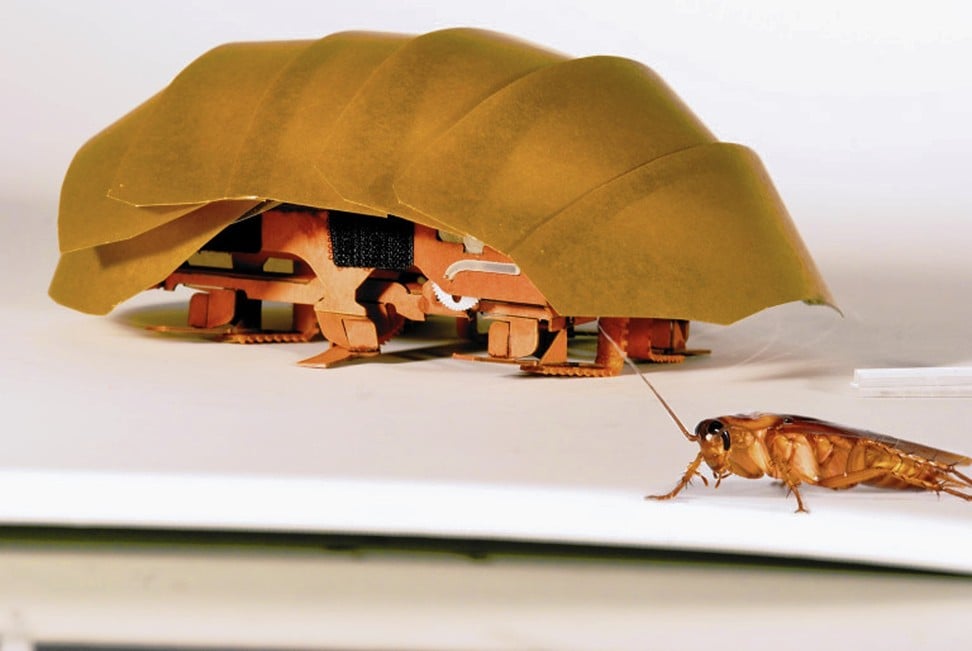
Scientists have long taken inspiration from insects, including cockroaches, for engineering robots. Researchers from UC Berkeley previously developed a palm-sized, roach-like robot – about 20 times the size of the bug – for rescue use in 2017.
By comparison, the new prototype achieved breakthroughs in terms of size and more importantly, the speed and robustness.
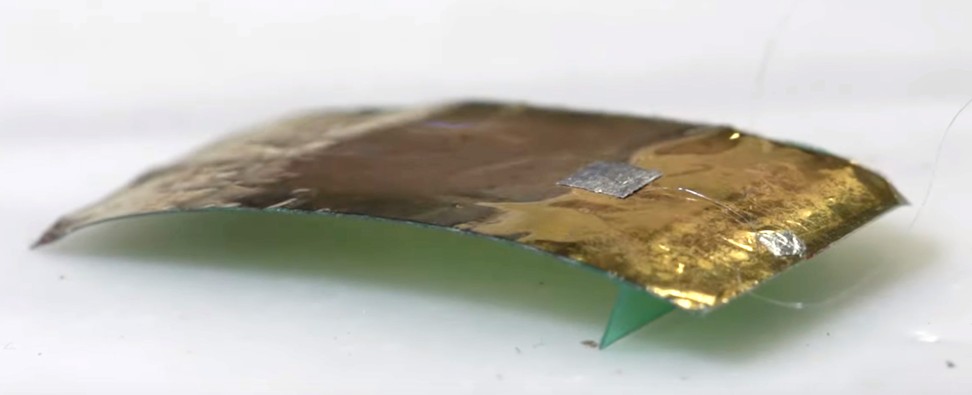
The latest robot, which is about the size of a postage stamp and weighs less than one-tenth of a gram, is composed of a flexible piezoelectric thin film and a polymer skeleton with two legs.
This screenshot from a video provides a closer look at the prototype soft robot developed by a group of researchers from China and the US. Its features were inspired by the sturdy qualities of the humble cockroach. Photo: YouTube
Despite its petite frame, this prototype showed the fastest speed among insect-scale robots in a similar weight range, as well as “ultra-robustness”, according to Lin Liwei, a professor of mechanical engineering at UC Berkeley who directed the research, in a separate email interview.
It can move as fast as a cockroach with speeds of up to 20 body lengths per second. It also continued to move after it was stepped on by an adult human weighting 60 kilograms, which is about 1 million times heavier than the robot, according to the study.
In 2017, researchers of the PolyPEDAL Lab at the University of California, Berkeley, designed a compressible robot, CRAM, that was about 20 times the size of a real cockroach. Photo: Handout
Those features sets up the robot for potential application in disaster relief, a field in which its size, agility and resilience would be invaluable to help detect survivors trapped beneath the rubble in catastrophes, such as major earthquakes.
Earthquakes have caused much devastation in China, a seismically active country with the world’s biggest population. For example, about 87,000 people died and more than 370,000 were injured when a magnitude-8 earthquake struck Wenchuan, a county in southwestern China’s Sichuan province, in 2008.
“The key innovation is the soft materials and structures used in the robot,” Lin said. “If the robot is too soft, it won’t be able to move fast. If the robot is too stiff, it can’t withstand the force of human weight.” The study detailed how the right combination of soft materials and structure enabled the robot to operate efficiently.
While the robot is currently attached to thin cables for power, the researchers are working to integrate a battery and control circuit to get rid of the existing wire in its design, helping expand its use in other applications.
“We want to make the robot carry small sensors, like a gas sensor, to provide it with more functions,” said Zhong Junwen, a researcher at UC Berkeley and one of the authors of the study, in a separate email interview. “With such a sensor, the robot can detect harmful gas leakage.”
Source: SCMP
Posted in battery, catastrophes, Chinese and US researchers, cockroach, cockroach robot, control circuit, design, Dinosaurs, disasters, earthquakes, energy technology, Environmental science, gas leakage, gas sensor, hard to squash, hardy insect, mechanical engineering, moves fast, piezoelectric thin film, polymer skeleton, PolyPEDAL Lab, postage stamp, power, Robot, Robotics, rubble, search and rescue, Shenzhen, sichuan province, small sensors, strike, thin cables, Tsinghua University, Tsinghua-Berkeley Shenzhen Institute, UC Berkeley, Uncategorized, University of California, Berkeley, Wenchuan |
Leave a Comment »
09/08/2019
- Tower falls on car outside the Chengdu worksite, killing motorist
A motorist was killed when a construction crane collapsed in Chengdu on Wednesday. Photo: Weibo
Authorities in southwest China are investigating a crane collapse at a construction site that killed one person and injured another.
The crane collapsed in Chengdu, Sichuan province, at around 7pm on Wednesday, falling onto a car parked near the site and killing the driver, the city’s urban renewal authority said in an online statement. A pedestrian also suffered minor injuries, it said.
Police were investigating the cause of the incident.
A crane accident at a construction site in Southwest China killed one person and injured another on Wednesday. Photo: Weibo
Photos and footage posted online showed emergency workers and others trying to move the crane off of a white car.
Shanghai-based news outlet ThePaper.cn quoted a witness as saying that the crane fell through the construction site wall and a number of trees.
By 10pm, the car had been towed away and the road reopened for use, according to reports.
In January, four people were killed and one was injured when a crane collapsed in Changsha, Hunan province, state news agency Xinhua reported.
Source: SCMP
Posted in car, Changsha, Chengdu, construction site, crane collapse, dead, Hunan Province, motorist, sichuan province, Southwest China, Thepaper.cn, Tower, Uncategorized, Xinhua |
Leave a Comment »
29/07/2019
- Chinese scientists say they have developed controls to help steer spent boosters crashing back to Earth
Lattice-like grid fins are used to guide spent boosters as they fall to Earth. Photo: Science and Technology Daily
China says it has successfully tested new fins on its Long March rockets to help guide spent boosters away from populated areas, possibly paving the way for development of reusable technology like SpaceX’s Falcon 9.
China successfully launched a Long March 2C rocket on Friday using grid-fin technology to guide its spent booster to a landing spot in Guizhou province in the country’s southwest, state-run Science and Technology Daily reported on Sunday, citing China Aerospace Science and Technology Corporation (CASC), a key contractor for the Chinese space programme.
The report said China was the second country to master the technology, after the United States.
Grid fins are aerodynamic control surfaces that are folded during the launch but deployed in flight. In the more sophisticated applications such as the Falcon 9, the fins manipulate the direction of the rocket during re-entry.
A Long March-2C carrier rocket carrying remote sensing satellites blasts off from the Xichang Satellite Launch Centre in Xichang, Sichuan province, on Friday. Photo: Xinhua
Shanghai-based online news outlet The Paper reported that the 2C’s grid fins were developed by a team of about a dozen engineers, all under the age of 35.
The team also designed a new companion electrical control system to control the fins, taking about six months to complete the task.
China has conducted frequent satellite launches in recent years, including 38 last year, the highest total for any country in 2018. But landing safety has become an issue as traditional zones grow more populated.
Chinese start-up rocket maker counts down to launching “shoebox” satellites
Chinese media reported in January 2018 that a booster from a Long March 3B rocket created a massive fireball after it fell from the sky and exploded in a residential area, though no casualties were reported.
And Shaanxi Television reported in May this year that debris was found on a motorway in northwestern China’s Shaanxi province, with residents saying they heard a loud noise and saw an object fall to the ground.
Under existing arrangements, authorities in projected landing zones have to evacuate the areas each time, not only inconveniencing residents but adding to the economic cost and difficulty of the work, according to the The Paper. The grid fins are expected to help ease some of those problems.
“The successful test of the [grid-fin] technology is of great significance to solving the landing issue,” the report quoted CASC assistant director He Wei as saying.
“It also lays a solid foundation for recoverable and reusable technologies.”
China plans more satellites to build up navigation system to rival GPS
Long Lehao, chief commander and designer of Long March 3A rocket series, said the development of reusable technologies could support large-scale development and use of space in the future, as well as make the space programmes more commercially competitive, The Beijing News reported.
Beijing sees space as an important driver for growth and an opportunity to promote hi-tech industries.
On Thursday,
became the first private firm in China to successfully launch a rocket into space.
Source: SCMP
Posted in China Aerospace Science and Technology Corporation (CASC), China’s Long March, global space race, grid-fin tech, Guizhou Province, Lift-off, reusable rockets, Science and Technology Dail, shaanxi province, sichuan province, SpaceX’s Falcon 9, The Beijing News, Uncategorized, Xichang Satellite Launch Centre |
Leave a Comment »
15/07/2019
Villagers clean a house damaged by floods at Jiangbei Village of Banlan Township, Rongan County, south China’s Guangxi Zhuang Autonomous Region,July 14, 2019. A series of reconstructing and rescuing works have been done since Rong’an was hit by heavy rains recently. (Xinhua/Huang Xiaobang)
BEIJING, July 14 (Xinhua) — At least 17 people were killed or missing and thousands evacuated as torrential downpours unleashed floods and toppled houses in central, eastern and southern China.
The National Meteorological Center on Sunday renewed a blue alert for rainstorms, predicting heavy rain in Zhejiang, Fujian, Jiangxi, Hunan, Guangdong, Yunnan, Sichuan provinces, as well as Guangxi Zhuang Autonomous Region and Tibet Autonomous Region.
Some of those regions will see up to 120 mm of torrential rainfall, it said.
China has a color-coded weather warning system, with red representing the most severe, followed by orange, yellow and blue.
As of 8 a.m. Sunday, at least 17 people died or were reported missing following rain-triggered floods in central Hunan Province, which also forced more than 470,000 people to be relocated and 179,000 were in urgent need of aid.
Four hydrometric stations along the Yangtze River in Xianning city, central Hubei Province, have reported the river water reaching or surpassing a level that can activate local anti-flood work.
In eastern Anhui Province, rain-triggered floods have affected more than 51,000 people and damaged over 2,700 hectares of crops.
The floods have forced the evacuation of 926 people, and caused a direct economic loss of more than 59.6 million yuan (8.66 million U.S. dollars) in the province.
As of Saturday noon, 330,000 people in 18 counties of Jiangxi Province have been affected by rainstorm-triggered floods, with over 10,500 residents relocated.
Poyang Lake, China’s largest freshwater lake in the lower reaches of the Yangtze, is swelling above the alarming level, according to the hydrographic department in Jiangxi.
The water level of the lake reached 20.08 meters as of 8 a.m. Saturday, 1.08 m above the warning level, as recorded by Xingzi Hydrometric Station on the lake.
In south China’s Guangxi Zhuang Autonomous Region, rainstorm has affected more than 360,000 people as of 5 p.m. Sunday, damaging over 35,000 hectares of crops, according to the region’s emergency management department.
The disastrous weather in Guangxi has prompted the region to activate a level-II emergency response and send special work teams and relief materials to the ravaged areas.
In some of the disaster-hit towns, flood water from subterranean rivers has inundated roads.
“After torrential downpours, waters on mountains and underground rivers converge into low-lying lands, which may lead to waterlogging. In affected villages, the water depth in some people’s houses can exceed two meters,” said Liao Bin, an official with Jiuwei Town, Hechi City.
Local authorities have dispatched boats and wooden rafts to transfer the stranded people, set up temporary relocation sites, and deliver living supplies to blocked villages.
Since June, the southwestern province of Guizhou has allocated a total of 16.5 million yuan for its hardest-hit 16 counties.
Source: Xinhua
Posted in Anhui province, blue, central, east, south China, China's largest freshwater lake, color-coded weather warning system, dead or missing, Fujian Province, guangdong province, Guangxi Zhuang Autonomous Region, Guizhou Province, Hechi City, hubei province, Hunan Province, Jiangxi Province, Jiuwei Town, National Meteorological Center (NMC), Orange, orange alert, Poyang Lake, rainstorms, red, sichuan province, sweep, Tibet Autonomous Region, Uncategorized, Xianning city, Yangtze River, yellow alert, Yunnan Province, zhejiang province |
Leave a Comment »
07/07/2019
TOKYO, July 6 (Xinhua) — “When I wrote the letter, I didn’t expect to receive a reply from President Xi Jinping. I was surprised and honored,” said Daichi Nakashima with excitement.
The 27-year-old Japanese man said he had received the reply from Xi before the Chinese leader attended the Group of 20 summit in Osaka. “When my friend told me on WeChat, I was shocked!” Nakashima said in an exclusive interview with Xinhua.
Nakashima had several times been a winner in the Panda Cup Japan Youth Essay Contest. Founded in 2014, the competition is co-sponsored by People’s China magazine, the Chinese embassy in Japan and the Japan Science Society, aiming to help Japanese youths have a more comprehensive, objective and rational understanding of China.
Nakashima began learning Chinese in college and has participated in several short-term exchange programs in China.
When talking about his original intention of writing a letter to Xi, Nakashima said, “I wanted to convey the warmth and friendship of the Chinese people I felt during my visit to China and the importance of mutual understanding and exchanges between Japanese and Chinese youths.”
Xi, in his reply, said he was glad to see that Nakashima has been studying the Chinese language and literature for a long time and, by participating in essay contests and exchange activities in China, has learned more about China and strengthened his bonds with Chinese friends.
“It’s the best affirmation and recognition of my persistence for so many years. I’m very touched,” Nakashima said.
Born in 1992, Nakashima first learned about China through classics like “Romance of the Three Kingdoms” and “Outlaws of the Marsh,” but it was a two-week trip to Tianjin in 2011 that gave him a glimpse of a vibrant China.
After that, he visited Beijing, Sichuan, Guangdong and other places. Last year, he went to Fudan University in Shanghai and studied for half a year.
Nakashima found that Chinese youth are very familiar with Japanese anime, music and so on, while Japanese youngsters do not know much about China. Their impression of China is restricted to Chinese tourists, “not knowing about Chinese movies and popular music,” he said.
Nakashima said he believes that the friendship between the two peoples needs more bilateral youth exchanges, as President Xi said in the letter.
Noting that China and Japan are close neighbors separated by only a narrow strip of water, Xi said the friendship between the two countries is rooted in the people, and that the future of the friendship between the two peoples is in the hands of the young people.
Xi said he hopes that the youth of China and Japan will strengthen exchanges and mutual learning, enhance mutual understanding, develop long-lasting friendships, and contribute to creating an even brighter future for bilateral relations.
Xi also encouraged Nakashima to continue to promote the China-Japan friendship. Nakashima said this is an encouragement, a mission and also motivation for him to move forward.
Nakashima graduated with a master’s degree in April and has begun to work in a publishing house. He has been determined to introduce excellent works such as Chinese picture books and science fiction to Japan, so that Japanese teenagers can feel the affinity between the two countries.
“I have met many friendly Chinese people and made many friends that are very important to me. In the future, I will continue to make efforts to help Japanese and Chinese youth deepen mutual understanding,” he said.
Source: Xinhua
Posted in Beijing, Chinese embassy in Japan, comprehensive, contributions, Daichi Nakashima, Fudan University, Group of 20 (G20), guangdong province, inspires, Japan Science Society, Japan-China friendship, Japanese youth, letter, master's degree, objective, Osaka, Outlaws of the Marsh, Panda Cup Japan Youth Essay Contest, People's China magazine, President Xi, publishing house, rational understanding, Romance of the Three Kingdoms, Shanghai, shocked, sichuan province, Tianjin, Uncategorized, WeChat |
Leave a Comment »
06/07/2019
BEIJING, July 6 (Xinhua) — Valuable tea plants are flourishing on around 67 hectares of tea farms in Qingchuan County of southwest China’s Sichuan Province, bringing new hope to impoverished locals.
“Tea plants are growing so well that I believe our lives will be better and better in the future,” said Jiao Yuan’en, a 66-year-old local villager, in the upbeat mood.
Jiao’s tea plants are grown from seedlings donated by tea farmers, thousands of miles away in Anji of eastern Zhejiang Province, as a gift to help alleviate poverty.
In April 2018, 20 tea farmers from Huangdu village of Anji, a well-known tea planting area, wrote a letter to Xi Jinping, general secretary of the Communist Party of China Central Committee, proposing to donate 15 million tea seedlings to poor areas.
Responding to their letter, Xi praised their move and called on Party members to share the Party’s burdens and encourage those who get rich first to help latecomers in the battle against poverty.
With Xi paying close attention to this project, the State Council Leading Group Office of Poverty Alleviation and Development chose 34 impoverished villages in provinces of Guizhou, Hunan and Sichuan to receive the seedlings.
By the end of March this year, a total of 16.65 million seedlings from Huangdu village were planted in around 358 hectares of land, involving 1,862 needy households, and more than 95 percent of the seedlings have survived.
In Guizhou, the donated tea seedlings helped inspire other locals to engage in tea planting, and in Hunan, tea farms were incorporated into local tourism.
The kind-hearted action from Anji farmers is expected to help 5,839 villagers improve their livelihood and lift them out of poverty when the tea plants are ripe for harvest in the spring of 2020.
China aims to lift all rural residents living below the current poverty line out of poverty by the year 2020.
Source: Xinhua
Posted in Anji, general secretary of the Communist Party of China Central Committee, Guizhou Province, Hunan Province, poverty alleviation, Qingchuan County, sichuan province, State Council Leading Group Office of Poverty Alleviation and Development, Tea seedling donation, Uncategorized, Xi JinPing, zhejiang province |
Leave a Comment »
06/07/2019
TIANJIN/BEIJING, July 6 (Xinhua) — Even at the age of 100, Yang Enze, one of the founders of China’s optical communication, does not stop his research and teaching as a professor at Tianjin University.
Besides his pioneering achievements as the chief engineer of China’s first optical communication project for practical use in the 1970s, Yang is also known as a survivor and a witness of the war of Japanese aggression against China.
“I was admitted to Wuhan University in 1937, the year when Japanese troops attacked the Lugou Bridge, also known as Marco Polo Bridge, on the outskirts of Beijing, on July 7,” said the senior recalling the start of his academic study.
The incident marked the beginning of Japan’s full-scale war against China during World War II and triggered China’s full-scale resistance against the invasion.
Ahead of the 82nd anniversary of the incident that falls on Sunday, Yang said because of the war, his university in central China’s Hubei Province was relocated to southwestern province of Sichuan to avoid the enemy forces. “Even in Sichuan, there were a lot of Japanese bombings, but none of the students missed any of the classes as long as there was no air-raid siren,” he recalled.
It was at that time he and many of his peers cemented the belief that the country needed advanced science and technology for reconstruction and revival.
“I have always kept in mind late chairman Mao Zedong’s words that it was Japanese militarists’ crime that was to blame for the war, not Japanese civilians, ” Yang said, noting that he still gets in touch with many Japanese scholars.
He established the first optical communication laboratory in Tianjin in 1985, when he was invited to teach at Tianjin University. In Yang’s career, he has made friends with several leading experts from Japan at international conferences and even kept friendship with some of them.
Also in Tianjin, Morita Naomi, a Japanese language teacher in Nankai University, works as a consultant to the school’s research institute of Zhou Enlai-Daisaku Ikeda.
“By involving in the research of the friendship between the late Chinese premier and the Japanese philosopher, I want to search for the core factors that help consolidate the friendship between the two peoples,” said Naomi.
She came to Nankai to pursue a master-degree study in Modern Chinese and Chinese Literature in 2010 and has stayed ever since.
When she first arrived, she had troubles even in learning Chinese phonics. Now she can read and speak Chinese fluently, write beautiful Chinese characters, and study ancient Chinese literature independently.
As a teacher, she feels frustrated that most of her Chinese students are more likely to be attracted by Japanese animation and games rather than Japanese literature.
According to the school’s statistics, nearly half of the undergraduates in the 2019 class of Japanese major chose to work in Japanese-funded enterprises or Japanese-related enterprises after graduation.
Naomi said Japanese visitors to China are more likely to choose destinations like Beijing, Shanghai and Guangzhou. Peking University in Beijing impresses young Japanese most.
According to a report released by the China Tourism Academy, China received 2.69 million Japanese visitors in 2018, making Japan China’s fourth largest source of foreign tourists. In the same year, Chinese made 9.06 million outbound visits to Japan as a direct destination.
The academy released the report at the 2019 China-Japan Tourism Forum Dalian held on May 26, which focused on promoting win-win cooperation on cultural exchanges and tourism between the two countries.
China and Japan agreed to push forward bilateral relations along the right track of peace, friendship and cooperation, at the summit of the Group of 20 (G20) major economies held in Osaka, Japan, in June.
This year marks the 70th anniversary of the founding of the People’s Republic of China, and Japan has also entered the Era of Reiwa. It is also the China-Japan Youth Exchange Promotion Year, for promoting friendship and cooperation in a wide range of areas between the two peoples.
“We keep the wartime memory not because we bear the hatred, but because we want the younger generations to cherish what they own today and move towards a better future,” said 70-year-old Zhen Dong, who on Friday visited an exhibition on Beijing’s past, held in Beijing Municipal Archives.
Zhao Hongwei, a professor with Tokyo-based Hosei University, said when it comes to the bilateral relations between China and Japan, it is very important to promote the free trade agreement and expand the markets of both sides.
Source: Xinhua
Posted in air-raid siren, ancient Chinese literature, Beijing, Beijing Municipal Archives, chairman Mao Zedong, China Tourism Academy, China-Japan friendship, China-Japan Tourism Forum, China-Japan Youth Exchange Promotion Year, Dalian, Era of "Reiwa", Group of 20 (G20), Guangzhou, Hosei University, hubei province, Japan, Japanese bombings, Modern Chinese and Chinese Literature, Nankai University, Osaka, Peacebuilders, Peking University, People's Republic of China (PRC), Shanghai, sichuan province, Tianjin University, Uncategorized, war of Japanese aggression, Zhou Enlai-Daisaku Ikeda |
Leave a Comment »








 CHINDIA ALERT: You'll be living in their world, very soon