Chindia Alert: You’ll be Living in their World Very Soon
aims to alert you to the threats and opportunities that China and India present. China and India require serious attention; case of ‘hidden dragon and crouching tiger’.
Without this attention, governments, businesses and, indeed, individuals may find themselves at a great disadvantage sooner rather than later.
The POSTs (front webpages) are mainly 'cuttings' from reliable sources, updated continuously.
The PAGEs (see Tabs, above) attempt to make the information more meaningful by putting some structure to the information we have researched and assembled since 2006.
CHENGDU, May 10 (Xinhua) — Sichuan, a quake-prone province in southwest China, will provide its residents earthquake early warning services by the end of this year, according to the Sichuan Earthquake Administration.
The early warning services include alerting residents seconds before seismic waves arrive through multiple broadcasting systems, using the theory that radio waves travel faster than seismic waves.
Earthquake research has found that being aware of an earthquake three seconds beforehand can save 14 percent of casualties, 10 seconds can save 39 percent of casualties, and 20 seconds can save 63 percent of casualties.
The services will also offer residents brief information about the quake one to two minutes after a quake strikes, its magnitude two to five minutes later, and an assessment of the disaster within two hours.
China’s capacity in earthquake monitoring and disaster relief has improved since 2008, when the Wenchuan Earthquake in Sichuan killed more than 69,000 people and left nearly 18,000 missing, said a report submitted to the country’s top legislature last year.
A new generation of earthquake monitoring and warning systems have been installed along more than 20 high-speed railway lines spanning 6,642 km, said the report.
Property management workers pull to safely elderly woman with Alzheimer’s disease climbing down side of building
The elderly woman with Alzheimer’s climbs down the outside of her residential building in Chengdu, Sichuan province, on Thursday. Photo: Weibo
An 84-year-old woman with Alzheimer’s disease in southwestern China stunned her neighbours by climbing out of a lavatory window in a high-rise building and down from her 14th-floor flat.
The octogenarian was rescued by property management workers, who were waiting near the window of a flat on the fifth floor to intercept her, news website Thepaper.cn reported.
The woman squeezed through the window of her home’s toilet in a residential block in Chengdu, Sichuan province, on Thursday after she was locked in by relatives, a property management employee said.
“She couldn’t open the door from inside. But she wanted to go out as it was so humid and hot today,” the unnamed worker said.
As she climbed down the outside of the building, her neighbours unfolded a bedsheet on the ground, hoping to catch her if she fell.
The elderly woman survived the incident unscathed. Photo: Weibo
Property management workers gave the woman water and food after rescuing her. She was later picked up by her relatives and was reported to have no injuries from her adventure, the report said.
There were 6 million Alzheimer’s disease patients in China in 2015, with around 300,000 new cases reported each year, news portal Sohu.com reported.
Chinese taxi driver takes his wife with Alzheimer’s to work every day
A 2016 white paper released by the Zhongmin Social Assistance Institute, a Beijing-based research NGO, said half a million old people got lost in China each year, with a quarter of them diagnosed with Alzheimer’s.
“China is seriously hit by Alzheimer’s disease based on the country’s rapidly ageing population,” Dr Wang Luning, chairman of the Chinese Alzheimer’s Disease Association, told Legal Daily.
“But many people, even some doctors, have little knowledge about this disease, leading to low rates of people seeking diagnosis, the rate of them being diagnosed and being treated all being low.”
Embassy officials have contacted families of two Chinese nationals who were killed in the blasts on Easter Sunday, and visited five who were injured
Four of the missing were travelling to the Indian Ocean on a study trip
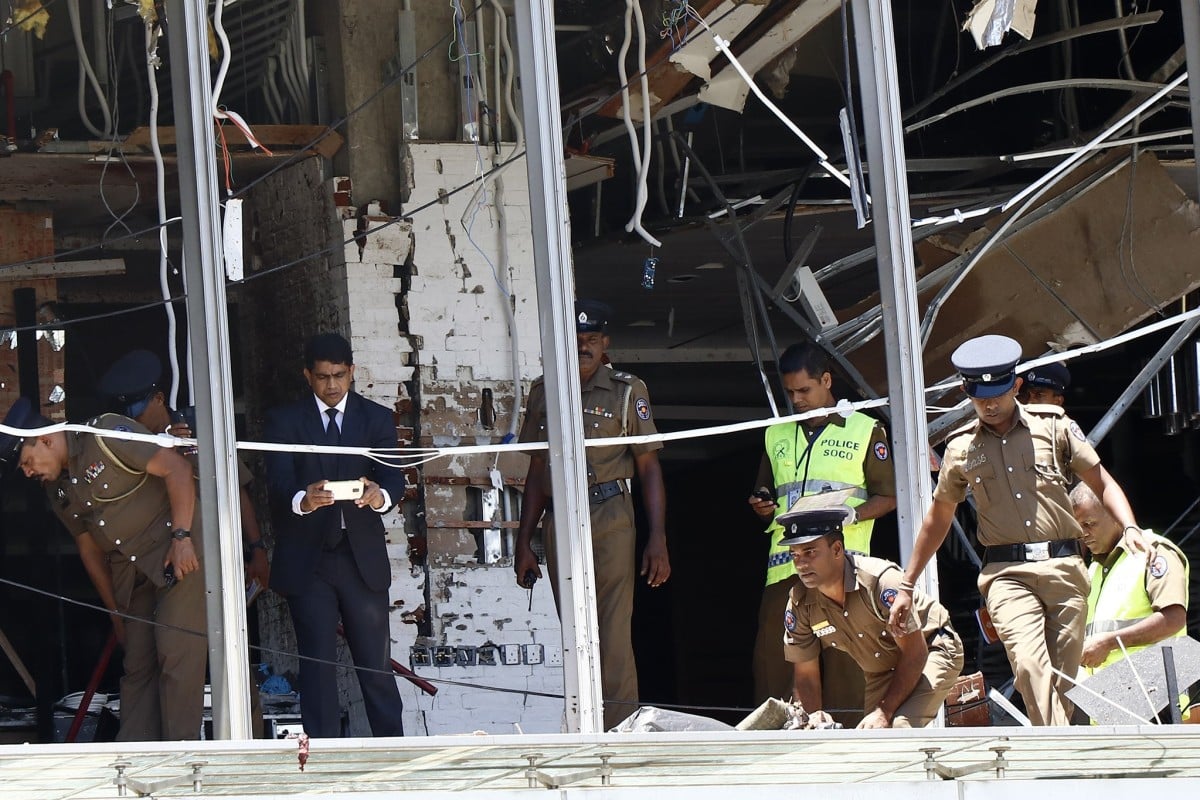
Police and investigators work at the Shangri-La Hotel blast scene in Colombo on Sunday, where the two Chinese were killed. Photo: Xinhua
Five Chinese nationals remain missing following a series of suicide bombings in hotels and churches in Sri Lanka on Easter Sunday that claimed the lives of
At least 290 people were killed and more than 500 others injured in the blasts, according to a Sri Lankan government official on Monday, who said a local militant group was behind the attacks.
The Chinese embassy in Colombo had contacted the families of the two deceased Chinese and was awaiting police confirmation on the fate of the five still missing, state-run People’s Daily reported.
Two Chinese nationals sustained serious injuries in the blasts and three others minor ones. Embassy officials had visited them several times in hospital, the report said.
“The embassy will closely monitor the situation, urge Sri Lankan police to confirm the whereabouts of the missing persons and assist Chinese citizens and families to properly handle the aftermath,” the embassy was quoted as saying.
The two Chinese who died, cousins surnamed Tan, were caught in a blast at the Shangri-La Hotel in Colombo, Red Star News quoted a Chinese businesswoman in the Sri Lankan capital as saying.
“Their families identified them at the scene,” she said.
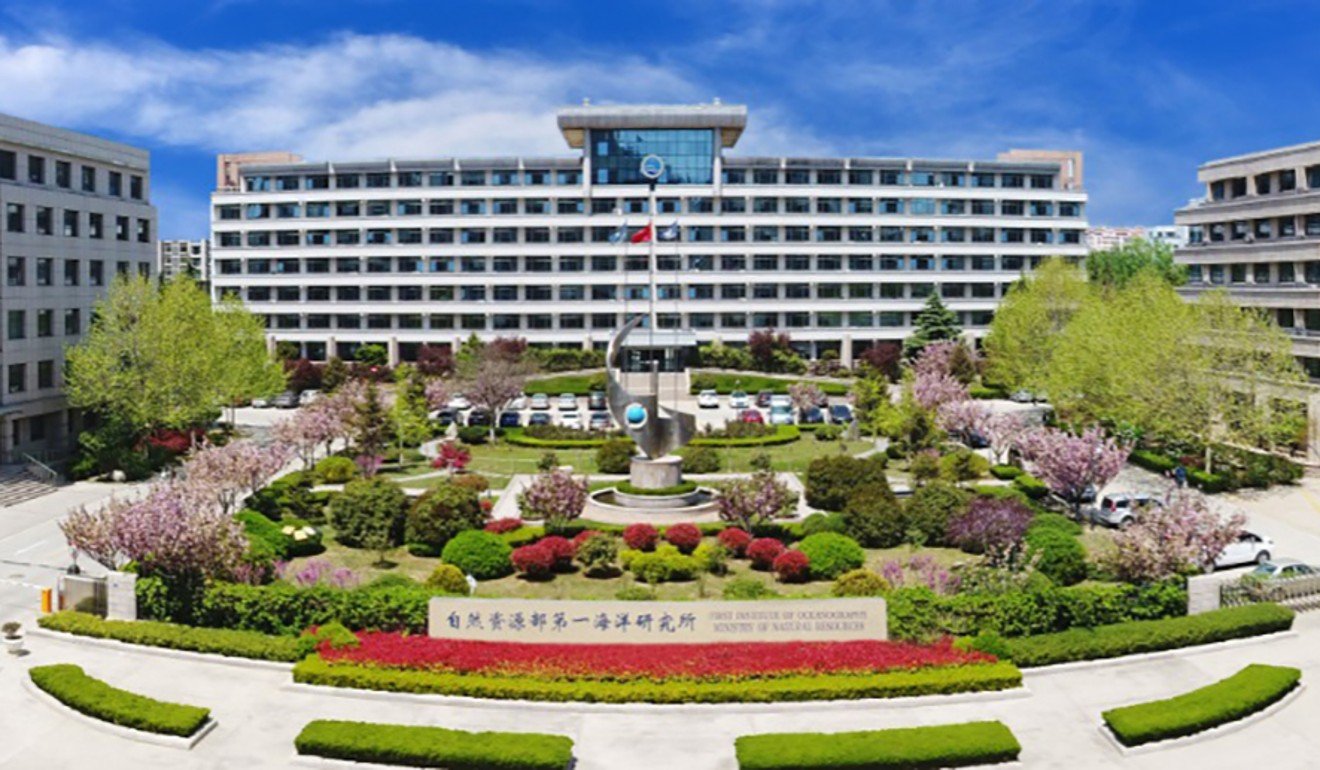
Four of the missing Chinese are students from the First Institute of Oceanography at the Ministry of Natural Resources. Photo: FIO
Four of the missing Chinese – Li Dawei, Li Jian, Pan Wenliang and Wang Liwei – are students from the Ministry of Natural Resources’ First Institute of Oceanography who were going to take part in a study in the Indian Ocean, an institute staff member told Red Star News.
Four of the five injured are students from the Chinese Academy of Sciences’ South China Sea Institute of Oceanology, who were en route to a study trip in the eastern Indian Ocean.
“It is an annual scientific expedition programme and they were on the way to replace the 10 others who had completed their rotation,” a staff member told The Beijing News. “Some sustained bruising on their legs and one could hardly hear after the blast.”
Tourists who returned to Shanghai and Chengdu, Sichuan province, told the newspaper that their trip had to be cut short as shops were closed and a curfew imposed amid tight security.
“All the private cars, coaches, vans and buses had to open their doors for inspection. There were checkpoints every 10 metres,” said one tour guide from Chengdu.
A traveller from the same city said airport security had also been stepped up. “There was a bombing 20 minutes after we left a restaurant and another one outside the airport when we were waiting there. We had to pass through three or four very strict security checks at the airport,” she said.
Back in Shanghai, another woman said: “We were not scared there but we are very glad to be back home.”
PHNOM PENH, April 18 (Xinhua) — A Cambodian and Chinese entrepreneurs meeting was held here on Thursday, aiming at exploring opportunities for trade and investment, officials said.
The meeting brought together nearly 20 entrepreneurs from southwest China’s Sichuan province and about 20 Cambodian business executives.
Ek Sam Ol, president of the Cambodia-China Friendship Association, said that currently, many enterprises from Sichuan have been doing businesses in various sectors in Cambodia.
“The forum is a good opportunity for the entrepreneurs from both sides to exchange experiences and to explore opportunities for investments or business partnerships,” he said.
Sam Ol said China is currently the top foreign investor in Cambodia and Chinese investments have importantly contributed to socio-economic development in the country.
He said Chinese investments have focused on a variety of sectors including transport infrastructure, hydropower plants, industrial zones, garment and footwear factories, banking and finance, real estate and construction, agriculture, tourism, and airlines.
CHENGDU, April 12 (Xinhua) — Chengdu, a major city in southwest China, showed its attraction to investors as it signed 22 investment contracts with overseas companies on Friday.
The investment projects involve manufacturing such as electronics, aviation, automobiles and equipment, and services including financing, logistics, elderly care and vocational training. The total value of these deals is around 3.39 billion U.S. dollars.
The signing foreign companies include Slovakian aircraft producer Aerospool, French company AREP with expertise in city planning and construction, Germany’s BMW, and U.S. firm Baxter.
Chengdu, capital of Sichuan Province, is a major economic powerhouse in China’s western region. The city has attracted investment projects from 285 of the world’s top 500 companies.
Video footage of woman fishing in a miniskirt and symbol of communist youth group deemed to violate law against ‘defiling revolutionary martyrs’
The woman was filmed in a miniskirt and red scarf. Photo: Weibo
Police in southwest China have detained a woman or “defiling revolutionary martyrs”after she appeared in a video wearing “bright, revealing clothes” and a Young Pioneers’ red scarf.
Footage of the woman, surnamed Tang, showing her fishing in a muddy field in Sichuan province was posted on the video-sharing website Kuaishou.com.
In one clip – which police said attracted three million views – she was dressed in a red blouse, white miniskirt and the red scarf traditionally worn by members of the under-14s Communist group.
Police in Rong county in Sichuan said Tang had deliberately dressed in “bright, revealing clothes” to “attract eyeballs, increase fans and video views”, and wearing the red scarf with such an outfit violated the Heroes and Martyrs Protection Law, which came into effect in May last year.
“The red scarf is a symbol of the Young Pioneers of China. It represents a corner of the red flag, dyed by the blood of martyrs,” the statement said.
Chinese artist gets naked with late father’s remains but is it art?
“Tang’s action has severely defiled what the red scarf stands for: patriotic martyrs, the honour of the young pioneers, and the patriotic sentiments of the people. It has had a bad social impact.”
Police said Tang had been given 12 days’ administrative detention on March 28 and fined 1,000 yuan (US$150). A man who shot the video footage was released with a warning.
The police statement caused heated debate on the social media platform Weibo.
Some supported the police for punishing “inappropriate behaviour”, while others questioned whether they had abused their power.
A ceremony is held to receive the bone ashes of fireman Zhang Chengpeng, who died while fighting a forest fire in southwest China’s Sichuan Province, at Jinan international airport in Jinan, east China’s Shandong Province, April 5, 2019. The ashes of fireman Zhang Chengpeng returned to his hometown of Zouping in Shandong Province on Friday. (Xinhua/Dong Naide)
BEIJING, April 1 (Xinhua) — A new relay satellite launched late Sunday night will allow videos calls to be made between China’s future space station and the ground and provide data transmission and control services for various spacecraft.
The Tianlian II-01 satellite was sent to an orbit at an altitude of 36,000 km by a Long March-3B carrier rocket from the Xichang Satellite Launch Center in southwest China’s Sichuan Province at 11:51 p.m. Beijing Time on Sunday.
The satellite, developed by the China Academy of Space Technology (CAST) under the China Aerospace Science and Technology Corporation, will provide data transmission services for satellites operating on medium- and low-Earth orbit and monitoring and control support for the launch of spacecraft.
“The Tianlian II-01 ushered in the construction of a new generation of the relay satellite system for China,” said Zhang Peng, commander in chief of the research team of the satellite from CAST.
From 2008 to 2016, China launched four relay satellites to form the Tianlian I system, making China the second country in the world to establish a relay satellite system which is able to cover the whole world. The system can provide global real-time information transmission.
As the first satellite of China’s second-generation relay satellite system, Tianlian II-1 is compatible with the Tianlian I system, but its transmission speed and volume and coverage area have been greatly improved, according to Zhang.
Image copyrightSUPPLIEDImage captionRotting bread was among the food found in the kitchen
One of China’s most prestigious high schools has been the target of public anger after piles of expired mouldy food were found in its canteen kitchen.
Mouldy bread, rotting meat and seafood were discovered at the Chengdu No 7 Experimental High School.
One parent told the BBC of his horror and disgust, saying the food was “stinky and disgusting” and compared it to pig slop.
The school has now apologised, saying it is deeply “embarrassed”.
Food safety scandals are not uncommon in China and they often leave authorities scrambling to defuse public outrage.
How did they discover the food?
The scandal first emerged when a small group of parents were on Monday invited to attend a tree planting event at the private high school in Chengdu, the capital city of China’s Sichuan province.
While at the school, a group of parents discovered mouldy bread, rotting meat and seafood items in the canteen kitchen canteen.
It is not clear why exactly they chose to stop by the kitchen, but one parent that the BBC’s Lulu Luo spoke to referenced an incident earlier last November where numerous school children came down with stomach-aches, constipation and various other ailments.
Image copyrightSUPPLIEDImage captionWhat looks like seafood and meat were seen in cardboard boxes
“[The items looked like they had] been in a freezer for years, [it looked] like zombie meat,” the father, who has a daughter and son enrolled in the school said.
“I smelled the pork, it was stinky. [There was] ginger, which looked disgusting too.”
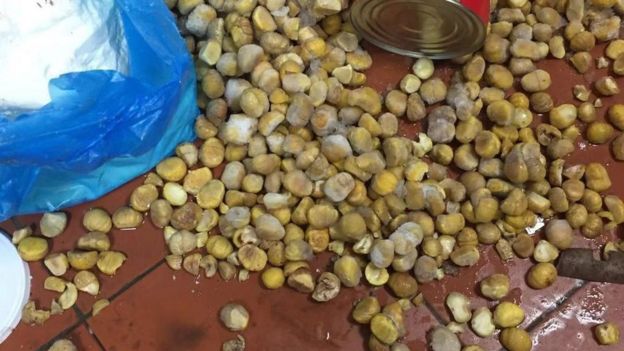
Image copyrightSUPPLIEDImage captionAnd chestnuts were seen strewn on the floorImage copyrightSUPPLIEDImage captionWhat appears to be tripe is also seen covered in dirt of some kind
According to the father, the private school costs 39,000 yuan (£4,380; $5,800) a year – about 20 times the amount a public school would cost.
“We don’t even let kids have leftover food at home… I spent tens of thousands of dollars and my kids are having pigwash there,” he said.
“I dare not tell my younger son… I’m worried he might not dare to eat canteen food after that. My daughter has been telling me she has a stomach-ache. I [told] her she might have just over exercised.
“It breaks my heart.”
How did parents react?
Horrified, the group of parents shared the pictures on social media, which were soon discovered by other parents.
According to the same parent, the school immediately transported the mouldy food away in two trucks.
One truck was intercepted and stopped by a swarm of angry parents who showed up at the school in protest, he said.
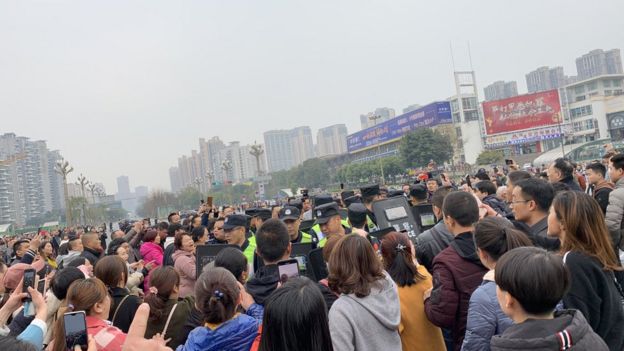
Image copyrightSUPPLIEDImage captionHundreds of parents stormed the school in protest
Videos that emerged on social media on Wednesday showed hundreds of parents angrily protesting outside the school gates.
Police were seen using brute force against them, with one video showing a group of policemen slamming a man against the ground.
In another video, parents can be seen clutching their eyes in pain, with some local news outlets saying police used pepper spray against them.
It said the parents had “severely disrupted” traffic and insulted the police. They were later released on the same day.
‘Why should they be trusted with anything?’
Stephen McDonell, BBC China correspondent
People overseas sometimes mistakenly think that there are not many protests in China. Actually, acts of dissent break out quite often and can erupt suddenly.
If family members are harmed, especially when under the care of a school or a kindergarten or a hospital, then orderly, calm communities can transform with scenes of anger spilling out onto the streets.
Faulty medicine, tainted milk powder, investment scams and perceived abuse of students under the care of teachers have all triggered public anger directed at the officials whose job it is to keep the community safe.
The school is one of the most prestigious in China and had in the past been named among China’s “Top 10 outstanding private schools”.
It said that those responsible would be dealt with by the law, saying it was “embarrassed” by the incident and that it would not happen again.
However, the parent the BBC spoke to said the case was not an “isolated incident”, saying that the same supplier catered to “over 100,000 students from across 20 schools”.
Wenjiang district government – the district in Chengdu that the school is in – issued a statement on Wednesday that said eight people responsible for food safety at the school were being investigated by authorities.
It said that 36 students from the school had been admitted into the local hospital for a check-up -all were later discharged.
The district government also said that the raw food would be sent for testing, adding that a “comprehensive and in-depth investigation” would be held into the matter.
The “ChinaSat 6C” satellite is launched by a Long March-3B carrier rocket from the Xichang Satellite Launch Center in southwest China’s Sichuan Province, March 10, 2019. It will provide high-quality radio and TV transmission services. (Xinhua/Guo Wenbin)
XICHANG, March 10 (Xinhua) — China Sunday sent a new communication satellite into orbit from the Xichang Satellite Launch Center in southwest China’s Sichuan Province.
The “ChinaSat 6C” satellite was launched at 0:28 a.m. Beijing Time by a Long March-3B carrier rocket. It will provide high-quality radio and TV transmission services.
The satellite has been sent to the geostationary orbit, and can cover China, Australia, New Zealand and the South Pacific island countries.
The satellite was developed by the China Academy of Space Technology, and will be operated by the China Satellite Communications Co., Ltd.
The launch marks the 300th mission of the Long March carrier rocket series developed by the China Aerospace Science and Technology Corporation.











 CHINDIA ALERT: You'll be living in their world, very soon