Archive for ‘slowing economy’

30/04/2020

Travel bookings surge up to 1,500 per cent on some sites after Beijing downgrades emergency alert level

  • Outbound flights from Beijing were 15 times higher on one travel site within half an hour of Beijing relaxing quarantine requirements on the city
  • The rebound in bookings spells some hope for online travel providers in China as the country emerges from a pandemic which saw widespread travel restrictions
Passengers arrive from a domestic flight at Beijing Capital Airport on March 27, 2020. Photo: AFP
Within an hour of Beijing downgrading its emergency response level, relaxing quarantine requirements for some arrivals to the Chinese capital city, travel bookings on some sites surged up to 15 times.
Thirty minutes after the announcement on Wednesday, bookings for outbound flights from Beijing were 15 times higher than before the announcement on Qunar, one of the biggest online travel service providers in China. Searches for travel packages and hotel bookings on the platform also increased three-fold, according to a Qunar report.
On Alibaba Group Holding‘s Fliggy travel platform, bookings for flight and trains heading in and out of Beijing increased 500 per cent and 300 per cent respectively one hour after the announcement, compared to the same time a day ago, according to a Fliggy report. Alibaba owns the South China Morning Post.
Bookings for flight and train tickets in Beijing for the upcoming Labour Day long weekend also increased more than 300 per cent and 160 per cent respectively on Chinese group buying site Meituan Dianping on Wednesday after the announcement compared to the day before, while searches for the attractions in the Beijing area on the platform increased almost three times from a week ago, according to Meituan.
“The surge in searches for travel in Beijing was because the lockdown measures in the city were the strictest in the country after work resumed,” said Jiang Xinwei, senior analyst with Analysys. “Consumption among residents was suppressed [during the lockdowns], so there is now a rebound in bookings.”
China’s online travel sites prepare for surge in domestic tourism
21 Mar 2020

The rebound in bookings spells some hope for online travel providers in China as the country gradually emerges from a pandemic which the Chinese government responded to by implementing strict quarantine measures, shutting down tourist attractions and suspending group tours.

Beijing-based consultancy Analysys estimates that China’s national tourism economy lost at least 10 billion yuan (US$1.4 billion) a day on average during the outbreak, with travel service providers like Qunar and Ctrip overloaded with millions of booking changes as well as cancellation and refund requests.
The relaxation of travel restrictions in and out of Beijing also comes ahead of a

five-day break dubbed the “mini golden week”

, which starts on Friday and is the first extended public holiday after Lunar New Year in late January.

In November, the Chinese government lengthened the holiday from the original three days to five to stimulate consumption and encourage travelling amid a slowing economy weighed down by the US-China trade war.

Some cities, such as Huzhou in eastern China’s Zhejiang province and Kunming in southwestern province Yunnan, have issued travel vouchers to stimulate consumption for the tourist industry, according to the Ministry of Culture and Tourism.

Ctrip estimated that there would be more than 86 million domestic tourists during the long weekend – more than double the number of travellers seen during the Ching Ming Festival in April, which recorded 43 million tourists, according to the China Tourism Academy.

However, Jiang said the rebound this week does not mean the Chinese travel industry is out of the red. “The travel industry will recover partially during the public holiday, but this will not be more than 60 per cent [of levels before the pandemic],” he said. “The government needs to do more to signal that travelling is safe and encourage residents to do so.”

Source: SCMP

03/10/2019

China’s scenic sites limit ‘golden week’ visitor numbers to cut crowds

  • Managers of the Leshan Giant Buddha and Jiuzhaigou National Park restrict ticket sales as millions head off for the holiday break
Park authorities in charge of the Leshan Giant Buddha in Sichuan have restricted visitor numbers in golden week. Photo: Xinhua
Several major tourist attractions in China have capped visitor numbers during this year’s National Day “golden week” holiday as millions take the chance to travel.
October 1 marked the start of a week-long break on the mainland, with an estimated 800 million people expected to go on trips in China or overseas, about 10 per cent more than last year, according to the China Tourism Academy.
The academy estimated that 726 million people would take domestic trips in this peak holiday period – a 9.4 per cent increase from last year, but that is the lowest level of growth since 2007 as pressure from China’s slowing economy and the trade war with the United States take their toll.
Managers at the scenic area surrounding the Leshan Giant Buddha – a 71-metre (233 feet) tall ancient statue carved into a cliff in southwestern Sichuan province – said last week that daily tickets would be capped at 22,400 during the holiday, which runs until Monday.
West Lake in Hangzhou, Zhejiang province, drew 300,400 visitors as golden week started. Photo: Xinhua

The park said it would update visitors on daily ticket sales through social media.

“Today’s tickets for the Giant Buddha have reached the limit and sales have stopped,” the park management committee said on its Weibo account on Tuesday. “To all tourists, please rearrange your itinerary. You can visit the areas surrounding the Giant Buddha scenic spot,” it said, adding that tickets could be booked online for any day for the rest of golden week.

“I expected it to be chock-full of people, but actually today it’s still relatively calm. I had lots of fun,” a visitor to the Giant Buddha told Pear Video on Tuesday.

Hong Kong protests leave ‘golden week’ tourist boom in tatters
Jiuzhaigou National Park in Sichuan said last week that it would be limiting visitors to 5,000 per day during golden week and said on Monday that tickets had sold out.

The network of valleys known for its natural scenery was devastated by an earthquake in August 2017, and reopened with limited access in March 2018.

However, there were no restrictions at other attractions. In eastern Zhejiang province, 340,400 visitors went through the gates at Hangzhou’s West Lake on Tuesday, the Global Times’ Chinese edition reported.

“There’s too many people. I have never seen so many of them in my life,” one tourist was quoted as saying.

A guide also said that instances of “uncivilised behaviour”, such as trampling on the gardens, were down compared to last year.

Next stop: Croatia. Chinese travellers skip Hong Kong for niche destinations over National Day break
“During the major holidays, many tourist attractions are so crowded that tourists can barely move an inch,” Hangzhou Daily said in an editorial on Monday.
“Not only is the tourist experience bad, but there are also safety hazards such as being trampled on, and this puts a lot of pressure on nearby public transport and food establishments.”
Travel booking platform Ctrip said that tourists heading overseas were increasingly seeking out new destinations, with bookings to places such as the Czech Republic, Austria, Croatia, Malta and Cambodia up by 45 per cent this year.
However, bookings for Hong Kong had fallen substantially after nearly four months of anti-government protests, Ctrip said.
Source: SCMP
22/07/2019

China prepares to axe inefficient industry in manufacturing heartland, despite slowing economy

  • Growth in Shandong, China’s third largest provincial economy, slowed in the first quarter due to cuts in inefficient industrial capacity
  • Shandong government aims to cut capacity in traditional sectors to boost ‘new’ industries, as well as reduce pollution
Shandong’s gross domestic product growth accelerated to 6.4 per cent last year from 5.7 per cent in 2017, but slipped back to 5.5 per cent in the first quarter of 2019. Photo: AP
Shandong province, a manufacturing heavyweight in eastern China, will press ahead with plans to cut capacity in inefficient “old” industries, even though it will hurt short-term growth, the provincial party chief said on Tuesday.
Like many provinces that still rely heavily on traditional industries, Shandong’s growth has slowed recently, in part due to the effect of the trade war with the United States.
While its gross domestic product (GDP) growth accelerated to 6.4 per cent last year from 5.7 per cent in 2017, it slipped back to 5.5 per cent in the first quarter of 2019, according to to Liu Jiayi, the secretary of Shandong Provincial Committee of the Communist Party of China.
The primary reason for the slowdown in growth was a plunge in production in “backward” industries at the start of the year, due in part to cuts already made to reduce production capacity, said Liu. He added that the capacity cutting measures will help the province reduce air pollution, one of the central government’s priorities for 2019.

“The quality of development is changing [in Shandong],” said Liu, who referred to the fact that Shandong’s industrial sectors dominate the economy and that 70 per cent of this heavy industry is in the chemicals sector. “As a result, our economic volume is large, but the quality of development is not very high.”

According to statistics from the Hong Kong Trade Development Council (HKTDC), Shandong’s industrial output has been dominated by heavy industry, which accounted for about 67.1 per cent of the gross industrial output in 2017. Within that, raw chemical materials and chemical products had the biggest share of all value-added industrial output, at 9.7 per cent, according to the HKTDC.

“This decline [in first quarter growth] was in exchange for our development of high-quality [production], because our traditional and backward production capacity has declined,” Liu added.

Shandong, the third largest provincial economy in China, will continue to reduce its reliance on chemicals production, while also cutting the use of coal for power, heating and fuelling heavy trucks for transport, all of which are major contributors to regional pollution, according to Gong Zheng, the governor of Shandong.

Shandong’s gross domestic product growth accelerated to 6.4 per cent last year from 5.7 per cent in 2017, but slipped back to 5.5 per cent in the first quarter of 2019. Photo: AFP

“We have stepped up our efforts [to cut pollution] and have refused to allow it to rebound, and we will do this well,” said Gong.

The central government launched a campaign to tackle pollution in 2014 as it sought to reverse the severe damage done to the environment after decades of breakneck industrial growth.

However, the rising costs of doing business in China – including higher wages and the costs of pollution control – have forced some manufacturing out of China. That process has been accelerated by firms searching for an alternative production base to avoid 

US tariffs

implemented as part of the trade war, which has made a severe dent in China’s investor and consumer confidence.China’s GDP growth slid to 6.2 per cent in the second quarter, the lowest reading since records began in the first quarter of 1992, and below the levels reported during the global financial crisis, the National Bureau of Statistics said on Monday.

However, Shandong party chief Liu, the former head of the National Audit Office who led the nationwide investigation into local government debt in 2014, said he was not concerned with GDP growth in Shandong.
“Now our GDP growth rate has dropped a little, and the growth rate for fixed asset investment has dropped a little,” said Liu. “Some people worry that the growth of Shandong is slipping. I can tell you responsibly, not only [growth] will not slip, we have to take a step back these years in exchange for the healthy development of the next few years.”
Source: SCMP
10/03/2019

China central bank pledges more policy support as bank lending slides

BEIJING (Reuters) – China’s central bank on Sunday pledged to further support the slowing economy by spurring loans and lowering borrowing costs, following data that showed a sharp drop in February’s bank lending due to seasonal factors.

The central bank is widely expected to ease monetary policy further this year to encourage lending especially to small and private firms vital for growth and job creation.

The central bank’s “prudent” monetary policy will emphasize on counter-cyclical adjustments, said People’s Bank of China (PBOC) Governor Yi Gang, using a phrase that implies the need to fight an economic slowdown.

“The global economy still faces some downward pressure and China faces many risks and challenges in its economy and financial sector,” Yi said at a press conference on the sidelines of the country’s annual meeting of parliament.

There is still some room for the PBOC to cut reserve requirement ratios (RRRs), although the amount of room is less compared with a few years ago, Yi said.

Chinese banks made 885.8 billion yuan ($131.81 billion) in net new yuan loans in February, down sharply from a record 3.23 trillion yuan in January, when several other key credit gauges also picked up modestly in response to the central bank’s policy easing.

Yi said combined January-February new loans and total social financing (TSF), a broad measure of credit and liquidity in the economy, could paint a more accurate picture as they showed a rise of 374.8 billion yuan and 1.05 trillion yuan from a year earlier, respectively.

DEBT DEFAULTS

Analysts say China needs to revive weak credit growth to help head off a sharper economic slowdown this year, but investors are worried about a further jump in corporate debt and the risk to banks as they relax their lending standards.

Corporate bond defaults hit a record last year, while banks’ non-performing loan ratio notched a 10-year high.

Pan Gongsheng, a vice governor at the PBOC, told the same briefing that China will control the amount of bond defaults in 2019, using both legal and market means.

Pan conceded that bond defaults increased last year, but the level of defaults was not high compared with China’s average bad loan ratio.

Premier Li Keqiang told parliament on Tuesday that monetary policy would be “neither too tight nor too loose”. Li also pledged to push for market-based reforms to lower real interest rates.

Chinese policymakers have repeatedly vowed not to open the credit floodgates in an economy already saddled with piles of debt – a legacy of massive stimulus during the global financial crisis in 2008-09 and subsequent downturns.

Sources have told Reuters the central bank is not ready to cut benchmark interest rates just yet, but is likely to cut market-based rates.

Yi said the downward trend in TSF has been initially curbed and broad M2 money supply growth will be more or less in line with nominal gross domestic product growth in 2019, Yi added.

Central bank data showed growth of outstanding TSF, a rough gauge of broad credit conditions, slowed to 10.1 percent in February from January’s 10.4 percent, versus a record low of 9.8 percent in December.

M2 money supply grew 8.0 percent in February from a year earlier, missing forecasts, the central bank data showed. Yi said China’s macro leverage ratio, or the amount of debt relative to GDP, was at 249.4 percent at the end of 2018, a fall of 1.5 percentage points from a year earlier, Yi said.
Analysts note there is a time lag before a jump in lending will translate into growth, suggesting business conditions may get worse before they get better.
Most economists expect a rocky first half before conditions begin to stabilize around mid-year as support measures begin to have a greater impact.
China’s economic growth is expected to cool to around 6.2 percent this year, a 29-year low, according to Reuters polls.
Growth slowed to 6.6 percent last year, with domestic demand curbed by higher borrowing rates and tighter credit conditions and exporters hit by the escalating trade war with the United States.
Source: Reuters
04/02/2019

China’s top 10 infrastructure projects to rescue its slowing economy

  • The National Development and Reform Commission (NDRC) has approved 27 infrastructure projects since the start of 2018, totalling US$219.43 billion
  • Projects in Shanghai, Jiangsu province, Wuhan, Guangdong province, Suzhou, Changchun, Shaanxi province, Hangzhou, Chongqing and Guangxi province
PUBLISHED : Monday, 04 February, 2019, 6:52pm
UPDATED : Monday, 04 February, 2019, 6:52pm

To counter China’s rapidly slowing economic growth, the Chinese government has returned to the policy playbook that worked well in the past: spending money on large infrastructure projects.

The National Development and Reform Commission (NDRC), China’s top economic planner, has accelerated its review process and approved 27 infrastructure projects with a total expected investment of 1.48 trillion yuan (US$219.43 billion) since the start of 2018, of which 16 worth around 1.1 trillion yuan were approved since the start of November.

Concerns were raised over a return to the debt-fuelled infrastructure investment binge that caused Beijing to halt approval of such projects in 2017, however, the need to stabilise the economy, which Beijing’s highest decision-making body set as the government’s top priority in July, took precedent.

We review the top 10 infrastructure projects by expected investment value that China has approved since the start of 2018, each costing over 50 billion yuan (US$7.41 billion).

The total investment for the 10 projects is projected at 1.158 trillion yuan over the next six years, or about 78 per cent of all newly approved infrastructure investment since the start of 2018.
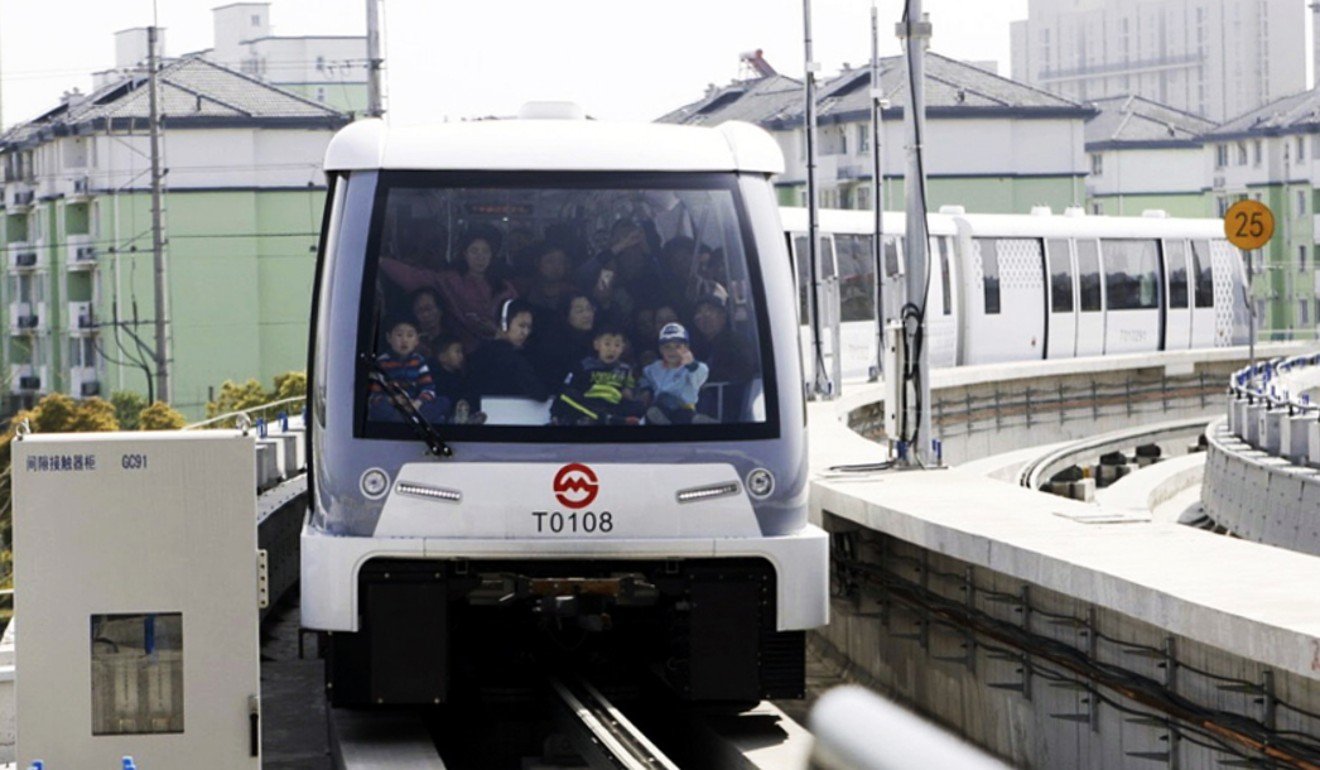
1. Shanghai Urban Rail Transit Expansion (US$44.23 billion)

Nine rail projects including six subway lines and three intercity railways will be constructed from 2018 to 2023.

The projects are estimated to total 286km and will cost 298.35 billion yuan. The network is aimed at creating better connections between the financial hub’s two airports and two major railway stations.

2. Intercity Railway along the Yangtze River in Jiangsu province (US$34.35 billion)

Eight regional intercity railways will be built in a metropolitan cluster along the Yangtze River in Jiangsu Province, a move to shorten commuting time from Nanjing, the capital city of Jiangsu province, to other districts and cities within the province.

Some of the lines will also connect Nanjing to municipalities in the neighbouring Anhui Province.

Construction of the intercity lines are estimated to cost about 231.7 billion yuan, with the construction running until 2025.

3. Wuhan Urban Rail Transit (US$21.78 billion)

Four metro lines plus four urban express lines will be constructed in the central Chinese city of Wuhan, with a total investment estimated at 146.9 billion yuan.

The NDRC said that the projects will support Wuhan’s urban layout and ease the city’s traffic congestion.

A circle line with 37 stops starting from Wuchang railway station tops the investment plan, which alone will cost 58.39 billion yuan (US$8.66 billion).

The construction will run from 2019 to 2024.

4. Intercity Rail Network in Eastern Guangdong (US$14.86 billion)

The intercity rail network in eastern Guangdong province, with a total investment of 100.2 billion yuan (US$14.86 billion), will facilitate connections between the cities of Shantou, Shanwei, Chaozhou, and Jieyang.

Construction on three rail lines totalling 320km started construction in 2018, with work on four others totalling 140km will start “at the right time”, according to the NDRC.

No specific completion date was mentioned by the state planner.

5. Suzhou Urban Rail Transit (US$13.84 billion)

Construction on four new urban transit lines in Suzhou was expected to start last year and finish in 2023.

Total investment is estimated at around 93.32 billion yuan (US$13.84 billion).

Among the four new lines, a 41km line will connect the city to Shanghai.

6. Changchun Urban Rail Transit (US$10.55 billion)

Seven urban rail transit lines, including the extension of three existing lines and four new lines, are due to be constructed in Changchun from 2019 to 2024.

The project is part of the government’s strategy to revitalise China’s northeastern provinces and boost the development of the city’s new districts.

The investment for the new projects is estimated at 71.14 billion yuan.

7. Xi’an-Yan’an High Speed Rail (US$8.18 billion)

A planned high speed rail connecting the Shaanxi provincial cities of Xi’an and Yan’an, the birthplace of Chinese Communist Party’s revolution, will also stop off at Chinese President Xi Jinping’s hometown of Fuping, located in the centre of the province.

The project will cost 55.16 billion yuan and will be completed within four and a half years.

8. Hangzhou Urban Rail Transit (US$8.3 billion)

An additional budget of 56.01 billion yuan has been granted for the already approved Hangzhou urban rail transit project.

Some 41.98 billion yuan (US$6.22 billion) of the new investment is for the new airport express from Wushan West station to Hangzhou International Airport.

According to the NDRC, it aims to better connect Hangzhou’s urban rail lines to the airport and to Hangzhou West railway station, a planned new station that is part of the infrastructure upgrade for the 2022 Asian Games which will be held in the city.

The construction will be completed by 2022.

9. Chongqing-Qianjiang High Speed Rail (US$7.93 billion)

China’s first railway tunnel under the Yangtze River – the high speed rail link between Chongqing and Qianjiang – will be completed in the next five and half years at a cost of 53.5 billion yuan.

As a major section of the Xiamen-Chongqing high speed rail line, the Chongqing-Qianjiang section covers 265km and will allow speeds of up to 350km/h.

10. Guangxi Intercity Railway Network (US$7.67 billion)

A total investment of 51.7 billion yuan will be put into two intercity railways in Guangxi province, with one from the capital city Nanning to the southeastern city of Yulin, and the other from Nanning to the southwestern city Chongzuo.

The track network is to be completed by 2023 and will connect regional towns with a total population over 500,000.

Source: SCMP

Law of Unintended Consequences

continuously updated blog about China & India

ChiaHou's Book Reviews

continuously updated blog about China & India

What's wrong with the world; and its economy

continuously updated blog about China & India