Archive for ‘corruption’

13/05/2020

Xinhua Headlines-Xi Focus: Xi stresses achieving moderately prosperous society in all respects

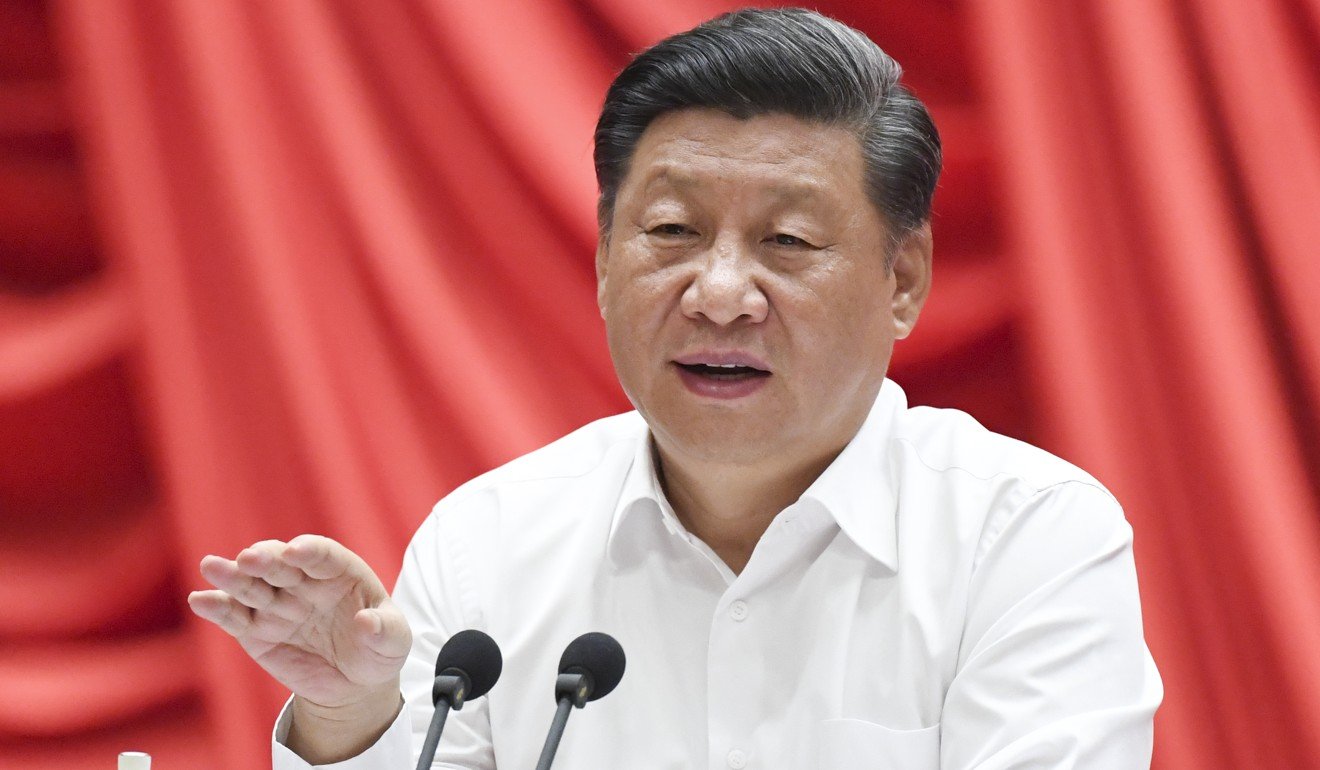
Chinese President Xi Jinping, also general secretary of the Communist Party of China Central Committee and chairman of the Central Military Commission, learns about poverty alleviation efforts at an organic daylily farm in Yunzhou District of Datong City, north China’s Shanxi Province, May 11, 2020. (Xinhua/Li Xueren)

— Xi stressed addressing the difficulties faced by enterprises in resuming production and operation.

— Xi underscored lifting the remaining poor population out of poverty.

— Xi required implementing pro-employment policies.

TAIYUAN, May 12 (Xinhua) — Chinese President Xi Jinping has stressed efforts to complete building a moderately prosperous society in all respects, and ride on the momentum to write a new chapter in socialism with Chinese characteristics for a new era.

Xi, also general secretary of the Communist Party of China (CPC) Central Committee and chairman of the Central Military Commission, made the remarks during an inspection tour in north China’s Shanxi Province.

Xi called for efforts to overcome the adverse impacts of the COVID-19 epidemic and make greater strides in high-quality transformation and development to ensure that the target of poverty eradication is reached and the building of a moderately prosperous society in all respects is completed.

During the tour from Monday to Tuesday, Xi inspected work on coordinating the regular epidemic response with economic and social development, and on consolidating the poverty eradication results.

While visiting an organic daylily farm in Yunzhou, Datong City, on Monday, Xi said what he cares about the most after poverty eradication is how to consolidate the achievements, prevent people from falling back into poverty, and make sure rural people’s incomes rise steadily.

He said an important benchmark to evaluate an official’s job performance is to see the amount of good and concrete services he or she has delivered to the people.

When visiting a community of relocated villagers, Xi said relocation is not only about better living conditions but also about chances to get rich. He called for follow-up support to residents with tailor-made rural business projects to ensure sustainable development.

Highlighting that whether the people can benefit shall be a top concern, Xi demanded more supporting policies be put in place in terms of industrial development, financing, agricultural insurance, among others.

Xi applauded the strenuous efforts made by primary-level officials on helping people fight poverty.

At the home of villager Bai Gaoshan, Xi chatted with Bai’s family as they sat on a “kang” — a bed-stove made out of clay or bricks in north China.

Chinese President Xi Jinping, also general secretary of the Communist Party of China Central Committee and chairman of the Central Military Commission, learns about poverty alleviation efforts in a village of Xiping Township in Datong City, north China’s Shanxi Province, May 11, 2020. (Xinhua/Xie Huanchi)

Xi said the CPC wholeheartedly seeks happiness for the Chinese people, having stopped collecting agricultural taxes and fees, helping the impoverished rural residents with housing and medical service, training them with skills, and finding ways for them to live a prosperous life.

“I believe our villagers will enjoy better days ahead,” Xi said.

On top of that, he called for consolidating achievements in poverty alleviation, and then focusing on rural vitalization to ensure a better life for rural residents.

He then went on to visit the 1,500-year Yungang Grottoes, a “treasure house” of artifacts featuring elements blending Chinese and foreign cultures, as well as cultures of China’s ethnic minorities and the Central Plains.

Xi stressed that historical and cultural heritages are irreplaceable precious resources, and protecting them should always be put in the first place in tourism development.

Noting that tourism should not be over-commercialized, Xi said tourism should become a way for the Chinese to understand and appreciate the culture of the nation and enhance their cultural confidence.

The historical implications of communication and integration behind the Yungang Grottoes should be further explored to enhance the sense of community for the Chinese nation, said Xi.

During a research tour in a stainless steel manufacturer in the provincial capital Taiyuan on Tuesday morning, Xi said products and technology are the lifeline of businesses, calling for more efforts in technological innovation to make a greater contribution to the development of advanced manufacturing.

He also called on businesses to strictly implement epidemic prevention and control measures to ensure the safety and health of their workers, while promoting the resumption of work and production to make up for the time lost.

Chinese President Xi Jinping, also general secretary of the Communist Party of China Central Committee and chairman of the Central Military Commission, waves to workers during a research tour in a stainless steel manufacturer in Taiyuan, capital city of north China’s Shanxi Province, May 12, 2020. (Xinhua/Li Xueren)

Later on, Xi went to check the ecological protection work of the Fenhe River in the city, and urged the incorporation of environment protection, energy revolution, green development, and economic transformation.

After hearing the work reports of the CPC Shanxi Provincial Committee and the provincial government on Tuesday afternoon, Xi stressed that no relaxation is allowed in epidemic prevention and control, noting that efforts should be made to guard against both imported infections and domestic rebounds, improve regular prevention and control mechanism, and prevent new outbreaks.

Xi called for efforts on more promptly and effectively addressing the difficulties faced by enterprises in resuming production and operation, on solid implementation of all the policies and measures for expanding domestic demand, and on strengthening the competitiveness and quality of the real economy, especially the manufacturing industry.

Chinese President Xi Jinping, also general secretary of the Communist Party of China Central Committee and chairman of the Central Military Commission, speaks with workers during a research tour in a stainless steel manufacturer in Taiyuan, capital city of north China’s Shanxi Province, May 12, 2020. (Xinhua/Xie Huanchi)

Continuous efforts should be made to promote the adjustment and optimization of China’s industrial structure, and scientific and technological innovations should be greatly enhanced to continue achieving breakthroughs in new infrastructures, technologies, materials, equipment as well as new products and business models, Xi said.

He stressed overcoming the difficulties and obstacles facing reforms in key areas, including state-owned enterprises and assets, the fiscal, tax, and financial system, business environment, the private sector, domestic demand expansion, and urban-rural integration.

Xi also highlighted efforts to improve the country’s system and mechanism for opening-up.

China will uphold the concept that lucid waters and lush mountains are invaluable assets, and steadily implement the national strategy for ecological protection and high-quality development of the Yellow River basin, he said.

More should be done to accelerate institutional innovation and strengthen the implementation of institutions to help form a green way of production and living, he said.

Efforts should be made to solidify the foundation for the development of agriculture and rural areas, beef up policy support for grain production and lift the remaining poor population out of poverty, Xi said.

Authorities should adhere to the people-centered development philosophy and ensure the bottom line of people’s livelihood, Xi said. He added that efforts should be made to implement pro-employment policies and facilitate the employment of key groups such as college graduates, veterans, rural migrant workers and urban people facing difficulties.

Efforts should be expedited to improve the weak areas in the public health system exposed by the epidemic and shift the focus of social governance to the primary levels, Xi said.

The rich and colorful local history and culture as well as revolutionary cultural resources should be fully drawn on and used to promote cultural advancement, Xi said.

He stressed consistent efforts to promote core socialist values to guide Party cadres as well as the public to enhance morality, cultivate good ethics and strengthen cultural confidence.

Xi also called for efforts to improve the Party’s political ecosystem, strictly observe the Party’s political discipline and rules and fight against corruption and undesirable conduct.

Source: Xinhua
19/02/2020

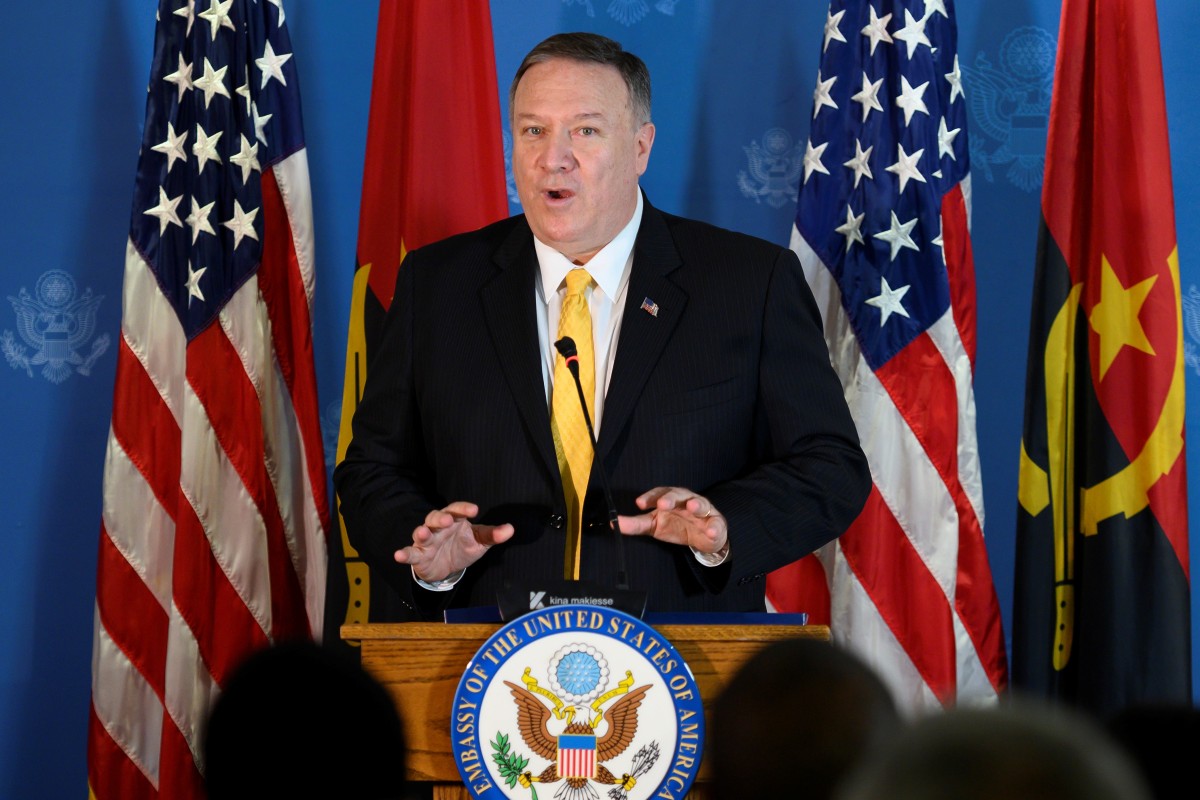
Mike Pompeo takes aim at corruption and Chinese investment in Angola

  • US secretary of state is eager to promote US investment as an alternative to China, which holds the lion’s share of Angola’s foreign debt
  • Isabel dos Santos, the former president’s daughter, became Africa’s richest woman but now stands accused of massive fraud
US Secretary of State Mike Pompeo in Luanda, Angola. Photo: Reuters

US Secretary of State Mike Pompeo denounced corruption and touted American business on Monday during the second leg of an African tour in Angola, where the government is seeking to claw back billions of dollars looted from state coffers.

Pompeo is aiming to promote US investment as an alternative to Chinese loans while assuaging concerns over a planned US military withdrawal and the expansion of visa restrictions targeting four African countries.

In Angola’s capital Luanda, Pompeo met with President Joao Lourenco, who took office in 2017 promising wide-ranging economic reforms and a crackdown on the endemic corruption that marked his predecessor Jose Eduardo dos Santos’ four-decade rule.

“Here in Angola, damage from corruption is pretty clear,” he told a group of businessmen following that meeting. “This reform agenda that the president put in place has to stick.”

Here in Angola, damage from corruption is pretty clear Mike Pompeo
Portugal’s public prosecutor has ordered the seizure of bank accounts belonging to

Isabel dos Santos

, the former president’s billionaire daughter, who is a suspect in an Angolan fraud investigation. Reputedly the richest woman in Africa, she has repeatedly denied any wrongdoing.

Angola, with Sub-Saharan Africa’s third-largest economy and its second-largest oil producer is ranked as one of the world’s most corrupt nations, in 165th place on a list of 180 countries, according to anti-corruption group Transparency International.

US oil majors ExxonMobil and Chevron have significant stakes in Angolan oilfields.

Last year, Chevron signed onto a consortium to develop Angola’s natural gas assets alongside Italy’s Eni, France’s Total, BP and Angolan state oil company Sonangol.

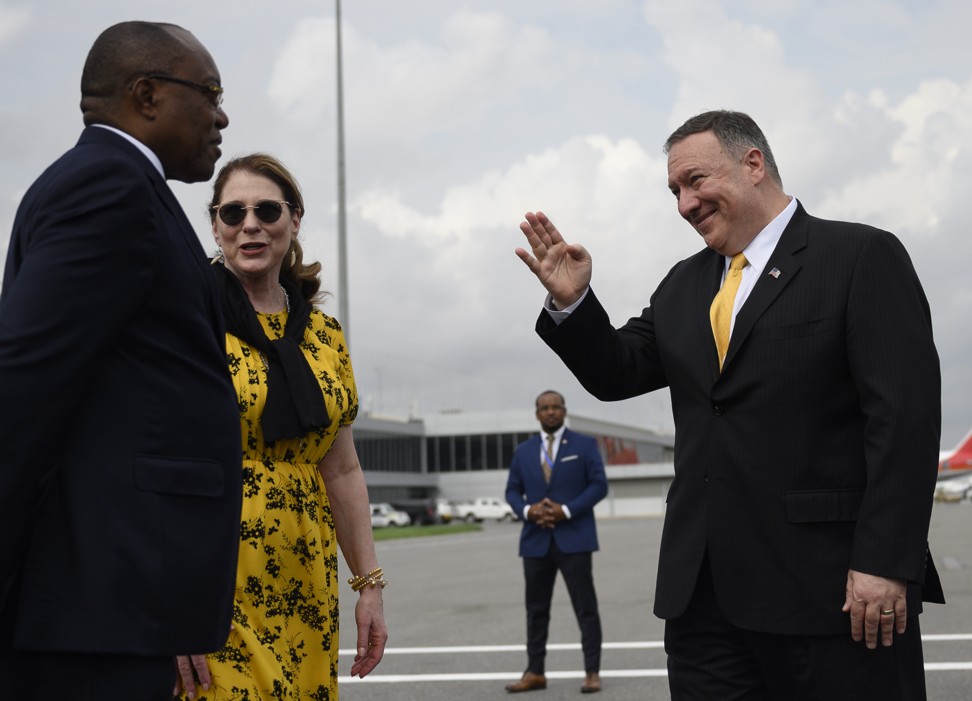
Mike Pompeo and his wife Susan greet Angola Foreign Minister Manuel Domingos Augusto in Luanda on Monday. Pool photo: AFP
“We’ve got a group of energy companies that have put more than US$2 billion in a natural gas project. That will rebound to the benefit of the American businesses for sure, but to the Angolan people for sure as well,” Pompeo said.

Despite US investments, the bulk of Angola’s oil production is destined for China, which holds the lion’s share of Angolan foreign debt.

The Trump administration has accused China of predatory lending in Africa, where Beijing has loaned governments billions of dollars for infrastructure projects in exchange for access to natural resources as part of its Belt and Road project. China rejects the criticism.

With a revamped International Development Finance Corporation and its new Prosper Africa trade and investment strategy, the administration is seeking to combat Chinese influence on the continent.

But the push comes as some governments are questioning US President Donald Trump’s commitment to Africa.

Do Africa’s emerging nations know the secret of China’s economic miracle?

13 Oct 2019

The White House last month tightened visa restrictions on nationals from Sudan, Tanzania, Eritrea and Nigeria.

West African governments are also worried about a proposed US troop withdrawal from the region just as Islamist groups with links to Islamic State and al-Qaeda are gaining ground.

During the first leg of his African trip in Senegal on Sunday, Pompeo sought to put some of those fears to rest.

“We have an obligation to get security right here, in the region. It’s what will permit economic growth, and we’re determined to do that,” he told reporters.

Source: SCMP

29/09/2019

China anniversary: The deep cuts of 70 years of Communist rule

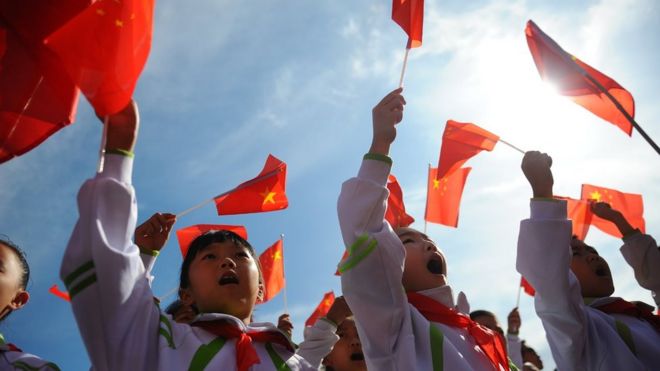
Children waving Chinese flagsImage copyright GETTY IMAGES
Image caption China’s version of its past is a story of prosperity, progress and sacrifice for the common good

China’s extraordinary rise was a defining story of the 20th Century, but as it prepares to mark its 70th anniversary, the BBC’s John Sudworth in Beijing asks who has really won under the Communist Party’s rule.

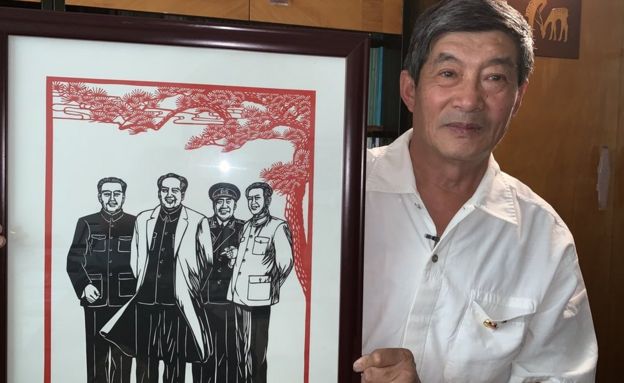
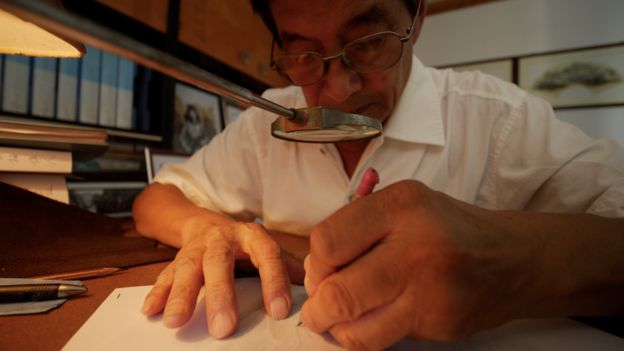
Sitting at his desk in the Chinese city of Tianjin, Zhao Jingjia’s knife is tracing the contours of a face.

Cut by delicate cut, the form emerges – the unmistakable image of Mao Zedong, founder of modern China.

The retired oil engineer discovered his skill with a blade only in later life and now spends his days using the ancient art of paper cutting to glorify leaders and events from China’s communist history.

“I’m the same age as the People’s Republic of China (PRC),” he says. “I have deep feelings for my motherland, my people and my party.”

Zhao Jingjia with a paper cut of Mao Zedong
Image caption For people like Zhao Jingjia, China’s success outweighs the “mistakes” of its leaders

Born a few days before 1 October 1949 – the day the PRC was declared by Mao – Mr Zhao’s life has followed the dramatic contours of China’s development, through poverty, repression and the rise to prosperity.

Now, in his modest but comfortable apartment, his art is helping him make sense of one of the most tumultuous periods of human history.

“Wasn’t Mao a monster,” I ask, “responsible for the deaths of tens of millions of his countrymen?”

“I lived through it,” he replies. “I can tell you that Chairman Mao did make some mistakes but they weren’t his alone.”

“I respect him from my heart. He achieved our nation’s liberation. Ordinary people cannot do such things.”

On Tuesday, China will present a similar, glorious rendering of its record to the world.

The country is staging one of its biggest ever military parades, a celebration of 70 years of Communist Party rule as pure, political triumph.

Beijing will tremble to the thunder of tanks, missile launchers and 15,000 marching soldiers, a projection of national power, wealth and status watched over by the current Communist Party leader, President Xi Jinping, in Tiananmen Square.

An incomplete narrative of progress

Like Mr Zhao’s paper-cut portraits, we’re not meant to focus on the many individual scars made in the course of China’s modern history.

It is the end result that matters.

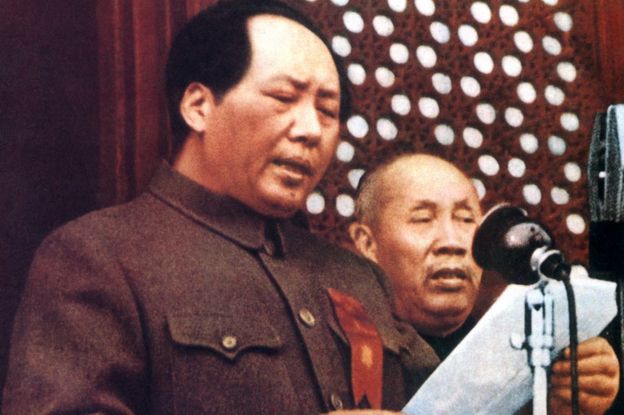
Mao Zedong declares the People's Republic of China in Beijing on 1 Oct 1949Image copyright XINHUA/AFP
Image caption Mao Zedong pronounces the dawn of the People’s Republic of China on 1 October 1949

And, on face value, the transformation has been extraordinary.

On 1 October 1949, Chairman Mao stood in Tiananmen Square urging a war-ravaged, semi-feudal state into a new era with a founding speech and a somewhat plodding parade that could muster only 17 planes for the flyby.

This week’s parade, in contrast, will reportedly feature the world’s longest range intercontinental nuclear missile and a supersonic spy-drone – the trophies of a prosperous, rising authoritarian superpower with a 400 million strong middle class.

It is a narrative of political and economic success that – while in large part true – is incomplete.

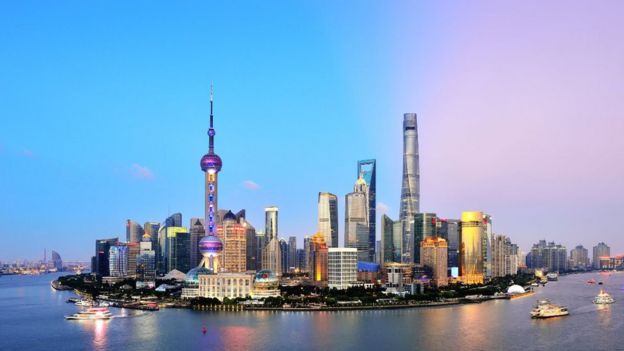
New visitors to China are often, rightly, awe-struck by the skyscraper-festooned, hi-tech megacities connected by brand new highways and the world’s largest high-speed rail network.

Shanghai skylineImage copyright GETTY IMAGES
Image caption Those in China’s glittering cities may accept the trade-off of political freedom for economic growth

They see a rampant consumer society with the inhabitants enjoying the freedom and free time to shop for designer goods, to dine out and to surf the internet.

“How bad can it really be?” the onlookers ask, reflecting on the negative headlines they’ve read about China back home.

The answer, as in all societies, is that it depends very much on who you are.

Many of those in China’s major cities, for example, who have benefited from this explosion of material wealth and opportunity, are genuinely grateful and loyal.

In exchange for stability and growth, they may well accept – or at least tolerate – the lack of political freedom and the censorship that feature so often in the foreign media.

For them the parade could be viewed as a fitting tribute to a national success story that mirrors their own.

But in the carving out of a new China, the knife has cut long and deep.

The dead, the jailed and the marginalised

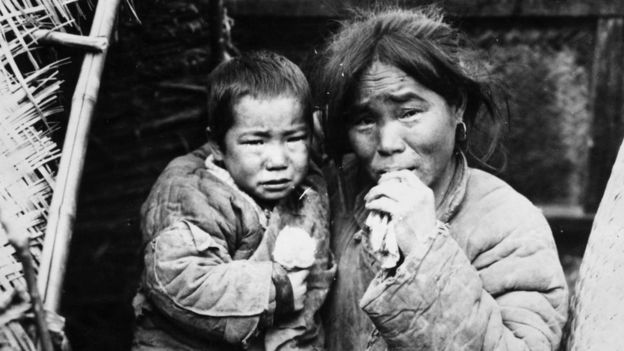
Mao’s man-made famine – a result of radical changes to agricultural systems – claimed tens of millions of lives and his Cultural Revolution killed hundreds of thousands more in a decade-long frenzy of violence and persecution, truths that are notably absent from Chinese textbooks.

Archive image of a starving woman and child during the famine in ChinaImage copyright GETTY/TOPICAL
Image caption Tens of millions starved to death under Mao, as China radically restructured agriculture and society

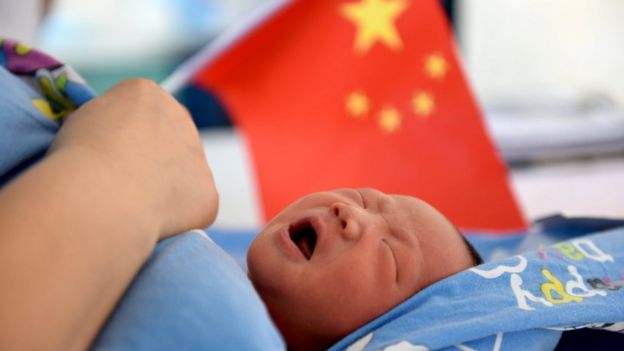
After his death, the demographically calamitous One Child Policy brutalised millions over a 40-year period.

Still today, with its new Two Child Policy, the Party insists on violating that most intimate of rights – an individual’s choice over her fertility.

The list is long, with each category adding many thousands, at least, to the toll of those damaged or destroyed by one-party rule.

Chinese baby in front of Chinese flagImage copyright GETTY IMAGES
Image caption Beijing still regulates how many children families can have

There are the victims of religious repression, of local government land-grabs and of corruption.

There are the tens of millions of migrant workers, the backbone of China’s industrial success, who have long been shut out of the benefits of citizenship.

A strict residential permit system continues to deny them and their families the right to education or healthcare where they work.

And in recent years, there are the estimated one and a half million Muslims in China’s western region of Xinjiang – Uighurs, Kazakhs and others – who have been placed in mass incarceration camps on the basis of their faith and ethnicity.

China continues to insist they are vocational schools, and that it is pioneering a new way of preventing domestic terrorism.

The stories of the dead, the jailed and the marginalised are always much more hidden than the stories of the assimilated and the successful.

Viewed from their perspective, the censorship of large parts of China’s recent history is not simply part of a grand bargain to be exchanged for stability and prosperity.

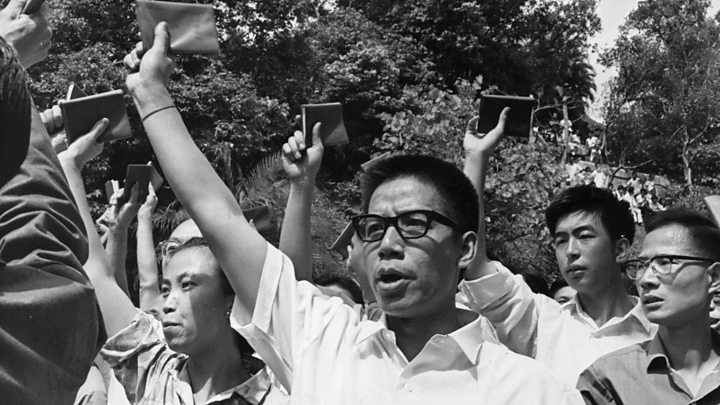
People holding pictures of Mao and the Little Red Book in Tiananmen Square, 1966

Getty
Timeline of modern China

  • 1949 Mao declares the founding of the People’s Republic of China
  • 1966-76 Cultural Revolution brings social and political upheaval
  • 1977 Deng Xiaoping initiates major reforms of China’s economy
  • 1989 Army crushes Tiananmen Square pro-democracy protests
  • 2010 China becomes the world’s second-largest economy
  • 2018 Xi Jinping is cleared to be president for life
It is something that makes the silence of their suffering all the more difficult to penetrate.

It is the job of foreign journalists, of course, to try.

‘Falsified, faked and glorified’

But while censorship can shut people up, it cannot stop them remembering.

Prof Guo Yuhua, a sociologist at Beijing’s Tsinghua University, is one of the few scholars left trying to record, via oral histories, some of the huge changes that have affected Chinese society over the past seven decades.

Her books are banned, her communications monitored and her social media accounts are regularly deleted.

“For several generations people have received a history that has been falsified, faked, glorified and whitewashed,” she tells me, despite having been warned not to talk to the foreign media ahead of the parade.

“I think it requires the entire nation to re-study and to reflect on history. Only if we do that can we ensure that these tragedies won’t be repeated.”

People with poster of Mao ZedongImage copyright GETTY IMAGES
Image caption Can progress really be attributed to the leadership?

A parade, she believes, that puts the Communist Party at the front and centre of the story, misses the real lesson, that China’s progress only began after Mao, when the party loosened its grip a bit.

“People are born to strive for a better, happier and more respectful life, aren’t they?” she asks me.

“If they are provided with a tiny little space, they’ll try to make a fortune and solve their survival problems. This shouldn’t be attributed to the leadership.”

‘Our happiness comes from hard work’

As if to prove the point about how the unsettled, censored pasts of authoritarian states continue to impact the present, the parade is for invited guests only.

Mao's portrait hanging in Tiananmen SquareImage copyright GETTY IMAGES
Image caption Mao’s portrait will, as it always is, be watching over the events in Tiananmen Square

Another anniversary, of which Tiananmen Square is the centrepiece, is also being measured in multiples of 10 – it is 30 years since the bloody suppression of the pro-democracy protests that shook the foundations of Communist Party rule.

The troops will be marching – as they always do on these occasions – down the same avenue on which the students were gunned down.

The risk of even a lone protester using the parade to mark a piece of history that has largely been wiped from the record is just too great.

With central Beijing sealed off, ordinary people in whose honour it is supposedly being held, can only watch it on TV.

Zhao

Back in his Tianjin apartment, Zhao Jingjia shows me the intricate detail of a series of scenes, each cut from a single piece of paper, depicting the “Long March”, a time of hardship and setback for the Communist Party long before it eventually swept to power.

“Our happiness nowadays comes from hard work,” he tells me.

It is a view that echoes that of the Chinese government which, like him, has at least acknowledged that Mao made mistakes while insisting they shouldn’t be dwelt on.

“As for the 70 years of China, it’s extraordinary,” he says. “It can be seen by all. Yesterday we sent two navigation satellites into space – all citizens can enjoy the convenience that these things bring us.”

Media caption What was China’s Cultural Revolution?

Source: The BBC

07/09/2019

Ancient past, modern ambitions: historian Wang Gungwu’s new book on China’s delicate balance

  • China Reconnects: Joining a Deep-rooted Past to a New World Order looks at how the Middle Kingdom is trying to build a modern civilisation without forgetting its heritage
The Scales of Justice and Lady Justice in front of China’s national flag. Photo: Alamy

China Reconnects: Joining a Deep-rooted Past to a New World Order is a new book by Australian historian Wang Gungwu. The book seeks to explain the new-found confidence among the Chinese in their capacity to learn all they need from the developed world while retaining enough from their past to build a modern civilisation. It does not employ theoretical frameworks to explain China’s rise, as Wang believes they are not appropriate to describe the changes sweeping the country. He calls for greater understanding of why history is particularly important to the Chinese state and its people, as the nation seeks the means to respond to a United States trying to preserve its dominant position in the international status quo.

Historian Wang Gungwu. Photo: Handout

Wang is university professor at the National University of Singapore and professor emeritus of the Australian National University. The book is published by World Scientific Publishing. Here are some excerpts.

CHINESE CHARACTERISTICS

Xi Jinping’s China inherited the policies that opened the country to the global economy. The policies created the conditions that made China prosperous and, to many, they put China on the world map again. At the same time, what Xi Jinping inherited also includes practices and lapses of discipline that led to corruption on an unprecedented scale. Deng Xiaoping might have expected some leakages in a more open system, but would not have thought that his party cadres could succumb to that extent.
China’s rise is peaceful, Xi Jinping tells foreign experts

Xi Jinping also inherited programmes from his predecessors “theories” like sange daibiao (Three Represents) and hexie shehuizhuyi shehui (Harmonious socialist society).

Given the pervasive corruption that he found in high places, he must have wondered how useful these theories were. The former was implicitly socialist, stressing productive forces, advanced culture and concern for the interests of the majority. The latter, however, was redolent of Confucian values, made even more explicit when Hu Jintao spoke of barong bachi, or “eight honours and eight disgraces”. Despite these exhortations, the corruption that accompanied them reminds us of conditions familiar to Chinese dynasties in decline.

Chinese President Xi Jinping inherited the policies that opened the country to the global economy. Photo: Xinhua

If the regime’s Chinese characteristics enabled officials to be corrupt and the rich to become excessively rich and selfish, where was the socialism? While no one would claim that everything in China’s past was desirable, surely there were better features that could have been chosen to inspire the present. Perhaps not all the corruption should be blamed on old feudal China; the open market economy with its capitalist characteristics is also known for creating the huge gap today between the super rich and the rest. If the capitalist mode is undermining socialist good intentions, are there Chinese characteristics that can protect China from that infection?

How China’s rise is revealing the cracks in US claims to legitimacy as global leader

Critics have been quick to attack as well as defend Confucian China and the market and no simple answer has been found. What Xi Jinping inherited was a collective leadership system that failed to police the Party. He thus reacted by asserting that the Party was in grave danger of collapse. The foremost patriotic act was to save the party. He has to find the socialism that could induce his comrades to rededicate themselves.

He turned to Karl Marx to emphasise its original inspiration and avoided the Russian duo, Lenin and Stalin. By stressing the importance of Marx’s world view and analytical methods, he could ignore the Soviet institutional baggage. Above all, Marx stood for the idea of progress, the modern import from the Enlightenment that has impressed generations of Chinese.

China’s modern story began by rebuilding a unified state. Those leaning towards socialism further agreed that the country had to have a strong centralised government, perhaps the most enduring feature of dynastic China. Sun Yat-sen had recognised that and wanted to be the leader with power to get things done. When Chiang Kai-shek seized power, he fought with every weapon available to maintain his supreme position. It was therefore not surprising that Mao Zedong thought that the Party leader should have full control. His victory over the Nationalists had put him in an unassailable position.

Thereafter, he could redefine the goals that fit his agenda. He was so successful that socialism in his hands became almost unrecognisable. Deng Xiaoping had a difficult time teaching another generation why socialism was progressive and why infusing it with Chinese characteristics would ensure its legitimacy.

China’s reform and opening must continue, 40 years after its ‘second revolution’

This was the background to the corrupted China that came so unexpectedly into Xi Jinping’s hands. From his appointment as party secretary in Shanghai to the Politburo Standing Committee and as vice-president, he had five years to prepare to become the leader of the country. Some of what went through his mind during that period may be gleaned from his writings when he served in Zhejiang, in the Zhijiang xinyu that he published in 2007, but more important was what he thought of a collective leadership that was headless.

Xi Jinping obviously believes that his anti-corruption campaign was vital to enable him to save the Party. His campaign also made him popular and he has tied the campaign to a new faith in socialism.

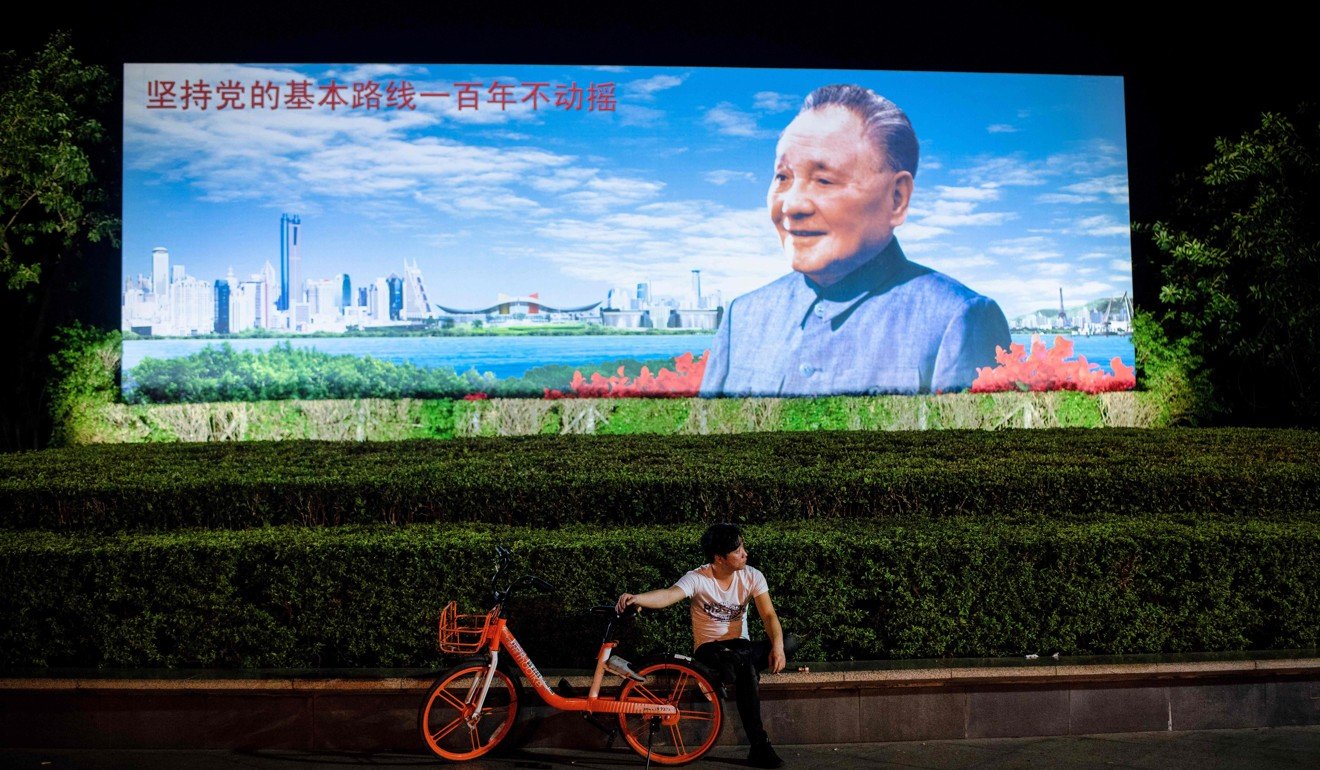
A poster of former Chinese leader Deng Xiaoping in Shenzhen. Photo: AFP

He has emphasised that Deng Xiaoping’s reforms saved the state and the Party and are integral to the power that he has inherited. He had worked dutifully in support of reform and this helped him rise to the highest office. His youthful experiences growing up with the peasants of the northwest taught him about failures as well as successes. That has led him to ask the Party to connect with the first 30 Maoist years as much as study the later years of reform. That way he confirmed the continuity of what he, his father and their comrades had committed their lives to serve. This attitude towards continuities in Chinese history has always looked to a strong state with powerful leaders. Xi Jinping discovered during his years of service what kind of power would be required to establish the caring and fair society that socialism stood for. When he became president, he not only knew that Mao Zedong as cult leader could not succeed but also that a leaderless collective endangered the Party. He has concluded that the Chinese way of doing socialism would have to be connected to the lessons learned throughout the Chinese past.

Where to now? 40 years after the big economic experiment that changed China

Only by recognising how relevant those lessons are can China confidently go forward to devise the modern state that it wants.

There is some truth in the French saying that the more things change the more things remain the same. The Chinese were even more directly paradoxical. They believed that change was inevitable and hence prepared for changes that could occur several times in a lifetime. When thus prepared, they hoped that each change would not destroy the things that were still valued. If the foundations survived, change could make the new become stronger.

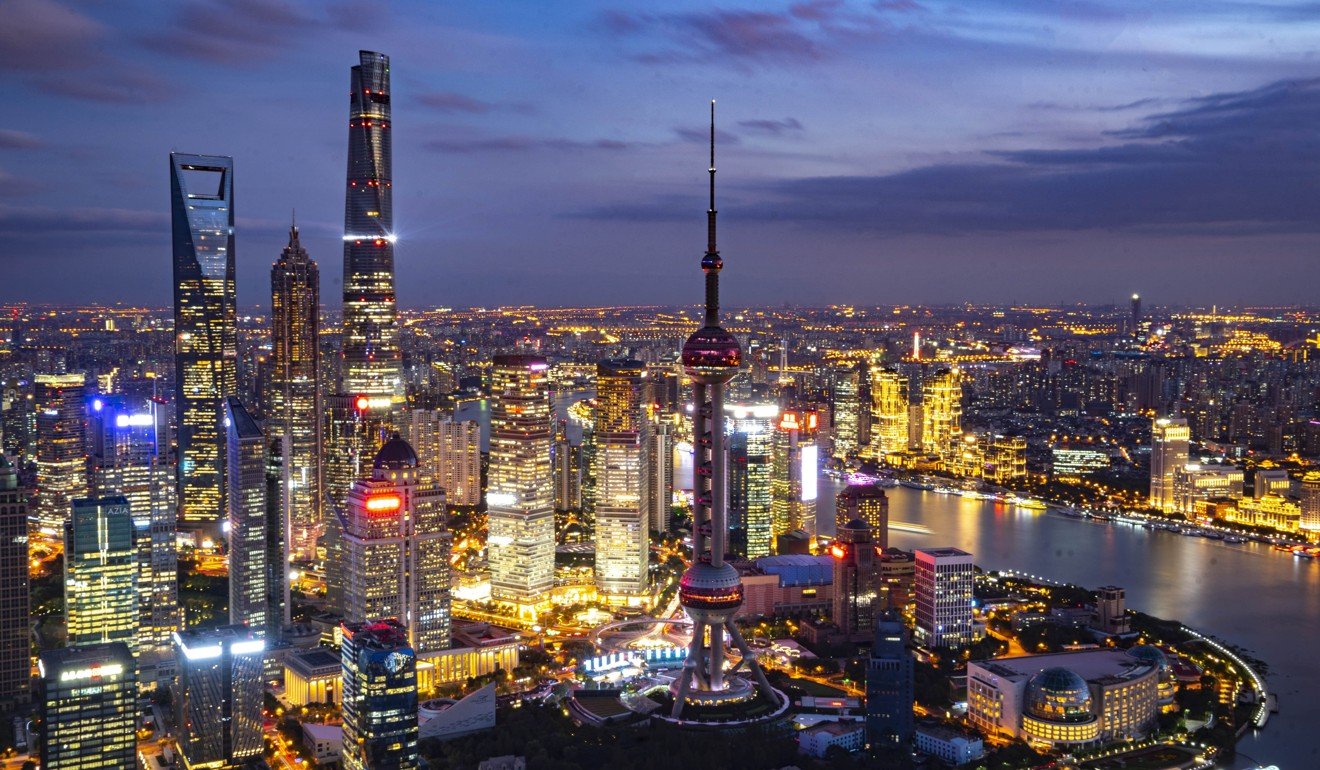
Shanghai is a showcase for China’s modernisation efforts. Photo: Xinhua

There are other ideas in the tradition that Xi Jinping understands. One is that of zhi and xing (knowing and acting) and zhixing heyi (combining knowledge with action). This had been highlighted since the days of Ming philosopher Wang Yangming.

In modern times, Sun Yat-sen advocated xing erhou zhi (act then you will know) as preferable to the safer and more conservative zhi erhou xing (know before acting) and Xi Jinping seems to share that view. When you act and make your choices, these add up so that you will really know. From that perspective, Mao Zedong’s choices taught hard lessons and the Chinese people now know what not to do. Another idea goes back to Confucius, who said shu er buzuo, or transmitting (tradition) and not doing (something new). In other words, without claiming newness or discovery, he transmitted wisdom and knowledge to those who followed. Xi Jinping seems to focus on drawing on past experiences that enable future generations to learn: with learning, something new would result.

Xi Jinping can dramatically reform China’s economy or maintain high growth – but he can’t do both

Xi Jinping may not need the word “new” for his socialism. His shehui zhuyi could be the accumulation of layers of modern experience that harmonise with selected bits of China’s history. Explaining the actions and reactions of generations of his predecessors could take his party-state to another level of development. Here a sage Marx symbolically as important as Confucius would add the goal of progress to inherited wisdom. Socialism could be “hard” in rational and disciplined action and “soft” in moral goals deeply rooted in people’s aspirations. A strong leader who knew how to link the past to a dream of the future could shape the socialism that his people could identify as the datong shehui in China’s heritage.

DIFFERENT HERITAGE

The distance between the legal systems in China and the West has long been a matter of regret. It began when Britain was no longer prepared to let Chinese law be used to punish British subjects; that issue became the cause célèbre in the Anglo-Chinese wars.

Despite the fact that China had, with the help of Anglo-American and other European legal scholars, reformed and modernised its legal system during the past 100 years, the gulf has remained and has continued to fuel an underlying lack of trust. This has once again surfaced in contemporary interstate relations wherever the People’s Republic is involved.

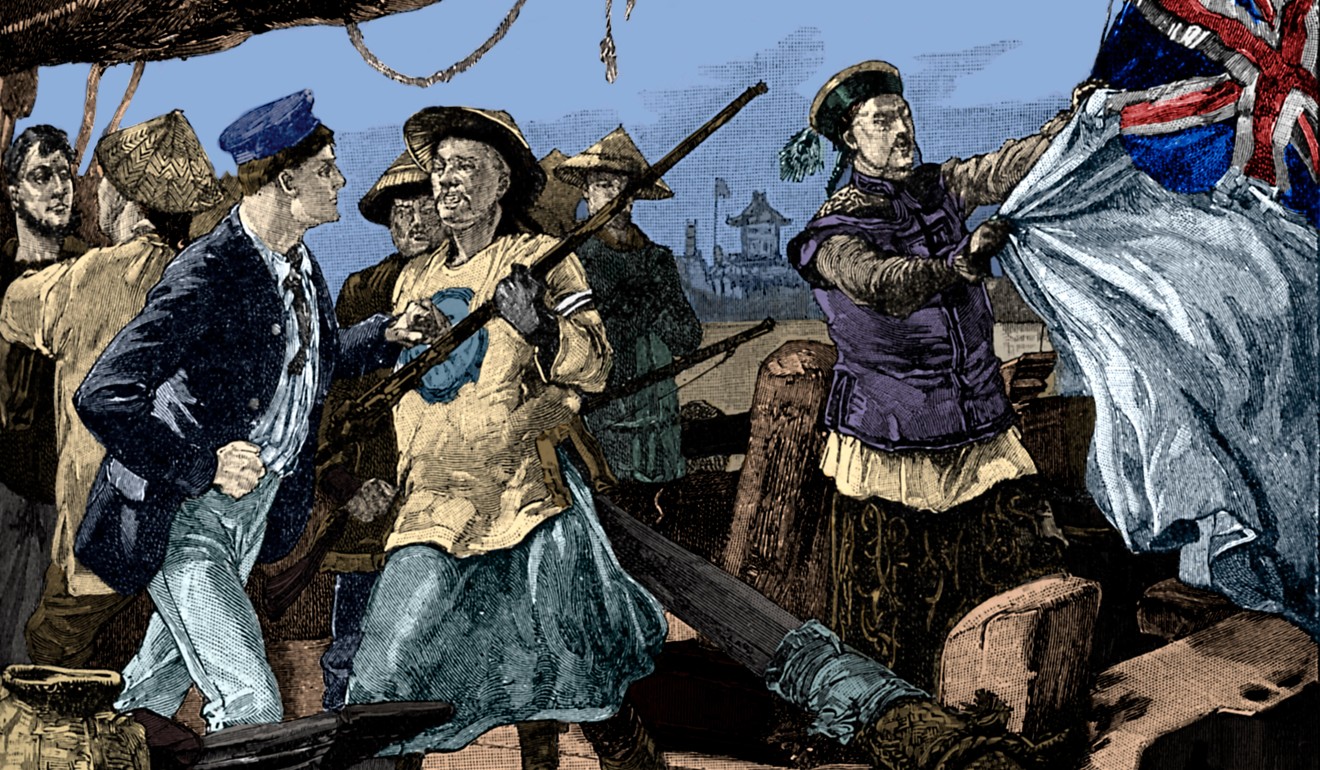
Chinese officials pull down a British flag on a ship in 1856. Photo: Alamy Stock Photo

The issue had become sensitive when the Western powers made it clear that their legal ideals were meant to cover the relations between civilised states, and China had been found wanting. The divide stemmed from the European assumption that international law was built on a common Christian heritage. The treaties that followed China’s several defeats led to extraterritorial jurisdictions by Western powers and Japan. These humiliated China for being so uncivilised that provisions were necessary for the protection of civilised people. The set of practices that diminished China’s sovereign rights remained a source of anger for 100 years and coloured Chinese attitudes towards all Western reference to the rule of law down to the present.

The different value given by China and the West to the role of law has deep roots. It originated from the different premises made about the relationship between man and nature, between those who moved from believing in many gods to faiths in one God, and those whose world views allowed them to live without reference to any God or gods.

Is reform dead in China? Trump’s trade war may be breathing life back into the cause

The single-god world emerged in the Mediterranean region (among Jewish, Christian or Islamic believers) while the mixed often-godless realm was developed in the Sinic cultural zone in eastern Asia.

When traced far back, what is significant is that, while there were great differences in conceptions, both godly and godless traditions paid respect to the role of law, albeit each in its own way. There was no question of not depending on law for securing order, especially the controls needed for political order. Whether the laws reached into private and family affairs, or were in the main varieties of civil and criminal law, all those in authority gave much thought to formulating them to bring out what was fair and most efficacious. And both European and Chinese rulers paid close attention to laws pertaining to governance, and specifically to their relations with their subjects.

The distance between legal systems in China and the West has long been a matter of contention. Photo: Xinhua

Where their respective heritage parted significantly was the way their rulers institutionalised their codes. Those in Europe believed that the rule of law was a higher principle that stood above other considerations; it was sanctified by the supernatural and therefore sacrosanct. The idea had grown out of customary law observed by tribal organisations as well as in the royal and canon laws promulgated in princely states or kingdoms. In time, they were extended to cover larger political units like nation states or empires. Law was therefore at the centre of all governance and remained steadfast whether the rulers were strong men or a group of oligarchs, or leaders who were democratically chosen. Whoever they were and wherever they came from, they could only rule through regulations and statutes that were seen as parts of God’s law. Thereafter, that conception of the rule of law led to questions being asked as to what would best serve those who are equal in the eyes of God. That led people to demand that law should protect people from abusive rulers. The key point was that, behind the respect for the law was religious doctrine and the Church. In certain contexts, God’s law had the power to send even the strongest leaders to the fires of hell. When this authority shifted following the Reformation, Christian Europe still maintained that each church embodied the spirit of God’s law.

To end the trade war, ‘China must deliver on its promises to reform and open up’

When the classics of the Greco-Roman period were given a new lease of life during the Renaissance, this ancient learning stimulated revolts within the Church. The Protestants reinterpreted their heritage and provided conditions whereby new ideas were allowed to grow. As a result, the advent of scepticism, rationalism and the scientific mind enabled an intense questioning of past assumptions that eventually led to a secular view of the world.

Western Europe largely moved away from church-determined ideas and went on to develop laws that have been described as rational and modern. That saw the beginning of a powerful legal system under which the ruler gave up most of his powers so that his subjects would have more say. Of course, who actually had a say was another matter.

US President Donald Trump, who many Chinese believe is trying to contain China’s rise. Photo: Reuters

It took the British more than 100 years to let ordinary men have the vote, and the women did not get theirs until the 20th century. The British were unapologetic about that pace of development. They thought that the only people who should be allowed to vote were people who owned property and were well-educated. Nevertheless, the principle that people could control their own destiny was confirmed.

In one form or another, laws were obeyed in good conscience by God-fearing people and rational scientific-minded people alike. Even when the laws were obviously man-made and could be cruelly implemented, whether by kings, judges or elected legislators, it continued to be understood that a higher spirit rested behind their making. That belief gave the laws a special moral standing and placed the rule of law at the heart of Western political culture. In short, the ruler was always subject to God’s law.

In comparison, the Chinese have also long acknowledged that laws should be respected but the idea of the rule of law was only implicitly understood. Everyone was conscious that the laws demanded absolute obeisance; that was akin to fear of the ruler’s wrath. Those draconian laws had been given centrality by the state of Qin during the Warring States period. The legalists who drew them up enabled the Qin to defeat the rival states and use the laws to control, dominate and dictate in every respect. What was understood, and sometimes made explicit, was that the ruler would always employ the law to stay in power.

Beijing unveils detailed reform plan to make Shenzhen model city for China and the world

The idea that rules accompanied by harsh punishments made states strong attracted many of the warring lords from the fifth to the third century BC. It led them to challenge the Zhou dynasty’s claim that good governance came from the model rulers of a legendary Golden Age who embodied the principle that the right to rule had to be defined in moral terms. In that context, legitimacy was confirmed through rituals that demonstrate that the ruler had received the Mandate of Heaven.

The rulers of the state of Qin thought otherwise. They employed legalists who believed that power depended on total control through harsh laws and finally destroyed all rivals to establish a new dynasty. The new emperor made sure everyone knew that he was above the law and his laws must be obeyed.

This law was a revolutionary instrument used to destroy a decrepit ancient regime. However, the legalists were so extreme in their rejection of traditional moral and social norms that people rose in revolt and that enabled the Han dynasty to take over the empire. The Han rulers reformed the emperor-state system and experimented with other ideas.

But they retained the body of Qin laws that guided the centralised bureaucracy and brought in non-legalists to administer the empire.

Xiamen in China’s Fujian province. Photo: Bloomberg

The fourth emperor, Han Wudi, then entrusted men of Confucian learning to balance the harsh laws with their moral ideals. The writings of Confucius had been torched and banned by the Qin. Now his disciples could practise what they preached.

The Han ideal thereafter was to educate rulers in the Confucian Classics that extolled them to be guided by responsible officials chosen for their learning and moral principles. The legal system was no longer upfront but remained there to be used by Confucian scholars whenever necessary. That set the tone of imperial governance even for the Central Asian tribal successors of the Han during the fifth and sixth centuries.

By the Tang dynasty, Confucian moral wisdom modified the law codes again, and these were further revised during the Ming-Qing dynasties.

In short, laws with deep roots in Confucian renzhi provided the foundations of the empire state for at least 1,500 years. As outlined earlier, God’s law in its secular form came to stand at the heart of the universalism promoted by the West and led by the United States and its European allies since the end of World War Two. In contrast, the idea of what was civilised in China had been particularistic and the laws guiding its modernisation process operate within its own framework.

Qin dynasty crossbow found at China’s Terracotta Army site may reveal secret of emperor’s success

The country has been prepared to learn from and even adopt Western law codes, but also wants to reconnect with the moral principles that had protected its heritage. This reminds us that law today has not only been a question of adapting modern law for China’s use but is also the source of tension in Sino-Western relations. The normative use of law extended by the West to apply to all interstate relations continues to provide a challenge. Chinese leaders closely observed how those legal institutions have worked in international relations. In particular, they noted how those institutions could not prevent the two wars that destroyed European supremacy. This has led them to believe that the system is not fair or stable and could be improved.

THE NANYANG CONNECTION

Today a new Southeast Asia can work through Asean. This regional organisation is a remarkable achievement, but it is still work in progress. Beginning with maritime interests, it now includes continental states with very different histories. Vietnam, for example, learnt the same lessons as the Chinese and now looks much more to the sea while Laos is totally landlocked. As for Cambodia and Myanmar, how they respond to maritime challenges is still unclear. As members of Asean, this may matter less as long as they can count on a united organisation to monitor the region’s naval concerns.

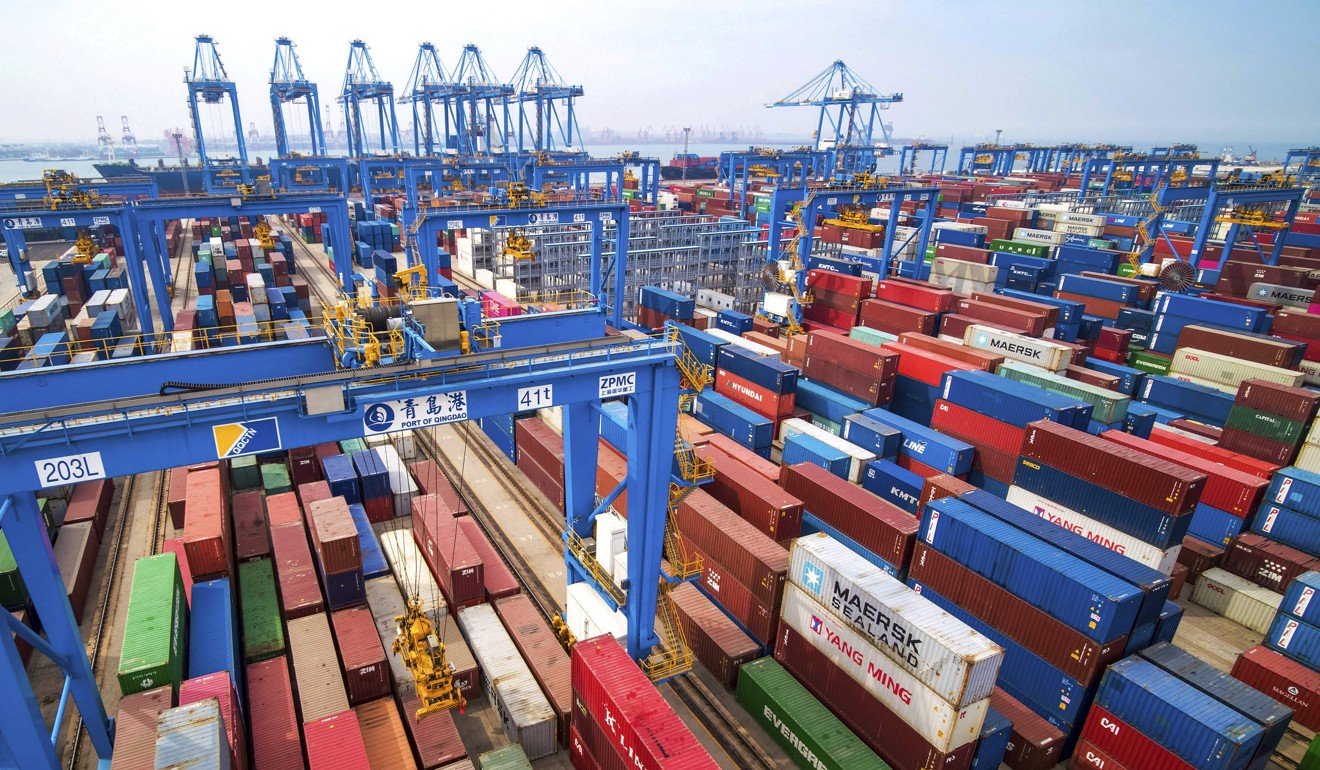
A container port in Qingdao, in China’s Shandong province. Photo: AP

Here Asean’s efforts could make it greater than its parts. The region’s location between the Indian and Pacific Oceans ensures that the great maritime powers of the world will always have a strategic interest in its well-being. But there are analogies with the Mediterranean world that may be relevant. Although on a smaller scale, naval power in that sea determined the fates of all the states involved, deep divisions between the states on its northern and southern coasts have lasted to this day. It is never a question of naval power alone. The states facing the sea have strong hinterlands and neither those of the north nor of the south could dominate the Mediterranean for long. That should remind us that Southeast Asia with its continental and maritime members could also be vulnerable to divisions when confronted by external forces coming from different directions and calling on each of its member states to choose sides.

Should China be worried about the US-Asean sea drill?

Another interesting question is why the South China Sea was never a zone of naval conflict the way the Mediterranean was. It is narrower in parts and wider in others and not well sealed like having Gibraltar at one end and Suez at the other. There are more openings to the ocean, as in the Taiwan Strait, the Sunda and Malacca Straits, as well as the passages leading into the South Pacific. In addition, unlike the Mediterranean where there were always powerful states on both sides of the sea, there was no power that could challenge the Chinese empire in the South China Sea. Had there been one, perhaps that sea would also have been a zone of tense and extended competition from ancient times.

That may be about to change. Today, the newly announced Indo-Pacific front has created a counter-power to face a rising China. At the same time, dynamic economic growth is moving from the Atlantic to this extended maritime space. Together, they have given new life to the Old World. Thus countries like China and India are building more credible navies to match those of Japan and the United States. In that way, the Indo-Pacific could serve as a larger Mediterranean in which the South China Sea acts as its strategic centre. That would make the double-ocean zone one of continuous tension in which powerful protagonists will keep the divisions permanent.

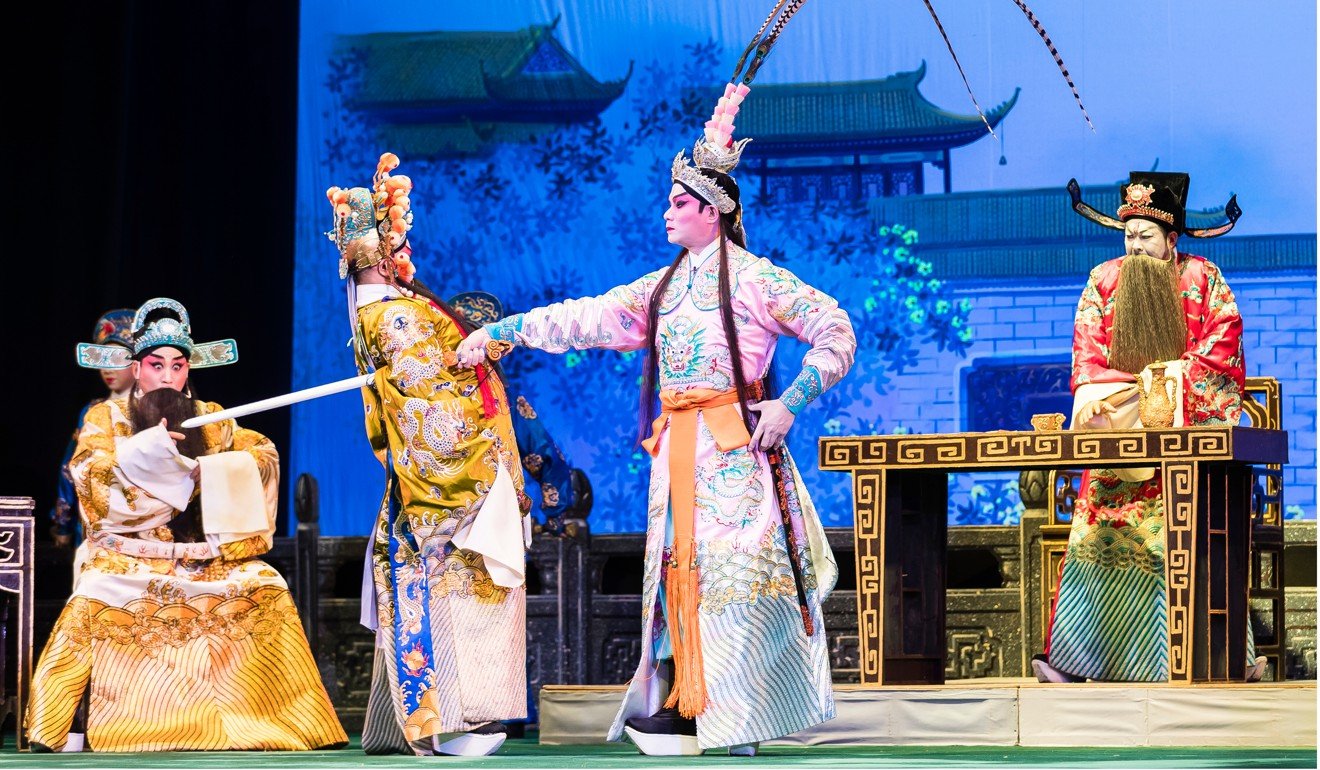
A Cantonese opera show. Can China hold on to its past as it builds a prosperous future? Photo: Handout

If Asean is divided underneath that overarching framework, it would be of little use to anybody. The region’s history renders it open to divisions, especially between the mainland and the archipelagic states that tend to look in different directions for their well-being. However, if these states can overcome their historical baggage, Asean could have a major role to play in the midst of the rapid changes in the relations between the New Global and Old World. If it is united on critical issues, it could provide a bridge that helps to make those relationships peaceful and constructive. That would not only help its members withstand the pressures put on them, but also demonstrate to all major powers that their interests are also best served by a truly united Asean.

Source: SCMP

30/07/2019

China jails award-winning cyber-dissident Huang Qi

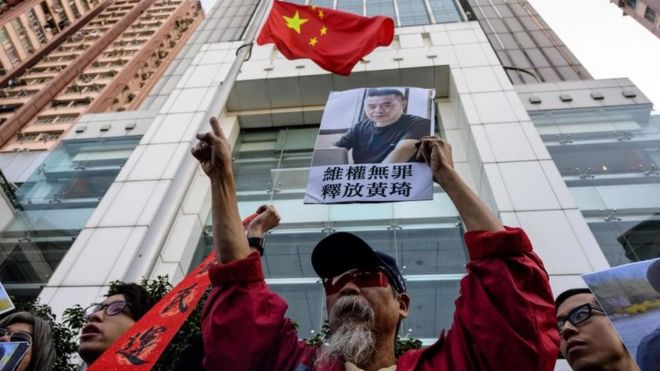
Huang Qi placardImage copyright GETTY IMAGES
Image caption Pro-democracy campaigners in Hong Kong have previously demanded Huang Qi’s release

A Chinese court has sentenced a civil rights activist widely referred to as the country’s “first cyber-dissident” to 12 years in jail.

Huang Qi is the founder of 64 Tianwang, a news website blocked in mainland China that covers alleged human rights abuses and protests.

An official statement said he had been found guilty of intentionally leaking state secrets to foreigners.

Huang has been detained since being arrested nearly three years ago.

He has already served previous prison sentences related to his journalism.

The statement, from Mianyang Intermediate People’s Court, added Mr Huang would be deprived of his political rights for four years and had also been fined 20,000 yuan ($2,900; £2,360).

Huang has kidney and heart disease and high blood pressure. And supporters have voiced concern about the consequences of the 56-year-old remaining imprisoned.

“This decision is equivalent to a death sentence, considering Huang Qi’s health has already deteriorated from a decade spent in harsh confinement,” said Christophe Deloire, the secretary-general of Reporters Without Borders.

The press-freedom campaign group has previously awarded Huang its Cyberfreedom Prize. It has now called on President Xi Jinping to “show mercy” and issue a pardon.

Amnesty International has called the sentence “harsh and unjust”.

“The authorities are using his case to scare other human rights defenders who do similar work exposing abuses, especially those using online platforms,” said the group’s China researcher Patrick Poon.

Repeated arrests

Huang created his website in 1998 to help people search for friends and family who had disappeared. But over time it began covering allegations of corruption, police brutality and other abuses.

In 2003, he became the first person to be put on trial for internet crimes in China, after he allowed articles, written by others, about the brutal crackdown of 1989’s Tiananmen Square pro-democracy protests to be published on the site.

That led to a five-year jail sentence.

He was subsequently sentenced to a further three years in prison, in 2009, after giving advice to the families of children who had died in an earthquake in Sichuan the previous year.

The relatives had wanted to sue the local authorities over claims that school buildings had been shoddily built – a claim the central government denied.

Huang was detained again, in 2014, after 64 Tianwang covered the case of a woman who had tried to set herself on fire in Tiananmen Square to coincide with the start of that year’s National People’s Congress.

Then he was arrested in November 2016 and accused of “inciting subversion of state power”, since when he has been incarcerated.

Since then, several human rights organisations, including Freedom House and the China Human Rights Lawyers Concern Group, have called for his release and raised concerns about reported threats to his 85-year-old mother, who had been campaigning on his behalf.

Pu WenqingImage copyright GETTY IMAGES
Image caption Huang’s mother, Pu Wenqing, had travelled to Beijing to plead her son’s case

And in December 2018, a group of the United Nations’ leading human rights experts also pressed for Huang to be set free and be paid compensation.

According to Reporters Without Borders, China currently holds more than 114 journalists in prison.

Source: The BBC

04/06/2019

Tiananmen Square: What happened in the protests of 1989?

File photo of protestersImage copyright AFP
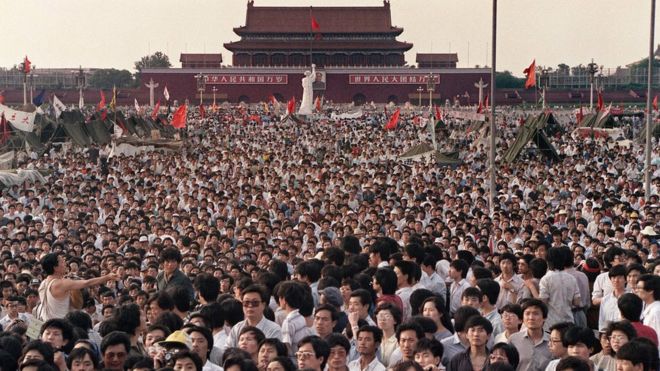
Image caption By early June 1989, huge numbers had gathered in Tiananmen Square

Thirty years ago, Beijing’s Tiananmen Square became the focus for large-scale protests, which were crushed by China’s Communist rulers.

The events produced one of the most iconic photos of the 20th Century – a lone protester standing in front of a line of army tanks.

What led up to the events?

In the 1980s, China was going through huge changes.

The ruling Communist Party began to allow some private companies and foreign investment.

Leader Deng Xiaoping hoped to boost the economy and raise living standards.

However, the move brought with it corruption, while at the same time raising hopes for greater political openness.

Protesters in Tiananmen SquareImage copyright GETTY IMAGES
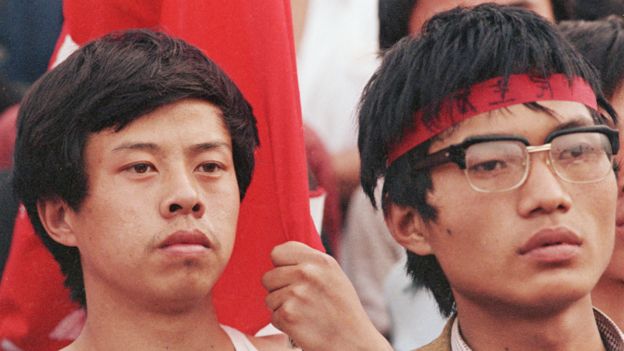
Image caption Protesters in Tiananmen Square, 1989

The Communist Party was divided between those urging more rapid change and hardliners wanting to maintain strict state control.

In the mid-1980s, student-led protests started.

Those taking part included people who had lived abroad and been exposed to new ideas and higher standards of living.

How did the protests grow?

In spring 1989, the protests grew, with demands for greater political freedom.

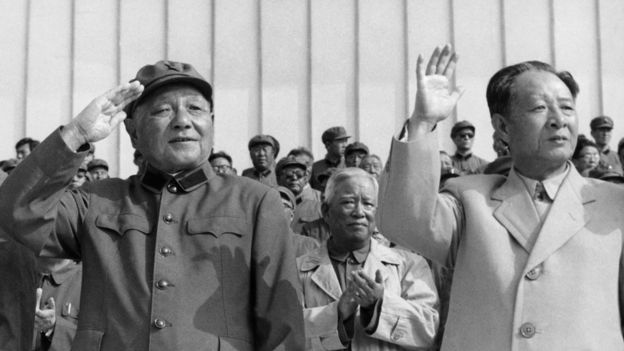
Protesters were spurred on by the death of a leading politician, Hu Yaobang, who had overseen some of the economic and political changes.

Archive picture of Deng and HuImage copyrigh AFP
Image caption Deng Xiaoping (left) with Hu Yaobang

He had been pushed out of a top position in the party by political opponents two years earlier.

Tens of thousands gathered on the day of Hu’s funeral, in April, calling for greater freedom of speech and less censorship.

In the following weeks, protesters gathered in Tiananmen Square, with numbers estimated to be up to one million at their largest.

The square is one of Beijing’s most famous landmarks.

It is near the tomb of Mao Zedong, the founder of modern China, and the Great Hall of the People, used for Communist Party meetings.

What was the government’s response?

At first, the government took no direct action against the protesters.

Party officials disagreed on how to respond, some backing concessions, others wanting to take a harder line.

The hardliners won the debate, and in the last two weeks of May, martial law was declared in Beijing.

On 3 to 4 June, troops began to move towards Tiananmen Square, opening fire, crushing and arresting protesters to regain control of the area.

Who was Tank Man?

On 5 June, a man faced down a line of tanks heading away from the square.

He was carrying two shopping bags and was filmed walking to block the tanks from moving past.

"Tank Man" in BeijingImage copyright GETTY IMAGES

He was pulled away by two men.

It’s not known what happened to him but he’s become the defining image of the protests.

How many people died in the protests?

No-one knows for sure how many people were killed.

At the end of June 1989, the Chinese government said 200 civilians and several dozen security personnel had died.

Other estimates have ranged from hundreds to many thousands.

In 2017, newly released UK documents revealed that a diplomatic cable from then British Ambassador to China, Sir Alan Donald, had said that 10,000 had died.

Do people in China know what happened?

Discussion of the events that took place in Tiananmen Square is highly sensitive in China.

View of Tiananmen SquareImage copyright GETTY IMAGES
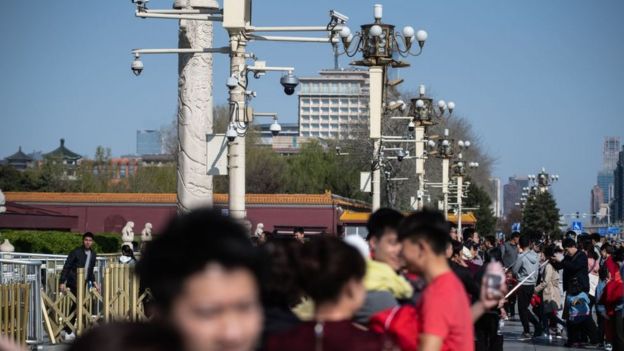
Image caption Tiananmen Square now – full of tourists and surveillance cameras

Posts relating to the massacres are regularly removed from the internet, tightly controlled by the government.

So, for a younger generation who didn’t live through the protests, there is little awareness about what happened.

Source: The BBC

21/05/2019

China’s green efforts hit by fake data and corruption among the grass roots

  • Local officials have devised creative ways to cover up their lack of action on tackling pollution
  • Falsified monitoring information risks directing clean-up efforts away from where they are needed most
China’s efforts to cut pollution are being hampered by local officials who use creative methods to hide their lack of action. Photo: Simon Song
China’s notoriously lax local government officials and polluting companies are finding creative ways to fudge their environmental responsibilities and outsmart Beijing’s pollution inspectors, despite stern warnings and tough penalties.
Recent audit reports covering the past two years released by the environment ministry showed its inspectors were frequently presented with fake data and fabricated documents, as local officials – sometimes working in league with companies – have devised multiple ways to cheat and cover up their lack of action.
Local governments have been under pressure to meet environmental protection targets since Chinese President Xi Jinping made it one of his top three policy pledges in late 2017.
The performance of leading local officials is now partly assessed by how good a job they have done in cleaning up China’s much depleted environment.
According to the reports released this month by the Ministry of Ecology and Environment, pollution inspectors have found evidence in a number of city environmental protection bureaus of made-up meeting notes and even instructions to local companies to forge materials.
Cao Liping, director of the ministry’s ecology and environment law enforcement department, said many of the cases uncovered were the result of officials failing to act in a timely manner.
“In some places, local officials didn’t really do the rectification work. When the inspections began, they realised they didn’t have enough time, so they made up material,” he said.
China ‘still facing uphill struggle in fight against pollution’

While some officials are covering up their inaction, others are actively corrupt. According to Guangzhou’s Southern Weekend, since 2012 there have been 63 cases involving 118 people in the environment protection system involved in corruption.

In the southwest province of Sichuan, 32 current and former employees of Suining city’s environmental protection bureau were found to be corrupt, raking in illicit income of 6.32 million yuan (US$900,000).

Fabricated notes

The party committee of Bozhou district in Zunyi, Guizhou province in southern China, was found to have fabricated notes for 10 meetings – part of the work requirement under the new environmental targets – in a bid to cheat the inspectors.

The case was flagged by the environment ministry in a notice issued on May 10, which said party officials in Bozhou lacked “political consciousness … the nature of this case is very severe”.
Watering down results
Environmental officials in Shizuishan, in the northwest region of Ningxia, tried to improve their results in December 2017 by ordering sanitation workers to spray the building of the local environmental protection bureau with an anti-smog water cannon.
The intention was to lower the amount of pollutant particles registered by the building’s monitoring equipment.
The scheme may have gone undetected if the weather had been warmer but the next day a telltale layer of ice covered the building and the chief and deputy chief of the environmental station in the city’s Dawokou district were later penalised for influencing the monitoring results.
1 million dead, US$38 billion lost: the price of China’s air pollution
Similar tactics were deployed in Linfen, in the northern province of Shanxi in March 2017, when former bureau chief Zhang Wenqing and 11 others were found to have altered air quality monitoring data during days of heavy pollution.
The monitoring machine was blocked and sprayed with water to improve the data and Zhang was also found to have paid another person to make sure the sabotage was not captured by surveillance camera.
According to the environment ministry, six national observation stations in Linfen were interfered with more than 100 times between April 2017 and March 2018. In the same period, monitoring data was seriously distorted on 53 occasions.
Zhang was sentenced to two years in prison in May last year for destroying information on a computer.
Bad company
A ministry notice on May 11 flagged collusion by local officials and businesses in Bozhou in southeast China’s Anhui province. Companies were given advance notice of environmental inspections, with instructions to make up contracts and temporarily suspend production in a bid to deceive inspectors.
In Henan province, central China, inspectors found a thermal power company had been using a wireless mouse to interfere with the sealed automatic monitoring system. They were able to remotely delete undesirable data, eliminating evidence of excessive emissions, and only provided selective data to the environment bureau.
Officials in Shandong reprimanded for failing to cut pollution
In another case, from 2017, an environmental inspection group in Hubei province, central China, found a ceramics company had been working with the data monitoring company to alter automatically collected data on sulphur dioxide emissions.
Criminal offence
Cao said that while the cheating by grass-roots officials was serious, the involvement of companies in falsifying data was a major issue that made the work of inspectors even harder.
“Some fraudulent methods are hidden with the help of high technology, so it’s hard for us to obtain evidence. Besides, the environment officials are not totally familiar with these technologies,” he said.
The environment ministry was working on solutions to the problems, he said, adding that falsifying monitoring data was now a criminal offence.
Fake data was particularly serious, he said, because it could directly influence his department’s decisions about where to deploy resources.

Wang Canfa, an environmental law expert at the China University of Political Science and Law, said the problem of fake data could damage the government’s credibility but also prevent it from taking measures in time.

“If the water pollution or air pollution is severe in one place but the local government has said it’s not a big deal, then the investment needed to control the situation might go to other places,” he said.

Zhou Ke, a professor of environment and resources law at Renmin University, said there was an incentive for local officials to cheat because the inspection results were directly related to their career prospects.

Officials ended up cheating or forging materials to protect local interests or their own political achievements, he said.

Source: SCMP

06/05/2019

Summit demonstrates China’s leapfrog into digital world

CHINA-FUJIAN-HUANG KUNMING-DIGITAL CHINA SUMMIT-SPEECH(CN)

Huang Kunming, a member of the Political Bureau of the Communist Party of China (CPC) Central Committee, also head of the Publicity Department of the CPC Central Committee, speaks at the opening ceremony of the second Digital China Summit in Fuzhou, southeast China’s Fujian Province, May 6, 2019. (Xinhua/Ding Lin)

FUZHOU, May 6 (Xinhua) — China on Monday sounded another heartening note for its development of information technologies, as both companies and the government rush to harness the nationwide tech boom to raise efficiency, buoy public satisfaction and even tackle corruption.

The second Digital China Summit opened Monday in eastern China’s Fujian Province, shedding light on the latest information technologies that have penetrated the country’s government, industries and society.

The Chinese government has expected information technologies to nurture new economic engines and upgrade old industries as the country shunts from the high-speed economic growth to the path of high-quality development.

Huang Kunming, a member of the Political Bureau of the Communist Party of China (CPC) Central Committee, in a keynote speech at the summit called for advancing the building of a digital China and smart society, stressing the role of information technology in promoting high-quality development.

Huang, also head of the Publicity Department of the CPC Central Committee, said China’s advantages in internet technology innovation, technology application and as a huge market should be transformed into advantages in developing a digital economy.

The official called for achieving breakthroughs in core technologies, enhancing protection of intellectual property rights, advancing information infrastructure construction and narrowing digital gaps between urban and rural areas.

A report reviewing the country’s digital development in 2018 was also issued at the summit, pointing to rapid growth in sectors including electronic information manufacturing, software service, communications and big data.

The report published by the Cyberspace Administration of China said the country last year recorded more than 9 trillion yuan (1.3 trillion U.S. dollars) in online retail. China’s digital economy reached 31.3 trillion yuan in scale, accounting for one-third of the national GDP in 2018.

Provincial-level e-government platforms have also slashed time for getting government permits by an average of 30 percent, noted the report.

Trendy technologies from driverless vendor vehicles and facial recognition security checks to 5G networks are being used at the event in the city of Fuzhou. A number of tech companies are displaying their cutting-edge products including Baidu’s driverless vehicles, Huawei’s AI chip “Ascend” and Foxconn’s “future factories.”

Pony Ma, CEO of China’s Internet giant Tencent, said at the summit that the company, by working with Fujian police, has used its facial recognition technology to help 1,000 families find missing family members in the past two years.

Hu Xiaoming, president of Ant Financial that runs the popular online payment network Alipay, said at the event that one of every four Chinese now handles government services on Alipay, making it the country’s largest platform that offers access to government services.

E-GOVERNMENT

One of the major highlights at the summit’s exhibition area are the many e-government apps, which have mushroomed across China to incorporate a wide range of government and public services. They are part of the government’s efforts to cut red tape to benefit residents and businesses alike.

In Fuzhou, the host city of the event, a citizen’s typical day now revolves around the e-Fuzhou app, which allows users to buy bus tickets, pay tuition fees and manage social security accounts without the need of visiting government offices.

A slew of digital technology applications, including the big data credit inquiry system, the online tax bureau, and the paperless customs clearance system, have also been developed in the province over the years.

Dingxi, one of the least developed cities in west China’s Gansu Province, has a booth displaying an online monitoring platform, which it launched last year to allow villagers to scrutinize the management of poverty-relief funds and report any signs of corruption.

“We went door-to-door to teach villagers how to use mobile phones to check the subsidies they are entitled to and the sum other families actually received,” said Yang Sirun, an inspector with the city’s discipline inspection commission.

“In the past, some wealthy families feigned poverty to claim subsistence allowances, while some officials fraudulently pocketed subsidies in the names of families that had moved away. The new platform can easily expose such ‘micro corruption,'” Yang said.

The official said since its launch, over 3,400 officials and residents have voluntarily turned in their illegal gains for fear of being reported. “Many hidden problems were also found during the collation of data from different departments, which proves big data’s power in fighting corruption,” he said.

The summit from May 6 to 8 aims to serve as a platform for issuing China’s policies on IT development and displaying the achievements and experience of e-government and the digital economy.

More than 1,500 officials, company representatives and scholars are attending the event, which is co-organized by the Cyberspace Administration of China, National Development and Reform Commission, Ministry of Industry and Information Technology and Fujian provincial government.

Source: Xinhua
08/03/2019

Xi stresses perseverance in fight against poverty

(TWO SESSIONS)CHINA-BEIJING-XI JINPING-NPC-DELIBERATION (CN)

Chinese President Xi Jinping, also general secretary of the Communist Party of China (CPC) Central Committee and chairman of the Central Military Commission, joins deliberation with deputies from Gansu Province at the second session of the 13th National People’s Congress in Beijing, capital of China, March 7, 2019. (Xinhua/Ju Peng)

BEIJING, March 7 (Xinhua) — Chinese President Xi Jinping on Thursday called for perseverance in the fight against poverty as there are only two years left for the country to meet its goal of eradicating extreme poverty by 2020.

“There should be no retreat until a complete victory is won,” said Xi, also general secretary of the Communist Party of China (CPC) Central Committee and chairman of the Central Military Commission.

He made the remarks when deliberating with deputies from Gansu Province at the second session of the 13th National People’s Congress (NPC), China’s national legislature.

Decisive progress has been achieved in the country’s tough fight against poverty over the past years, marking a new chapter in the poverty reduction history of mankind, said Xi, stressing that the goal to eradicate extreme poverty must be achieved on time.

He warned that the tasks ahead remain arduous and hard as those still in poverty are the worst stricken.

Explaining the criteria of lifting people out of poverty, Xi said they should no longer need to worry about food and clothing while enjoying access to compulsory education, basic medical care and safe housing.

The practices of formalities for formalities’ sake and bureaucratism hamper the effective advancement of poverty reduction, he said, stressing a firm hand in rectifying malpractices in poverty relief.

Xi asked Party committees and governments at all levels to shoulder their responsibilities in the critical battle against poverty.

He ordered efforts to redress undesirable conduct of officials in a timely manner, as well as special campaigns to target corruption and bad conduct in poverty reduction.

Li Keqiang, Li Zhanshu, Wang Yang, Wang Huning, Zhao Leji and Han Zheng — members of the Standing Committee of the Political Bureau of the CPC Central Committee — on Thursday also separately joined deliberation with NPC deputies.

Premier Li Keqiang spoke of the need to replace old growth drivers with new ones and improve people’s wellbeing to advance high-quality development.

NPC Standing Committee Chairman Li Zhanshu called for efforts to adhere to green, high-quality development and link poverty alleviation with rural vitalization strategy.

Wang Yang, chairman of the National Committee of the Chinese People’s Political Consultative Conference, urged high-quality poverty alleviation work to make sure that nobody is left behind in the course of building a moderately prosperous society in all respects.

Wang Huning, a member of the Secretariat of the CPC Central Committee, said he expects Shanghai to continue to lead the reform and opening-up and to elevate the coordinated development of the Yangtze River Delta to a higher level.

Zhao Leji, secretary of the CPC Central Commission for Discipline Inspection, spoke of the need for Tianjin to take advantage of the period of strategic opportunity, enhance the capacity of innovation, and focus on developing real economy.

Vice Premier Han Zheng stressed the full implementation of the national strategy of the coordinated development of the Yangtze River Delta.

Source: Xinhua
18/02/2019

New media facilitates crackdown on corruption in China

BEIJING, Feb. 18 (Xinhua) — The widely used new media has become an efficient tool for China’s anti-graft body to promote information transparency.

Commentary in a newspaper administrated by the Communist Party of China Central Commission for Discipline Inspection and the National Supervisory Commission said Monday netizens can find the latest information released by the top anti-graft watchdog on its website and post suggestions there.

People can report corrupt practices and other violations of disciplines and laws online, such as posting on the micro-blogging site Weibo, sending a message to anti-graft authorities’ accounts on the instant messaging tool WeChat or reporting through an app run by the top anti-graft authority.

Varied reporting channels have helped expose more officials violating disciplines and laws that were hard to be found out by anti-graft authorities in the past, the commentary said.

Improved information transparency has also helped ensure more objective and fair investigations, it added.

Anti-graft authorities can post online information of corrupt officials, including those fleeing overseas, meaning there will be more chances to capture them, said the commentary.

It also said as anti-graft authorities’ articles and video clips are reaching more people online through Weibo, Wechat and their apps, people are now able to learn about the ongoing crackdown on corruption, which also benefits the anti-graft work.

Source: Xinhua
Law of Unintended Consequences

continuously updated blog about China & India

ChiaHou's Book Reviews

continuously updated blog about China & India

What's wrong with the world; and its economy

continuously updated blog about China & India