26/09/2019
Li Zhanshu, chairman of the Standing Committee of the National People’s Congress of China, meets with First President of Kazakhstan Nursultan Nazarbayev in Kazakhstan, Sept. 23, 2019. Li paid an official goodwill visit to Kazakhstan from Sept. 21 to 25 at the invitation of Dariga Nazarbayeva, speaker of the Kazakh Parliament’s Upper House, Nurlan Nigmatulin, speaker of the Kazakh Parliament’s Lower House. (Xinhua/Zhai Jianlan)
NUR-SULTAN, Sept. 25 (Xinhua) — Li Zhanshu, chairman of the Standing Committee of the National People’s Congress (NPC) of China, and Kazakh leaders have agreed here to boost mutually beneficial cooperation in various areas.
During an official goodwill visit from Saturday to Wednesday, Li met with First President of Kazakhstan Nursultan Nazarbayev and conveyed Chinese President Xi Jinping’s cordial greetings to him.
Li told Nazarbayev that China and Kazakhstan are good neighbors and the most reliable friends and partners.
Li said China and Kazakhstan have decided to develop a permanent comprehensive strategic partnership and build a community with a shared future, and their ties have become a model of interstate relations following 27 years of development since the establishment of their diplomatic relationship.
Both sides need to strengthen political mutual trust and mutually beneficial cooperation in various fields, Li said, adding that China has full confidence in the future of Kazakhstan and will continue to support the Central Asian country in pursuing its development path that suits its national conditions.
Nazarbayev told Li that China is a good friend of his country and China’s development is vital to Kazakhstan.
He said strengthening Kazakhstan-China cooperation is in line with the two countries’ interests, and Kazakhstan always prioritizes in its foreign policy cementing and developing ties with China.
At a meeting with Kazakh President Kassym-Jomart Tokayev, Li conveyed Xi’s good wishes to him.
Li said the construction of a Silk Road Economic Belt was first proposed in Kazakhstan, and both countries as permanent comprehensive strategic partners should respect, trust and support each other no matter how the global and regional situations develop.
China and Kazakhstan should improve the alignment of their development strategies and boost cooperation in production capacities, energy, agriculture, inter-connectivity, finance, cross-border e-commerce, high-technology, education, sports, culture and tourism, Li said.
Tokayev said that Kazakhstan, located in the center of the Eurasian continent, will always be a friendly neighbor of China. He praised China’s key role in maintaining global security and stability.
The Belt and Road Initiative is significant to Kazakhstan, which is ready to strengthen cooperation with China, implement bilateral agreements and achieve more outcomes.
At talks with Dariga Nazarbayeva, speaker of the Kazakh parliament’s upper house, and Nurlan Nigmatulin, speaker of the lower house, Li said the two legislatures should implement the important consensuses reached by the heads of state and facilitate bilateral cooperation with legislation and favorable policy.
Li said the two legislatures should push for the signing of an updated version of the China-Kazakhstan investment protection pact, streamline procedures for customs clearance and work permits, and create a sound investment environment.
Nazarbayeva said that strengthening Kazakhstan-China cooperation has particular significance as the world is fraught with risks and challenges, and that she expects better quality in such cooperation.
Nigmatulin said the Kazakh parliament is willing to compare notes on legislation and supervision with the NPC of China.
During his visit, Li and Kazakh Prime Minister Askar Mamin attended the opening ceremony of the China Construction Bank’s Astana office.
Li listened to a report about the Astana International Financial Center and encouraged financial institutions in the center to participate in the Belt and Road Initiative.
The Chinese top legislator also visited the site of the 2017 Astana Expo and the national museum.
Source: Xinhua
Posted in 2017 Astana Expo, agriculture, Askar Mamin, Astana International Financial Center, Astana office, Belt and Road Initiative, Belt and Road Initiative (BRI), Central Asian country, chairman of the Standing Committee of the National People's Congress (NPC), China Construction Bank, China-Kazakhstan investment protection pact, Chinese President Xi Jinping, Culture, Dariga Nazarbayeva, education, energy, Eurasian continent, Finance, financial institutions, First President of Kazakhstan, high technology, Kazakh leader, Kazakh Prime Minister, Kazakhstan, Kazakhstan-China cooperation, Li Zhanshu, national museum, NPC of China, Nurlan Nigmatulin, opening ceremony, speaker of the Kazakh parliament, speaker of the lower house, sports, Tourism, Uncategorized |
Leave a Comment »
26/09/2019
- An increasing proportion of young people no longer willing to wait tables in China as restaurant owners look to new technology for answers
Catering robots developed by Pudu Tech, the three-year-old Shenzhen start-up, have been adopted by thousands of restaurants in China, as well as some foreign countries including Singapore, Korea, and Germany. Photo: Handout
Two years ago, Bao Xiangyi quit school and worked as a waiter in a restaurant for half a year to support himself, and the 19 year-old remembers the time vividly.
“It was crazy working in some Chinese restaurants. My WeChat steps number sometimes hit 20,000 in a day [just by delivering meals in the restaurant],” said Bao.
The WeChat steps fitness tracking function gauges how many steps you literally take and 20,000 steps per day can be compared with a whole day of outdoor activity, ranking you very high in a typical friends circle.
Bao, now a university student in Hangzhou, Zhejiang province, quit the waiter job and went back to school.
“I couldn’t accept that for 365 days a year every day would be the same,” said Bao.
“Those days were filled with complete darkness and I felt like my whole life would be spent as an inferior and insignificant waiter.”
Olivia Niu, a 23-year-old Hong Kong resident, quit her waiter job on the first day. “It was too busy during peak meal times. I was so hungry myself but I needed to pack meals for customers,” said Niu.
Being a waiter has never been a top career choice but it remains a big source of employment in China. Yang Chunyan, a waitress at the Lanlifang Hotel in Wenzhou in southeastern China, has two children and says she chose the job because she needs to make a living.
Catering robots developed by Pudu Tech, the three-year-old Shenzhen start-up. Photo: Handout
Today’s young generation have their sights on other areas though. Of those born after 2000, 24.5 per cent want careers related to literature and art. This is followed by education and the IT industry in second and third place, according to a recent report by Tencent QQ and China Youth Daily.
Help may now be at hand though for restaurants struggling to find qualified table staff who are able to withstand the daily stress of juggling hundreds of orders of food. The answer comes in the form of robots.
Japan’s industrial robots industry becomes latest victim of the trade war
Shenzhen Pudu Technology, a three-year-old Shenzhen start-up, is among the tech companies offering catering robots to thousands of restaurant owners who are scrambling to try to plug a labour shortfall with new tech such as machines, artificial intelligence and online ordering systems. It has deployed robots in China, Singapore, Korea and Germany.
With Pudu’s robot, kitchen staff can put meals on the robot, enter the table number, and the robot will deliver it to the consumer. While an average human waiter can deliver 200 meals per day – the robots can manage 300 to 400 orders.
“Nearly every restaurant owner [in China] says it’s hard to recruit people to [work as a waiter],” Zhang Tao, the founder and CEO of Pudu tech said in an interview this week. “China’s food market is huge and delivering meals is a process with high demand and frequency.”
Pudu’s robots can be used for ten years and cost between 40,000 yuan (US$5,650) and 50,000 yuan. That’s less than the average yearly salary of restaurant and hotel workers in China’s southern Guangdong province, which is roughly 60,000 yuan, according to a report co-authored by the South China Market of Human Resources and other organisations.
As such, it is no surprise that more restaurants want to use catering robots.
According to research firm Verified Market Research, the global robotics services market was valued at US$11.62 billion in 2018 and is projected to reach US$35.67 billion by 2026.
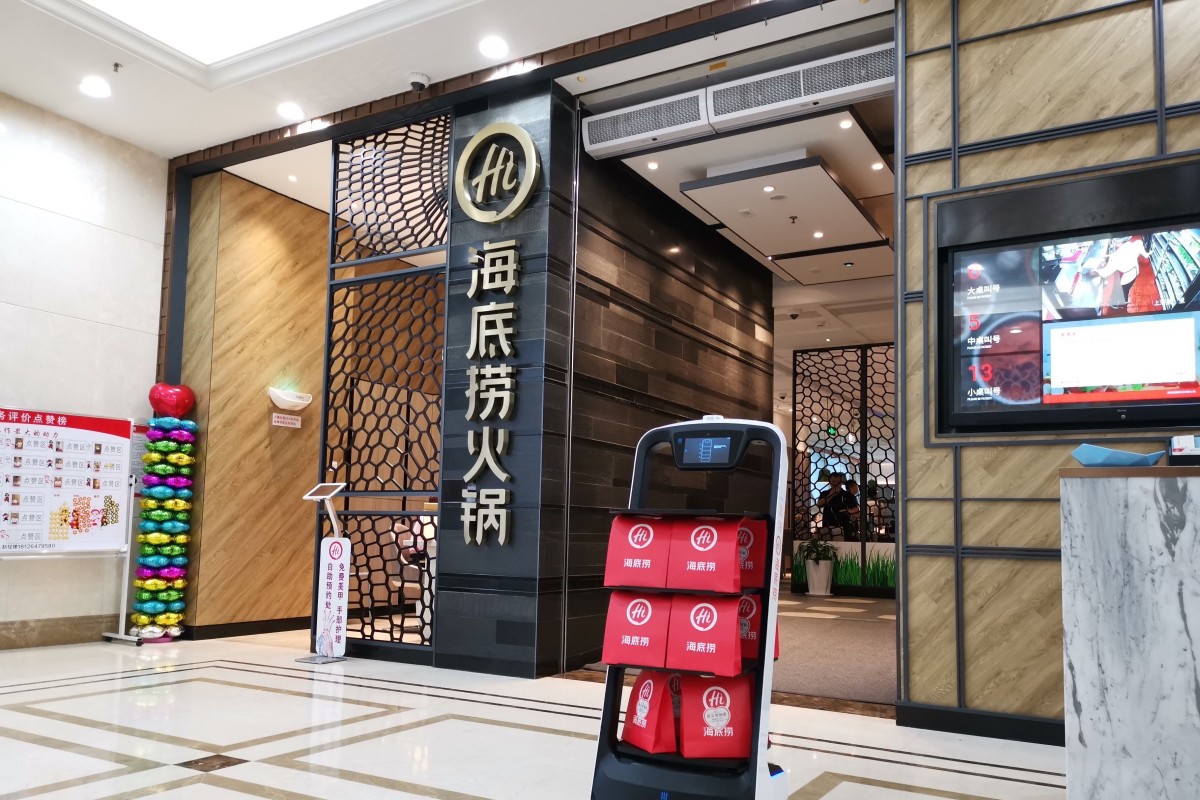
Haidilao, China’s top hotpot restaurant, has not only adopted service robots but also introduced
a smart restaurant with a mechanised kitchen in Beijing last year. And in China’s tech hub of Shenzhen,
it is hard to pay without an app as most of the restaurants have deployed an online order service.
Can robots and virtual fruit help the elderly get well in China?
China’s labour force advantage has also shrank in recent years. The working-age population, people between 16 and 59 years’ old, has reduced by 40 million since 2012 to 897 million, accounting for 64 per cent of China’s roughly 1.4 billion people in 2018, according to the national bureau of statistics.
By comparison, those of working age accounted for 69 per cent of the total population in 2012.
Other Chinese robotic companies are also entering the market. SIASUN Robot & Automation Co, a hi-tech listed enterprise belonging to the Chinese Academy of Sciences, introduced their catering robots to China’s restaurants in 2017. Delivery robots developed by Shanghai-based Keenon Robotics Co., founded in 2010, are serving people in China and overseas markets such as the US, Italy and Spain.
Pudu projects it will turn a profit this year and it is in talks with venture capital firms to raise a new round of funding, which will be announced as early as October, according to Zhang. Last year it raised 50 million yuan in a round led by Shenzhen-based QC capital.
To be sure, the service industry is still the biggest employer in China, with 359 million workers and accounting for 46.3 per cent of a working population of 776 million people in 2018, according to the national bureau of statistics.
And new technology sometimes offers up new problems – in this case, service with a smile.
“When we go out for dinner, what we want is service. It is not as simple as just delivering meals,” said Wong Kam-Fai, a professor in engineering at the Chinese University of Hong Kong and a national expert appointed by the Chinese Association for Artificial Intelligence. “If they [robot makers] can add an emotional side in future, it might work better.”
Technology companies also face some practical issues like unusual restaurant layouts.
“Having a [catering robot] traffic jam on the way to the kitchen is normal. Some passageways are very narrow with many zigzags,” Zhang said. “But this can be improved in future with more standardised layouts.”
Multi-floor restaurants can also be a problem.
Dai Qi, a sales manager at the Lanlifang Hotel, said it is impossible for her restaurant to adopt the robot. “Our kitchen is on the third floor, and we have boxes on the second, third, and fourth floor. So the robots can’t work [to deliver meals tdownstairs/upstairs],” Dai said.
But Bao says he has no plans to return to being a waiter, so the robots may have the edge.
“Why are human beings doing something robots can do? Let’s do something they [robots] can’t,” Bao said.
Source: SCMP
Posted in ability, answers, Artificial intelligence, artificial intelligence (AI), Beijing, careers, catering robot, China alert, China Youth Daily, Chinese Academy of Sciences, Chinese University of Hong Kong, complain, Consumer, education, foreign countries, founder and CEO, Germany, global robotics services market, guangdong province, Hangzhou, hard to recruit, Hong Kong resident, hundreds of orders, increasing proportion, industrial robots industry, IT industry, Japan, juggle, Korea, labour shortfall, Lanlifang Hotel, latest victim, literature and art, machines, Multi-floor restaurants, national bureau of statistics, National Bureau of Statistics (NBS), new technologies, new technology, online ordering systems, plug, problem, Pudu Tech, restaurant owners, Shanghai, Shenzhen, Shenzhen Pudu Technology, Singapore, smart restaurant, start up, table number, Tech Companies, tencent qq, top hotpot restaurant, trade war, traffic jams, Uncategorized, venture capital firms, Verified Market Research, wait tables, WeChat, Wenzhou, willing, young people, Zhang Tao, zhejiang province, zigzags |
Leave a Comment »
22/09/2019
HEFEI, Sept. 21 (Xinhua) — Chinese top telecom operators have shown their latest achievements in 5G applications at the World Manufacturing Convention 2019 in Hefei, capital of eastern China’s Anhui Province, according to the organizer.
The operators, including China Unicom and China Mobile, showcased 5G applications in education, health and other fields.
“China Unicom has focused on 5G applications in finance. We will also provide 5G communication services for the 2022 Beijing Olympic Winter Games,” said Tao Xian, industry director of China Unicom Anhui branch.
The World Manufacturing Convention 2019 opened Friday in Hefei, setting a platform for industry insiders to showcase cutting-edge technologies and develop business contacts.
The four-day event brings together more than 4,000 representatives from over 60 countries and regions, including senior managers from Global Fortune 500 companies, said the organizing committee.
Source: Xinhua
Posted in 5G applications, Anhui province, Beijing Olympic Winter Game, China Mobile, China Unicom, cutting-edge technologies, education, Finance, Global Fortune 500 companies, health, Hefei, telecom operators, Uncategorized, World Manufacturing Convention |
Leave a Comment »
21/09/2019
BAKU, Sept. 21 (Xinhua) — China and Azerbaijan enjoy promising prospects in co-building the Belt and Road, Chinese Ambassador to Azerbaijan Guo Min said in a recent exclusive interview with Xinhua.
With a sound and steady development of bilateral relations, Guo praised the advantages of the China-proposed Belt and Road Initiative (BRI) for both sides, emphasizing Azerbaijan’s full support for and involvement in the construction of the Belt and Road.
She said Azerbaijan sees the development of relationship with China as a diplomatic priority. “China and Azerbaijan have exchanged frequent high-level visits since the beginning of this year, with mutual political trust deepening even further.”
Azerbaijani President Ilham Aliyev attended the second Belt and Road Forum for International Cooperation held in Beijing in April, said Guo, adding “the leaders of the two countries reached important consensus to further develop bilateral relations and practical cooperation in various fields.”
“Cooperation in trade, energy, transportation, humanities and other fields has yielded fruits,” she said, noting bilateral trade reached 1.5 billion U.S. dollars from January to August, an increase of 104 percent from the same period last year.
“In recent years, the two nations have been promoting cooperation in a number of areas, including education, culture, health, sports and tourism on a continuous basis,” said the ambassador.
The two countries “have exchanged the visits of culture and art figures and held a wide range of film festivals, art exhibitions and other activities to actively promote unity, mutual understanding and friendly exchanges between the people,” according to Guo.
“At the next stage, the two nations should capitalize on the existing potential and focus on more points of interest,” the ambassador said.
She described the deep traditional friendship, high-level mutual political trust and the highly complementary practical cooperation as key foundations and effective guarantees for the stability and improvement of bilateral relations.
“China is willing to work together with Azerbaijan to push Sino-Azerbaijani friendship and cooperation to a new level and benefit the two countries and their peoples,” the ambassador added.
Source: Xinhua
Posted in art exhibitions, Azerbaijan, Azerbaijani President, Belt and Road Forum for International Cooperation (BRF), Belt and Road Initiative (BRI), bilateral trade, China alert, Chinese ambassador, Chinese Ambassador to Azerbaijan, co-building, cooperation, Culture, education, energy, enjoy, film festivals, fruits, health, humanities, Ilham Aliyev, promising prospects, Sino-Azerbaijani friendship and cooperation, sports, Tourism, Trade, transportation, Uncategorized, Xinhua, Xinhua News Agency |
Leave a Comment »
15/09/2019
- An increasing proportion of young people no longer willing to wait tables in China as restaurant owners look to new technology for answers
Catering robots developed by Pudu Tech, the three-year-old Shenzhen start-up, have been adopted by thousands of restaurants in China, as well as some foreign countries including Singapore, Korea, and Germany. Photo: Handout
Two years ago, Bao Xiangyi quit school and worked as a waiter in a restaurant for half a year to support himself, and the 19 year-old remembers the time vividly.
“It was crazy working in some Chinese restaurants. My WeChat steps number sometimes hit 20,000 in a day [just by delivering meals in the restaurant],” said Bao.
The WeChat steps fitness tracking function gauges how many steps you literally take and 20,000 steps per day can be compared with a whole day of outdoor activity, ranking you very high in a typical friends circle.
Bao, now a university student in Hangzhou, Zhejiang province, quit the waiter job and went back to school.
“I couldn’t accept that for 365 days a year every day would be the same,” said Bao. “Those days were filled with complete darkness and I felt like my whole life would be spent as an inferior and insignificant waiter.”
Olivia Niu, a 23-year-old Hong Kong resident, quit her waiter job on the first day. “It was too busy during peak meal times. I was so hungry myself but I needed to pack meals for customers,” said Niu.
Being a waiter has never been a top career choice but it remains a big source of employment in China. Yang Chunyan, a waitress at the Lanlifang Hotel in Wenzhou in southeastern China, has two children and says she chose the job because she needs to make a living.
Catering robots developed by Pudu Tech, the three-year-old Shenzhen start-up. Photo: Handout
Today’s young generation have their sights on other areas though. Of those born after 2000, 24.5 per cent want careers related to literature and art. This is followed by education and the IT industry in second and third place, according to a recent report by Tencent QQ and China Youth Daily.
Help may now be at hand though for restaurants struggling to find qualified table staff who are able to withstand the daily stress of juggling hundreds of orders of food. The answer comes in the form of robots.
Japan’s industrial robots industry becomes latest victim of the trade war
Shenzhen Pudu Technology, a three-year-old Shenzhen start-up, is among the tech companies offering catering robots to thousands of restaurant owners who are scrambling to try to plug a labour shortfall with new tech such as machines, artificial intelligence and online ordering systems. It has deployed robots in China, Singapore, Korea and Germany.
With Pudu’s robot, kitchen staff can put meals on the robot, enter the table number, and the robot will deliver it to the consumer. While an average human waiter can deliver 200 meals per day – the robots can manage 300 to 400 orders.
“Nearly every restaurant owner [in China] says it’s hard to recruit people to [work as a waiter],” Zhang Tao, the founder and CEO of Pudu tech said in an interview this week. “China’s food market is huge and delivering meals is a process with high demand and frequency.”
Pudu’s robots can be used for ten years and cost between 40,000 yuan (US$5,650) and 50,000 yuan. That’s less than the average yearly salary of restaurant and hotel workers in China’s southern Guangdong province, which is roughly 60,000 yuan, according to a report co-authored by the South China Market of Human Resources and other organisations.
As such, it is no surprise that more restaurants want to use catering robots.
According to research firm Verified Market Research, the global robotics services market was valued at US$11.62 billion in 2018 and is projected to reach US$35.67 billion by 2026. Haidilao, China’s top hotpot restaurant, has not only adopted service robots but also introduced a smart restaurant with a mechanised kitchen in Beijing last year. And in China’s tech hub of Shenzhen, it is hard to pay without an app as most of the restaurants have deployed an online order service.
Can robots and virtual fruit help the elderly get well in China?
China’s labour force advantage has also shrank in recent years. The working-age population, people between 16 and 59 years’ old, has reduced by 40 million since 2012 to 897 million, accounting for 64 per cent of China’s roughly 1.4 billion people in 2018, according to the national bureau of statistics.
By comparison, those of working age accounted for 69 per cent of the total population in 2012.
Other Chinese robotic companies are also entering the market. SIASUN Robot & Automation Co, a hi-tech listed enterprise belonging to the Chinese Academy of Sciences, introduced their catering robots to China’s restaurants in 2017. Delivery robots developed by Shanghai-based Keenon Robotics Co., founded in 2010, are serving people in China and overseas markets such as the US, Italy and Spain.
Pudu projects it will turn a profit this year and it is in talks with venture capital firms to raise a new round of funding, which will be announced as early as October, according to Zhang. Last year it raised 50 million yuan in a round led by Shenzhen-based QC capital.
To be sure, the service industry is still the biggest employer in China, with 359 million workers and accounting for 46.3 per cent of a working population of 776 million people in 2018, according to the national bureau of statistics.
And new technology sometimes offers up new problems – in this case, service with a smile.
“When we go out for dinner, what we want is service. It is not as simple as just delivering meals,” said Wong Kam-Fai, a professor in engineering at the Chinese University of Hong Kong and a national expert appointed by the Chinese Association for Artificial Intelligence. “If they [robot makers] can add an emotional side in future, it might work better.”
Technology companies also face some practical issues like unusual restaurant layouts.
“Having a [catering robot] traffic jam on the way to the kitchen is normal. Some passageways are very narrow with many zigzags,” Zhang said. “But this can be improved in future with more standardised layouts.”
Multi-floor restaurants can also be a problem.
Dai Qi, a sales manager at the Lanlifang Hotel, said it is impossible for her restaurant to adopt the robot. “Our kitchen is on the third floor, and we have boxes on the second, third, and fourth floor. So the robots can’t work [to deliver meals to downstairs/upstairs],” Dai said.
But Bao says he has no plans to return to being a waiter, so the robots may have the edge.
“Why are human beings doing something robots can do? Let’s do something they [robots] can’t,” Bao said.
Source: SCMP
Posted in ability, adopted, Art, artificial intelligence (AI), Bao Xiangyi, Beijing, careers, catering robots, CEO of Pudu tech, China alert, China Youth Daily, Chinese Academy of Sciences, Chinese Association for Artificial Intelligence, Chinese University of Hong Kong, complain, darkness, delivering meals, education, foreign countries, Germany, guangdong province, Haidilao, Hangzhou, hotpot restaurant, hundreds of orders, industrial robots industry, IT industry, Italy, Japan, juggle, Keenon Robotics Co, Korea, labour shortfall, Lanlifang Hotel, literature, machines, mechanised kitchen, online ordering systems, plug, Pudu Tech, QC capital, qualified table staff, quit, Restaurant, restaurants, robots, school, Shenzhen, Shenzhen Pudu Technology, SIASUN Robot & Automation Co, Singapore, smart restaurant, South China Market of Human Resources, Spain, start up, tencent qq, trade war, Uncategorized, university student, US, Verified Market Research, victim, waiter, WeChat, Wenzhou, worked, zhejiang province |
Leave a Comment »
10/09/2019
- Expensive presents are officially discouraged but have become the norm at many schools on day of appreciation for educators
Students at Yangzhou Technical Vocational College form the Chinese characters for “Hello Teacher” to mark China’s Teachers’ Day. Photo: Handout
Despite a decade of official discouragement, parents in China have been struggling with one of the biggest dilemmas of the school year – how to mark the country’s annual Teacher’s Day.
Ellen Yuan agonised for a day and a night before sending her son off to kindergarten on Tuesday with a 1,000 yuan (US$140) gift card in his bag for the teacher.
It was the boy’s second week of attendance and Yuan had given no thought to any Teacher’s Day obligations –until she learned that several of her friends had been busy over the weekend preparing gifts for their children’s teachers.
“It makes me feel that I am being a drag on my son if I don’t do so,” said Yuan, who works for a foreign company in Shanghai.
Respecting teachers has traditionally been a fundamental social norm in China but gift giving on the special day for educators has gone beyond an expression of appreciation by their students, as parents have taken over with ever more expensive gifts – and sometimes cash – which they hope will mean their kids are well taken care of while at school.
What gift, how expensive it should be, and how to deliver it have become the biggest questions for many parents in the run-up to September 10 each year, even though the education ministry and its subordinate bodies have repeatedly issued directives over the past decade to ban teachers accepting gifts.
Yuan said one of her friends had bought a body care set worth more than 600 yuan for each of her child’s three teachers, another had bought an 800 yuan gift card, while a third had given the head teacher a 1,000 yuan bottle of perfume.
Some parents had delivered the presents directly to the school, while others had asked their children to take the gifts to their teachers. Yuan’s plan was to message the teacher and tell her to take the gift card from her son’s bag.
“I know it’s bad. I don’t want my kid to know that,” Yuan said.
Hundreds of teachers protest in China over poor pay
The question of whether parents should give gifts on Teacher’s Day was one of the hottest topics on Weibo, China’s Twitter-like social media platform, attracting more than 15 million views as of Tuesday afternoon.
“Of course we should not, but I don’t dare to ignore it,” one user said, winning more than 10,000 likes.
Chu Zhaohui, a researcher at the National Institute of Education Sciences, said the gift-giving trend had been partly driven by a “keeping up with the Joneses” mentality.
“Everybody has given a gift. Would my child be specially treated if I don’t? This is a common concern,” Chu said. As a result, the purpose of gift giving on Teacher’s Day had become about protecting the children’s interests instead of a sincere expression of gratitude, he said.
But not every teacher gets presents – with gifts usually reserved for those teaching the “main subjects” of mathematics, Chinese and English, which count the most in high school and college entrance examinations.
Emily Shen, an English teacher from a middle school in Hangzhou, in the eastern province of Zhejiang, said she also prepared gifts for the teachers of her two kids. “Some chocolate for them to take to school. And I myself would give a gift card to each of those who teach the main subjects,” she said.
Zhuang Ke, a music teacher at a primary school in Jiaxing, also in Zhejiang province, admitted she was embarrassed by the parents’ different treatment of teachers of “less important” subjects like her’s. “It’s always nice to receive presents. But teachers who teach music, art and PE are often forgotten,” she said.
Chinese kindergarten teacher fired for hot sun punishment
State broadcaster CCTV said in a commentary on its website on Sunday that “all forms of behavior that attempt to ruin normal teaching order and interfere in equality by sending gifts should be resolutely abandoned”. A similar message was run by a series of official media outlets at local level.
“The most fundamental way to stop parents from sending gifts is to treat the students equally and fairly every day, so that parents conclude it makes no difference whether they give a gift,” Rednet.cn, the official news portal of Hunan province, said on Monday.
Although some teachers have made it explicit to students that they will refuse presents on Teacher’s Day, Yuan said her son’s teacher accepted the gift, as did the teachers of her three friends’ children.
Source: SCMP
Posted in Art, bag, body care set, bottle of perfume, Chinese, chinese parents, Chocolate, college entrance examination, commentary, day of appreciation, discouraged, educators, English, Expensive presents, fired, foreign company, forgotten, fundamental way, gift card, gift etiquette, Hangzhou, High school, hot sun punishment, Hunan Province, Jiaxing, keeping up with the Joneses, kindergarten, mathematics, mentality, middle school, music, music teacher, National Institute of Education Sciences, norm, official news portal, officially, PE, poor pay, primary school, Protest, Rednet.cn, schools, Shanghai, sincere expression of gratitude, state broadcaster CCTV, struggle, teacher, Teacher’s Day, Uncategorized, website, Weibo, Yangzhou Technical Vocational College, zhejiang province |
Leave a Comment »
05/09/2019
- Doctor who helped 13-year-old girl recover says demands on her to do well at school induced condition
- Weibo poll reveals that 68 per cent of participants had hair loss in school
Studies and polls suggest stress leading to hair loss is a big health concern in China. Photo: Alamy
When the 13-year-old girl walked into the hospital in southern China around eight months ago, she was almost completely bald, and her eyebrows and eyelashes had gone.
“The patient came with a hat on and did not look very confident,” Shi Ge, a dermatologist at the Sixth Affiliated Hospital of Sun Yat-sen University in Guangzhou, told the Pear Video news portal.
The girl had done well in primary school but her grades dropped in middle school, Shi said.
Under parental pressure to do well, the girl pushed herself harder, but the stress resulted in severe hair loss.
With time and medical treatment, the teen’s hair grew back but her story left a lasting impression, raising awareness of the increasing number of young people in China seeking treatment for stress-induced hair loss, according to Chinese media reports.
Jia Lijun, a doctor at Shenzhen Traditional Chinese Medicine Hospital, told state-run Xinhua News Agency in May that aside from genetics, factors such as stress in work, study and life would result in endocrine imbalances which affected the cycle of hair growth.
And in January, a survey of 1,900 people by China Youth Daily found that 64.1 per cent of people aged between 18 and 35 said they had hair loss resulting from long and irregular working hours, insomnia, and mental stress.
Hits and myths: stress and hair loss
Shi said that an increasing number of young people had come to her for treatment of hair loss in recent years, and those working in information technology and white-collar jobs were the two biggest groups.
“They usually could not sleep well at night due to high pressure or had an irregular diet because of frequent business trips,” Shi said.
A Weibo poll on Wednesday revealed that 68 per cent out of 47,000 respondents said they had had serious hair loss when they were in school. About 22 per cent said they noticed after starting their careers, while only 5 per cent said it happened after they entered middle age.
More than half of the Chinese students who took part in a China Youth Daily survey said they had hair loss. Photo Shutterstock
Research published in 2017 by AliHealth, the health and medical unit of the Alibaba Group, found that 36.1 per cent of Chinese people born in the 1990s had hair loss, compared to the 38.5 per cent born in the 1980s. Alibaba is the parent company of the South China Morning Post.
The teenager’s experience sparked a heated discussion on Weibo, with users recounting similar cases and some voicing their panic.
“My niece’s hair was gone while she was in high school and has not recovered, even after she graduated from university. This makes her feel more and more inferior,” one user said.
Hong Kong’s schoolchildren are stressed out – and their parents are making matters worse
Another said: “I lost a small portion of my hair during the high school entrance exam, but that is already scary enough for a girl in her adolescence.”
“I had to quit my job and seek treatment,” said a third, who adding that he also suffered from very serious hair loss a few months ago because of high pressure.
Source: SCMP
Posted in adolescence, Alibaba Group, Alibaba Group Holding, AliHealth, at school, business trips, careers, chasing grades, China Youth Daily, Chinese people, Chinese teenager, condition, debate, demands, dermatologist, do well, doctor, entrance exam, frequent, Guangzhou, hair loss, health and medical unit, her hair, high pressure, High school, induced, inferior, Information technology, irregular diet, job, lost, middle age, middle school, myths, pressure, primary school, quit, recover, school, Shenzhen Traditional Chinese Medicine Hospital, Sixth Affiliated Hospital, south china morning post, sparks, stress, Sun Yat-Sen University, treatment, Uncategorized, university, Weibo, white-collar jobs, Xinhua News Agency, young people |
Leave a Comment »
04/09/2019
- Two classrooms on Nanjing campus were chosen for pilot project
- Camera automatically captures students’ faces without their cooperation
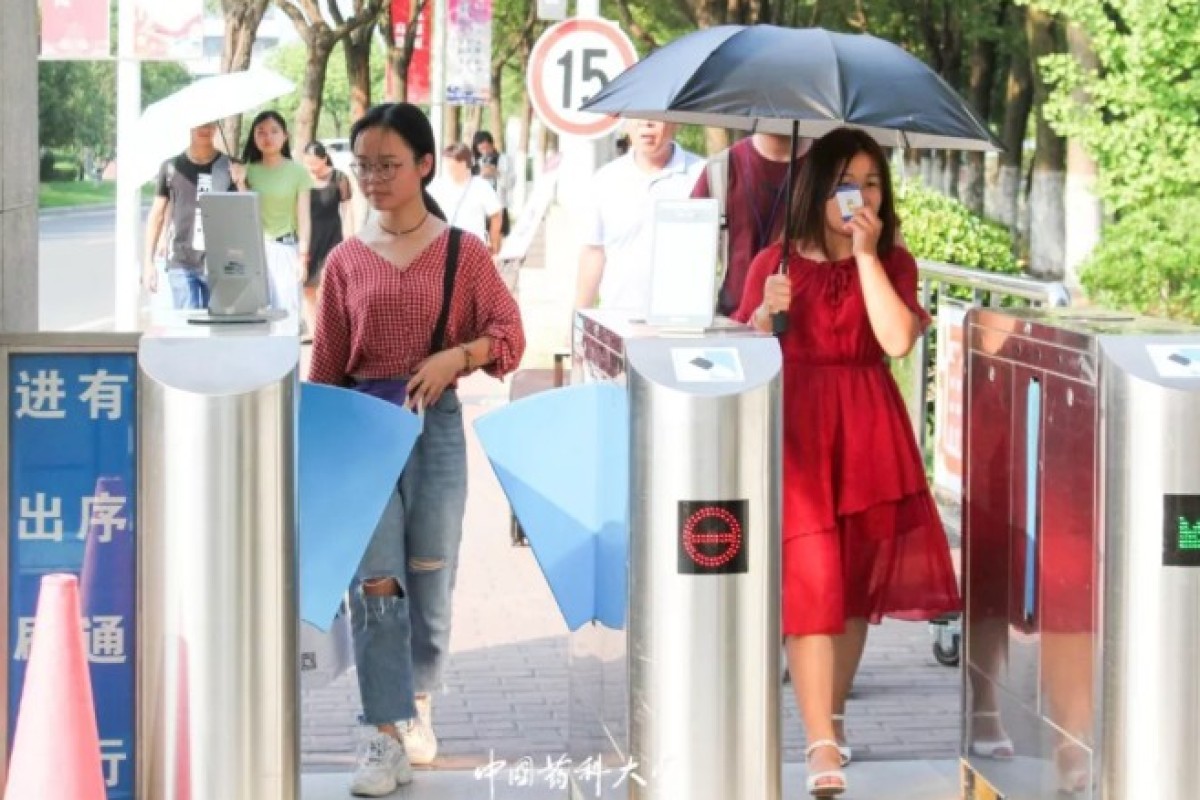
Students pass through a facial recognition turnstile at China Pharmaceutical University in Nanjing. Photo: Weibo
A university in eastern China has installed a facial recognition system at its entrance and in two classrooms to monitor the attendance and behaviour of students.
China Pharmaceutical University in Nanjing, Jiangsu province, announced on its website on Thursday that it was one of the first higher education institutions in the country to put such a system in place.
“It can effectively solve the management difficulties and low efficiencies in a traditional attendance system, and make it easier for managers to track their students,” Xu Jianzhen, director of the university’s library and information centre, told news website Thepaper.cn
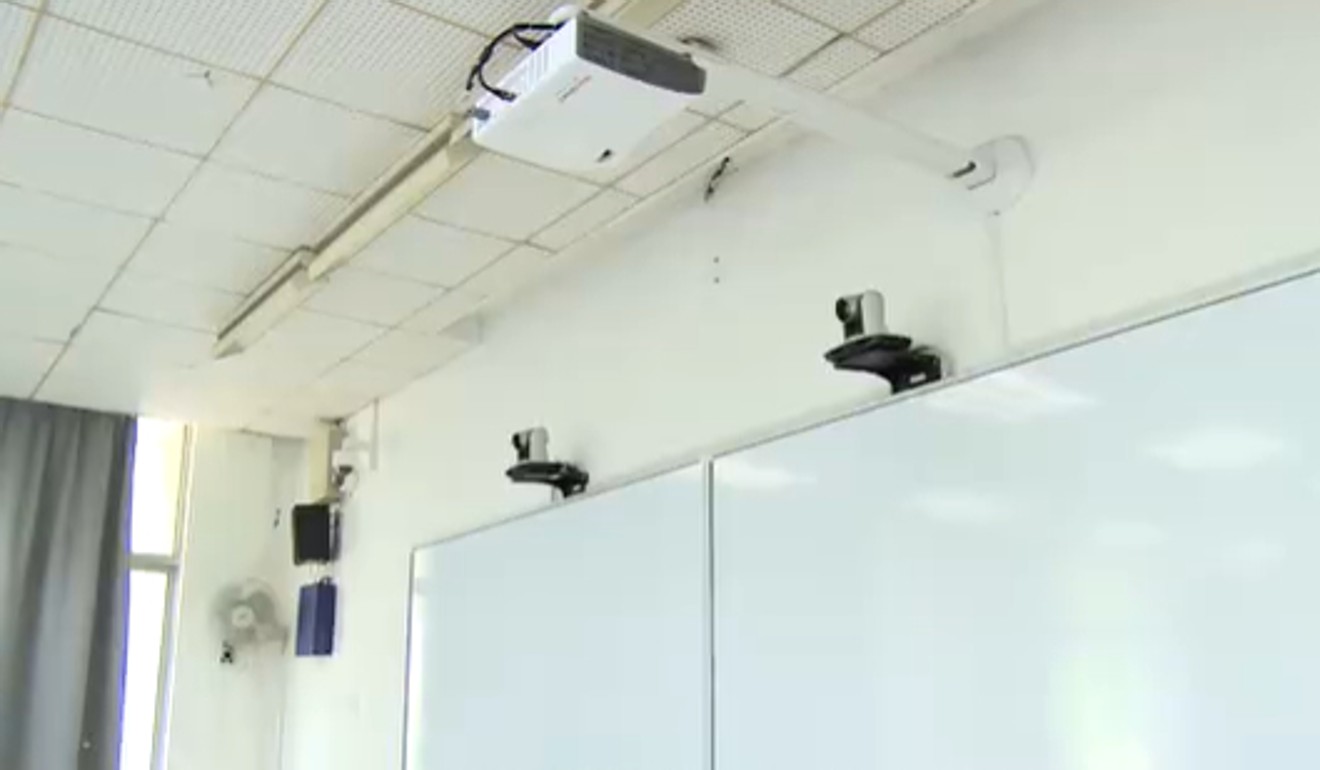
In a pilot project, two classrooms were equipped with an attendance system using facial recognition software, with a camera that automatically captured the faces of students in class without their cooperation, the university said.
“Besides attendance, the system installed in the classroom can provide surveillance of the students’ learning, such as whether they are listening to the lectures, how many times they raise their heads, and whether they are playing on their phones or falling asleep,” Xu told the news website.
“The school is taking action to cut down on students skipping class, leaving classes early, paying for a substitute to attend classes for them and not listening in class,” he said.
The plan was not well received online, with some critics raising privacy concerns for staff and students.
Why are Hong Kong protesters targeting lamp posts?
“What kind of talent are they trying to cultivate?” a user of the Twitter-style Weibo network asked. “I’ve never seen such a method.”
Another wrote: “If this system was being installed in Europe or America, they’d be sued and the school would have to close down.”
But Xu said the university had consulted the police and sought legal advice, and was told the system would not be considered an invasion of privacy as classrooms were public spaces.
“You are complaining about [a system] that’s meant to urge you to learn? Are you a student?” he told the news website.
A spokesman said China Pharmaceutical University was using a facial recognition system to improve class attendance. Photo: Weibo
The university would seek feedback from teaching staff before deciding whether to install facial recognition systems in all of its classrooms, according to the report.
In May last year, a school in Hangzhou, Zhejiang province, installed cameras to monitor pupils’ facial expressions and attentiveness in class as part of a “smart classroom behaviour management system” to give teachers real-time information on their students.
Elsewhere, facial recognition has been used to catch unlicensed drivers in the southern technology hub of Shenzhen, jaywalkers in Shanghai, and criminal suspects at public events across China.
Source: SCMP
Posted in America, attendance, attentiveness, automatically captures, Camera, China alert, China Pharmaceutical University, Chinese university, consulted, cooperation, criminal suspects, Europe, facial expressions, Facial recognition system, Hangzhou, invasion of privacy, jaywalkers, jiangsu province, legal advice, library and information centre, Nanjing, pilot project, Police, public events, Shanghai, Shenzhen, students’ faces, sued, Thepaper.cn, Uncategorized, university, unlicensed drivers, website, Weibo, without, zhejiang province |
Leave a Comment »
22/07/2019
Chinese State Councilor and Foreign Minister Wang Yi (R) meets with Minister of Foreign Affairs and International Cooperation of the United Arab Emirates (UAE) Sheikh Abdullah bin Zayed Al Nahyan in Beijing, capital of China, July 21, 2019. (Xinhua/Yan Yan)
BEIJING, July 21 (Xinhua) — Chinese State Councilor and Foreign Minister Wang Yi met with Sheikh Abdullah Bin Zayed Al Nahyan, minister of Foreign Affairs and International Cooperation of the United Arab Emirates (UAE), here Sunday.
Hailing the UAE as China’s important and reliable partner in the Middle East, Wang said China stands ready to work with the UAE to implement the consensus reached by the two countries’ leaders, deepen their partnership under the Belt and Road Initiative, promote cooperation in various fields, enhance people-to-people exchanges, strengthen cooperation on anti-terrorism and law enforcement, and bring the China-UAE comprehensive strategic partnership to higher levels.
Sheikh Abdullah said the UAE is willing to strengthen cooperation with China in trade, investment, energy, culture, education and third-market cooperation, and to work for closer coordination within the United Nations and in regional affairs.
Source: Xinhua
Posted in Belt and Road Initiative (BRI), China-UAE comprehensive strategic partnership, Chinese State Councilor, Chinese State Councilor and Foreign Minister Wang Yi, Culture, education, energy, Investment, Middle East, minister of Foreign Affairs and International Cooperation, Sheikh Abdullah Bin Zayed Al Nahyan, third-market cooperation, Trade, UAE Foreign Minister, Uncategorized, United Arab Emirates (UAE), United Nations |
Leave a Comment »
22/07/2019
- Some 150,000 residents of Baishizhou have to leave by the end of September to make way for malls, hotels and high-end residential projects
- They worry about finding affordable housing in the city, and their children’s education
Urban villages like Baishizhou provide affordable housing, mostly for migrant workers. Photo: Phoebe Zhang
As their eviction deadline nears, all Chen Jian can think about is the wrecking ball – and where his family is going to go. He often dreams about the negotiations – with officials, real estate developers, landlords. On other nights, he cannot sleep at all.
“I’m mostly worried about my daughter – she starts secondary school in September,” said Chen, 41, who works as a quality supervisor for a foreign trading company.
His family of four lives in a cheap one-bedroom flat in Baishizhou, one of the last standing chengzhongcun, or “urban villages”, in the flourishing commercial zones of southern Chinese city Shenzhen.
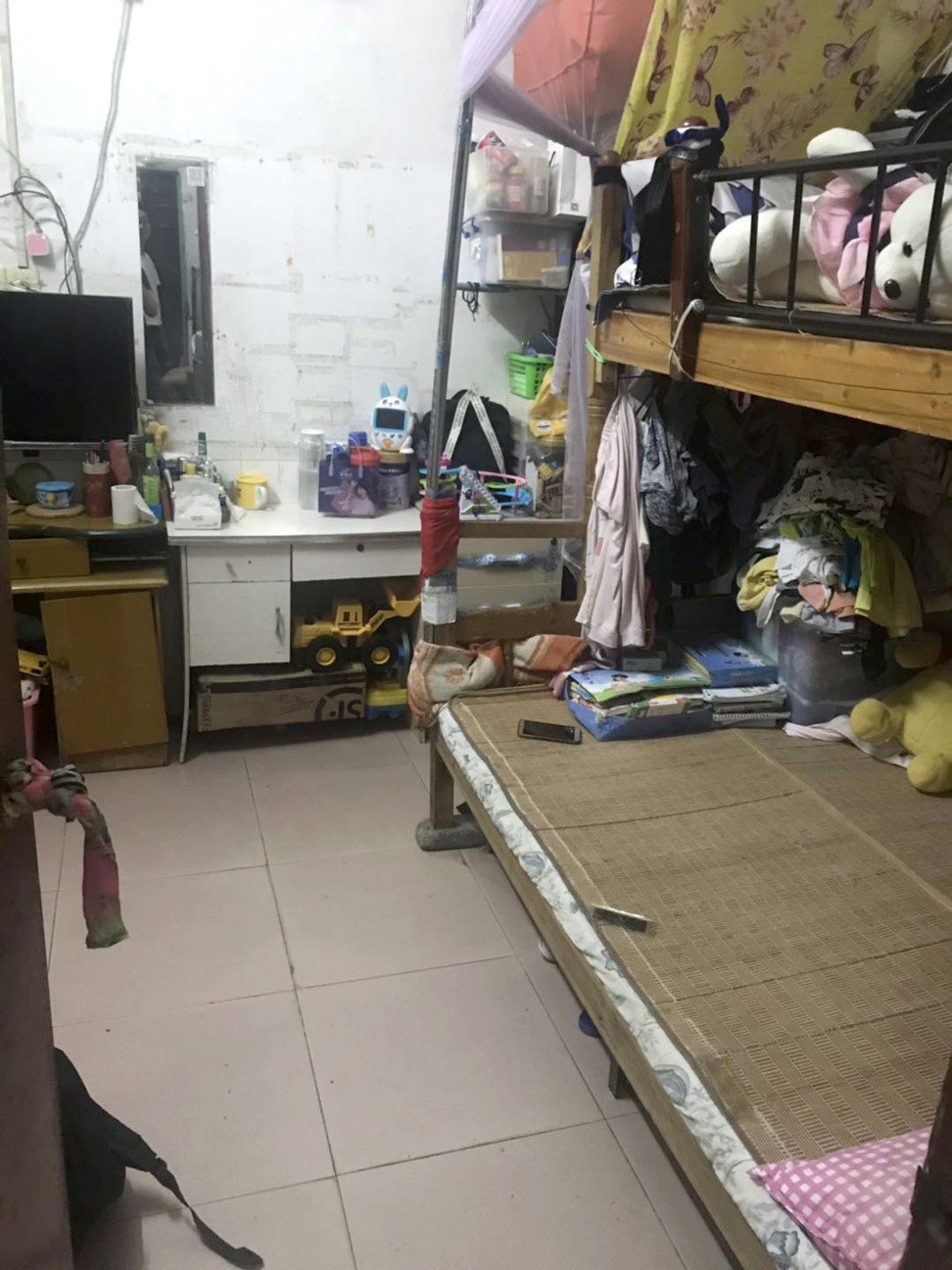
The villages provide affordable housing – costing from a few hundred to a few thousand yuan per month – to a mostly migrant worker population that provides services and labour.
But Baishizhou, in the Nanshan district, will not be standing for much longer. Many tenants in the area have received eviction notices since June, telling them to move out before the end of September to make way for a real estate project led by Shenzhen-based developer LVGEM Group.
The developer bought the land and buildings from their landlords, and it plans to knock them down and replace them with malls, hotels, high-end residential projects and skyscrapers.
Some 150,000 people are affected, mostly migrant workers, and they will have to find new homes, change jobs or even move back home at short notice.
Chen Jian lives in a one-bedroom flat in Baishizhou with his wife, daughter and son. Photo: Phoebe Zhang
For Chen and more than 2,000 other families, their children’s education is the most urgent issue. He said they could move somewhere else nearby, but the rent would be more than four times higher. A cheaper area would mean a long walk to school for his daughter from the nearest subway station.
As the breadwinner, Chen’s monthly income of 12,000 yuan (US$1,750) has to cover the whole family. His wife takes care of their three-year-old son and their daughter, 12.
“If I were here by myself, I would just pack up my bags and go,” said Chen, who moved to Shenzhen from Henan province. “But I can’t – I have children, I would do anything for my children.”
Families who’ve lived in old Chinese town for generations being kicked out to make way for tourists
Urban villages are a phenomenon that grew from China’s rapid development. In the 1980s, soon after Shenzhen became the country’s first special economic zone, the local government expropriated mostly vacant land from villagers and allowed developers to build commercial properties there.
The locals invested the large sums of money they received into new living spaces in their villages, which they rented out to the migrant workers that flowed into the city amid a manufacturing boom.
These chengzhongcun emerged as a tangle of damp alleyways, where electricity and telephone wires hang like spiderwebs. They bustle with fruit carts, soy milk shops, cobblers, karaoke parlours, short-stay love hotels and hair salons offering massage services. The “handshake buildings” where people live are packed together so tightly that residents could reach out of the window and shake their neighbour’s hand in the opposite flat.
“I call this ‘voluntary urbanisation’,” said Duan Peng, an architect based in the city. Since he moved to Shenzhen in 2001, Duan has spent many days and nights in Baishizhou. He said its development was in line with the government’s urban planning policy, since it allowed migrant workers to live in a relatively prosperous area in the city centre rather than on its periphery.
“Handshake buildings”, where residents can shake their neighbours’ hands through the windows, are a feature of China’s urban villages. Photo: Phoebe Zhang
Chen moved to Shenzhen with his wife in 2000, and both their children were born there. They moved to Baishizhou in 2008 after he was introduced to his landlord, who is from Chen’s hometown and rented him the flat for 650 yuan a month.
The rent has gone up by just 300 yuan in the 11 years they have lived there. They have watched as new developments sprang up around them – amusement parks, a golf course, malls and an area that is home to some of the country’s top tech companies including Huawei, Tencent and DJI.
How the eviction of Beijing’s migrant workers is tearing at the fabric of the city’s economy
But away from the shiny new developments, 150,000 migrant workers from all over the country are packed into 2,500 buildings in Baishizhou, where rents and services are affordable.
The urban village is full of people like Chen. Small business owner Wang Fang came to Shenzhen from northeast China in 2003 and has lived in Baishizhou ever since. Six months ago, she signed a three-year lease on a commercial space and opened a dumpling restaurant, but she is worried about the future.
“I can’t go back home, I already have a Shenzhen hukou,” she said, referring to the household registration document that gives access to public services. “I don’t have land there any more and can’t make a living there [as a farmer].”
She has not been told she has to leave the restaurant, but Wang and her two sons have until the end of September – when the building’s water and electricity will be cut off – to vacate their flat.
“It’s only a matter of time before the business is shut down as well,” she said.
Small shops and street vendors line Baishizhou’s bustling alleyways. Photo: Phoebe Zhang
According to an online poll of 1,031 Baishizhou residents this week, about half said they may have to find another job, and more than 600 were concerned about their children’s education. The survey, conducted by Shenzhen University urban planning professor Chen Zhu, also found that 70 per cent of those polled planned to find another flat in the city, while 28 per cent would leave.
Duan said the evictions and redevelopment would inevitably affect the surrounding areas, as well as the residents.
“The prices of services in the neighbourhood will increase, because many of the workers [now providing those services] will move far away, and rents will increase as well,” he said.
But for many such redevelopments, while the government, landlords and village officials might be consulted, the tenants are left out.
“Most of these residents, their voices and their interests aren’t on the negotiating table – their losses aren’t calculated in the real estate developer’s demolition costs,” Duan said.
A receptionist at LVGEM said he was not aware of any complaints about the redevelopment, while emails to the company went unanswered.
Meanwhile the developer’s partner, Baishizhou Corporation, told Southern Metropolis Daily it would provide legal services, rentals support and school buses for tenants who will be displaced.
But it is not enough for migrant workers like Chen. Like many of those facing eviction, he fears he will have to pay more rent, and there may not be a school bus service in his area.
He mentions a slogan plastered on walls in the city, “Once you come, you’re a Shenzhener” – part of a government campaign to lure talent and investors.
Chen said he worried that Shenzhen wanted only hi-tech workers and luxury residential compounds in the city, leaving little room for low-income workers.
“Despite what the slogan says, you ask yourself, are you really a Shenzhener?” he said.
Source: SCMP
Posted in affordable housing, automotive special economic zone (SEZ, Baishizhou, breadwinner, chengzhongcun, commercial properties, dumpling restaurant, education, evictions, forced out, hotels, household registration document, hukou, landlords, malls, migrant workers, Nanshan district, negotiations, officials, real estate developers, residential projects, residents, Shenzhen, Shenzhen University, Shenzhener, skyscrapers, subway station, tourists, Uncategorized, urban villages, wrecking ball |
Leave a Comment »









 CHINDIA ALERT: You'll be living in their world, very soon
Chinese parents struggle with Teacher’s Day gift etiquette
Despite a decade of official discouragement, parents in China have been struggling with one of the biggest dilemmas of the school year – how to mark the country’s annual Teacher’s Day.
Ellen Yuan agonised for a day and a night before sending her son off to kindergarten on Tuesday with a 1,000 yuan (US$140) gift card in his bag for the teacher.
It was the boy’s second week of attendance and Yuan had given no thought to any Teacher’s Day obligations –until she learned that several of her friends had been busy over the weekend preparing gifts for their children’s teachers.
“It makes me feel that I am being a drag on my son if I don’t do so,” said Yuan, who works for a foreign company in Shanghai.
Respecting teachers has traditionally been a fundamental social norm in China but gift giving on the special day for educators has gone beyond an expression of appreciation by their students, as parents have taken over with ever more expensive gifts – and sometimes cash – which they hope will mean their kids are well taken care of while at school.
What gift, how expensive it should be, and how to deliver it have become the biggest questions for many parents in the run-up to September 10 each year, even though the education ministry and its subordinate bodies have repeatedly issued directives over the past decade to ban teachers accepting gifts.
Yuan said one of her friends had bought a body care set worth more than 600 yuan for each of her child’s three teachers, another had bought an 800 yuan gift card, while a third had given the head teacher a 1,000 yuan bottle of perfume.
Some parents had delivered the presents directly to the school, while others had asked their children to take the gifts to their teachers. Yuan’s plan was to message the teacher and tell her to take the gift card from her son’s bag.
“I know it’s bad. I don’t want my kid to know that,” Yuan said.
But not every teacher gets presents – with gifts usually reserved for those teaching the “main subjects” of mathematics, Chinese and English, which count the most in high school and college entrance examinations.
Emily Shen, an English teacher from a middle school in Hangzhou, in the eastern province of Zhejiang, said she also prepared gifts for the teachers of her two kids. “Some chocolate for them to take to school. And I myself would give a gift card to each of those who teach the main subjects,” she said.
Zhuang Ke, a music teacher at a primary school in Jiaxing, also in Zhejiang province, admitted she was embarrassed by the parents’ different treatment of teachers of “less important” subjects like her’s. “It’s always nice to receive presents. But teachers who teach music, art and PE are often forgotten,” she said.
Chinese kindergarten teacher fired for hot sun punishment
State broadcaster CCTV said in a commentary on its website on Sunday that “all forms of behavior that attempt to ruin normal teaching order and interfere in equality by sending gifts should be resolutely abandoned”. A similar message was run by a series of official media outlets at local level.
“The most fundamental way to stop parents from sending gifts is to treat the students equally and fairly every day, so that parents conclude it makes no difference whether they give a gift,” Rednet.cn, the official news portal of Hunan province, said on Monday.
Although some teachers have made it explicit to students that they will refuse presents on Teacher’s Day, Yuan said her son’s teacher accepted the gift, as did the teachers of her three friends’ children.
Source: SCMP
Posted in Art, bag, body care set, bottle of perfume, Chinese, chinese parents, Chocolate, college entrance examination, commentary, day of appreciation, discouraged, educators, English, Expensive presents, fired, foreign company, forgotten, fundamental way, gift card, gift etiquette, Hangzhou, High school, hot sun punishment, Hunan Province, Jiaxing, keeping up with the Joneses, kindergarten, mathematics, mentality, middle school, music, music teacher, National Institute of Education Sciences, norm, official news portal, officially, PE, poor pay, primary school, Protest, Rednet.cn, schools, Shanghai, sincere expression of gratitude, state broadcaster CCTV, struggle, teacher, Teacher’s Day, Uncategorized, website, Weibo, Yangzhou Technical Vocational College, zhejiang province | Leave a Comment »