22/09/2019
HEFEI, Sept. 21 (Xinhua) — Chinese top telecom operators have shown their latest achievements in 5G applications at the World Manufacturing Convention 2019 in Hefei, capital of eastern China’s Anhui Province, according to the organizer.
The operators, including China Unicom and China Mobile, showcased 5G applications in education, health and other fields.
“China Unicom has focused on 5G applications in finance. We will also provide 5G communication services for the 2022 Beijing Olympic Winter Games,” said Tao Xian, industry director of China Unicom Anhui branch.
The World Manufacturing Convention 2019 opened Friday in Hefei, setting a platform for industry insiders to showcase cutting-edge technologies and develop business contacts.
The four-day event brings together more than 4,000 representatives from over 60 countries and regions, including senior managers from Global Fortune 500 companies, said the organizing committee.
Source: Xinhua
Posted in 5G applications, Anhui province, Beijing Olympic Winter Game, China Mobile, China Unicom, cutting-edge technologies, education, Finance, Global Fortune 500 companies, health, Hefei, telecom operators, Uncategorized, World Manufacturing Convention |
Leave a Comment »
21/09/2019
BAKU, Sept. 21 (Xinhua) — China and Azerbaijan enjoy promising prospects in co-building the Belt and Road, Chinese Ambassador to Azerbaijan Guo Min said in a recent exclusive interview with Xinhua.
With a sound and steady development of bilateral relations, Guo praised the advantages of the China-proposed Belt and Road Initiative (BRI) for both sides, emphasizing Azerbaijan’s full support for and involvement in the construction of the Belt and Road.
She said Azerbaijan sees the development of relationship with China as a diplomatic priority. “China and Azerbaijan have exchanged frequent high-level visits since the beginning of this year, with mutual political trust deepening even further.”
Azerbaijani President Ilham Aliyev attended the second Belt and Road Forum for International Cooperation held in Beijing in April, said Guo, adding “the leaders of the two countries reached important consensus to further develop bilateral relations and practical cooperation in various fields.”
“Cooperation in trade, energy, transportation, humanities and other fields has yielded fruits,” she said, noting bilateral trade reached 1.5 billion U.S. dollars from January to August, an increase of 104 percent from the same period last year.
“In recent years, the two nations have been promoting cooperation in a number of areas, including education, culture, health, sports and tourism on a continuous basis,” said the ambassador.
The two countries “have exchanged the visits of culture and art figures and held a wide range of film festivals, art exhibitions and other activities to actively promote unity, mutual understanding and friendly exchanges between the people,” according to Guo.
“At the next stage, the two nations should capitalize on the existing potential and focus on more points of interest,” the ambassador said.
She described the deep traditional friendship, high-level mutual political trust and the highly complementary practical cooperation as key foundations and effective guarantees for the stability and improvement of bilateral relations.
“China is willing to work together with Azerbaijan to push Sino-Azerbaijani friendship and cooperation to a new level and benefit the two countries and their peoples,” the ambassador added.
Source: Xinhua
Posted in art exhibitions, Azerbaijan, Azerbaijani President, Belt and Road Forum for International Cooperation (BRF), Belt and Road Initiative (BRI), bilateral trade, China alert, Chinese ambassador, Chinese Ambassador to Azerbaijan, co-building, cooperation, Culture, education, energy, enjoy, film festivals, fruits, health, humanities, Ilham Aliyev, promising prospects, Sino-Azerbaijani friendship and cooperation, sports, Tourism, Trade, transportation, Uncategorized, Xinhua, Xinhua News Agency |
Leave a Comment »
20/09/2019
ULAN BATOR, Sept. 19 (Xinhua) — Mongolians have been reaping tangible benefits from humanitarian activities under the China-proposed Belt and Road Initiative (BRI), the Mongolian Red Cross Society (MRCS) General Director Nordov Bolormaa said here on Thursday.
“Humanitarian activities play a crucial role in strengthening cooperation between countries and friendship between their peoples,” Bolormaa told Xinhua in an interview. “We are very happy that many Mongolian citizens have been benefiting from humanitarian projects under the BRI.”
A total of 98 Mongolian children with congenital heart disease have received free surgeries in China under a BRI humanitarian aid program launched in 2017, she said.
The heart surgeries were among multiple humanitarian aid programs conducted by the MRCS, the Red Cross Society of China (RCSC), and the latter’s Inner Mongolian branch, according to the RCSC of Inner Mongolia Autonomous Region.
In addition, over 300 Mongolian seniors have received free cataract surgeries under a project called “The Belt and Road-Brightness Trip” since June, Bolormaa said. The plan aims to provide at least 1,000 free cataract surgeries within five years.
Moreover, the RCSC Inner Mongolia branch helped build a first-aid training center equipped with advanced devices at the headquarters of the MRCS in June on the occasion of the 80th anniversary of the MRCS.
“We provide first aid trainings to students, teachers, employees of organizations and others 3-4 times a week at the center,” Bolormaa said, adding that this is another example of fruitful cooperation of the humanitarian organizations between Mongolia and China.
She said that the MRCS will further contribute the development of bilateral relations between Mongolia and China by more actively cooperating with the RCSC in disaster relief, first aid, prevention of traffic accidents and disaster risk reduction.
Source: Xinhua
Posted in Belt and Road Initiative (BRI), disaster relief, disaster risk reduction, first aid, General Director, humanitarian projects, inner mongolia autonomous region, Mongolia, Mongolian Red Cross Society (MRCS), Mongolians, prevention, reap, Red Cross Society of China (RCSC), tangible benefits, traffic accidents, Ulan Bator, Uncategorized |
Leave a Comment »
19/09/2019
LANZHOU, Sept. 18 (Xinhua) — A total of 26 participants from 21 countries including Brazil, New Zealand and the United States attended the closing ceremony of the Gansu International Fellowship Program held Tuesday in the capital city of Lanzhou, northwest China’s Gansu Province.
Held by the provincial government, the 30-day program, starting from Aug. 20, focused on China’s overall development in areas such as the economy, society and culture, as well as its anti-poverty campaign.
Economic experts, scientists and sociologists from local universities and research institutes as well as government departments were invited to share their experience and give lectures.
During the program, all participants visited the Mogao Grottoes, a UNESCO World Heritage site. Based on the culture courses, they exchanged ideas with local officials and experts.
“I was very impressed with the comprehensive structure planning being undertaken to turn Lanzhou and Gansu as a whole into a major hub of China,” said Robert Love, a strategy and policy planner with Selwyn District Council, New Zealand, after his visit to the Lanzhou Urban Planning Exhibition Hall.
Philippe Dall’Agnol, a state attorney from Brazil, told Xinhua that China’s poverty alleviation efforts and means of increasing production were particularly worth studying, adding that when he returns to Brazil, he will continue to be a messenger of peace and a bridge of friendship, to actively promote exchanges and cooperation between the two countries.
Since it was initiated in 2006, a total of 309 participants from 62 countries have graduated from the program, making it an important platform for international exchanges and cooperation.
Source: Xinhua
Posted in anti-poverty campaign, Brazil, China's development, closing ceremony, Culture, Economic experts, economy, experience, Gansu International Fellowship Program, Gansu Province, government departments, Int'l fellowship program, Lanzhou, Lanzhou Urban Planning Exhibition Hall, lectures, local universities, Mogao Grottoes, New Zealand, poverty alleviation efforts, research institutes, scientists, Selwyn District Council, share, society, sociologists, Uncategorized, unesco world heritage site, United States, World, Xinhua News Agency |
Leave a Comment »
15/09/2019
BEIJING, Sept. 14 (Xinhua) — The 22nd Mandarin popularization week will be held from Sept. 16 to 22 across China, highlighting a myriad of Mandarin-speaking and writing activities, according to the Ministry of Education.
Focusing on promoting Mandarin and carrying forward China’s fine traditional culture, this year’s event will start in Shanghai and conclude in the city of Kaili in southwest China’s Guizhou Province, the ministry said.
Initiated in 1998, the annual event falls on the third week of September and has become an important platform for Mandarin popularization and the promotion of fine traditional culture in society.
As of 2015, about 73 percent of Chinese people can speak Mandarin, up from 53 percent in 2000, while more than 95 percent of the literate population can use standardized Chinese characters.
Source: Xinhua
Posted in Beijing, China alert, Chinese characters, Guizhou Province, Kaili, Mandarin, Ministry of Education, promotion events, Shanghai, Uncategorized |
Leave a Comment »
15/09/2019
- An increasing proportion of young people no longer willing to wait tables in China as restaurant owners look to new technology for answers
Catering robots developed by Pudu Tech, the three-year-old Shenzhen start-up, have been adopted by thousands of restaurants in China, as well as some foreign countries including Singapore, Korea, and Germany. Photo: Handout
Two years ago, Bao Xiangyi quit school and worked as a waiter in a restaurant for half a year to support himself, and the 19 year-old remembers the time vividly.
“It was crazy working in some Chinese restaurants. My WeChat steps number sometimes hit 20,000 in a day [just by delivering meals in the restaurant],” said Bao.
The WeChat steps fitness tracking function gauges how many steps you literally take and 20,000 steps per day can be compared with a whole day of outdoor activity, ranking you very high in a typical friends circle.
Bao, now a university student in Hangzhou, Zhejiang province, quit the waiter job and went back to school.
“I couldn’t accept that for 365 days a year every day would be the same,” said Bao. “Those days were filled with complete darkness and I felt like my whole life would be spent as an inferior and insignificant waiter.”
Olivia Niu, a 23-year-old Hong Kong resident, quit her waiter job on the first day. “It was too busy during peak meal times. I was so hungry myself but I needed to pack meals for customers,” said Niu.
Being a waiter has never been a top career choice but it remains a big source of employment in China. Yang Chunyan, a waitress at the Lanlifang Hotel in Wenzhou in southeastern China, has two children and says she chose the job because she needs to make a living.
Catering robots developed by Pudu Tech, the three-year-old Shenzhen start-up. Photo: Handout
Today’s young generation have their sights on other areas though. Of those born after 2000, 24.5 per cent want careers related to literature and art. This is followed by education and the IT industry in second and third place, according to a recent report by Tencent QQ and China Youth Daily.
Help may now be at hand though for restaurants struggling to find qualified table staff who are able to withstand the daily stress of juggling hundreds of orders of food. The answer comes in the form of robots.
Japan’s industrial robots industry becomes latest victim of the trade war
Shenzhen Pudu Technology, a three-year-old Shenzhen start-up, is among the tech companies offering catering robots to thousands of restaurant owners who are scrambling to try to plug a labour shortfall with new tech such as machines, artificial intelligence and online ordering systems. It has deployed robots in China, Singapore, Korea and Germany.
With Pudu’s robot, kitchen staff can put meals on the robot, enter the table number, and the robot will deliver it to the consumer. While an average human waiter can deliver 200 meals per day – the robots can manage 300 to 400 orders.
“Nearly every restaurant owner [in China] says it’s hard to recruit people to [work as a waiter],” Zhang Tao, the founder and CEO of Pudu tech said in an interview this week. “China’s food market is huge and delivering meals is a process with high demand and frequency.”
Pudu’s robots can be used for ten years and cost between 40,000 yuan (US$5,650) and 50,000 yuan. That’s less than the average yearly salary of restaurant and hotel workers in China’s southern Guangdong province, which is roughly 60,000 yuan, according to a report co-authored by the South China Market of Human Resources and other organisations.
As such, it is no surprise that more restaurants want to use catering robots.
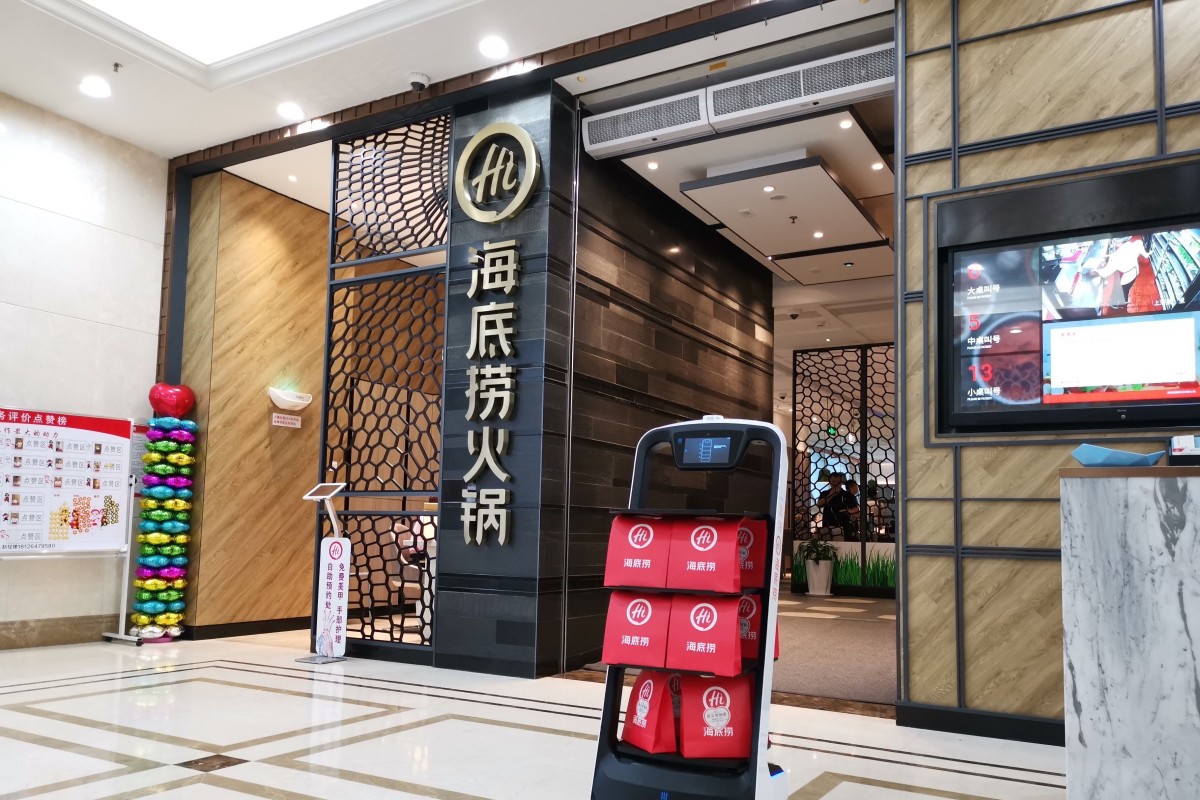
According to research firm Verified Market Research, the global robotics services market was valued at US$11.62 billion in 2018 and is projected to reach US$35.67 billion by 2026. Haidilao, China’s top hotpot restaurant, has not only adopted service robots but also introduced a smart restaurant with a mechanised kitchen in Beijing last year. And in China’s tech hub of Shenzhen, it is hard to pay without an app as most of the restaurants have deployed an online order service.
Can robots and virtual fruit help the elderly get well in China?
China’s labour force advantage has also shrank in recent years. The working-age population, people between 16 and 59 years’ old, has reduced by 40 million since 2012 to 897 million, accounting for 64 per cent of China’s roughly 1.4 billion people in 2018, according to the national bureau of statistics.
By comparison, those of working age accounted for 69 per cent of the total population in 2012.
Other Chinese robotic companies are also entering the market. SIASUN Robot & Automation Co, a hi-tech listed enterprise belonging to the Chinese Academy of Sciences, introduced their catering robots to China’s restaurants in 2017. Delivery robots developed by Shanghai-based Keenon Robotics Co., founded in 2010, are serving people in China and overseas markets such as the US, Italy and Spain.
Pudu projects it will turn a profit this year and it is in talks with venture capital firms to raise a new round of funding, which will be announced as early as October, according to Zhang. Last year it raised 50 million yuan in a round led by Shenzhen-based QC capital.
To be sure, the service industry is still the biggest employer in China, with 359 million workers and accounting for 46.3 per cent of a working population of 776 million people in 2018, according to the national bureau of statistics.
And new technology sometimes offers up new problems – in this case, service with a smile.
“When we go out for dinner, what we want is service. It is not as simple as just delivering meals,” said Wong Kam-Fai, a professor in engineering at the Chinese University of Hong Kong and a national expert appointed by the Chinese Association for Artificial Intelligence. “If they [robot makers] can add an emotional side in future, it might work better.”
Technology companies also face some practical issues like unusual restaurant layouts.
“Having a [catering robot] traffic jam on the way to the kitchen is normal. Some passageways are very narrow with many zigzags,” Zhang said. “But this can be improved in future with more standardised layouts.”
Multi-floor restaurants can also be a problem.
Dai Qi, a sales manager at the Lanlifang Hotel, said it is impossible for her restaurant to adopt the robot. “Our kitchen is on the third floor, and we have boxes on the second, third, and fourth floor. So the robots can’t work [to deliver meals to downstairs/upstairs],” Dai said.
But Bao says he has no plans to return to being a waiter, so the robots may have the edge.
“Why are human beings doing something robots can do? Let’s do something they [robots] can’t,” Bao said.
Source: SCMP
Posted in ability, adopted, Art, artificial intelligence (AI), Bao Xiangyi, Beijing, careers, catering robots, CEO of Pudu tech, China alert, China Youth Daily, Chinese Academy of Sciences, Chinese Association for Artificial Intelligence, Chinese University of Hong Kong, complain, darkness, delivering meals, education, foreign countries, Germany, guangdong province, Haidilao, Hangzhou, hotpot restaurant, hundreds of orders, industrial robots industry, IT industry, Italy, Japan, juggle, Keenon Robotics Co, Korea, labour shortfall, Lanlifang Hotel, literature, machines, mechanised kitchen, online ordering systems, plug, Pudu Tech, QC capital, qualified table staff, quit, Restaurant, restaurants, robots, school, Shenzhen, Shenzhen Pudu Technology, SIASUN Robot & Automation Co, Singapore, smart restaurant, South China Market of Human Resources, Spain, start up, tencent qq, trade war, Uncategorized, university student, US, Verified Market Research, victim, waiter, WeChat, Wenzhou, worked, zhejiang province |
Leave a Comment »
10/09/2019
- Deity has all the necessary travel documents for seven-day journey bringing blessings to coastal communities
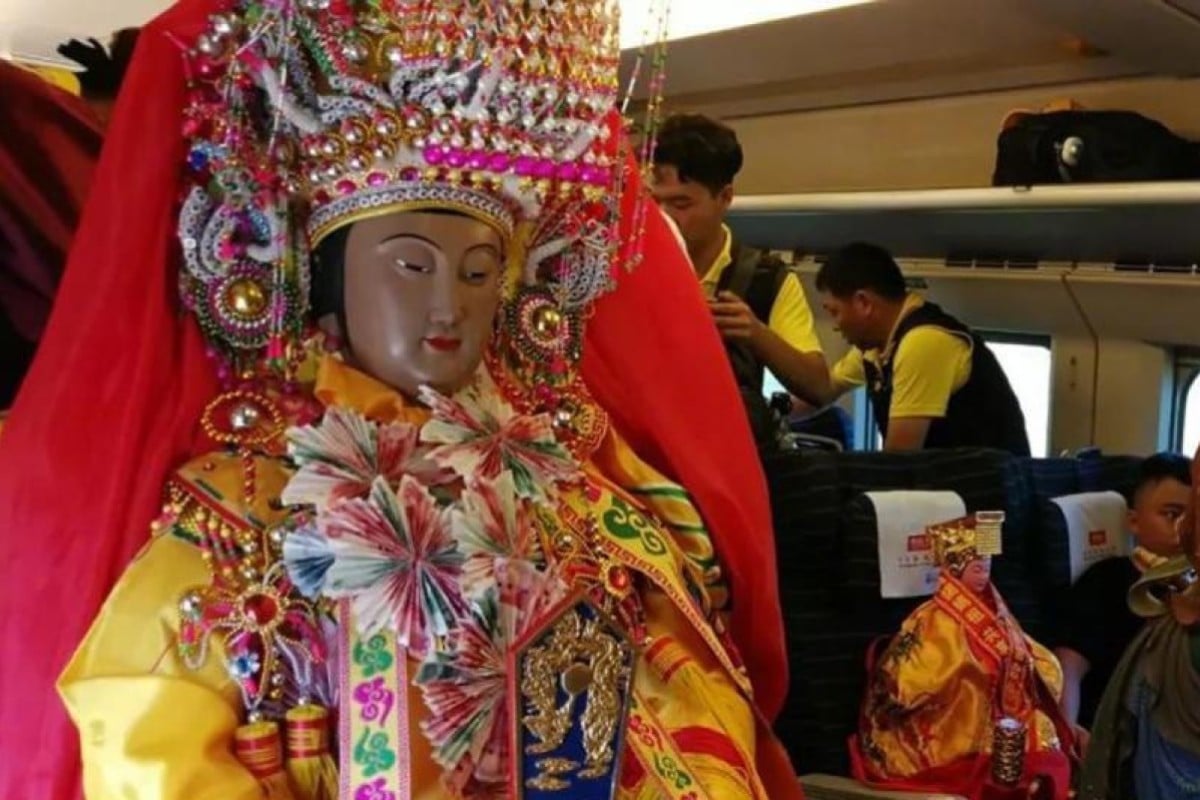
The statue of Chinese sea goddess Mazu on board the train for her seven-day tour of eastern China. Photo: Weibo
High-speed rail travellers in eastern China may find themselves in exalted company this week as one of China’s most beloved deities is on a seven-day tour.
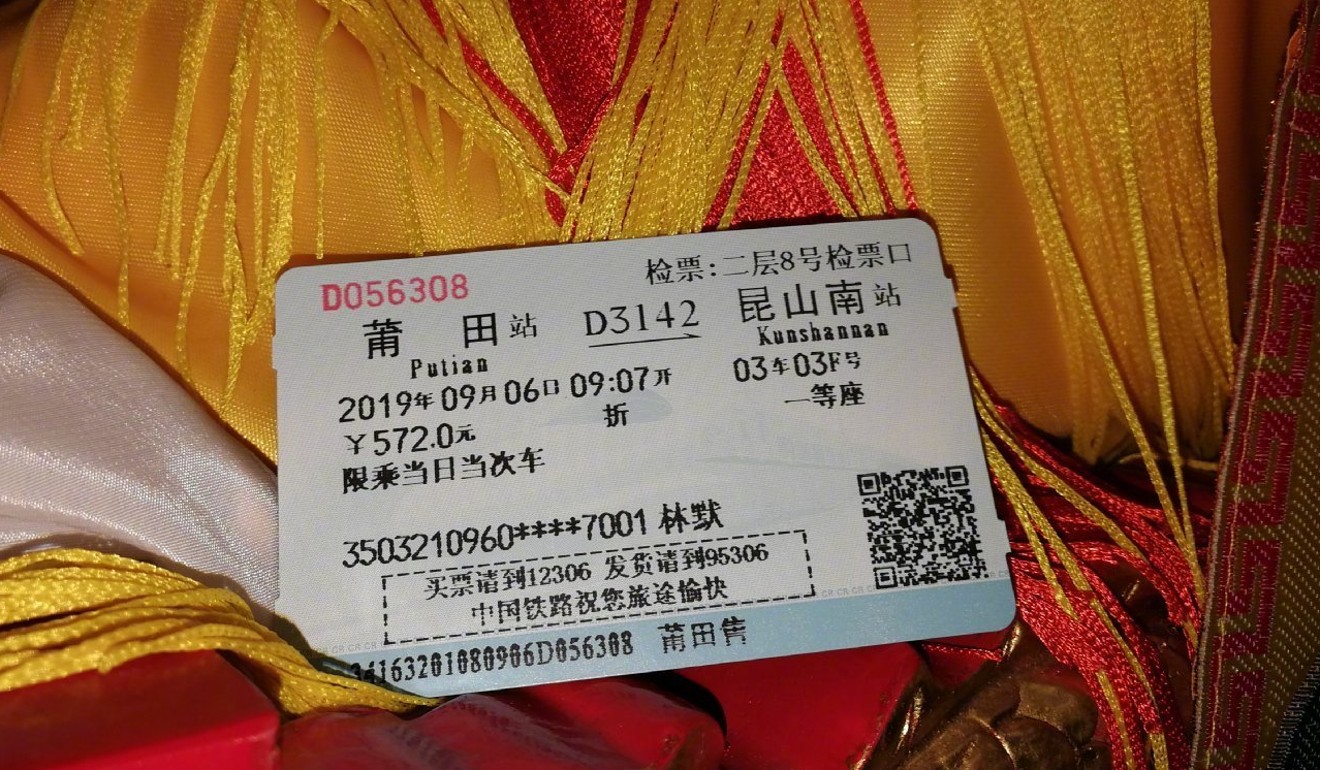
Mazu, protector of seafarers, boarded the train at Putian in Fujian province on Friday with an entourage of 230 worshippers for one of her regular “inspection tours”. And, like any modern traveller, the sea goddess had the necessary identity card and ticket for the journey.
Mazu, known as Tin Hau in Hong Kong, began life more than 1,000 years ago as a mortal named Lin Mo, according to Chinese folk belief. As a girl she is said to have saved some of her family members when they were caught in a typhoon while out fishing. In another version of the myth, Lin Mo died while trying to rescue shipwreck victims.
She fell out of favour in mainland China during the Cultural Revolution, when her ancestral temple on Meizhou Island in the southeastern province of Fujian was destroyed to make way for a People’s Liberation Army garrison. In the late 1970s the temple was rebuilt and in 2009 the beliefs and customs surrounding Mazu were recognised as an Intangible Cultural Heritage of Humanity by Unesco.
Inspectors on China’s high speed rail will find everything in order if they ask to see the goddess Mazu’s ticket during her seven-day tour. Photo: Weibo
Staff at the Meizhou Mazu Temple applied for an ID card for the goddess, in her earthly name of Lin Mo. Tickets were also organised for two other fairy figures who traditionally protect her, according to Chinese folklore.
“Not only Mazu but Thousand-Mile Eye and Wind-Accompanying Ear were all bought tickets,” a temple representative told the Southern Metropolis News.
This is not the first time the trio have been bought travel tickets. Two years ago their airfares were paid for when they visited Malaysia and Singapore and, a year later, they took a cruise ship to the Philippines.
This year’s tour includes a visit to Kunshan in Jiangsu and Shanghai, before Mazu returns to her home temple on the island of Meizhou. At each stop, devotees believe Mazu blesses the location with her presence and protects its residents from harm.
Taiwanese tycoon Gou thanks sea goddess for presidential inspiration
The tour has been organised jointly by the Meizhou Temple as well as the Huiju Mazu Temple in Kunshan and the Lugang Mazu Temple in Taiwan.
News of the celestial train journey quickly went viral on Chinese social media, with posts on Mazu receiving 460 million views on Weibo, the Twitter-like microblogging platform, since Monday. “First, respect. Second, she takes up a seat so it’s not crazy to buy her a ticket,” one comment read.
Source: SCMP
Posted in airfares, ancestral temple, blessings, celestial train journey, Chinese folk belief, Chinese social media, coastal communities, Cruise Ship, Cultural Revolution, Deity, Eastern China, exalted company, fishing, Fujian Province, garrison, High-speed rail travellers, Hong Kong, Huiju Mazu Temple, identity card, inspection tours, Intangible Cultural Heritage of Humanity, jiangsu province, journey, Kunshan, lets train, Lin Mo, Lugang Mazu Temple, Mainland China, Malaysia, Mazu, Meizhou Island, modern traveller, most beloved deities, myth, necessary, on board the train, People’s Liberation Army, Philippines, protector of seafarers, Putian, sea goddess, seven-day journey, Shanghai, shipwreck victims, Singapore, Southern Metropolis News, statue, Taiwan, Taiwanese tycoon, take the strain, Thousand-Mile Eye, ticket, Tin Hau, tour, travel documents, Typhoon, Uncategorized, UNESCO, viral, Weibo, Wind-Accompanying Ear, worshippers |
Leave a Comment »
10/09/2019
- More than 40 per cent of those surveyed in an online poll say they feel they have no other choice, while just a quarter think the extra tutoring is necessary
- It reflects widespread anxiety over getting places at the top schools, according to researcher
Sixty per cent of mainland Chinese children aged from three to 15 are receiving extra tutoring outside the classroom, according to a report. Photo: Handout
More than 40 per cent of Chinese parents feel they have no choice but to send their children to after-school classes because of the intense competition in the education system, according to an online poll.
But just a quarter of the respondents said they thought the extra tutoring was actually necessary for their children.
Nearly 200,000 parents had responded to the survey, conducted by social network Weibo, by Tuesday.
It comes after a report last week said 60 per cent of children aged between three and 15 in mainland China were receiving extra tutoring outside the classroom.
That report, released by the China National Children’s Centre and the Social Sciences Academic Press, also said parents of children in the age range were spending an average of 9,200 yuan (US$1,290) per year on after-school classes to cope with growing academic pressure.
It was based on a survey of nearly 15,000 children in 10 mainland cities and rural areas.
For the children, that meant they were spending an average of less than two hours playing outside on weekends, according to the report. They were also found to be devoting an average of 88 minutes a day to homework on school days.
Chinese parents send their children to a wide range of after-school classes. Photo: Xinhua
Wu Hong, a researcher from the Dandelion Education Think Tank in Chongqing, said the findings reflected the widespread anxiety of parents over their children getting places at the top schools.
“Many parents don’t have their own ideas about how their kids should be educated and they just follow others blindly. For example, a friend of mine said she plans to send her two five-year-olds to an international school in Thailand just because several of her friends did that,” Wu said.
“It’s not that kids should not attend any after-school classes, but we are apparently giving them too much when they’re so young, and this is only limiting their imagination.”
Last go at exam success for China’s ‘gaokao grandpa’
Studying a wider range of subjects in more depth than the public school syllabus requires and getting a head start by going over topics before they are covered in school have become common tactics used by parents trying to help their children compete in a challenging educational environment in China.
In the more affluent cities, some parents are spending a lot more than the average on their children’s extracurricular activities. Shanghai mother Emma Jin said she wanted to give her daughter, who is in Year Two, a good chance in the education system.
“Extra English classes cost 20,000 yuan for a year. She also takes dance classes, taekwondo and so on,” Jin said. “I don’t expect much from her, but I don’t want her to be the worst in the class either.”
Some parents said the pressure came from the schools.
“My child is studying at a public school. The teacher told us to have our child learn pinyin [the mainland’s system of romanisation of Mandarin script] in advance at after-school classes during the admission interview. Should I have just disregarded his advice?” one parent commented on Weibo.
‘Heavy burden’ of homework leaving Chinese children sleep-deprived, study finds
The heavy pressure on children from extra classes has meanwhile prompted the Ministry of Education to issue several directives to schools asking them to pay more attention to pupils’ well-being – including by encouraging them to get at least one hour of outdoor exercise and 10 hours’ sleep a day. Last year, it also banned cram schools from holding competitions or offering classes to children that were too advanced for their age.
Source: SCMP
Posted in academic pressure, after-school classes, China National Children’s Centre, chinese parents, Chongqing, Dandelion Education Think Tank, extra tutoring, forces, gaokao grandpa, homework, imagination, intense competition, international school, Mainland China, Mandarin, Ministry of Education, send children, Social Sciences Academic Press, Thailand, top schools, Uncategorized, weekends |
Leave a Comment »
10/09/2019
- Expensive presents are officially discouraged but have become the norm at many schools on day of appreciation for educators
Students at Yangzhou Technical Vocational College form the Chinese characters for “Hello Teacher” to mark China’s Teachers’ Day. Photo: Handout
Despite a decade of official discouragement, parents in China have been struggling with one of the biggest dilemmas of the school year – how to mark the country’s annual Teacher’s Day.
Ellen Yuan agonised for a day and a night before sending her son off to kindergarten on Tuesday with a 1,000 yuan (US$140) gift card in his bag for the teacher.
It was the boy’s second week of attendance and Yuan had given no thought to any Teacher’s Day obligations –until she learned that several of her friends had been busy over the weekend preparing gifts for their children’s teachers.
“It makes me feel that I am being a drag on my son if I don’t do so,” said Yuan, who works for a foreign company in Shanghai.
Respecting teachers has traditionally been a fundamental social norm in China but gift giving on the special day for educators has gone beyond an expression of appreciation by their students, as parents have taken over with ever more expensive gifts – and sometimes cash – which they hope will mean their kids are well taken care of while at school.
What gift, how expensive it should be, and how to deliver it have become the biggest questions for many parents in the run-up to September 10 each year, even though the education ministry and its subordinate bodies have repeatedly issued directives over the past decade to ban teachers accepting gifts.
Yuan said one of her friends had bought a body care set worth more than 600 yuan for each of her child’s three teachers, another had bought an 800 yuan gift card, while a third had given the head teacher a 1,000 yuan bottle of perfume.
Some parents had delivered the presents directly to the school, while others had asked their children to take the gifts to their teachers. Yuan’s plan was to message the teacher and tell her to take the gift card from her son’s bag.
“I know it’s bad. I don’t want my kid to know that,” Yuan said.
Hundreds of teachers protest in China over poor pay
The question of whether parents should give gifts on Teacher’s Day was one of the hottest topics on Weibo, China’s Twitter-like social media platform, attracting more than 15 million views as of Tuesday afternoon.
“Of course we should not, but I don’t dare to ignore it,” one user said, winning more than 10,000 likes.
Chu Zhaohui, a researcher at the National Institute of Education Sciences, said the gift-giving trend had been partly driven by a “keeping up with the Joneses” mentality.
“Everybody has given a gift. Would my child be specially treated if I don’t? This is a common concern,” Chu said. As a result, the purpose of gift giving on Teacher’s Day had become about protecting the children’s interests instead of a sincere expression of gratitude, he said.
But not every teacher gets presents – with gifts usually reserved for those teaching the “main subjects” of mathematics, Chinese and English, which count the most in high school and college entrance examinations.
Emily Shen, an English teacher from a middle school in Hangzhou, in the eastern province of Zhejiang, said she also prepared gifts for the teachers of her two kids. “Some chocolate for them to take to school. And I myself would give a gift card to each of those who teach the main subjects,” she said.
Zhuang Ke, a music teacher at a primary school in Jiaxing, also in Zhejiang province, admitted she was embarrassed by the parents’ different treatment of teachers of “less important” subjects like her’s. “It’s always nice to receive presents. But teachers who teach music, art and PE are often forgotten,” she said.
Chinese kindergarten teacher fired for hot sun punishment
State broadcaster CCTV said in a commentary on its website on Sunday that “all forms of behavior that attempt to ruin normal teaching order and interfere in equality by sending gifts should be resolutely abandoned”. A similar message was run by a series of official media outlets at local level.
“The most fundamental way to stop parents from sending gifts is to treat the students equally and fairly every day, so that parents conclude it makes no difference whether they give a gift,” Rednet.cn, the official news portal of Hunan province, said on Monday.
Although some teachers have made it explicit to students that they will refuse presents on Teacher’s Day, Yuan said her son’s teacher accepted the gift, as did the teachers of her three friends’ children.
Source: SCMP
Posted in Art, bag, body care set, bottle of perfume, Chinese, chinese parents, Chocolate, college entrance examination, commentary, day of appreciation, discouraged, educators, English, Expensive presents, fired, foreign company, forgotten, fundamental way, gift card, gift etiquette, Hangzhou, High school, hot sun punishment, Hunan Province, Jiaxing, keeping up with the Joneses, kindergarten, mathematics, mentality, middle school, music, music teacher, National Institute of Education Sciences, norm, official news portal, officially, PE, poor pay, primary school, Protest, Rednet.cn, schools, Shanghai, sincere expression of gratitude, state broadcaster CCTV, struggle, teacher, Teacher’s Day, Uncategorized, website, Weibo, Yangzhou Technical Vocational College, zhejiang province |
Leave a Comment »
08/09/2019
- International watchdog to vote on whether to extend restrictions to southern African countries that are the biggest exporters
- If passed, China may find it hard to buy elephants from Africa
An elephant is hoisted into Chongqing zoo in southwestern China, on loan from another Chinese zoo. Photo: Reuters
China, one of the leading buyers of African elephants, could face difficulty in acquiring the mammals if a widening of a ban on their sale to zoos is ratified next week by the global regulator of wildlife trade.
A motion further restricting the sale of live elephants was on Sunday supported by 46 countries at the committee stage of the Convention on International Trade in Endangered Species of Wild Fauna and Flora (Cites) in Geneva. It will go to a final vote on August 28.
The sale of elephants from West, Central and East Africa is already banned – but there is a lower level of protection for them in southern African countries such as South Africa, Namibia and Zimbabwe, which are the top three exporters of wild elephants to overseas zoos, according to Cites.
Keeping elephants caught from the wild in zoos is considered cruel by conservation and animal rights groups.
Conservationists criticised Zimbabwe’s capture of 35 baby elephants that were exported to a Chinese zoo in February. There was also uproar from activists in 2015 when a video filmed in a Chinese zoo showed two dozen elephants bought from Zimbabwe exhibiting signs of distress.
Zimbabwe was among 18 countries that opposed the potential ban at the committee stage, along with the United States – another leading buyer of elephants from Africa. China was one of 19 countries that abstained, while the European Union’s 28 countries did not vote.
If the motion is passed, China and the US – both known to be buying elephants from Africa and keeping them in so-called captive facilities or zoos – may find it hard to source the animals from the continent. Zimbabwe has come under
global scrutiny
for its capture and sale of elephants to captive facilities including zoos and safari parks in China and the US.
Peter Knights, founder and chief executive of WildAid, an environmental organisation in San Francisco, explained that Cites still allowed the movement of live elephants for on-site conservation efforts such as moving the animals back into the wild or to a national park where they had been depleted.
“This is not primarily a conservation issue but more about animal welfare,” he said. “As highly social, intelligent animals, African elephants do not usually do well in captivity, requiring very large areas, and often developing behavioural problems in captivity and not usually reproducing successfully – indicating far from ideal housing.”
According to Humane Society International, which promotes animal welfare, Zimbabwe has sold more than 100 baby elephants to zoos in China since 2012, with a further 35 reportedly awaiting export.
On Monday, 55 elephant specialists protested to the US wildlife management agency about plans for the country’s zoos to import juvenile elephants caught in the wild from Zimbabwe. They asked the agency to prohibit imports of wild-caught elephants for captivity in US facilities.
“We are vehemently opposed to the proposed imports,” the experts wrote in a letter to the agency. “Young elephants are dependent on their mothers and other family members to acquire necessary social and behavioural skills. Male calves only leave their natal families at 12 to 15 years old and females remain for life. Disruption of this bond is physically and psychologically traumatic for both the calves and remaining herds and the negative effects can be severe and lifelong.”
The letter said that eSwatini, formerly Swaziland, had sold a total of 11 wild elephants to two American zoos in 2003, and a further 18 to three US zoos in 2016.
‘Hundreds’ of elephants are being poached each year in Botswana
Concerns about keeping elephants in zoos come at a time when the animals remain under threat in Africa from poachers who kill them for ivory.
Southern African countries such as Botswana, Namibia, Zimbabwe and Zambia are pushing to reopen the trade in ivory. Zambia is seeking to have the classification of its elephants downgraded to allow commercial trade in registered raw ivory with approved trading partners.
Other countries, including Kenya, Nigeria and Gabon, are seeking the highest possible levels of protection for all of Africa’s elephants.
Two previous attempts at regulating the ivory trade failed to curb poaching, which has caused elephant numbers to dwindle over the past two decades. A 2016 study estimated that 30,000 to 40,000 elephants were being killed every year, with about 400,000 remaining in total.
Knights, of WildAid, said that between 1975 and 1989 – the first period in which the ivory trade was regulated – half of Africa’s elephants were lost. During the second attempt at regulation between 2008 and 2017, participating countries claimed to have addressed the problem but poaching increased.
“It is clear that we cannot control ivory trade and that legal trade stimulates poaching and demand for ivory, rather than substituting for it as some countries suggest. The price fell by two-thirds when China banned domestic sales,” Knights said, adding that demand for ivory came primarily from Asia.
“Most seized shipments are en route to China. It has banned all sales and is making a great effort to crack down on illegal trade.”
Source: SCMP
Posted in affect, africa, African countries, African elephants, ban, Botswana, buy, China alert, Chongqing zoo, Convention on International Trade in Endangered Species of Wild Fauna and Flora (Cites), elephants, eSwatini, European Union, Gabon, Geneva, hoisted, Humane Society International, International watchdog, ivory, Ivory trade, Kenya, mammals, Namibia, Nigeria, poaching, safari parks, sale, San Francisco, South Africa, southern, Swaziland, Uncategorized, US, US-China relationship, vote, West, Central and East Africa, wild, WildAid, Zimbabwe, zoos |
Leave a Comment »





 CHINDIA ALERT: You'll be living in their world, very soon
Chinese parents struggle with Teacher’s Day gift etiquette
Despite a decade of official discouragement, parents in China have been struggling with one of the biggest dilemmas of the school year – how to mark the country’s annual Teacher’s Day.
Ellen Yuan agonised for a day and a night before sending her son off to kindergarten on Tuesday with a 1,000 yuan (US$140) gift card in his bag for the teacher.
It was the boy’s second week of attendance and Yuan had given no thought to any Teacher’s Day obligations –until she learned that several of her friends had been busy over the weekend preparing gifts for their children’s teachers.
“It makes me feel that I am being a drag on my son if I don’t do so,” said Yuan, who works for a foreign company in Shanghai.
Respecting teachers has traditionally been a fundamental social norm in China but gift giving on the special day for educators has gone beyond an expression of appreciation by their students, as parents have taken over with ever more expensive gifts – and sometimes cash – which they hope will mean their kids are well taken care of while at school.
What gift, how expensive it should be, and how to deliver it have become the biggest questions for many parents in the run-up to September 10 each year, even though the education ministry and its subordinate bodies have repeatedly issued directives over the past decade to ban teachers accepting gifts.
Yuan said one of her friends had bought a body care set worth more than 600 yuan for each of her child’s three teachers, another had bought an 800 yuan gift card, while a third had given the head teacher a 1,000 yuan bottle of perfume.
Some parents had delivered the presents directly to the school, while others had asked their children to take the gifts to their teachers. Yuan’s plan was to message the teacher and tell her to take the gift card from her son’s bag.
“I know it’s bad. I don’t want my kid to know that,” Yuan said.
But not every teacher gets presents – with gifts usually reserved for those teaching the “main subjects” of mathematics, Chinese and English, which count the most in high school and college entrance examinations.
Emily Shen, an English teacher from a middle school in Hangzhou, in the eastern province of Zhejiang, said she also prepared gifts for the teachers of her two kids. “Some chocolate for them to take to school. And I myself would give a gift card to each of those who teach the main subjects,” she said.
Zhuang Ke, a music teacher at a primary school in Jiaxing, also in Zhejiang province, admitted she was embarrassed by the parents’ different treatment of teachers of “less important” subjects like her’s. “It’s always nice to receive presents. But teachers who teach music, art and PE are often forgotten,” she said.
Chinese kindergarten teacher fired for hot sun punishment
State broadcaster CCTV said in a commentary on its website on Sunday that “all forms of behavior that attempt to ruin normal teaching order and interfere in equality by sending gifts should be resolutely abandoned”. A similar message was run by a series of official media outlets at local level.
“The most fundamental way to stop parents from sending gifts is to treat the students equally and fairly every day, so that parents conclude it makes no difference whether they give a gift,” Rednet.cn, the official news portal of Hunan province, said on Monday.
Although some teachers have made it explicit to students that they will refuse presents on Teacher’s Day, Yuan said her son’s teacher accepted the gift, as did the teachers of her three friends’ children.
Source: SCMP
Posted in Art, bag, body care set, bottle of perfume, Chinese, chinese parents, Chocolate, college entrance examination, commentary, day of appreciation, discouraged, educators, English, Expensive presents, fired, foreign company, forgotten, fundamental way, gift card, gift etiquette, Hangzhou, High school, hot sun punishment, Hunan Province, Jiaxing, keeping up with the Joneses, kindergarten, mathematics, mentality, middle school, music, music teacher, National Institute of Education Sciences, norm, official news portal, officially, PE, poor pay, primary school, Protest, Rednet.cn, schools, Shanghai, sincere expression of gratitude, state broadcaster CCTV, struggle, teacher, Teacher’s Day, Uncategorized, website, Weibo, Yangzhou Technical Vocational College, zhejiang province | Leave a Comment »