Archive for ‘Social & cultural’

18/05/2019

Narendra Modi attends first press conference but takes no questions

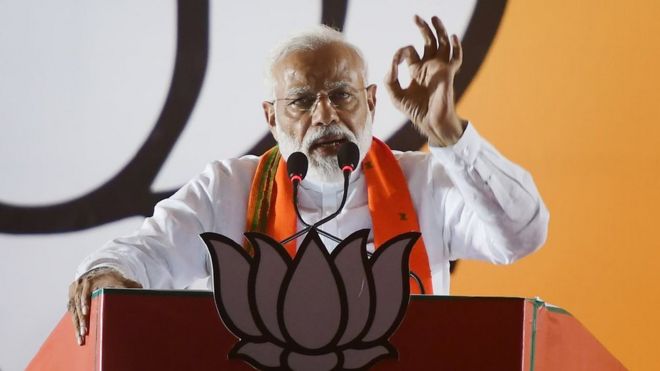
Mr Modi said the Congress should be ashamed of the 1984 anti-Sikh riotsImage copyright GETTY IMAGES
Image caption Mr Modi said he will not forgive Pragya Thakur

India is in full election mode: voting began on 11 April, and the final ballot will be cast on 19 May with results out on 23 May. Every day, the BBC will be bringing you all the latest updates on the twists and turns of the world’s largest democracy.

What happened?

Indian Prime Minister Narendra Modi has attended first ever press conference at the Bharatiya Janata Party (BJP) head office in Delhi – days before Indians take part in the final stage of voting.

But journalists were left disappointed as he did not take any questions, and instead largely talked about his government’s achievements.

“I have come to thank the country for blessing me. I have seen a lot of ups and downs but the country stayed with me,” he said.

Mr Modi also spoke of his pride in India’s democratic process and said he needs to show the world “how diverse our democracy is”.

Mr Modi was seated next to party president Amit Shah. He said he would not take questions because the press conference was Mr Shah’s.

Earlier, the prime minister said he would “never be able to forgive” those who have “insulted” Mahatma Gandhi.

Mr Modi’s statement comes after controversial Bharatiya Janata Party (BJP) politician Pragya Thakur called Nathuram Godse – the man who assassinated Mahatma Gandhi – a “patriot”.

Ms Thakur apologised after several leaders, including those from the BJP, criticised her.

“Such statements should be condemned. There is no place in society for such comments. She [Ms Thakur] may have apologised, but I will never be able to forgive her,” he said in an interview to News24 TV channel.

Why does this matter?

This is the first time Mr Modi has attended a press conference as prime minister while in India. Most of his press conferences have been on state visits to other countries and often involved little more than reading out an official statement.

He has given some one-on-one interviews to Indian media, though critics say that these have largely been tightly controlled and given to journalists seen as sympathetic to him. However in recent weeks he has given a flurry of interviews to several leading publications and television channels, including those that have been critical of him.

But if people were expecting a complete about-turn in his media policy this time, they would have been disappointed.

This caused some frustration among journalists on Twitter.

Presentational white space
Presentational grey line

Also on Friday, a BJP candidate apologised for calling Gandhi’s killer a patriot
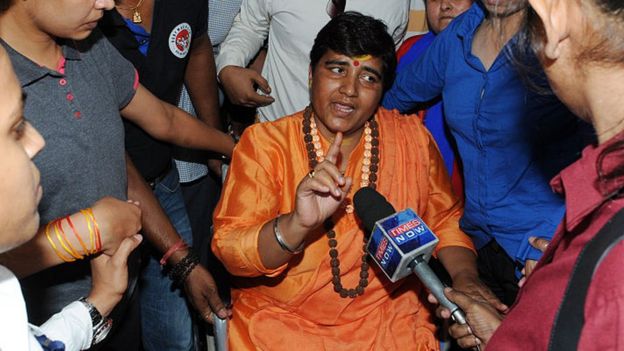
Hindu activist Sadhvi Pragya Singh Thakur leaving for Simhastha in Ujjain under heavy police protection on May 18, 2016 in Bhopal, India.Image copyright GETTY IMAGES

What is happening?

Bharatiya Janata Party (BJP) politician Pragya Thakur has apologised after calling Nathuram Godse – the man who assassinated Mahatma Gandhi – a “patriot”.

Several political parties had criticised her comment and her own party demanded that she should publicly apologise.

“It was my personal opinion. My intention was not to hurt anyone’s sentiments. If I’ve hurt anyone, I do apologise. What Gandhi Ji has done for the country cannot be forgotten. My statement has been twisted by the media,” Ms Thakur said on Thursday evening.

She made the comment after actor-turned politician Kamal Haasan said Godse was India’s first Hindu “extremist” earlier this week.

Why does this matter?

The BJP as well as opposition parties immediately reacted to her comment, which also caused a storm on social media.

BJP spokesperson GVL Narasimha Rao said that the party does not agree with her statement, and asked her to publicly apologise.

The main opposition Congress party demanded an apology from Prime Minister Narendra Modi and said that the BJP should take “punitive action” against Ms Thakur.

Congress spokesperson Randeep Surjewala said that “insulting martyrs is in the BJP DNA” and that the “soul of the nation” has been hurt by her remarks.

Congress party leader Priyanka Gandhi also lashed out at the BJP.

Political analysts also say that her comments have put the BJP in a tough spot, since Mr Modi and BJP president Amit Shah defended their decision to field her as a candidate despite terror charges against her.

Her candidature caused outrage as she is an accused of involvement in a blast that killed seven people and injured 100 others. Ms Thakur denies all charges against her.

However, Ms Thakur’s comments do reflect the views of some right-wing Hindus who support the BJP and have long seen Gandhi as too moderate.

Godse, who shot Gandhi in the chest three times at point-blank range on 30 January 1948, was also an activist with nationalist right-wing groups, including those closely associated with the BJP.

Hindu hardliners in India accuse Gandhi of having betrayed Hindus by being too pro-Muslim, and even for the division of India and the bloodshed that marked Partition, which saw India and Pakistan created after independence from Britain in 1947.

Presentational grey line

On Thursday, a ruling party candidate called Gandhi’s killer a patriot

What happened?

Controversial Bharatiya Janata Party (BJP) politician Pragya Thakur made headlines again. This time it was for calling Nathuram Godse – the man who assassinated Mahatma Gandhi – a “patriot”.

Her comment was made in response to a statement by southern actor-turned politician Kamal Haasan who had said India’s first “extremist” was a Hindu”, referring to Godse.

Presentational white space

His statement, made on Monday, was heavily criticised by the BJP, which accused him of indulging in “divisive politics” and filed a complaint against him with the Election Commission of India.

Why does this matter?

The BJP responded by criticising Ms Thakur and asking her to publicly apologise.

“BJP does not agree with this statement, we condemn it. Party will ask her for clarification, she should apologise publicly for this statement,” party spokesperson GVL Narasimha Rao told reporters.
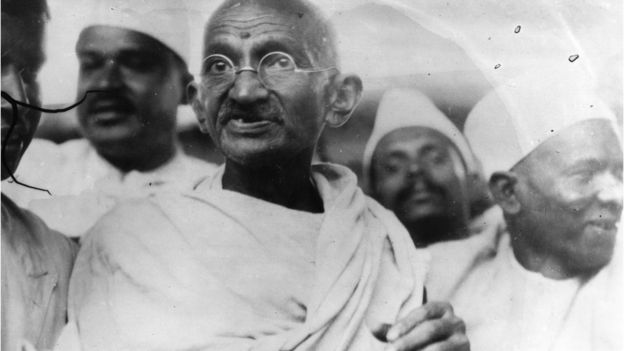
Mahatma Gandhi (Mohandas Karamchand Gandhi,1869 - 1948), Indian nationalist and spiritual leader, leading the Salt March in protest against the government monopoly on salt production.Image copyright GETTY IMAGES

Ms Thakur has seen her fair share of controversy. Her candidature caused outrage as she is an accused of involvement in a blast that killed seven people and injured 100 others. On 18 April, she said that police officer Hemant Karkare had died in the November 2008 Mumbai terror attacks because she had “cursed” him. She was then banned from campaigning for 72 hours as a result.

A team led by Mr Karkare had arrested her for questioning in connection with the Malegaon blast.

During her campaign, she also said she was “proud” of her part in the demolition of the 16th Century Babri mosque. In 1992, right-wing Hindu mobs razed the mosque to the ground, claiming it was built on the site of a temple destroyed by Muslim rulers. The site, which is in the city of Ayodhya, has been a religious flashpoint for Hindus and Muslims for decades.

Presentational grey line

Campaigning ended in West Bengal a day before deadline

What happened?

The Election Commission (EC) told political parties to end their campaigning in West Bengal state, a day before the deadline in the wake of poll-related violence.

The campaign will end on Thursday at 10pm local time, and voting will be held on Sunday.

The decision comes after clashes broke out between the Bharatiya Janata Party (BJP) workers and protesters believed to be from the ruling Trinamool Congress (TMC) in Kolkata (formerly Calcutta) on Tuesday.

It happened during a roadshow of BJP chief Amit Shah. Several people were injured and vehicles were set on fire. A statue of renowned Bengali reformer Iswarchandra Vidyasagar was also vandalised in the clashes.

Both parties have accused each other of starting the violence.

Why does this matter?
Violence took place during BJP chief Amit Shah's rally in Kolkata on TuesdayImage copyright GETTY IMAGES
Image caption Violence took place during BJP chief Amit Shah’s rally in Kolkata on Tuesday

The BJP welcomed the decision, saying it validated their argument that the state had “descended into anarchy” under the leadership of chief minister Mamata Banerjee.

Ms Banerjee said that the move was “undemocratic” and “it had insulted the people of Bengal”.

“Tomorrow, [Prime Minister Narendra] Modi has two meetings in Bengal. When he finishes, the campaigning also ends… Instead of punishing Amit Shah, the Election Commission has given a gift to the BJP,” she said.
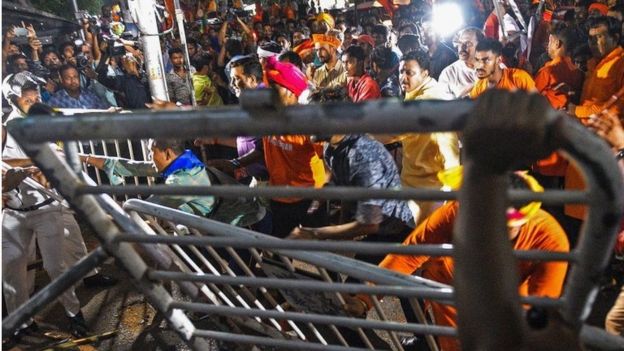
This photo taken on May 14, 2019 shows supporters of the Bharatiya Janata Party (BJP) facing off with Indian police next to torn down barricades during clashes between rival groups during a campaign rally event held by BJP president Amit Shah in KolkataImage copyright AFP
Image caption Several people were injured and vehicles were set on fire during the violence

Both parties are locked into a fierce election battle to win most out West Bengal’s 42 seats. Ms Banerjee has ambitions of becoming the prime minister in case a nationwide coalition of regional parties wins enough seats.

The state has also become crucial for the BJP as it’s trying to expand its reach in the eastern state. It won only two seats in the 2014 election.

The BJP performed well in northern states like Uttar Pradesh and Rajasthan in 2014, but this time it’s expected to suffer loses against a coalition of regional parties and the main opposition Congress.

So the party is trying to make up for the losses in West Bengal.

Presentational grey line

On Wednesday, the TMC and the BJP accused each other of poll violence
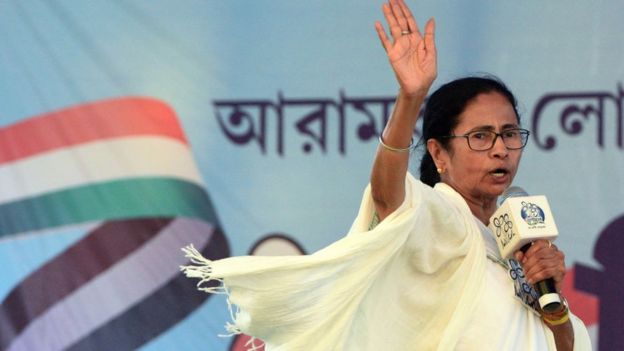
West Bengal chief minister Mamata BanerjeeImage copyright GETTY IMAGES

What happened?

The war of words between West Bengal state chief minister Mamata Banerjee and the governing Bharatiya Janata Party (BJP) intensified ahead of voting on Sunday.

The latest verbal duel comes after violence was reported during BJP chief Amit Shah’s roadshow in Kolkata (formerly Calcutta) on Tuesday.

Clashes broke out between BJP supporters and protesters who were holding “Amit Shah go back” posters.

Some people suffered minor injuries and a few vehicles were set on fire.

The BJP said the protest was “orchestrated” and called it an “attempt to strangulate democracy”.

Why does this matter?

The eastern state has become politically crucial for the BJP as it has intensified campaigning in the past few days.

And that has sparked a feverish electoral battle between the BJP and Ms Banerjee’s Trinamool Congress (TMC).

“What does Amit Shah think of himself? Is he above everything? Is he god that no one can protest against him?” Ms Banerjee said.

In reply, Mr Shah accused the TMC of not following democratic norms during elections.

“Have faith in the people of Bengal that they’d face the TMC goons,” he said.

Prime Minister Narendra Modi is scheduled to hold more rallies in the coming days, so one can expect more verbal fireworks from the two leaders.

Presentational grey line

On Tuesday, the saga of the morphed Mamata meme continued

What happened?

India’s top court stepped in to release an activist belonging to India’s governing Bharatiya Janata Party (BJP) who was sent to prison for sharing a doctored image of West Bengal Chief Minister Mamata Banerjee.

Priyanka Sharma was sentenced to two weeks in prison on 10 May after she shared a picture of Bollywood star Priyanka Chopra and her husband Nick Jonas at the Met Gala – but with Ms Banerjee’s head superimposed on to Chopra’s body.

Earlier the court had said Ms Sharma could be released only if she apologised to Ms Banerjee, but later waived this condition.

Why does this matter?

The battle for West Bengal in this general election has been absolutely bruising.

The BJP, led by Prime Minister Narendra Modi himself, has been campaigning hard for votes in the state. This has brought them toe-to-toe with the state’s feisty chief minister. The fact that voting for West Bengal’s 42 seats has been split across all nine phases of voting has meant that the battle has been long and drawn-out.

And with just one phase to go before voting finally ends, the gloves are well and truly off. The two parties have traded insults on the campaign stage, their workers have attacked each other, and the violence on the ground has intensified. And now the battle has spread to cyberspace as well.

The country’s finance minister Arun Jaitley jumped at news of Ms Sharma’s release to call Ms Banerjee a dictator.

Analysts say that this political row is so bitter because the BJP has clearly identified West Bengal as one of the states where they may be able to make gains this election. This becomes more important for the party in the context of their fight in the politically crucial state of Uttar Pradesh, which sends the most number of MPs (80) to parliament.

They are up against a powerful coalition of regional parties there, and many expect them to lose seats as a result.

Presentational grey line

And PM Modi said Rahul Gandhi should be ashamed of 1984 riots

What happened?

Prime Minister Narendra Modi said that main opposition Congress party chief Rahul Gandhi should be “ashamed of himself” over his colleague’s remark on the 1984 anti-Sikh riots.

Mr Modi was replying to a controversial statement made by Sam Pitroda, who is a strategist of the Congress party.

In his reply to a question about the Congress’ role in the riots, Mr Pitroda had said “so what?”.

“I don’t think so, this is also another lie, and what about 1984? You speak about what you [Mr Modi] have done in five years. It [the riots] happened in 1984, so what?” he said.

Mr Gandhi said he was “ashamed” of Mr Pitroda’s statement, and asked him to apologise.

Mr Pitroda later said his statement was “twisted” and he did not mean to hurt sentiments.

But Mr Modi said the Congress chief “must apologise”.

“I was watching that naamdar [the dynast] told his guru that he should be ashamed of what he said. I want to ask naamdar, you pretended to scold your mentor for what? Because he exposed what was always in the Congress’s heart, and in the discussions of the naamdar family? Because he made public a family secret? Naamdar, it is you who should be ashamed,” Mr Modi said.

Why does this matter?

The controversy matters because it comes days ahead of voting for the 13 seats in the northern state of Punjab.

The BJP, which has formed a coalition with regional Shiromani Akali Dal, is locked in a bitter electoral battle with the ruling Congress in the state.

Sikhs are a majority in the state and the 1984 riots is still an emotional issue for many of them.

More than 3,000 Sikhs were killed in 1984 after the assassination of former prime minister Indira Gandhi by her Sikh bodyguards.

They were angry at her decision to send the army into the Golden Temple – Sikhism’s holiest shrine – to flush out militants earlier in the year.

The killing of Mrs Gandhi, who belonged to the Congress, saw mobs attack and murder members of the Sikh community across the country.

And both parties appear to be trying to come across as pro-Sikh ahead of the vote on 19 May.

Presentational grey line

On Sunday, Delhi voted but not enthusiastically
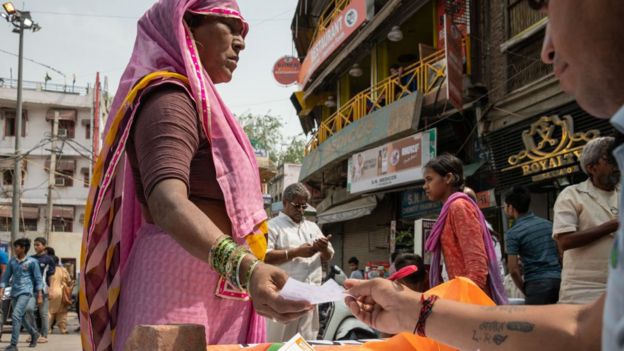
A voter in Delhi in the general electionImage copyright GETTY IMAGES
Image caption Delhi’s voter turnout was lower than in 2014

What happened?

Sunday saw India’s capital Delhi vote along with several other states in the polls – the penultimate phase of the country’s mammoth general election.

Voters turned out to vote, but in fewer numbers than they did in 2014. The election commission said that around 60% of the capital’s registered voters had actually cast ballots, which was about a five percent drop from 2014.

Delhi Chief Electoral Officer Ranbir Singh expressed disappointment, saying that the turnout did not match expectations.

Why does this matter?

The election commission is right to be disappointed – it had run a series of campaigns in the city, encouraging more people to vote.

But it was not as though polling in Delhi was an entirely smooth process. Some voters complained that their names were missing from electoral lists even though they had all the necessary documents. There were also reports that around 1,200 Electronic Voting Machines (EVMs) had malfunctioned across the city, delaying the polling process.

The fact that Delhi became a three-cornered contest after the main opposition Congress and the Aam Aadmi Party (AAP), which controls the Delhi state assembly, failed to stitch up an alliance may also have put voters off. Many analysts believe that this failure will only split voters who were against prime minister Narendra Modi’s Bharatiya Janata Party (BJP) and effectively hand them victory.

So they may have decided to just stay home, and not bother queuing up in the blistering heat – it touched 40C on Sunday.

Source: The BBC

16/05/2019

Gandhi killer ‘patriot’ comment by BJP candidate draws outrage

Mahatma Gandhi (Mohandas Karamchand Gandhi,1869 - 1948), Indian nationalist and spiritual leader, leading the Salt March in protest against the government monopoly on salt production.Image copyright GETTY IMAGES

India is in full election mode: voting began on 11 April, and the final ballot will be cast on 19 May with results out on 23 May. Every day, the BBC will be bringing you all the latest updates on the twists and turns of the world’s largest democracy.

Ruling party candidate calls Gandhi’s killer a patriot

What is happening?

Controversial Bharatiya Janata Party (BJP) politician Pragya Thakur has made headlines again. This time it was for calling Nathuram Godse – the man who assassinated Mahatma Gandhi – a “patriot”.

Her comment was made in response to a statement by southern actor-turned politician Kamal Haasan who had said India’s first “extremist” was a Hindu”, referring to Godse.

Presentational white space

His statement, made on Monday, was heavily criticised by the BJP, which accused him of indulging in “divisive politics” and filed a complaint against him with the Election Commission of India.

Why does this matter?

The BJP has responded by criticising Ms Thakur and asking her to publicly apologise.

“BJP does not agree with this statement, we condemn it. Party will ask her for clarification, she should apologise publicly for this statement,” party spokesperson GVL Narasimha Rao told reporters.

However, Ms Thakur’s comments do reflect the views of some right-wing Hindus who support the BJP and have long seen Gandhi as too moderate.

Godse, who shot Gandhi in the chest three times at point-blank range on 30 January 1948, was also an activist with nationalist right-wing groups, including those closely associated with the BJP.

Hindu hardliners in India accuse Gandhi of having betrayed Hindus by being too pro-Muslim, and even for the division of India and the bloodshed that marked Partition, which saw India and Pakistan created after independence from Britain in 1947.

Ms Thakur has seen her fair share of controversy. Her candidature caused outrage as she is an accused of involvement in a blast that killed seven people and injured 100 others. On 18 April, she said that police officer Hemant Karkare had died in the November 2008 Mumbai terror attacks because she had “cursed” him. She was then banned from campaigning for 72 hours as a result.

A team led by Mr Karkare had arrested her for questioning in connection with the Malegaon blast.

During her campaign, she also said she was “proud” of her part in the demolition of the 16th Century Babri mosque. In 1992, right-wing Hindu mobs razed the mosque to the ground, claiming it was built on the site of a temple destroyed by Muslim rulers. The site, which is in the city of Ayodhya, has been a religious flashpoint for Hindus and Muslims for decades.

Presentational grey line

Campaigning ends in West Bengal a day before deadline

What happened?

The Election Commission (EC) has told political parties to end their campaigning in West Bengal state, a day before the deadline in the wake of poll-related violence.

The campaign will end on Thursday at 10pm local time, and voting will be held on Sunday.

The decision comes after clashes broke out between the Bharatiya Janata Party (BJP) workers and protesters believed to be from the ruling Trinamool Congress (TMC) in Kolkata (formerly Calcutta) on Tuesday.

It happened during a roadshow of BJP chief Amit Shah. Several people were injured and vehicles were set on fire. A statue of renowned Bengali reformer Iswarchandra Vidyasagar was also vandalised in the clashes.

Both parties have accused each other of starting the violence.

Why does this matter?

Violence took place during BJP chief Amit Shah's rally in Kolkata on TuesdayImage copyright GETTY IMAGES
Image caption Violence took place during BJP chief Amit Shah’s rally in Kolkata on Tuesday

The BJP welcomed the decision, saying it validated their argument that the state had “descended into anarchy” under the leadership of chief minister Mamata Banerjee.

Ms Banerjee said that the move was “undemocratic” and “it had insulted the people of Bengal”.

“Tomorrow, [Prime Minister Narendra] Modi has two meetings in Bengal. When he finishes, the campaigning also ends… Instead of punishing Amit Shah, the Election Commission has given a gift to the BJP,” she said.

This photo taken on May 14, 2019 shows supporters of the Bharatiya Janata Party (BJP) facing off with Indian police next to torn down barricades during clashes between rival groups during a campaign rally event held by BJP president Amit Shah in KolkataImage copyright AFP
Image caption Several people were injured and vehicles were set on fire during the violence

Both parties are locked into a fierce election battle to win most out West Bengal’s 42 seats. Ms Banerjee has ambitions of becoming the prime minister in case a nationwide coalition of regional parties wins enough seats.

The state has also become crucial for the BJP as it’s trying to expand its reach in the eastern state. It won only two seats in the 2014 election.

The BJP performed well in northern states like Uttar Pradesh and Rajasthan in 2014, but this time it’s expected to suffer loses against a coalition of regional parties and the main opposition Congress.

So the party is trying to make up for the losses in West Bengal.

Presentational grey line

TMC, BJP accused each other of poll violence

West Bengal chief minister Mamata BanerjeeImage copyright GETTY IMAGES

What happened?

The war of words between West Bengal state chief minister Mamata Banerjee and the governing Bharatiya Janata Party (BJP) intensified ahead of voting on Sunday.

The latest verbal duel comes after violence was reported during BJP chief Amit Shah’s roadshow in Kolkata (formerly Calcutta) on Tuesday.

Clashes broke out between BJP supporters and protesters who were holding “Amit Shah go back” posters.

Some people suffered minor injuries and a few vehicles were set on fire.

The BJP said the protest was “orchestrated” and called it an “attempt to strangulate democracy”.

Why does this matter?

The eastern state has become politically crucial for the BJP as it has intensified campaigning in the past few days.

And that has sparked a feverish electoral battle between the BJP and Ms Banerjee’s Trinamool Congress (TMC).

“What does Amit Shah think of himself? Is he above everything? Is he god that no one can protest against him?” Ms Banerjee said.

In reply, Mr Shah accused the TMC of not following democratic norms during elections.

“Have faith in the people of Bengal that they’d face the TMC goons,” he said.

Prime Minister Narendra Modi is scheduled to hold more rallies in the coming days, so one can expect more verbal fireworks from the two leaders.

Presentational grey line

On Tuesday, the saga of the morphed Mamata meme continued

What happened?

India’s top court stepped in to release an activist belonging to India’s governing Bharatiya Janata Party (BJP) who was sent to prison for sharing a doctored image of West Bengal Chief Minister Mamata Banerjee.

Priyanka Sharma was sentenced to two weeks in prison on 10 May after she shared a picture of Bollywood star Priyanka Chopra and her husband Nick Jonas at the Met Gala – but with Ms Banerjee’s head superimposed on to Chopra’s body.

Earlier the court had said Ms Sharma could be released only if she apologised to Ms Banerjee, but later waived this condition.

Why does this matter?

The battle for West Bengal in this general election has been absolutely bruising.

The BJP, led by Prime Minister Narendra Modi himself, has been campaigning hard for votes in the state. This has brought them toe-to-toe with the state’s feisty chief minister. The fact that voting for West Bengal’s 42 seats has been split across all nine phases of voting has meant that the battle has been long and drawn-out.

And with just one phase to go before voting finally ends, the gloves are well and truly off. The two parties have traded insults on the campaign stage, their workers have attacked each other, and the violence on the ground has intensified. And now the battle has spread to cyberspace as well.

The country’s finance minister Arun Jaitley jumped at news of Ms Sharma’s release to call Ms Banerjee a dictator.

Analysts say that this political row is so bitter because the BJP has clearly identified West Bengal as one of the states where they may be able to make gains this election. This becomes more important for the party in the context of their fight in the politically crucial state of Uttar Pradesh, which sends the most number of MPs (80) to parliament.

They are up against a powerful coalition of regional parties there, and many expect them to lose seats as a result.

Presentational grey line

And PM Modi said Rahul Gandhi should be ashamed of 1984 riots

What happened?

Prime Minister Narendra Modi said that main opposition Congress party chief Rahul Gandhi should be “ashamed of himself” over his colleague’s remark on the 1984 anti-Sikh riots.

Mr Modi was replying to a controversial statement made by Sam Pitroda, who is a strategist of the Congress party.

In his reply to a question about the Congress’ role in the riots, Mr Pitroda had said “so what?”.

“I don’t think so, this is also another lie, and what about 1984? You speak about what you [Mr Modi] have done in five years. It [the riots] happened in 1984, so what?” he said.

Mr Gandhi said he was “ashamed” of Mr Pitroda’s statement, and asked him to apologise.

Mr Pitroda later said his statement was “twisted” and he did not mean to hurt sentiments.

But Mr Modi said the Congress chief “must apologise”.

“I was watching that naamdar [the dynast] told his guru that he should be ashamed of what he said. I want to ask naamdar, you pretended to scold your mentor for what? Because he exposed what was always in the Congress’s heart, and in the discussions of the naamdar family? Because he made public a family secret? Naamdar, it is you who should be ashamed,” Mr Modi said.

Why does this matter?

The controversy matters because it comes days ahead of voting for the 13 seats in the northern state of Punjab.

The BJP, which has formed a coalition with regional Shiromani Akali Dal, is locked in a bitter electoral battle with the ruling Congress in the state.

Sikhs are a majority in the state and the 1984 riots is still an emotional issue for many of them.

More than 3,000 Sikhs were killed in 1984 after the assassination of former prime minister Indira Gandhi by her Sikh bodyguards.

They were angry at her decision to send the army into the Golden Temple – Sikhism’s holiest shrine – to flush out militants earlier in the year.

The killing of Mrs Gandhi, who belonged to the Congress, saw mobs attack and murder members of the Sikh community across the country.

And both parties appear to be trying to come across as pro-Sikh ahead of the vote on 19 May.

Presentational grey line

On Sunday, Delhi voted but not enthusiastically

A voter in Delhi in the general electionImage copyright GETTY IMAGES
Image caption Delhi’s voter turnout was lower than in 2014

What happened?

Sunday saw India’s capital Delhi vote along with several other states in the polls – the penultimate phase of the country’s mammoth general election.

Voters turned out to vote, but in fewer numbers than they did in 2014. The election commission said that around 60% of the capital’s registered voters had actually cast ballots, which was about a five percent drop from 2014.

Delhi Chief Electoral Officer Ranbir Singh expressed disappointment, saying that the turnout did not match expectations.

Why does this matter?

The election commission is right to be disappointed – it had run a series of campaigns in the city, encouraging more people to vote.

But it was not as though polling in Delhi was an entirely smooth process. Some voters complained that their names were missing from electoral lists even though they had all the necessary documents. There were also reports that around 1,200 Electronic Voting Machines (EVMs) had malfunctioned across the city, delaying the polling process.

The fact that Delhi became a three-cornered contest after the main opposition Congress and the Aam Aadmi Party (AAP), which controls the Delhi state assembly, failed to stitch up an alliance may also have put voters off. Many analysts believe that this failure will only split voters who were against prime minister Narendra Modi’s Bharatiya Janata Party (BJP) and effectively hand them victory.

So they may have decided to just stay home, and not bother queuing up in the blistering heat – it touched 40C on Sunday.

Source: The BBC

11/05/2019

China’s mothers say no to more babies, they can’t afford them

  • Birth rate continues to fall three years after one-child policy was relaxed
  • Survey finds high cost of raising children biggest deterrent to second baby
Chinese mothers say financial pressures are stopping them from having another child. Photo: Shutterstock
Half of China’s working mothers do not want a second child, mainly because of financial pressures, a survey released ahead of Mother’s Day has found.
Another 40 per cent said they hoped to have a second child, but dared not to, according to the 2019 working mothers’ living condition survey by Chinese recruitment website Zhaopin.com, which polled 8,739 women over the past two weeks.
The biggest obstacle deterring the mothers from having a second child was economic pressure, with 85 per cent saying they could not afford the high cost of raising children.
China’s low birth rate has been a top concern for the government since it introduced a universal two-child policy in 2016. After decades of a rigidly enforced restriction on couples to have only one child, the number of newborns has not risen as expected.
Births across the country have continued to fall over the past three years, from 17.86 million in 2016, to 17.23 million in 2017, and 15.23 million last year, according to data from the National Bureau of Statistics.
Social demography professor Yang Juhua, from the Centre for Population and Development Studies at Renmin University of China in Beijing, said there were several factors influencing Chinese women’s decision to stick to one child, despite the policy relaxation.

“People are reluctant to give birth because of two reasons: no money to raise kids and no people to look after them, especially when the babies are too young to be admitted to kindergartens,” she said.

The economic stress of raising a child was not about basic living costs, but the expense of extracurricular courses and tuition fees at elite private schools, she said.
“Parents have to send their kids to learn various subjects in order to keep up with their peers amid fierce competition. So the kids are called cash-smashers.”
‘Burden’ of homework leaves kids sleep-deprived Doris Ding, a mother of an eight-year-old boy in Shanghai, said she decided years ago not to have another child.
The senior manager at an audit firm and her husband, an IT engineer at a technology company, pay more than 200,000 yuan (US$30,000) a year for their son to attend an international primary school. His after-school classes, which include piano and public speaking, cost another 50,000 yuan a year.
“So it’s out of our reach to raise a second kid,” Ding said.
Yang said that for many families the second major challenge was an inability to find relatives or other trustworthy people to take care of their children while they were at work.
“Grandparents are too old or not strong enough to do that. We often hear complaints from old people that they are tired of raising the first kid and don’t want to help raise the second one. Otherwise, they don’t have a personal life at all for many years,” she said.
Chinese database lists whether 1.8 million women are ‘BreedReady’
Nurseries providing places for children under the age of three was far from sufficient to resolve the problem, Yang said.
On Thursday, China’s executive State Council proposed a raft of policies aimed at easing the childcare burden for new parents, including encouraging companies to set up day care services for children aged three and under, as well as extended childcare and maternity leave.
According to research by Zhu Qin, a professor from the Centre for Population and Development Policy Studies at Shanghai’s Fudan University, China’s total fertility rate is just 1.54 per woman, putting the country among the lowest birth rates in the world.
As well as the economic factors, Zhu said women were not willing to give birth because of the lack of support from society.
The latest survey from Zhaopin.com showed only 8 per cent of companies had designated rooms for mothers and infants, while 40 per cent of working mothers said they did not take their legally entitled maternity or breastfeeding leave.
“In big cities, white-collar women face the challenge that their career progress will be affected by having babies,” Zhu said.
Source: SCMP
06/05/2019

Summit demonstrates China’s leapfrog into digital world

CHINA-FUJIAN-HUANG KUNMING-DIGITAL CHINA SUMMIT-SPEECH(CN)

Huang Kunming, a member of the Political Bureau of the Communist Party of China (CPC) Central Committee, also head of the Publicity Department of the CPC Central Committee, speaks at the opening ceremony of the second Digital China Summit in Fuzhou, southeast China’s Fujian Province, May 6, 2019. (Xinhua/Ding Lin)

FUZHOU, May 6 (Xinhua) — China on Monday sounded another heartening note for its development of information technologies, as both companies and the government rush to harness the nationwide tech boom to raise efficiency, buoy public satisfaction and even tackle corruption.

The second Digital China Summit opened Monday in eastern China’s Fujian Province, shedding light on the latest information technologies that have penetrated the country’s government, industries and society.

The Chinese government has expected information technologies to nurture new economic engines and upgrade old industries as the country shunts from the high-speed economic growth to the path of high-quality development.

Huang Kunming, a member of the Political Bureau of the Communist Party of China (CPC) Central Committee, in a keynote speech at the summit called for advancing the building of a digital China and smart society, stressing the role of information technology in promoting high-quality development.

Huang, also head of the Publicity Department of the CPC Central Committee, said China’s advantages in internet technology innovation, technology application and as a huge market should be transformed into advantages in developing a digital economy.

The official called for achieving breakthroughs in core technologies, enhancing protection of intellectual property rights, advancing information infrastructure construction and narrowing digital gaps between urban and rural areas.

A report reviewing the country’s digital development in 2018 was also issued at the summit, pointing to rapid growth in sectors including electronic information manufacturing, software service, communications and big data.

The report published by the Cyberspace Administration of China said the country last year recorded more than 9 trillion yuan (1.3 trillion U.S. dollars) in online retail. China’s digital economy reached 31.3 trillion yuan in scale, accounting for one-third of the national GDP in 2018.

Provincial-level e-government platforms have also slashed time for getting government permits by an average of 30 percent, noted the report.

Trendy technologies from driverless vendor vehicles and facial recognition security checks to 5G networks are being used at the event in the city of Fuzhou. A number of tech companies are displaying their cutting-edge products including Baidu’s driverless vehicles, Huawei’s AI chip “Ascend” and Foxconn’s “future factories.”

Pony Ma, CEO of China’s Internet giant Tencent, said at the summit that the company, by working with Fujian police, has used its facial recognition technology to help 1,000 families find missing family members in the past two years.

Hu Xiaoming, president of Ant Financial that runs the popular online payment network Alipay, said at the event that one of every four Chinese now handles government services on Alipay, making it the country’s largest platform that offers access to government services.

E-GOVERNMENT

One of the major highlights at the summit’s exhibition area are the many e-government apps, which have mushroomed across China to incorporate a wide range of government and public services. They are part of the government’s efforts to cut red tape to benefit residents and businesses alike.

In Fuzhou, the host city of the event, a citizen’s typical day now revolves around the e-Fuzhou app, which allows users to buy bus tickets, pay tuition fees and manage social security accounts without the need of visiting government offices.

A slew of digital technology applications, including the big data credit inquiry system, the online tax bureau, and the paperless customs clearance system, have also been developed in the province over the years.

Dingxi, one of the least developed cities in west China’s Gansu Province, has a booth displaying an online monitoring platform, which it launched last year to allow villagers to scrutinize the management of poverty-relief funds and report any signs of corruption.

“We went door-to-door to teach villagers how to use mobile phones to check the subsidies they are entitled to and the sum other families actually received,” said Yang Sirun, an inspector with the city’s discipline inspection commission.

“In the past, some wealthy families feigned poverty to claim subsistence allowances, while some officials fraudulently pocketed subsidies in the names of families that had moved away. The new platform can easily expose such ‘micro corruption,'” Yang said.

The official said since its launch, over 3,400 officials and residents have voluntarily turned in their illegal gains for fear of being reported. “Many hidden problems were also found during the collation of data from different departments, which proves big data’s power in fighting corruption,” he said.

The summit from May 6 to 8 aims to serve as a platform for issuing China’s policies on IT development and displaying the achievements and experience of e-government and the digital economy.

More than 1,500 officials, company representatives and scholars are attending the event, which is co-organized by the Cyberspace Administration of China, National Development and Reform Commission, Ministry of Industry and Information Technology and Fujian provincial government.

Source: Xinhua

29/04/2019

The Wandering Earth and China’s sci-fi heritage

Still from The Wandering EarthImage copyrightNETFLIX
Image caption The Wandering Earth debuts on Netflix on 30 April

The Wandering Earth has been billed as a breakthrough for Chinese sci-fi.

The film tells the story of our planet, doomed by the expanding Sun, being moved across space to a safer place. The Chinese heroes have to save the mission – and humanity – when Earth gets caught in Jupiter’s gravitational pull.

Based on Hugo Award winner Liu Cixin’s short story of the same name, Wandering Earth has already grossed $600m (£464m) at the Chinese box office and was called China’s “giant leap into science fiction” by the Financial Times. It’s been bought by Netflix and will debut there on 30 April.

But while this may be the first time many in the West have heard of “kehuan” – Chinese science fiction – Chinese cinema has a long sci-fi history, which has given support to scientific endeavour, offered escapism from harsh times and inspired generations of film-goers.

So for Western audiences eager to plot the rise of the Chinese sci-fi movie, here are five films I think are worth renewed attention.

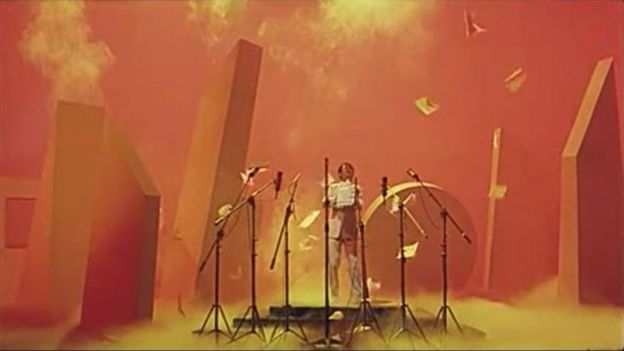
Dislocation

Huang Jianxin, 1986

For most in the Western world, their first encounter with Chinese cinema came from directors like Wu Tianming (The Old Well, The King of Masks) and Zhang Yimou (House of Flying Daggers, Raise the Red Lantern).

A still image from the film DislocationImage copyrightNANHAI FILMS
Image caption Dislocation explores themes of work and artificial intelligence in a surreal dreamscape

They were largely preoccupied with themes like the loss of youth, tradition versus change, and creating the rural aesthetic most people associated with Chinese film.

But China in the 1980s was a scene of rapid modernisation, urbanisation and Westernisation, and films started responding to the impact of this massive change.

In Dislocation, a scientist creates an android version of himself to attend the endless meetings that rob him of his time, in a black comedy of mechanisation and bureaucracy.

Huang’s take on the debate on artificial intelligence is superbly delivered against a surreal Kafka-esque dreamscape, with stark lighting and suspenseful music, making this film a delight to watch.

Hopefully the new interest in kehuan will see it gain an official release in the West.

Short presentational grey line

Warrior Revived

Li Guomin, 1995

A grown-up style of kehuan emerged in the 1990s, reflecting the themes of identity versus technological advancement which were also occupying Western sci-fi at the time.

Still image from Warrior RevivedImage copyrightSHANGHAI FILM STUDIOS
Image caption The low budget appearance of Warrior Revived never gets in the way of its creative energy

In Warrior Revived, police officer Song Da Wei dies a gruesome death on duty and ends up in a decade-long coma. He’s brought back to life by a “miracle cure” from a biologist who has found a way to repair defective DNA.

The genetically enhanced Song finds himself uncomfortable with the cyberised world around him, and excluded by his old comrades. Meanwhile, the heavily maimed villain he gave his life to destroy is plotting to steal the gene formula and wreak his revenge.

Like a lot of great cyberpunk movies before the age of CGI, this early mainland kehuan impresses with its high kitsch, low-budget, imaginative approach.

The villain’s lair is filled with neon tubes, hand-crafted lab controls and walls covered with plastic bowls in the best traditions of the Tardis.

What it lacks in sleekness it more than makes up with innovative costume designs and soundtrack, diligent camera work and the sheer energy from the cast.

Short presentational grey line

Wonder Boy

Song Chong, 1988

The 1980s brought a slew of Hollywood sci-fi films made for children, but which appealed equally to adults – like Explorers, Flight of The Navigator, and D.A.R.Y.L. – and filmmakers in China were taking a similar route.

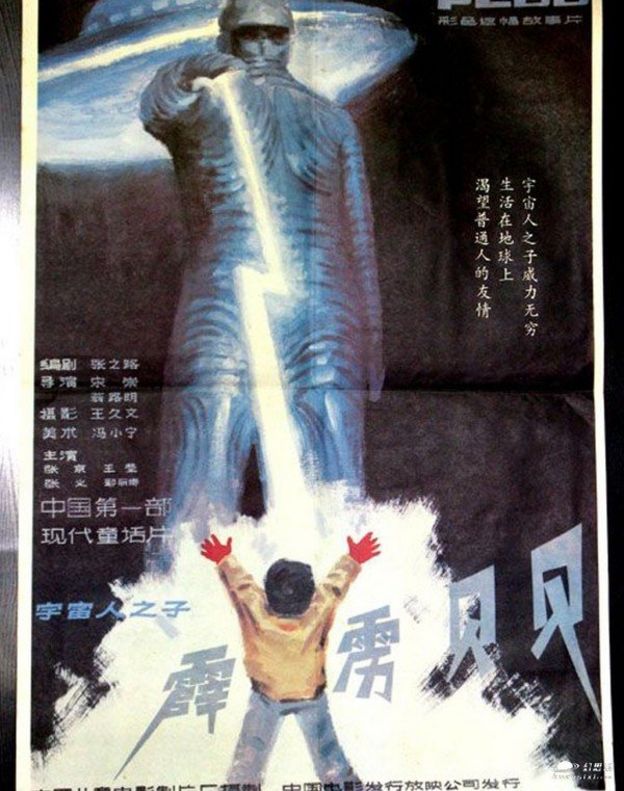
Promotional poster for Wonder BoyImage copyrightCHILDREN’S FILM STUDIO
Image caption Wonder Boy remains popular and is still occasionally played out on national TV
Presentational white space

Produced by the Children’s Film Studios and hailed as the nation’s first children’s fantasy film, Wonder Boy tells the story of a child born with the ability to generate electricity.

Bei Bei is bullied by neighbours and kept in isolation by parents who want to protect him, but is still a caring and mischievous little boy, who uses his powers to help others and have fun in equal measure.

When Bei Bei is taken away to be experimented on – by a non-governmental, possibly foreign group – a handful of the close friends he has made come to his rescue.

Well-loved for its humour and accessibility, Wonder Boy is remembered in China as a great classic, and still enjoyed by children today when it is repeated on both national television and streaming services.

Short presentational grey line

Reset

Hong-Seung Yoon, 2017

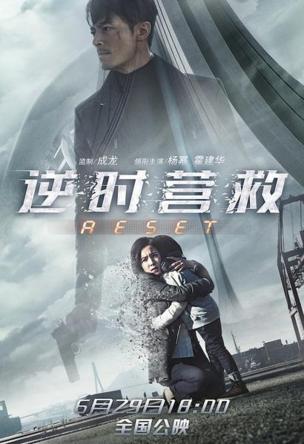
Produced by Jackie Chan and winner of the 2017 Grand Remi for Best Feature and Best Actress, Reset is a time travel thriller, which addresses a Chinese preoccupation with personal roles in a culture that so totally promotes the good of society.

Xia Tian (Yang Mi) is a senior researcher of wormhole technology and a single mother. When her young son is kidnapped, she is forced to hand over her research, but when the villain murders her child anyway she is forced to test her own discoveries into time travel in order to save his life, and maybe undo her own betrayal of the programme.

Promotional poster for ResetImage copyrightBEIJING YAOYING MOVIE DISTRIBUTION CO LTD
Image caption Reset explores the identity struggle facing many modern Chinese women
The film is an exploration of the plight of a New Chinese Woman, who walks the line between the roles of highly skilled professional and loving mother. The psychological exploration is fantastic. With several versions of Xia being generated by her repeated time travel, the face-off between our heroine and these alternate selves, including a darker, damaged one, creates an amazing tension which is missing from so many Western takes on this classic trope.

A female-led space kehuan story that also deals with single parenthood couldn’t be more relevant in a society that is simultaneously beginning a golden space age, and struggling with attitudes to women’s emancipation.

Short presentational grey line

Super Mechs

Cui Junjie, 2018

Wuxia, or kung fu fantasy, is so intrinsic to Chinese pop culture it was almost inevitable that its tropes would be incorporated into Chinese sci-fi.

Promotional poster for Super MechsImage copyrightSEVEN ENTERTAINMENT PICTURES
Presentational white space

Produced exclusively for IQiyi, China’s version of Netflix, Super Mechs is set in 2066 in a world where humanity has begun to experience genetic mutations which leave some people with X-Men style super powers.

Global criminal organisations are threatening the order of society and private entities are stepping up to uphold it by developing highly advanced mechanised power suits.

Hero Xiao Qi is an ordinary office clerk enlisted by the Dragon Clan, who reveal to him his latent mutant ice powers, before arming him with a robotic power suit and sending him on a mission. Little does Xiao Qi know that he will be greeted by another mech-suited warrior with fire-based powers who will fight him to a standstill.

The “warriors with opposite powers” trope is a staple of the wuxia genre, but the film falls deeper down the rabbit hole when this deadly opponent is revealed to be Xiao Qi’s long-lost brother.

Add in ancient warring clans, fast-paced action between the sleek computer-generated mechanical fighters and a cheeky sense of humour from our protagonist, and the high budget Huayi Brothers production appeals to fans of superhero, kung fu and toku/tecuo films alike.

The works of stalwart wuxia authors like Jin Yong are steadily being translated into English, so we will certainly see more from this sub-genre reach our screens.

Short presentational grey line

Acknowledging the rich and varied Chinese science fiction tradition does not at all detract from the pride in the success of Wandering Earth.

With China’s growing middle class and increased youth spending power, Chinese filmmakers are increasingly catering for a booming domestic demand for entertainment, and no longer worry as much about making their films palatable for export.

But with more East-West co-productions in the pipeline, like the animated Next Gen which originated from a Chinese web comic, it is certainly a sensible decision for companies like Netflix to bring films from platforms like IQiyi, to an English speaking audience, and that is going to include kehuan.

Western audiences may not immediately “get” some of these films, or may feel that some elements do not flow to their expectations.

But Wandering Earth and the titles above are the product of China’s culture and worldview. And to some extent, it’s what makes them different that will pique interest, fascinate and entertain.

08/04/2019

China’s booming middle class creates opportunities for culture, entertainment industry: business leaders

NEW YORK, April 6 (Xinhua) — Boosted by a growing middle class population, China’s culture and entertainment industry enjoys broader prospect and is creating enormous opportunities, a group of business leaders from the United States and China said here Saturday.

Chinese society today has a growing appetite for the intellectual strength of art and music, Joseph Polisi, president emeritus and chief China officer at the Juilliard School, a renowned performing arts conservatory in the United States, said at a panel in New York.

Themed “The human connection: China and America in culture and entertainment,” the panel is part of the ongoing annual conference held by the Committee of 100 (C100), a premier U.S. organization of Chinese-American leaders from different fields.

The demand of “Chinese audiences are growing in size for western music,” he said, adding that Chinese parents have a greater request for orchestral musical training programs resulting in Chinese children being able to engage in sophisticated musical works at a young age.

Polisi, who is also an accomplished bassoonist, said that Juilliard is establishing a campus in Tianjin. Slated to open in fall 2019, the Tianjin campus offers audition-based programs on pre-college and graduate levels.

U.S. businesses have much to gain by accessing the Chinese market with the growth of the Chinese middle class and the emergence of dynamic forces including the nation’s Generation Z, small-town and rural dwellers, noted the panelists.

Their growing demand for a better life and high-quality goods will create new business opportunities.

Ben Wood, founder of Studio Shanghai Architectural Firm, who has spent 22 years in China, said bringing popular culture to China through the rapid rise of the middle class is among others behind his business success.

Gong Yu, founder and CEO of China’s leading online entertainment platform iQiyi, said his company delivers content to 200 to 300 million users daily, a remarkable achievement made in a span of only nine years thanks to the broader picture of China’s rapid development. He is confident that there will be more Chinese culture and entertainment production going global since more Chinese young people are willing to be dedicated in the industry.

Now China is home to the world’s biggest middle-income group comprised of some 400 million people, and the number is still on the rise. The country is evolving from the world’s workshop to becoming a major consumer of goods and services instead.

ource: Xinhua

14/03/2019

China Focus: Tibetan Buddhism well respected, preserved: political advisors

BEIJING, March 13 (Xinhua) — Chinese religious figures serving as political advisors at this year’s “two sessions” are pleased with the country’s protection of Tibetan Buddhism in southwest China’s Tibet Autonomous Region.

Political advisor Lhapa from Jokhang Temple is among the over 2,000 members of the National Committee of the Chinese People’s Political Consultative Conference (CPPCC), who gathered in Beijing for this year’s session that started on March 3 and concluded Wednesday.

Jokhang Temple, in downtown Lhasa, the regional capital of Tibet, is a must for visitors to Tibet and a sacred site for Tibetan Buddhists. It attracts about 800,000 tourists and receives over three million Buddhist followers each year.

Built in the 7th century in the Tang Dynasty (618-907), Jokhang Temple is home to plenty of historical relics and typical Tibetan architecture. It was included in the UNESCO World Heritage List in 2000.

The Chinese government has attached great importance to the protection and preservation of the temple, said Lhapa, executive deputy director of the management committee of Jokhang Temple. Five years ago, for example, the government invested over 60 million yuan (8.94 million U.S. dollars) in gilding the five golden roofs of the temple.

The Buddha figures, Thangka and murals in the temple have also been well preserved. To better protect these precious cultural relics, a database for Buddha statues and Thangka in both Mandarin and Tibetan languages, launched in 2015, will be completed next year, he added.

Experts from Beijing and Xi’an have been invited to help build the database. More than 6,000 Buddha statues and over 600 Thangka have been included in the database, according to Lhapa.

“The government has invested 100 million yuan in protecting the cultural relics,” Lhapa said. “I’m really satisfied with the government’s role in protecting the temple, a treasure of the country.”

As a political advisor from the religious circles, Lhapa said he must serve all the people, including tourists, believers and researchers who visit the temple.

“We have personnel working 24/7 in the halls of the temple, including monks, firefighters and police officers to prevent the cultural heritage from being destroyed or stolen, and to ensure tourists’ safety,” Lhapa said.

The monks in Jokhang Temple usually spend about nine hours every day conducting religious activities such as chanting sutra and learning Buddhist doctrine, Lhapa said.

“Anyone who comes to Jokhang Temple will see worshippers crowd the square in front of the main hall throughout the year,” Lhapa said.

Every Tibetan New Year, Jokhang Temple opens for 24 hours to provide convenience for believers and tourists.

“On the Lamp Festival, we have Dharma assembly here and the butter lamps are lit on top of the temple. Believers come to pray for happiness and health,” he said.

Similar to Jokhang Temple, almost all the temples and monasteries in Tibet are under national or regional protection, according to Lhapa.

Living Buddha Drigung Khyungtsang echoed Lhapa’s ideas, saying today’s Tibet observes many traditional folk and religious activities. The Shoton festival at Zhaibung Monastery and the worship activities at Sera Monastery are among the most popular ones.

“Tibetan Buddhists, young and old, would sway their praying wheels and chant sutras when significant activities are launched,” said Drigung Khyungtsang.

As vice chairman of the Tibet branch of the Buddhist Association of China, Drigung Khyungtsang is in charge of the Kangyur printing. The precious wooden templates of the Kangyur have been well preserved and printing is suspended in winter because cold weather may cause damage to the templates.

Political advisor Lodro Gyatso, a senior monk from the Sakya Monastery, the earliest monastery of the Sakya Sect of the Tibetan Buddhism, in Xigaze Prefecture, told Xinhua that the monastery has two Buddhist colleges, offering various classes including Tibetan language, Tibetan calligraphy, Buddhist texts, astronomy, calendrical calculation and philosophy to monks and lamas.

Thanks to a digital archive project launched in 2017 in the monastery, the original sutra books and archives have been preserved while their digital versions are available online.

Living Buddha Jewon Koondhor has a story different from other political advisors. He had spent most of his life outside and returned to his hometown, the city of Qamdo in Tibet, when he was 60 in 2011.

“My hometown Qamdo has changed a lot and is continually improving. The traffic there today is much more convenient. I’m happy to be back,” he said.

Source: Xinhua

14/03/2019

Chinese police detain suspect after several children are attacked at primary school in Hebei

  • Video from scene shows man on ground, imploring police to ‘Beat me to death’
  • Investigations go on after pupils treated for non-life-threatening injuries
Video footage purports to show a suspect apprehended by police after reports of assaults on pupils at a primary school in Fengrun district of Tangshan city in Hebei province. Photo: Handout
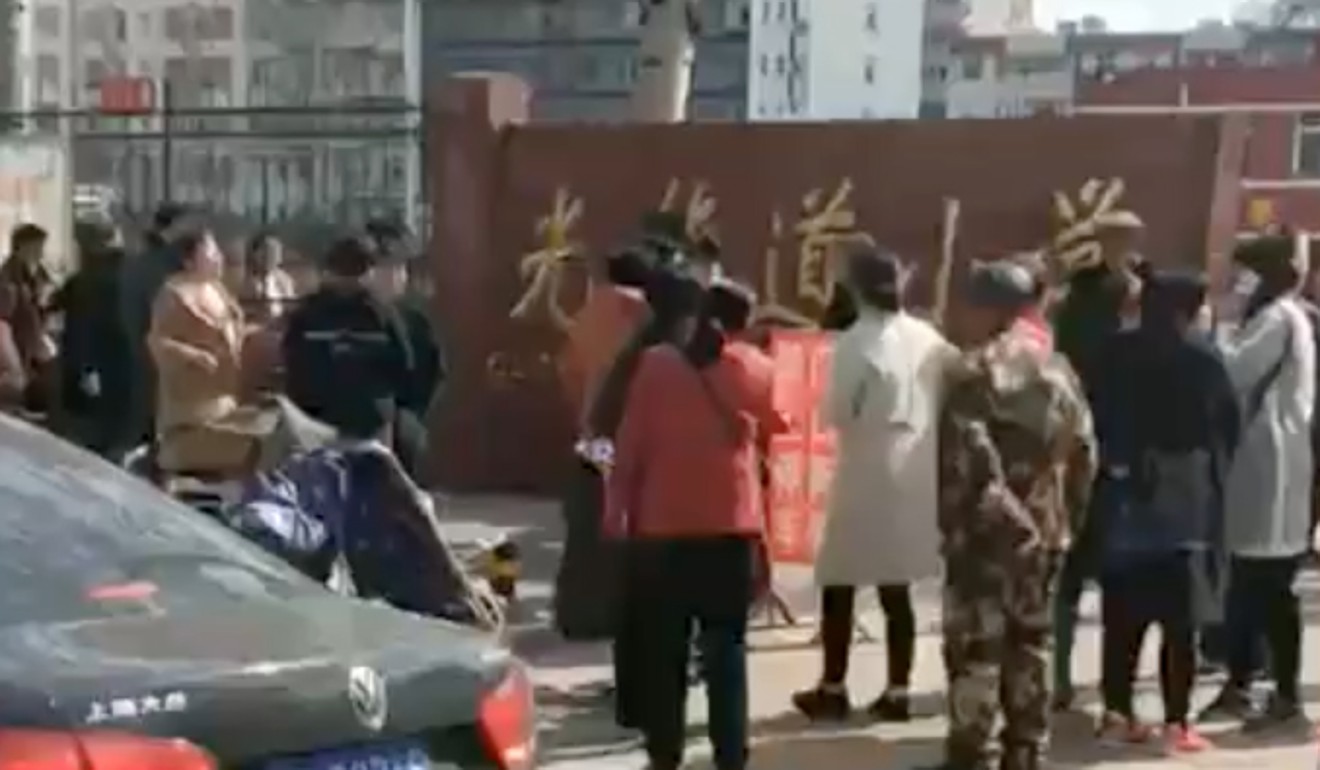
Several pupils were attacked outside a primary school in northern China on Thursday.

Police said the incident took place in the Fengrun district of Tangshan city in Hebei province at about 1.30pm. It was not clear how many pupils were wounded or how their wounds were inflicted.

According to video footage obtained by The South China Morning Post, a suspect was arrested by police next to a pool of blood on the ground.

He could be heard saying, “Beat me to death, just beat me to death,” in the video.

Police officers named the suspect as Cui Zhenjiang, 54, of Fengrun.

Pupils involved in the attack were taken to hospital for treatment of non-life-threatening injuries, officials said.

Police said investigations were ongoing.

Onlookers and families gather at a primary school in the Fengrun district of Tangshan city in Hebei province after reports of an incident on Thursday afternoon. Photo: Handout
Onlookers and families gather at a primary school in the Fengrun district of Tangshan city in Hebei province after reports of an incident on Thursday afternoon.
Source: SCMP
12/03/2019

Two dead after Chinese navy plane crashes

  • No other injuries reported following accident on southern island of Hainan
  • Military is currently intensifying training for pilots as it looks to strengthen capabilities

Mobile phone footage believed to be taken from the crash site. Photo: Handout
A Chinese navy plane crashed in Hainan province on Tuesday killing two crew members, the military said.
A short statement said the crash happened during a training exercise over rural Ledong county in the southern island province.
No one else was reported to have been injured after the plane hit the ground and the cause of the incident is being investigated.
Footage that purported to be taken from the crash site started circulating on social media after the accident.
Footage apparently taken at the crash site. Photo: Handout

The PLA’s official statement did not specify the type plane that crashed, although unverified witness account online said it was a twin-seat Xian JH-7 “Flying Leopard”.

The JH-7, which entered service with the navy and air force in the 1990s, has been involved in a number of fatal accidents over the years.

The country’s worst military air accident in recent years happened in January 2018. At least 12 crew members died when a PLA Air Force plane, believed to be an electronic reconnaissance aircraft, crashed in Guizhou in the southwest of the country.

Between 2016 and 2017, there were at least four accidents involving the navy’s J-15 “Flying Sharks”, one of them resulting in the death of the pilot.

Military commentators have previously said that China’s drive to improve its combat readiness, which includes the building of new aircraft carriers and warplanes, has resulted in a serious shortage of qualified pilots.

To fill the vacancies the Chinese military has started a major recruitment drive and intensive training programme for pilot pilots.

One unverified report said the plane that crashed was a JH-7 “Flying Leopard”. Photo. Xinhua

Currently China has one aircraft carrier, the Liaoning, in service, which can carry a maximum of 24 J-15s as well as other aircraft.

Meanwhile, the new home-grown carrier Type 001A will soon be commissioned, which is designed to accommodate to carry eight more fighters.

In addition, construction is believed to have started on another carrier that will be able to carry heavier and more advanced warplanes.

Chinese navy veteran warns training, not hardware is key to military preparedness
According to figures from the end of 2016, there were only 25 pilots qualified to fly the J-15 while 12 others were in training.
Most of the Chinese navy’s pilots have been redeployed from the air force, which is itself in need of more trained pilots.
This year the navy for the first time began a nation-wide programme to scout out potential pilots.
Speaking on the sidelines of the ongoing legislative meeting in Beijing Feng Wei, a PLA pilot from the Western Theatre, said the military was currently intensifying its pilots’ training as increasing amounts of new equipment entered service.
“Personnel quality is the key to everything,” he added.
Source: SCMP
10/03/2019

China’s wealthy families are turning to long holidays abroad as their efforts emigrate overseas are halted

  • Foreign lifestyle experiences are becoming more popular as citizens seek to escape pollution, food and medicine safety worries and authoritarian government controls
  • Citizens encountering more barriers to their dreams of travelling abroad, with severe limits on moving money overseas and restrictions on visiting foreign countries
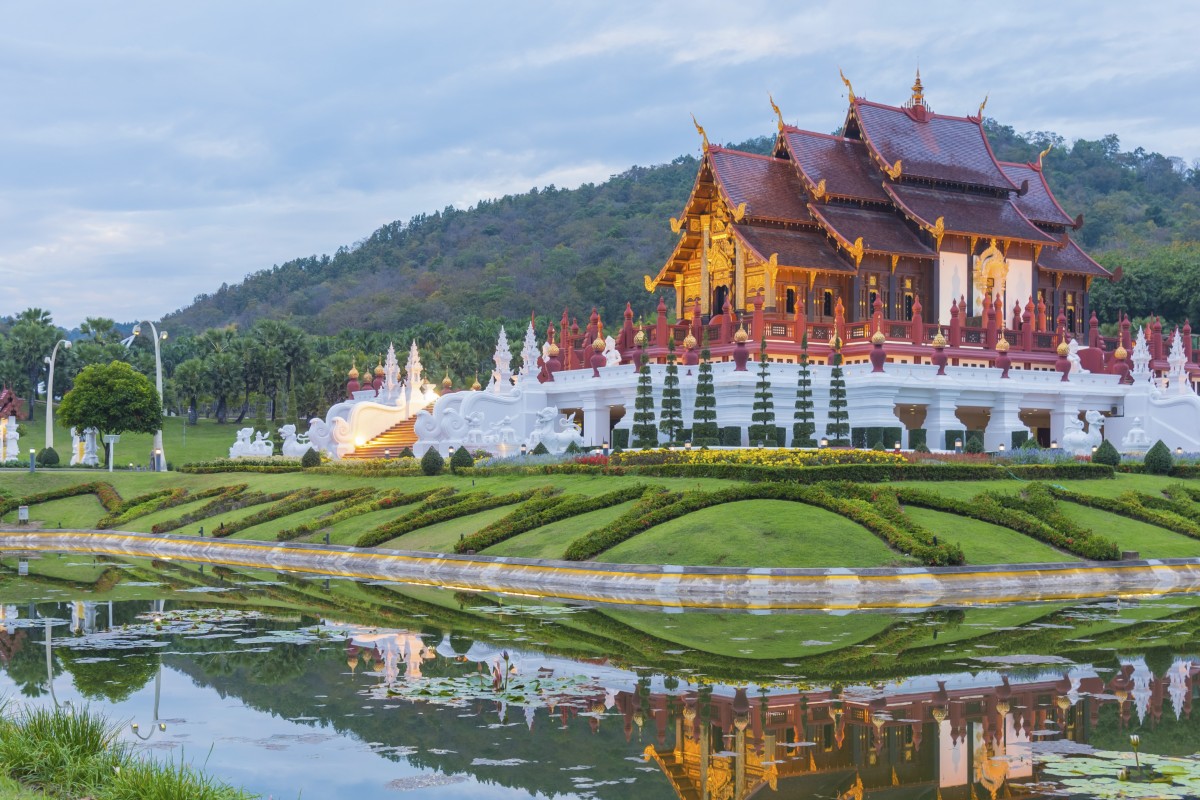
Thailand, including the likes of Chiang Mai, the United States, Australia, Canada, New Zealand are popular destinations for Chinese families. Photo: Shutteratock

Xu Zhangle and her husband and their two children are a typical middle-class couple from Shenzhen, and along with 60 other Chinese families, they are going on an extended holiday to Thailand in July, where they hope to enjoy an immigrant-like life experience.

The family have paid a travel agent around 50,000 yuan (US$7,473) for the stay in Chiang Mai in the mountainous north of the country, including transport, a three-week summer camp for their daughters at a local international school, rent for a serviced apartment and daily expenses.

Zhangle loves Chiang Mai’s relaxed lifestyle and easy atmosphere and wants to live as a local for a month or even longer, instead of having to rush through a short-term holiday.

“It would not be just [tourist] travelling but rather a life away from the mainland.” she said.

Recently, upper middle-class citizens have increased their efforts to safeguard their wealth and achieve more freedom by spending more time abroad.

They have invested considerable amounts of money in overseas properties and applied for long-stay visas, although many of their attempts have ended in failure.

Chinese citizens are encountering more barriers to their dreams of travelling abroad, with severe limits on moving money overseas and restrictions on visiting foreign countries.

Still, growing anxieties about air pollution, food and medicine safety and an increasingly authoritarian political climate are pushing middle class families to look for new ways to circumvent the obstacles so they can live outside China.

Among the options, there is growing demand for sojourns abroad of a month or more, to enjoy a foreign lifestyle for a brief period to make up for the fact that their emigration dreams may have stalled.

“I think this is becoming a trend. Chinese middle-class families are facing increasing difficulties to emigrate and own homes overseas. On the other hand, they still yearn for more freedom, for a better quality of life than what is found in first-tier cities in China.

They are eager to seek alternatives to give themselves and their children a global lifestyle,” said Cai Mingdong, founder of Zhejiang Newway, an online tour and education operator in Ningbo, south of Shanghai.

“First, the availability of multiple-entry tourist visas and the sharp drop in air ticket prices have made it convenient and practical to stay abroad for from a few weeks to up to three months each year.”

Blacklist labels millions of Chinese citizens and businesses untrustworthy

Now, many well-to-do Chinese middle class families can get a tourist visa for five or even 10 years that allows them to stay in a number of countries — including the United States, Australia, Canada, New Zealand and other Asian countries — for up to six months at a time.

“In 2011, a round-trip air ticket from Shanghai to New Zealand cost 14,000 yuan (US$2,000), but now is about 4,000 (US$598),” added Cai.

This opens up the possibility for many middle-class families who are not eligible to emigrate, to live abroad for short periods of time.

Many wealthy Chinese middle class families can get a tourist visa for five or even 10 years that allows them to stay in several countries including the United States, Australia, Canada, New Zealand and other Asian countries, for up to six months at a time. Photo: AP

Chinese tourists made more than 140 million trips outside the country in 2018, a 13.5 per cent increase from the previous year, spending an estimated US$120 billion, according to the China Tourism Academy, an official research institute under the Ministry of Culture and Tourism.

“In [the Thai cities of] Bangkok and Chiang Mai, there are more and more Chinese who stay there to experience the local lifestyle, which is different from theirs in China. The life there is very different from that in China,” said Owen Zhu, who now lives in the Bangkok condo he bought last year.

“The freedom, culture and community are diversified. The quality of air, food and services are much higher than in first-tier cities in China, but the prices are more affordable.

“In Bangkok, in many international apartment complexes where foreigners live, the monthly rent for a one-bedroom [apartment] is about 2,000 (US$298) to 3,000 yuan.”

China’s richest regions are also home to the most blacklisted firms
A one-bedroom apartment in Shenzhen in southern China is twice as expensive, with rents continuing to rise rapidly.

There are global goods, and it is easy to socialise with different people from around the world,” Zhu added

“Many Chinese people around me, really, come to Thailand to live for a while and go back to China, but then come back again after a few months.”

Both Cai and Zhu said they discovered the new phenomenon among China’s middle class and decided it was a business opportunity.

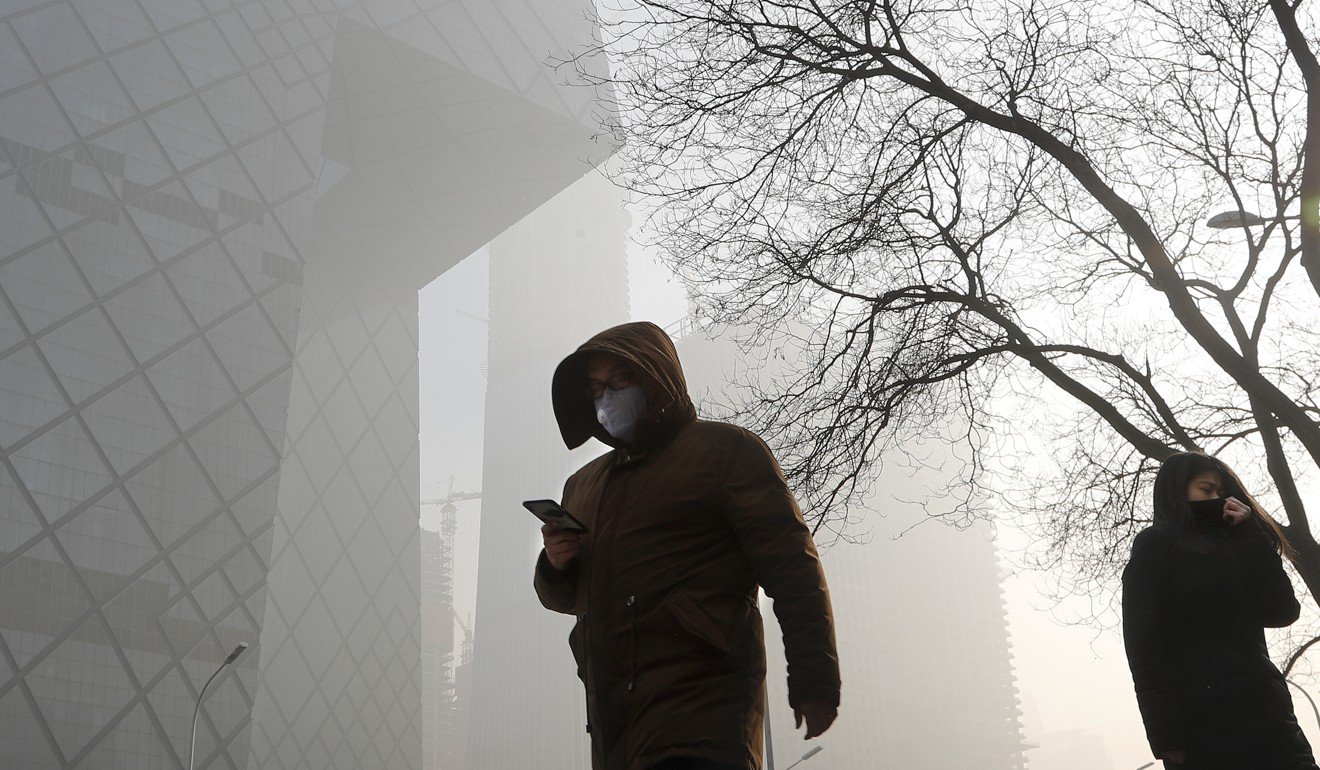
Growing anxieties about air pollution, food and medicine safety and an increasingly authoritarian political climate are pushing middle class families to look for new ways to circumvent the obstacles so they can live outside China. Photo: AP

Zhu is in the process of registering a company in Bangkok and plans to build an online platform to service the needs of Chinese citizens living abroad who do not own property or have immigration status, especially members of the LGBT community.

Cai said dozens of Chinese families in the Yangtze River Delta had paid him to send their children to schools in New Zealand or Europe for around three or four weeks in the middle of the school year, while the parents rent villas in the area, with New Zealand and Toronto in Canada among the most popular destinations.

Last year, Zheng Feng, a single mother and freelance writer from Beijing, rented a small villa in Australia for a month for them, a friend and their children to escape Beijing’s pollution and experience life overseas.

“To be honest, I don’t have enough money to invest in a property or a green card in Australia. But it’s very affordable for me and my son to pay about 30,000 yuan (US$4,484) to live abroad for one or two months.” Zheng said.

China says 2018 growth was worth more than Australia’s whole GDP

Zheng will join the Xu family in Chiang Mai later this year and she is also planning a similar trip to England next year.

Zheng’s friend, Alice Yu, invested in an American EB-5 investor visa a few years ago, and plans to make one or two month-long trips abroad each year until her family is finally able to move to the United States.

Demand for the EB-5 investor visa in China seems to be waning given heightened uncertainty about the future of the programme and US immigration law in general under US President Donald Trump.

Approval for the visa can now take up to 10 years, resulting in a huge backlog that has further dampened interest and led to a significant dip in investment inflows into the US from foreign individuals.

A one-bedroom apartment in Bangkok can cost around bout 2,000 (US$298) to 3,000 yuan a month. Photo: AFP

“Maybe it will soon become standard for a real Chinese middle-class family to have the time and money to enjoy a long stay at a countryside villa overseas,” said Yu.

“Regardless of whether we can get a long-term visa for the United States, I want my children grow up in a global lifestyle and with more freedom than just growing up on the mainland. So do all wealthy and middle class Chinese families, I think.”

Karen Gao’s son started studying at an international school in Chiang Mai in June, at the cost of about 70,000 yuan (US$10,462) a year, after she quit her job as a public relations manager in Shenzhen and moved to Thailand on a tourist visa.

For better or worse? China’s complicated employment explained

“A few months each year for good air, good food and no censorship and internet control, but cheaper living costs compared to Beijing, it sounds like a really good deal to go,” said Gao, who has now been offered a guardian visa to accompany her son, who has already been given a student visa.

“In Shenzhen, I wasn’t able to get him into school because I had no [local] residence permit.

“It would be the best choice for us because we feel so uncertain and worried about investing and living in the mainland.”

Last year, Gao, like thousands of other private investors mostly middle class people living in first-tier cities, suffered significant losses when their investments in hotels and inns in Dali, Yunnan province, were demolished amid the local government’s campaign to curb pollution and improve the environment around Lake Erhai.

“We were robbed by the officials without proper compensation,” Gao said.

Source: SCMP

Law of Unintended Consequences

continuously updated blog about China & India

ChiaHou's Book Reviews

continuously updated blog about China & India

What's wrong with the world; and its economy

continuously updated blog about China & India