Archive for ‘Social & cultural’

19/12/2018

China’s staggering 40 years of change in pictures

Forty years ago, China introduced major economic reforms – lifting hundreds of millions of people out of poverty and leading to it becoming the second-largest economy in the world.

Here’s the story of how China changed – in pictures.

1. Wheels and more wheels

This is what Chang’an Avenue – a major street in the capital Beijing – looked like in 1978.

Four decades on, the street looks pretty different.

Car ownership in China has soared – there are now over 300 million registered vehicles in the country – while bike ownership has dropped.

It’s a result of China’s urbanisation and economic growth – but has also come at a price.

Frequent traffic jams in many cities have led to licence plate quotas being imposed.

And the World Health Organization says more than a million people in China die every year due to air pollution.

2. Money money money

Compare a 1978 shop window…

… with one from this decade.

As China’s gross domestic product (GDP) has skyrocketed, its shopping habits have changed too.

Chinese shoppers are among the world’s highest consumers of luxury goods.

President Xi Jinping emphasised China’s economy – and how it had transformed people’s lives – during a long speech on Tuesday marking the anniversary of the economic reforms.

“Grain coupons, cloth coupons, meat coupons, fish coupons, oil coupons, tofu coupons, food ticket books, product coupons and other documents people once could not be without have now been consigned to the museum of history,” he said.

“The torments of hunger, lack of food and clothing, and the hardships which have plagued our people for thousands of years have generally gone and won’t come back.”

Image captionApple is a popular brand in China – though not as popular as Huawei

There’s even a political element to this. As Chinese consumers have grown richer, they’ve become increasingly influential.

Several companies have been forced to apologise after offending Chinese sensibilities, and while foreign brands are generally coveted in China, more and more shoppers are starting to say they prefer local brands.

It’s a sentiment that Mr Xi also touched on in his speech, when he said: “China is increasingly approaching the centre of the world stage.”

“No-one is in a position to dictate to the Chinese people what should or should not be done.”

3. Families and children

Life has changed significantly for children of the 2010s, compared to children of the 1970s.

Image captionA family enjoy tea in a park in Guangzhou, 1978

For starters, they are likely to live longer – China’s life expectancy was 66 back in 1978, and is now about 76.

They’re also more likely to have a better education – literacy rates increased from 66% in the early 1980s to 95% in 2010.

For most Chinese children in the 1970s, going on an overseas holiday would have been almost unthinkable. Today China has the world’s largest number of outbound tourists – who spend billions of dollars while abroad.

Image captionA girl celebrates the golden week national holiday with her dad in October 2018

Chinese students are now also more likely to end up studying abroad.

According to Chinese government figures, China is currently the world’s largest source of international students.

One thing hasn’t changed as much as the government would like though – the birth rate.

In 1979 – a year after starting economic reforms – the government imposed a one-child policy to try and curb population growth.

Birth rates were declining anyway – but the controversial policy was harshly enforced in some cases.

Couples who violated the policy could face punishments ranging from fines and the loss of employment to forced abortions and sterilisation.

China’s population, like those of many other developed countries, is now ageing.

In 2015, the government decided to end the one-child policy and allow couples to have two children.

There is even speculation that the policy may be relaxed further – to allow three or more children – in the near future.

But many Chinese millennials see having more children as too expensive – or a burden on their careers.

4. To market, to market

As economies change, so do people’s diets, and what they want to spend their money on.

Here’s a marketplace in the central city of Xi’an, back in 1978.

And here’s what some of Xi’an’s street markets look like now.

Many of the signs are advertising meat dishes – and statistics show meat consumption in China has risen significantly over the past few decades.

Pork, for example, used to be considered a luxury food reserved for special occasions – now, figures suggest the average Chinese person will consume about 40kg of pork per year.
17/12/2018

Three-year-old assaulted on Delhi bus rape anniversary

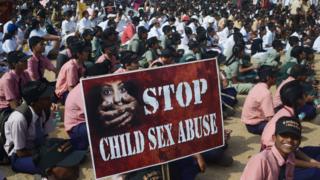
A protest in India against child sex abuseImage copyrightAFP

A three-year-old Indian girl is in critical condition after she was allegedly raped by her neighbour in the capital Delhi.

The accused, a 40-year-old security guard who worked in the building the child lived in, has been arrested.

Police found the girl unconscious and rushed her to hospital where she is undergoing surgery.

The incident occurred on Sunday, which was the sixth anniversary of the brutal gang rape of a student on a Delhi bus.

Delhi Women’s Commissioner Swati Maliwal said the incident “let down” the bus rape victim, whose attack saw country-wide protests and a tightening of rape laws.

There is still no clarity on the condition of the girl or whether she will survive the attack, which local media have described as “brutal”.

Locals in the area found the accused and attacked him after the incident came to light, the Times of India newspaper said. It also quoted police as saying that the accused was treated for injuries before they arrested him.

The girl’s parents, who are daily wage labourers, were away when the incident occurred. The accused allegedly lured the girl with sweets and picked her up from outside her house.

Police have registered a case for rape under the Protection of Children from Sexual Offences (POSCO) Act, which could see the death penalty handed out to the accused.

The incident, which has prompted a fresh wave of anger and outrage in India, comes after a series of high-profile cases against children this year. In April, the brutal gang-rape and murder of an eight-year-old in Indian-administered Kashmir dominated headlines. In June, hundreds took to the streets in the central state of Madhya Pradesh over the rape of a seven-year-old girl.


The scale of abuse in India

  • A child under 16 is raped every 155 minutes, a child under 10 every 13 hours
  • The number of reported rapes of children increased from 8,541 in 2012 to 19,765 in 2016
  • More than 10,000 children were raped in 2015
  • 240 million women living in India were married before they turned 18
  • 53.22% of children who participated in a government study reported some form of sexual abuse
  • 50% of abusers are known to the child or are “persons in trust and care-givers”
17/12/2018

Narendra Modi: Is hardline Hindu politics failing India’s PM?

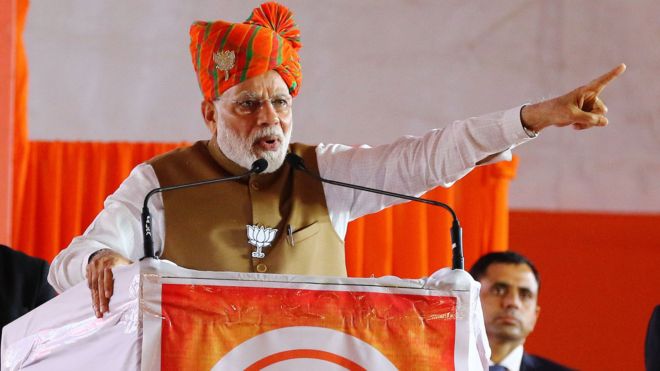
Prime Minister Narendra Modi addressing the election campaign rally ahead the state assembly polls , in Jaipur , Rajasthan, India , Dec 04,2018.Image copyrightGETTY IMAGES

Last week’s electoral losses in five states for India’s ruling party has led to speculation that its agenda of promoting hardline Hindu politics has backfired. The BBC’s Priyanka Pathak reports.

Prime Minister Narendra Modi’s Bharatiya Janata Party (BJP) lost to the main opposition Congress party in the Hindi-speaking heartland states of Madhya Pradesh, Rajasthan and Chhattisgarh, all of which they previously governed. Local parties swept up the other two states – Telangana and Mizoram – putting the BJP in a tough place ahead of general elections next year.

It appears that after winning no less than 13 state elections since coming to power in 2014, the BJP’s seemingly invincible electoral juggernaut is losing steam.

There is a great deal of introspection within and outside the party. And the main question is: has the BJP’s recent pursuit of a hardline Hindu agenda – known locally as Hindutva – backfired? Will a departure from an inclusive, development agenda to a polarising, communal one cost the BJP general election too?

These are legitimate questions because the party deployed the chief minister of the northern state of Uttar Pradesh, Yogi Adityanath, as its star campaigner in the five states that went to polls.

Mr Adityanath is widely considered a controversial figure because of his well-publicised anti-Muslim comments.

He addressed 74 election rallies while Mr Modi, who is usually his party’s star campaigner, addressed just 31.

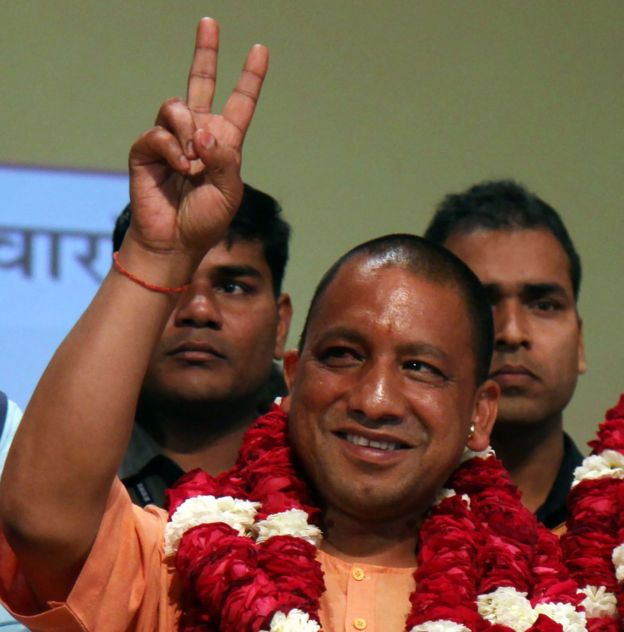
Adityanath victoryImage copyrightAFP
Image captionYogi Adityanath is seen as a “poster child” for a hardline Hindu agenda

Mr Adityanath also spent the past few months courting the Sangh Parivar – a “family” of Hindu nationalist organisations including the Rashtriya Swayamsevak Sangh (RSS), a hardline Hindu organisation with umbilical ties to the BJP.

The Sangh Parivar also includes the Vishwa Hindu Parishad (VHP), which has been at the forefront of a movement demanding the construction of a Hindu temple on the site of a 16th Century mosque that was torn down by Hindu mobs in 1992, provoking widespread riots that left thousands dead.

Hindus believe Ayodhya, situated in Mr Adityanath’s Uttar Pradesh state, is the birthplace of their revered deity Lord Ram, and say an older temple existed at the site before the mosque was constructed.

Mr Adityanath has announced the construction of a giant statue of Ram in the state, and changed the name of the historical city of Allahabad to the more “Hindu” sounding Prayagraj ahead of the forthcoming Ardh Kumbh Mela, one of the world’s largest religious gatherings.

But if Mr Adityanath was hoping to prove to the VHP leadership that he is a more willing pursuer of the Hindutva agenda and, therefore, a potential alternative to Mr Modi, the recent electoral defeats do not advance his case.

Many observers believe that the BJP’s defeats are because the party deviated from the development agenda that swept them to power in 2014. The pursuit of Hindutva has backfired, they say.

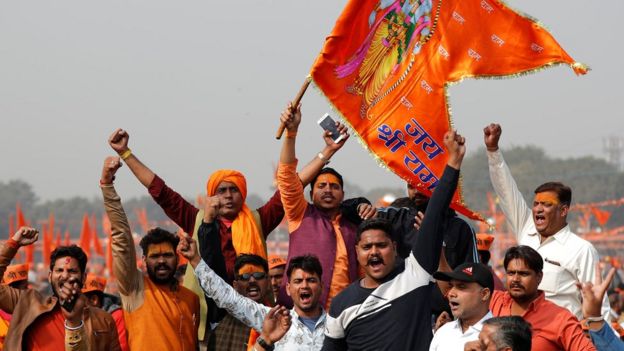
Supporters of the Vishva Hindu Parishad (VHP), a Hindu nationalist organisation, shout religious slogansImage copyrightREUTERS
Image captionHindus believe the disputed religious site of Ayodhya is the birthplace of one of their most revered deities

But some in the Sangh Parivar disagree, insisting that it is actually the opposite that is true. “Just the way people feel disenchanted with the economic policies of the government, the people have also lost faith in this government’s commitment to build the Ram temple. If the VHP and RSS have to come to the street to warn the government about it, what does it tell you? What does it tell the electorate?” one of them said.

Last week, tens of thousands of Hindus gathered in the capital, Delhi, to demand the expedited construction of the temple and criticised the government for failing to do so.

They chanted a striking slogan directly targeting Mr Modi’s stated development-first agenda: “Pehle Ram ko aasan do, phir humko sushasan do (First give Ram a throne, then give us good governance)”.

But it must be noted that while Mr Modi has never openly supported these hardline elements, his silence on issues such as an increasing number of attacks on Muslims over various issues like eating beef – cows are considered sacred in Hinduism and their slaughter is banned in many Indian states – is interpreted as a tacit approval for muscular Hindu politics.

But he now faces pressure to do more.

His government already leads a lacklustre economy. And this renewed pressure to recommit to Hindutva, despite its apparent failure as an electoral agenda, puts Mr Modi’s government in a difficult place.

There is also the fact that the RSS played a vital role in the BJP’s 2014 election victory by mobilising and galvanising voters. They are also credited for Mr Modi’s rise from state chief minister to a national figure. Apart from spearheading a sophisticated online and digital campaign in his favour, cadres also held 600 district-level meetings across the country to make Mr Modi a familiar name among the rural population.

Clearly, they cannot be ignored or offended.

So even as the liberals suggest that Hindutva has backfired and demand that the government refocus on the economy, there are voices within the BJP which are demanding a more strident return to the party’s “core” agenda – including the construction of the Ram temple and renewed focus on efforts to protect cows – to reassure their base that the BJP has not abandoned them.

The less-than-satisfactory economic performance will also make the Hindutva agenda more important, they say.

14/12/2018

‘Racist’ Gandhi statue removed from University of Ghana

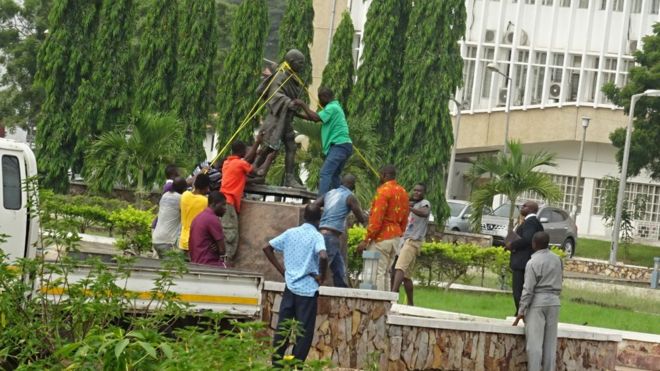
Men removing the Gandhi statueImage copyrightEMMANUEL DZIVENU/JOYNEWS

A statue of Mahatma Gandhi, the famed Indian independence leader, has been removed from a university campus in Ghana’s capital, Accra.

University of Ghana lecturers began a petition for its removal shortly after it was unveiled in 2016 by India’s former President Pranab Mukherjee.

The petition said Gandhi was “racist” and African heroes should be put first.

In the wake of the row, Ghana’s government at the time said the statue would be relocated.

Lecturers and students told the BBC that the statue, originally located at the university’s recreational quadrangle, had been removed on Wednesday.

The university confirmed this, saying that the Ministry of Foreign Affairs and Regional Integration was responsible.

Law student Nana Adoma Asare Adei told the BBC: “Having his statue means that we stand for everything he stands for and if he stands for these things [his alleged racism], I don’t think we should have his statue on campus.”

Mahatma Gandhi was one of the most celebrated figures of the 20th Century. He is best known for leading non-violent resistance to British colonial rule in India.

However, as a young man he lived and worked in South Africa, and although he has inspired people throughout the world his comments on black Africans have been controversial.

In his early writings he referred to black South Africans as “kaffirs” – a highly offensive racist slur. He also said that Indians were “infinitely superior” to black people.

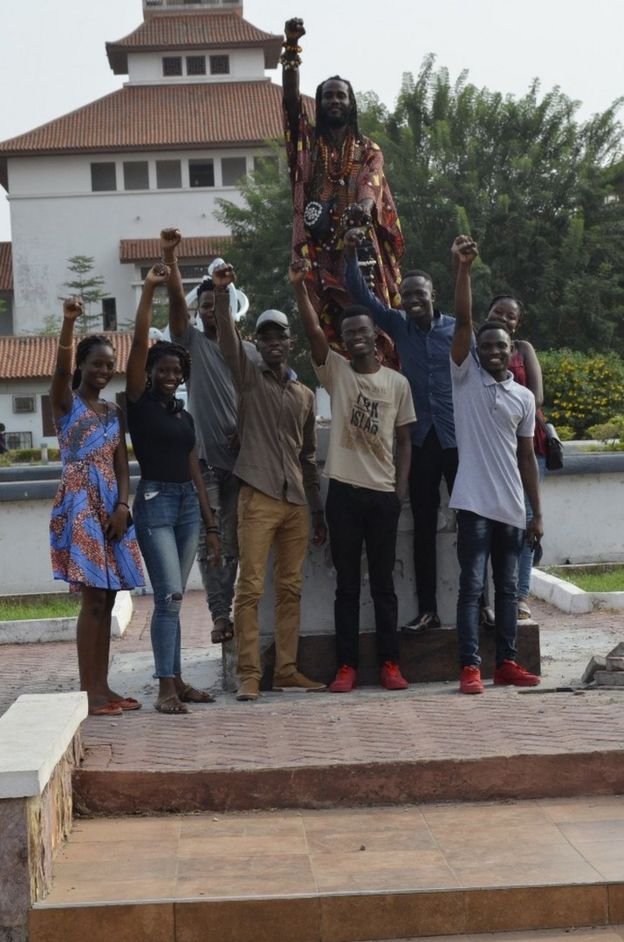
Lecturers and students at the University of Ghana pose in celebration after statue is removed (12 December 2018)Image copyrightEMMANUEL DZIVENU/JOYNEWS
Image captionLecturers and students celebrated in front of the newly empty plinth after the statue was removed
14/12/2018

Chinese university student creates a buzz with cheap campus haircuts

An enterprising student is creating a buzz at a university campus in southwest China, where his cheap and reliable haircuts are in demand.

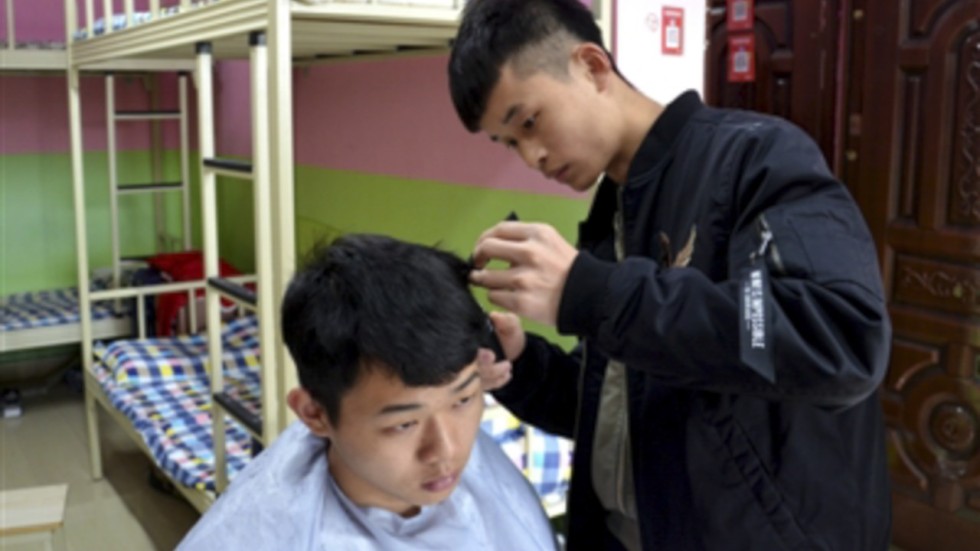
Ding Weijie, 19, opened an “express hairdressing salon” in his dormitory at the Sichuan Hope Automotive Vocational College in early November, Chengdu Economic Dailyreported on Friday.

Although Ding is self-taught, his hairdressing skills have already turned heads on the campus in Ziyang. His 5 to 6 yuan (73 to 87 US cents) cuts for men have become so popular that appointments need to be booked a few days in advance.

The first-year student, whose major is new energy vehicles, said he had been looking for a way to make some extra cash.

“After I started university, I wanted to find a part-time job to earn some money for my living costs,” Ding, who is from Yibin in Sichuan province, told the newspaper.

ADVERTISEMENT

He initially took a job as a dishwasher in the university canteen, but it did not pay well and left him with little time for studying.

12/12/2018

Chinese loan shark who raped victim among 18 jailed for gang crime

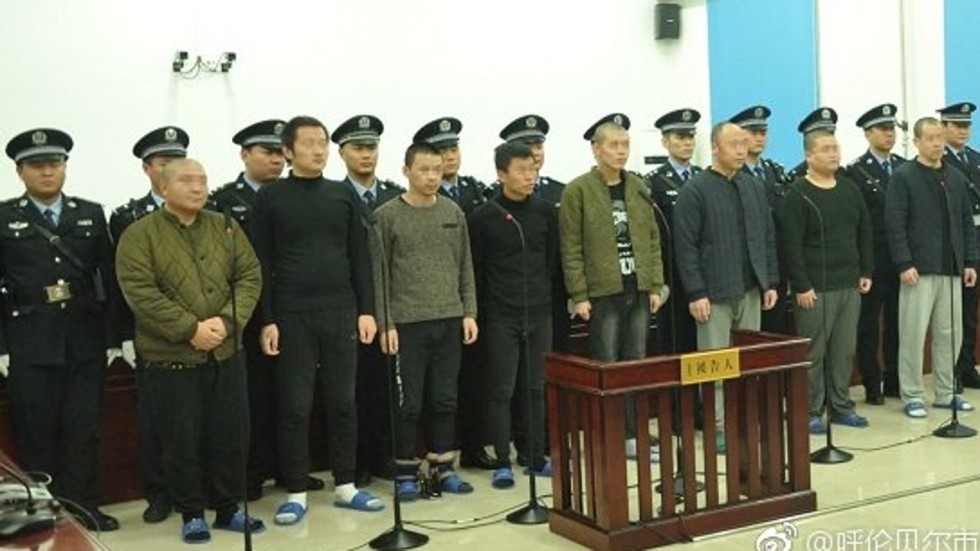
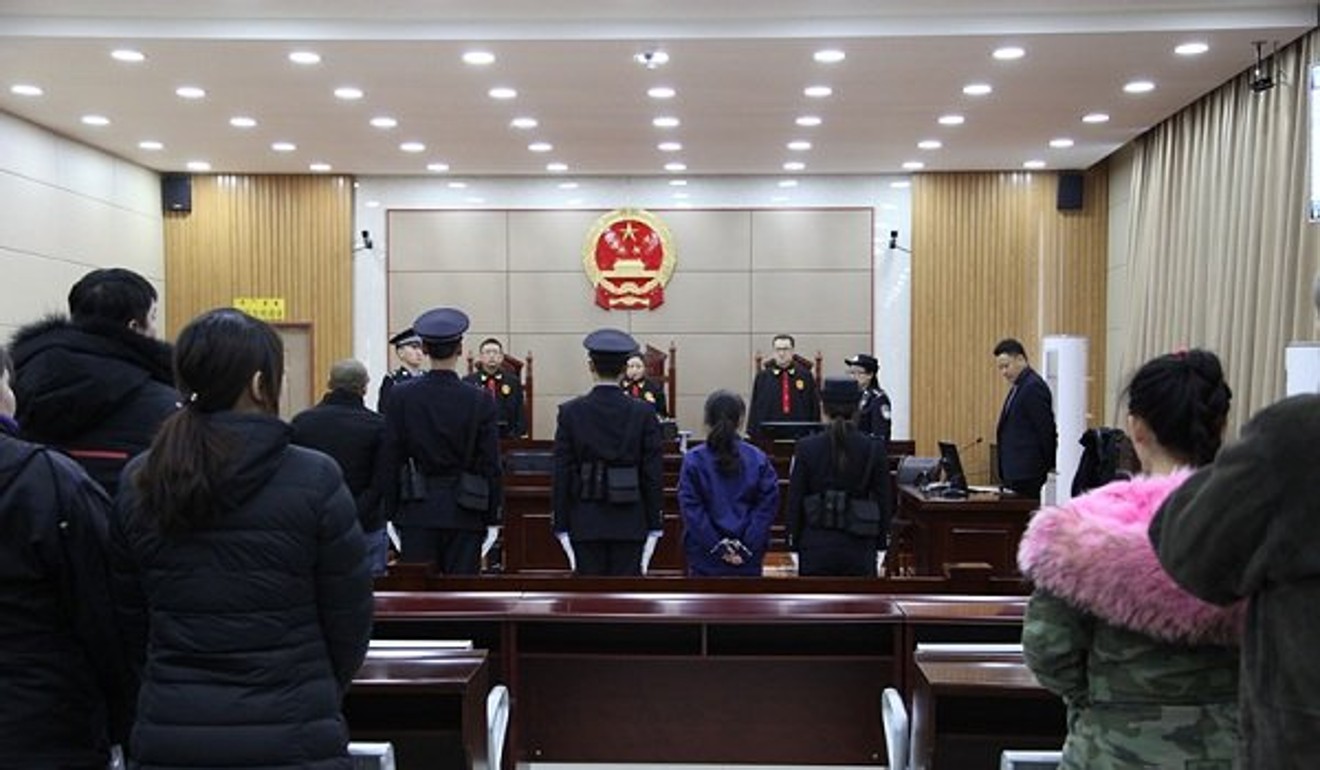
Wang Yinan was one of 19 people convicted of various gang-related crimes in Hulunbuir in the Inner Mongolia autonomous region, Beijing Youth Daily reported on Tuesday.

Wang and eight of his associates were tried in the city on Monday charged with illegally providing loans of between 10,000 yuan (US$1,450) and 30,000 yuan to people via a smartphone app since September 2017.

Those who failed to keep up with their repayments were subjected to physical assault, including being made to stand naked in the snow, the report said. One victim was raped as punishment, it said, without providing any further details of the crime.

Wang’s associates were each sentenced to between one and nine years in prison.

The trials followed a nationwide crackdown on organised crime launched at the start of the year.

Among the others given prison sentences on Monday were Lee Yongbin, who led a group of hired thugs that intimidated people involved in construction conflicts and worked as debt collectors for loan sharks, the report said.

Members of the gang were also charged with “creating public disturbances”, the court heard.

Lee was sentenced to 5½ years in prison, and his associates to between 10 and 30 months.

09/12/2018

As election nears, religious tensions surge in an Indian village

NAYABANS, India (Reuters) – Nayabans isn’t remarkable as northern Indian villages go. Sugar cane grows in surrounding fields, women carry animal feed in bullock carts through narrow lanes, people chatter outside a store, and cows loiter.

But this week, the village in Uttar Pradesh state became a symbol of the deepening communal divide in India as some Hindu men from the area complained they had seen a group of Muslims slaughtering cows in a mango orchard a couple of miles away.

That infuriated Hindus, who regard the cow as a sacred animal. Anger against Muslims turned into outrage that police had not stopped an illegal practise, and a Hindu mob blocked a highway, threw stones, burned vehicles and eventually two people were shot and killed – including a police officer.

The events throw a spotlight on the religious strains in places like Nayabans since Prime Minister Narendra Modi’s Hindu nationalist Bharatiya Janata Party (BJP) came to power at the national level in 2014 and in Uttar Pradesh in 2017. Tensions are ratcheting up ahead of the next general election, due to be held by May.

The BJP said it was “bizarre” to assume the party would benefit from any religious disharmony, dismissing suggestions that its supporters were largely responsible for the tensions.

“In a large country like India nobody can ensure that nothing will go wrong, but it’s our responsibility to maintain law and order and we understand that,” party spokesman Gopal Krishna Agarwal said. “But people are trying to politicize these issues.”

SPONSORED

Nayabans, just about three hour’s drive from Delhi, has about 400 Muslims out of a population of 4,000, the rest are Hindu. Relations between the communities began deteriorating around the Muslim holy month of Ramadan last year when Hindus in the village demanded that loudspeakers used to call for prayer at a makeshift mosque be removed, local Muslims said.

“For 40 years mikes were used in the mosque, calls for prayer were made five times a day, but no one objected,” said Waseem Khan, a 28-year-old Muslim community leader in Nayabans.

“We resisted initially but then we thought it’s better to live in peace then create a dispute over a mike,” he said. “We don’t want to give them a chance to fan communal tensions.”

Reuters spoke with more than a dozen Muslims from the village but except for Khan, no one else wanted to be named for fear of angering the Hindu population.

Several among a group of Muslim women and girls standing outside the mosque said they have been living in fear since the BJP came to power in the state in 2017.

They said that Hindu groups now hold provocative processions through the village during every Hindu festival, loudspeakers blaring, something that used to happen rarely before. They said they felt “terrorised” by Hindu activists.

“While passing through our areas during their religious rallies, they chant ‘Pakistan murdabad’ (down with Pakistan) as if we have some connection to Pakistan just because we are Muslims,” Khan said.

HINDU PRIEST CHIEF MINISTER

The subcontinent was divided into Muslim Pakistan and Hindu-majority India at the time of independence from British colonial rule in 1947.

During the violence on Monday, many Muslims in Nayabans locked themselves in their homes fearing attacks. Some who had attended a three-day Muslim religious congregation some miles away stayed outside the area that night to avoid making themselves targets for the mob.

Muslim villagers say they are particularly fearful of the top elected official in Uttar Pradesh, Chief Minister Yogi Adityanath, who is a Hindu priest and senior BJP figure. Hindu hardliners started asserting themselves more in the village after he was elected, they say.

Uttar Pradesh sends 80 lawmakers to the lower house of parliament, the largest of any state in the country.

Considered the county’s political crucible, it has also been the scene for spiralling Hindu-Muslim tensions.

Slideshow (8 Images)

Adityanath said the lead up to the rioting in Nayabans was a “big conspiracy”, but did not elaborate.

In the only statement from his office on the incident, Adityanath ordered police to arrest those directly or indirectly involved in the slaughter of cows and made no mention of the death of the police inspector. He announced 1 million rupees ($14,110) as compensation for the family of the other dead man, a local who is among those accused by police for the violence.

Both men were Hindus and died of bullet wounds, although police said it was not yet clear who shot whom.

Police say they have arrested up to five people for the cow slaughter but have not given their religion. Locals say all the arrested people are Muslims. Four Hindu men have been arrested for the violence leading to the deaths.

“All invidious elements who may have conspired to vitiate the situation will be exposed through a fair and transparent investigation,” Anand Kumar, the second highest police official in Uttar Pradesh, told Reuters.

Asked if there was any bias against Muslims, Uttar Pradesh government spokesman Sidharth Nath Singh – who is also the state’s health minister – told Reuters: “We believe in equality and our motto is sabka saath, sabka vikas”, using a Hindi phrase often used by Modi that means “collective effort, inclusive growth”.

RELATIVE HARMONY

The two communities in Nayabans have lived in relative harmony for years, residents from both groups said.

But now Hindus in the village, who mostly say they support Yogi, accuse the Muslims of trying to turn themselves into the victims when they weren’t.

“Can’t believe they are raising our processions with journalists!” said Daulat, a Hindu daily wage labourer who goes by one name. “They are making it a Hindu-Muslim issue, we are not. Their people have been accused of killing cows, so they are playing the victim.”

At a middle school, metres from the police outpost near where the two men got killed, two women teachers, sitting on a veranda soaking in the winter sun, said its 66 students stopped coming for classes in the first few days after the violence.

“We worship cows and their slaughter can’t be accepted,” said one of the teachers, Uma Rani. “Two Hindus died here but nothing happened to the cow killers.”

Both teachers were Hindus.

Political analysts say relations between the two communities are likely to stay tense ahead of the national vote, particularly in polarised states such as Uttar Pradesh.

The BJP made a near-clean sweep in Uttar Pradesh in 2014, helping Modi win the country’s biggest parliamentary mandate in three decades, but pollsters predict a tighter contest next year because of a lack of jobs and low farm prices.

“Facing economic headwinds and lacklustre job growth, Modi will rally his conservative base by selectively resorting to Hindu nationalism,” global security consultancy Stratfor said last month.

Muslims say they increasingly feel like second-class citizens in their own country.

“The BJP will definitely benefit from such incidents,” said Tahir Saifi, a Muslim community leader a few miles from the area of violence who supports a regional opposition party in Uttar Pradesh. “They want all Hindus to unite, and when religion comes into the picture, other issues like development take a back seat.”

07/12/2018

China, Cambodia to boost youth ties: officials

CHINA-BEIJING-WANG YI-CAMBODIA-YOUTH TIE (CN)

Chinese State Councilor and Foreign Minister Wang Yi meets with Hun Many, president of the Union of Youth Federations of Cambodia in Beijing, capital of China, Dec. 6, 2018. (Xinhua/Yin Bogu)

BEIJING, Dec. 6 (Xinhua) — Chinese State Councilor and Foreign Minister Wang Yi met with Hun Many, president of the Union of Youth Federations of Cambodia on Thursday, pledging to strengthen exchanges and cooperation on youth.

Wang spoke highly of the friendship between China and Cambodia over the past six decades since the establishment of diplomatic ties.

Noting that China supports Cambodia in safeguarding national sovereignty and independence, and choosing the development path suited to itself, Wang expressed China’s appreciation for Cambodia’s support on issues concerning China’s core interests.

Wang also said he hoped young people from both countries would continue the China-Cambodia friendship.

“As the young generation of Cambodia, we will continue the Cambodian-Chinese friendship and strengthen the exchange and cooperation between the two countries’ youths,” Hun Many said.

05/12/2018

Angry Indian farmers march on parliament to denounce their plight

NEW DELHI (Reuters) – Tens of thousands of Indian farmers and rural workers marched to the Indian parliament in the capital, New Delhi, on Friday in a protest against soaring operating costs and plunging produce prices that have brought misery to many.

Farmers march towards the parliament house during a rally to protest soaring farm operating costs and plunging prices of their produce, in New Delhi, India, November 30, 2018. REUTERS/Adnan Abidi

The protest is one of the biggest displays of frustration with Prime Minister Narendra Modi’s government, which faces a tough general election due by May next year. India’s 263 million farmers make up an important voting bloc.

“Farmers have been routinely committing suicide,” said one of the protest leaders, Yogendra Yadav, as he marched in a crowd down a central Delhi thoroughfare.

“It’s a shame that the government doesn’t have any time for those who feed us,” said Yadav, who leads the Jai Kisan Andolan, a farmers’ group.

Low food prices, export curbs, anti-inflation policies that keep rural incomes low and a broad shift from subsidies to investment spending have all infuriated and demoralised farmers.

Core inflation in India, where farming is a mainstay for nearly half the people, has hovered around 6 percent in the past few months, but food prices have either fallen or remained stagnant.

Agriculture contributes about 15 percent to India’s $2.6 trillion economy, Asia’s third-largest, but employs nearly half of its 1.3 billion people.

Farmers from more than 200 groups began gathering in New Delhi on Thursday. They demanded that the government call a special session of parliament to discuss the crisis in the countryside.

“I myself know so many farmers who have committed suicide, and their families are now living in penury,” said farmer Lakhan Pal Singh from the northern state of Uttar Pradesh, India’s most populous state.

“The policies of the Modi administration are responsible.”

Farmers have also protested in the financial hub of Mumbai, including this month when tens of thousands of farmers marched to Mumbai to demand loan waivers and the transfer of forest land to villagers.

New Delhi police deployed 3,500 personnel in the city on Friday but there was no trouble.

In October, police fired teargas and water cannons in a clash with about 50,000 farmers heading for New Delhi.

‘LAST STRAW’

The discontent in the countryside, where 70 percent of Indians live, could erode support for Modi’s ruling Bharatiya Janata Party (BJP), which won India’s biggest parliamentary mandate in three decades in the last general election in 2014.

But political analysts and farm economists say Modi will find it hard to repeat that next time.

“We voted for the BJP but anti-farmer policies of the government have hit us hard,” said Singh.

The last time a BJP government lost power, in a 2004 election, it was largely because rural voters abandoned the party.

Last year, police shot and killed six farmers protesting against lower prices in the central state of Madhya Pradesh, which recently held a state assembly election – a neck-and-neck contest between the BJP and opposition Congress party.

The result is due on Dec. 11.

Leaders from the main opposition Congress party, as well as left-wing parties and the Aam Aadmi (Common Man) Party addressed the flag-waving protesters who converged in the historic heart of the city.

“We’ve been living a hand-to-mouth existence for a very long time but rising prices of seeds, diesel and fertiliser and falling prices of milk, fruits, vegetables and even staples is the last straw,” said farmer Shivpal Yadav.

“If the government doesn’t address the problems, we’ll be back,” said Yadav, from the northern state of Haryana.

Reporting by Mayank Bhardwaj; Editing by Robert Birsel

05/12/2018

Two killed in violence over cow slaughter in north India

NEW DELHI (Reuters) – A senior police officer and another man were killed on Monday in violent protests over reports of a slaughtered cow, an animal sacred in Hindu culture, in India’s Uttar Pradesh state.

A crowd angered over what they believed was the slaughter of the cow threw stones and torched vehicles outside a police station. The officer died from gunshot wounds, district magistrate Anuj Jha told Reuters.

Earlier, police had said the officer was stoned to death and the other man died from gunshot wounds.

“Villagers complained after they found a dead cow, and took to the streets to protest. They blocked a road with a tractor and pelted stones,” he said.

So-called cow vigilantes from India’s Hindu majority have attacked and killed a number of Muslims involved in transporting cattle to slaughterhouses in recent years. However, the exact circumstances of Monday’s protests were not clear.

Reporting by Sudarshan Varadhan, Himani Singh and Amit Ganguly; Edited by Mark Heinrich

Law of Unintended Consequences

continuously updated blog about China & India

ChiaHou's Book Reviews

continuously updated blog about China & India

What's wrong with the world; and its economy

continuously updated blog about China & India